An objective psychological test is a standardized assessment used to measure an individual’s characteristics, such as personality or creativity, through a series of questions with fixed-response options (e.g., true/false, multiple-choice). Its scoring is free from the scorer’s personal judgment or bias, ensuring results are consistent, reliable, and quantifiable.
Have you ever wondered how to measure your creative potential or personality? In a world that values new ideas, understanding how you think is more important than ever. This search for answers often leads to psychological assessments, but not all tests are the same. Here at Creative Ability Test, we use a scientific approach to help you gain a deeper understanding of yourself.
This is where objective psychological tests come in. Unlike tests open to interpretation, an objective psychological test provides a clear, standard way to measure your thinking. It assesses everything from problem-solving skills and cognitive flexibility to creativity and openness to new experiences. These tests offer reliable, consistent data and give you useful insights, helping you identify your creative strengths and areas for growth.
If you want to learn how these powerful assessment tools can help you build self-awareness and spark innovation, you’re in the right place. This article will explain what an objective psychological test is, cover its key features, and provide examples of how platforms like Creative Ability Test use this method. We’ll also clarify the difference between objective and projective personality tests, so you can better understand and use your results.
What Is an Objective Psychological Test?
Defining Objective Measurement in Psychology
An objective psychological test is a clear, consistent way to measure how your mind works. Think of it as a ruler for your creative potential. It’s a standard method for looking at your traits and abilities. This means your results are not affected by the person giving or scoring the test. Instead, every test is scored using the same key.
With objective measurement, everyone’s answers are scored the same way. Each response gets a clear, numerical score, which removes personal bias from the results. This makes sure the evaluation is fair for everyone. For example, a question might ask you to pick the best solution from a list. The “best” answer is already decided and isn’t up for debate.
This method is key to understanding complex skills like creativity. It helps us pinpoint your specific creative strengths and unique ways of thinking. For instance, an objective test can measure your cognitive flexibility, which is how easily you switch between ideas. It can also assess your divergent thinking skills, or your ability to brainstorm many different solutions [1]. Both are key parts of being innovative and solving problems.
Ultimately, objective tests turn abstract ideas about your mind into clear, useful information. They offer a reliable way to learn more about yourself. You get a clear picture of your abilities, including how you come up with ideas and tackle challenges.
Why standardized scoring Matters
Standardized scoring is a key part of any good objective psychological test. It ensures fairness and consistency for everyone who takes it. Imagine if your answers were scored differently from someone else’s. The results wouldn’t be very helpful, would they?
With standardized scoring, every answer is graded using the same set of rules. This allows for reliable comparisons, so you can see how your results stack up against others. It also helps you track your own growth over time and watch your creative skills develop.
Our Creative Ability Test is a good example. This 30-question assessment uses standardized scoring to give you accurate and reliable insights. Your personalized feedback is based on a consistent system that applies to everyone. This system is backed by solid research on creativity, so you get practical tips you can use right away.
The benefits of standardized scoring are clear:
- Fairness: Every individual’s results are treated equally.
- Reliability: The test consistently measures what it’s supposed to measure.
- Comparability: Your scores can be meaningfully compared to a larger group or your own past results.
- Useful Advice: Clear data leads to personalized tips for growth.
This consistency helps you understand your unique creative profile. It takes the guesswork out of self-improvement and gives you a clear path forward. You’ll discover specific ways to boost your creative potential, helping you grow both personally and professionally.
What Are the Key Characteristics of an Objective Test?
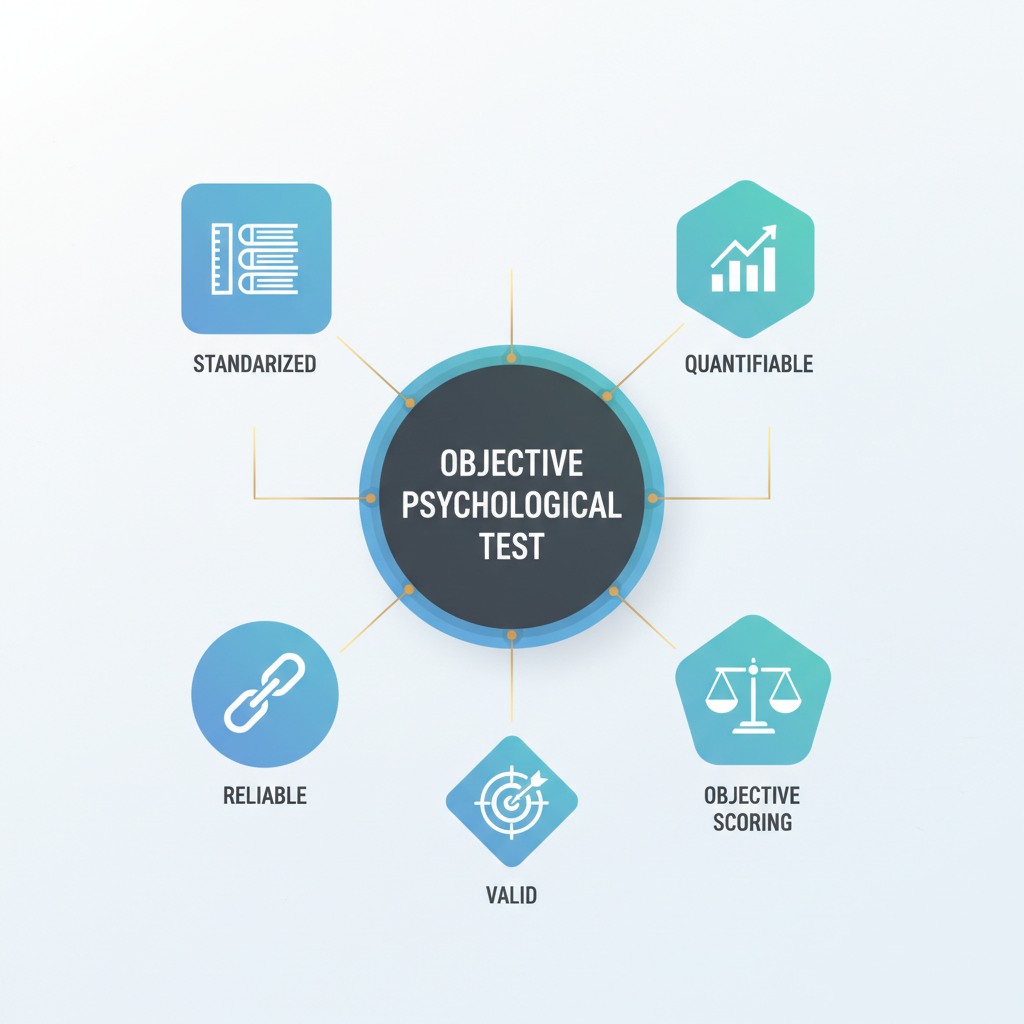
Standardized Administration and Scoring
What makes an objective test reliable is standardization. This means everyone takes the test under the same conditions, much like in a controlled experiment.
First, the testing process is always the same. Instructions, time limits, and the testing environment are kept consistent for everyone. This consistency is key to fair results.
Second, the scoring is standardized. Answers are checked against a set answer key, which removes any personal opinion or bias from the person scoring the test. As a result, the score is completely objective [2].
This strict process ensures fairness and accuracy. It means your results on an assessment like the Creative Ability Test are dependable. They can also be compared to others’ results, giving you a clear comparison point for your creative potential. This provides a solid foundation for understanding your unique way of thinking.
Fixed-Response Questions (e.g., Multiple Choice, True/False)
A key feature of objective tests is their use of fixed-response questions. These questions give you a limited set of answers to choose from. Common types include:
- Multiple Choice: You pick the best answer from several options.
- True/False: You decide if a statement is correct.
- Rating Scales: You show how much you agree with a statement on a scale (e.g., “strongly agree” to “strongly disagree”).
This format makes scoring fast and simple because there is always a correct or expected answer. For example, to measure flexible thinking, a question might present a problem and ask you to pick the most unusual solution. These clear formats help accurately measure specific creative skills and can pinpoint your strengths in areas like divergent thinking or openness to experience.
Empirically-Based Measurement
Objective tests are built on evidence. The term “empirical” means something is based on observation, experimentation, and data. This means every part of the test is backed by scientific research.
The questions are not random. They are carefully created and improved through detailed studies. Psychologists study how different answers relate to real-world behaviors or known creative skills [3]. This process makes sure the test measures what it claims to measure.
How your score is understood is also based on data analysis. Because of this scientific foundation, your results from the Creative Ability Test are meaningful. They give you a data-based look at your creative strengths and opportunities for growth. As a result, you get personal feedback based on proven psychological principles. This helps you turn questions about your creativity into clear self-awareness and a plan for growth.
What Are Examples of Objective Psychological Tests?
Classic personality inventories (e.g., MMPI, Myers-Briggs)
Objective psychological tests measure different sides of your personality. They give you a structured look at who you are. They use standard questions with clear answer choices. This makes scoring consistent for everyone.
A well-known example is the Minnesota Multiphasic Personality Inventory (MMPI) [4]. This popular test helps identify personality traits and mental health challenges. It has hundreds of true/false questions. These questions help create a full picture of how a person thinks and feels. The MMPI provides a reliable assessment based on data.
Another famous example is the Myers-Briggs Type Indicator (MBTI). This test explores your personal preferences. It sorts people into 16 personality types [5]. You answer a series of multiple-choice questions. Your answers show how you prefer to think, feel, and interact. While it’s a popular tool for self-discovery, experts debate its scientific accuracy. Still, its structured format is a clear example of an objective test.
These tests offer a basic understanding of how people see the world. They can also hint at a natural tendency for creative thinking. Certain personality traits, like openness to experience, are often linked to higher creativity.
aptitude and intelligence tests
Objective tests are also great for measuring specific mental skills, like aptitude and intelligence. These tests measure your ability to learn and solve problems using standard tasks and questions. Also, they usually have clear right-or-wrong answers, which ensures objective scoring.
Consider general intelligence tests, often called IQ tests [6]. These tests measure various mental skills, such as verbal comprehension, perceptual reasoning, and working memory. Similarly, aptitude tests measure your potential in a specific area. The Scholastic Assessment Test (SAT) is a good example. It measures skills needed for success in school [7].
These tests are objective because the scoring is based on numbers and is the same for everyone. They provide a standard way to measure your mental strengths. A strong foundation in these areas can be a big help for creative work. For example, strong problem-solving skills are key to finding new solutions. Cognitive flexibility also lets you switch viewpoints easily, which is a key part of creative thinking.
Modern Assessments: The Creative Ability Test
New, specialized objective tests are now available. These tools focus on specific areas like creativity, giving you results you can act on. The Creative Ability Test is a top example. It uses an objective method to accurately measure your creative potential.
Our platform offers a 30-question test based on science. This test uses a fixed-response format, which ensures scoring is consistent and unbiased. The Creative Ability Test carefully measures several key parts of creativity:
- Cognitive Flexibility: Your ability to adapt your thinking.
- Divergent Thinking: How well you generate multiple unique ideas.
- Problem-Solving Skills: Your capacity to find innovative solutions.
- Openness to New Experiences: Your willingness to explore novel concepts.
The Creative Ability Test offers more than just scores. It turns uncertainty about your skills into self-knowledge you can use. You get personal feedback on your unique strengths. It also provides clear, practical tips to improve your creative thinking. This includes advice for encouraging new ideas and supporting your personal growth.
This assessment helps you understand your creative strengths and gives you a roadmap for improvement. It helps you use your creativity in real-life situations. Whether for personal or professional growth, the insights are designed to be practical and helpful. Discovering your creative potential has never been easier or more based in science.
Objective vs Projective Tests Psychology: What’s the Difference?
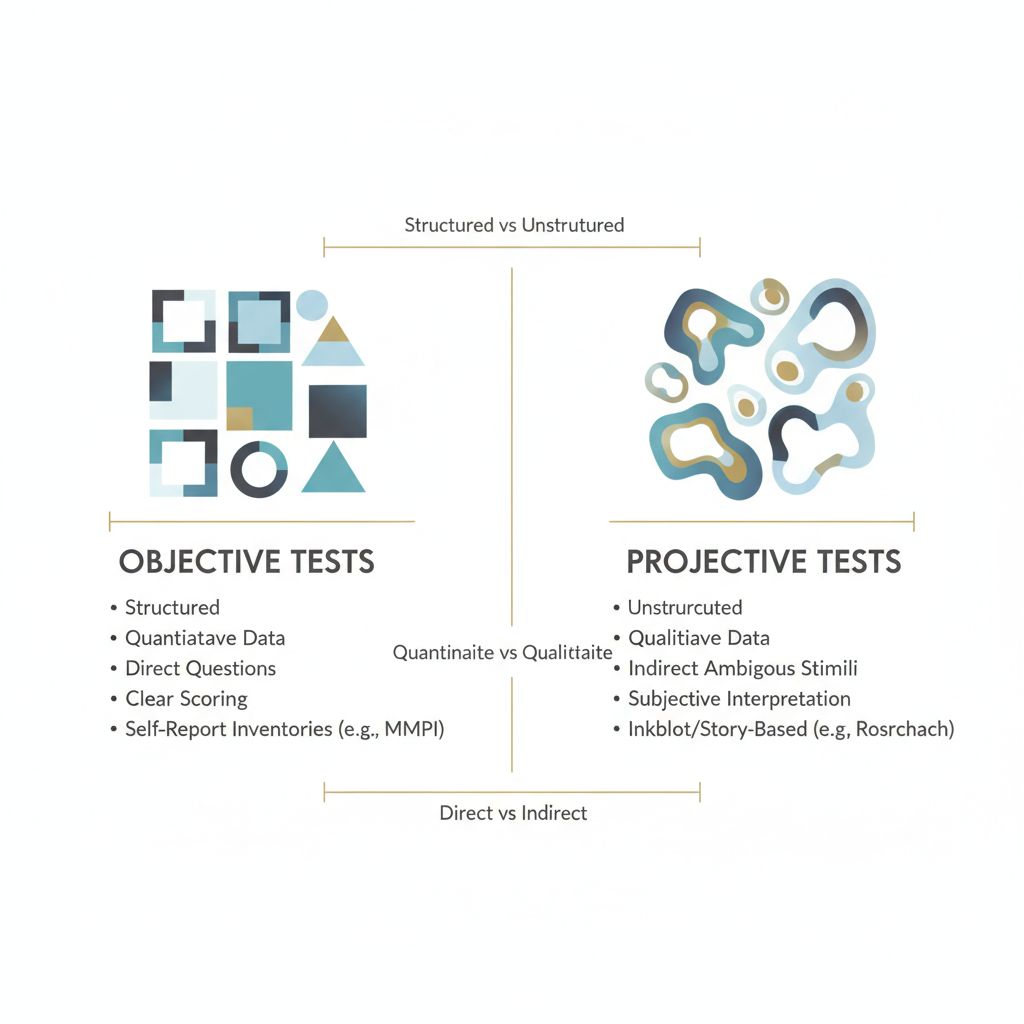
Understanding Subjective vs. Objective Data
In psychology, all insights are built on data. To explore your creativity, it’s important to know the difference between subjective and objective data. This difference affects how test results are collected and understood.
Subjective data is based on personal experience. It includes individual feelings, thoughts, and opinions. This information can change from one person to the next. For example, describing how you “feel” creative is subjective.
Objective data, on the other hand, is factual and measurable. It is not easily influenced by personal feelings. This kind of data can be verified and counted. For instance, the number of unique ideas you come up with in a timed test is objective data. Objective tests are designed to reduce bias during scoring [8].
When measuring creativity, objective data gives you clear, useful information. This helps you understand your creative strengths without having to guess.
Response Format: Restricted vs. Open-Ended
The type of question you answer changes the kind of data that is collected. This is a major difference between objective and projective tests.
Restricted-response formats are common in objective tests. These questions give you a limited number of answers to choose from. Common examples include:
- Multiple-choice questions
- True/False statements
- Rating scales (e.g., “strongly agree” to “strongly disagree”)
This structure leads to consistent answers, which makes scoring simple and fair. The Creative Ability Test uses this format to measure parts of your creative thinking, like cognitive flexibility and problem-solving skills. This clear approach provides dependable results about your potential.
In contrast, open-ended response formats are used in projective tests. These questions let you answer freely, with no pre-set choices. You might be asked to:
- Describe what you see in an ambiguous image
- Create a story from a picture
- Complete an unfinished sentence
This format allows for many different personal answers. As a result, the scoring depends on the expert’s training and judgment.
Scoring and Interpretation
The way tests are scored also shows how different they are. This affects the feedback you get on your creative skills.
Objective tests use a standard scoring system. Your answers are compared against a set benchmark. This allows for scoring with numbers. The results are often numbers or categories that are easy to understand and compare. For example, the Creative Ability Test gives you clear scores for different creative skills, like divergent thinking. This makes it easy to see your results and get useful tips for improvement [9].
Projective tests, on the other hand, are more complex to interpret. A trained expert, like a psychologist, reviews your answers. They look for themes, patterns, and emotional meaning. This process is subjective because it relies on the expert’s judgment. Because of this, two experts might see the same answers differently. The goal is to uncover hidden thoughts or feelings, not to get a simple measurement.
Examples of Projective Tests
The Creative Ability Test is an objective test, but it’s helpful to know about projective tests for context. They offer a different way to explore psychology.
Here are some well-known examples of projective tests:
- Rorschach Inkblot Test: In this famous test, you look at a series of inkblots and describe what you see [10]. Your answers are then studied to learn about your personality and emotions.
- Thematic Apperception Test (TAT): In this test, you are shown several pictures and asked to create a story for each one. You describe what’s happening and what the people in the picture are thinking. The stories are then reviewed to understand your motivations and views [11].
- Sentence Completion Tests: These tests give you the beginning of a sentence, and you finish it with the first thing you think of. For example, “My greatest fear is…” or “I feel happy when…” Your answers can give hints about your feelings, attitudes, and beliefs.
These tests are useful tools for certain clinical needs. However, because they are subjective, they are not ideal for measuring creativity in a standard way. Objective tests like the Creative Ability Test offer a clearer path. They provide measurable, science-backed results to help you understand and grow your creative potential.
How Can an Objective Test Reveal Your Creative Potential?
Measuring Creative Traits with Precision
You might wonder how a test can measure something as flexible as creativity. The answer is in the questions. Instead of relying on vague self-ratings, our Creative Ability Test pinpoints your specific creative skills.
These tests use proven methods to explore different parts of your creative mind. We look at how you come up with new ideas and solve problems.
For example, our 30-question test looks at key areas, such as:
- Divergent Thinking: Your ability to produce many varied ideas from a single starting point [12].
- Cognitive Flexibility: How easily you can switch between different concepts or problem-solving strategies.
- Openness to Experience: Your willingness to explore new ideas, concepts, and unconventional approaches.
- Problem-Solving Skills: Your unique methods for tackling complex situations creatively.
By breaking creativity into these measurable parts, we get a clear picture of your skills. The test gives you reliable data to help you understand your unique creative profile, moving beyond guesswork.
Gaining Actionable Insights into Your Strengths
Measuring your creative skills is just the first step. The real value comes from what you learn about yourself. Our test provides a clear map of your creative abilities and shows you exactly where your strengths are.
Imagine knowing your main thinking style. Are you great at brainstorming lots of ideas? Or are you better at improving existing ones? Knowing this is powerful. It lets you use your natural talents more effectively.
The Creative Ability Test offers personalized feedback that highlights your unique creative strengths. It also explains what these strengths mean for you. For example, a high score in cognitive flexibility means you are likely good at adapting quickly and handling change. Understanding this can boost your confidence.
You will learn about the specific areas where you shine. This might be in your approach to new ideas or your ability to connect different concepts. These insights are not just descriptions—they are tools for growth. They help you build on your natural talents and turn uncertainty into useful self-awareness.
Using Your Results for Personal and Professional Growth
Understanding your creative potential is powerful, but using what you learn leads to real growth. Our test gives you a starting point for your development and offers practical strategies to help you improve.
For personal growth, your results can inspire you to try new things. You might discover a hidden talent for writing or find a new passion for solving daily problems. Your profile can help you overcome creative blocks, feel more confident exploring hobbies, and find new ways to express yourself.
In your career, these insights are very useful. Creativity is a top skill employers want [13]. Knowing your creative strengths allows you to:
- Innovate in Your Role: Apply creative thinking to existing processes or product development.
- Improve Problem-Solving: Approach workplace challenges with a fresh, imaginative perspective.
- Lead Creatively: Inspire your team to think outside the box and generate novel solutions.
- Enhance Career Development: Identify roles where your creative style can truly thrive.
The Creative Ability Test does more than just measure your skills. It gives you practical strategies based on your unique profile. These steps help you improve your creative thinking and problem-solving skills. We help you move from knowing your potential to actively using it for real-world growth.
Frequently Asked Questions
What are the 4 types of psychological tests?
Psychological tests are useful tools for learning about people’s behavior and abilities. While many specialized tests exist, they generally fall into four main groups:
- Personality Tests: These tests show your usual ways of thinking, feeling, and acting. They help you learn about your unique traits and how you connect with the world. The Creative Ability Test, for example, looks at personality traits linked to creative thinking.
- Ability or Aptitude Tests: These tests measure your ability to learn or do specific tasks. They check skills like problem-solving or your way with words and numbers. For creativity, these might include tests that measure brainstorming skills or your potential for new ideas.
- Intelligence Tests: Designed to measure general thinking skills, these tests look at reasoning, memory, and problem-solving. While not the same as creativity, strong thinking skills often support creative thought.
- Interest Inventories: These tests help find out what activities and jobs you might enjoy. They can help with career decisions and show you where your creative side could shine.
Each type of test offers different information. Together, they create a full picture of a person’s psychological profile.
What is an example of an objective test question?
An objective test question has a simple, fixed format. This means there is only one correct answer or a few choices to pick from. This setup makes scoring fair and consistent for everyone. The questions are designed to be clear and straightforward.
Here is an example you might see on a personality or creativity test:
- Statement: “I enjoy exploring multiple solutions to a single problem.”
- Response Options:
- Strongly Disagree
- Disagree
- Neutral
- Agree
- Strongly Agree
This kind of question measures traits like flexible thinking, which is a key part of creativity. Your answer is then scored, giving you clear, useful feedback on your creative thinking style.
How are objective and projective personality tests different?
Objective and projective tests are two very different ways to assess personality. Knowing how they differ helps you see what makes each one useful.
Objective tests, like the Creative Ability Test, use clear questions and a set scoring system. In contrast, projective tests use vague images or prompts that are open to interpretation.
| Feature | Objective Personality Tests | Projective Personality Tests |
|---|---|---|
| Response Format | Fixed-choice (e.g., True/False, Multiple Choice, Rating Scales) | Open-ended (e.g., interpreting ambiguous images, completing stories) |
| Scoring | Standardized and clear; answers are easily counted, often by computer | Based on interpretation and requires an expert’s judgment |
| Interpretation | Direct and based on data from large groups of people | Indirect; looks for hidden thoughts and feelings |
| Examples | Creative Ability Test, MMPI, Big Five personality inventories | Rorschach Inkblot Test, Thematic Apperception Test (TAT) |
| Purpose | Measures specific traits and gives you clear, useful feedback | Explores deeper thoughts and can uncover hidden issues |
Objective tests are known to be reliable and accurate, which makes them great for self-discovery and planning personal growth [14]. Projective tests are often used by therapists to look into more complex issues.
What is a benefit of an objective personality test?
Objective personality tests have many benefits, especially if you want to understand and improve your creativity. They offer a clear, science-based way to learn about yourself and grow.
Key advantages include:
- Reliability and Validity: These tests are based on scientific research, so they are dependable and accurate. They consistently measure what they claim to measure, giving you results you can trust.
- Standardized Scoring: Because the questions and scoring are set, these tests are fair and unbiased. Your results are compared to a large group of people, giving you an accurate picture of where you stand.
- Actionable Insights: Objective tests give you clear data, not just interpretations. This data leads to useful, personal feedback. For example, the Creative Ability Test can show you your specific creative strengths and where you can improve.
- Efficiency and Accessibility: These tests are usually quick and easy to take, and many are online. This makes it simple to get fast insights into your abilities.
- Personalized Growth Strategies: The clear results help you understand your creative strengths. They also offer specific tips on how to build on them. This turns confusion into clear steps for self-improvement.
Using a science-based objective test gives you a solid starting point for growth. It helps you turn what you learn into real progress.
Sources
- https://psycnet.apa.org/record/2012-07502-001
- https://www.psychologytoday.com/us/basics/standardization
- https://www.apa.org/education-career/guide/science-psychology
- https://www.apa.org/pubs/books/minnesota-multiphasic-personality-inventory-mmpi-2-rf
- https://www.myersbriggs.org/my-mbti-personality-type/
- https://www.britannica.com/science/intelligence-test
- https://www.collegeboard.org/sat
- https://dictionary.apa.org/objective-test
- https://www.apa.org/topics/testing/psychological-tests
- https://www.britannica.com/science/Rorschach-Test
- https://www.psychologytoday.com/us/basics/thematic-apperception-test
- https://psycnet.apa.org/record/2012-04987-001
- https://www.weforum.org/agenda/2023/05/future-of-jobs-2023-top-skills/
- https://www.psychologytoday.com/us/basics/psychological-testing
Leave a Reply