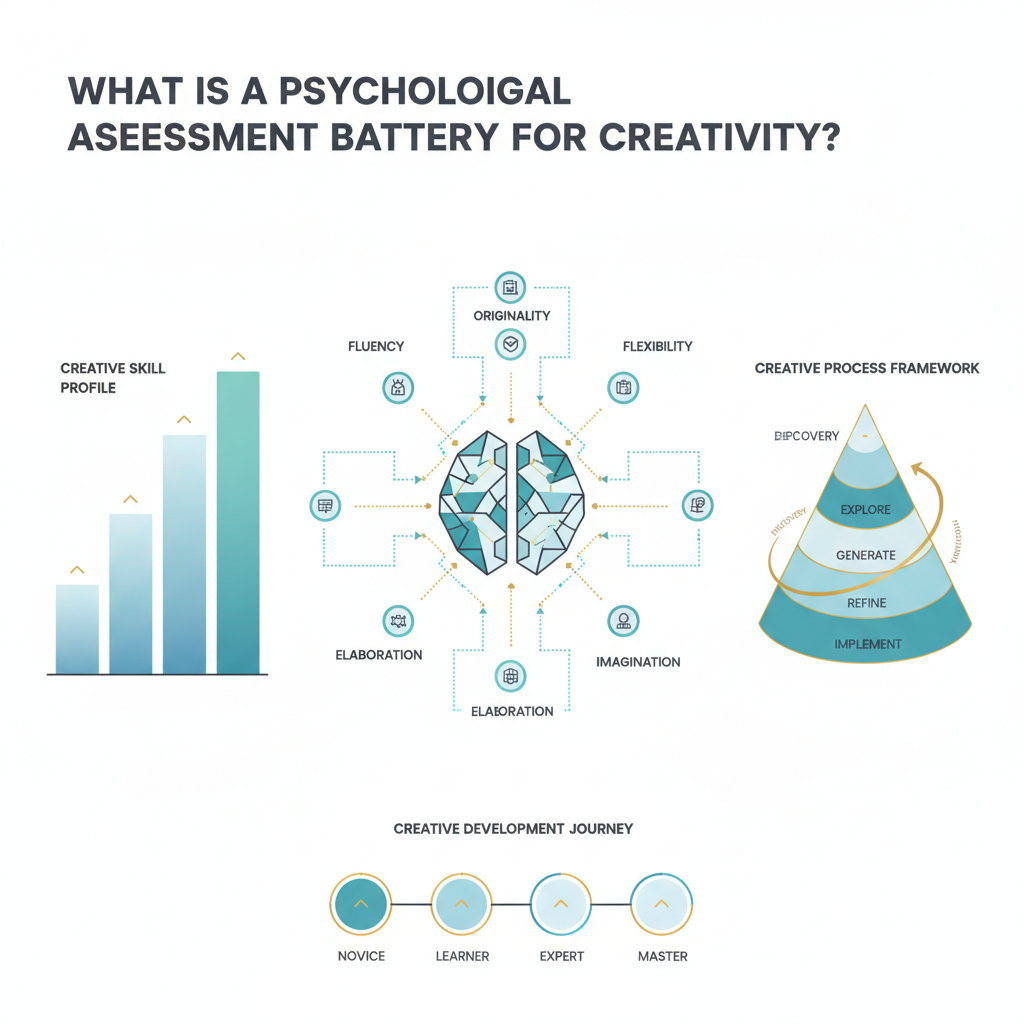
A psychological assessment battery is a collection of tests used together to gain a comprehensive understanding of an individual’s cognitive and emotional functioning. In the context of creativity, this approach allows for a detailed evaluation of various skills like divergent thinking, problem-solving, and cognitive flexibility, providing a holistic view of one’s creative potential.
We know that creativity is important for new ideas, personal growth, and solving daily problems. But how do you measure something with so many parts? It’s more than just being artistic or having ideas. To truly understand your creative side, you need more than a single test. This is where a psychological assessment battery for creativity can help by offering a complete view of the strengths that make up your innovative mind.
Imagine learning not just *if* you are creative, but *how* you are creative. A psychological battery test is not a single quiz. It’s a carefully chosen set of assessments that work together to show your complete creative thinking styles. Using proven questions, it examines skills like your Cognitive flexibility, your ability to generate original ideas (divergent thinking), and your unique ways of solving problems. Our goal at Creative Ability Test is to give you useful advice and personalized strategies to use these strengths in your personal and professional life.
This article explains what a psychological assessment battery for creativity is, how it’s structured, and the valuable information it provides. By looking at the science behind these evaluations, you’ll learn how to identify your natural creative strengths, understand how you think, and get practical tips to improve your problem-solving skills. This is a chance to turn uncertainty about your creative potential into clear, useful self-awareness.
What Is a Psychological Assessment Battery?

What Is a Test ‘Battery’ in Psychology?
In psychology, a “battery” isn’t a power source. It’s a group of different tests. You can think of it like a toolbox filled with special tools for assessment.
Each test in the battery measures a specific part of a person’s cognitive abilities, personality traits, or behavior. This method helps experts get a fuller, more complete picture than just one test ever could.
For instance, to assess a complex skill like creativity, a psychologist might use several tests. Each one would look at different thinking styles or ways of solving problems. Together, the results create a detailed picture of a person’s creative style and potential.
Why a Single Test Isn’t Enough
Think about trying to understand a whole forest by looking at just one tree. A single psychological test gives you only a small peek into a person’s complex mind. Skills like creativity have many different layers.
One test might measure a specific skill well, but it will miss other important parts. For example, a test could show you can come up with many ideas. But it might not show how original those ideas are or how easily you can change your thinking.
Creativity involves many different skills and traits, such as:
- Divergent thinking: The ability to come up with many different ideas.
- Cognitive flexibility: The skill of switching between different ways of thinking.
- Problem-solving skills: Using creative ideas to overcome challenges.
- Originality: Creating new and unique solutions.
- Openness to new experiences: A willingness to try new things and think differently.
Because creativity has so many parts, a full evaluation needs more than one tool. A test battery lets us look at all these different sides. This gives a complete picture of your creative strengths and where you can grow [1].
That’s why the Creative Ability Test is a science-based, 30-question assessment that works like a specialized battery. Our test measures the many sides of creativity. This gives you personalized and useful insights that show your true creative style.
How Is a ‘Test Battery’ Used to Measure Creativity?
Moving Beyond Clinical Use to Personal Growth
In the past, psychological tests were mainly used in clinical settings. They helped diagnose conditions or understand how the mind works [2]. But that has changed a lot. Today, these powerful tools are widely used for personal growth and self-discovery.
This change is great for anyone who wants to understand their own creativity. A creativity test isn’t about finding flaws or “diagnosing” a problem. Instead, it’s a helpful guide that shows you your unique creative strengths and ways of thinking.
Think of it as a journey to understand yourself better. You’ll get a clear picture of how you come up with new ideas. You’ll learn your natural way of solving problems. This knowledge is very empowering.
- Discover Your Strengths: Find out where your creative genius really shines.
- Understand Your Process: Learn how you naturally take on new challenges.
- Foster Growth: Find areas where you can purposefully grow your creative skills.
This modern approach helps people just like you. It’s not about finding problems. It’s about unlocking your natural potential. It turns uncertainty about your creative skills into self-awareness you can actually use.
The Creative Ability Test as a Specialized Battery
Creativity is complex and has many sides. It involves different ways of thinking and parts of your personality [3]. That’s why you can’t measure it with just one simple question. This is where a specialized psychological assessment battery becomes so important.
The Creative Ability Test is designed for this exact purpose. It’s a complete, specialized creativity test. Our 30-question assessment is backed by science and does more than scratch the surface. It looks deeply into the different parts of your creative mind.
This whole-picture approach gives you a complete view of your creative potential. We go beyond generic quizzes to offer you personal and practical insights.
Here’s how our platform functions as your dedicated creativity test:
- Comprehensive Assessment: Our 30 questions cover a wide range of signs of creativity.
- Multi-Dimensional Measurement: We look at things like your ability to brainstorm, think flexibly, and stay open to new experiences. This gives you a more detailed understanding.
- Backed by Science: Our methods are based on proven research into creativity. This ensures you get trustworthy results.
- Personalized Insights: You get feedback that is specific to you. It points out your unique creative strengths and areas where you can grow.
- Actionable Strategies: The test gives you practical tips. These help you improve your creative thinking and problem-solving skills in your daily life.
By taking the Creative Ability Test, you get more than just a score. You unlock a deeper understanding of yourself. You’ll go from having a basic idea of your creativity to using it for personal growth, career development, and new ways of thinking.
What Key Traits Does a Creativity Assessment Battery Measure?

Divergent and Convergent Thinking
Creativity is often seen as one skill, but it’s more complex. It actually involves two different ways of thinking. A good creativity test measures both divergent and convergent thinking.
Divergent thinking is your ability to come up with many different ideas. Think of it as brainstorming. You explore a wide range of possibilities without judgment. This skill is key to finding lots of potential solutions. For example, you might list countless uses for a common object like a paperclip.
Convergent thinking is the opposite. It’s your ability to narrow down those many ideas to find the best one. You pick the most fitting solution. This requires critical thinking and logic. For that paperclip, you might choose the most practical use based on a specific problem.
You need both for real creative success. Our assessment helps you understand your balance between these two powerful ways of thinking. It shows your strengths in creating and choosing ideas.
Cognitive Flexibility
Cognitive flexibility is a key part of creative thinking. It’s about being mentally agile. This trait is the ability to change your point of view and adapt your thinking quickly. It means you can look at problems from different angles.
Imagine facing a complex challenge. Someone with high cognitive flexibility can easily switch gears. They can change their approach if one idea isn’t working. This helps you get past mental blocks and find new solutions.
For instance, think about planning a new marketing campaign. A flexible thinker might look at it from the customer’s point of view. Then, they’ll consider it from the sales team’s perspective. After that, they might think like a competitor. Looking at the problem from all sides leads to stronger solutions.
Our assessment helps you understand how flexible your thinking is. It gives you insight into how well you adapt. Knowing this helps you handle change more effectively.
Problem-Solving Approaches
Creativity isn’t just about art. At its core, it’s about solving problems. A good assessment looks at how you face challenges. It examines your unique ways of solving problems creatively.
This involves several key parts:
- Identifying the core issue: Seeing beyond surface symptoms.
- Reframing problems: Viewing challenges in new and innovative ways.
- Developing novel solutions: Coming up with original answers.
- Persistence: Staying resilient when facing obstacles.
Think of a common problem at home, like a cluttered room. A creative problem-solver wouldn’t just tidy up. They might redesign the space. They would create a new system to stay organized. Our platform shows your natural tendencies in these areas. It helps you use your creativity for challenges at home and at work.
Originality and Idea Generation
Originality is at the heart of innovation. It’s the ability to come up with truly unique ideas that others don’t usually think of. Idea generation is about how many new ideas you can create. It’s about bringing new thoughts to life.
Originality means your ideas stand out. They make your work or solutions different. This quality goes beyond the usual answers. For example, instead of just improving a product, an original idea might be a totally new one that solves an unmet need. This is where breakthroughs happen.
Our assessment measures how original your ideas are. It also checks how good you are at generating ideas in general. Understanding this helps you grow your unique creative spark and share your most innovative thoughts.
Openness to New Experiences
Openness to New Experiences is a key personality trait. It’s strongly linked to creative potential [4]. This trait is about your willingness to explore new ideas, concepts, and unusual experiences. It is about curiosity and a desire to learn.
People who are very open tend to be:
- Intellectually curious and eager to learn.
- Aesthetically sensitive and appreciative of art.
- Adventurous and willing to try new things.
- Emotionally aware and reflective.
This trait acts as fuel for creativity. It encourages you to step outside your comfort zone and look for different kinds of inspiration. This expands the way you see the world. For example, someone who is very open might try a new type of food or read about a complex scientific theory. These experiences give them a richer point of view and more material for creative thought.
Our assessment helps measure how open you are to new things. It links this trait to your overall creative potential. This understanding helps you find new ways to grow and expand your creative horizons.
What Does a Psychological Battery Test and Evaluation Involve?
Step 1: The Assessment Experience
Your creative journey starts with a simple, engaging assessment. This isn’t just one test. Instead, you’ll go through a series of fun activities and questions. Each task helps us understand how you think creatively.
Our Creative Ability Test, for example, has 30 science-backed questions. Each one is a chance to explore your mind. You’ll solve different kinds of problems and use your imagination. There are no right or wrong answers here. Your honest responses are what count. They show us your natural creative instincts.
The online format is easy to use. You can complete the test at your own pace in a comfortable setting. This helps you express yourself freely. This first step is all about exploring your creative potential.
Step 2: Analyzing Your Comprehensive Profile
After you finish the test, our experts get to work. They carefully analyze your answers. We don’t just add up scores. Instead, we look at how your answers connect. This gives us a complete picture of your creative profile.
Our team of psychologists and data scientists uses proven models to analyze your results. They look for patterns in your thinking and measure key traits like:
- Divergent Thinking: How many unique ideas can you generate?
- Cognitive Flexibility: Can you easily shift perspectives and approaches?
- Originality: Are your ideas fresh and uncommon?
- Problem-Solving Approaches: What strategies do you naturally employ?
- Openness to Experience: How receptive are you to new ideas and concepts?
This detailed review shows how you naturally create and solve problems. It helps us understand your unique thinking style. Our scientific approach ensures your results are accurate and useful [5]. By combining these measurements, we create a clear picture of your creative strengths and areas for growth.
Step 3: Receiving Personalized, Actionable Insights
In the final step, you get your results. We send you a personalized report based on our detailed analysis. It’s more than just scores. The report explains what your results mean in simple, easy-to-understand language. This helps you clearly see your unique creative strengths.
Your personalized insights will include:
- Specific Strengths: See where you shine creatively. For example, you may be great at brainstorming or finding unique solutions.
- Growth Opportunities: Find areas where you can build your creative skills. For instance, you might try practicing new ways to solve problems.
- Practical Strategies: Get tips and exercises made just for you. They are designed to fit your thinking style and help you become more innovative.
- Real-World Applications: Learn how to use your creativity every day, at home or at work. You’ll be able to tackle challenges with a fresh point of view.
This feedback turns confusion into clarity. You’ll go from wondering about your creativity to knowing how to improve it. Our goal is to give you the tools you need. We want you to use your creative strengths to solve problems and create new ideas.
Can You Give a Psychological Assessment Battery Example?
A General Clinical Example
Let’s use a general clinical example to see how a psychological assessment battery works. Imagine someone is having trouble with focus and mood. One test alone can’t fully explain these complex issues.
That’s why a full clinical battery is used. It combines different tests to get a complete picture. This helps professionals find the root causes of a person’s struggles. [6]
This type of battery typically includes:
- Cognitive Ability Tests: These test skills like attention, memory, and how quickly you process information. For example, a Wechsler Adult Intelligence Scale (WAIS) might be used.
- Personality Inventories: Tools like the Minnesota Multiphasic Personality Inventory (MMPI) look at personality traits and emotional patterns.
- Symptom Checklists: Questionnaires like the Beck Depression Inventory (BDI) measure how severe certain symptoms are.
- Behavioral Observations: Clinicians also observe behavior during the assessment process.
By combining the results from these tools, clinicians get a much clearer picture. This allows them to make an accurate diagnosis and create an effective treatment plan. This varied approach is key to understanding complex human behavior.
An Example Focused on Creative Potential
Now, let’s look at a psychological assessment battery designed for creativity. Unlike a clinical one, this type of assessment aims to find your unique creative strengths and potential. It gives you a complete map of your creative mind.
A strong creativity assessment battery, like the one offered by Creative Ability Test, uses a mix of science-backed questions. These questions look at different parts of creative thinking. This ensures a complete review of your skills. [7]
This kind of battery might test:
- Divergent Thinking: This measures your skill at coming up with many unique ideas from one starting point. For instance, you might be asked to list all possible uses for a common object.
- Convergent Thinking: This tests your ability to find the single best answer to a problem. It uses logic and judgment.
- Cognitive Flexibility: This looks at how easily you can switch between different ways of thinking. It’s important for handling new challenges.
- Problem-Solving Approaches: The battery looks at how you solve open-ended problems. It shows your favorite creative methods.
- Originality and Elaboration: This tests how unique your ideas are and how well you can add details to them.
- Openness to Experience: This personality trait is closely linked to creativity. It shows how open you are to new ideas and experiences.
The Creative Ability Test covers these areas in its 30-question assessment. It moves beyond simple “right or wrong” answers. Instead, it captures the details of your creative process. As a result, you receive personalized feedback.
This feedback goes beyond just scores. It includes practical tips based on your results. You learn how to use your strengths. You also discover practical ways to improve in other areas. This turns creative ideas into real skills. You can then use them in your personal and professional life. [8]
Ultimately, a creativity assessment gives you more self-awareness. It helps you understand your unique creative potential. This understanding is the first step to improving your innovative thinking and problem-solving skills.
How Can Understanding Your ‘Creativity Battery’ Help You?

Identifying Your Natural Creative Strengths
Understanding your “Creativity Battery” helps you learn about yourself. It shows you what your unique creative talents are. Think of it as a personalized map of your creative mind. This assessment is more than just a simple label. It points out the specific mental skills you use to come up with new ideas.
For example, you might be great at brainstorming. This means you can come up with many ideas easily. Or, you could have strong mental flexibility, which helps you switch viewpoints without effort. The Creative Ability Test pinpoints these key strengths. Knowing this builds confidence by showing you where your natural talents are. Recognizing these strengths is the first step to focusing on what you do best. When you understand your creative style, you can feel more fulfilled and perform better [9].
You will discover:
- Your main thinking style: Do you come up with ideas quickly, or do you carefully piece them together?
- Your natural talents: Where does your creativity come to you most easily?
- Your mental superpowers: Maybe you’re great at connecting different ideas.
- Your problem-solving style: How do you usually handle tough problems?
This insight helps you use your natural abilities and apply them in your daily life.
Finding Opportunities for Growth
No one is creatively perfect, and everyone has areas where they can grow. Your “Creativity Battery” also highlights these areas. This isn’t about finding weaknesses. Instead, it points out specific ways you can improve. This helps you build your creative skills with a clear purpose.
Perhaps your results show you could get better at choosing the best idea from a list. Or maybe you could work on making your ideas more unique. The Creative Ability Test gives you practical steps for these areas that are tailored to your profile, not just generic tips. Having a growth mindset is a big help when learning new skills [10]. You’ll get useful tools to broaden your creative abilities. This organized method helps you get past creative blocks and turns challenges into exciting ways to learn.
Key growth areas often include:
- Generating more ideas: Learn ways to come up with more new and varied ideas.
- Becoming more flexible: Do exercises to see things from new angles and get comfortable with uncertainty.
- Solving problems better: Find strategies for more creative and effective solutions.
- Being more original: Use methods to think outside the box.
With personalized guidance, you can build a more well-rounded creative skillset.
Applying Insights to Real-World Challenges
The real power of your “Creativity Battery” comes from using what you learn. This isn’t just theory—it’s about getting real results. The insights from the test have direct, real-world benefits. You learn to use your unique creative strengths to handle challenges at home and work more effectively. For example, if you’re good at brainstorming, you can lead a team session to find new solutions. Or, if you have original ideas, you can suggest fresh marketing campaigns.
This knowledge also helps you see challenges as chances to be creative, so you can move from feeling uncertain to feeling confident in your abilities. This leads to innovative solutions. Creative problem-solving is a key skill for success in today’s work world [11]. We provide clear explanations and simple examples to show you how to tap into your creative potential. You’ll feel more confident facing any situation with a creative outlook, which changes how you solve problems and come up with new ideas.
Practical applications include:
- Personal Growth: Finding creative ways to manage stress or pursue hobbies.
- Professional Development: Innovating at work or excelling in new roles.
- Problem-Solving: Handling daily challenges with a fresh point of view.
- Strategic Planning: Developing forward-thinking strategies in any field.
Ultimately, understanding your creative battery helps you unlock your full potential and guides you toward a more innovative and fulfilling life.
Frequently Asked Questions
What is psychological assessment?
Psychological assessment is a structured way of gathering information about a person. It uses a mix of tools and methods, such as tests, interviews, and observations.
The main goal is to understand a person’s abilities, strengths, and unique qualities. It offers insights into personality, thought processes, and emotional well-being [2]. This understanding can then be used for personal development or to help solve problems.
On our platform, we use psychological assessment to focus on your creative potential. We go beyond traditional clinical uses and instead offer a path to self-discovery and growth, helping you identify your unique creative thinking styles.
What is an example of a test battery in psychology?
In psychology, a “test battery” is a set of different tests given together to get a complete picture of a person. For instance, a clinical battery might look at thinking skills like memory, attention, and decision-making to help diagnose conditions like ADHD or learning disabilities.
However, test batteries are used in many other areas, too. The Creative Ability Test is a great example of a battery focused entirely on creativity. Instead of a single test, our battery includes multiple parts, and each one measures a different aspect of your creative mind.
Our battery examines key areas such as:
- Divergent Thinking: Your ability to generate many unique ideas.
- Cognitive Flexibility: How easily you switch between different perspectives.
- Problem-Solving Approaches: Your natural methods for tackling challenges creatively.
- Openness to New Experiences: Your willingness to explore novel concepts.
By combining these assessments, we provide a complete view of your creative strengths. This deeper understanding helps support your personal growth.
How does a psychological battery test and evaluation work online?
Taking a psychological test battery online is simple and convenient. Our platform guides you through each step to make the experience smooth and engaging.
Here’s how the process works with the Creative Ability Test:
- Step 1: Take the Assessment. You’ll start by answering a series of 30 scientifically-based questions. These questions are designed to explore different sides of your creative thinking. You can complete them at your own pace.
- Step 2: Get Your Profile Analysis. After you finish, our system analyzes your answers using proven methods. It then creates a detailed profile that highlights your creative strengths and unique thinking styles.
- Step 3: Receive Actionable Insights. Finally, you get your personalized results in a clear, easy-to-understand report. We explain your creative potential and offer practical strategies to help you improve specific skills. This turns insight into action, helping you grow in a structured way.
Our online platform makes it easy to measure and understand your creativity. We deliver insights directly to you, encouraging personal development and new ways of thinking.
What is reliability in psychological testing?
In psychological testing, reliability means consistency. A reliable test produces the same results over and over again. Think of a scale: if it shows the same weight each time you step on it, it’s reliable. In the same way, a reliable psychological test gives you similar scores if you retake it under the same conditions.
Reliability is crucial for any assessment because it ensures the results are trustworthy. Without it, test scores would be random or change too much, making them meaningless for understanding your abilities.
There are different ways to measure reliability:
- Test-Retest Reliability: This measures consistency over time. If you take the same test twice, your scores should be similar.
- Internal Consistency: This checks if different items within a single test measure the same concept. All parts should work together smoothly.
The Creative Ability Test is built on scientific principles, and we make high reliability a priority. This means you can trust your results. Our assessment consistently and accurately measures your creative potential [12]. This gives you the confidence to use our strategies for real-world growth.
Sources
- https://www.apa.org/education-career/guide/tests
- https://www.apa.org/education-career/guide/assessment
- https://www.journals.uchicago.edu/doi/abs/10.1086/721204
- https://www.frontiersin.org/journals/psychology/articles/10.3389/fpsyg.2016.00297/full
- https://www.apa.org/monitor/2013/04/assessing-creativity
- https://www.apa.org/education-career/guide/assessments
- https://psycnet.apa.org/record/2012-00507-001
- https://www.psychologytoday.com/us/basics/creativity
- https://positivepsychology.com/self-awareness-skills/
- https://hbr.org/2014/11/what-having-a-growth-mindset-actually-means
- https://www.weforum.org/agenda/2023/05/future-jobs-report-2023-top-skills/
- https://www.apa.org/pi/about/publications/caregivers/practice-settings/assessment/reliability-validity
Leave a Reply