A performance test in psychology is an assessment where an individual performs a specific task or activity, rather than just answering questions. These tests are designed to evaluate practical skills, problem-solving abilities, and aptitudes like creativity in a hands-on context, revealing how a person applies their knowledge.
Have you ever wondered how well you handle unexpected problems, come up with new ideas, or adjust your thinking in new situations? While most tests focus on what you *know*, understanding skills like innovative problem-solving, cognitive flexibility, and creative thinking requires a different approach. It’s about measuring your practical skills and how you act when given a real task to complete.
This is the main goal of a “performance test in psychology.” Instead of just asking questions, these scientifically grounded assessments observe how you complete a task. They watch your actions and strategies to reveal your unique strengths and thinking style. These tests offer valuable information about your ability to brainstorm, your approach to innovation, and your creative potential. In this article, we’ll explain what these tests are and why they’re so important for revealing practical skills. You’ll also learn how they can support your personal growth and help you use your creativity in the real world.
What is a Performance Test in Psychology?
Moving Beyond Questions to Actions
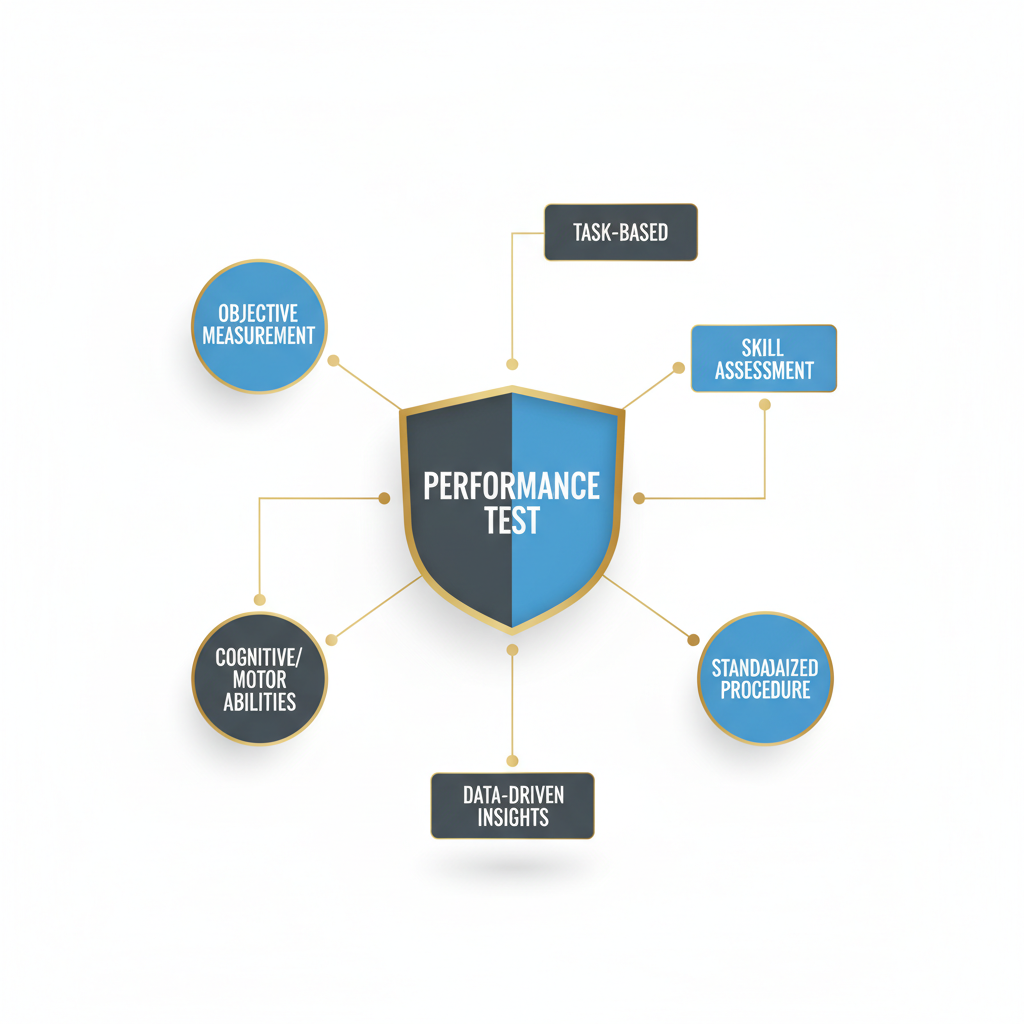
A performance test is different from a typical quiz. Instead of asking what you know or how you feel, it looks at what you actually do.
Think of it as a hands-on assessment. This method helps us see your abilities in action. It shows your practical skills and how you use what you know.
This kind of test is also key to understanding creativity. Creativity isn’t just an idea. It’s about making new things, solving problems, and adapting. Our platform uses this active approach. We help you go from just thinking about creativity to actually understanding and improving it.
How It Measures What You Can Do, Not Just What You Know
A performance test measures your skills by watching you complete specific tasks. Psychologists then review your actions and the results [1]. This is very different from traditional multiple-choice questions or self-report surveys.
Here is how performance tests measure what you can do:
- Hands-On Challenges: You are given a task to complete, like building a structure, solving a puzzle, or brainstorming ideas.
- Watching Your Process: Experts observe how you approach the task. They look at your strategies and decision-making process.
- Reviewing the Outcome: Your final product or solution is reviewed for its quality, originality, and effectiveness.
- Real-Life Scenarios: These tests often use situations you might face in the real world. This makes the results more useful for everyday challenges.
For creativity, these tests are especially useful. They don’t just ask if you think you’re creative. Instead, they measure your ability for things like:
- Divergent Thinking: The ability to come up with many unique ideas from one starting point. This shows your mental flexibility.
- Cognitive Flexibility: How easily you can shift your thinking between different ideas or methods. This is key for innovation.
- Problem-Solving Skills: How you handle new situations and find creative solutions to unfamiliar problems.
- Originality: We directly observe how unique and new your ideas are.
Our 30-question assessment is a performance test based on these scientific principles. It shows you your unique creative strengths. You will get personalized insights into how you use creativity in real life. This helps you move from uncertainty to actionable self-awareness.
What is the Importance of Performance Test in Psychology?
Revealing practical skills and problem-solving
Performance tests don’t just check what you know. They show what you can do when given a task. This hands-on approach is very useful in psychology. These tests show how well you apply your knowledge in real situations. They assess how you handle real-world challenges and find solutions. It’s about showing your skills, not just remembering facts. This gives a clearer picture of your true abilities.
Think about how this applies to problem-solving. A performance test might ask you to solve a puzzle or create a strategy. This shows your thinking skills in action. For instance, these tests can measure how quickly you adapt to new information. They also see how efficiently you reach a goal [2].
At Creative Ability Test, we focus on these practical skills. We help you understand your own way of facing challenges. This leads to clear steps for personal growth and professional development.
Assessing Creativity and Innovative Thinking
A powerful feature of performance tests is their ability to measure creativity directly. Creativity is not just about artistic talent. It involves coming up with new and useful ideas to solve problems. These tests offer a unique look at your innovative thinking.
They often use open-ended tasks. You might be asked to brainstorm uses for an everyday object. Or, you could be challenged to find new solutions to a made-up problem. Such tasks directly measure divergent thinking. This is your ability to create a wide range of ideas [3].
Performance tests also reveal how comfortable you are with unclear situations. They show how you handle challenges that don’t have a single “right” answer. This skill is vital for new ideas in any field. It highlights your flexible thinking and openness to new experiences.
Our Creative Ability Test uses a proven scientific method. It uses performance-based questions to uncover your unique creative strengths. You get personalized feedback on your thinking styles. This helps you build on your potential for innovation.
Understanding your creative abilities offers many benefits:
- Uncovering Hidden Strengths: Discover creative talents you didn’t know you had.
- Enhancing Problem-Solving: Learn to create more imaginative and effective solutions.
- Boosting Innovation: Use creative thinking to develop new ideas at work or in your personal life.
- Building Adaptability: Get better at handling uncertainty and embracing change.
Providing Objective Insights into Abilities
A key benefit of performance tests is that they are objective. They provide feedback based on what you do, not just on your feelings or beliefs. This greatly reduces personal bias.
When you complete a task, your performance is measured directly. For example, the number of unique ideas you create is real data. This is different from simply being asked if you “think you are creative.” Because of this, performance tests offer a more accurate picture of your true abilities. This is especially true for complex skills like creativity [4].
This objective feedback is valuable for several reasons:
- Accurate Self-Awareness: Get a clear, unbiased view of your strengths and areas for growth.
- Targeted Development: Get personal tips based on real evidence, making it easier to improve.
- Tracking Progress: Objectively see how your creative skills change over time.
- Informed Decision-Making: Make better life and career choices that match your true potential.
At Creative Ability Test, our assessments are designed to do just that. We provide feedback based on evidence to support your journey of self-discovery. Our scientific method ensures you get results you can trust and use. These insights guide you toward real growth and better creative performance.
How Do Maximum vs. Typical Performance Tests Differ?
Maximum Performance: Measuring Your Best Effort
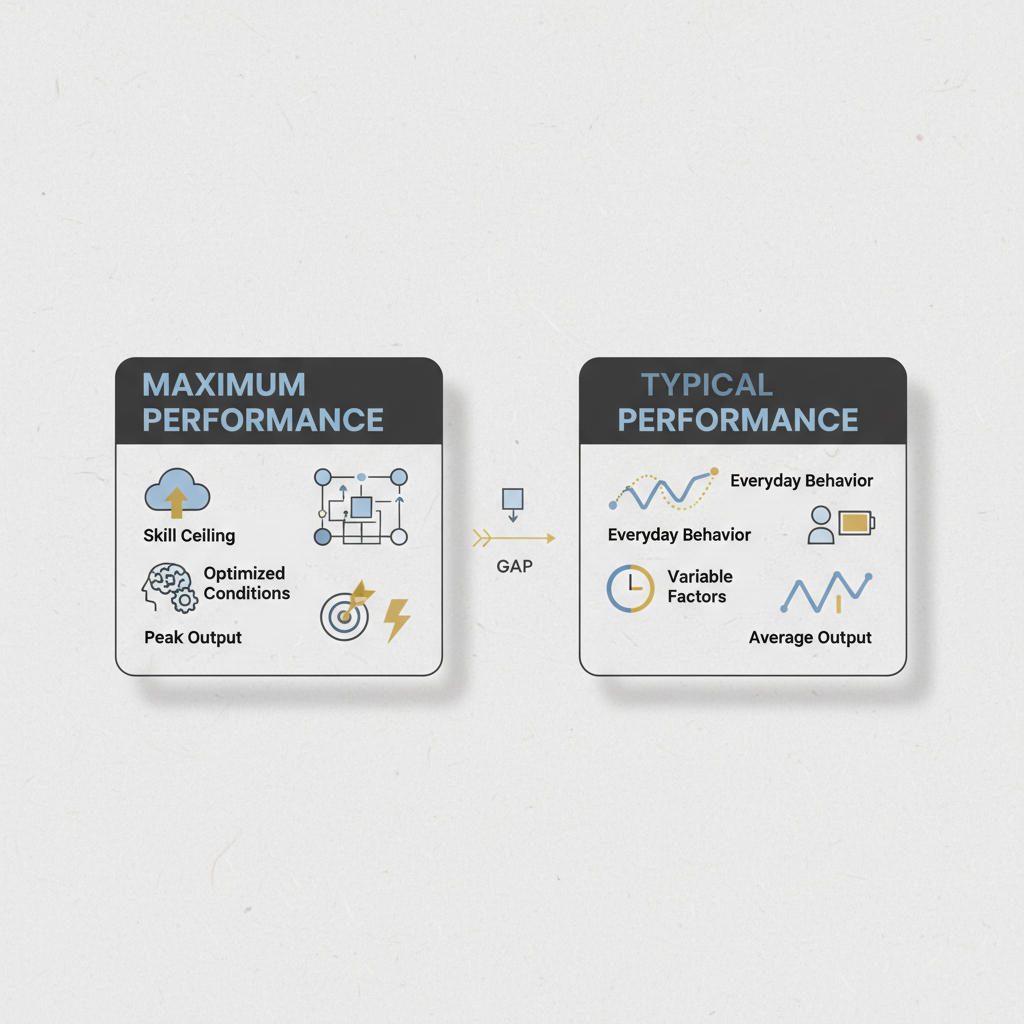
To understand your creative potential, we often look at your maximum performance. This measures what you can do at your absolute best. It shows your peak ability when you are motivated and giving your full effort [5].
For example, imagine being asked to think of as many unique ideas as you can within a time limit. This is a classic test of maximum performance. You push yourself to think in new ways, aiming for both quality and quantity. Your Creative Ability Test has tasks designed to measure this peak creative output.
Key characteristics of maximum performance tests include:
- High Stakes: Participants know they are being evaluated and try to get the best possible score.
- Clear Goals: There is a specific goal, like solving a tough problem or creating many ideas.
- Focus on Capacity: These tests show your upper limit. They reveal what you can do under the best conditions.
- Revealing Potential: This type of performance highlights your untapped skills and shows where your creative strengths are.
Measuring your maximum creative performance gives us valuable insights into your potential for new ideas and innovation. This understanding helps guide you. It shows you how to unlock more of your natural creativity in everyday life.
Typical Performance: Understanding Your Usual Behavior
Typical performance, on the other hand, measures what you usually do in everyday life. These tests look at your regular habits and how you naturally approach situations. They don’t measure your best effort. Instead, they focus on how you normally handle tasks and problems [6].
For example, think about how often you try new things. Or how you usually react to unexpected challenges. These are examples of your typical creative behavior. They show your consistent creative habits. Your Creative Ability Test helps you discover these everyday styles.
Here’s what defines typical performance tests:
- Low Stakes: People can be honest about their usual behavior because there is less pressure to perform well.
- Self-Report Focus: These tests usually use questionnaires where you describe your own actions and feelings.
- Real-World Relevance: They show how creativity fits into your daily life and reveal your natural problem-solving style.
- Insights into Application: This helps us see how you use your creative strengths in real life and whether you apply them consistently.
Both maximum and typical performance give us important information. The Creative Ability Test provides a complete picture by connecting your peak potential with your daily habits. This approach empowers you. It helps you use these insights for personal and professional growth.
What is a Performance Test in Psychology Example?
Tests for Cognitive and Problem-Solving Skills (e.g., Block Design)
Performance tests measure how you think and solve problems. They go beyond simply what you can remember. Instead, they look at your ability to use information and logic to find solutions.
A classic example is the Block Design task. In this test, you get a set of colored blocks. You then arrange them to match a picture. This task tests your spatial reasoning and your ability to break a big problem into smaller steps. It also measures how quickly you can change your strategy if something isn’t working.
These tests help us understand how flexible your thinking is. They show your ability to think in new ways. A strong performance shows you can picture solutions in your mind and carry them out well. This skill is key to solving creative problems in everyday life.
- Spatial Reasoning: How well you understand and work with objects in your mind.
- Breaking Down Problems: Your skill in turning large problems into smaller parts.
- Flexible Thinking: Your ability to switch strategies when one isn’t working.
- Efficient Action: How well you carry out a plan to solve a problem.
Knowing your strengths helps you grow. It helps you see where your natural problem-solving skills are. Our platform can help you find these thinking patterns and give you tips to improve them.
Tests for Creative Thinking (e.g., Divergent Thinking Tasks)
For many, the most exciting performance tests are the ones that focus on creativity. These tests don’t have one “right” answer. Instead, they value originality and a wide range of ideas.
Divergent thinking tasks are a great example. These tests check your ability to come up with many unique ideas from one starting point [7]. For instance, you might be asked to list all the possible uses for a brick. Your imagination is the only limit.
These tasks measure several key parts of your creative mind:
- Fluency: The total number of ideas you can come up with.
- Flexibility: The variety of categories your ideas fall into.
- Originality: How new or uncommon your ideas are compared to others.
- Elaboration: The amount of detail you include in each idea.
Doing well on these tests shows you are open to new possibilities and have a strong ability to innovate. These are key skills for personal and professional success. Our science-backed test measures these areas and provides personal feedback. This helps you understand and use your creative strengths.
You can then use what you learn to think more creatively and solve problems in any situation. This helps turn your creative potential into real-world skills.
Tests for Motor Skills and Coordination
While less tied to creative thinking, some performance tests also measure motor skills. These tests check your physical skill and coordination. They see how quickly and accurately you can make specific movements, from using your fingers to reacting to a trigger.
Examples include pegboard tests, where you place pegs into small holes. Other tests might involve following a moving target on a screen. These tests are important in many fields. They help see if someone is ready for a certain job or can help people recover from injuries.
Such tests give clear information about physical skills and show areas where you can improve. While our platform focuses on creative thinking, these examples show how wide-ranging performance tests are. They prove we can measure many different human skills by seeing them in action.
How Do Performance Tests Relate to Your Creative Potential?
Measuring Your Ability to Generate Unique Ideas
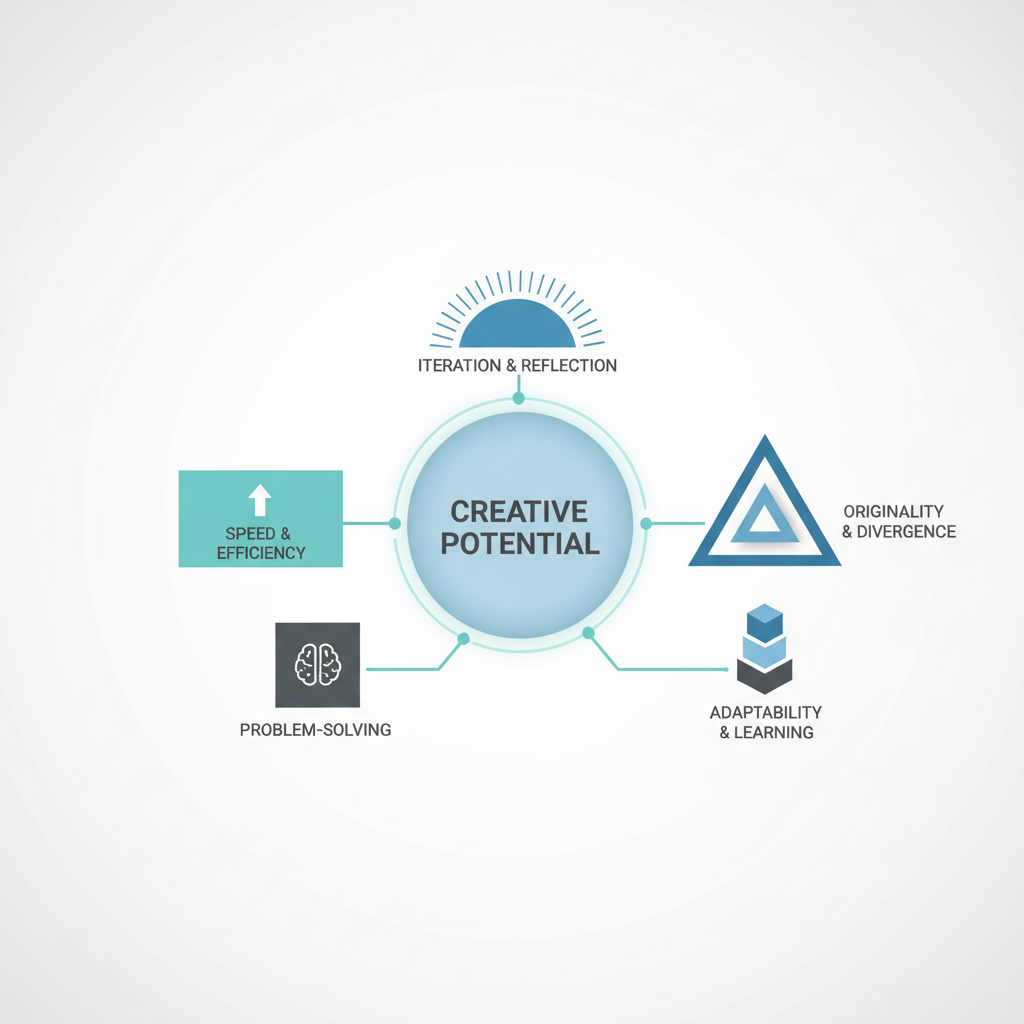
Creativity starts with new ideas. Performance tests help measure this skill directly. They go beyond theory and look at how you actually generate thoughts. These tests evaluate your ability to produce a wide range of solutions or concepts.
For example, you might be asked to list many uses for a common object. This simple task shows your divergent thinking skills. Divergent thinking is key to creativity. It’s about exploring many possible solutions. Instead of focusing on one correct answer, you come up with many unique ones [7].
Our Creative Ability Test uses methods based on science. It assesses how easily and flexibly you generate ideas. This shows you are open to new possibilities. It also highlights your cognitive flexibility, which is your mind’s ability to switch between different concepts. Understanding this helps you see your unique creative strengths.
Understanding How You Approach and Solve New Problems
Creativity is more than just having ideas. It’s also about how you use them. Performance tests offer a look into your problem-solving process. They don’t just check the final answer; they observe your method when you face a new challenge.
When solving new problems, you show several creative skills:
- Originality: This is about coming up with truly unique and uncommon ideas.
- Fluency: This is how many useful ideas you can think of quickly.
- Flexibility: This measures how many different types of ideas you explore.
- Elaboration: This shows your ability to add rich details to your ideas.
Our assessment looks at these areas to help you understand your personal thinking style. Do you prefer a structured plan, or are you more spontaneous? Knowing this helps you use your natural strengths. It allows you to solve real-world problems more effectively. This knowledge is key for innovation and personal growth.
Using Feedback to Help Your Creativity Grow
Unlocking your creative potential is a journey. Performance tests give you a clear starting point. They offer useful feedback on your unique creative style. This personal information is a powerful tool that turns uncertainty into a clear plan for improvement.
Here’s how this feedback helps you:
- Targeted Improvement: If you are good at fluency, you can focus on making your ideas better. If flexibility is an area for growth, you can practice seeing things from different angles.
- Better Problem-Solving: Understanding your creative style helps you approach challenges differently. You can use your strengths on purpose, which leads to more innovative solutions.
- Career Growth: Creativity is valued in many jobs. Our feedback gives you practical tips to boost your innovation skills and support your professional goals.
- Personal Growth: Gaining confidence in your creative skills is powerful. It helps you build a mindset of always improving.
The Creative Ability Test offers detailed feedback with useful tips based on your results. This guides you to improve your cognitive flexibility and divergent thinking. As a result, you go from just knowing your potential to actively growing it. Start using your creativity in meaningful ways today.
Frequently Asked Questions
What are the 4 types of psychological tests?
Psychological tests are tools that help you understand yourself. They measure how you think, feel, and act. These assessments give you valuable self-awareness and often fall into four main types:
- Ability/Aptitude Tests: These tests check your potential to learn or do certain tasks. For example, they might measure your thinking skills or creative talent. Our Creative Ability Test helps you find your unique creative strengths.
- Achievement Tests: These tests measure what you already know. They check your current skills or knowledge in a specific subject, like a final exam for a class.
- Personality Tests: These explore your typical ways of thinking, feeling, and acting. They can show personality traits like being introverted, organized, or open to new things [source: https://www.apa.org/education-career/guide/science-psychology].
- Neuropsychological Tests: These tests check how your brain is working, especially after an injury or illness. They look at skills like memory, focus, and problem-solving.
Knowing these types helps you see how a creative test fits in. It’s a great tool for personal growth.
What is a typical performance test example?
A typical performance test shows how you usually act. It’s not about your best effort, but your everyday approach. These tests reveal your natural tendencies and consistent patterns.
Imagine a test asks you to brainstorm uses for a common object, like a brick. The goal isn’t to find the “best” answer, but to see how your ideas naturally flow. This kind of task shows how you think creatively in a low-pressure setting. It’s different from a “maximum performance” test, which pushes you to get the highest score possible.
This type of test helps you discover your natural problem-solving style. It gives you a starting point for understanding your creative strengths and offers useful tips on how you create new ideas.
How does a performance test differ from a verbal test in psychology?
Performance tests and verbal tests measure abilities in different ways. It’s important to know how they are different.
- Performance Tests: These tests require you to do a task, not just talk about it. You might solve a puzzle, handle an object, or come up with new ideas. For example, our Creative Ability Test asks you to complete creative tasks. This shows your skills in action and is great for seeing how you apply your creative thinking.
- Verbal Tests: These tests use words. You answer questions by writing, speaking, or reading. Vocabulary tests and essays are common examples. They measure what you know and how well you can explain it with language.
The main difference is action versus words. Performance tests show what you can do, while verbal tests show what you know. Both are valuable, but performance tests give a clearer picture of your creative skills in action. They connect ideas to real-world use.
What is an example of a group test in Psychology?
A group test in psychology is when many people are tested at the same time. This method is efficient and ensures everyone takes the test under the same conditions. This makes it fair to compare the results.
A common example is a creativity test given to an entire class. Imagine a teacher gives all students the same design challenge, materials, and time limit. For instance, the task could be to “design a new type of transportation.” Everyone’s work is then graded using the same rules. This is a group test because it measures the creative skills of many people at once [source: https://psycnet.apa.org/record/2012-00507-000].
These tests are often used in schools or workplaces. They help find patterns or individual strengths in a group. For example, a test could find which students are best at brainstorming many ideas. This information is useful for creating training and development programs.
Sources
- https://www.apa.org/pubs/books/4318090
- https://psycnet.apa.org/record/2012-09413-004
- https://www.sciencedirect.com/topics/psychology/divergent-thinking
- https://www.journals.uchicago.edu/doi/full/10.1086/665988
- https://psycnet.apa.org/record/2012-07383-001
- https://www.sciencedirect.com/science/article/pii/B9780123743322002573
- https://www.apa.org/education-career/guide/divergent-thinking
Leave a Reply