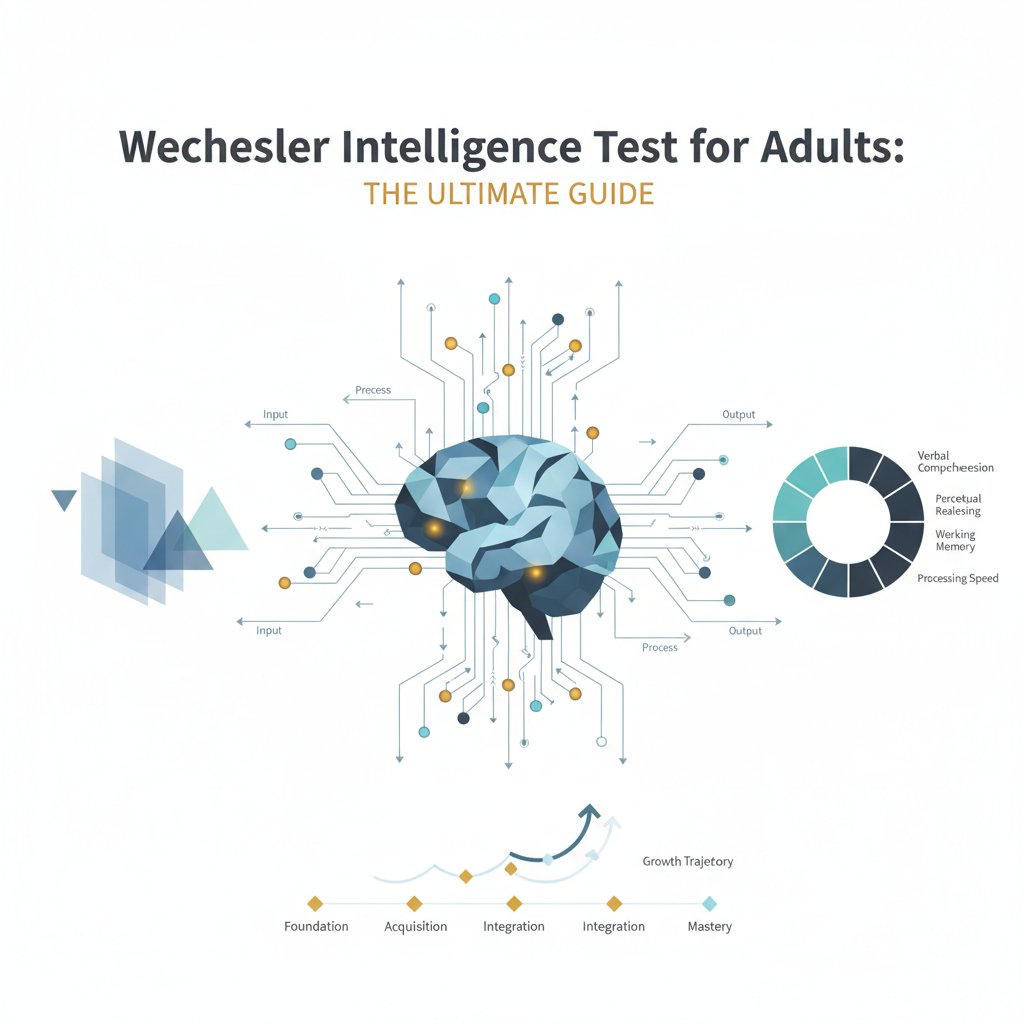
The Wechsler Intelligence Test for Adults, known as the Wechsler Adult Intelligence Scale (WAIS), is a professionally administered IQ test measuring cognitive abilities. It evaluates key areas such as verbal comprehension, perceptual reasoning, working memory, and processing speed to provide a comprehensive profile of an individual’s intellectual strengths and weaknesses.
Have you ever wondered how your mind works—how it learns, solves problems, and adapts? Our cognitive skills are key to how we experience the world. For decades, the Wechsler family of intelligence tests has been a primary tool for understanding these abilities. Among these, the Wechsler Intelligence Test for Adults, also known as the WAIS psychological test, provides a detailed look at adult intelligence, offering insights that go beyond a single number.
This guide will explain the entire Wechsler family, including the WAIS, the WISC psychology test for children, and the WPPSI intelligence test for preschoolers. We will break down what each test measures, how they differ, and what their scores mean in practical terms. Understanding these tests can shed light on your own cognitive strengths or those of others. Our goal is to make complex psychological concepts accessible and give you a clearer view of how intelligence is measured through tools like the WAIS in psychology.
By the end of this article, you will have a clear understanding of the Wechsler tests and their importance. We will also explore the connection between traditional intelligence scores and creativity. While IQ tests measure specific cognitive skills, they don’t capture your full creative potential. Join us as we explain the science behind these tests, connect them to problem-solving, and show you how to unlock your unique creative abilities for personal growth and innovative thinking.
What is the Wechsler Family of Intelligence Tests?
The Wechsler family of intelligence tests are a key part of psychological assessment. They are well-known and trusted tools used to understand a person’s thinking skills and mental strengths [1]. Professionals around the world use them to get a detailed look at how someone thinks and solves problems.
Created by Dr. David Wechsler, these tests provide a complete picture of a person’s intelligence. They measure different skills, like understanding words and processing information quickly. Because the tests are designed for all ages, there are special versions for children, teens, and adults.
Learning about how you think is an important part of understanding yourself. It helps you see your own mental strengths and weaknesses. With this knowledge, you can use your talents more effectively and identify areas to improve. This is helpful for anyone, from students to professionals.
Wechsler tests measure general intelligence, which provides a foundation for other skills. They offer a look into your basic thought processes, which also support creative thinking. For example, strong reasoning helps you connect different ideas. A good working memory lets you hold several thoughts at once. Both are key for developing new ideas.
At Creative Ability Test, we look at a person’s full potential. We know that general intelligence and creativity are separate but related. Learning about your thinking skills is a great addition to our focus on creativity. It can give you a deeper understanding of your own creative abilities.
This complete approach helps guide you from being unsure to having clear self-knowledge you can use. It changes how you see your own mind and shows you practical ways to apply your unique mental and creative talents.
What Are the Different Types of Wechsler Tests?
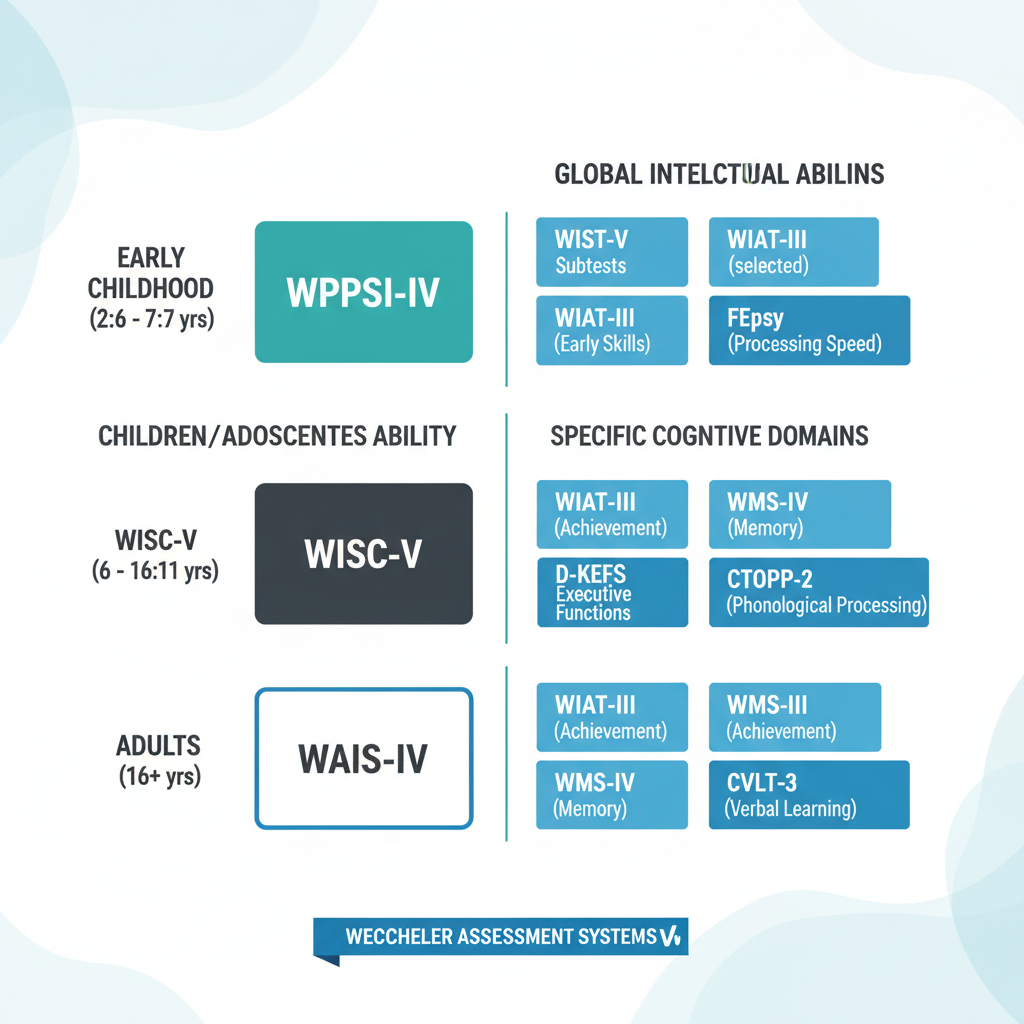
The Wechsler Adult Intelligence Scale (WAIS)
The Wechsler Adult Intelligence Scale (WAIS) is a popular IQ test for adults. It measures thinking skills in people from age 16 to 90 years and 11 months [2].
The WAIS measures key thinking skills. These include verbal comprehension, perceptual reasoning, working memory, and processing speed. The results show how a person processes information and solves problems.
If you’re curious about your creativity, these scores are helpful. For example, strong perceptual reasoning is tied to visual thinking, a key part of creative breakthroughs. A good working memory also helps with complex problem-solving, which is vital for new ideas. The WAIS shows your unique thinking style. This self-awareness can help you grow personally and professionally.
The Wechsler Intelligence Scale for Children (WISC)
The Wechsler Intelligence Scale for Children (WISC) is an IQ test designed for children and teens. It measures their thinking skills. The test is for those between 6 years 0 months and 16 years 11 months old [3].
Like the WAIS, the WISC measures several thinking skills. It looks at verbal comprehension, visual-spatial abilities, fluid reasoning, working memory, and processing speed. This gives a full picture of a child’s strengths and weaknesses. The information is very useful for school planning.
Understanding a child’s thinking skills can help nurture their creativity. For instance, strong fluid reasoning means they are good at solving new problems, which is key for creative thinking. Supporting these skills early on can boost their creativity. The WISC shows how a child thinks, which helps parents and teachers support them better.
The Wechsler Preschool and Primary Scale of Intelligence (WPPSI)
The WPPSI is an IQ test for the youngest children. It measures thinking skills in kids from 2 years 6 months to 7 years 7 months old [4].
The WPPSI measures skills like verbal comprehension, visual-spatial, working memory, fluid reasoning, and processing speed. Some parts of the test are only for older kids in this age range. This makes the assessment suitable for their age.
Understanding a young child’s thinking patterns is very helpful. It shows how they learn about the world. This knowledge can help you encourage their natural curiosity and imagination. This helps create a space where creativity can grow. The WPPSI is useful for early support and personalized learning.
The Wechsler Abbreviated Scale of Intelligence (WASI)
The Wechsler Abbreviated Scale of Intelligence (WASI) is a quick IQ test. It’s a shorter version of the other Wechsler tests. It is for people from 6 to 90 years old [5].
The WASI measures key thinking skills, including verbal comprehension and perceptual reasoning. This short test gives a good estimate of a person’s overall thinking ability. It is often used when a full, comprehensive assessment is not needed, such as for screening or research.
The WASI is less detailed, but it is still very useful. It gives a quick look at a person’s main thinking strengths. Knowing these strengths helps you understand yourself better. It can also help you improve your creative problem-solving skills. Even a short test can make you curious about your own thinking style and potential.
What is the WISC test in psychology?
What the WISC Measures
The Wechsler Intelligence Scale for Children (WISC) is an important tool that helps us understand a child’s thinking skills. This test is for children from 6 to 16 years and 11 months old [source: Pearson Assessments]. It’s important to understand how a child thinks to support their development.
The WISC is not about a single score. Instead, it gives a detailed look at a child’s cognitive strengths and weaknesses. This helps parents and teachers create the right learning plans. It also helps children use their natural talents.
Specifically, the WISC measures several key areas:
- Verbal Comprehension: This looks at how well a child understands and uses language. It shows their general knowledge and ability to reason with words.
- Visual Spatial: This checks how well a child sees patterns and understands visual information, like shapes and spaces.
- Fluid Reasoning: This measures a child’s ability to solve new problems by thinking logically without relying on what they already know.
- Working Memory: This checks how well a child can hold and use information in their mind. This skill is key for learning and following directions.
- Processing Speed: This measures how quickly a child can handle simple information and complete tasks.
By looking at these areas, the WISC provides useful information. This information can help a child grow and succeed in school. It helps pinpoint where a child might do well or need extra support. This complete picture goes beyond simple labels like “smart” or “not smart” and helps a child reach their full potential.
WISC vs. WAIS: Key Differences
The WISC and the Wechsler Adult Intelligence Scale (WAIS) are both well-respected intelligence tests, but they are for different age groups. It’s important to know the difference to make sure the right test is used for the person’s age and stage of development.
The main difference is who they are for. The WISC is for children and teens, while the WAIS is for adults. This difference isn’t just about age. It’s also about how thinking skills develop and show up at different life stages. Each test uses different tasks and questions. This makes the content a good fit for the age group being tested. For example, the WAIS may ask about situations an adult would face, while the WISC focuses more on school and childhood.
Here is a quick comparison:
| Feature | WISC (Wechsler Intelligence Scale for Children) | WAIS (Wechsler Adult Intelligence Scale) |
|---|---|---|
| Target Age Range | 6 years 0 months to 16 years 11 months | 16 years 0 months to 90 years 11 months [source: Pearson Assessments] |
| Purpose | Measures thinking skills in children and teens. Helps find learning disabilities, giftedness, or developmental delays. | Measures thinking skills in adults. Used for clinical diagnosis, career planning, and checking brain function. |
| Content & Tasks | Made for children’s experiences and school. Includes tasks like puzzles and questions that fit younger minds. | Made for adult thinking and knowledge. Includes harder reasoning puzzles, a wider vocabulary, and questions about adult life. |
| Focus | To understand a child’s learning style and potential. Helps with school planning and personal growth. | To check an adult’s cognitive strengths and weaknesses. Helps with career advice, treatment plans, and tracking mental changes over time. |
Both tests give valuable information about how a person thinks. Choosing the right test is key to getting accurate results. The right test helps create a better understanding of a person’s intellectual profile. In the end, this understanding is a key part of personal growth and creating strategies to help them succeed.
What are the 5 cognitive domains of WISC?
The Wechsler Intelligence Scale for Children (WISC) is a detailed test. It helps us see a child’s mental strengths and where they can improve. The test looks at intelligence in several key parts. The latest version, the WISC-V, measures five main areas of thinking. Understanding these areas shows how different people think.
These five areas are key to learning and solving problems. They include:
- Verbal Comprehension
- Visual Spatial
- Fluid Reasoning
- Working Memory
- Processing Speed [6]
While the WISC is for children, these thinking skills are important for everyone. They support creativity at any age. Let’s look at how each area shapes our thinking and creativity.
Verbal Comprehension
Verbal Comprehension is your ability to understand and use words. It tests your vocabulary, your understanding of ideas, and your ability to reason with words. Strong verbal comprehension means you can think with words effectively. You can also express complex ideas clearly.
This area is key for creative thinking. It allows you to:
- Understand details in language.
- Form abstract ideas.
- Link different ideas using words.
- Explain your creative ideas to others.
For example, a writer with high verbal comprehension can create vivid descriptions and explain complex plots. In the same way, a marketer can create powerful stories for new products. Improving your verbal skills can directly boost your creativity.
Visual Spatial & Fluid Reasoning
This combined area covers two key thinking skills. Visual Spatial skill is about seeing patterns and working with images in your mind. It’s about understanding how objects relate in space. Fluid Reasoning, on the other hand, is your ability to solve new problems. It’s about using logic to figure things out, even when you have no experience with the problem.
Both skills are vital for new ideas:
- Visual Spatial: This helps you visualize solutions. You can imagine new designs or mentally rearrange parts. Architects, graphic designers, and engineers rely heavily on this. It helps them picture how things fit together in space.
- Fluid Reasoning: This helps you solve new problems. You can spot patterns and come up with creative guesses. It’s the “thinking on your feet” part of intelligence. This skill is key for solving problems you haven’t seen before. For instance, a scientist designing a new experiment or an entrepreneur creating a new business plan uses fluid reasoning.
Together, these skills help you imagine what’s possible. They also help you find new ways to get things done. They are about seeing both the big picture and the logical steps needed to get there.
Working Memory
Working Memory is your mental workspace. It’s the ability to hold and use information in your mind for a short time. This could be remembering a list of steps or combining several ideas to form a new one. It’s like a mental scratchpad for active thinking.
This area plays a huge role in creativity. Strong working memory allows you to:
- Stay focused on a creative task.
- Connect different ideas.
- Hold multiple options in mind while brainstorming.
- Improve your ideas step-by-step.
Imagine composing music or writing a story. You need to remember themes, characters, and melodies as you create. Working memory makes this possible. You can improve your working memory with focused practice. Try activities that make you focus for a long time, like complex puzzles or strategy games.
Processing Speed
Processing Speed is how quickly you can do simple mental tasks. It measures how efficient your thinking is. This includes quickly scanning information, making fast decisions, and doing tasks correctly. It shows how fast your brain can see information and react.
While speed isn’t creativity, it helps your creative ideas flow. A high processing speed means you can:
- Come up with ideas quickly.
- Move quickly between different thoughts.
- Put your creative ideas into action faster.
- Quickly adjust to new information as you create.
For example, a fast processing speed helps a coder quickly fix a bug or a graphic designer quickly try out different layouts. This efficiency leaves more mental energy for bigger creative challenges. It keeps your brain from getting stuck on basic tasks.
Understanding these areas of thinking gives you a clearer picture of how your mind works. They are all connected and add to your unique creative ability. The Creative Ability Test goes beyond these traditional measures. It explores how these basic skills work together. This leads to new ways of solving problems and thinking of original ideas. It gives you useful insights into your unique strengths [7].
What’s a good WISC test score?
Understanding the IQ Bell Curve
When you see a WISC test score, it helps to know what it means. Scores are often shown on a “bell curve.” This curve shows how most scores gather around the middle, or average.
The average score for the WISC and most IQ tests is 100. About two-thirds of people score between 85 and 115. This is the “average” range.
Scores are compared to a large group of people. This shows how one person’s score compares to others. So, a score over 100 is above average. A score below 100 is below average.
The bell curve is a picture of this pattern. Most people score near the middle. Fewer people get very high or very low scores. This system is a standard way to compare thinking skills across different people [8].
Here is a general guide to WISC score ranges:
- 130 and above: Very Superior
- 120-129: Superior
- 110-119: High Average
- 90-109: Average
- 80-89: Low Average
- 70-79: Borderline
- Below 70: Extremely Low
This list helps you understand the results. But remember, these are just general groups. They give a quick look at certain thinking skills.
What Do the Numbers Mean in the Real World?
A WISC score is more than just a number. It shows a child’s thinking strengths and where they might need more help. A high score points to strong thinking skills, like understanding words or solving problems. A lower score might point to learning challenges. This shows where extra support could help.
For example, a child with a high Verbal score might be great with words. They may understand instructions easily or love to read. On the other hand, a lower Processing Speed score means a child might need more time for timed tests. It doesn’t mean they are less smart, just that they learn differently.
Remember, WISC scores only measure certain thinking skills. They don’t show a person’s full potential. Things like effort, motivation, and social skills are also key to success. An IQ test does not measure these things.
This information can help guide a child’s growth. Knowing their strengths helps parents and teachers adjust how they teach. This can also build confidence. Finding areas for improvement allows for focused help, like memory exercises or organization skills.
Also, the kind of intelligence WISC measures is just one piece of the puzzle. Creativity and new ways of solving problems are just as important. These skills work together with thinking skills to help people succeed. A high IQ doesn’t always mean high creativity, and a high level of creativity doesn’t always mean a high IQ.
Our platform, Creative Ability Test, looks at things differently. It focuses on your wider potential. While WISC measures specific thinking skills, our test explores your creative side. It finds your unique ways of thinking, like being flexible, innovative, or open to new things. Knowing this gives you a more complete picture of what you can do. It also offers real ways to grow personally and professionally.
Beyond IQ: How Does Intelligence Relate to Creativity?
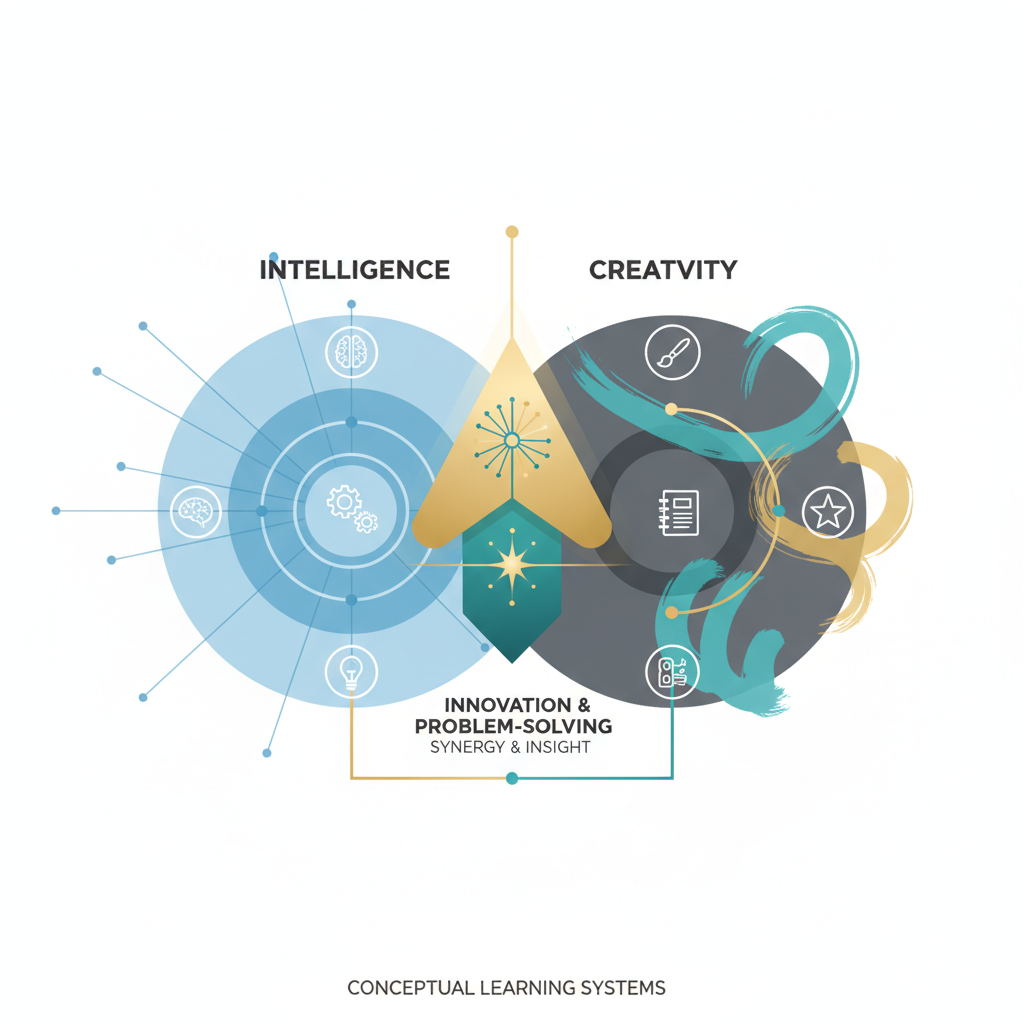
Can an IQ Test Measure Your Creative Potential?
Intelligence Quotient (IQ) tests measure specific thinking skills. They look at logical reasoning, problem-solving speed, and memory. These tests are good at measuring convergent thinking. This means finding the single best answer to a problem with a clear solution.
But creativity is different. It relies on divergent thinking, which is the ability to come up with many unique ideas for an open-ended problem. IQ tests aren’t designed to measure this type of thinking. That’s why they can’t show your true creative potential.
Research shows a link between IQ and creativity, but only up to a point. A certain level of intelligence helps. But beyond an IQ score of about 120, a higher IQ doesn’t mean more creativity [9]. Many other factors are also important for creativity.
Creativity is a mix of many things, including:
- Cognitive Flexibility: The ability to see things from different angles.
- Openness to Experience: A willingness to explore new ideas.
- Motivation: A natural drive to create and innovate.
- Domain-Specific Knowledge: Having expertise in a certain area.
- Personality Traits: Such as curiosity and a willingness to take risks.
So, while IQ tests can show some of your thinking strengths, they don’t show the whole picture. They miss the many different sides of creative potential.
Discover Your Strengths with the Creative Ability Test
To understand your creativity, you need a different kind of test. The Creative Ability Test is a science-backed tool made just for this. Unlike a standard IQ test, it gives you a complete picture of your unique creative strengths.
Our test looks at creativity from many angles. It focuses on how you solve problems and come up with ideas. The 30-question test explores key areas to give you personalized insights.
Here’s what our test helps you understand:
- Divergent Thinking: How well you come up with many different ideas.
- Cognitive Flexibility: How easily you switch between different thoughts or strategies.
- Problem-Solving Skills: How you use new ideas to solve challenges.
- Openness to New Experiences: How open you are to new things.
- Creative Thinking Styles: Your preferred ways of being creative.
We give you easy-to-understand results and practical tips based on your profile. This helps you grow your creative skills for personal and professional development. For example, if you’re good at coming up with ideas, we’ll suggest brainstorming techniques. If you need a boost in cognitive flexibility, we’ll offer exercises to help you think in new ways.
Our platform helps you turn confusion about your creative skills into clear self-awareness. Instead of feeling stuck, you’ll get a clear plan to improve. You’ll learn how to take your creative ideas and use them in the real world. Discover your unique creative strengths and unlock your full potential with the Creative Ability Test.
Frequently Asked Questions About Wechsler Tests
Is the WISC an intelligence test?
Yes, the WISC (Wechsler Intelligence Scale for Children) is a widely used intelligence test. It measures a child’s thinking skills and intellectual ability. The test helps find a child’s strengths and areas where they may need extra help.
It’s important to understand a child’s different thinking skills. The WISC looks at several key areas of intelligence. These areas are verbal comprehension, visual-spatial reasoning, fluid reasoning, working memory, and processing speed [10].
The WISC measures traditional intelligence, but it also shows how a child’s mind works. This can offer clues about their creative potential. Creative thinking often uses skills like flexible thinking and problem-solving. Some parts of the WISC test for these skills.
At Creative Ability Test, we take a different approach. We focus on specific areas of creativity. Our test is made to find your unique creative strengths. You’ll get practical tips to help you grow and think in new ways.
What is the WISC R test?
The WISC-R is the Revised edition of the Wechsler Intelligence Scale for Children. Published in 1974, it was a major update to the original WISC test.
Each new version of the WISC makes the test better. Updates include new questions, scoring standards, and a stronger scientific basis. The WISC-R was a standard test for children from 6 to 16 years old. It measured both verbal skills and hands-on problem-solving.
For many years, it was a very common tool for psychologists. They used it for school and clinical evaluations. But like all scientific tools, it was eventually updated.
Is WISC-R still used?
No, professionals don’t really use the WISC-R anymore. It has been replaced by newer versions. These newer tests are more accurate and reliable.
The science of intelligence testing is always improving. Researchers learn more about how the brain works. Because of this, new versions of the test are released. This keeps the tests accurate and trustworthy.
Several new versions have come out since the WISC-R. These include the WISC-III, WISC-IV, and the current WISC-V [11]. Each new version is based on the latest research. The questions are also updated to be more modern and fair.
Today’s versions give a more complete and accurate picture of a person’s abilities. They match our modern understanding of intelligence. Using an old test can give the wrong results. That’s why professionals always use the newest official version.
Where can you take a Wechsler IQ test?
Wechsler IQ tests, like the WISC for children or the WAIS for adults, are professional tools. They must be given and scored by a trained expert. You cannot take these tests online by yourself.
These tests are usually given in specific places:
- Licensed Psychologists’ Offices: Many psychologists in private practice offer IQ testing. They are trained to give the test correctly and explain the results.
- Schools: Most schools have a school psychologist. They use Wechsler tests to evaluate students for special education. This helps decide if a student needs extra support or a different class placement.
- Clinics and Hospitals: These tests are also available at hospitals and mental health clinics. They are often used to help diagnose conditions like learning disabilities, ADHD, or other thinking challenges.
- University Clinics: Some universities have psychology clinics that offer testing for a lower fee. Graduate students give the tests under the supervision of professors.
It’s very important to work with a qualified professional. They make sure the test is done right. They also explain what the scores mean in a helpful way. This feedback gives you a clear look at a person’s thinking strengths and weaknesses.
If you want to understand your creative side, the Creative Ability Test can help. Wechsler tests measure thinking skills, but our test helps you explore and grow your creativity. Our 30-question test gives you personal feedback. We provide practical tips to help you think more creatively. Find your unique creative talents and open up new opportunities for growth with us.
Sources
- https://www.pearsonassessments.com/professional-assessments/cultural-language/wechsler-family-of-tests.html
- https://www.pearsonassessments.com/store/us/en/products/clinical-assessments/ages-16-90/wechsler-adult-intelligence-scale–fourth-edition-/p/100000088.html
- https://www.pearsonassessments.com/store/us/en/products/clinical-assessments/ages-6-16/wechsler-intelligence-scale-for-children-%7c-fifth-edition-/p/100000787.html
- https://www.pearsonassessments.com/store/us/en/products/clinical-assessments/ages-0-5/wechsler-preschool-and-primary-scale-of-intelligence–fourth-edition-/p/100000096.html
- https://www.pearsonassessments.com/store/us/en/products/clinical-assessments/ages-6-90/wechsler-abbreviated-scale-of-intelligence-%7c-second-edition-/p/100000450.html
- https://www.pearsonassessments.com/store/usassessments/en/Store/Professional-Assessments/Clinical-SPED/Intelligence/Wechsler-Intelligence-Scale-for-Children%C2%AE-%7C-Fifth-Edition-/p/100001662.html
- https://www.creativeabilitytest.com/about-us
- https://www.apa.org/education-career/guide/science-psychology/intelligence
- https://pubmed.ncbi.nlm.nih.gov/22136015/
- https://www.pearsonassessments.com/store/usg/en/categories/products/clinical-assessments/intelligence/wechsler-intelligence-scale-for-children-%7c-wisc-v/p/100000771.html
- https://en.wikipedia.org/wiki/Wechsler_Intelligence_Scale_for_Children
Leave a Reply