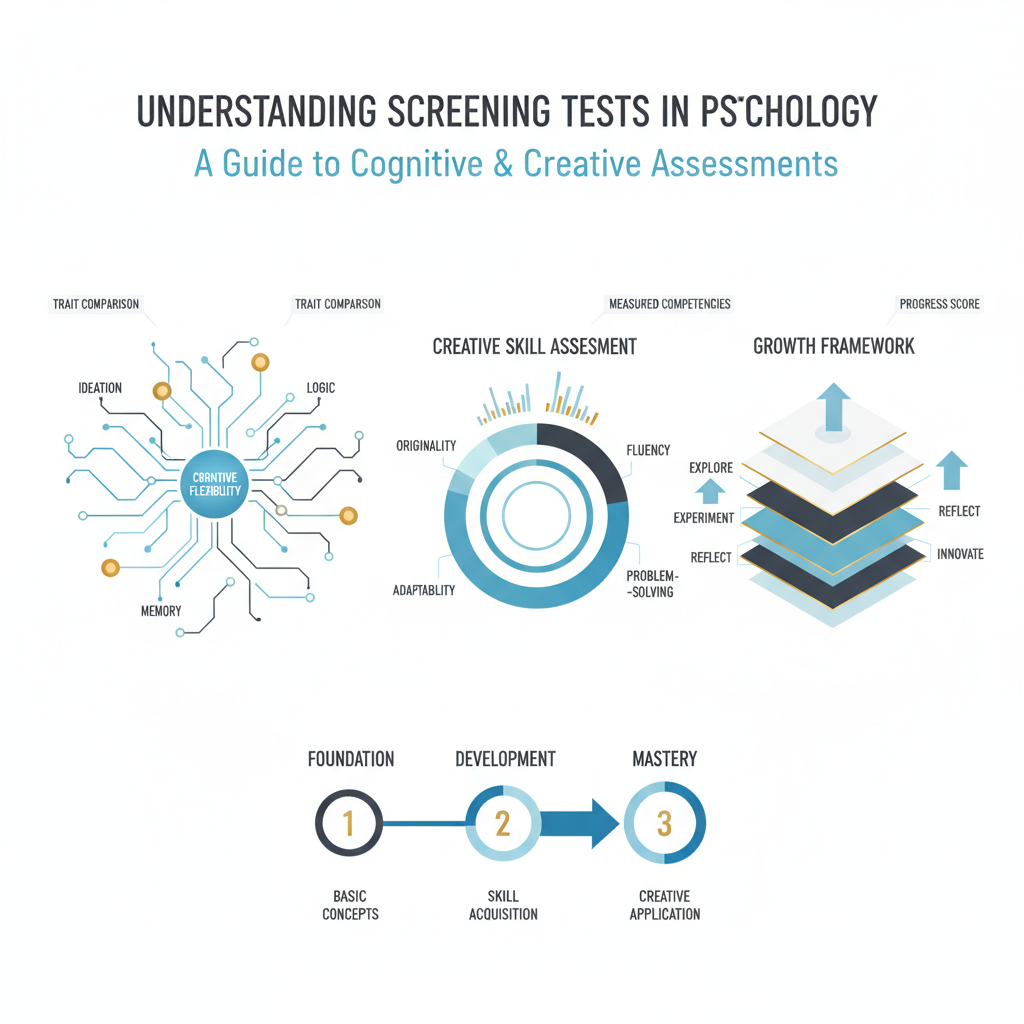
A screening test in psychology is a brief assessment tool designed to quickly identify potential characteristics, cognitive strengths, or risks for certain conditions. Its purpose is not to provide a diagnosis but to determine if a more in-depth evaluation is warranted, whether for clinical insight or for understanding personal traits like creativity.
Have you ever wondered about your unique way of thinking and solving problems? Understanding your natural abilities is the first step to unlocking your full potential. Psychology offers many tools to help, and screening tests are one of the most accessible. These initial assessments offer a glimpse into your cognitive processes and creativity, revealing strengths you might not know you have.
This article is your guide to psychological screening tests. We’ll explain what these tests are, how they differ from diagnostic tools, and the many areas they cover—from memory and reasoning to your creative potential. You’ll learn how a reliable screening test can highlight your unique thinking styles, offering practical ideas for personal growth and problem-solving in your daily life and at work.
Whether you’re curious about your cognitive flexibility, want to boost your creative thinking, or simply wish to understand the psychology behind innovation, a well-designed screening test is a clear, objective starting point. It’s a great step towards self-discovery, giving you the knowledge to build on your natural talents. Let’s begin by defining what a psychological screening test is.
What Is a Screening Test in Psychology?
The Purpose of a Preliminary Assessment
A psychological screening test is a helpful first step. It’s a quick way to get a glimpse into how a person thinks. Think of it as a flashlight that shines a light on specific areas for a closer look.
These tests help find your strengths and areas that need more focus. They give you a general overview without requiring a full, in-depth evaluation. For example, in schools, a screening can identify different learning styles [1]. For Professional Development, it might show leadership skills or how you prefer to work in a team.
When it comes to creativity, screening tests like our Creative Ability Test are very powerful. They help you discover your unique creative skills and thinking styles. Our science-based test looks at different parts of your creativity, such as your mental flexibility, how you solve problems, and your openness to new ideas. This gives you useful insights into how your mind creates new solutions and thoughts.
The main goal is to give you more self-awareness. This awareness helps you grow both personally and professionally. It helps you:
- Identify your natural creative talents.
- Understand your favorite ways to solve problems.
- Pinpoint areas where you can grow your creativity.
- Use your strengths effectively in everyday situations.
In the end, a preliminary assessment gives you a clear starting point. It takes you from being unsure about your abilities to having a clear awareness you can act on.
Screening vs. Diagnosis: Knowing the Difference
It’s important to know the difference between a screening test and a diagnosis. While both are types of assessments, their goals and detail are very different. A screening test gives you a first look. On the other hand, a diagnosis is a final, in-depth evaluation.
A screening test is designed to give a general picture. It suggests you might have certain traits or points out areas of interest. For example, a creativity screening shows your thinking styles. It doesn’t label you “creative” or “uncreative.” Instead, it shows how you handle challenges and come up with ideas.
In contrast, a diagnosis is a complete process done by a qualified professional. It includes detailed assessments, interviews, and information from several sources. A diagnosis results in a specific clinical label or the identification of a condition [2]. It is used to guide treatment plans or other interventions.
Here’s an analogy: A screening test is like a general health check-up. It might show that certain areas need more attention. A diagnosis, however, is like seeing a specialist after that check-up. The specialist confirms a condition and recommends a specific treatment. Our Creative Ability Test is only a screening tool. It offers valuable insights into your creative potential but does not provide any kind of psychological diagnosis.
Knowing this difference is key. It helps you use these tools in the right way. Our platform offers a powerful, science-backed screening for creativity. It’s a guide to help you understand and improve your skills. It gives you personal insights and tips for growth, helping you develop your creative thinking without any clinical meaning.
What Are the Different Types of Psychological Screening Tests?
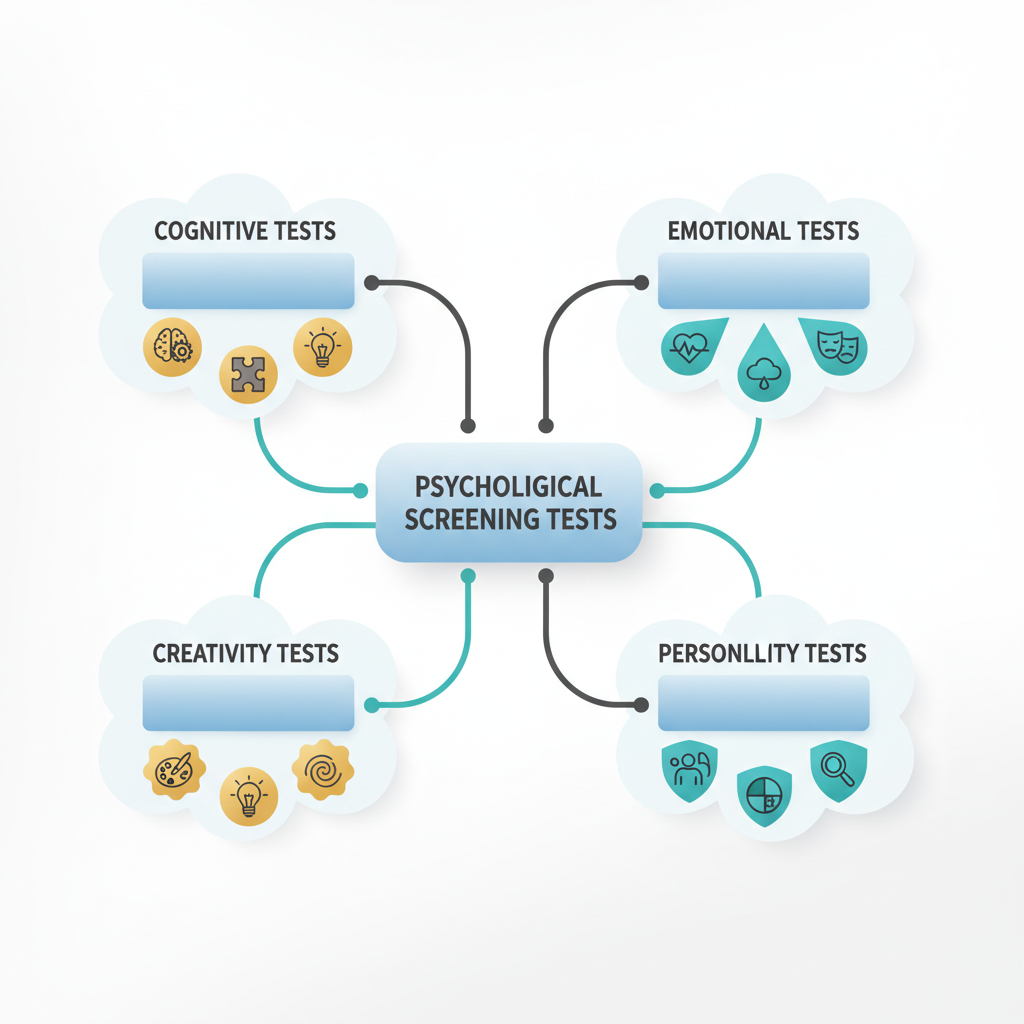
Clinical Screening for Mental Health
Screening tests have many important uses. A common type is the mental health screening. These tests are early detection tools that help identify possible signs of a mental health condition.
These screenings often look for common issues like depression, anxiety, stress, or substance use. They are usually quick, self-report questionnaires. People use them to get a basic idea of their emotional well-being.
It’s important to know that a screening is not a diagnosis. It simply suggests if you should see a mental health professional for a full evaluation. This helps people get support sooner [3], which can lead to better outcomes.
cognitive screening for Abilities like Memory and Reasoning
Cognitive screening is another key type of test. These tests measure mental skills like memory, attention, problem-solving, and processing speed. They help us understand how our brains function.
People use these screenings for many reasons. They can spot changes in thinking skills over time or find a person’s learning strengths and weaknesses. For example, a test might show someone is good at verbal reasoning but has slower processing speed.
These tests often use standard tasks, like puzzles or special memory exercises. The results give you a helpful look at your cognitive profile. Knowing your cognitive abilities is important, as it helps you manage school, work, and daily life. Plus, cognitive flexibility is a key part of creative thinking.
Creativity Screening for Innovative Potential
Creativity tests are a fascinating and growing field. They are designed to understand your potential for innovation. They measure the different parts of creative thinking and problem-solving.
These tests look at how you come up with new ideas. They check your ability for divergent thinking, which means finding many unique solutions to one problem. They also measure your openness to new experiences, along with your curiosity and imagination.
A good creativity test gives you a detailed look at your unique thinking style. It helps you find your true creative strengths. For example, our Creative Ability Test is a 30-question assessment based on science. It reveals several sides of your creativity. Our approach is based on proven methods.
The results are practical. They give you clear self-awareness and next steps. You get personalized feedback with strategies that match your creative profile. This helps you build your creative skills consistently.
Here are key benefits of understanding your creative potential:
- Better Problem-Solving: Learn to see challenges in new ways. This helps you find creative solutions at home and at work.
- Personal Growth: Finding your creative strengths builds confidence. It also encourages you to keep learning and improving.
- Career Growth: Creativity is a valuable skill at work. Understanding and growing it can open up new career opportunities and help you bring new ideas to your job.
- More Cognitive Flexibility: You get better at adapting your thinking. This makes it easier to switch between different ideas and points of view.
We use clear explanations and simple examples to make creativity easy to understand. Our platform helps you take what you learn about your creativity and use it in your daily life. This turns a basic understanding into real-world innovation.
How Can a Screening Test Help You Understand Your Strengths?
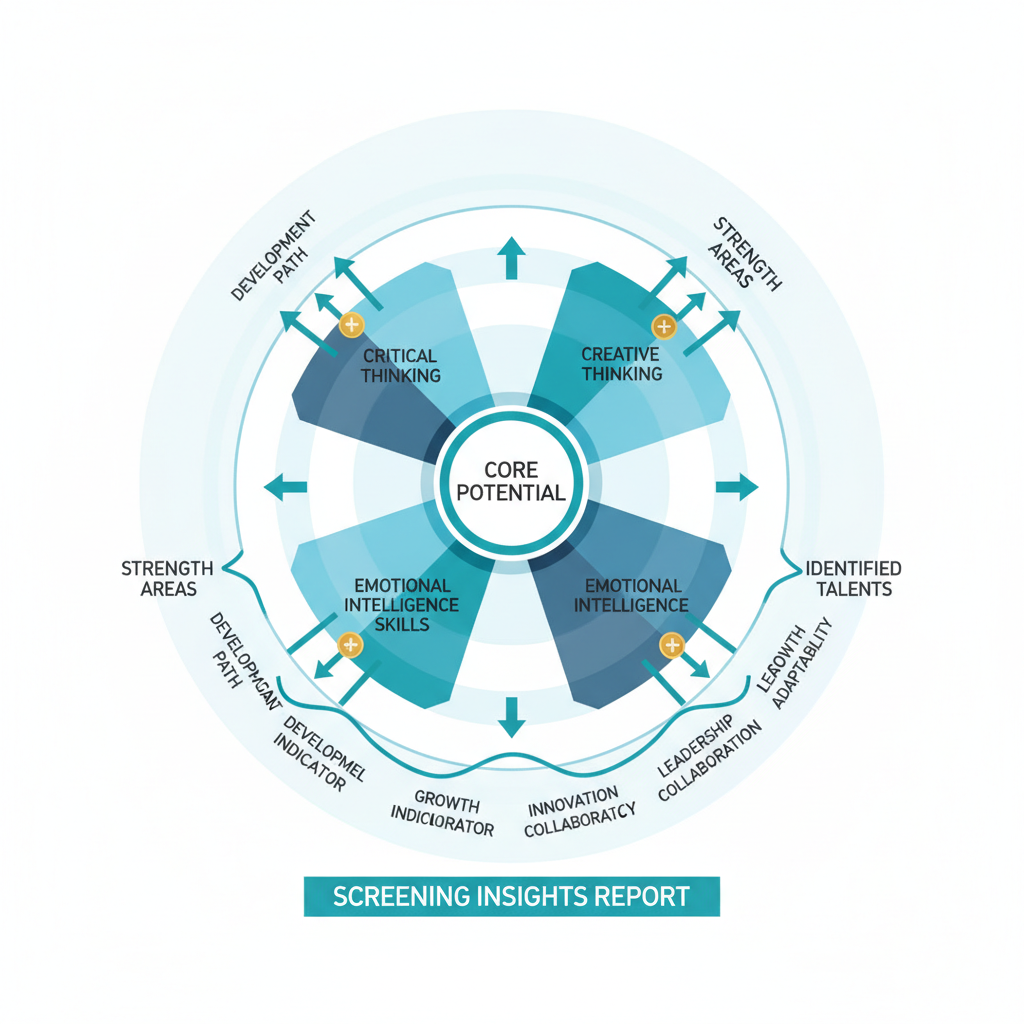
Find Your Thinking and Creative Skills
Knowing your unique skills is a powerful first step. A good screening test helps you find your natural thinking and creative strengths. Think of it as a compass that points you toward what you do best.
For example, the Creative Ability Test is a 30-question test based on science. It helps show the different parts of your creative ability. It looks at more than just simple answers to see how your mind works.
You might discover talents in several key areas:
- Divergent Thinking: This is how you come up with many different ideas. It’s key for brainstorming and finding more than one solution.
- Cognitive Flexibility: This is how easily you can change the way you think. It helps you adjust to new situations.
- Problem Sensitivity: This is a skill for seeing problems others might miss. It’s often the first step to solving a problem well.
- Originality: The test can show your skill for creating new and unique ideas. These ideas are often different from what’s common.
- Openness to Experience: This shows how open you are to new ideas and concepts. It’s a key part of creative thinking [4].
Finding these talents gives you a clear picture. It turns unclear feelings about yourself into solid facts about your skills.
Get Real Advice for Personal Growth
Knowing your strengths is just the first step. A good screening test gives you advice you can actually use. You get more than just scores; you get real guidance for improving yourself.
The Creative Ability Test gives you feedback just for you. It explains what your results mean. It also suggests specific ways to improve, based on your profile. This helps you go from just knowing your skills to actually building them.
Consider these benefits:
- Better Self-Awareness: You get to know your own creative thinking style better. This is the foundation for personal growth.
- Focused Improvement: You get specific tips for your creative skills, not just general advice. For example, if you’re good at divergent thinking, you might get advice on how to choose your best ideas.
- Build Confidence: Understanding your natural talents can boost your confidence. This makes it easier to take on new challenges.
- A Clear Path to Grow: The results give you a roadmap to improve your creative skills. It helps turn your creativity into a skill you can count on.
In the end, these insights are your guide. They help you develop your own creative style and lead to real personal growth.
Use Your Strengths to Solve Problems
Your creative strengths are more than just ideas. They are real tools you can use to solve problems and create new things. A screening test shows you how to use them in your daily life.
For example, say you find out you’re highly original. You can use this skill at work on purpose. You could suggest new solutions to your team or help create new products.
Here are a few ways to use your strengths:
- At Work: Use your divergent thinking to brainstorm new ideas in meetings. Use your cognitive flexibility to adjust when a project changes.
- In Your Personal Life: If you’re good at spotting problems, you can find the real cause of your own challenges. Then, you can use your creative skills to find new solutions.
- For School: Students can use their imagination to come up with great essay ideas. They can also use creative thinking to handle tough research questions.
- For Business Owners: Entrepreneurs can use their openness to new things to find gaps in the market. This helps them create new and exciting business ideas.
The Creative Ability Test helps you connect the dots. It links your natural creative talent with real-world use. This allows you to handle challenges better. It also helps you bring a fresh approach to your personal and professional life.
How Does a Creativity Screening Test Work?
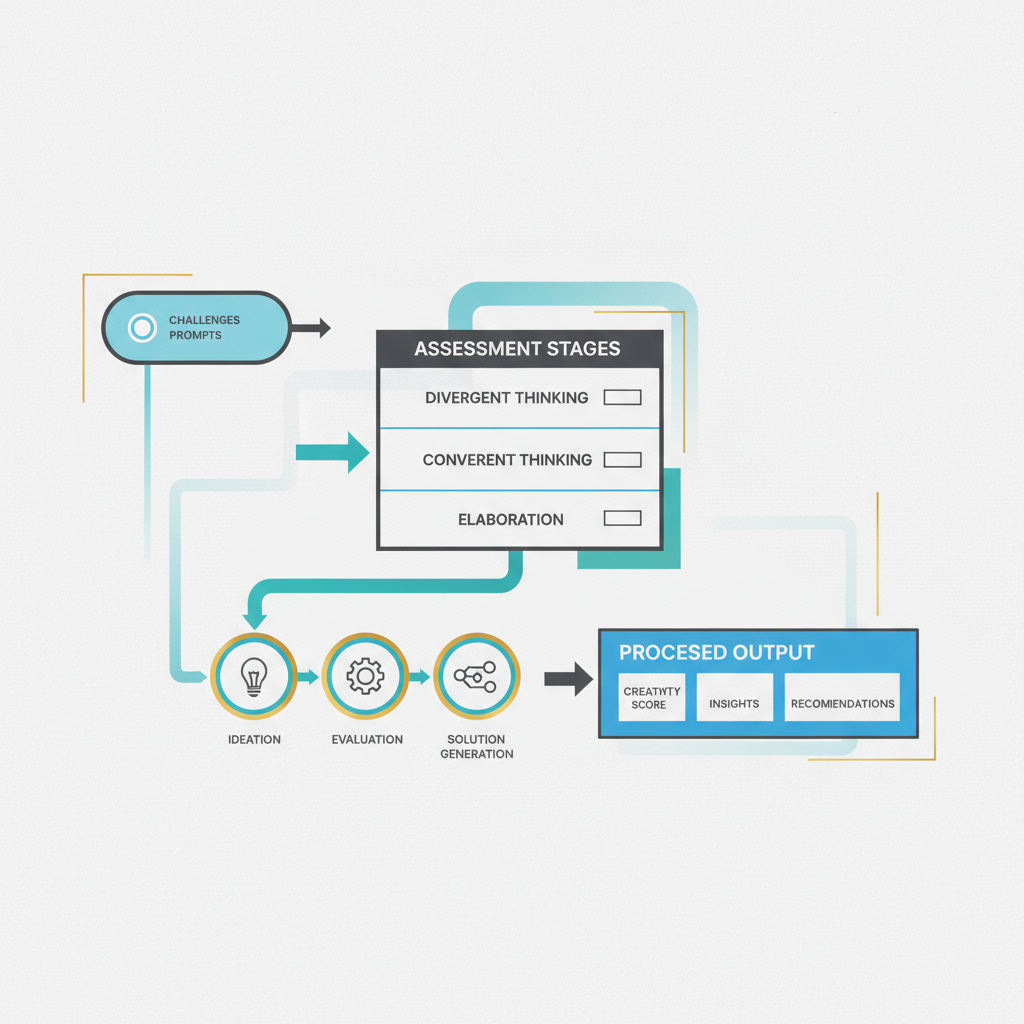
Measuring Key Dimensions like Divergent Thinking
Creativity is a mix of different skills. Our Creative Ability Test is a science-based, 30-question test that helps measure them. It is designed to show your unique creative strengths.
One key skill is divergent thinking. This is the ability to come up with many ideas from a single starting point [5]. For example, “How many uses can you think of for a brick?” Someone with strong divergent thinking will list many different and original answers.
Other key skills include:
- Fluency: This is the total number of ideas you can generate. More ideas often lead to better ones.
- Originality: This measures how unique your ideas are. We look for new and surprising connections.
- Elaboration: This is your ability to add details to an idea. Rich details make your concepts stronger and more complete.
- Cognitive Flexibility: This is your ability to look at things in new ways. It helps you find fresh solutions to problems.
- Openness to Experience: This personality trait is closely linked to creativity [6]. It’s about being open to new experiences and unusual ideas.
Our test questions are designed to make you think broadly and explore many solutions. This approach gives a clear picture of your creative strengths.
Interpreting Your Results for Practical Use
When you finish the Creative Ability Test, you get a personal report. This report is more than just a score. It gives you details about your creative style and how you think.
Your results show your strengths clearly. For example, you might be great at divergent thinking, which means you can easily brainstorm lots of ideas. Or, a high originality score suggests you often come up with new and unique concepts.
The feedback also explains how you think. Can you connect ideas that seem unrelated? Do you spot patterns others miss? Knowing this helps you use your natural strengths better.
The report also shows areas where you can improve. This isn’t about weakness. It’s about potential. For example, you could work on your elaboration skills by learning to add more detail to your ideas.
We explain each point with clear examples. This makes it easy to understand how your creative skills work in real life. Knowing this helps you use your creativity with more confidence.
Using Feedback to Enhance Your Creative Skills
The best part of a creativity test is the feedback you can use. It’s not just about knowing your score. It’s about using that knowledge to grow your skills.
Your Creative Ability Test report includes helpful tips. These tips are designed to improve your creative thinking. They help you use what you’ve learned to solve real problems.
Here are a few ways to use your feedback:
- Targeted Practice: If you want to improve cognitive flexibility, practice looking at problems from different angles. This helps train your brain to think in new ways.
- Boost Brainstorming: To improve fluency, try quick brainstorming sessions. Write down every idea that comes to mind. More ideas can lead to better ideas.
- Cultivate Originality: Read about different topics, travel, and explore new cultures. New experiences are great for sparking original ideas.
- Refine Ideas: To get better at elaboration, take a simple idea and add to it. Ask yourself, “How can I add more detail?” or “What if…?”
- Problem-Solving Application: Use your strengths to solve problems. If you’re good at divergent thinking, start by listing many possible solutions before choosing the best one.
These tips are based on your personal results. They turn knowledge into simple, clear actions. Studies show that creativity can be improved with practice [7].
By using these techniques regularly, you can improve your creative skills. This helps with both personal and professional growth. You will get better at solving problems and creating new things. Our test is a guide on your journey to becoming more creative.
What Should You Look for in an Online Screening Test?
The Importance of Scientific Grounding
When exploring your creative potential, it’s important to choose an online screening test carefully. The most critical factor is its scientific basis. This means the test is built on established psychological research and uses proven methods.
A test with a scientific basis offers reliable and valid results. Reliability means the test consistently measures what it’s supposed to. Validity means it accurately measures creativity, not another trait. Think of it like a trusted tool—you want it to work correctly every time [8].
Without this foundation, test results can be misleading. They might be entertaining but won’t offer real value for personal growth. Furthermore, these tests can’t truly help you understand your unique creative style.
The Creative Ability Test, for example, is evidence-based. Our 30-question assessment is based on deep research in cognitive psychology and creativity. This commitment to science gives you accurate, trustworthy insights into your creative strengths.
Look for clear information about how the test was made. Does it mention specific research or psychological theories? This transparency builds trust. It assures you that your results are based on solid science.
Ensuring Clarity and Actionable Feedback
A good online screening test should do more than just give you a “score.” It should provide feedback that is both clear and practical. You need to understand what your results mean in everyday life. Vague statements don’t help you improve.
Good feedback makes complex ideas simple. It breaks down your creative profile into easy-to-understand parts. For example, it might explain your skill in coming up with new ideas. It could also highlight your mental flexibility or openness to new experiences.
Beyond explanations, the feedback should offer practical tips. These tips help you build your creative skills. They turn abstract ideas into real steps you can take for personal and professional growth [9].
The Creative Ability Test excels in this area. We provide personalized feedback that outlines your specific strengths. It also identifies areas where you can grow your creativity. Our aim is to move you from feeling unsure to having a clear, useful understanding of yourself.
When looking at a test, ask yourself:
- Are the results easy for a beginner to understand?
- Does the feedback offer specific examples or scenarios?
- Are there practical tips for applying these insights daily?
- Does it inspire confidence and a clear path for improvement?
Choosing a test with clear, practical feedback helps you use your creativity to solve real-world problems and innovate.
Understanding the Scope: What the Test Can and Can’t Tell You
It’s important to have realistic expectations for any screening test. An online test offers useful information, but it is not a final diagnosis or a full life assessment. Its purpose is to give you a first look at specific parts of your thinking and creative skills [10].
A creativity test, like the Creative Ability Test, identifies your current creative potential and thinking styles. It measures things like your ability to generate new ideas. It also looks at how you approach problems creatively. This is a snapshot of your skills at this moment in time.
What a test *can* tell you:
- Your main creative thinking styles.
- Your creative strengths, such as original thinking.
- Potential ways you can grow your creativity.
- How to use your creativity in different situations.
- A starting point for creating your own growth plan.
What a test *cannot* tell you:
- If you are “creative” or “not creative.” Creativity changes and grows.
- A full psychological diagnosis. This is not a clinical tool.
- If you will succeed in a creative field. It shows potential, not your destiny.
- Every detail of your personality. It focuses on creativity and thinking skills.
Our platform is designed to empower you. We help you understand your creative strengths and unique skills. The Creative Ability Test offers a starting point for self-discovery. It guides you toward improving your creative thinking. This allows you to embrace personal growth and find new ways to solve problems.
Frequently Asked Questions
What are some psychological testing examples?
Psychological tests give us helpful insights into how people think and behave. They help us understand ourselves better. They come in many different forms, and each one has a special purpose.
Here are some common examples:
- Cognitive Ability Tests: These tests check your mental skills. They measure areas like memory, problem-solving, and reasoning. Our Creative Ability Test, for example, looks at how flexible your thinking is. That’s a big part of being creative.
- Personality Assessments: These tests show your unique personality traits. They can show how you connect with the world around you. For example, some measure your openness to experience. This trait is closely linked to creativity.
- Creativity Screening Tests: These tests measure your potential for new ideas. They look at your imagination and ability to brainstorm. The Creative Ability Test is a prime example. It helps you find your unique creative strengths and thinking styles.
- Clinical Diagnostic Tests: Experts use these to check for mental health conditions. They help diagnose conditions like anxiety or depression. They are very important for creating treatment plans.
- Neuropsychological Tests: These tests check how your brain is working. They can find issues with specific brain skills. For example, they might test attention or language skills.
Each type of test gives you a different way to learn about yourself. Knowing these types helps you pick the right tool for your own growth. [11]
Can you take a psych evaluation test online for free?
Yes, you can find many free psychological quizzes and screeners online. They cover a wide range of topics, like personality or creative style.
But, it’s important to know the difference between them:
- Informal Quizzes: Most free tests are just for fun or curiosity. They often aren’t backed by science. This means the results may not be accurate. They only give you a basic look.
- Scientifically Validated Assessments: Professional tests, like the Creative Ability Test, are based on real research. Our 30-question test is backed by science. It gives you feedback you can trust and use. We use methods that are proven to work.
Free tests are a good place to start if you’re curious. But they usually don’t offer the deep insights needed to truly grow. Using a trusted, science-backed test has real benefits. You get personal insights and useful tips. This helps you boost your creativity and grow as a person.
What is a mental health test online?
An online mental health test is a screening tool. It helps people check for symptoms of common conditions. These often include anxiety, depression, or stress.
Here’s what you should know about them:
- Purpose: Their goal is to help you become more self-aware. They help you see if you might have certain symptoms. This can be the first step to getting help.
- Not Diagnostic: It’s important to remember these tests can’t give you a diagnosis. Only a qualified mental health professional can do that. An online test isn’t a substitute for a full evaluation by an expert.
- Guidance to Support: If a screening shows you might have an issue, it will usually suggest you see a professional. This advice is key to getting help when you need it.
- Focus Difference: Mental health tests focus on your well-being. Creative tests focus on your strengths. Our Creative Ability Test, for example, helps you understand and improve your creative thinking. This helps you grow personally and professionally.
These online tools are a helpful first step. Always talk to a mental health professional if you have concerns. They can give you expert guidance and support. [12]
Sources
- https://www.niu.edu/citl/resources/guides/instructional-guide/learning-styles/index.shtml
- https://www.apa.org/topics/psychological-assessment
- https://www.nimh.nih.gov/health/topics/mental-health-screenings
- https://psycnet.apa.org/record/2012-07502-001
- https://en.wikipedia.org/wiki/Divergent_thinking
- https://www.psychologytoday.com/us/blog/the-wide-open-world/201908/the-link-between-openness-and-creativity
- https://psycnet.apa.org/record/2017-06283-001
- https://www.apa.org/education-career/guide/assessment-research
- https://cft.vanderbilt.edu/guides-sub-pages/writing-good-feedback/
- https://www.ncbi.nlm.nih.gov/pmc/articles/PMC8900010/
- https://www.apa.org/education-career/guide/testing
- https://www.nami.org/About-Mental-Illness/Diagnosing-Mental-Illness/Online-Screenings
Leave a Reply