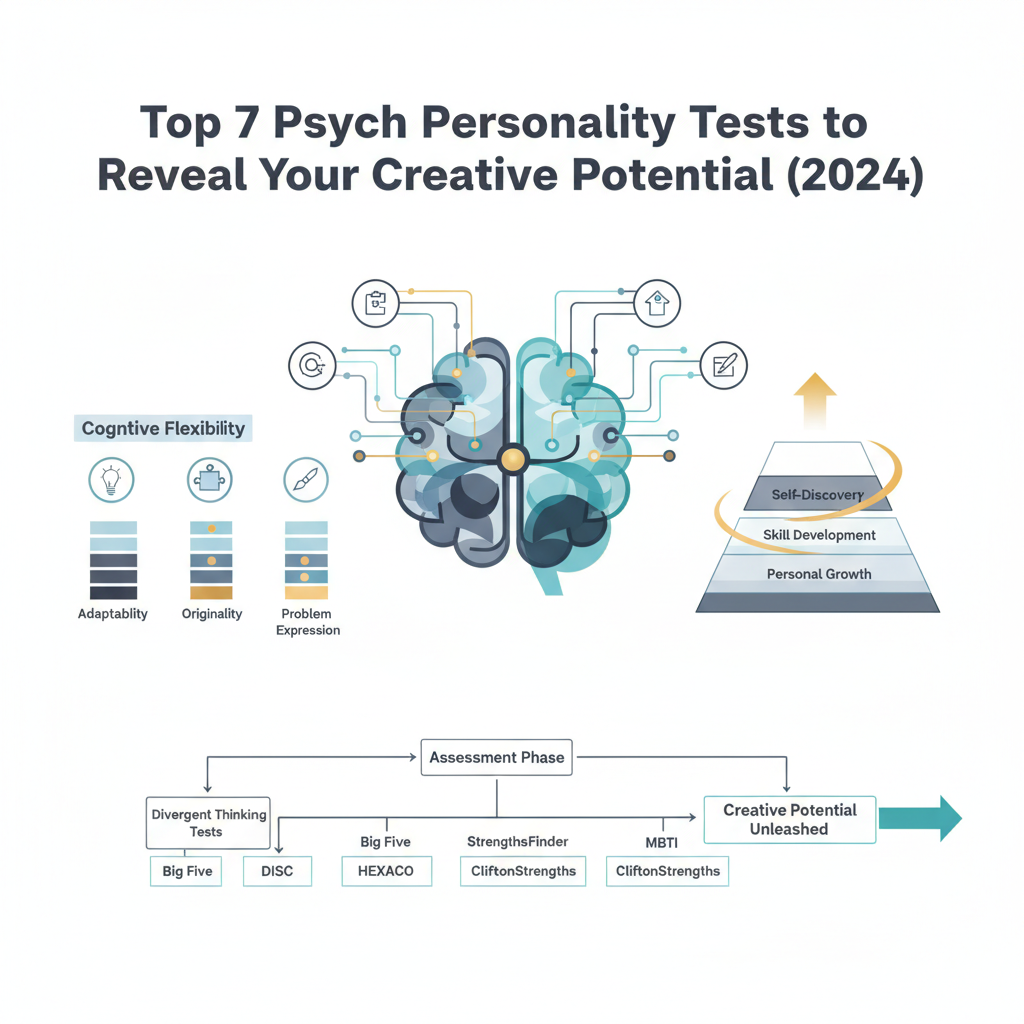
A psych personality test is a scientifically designed assessment used to understand an individual’s distinct character traits, emotional patterns, and cognitive styles. Popular examples like the Big Five (OCEAN test) and MBTI provide a structured psych profile that offers insights into your strengths, weaknesses, and how you approach creative challenges and interact with the world.
Have you ever wondered what makes you creative? Maybe you’ve had a great idea or found a new way to solve a problem and wished you knew how your mind worked. Creativity isn’t just for artists. It’s a key skill that helps us grow, succeed at work, and deal with a complex world. When you understand your own creative style, you can find new ways to approach challenges and opportunities.
The good news is that it’s easy to learn more about your creative potential. This article will introduce you to psychological assessment and show you top psych personality test options. These tests can reveal your unique creative strengths and ways of thinking. You’ll learn about different tests, from detailed ones that offer personal insights to popular tools like the ocean test psychology. We’ll explain how these tests work and what concepts like cognitive flexibility and divergent thinking mean in simple terms.
Ready to learn more about yourself? By exploring these reliable psychology character test options, you’ll better understand your natural talents. You will see how your personality affects your problem-solving skills and learn practical ways to improve them. Instead of guessing, you can use your psych profile test results to build creative confidence. These insights can be used for real-world projects and personal growth. Let’s unlock your creative power together.
What Can a Psych Personality Test Reveal About Your Creativity?

Have you ever wondered what makes some people so creative? A personality test can offer a look into your unique creative style. These tests aren’t about labels. Instead, they show you the specific traits and ways of thinking that spark your imagination and help you solve problems.
Taking a personality test helps you understand yourself better. You’ll learn how your key traits affect your creative side. This knowledge helps you use your strengths and build new skills. It also shows you how to be more creative in all parts of your life.
Discover Your Creative Style
A good personality test does more than scratch the surface. It looks at the foundations of your creativity. You’ll learn about your natural tendencies and thinking patterns. Knowing this is key for personal growth and professional success.
Here’s what a quality personality test can show you about your creative style:
- Openness to Experience: This is a key part of creativity. It’s your willingness to explore new ideas and try new things. People who are high in openness are often more imaginative and insightful. This trait is strongly linked to creative ability in many areas [1].
- Cognitive Flexibility: This is your ability to switch your point of view. It also shows how easily you adapt to new situations. Flexible thinkers can connect ideas that seem unrelated, which is key for creative problem-solving.
- Divergent vs. Convergent Thinking: A test can show which thinking style you prefer. Divergent thinking is about creating lots of new ideas. Convergent thinking is about finding the single best solution. Knowing your balance helps you improve at both.
- Problem-Solving Approaches: Learn how you naturally solve problems. Do you like logical, step-by-step plans? Or do you prefer to use your intuition and think outside the box? Knowing this helps you improve your approach.
- Potential for Innovation: Your overall results can show your ability to innovate. This includes how open you are to change and how ready you are to create new solutions.
Using Your Results to Grow
Understanding these traits is the first step. The real value comes from using what you learn. A good personality test turns complex results into practical advice. It helps replace uncertainty with clear self-awareness.
Your personality test results can give you:
- Personalized Strategies: Get advice tailored to your creative strengths. This can help you overcome specific creative blocks.
- Better Self-Awareness: See the patterns in how you think and act. This makes you more aware of your own creative process.
- Targeted Growth: Find specific areas where you can build your creativity. This might mean practicing idea-generating exercises or trying new things.
- More Confidence: Discover your hidden creative talents. This boosts your confidence in your own abilities. You’ll feel more ready to take on new creative projects.
- Real-World Application: Learn how to use what you’ve learned to solve everyday problems. This helps you be more innovative at work, in school, or in your hobbies.
At Creative Ability Test, our science-based 30-question test measures different sides of your creativity. It gives you personalized feedback and practical tips. We help you measure, understand, and grow your creative potential. Take our personality test today to unlock your full creative power.
The 7 Best Psychology Personality Tests for Creative Self-Discovery

Knowing your personality is a great way to unlock your creative potential. Psychology personality tests offer a clear path to learn about your thinking styles, preferences, and natural strengths. These insights can show you how you solve problems, create ideas, and innovate.
Here, we explore several tests. Some are backed by science and give a deep analysis. Others are a lighter, more fun way to learn about yourself. Each test can help you link your personality to your creativity. This helps you grow personally and professionally.
1. The Creative Ability Test: Measure Your Innovation Potential
The Creative Ability Test (CAT) is a special tool made to measure and improve your creative skills. It goes beyond general personality traits. It focuses on how you create ideas, handle new challenges, and think in new ways. This platform has a 30-question test based on science.
It also gives you personalized feedback. You get practical tips to boost creativity in your life and work. The CAT focuses on flexible thinking, coming up with many ideas, and being open to new things. These are key parts of being creative.
Our detailed test turns confusion about your potential into clear self-awareness. You’ll get useful insights to help you use creativity to solve real problems and innovate.
- Key Focus: Measures creative thinking, innovation skills, and flexible thinking.
- Benefits for Creativity: Gives you a custom plan to improve your creative process. It shows your strengths and where you can grow.
- Why It Stands Out: Based on solid research, the CAT gives personal, practical tips. It makes complex ideas easy for anyone to use.
2. The Big Five (OCEAN) Test: Understand Your Core Traits
The Big Five personality model, often known as OCEAN, is one of the most respected systems in psychology. It looks at five main areas of personality: Openness to Experience, Conscientiousness, Extraversion, Agreeableness, and Neuroticism.
Each trait is a spectrum. High scores in “Openness to Experience” are strongly linked to creativity [2]. This trait shows how willing you are to explore new ideas and experiences.
Knowing your Big Five profile gives you a good starting point. It shows how your main traits affect your creative style. For example, being very conscientious might make your creative work neat and detailed. Being an extrovert could help you work creatively with others.
- Key Focus: Assesses five basic parts of personality.
- Benefits for Creativity: Helps you see how your natural traits help or hurt your creativity. It points to “Openness” as a key factor.
- Practical Tip: Think about how your “Openness” level shows up in your daily habits. Do you look for new things to try?
3. The 16 Personalities Test (MBTI): Discover Your Personality Type
The 16 Personalities Test is based on the Myers-Briggs Type Indicator (MBTI). It sorts people into 16 personality types. It uses four pairs of traits: Introversion/Extraversion, Sensing/Intuition, Thinking/Feeling, and Judging/Perceiving.
While scientists debate how reliable it is, this test is very popular for self-discovery [3]. It helps many people understand what they prefer. It also gives them words to describe how they see the world.
People with high Intuition (N) and Perception (P) scores are often naturally creative. They are open to new ideas and like thinking about possibilities. Knowing your type helps you use your natural strengths. It also shows you how to work best in a creative team.
- Key Focus: Places people into 16 distinct personality types based on their preferences.
- Benefits for Creativity: Gives you a way to understand your creative style. It shows how your preferences affect how you brainstorm and solve problems.
- Actionable Insight: Think about how your type’s strengths, like “intuitive” thinking, can help your projects.
4. Divergent Thinking Tests: Assess Your Idea Generation Skills
Divergent thinking is a key part of creativity. It means coming up with many different ideas from one starting point. These tests measure how well you brainstorm and solve problems in new ways. A well-known example is the Torrance Tests of Creative Thinking (TTCT) [4].
A common exercise is the “Alternative Uses Test.” You list as many new uses as you can for a simple object, like a brick. Another is the “Consequences Test.” You think of different results for a made-up situation.
These tests look at a few different things. They check your fluency (number of ideas), flexibility (range of categories), originality (uniqueness of ideas), and elaboration (detail in ideas). Improving your divergent thinking skills will make you more innovative.
- Key Focus: Directly measures your ability to come up with a wide range of creative ideas.
- Benefits for Creativity: Gives you a clear look at your idea-generation skills. It offers real ways to get better at brainstorming and problem-solving.
- Growth Strategy: Practice these exercises often. For example, set a timer and list new uses for things around your house.
5. The Fisher Temperament Inventory: Explore Your Brain’s Chemistry
Dr. Helen Fisher’s research connects personality traits to your brain’s chemistry. Her Temperament Inventory identifies four main types of temperament: Explorer (dopamine system), Builder (serotonin system), Director (testosterone system), and Negotiator (estrogen system) [5].
Each type has its own creative strengths. For example, Explorers are curious and love new things, making them natural innovators. Builders focus on details, which is great for finishing creative projects. Directors are decisive thinkers. Negotiators are team players who see the big picture.
Knowing your main temperament gives you a unique view of yourself. It shows your natural way of handling creative work. This can help you create the right workspace for you. It also points you to projects that fit your style.
- Key Focus: Links personality to brain chemistry and temperament.
- Benefits for Creativity: Shows your basic creative style and what comes naturally to you. It suggests the best ways for you to be creative.
- Self-Discovery Tip: Think about how your main temperament affects whether you prefer to work alone or with others.
6. Visual Personality Quizzes: Fun Psychology Tests with Pictures
Visual personality quizzes are a different, more intuitive way to learn about yourself. These “psych profile tests” use images, colors, or patterns. You choose what you like best. Then, you get a short personality summary based on your choices.
These “fun psychology personality tests” aren’t scientific, but they are still useful. They are engaging and easy for beginners. They can make you curious about your personality and creative preferences in a fun way.
Think of them as an easy start to self-discovery. They can be a quick, simple way to notice certain traits in yourself. This may inspire you to try a more detailed test, like the Creative Ability Test, for more insight.
- Key Focus: Uses images for quick and fun personality insights.
- Benefits for Creativity: A fun, easy way to start thinking about your preferences. It can be a first step to self-awareness.
- Approach: Use these for entertainment and simple reflection. Enjoy seeing how you react to different images.
7. ‘Which Character Are You?’ Quizzes: A Fun Look at Your Profile
‘Which character are you?’ quizzes are a popular and fun type of “psychology character test.” They match your answers to the traits of fictional characters from movies, books, or TV shows. These quizzes are for fun, not for serious psychological analysis.
But even though they’re playful, they can be useful. They make personality traits easy to understand and remember. By matching with a character, you might notice strengths or creative styles in yourself you hadn’t seen before.
These quizzes are a fun way to start understanding yourself. They help you think about yourself in a low-pressure, engaging way. You might learn something new about yourself while having fun. Remember to use them for fun and out of curiosity.
- Key Focus: Matches your personality to fictional characters for fun.
- Benefits for Creativity: Makes personality ideas easier to relate to. It can make you curious about your own creative “character.”
- Engagement Tip: Think about which parts of the character you connect with. How do those traits show up in your creative work?
How Do Personality Traits Influence Creative Thinking?

Openness to Experience: The Gateway to Creativity
Your personality traits show how your mind works and how creative you naturally are. One of the most important traits for creativity is Openness to Experience. It’s a key part of the Big Five (OCEAN) personality model.
People who are high in Openness are curious by nature. They like new ideas, different experiences, and abstract thoughts. They also tend to have active imaginations. This trait is a powerful boost for creative thinking.
Think about how this trait shapes how you see the world:
- Curiosity: You love to learn and question the way things are done. This helps you explore and discover new things.
- Love of Beauty: You feel moved by art, music, and nature. This can inspire you to create.
- Active Imagination: You have a strong inner world. You can easily imagine new possibilities that others don’t see.
- Need for Variety: You get bored with routine and prefer new experiences. This pushes you to find different solutions.
Research shows a strong link between Openness to Experience and creativity [6]. People with high Openness are often good at divergent thinking, which means they come up with many unique ideas. They are also more likely to do creative things. Knowing your own level of openness is a great first step to understanding your creative potential. Our Creative Ability Test measures qualities related to this trait, giving you a clear picture of your natural creative strengths.
Connecting Your Psych Profile Test to Problem-Solving
Knowing your personality is about more than just self-awareness. It gives you real insights into how you solve problems. The results from your psych profile test can show you how you face challenges, whether you like logical steps or creative jumps.
For example, a person high in Openness to Experience might try many unusual ideas first. In contrast, someone high in Conscientiousness may prefer a structured, step-by-step solution. Both ways are valuable. Knowing your natural style helps you adjust when you need to.
Here is how these insights can improve your problem-solving:
- Know Your Strengths: Your results show your natural mental strengths. Are you great at brainstorming new ideas or at analyzing details?
- Find Your Weak Spots: Knowing your usual approach shows you where you can improve. Maybe you need to practice thinking of more ideas, or perhaps you need to get better at narrowing them down.
- Become More Flexible: Being flexible means changing your thinking to fit the situation. Your test insights can help you practice different ways of thinking so you can switch gears when a solution isn’t working.
- Match Your Strategy to the Problem: You can choose the best way to tackle a challenge. If a problem needs a completely new idea, use your open-minded side. If it requires careful, exact work, rely on your structured thinking.
The Creative Ability Test gives you personalized feedback to help you understand your creative style. It also provides practical tips you can use to make the most of your strengths when solving problems. This helps you turn your potential into real results.
Using Test Results for Personal and Professional Growth
Your journey with our tests is more than just getting a score. It’s a powerful tool for growth. The insights from a test like our Creative Ability Test can guide both your personal and professional development.
Here’s how to turn your test results into real growth:
- Personal Growth:
- Build Self-Confidence: Knowing and accepting your unique creative strengths will make you more confident.
- Embrace Your Style: Creativity shows up in many forms. Learn to understand and develop your own creative voice.
- Discover More About Yourself: Use your results to think about your interests. Match your hobbies and activities with what truly inspires you.
- Grow Your Curiosity: If your results show you’re less open, try seeking out new experiences. Read different kinds of books or learn a new skill.
- Professional Development:
- Boost Innovation at Work: Use your creative insights to come up with fresh ideas for new products or better processes.
- Work Better with Teams: Understand how your creative style fits with others. Appreciating different ways of thinking on your team creates a more innovative workplace.
- Become a Stronger Leader: Encourage creative problem-solving by leading the way. Use what you know about personality to inspire your team.
- Advance Your Career: Use your improved creative skills, which are highly valued in today’s fast-changing job market. This can open up new opportunities for you [7].
The Creative Ability Test is more than a score—it’s a personalized roadmap for growth. It gives you practical steps to develop your creative potential. Our platform supports your journey, from understanding your personality to using your creativity in real life. We help you go from simple self-assessment to getting specific, useful tips for growth.
What is the Name of Personality Test in Psychology?
Trait-Based Tests vs. Type-Based Tests
Personality tests usually fall into two main groups: trait-based and type-based. Knowing the difference helps you understand your results and use them to boost your creativity.
What are Trait-Based Tests?
Trait-based tests measure different parts of your personality on a scale. Instead of putting you in a box, they show that everyone has a certain amount of each trait. Together, these traits create your unique personality profile. Think of it like a spectrum. For example, instead of being either “creative” or “not creative,” you might score high on openness to experience—a key trait for creativity.
- Focus: How much of a certain trait do you have?
- Outcome: Gives you a detailed score for different traits.
- Benefit for Creativity: Helps you spot specific strengths, like flexible or original thinking. This lets you focus on areas for growth.
The Creative Ability Test uses a similar approach. It gives you a detailed look at different parts of your creative potential. This helps you find areas to improve and use your unique creative strengths.
What are Type-Based Tests?
By contrast, type-based tests sort people into distinct groups or “types.” They place you in a single category that best describes how you tend to think or act. For example, you might be labeled an “innovator” or a “strategist.”
- Focus: Which type fits you best?
- Outcome: Puts you into a single personality type.
- Benefit for Creativity: Offers a simple overview of your style. This can be a good starting point for thinking about your creativity.
While type-based tests give a quick snapshot, trait-based tests like the Creative Ability Test offer deeper insights you can act on. They help you understand your creative style and problem-solving skills in more detail.
Common Personality Tests in Psychology
There are many types of personality tests in psychology. Each one gives you a different way to look at yourself. Here are a few well-known tests:
- The Big Five (OCEAN) Test: This is a popular trait-based test used by psychologists. It measures five key traits: Openness to Experience, Conscientiousness, Extraversion, Agreeableness, and Neuroticism. The “Openness to Experience” trait is strongly linked to creativity and new ideas [8].
- The 16 Personalities Test (MBTI – Myers-Briggs Type Indicator): This well-known, type-based test sorts people into one of 16 personality types. It looks at your preferences, like how you see the world and make choices. It’s popular for self-discovery, but many scientists question its validity [9].
- Divergent Thinking Tests: These tests measure your ability to come up with many unique ideas from one starting point. They are designed to measure a key part of creative thinking. A classic example is asking you to list all the uses for a brick.
- The Creative Ability Test: Our platform offers a 30-question assessment based on science. It measures several parts of your creative potential, like how flexibly you think and how open you are to new things. It gives you personalized feedback and real steps to improve your creative strengths. Instead of just giving you a label, it focuses on growth and ideas you can actually use.
Choosing the right test depends on what you want to learn. If you want practical advice for growing your creative skills, a specialized test is your best bet.
Finding a Credible Personality Test
With so many tests online, it’s important to know how to find a good one. A reliable test gives you real insights you can use to grow, both personally and professionally.
Here’s what to look for:
- Scientific Grounding: Look for tests made by psychologists or researchers. They should be based on solid psychological theories and research. The test should be proven to be valid (it measures what it says it does) and reliable (it provides consistent results).
- Clear Purpose and Focus: A good test clearly explains what it measures and why. To learn about your creativity, pick a test made to measure creative thinking or problem-solving.
- Actionable Insights: The best tests do more than just give you a label. They give you personal feedback, point out your strengths, and offer clear steps for improvement. This helps you use what you’ve learned about yourself in real life.
- Transparency: Good tests are open about how they work, how to understand the results, and what their limits are. They don’t make wild promises.
Many “free personality tests” online are fun, but they often aren’t backed by science. Their results might not be deep or accurate enough to help you truly improve [10].
The Creative Ability Test was designed with these ideas in mind. It’s a test based on solid research. Our 30-question test gives you detailed, personal insights into your creative abilities. We also give you practical tips to boost your creative thinking and problem-solving skills. This helps you clearly see your strengths and find real ways to be more innovative.
How to Choose the Right Online Personality Test for You
Choosing the right online personality test is a key step to unlocking your creative potential. With so many options, it can be hard to know where to start. But by asking a few key questions, you can find a test that fits your goals.
A good test should be a reliable guide on your creative journey. It does more than give you a label—it offers clear steps for growth and real-world use. Let’s explore how to choose the best test for you.
Clarify Your Creative Goals
Before you take a personality test, think about what you want to learn. Are you just curious about your personality? Or do you want to measure and improve your creative thinking? Knowing your goal will help you choose the right test.
- For Self-Discovery: If you want to understand your general character traits, a broad test like the Big Five or MBTI can be helpful. They provide a good starting point.
- For Creativity Assessment: To measure your creative potential, find a test designed for it. Look for tools that measure flexible thinking, idea generation, and openness to new things. These are key for innovation.
- For Problem-Solving & Innovation: If you want to solve real-world problems, pick a test with practical tips. It should help you turn your results into action. For example, knowing your creative style can improve how you solve problems.
When you know your goal, you can pick a test that gives you useful results.
Understand Different Test Approaches
Online personality tests work in different ways. Some look at general traits, while others focus on specific mental skills. Knowing the difference helps you make a smart choice.
- Trait-Based Tests: These tests measure different parts of your personality. The Big Five (OCEAN) test, for example, scores you on Openness, Conscientiousness, Extraversion, Agreeableness, and Neuroticism. A high score in openness is often linked to creativity [source: https://www.apa.org/pubs/journals/releases/psp-874558.pdf].
- Type-Based Tests: Tests like 16 Personalities (MBTI) put you into a specific personality type. While popular, they are often less scientific than trait-based tests [source: https://www.psychologytoday.com/us/blog/give-and-take/201309/goodbye-mbti-hello-big-five]. They can be fun but may not offer deep creative insights.
- Creativity-Specific Assessments: These tests are made to measure creativity directly. They look at things like idea generation, imagination, and creating new things. For instance, a test might ask you to list all the possible uses for a paperclip. This directly checks your ability to come up with many different ideas.
To fully understand your creative skills, a test focused on creativity is usually the best option.
Prioritize Scientific Credibility
A test’s accuracy depends on its scientific backing. Look for tests that are based on real evidence.
- Grounded in Research: A good test is created by psychologists or researchers. It should be built on proven theories and methods.
- Validated Assessments: Check if the test has been validated. This means research has shown that it accurately measures what it’s supposed to. This makes your results reliable.
- Transparency: Trustworthy sites explain how their test works. They should make it clear how their questions connect to psychological concepts.
For example, the Creative Ability Test uses a science-backed, 30-question assessment. It gives you solid insights into your creative strengths and mental flexibility. This means you get feedback that is both accurate and useful.
Seek Actionable Insights and Practical Strategies
A good personality test should give you more than just a score. It should offer clear explanations and useful advice.
- Beyond Labels: Look for a test that explains what your results mean. It should clearly describe your creative traits and thinking styles in a way that is easy to understand.
- Personalized Feedback: Generic results are not very helpful. Find a test that gives you feedback tailored to you, highlighting your unique strengths and areas for improvement.
- Actionable Tips: The best tests give you power. They offer real strategies to boost your creative thinking and problem-solving skills. For example, if you are good at generating many ideas, the test might give you tips on how to brainstorm even better.
The Creative Ability Test provides personalized feedback and practical strategies. It helps you grow your creativity for both personal and professional goals, moving you from confusion to clear progress.
Consider the Depth of the Assessment
The length of a test affects how deep your results will be. Some quick quizzes are just for fun, while others offer a more complete analysis.
- Comprehensive vs. Quick Quizzes: Short, fun personality quizzes can be enjoyable, but they usually don’t offer the detail needed for real growth. A longer test, like a 30-question assessment, can explore many sides of your creativity.
- Multiple Dimensions of Creativity: Creativity is complex and involves many different mental skills. A good test will measure different aspects like originality, fluency, and flexibility. This gives you a fuller picture of your ability to innovate.
The Creative Ability Test is a complete platform that measures these different sides of creativity. It gives you insight into your creative strengths, mental flexibility, and openness. This detailed approach gives you insights that build your confidence.
Choose a Platform Committed to Growth
The right online personality test should support your personal growth. It should help you use your creativity in everyday life.
- Emphasis on Growth: Look for a platform that presents your results as a chance to grow. It should guide you on how to improve your creative skills.
- Supportive Guidance: The test should have an encouraging and positive tone. It should also explain complex ideas in a simple way.
- Connecting Insights to Life: A good platform shows you how your creative style fits into your daily and work life. It should use examples you can relate to.
The Creative Ability Test is designed to be your guide. We focus on growth, self-discovery, and using your creative insights in the real world. We help you move from basic knowledge to deep, practical understanding.
Frequently Asked Questions
What are the types of personality tests in psychology?
Personality tests are tools that help us understand how we tend to think, feel, and behave. They can show you more about your creative strengths and the way you prefer to think.
Generally, these tests fall into a few main categories:
- Objective Tests (Self-Report Inventories): These are the most common. You answer a list of questions about yourself. Your answers are then scored and compared to the results of a large group of people.
- How they help creativity: They often measure traits like openness to experience, which is strongly linked to creativity [11]. They can help you see which parts of your personality boost or block your creative expression.
- Projective Tests: These show you unclear prompts, like inkblots or incomplete sentences, and ask what you see. The idea is that your answers reveal hidden thoughts and feelings.
- How they help creativity: While not a direct measure of creativity, how you interpret these prompts can tap into your imagination and offer a new way to understand yourself.
- Type-Based Tests: These tests sort you into a specific personality type. A famous example is the Myers-Briggs Type Indicator (MBTI), which suggests 16 different types.
- How they help creativity: Knowing your “type” can help you recognize your natural way of solving problems and working with others—both key parts of being creative.
- Trait-Based Tests: Instead of a fixed type, these tests measure your personality traits on a scale. The Big Five (OCEAN) is a great example, showing where you score on different traits.
- How they help creativity: These tests are great for identifying specific skills linked to creativity, like your ability to come up with new ideas or adapt your thinking.
Understanding these types helps you pick the right test for your goals. Our Creative Ability Test, for example, is an objective, trait-based test that gives you practical insights into your creative skills.
What is the OCEAN test in psychology?
The OCEAN test is also known as the “Big Five” personality traits. It’s a trusted, science-backed model in psychology. It suggests that we can describe personality using five main areas. These traits are measured on a scale, meaning you fall somewhere along the line for each one.
Each letter in OCEAN stands for a different personality trait:
- O is for Openness to Experience: This shows how willing you are to try new things and how curious and imaginative you are. People high in openness are often creative and like exploring new ideas.
- Creative Connection: This is the trait most connected to creativity. People high in openness are more likely to think outside the box and explore new solutions, which boosts their creative potential.
- C is for Conscientiousness: This describes how organized, responsible, and disciplined you are. It’s about being focused on goals and paying attention to detail.
- Creative Connection: While not a creative trait itself, conscientiousness helps creative work by providing the discipline to turn good ideas into finished projects.
- E is for Extraversion: This trait shows how outgoing and sociable you are. Extraverts are often energetic and enjoy being around other people.
- Creative Connection: Extraversion can help creativity in group settings. Extraverts often enjoy sharing ideas and brainstorming with others.
- A is for Agreeableness: This measures how cooperative, kind, and friendly you are. Agreeable people tend to value getting along with others.
- Creative Connection: Agreeableness is helpful when working on creative teams. It encourages good teamwork and feedback, which helps new ideas grow.
- N is for Neuroticism (or Emotional Stability): This relates to how you handle your emotions, especially stress and anxiety. Low neuroticism means you are more emotionally stable.
- Creative Connection: While some creative people can be anxious, being emotionally balanced often helps you stay focused and bounce back from creative setbacks.
The OCEAN model is a simple but thorough way to understand your personality. To improve your creativity, learning about your Openness to Experience score is especially helpful. It can encourage you to look at things in new ways and grow your imagination.
Are free personality tests in psychology accurate?
The accuracy of free personality tests can be very different. It depends on the science behind them and what they are designed for.
Many online quizzes are just for fun. They might offer some quick thoughts, but they usually aren’t backed by science. This means they haven’t been carefully tested for reliability (if you get the same results over time) or validity (if they actually measure what they say they do) [12]. Because of this, their results may not be a true picture of your personality.
However, some free tests are shorter versions of real, science-backed assessments. These can give you a general idea, but they might not have the detail and accuracy of the full version. The key differences are usually:
- Methodology: Good tests are made with careful research using lots of people and data. Fun, free quizzes often skip this process.
- Expertise: Science-based tests are created by psychologists and other experts. Most online quizzes are not.
- Depth of Feedback: Validated tests give you detailed, personalized feedback with practical advice. Free quizzes often give you generic results.
For real self-improvement and trustworthy insights into your creative skills, it’s best to use a test based on solid science. The Creative Ability Test, for example, uses a proven method to provide accurate, practical tips, helping you understand and grow your creative skills with confidence.
What psychological test can I take to know my personality?
Choosing the right psychological test depends on what you want to learn. Are you curious about your personality in general, or do you want to know more about your creative skills and thinking style?
Here are some great options for different goals:
- For General Personality Understanding (Trait-Based):
- The Big Five (OCEAN) Test: This is a well-respected, science-backed test. It tells you where you score on the five core personality traits: Openness, Conscientiousness, Extraversion, Agreeableness, and Neuroticism. It’s great for a general overview of your character and how traits like Openness affect your creative side.
- For General Personality Understanding (Type-Based):
- The 16 Personalities Test (based on MBTI): This popular test puts you into one of 16 personality types. It helps you understand your preferences for how you get your energy, take in information, make decisions, and organize your life. This can give you a simple way to see how you handle creative tasks.
- For Specific Creative Potential and Thinking Styles:
- The Creative Ability Test: If your main goal is to measure and grow your creativity, this is the perfect choice. It is a science-backed, 30-question test designed to show you your creative strengths, your ability to think in new ways, your problem-solving skills, and your openness to new experiences. You get personalized feedback and practical tips to build your creativity.
- Divergent Thinking Tests: Tests like the Torrance Tests of Creative Thinking measure how well you can come up with many different and original ideas from one starting point. They are excellent for understanding your idea-generation skills.
To really get to know your personality and use your creativity, start with a clear goal. If creativity is your focus, a test like the Creative Ability Test will give you the most direct and useful advice. It provides a clear path from understanding yourself to using your creativity in your daily life.
Sources
- https://www.psychologytoday.com/us/basics/openness-experience
- https://www.sciencedirect.com/science/article/abs/pii/S019188691500300X
- https://www.psychologytoday.com/us/blog/prescriptions-life/202102/the-myers-briggs-type-indicator-a-brief-critical-review
- https://creativeeducationfoundation.org/resources/torrance-tests-of-creative-thinking/
- https://www.helenfisher.com/the-four-broad-basic-styles-of-thinking-and-behaving-that-i-call-temperaments/
- https://journals.sagepub.com/doi/abs/10.1177/1088868307302792
- https://www.weforum.org/agenda/2023/05/future-of-jobs-2023-top-skills/
- https://psycnet.apa.org/record/1997-04660-001
- https://journals.sagepub.com/doi/abs/10.1177/1089268005284814
- https://www.psychologytoday.com/us/blog/give-and-take/201311/good-and-bad-personality-tests
- https://journals.sagepub.com/doi/abs/10.1177/1088868310389278
- https://www.psychologicalscience.org/observer/what-s-wrong-with-the-mbti
Leave a Reply