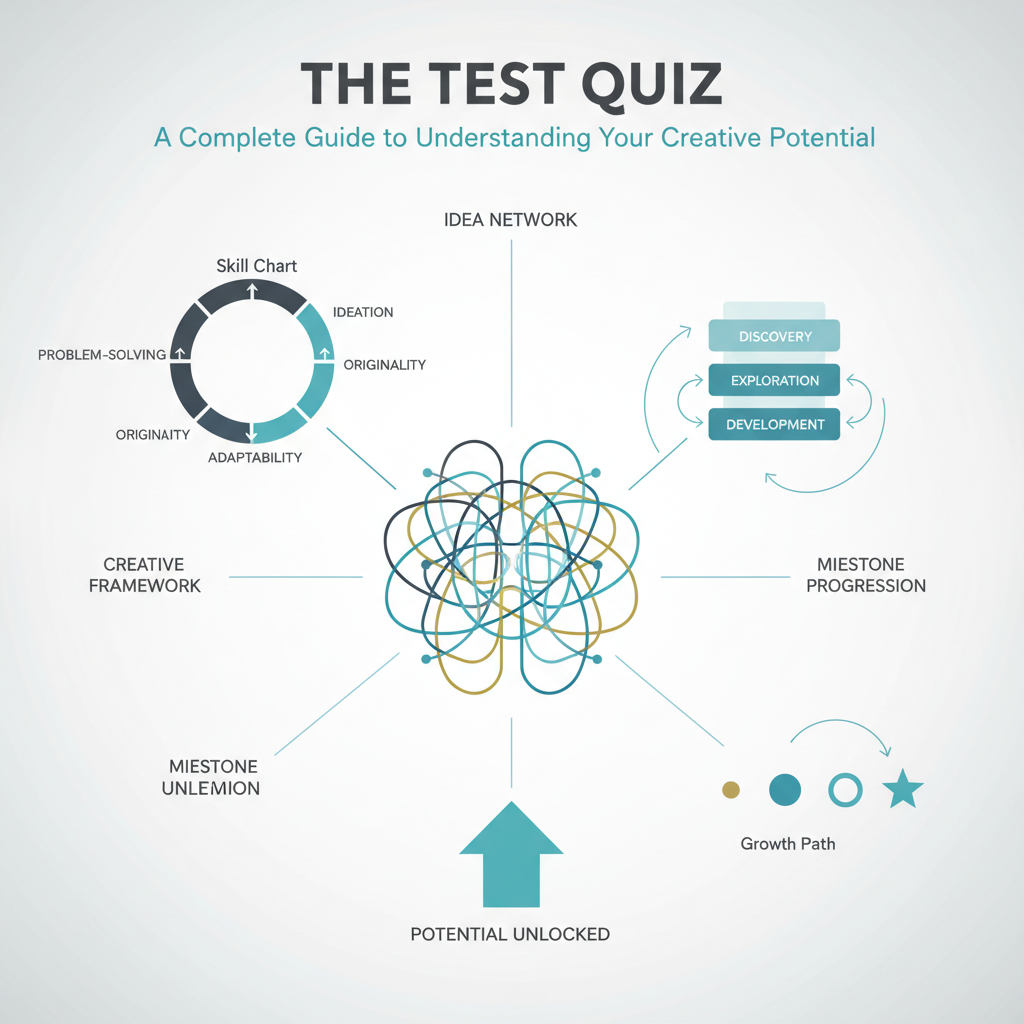
A ‘test quiz’ for creativity is an assessment designed to measure your creative potential beyond simple right-or-wrong answers. The Creative Ability Test is a scientifically grounded 30-question quiz that evaluates your cognitive flexibility, problem-solving skills, and divergent thinking to provide actionable insights for personal and professional growth.
Have you ever considered the power of your own creativity? It’s not just for artists—it’s how we solve problems and see the world in new ways. Knowing your creative potential can lead to personal and professional growth. If you’re ready for a journey of self-discovery, “the test quiz” is your starting point.
At Creative Ability Test, we believe that understanding your creative strengths and thinking styles opens up new possibilities. Our 30-question test is based on science and gives you more than just a score. We look at key areas like your Cognitive flexibility, ability to brainstorm, and openness to new things. This gives you a clear picture of how you think. It’s more than a quiz—it’s a look into how your creative mind works.
This guide will help you understand what “the test quiz” measures and what your results mean. Most importantly, we’ll show you how to use this knowledge in your daily life. We explain the science behind the test in simple terms and give you practical tips to boost your creative thinking. You’ll learn how to solve problems better and grow as a person. Get ready to turn your ideas into action.
What Is ‘The Test Quiz’ for Creativity?
Beyond a Simple Score: What a Real Creativity Test Measures
Many online quizzes give you a simple “creativity score.” But real creativity is more complex than that. Our platform, Creative Ability Test, goes deeper. We help you take a closer look at your unique creative mind.
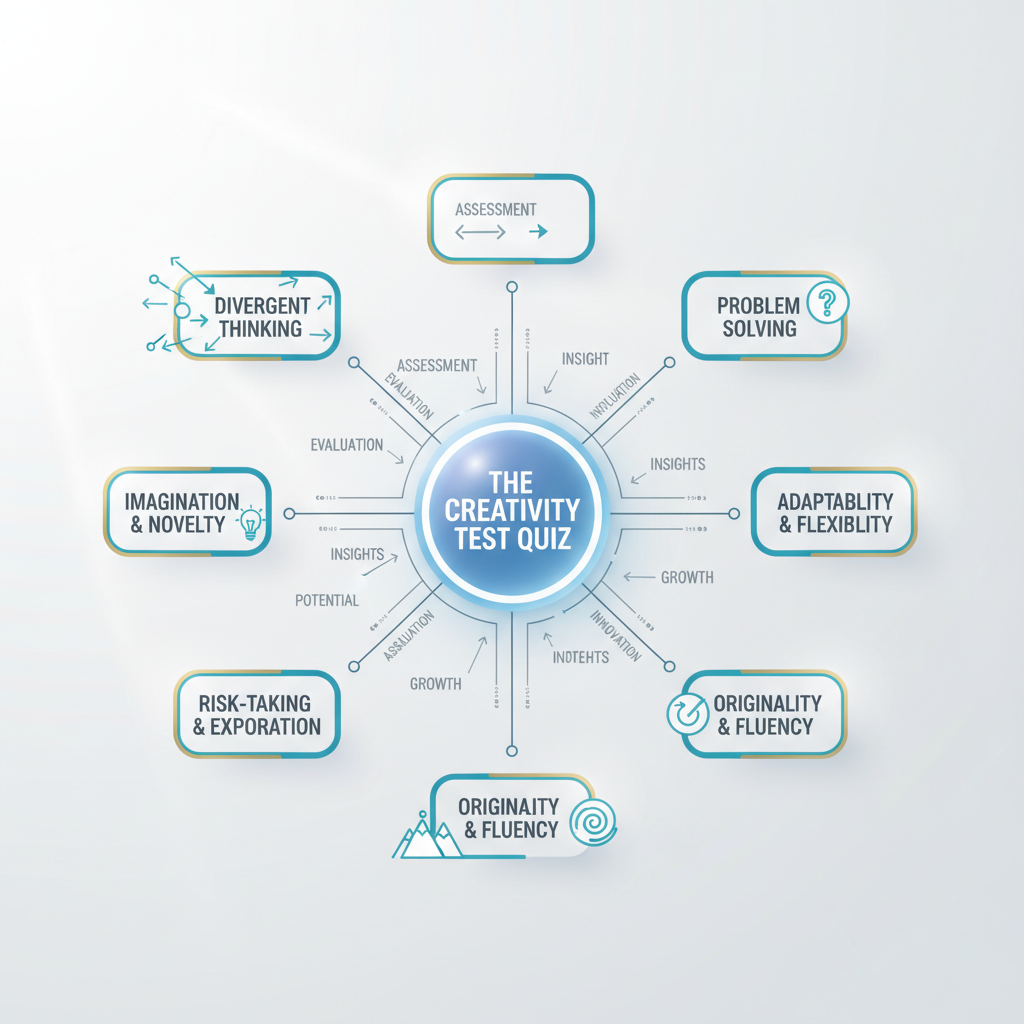
A real creativity assessment looks at you from many angles. It doesn’t just tell you *if* you’re creative—it shows you *how* you’re creative. This involves looking at your different thinking skills and styles.
We see creativity as a skill you can grow, not a fixed trait. Our test finds your strengths in key areas. This knowledge helps you grow those strengths and use your creative potential.
Our test looks at important parts of creativity, such as:
- Divergent Thinking: Your ability to come up with many unique ideas. We look at how you brainstorm and find different solutions.
- Cognitive Flexibility: How well you can switch your point of view. This shows how easily you adjust to new information or challenges.
- Problem-Solving Skills: How you handle and solve tricky problems. This includes your ability to find new and creative solutions.
- Openness to Experience: Your curiosity and willingness to try new things. This shows how open you are to fresh ideas.
Understanding these parts gives you a full picture of your creativity. It helps you unlock your true potential. You’ll also get practical tips for your personal and professional life.
The Science Behind Our 30-Question Assessment
The Creative Ability Test isn’t just a random quiz. Our 30-question test is based on science. It uses proven psychological research and theories about creativity. This makes our test a reliable way to measure your creative skills.
Our method is backed by evidence. We designed each question to test a specific part of your creativity. Top researchers have approved similar methods [1]. This careful process ensures your results are accurate.
The 30 questions cover a lot of ground. They look at many different creative behaviors and ways of thinking. This helps us create a detailed profile of your creative strengths and find areas for you to grow.
Our test is also standardized, so everyone gets the same high-quality evaluation. This means you can trust your personalized feedback. It gives you a strong starting point for learning more about yourself.
We explain complex psychological concepts in a simple way. This makes the science of creativity easy for anyone to understand. Our goal is to give you clear, useful advice from a source you can trust.
Why Understanding Your Creative Style Matters
Knowing your creative style is a powerful tool. It helps you move from being unsure to feeling a confident self-awareness. Your unique way of being creative affects every part of your life.
First, it helps you grow as a person. When you know how your mind works, you can use your natural strengths. For instance, if you’re good at divergent thinking, you can use it to solve personal problems. You can come up with new solutions for everyday challenges.
Second, it helps your career. Companies want employees who can create new things and solve problems [2]. Knowing your creative strengths makes you a valuable team member. You can use them in group projects, planning, or to move your career forward. This helps you make a real difference at work.
Our test gives you useful tips and clear explanations about your creative side. For example, you might learn you’re very open to new experiences. This can encourage you to explore new fields or learn new skills, broadening your world.
In the end, this knowledge gives you power. It’s like a roadmap for being creative on purpose. You can use your talents to solve real-world problems. This will change how you approach challenges, helping you face them with more confidence and new ideas.
What Kind of Questions Are in The Test Quiz?
Exploring Divergent Thinking Challenges
The Creative Ability Test looks at your divergent thinking. This is your ability to come up with many different ideas from one starting point. Think of it as a more advanced form of brainstorming.
Our quiz gives you challenges that push you to think outside the box. You will explore many possibilities, not just the obvious ones. This helps us see how well your mind connects different ideas.
For example, we might ask you to list as many unusual uses as possible for a common object. These questions are not about finding one “right” answer. Instead, they measure how many ideas you have and how unique they are. Research shows that this skill is a key part of creativity [3].
By taking on these challenges, you will learn about your natural ability for:
- Idea Fluency: How many ideas you can generate.
- Originality: How new and unique your ideas are.
- Flexibility: The different categories your ideas fall into.
- Elaboration: Your skill in adding details to your ideas.
Understanding your strengths in divergent thinking helps you find new solutions. It gives you more options when you’re trying to solve a problem.
Assessing Your Cognitive Flexibility
Cognitive flexibility is another key part of creativity that we measure. Think of it as mental agility. It’s your ability to switch between different ways of thinking, adapt to new facts, and get past mental blocks.
Our quiz has questions designed to test this skill. They often ask you to change your perspective. You might need to rethink your first ideas or try a new way to solve a problem.
For instance, a question might describe a situation where the easy solution fails. You will then be asked to come up with a different plan. This shows how easily you can drop an old idea for a better one. This skill is essential for learning and adapting in a fast-changing world [4].
By assessing your cognitive flexibility, we learn more about your ability to:
- Adjust your thinking when you face a challenge.
- See an issue from more than one point of view.
- Learn from mistakes and change course.
- Handle complex problems more easily.
This assessment helps you understand how you react to new situations and change your ideas under pressure. This skill is valuable for both personal growth and professional success.
Evaluating Your Openness to New Experiences
How open you are to new experiences has a big impact on your creativity. This is a core personality trait. It shows your curiosity, imagination, and desire to explore new ideas, concepts, and cultures.
The Creative Ability Test looks at this trait with questions about your interests. We ask about your taste for adventure, how you feel about unusual ideas, and what you like to learn about.
We might ask if you enjoy trying new things or if you’re drawn to art and abstract ideas. People who are very open tend to seek out different experiences. This gives them more knowledge and sparks their imagination [5].
Through this assessment, you will discover:
- Your level of curiosity about the world.
- How open you are to new and different ideas.
- Your comfort level in unfamiliar situations.
- Your interest in art and imagination.
Understanding your openness can help you find new learning opportunities. It can encourage you to step out of your comfort zone and find new ways to grow.
Problem-Solving Scenarios
Creativity isn’t just about having great ideas; it’s about using them to solve real problems. The Creative Ability Test includes practical problem-solving challenges. These see how you put your creative skills to use.
We give you realistic situations that don’t have easy answers. You will need to think in new and clever ways. For example, you might be asked to improve a common product or solve a problem for a community. These are hands-on challenges, not just theory.
These questions show us how you apply your creative skills in practice. They reveal your ability to think ahead and come up with truly new ideas. Good problem-solving requires both creating and carrying out new solutions [6].
By working through these scenarios, you will learn about:
- Your ability to spot and define problems in a new light.
- How you use creative thinking to solve practical issues.
- Your knack for developing real, innovative solutions.
- Your skills in imagining improvements and positive change.
This part of the quiz connects creative thinking with real-world results. It helps you see how your creative skills can make a real difference in your life and work.
How Do You Interpret Your Quiz Results?
From a Score to Actionable Insights
Your results from The Test Quiz are more than just a number. Your score is a starting point, but the real value is in the detailed insights you’ll receive. We turn this data into a personal guide to help you grow your creative skills.
This helps you understand what your score means in the real world. You’ll learn about your creative mindset and the specific ways you think.
We give you clear, practical steps to use your creative strengths and build on your growth areas. This helps you improve your skills and grow as a person.
Understanding Your Personalized Feedback Report
After the Creative Ability Test, you get a detailed, personal feedback report. This report is your guide to your unique creative style. It looks at creativity from many angles, giving you more than just a basic score.
Every section is easy to follow. You’ll learn about how you think. For instance, you’ll see how you did with divergent thinking—the skill of coming up with lots of ideas [7]. We also look at your cognitive flexibility, which is how easily you can switch between different ideas or adapt to change.
Your report turns complex ideas into simple, useful information. It shows how your results connect to real-world skills like problem-solving and innovation. It’s like a blueprint for how your creative mind works.
Key areas covered in your report include:
- Your main creative thinking styles.
- How you approach solving problems.
- How open you are to new experiences and ideas.
- Insights into your imagination and original thinking.
- How well you adapt and think flexibly.
This report is made just for you. It’s based on proven methods to make sure your results are accurate and helpful.
Identifying Your Unique Creative Strengths
Your personal report shows you exactly what your creative strengths are. These are the skills where you naturally shine. Knowing what you’re good at helps build confidence.
For example, you might be great at coming up with many new ideas quickly. This is a sign of strong divergent thinking. Or maybe you’re skilled at connecting ideas that don’t seem related, showing your ability to think associatively.
Another strength could be your imagination. You might find it easy to picture complex solutions. These are valuable talents you can use in your personal and professional life.
Our report helps you see these natural talents. When you know your strengths, you can focus your energy, solve problems more effectively, and use your creativity to innovate.
Think about how your strengths show up:
- Are you a natural brainstormer who is always full of ideas?
- Do you see patterns others miss and come up with unique solutions?
- Are you quick to change your perspective when facing a new problem?
- Do you enjoy trying new or different ways of doing things?
Finding your strengths is the first step to turning self-awareness into a powerful tool for personal growth.
Pinpointing Areas for Growth
The Creative Ability Test also shows you areas where you can grow. We don’t see these as weaknesses, but as opportunities to become even more creative. Creativity is a skill you can build with practice [8].
Your report gives clear advice on how to develop these areas. For instance, if you could improve your cognitive flexibility, the report suggests ways to do that, like trying new problem-solving methods or looking at things from a different point of view.
In the same way, if you want to strengthen your divergent thinking, you’ll get useful tips. This could mean doing brainstorming exercises or getting in the habit of questioning assumptions. These are real-world strategies you can use right away.
Focusing on these growth areas helps you develop as a person. It makes your creative skills more consistent and sharpens your ability to solve problems, which boosts your overall capacity for innovation.
Every growth area is a chance to learn and improve. Our goal is to give you the tools to turn any limitation into a new strength. You always have the power to grow your creative potential.
How Can You Use Your Results for Personal and Professional Growth?
Practical Strategies to Boost Your Creative Thinking
Your Creative Ability Test results are a personal roadmap. They show your specific creative strengths. Now, let’s put these insights into action. You can boost your creative thinking with targeted exercises designed to train your brain.
Unlock Your Creative Potential Daily
Understanding your creative style is the first step. For instance, if your results show you’re good at coming up with many different ideas, focus on brainstorming. If you excel at flexible thinking, try new ways to do daily tasks. Here are some proven ways to boost your creativity:
- Mind Mapping: Start with a central idea and branch out with related thoughts. This technique helps you see connections and make new associations.
- SCAMPER Method: Use this checklist to generate ideas. It stands for Substitute, Combine, Adapt, Modify (Magnify, Minify), Put to another use, Eliminate, Reverse (Rearrange). This tool helps you look at existing ideas from new angles.
- Lateral Thinking Puzzles: Try puzzles that need creative solutions. This practice helps you think outside the box and improves your problem-solving skills [9].
- Change Your Routine: Even small changes can spark new ideas. Take a different route to work or try a new hobby. New experiences build new connections in your brain.
- Practice Observational Drawing: Pay close attention to the details around you. Drawing helps you see things from new perspectives and trains your brain to notice what others might miss.
- Embrace “Idea Quotas”: Challenge yourself to come up with a set number of ideas each day. Don’t judge them. More ideas often lead to better ideas.
These are more than just exercises; they are habits that build your creative muscle. Your feedback from the test shows you the best place to start.
Using Your Creative Talents in Your Career
Your creative skills are valuable tools for your career. They can help you advance at work. Employers highly value creative problem-solvers. In fact, creativity is always one of the top skills companies look for [10].
Use Your Creativity at Work
Think about how your creative strengths can be used in your job. Are you good at solving problems in new ways? Are you open to new ideas? Here’s how to use your creativity at work:
- Innovative Problem-Solving: Use a creative approach to workplace challenges. Come up with many possible solutions, then use critical thinking to pick the best one. This leads to better results.
- Process Improvement: Look for ways things could work better. Use your creative eye to imagine better ways of doing things. Suggest new ideas to make work easier and faster.
- Team Collaboration and Leadership: Help create a team environment where new ideas are welcome. Encourage open idea sharing. Your insights can inspire your coworkers and help you lead effective brainstorming sessions.
- Project Development: Offer fresh ideas on new projects. Whether it’s product design or a marketing plan, your creativity can lead to new and better things and make your work stand out.
- Effective Communication: Present your ideas in interesting ways. Try using storytelling or visuals. This helps your message connect better with your audience.
- Adaptability to Change: The workplace is always changing. Your flexible thinking helps you adapt quickly. You can learn new tools and methods with ease.
Your test results give you the words to describe your creative strengths. Use them to explain your value in interviews and performance reviews. This will help you stand out.
Using Creativity for Everyday Problem-Solving
Creativity isn’t just for artists or inventors. It’s a key skill for daily life. Knowing your creative profile from the test helps you handle everyday challenges with confidence and a fresh point of view.
Navigate Daily Life with Creative Solutions
From planning errands to solving arguments, creativity can make life smoother. It helps turn challenges into chances to learn. Here’s how to use your creative strengths in your daily routine:
- Household Hacks: Faced with a broken item? Need to organize a cluttered space? Use your problem-solving skills to find unusual fixes or clever storage solutions.
- Personal Planning: Planning a trip or a busy week requires flexibility. Use your creative thinking to find the best routes or develop better ways to manage your time.
- Relationship Dynamics: Disagreements happen. Try to understand the other person and communicate creatively. Think of unique ways to solve disagreements that work for everyone.
- Learning and Hobbies: Help yourself grow by approaching new hobbies with an open mind. Find new ways to learn skills, like using a creative trick to remember new information.
- Budgeting and Finances: Get creative with your money. Find new ways to save, discover new income streams, or think outside of traditional budgeting methods.
- Adapting to Unexpected Situations: Life is full of surprises. Your flexible thinking helps you change direction when needed. You can adjust plans quickly and turn challenges into minor bumps in the road.
The insights from the test give you the confidence to tackle any problem, big or small. You’ll understand yourself better and know what actions to take. Enjoy the journey of growing your creativity.
Frequently Asked Questions
What are the questions in the test quiz?
The Creative Ability Test explores how you come up with new ideas. It’s not a memory or knowledge test. Instead, our 30 questions are made to help you think differently. We focus on measuring different parts of your creative skills.
You’ll see a few different types of questions. This helps us learn about your creative strengths. For example, we might ask you to:
- Brainstorm multiple uses for an everyday object. This shows us your divergent thinking, which is the ability to come up with many different ideas from one starting point [11].
- Solve open-ended problems. These situations need flexible and creative solutions.
- Respond to visual prompts. How you see things can show how open you are to new ideas.
- Evaluate different approaches to a challenge. This tests how you adapt your thinking to solve problems.
Each question is designed to be fun and revealing. They show how you handle challenges and create new ideas. Our goal is to discover your natural creative style, not to trick you.
How can I find the test quiz with answers?
Our Creative Ability Test is a personal tool, not a typical quiz with right or wrong answers. Because of this, there is no separate answer key.
The real “answers” are the personal insights in your detailed report. This report breaks down your unique creative style. It shows your strengths, how you think, and where you can improve.
You get the most value by answering honestly. This gives you the clearest picture of your creative abilities. Based on your responses, we give you detailed feedback with practical tips to improve your creativity. This will help you use your creative skills in your personal and professional life.
Is this a game or a scientific assessment?
The Creative Ability Test is a science-based tool, not just a game or a fun online quiz. We built it using proven ideas from psychology and creativity research.
Our 30 questions are designed to measure key parts of creativity, such as flexible thinking, divergent thinking, and openness to new ideas. Every part of our test is backed by solid research [12].
Unlike a game, our goal is to help you grow. We give you more than just a score. You get a full, personal report with clear insights into how you think creatively. It also includes practical ways to build your creative skills.
We want to give you a clear, useful understanding of your creative skills. This knowledge helps you grow, both personally and professionally. It helps you use your creativity in all parts of your life.
Sources
- https://psycnet.apa.org/record/2012-09414-001
- https://hbr.org/2019/11/how-to-foster-creativity-in-your-team
- https://www.sciencedirect.com/science/article/abs/pii/S016773221300021X
- https://pubmed.ncbi.nlm.nih.gov/30449964/
- https://www.psychologytoday.com/us/basics/openness-experience
- https://hbr.org/2014/11/the-four-ways-to-approach-a-problem
- https://positivepsychology.com/divergent-thinking/
- https://hbr.org/2012/03/is-creativity-a-skill-or-a-talent
- https://www.sciencedirect.com/science/article/pii/S001002772030245X
- https://www.weforum.org/agenda/2023/05/future-of-jobs-2023-skills/
- https://psychology.iresearchnet.com/experimental-psychology/cognition/divergent-thinking/
- https://www.simplypsychology.org/creativity.html
Leave a Reply