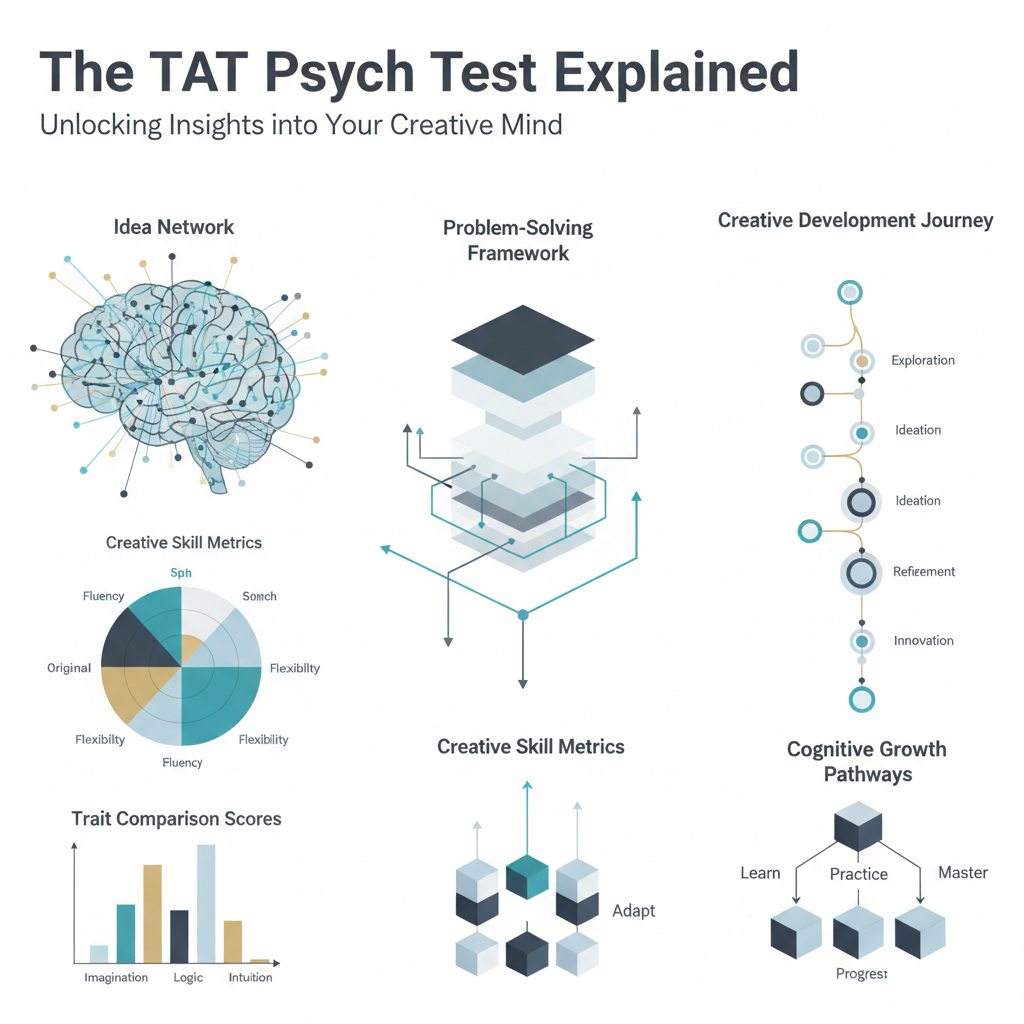
The Thematic Apperception Test (TAT) is a projective psychological test where individuals are shown ambiguous pictures and asked to create stories about them. These narratives are analyzed to reveal a person’s underlying motives, concerns, and their unique way of perceiving the social world, offering insights into personality and thought patterns.
Have you ever wondered what drives your imagination or how you approach challenges? Understanding how your mind works can reveal your personal strengths, especially your creativity. One historic psychological tool used to explore these thoughts and feelings is the Thematic Apperception Test, often called the tat psych test.
The TAT in psychology offers a glimpse into how people see the world and tell stories about unclear situations. While it’s often used for personality assessment, the test can also uncover a lot about a person’s creative thinking, problem-solving style, and emotions. In this article, we’ll explain what the TAT is, how it works, and what it might reveal about your own creativity and approach to challenges.
Join us as we explore the TAT psych test. We’ll then look at how modern, science-based assessments, like those from Creative Ability Test, offer real-world strategies to help you develop and use your creative talents.
What is the TAT Psych Test?

A Beginner’s Guide to the Thematic Apperception Test
The Thematic Apperception Test, or TAT, is a fascinating tool used in psychology. It provides a unique look into how a person sees the world.
Psychologists Henry Murray and Christiana Morgan created the TAT in the 1930s at Harvard University [1]. It’s a type of “projective test.” Unlike a multiple-choice quiz, these tests let you respond freely. There are no right or wrong answers.
During the TAT, you look at a series of pictures that are open to interpretation. These images often show people in different situations. For each picture, your task is to tell a story. You’ll describe what you think led up to the scene, what’s happening now, and what might happen next. You’ll also talk about what the characters are thinking and feeling.
The process is very engaging. It uses your imagination and storytelling skills. By doing this, the test helps psychologists understand your unique way of seeing things.
The Goal: Revealing Unconscious Thoughts and Motives
The main goal of the TAT is to uncover hidden thoughts and feelings. It’s designed to reveal unconscious desires and motivations. These are parts of ourselves that we may not be fully aware of or able to easily express.
As you tell a story, you project your own experiences onto the pictures. For example, a character’s struggles might show how you deal with challenges. Their hopes could reflect your own goals. This “projection” gives valuable clues about your usual reactions and feelings.
Understanding these hidden stories about yourself is powerful. It can lead to greater self-awareness. This insight is important for personal growth and creativity. It shows how your inner thoughts affect the way you solve problems and come up with new ideas.
Also, recognizing these hidden parts of yourself can change the way you think. It can help you solve problems more effectively. You get a clearer view of your creative strengths, including how you see challenges and create new solutions.
How Does the TAT in Psychology Work?

The Role of Ambiguous Pictures (TAT Cards)
The Thematic Apperception Test (TAT) uses a set of special pictures, often called TAT cards. Each card shows a scene that is purposely unclear or ambiguous. For instance, one card might show a young boy staring at a violin. Another could show a man and a woman in a vague situation. This lack of clear detail is a key part of the test.
The pictures act as a blank canvas for your mind. They don’t have a set story, so they invite you to fill in the gaps. Psychologists believe this vagueness encourages you to project your own inner world onto the images. You use your own experiences, feelings, and ways of thinking. This process reveals your underlying thoughts and creative side. [2]
In short, the cards do not have a “right” answer. Instead, they encourage a very personal response. This helps show how differently people see things and use their imagination. It also highlights your natural creativity.
The Art of Storytelling in Psychological Assessment
When you see a TAT card, you are asked to tell a complete story about it. This is more than just describing what you see. You need to create a whole story, like making up a short story on the spot.
A good TAT story usually includes a few key parts:
- What led up to the scene? Explain what happened before the image.
- What is currently happening? Describe the actions and what people are doing.
- What are the characters thinking and feeling? Go into their inner thoughts and emotions.
- What will be the outcome? Give the story an ending.
This storytelling process reveals a lot. It shows how creative you are with stories. It also shows how you make sense of things with little information. The way you build the plot, characters, and emotions provides useful insights. It helps show how flexible your thinking is and how deep your imagination goes. Seeing your thinking style in action is a key part of the TAT’s value. It offers a glimpse into your unconscious mind.
What Do Psychologists Look For in Your Stories?
When analyzing your TAT stories, psychologists look for repeating themes and specific details. They are not judging your storytelling skills. Instead, they are looking at the meaning behind your story. The goal is to understand what drives you, your inner conflicts, and how you deal with challenges. They look at how you organize your ideas and show emotion.
Key areas of focus include:
- Common Themes: Do your stories often involve ambition, failure, relationships, or conflict? These patterns can reveal your main concerns.
- Character Identification: Which character do you relate to the most? This can show how you see yourself or who you want to be.
- Emotional Tone: Are your stories generally optimistic, pessimistic, anxious, or hopeful? This reflects your overall outlook on life.
- Narrative Complexity: How complex and detailed are your plots? This suggests your level of cognitive processing and how deep your imagination goes.
- Problem-Solving Approaches: How do characters solve their problems? This hints at your own ways of handling obstacles.
For example, someone who often tells stories about overcoming challenges may be very resilient. Someone who frequently tells stories about new ideas might be a very creative thinker. These interpretations help build a picture of your personality and creative potential. They go deeper than what’s on the surface. The TAT aims to uncover deeper parts of how you think and feel, including your unique creative strengths and thinking styles.
What Can the TAT Reveal About Your Creative Thinking?

Assessing Narrative Creativity and Imagination
The Thematic Apperception Test (TAT) asks you to create stories from unclear pictures. This process shows your creativity and imagination. The stories you tell reveal how your mind comes up with ideas and links different thoughts together.
When you create a story, several parts of your creativity are at work:
- Originality: Are your stories new and different? Do they go beyond obvious interpretations? Originality shows your ability to think differently.
- Fluency of Ideas: How easily do you come up with ideas? A story with many details and plot points points to a strong imagination.
- Flexibility: Can you change viewpoints or add surprising twists? This shows you can think in flexible ways, which is a key part of creativity.
- Elaboration: Do you add depth with descriptions, feelings, and character growth? Telling a detailed story shows a powerful imagination.
For instance, a picture of a boy and a violin could inspire different stories. It might be about a future music star, a child feeling pressured by his parents, or even a magical violin that takes him to a new world. Each story shows a different way of thinking. Understanding these styles helps you see your own creative strengths.
Understanding Your Problem-Solving Approaches
Besides showing your imagination, the TAT can also reveal how you solve problems. Every good story has a problem and a solution. How your characters handle problems often shows how you deal with challenges in real life.
Think about these points in your stories:
- Identifying Challenges: What problems do your characters face? How clearly do you explain them?
- Solution Generation: Do your characters find normal or new solutions? Creative people often try many different ways to solve a problem.
- Resourcefulness: Do they use what’s available in clever or unexpected ways? This highlights your ability to think on your feet.
- Adaptability: Do they change their plans when new problems come up? This shows you can bounce back and adapt, which is important for handling tough situations.
For example, if a character is trapped, do they plan a careful escape (analytical thinking)? Do they try a lot of different ideas until one works (divergent thinking)? Or do they use a normal object in a new way to solve the problem (innovative thinking)? Looking at these patterns can show you your natural problem-solving style and your ability to come up with new ideas.
Connecting Emotional Insight to Creative Expression
Creativity and emotion are often closely linked. The TAT can show how you handle and share emotions in your creative work. The feelings, reasons, and problems you give your characters can show how well you understand emotions.
This connection is powerful for several reasons:
- Authentic Expression: Stories with real feelings are more powerful. When you can fill your stories with true emotion, it shows your creative voice is more genuine.
- Empathy and Perspective-Taking: Creating characters with deep and varied feelings shows you have empathy. This skill is key to seeing things from other points of view, which is a big part of creative problem-solving [3].
- Emotional Depth: Do your stories explore feelings like hope, sadness, or joy in a detailed way? This shows you can use your own emotional experiences to make your creative work better.
- Relatability: When your characters’ problems and successes feel real, it’s often because you understand human emotions. This makes the things you create more powerful.
By looking at the emotions in your TAT stories, you can learn how your feelings power your creativity. This knowledge can help you use your feelings on purpose to create richer, more meaningful work.
Are There Limitations to the TAT Psych Test?
Why Interpretation Can Be Subjective
A main weakness of the Thematic Apperception Test (TAT) is that it’s based on interpretation. When you tell a story about an unclear picture, the meaning isn’t always obvious. As a result, different psychologists might find different meanings in the very same story.
For example, one psychologist might see your story as a sign of a creative imagination. Another might focus on hidden worries. This difference in opinion makes the TAT less reliable. There is no single, standard way to score the TAT [4].
This makes it hard to compare results between people, or even for the same person at different times. Because of this, the results can say as much about the psychologist as they do about you. At Creative Ability Test, our goal is to offer clear, consistent, and science-backed insights into your unique creativity.
Why Context Matters in Testing
Another key problem with the TAT is context. Your mood, your surroundings, or even the person giving the test can influence your answers. A story told on a stressful day might be very different from one you tell on a relaxed day. Therefore, a single TAT session may not show your full creative ability.
True creativity has many sides, and it doesn’t always show up in one situation. The TAT also focuses mainly on storytelling. It can miss other important parts of creativity, such as:
- Thinking flexibly
- Coming up with many ideas
- Solving problems in new ways
- Being open to new experiences
To get a full picture, a test needs to look at all these areas and be less affected by your mood or surroundings. Our science-backed Creative Ability Test provides a structured way to measure your skills. It gives you a wider, more reliable view of your creative strengths, helping you get clear and useful insights about yourself.
Beyond the TAT: Modern Ways to Assess Your Creativity
From Projective Tests to Structured Assessments
Tests like the Thematic Apperception Test (TAT) can offer deep insights into your unconscious thoughts. But interpreting these tests is often subjective, meaning results can vary. Because of this, modern psychology saw the need for more consistent methods.
Older tests relied on an expert’s interpretation, which made them less consistent. So, new methods were created. These new tests focus on being objective and reliable.
Today, structured tests are more common. They ask clear questions to measure specific creative skills, like divergent thinking. They also use standard scoring. This makes the results more reliable and trustworthy [5].
This change has many benefits. The data is more consistent, and it’s easier to track your progress. As a result, measuring creativity is now more accessible. These tests turn an abstract idea like “potential” into clear, useful insights.
How the Creative Ability Test Offers Actionable Insights
The Creative Ability Test is a perfect example of this modern approach. Our platform provides a clear, structured test. We go beyond subjective opinions and give you data-backed insights into how you think creatively.
Our 30-question test measures key parts of your creativity. This includes skills like cognitive flexibility, problem-solving, and your openness to new things. Our method is based on proven scientific research into creativity [6].
After the test, you get personalized feedback that’s more than just a score. It shows you your unique creative strengths and points out areas where you can grow. We then give you practical tips to help you improve your creative thinking in real ways.
Think about how you can use creativity to solve real-world problems. For example, knowing your score for divergent thinking can help you brainstorm better ideas for a project. In the same way, understanding your cognitive flexibility can help you adapt to change. Our insights help you feel more confident and become more innovative.
The Creative Ability Test helps you understand your creative side. It gives you a clear path for personal and professional growth. Discover what you’re capable of with our trusted, science-backed test.
Frequently Asked Questions
What are some Tat psych test questions?
The Thematic Apperception Test (TAT) doesn’t use questions like a normal quiz. Instead, you are shown unclear pictures, called TAT cards, to spark your imagination.
A psychologist will show you a card and ask you to tell a story about it. This encourages you to create a complete story. You become the storyteller, making up a narrative from scratch.
Typical prompts help you build your story:
- “Tell me what is happening in this picture.”
- “What led up to this scene?”
- “What are the characters thinking and feeling?”
- “What will be the outcome of this situation?”
These prompts are designed to help you think more freely. They tap into your imagination and your natural ways of thinking. The stories you tell show how you see things, what drives you, and how you creatively solve problems.
Can you take a Tat psych test online for free?
You cannot take a real, official TAT psych test online for free. The most important part of the TAT is having a professional interpret your stories. A licensed psychologist or trained clinician is needed to analyze your answers properly. [7]
Online versions you might find are often simplified and cannot provide accurate psychological insights. These online tests lack the expert evaluation needed for a real assessment. A real TAT is given in a specific way and requires a deep knowledge of psychology.
However, if you just want to check your creative skills, there are good, science-based online tests. The Creative Ability Test offers a structured way to measure different parts of your creativity. Our 30-question assessment gives you personalized feedback. You get practical tips to improve your creative thinking in everyday life.
This approach gives you clear information about your strengths and areas for growth. It’s a trusted way to understand and improve your creative skills.
What is a Tat in psychology example?
Imagine a TAT card showing a young boy looking at a violin on a table. The image is intentionally unclear and has no obvious story.
Here are a few ways someone might interpret this picture:
- Aspirations and Talent: The boy dreams of becoming a musician and is thinking about his future.
- Burden and Pressure: The violin is a symbol of pressure from his parents to practice.
- Curiosity and Discovery: The boy just found the violin and is curious about how it sounds.
- Loss and Remembrance: The violin belonged to someone important, and the boy is feeling sad or nostalgic.
A psychologist would analyze the themes, feelings, and structure of your stories. They would look for repeated patterns, which can reveal your core needs, what drives you, and how you usually handle challenges. Your unique story also shows your imagination and how you find meaning in unclear situations. This is a key part of creative thinking.
Sources
- https://www.simplypsychology.org/thematic-apperception-test.html
- https://www.apa.org/pubs/books/thematic-apperception-test-manual
- https://greatergood.berkeley.edu/topic/empathy/definition
- https://www.simplypsychology.org/tat.html
- https://www.apa.org/monitor/2014/12/testing-testing
- https://www.frontiersin.org/articles/10.3389/fpsyg.2016.01236/full
- https://www.apa.org/pubs/books/thematic-apperception-test
Leave a Reply