The Cube Psychology Test is a popular projective game from Japanese Kokology, where you visualize a desert scene with a cube, ladder, horse, storm, and flowers. Each object’s imagined details—like the cube’s size or the horse’s behavior—are interpreted to provide insights into your personality, self-perception, relationships, and approach to challenges.
Have you ever wondered what your subconscious mind is trying to tell you? Your imagination holds important clues about your inner world, revealing not just personality quirks but also how you use creative thinking. Simple mental scenarios can show you surprising things about how you see the world, face challenges, and spark new ideas. This journey of self-discovery often starts with tools like the cube psychology test, which asks you to picture a scene and interpret its symbols.
These imaginative quizzes are more than just games. They are fun ways to look at your cognitive flexibility and problem-solving style. By asking you to picture items in a forest or desert, they tap into your ability to generate many ideas and solutions. Understanding your thought patterns can help you see your natural creative strengths. This gives you a fresh perspective on personal growth and how you innovate in your daily life.
In this article, we’ll explore the popular cube psychology test, look at its origins, and explain what your answers might reveal. We’ll also share eight more captivating quizzes, including the shape psychology test, that show different sides of your personality and creative mind. Get ready for an exploration that will spark your curiosity and offer valuable insights into your unique way of thinking.
What is the Cube Psychology Test?
The Origins in Kokology
The Cube Psychology Test is a popular “Kokology” quiz. Kokology is a fun type of self-discovery quiz that started in Japan. It’s a playful way to understand your personality by using creative questions to reveal your hidden attitudes and traits.
The name “Kokology” combines the Japanese word “kokoro” (meaning mind, spirit, or heart) with the Greek word “-logia” (the study of). These quizzes use projective techniques. In other words, your quick answers to creative questions can show what’s in your subconscious mind.
Kokology tests, like the Cube, are not scientific tools for diagnosis. But they do offer a fun look into your creative side. They show how you see the world and solve problems. Professor Tadahiko Nagao of Ritsumeikan University in Kyoto helped make Kokology popular with his books [1].
These quizzes are a fun way to think about yourself. You can learn more about your creative strengths and how you think.
How Does the Test Work?
The Cube Test asks you to picture a scene in your mind. You start by imagining a desert. This desert acts as a blank canvas for your thoughts.
Next, you get a series of questions. Each one asks you to add an object to the scene. You will describe what it looks like and where it is. For instance, you might be asked:
- Imagine a cube in this desert. What does it look like? Where is it?
- Now, visualize a ladder. What kind of ladder is it? Where is it in relation to the cube?
- Next, picture a horse. What is the horse doing? Where is it?
- Are there any flowers? How many? Where are they?
- Finally, is there a storm? What kind of storm? How close is it?
Your first answers are the most important. There are no right or wrong answers. Every detail you give is a symbol. These symbols can reflect your personality, relationships, and how you face challenges. This process shows how flexible your thinking is. It reveals how you understand abstract ideas, which is a key part of creativity.
What Do the Symbols Mean?
Every object you picture in the Cube Test has a symbolic meaning. These meanings are meant to give you insights about yourself. They can help you better understand your own creative mind.
Here is a guide to what each symbol often means:
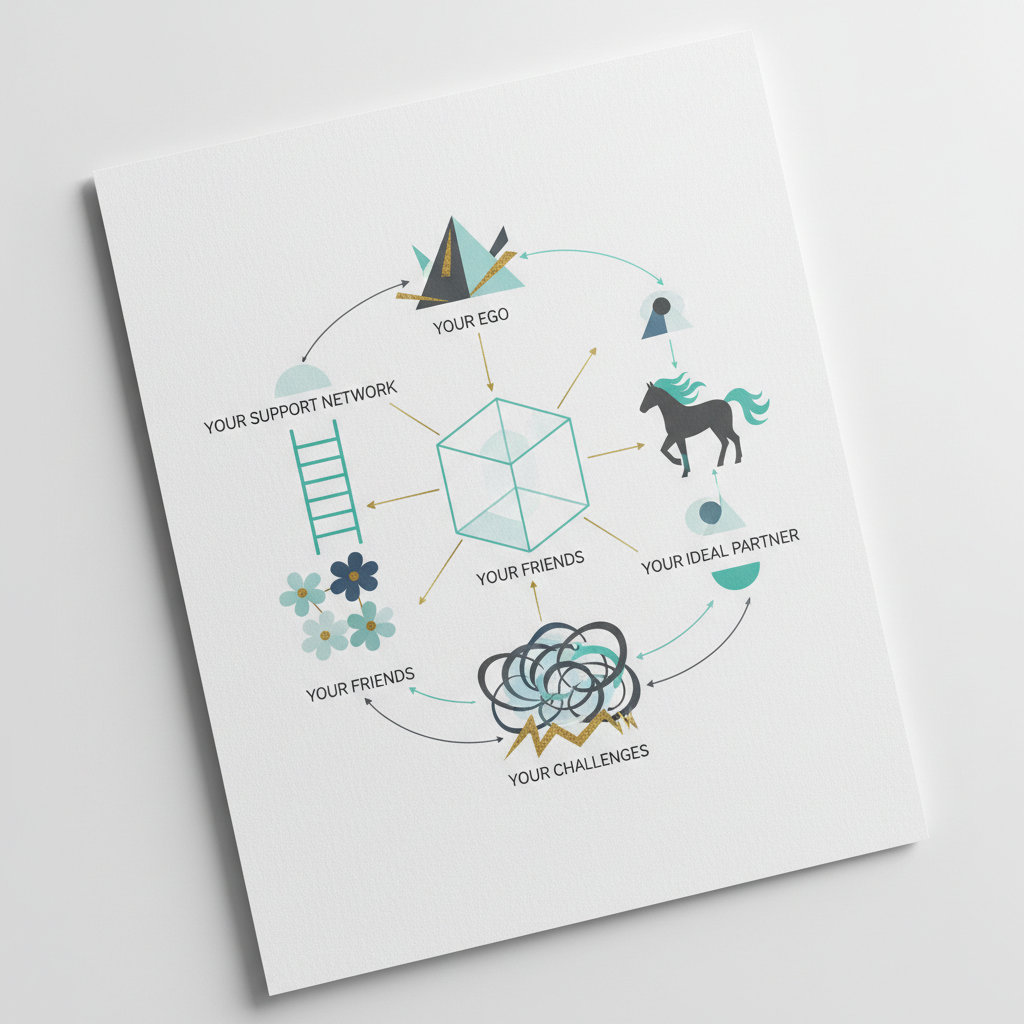
- The Cube: This symbolizes you and your sense of self.
- Size: A large cube might suggest confidence. A small one could indicate humility.
- Material: A solid cube suggests you are resilient. A fragile one might mean you are more sensitive.
- Placement: If it’s on the ground, you are likely grounded. If it’s floating, you may be more imaginative or detached.
- The Ladder: This represents your friends and social connections.
- Sturdy vs. Wobbly: This shows how strong your friendships are.
- Close to the Cube vs. Far Away: This shows how close you feel to others.
- Number of Rungs: Can suggest if you see your social life as simple or complex.
- The Horse: This stands for your partner or ideal partner.
- Wild vs. Tame: This suggests if you prefer independence or commitment in a relationship.
- Near vs. Far: This reflects your current relationship or what you desire.
- What it’s Doing: A horse that is eating grass might mean you feel content. A running horse could suggest you want more freedom.
- The Flowers: These symbolize children, creativity, or your hopes for the future.
- Number: Many flowers could suggest a desire for a large family or that you are very creative.
- Vibrancy: Bright, healthy flowers can point to optimism.
- Placement: Growing near the cube could mean they are a central part of your life.
- The Storm: This represents the challenges, problems, or anxieties in your life.
- Intensity: A light rain versus a big thunderstorm shows how serious you feel your challenges are.
- Distance: A distant storm suggests minor concerns. A storm directly over the cube indicates problems you are facing right now.
By thinking about these meanings, you can get a new perspective. You can see how your mind deals with ideas, relationships, and problems. This self-awareness is a great first step to understanding and boosting your creative potential.
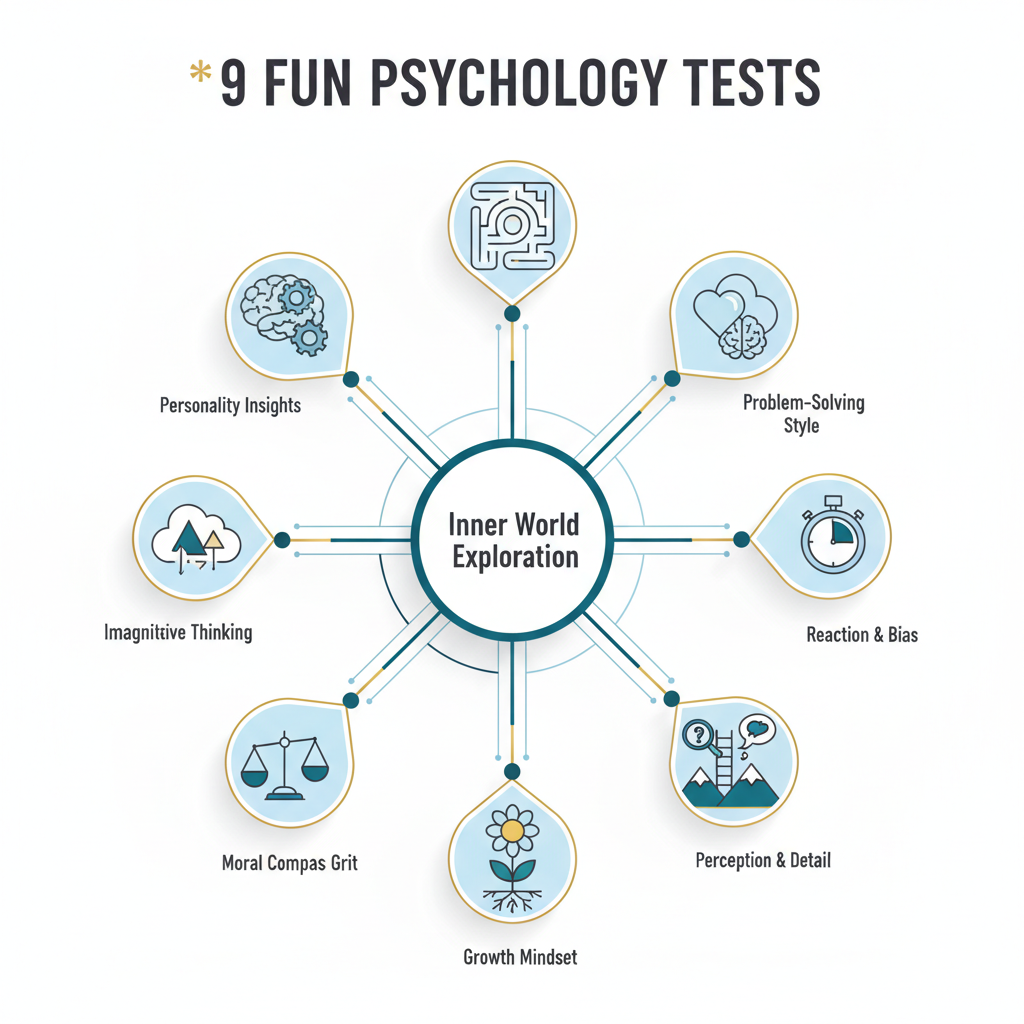
9 Fun Psychology Tests to Explore Your Inner World
1. The Cube Psychology Test (The Classic Kokology Game)
The Cube Psychology Test is a popular Kokology game from Japan. In this self-discovery game, you imagine a desert. You then picture a cube, a ladder, a horse, flowers, and a storm in the scene. How you describe each item reveals something about you.
Your answers show parts of your personality. For example, the cube can represent your ego. The horse often stands for your friends and social life. This fun test helps you reflect on yourself. It helps you see your inner world and creative side.
2. The Shape Psychology Test (Psycho-Geometrics)
The Shape Psychology Test uses basic shapes to show personality traits. It’s also called Psycho-Geometrics. The idea is that we are drawn to certain shapes [2]. You pick the shape you connect with most: a square, circle, triangle, rectangle, or squiggle.
Each shape connects to a dominant thinking style. Squares often stand for logic and order. Circles point to harmony and connection. Knowing your shape gives you clues about how you communicate and solve problems. This can help you work more creatively with others.
3. The Forest Psychology Test (A Walk in the Woods)
Imagine you are walking through a forest. As you walk, you see different things. What do you see? Who is with you? What animal do you meet? What object do you find? Your answers create a picture of your emotions.
This “Walk in the Woods” test reveals your feelings about relationships and fears. It also shows how you deal with life’s challenges. Thinking about your answers can give you new ideas about your inner strength.
4. The Desert Psychology Test
Imagine crossing a huge desert. What do you bring? How do you feel? What challenges do you meet? This test is about survival and what you need to get by. It shows how well you adapt and what you value most.
The Desert Psychology Test helps you see how you handle pressure. It also reveals your style of solving problems. Thinking about your journey can help you find creative ways to solve real-life problems.
5. The Dragon Test Psychology
In this test, you imagine meeting a dragon. Is it friendly or fearsome? What do you do? How does it interact with you? The dragon often represents the biggest challenge or fear in your life. How you act shows how you face challenges.
This test offers a fresh look at your courage and inner strength. It helps you see the strength you have inside. Understanding your “dragon” can give you creative ideas for handling problems at work or in your personal life.
6. The Flower Psychology Test
Imagine you are given a flower. What kind of flower is it? What color? Where do you plant it? Who do you give it to, or do you keep it? Your answers about the flower give clues about your feelings and relationships.
The Flower Psychology Test looks at themes like beauty, growth, and connection. It shows how you care for yourself and others. This fun test helps you think creatively about your own growth and happiness.
7. More Fun Kokology Tests for Self-Discovery
Kokology includes many short, fun quizzes. These tests use make-believe situations to show hidden parts of your personality. They are not scientific. But, they are great tools for thinking about yourself.
These short tests ask simple questions. For example, what would you do if a bird landed on your window? Your answers can offer surprising clues about how you see things. They are a fun, easy way to explore your creative side.
8. Relational Psychology Tests
Some tests focus on how you get along with others. They look at how you see your relationships. For example, you might describe a house and who lives inside. This can show how you feel about your family.
These tests are great for understanding how you act with people. They help you see how you interact and work with others. Learning about your social style can improve teamwork and create a more open environment.
9. Fun Psychology Tests for Students
Students can learn a lot from these fun psychology tests. They are a simple way to learn more about yourself. These tests can point to learning styles or possible career paths. They are also great for building critical thinking skills.
For example, a test about choosing a pet might suggest leadership skills. These fun tests also encourage students to think about themselves. They help students find their unique strengths and interests. This can help guide their school work and creative projects.
How Can These Fun Tests Unlock Your Creativity?
Understanding Your Creative Thinking Style
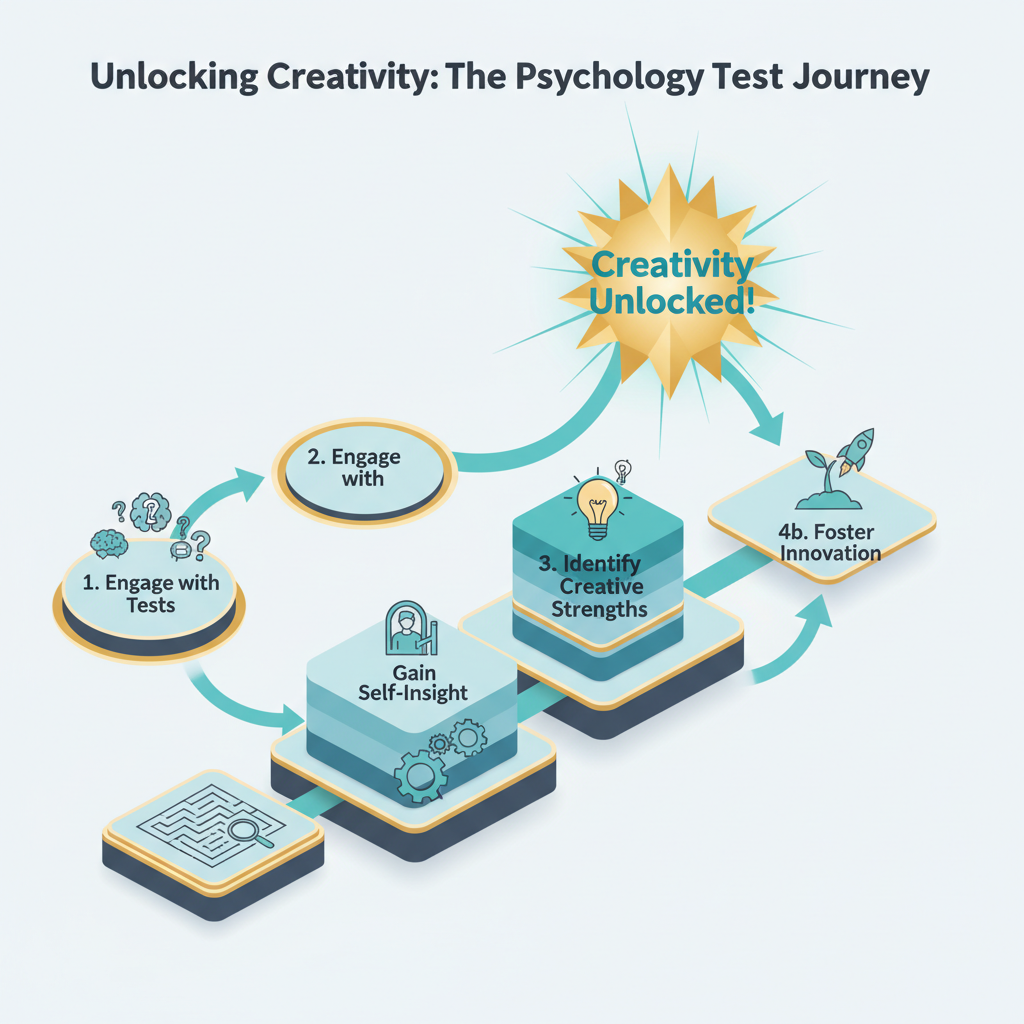
Fun psychological tests, like the Cube Psychology Test or the Forest Psychology Test, offer a unique peek into your mind. They use imaginative scenarios to show what you naturally prefer. By answering these playful questions, you start to see how you think creatively.
Your choices in these tests can point to your thinking style. For instance, do you focus on small details or the big picture? Do you like structure or freedom in your answers? These small clues tell you a lot.
Think about how you describe your cube or your journey through the forest. Your answers show how you:
- Face new ideas and challenges.
- Connect different ideas.
- Handle information and sensory details.
This self-reflection helps you see your natural tendencies. You get a first look at your cognitive flexibility. This is your brain’s ability to switch between different ideas [3] or adapt to new situations. Knowing this helps you see why some creative tasks feel easy and others feel hard.
Identifying Strengths and Growth Areas
Fun psychology tests act like a mirror, showing you your creative personality. They are not strict scientific tests. However, their symbolic meanings can point out your strengths and areas where you can grow. For example, a very detailed description in the Dragon Test Psychology might mean you have a vivid imagination. That’s a great creative skill.
When you think about your responses, ask yourself:
- Which parts of my answers were original?
- When did I find myself thinking outside the box?
- What was hard to imagine or describe?
This simple exercise gives you helpful clues. It helps you find where your creative flow is strongest. Maybe you are good at divergent thinking, which means coming up with lots of ideas. Or perhaps you are skilled at problem-solving and finding unique solutions. Seeing these patterns gives you confidence. It provides a starting point to grow your creative skills on purpose. Everyone has their own creative strengths [4], and these tests can help you find yours.
Using Symbolism to Fuel Innovation
Symbolism is at the heart of many of these fun tests. Working with symbols is a powerful way to unlock creative thinking. When you explain what a cube, tree, or flower means to you, you are practicing abstract thinking. This skill is key for coming up with new ideas.
Symbolic thinking pushes you to look beyond the obvious. It helps you connect ideas that do not seem related. This process is a key part of generating fresh ideas. It fuels divergent thinking, which is a cornerstone of creativity [5].
You can use this skill for real-world problems. For example, think about a challenge at work. How could a ‘desert’ or ‘forest’ relate to it? What meaning can you find in those symbols? This helps you brainstorm new perspectives. It lets you turn abstract ideas into real solutions.
Practical tips for using symbolism to boost innovation:
- Reflect on interpretations: After a test, think about what the symbols mean to you. How do these meanings affect your feelings or ideas?
- Connect to challenges: Apply test symbols to current problems. If your ‘flower’ stands for growth, how can you encourage growth in a project?
- Practice divergent thinking: Regularly do activities that ask you to create many ideas from a single starting point.
- Embrace metaphors: Use metaphors and analogies in your daily problem-solving. This strengthens your symbolic thinking muscle.
These playful tests are a simple way to learn about creative psychology. They encourage self-discovery and personal growth. They help you build confidence in your ability to think flexibly. This prepares you to explore your creative potential even more.
Ready for a Deeper, Scientific Look at Your Creativity?
Beyond Games: The Creative Ability Test
Fun quizzes like the cube and forest psychology tests can be a great start. They give you a quick look into your personality and imagination. But to truly understand and grow your creativity, you need a more scientific method.
That’s where the Creative Ability Test comes in. It’s not just another game. It’s a powerful, science-backed test of your creative mind. The goal is to give you real, practical insights.
Our 30-question test is based on proven psychological research. It measures key parts of your creativity, such as:
- Divergent Thinking: Your ability to come up with many unique ideas.
- Cognitive Flexibility: How easily you can switch your point of view.
- Problem-Solving Skills: Your natural way of handling challenges creatively.
- Openness to Experience: How willing you are to explore new things.
This gives you a much clearer picture of your creative strengths. Because the test is based on science, you can trust the results. Understanding these parts of your creativity is key to growing, both personally and professionally [6].
Get Actionable Insights and Personalized Feedback
The Creative Ability Test gives you more than just a score. You get feedback that is personalized just for you. We don’t use generic advice. Instead, we help you understand your own unique way of thinking creatively.
What can you expect from your personalized feedback?
- Clear Explanations: We explain complex ideas in simple, easy-to-understand language.
- Know Your Strengths: Find out what makes your creative thinking special and powerful.
- Areas for Growth: Pinpoint specific areas where you can improve your creativity.
- Practical Tips: Get useful strategies to boost your creative skills and use them every day.
Imagine knowing why you’re great at brainstorming, or how to push past a creative block. Our insights help you use your strengths and give you a clear path for building new creative skills.
This journey turns creative doubt into confidence. You’ll learn how to grow your skills step-by-step, instead of hoping for inspiration to strike. You will go from simply knowing about creativity to using it to solve problems and innovate. Unlock your full creative potential and make a real difference at home and at work.
Frequently Asked Questions
What is the interpretation of the cube personality test?
The Cube Psychology Test is a fun imagination game. It asks you to picture a desert scene with a few items in it. What you imagine reveals interesting things about how you see yourself, your relationships, and the world.
Each item you picture has a special meaning:
- The Cube: This stands for you or your self-image. Its size, material, and location can show how you see yourself.
- The Ladder: This represents your friends. How you imagine the ladder can show how you feel about your social life.
- The Flower: Flowers can show your love for life and family. How many there are and what they look like can hint at how you’re feeling.
- The Horse: This represents your ideal partner. The horse’s appearance and actions can show what you look for in a relationship.
- The Desert: The desert stands for your life in general. How it looks can show your view on life and its challenges.
This test is a fun way to think about yourself. It helps you understand how you think creatively and handle problems. While it’s just a game, it can help you learn more about who you are. For a more detailed look at your creative mind, our Creative Ability Test offers a scientific review.
What is a Kokology personality test?
Kokology is a Japanese term from the words “kokoro” (meaning mind or spirit) and “logia” (the study of). So, Kokology is the “study of the mind.”
In these fun quizzes, you imagine yourself in different situations. Your answers, even small details, can show hidden parts of your personality. They offer a look into your feelings, thoughts, and how you tend to act.
Kokology tests were created by Professor Tadahiko Nagao and Isamu Saito [7]. They are designed to be fun and revealing.
Kokology tests are great for:
- Helping you learn about yourself through imagination.
- Finding out more about your feelings.
- Getting you to think in new and creative ways.
- Offering a fun way to explore who you are.
While Kokology offers fun insights, the Creative Ability Test uses a scientific method. Our platform gives you a deeper, personal look at your creative skills. You get useful tips to improve how you think and solve problems.
What is the shape psychology test?
The Shape Psychology Test is also called Psycho-Geometrics. It was created by Susan Dellinger [8]. This test says that most people are drawn to one of five basic shapes. Your choice can show your main personality traits and how you think.
Each shape is linked to certain traits:
- Square: You are likely organized, logical, and hardworking. You enjoy structure and clear plans.
- Circle: You are often caring, a peacemaker, and a great communicator. Relationships are important to you.
- Triangle: You are often a driven leader who thinks strategically. You like to set and reach goals.
- Rectangle: You are likely going through a period of change. You are curious, adaptable, and open to new things.
- Squiggle: You are usually creative, free-spirited, and think outside the box. You love using your imagination to come up with new ideas.
Knowing your shape helps you understand your natural creative talents. For example, Squiggles are great at brainstorming and finding new answers. Triangles are good at planning to solve problems. This can help you better communicate and work with others.
While the Shape Psychology Test gives a simple overview, the Creative Ability Test goes deeper. It gives a detailed review of how your creative mind works. You get personal feedback on your creative style and useful tips on how to improve.
Where can I find fun psychology tests for students?
Fun psychology tests are great for students. They help them think about themselves and get curious about why people act the way they do. These tests can help students understand themselves and their friends better.
Here are a few fun types of psychology tests for students:
- Kokology Tests: These story-based tests, like the Cube or Forest test, show personality traits. They are fun and make you think.
- Color Psychology Quizzes: Students learn how colors can connect to feelings, moods, and personality.
- Learning Style Inventories: These help students find their best way to learn, such as by seeing, hearing, or doing. This can help them do better in school.
- Simplified Career Aptitude Quizzes: These tests link interests and skills to possible jobs. They get students thinking about their future.
- Short Creative Challenges: These push students to think creatively and solve problems in new ways. They are great for building creative skills.
You can find these tests on educational psychology websites, in science magazines, and in books about self-discovery. Online quiz sites are another option, but always check to make sure they are a good source.
For students who want to understand their creative skills on a deeper level, the Creative Ability Test offers a strong, science-backed test. Our platform provides useful, personal feedback for school and future careers.
Sources
- https://news.virginia.edu/content/kokology-what-your-mind-reveals-about-you
- https://www.psychometrics.com/blog/understanding-psychometric-tools-the-origins-of-psycho-geometrics/
- https://www.sciencedirect.com/topics/neuroscience/cognitive-flexibility
- https://www.psychologytoday.com/us/blog/the-power-of-habits/201602/how-discover-your-creative-strength
- https://www.sciencedirect.com/topics/psychology/divergent-thinking
- https://psycnet.apa.org/record/2012-05452-000
- https://www.kokology.com/
- https://www.dellinger.com/
Leave a Reply