Tag: self-understanding

  • Psychology Scenario Test: A Guide to Understanding Your Creative Mind

    Psychology Scenario Test: A Guide to Understanding Your Creative Mind

    A psychology scenario test is a tool used to assess personality, problem-solving skills, and cognitive traits through hypothetical situations. By analyzing your responses to a story or scenario, it provides insights into your decision-making processes, underlying values, and creative thinking patterns.

    Have you ever wondered why you think the way you do, or how you naturally handle new problems? Understanding your mind helps you see who you are and what you’re capable of. An interesting way to learn more is with a psychology scenario test. These story-based tests offer a unique look into your creative thinking, showing how you process information, adapt to change, and solve problems.

    Unlike a typical quiz, a psychology scenario test puts you in an imaginary story and asks for your response. Your choices and the details you focus on can reveal a lot about your Cognitive Flexibility, Divergent Thinking, and openness to new experiences. This article explains how these tests work, what they show about your creative strengths, and why understanding tests like the well-known “castle test psychology” can support your growth. These tools offer more than a snapshot; they provide a guide to help you build on your natural creative skills.

    At Creative Ability Test, we believe understanding your creative process is the first step to unlocking your potential. We break down the science behind these tests to give you clear explanations and useful tips. Prepare to see complex psychological ideas become simple tools you can use to improve your thinking and problem-solving skills. Let’s begin by exploring what a psychology scenario test can truly show you.

    What Can a Psychology Scenario Test Reveal About You?
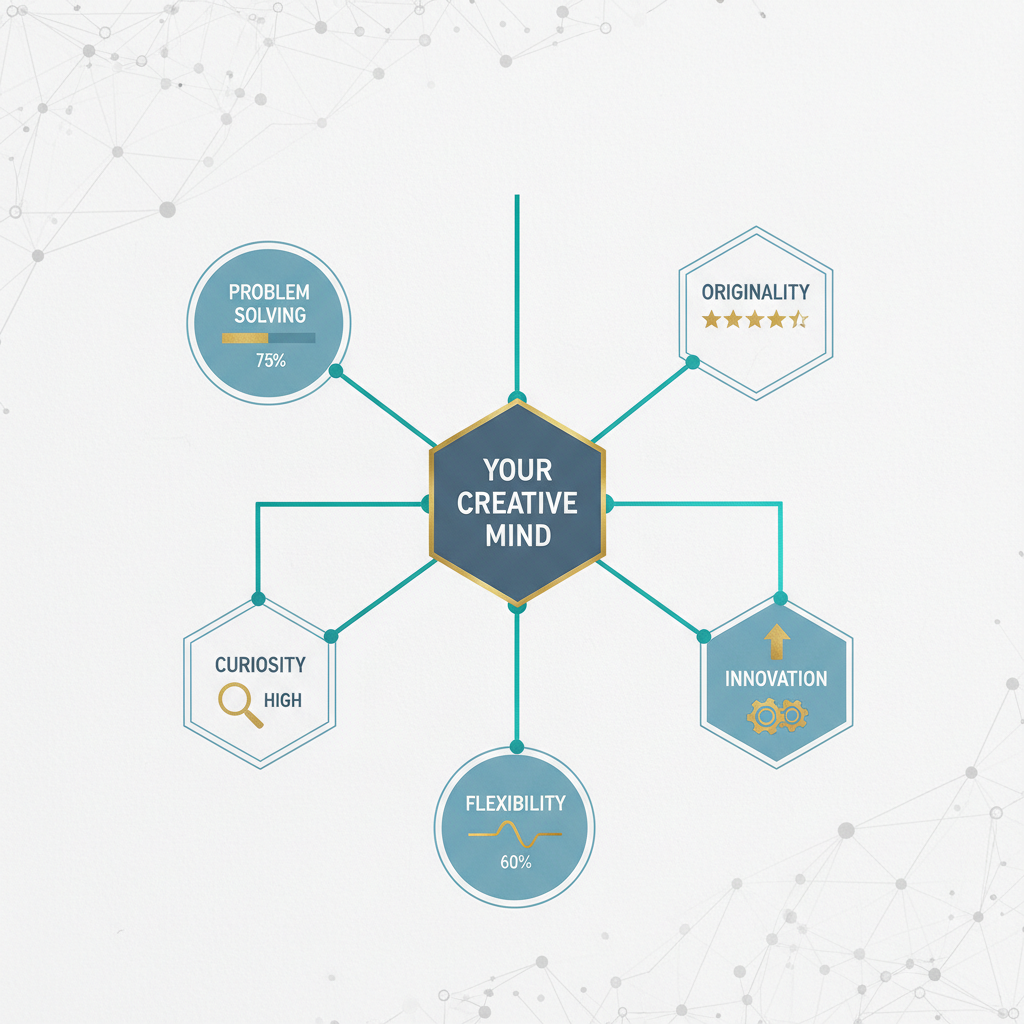
    An infographic showing a central 'Creative Mind' node branching out to connected nodes representing creative dimensions like problem-solving, originality, flexibility, and curiosity, each with a visual indicator of assessment level.
    An abstract educational infographic representing ‘What Can a Psychology Scenario Test Reveal About You?’. Visualize a central geometric node labeled ‘Your Creative Mind’ acting as a hub, branching out into 4-5 interconnected, distinct geometric shapes (e.g., hexagons, circles) representing different creative dimensions such as ‘Problem Solving’, ‘Originality’, ‘Flexibility’, ‘Curiosity’, and ‘Innovation’. Each dimension node has a subtle visual indicator (e.g., a small progress bar or star rating) to suggest assessment levels. The overall layout is a cognitive network diagram or idea cluster, minimalist and vector-based. Use soft blues, whites, and charcoal for the main elements, with gold or teal accents for indicators and connectors to highlight insights. Maintain ample negative space for clarity, structured grouping, and professional aesthetics. No people, no cartoons, focus on conceptual representation.

    Understanding the Basics of Scenario-Based Assessments

    Scenario-based tests are unique tools that put you in imaginary situations. How you respond reveals a lot about how you think. Unlike simple questionnaires, these tests ask you to step into a story and imagine how you would act or feel. This method offers a deeper look into your mindset.

    At their core, these assessments explore your natural reactions. They are designed to get past rehearsed answers and encourage you to think for yourself. Psychologists use these tests to understand patterns in how people think and feel [1]. This approach shows how you handle complex situations.

    Here’s a simple example. A scenario might describe a challenge in a strange land. Your choices in the story can show several things about you, such as your:

    • Decision-making style: Do you act quickly or think carefully?
    • Problem-solving approach: Are you analytical or intuitive?
    • Emotional regulation: How do you handle stress or uncertainty?
    • Creative thinking: Can you find new or clever solutions?

    These tests are powerful tools that offer a window into your inner world. They also show how you might solve real-life problems. Our Creative Ability Test uses research-based scenarios to accurately measure your unique potential.

    Moving Beyond Personality: Testing for Creativity and Problem-Solving

    Many people are familiar with personality tests, which often group your traits into categories. Scenario-based tests go a step further. They don’t just tell you “who you are.” They show “how you think and act” in different situations. This difference is key to understanding creativity.

    Scenario tests are a great way to measure your creativity. They look at how you come up with ideas and approach new challenges. This type of assessment helps reveal different sides of your creativity. For example, they can show your:

    • Cognitive Flexibility: Your ability to switch between different ideas or tasks [2]. This shows how adaptable your thinking is.
    • Divergent Thinking: Your ability to create many unique ideas from a single prompt. It’s a key part of creative thought [3].
    • Innovative Problem-Solving: Your skill in finding original solutions and overcoming obstacles in new ways.
    • Openness to Experience: This trait is strongly linked to creativity and shows your willingness to explore new ideas.

    By putting you in a fictional situation, these tests show your creative process in action. You don’t just describe your skills—you demonstrate your thinking style. This practical approach gives you useful feedback you can use to improve your creative abilities. Our comprehensive 30-question assessment offers personalized feedback to help you understand yourself better. It also gives you clear strategies for growth.

    How Do Psychology Scenario Tests Work?
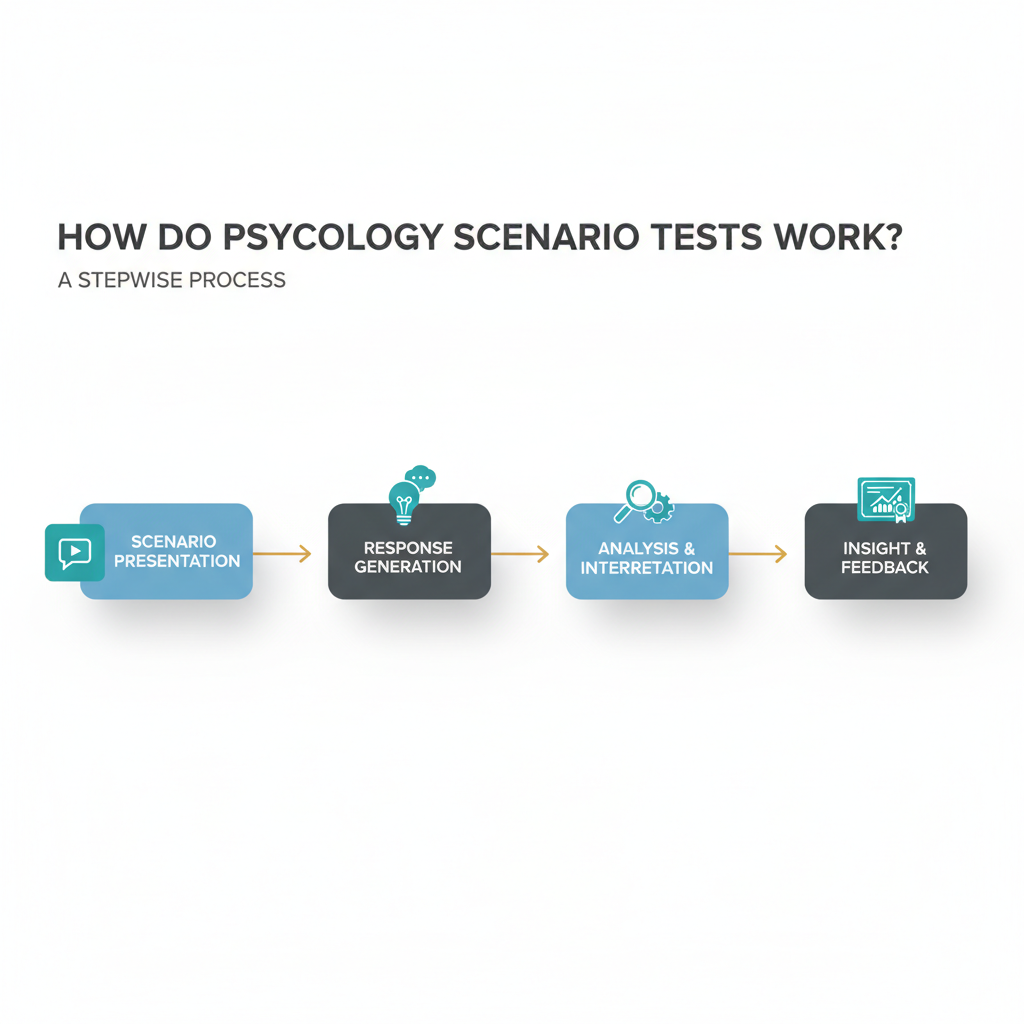
    An infographic showing a four-step linear process diagram for psychology scenario tests: Scenario Presentation, Response Generation, Analysis & Interpretation, and Insight & Feedback, each represented by a distinct geometric shape and icon.
    An abstract educational infographic representing ‘How Do Psychology Scenario Tests Work?’. Create a linear, stepwise process diagram using clean, distinct geometric shapes (e.g., rounded rectangles or arrows) to illustrate the flow of a scenario test. The steps include: ‘Scenario Presentation’ (an initial input icon), ‘Response Generation’ (a thought bubble or lightbulb icon), ‘Analysis & Interpretation’ (a gear or magnifying glass icon), and ‘Insight & Feedback’ (a certificate or graph icon). Each step is a clearly defined block connected by subtle arrows, showing progression. The style is minimalist and vector-based. Use soft blues, whites, and charcoal for the main steps, with gold or teal accents for the connecting arrows and icons. Maintain ample negative space, structured grouping, and professional aesthetics. No people, no cartoons, focus on conceptual representation.

    The Power of Storytelling in Psychological Assessment

    Psychology scenario tests use storytelling because it’s a powerful tool. They invite you into an imaginary situation, which is more engaging than a simple questionnaire. By using your imagination, you become the main character in a unique story.

    These stories offer a window into your mind, revealing how you naturally think and feel. While direct questions can lead to practiced answers, scenarios tap into your spontaneous responses. This process uncovers your true creative potential and natural problem-solving skills.

    Stories provide a safe space to explore ideas because there are no right or wrong answers. This freedom encourages you to express yourself authentically and shows your creative thinking in action. Our science-backed tests, like the Creative Ability Test, use similar methods. We aim to understand your unique mental flexibility and ability to generate new ideas.

    Through storytelling, we can observe:

    • Your unique perspective on challenges.
    • How you generate new ideas.
    • Your ability to adapt to new situations.
    • The depth of your imagination.

    This method offers deep insights into your creative mind, helping you understand your strengths and areas for growth.

    Analyzing Your Responses to Hypothetical Situations

    When you respond to a scenario, we don’t just grade your answers. Instead, we carefully analyze them to understand your creative process. We look at the choices you make and the reasons behind them. Every detail offers clues about how you think.

    Our assessors look for several key things, like the structure of your story and its emotional tone. They also consider your problem-solving approach and your descriptions of characters and settings. For example, how you overcome an obstacle can reveal your innovation skills. Your willingness to try unusual solutions shows your mental flexibility.

    Consider a situation where you face a locked door. Do you:

    • Search for a hidden key?
    • Try to pick the lock?
    • Look for an alternative path?
    • Design a tool to open it?

    Each response reflects a different creative impulse and shows your unique way of facing challenges. We don’t look for one “correct” answer. Instead, we look for patterns in your responses that reveal your core creative traits. This detailed analysis provides personal insights and helps you grasp your problem-solving abilities in real-world situations.

    Our method is based on solid evidence. It connects your answers to established creativity research [4]. This ensures our feedback is both accurate and useful, giving you a clear understanding of your creative strengths.

    Common Themes and Archetypes in Story-Based Tests

    Psychology scenario tests often use common themes that connect with human experience. These themes provide a rich backdrop for creative exploration. While your answers are unique, the core themes are consistent, which helps us interpret their underlying meaning.

    Some recurring themes include:

    • Journeys: Representing personal growth and transformation.
    • Challenges: Highlighting problem-solving and resilience.
    • Discovery: Indicating curiosity and openness to new experiences.
    • Relationships: Revealing social intelligence and empathy.
    • Protection: Exploring safety, security, and inner strength.

    A classic example is “The Castle Test” in psychology. In this test, a castle is a powerful symbol. It can represent your inner world, your goals, or your feelings of safety. How you describe the castle reveals a lot. Do you see it as a fortress or a welcoming home? Is it in ruins or in good repair?

    How you interact with these symbols is key. For instance, the way you handle a challenge shows your innovation skills. If you meet a wise guide, your conversation reveals how you seek advice. This deep dive into symbolic stories offers profound self-awareness and helps you understand your creative mind. These insights can be used for personal growth and to improve your creativity at work.

    Exploring ‘The Castle Test’ in Psychology

    What the Castle Symbolizes in This Scenario

    The “Castle Test” is a simple mind exercise using a powerful symbol: the castle. In this test, the castle is more than a building. It represents your inner world—a map of your personality.

    It also stands for your goals and personal boundaries. It shows how you protect your private thoughts. The choices you make about the castle reveal a lot about your creative mind.

    Psychologists use symbols like this to understand how we think. For example, Carl Jung studied symbols like the castle [5]. This approach goes deeper than simple questions. It shows how your mind sees the world and how you creatively face challenges.

    Interpreting Your Unique Journey Through the Castle

    Your journey through the castle is unique to you. Every detail you imagine has meaning. Think about the castle’s condition. Is it new and clean, or old and falling apart? This can show how you feel about order and change.

    Also, think about who is in the castle. Are you alone, or are there others? This shows how you handle relationships. Finding treasures might point to what you value most and how you find opportunities.

    How you explore the castle shows your creative style. For instance, some people might carefully check every room. This suggests a step-by-step problem-solver. Others might look for secret passages. This points to an ability to find many possible solutions. This test helps you see how you adapt your thinking and approach new situations.

    • The Castle’s State: Shows how you care for yourself and handle setbacks.
    • Inhabitants: Reveals your feelings about being alone versus with others.
    • Treasures: Points to what you value and your knack for finding opportunities.
    • Challenges: Shows your problem-solving style and how you adapt to change.

    What This Test Can Suggest About Your Inner World

    This test offers a look into your inner world. It shows how you face challenges. Are you adventurous or careful? Do you welcome new ideas? The test can show how open you are to new things.

    It also reveals how you use what you have. Do you find clever solutions to problems in the castle? This often reflects how you solve problems in real life. The test can also tap into your emotions. How does the castle make you feel? Your answers can point to your emotional awareness.

    Understanding these parts of yourself is helpful. It allows you to build creative skills. For example, if you tend to stick to the main path, you can practice looking for other routes. This makes your thinking more flexible. The Castle Test is a special tool to see your natural creativity. This information adds to the scientific feedback from the Creative Ability Test, guiding you toward growth and new ideas.

    What Are the Benefits of Taking a Scenario-Based Test?
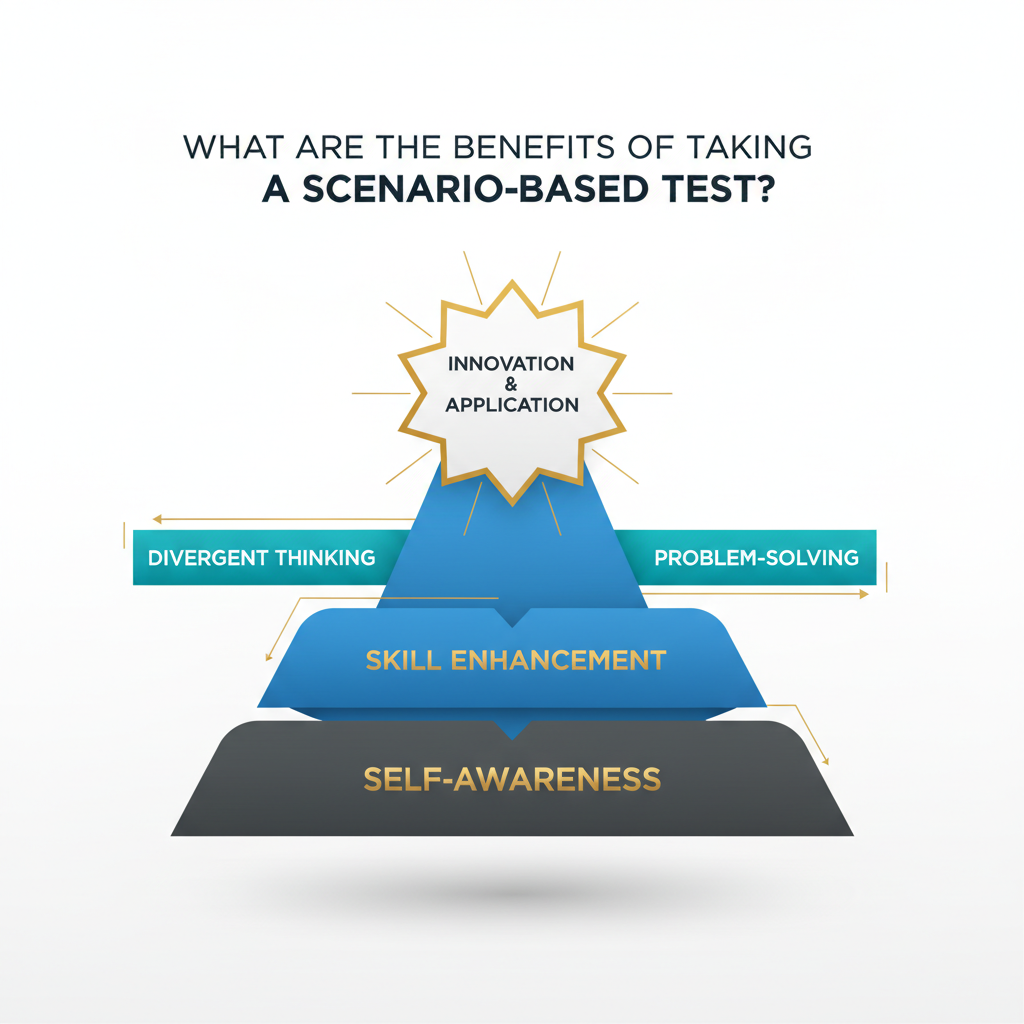
    An infographic illustrating the benefits of scenario-based tests as a layered, upward-progressing chart, starting with Self-Awareness, building to Skill Enhancement, and culminating in Innovation & Application.
    An abstract educational infographic representing ‘What Are the Benefits of Taking a Scenario-Based Test?’. Visualize the benefits as a layered system or upward-progressing milestone chart. Start with a foundational layer (e.g., a wide, solid base shape) labeled ‘Self-Awareness’, building up to a middle layer ‘Skill Enhancement’ (which could branch slightly to show ‘Divergent Thinking’ and ‘Problem-Solving’), and culminating in a top layer ‘Innovation & Application’ (a more elevated, perhaps star-shaped or upward-pointing form). The layers or milestones are distinct geometric shapes, subtly stacked or overlapping to show progression and interconnectedness. The style is minimalist and vector-based, using soft blues, whites, and charcoal for the layers, with gold or teal accents to highlight the progression and benefit labels. Maintain ample negative space, clear visual hierarchy, and professional aesthetics. No people, no cartoons, focus on conceptual representation.

    Gaining Actionable Self-Awareness

    A scenario-based test offers a unique look at how you think. It goes beyond simple self-description by challenging you with creative situations. Your responses show how you naturally approach problems.

    This process uncovers your hidden creative strengths. You will learn your specific thinking style. Do you prefer logic, or do you lean towards imaginative solutions? Understanding your natural approach is powerful and allows for deeper self-reflection.

    These tests also highlight your cognitive flexibility, which is your ability to adapt your thinking. It helps you see new perspectives and gain a clearer picture of your creative potential. This isn’t just about what you can do, but also how you can grow.

    • Uncover Your Natural Approach: See how you react to complex situations on the spot.
    • Identify Creative Strengths: Pinpoint your unique talents for new ideas and solutions.
    • Understand Thinking Styles: Discover your favorite ways to think creatively.
    • Boost Cognitive Flexibility: Learn how well you adapt your thinking to new challenges.
    • Promote Self-Reflection: Think deeply about your natural skills and where you can grow.

    Enhancing Your Creative Problem-Solving Skills

    Scenario tests are more than assessments—they are practice grounds. They mimic real-world challenges that require new ways of thinking. This helps you build key problem-solving skills.

    You’ll practice divergent thinking, which means coming up with many different ideas. This helps you explore more solutions. The tests also push you to find new approaches, which improves your ability to innovate and think outside the box.

    This process sharpens your decision-making. You learn to consider the bigger picture. This experience builds your confidence, so you feel more prepared for future challenges. It’s like a workout for your creative muscles.

    For example, one study showed that creative problem-solving exercises improved divergent thinking by up to 20% [6]. This shows the real benefit of actively practicing these skills.

    • Simulate Real-World Challenges: Practice your skills in a safe, low-stakes setting.
    • Develop Divergent Thinking: Learn to generate a wide range of creative ideas.
    • Foster Innovation Skills: Build your ability to come up with new and unique solutions.
    • Refine Decision-Making: Sharpen your judgment in complex situations.
    • Build Problem-Solving Confidence: Feel more prepared for creative tasks in your daily life.

    Applying Insights to Personal and Professional Growth

    The real value of this test is using what you learn. Your results are more than just a score—they are a roadmap for growth. The personalized feedback helps you focus your efforts on the right areas.

    For personal growth, you can use your creative strengths in new ways. Try hobbies that match your thinking style to find more enjoyment and fulfillment in your life. Understanding yourself helps you thrive.

    Professionally, these insights are just as powerful. You can use your creative thinking to solve workplace challenges and innovate in your role. You might brainstorm new project ideas or improve how your team works together. Your unique approach can lead to success.

    The Creative Ability Test takes this a step further by offering practical strategies based on scientific research. These tips help you keep improving your creative skills. Your journey from potential to planned growth starts here.

    • Personalized Growth Roadmap: Use specific feedback to guide your self-improvement.
    • Enhanced Personal Fulfillment: Match your hobbies and activities to your creative style.
    • Professional Advancement: Apply creative solutions to succeed in your career.
    • Innovative Workplace Solutions: Bring new ideas and improvements to your job.
    • Structured Growth Strategies: Get science-backed advice for your continued creative growth.

    How to Get the Most from Your Test Results

    From Insight to Action: Using Feedback to Foster Growth

    Understanding your psychology test results is a great start. But the real value comes from turning those insights into action. Your answers show your unique way of thinking and solving problems. This feedback is a guide to help you grow your creativity.

    For example, if your path in a “castle test psychology” scenario was spontaneous, it points to strong divergent thinking. On the other hand, a structured path suggests strong convergent thinking and planning skills. Both are valuable creative skills.

    Here are practical ways to use your scenario test feedback:

    • Reflect on your thinking style: Think about how you naturally handle challenges. Do you prefer open-ended situations or clear structure?
    • Identify your creative strengths: Find the creative strengths your answers pointed out. Are you good at coming up with many ideas (ideation)? Or are you better at finding one-of-a-kind solutions (innovation)?
    • Recognize growth opportunities: Find areas where you can grow. Each result shows a skill you can develop. If the test showed you prefer familiar paths, challenge yourself to explore new viewpoints more often.
    • Keep a creativity journal: Write down your thoughts after you face a new problem. Pay attention to your creative process and what helps you find new ideas.
    • Practice cognitive flexibility: Work on being mentally flexible. Look for tasks that make you change your perspective. Try to solve a problem from different angles. This makes your mind more agile. [7]

    By acting on your feedback, you turn self-awareness into real personal growth. You learn not just what you think, but how you think. This helps you use your creativity in new and effective ways.

    Connect Your Results to Our Science-Based Test

    A psychology test like “The Castle Test” gives you a rich, personal look into your creative mind. It shows your natural reactions and how you think. But to get a full, structured understanding of your creative potential, it’s best to pair these insights with a science-based assessment.

    The Creative Ability Test provides this deeper look. It works as a powerful partner to your scenario test results. While a scenario test tells your story, our test measures the specific creative skills behind that story. This includes skills like cognitive flexibility, divergent thinking, problem-solving, and being open to new things.

    Here’s how our Creative Ability Test complements your scenario results:

    • Comprehensive Assessment: Our 30-question test goes beyond intuition. It measures different parts of your creative thinking. This gives you a clear baseline of your abilities.
    • Personalized Insights: You get a report just for you. It explains your strengths in areas like generating ideas, originality, and adaptability. It also points out specific areas where you can grow.
    • Actionable Strategies: The test doesn’t just identify your traits. It gives you practical, evidence-based strategies to boost your unique creative skills. For instance, if your scenario test showed a preference for traditional solutions, our feedback might suggest brainstorming or lateral thinking exercises.
    • Scientifically Grounded: Our method is based on established psychological research. This ensures your results are reliable and accurate. You can feel confident knowing your results are backed by science.

    Combining the personal insights from a scenario test with the clear data from the Creative Ability Test gives you a complete picture. You go from just recognizing your creative skills to actively shaping and improving them. This helps you grow personally and professionally by thinking in new, innovative ways.

    Frequently Asked Questions

    What kind of questions are in a psychology scenario test?

    Psychology scenario tests give you open-ended, imaginary situations. There is no “right” or “wrong” answer. Instead, the goal is to explore your reactions and how you think.

    For example, you might be asked to imagine: “You discover a hidden path in a dense forest. What do you do next?” Or, “You find a mysterious, unlocked box. What do you expect to be inside, and why?”

    Your answers show your unique point of view. They reveal how you think creatively and solve problems. They also show how you adapt to new situations and handle the unknown.

    These scenarios are designed to uncover your intuition and creative thinking. The questions encourage you to use your imagination, not just recall facts.

    What is a story based personality test in psychology?

    A story-based personality test asks you to create or finish a story. These tests, also called projective tests, aim to explore your deeper thoughts and feelings [1]. They don’t ask direct questions about your personality.

    For example, in “The Castle Test,” you might describe a castle, its surroundings, and a journey inside it. Your description becomes a story that offers a peek into your inner world.

    These tests can reveal:

    • Your storytelling skills.
    • Emotional responses to imagined situations.
    • Unique problem-solving approaches.
    • Your hidden values, goals, or fears.

    By looking at the story you create, psychologists can understand you better. This method helps explore your personality, your creative thinking, and how you deal with challenges.

    Are free online psychology scenario tests accurate?

    Many free online psychology scenario tests are fun. They can make you curious about yourself. However, you should be careful about how accurate they are.

    Most free tests are not backed by science. They haven’t been properly researched. This means their results might not be reliable or measure what they promise to [8]. They can offer interesting ideas, but you usually can’t act on them.

    For real self-discovery and growth, a test needs to be based on science. A truly accurate test:

    • Is created using proven research methods.
    • Is tested to make sure it’s psychologically sound.
    • Provides consistent and meaningful results.
    • Gives you personal feedback you can actually use to grow.

    The Creative Ability Test is different. It is built on a scientific foundation. Our 30-question test is based on solid creativity research. It gives you proven insights into your creative strengths and a reliable way to boost your creative potential.


    Sources

    1. https://www.simplypsychology.org/projective-tests.html
    2. https://www.apa.org/pubs/journals/features/xge-gse0000021
    3. https://www.verywellmind.com/what-is-divergent-thinking-2795029
    4. https://psycnet.apa.org/record/1988-06283-001
    5. https://www.simplypsychology.org/carl-jung.html
    6. https://www.researchgate.net/publication/262744391_Enhancing_Creative_Problem_Solving_and_Divergent_Thinking_through_a_Training_Program
    7. https://www.pnas.org/doi/10.1073/pnas.1712230115
    8. https://www.apa.org/education-career/guide/science-test-accuracy
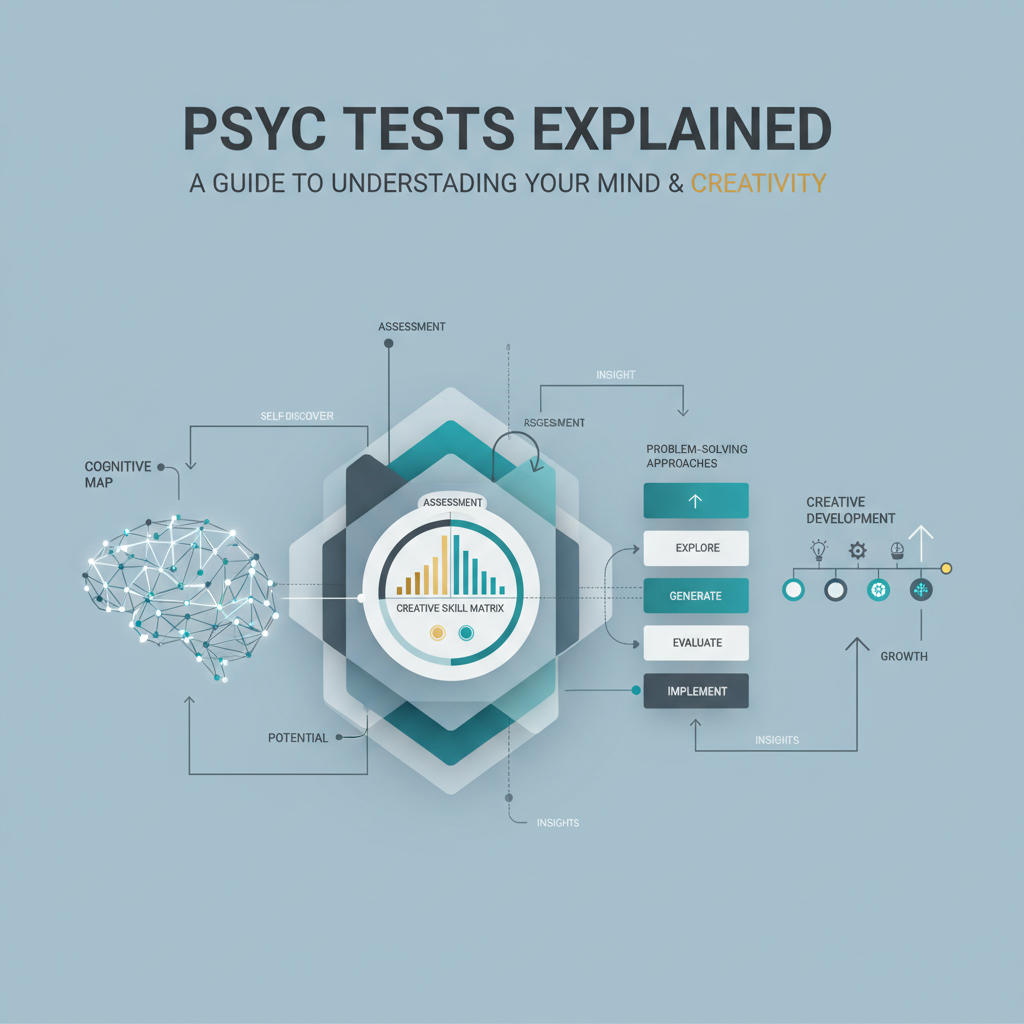
  • Psyc Tests Explained: A Guide to Understanding Your Mind & Creativity

    Psyc Tests Explained: A Guide to Understanding Your Mind & Creativity

    Psychological tests, or ‘psyc tests,’ are standardized methods designed to measure and understand aspects of human behavior, abilities, and personal traits. They range from clinical assessments for mental health to evaluations for cognitive skills like creative thinking. These tests provide structured, evidence-based insights into how individuals think, feel, and solve problems.

    Have you ever wondered how your mind works or how you come up with new ideas? Many of us want to understand ourselves better to improve and reach our full potential. This search often leads us to psychological assessments, also known as psyc tests. These science-based tools are a great way to discover more about yourself and find ways to boost your creativity.

    This article will explain psyc tests in simple terms, showing how they can highlight your creative strengths, thinking styles, and problem-solving skills. We’ll look at how these assessments are more than just quizzes. They offer insight into areas like cognitive flexibility, divergent thinking, and your openness to new experiences. Understanding these parts of your mind can change how you face challenges, spark new ideas in your career, and support your personal growth.

    Join us as we explore what psyc tests are, how they work, and how they can help you unlock your full creative potential. We’ll also cover how to apply your new insights to real-world situations. First, let’s start with a basic understanding of these tests and what they measure.

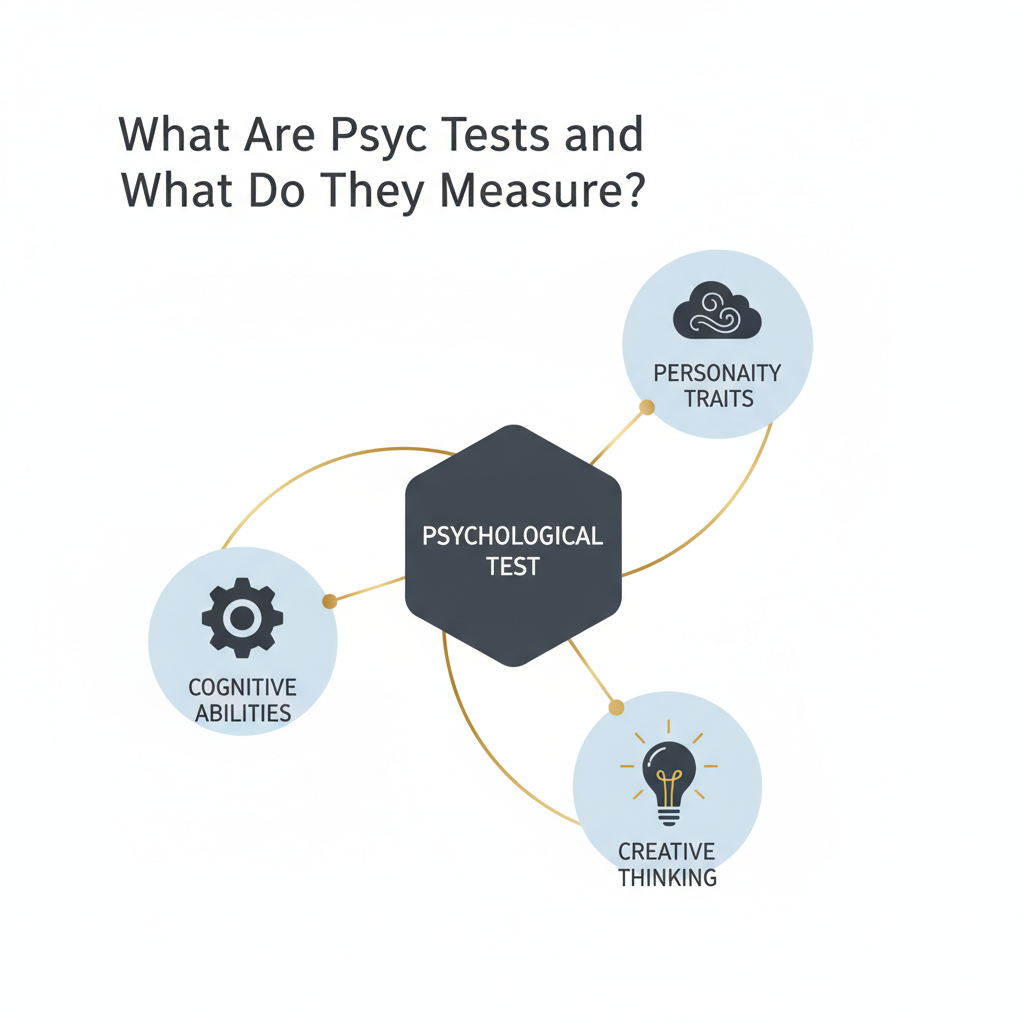
    What Are Psyc Tests and What Do They Measure?

    An infographic showing a central psychological test branching out to measure cognitive abilities, personality traits, and creative thinking, represented by geometric shapes and simple icons.
    Create a minimalist, vector-based infographic illustrating ‘What Are Psyc Tests and What Do They Measure?’. The visual should feature a central, abstract representation of a ‘Psychological Test’ as a foundational cube or sphere. From this central element, branch out with clean, geometric lines to various conceptual nodes or segments, each representing a key measurement area: ‘Cognitive Abilities’, ‘Personality Traits’, and ‘Creative Thinking’. Each measurement area should have a distinct, simple icon (e.g., a gear for cognition, a cloud for personality, a lightbulb for creativity) within a circular or square container. Use a color palette of soft blues and charcoal for primary elements, with subtle gold accents for clarity and emphasis on connections. Ensure ample negative space, clear visual hierarchy, and only short, professional labels for the central test and each measurement area. No humans or cartoon elements. The style should be professional, educational, and approachable, suitable for students and professionals.

    Beyond the Clinic: Using Tests for Personal Growth

    When you think of psychological tests, you might picture a doctor’s office or a mental health evaluation. But they can be used for much more than that. In fact, they are powerful tools for self-discovery and personal growth.

    Imagine understanding your mind in new ways. Psychological tests can highlight your mental strengths, uncover hidden talents, and clarify how you like to think. This knowledge helps you make better decisions about your learning, career, and personal life.

    For instance, understanding your creative profile helps you:

    • Identify your unique problem-solving approaches.
    • Recognize areas where your creative thinking shines.
    • Discover practical ways to enhance your innovation skills.
    • Apply creativity to daily challenges and opportunities.

    These tests act like a mirror to your inner world. They offer a look into your skills, motivations, and potential. This self-awareness is the first step toward meaningful growth and unlocking your full creative potential.

    The Creative Ability Test, for example, focuses specifically on creativity. It helps you find your strengths in areas like cognitive flexibility and divergent thinking. This test guides you from being unsure to having clear, useful insights about yourself.

    You move from wondering about your creative potential to actively developing it. This personal journey helps you build confidence and keep improving.

    The Science Behind Psychological Assessments

    Good psychological tests are based on solid science. They are not just fun quizzes—they are carefully designed tools. Experts create them to accurately measure specific mental traits.

    Two key ideas support any reliable psychological test:

    • Reliability: This means the test is consistent. A reliable test gives similar results if you take it multiple times under similar conditions. Think of it like a consistent measuring tape.
    • Validity: This means the test is accurate. A valid test measures what it says it will. For example, a creativity test must truly measure creativity, not just general intelligence [1].

    Creating these tests takes a lot of research. This includes statistical analysis and studies to prove they work. Researchers collect data from many different people to help improve the questions and scoring. As a result, the tests provide useful and correct information.

    For Creativity assessments, scientists study different aspects of creativity. These include divergent thinking (the ability to come up with many ideas) and cognitive flexibility (the skill of switching perspectives). Innovation and being open to new experiences are also key parts.

    The Creative Ability Test is built on this science. It uses a proven, evidence-based method. Its 30 questions are designed to give you strong, reliable insights. This scientific backing means your personal feedback is trustworthy and useful.

    Understanding the science makes these tests more valuable. You can trust that the insights you receive are not random. They are backed by years of psychological research. This scientific strength makes your journey of personal development and creative growth even more powerful.

    What Are the Main Types of Psychology Tests?

    Personality tests

    Personality tests help you understand your unique traits and preferences. They show how you tend to think, feel, and behave. These tests reveal key parts of your character, like how you interact with others and face challenges.

    There are many types of personality tests. Two popular examples are the Myers-Briggs Type Indicator (MBTI) and the Big Five personality traits.

    • Myers-Briggs Type Indicator (MBTI): This test sorts your preferences into four pairs of opposites: extraversion/introversion, sensing/intuition, thinking/feeling, and judging/perceiving. The MBTI suggests a personality ‘type’ with unique strengths and areas for growth [2].
    • Big Five Personality Traits: This model measures five key areas of personality: Openness to Experience, Conscientiousness, Extraversion, Agreeableness, and Neuroticism (OCEAN). This model is widely used in scientific research and provides a solid way to understand individual differences.

    Understanding your personality can affect your creativity. For example, people high in “Openness to Experience” are often more creative because they welcome new ideas. This self-awareness helps you grow and use your natural strengths.

    Cognitive ability tests

    Cognitive ability tests measure mental skills for learning, reasoning, and problem-solving. They don’t test what you know, but how you process information. These tests show your ability to learn and adapt.

    Key areas measured by cognitive ability tests include:

    • IQ (Intelligence Quotient) Tests: These evaluate general intelligence, including your reasoning, logic, and problem-solving skills.
    • Memory Tests: These assess how well you recall information, both in the short term and long term.
    • Problem-Solving Assessments: These measure how well you analyze complex situations and find good solutions.

    Strong cognitive skills are important for creative thinking. They help you connect different ideas and overcome mental blocks. For example, a good memory helps you recall past solutions, while strong problem-solving skills can lead to new ideas. These tests help you find your mental strengths so you can learn to think more flexibly.

    Mental Health Screenings and Assessments

    Mental health screenings are important tools used by professionals to identify potential mental health concerns. They help diagnose conditions like anxiety or depression and guide treatment plans.

    These assessments often use questionnaires or interviews to explore symptoms and emotional wellness. Their main goal is different from a creativity test. They are clinical tools for supporting mental health, not for creative self-improvement. Instead, they support your overall well-being, which is the foundation for any personal growth.

    Aptitude and Career Tests

    Aptitude tests measure your potential to do well in certain areas. They show your natural talents and can suggest good career paths. Instead of testing what you already know, they focus on what you could be good at. This helps you find where your natural strengths lie.

    Examples of aptitudes include:

    • Verbal Reasoning: The ability to understand and use language well.
    • Numerical Reasoning: Skill with numbers and math concepts.
    • Spatial Reasoning: The ability to imagine and move objects in your mind. This is crucial for design and engineering.
    • Mechanical Reasoning: Understanding how physical objects and forces work.

    These tests can guide your creative journey by helping you choose fields where you are likely to succeed. For example, strong spatial reasoning might mean you’d be good at creative design. High verbal skills could point to a talent for writing. These insights help you match your career to your natural strengths, making your work feel more meaningful.

    Creativity Assessments

    Creativity assessments are designed to measure your creative potential. They explore different sides of your imagination. Unlike traditional intelligence tests, they focus on how you come up with new ideas and solve problems in new ways.

    Key aspects measured by creativity assessments include:

    • Divergent Thinking: The ability to generate many different ideas or solutions for a single problem.
    • Cognitive Flexibility: How easily you can switch your point of view and adapt to new information.
    • Problem-Solving Skills: How well you handle and solve new problems using creative thinking.
    • Openness to New Experiences: Being willing to try new things and consider unusual ideas.

    Our Creative Ability Test is a 30-question assessment based on science. It gives you personalized insights into your creative strengths and thinking styles. For example, you might find you’re great at brainstorming or connecting different ideas. You’ll get practical tips you can use to improve your creative thinking every day. This helps you approach challenges with more confidence and new ideas.

    Understanding your creative profile builds self-awareness, which leads to personal and professional growth. You’ll learn how to use your creativity for problem-solving and bringing new ideas to life. The Creative Ability Test gives clear explanations, making complex ideas easy to understand. It’s designed to help you unlock your full creative potential.

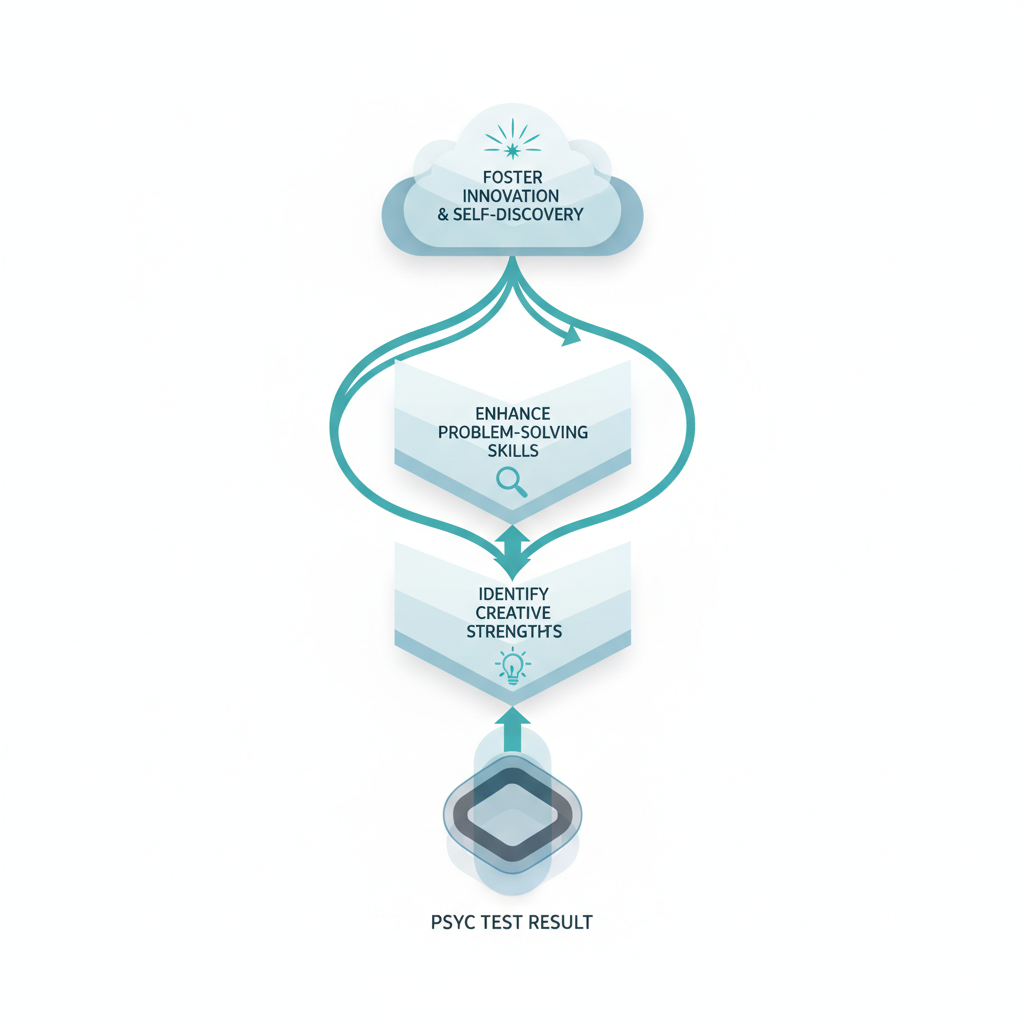
    How Can a Psyc Test Help You Understand Your Creativity?

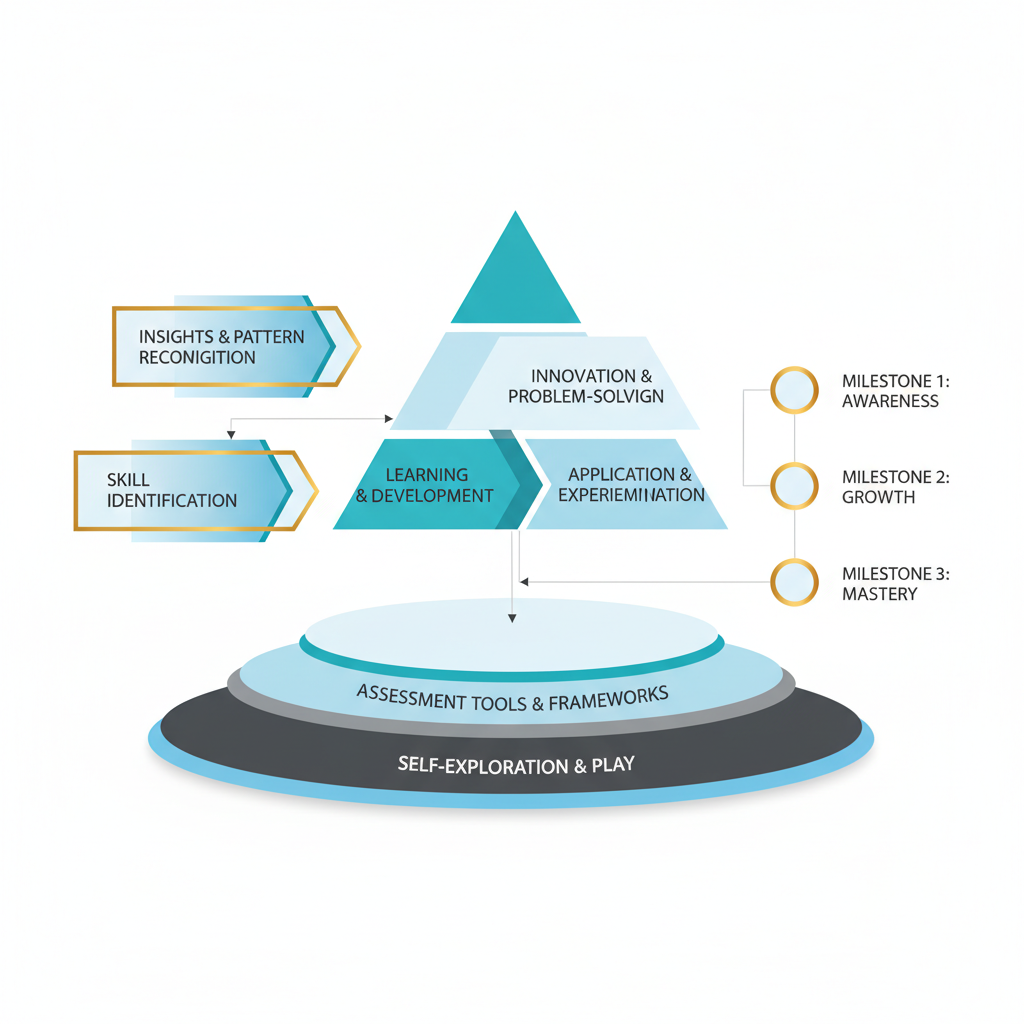
    An infographic illustrating how psychological test results can lead to understanding creative strengths, identifying growth areas, enhancing problem-solving, and fostering innovation, shown as a layered progression.
    Design a clean, vector-based infographic detailing ‘How Can a Psyc Test Help You Understand Your Creativity?’. The visualization should depict a structured pathway or layered system. Start with an abstract representation of a ‘Psyc Test Result’ at the base, leading upwards through a series of interconnected, transparent layers or milestone steps. The first layer should represent ‘Identify Creative Strengths’, followed by ‘Pinpoint Growth Areas’, then ‘Enhance Problem-Solving Skills’, and finally ‘Foster Innovation & Self-Discovery’. Each layer or step should be a distinct, clean geometric shape (e.g., a rectangle or chevron) with subtle gradients, linked by upward-pointing arrows. Utilize a palette of soft blues, whites, and charcoal, with teal accents highlighting the progression and benefits. Incorporate ample negative space for legibility and include only short, concise labels for each stage. The aesthetic must be professional, educational, and free of any human figures or cartoon elements, focusing purely on conceptual representation.

    Measuring Divergent vs. Convergent Thinking

    Creativity can seem like a mysterious quality. But special tests can offer clear insights. These tests show how you come up with and improve ideas. They shed light on your unique way of thinking.

    A key part of creativity is using two different ways of thinking. First is divergent thinking. This is your ability to come up with many different ideas for a single problem. Think of a brainstorming session where you aim for lots of new ideas. For example, imagining all the possible uses for a brick is a great example of divergent thinking.

    The second style is convergent thinking. This is how you narrow down your options to find the single best solution. After brainstorming, you analyze and evaluate your ideas. You logically choose the one that works best. Both divergent and convergent thinking are essential for solving problems creatively [3].

    Tests like the Creative Ability Test are designed to measure these skills. They use specific tasks to see how you handle both types of thinking. As a result, you get a better sense of your natural style. You’ll find out if you’re better at coming up with new ideas or making existing ones better. Knowing this helps you use your strengths more effectively.

    Identifying Your Unique Problem-Solving Style

    Creativity isn’t just for art. It’s a powerful tool for facing any challenge. It’s important to know your own problem-solving style. Everyone approaches problems differently. Some people like a structured, logical approach. Others follow their gut and try new things. A creativity test can show you which approach you use most.

    For example, you might be very analytical. You like to break problems down and look at each piece logically. On the other hand, you could be an intuitive thinker. You get solutions from sudden flashes of insight. Others are more experimental. They like to test different solutions to learn as they go. Each style has its own strengths.

    A good assessment will show you these preferences. It highlights how you usually handle difficult problems. This insight is incredibly valuable. Knowing your unique style helps you in several ways:

    • Use your strengths: You can apply your natural approach more effectively.
    • See your blind spots: You become aware of areas where you might get stuck.
    • Improve collaboration: You understand how your style works with others.
    • Adjust your approach: You can consciously change your strategy for different problems.

    In the end, knowing yourself better helps you solve problems with more confidence and success. It also helps you grow personally and professionally.

    Gaining Actionable Insights for Innovation and Growth

    Understanding your creative strengths is just the beginning. The real power comes from using what you learn. A well-designed creativity test does more than just put you in a box. It gives you practical advice you can use right away. These are real steps you can take to be more innovative and grow as a person.

    Your report from the Creative Ability Test turns what you learn about yourself into real-world advice. It shows you how to use your unique creative style in everyday life. For example, if you are great at creating ideas but struggle to narrow them down, the report will offer specific tips. This could include new ways to evaluate ideas or make decisions. On the other hand, if you’re good at choosing the best option, you might get tips on how to brainstorm or think outside the box.

    This personalized advice helps you to:

    • Boost your creative output: Learn ways to come up with new ideas more often.
    • Improve your ideas effectively: Build skills to judge and improve your ideas.
    • Overcome creative blocks: Know what holds you back and learn how to get past it.
    • Apply creativity to daily life: Use your creative thinking to solve everyday challenges.
    • Be more innovative at work: Learn how to bring new ideas to your job and projects.

    The Creative Ability Test provides more than just a score. It gives you a clear plan to build on your creative skills. It helps you go from knowing your strengths to actively growing them. This leads to ongoing growth, both at work and in your personal life.

    Is a ‘Psych Evaluation Test Online Free’ Reliable?

    Understanding the Limits of Free Quizzes

    You’ve probably seen many free “psych evaluation tests” or quizzes online. While they promise quick insights, it’s best to be careful. Most of these quizzes are not based on real science.

    Often, free quizzes are just for entertainment. They give you generic or very simple results. For example, they might tell you if you are “left-brained” or “right-brained.” However, this idea is a common myth about the brain [4]. Quizzes like these rarely offer real psychological insights.

    Here’s why you should be wary of free online quizzes:

    • Lack of Validation: Psychology experts don’t make or test them. So, the questions don’t really measure what they say they do.
    • No Standardization: A good test gives everyone the same experience. Free quizzes don’t do this.
    • Superficial Results: The feedback is too broad and general. It has little personal value and doesn’t offer useful advice.
    • Entertainment Over Insight: Their main goal is to be fun, not to be an accurate psychological test. As a result, they can’t help you grow as a person.
    • Potential for Misinformation: They can spread old or wrong ideas about psychology.

    If you want to understand your own creativity, these quizzes are not very helpful. They can’t identify your unique creative strengths or show you how to improve. To get real insights, you need a better tool.

    The Value of Scientifically Grounded Assessments

    If you want real insights about your mind, choose a test built on science. Experts develop these tests. They go through careful testing to make sure they are reliable and accurate.

    A good creativity test gives you more than just a score. It gives you a detailed map of how you think creatively. This map shows your unique thinking styles and your strengths in solving problems.

    Key benefits of choosing a science-based assessment include:

    • Accurate Measurement: These tests accurately measure different parts of creativity, like your ability to brainstorm ideas, think flexibly, and be open to new experiences.
    • Personalized Insights: You get feedback that is specific to you, not just a general description.
    • Actionable Strategies: The results include practical advice. These tips help you improve your creative skills in your daily life.
    • Evidence-Based Foundation: These tests are based on solid psychological research. This means you can trust the results [1].
    • Structured Growth: They help you understand your creative potential and turn that knowledge into action. This allows you to grow in a structured way, both personally and professionally.

    The Creative Ability Test is a good example of this approach. Our 30-question test is based on science. It measures different parts of your creativity. You’ll get personal insights into your creative strengths. We also give you practical tips to help you use your creativity for new ideas and personal growth. This complete approach guides you on a path of self-discovery.

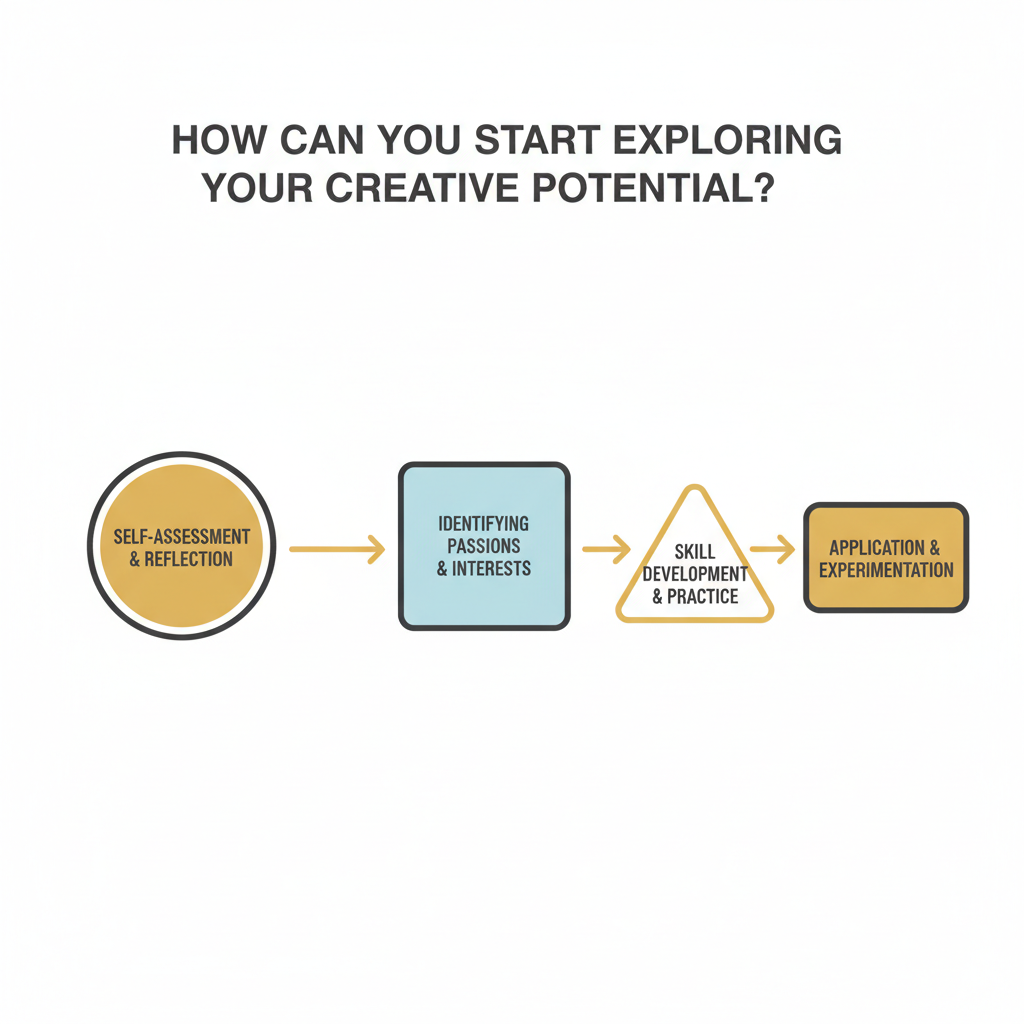
    How Can You Start Exploring Your Creative Potential?

    An infographic displaying a step-by-step pathway to explore creative potential, including self-assessment, identifying passions, skill development, and application, using geometric shapes and connecting lines.
    Create a minimalist, vector-based infographic outlining ‘How Can You Start Exploring Your Creative Potential?’. The visual should be a clear, step-by-step process represented as a series of connected, distinct geometric shapes forming a pathway. Begin with ‘Self-Assessment & Reflection’, leading to ‘Identifying Passions & Interests’, then ‘Skill Development & Practice’, and finally ‘Application & Experimentation’. Each step should be represented by a unique, clean geometric shape (e.g., a circle, square, triangle), interconnected by directional lines or arrows. Use a color scheme of soft blues, whites, and charcoal, with vibrant gold accents to highlight the active process and encourage engagement. Ensure the layout includes generous negative space and structured grouping for clarity. Only short, professional labels should mark each step. The overall style should be highly professional, educational, and approachable, with no human figures or cartoon elements, focusing entirely on conceptual guidance.

    Discover the Creative Ability Test

    Want to unlock your full creative potential? Many people wonder how to explore their creative skills. The Creative Ability Test offers a clear, science-based path to do just that. This unique test helps you find and understand your creative strengths.

    It’s more than a basic quiz. Our platform gives you a detailed 30-question test. This test looks at different parts of your creativity. It measures your flexible thinking, problem-solving skills, and openness to new experiences. It also helps pinpoint your unique thinking styles.

    Taking the Creative Ability Test is a big step in learning about yourself. It’s like a personal guide. You’ll get practical insights into how your mind creates new ideas. For example, you might find you’re good at divergent thinking—the skill of creating many ideas from a single point. Research shows that creativity is a key skill for success in today’s fast-changing world [5].

    This test is perfect for anyone who wants to grow personally or improve at work. Start your journey today and understand the full range of your creative mind.

    What You’ll Learn from Your Personalized Report

    After you finish the test, you get a detailed personal report. This report is your guide to understanding your creative style. It helps you move from being unsure to clearly understanding yourself and how you create.

    Your personal insights are more than just scores. They give clear explanations of your creative skills. You will understand your main thinking styles and how you handle new ideas and solve problems. For example, you might learn if you’re better at coming up with brand-new ideas or improving on existing ones.

    The report focuses on how to use your creativity in the real world. It gives you tips to grow your creative skills and improve your creative thinking. It also offers advice for everyday situations, like solving problems at work or in your personal life.

    Here’s what your personal report will help you do:

    • Identify Your Creative Strengths: Discover your natural creative talents and build confidence in your abilities.
    • Understand Your Thinking Style: Learn if you prefer divergent or convergent thinking, and how to use both well.
    • Get Practical Tips: Receive tips matched to your profile that are designed to improve your creative skills.
    • Solve Problems Creatively: Learn how to use your unique creative style to handle challenges at work or home.
    • Grow Your Creativity: Get a clear plan for creative growth to help you be more consistently creative.
    • Get Easy Explanations: Complex psychology ideas are made easy to understand, so your report is accessible to everyone.

    This detailed report helps you grow. It turns a basic understanding of creativity into useful, personal insights. Start exploring and begin your creative journey today.

    Frequently Asked Questions About Psyc Tests

    What are some psychological testing examples?

    Psychological tests are powerful tools that help us understand how people think, feel, and act. These tests are not just for clinical use; they also offer insights that can help you grow as a person.

    Here are some common examples of psychological tests:

    • Personality Assessments: These tests explore your patterns of thinking, feeling, and behaving. The Big Five Inventory, for example, measures traits like openness, conscientiousness, extraversion, agreeableness, and neuroticism [6]. Knowing your personality can show you how you handle challenges or work with others.
    • Cognitive Ability Tests: These evaluate your mental skills, such as IQ, memory, attention, and problem-solving. They can highlight your core strengths, which are often the foundation for creative thinking.
    • Aptitude and Career Tests: These help you find your natural talents and interests to guide you toward fitting school or work paths. Knowing what you’re good at helps you use your strengths.
    • Mental Health Screenings: These tools help spot signs of mental health issues, which is important for your overall well-being. A healthy mind is key to being your most creative self.
    • Creativity Assessments: Special tests are designed to measure different parts of creativity. Our Creative Ability Test is one example. It looks at your mental flexibility, ability to brainstorm, and openness to new things—all key parts of thinking in new ways.

    Each type of test offers a unique way to look at yourself. This self-knowledge is the first step to improving and reaching your full potential.

    What is the difference between a psychology test and a quiz?

    People often use the words “test” and “quiz” to mean the same thing. But in psychology, they are very different. Knowing the difference helps you choose a tool that gives you trustworthy results.

    A real psychological test is a scientific tool that has been carefully created and proven to work. A casual quiz, on the other hand, is usually just for fun. Here’s a comparison:

    Feature Psychology Test Casual Quiz
    Purpose To measure something specific, make a diagnosis, or provide insights for growth. Entertainment, light self-reflection, or general interest.
    Scientific Basis Based on research, developed by experts, with standard rules for taking and scoring. Often made without a scientific background; based on popular ideas.
    Reliability Gives consistent results over time, no matter who gives the test [7]. Results can be inconsistent and are often based on opinion.
    Validity Accurately measures what it says it will measure [8]. Often has no proof of accuracy; may not measure anything real.
    Actionable Insights Provides feedback based on data and real steps you can take to improve. Offers general comments that are not specific to you or easy to act on.

    The Creative Ability Test is a true psychological assessment. It uses a proven, scientific method. This means you get accurate, personal, and useful results to help you understand and grow your creative skills.

    Are there specific psychology tests for students?

    Yes! Psychology tests are very helpful for students. They offer guidance for school and personal growth by helping them understand their strengths, learning styles, and possible career paths.

    Here are ways psychology tests support students:

    • Learning Style Assessments: These help students find their best way to learn, whether they are visual, auditory, or hands-on learners. Knowing this can improve study habits.
    • Career Aptitude and Interest Tests: These tests match a student’s skills and passions with different jobs. This helps them choose a major and plan for a future career.
    • Cognitive Skills Evaluation: Tests can find specific mental strengths or areas that need work. This helps students adjust how they learn and build confidence in tough subjects.
    • Creativity Assessments: Creative thinking is a very important skill for students. Our Creative Ability Test helps students:
      • Discover their unique creative strengths.
      • Improve their problem-solving skills.
      • Bring new ideas to their school projects.
      • Prepare for future careers that require fresh ideas and the ability to adapt.
    • Emotional Intelligence Tests: Understanding and managing emotions is a key life skill. These tests help students build better relationships and handle stress.

    By using scientific tests like the Creative Ability Test, students get a clear picture of their abilities. They can create a real plan for improvement. This helps turn confusion into confidence and prepares them for a future where new ideas are important.


    Sources

    1. https://www.apa.org/education-career/guide/science-psychology
    2. https://www.myersbriggs.org/
    3. https://psycnet.apa.org/record/1971-00827-001
    4. https://www.health.harvard.edu/blog/right-brainleft-brain-right-2017082512222
    5. https://hbr.org/2019/08/how-to-build-a-culture-of-creativity
    6. https://bigfivepersonalitytest.com/
    7. https://www.simplypsychology.org/reliability.html
    8. https://www.simplypsychology.org/validity.html

  • Psychological Assessment Fundamentals: A Beginner’s Guide

    Psychological Assessment Fundamentals: A Beginner’s Guide

    Psychological assessment fundamentals refer to the core principles and methods used to measure a person’s mental abilities, personality traits, and behaviors. This scientific process relies on standardized, reliable, and valid tools like tests and questionnaires to gather information, which is then interpreted to provide actionable insights for personal growth, educational planning, or professional development.

    Have you ever wondered how your mind works—how you solve problems, innovate, or come up with new ideas? Understanding this is a journey, and a psychological assessment is a science-based tool that can guide you. These tests aren’t just for experts; they offer clear insights into your cognitive abilities, personality traits, and natural potential, including your creative strengths.

    This beginner’s guide explains the basics of psychological measurement, making complex topics easy to grasp for anyone curious about self-discovery. We will explore how these tests offer more than just self-reflection by providing structured ways to find your strengths, understand your thinking style, and unlock your ability to innovate. Whether you want to grow personally, advance your career, or simply understand yourself better, these tools can be empowering.

    This article will give you a solid foundation, from the core principles that make a test reliable to the different types available, including those that measure creativity and even famous methods like the ink blot test. You will learn to turn uncertainty about your abilities into useful self-awareness, helping you create a plan for growth and better appreciate your unique creative potential.

    What Is Psychological Assessment and Why Does It Matter?

    Moving Beyond Mystery: A Simple Introduction

    What drives your thoughts? How do you solve problems? A psychological assessment can help answer these questions. It’s a process that helps you understand how your mind works. Think of it as a roadmap to your inner world.

    Instead of guesswork, this process uses proven tools to measure how you think and feel. It can show you your creative strengths and your personal thinking style. This means understanding how open you are to new ideas or how easily you can switch between tasks [1].

    The main goal is to give you a clear picture of yourself. It provides real facts about your skills and potential. In the end, it helps you learn more about who you are.

    How Assessments Help You Understand Yourself

    Assessments act like a mirror for your mind. They give you insights you might not find on your own. This helps you understand yourself better, which is key to personal growth.

    Here’s how they can help:

    • Identify Strengths: Discover your natural talents and abilities, including your specific creative thinking skills.
    • Uncover Potential: Find your hidden talents in areas like problem-solving and new ideas.
    • Find Areas for Growth: Learn where you can improve. For example, you can get better at brainstorming new ideas (also known as divergent thinking) [2].
    • Clarify Thinking Styles: Understand how you handle information and solve problems.
    • Boost Self-Awareness: Get a clearer picture of your personality and how your mind works.

    For example, you might find out you’re great at coming up with lots of ideas, or that you’re skilled at improving existing ones. This kind of information is very useful.

    The Goal: Using Insights for Real Growth

    An assessment is not about getting a label. The goal is to give you practical advice you can use. This information helps you make real, positive changes in your life.

    Here are some of the benefits:

    • Personalized Strategies: Get advice created just for you to help grow your creativity.
    • Better Problem-Solving: Use your unique creative strengths to solve tough challenges.
    • Career Growth: Use what you learn to do better in your job and build a clear path forward.
    • A Path to Self-Improvement: Feel more confident on your journey of personal growth.

    For example, our Creative Ability Test gives you personalized feedback and practical tips to improve your creative thinking. It helps you use your full creative talent for personal and professional success. It’s all about understanding your mind and putting that knowledge into action.

    What Are the Core Principles of Psychological Measurement?

    Reliability: Is the Test Consistent?

    Imagine stepping on a scale. You expect it to show the same weight every time you use it. That’s the basic idea behind reliability.

    A reliable test gives you similar results under similar conditions. In other words, if you take a good creativity test today and again next week, your results should be nearly the same (as long as your creative skills haven’t changed much).

    Reliability is crucial for your self-discovery. It means you can trust the insights from the Creative Ability Test. The feedback you get is dependable. This helps you build a solid understanding of your creative style and plan your growth [3].

    Key parts of a reliable test include:

    • Consistency over time: You get similar results if you take the test again.
    • Internal consistency: Different parts of the test that measure the same skill give similar results.
    • Stable insights: The creative strengths it finds are a true reflection of your skills.

    When a test is reliable, you can act on its insights with confidence. You know your personalized strategies for boosting creativity are based on stable, consistent data.

    Validity: Does the Test Measure What It Claims?

    Reliability means a test is consistent. But validity asks a different, equally important question: Does the test actually measure what it’s supposed to?

    For example, a creativity test should measure your ability to brainstorm new ideas. It shouldn’t be a simple vocabulary or knowledge quiz. Validity ensures the Creative Ability Test truly assesses your creative potential, not some other skill.

    A valid test provides accurate, meaningful insights. This means the feedback you get truly reflects your creative strengths and ways of thinking. You can confidently use these insights to solve real-world problems.

    Our Creative Ability Test is based on solid research into creativity. This careful design ensures it measures key creative skills, so your results give you a true picture of your creative mind.

    Understanding validity helps you:

    • Trust the results: Know that the creative strengths it identifies are real.
    • Apply insights correctly: Use your results to improve specific creative skills.
    • Make smart decisions: Guide your personal and professional growth.

    Validity points your creative journey in the right direction. It turns guessing into clear self-awareness.

    Standardization: Ensuring Fairness and Comparison

    For test results to be meaningful, we need standardization. This means everyone takes the test under the same conditions and is scored by the same rules.

    Imagine one person taking a test in a quiet room and another in a noisy one. Their results wouldn’t be a fair comparison. Standardization prevents these issues and creates a level playing field for everyone.

    For the Creative Ability Test, standardization means you get clear instructions and a fair testing environment. Your score is then compared to a large group of people who took the test in the same way [4].

    This process offers several key benefits:

    • Fairness: Outside factors don’t affect your results.
    • Comparison: You can see how your creative strengths compare to others.
    • Clear interpretation: Your feedback is based on a consistent, objective system.
    • Meaningful benchmarks: You get a clear sense of your creative potential and where you can grow.

    Standardization helps you measure your creative skills accurately. It shows you where you stand compared to others. This knowledge is a powerful tool for personal growth and innovation.

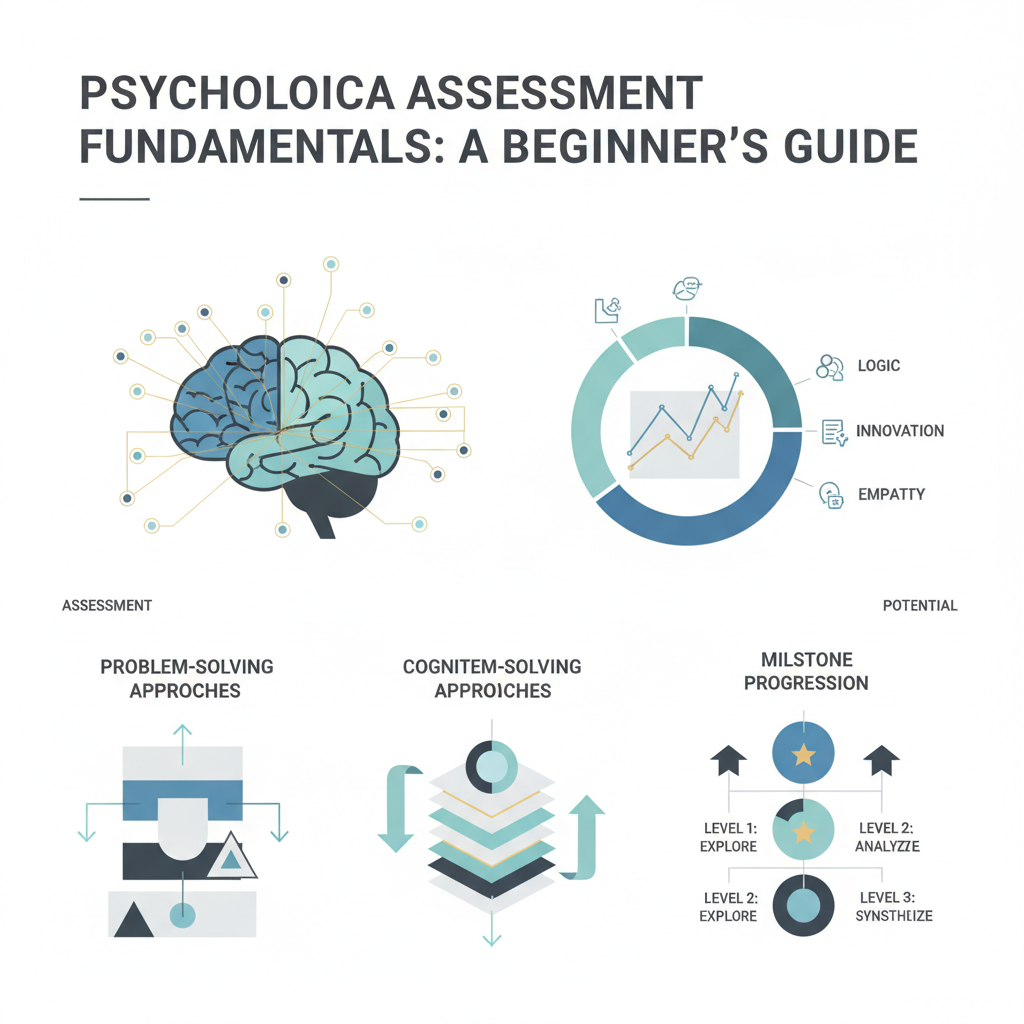
    What Are the Common Psychological Test Types?

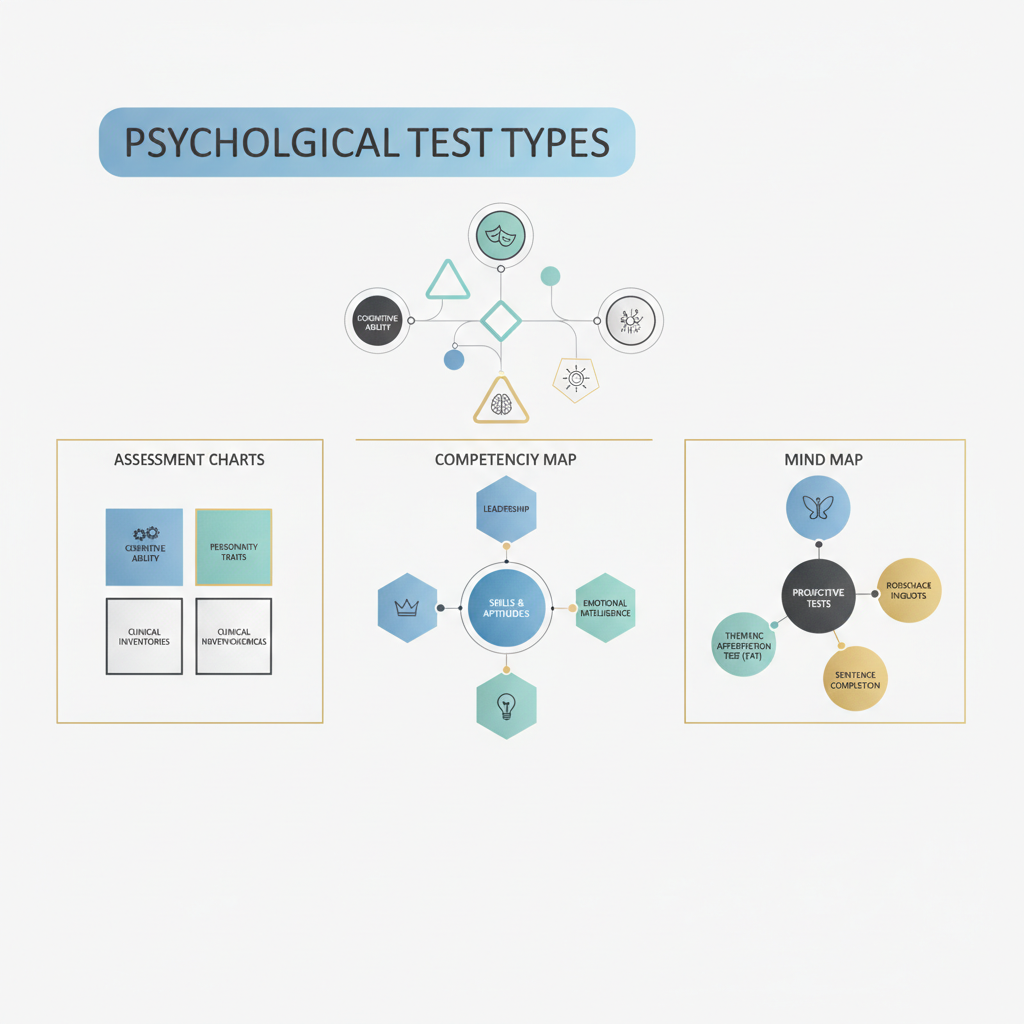
    An infographic categorizing common psychological test types using a structured, abstract diagram with distinct sections.
    Design an abstract, educational infographic presenting various common psychological test types. Use a structured assessment chart, competency map, or a mind map with idea clusters to categorize and visually differentiate the types. Employ clean, geometric shapes with subtle gradients and a color palette of soft blues, whites, charcoal, with gold or teal accents. Ensure the layout maintains visual hierarchy and structured grouping, with open areas for short category headers. No human figures or cartoons, maintaining a minimalist, professional, vector-based style.

    Objective tests: Structured Questions and Answers

    Objective tests are a common and straightforward way to measure certain traits. They ask a clear set of questions, and you simply select from pre-defined answers like multiple-choice, true/false, or rating scales. Because the scoring is standardized, it’s easy to compare results across many people.

    These tests are designed to measure traits like personality, attitudes, and abilities. For instance, a popular objective test called the Big Five Inventory measures “Openness to Experience,” a trait closely linked to creativity and innovative thinking [5].

    If you’re interested in your own creativity, objective tests offer a structured way to learn more. They can help you understand your thinking style, such as how you solve problems or explore new ideas. Our Creative Ability Test uses this reliable, objective method to provide clear, actionable insights into your personal creative profile.

    Benefits of objective tests include:

    • Consistency: They provide reliable results due to standardized scoring.
    • Efficiency: Many can be completed relatively quickly.
    • Breadth: They can cover a wide range of traits or skills.
    • Clarity: Results are often presented in an easy-to-understand format, offering immediate self-awareness.

    Projective Tests: Uncovering Deeper Insights

    Projective tests take a different approach. Instead of clear questions, they use vague images or situations. You respond freely with what you see or imagine, as there are no right or wrong answers. The goal is to reveal deeper, sometimes unconscious, aspects of your personality through your responses.

    Famous examples include the Rorschach Inkblot Test, where you describe what you see in abstract inkblots [6]. Another is the Thematic Apperception Test (TAT), where you create stories about pictures. These tests aim to uncover hidden motives or conflicts and provide rich, detailed insights into a person’s inner world.

    While interesting, projective tests are difficult to interpret and require extensive training for psychologists. Their focus isn’t on measuring specific skills, but rather on exploring deeper thought patterns. Our Creative Ability Test, in contrast, focuses on measurable creative strengths. Still, knowing about projective tests shows the many ways we can try to understand the human mind.

    • Projection Test Psychology: Discover the principles behind projection tests, which use ambiguous stimuli to help reveal unconscious thoughts and feelings about your inner world.
    • Psychodynamic Test: Explore psychodynamic tests and see how they aim to uncover the unconscious forces that may shape your personality and creative expression.

    Aptitude and Performance Tests: Measuring Your Skills

    Aptitude and performance tests measure your potential and current skills. Aptitude tests look at your natural talent and your capacity to learn something new. In contrast, performance tests measure what you can do right now by evaluating your existing skills and knowledge.

    These tests are especially useful for understanding creativity. A creative aptitude test, such as ours, measures your potential for innovative thinking. It looks at your natural ability to generate new ideas and solve problems, focusing on skills like:

    • Divergent Thinking: The ability to generate many varied ideas.
    • Cognitive Flexibility: Shifting perspectives and adapting thought processes.
    • Originality: Producing unique and novel concepts.
    • Problem-Solving Skills: Applying creative thought to overcome challenges.
    • What is a Performance Test in Psychology?: This guide explains what performance tests are, providing examples of how they measure what you can do right now by evaluating your current skills.

    Taking a creative aptitude test gives you practical insights into yourself. You’ll learn about your unique creative strengths and see where you can grow. It helps replace uncertainty with a clear map of your creative potential. Our 30-question assessment is based on science and gives you personalized feedback and practical tips to boost your creativity for personal and professional growth.

    Behavioral, Observational, and Situational Tests

    These tests look at how you act in specific situations. They often work by observing you in a real-life or simulated setting, which gives direct insight into your actions. For example, a situational test might show you a workplace problem and ask you to choose the best way to handle it.

    When it comes to creativity, these tests might involve practical tasks like brainstorming solutions or participating in a design challenge. An observer would then assess your approach, looking at your innovative ideas and collaboration skills. This method provides a realistic view of how you use your creativity in practice.

    While effective, these tests can be time-consuming and often need trained observers. The Creative Ability Test offers a more efficient alternative. It uses structured questions to find patterns in your creative thinking and behavior. Our test simplifies this information into measurable insights about your creative strengths. This helps you understand how you might tackle real-world creative challenges and gives you a clear path for improvement.

    • Observation Test in Psychology: Learn about observational methods in psychology and how watching behavior in specific contexts provides direct insights into a person’s skills and actions.

    To learn more about the different categories of assessments, this resource offers a helpful overview:

    • Psyc Tests Explained: Learn more about the different types of psychological tests available and how they can help you understand your own mind and creative abilities.

    A Closer Look at Famous Psychological Tests

    The Inkblot Test (Rorschach): What Do You See?

    Imagine looking at a symmetrical inkblot. What does it look like to you? That’s the basic idea behind the Rorschach Inkblot Test.

    A Swiss psychiatrist named Hermann Rorschach developed the test in 1921. It uses ten standard inkblots. Some are black and white, while others have color. Testers show you each blot one by one. They then ask what you see and where you see it. [7]

    The idea is that how you interpret these vague images reveals your hidden thoughts, feelings, and personality traits. For example, seeing movement might suggest you have a dynamic personality. Focusing on small details could mean you have a careful mind.

    The Rorschach test is historically important, but many experts question its scientific accuracy. Today, many psychologists prefer tests that are more objective. Still, it offers a fascinating look at how different people see the same thing. This can highlight a person’s imagination and unique point of view.

    This shows the power of perception. Creative people often see connections and patterns that others miss. They can turn something unclear into a new idea. While the Rorschach doesn’t directly measure creativity, it shows how much our perception shapes our thoughts.

    Thematic Apperception Test (TAT): Telling a Story

    Another classic projective test is the Thematic Apperception Test, or TAT. This test asks you to be a storyteller.

    You look at a series of vague pictures, usually showing people in different situations. Your task is to make up a story for each picture. You’ll describe what happened before the scene, what’s happening now, how the characters feel, and what will happen next. [8]

    Psychologists use the TAT to understand a person’s inner motivations, feelings, and relationships. The stories you tell can reveal your main drives and inner conflicts. They also show how you see the world around you.

    Storytelling is a core part of human creativity. It takes imagination, empathy, and the skill to build a clear story. The TAT, therefore, offers a peek into how you create stories in your mind. It’s about making sense of the unknown, which is a key creative skill. But like the Rorschach, the TAT’s results depend on the psychologist’s interpretation, which can be inconsistent.

    • The TAT Psych Test Explained: Delve deeper into the Thematic Apperception Test (TAT) and explore how this unique storytelling assessment can offer surprising insights into your creative thinking patterns.

    Sentence Completion and Drawing Tests (HTP, DAP)

    These tests are another way to encourage personal expression. They give a unique look into a person’s inner world.

    Sentence Completion Tests

    In these tests, you are given incomplete sentences and asked to finish them. For example, you might see “My greatest fear is…” or “I feel happiest when…”.

    Your answers can reveal your attitudes, beliefs, and feelings. They offer a direct look at how you think. These tests are often clearer than inkblots or pictures.

    This method tests your ability to come up with ideas and shows how you express yourself. This connects to creative thinking and self-reflection.

    Drawing Tests: HTP and DAP

    Drawing tests, like the House-Tree-Person (HTP) and Draw-A-Person (DAP) tests, are another type of projective assessment. They ask you to draw specific things.

    • House-Tree-Person (HTP): You draw a house, a tree, and a person.
    • Draw-A-Person (DAP): You simply draw a person.

    Psychologists analyze these drawings. They look at the details, style, and the overall picture. The goal is to learn about your self-image, emotional state, and how you see your own body. For instance, the size of a house you draw might relate to your feelings about family.

    These tests use drawing to express feelings. They can hint at your imagination and show how you organize ideas visually. While they don’t directly measure creativity, they show the connection between drawing and your inner world.

    Questionnaires and Inventories

    Unlike open-ended projective tests, questionnaires and inventories are more structured. They are common in modern psychology because they provide clear, measurable data.

    These tests usually have a series of questions or statements. You answer using multiple-choice, rating scales, or true/false options. They are designed to measure many different things, such as personality traits, attitudes, interests, and specific skills.

    A well-known example is the Big Five Personality Inventory. While not focused on creativity directly, it measures traits like Openness to Experience, which is strongly linked to creative thinking. [9]

    Questionnaires are very useful for measuring specific parts of creativity. They offer a clear, scientific way to find your creative strengths and understand how you think.

    The Creative Ability Test uses this same scientific method. It’s a 30-question assessment that measures different aspects of creativity. Afterward, our platform gives you personalized feedback and practical strategies. This helps you improve your creative thinking and problem-solving skills.

    • Psychological Screening Inventory: Understand the purpose of a psychological screening inventory and how its broad screening approach differs from a focused assessment of creativity.

    By using a scientific approach, these tests help you move from being unsure to having a clear understanding of yourself. They give you a clear path to grow. You get a solid understanding of your creative potential, which helps you use your creativity in real life.

    • 10 Popular Psychological Tests: From personality inventories to cognitive measures, explore this list of 10 popular psychological tests and learn what each one reveals about the human mind.

    How Are Psychological Assessments Used in Real Life?

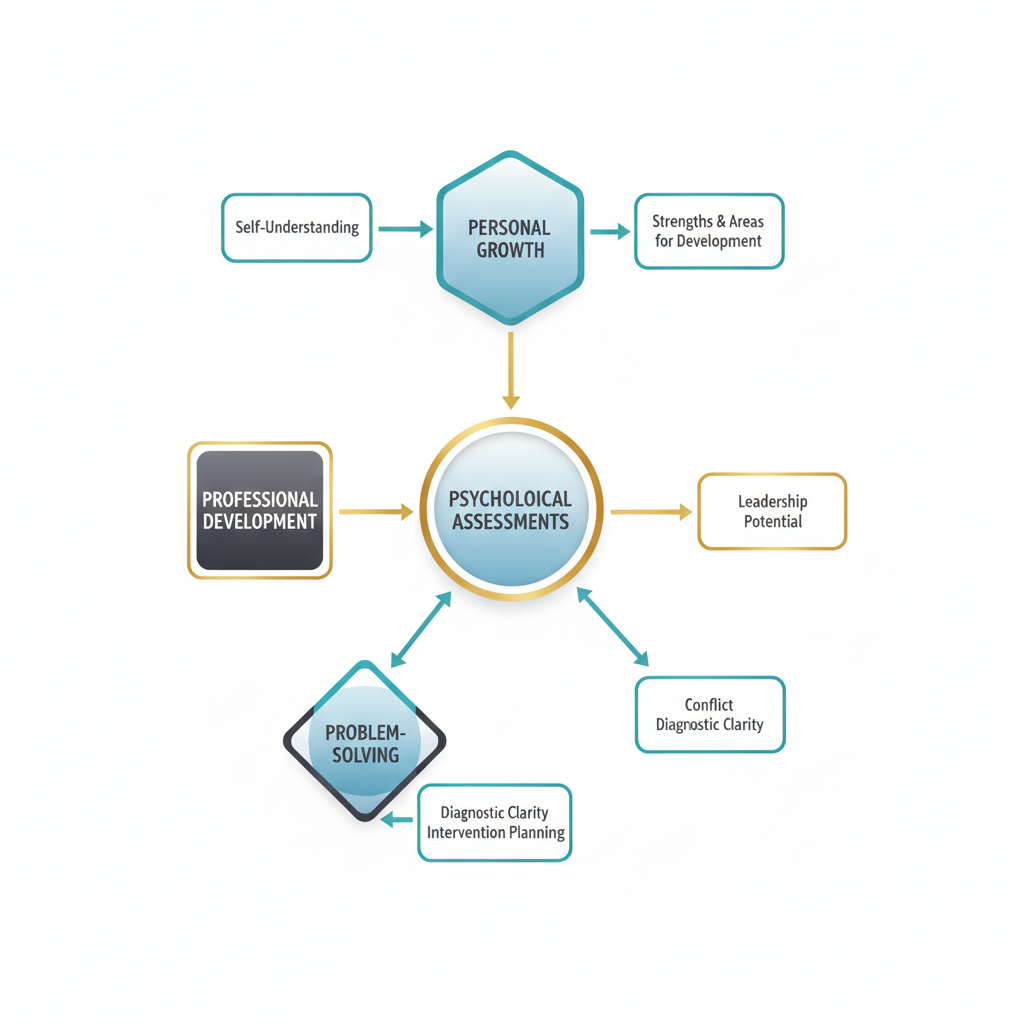
    An infographic showcasing diverse real-life applications of psychological assessments through a branching, conceptual network diagram.
    Generate an abstract, educational infographic illustrating the real-life applications of psychological assessments. Visualize this as a branching pathway or a cognitive network diagram, showing how assessments connect to various fields or outcomes such as personal growth, professional development, and problem-solving. Use clean, geometric shapes, subtle gradients, and a color palette of soft blues, whites, charcoal, with gold or teal accents. Incorporate directional markers and maintain a minimalist, professional, vector-based style with sufficient negative space. No human figures or cartoons.

    For Personal Growth and Self-Discovery

    Psychological assessments are like a mirror for your mind. They help you understand yourself better. Many people use them for personal growth and to find their unique strengths. These tools can show you hidden talents and new ways of thinking.

    For example, a creativity test can show your potential for innovation and how you solve problems. You might learn you are good at divergent thinking, which is the ability to come up with many ideas. Knowing these traits helps you become more self-aware and can guide you toward new opportunities.

    This process turns confusion into clarity. Instead of just wondering about your skills, you gain self-knowledge you can act on. It helps you build on your strengths and work on areas where you want to grow. This journey is all about reaching your full potential.

    A good assessment gives you personal feedback that explains your creative style. This helps you see yourself more clearly. Such insights are key for self-improvement and support your personal development in real ways. [10]

    In Education: Understanding Learning Styles

    Assessments play an important role in education. They help teachers adjust their teaching methods for different students. Students also learn more about how their own minds work. This leads to better study habits.

    For instance, cognitive tests can show how students best take in information. They reveal preferred learning styles. Some students learn best by seeing things (visually). Others learn by hearing (auditory). Some do best with hands-on experience.

    Understanding creative thinking in education is also key. It reveals how students solve problems and come up with new ideas. This knowledge helps teachers create classrooms that encourage curiosity and critical thinking. As a result, students can do better in school and become more engaged with their subjects.

    • Psychological Tests in Education: Explore how psychological tests are used in educational settings to identify learning styles, support student development, and unlock academic potential.

    In the Workplace: Career Development and Aptitude

    In today’s fast-paced world, many businesses use psychological assessments. These tools help them make hiring decisions and support employee career growth. They help match the right person to the right job. [11]

    Assessments identify key talents and strengths. They show how a person might contribute to a team. For example, a creativity assessment can find innovative thinkers. These individuals are valuable for solving problems and developing new ideas. Understanding your own creative strengths can also open new career paths and help you explain your unique value.

    By understanding your creative potential, you can:

    • Identify roles that align with your natural abilities.
    • Enhance your problem-solving skills for complex challenges.
    • Contribute innovative ideas to projects and teams.
    • Communicate your unique value to employers.
    • Guide your professional development toward growth areas.
    • A Beginner’s Guide to Occupational Tests: Discover how occupational tests are used in the workplace to assess skills, match candidates to roles, and guide career development.
    • Psychological Assessment in the Workplace: Learn how businesses use psychological assessments to identify creative talent, build innovative teams, and foster professional growth among employees.

    This knowledge gives you a clear plan for growth. It helps you use your creativity at work, turning ideas into real-world actions. This boosts innovation within any organization.

    The Role of a Full Psych Evaluation

    While some tests focus on specific traits, a full psychological evaluation is more complete. It offers a broad look at a person’s mental and emotional health. This evaluation involves several tests and interviews to cover many areas of a person’s life. [12]

    Professionals use these evaluations to diagnose mental health conditions and guide treatment plans. This may include checking cognitive abilities or evaluating personality traits. Such evaluations provide a complete picture of a person’s well-being. They are usually done by a licensed psychologist to ensure a thorough and expert assessment.

    Unlike a specialized creativity assessment, a full evaluation is a clinical tool for deeper psychological concerns. However, both types of assessments share a common goal: to provide useful insights. They both aim to help people understand themselves better and contribute to overall growth and well-being.

    How Can You Take an Assessment to Understand Your Creativity?

    An infographic representing the journey of creativity assessment, depicted as a series of interconnected, abstract steps or layered segments.
    Create an abstract, educational infographic illustrating the process of understanding one’s creativity through assessment. Visualize a layered system showing growth, learning, or application of creative skills. Use clean, geometric shapes, subtle gradients, and a color palette of soft blues, whites, charcoal, with gold or teal accents. Incorporate milestone steps or a problem-solving framework. Ensure ample negative space for short labels and maintain a minimalist, professional, vector-based style. No human figures or cartoons.

    The Importance of a Creative Aptitude Test

    It’s natural to wonder about your creative potential. Many people ask themselves if they are “creative.” But creativity isn’t a single trait. It’s a mix of different skills and ways of thinking. A creative aptitude test gives you a clear way to explore them.

    Knowing your creative strengths is key to personal growth. It helps you find hidden talents and use new approaches to solve problems. For example, understanding how flexible your thinking is can help you adapt to new challenges.

    These tests replace guesswork with real, evidence-based facts about your mind. This helps you build your skills in a smart way. Research shows that growing your creativity leads to more well-being and success in many fields [13].

    By taking a creative aptitude test, you get:

    • Clear insights into your unique creative thinking styles.
    • A deeper understanding of your natural strengths.
    • Awareness of areas where you can grow your creativity.
    • Confidence in your ability to create new ideas.
    • Practical tips for using creativity in your daily life.

    What to Expect from the Creative Ability Test

    Our Creative Ability Test is a deep dive into how you think creatively. It’s a 30-question test based on science, designed to be simple and interesting for everyone. It measures many sides of your creativity, not just one.

    You will explore different parts of your creative potential. This includes things like flexible thinking and coming up with many new ideas. The test also looks at your openness to new experiences and your problem-solving skills. The questions show how you naturally handle challenges and form ideas.

    When you finish, you get personal feedback that is easy to understand. It points out your creative strengths and shows you areas where you can grow. Instead of just a score, you get a detailed picture of your creative profile, with simple explanations. This helps you use what you’ve learned with confidence.

    • Take the Creative Ability Assessment: Ready to discover your creative profile? This guide explains how you can take our assessment to understand your strengths and unlock your full potential.

    Our methods are based on solid research, which ensures your results are reliable. We turn complex psychological ideas into simple, practical tips that you can use right away.

    Turning Your Results into Action

    Getting your test results is just the first step. The real value is using them to make progress. Our platform gives you more than a report—it offers a plan for your creative growth. This helps you build confidence and grow as a person.

    Your personal feedback includes practical strategies tailored to you. For example, if you are good at generating many ideas, you might get tips on brainstorming. If your thinking could be more flexible, you might get exercises to help you see things from a new angle.

    Here are practical steps to use your test results:

    • Understand Your Traits: Look over your report. Find your main thinking styles and see how they affect your daily life.
    • Set Growth Goals: Pick one or two areas you want to improve. For example, you could aim to practice mindful observation to gain new insights.
    • Use the Strategies: Use the specific tips we provide. Make them part of your daily routine at work or home.
    • Engage in Creative Exercises: Set aside time for activities that spark your creativity, like journaling, drawing, or trying new hobbies.
    • Reflect and Adjust: Check your progress from time to time and change your approach as needed. Creativity is like a muscle—it gets stronger with practice.

    Using these insights can lead to great results. You can boost your career, bring new ideas to your work, and understand yourself better. This is your first step from wondering about your creativity to using it. The Creative Ability Test gives you the tools to improve your creative skills over time.

    Frequently Asked Questions

    What is psychological assessment?

    A psychological assessment is a structured way to understand a person. It uses different tools and methods to learn about your thoughts, feelings, and actions. In the end, it helps you understand yourself better. This process finds your unique strengths and areas where you can grow.

    For example, our Creative Ability Test is based on science. It helps you discover your creative thinking styles. We give you clear, useful tips for your personal growth.

    What are some psychological testing examples?

    Psychological tests use different methods to explore the human mind. Here are some common examples:

    • Objective Tests: These use clear questions with fixed answers. They often measure personality or natural skills. The Creative Ability Test is an objective assessment. It helps measure specific parts of your creativity.
    • Projective Tests: These show you unclear images, like inkblots or pictures. Their goal is to reveal thoughts and feelings you may not be aware of. The Rorschach Inkblot Test is a well-known example.
    • Cognitive Tests: These measure skills like intelligence (IQ), memory, and problem-solving. They help show how you think and process information.
    • Behavioral Assessments: This means watching a person in certain situations. They show how someone actually behaves and reacts.

    Each type of test gives us a different way to understand ourselves. Our platform focuses on giving you insights into your own creativity.

    What are the tools of psychological assessment?

    Experts use several tools for psychological assessments. These tools help them gather complete and reliable information. Here are the main ones:

    • Standardized Tests and Questionnaires: These are tools developed through scientific research. They have set rules for how they are given and scored. Our 30-question Creative Ability Test is one of these. It measures creative skills like flexible and original thinking.
    • Interviews: Psychologists hold interviews that can be either structured or more open-ended. These talks help gather details about a person’s history, experiences, and views.
    • Observation: This means watching and recording a person’s behavior. This can happen in everyday places or in a controlled setting.
    • Case Studies: These are deep dives into a single person or group. They provide rich, detailed information over time.
    • Technology-Enhanced Platforms: Modern assessments often use online platforms. This makes them easier to access and helps collect information quickly. Our platform is a good example of this, giving you easy-to-access, personal insights about your creativity.

    Using these different tools helps create a complete and detailed picture of a person’s mind.

    What is a full psych evaluation for adults?

    A full psychological evaluation for adults is a complete assessment. It’s more than just one test. This deep process helps to understand a person’s mental health, thinking skills, and personality in detail. It’s often used to diagnose conditions, help create treatment plans, or check on a person’s overall mental well-being.

    It usually includes several parts:

    • Clinical Interviews: Long conversations cover a person’s history, symptoms, and life events.
    • Battery of Tests: This includes a variety of standard tests. They might test intelligence, personality, emotions, and specific thinking skills.
    • Review of Records: Past medical, school, or therapy records are often reviewed.
    • Behavioral Observations: The psychologist watches and takes notes on behavior during the sessions.

    Unlike a focused test like our Creative Ability Test, a full evaluation is very broad. It gives a complete picture for clinical or diagnostic purposes. Our platform, on the other hand, focuses only on helping you understand and grow your creative skills.

    Can you take an inkblot test online for free?

    You might find free “inkblot tests” online, but they are not real psychological assessments. The famous Rorschach Inkblot Test is a complex tool. A professional needs special training to give the test and understand the results [14].

    A real Rorschach analysis isn’t just about “what you see.” It’s a deep look at *how* you see it. This includes details like where you see things in the inkblot, what makes you see them (like shape or color), and what you see. Only a trained psychologist can correctly analyze your answers. That’s why a free online version can’t give you real insights.

    In contrast, our Creative Ability Test is made for clear insights you can use yourself. It uses a science-based questionnaire to measure specific parts of your creativity. We give you personal feedback and steps you can take. We focus on real, practical parts of your creativity, making big ideas easy to understand and use for your growth.


    Sources

    1. https://www.simplypsychology.org/cognitive-flexibility.html
    2. https://psychology.iresearchnet.com/developmental-psychology/cognitive-development/divergent-thinking/
    3. https://www.apa.org/pubs/books/essentials-psychological-testing-6th-edition
    4. https://psychcentral.com/lib/the-importance-of-test-standardization
    5. https://journals.sagepub.com/doi/abs/10.1177/0146167295213002
    6. https://www.apa.org/news/press/releases/2013/05/rorschach-test
    7. https://www.simplypsychology.org/rorschach-test.html
    8. https://www.psychologytoday.com/us/basics/thematic-apperception-test
    9. https://www.frontiersin.org/articles/10.3389/fpsyg.2016.01168/full
    10. https://www.apa.org/education-career/guide/assessments
    11. https://www.shrm.org/resources-and-tools/hr-topics/talent-acquisition/Pages/personality-assessments-workplace.aspx
    12. https://www.mayoclinic.org/tests-procedures/psychological-testing/about/pac-20384616
    13. https://hbr.org/2019/07/why-creativity-is-the-most-important-skill-in-the-world
    14. https://www.apa.org/education-career/guide/rorschach-test