Tag: Self-awareness

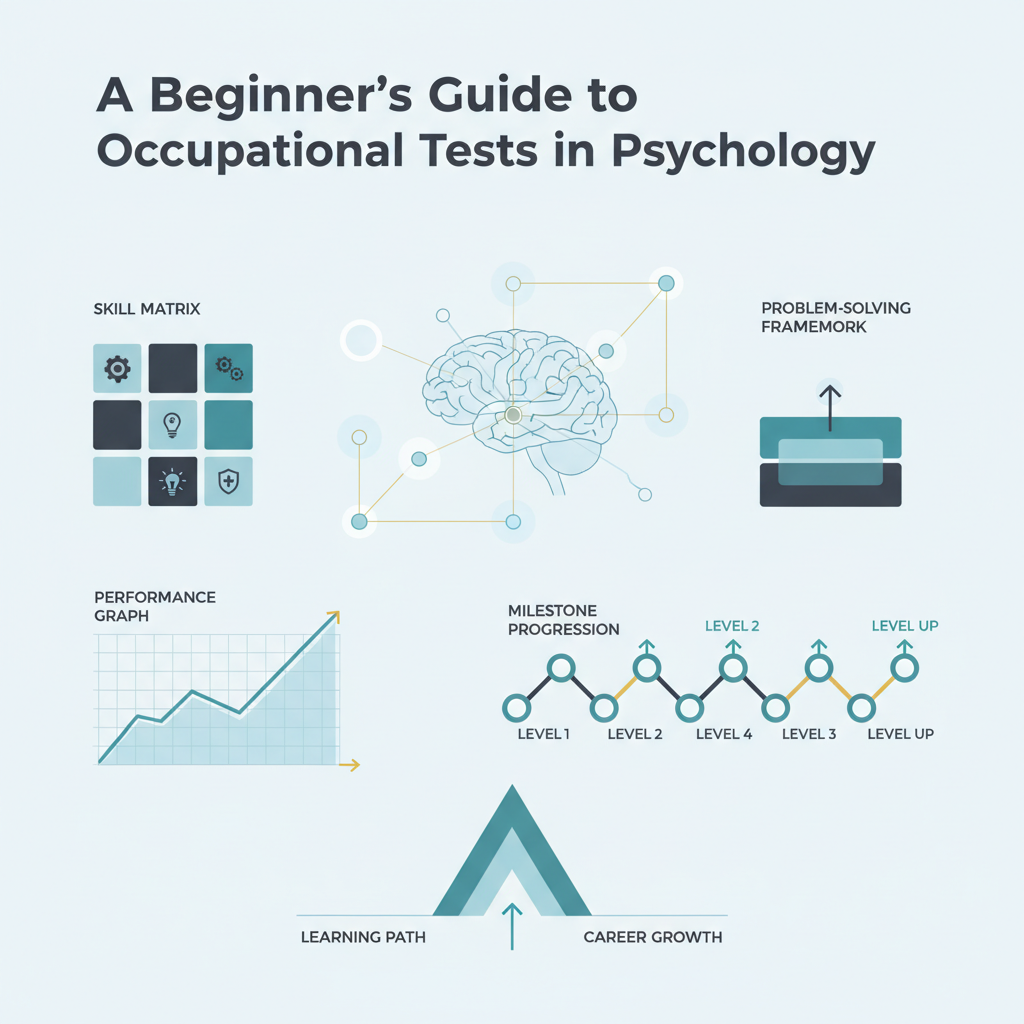
  • A Beginner’s Guide to Occupational Tests in Psychology

    A Beginner’s Guide to Occupational Tests in Psychology

    An occupational test in psychology is a standardized assessment designed to measure an individual’s cognitive abilities, personality traits, skills, and interests for a specific job or career field. These tests provide objective data to help guide individuals toward suitable career paths and assist employers in making informed hiring decisions.

    Do you want to find your unique strengths and a clearer career path? Many people want to learn what drives them and where their talents truly shine. This pursuit of self-awareness often leads them to a powerful, science-based tool: an occupational test in psychology.

    This is more than just another quiz. Occupational testing in psychology uses a proven method to show your cognitive flexibility, problem-solving skills, and even your Creative thinking styles. These tests don’t just give you a quick look; they go deep into your personal profile. They show where you naturally do well and how you think through problems. When you understand these key parts of yourself, you can make better decisions for your career and personal life.

    In this guide, we will explain what an occupational test in psychology is all about. We’ll look at its main purpose, how it’s different from simple quizzes, and why it’s so helpful for your career and personal growth. Get ready to discover your strengths and learn how to use them better.

    What is an Occupational Test in Psychology?

    Understanding the Core Purpose

    A psychological occupational test is a special tool designed to understand what makes you unique. It looks at your abilities, personality traits, and specific skills. Its main purpose is to see your potential at work. But it’s more than just for job-hunting. It’s also a powerful way to learn about yourself and grow as a person.

    For you, this kind of test provides a clear picture of your natural strengths and ways of thinking, especially when it comes to creativity. We use these results to show you your unique way of solving problems. You’ll get a better sense of what truly motivates you.

    Think of it as a personal guide for your growth. This test helps you see where your creative talents are strongest. It also shows you where you can build new skills. The result isn’t just knowing more about yourself—it’s knowing what to do with that knowledge. You learn how to use your creative skills every day, both at home and at work. This helps you turn doubt into confident action.

    • Uncover Your Strengths: Find your natural creative talents.
    • Understand Thinking Styles: Learn how you solve problems and come up with ideas.
    • Guide Personal Growth: Get a clear plan to improve your skills.
    • Boost Professional Development: Use your results for career growth and new ideas.
    • Enhance Self-Awareness: Get a full picture of what you can do.

    How It Differs from a Standard Quiz

    Online quizzes can be fun, but a psychological occupational test is very different. It is a serious, science-based assessment. Psychologists carefully create these tests using proven methods. This makes sure the results are accurate and meaningful [1].

    A typical quiz gives you general or fun results, not deep, personal insights. In contrast, occupational tests are built to be reliable, so your results stay consistent over time. They are also valid, which means they accurately measure what they’re supposed to. This precision makes the information they provide very useful.

    Our Creative Ability Test is a great example of this. It’s much more than a simple quiz. We don’t just give you a score. We provide personal feedback and useful tips that are specific to you. This changes how you see your own creativity.

    A simple quiz might just give you a label. A real occupational test gives you knowledge. It helps you understand the psychology behind your creative process. You learn how to use this knowledge to truly grow and think in new ways.

    • Scientific Rigor: Developed by experts using psychological principles.
    • Evidence-Based: Backed by research to ensure accuracy.
    • Actionable Insights: Gives you practical tips to improve.
    • Personalized Feedback: Offers tailored results, not generic labels.
    • Predictive Power: Shows how you might perform in real-world situations.
    • Focus on Growth: Helps you improve your creative skills on purpose.

    Why is Occupational Testing in Psychology Important for Your Career?

    Benefits for Personal Growth and Self-Discovery

    Career tests act like a mirror. They help you see past your basic skills to better understand who you are and how you think.

    Take creativity, for example. Tests like the Creative Ability Test can show your unique creative strengths. They point out your cognitive flexibility and divergent thinking abilities. Learning this about yourself is very valuable.

    Here’s how these tests help you grow:

    • Uncover Hidden Talents: You might find a natural talent for creative problem-solving or learn that you’re great at coming up with new ideas.
    • Understand Your Thinking Style: Learn if you’re a big-picture thinker or a hands-on innovator. This helps you find the best way to approach challenges.
    • Identify Growth Opportunities: By seeing where you can improve, you can focus on developing new creative skills.
    • Boost Confidence: Knowing your strengths makes you more self-assured. You learn to trust your unique skills.
    • Shape Your Personal Development: This insight guides what you choose to learn. You can focus on skills that will make you even more creative.

    These tests turn confusion about your skills into clear self-knowledge. This gives you a path forward, helping you use your creativity every day.

    How Employers Use These Assessments

    More and more employers are using these tests. They want to find people who are a good fit for the company culture and the job. In fact, many companies use psychometric assessments as a normal part of hiring [2].

    These tests help employers in several key ways:

    • Identify Best-Fit Candidates: They match a person’s skills and personality to what the job requires, leading to better hires.
    • Predict Job Performance: These tests can help predict how well someone will perform in a job. They show potential for new ideas and teamwork.
    • Build Stronger Teams: By understanding everyone’s strengths, companies can build teams with a good mix of skills. This helps the group solve problems more effectively.
    • Assess Soft Skills: Besides technical skills, these tests measure things like critical thinking, communication, and adaptability. Creativity is a very valuable soft skill.

    Knowing your own creative style gives you a big advantage. You can clearly explain how you approach challenges and show off your problem-solving skills. This helps you stand out in a competitive job market.

    Aligning Your Skills with the Right Role

    Understanding your professional strengths, especially in creativity, is very important. It helps you find a career that is a great fit for you. This leads to more job satisfaction and success.

    Here’s how to match your unique skills with the right career:

    • Identify Compatible Industries: If you’re good at thinking of many different ideas, jobs that require constant innovation could be a great fit. Think about roles in R&D, design, or marketing.
    • Tailor Your Job Search: Look for jobs that need your specific creative skills. This makes your search more focused and effective.
    • Enhance Interview Performance: In interviews, confidently explain how your creative style helps solve real-world problems. Give examples that show off your strengths.
    • Strategize Career Advancement: Use what you learn from the test to find roles that use your best skills. This will help guide your career growth.
    • Boost Workplace Engagement: When your job matches your natural talents, you’ll feel more involved and motivated. This leads to better work and greater personal satisfaction.

    This knowledge can change your career path. It helps you go from guessing about your skills to using your creativity with confidence in all parts of your job.

    What are the Main Types of Occupational Testing in Psychology?
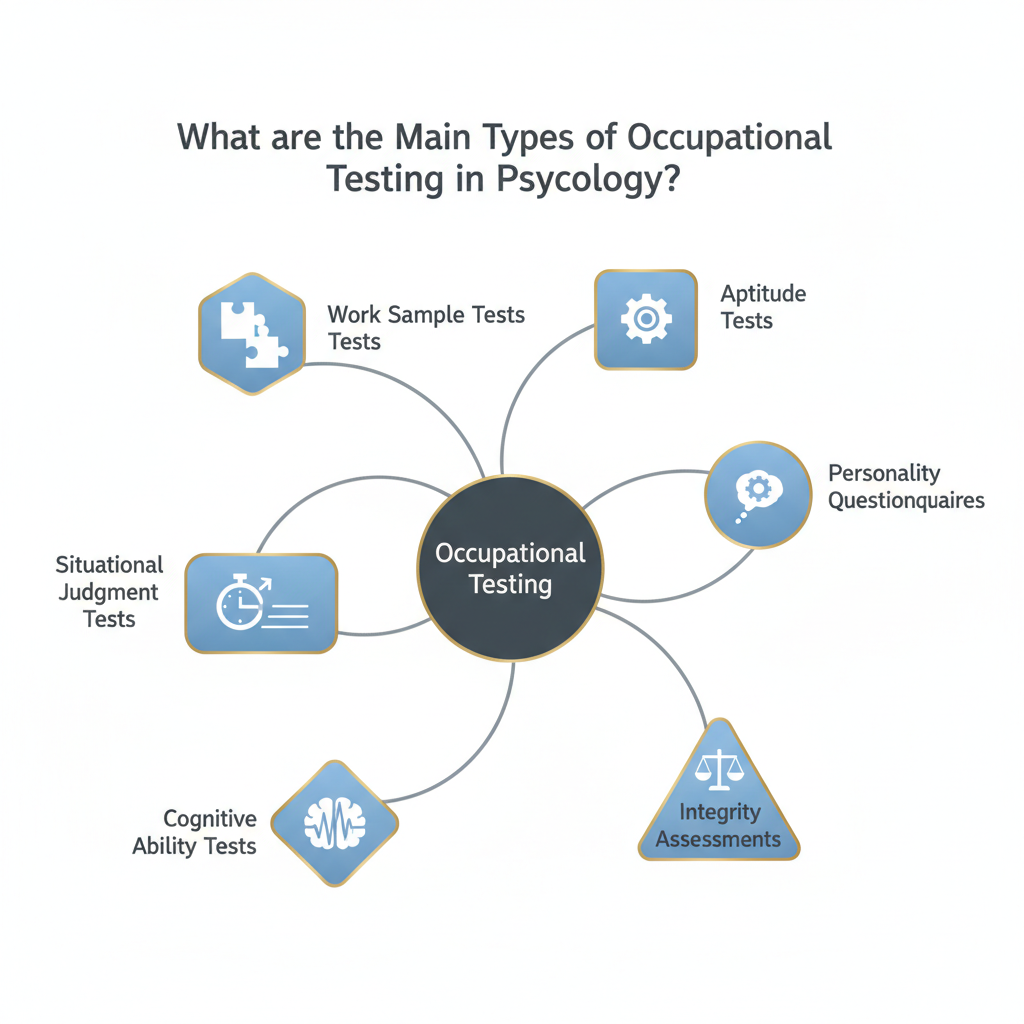
    An infographic with a central hub representing Occupational Testing, branching out into distinct geometric shapes, each symbolizing a different type of test like aptitude or personality, with minimal labels.
    A clean, minimalist vector-based infographic illustrating ‘What are the Main Types of Occupational Testing in Psychology?’. The visual features a central conceptual hub labeled ‘Occupational Testing’ in charcoal text, from which multiple distinct branches elegantly extend outwards. Each branch terminates in a unique, soft blue geometric shape (e.g., square, circle, triangle, hexagon) with a subtle teal or gold accent, representing a different type of test. Inside each shape, a simple, abstract white icon or geometric pattern symbolizes the nature of that test type (e.g., a small gear for aptitude, a thought bubble for personality, a scale for integrity). The overall layout maintains ample negative space, ensuring visual hierarchy and structured grouping, set against a white background. Short, descriptive charcoal labels accompany each type, keeping the text minimal and educational. The style is professional, approachable, and uses subtle gradients for depth without being cartoonish. No humans, no photographs, no cartoons.

    Work-related tests are an important tool for understanding yourself and what you can do. These tests help you find your unique strengths and ways of thinking. They give you useful information for both personal growth and your career.

    There are many kinds of work-related tests. Each one offers a different way to look at your skills and preferences. Learning about them can help you see what makes people successful and creative at work.

    Aptitude and Ability Tests

    Aptitude and ability tests measure your thinking skills. They check your potential to learn new things or do well in certain tasks. These tests focus on your natural ability, not what you have already learned.

    Common examples include:

    • Verbal Reasoning: This measures your ability to understand and use written information.
    • Numerical Reasoning: This tests your ability to work with numbers, data, and solve math problems.
    • Abstract Reasoning: This tests your ability to see patterns and solve problems without using words or numbers. It is often linked to fluid intelligence, which helps with new and unfamiliar problems [3].

    Knowing your mental strengths can show you where you naturally do well. This includes skills like logical thinking and learning quickly. These are key for solving problems in new ways and adjusting to change.

    Personality Questionnaires (e.g., OPQ)

    Personality questionnaires explore your typical behaviors, preferences, and traits. They do not have right or wrong answers. Instead, they provide a profile of your unique working style.

    The Occupational Personality Questionnaire (OPQ) is a well-known example. It helps you see how your personality might affect how you work with others and make decisions. Another popular model is the Big Five personality traits. These are:

    • Openness to Experience: This measures curiosity and a willingness to try new things.
    • Conscientiousness: This reflects organization and a focus on goals.
    • Extraversion: This indicates how sociable and energetic you are.
    • Agreeableness: This shows how cooperative and kind you are.
    • Neuroticism (or Emotional Stability): This assesses how you react to stress.

    Traits like openness to experience are closely tied to creativity. People who score high in openness are often imaginative and curious [4]. Understanding your personality helps you see how you solve problems and work with others. Our Creative Ability Test gives you a closer look at these creative traits. It helps you find your natural style for creative thinking and learning about yourself.

    Situational Judgement Tests

    Situational Judgement Tests (SJTs) show you realistic work situations. You are asked to pick the best way to handle them from a list of options. These tests check your practical judgment and problem-solving skills in real-life settings.

    SJTs look at how you would deal with common problems at work. They check your decision-making, people skills, and sense of right and wrong. For example, you might be given a situation where a team project runs into a problem. How you answer shows your approach to solving it.

    These tests are a good way to see how you use your skills in the real world. They show if you can think on your feet and come up with creative solutions. This is very useful when you face new or unclear problems.

    Creativity and Problem-Solving Assessments

    These specific tests focus on your ability to think in new ways. They measure different parts of your creativity and how you handle difficult problems. This includes how well you can come up with new ideas and find unique answers.

    Key elements often assessed include:

    • Divergent Thinking: This is the ability to generate many different ideas from a single starting point. It’s about brainstorming and exploring multiple possibilities.
    • Cognitive Flexibility: This is your ability to switch between different ideas or ways of thinking. It helps you adjust when your first plan doesn’t work.
    • Originality: This assesses how unique and new your ideas are.
    • Problem-Solving Styles: This identifies your preferred ways of breaking down and solving challenges.

    The Creative Ability Test is a great example of this type of test. It is a 30-question test based on science, made for individuals, students, and professionals. It gives you a full picture of your creative strengths and potential. You will get practical tips to improve your thinking for personal and career growth.

    This kind of test helps you move from being unsure about your creative skills to truly understanding them. It offers feedback just for you. You learn how to use your creativity better in real life. You will also discover your unique problem-solving style and how to use it to create new things.

    What is an Example of an Occupational Test in Psychology?

    Real-World Scenarios

    Occupational tests in psychology help reveal your skills. They show how your unique talents fit certain jobs. For example, a large tech company might use these tests to find people for a new product team.

    This team needs creative thinkers who can come up with new ideas and solve tough problems. A test that measures creativity would be perfect for this.

    This kind of test looks for candidates who are strong in:

    • Divergent thinking abilities
    • Cognitive flexibility
    • Problem-solving skills
    • Openness to new experiences

    These skills are key for innovation jobs. This gives the company more insight than a resume alone. They see how a person handles challenges with creativity.

    For you, taking a test like this is a great way to learn about yourself. You discover your creative strengths. This helps you find a job where you can really succeed. It helps guide your career path. You can find a career you’re passionate about, not just a job.

    Understanding how you think creatively is empowering. It turns uncertainty into clear self-awareness. You get a clear plan for using your unique skills in the real world.

    Sample Questions and What They Measure

    Creativity tests aren’t about right or wrong answers. Instead, they look at how you think. They show your unique way of solving problems. Let’s look at a few examples of what you might see.

    Divergent Thinking Questions

    These questions test your ability to come up with many different ideas. They measure fluency, flexibility, and originality.

    Sample Question: “List as many uses as you can for a common brick.”

    What it measures:

    • Fluency: The total number of ideas you list.
    • Flexibility: The number of different categories your ideas fit into (e.g., building material, weapon, paperweight, art supply).
    • Originality: How unique or unusual your ideas are compared to others.

    A high score here means you’re a great brainstormer. You are good at thinking of many options when you face a problem. This skill is essential for creating new things and finding solutions.

    Problem-Solving and Cognitive Flexibility Questions

    These scenarios test how well you can adapt your thinking. They see how you handle new problems. You need to think about them from different angles.

    Sample Question: “Imagine you are stuck in a remote cabin with no power. You need to keep food from spoiling without a refrigerator. What are three unconventional methods you could use?”

    What it measures:

    • Cognitive Flexibility: Your ability to switch your way of thinking.
    • Adaptive Reasoning: How well you use what you already know in new situations.
    • Practical Innovation: Your ability to come up with clever solutions with limited resources.

    Success in these areas shows you have a flexible mind. You can switch gears and adapt easily. You find creative ways to get around challenges. This helps you apply creativity to solve tough problems in any field.

    Figural and Elaboration Tasks

    Some tests use images to check your creative thinking. They explore your imagination and attention to detail.

    Sample Question: “Complete this abstract drawing in any way you choose, making it as interesting or meaningful as possible.” (A partially drawn, abstract shape is provided.)

    What it measures:

    • Originality of Elaboration: How unique and detailed your additions are.
    • Imaginative Interpretation: How you see and build on the starting shape.
    • Detail Orientation: Your ability to add details and develop ideas visually.

    These tasks show how you turn simple ideas into detailed creations. They highlight your skill for artistic expression and developing concepts. Research shows these tests are good at predicting creative success [5].

    Our Creative Ability Test uses similar science-based methods. We give you personalized results about how you think creatively. You will get a clear picture of your strengths. Our platform then gives you practical tips to improve your creative thinking and problem-solving skills.

    How Can Understanding Your Profile Enhance Your Creativity?
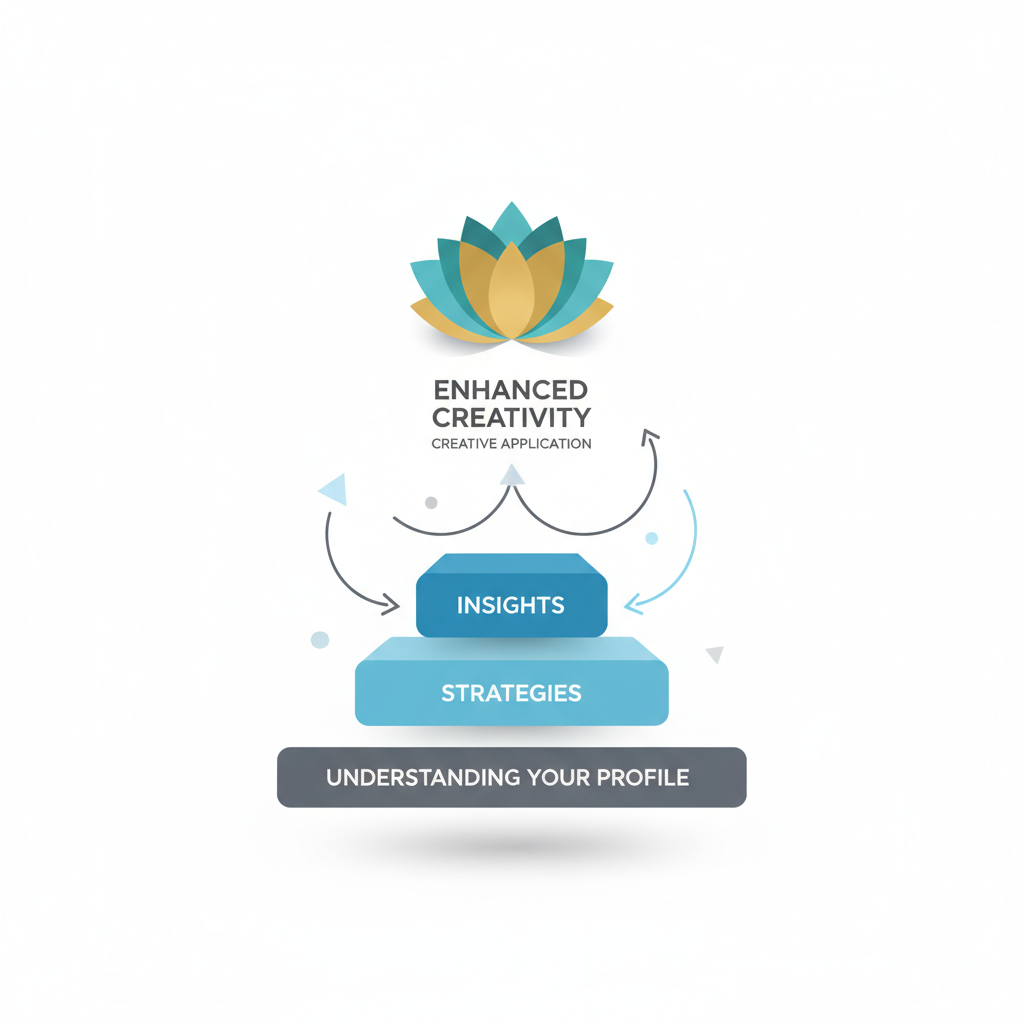
    A layered infographic showing a pathway of creative growth, starting from 'Understanding Your Profile' and ascending through 'Insights' and 'Strategies' to culminate in 'Enhanced Creativity', using geometric shapes and directional arrows.
    A clean, minimalist vector-based infographic illustrating ‘How Can Understanding Your Profile Enhance Your Creativity?’. The visual is a layered, ascending pathway or framework, starting from a foundational layer at the bottom and progressing upwards. The base layer, in soft charcoal, represents ‘Understanding Your Profile’, flowing into mid-layers in varying shades of soft blue that represent ‘Insights’ and ‘Strategies’. These lead to a prominent top layer or culminating element, highlighted with a radiant gold or teal accent, symbolizing ‘Enhanced Creativity’ or ‘Creative Application’. Abstract geometric shapes, subtle gradients, and connecting lines or arrows indicate progression and logical flow between layers. The design emphasizes growth, self-discovery, and practical application. Ample negative space provides clarity, and short, professional charcoal labels guide the viewer through the enhancement process. The overall aesthetic is professional, approachable, and educational. No humans, no photographs, no cartoons.

    Connecting Personality Traits to Creative Strengths

    To understand your creative profile, you first need to know your personality. Tests like our Creative Ability Test show how your personal traits affect your creative thinking. Some personality traits are strongly linked to your ability to innovate.

    For example, people who are high in “Openness to Experience” are often more curious. They look for new ideas and welcome different solutions [6]. This trait is a key part of creative thinking.

    Your results explain these connections clearly. They turn complex psychological ideas into simple, helpful tips. You will learn which of your natural qualities help you be more creative.

    Here’s how your personality traits can fuel your creative strengths:

    • Openness to Experience: You are probably imaginative and like exploring new ideas. This trait helps you come up with many unique solutions.
    • Conscientiousness: This is often about being organized, but it also helps you stick with creative tasks. You work on ideas until they are just right.
    • Extraversion: You may get ideas from being around others. Working together often sparks new concepts for you.
    • Agreeableness: You work well in teams. This helps different ideas to be shared and grow without causing problems.
    • Neuroticism (Emotional Stability): Even this trait can help. If you are very sensitive, you may have deep emotional insights that make your creative work better. Learning to manage this can unlock amazing creativity.

    When you know these links, you can feel more confident. You can use your natural tendencies to your advantage. Our personalized feedback gives you specific tips to help you use your natural strengths to be more creative.

    Using Test Insights for Professional Development

    Your Creative Ability Test results are a great tool for your career. They give you practical knowledge about your creative skills, so you don’t have to guess. This knowledge helps you succeed in today’s changing workplace.

    Many jobs now require new ways of thinking. Companies want people who can adapt and create new solutions. When you know your creative profile, you can work on improving these important skills.

    Here’s how these insights can help you grow in your career:

    • Focus on Skill Building: Identify areas where you can improve. For example, you might need to practice thinking more flexibly. The test shows you what to work on.
    • Solve Problems Better: Use your unique creative strengths to solve problems at work. This helps you find new and better solutions.
    • Find the Right Career: Discover jobs that fit your creative style. You can look for roles where you can really use your talents.
    • Improve Leadership and Teamwork: Lead your team with creative methods. You can inspire others by showing them different ways to think.
    • Contribute to Innovation: Be the person your team turns to for new ideas. Your insights can help your company grow and innovate.

    The Creative Ability Test gives you practical tips that are tailored to you. They help you use creative thinking in your everyday work. You will learn how to use your creativity to solve problems and create new things with confidence.

    This turns occasional creative moments into steady growth. As a result, your work will have a bigger impact.

    Discovering Your Unique Problem-Solving Style

    Everyone has a different way of facing challenges. Your Creative Ability Test shows your unique problem-solving style. This knowledge is very helpful. It helps you see how you naturally handle information and come up with solutions.

    Do you like to brainstorm lots of ideas first? That means you have a divergent thinking style. Or do you find the most logical answer quickly? That points to a convergent style.

    Our test explains these creative traits in a simple way. Your results are easy to understand, even if you’re new to these concepts. This makes complex ideas from psychology easy to learn.

    Here are common creative problem-solving styles:

    • Divergent Thinker: You are good at generating many different ideas. You explore lots of possibilities without judging them right away.
    • Convergent Thinker: You are good at reviewing options and picking the best one. You focus on what is practical and will actually work.
    • Analytical Solver: You break down big problems into smaller pieces. You use logic and clear steps to find a solution.
    • Intuitive Solver: You trust your gut feelings and sudden ideas. Solutions often come to you in a flash.
    • Collaborative Creator: You do your best work with other people. You use group brainstorming to build on everyone’s ideas.

    Understanding your style has big benefits. You can pick methods that work best for you. This makes solving problems easier and more effective.

    For example, if you are a divergent thinker, give yourself time to freely brainstorm ideas. If you are more of a convergent thinker, focus on weighing your options early. Our personalized tips give you guidance to build your confidence.

    By using your unique style, you improve your creative skills. You change how you approach challenges. This leads to better and more creative results in everything you do.

    Frequently Asked Questions

    What are the 4 types of psychological tests?

    Psychological tests are useful tools. They provide insights into how people think and act. These tests can help you understand your skills, personality, and even your creative side.

    Professionals usually group these tests into four main types. Each one offers a different way to learn about yourself:

    • Intelligence Tests: These tests measure your thinking skills. They look at how you reason, solve problems, and think critically. Knowing your mental strengths can help you tackle tough creative tasks [7].
    • Aptitude Tests: Aptitude tests don’t measure what you know. Instead, they predict your ability to learn new skills. They show where you have potential to succeed. For example, a skill for abstract thinking can help with creative problem-solving.
    • Personality Tests: These tests explore your personal traits and habits. They show how you connect with the world and other people. Many creativity tests, like the Creative Ability Test, look at personality traits like openness, curiosity, and how well you adapt to change.
    • Achievement Tests: These tests measure what you already know or can do. They check your knowledge in a specific area. For example, a graphic designer might take a test on design principles.

    Understanding these types is helpful. It helps you make sense of what tests like the Creative Ability Test show you. You can use this knowledge to build on your strengths at work and in your personal life.

    What is an Occupational Personality Questionnaire?

    An Occupational Personality Questionnaire (OPQ) is a test for the workplace. It’s designed to see how your personality traits show up at work. The results help people and companies understand how personality affects job performance.

    The OPQ measures many different traits, including:

    • Interpersonal Style: How you work with others and build relationships.
    • Thinking Style: How you prefer to solve problems and make decisions. This also includes how flexible your thinking is.
    • Coping Strategies: How you manage stress, challenges, and feelings at work.

    Your OPQ results can teach you a lot about yourself. For example, you might find you’re good at creative problem-solving. You could also learn that you’re comfortable with unclear situations, which is common for creative people [8]. This information is very useful.

    An OPQ can guide your career. It helps you find jobs that fit your natural strengths. It can also point out traits like openness and a willingness to try new things. These skills are key for creativity and new ideas in any job. This helps you grow personally and professionally.

    Can I find a free psychology career test?

    Yes, many free psychology career tests are available online. They often promise quick answers about your best career or personality type. These can be a fun way to start thinking about yourself.

    However, it’s important to know their limits. Most free quizzes are just for fun. They aren’t designed with the same care as professional tests. This means you can’t always trust their results for serious career advice.

    For real growth and useful advice, look for tests based on science. Assessments like the Creative Ability Test are made by experts and are carefully tested for accuracy. They offer:

    • Evidence-Based Insights: Trustworthy information about your creative skills and flexible thinking.
    • Personalized Feedback: Advice that is specific to your personal results.
    • Actionable Strategies: Practical steps to improve your creative and problem-solving skills.

    Choosing a science-backed test makes a real difference. It takes you from simply being curious to truly understanding yourself. You get clear steps for how to grow. This helps you use your creativity well in your job and personal life. Investing in a quality test is an investment in your future.


    Sources

    1. https://www.apa.org/topics/psychological-testing
    2. https://www.shrm.org/resources-and-tools/hr-topics/talent-acquisition/pages/psychometric-assessments-hiring-success.aspx
    3. https://www.simplypsychology.org/fluid-and-crystallized-intelligence.html
    4. https://www.frontiersin.org/articles/10.3389/fpsyg.2017.00980/full
    5. https://journals.sagepub.com/doi/abs/10.1177/0013164406288390
    6. https://psycnet.apa.org/record/2012-23740-001
    7. https://www.apa.org/topics/intelligence
    8. https://www.shl.com/assessments/personality/opq/
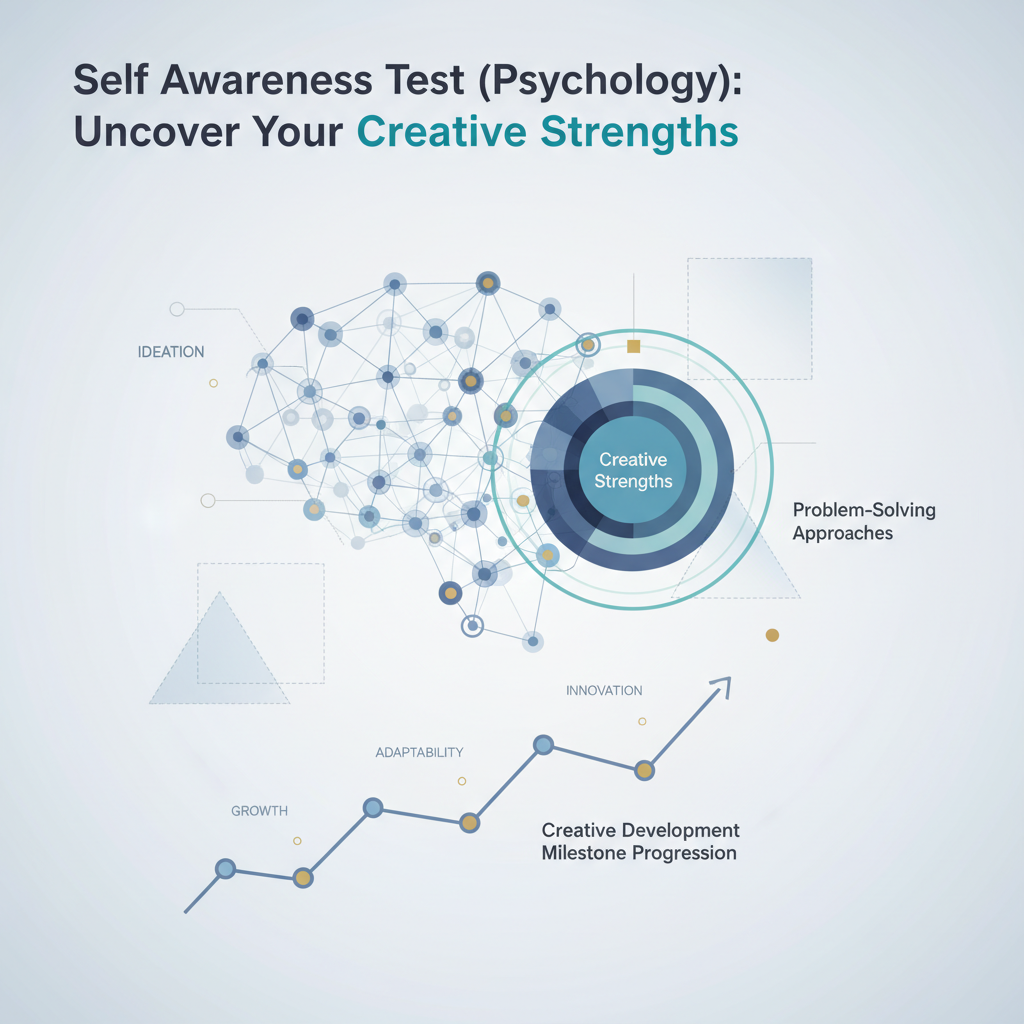
  • Self Awareness Test (Psychology): Uncover Your Creative Strengths

    Self Awareness Test (Psychology): Uncover Your Creative Strengths

    A self-awareness test in psychology is a structured assessment designed to measure an individual’s conscious knowledge of their own character, feelings, and creative thought patterns. It uses scientifically-grounded questions to provide actionable insights into personal strengths and areas for growth, forming a foundation for enhancing creative potential.

    Do you ever wonder how creative you really are? Many people mistakenly believe creativity is a rare gift, but it’s a skill we all possess. It helps us with everything from everyday problem-solving to major new ideas. The first step to unlocking your creativity is understanding yourself. This is where a good self awareness test psychology can make a real difference, showing you your natural talents and how you think.

    Learning about your creative strengths is about more than just finding a talent; it’s about finding a better way to approach life and work. Our method is more than a basic quiz—it’s a science-based awareness test designed to show your personal creative style. This test looks at key areas like your Cognitive flexibility, your ability to brainstorm, and your unique problem-solving methods. By highlighting these areas, we offer practical tips you can use to build on your creative skills in the real world, helping you grow both personally and professionally.

    Are you curious about the science of discovering your creative side? This article will explain what a self-awareness test in psychology is and how it can help you find and strengthen your creative skills. Prepare for a journey of self-discovery with simple explanations, easy-to-understand results, and new confidence in your own unique thinking style.

    What is a Self-Awareness Test in Psychology?

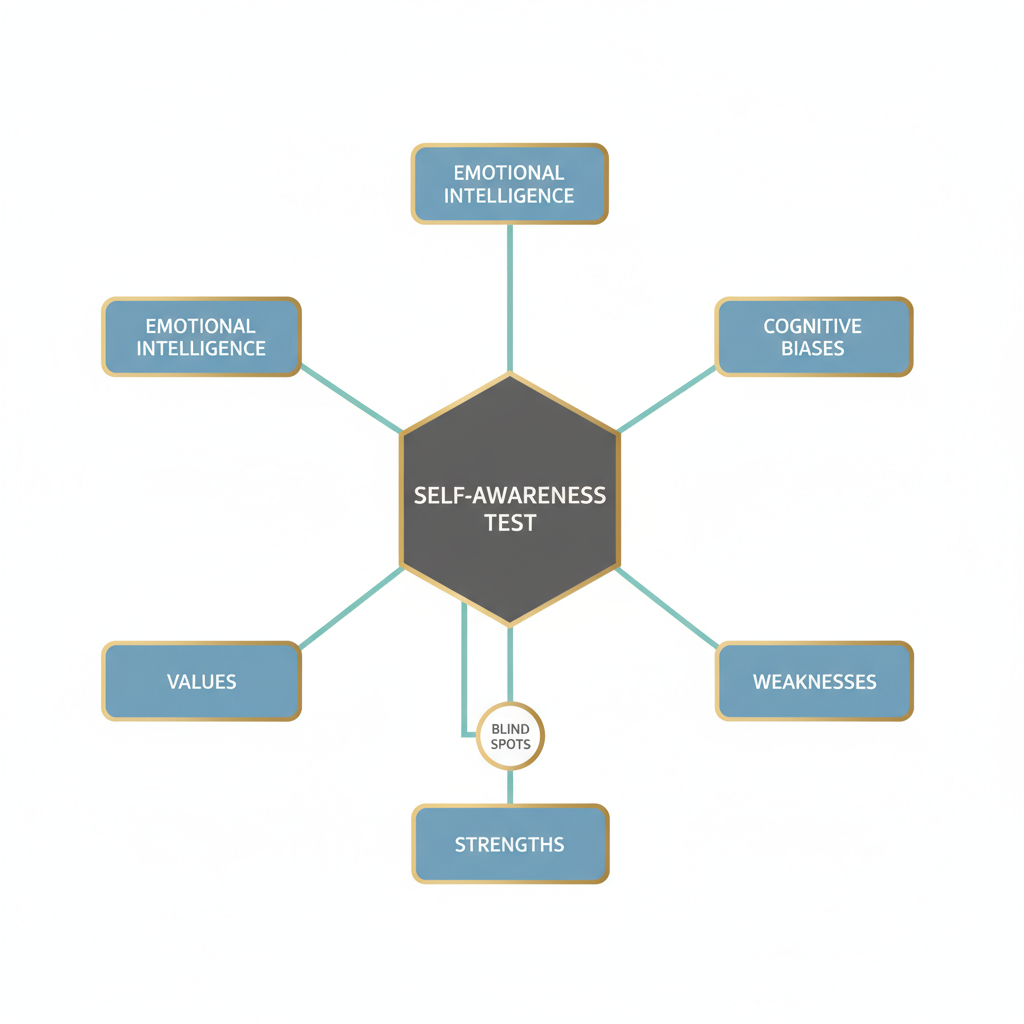
    An abstract infographic illustrating the components of a self-awareness test as interconnected geometric shapes in a cognitive network diagram.
    Infographic, minimalist vector illustration: A central geometric shape labeled ‘Self-Awareness Test’ with multiple branching lines leading to smaller, distinct geometric shapes labeled with key components like ‘Emotional Intelligence’, ‘Cognitive Biases’, ‘Values’, ‘Strengths’, and ‘Weaknesses’. The overall structure resembles a clean cognitive network diagram or a competency map. Soft blues, whites, charcoal, with subtle gold or teal accents. Ample negative space. No people, no photographs, no cartoon elements.

    A self-awareness test is a structured assessment that helps you understand your inner world. It looks at your thoughts, feelings, behaviors, and motivations. By using scientifically proven questions, these tests offer a clear picture of who you are. This insight is a powerful tool for personal growth.

    How Self-Awareness Connects to Creativity

    Self-awareness is key to creativity. When you understand yourself, you can unlock your creative potential. Knowing your strengths lets you use them fully. It is also important to know your unique thinking style. For example, do you like to brainstorm freely or analyze details? Answering this helps you improve your creative process.

    People who are self-aware are often more mentally flexible, meaning they can adapt their thinking with ease. They also tend to be more open to new experiences—a key trait for innovation. Looking inward helps you see things from new angles, which often leads to fresh ideas. By challenging your own assumptions, you learn to think differently and turn your creative potential into real results.

    Think about how artists use their emotional understanding to create expressive work. In the same way, an inventor who knows their usual approach to problems can consciously try new methods. The Creative Ability Test is based on this idea. It helps you become more self-aware, showing you your specific creative strengths and how to use them well.

    The Science Behind Our Assessment

    Our Creative Ability Test is based on solid psychological science. It is not just a random list of questions, but a carefully designed 30-question assessment. It uses proven ideas from the study of creativity and thinking [1]. We also apply ideas from cognitive psychology, including research on different ways of thinking and solving problems.

    The test looks at several key areas. It measures your mental flexibility and your openness to new ideas. We also look at your favorite ways to solve problems. Our method is reliable, which means you will get consistent results. It is also valid, which means it accurately measures what it claims to measure.

    Each question is based on scientific research and designed to reveal your unique creative style. Our goal is to give you accurate, proven insights. Because the test is science-backed, your personal feedback is truly meaningful. You will receive practical tips tailored to your creative strengths. We want to make psychology easy to understand and give you clear guidance for your growth. This turns a simple test into a powerful tool for developing your creativity.

    How Can This Test Reveal Your Creative Potential?

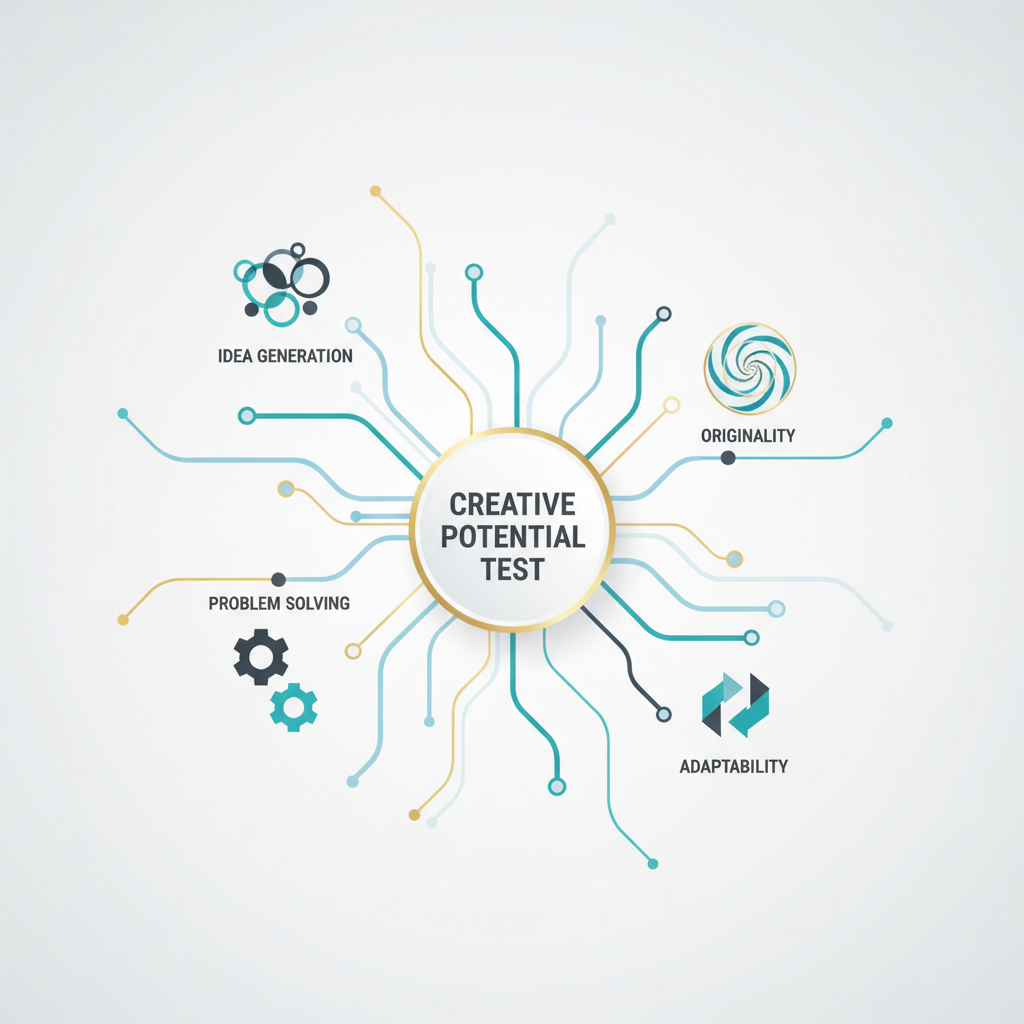
    An infographic showing a branching pathway originating from a creative potential test, diverging into different creative skills like idea generation and problem-solving.
    Infographic, minimalist vector illustration: A dynamic branching pathway originating from a central point labeled ‘Creative Potential Test’. The pathways diverge into distinct abstract representations of creative skills, such as ‘Idea Generation’, ‘Problem Solving’, ‘Originality’, and ‘Adaptability’, each represented by unique geometric icons or segments. The visual should suggest growth and exploration, like a divergent thinking pathway. Soft blues, whites, charcoal, with gold or teal accents highlighting the pathways. Clean, professional style, ample negative space. No people, no photographs, no cartoon elements.

    Identifying Your Unique Thinking Style

    Knowing your thinking style is a powerful first step. It helps unlock your creative side. Our test shows you how your mind works and how you like to create new ideas.

    For example, some people are great at divergent thinking. They can come up with many different ideas easily [2]. Others are better at convergent thinking, which is about choosing the best idea from a list.

    The assessment helps you see if you are more:

    • Intuitive: You trust your gut feelings and sudden ideas.
    • Analytical: You prefer using logic and looking at details.
    • Conceptual: You like to explore big-picture and abstract ideas.
    • Practical: You focus on solutions that work right now.

    Knowing your style helps you use your natural strengths. You can also improve in areas where you’re less comfortable. This personal insight helps guide your creative growth.

    Measuring Your Cognitive Flexibility

    Cognitive flexibility is key to creativity. It’s your brain’s ability to switch between different ideas or tasks. It also helps you adapt to new situations [3]. Our test measures this important skill.

    High cognitive flexibility means you can:

    • See problems from different angles.
    • Change your thinking when you get new information.
    • Create new solutions by connecting unrelated ideas.
    • Get past mental blocks more easily.

    This test shows you how flexible your thinking is. It gives you a clear picture of how well you adapt to change. Improving your cognitive flexibility makes you a better problem-solver. It also helps you be more innovative in all parts of your life.

    Understanding Your Problem-Solving Approach

    Creativity isn’t just about new ideas. It’s also about effectively solving problems. Our test looks at your personal way of solving problems. It shows how you handle challenges from start to finish.

    The test shows your habits during these key parts of problem-solving:

    • Problem Identification: How good are you at spotting issues and opportunities?
    • Ideation: What methods do you use to brainstorm solutions?
    • Evaluation: How do you judge if your ideas are workable and original?
    • Implementation: How do you bring your creative solutions to life?

    For example, some people are comfortable with uncertainty at the start. Others prefer to have a clear plan right away. By knowing your natural style, you can be more effective. You’ll learn to use your strengths in a smarter way. This makes you a more confident and creative problem solver.

    What Will You Learn From Your Test Results?

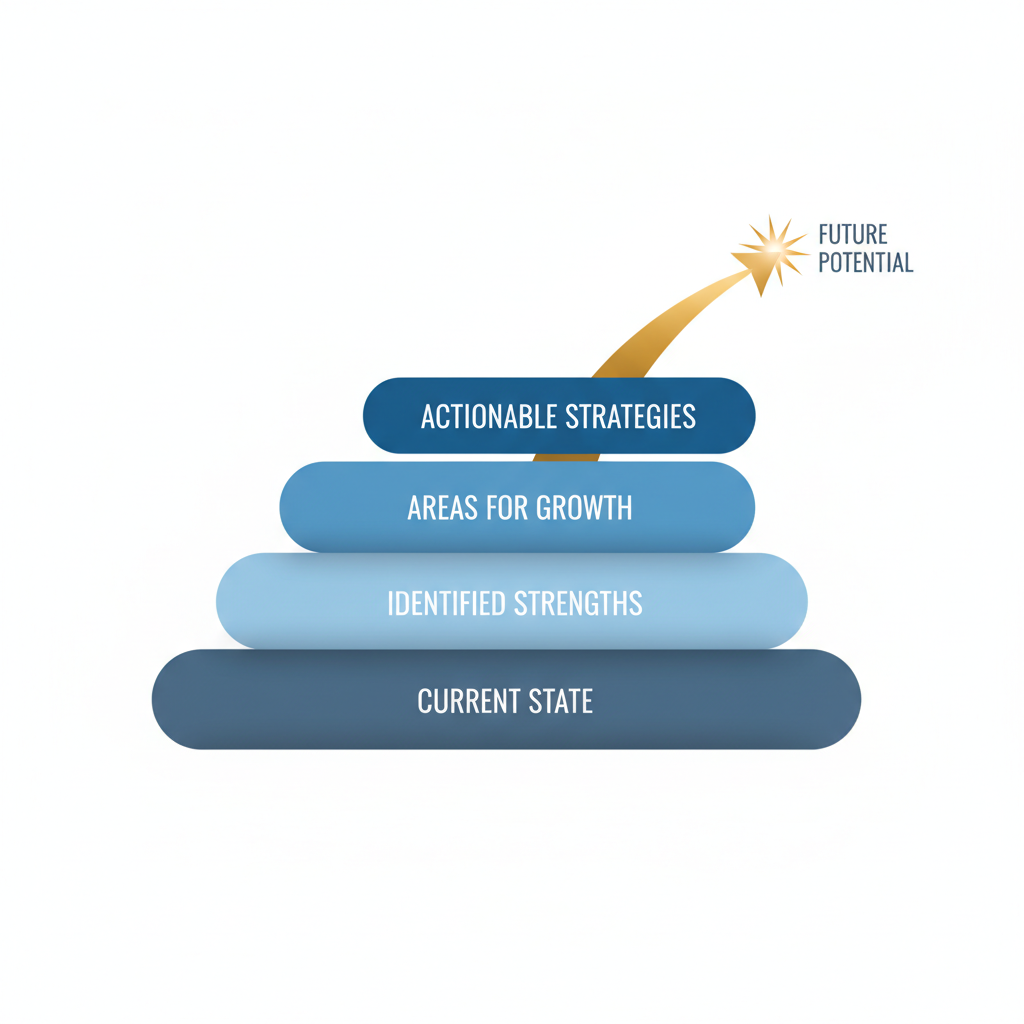
    An abstract infographic showing a layered progression from current state to future potential, highlighting identified strengths, areas for growth, and actionable strategies from test results.
    Infographic, minimalist vector illustration: A stylized competency graph or a layered system indicating personal growth and actionable insights. The base layer represents ‘Current State’, with subsequent ascending layers or segments representing ‘Identified Strengths’, ‘Areas for Growth’, and ‘Actionable Strategies’. Each layer uses subtle geometric shapes or color gradients to signify progression. A highlight element in gold or teal points towards ‘Future Potential’. Soft blues, whites, charcoal. Professional, clean, and educational. Ample negative space. No people, no photographs, no cartoon elements.

    Your Personalized Creative Strengths Profile

    Our assessment is more than a simple “creative or not” label. Instead, you’ll get a detailed report on your unique creative style. This report shows you how you naturally solve problems and come up with new ideas.

    You’ll discover which parts of creativity are your natural strengths. This includes your:

    • Divergent Thinking: Your ability to brainstorm lots of different ideas from one starting point [4]. This is key for exploring all possibilities.
    • Cognitive Flexibility: How you switch between different ways of thinking. This helps you adapt to new information and get past mental blocks.
    • Originality: How unique and new your ideas are. You’ll see how your thoughts differ from the usual solutions.
    • Problem Reframing: Your knack for looking at problems in new ways. This skill can turn tough problems into solvable ones.

    The Creative Ability Test also reveals your main creative thinking styles. Maybe you’re great at imagining new things, or perhaps you excel at creating practical solutions. Knowing your strengths helps you use them better in every part of your life.

    This personal insight builds your confidence. It confirms that your way of being creative is unique and valuable.

    Actionable Strategies for Personal Growth

    Understanding your strengths is just the first step. Your test results also give you practical, personal strategies designed to help you improve your creative skills.

    Every tip is tailored to your unique profile. You’ll learn specific exercises and habits to add to your daily routine. For example, if you want to improve your cognitive flexibility, we might suggest things like:

    • Mind Mapping: A visual way to organize thoughts and find new connections, which helps you generate more ideas [5].
    • “What If” Scenarios: Asking “what if?” to explore new ideas. This simple practice can stretch your imagination.
    • Perspective Shifting: Trying to see a problem from someone else’s point of view. This builds both understanding and empathy.

    You’ll also get advice on how to grow in other areas. This turns areas for improvement into opportunities for growth. Our goal is to give you a clear plan that helps you build a stronger, more flexible creative mind.

    These strategies aren’t just theory; they are made for the real world. They help you on your path to self-improvement and give you the tools to consistently improve your creative thinking.

    Applying Your Insights in Real-World Scenarios

    Your Creative Ability Test results offer more than just self-knowledge. They give you a practical guide for using creativity every day. You’ll learn how to use your unique strengths to get real results.

    Think about your work life. Understanding your creative style can change how you handle projects. For example, if you’re good at divergent thinking, you could lead brainstorming sessions and come up with lots of ideas for your team. Or, if your strength is problem reframing, you can help the team see a challenge in a new light, leading to new solutions [6].

    In your personal life, these insights are just as helpful. Maybe you want to learn a new skill or overcome a challenge. Knowing your creative style helps you pick methods that fit how you naturally think. This makes learning more effective and fun.

    Ultimately, this test gives you personal, practical insights instead of just a general score. This helps you handle any situation with a creative edge. You’ll be ready to innovate, solve tough problems, and grow both personally and professionally.

    Ready to Discover Your Creative Self? Take the Test Now

    Knowing yourself is the first step to unlocking your creative potential. A self-awareness test psychology can show you the way. It helps you find new paths to fresh ideas and personal growth. Are you ready to start exploring?

    Our Creative Ability Test is a special, science-based tool that helps you find your natural creative talents. It gives you more than general advice. You will get a personal plan to help you grow.

    What You’ll Discover

    • Understand Your Creative Mind: Find out your main thinking styles. Learn how you come up with new ideas and connect different thoughts.
    • Identify Your Unique Strengths: Pinpoint what makes you a creative thinker. See how you think outside the box and adapt to new ideas.
    • Get Practical Tips for Growth: Receive useful advice to improve how you create new things and solve problems.
    • Apply Your Skills to Real Life: Learn to use your new self-knowledge at home, in school, or at work.

    This is more than a simple awareness test psychology. It’s a journey into how you think. It helps you build confidence and believe in your ability to grow. Many people have already used their personal results to reach their goals.

    The Creative Ability Test is more than just a test. We give you clear explanations and useful tools. We make complex psychology ideas easy for everyone to understand.

    Begin Your Creative Journey Today

    Stop wondering about your creative potential and start using it. Our 30-question test is quick, helpful, and based on research. You’ll get easy-to-understand results and guidance to help you feel more confident.

    Ready to discover your creative side? Take the test now to find your strengths. Try new ways of thinking and change how you face challenges. Your creative journey starts here!

    Frequently Asked Questions

    What kind of questions are in a psychology self-awareness test?

    Our self-awareness test looks at how you think, feel, and react. It helps uncover your unique creative strengths. There are no right or wrong answers. The questions simply explore your preferences and how you naturally approach things.

    The 30-question test focuses on a few key areas. We explore your:

    • Cognitive Flexibility: How easily you adapt your thinking to new situations. This skill is key for creative problem-solving.
    • Divergent Thinking: Your ability to create many unique ideas from a single prompt. This is a common sign of creativity.
    • Problem-Solving Approach: How you tackle challenges, whether you prefer structured methods or imaginative solutions.
    • Openness to Experience: How willing you are to explore new ideas and experiences. This helps you grow as a person.
    • Emotional Intelligence: How well you understand your own emotions and how they affect your creative process.

    For example, a question might ask how you would react to a sudden change in plans. Or, it might ask how you come up with ideas for a big project. Our goal is to give you deep insights into your creative mind [7]. This helps you understand your potential.

    Is there a free self-awareness test based on psychology?

    Many online quizzes say they are “self-awareness tests,” but not all are based on real science. While some may offer simple insights, they often aren’t deep or personal. These quick quizzes usually don’t give you practical advice.

    At Creative Ability Test, we offer a test based on science. Our 30-question test is developed by experts. It gives you personal feedback and useful tips. This level of detail takes a lot of research and development. That’s why our full test is a paid service. We make sure the insights you get are reliable and truly helpful for your growth. Investing in your self-awareness is investing in your creative future.

    Can this self-awareness test be used by students?

    Yes, our self-awareness test is very helpful for students. It offers unique insights into your creative thinking style. Understanding these strengths can really help you in school. It also prepares you for a successful career.

    Students can use the test results to:

    • Improve Learning: Find out how your creative strengths affect your study habits.
    • Solve Problems Better: Use new ways of thinking for school projects and challenges.
    • Work Better in Groups: Learn your role in group projects and how to contribute well.
    • Choose a Career Path: Find careers that are a good match for your creative skills.
    • Grow as a Person: Build confidence in your unique skills and become more self-aware.

    For example, if you’re good at divergent thinking, it can help you brainstorm ideas for a big paper. Or it could help you find a better way to handle a complex science project. Our platform gives you practical tips designed to help you grow. These insights help you do well in your studies and in your personal life.

    What is a self-awareness assessment questionnaire?

    A self-awareness questionnaire is a set of structured questions. It helps you explore different parts of your inner world. The main goal is to help you understand yourself better. This includes your thoughts, emotions, behaviors, and motivations.

    Our 30-question test does exactly that. It is designed to measure creativity and how you think. By thinking about the questions, you show your natural tendencies. We then analyze your answers using a scientific method. This gives you a clear picture of your creative strengths.

    The questionnaire acts as a mirror. It shows how you usually handle challenges, create ideas, and work with new information. The results give you personal insights. They help you use your unique creative skills in the real world. In the end, it helps you move from being unsure to having a clear, useful understanding of yourself.


    Sources

    1. https://www.apa.org/pubs/journals/features/xap-a0033285
    2. https://psychology.jrank.org/pages/195/Divergent-Thinking.html
    3. https://www.sciencedirect.com/topics/neuroscience/cognitive-flexibility
    4. https://www.sciencedirect.com/topics/neuroscience/divergent-thinking
    5. https://www.tonybuzan.com/glossary/mind-mapping/
    6. https://hbr.org/2014/09/the-creative-process-in-light-of-research
    7. https://www.apa.org/education-career/guide/science-psychology

  • A Beginner’s Guide to the DISC Psychology Test: Understand Your Style

    A Beginner’s Guide to the DISC Psychology Test: Understand Your Style

    The DISC psychology test is a behavioral self-assessment tool designed to help individuals understand their personality and communication styles. It categorizes behavior into four primary types: Dominance (D), Influence (I), Steadiness (S), and Conscientiousness (C). These insights are commonly used for personal development, improving teamwork, and enhancing professional relationships.

    Have you ever wondered why you react to things the way you do? Or why some tasks feel easy while others are a challenge? Understanding your behavioral style is a key step toward self-awareness and reaching your full potential. The DISC test offers a simple way to explore your personality and how you interact with the world.

    A DISC profile is often used for teamwork, but its benefits go much further. If you’re interested in personal or professional growth, knowing your natural tendencies is a big help. It shows you how you solve problems and approach creative tasks. This helps you understand your strengths, find your ideal work environment, and use your natural style to build your skills.

    This beginner’s guide makes the DISC model easy to understand. We will explain its four main styles—Dominance, Influence, Steadiness, and Conscientiousness—with clear descriptions. You’ll learn what each style means, how it affects your daily life, and how this knowledge can help you grow and be more creative. Let’s dive into this insightful behavioral assessment.

    What Is the DISC Psychology Test?

    A Brief History of the DISC Model

    Knowing ourselves is a key step to unlocking our full potential. This means understanding our unique ways of thinking and creating.

    The DISC model is a helpful tool for this self-discovery. As a behavioral assessment tool, it helps us learn about our personal preferences and habits.

    The DISC model comes from the work of psychologist William Moulton Marston, a key researcher in the early 1900s. Marston studied how our emotions affect our behavior.

    In his 1928 book, “Emotions of Normal People,” Marston introduced his theory [1]. He suggested that people show four main types of behavior.

    These types describe how we interact with the world around us. Marston believed our actions are linked to our emotions. It’s important to know that DISC is not a personality test. Instead, it measures how we behave and focuses on “how” we do things.

    Over the years, Marston’s theory grew. Researchers created assessment tools from his model. These tools help us gain insight into our own style and better understand others.

    This understanding is key to better communication and teamwork, which are vital for creative problem-solving and new ideas.

    What Does DISC Stand For?

    DISC stands for four main behavioral styles. Each style shows a common way people think, act, and connect with others. Knowing your main style reveals your natural strengths and areas where you can grow.

    These four styles explain different ways of handling tasks, facing challenges, and working in a team. Here is what each letter means:

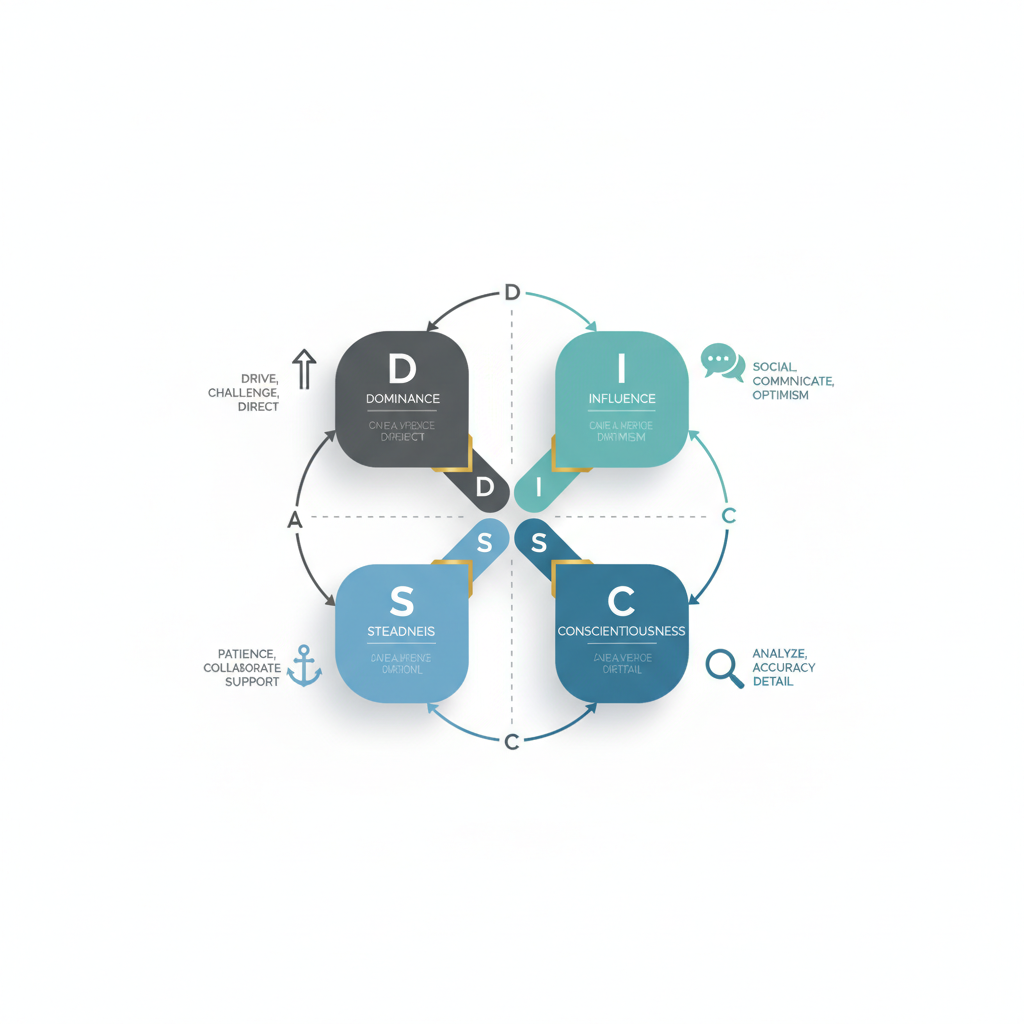
    • D – Dominance: People with a high “D” style are often direct and decisive. They focus on results and overcoming challenges. They like to take charge and are driven to act quickly to reach their goals.
    • I – Influence: The “I” style describes people who are optimistic and outgoing. They enjoy being social and are often persuasive and inspiring. They thrive on teamwork and sharing ideas.
    • S – Steadiness: Those with a high “S” style are often sympathetic and cooperative. They value stability and enjoy supporting others. As patient and reliable team players, they focus on creating consistency and harmony.
    • C – Conscientiousness: The “C” style describes people who are careful and precise. They focus on accuracy, quality, and logic. As analytical thinkers, they pay close attention to details and rules.

    Understanding these styles helps you recognize your natural habits. This awareness can improve how you create. For example, a “D” type might quickly turn new ideas into action. An “S” type can make sure the team works well together on a creative project. A “C” type might carefully perfect an idea, while an “I” type could inspire the team with great enthusiasm.

    Learning about your DISC profile gives you useful self-awareness. It shows how your behavior affects your creative approach. This knowledge is a great addition to the insights from assessments like the Creative Ability Test. Together, they offer a more complete picture of your potential.

    What Do the Four DISC Personality Types Mean?

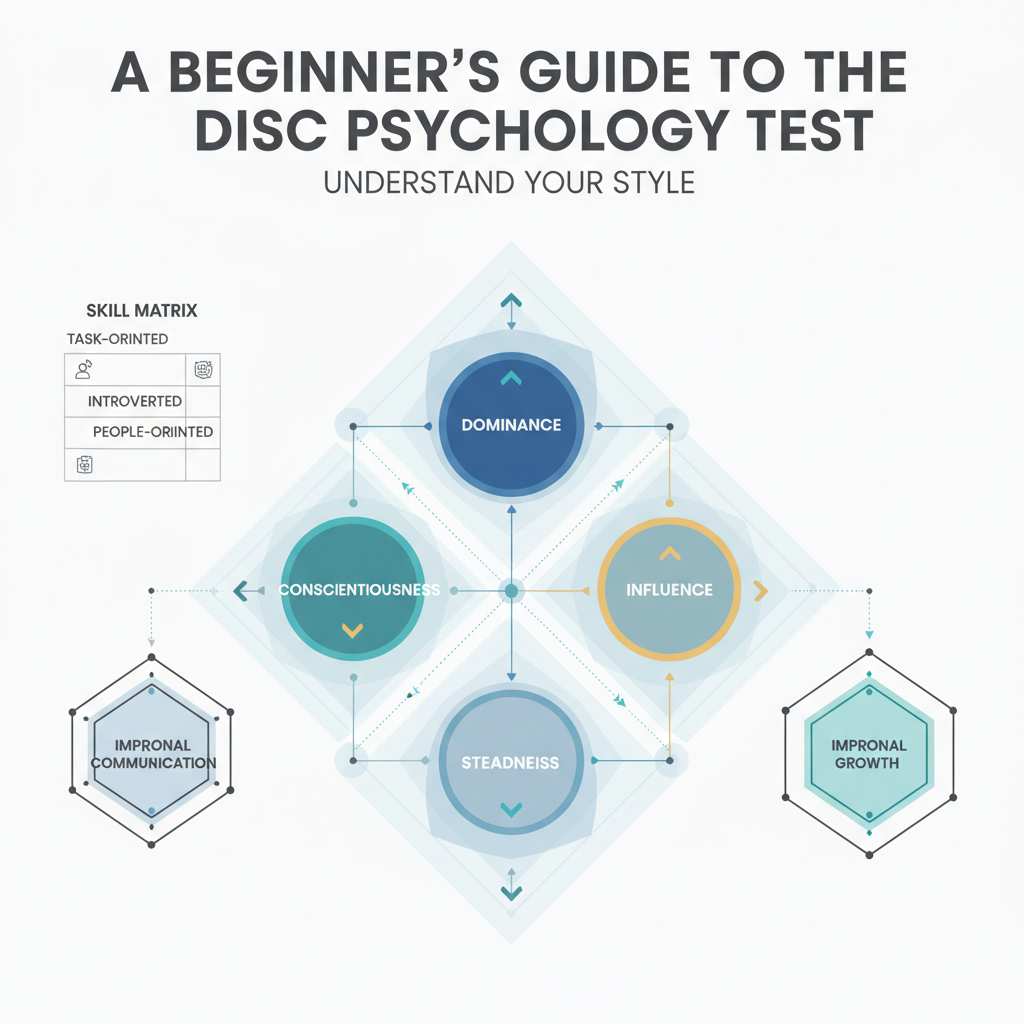
    An infographic showing four interconnected nodes representing the DISC personality types: Dominance, Influence, Steadiness, and Conscientiousness, with their core attributes.
    An abstract, educational infographic illustrating the four DISC personality types. Visualize as a clean, minimalist vector-based diagram with four distinct, interconnected nodes or clusters, each representing D, I, S, and C. Each node should have small, symbolic icons or short text labels for its key attributes (e.g., ‘Dominance’ with an upward arrow, ‘Influence’ with speech bubbles, ‘Steadiness’ with an anchor, ‘Conscientiousness’ with a magnifying glass). Use soft blues, whites, charcoal, with gold or teal accents for hierarchy and clarity. Maintain ample negative space.

    The DISC test is a powerful tool for understanding yourself. It shows your natural behavioral style and how you interact with the world. By learning about the four DISC personality types, you can gain valuable insights into how you communicate, solve problems, and approach creative work.

    Knowing your main DISC style gives you a new perspective. It shows how you start projects, handle challenges, work with others, and process information. This self-awareness is key to unlocking your full creative potential. It helps you use your strengths and find effective ways to grow.

    D – Dominance: Direct & Decisive

    People with a “D” style are direct and focused on results. They are driven by challenges and eager to achieve their goals. They tend to be decisive and take charge. These individuals do best in environments that require quick action and bold solutions.

    Their creative process is focused on effectiveness. They quickly spot problems and find efficient ways to solve them. D-styles enjoy leading creative projects, pushing boundaries, and delivering clear results. For example, a “D” might imagine a new product and immediately start planning how to create it. They prefer to move past endless brainstorming and get to work [2].

    Creative Strengths:

    • Quickly identifies core problems and workable solutions.
    • Drives innovative projects forward with urgency.
    • Takes calculated risks to achieve creative breakthroughs.
    • Focuses on practical use and measurable results.

    Tips for Growth:

    • Practice patience during the early brainstorming phase.
    • Involve others in decision-making to get more perspectives.
    • Listen actively to different viewpoints before acting.
    • Be open to making changes and improvements, not just getting immediate results.

    I – Influence: Optimistic & Outgoing

    The “I” style describes people who are enthusiastic and outgoing. They love connecting with others and are skilled at inspiring them. They are naturally optimistic and enjoy lively social settings. These individuals often bring energy and excitement to any group.

    When it comes to creativity, “I” styles are great at brainstorming and generating new ideas. They often get collaborative projects started. Their ability to share a vision persuasively helps get people on board. An “I” personality might be the one to rally a team around a bold, imaginative idea. They see exciting possibilities and inspire the group to take action.

    Creative Strengths:

    • Generates many different and creative ideas.
    • Inspires and motivates teams during creative projects.
    • Leads lively brainstorming and idea-sharing sessions.
    • Connects ideas that don’t seem related to form new insights.

    Tips for Growth:

    • Focus on how deep and realistic ideas are, not just on the number of ideas.
    • Develop structured plans to follow through on big visions.
    • Pay attention to details that might affect project success.
    • Seek feedback from more analytical thinkers to improve concepts.

    S – Steadiness: Sympathetic & Cooperative

    “S” style people are patient and supportive. They value harmony and cooperation, which makes them reliable team members. They prioritize stability and consistency. These individuals create a calm and predictable environment and often act as the glue that holds a group together.

    Their creative contribution is their ability to improve and carry out ideas. They make sure creative solutions are practical and sustainable. S-styles are thorough and see things through to the end, ensuring great ideas become reality. They build agreement and provide steady support. For instance, an “S” might carefully plan the steps needed to complete a creative project. They are great at making sure everyone is on board [3].

    Creative Strengths:

    • Carefully improves and perfects existing ideas.
    • Makes sure creative solutions are practical and can be done.
    • Encourages teamwork and builds agreement around new ideas.
    • Provides consistent support throughout the creative process.

    Tips for Growth:

    • Be open to starting new and unfamiliar creative projects.
    • Embrace change and adapt as project needs evolve.
    • Speak up with original ideas, even if they challenge the norm.
    • Take on leadership roles in creative problem-solving.

    C – Conscientiousness: Concerned & Correct

    People with a “C” style are analytical and detail-oriented. They value accuracy and precision. They prefer to work in an organized way and seek high-quality outcomes. These individuals often approach tasks with careful planning and thorough research.

    In a creative setting, “C” styles are critical thinkers who evaluate ideas carefully. They make sure solutions are logical and well-supported. Their strength is in refining concepts, identifying potential flaws, and improving the quality of the final work. A “C” personality might spend a lot of time researching a problem to ensure the solution is strong and accurate before sharing it. They prioritize facts and logic above all else.

    Creative Strengths:

    • Conducts thorough research to inform creative decisions.
    • Checks ideas for how realistic, accurate, and effective they are.
    • Develops detailed, high-quality, and strong creative solutions.
    • Ensures work is done with precision and attention to detail.

    Tips for Growth:

    • Practice brainstorming without judging ideas right away.
    • Be comfortable with uncertainty and imperfection in early creative stages.
    • Trust your intuition more often, along with data and logic.
    • Collaborate with “I” or “D” styles to spark new directions.

    How Can Understanding Your DISC Profile Enhance Your Creativity?

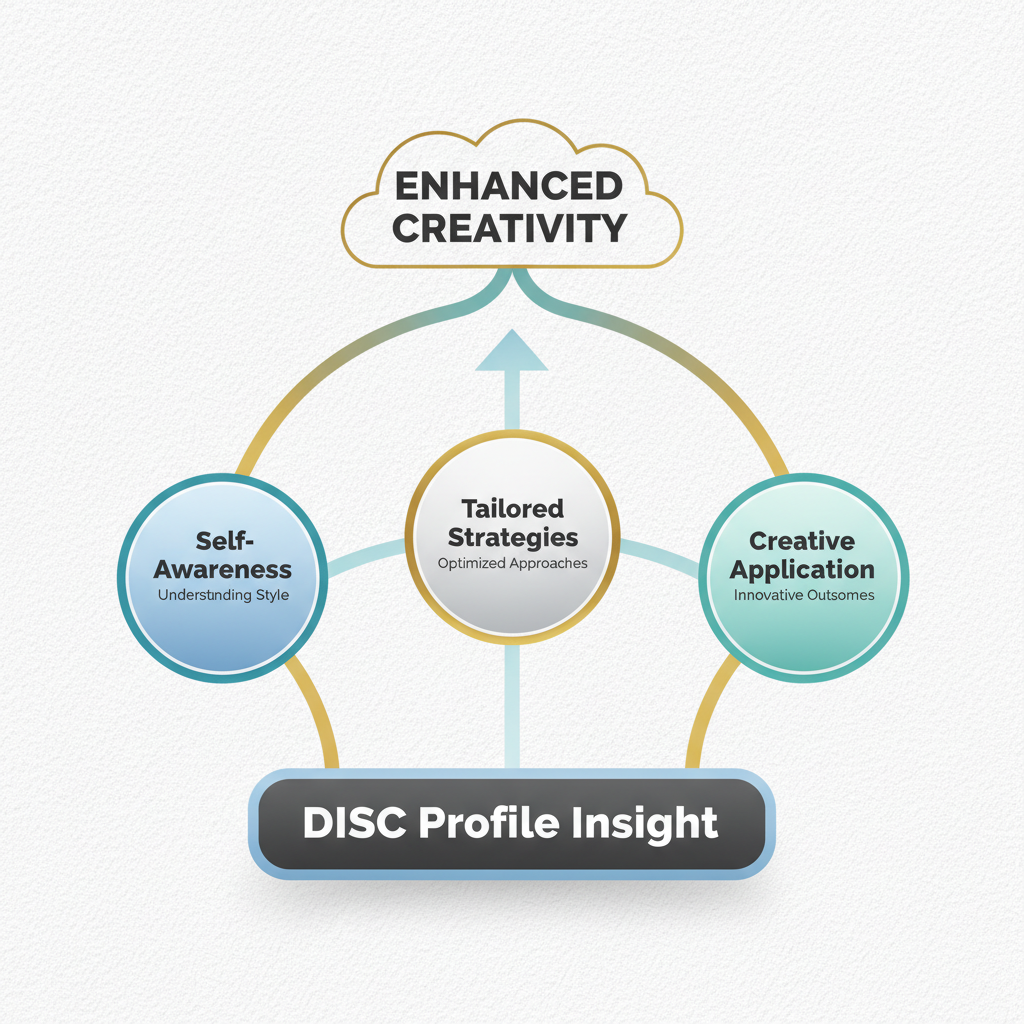
    An infographic illustrating a layered system where DISC profile insights lead to self-awareness, tailored creative strategies, and practical creative application.
    An abstract, educational infographic demonstrating how a DISC profile enhances creativity. Visualize a clean, minimalist vector-based diagram featuring a layered system or a multi-step pathway. Start with a foundational layer labeled ‘DISC Profile Insight’, branching into pathways or circular segments representing ‘Self-Awareness’, ‘Tailored Strategies’, and ‘Creative Application’. Use subtle gradients and accent highlights in gold or teal. Emphasize growth and practical application. Soft blues, whites, and charcoal dominant. Maintain visual hierarchy and open areas for labels.

    A DISC profile is a powerful tool for understanding your behavioral style. It shows how your natural habits shape the way you create. This knowledge can help you find new ways to innovate and solve problems.

    The Creative Ability Test works well with this, showing your specific creative strengths. Using both tests gives you a full picture of your potential. Together, they turn confusion into clear self-awareness [4].

    Connecting Your Behavioral Style to Creative Strengths

    Your DISC profile shows your natural behaviors. These behaviors affect how you handle creative work. When you know your style, you can use your natural talents more effectively. It also helps you build new creative skills.

    Here is how each DISC style often connects to creative strengths:

    • D – Dominance: Direct & Decisive Innovators
      • Dominant styles are often bold and challenge how things are usually done.
      • They are great at creating new ideas quickly.
      • They push projects forward with confidence.
      • Their strength is in carrying out new ideas and overcoming challenges.
    • I – Influence: Optimistic & Outgoing Ideators
      • Influencing types bring excitement and energy to brainstorming.
      • They are great at brainstorming lots of different ideas.
      • They do well in groups, inspiring others to share their thoughts.
      • Their creativity often involves creative storytelling and convincing others.
    • S – Steadiness: Sympathetic & Cooperative Refiners
      • Steady individuals are thoughtful when they approach creative work.
      • They are excellent at improving ideas and making sure they are practical.
      • They create calm and supportive spaces for creative teamwork.
      • Their strength is in improving existing ideas with careful, steady work.
    • C – Conscientiousness: Concerned & Correct Strategists
      • Conscientious styles use detail and logic in their creative thinking.
      • They are great at solving problems by analyzing them to find the best solutions.
      • They fully research and test ideas before putting them into action.
      • Their creativity often involves organized planning and careful work.

    Understanding these connections is a good first step. It shows you where your creativity is strongest and also highlights areas for growth. Our Creative Ability Test provides personal feedback to help you build on these natural strengths.

    Using DISC Insights for Better Team Collaboration

    Creative breakthroughs often happen in teams. When different types of people work together, new ideas appear. Knowing your team’s DISC profiles improves how you work together. It reduces conflict and boosts innovation [5].

    Here’s how to improve creative teamwork:

    • Leverage Diverse Thinking:
      • Let a D-style person lead with bold new ideas.
      • Ask an I-style to run brainstorming sessions to get everyone sharing.
      • Trust an S-style to make sure everyone is heard and ideas are discussed calmly.
      • Have a C-style check ideas to see if they are practical and find any problems.
    • Improve Communication:
      • Change how you talk to match each style. Be direct with D-styles, energetic with I-styles, patient with S-styles, and logical with C-styles.
      • This avoids misunderstandings and makes everyone feel included.
    • Assign Roles Strategically:
      • A D-style might lead a project to develop a new product.
      • An I-style is great for marketing or coming up with brand ideas.
      • An S-style can manage how a project is carried out and keep the team working well together.
      • A C-style might be perfect for research, quality control, or analyzing data.

    When you understand each person’s style, you can build better creative teams. Our platform helps you see the details of creative talent. This leads to better teamwork and more creative results for your group.

    Identifying Your Unique Problem-Solving Approach

    Every challenge needs a solution. Your DISC profile affects how you naturally solve problems and shapes your strategy for finding answers. Knowing this helps you become a better and more flexible problem-solver.

    Here’s how each DISC style often tackles challenges:

    • D – Dominance: The Decisive Solution-Seeker
      • They quickly find the main problem.
      • They prefer direct action and quick solutions.
      • They are good at making fast decisions under pressure.
      • Their focus is on getting results and beating challenges.
    • I – Influence: The Collaborative Ideator
      • They ask others for ideas and brainstorm many options.
      • They enjoy creative thinking and unusual solutions.
      • Their approach is often positive and open to new ideas.
      • They use their influence to get support for their solutions.
    • S – Steadiness: The Patient, Practical Resolver
      • They look at problems carefully from all sides.
      • They focus on steady solutions that cause few problems.
      • They prefer agreement and proven, practical methods.
      • Their strength is in carrying out solutions smoothly for long-term success.
    • C – Conscientiousness: The Analytical Strategist
      • They carefully gather data and check all the facts.
      • They make detailed plans and look at possible risks.
      • Their solutions are based on logic, facts, and proof.
      • They make sure every detail is right before starting.

    Knowing your natural problem-solving style gives you power. You can use your strengths more effectively. It also shows you where you may need to change your approach. For example, a D-style might learn to pause and gather more data, while a C-style might practice brainstorming more creative ideas.

    Our Creative Ability Test shows your mental flexibility and creative thinking skills. These skills are key to becoming a better problem-solver. With these tools, you can face any challenge with more confidence and success.

    How Is a DISC Assessment Different From a Creativity Test?

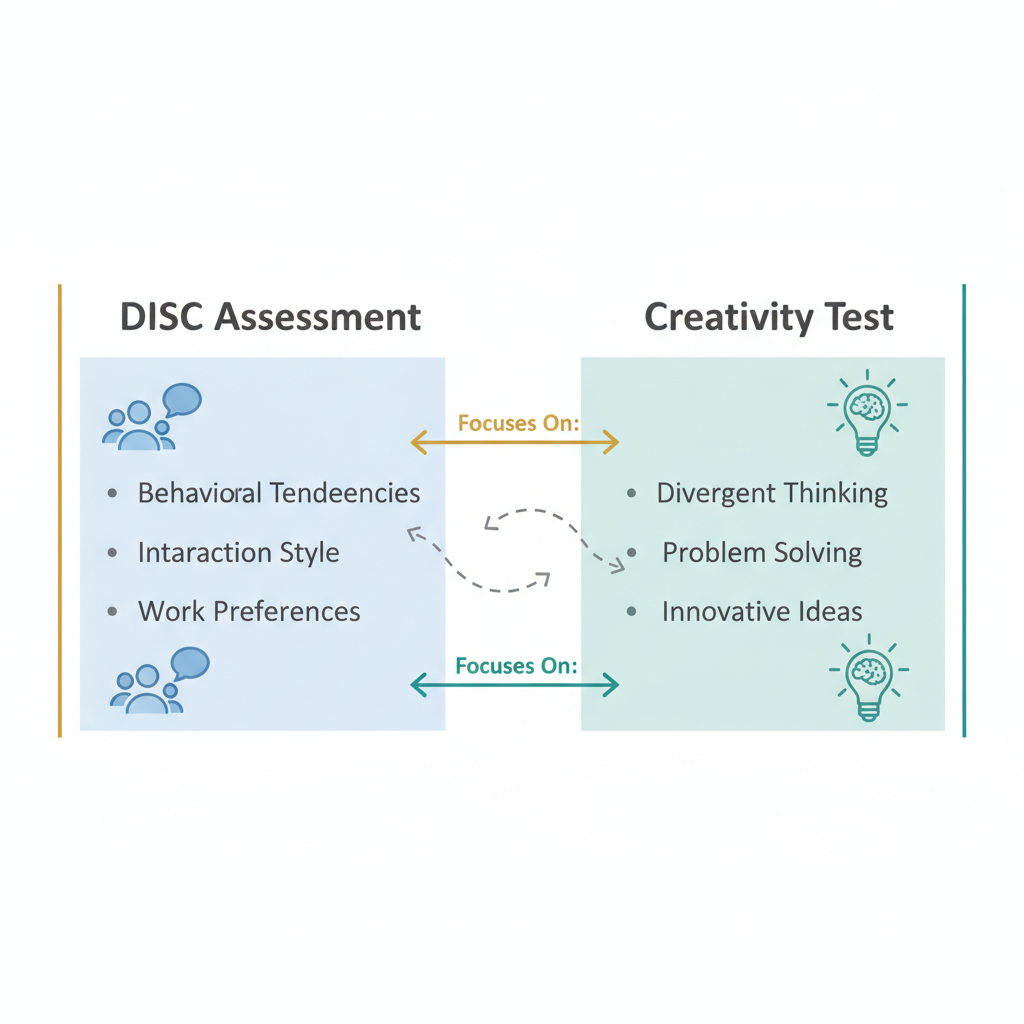
    An infographic comparing a DISC assessment, focusing on behavioral tendencies, with a creativity test, focusing on divergent thinking and problem-solving.
    An abstract, educational infographic contrasting a DISC Assessment with a Creativity Test. Visualize as a clean, minimalist vector-based comparison chart or a dual-column layout. One side represents ‘DISC Assessment’ with elements like ‘Behavioral Tendencies’ and ‘Interaction Style’. The other side represents ‘Creativity Test’ with elements like ‘Divergent Thinking’ and ‘Problem Solving’. Use distinct visual indicators (e.g., different icons or subtle color shifts between the two columns) and connecting lines or arrows to highlight their separate focuses. Employ soft blues, whites, charcoal, with gold or teal accents for key distinctions. Focus on clarity and conceptual representation.

    Behavioral Style vs. Creative Potential

    Understanding yourself is a journey. While DISC and creativity tests both offer useful insights, they look at different parts of who you are. Knowing the difference is key to seeing the full picture.

    A DISC assessment focuses on your behavior. It shows how you tend to act, communicate, and interact with others. For example, it can reveal if you are comfortable with risk or prefer working in a team. It highlights how you usually respond to different situations, including how you generally solve problems and make decisions.

    In contrast, a creativity test, like the one from Creative Ability Test, measures your potential for new ideas. It explores your unique thinking styles and natural ability to be innovative. This assessment looks at key parts of creativity, such as divergent thinking, cognitive flexibility, and your skill at solving problems in new ways. [6]

    The table below outlines the main differences between these two powerful tests:

    Feature DISC Assessment Creativity Test (Creative Ability Test)
    What it Measures Behavior, communication style, and emotional responses. Thinking skills for new ideas, problem-solving, and innovation.
    Core Focus How you act and interact with your environment. How you think creatively and find new solutions.
    Primary Outcome Insights into how you work with others and your best work style. Understanding of your creative strengths, thinking styles, and potential.
    Best For Improving communication, teamwork, and leadership. Boosting innovation, problem-solving, and creative skills.

    One test shows how you naturally interact with others. The other reveals your capacity for innovation. Both are needed to get a complete picture of yourself.

    Using Both Assessments for Complete Self-Discovery

    Using insights from both a DISC and a creativity test gives you a much deeper understanding of yourself. DISC shows how you like to work and communicate. Our creativity test reveals what unique creative power you have. Together, they give you a complete map of your personal strengths.

    This combined approach helps you grow both personally and professionally. You can move from feeling unsure to having self-awareness you can act on. You can turn inconsistent creativity into a clear plan for growth. Here are the key benefits:

    • Complete Self-Awareness: Get a full picture of your strengths. Understand both your communication style and your creative abilities. This clearer view helps you understand yourself better.
    • Personalized Growth Plans: Create plans that fit your natural behavior and boost your creative strengths. This makes your personal development more effective.
    • Better Problem-Solving: Use your DISC style to tackle challenges in an organized way. Then, apply your creative skills to find new and better solutions.
    • Stronger Teamwork: See how your behavior affects how you create with others. This insight helps improve team collaboration and leads to more innovation.
    • Focused Development: Pinpoint specific ways to grow your creative thinking. Connect this growth to your natural behaviors to build confidence and keep improving.

    Creative Ability Test provides practical strategies to help you build on your unique creative skills. When paired with DISC insights, you can unlock your full potential. Start this journey of self-discovery to grow your creativity for personal, professional, and innovative success. Your path to greater innovation begins here.

    What Are the Practical Applications of the DISC Test?

    In Professional Development

    Understanding your DISC profile helps you in your career. It shows your natural style for working with others, handling tasks, and solving problems. It also highlights what you bring to a team, including your own creative style.

    Using DISC insights gives you a clear understanding of your work style. You can use your strengths and adjust your approach to grow and come up with new ideas.

    • Enhanced Communication: Knowing your DISC style, and the styles of your colleagues, helps you adjust how you communicate. This prevents mix-ups and builds better work relationships. For example, a “D” type prefers direct, to-the-point communication, while an “S” type values warmth and support.
    • Optimized Team Collaboration: Different DISC profiles bring different points of view to a project. A team with a mix of styles can create better ideas and solutions. It makes sure everything is considered—from big ideas to careful planning—which leads to stronger creative results [7].
    • Improved Problem-Solving: Your DISC style affects how you solve problems. A “C” style might use logic and data, while an “I” style is great at brainstorming new ideas. Understanding these differences helps teams use the best strategies for each challenge.
    • Strategic Career Pathing: Knowing your DISC profile helps you find jobs that fit your natural strengths. This leads to more happiness at work and lets you use your creativity where it counts. It shows you where your style can lead to new ideas.

    This knowledge helps you create a clear plan for your professional growth. You get better at using your creative skills in your job.

    For Personal Growth and Relationships

    The benefits of a DISC assessment are also useful outside of work. It is a great tool for self-discovery, helping you understand what drives you, what you fear, and why you react in certain ways. This helps you handle personal challenges and build stronger relationships.

    Instead of general advice, you get practical insights about yourself. This encourages you to think about your own behavior and be more curious about others.

    • Deepened Self-Awareness: Discovering your main DISC style explains why you act and react the way you do. This is key to personal growth and helps you understand your own creative process, whether it’s organized or more spontaneous.
    • Stronger Personal Relationships: When you understand the styles of your family and friends, you can change how you talk to them and what you expect. This leads to less conflict and stronger, more supportive relationships. For example, knowing a loved one is an “S” type can remind you to be patient and supportive.
    • Effective Conflict Resolution: When you disagree with someone, DISC can help you see their side. This helps you have better conversations, find common ground, and lower stress in your relationships.
    • Goal Setting and Motivation: Knowing what motivates you helps you set goals that you can and want to achieve. This includes creative hobbies that match your personality and energy levels.

    Using these insights gives you a clear understanding of your personal potential. You learn about your creative strengths and can use this knowledge to improve all parts of your life.

    In Leadership and Management

    For leaders and managers, the DISC test is a great tool for building strong teams and encouraging new ideas. It gives you practical tips on how to lead, motivate, and support different kinds of people.

    This lets you move beyond generic management styles and use personal approaches that get results. It helps you apply creative leadership to solve problems and drive innovation.

    • Tailored Communication and Motivation: Leaders can change their communication style to match each team member. This makes sure messages are understood and that people feel motivated, which helps unlock each person’s creativity. A “D” might be motivated by challenges, while an “I” thrives on recognition and group brainstorming.
    • Strategic Team Building and Delegation: Understanding your team’s strengths helps you build well-rounded teams. You can assign tasks to people whose styles are the best fit for the job. This improves both speed and creativity.
    • Effective Coaching and Development: DISC provides a way to offer specific feedback and create development plans. Leaders can coach people in a way that uses their natural talents. This helps them grow and handle challenges well.
    • Conflict Mediation: Managers can use DISC to handle team conflicts better. By understanding what drives each person, leaders can find solutions that respect everyone and keep the team working well together.
    • Fostering Innovation: A leader who knows their team’s DISC profiles can create a place where all types of creative thinking are welcome. They can encourage “I” types to brainstorm freely and “C” types to carefully review ideas, leading to more innovative solutions [8].

    As a leader, using DISC helps you guide your team with a clear plan for growth. You learn how to bring out your team’s creative best, leading to real growth and new ideas.

    How Can You Find a DISC Psychology Test Online?

    What to Look for in a Quality Assessment

    A reliable DISC psychology test is key to understanding your behavioral style. A good assessment gives you deep insights that can improve how you communicate, collaborate, and create.

    As you look at your options, choose tests that are backed by science and offer practical advice. This will help you gain real self-awareness and move from being unsure about your style to clearly knowing your strengths.

    Here are key things to look for when choosing a DISC assessment:

    • Scientific Validity and Reliability: A good test is backed by research and consistently measures what it’s supposed to. Look for assessments supported by psychological studies [9]. This makes sure the results accurately reflect your style.
    • Comprehensive and Personalized Reports: A great DISC test gives you more than just a score. It provides a detailed report that explains your style, what it means, and offers personal feedback. It should also give you practical tips to help you grow and communicate better.
    • Clear, Understandable Language: The best tests explain complex psychological ideas in a simple way. They use clear language without a lot of jargon, so you can easily understand and use your results.
    • Actionable Insights for Growth: A quality DISC profile doesn’t just describe you—it gives you practical advice. It should offer tips to improve communication, handle conflict, and boost your creative problem-solving. Knowing your DISC style can help you find new ways to tackle challenges and innovate.
    • Qualified and Reputable Provider: Choose a provider known for their expertise in psychological tests. A reputable company will often give you extra resources or support to help you make sense of your results.
    • Privacy and Data Security: Make sure the platform protects your personal information. Read their privacy policy before you take any test.

    Understanding Free vs. Paid Test Options

    When you look for a DISC test, you’ll find free and paid versions. They differ in depth and reliability. The right choice for you depends on your goals.

    Many free tests can give you a quick introduction to the DISC model. But for deeper results, a paid assessment is usually a better choice. It provides the science-backed, detailed insights you need for real growth.

    Here is a comparison to help you choose:

    Feature Free DISC Tests Paid DISC Tests
    Scientific Basis Often not backed by science. May be simplified versions. Developed and tested by psychologists to be accurate and reliable [10].
    Report Depth Usually give short, generic results with little explanation. Give detailed, personal reports with charts and insights into your behavior.
    Actionable Insights Rarely include practical tips for how to use your results. Provide clear advice for personal and professional growth, including skills like creative teamwork.
    Reliability & Consistency Results can change a lot and may not always be accurate. Designed to be very reliable. They give you consistent results over time, making them a trustworthy tool.
    Support & Resources Usually offer no extra support or learning materials. Often come with extra materials, workshops, or coaching to help you understand your results.
    Cost Free, which is great if you’re just curious. Costs money, which reflects their higher quality and detail.

    If you’re serious about personal and professional growth, investing in a paid, high-quality DISC assessment is the best choice. It turns uncertainty into clear self-awareness. This helps you apply your new insights to solve problems and innovate.

    Frequently Asked Questions about the DISC Test

    What are the DISC personality types?

    The DISC model sorts behavior into four main styles. Each style shows how people prefer to act and engage with others. Understanding these types gives you insight into how you communicate and solve problems, which affects your creativity.

    • D – Dominance: Direct & Decisive

      People with a high ‘D’ style are direct, driven, and focused on results. They like challenges and prefer to act quickly. When being creative, ‘D’ types are great at brainstorming new solutions under pressure. They can quickly start new projects and push for change.

    • I – Influence: Optimistic & Outgoing

      High ‘I’ people are often enthusiastic, optimistic, and social. They love working with and inspiring others. Their creative strength is coming up with many different ideas. They are great at boosting a group’s creativity and getting people to share their thoughts freely.

    • S – Steadiness: Sympathetic & Cooperative

      People with a strong ‘S’ style are patient, supportive, and cooperative. They value stability and consistency. Creatively, ‘S’ types use a thoughtful, step-by-step approach. They are good at refining ideas, making sure they will work in the real world, and getting the team to agree on new projects.

    • C – Conscientiousness: Concerned & Correct

      High ‘C’ people are typically analytical, precise, and detail-oriented. They aim for accuracy and high standards. They contribute creatively by analyzing ideas, testing assumptions, and making sure new concepts are workable. They help turn broad ideas into clear, practical plans.

    Each style offers a unique approach to solving problems and creating new things. Knowing your main styles, and the styles of others, can improve how you create things together.

    How do I interpret DISC personality test results?

    Interpreting your DISC results is about understanding yourself better, not just putting yourself in a box. The results show your preferred ways of behaving. This helps you use your strengths and see where you can improve, especially with creativity and problem-solving.

    Here’s how to approach your results:

    • Understand Your Primary Style: Your report will likely point out one or two main styles. This is your most natural way of thinking and acting. For example, a high ‘I’ suggests you’re naturally good at coming up with creative ideas.
    • Recognize Your Blend: Most people are a mix of all four styles in different amounts. Your unique blend shows the details of your personality. It explains why you might change your approach in different situations.
    • Connect to Creative Strengths: Think about how your profile affects your creativity. Are you a natural at creating ideas (I)? Are you good at questioning the usual way of doing things (D)? Do you prefer to perfect ideas (C) or get the team to agree (S)? Your DISC results can help you find your creative strengths.
    • Identify Growth Areas: The report can also show you the styles you use less often. For instance, a high ‘C’ might struggle with quick, on-the-spot brainstorming. Knowing this helps you work on those areas to become more flexible in your thinking and stretch your creative muscles.
    • Apply Insights Practically: Use this knowledge to communicate better, work more effectively with others, and improve how you solve problems. For example, if you have a high ‘D’ style, you could make an effort to listen with more understanding when working on creative projects with a team [11].

    Ultimately, understanding your DISC results helps you see your natural creative style. This allows you to use your strengths more effectively in your personal and professional life.

    Can I get a DISC psychology test as a PDF?

    Yes, some providers offer DISC tests that give you results as a PDF. You might download a questionnaire or get a PDF report after finishing a test online. While PDFs are easy to print or share, they often have some downsides.

    Interactive online platforms usually offer a better experience. They give you feedback that is personal and interactive, not just plain text. A good online test, like those from Creative Ability Test, usually includes:

    • Detailed Analysis: More in-depth explanations of your specific profile.
    • Actionable Strategies: Practical tips based on your style. These can help you think more creatively or work better with others.
    • Personalized Growth Plans: Suggestions for becoming a more flexible thinker and a better problem-solver.
    • Engaging Visuals: Graphs and charts that make complex data easy to understand.

    While a PDF gives you basic information, a full online assessment helps you learn more about yourself. It can unlock your creative potential by giving you personalized advice and clear steps to take.

    Where can I find a free DISC psychology test online?

    Many websites offer free DISC tests. A quick search will show you many options. These can be a good starting point for a basic introduction to the DISC model.

    However, it’s important to think about the quality of free tests and whether they are backed by science. The quality of the insights and the reliability of the results can vary a lot:

    • Limited Depth: Free tests often provide a very basic summary. They might only give you a single letter or a short description. They usually don’t have the detailed, subtle analysis you get from paid tests that have been proven to work.
    • Scientific Validity: Good assessments are based on a lot of research and proven methods. Many free tests may not have this strong scientific support [12]. This means their results might not accurately show your true behavior style.
    • Actionable Insights: One of the most valuable things about any psychological test is the useful advice it gives. Free tests rarely offer personal advice for how to improve or specific tips for boosting your creative thinking based on your results.

    If you want to truly understand your creative strengths and get practical tips to improve, it’s worth paying for a good assessment. Platforms that use methods based on science, like Creative Ability Test, focus on giving detailed feedback. They provide helpful advice for your personal and professional growth. When looking at free options, be curious but careful. Understand that they are not as thorough as paid, science-backed tests.


    Sources

    1. https://www.williammaul.com/what-is-disc/
    2. https://www.forbes.com/sites/carolinecastrillon/2021/04/18/unlock-your-potential-the-power-of-the-disc-assessment/?sh=698e0a297e68
    3. https://www.psychologytoday.com/us/basics/personality/big-five-personality-traits
    4. https://hbr.org/2018/01/why-self-awareness-is-the-most-important-leadership-skill-of-all
    5. https://www.forbes.com/sites/forbescoachescouncil/2023/12/11/unlocking-innovation-the-power-of-diverse-teams/
    6. https://en.wikipedia.org/wiki/Creativity_quotient
    7. https://www.forbes.com/sites/forbescoachescouncil/2023/06/07/how-to-build-a-more-effective-team-through-di-sc-assessments/
    8. https://www.gallup.com/workplace/236465/why-employee-strengths-matter-talent-management.aspx
    9. https://www.apa.org/pubs/journals/features/amp-a0038814
    10. https://www.journals.uchicago.edu/doi/abs/10.1086/209193
    11. https://www.discprofile.com/what-is-disc/interpreting-your-graph
    12. https://www.forbes.com/sites/forbescoachescouncil/2021/04/13/what-to-look-for-in-an-assessment-tool/

  • Top Free Enneagram Tests for Instant Results (And What They Reveal About Your Creativity)

    Top Free Enneagram Tests for Instant Results (And What They Reveal About Your Creativity)

    You can get free Enneagram test results from several online platforms like Truity, Eclectic Energies, and Enneagram Universe. These tests provide an overview of your likely Enneagram type by analyzing your answers to a series of questions, offering insights into your core motivations, fears, and worldview.

    Many of us want to understand ourselves better. We look for tools to highlight our strengths, preferences, and blind spots to help with personal and professional growth. The Enneagram is a popular system of nine interconnected personality types that offers deep self-awareness. It provides a unique way to view our core motivations and behaviors.

    But what if this journey of self-discovery could also reveal your creative potential? Learning your Enneagram type can help you understand who you are and show you your unique style of problem-solving, innovation, and creativity. If you want to take the Enneagram test to uncover these insights, you’re in the right place.

    This article will guide you to the best free Enneagram tests online. We’ll explore how each type expresses creativity, linking personality to your ability to generate new ideas. You’ll learn how your nature shapes your innovative spirit, connecting self-discovery with creative psychology.

    Why Are People Seeking Free Enneagram Test Results?

    People are naturally curious about themselves. This desire to understand who we are leads to a high interest in personality tests. The Enneagram, especially, has become much more popular. Many people look for ways to take the Enneagram test and get free results.

    This comes from a basic human need to discover who we are. We want to understand our motives, fears, and deepest desires. The Enneagram offers a special system for this journey. It gives us a way to understand ourselves and others, offering a new perspective on why people act the way they do.

    Free online Enneagram tests make it easy for anyone to start this process. They offer a simple way to learn about ideas in psychology without being too difficult. This lets more people use the system without having to pay first.

    Why People Want Free Enneagram Results

    There are a few key reasons why people take the Enneagram test online. Usually, they are interested in personal growth and self-awareness. The Enneagram system is like a map that helps you understand your usual habits.

    • Understanding Yourself Better: People want to understand what truly drives them. They want to know the reasons behind their thoughts and actions [1]. This knowledge can highlight your strengths and show you areas where you can improve.
    • Growing as a Person and at Work: Knowing your Enneagram type can help you grow. It shows you how to build on your strengths and work on your weaknesses. This is useful in your personal life and at your job.
    • Better Relationships: When you understand your type and the types of others, it helps you connect with them. It can lead to better talks and fewer arguments. This builds stronger, happier relationships.
    • Learning About Your Creative Side: The Enneagram isn’t a creativity test, but it can show you how you approach creative tasks. Some types might be more analytical, while others are more expressive. Knowing this can be a first step to exploring your creativity more deeply.
    • Being Curious and Learning About Yourself: Many people are just curious about personality systems. They enjoy learning about themselves. It gives them an organized way to think about who they are and how they connect with the world.

    Learning about your personality type gives you a starting point. It can help you make better choices. This leads to a happier life, both personally and professionally.

    How Personality Links to Creativity

    Understanding your personality with a tool like the Enneagram gives you useful insights about yourself. It helps you see patterns in how you act and think. This knowledge can also shape how you approach creative tasks. For example, if you are an analytical type, you might solve problems in a step-by-step way. If you are an expressive type, you might lean more toward art.

    However, the Enneagram looks at your overall personality. It is a helpful tool for self-discovery. But if your main goal is to understand and improve your creative skills, a test designed for creativity is a better choice. Our science-backed Creative Ability Test does more than look at personality. It explores the specific parts of creativity. It finds your unique creative talents, how flexibly you think, and your ability to come up with new ideas. This gives you practical tips made just for you, helping you grow your creative potential. It helps you go from general self-knowledge to focused creative improvement.

    A Review of the Best Places to Take an Enneagram Test Online

    Truity: For a Detailed Look

    Want to better understand what drives you? Truity offers a popular Enneagram test. This platform provides an in-depth assessment that gives you detailed results, helping you fully explore your personality type. It also offers insights into your potential wings and subtypes. This detailed approach is great for self-discovery.

    Knowing your Enneagram type is a powerful tool for personal growth. It reveals your core fears and desires. This can also show how your natural traits affect your creative process. For example, a Type Five (The Investigator) might solve problems with deep analysis. A Type Seven (The Enthusiast) might prefer brainstorming new and exciting ideas. Knowing your type helps you use your natural strengths.

    What you can expect from Truity:

    • Detailed Results: Get an in-depth report about your likely Enneagram type and its main traits.
    • Deeper Insight: Learn about details like your wing type and subtype. This adds more depth to how you see yourself.
    • Good Questions: The test asks questions that make you think. This helps you get a clearer view of your inner world.
    • Creative Uses: See how your personality affects your creative process. This can help you find new ways to solve problems.

    Eclectic Energies: For a Quick, Classic Test

    If you want a quick introduction to the Enneagram, Eclectic Energies is a great choice. This platform offers a short, classic test that is perfect for a quick self-check. Plus, its simple format is easy for beginners to use. You get instant results on your potential type, which can make you curious to learn more about personality.

    A fast Enneagram test can be a great starting point. It helps you quickly spot patterns in how you think. This is valuable for creative people because it helps you recognize your preferred thinking styles. For example, do you prefer careful planning or jumping right in? Knowing this can help with your creative projects. It allows you to use your strengths, whether you’re brainstorming or getting things done. Even a few quick insights can help you become more creative.

    Eclectic Energies provides:

    • Quick Results: Get your likely Enneagram type right away. It’s perfect for a first look.
    • Classic Questions: The questions are simple and to the point, offering a traditional test experience.
    • Easy to Use: The website is simple and user-friendly. It’s easy to get around.
    • A Good Start: It gives you a basic understanding to build on. This can encourage you to learn more.

    Enneagram Universe: For a User-Friendly Experience

    Enneagram Universe stands out with its very user-friendly design. Taking the test here feels easy and natural. The design is clean and the questions are simple to follow, which makes for a smooth experience. It removes any roadblocks to learning about yourself. This makes it ideal for those new to personality assessments.

    An easy-to-use test helps you stay engaged. It lets you focus only on the questions, which can lead to more honest answers. When it’s easy to understand your personality, you can better link it to your creative strengths. For example, knowing you need harmony (Type Nine) might explain your collaborative style. Understanding your drive for success (Type Three) could explain your ambitious projects. Clear insights help you find real ways to grow creatively.

    Key features of Enneagram Universe include:

    • Easy Navigation: The website is easy to use. You can find the test and your results without any trouble.
    • Clear Questions: The questions are direct and easy to understand, which avoids confusion.
    • Friendly Design: The site has a welcoming look and feel. It makes taking a test a positive experience.
    • Great Starting Point: It’s an easy way to start learning about how your personality influences your creativity.

    Similar Minds: For a Different Kind of Test

    Similar Minds offers a different take on the Enneagram test. Instead of typical multiple-choice questions, it gives you statements to rate on a scale, like “strongly agree” to “strongly disagree.” This approach can show different sides of your personality. It can also give you a fresh look at your potential Enneagram type. Some people might find this style works better for them.

    Looking at your personality in new ways is a creative act. It makes you a more flexible thinker, which is a key part of creativity [2]. A different test format challenges how you usually think and encourages you to see yourself in new ways. This can help you solve creative problems. For example, if you’re stuck on a project, changing your perspective can lead to new solutions. This kind of test might reveal creative traits you hadn’t seen before.

    Why choose Similar Minds:

    • Different Question Style: You rate statements instead of picking from a list. This can give you a more detailed view of yourself.
    • Fresh Perspective: Get insights from a different kind of test. This helps you understand yourself better.
    • Makes You Think: The rating scale encourages you to think more deeply about your answers.
    • Boosts Flexible Thinking: Trying new test formats is a good mental workout. It strengthens your creative thinking skills.

    How Can Understanding Your Enneagram Type Unlock Your Creativity?

    An infographic showing a central abstract 'Creativity Core' being activated and unlocked by insights from various distinct Enneagram types, represented by connecting geometric shapes.
    An abstract, educational infographic for ‘How Can Understanding Your Enneagram Type Unlock Your Creativity?’. The visual features a central, multifaceted ‘Creativity Core’ represented by interconnected geometric shapes in soft blue and white. Surrounding it, several distinct, stylized ‘keyhole’ or ‘gear’ shapes, each subtly different in design (representing Enneagram types), lead into the core with elegant, gold-accented connecting lines. These connections illustrate ‘insights’ flowing into and activating the creativity. The overall style is minimalist, vector-based, and professional, using a palette of soft blues, whites, and charcoal, with prominent gold accents for the connections and activation points. Negative space is left for potential short conceptual labels like ‘Type X Trait,’ ‘Creative Strength,’ or ‘Unlock Potential.’ No humans, no cartoon elements, focus on clarity and conceptual representation.

    The Gut Triad (Types 8, 9, 1): Instinct and Action

    Your Enneagram type shows your creative strengths. For the Gut Triad, creativity comes from instinct. You are driven to make a real-world impact. This group includes Types 8, 9, and 1.

    Each type in this triad expresses creativity in a different way:

    • Type 8 (The Challenger): You are bold and take direct action. Your creativity helps you create new paths. You are a natural leader who can break through barriers [3]. Your projects often make a big impact and challenge the way things are done.
    • Type 9 (The Peacemaker): Your creativity comes from a desire for harmony. You are skilled at bringing different ideas together. This makes you great at group projects and blending viewpoints [4]. You find new ways to create unity and understanding.
    • Type 1 (The Reformer): You use creativity to make things better and aim for perfection. Your focus on detail leads to high-quality results. You are good at creating fair systems and organized solutions [5]. This drive ensures your work is both effective and built on strong principles.

    Knowing your natural drive helps you use your strengths. For example, a Type 8 might lead a bold new company. A Type 9 could create an inclusive community space. A Type 1 might build flawless software. Understanding what motivates you helps you focus your energy. Our Creative Ability Test offers more insight into how your thinking style supports these actions. You can discover your specific strengths, like problem-solving and flexible thinking.

    The Heart Triad (Types 2, 3, 4): Feeling and Connection

    The Heart Triad types are guided by their feelings. Their creativity comes from emotion, relationships, and self-expression. This group includes Enneagram Types 2, 3, and 4.

    Here is how each type shows creativity:

    • Type 2 (The Helper): Your creativity is driven by a desire to help people. You are good at understanding what others need. This helps you create solutions that truly make a difference [6]. You often build creative communities and inspire teamwork.
    • Type 3 (The Achiever): You use your creativity to reach goals and make an impact. You are skilled at presenting ideas in a powerful way. This makes you great at storytelling and creating fresh marketing ideas [7]. Your work is often polished and highly effective.
    • Type 4 (The Individualist): Your creativity is deeply personal and unique. You use your strong connection to emotions to create original work [8]. This makes you a natural artist or an innovator with a unique style.

    Knowing your Heart Triad type can help you understand your creative style. For example, a Type 2 might create easy-to-use products. A Type 3 could develop a powerful ad campaign. A Type 4 might make art that connects with people’s feelings. This awareness helps you use your natural gifts. Our platform measures skills like openness and emotional intelligence. This gives you clear steps to enhance your unique creative talents.

    The Head Triad (Types 5, 6, 7): Thinking and Ideas

    For the Head Triad, creativity comes from thinking and new ideas. This group includes Types 5, 6, and 7. You process the world through logic, always seeking to understand or experience something new.

    Explore the different creative styles in this triad:

    • Type 5 (The Investigator): Your creativity comes from deep knowledge and research. You enjoy solving complex problems. This leads you to create smart, detailed systems [9]. You are driven by curiosity and often have brilliant insights.
    • Type 6 (The Loyalist): You use careful planning in your creative work. You are good at spotting problems before they happen. This helps you create practical and reliable solutions [10]. Your thoughtful approach makes sure projects are well-planned and strong.
    • Type 7 (The Enthusiast): Your creativity is fueled by new ideas and experiences. You are a natural at brainstorming and thinking outside the box [11]. Your playful approach helps you come up with many fresh and exciting ideas.

    Using your Enneagram type can help you use your mental strengths. A Type 5 might develop a new theory. A Type 6 could create a solid project plan. A Type 7 might launch several new projects at once. Our 30-question assessment looks at these thinking skills. It measures how you solve problems and adapt your thinking. This gives you personal feedback and tips. You can then use your unique way of thinking to innovate.

    Beyond Personality: Why a Creativity Test Offers More Actionable Insights

    An infographic comparing the general insights from personality tests with the specific, actionable strategies derived from a detailed creativity test, shown as a split diagram.
    A clean, instructional infographic for ‘Beyond Personality: Why a Creativity Test Offers More Actionable Insights’. The visual is structured as a clear comparison using a dual-panel or side-by-side layout. The left side, labeled conceptually ‘Personality Insights’ (e.g., Enneagram), features a broad, less specific cognitive network diagram in soft blues and charcoal, showing general connections. The right side, labeled conceptually ‘Creativity Test Insights,’ presents a more detailed and intricate competency graph or a multi-axis radar chart using a mix of soft blues, white, and teal accents. This side clearly shows specific dimensions of creativity (e.g., ‘Divergent Thinking,’ ‘Problem Solving,’ ‘Innovation Potential’) with measurable indicators and distinct, outward-pointing gold arrows or small icons symbolizing ‘Actionable Strategies.’ The design is minimalist, vector-based, and professional, emphasizing clarity and practical application. Negative space is strategically used for short conceptual labels. No people, no cartoon elements, focus on conceptual representation and professional educational branding.

    From ‘Who You Are’ to ‘What You Can Create’

    Personality tests, like the Enneagram, tell you about your motivations and fears. They help you understand “who you are.” This self-awareness is a great first step for personal growth. But if you want to boost your creativity, a different approach works better.

    A creativity test focuses on something different. Instead of looking at your personality, it explores “what you can create” by measuring your creative skills. This is a key difference. It helps you turn self-awareness into real-world action.

    Understanding your creative ability is more than just knowing your personality type. It’s about finding the skills you can improve. This helps you get better at solving problems and learn how you come up with new ideas. It puts you in control of your creative growth.

    Measuring Creative Skills You Can Improve

    To truly grow your creativity, you need to understand your specific creative skills. A good creativity test measures these key areas. Think of them as the building blocks of innovation. These skills aren’t fixed—you can develop and strengthen them over time.

    Our science-based test focuses on key areas of creativity, including:

    • Divergent Thinking: Your ability to come up with many different ideas from one starting point. For example, brainstorming new uses for a paperclip. It’s about exploring all the possibilities [12].
    • Cognitive Flexibility: How easily you can switch your way of thinking. It shows how you adapt when facing a challenge. This skill is key to getting past mental blocks and seeing things in a new light.
    • Problem-Solving Skills: Creativity is often about finding new solutions to tough problems. Our test measures your ability to spot problems, understand them, and come up with original ways to move forward.
    • Openness to Experience: While this is a personality trait, it has a big impact on creativity. It’s your willingness to try new things and explore new ideas. This openness helps fuel creative thinking.

    By measuring these skills, a creativity test gives you a clear roadmap for growth. You don’t just learn *that* you are creative—you learn *how* you are creative. This insight helps you focus on specific areas to improve. It turns your potential into real, usable skills.

    Discover Your Creative Strengths with Our Science-Based Test

    If you want to go from self-reflection to actively building your creative skills, a creativity test is the perfect next step. The Creative Ability Test is a unique, research-backed tool to guide you. We offer a detailed assessment, not just another free personality quiz.

    Our 30-question test is based on proven research in creative psychology. It accurately measures your creative strengths. Our methods are tested and reliable, giving you trustworthy insights that are personalized for you. [13].

    When you finish the test, you get personalized feedback that’s more than just a score. It shows you your specific creative strengths and points out areas where you can grow. We also give you practical tips and strategies to help you improve your creative thinking at work and in your daily life.

    Ready to unlock your full creative potential? Learn how your unique thinking style can lead to new ideas. Find better ways to solve problems. Start your journey today and see the power of personal, practical insights.

    Frequently Asked Questions

    What is the best free Enneagram test?

    The “best” free Enneagram test depends on your goals. Some people want a detailed report, while others prefer a quick quiz.

    We’ve reviewed several top options, including:

    • Truity: This platform gives you a deep dive with detailed reports. You may need to provide an email to see everything.
    • Eclectic Energies: This classic test gives you fast results with a simple format.
    • Enneagram Universe: This site is easy to use and helps you understand your type.
    • Similar Minds: Try this test if you want a different style of questions. It looks at personality in a unique way.

    These tests offer good personality insights, but they don’t measure creativity directly. Our Creative Ability Test is different because it focuses only on your creative skills. It measures practical abilities like problem-solving and thinking outside the box. This gives you clear steps to boost your creativity.

    What are the 9 Enneagram types?

    The Enneagram has nine personality types. Each type has a core drive that shapes how they see the world. These types are grouped into three “triads” based on their center of intelligence: Gut, Heart, or Head.

    The Gut Triad (Instinctive & Grounded Creativity)

    • Type 8 – The Challenger: Eights are confident and protective. Their creativity is bold and action-oriented. They often challenge norms and lead innovative projects.
    • Type 9 – The Peacemaker: Nines want harmony and connection. They are creative in ways that bring people and ideas together. They offer a calm, unifying view.
    • Type 1 – The Reformer: Ones are principled and aim for perfection. Their creativity focuses on making things better and finding ethical solutions. They carefully polish their ideas until they’re just right.

    The Heart Triad (Empathetic & Expressive Creativity)

    • Type 2 – The Helper: Twos are caring and generous. They use their creativity to help others and build relationships. Their ideas often create a sense of community.
    • Type 3 – The Achiever: Threes are driven and focused on success. They use creativity to hit their goals and pitch ideas well. They are great at turning a vision into a reality.
    • Type 4 – The Individualist: Fours are unique and expressive. Their creativity is very personal and often artistic. They are known for their original and deep insights.

    The Head Triad (Analytical & Innovative Creativity)

    • Type 5 – The Investigator: Fives are observant and analytical. They use creativity to explore complex topics and become experts. Their best ideas come from a deep knowledge of a subject.
    • Type 6 – The Loyalist: Sixes are committed and responsible. They use their creativity to solve problems and create security. They are good at spotting future challenges and planning for them.
    • Type 7 – The Enthusiast: Sevens are adventurous and positive. They are most creative when trying new things and coming up with lots of ideas. They are often great visionaries and brainstormers.

    Learning your type helps you understand yourself better. But our Creative Ability Test takes it a step further. It gives you practical ways to build on your unique creative style. It focuses on real growth, not just personality labels.

    Can I get Enneagram test free results without providing an email?

    Yes, many free Enneagram tests show you your results right away without an email. For example, sites like Eclectic Energies and Similar Minds usually display your results on the screen as soon as you finish.

    However, some sites ask for your email to send you a more detailed report. This is common for tests that offer deeper insights or follow-up guides. It allows them to give you personalized feedback.

    If you care about privacy, you still have plenty of options to learn about yourself. And when you’re ready to improve your creativity, our Creative Ability Test gives you direct, useful advice. Our science-backed test focuses on your creative skills, not just your personality type. [14]

    What is an Enneagram wing test?

    Your Enneagram “wing” is one of the two types on the Enneagram circle right next to your main type. A wing adds extra flavor and detail to your personality. It has a gentle effect on how you act and what drives you. For example, a Type 9 can have an 8 wing (9w8) or a 1 wing (9w1).

    • A 9w8 might be more confident and protective than a typical 9.
    • A 9w1 might be more principled and orderly.

    Most detailed Enneagram tests will figure out your wing for you. They explain how it influences your personality. These tests often describe what your core type looks like when combined with your wing.

    A wing adds layers to your Enneagram type, and creativity has layers, too. Our Creative Ability Test measures different parts of your creative thinking, like flexible thinking and brainstorming. We give you personal feedback to help you see your unique creative strengths. Then, we offer clear steps for growth so you can reach your full potential, not just stick with a label.


    Sources

    1. https://www.enneagraminstitute.com/how-the-enneagram-can-help-you
    2. https://hbr.org/2015/11/what-is-cognitive-flexibility
    3. https://www.enneagraminstitute.com/type-8
    4. https://www.enneagraminstitute.com/type-9
    5. https://www.enneagraminstitute.com/type-1
    6. https://www.enneagraminstitute.com/type-2
    7. https://www.enneagraminstitute.com/type-3
    8. https://www.enneagraminstitute.com/type-4
    9. https://www.enneagraminstitute.com/type-5
    10. https://www.enneagraminstitute.com/type-6
    11. https://www.enneagraminstitute.com/type-7
    12. https://psycnet.apa.org/record/1968-07223-001
    13. https://www.creativityatwork.com/what-is-creativity-research-and-why-is-it-important/
    14. https://www.psychologytoday.com/us/blog/head-games/202102/the-growing-popularity-the-enneagram