The Raven Psychological Test, also known as Raven’s Progressive Matrices (RPM), is a non-verbal assessment designed to measure abstract reasoning and fluid intelligence. It presents a series of visual patterns with a missing piece, and the test-taker must select the correct piece to complete the pattern. This evaluates an individual’s ability to think logically and solve novel problems independent of language or cultural background.
Have you ever wondered how your mind works, or what drives your ability to solve problems, think logically, and be creative? Knowing your mental strengths is a key step to growing personally and professionally. This article introduces the Raven Psychological Test, a well-known assessment that measures these exact skills. Often called the RPM intelligence test, it provides a unique look into how you see the world and approach new challenges.
Unlike traditional assessments that test what you already know, the Raven test focuses on your fluid intelligence. This is your natural ability to understand new information and solve problems you’ve never seen before. By learning how this non-verbal test works, you’ll gain practical insights into how you think, spot patterns, and solve problems creatively. Understanding these core skills helps you use your strengths and work on areas you want to improve.
In this complete guide, we’ll explain how the Raven test works, what your scores really mean, and offer practical tips to improve the very skills it measures. Get ready to understand your own thinking style on a deeper level, starting with the basics. Let’s begin by exploring the main question: What is the Raven Psychological Test (RPM)?
What is the Raven Psychological Test (RPM)?
To unlock your creative potential, it helps to first understanding-intelligence-and-cognitive-tests/”>understand your core thinking skills. One standout tool for this is the Raven Psychological Test (RPM), also known as Raven’s Progressive Matrices. It’s a key part of psychological assessment that shows how your mind solves new problems.
So, what is the Raven test? It’s a non-verbal test that measures your ability to reason abstractly. Psychologists created it to measure “fluid intelligence.” This is your brain’s natural talent for solving new problems by spotting patterns and seeing how things connect, all without needing prior knowledge or language skills [1].
Many tests use words or math, but the RPM uses visual puzzles. You’ll see a series of abstract shapes and have to figure out which one comes next. This design tests your raw problem-solving skills. It shows how well you can understand new information and use logic to find the right answer.
Understanding your fluid intelligence gives you valuable information about how you think. It shows how flexible your mind is, which is a key part of being creative and innovative. For example, strong fluid intelligence means you’re likely good at coming up with many different solutions to a problem. It also means you can easily switch between different ways of thinking to find what works best.
At Creative Ability Test, we believe that understanding your core thinking skills is empowering. It helps you see the foundation of your creative talent. When you know how you process information, you can improve your problem-solving methods and think more innovatively. This self-awareness gives you a clear path forward, helping you grow your creative abilities in a structured way.
How Does the RPM Intelligence Test Work?
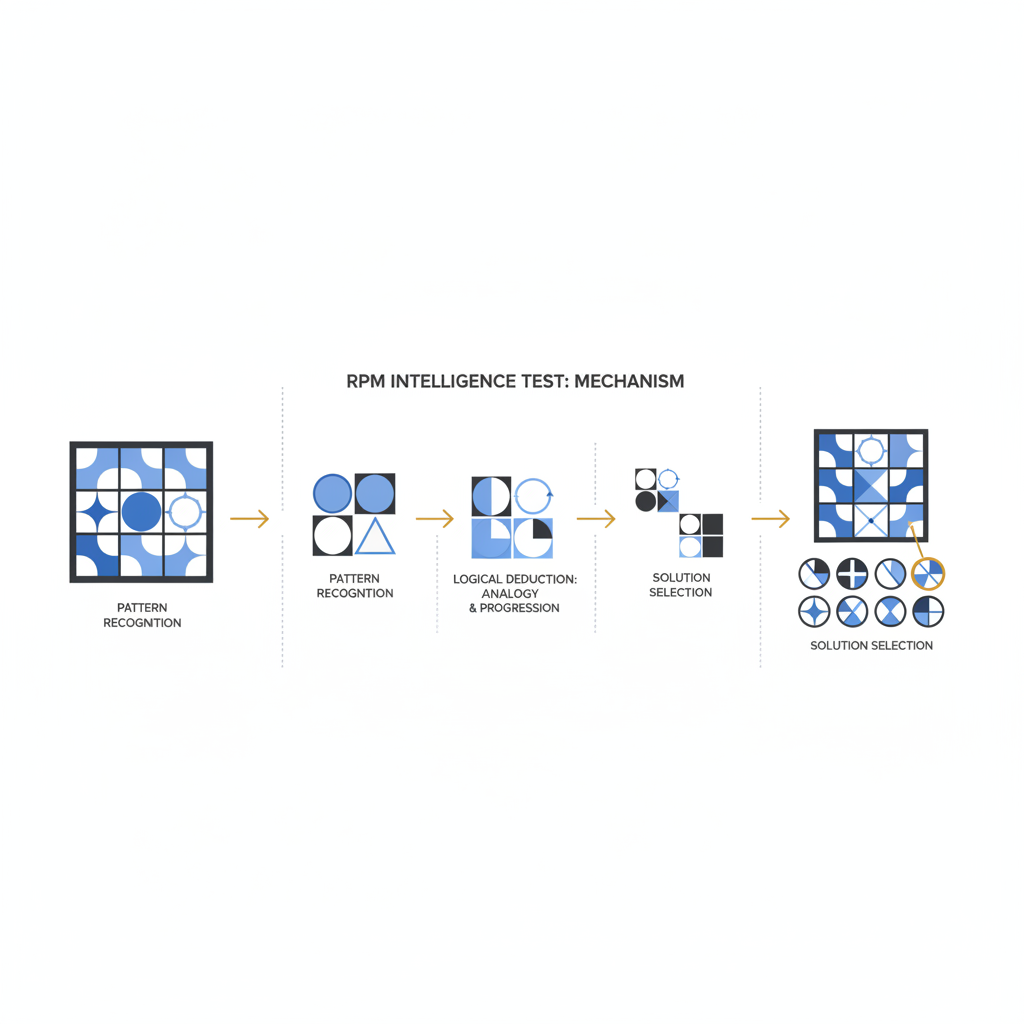
The Role of Visual Patterns
The Raven’s Progressive Matrices (RPM) is a special kind of test. It uses only visual patterns to measure your thinking skills. You’ll see a series of shapes and designs and have to find the missing piece that fits the pattern.
This test doesn’t use words, so it avoids language or cultural barriers. This gives a clear picture of your problem-solving skills. The patterns challenge you to find connections and figure out what comes next, pushing you to think in new ways.
Being able to see these patterns is key for creative thinking. It helps you find the basic structure in a complex problem. This skill is important for coming up with new ideas and solutions in any area.
Assessing non-verbal abstract reasoning
The main goal of the RPM test is to measure non-verbal abstract reasoning. So, what does that mean? It’s your ability to work with ideas and patterns, not just words or objects. You have to see the hidden “rules” that make the pattern work.
This kind of reasoning is a key part of intelligence. It shows how well you can think logically and understand new information. The test doesn’t rely on things you’ve memorized. Instead, it measures your natural skill for solving new problems.
For instance, a pattern might change by getting bigger or turning. Your job is to figure out the rule behind the change. This mental flexibility is also a big part of creativity. It helps you adapt and come up with new ideas [2].
Good abstract reasoning skills also help you think more broadly. This means you can come up with many different solutions for a single problem. This improves your problem-solving skills overall.
Progressive Difficulty Explained
The RPM test is designed to get harder as you go. It starts with simple patterns to help you get used to the format. Then, the questions slowly become more complex.
Each new question adds more rules or small changes. You might need to think about several rules at the same time. This increase in difficulty is done on purpose to really challenge your thinking skills.
This structure helps the test find your exact skill level. It shows how well you handle more complex information. It also shows how you adapt when problems get harder.
Knowing how you perform on a test like this can be very helpful. It shows your ability to learn and improve. Like with creativity, working through tough challenges can lead to big ideas. This helps you understand how you think and where you can become a more flexible thinker.
What Skills Does the Raven Test Actually Measure?
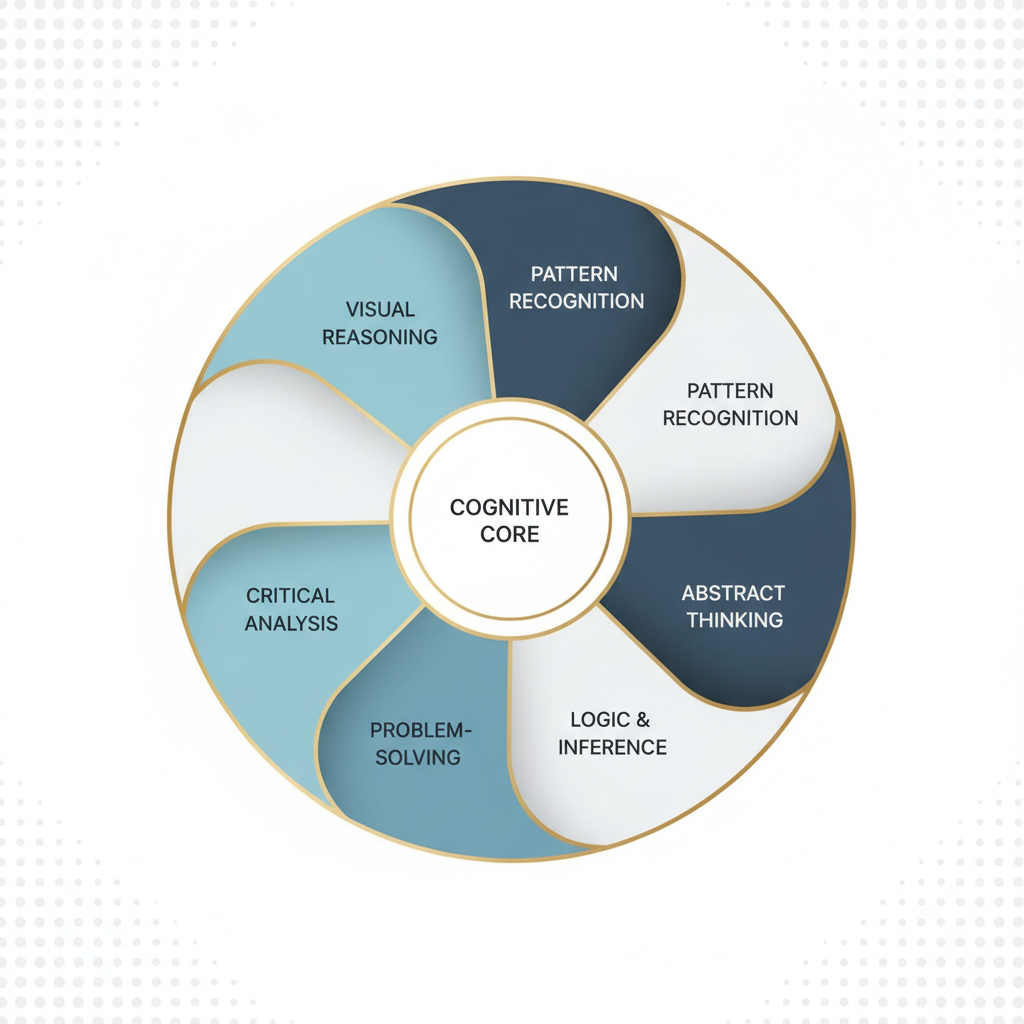
Fluid Intelligence: Your Ability to Solve New Problems
The Raven Psychological Test mainly measures your fluid intelligence [3]. This is your natural ability to solve new problems. It’s how you understand tricky situations and find solutions without relying on what you already know.
Think of it as your brain’s raw processing power. It helps you pick up new ideas quickly. Fluid intelligence is also key for adapting to new challenges, allowing you to think on your feet. For example, you use it when learning a new game or handling a surprise issue at work.
This skill is important for personal growth because it helps you learn new things and think in fresh ways. When your fluid intelligence is strong, you can face unfamiliar problems with confidence and create smart plans to solve them.
Pattern Recognition and Logical Thinking
Raven tests challenge how well you recognize patterns. You have to see the connections between shapes and figures. This means finding sequences, spotting what doesn’t belong, and finishing visual patterns correctly.
Logical thinking is also a big part of the test. You use two types of reasoning: deductive and inductive. Deductive reasoning helps you guess the next item in a series. Inductive reasoning lets you create general rules from specific examples. Both are key to solving the test’s puzzles.
These skills are useful far beyond tests. In daily life, pattern recognition helps you:
- See trends in data.
- Guess what might happen in social situations.
- Find mistakes in complex systems.
Logical thinking helps you make decisions by letting you weigh your options clearly. This leads to better choices. Building these skills makes your thinking more flexible, preparing you to solve all kinds of problems. Many studies show a strong link between these thinking skills and success in school [source: https://journals.sagepub.com/doi/abs/10.1177/0013164415591030].
The Connection to Creative Problem-Solving
While the Raven Test doesn’t measure creativity directly, it checks the core skills you need for it. Fluid intelligence, pattern recognition, and logical thinking are the building blocks for creative problem-solving. They help you come up with new ideas.
Think about it: to be creative, you first have to understand a problem. You need to see the patterns behind it and then think through possible answers. That’s when the skills measured by the Raven test become a big help.
They also help with divergent thinking, which is the ability to brainstorm many different ideas from a single point. These thinking skills also help you:
- Break big problems into smaller, easier parts.
- Find surprising links between different ideas.
- Check if your ideas will actually work and are truly new.
- Change your approach when your first plan fails.
In the end, strong skills in these areas boost your creativity. They help you go from just seeing a problem to creating a new solution. Our Creative Ability Test takes this even further by helping you explore these connections. You’ll discover how your own thinking style can lead to new ideas. It offers personal advice and real steps to help you grow your creative skills and use them well in all parts of your life.
How Are Raven IQ Test Scores Interpreted?
Understanding Percentiles and Scores
To understand your Raven IQ test score, you need to know about percentiles. Your raw score—the number of questions you got right—doesn’t tell the whole story. Instead, your score is compared to a large group of people.
This comparison gives you a percentile rank. For example, a 75th percentile score means you performed better than 75% of other test-takers. It shows how your score compares to others.
Here’s what the ranks usually mean:
- Average Range: Scores between the 25th and 75th percentile are considered average. Most people score in this range.
- Above Average: A score above the 75th percentile shows strong abstract reasoning skills.
- Below Average: A score below the 25th percentile may point to thinking skills that could be developed further.
Remember, percentiles are just a snapshot. They help measure your non-verbal reasoning and show how quickly you can spot complex patterns [4].
What Your Score Says About Your Thinking Skills
Your Raven score mainly shows your fluid intelligence. This is your ability to solve new problems and figure out complex situations. It relies on pure reasoning, not on things you’ve already learned. For instance, strong fluid intelligence helps you adjust to new challenges.
High scores suggest you are excellent at:
- Pattern Recognition: You quickly see how things are connected or repeated.
- Logical Deduction: You can figure out rules and use them in new situations.
- Abstract Reasoning: You can solve conceptual problems well, even without clear examples.
- Problem-Solving Skills: You can find solutions to new tasks efficiently.
These abilities are key to creative thinking and form the foundation for new ideas. For example, if you are good at finding patterns, you might also be good at seeing unique links between different ideas. This is a key part of creativity.
However, a Raven score is just one piece of information. It doesn’t measure creativity directly. Instead, it highlights key thinking skills that can be a big help as you explore your creativity.
Beyond the Score: Using Your Results for Personal Growth
Your Raven score gives you valuable insights into your core thinking skills. But the real value comes from using this knowledge to grow your creative potential.
Think of your score as a starting point. It shows you how you tend to think. You can use this self-awareness to improve.
Here are a few ways to use what you’ve learned:
- Solve Creative Problems: If you’re strong in abstract reasoning, use it for tough creative challenges. Try breaking problems down into smaller parts.
- Become a More Flexible Thinker: Fluid intelligence can be trained. Try activities that involve learning something new to strengthen your thinking skills.
- Find Areas for Growth: If your score was lower than you hoped, see it as a chance to improve. You can do exercises to get better at pattern recognition and logical thinking.
- Find New Ideas: Use your ability to connect the dots. Look for surprising links between ideas. This is often how new ideas are born.
- Focus on Growth: Remember that creativity is a skill. Like any skill, it can be developed and improved over time with practice.
Understanding your thinking strengths can help you find practical strategies for growth. The Creative Ability Test, for example, builds on these ideas. It helps you explore different sides of your creativity and gives you personalized feedback. This guidance helps you turn your potential into real-world skills and apply what you’ve learned.
How Can You Prepare for a Raven-Style Test?
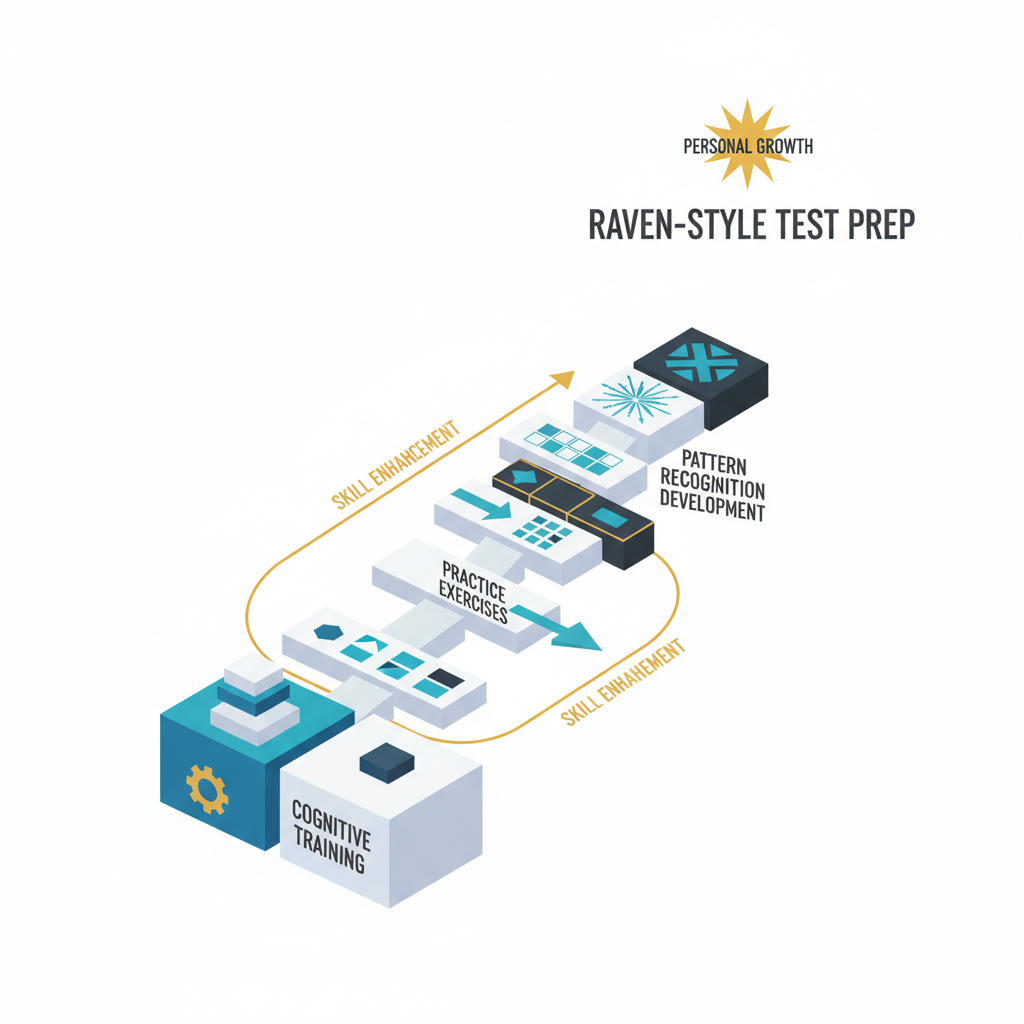
Finding Reliable Practice Tests Online
Taking practice tests for a Raven-style exam helps you learn abstract thinking. Finding good study materials is important. These tests help sharpen your thinking skills, like spotting patterns and solving new problems. These skills are key to thinking creatively.
Look for practice tests that are like the real Raven’s Progressive Matrices (RPM). Many learning websites have helpful resources. They often explain why answers are right or wrong. This feedback is key for learning.
When you search, look for trusted sources. These might include:
- University psychology departments: They often share information about thinking tests.
- Educational sites for logic and IQ tests: They create materials to help you think better.
- Psychometric test publishers: Some offer sample questions or guides.
A good practice test helps you get used to the types of questions and builds your confidence. Practicing regularly can make a big difference. It gets your mind ready to solve new problems well [5].
Tips for Improving Your Pattern Recognition Skills
Good pattern recognition is key for a Raven-style test. It also makes your thinking more flexible, which is a big part of creativity. Improving this skill can help you in many areas of life.
Here are some simple ways to get better at pattern recognition:
- Play logic puzzles: Games like Sudoku, chess, or visual matching puzzles train your brain to find patterns and connections.
- Observe your surroundings: Pay attention to patterns in nature, buildings, or even your daily routine. Noticing small details makes you a better observer.
- Learn a musical instrument: Music is full of patterns. Learning rhythm and melody helps you recognize patterns in sound.
- Explore coding or programming: Coding means breaking down problems and finding logical patterns. This greatly improves your systematic thinking.
- Engage in visual arts: Drawing or painting requires you to see shapes, colors, and arrangements. This sharpens your ability to spot visual details.
Building these skills helps you do better on RPM tests. More importantly, it improves your ability to solve problems creatively. You will start to see connections where others see only chaos. This helps you create new ideas and think outside the box.
Understanding Test Examples and Questions
To do well on a Raven-style test, it is important to understand how the questions work. Each question asks you to find the missing piece of a pattern by figuring out the rules behind it. Think of it as a creative puzzle where you use logic to find the right answer.
When you see a question, break it down:
- Analyze each part: Look at the shapes, sizes, colors, and positions. How do they change across the puzzle?
- Find the pattern: Does a shape get bigger, smaller, rotate, or change in another way? Check both rows and columns.
- Look for combined rules: Sometimes, parts from one row or column mix with another to create a new pattern.
- Use elimination: Get rid of answers that clearly do not fit the rules. This makes it easier to choose.
Many online practice tests offer detailed explanations. Study them carefully to understand the thinking behind each correct answer. This organized approach is not just for tests; it is a great way to solve any difficult problem at work or in your personal life. Building this skill can lead to new, creative solutions and builds the flexible thinking measured by the Creative Ability Test. You will go from just guessing to confidently using logic.
Frequently Asked Questions About the Raven Test
What are some examples of Raven psychological test questions?
Raven’s Progressive Matrices (RPM) test questions are visual puzzles. They are designed to measure your non-verbal reasoning skills—how well you solve problems using pictures instead of words [6].
Each question shows you a grid of geometric shapes with one piece missing. Your task is to look at a set of options and find the one that logically completes the pattern.
The patterns change in different ways, such as:
- Shape Progression: Shapes might grow in number or change their form.
- Rotation: Pieces in the pattern might rotate or turn in a sequence.
- Color or Shading Changes: The fill or outline of shapes might lighten, darken, or switch colors.
- Pattern Combination: Pieces from different parts of the grid might combine to create a new image.
To solve these puzzles, you need to spot rules, see how shapes are related, and figure out what comes next. This process tests your fluid intelligence—your ability to solve new problems. It also shows your cognitive flexibility, or how well you can adapt your thinking to new information.
Can you get the Raven’s Progressive Matrices Test as a PDF?
The official Raven’s Progressive Matrices (RPM) tests are copyrighted materials. They are created and sold by Pearson Clinical Assessment [6]. Because of this, you cannot legally download the official test as a free PDF.
Tests like the RPM are carefully protected to make sure they are reliable and fair. Usually, only trained professionals, like psychologists, can give the test and explain the results. This ensures the scores are accurate and used correctly.
If the official tests were available for free, they would become less reliable for actual assessments. However, you can find many “Raven’s-style” or “abstract reasoning” practice questions online. These unofficial tests can help you get familiar with the types of problems you’ll see.
At Creative Ability Test, we believe in using proven, science-backed methods to understand your thinking skills. Our assessments offer useful insights into your creativity, mental flexibility, and problem-solving skills. We provide an ethical and effective way to explore your cognitive strengths.
How is the Raven IQ test score interpreted?
A Raven’s test score mainly shows your “fluid intelligence.” This is your ability to solve new problems without relying on prior knowledge [7]. Your score is usually given as a percentile, which compares your performance to others who have taken the test.
Here is a general guide to what percentile scores mean:
- 50th Percentile: This is an average score. It means you performed as well as or better than 50% of people in the comparison group.
- Above 50th Percentile: A higher percentile suggests stronger fluid reasoning skills. For example, a 90th percentile score means you did better than 90% of the group.
- Below 50th Percentile: A lower percentile suggests your fluid reasoning skills are less developed than average.
It’s important to remember that a Raven’s score is just one piece of the puzzle. It measures a specific kind of intelligence but doesn’t define your overall intelligence or creativity.
At Creative Ability Test, we help you understand your unique thinking style so you can grow. We provide personal feedback on your creative strengths, mental flexibility, and approach to problems. Instead of just a single score, we give you useful tips to improve your skills. Our goal is to help you discover more about yourself and support your ongoing growth.
Where can I find a free RPM intelligence test online?
You cannot find an official Raven’s Progressive Matrices (RPM) test for free online. As mentioned earlier, the RPM is a copyrighted test that must be given by a trained professional.
However, many websites offer “Raven’s-style” practice tests. These unofficial tests copy the style of the real RPM questions. They are a good way to get used to the format and practice finding patterns. Just know that the quality of these free tests can be very different from one site to another.
When looking for practice tests, keep these tips in mind:
- Focus on “Style” Tests: Search for phrases like “Raven’s-style practice,” “abstract reasoning test,” or “non-verbal reasoning puzzles.”
- Review Explanations: Choose sites that explain the answers. This helps you learn the logic behind each puzzle.
- Diverse Question Types: Look for tests with a variety of patterns. This will expose you to different kinds of problems.
- Reputable Sources: Try to use practice tests from trusted educational or test-prep websites.
While practice tests are helpful, they have limits. For a full picture of your thinking skills and creative potential, a science-backed assessment is better. Our 30-question Creative Ability Test gives you personal feedback and practical advice. It looks at your creative strengths, mental flexibility, and innovation skills. This helps you use your creativity for both personal and professional growth.
Sources
- https://dictionary.apa.org/raven-s-progressive-matrices
- https://www.sciencedirect.com/topics/psychology/ravens-progressive-matrices
- https://www.verywellmind.com/what-is-fluid-intelligence-2795295
- https://www.apa.org/topics/intelligence/iq-tests
- https://www.cambridge.org/core/journals/journal-of-child-psychology-and-psychiatry/article/abs/assessment-of-intelligence-in-children/CF974E6F8C1D6B8C2D4E4A2A2D4E4A2A
- https://www.pearsonclinical.co.uk/Psychology/AdultCognition/AdultAttentionExecutiveFunctions/Ravens2/Ravens2.aspx
- https://www.britannica.com/science/fluid-and-crystallized-intelligence