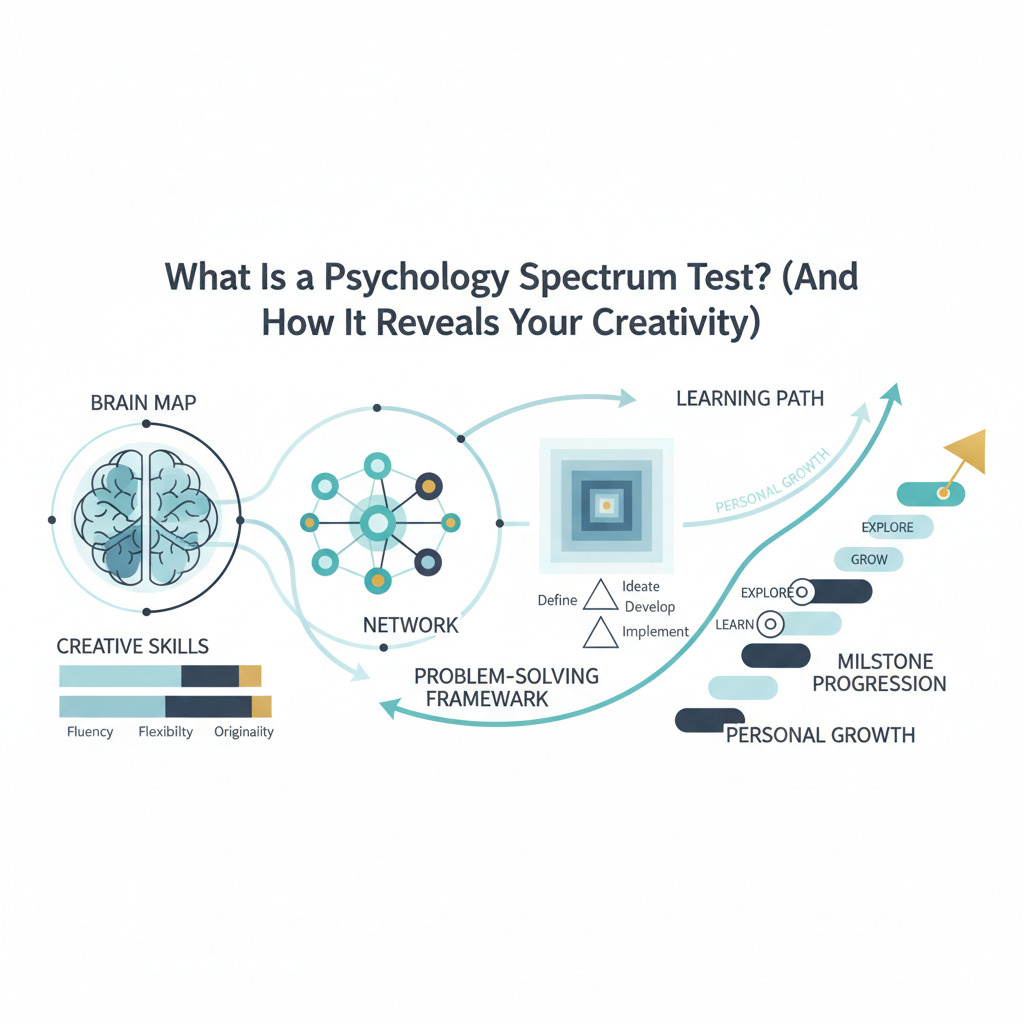
A psychology spectrum test is an assessment designed to measure where an individual’s traits fall along a continuum. These tests can range from clinical tools for diagnosing conditions to self-discovery instruments that map cognitive styles, such as your unique approach to creativity and problem-solving.
Have you ever wondered how your mind comes up with new ideas or solves tough problems? Many people see creativity as a mysterious gift you’re either born with or not. But the truth is more interesting: creativity isn’t a single talent. It’s a mix of different thinking styles and traits that everyone has. This is the first step to understanding your personal creative landscape. In this article, we’ll explain what a psychology spectrum test is and how it can show you your unique creative potential and approach to new ideas.
Unlike a generic quiz, a science-based psychology spectrum test is a powerful tool for self-discovery and growth. It helps you move beyond simple labels like “creative” or “not creative” to understand the specific ways your mind works. By measuring traits like cognitive flexibility, openness to new experiences, and divergent thinking, these assessments give you a clear, personalized picture of your strengths. This isn’t just about labels; it’s about getting useful insights that help you grow personally, improve at work, and solve real-world problems with confidence and creativity.
What Exactly Is a Psychology Spectrum Test?
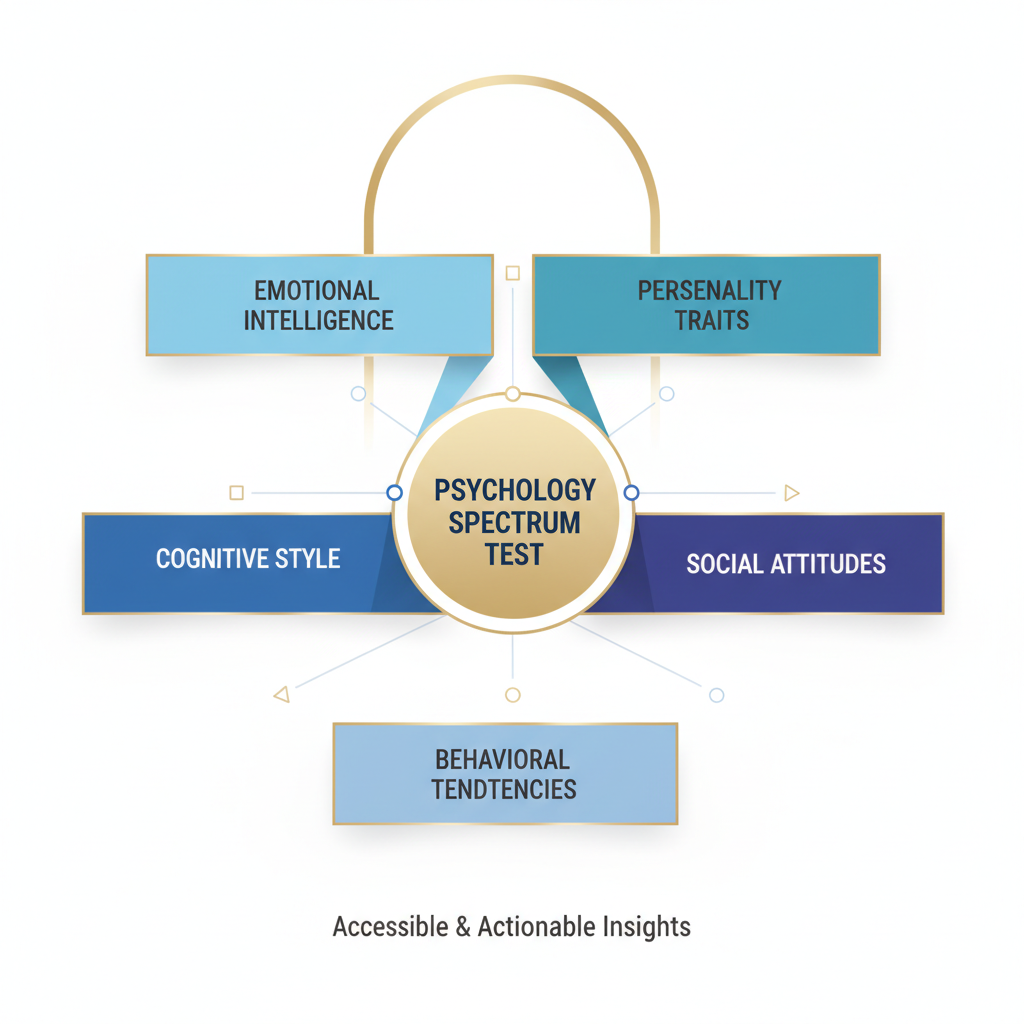
Understanding Psychological Spectrums vs. Categories
In psychology, it’s helpful to see personal traits on a “spectrum” instead of in rigid “categories.” Categories sort people into fixed groups. For example, some might see people as either “creative” or “not creative.” But this black-and-white view is very limiting.
A spectrum, on the other hand, shows that most human traits exist on a scale. This means you can have different levels of a trait. Instead of being just one thing or another, you simply have more or less of it. Most psychologists agree that traits like creativity work this way [1].
For creativity, this way of thinking is empowering. It means that everyone has creative potential. Your creativity isn’t an on/off switch—it’s more like a dial. Our test helps you see where your dial is set for different types of creativity.
Seeing creativity as a spectrum has several key benefits:
- Encourages Growth: It shows you can always develop and improve your creative skills.
- Provides Nuance: You get a better feel for your specific creative strengths and unique ways of thinking.
- Avoids Labels: It moves beyond simple labels to give you a richer view of your personal creativity.
- Personalized Insights: It helps identify your unique mix of creative traits, which is key for focused growth.
Therefore, knowing where you are on the creativity spectrum is powerful. It gives you useful insights about yourself. You can stop wondering about your potential and start understanding how you truly think and innovate.
The Difference Between Clinical Tests and Self-Discovery Tools
When you hear “psychology test,” you might think of tests used to diagnose medical conditions. It’s important to know the difference between these and self-discovery tools. Both are useful, but they have very different goals and uses.
Clinical Psychology Tests are medical tools used for diagnosis. They are given and explained by licensed professionals, like therapists or doctors. These tests help diagnose conditions such as depression, anxiety, or ADHD and are used to create treatment plans. Their main goal is to find and understand mental health challenges.
Self-Discovery Tools, such as The Creative Ability Test, have a different goal. These tools are made to help you understand your personality, skills, and ways of thinking. They focus on personal growth, strengths, and what you can improve. Our test is based on science and gives you insights into how you create, think flexibly, and solve problems.
Here’s a clear comparison:
| Feature | Clinical Psychology Tests | Self-Discovery Tools (e.g., Creative Ability Test) |
|---|---|---|
| Primary Goal | Diagnose and treat health conditions. | Personal growth, self-awareness, finding strengths. |
| Administrator | Licensed professionals (therapists, doctors). | Usually taken on your own; backed by science. |
| Focus Area | Problems, disorders, medical issues. | Strengths, potential, thinking styles, positive psychology. |
| Outcome | A medical diagnosis and treatment plan. | Personal insights and tips for growth. |
| Example | Tests for anxiety, depression, etc. | Creativity assessments, personality inventories, skill tests. |
The Creative Ability Test is a powerful self-discovery tool, not a medical one. Its goal is to give you knowledge about your unique creativity so you can unlock your potential. It also provides practical tips to improve your creative thinking. By getting clear explanations of your creative traits and thinking styles, you can build confidence and guide your personal growth.
How Can a Spectrum Test Reveal Your Creative Psychology?
Mapping Your Position on the Creative Thinking Spectrum
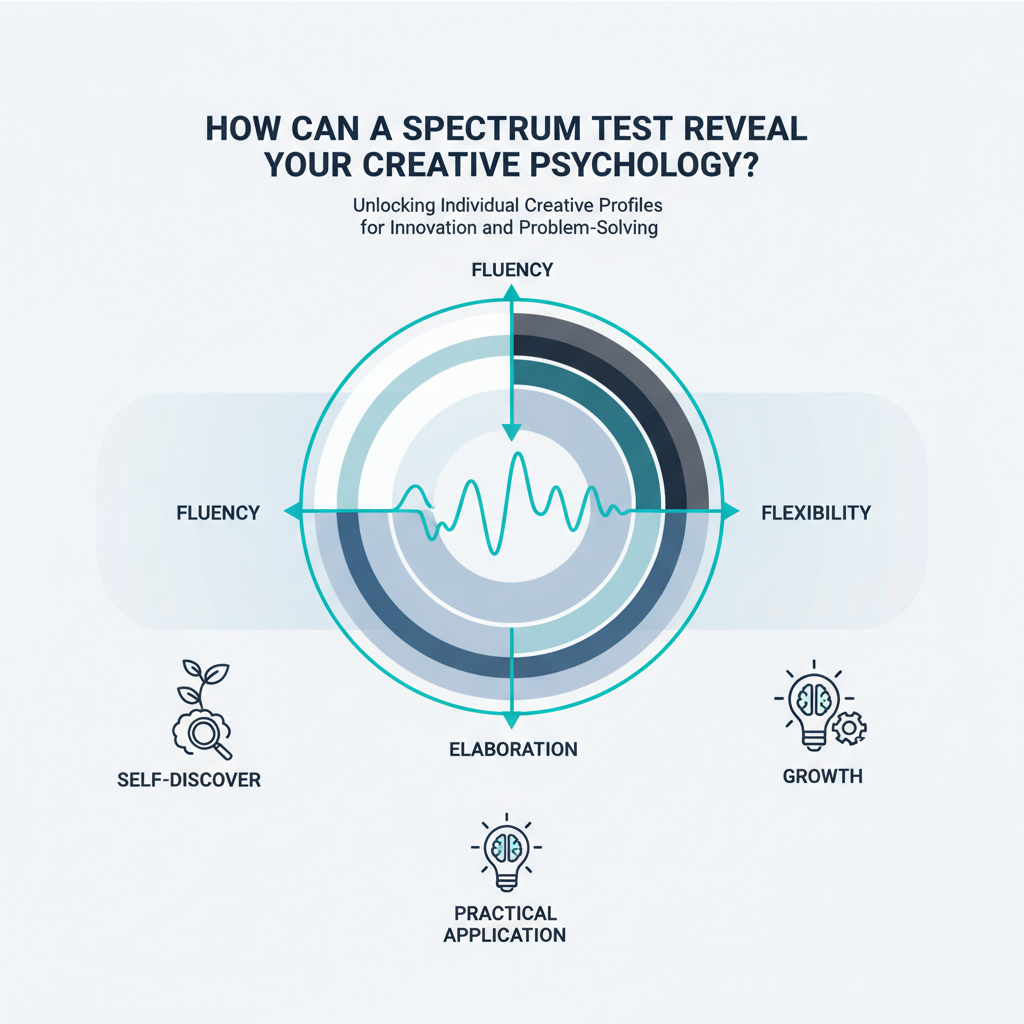
Creativity isn’t an “on” or “off” switch. It’s more like a spectrum, and a test can show you where you fall on it.
Instead of being labeled “creative” or “not creative,” you’ll learn about your specific creative strengths.
For example, you might find that you lean towards:
- Divergent Thinking: This is the ability to generate many different ideas. You might be great at brainstorming or exploring a wide range of solutions.
- Convergent Thinking: This focuses on finding the single best solution by evaluating ideas. You might be skilled at making ideas happen.
- Balanced Thinking: You might easily switch between exploring new ideas and focusing on the best one, allowing you to be both imaginative and practical.
Knowing your natural tendencies helps you use your strengths more effectively. Our 30-question assessment shows where you stand in these areas, giving a clear picture of your creative style [2].
Identifying Your Unique Problem-Solving Style
Creative problem-solving is not a one-size-fits-all skill. A test can show your unique way of tackling challenges and highlight the methods you prefer.
Consider how different people approach a new project. One person might start by exploring every possible angle. Another might immediately look for patterns and connections.
Your test results will show these differences. You might learn that you tend to use:
- Intuitive-Creative Style: You rely on gut feelings and sudden insights. Solutions might seem to just pop into your head.
- Systematic-Creative Style: You prefer a structured process with logical steps. New ideas come from careful and organized work.
- Collaborative-Creative Style: You do your best work when bouncing ideas off others. Working with a group brings out your best ideas.
Knowing your style is very helpful. It allows you to use your creativity more effectively in real-world situations. You’ll also get practical tips on how to improve your problem-solving skills.
Measuring Key Creative Traits Like Openness and Flexibility
Creativity is built on several key psychological traits. A test does more than give you a simple “creativity score”—it measures these core traits.
Two of the most important traits for creativity are openness and cognitive flexibility [3].
- Openness to Experience: This trait shows your willingness to explore new ideas, emotions, and different concepts. High openness often means you are imaginative, curious, and appreciate art and beauty.
- Cognitive Flexibility: This is your ability to switch between different ways of thinking. It allows you to adapt to new information and get past mental blocks.
In addition, our assessment looks at other important factors. These include curiosity, imagination, and your comfort with uncertainty. These elements are all important parts of your creative potential.
By understanding your scores for each trait, you get to know yourself better. This helps you focus on specific areas for improvement, so you can use your creativity for better problem-solving and new ideas.
What Kind of Questions Are on a Psychology Spectrum Test for Creativity?
Questions That Look at How You Form Ideas
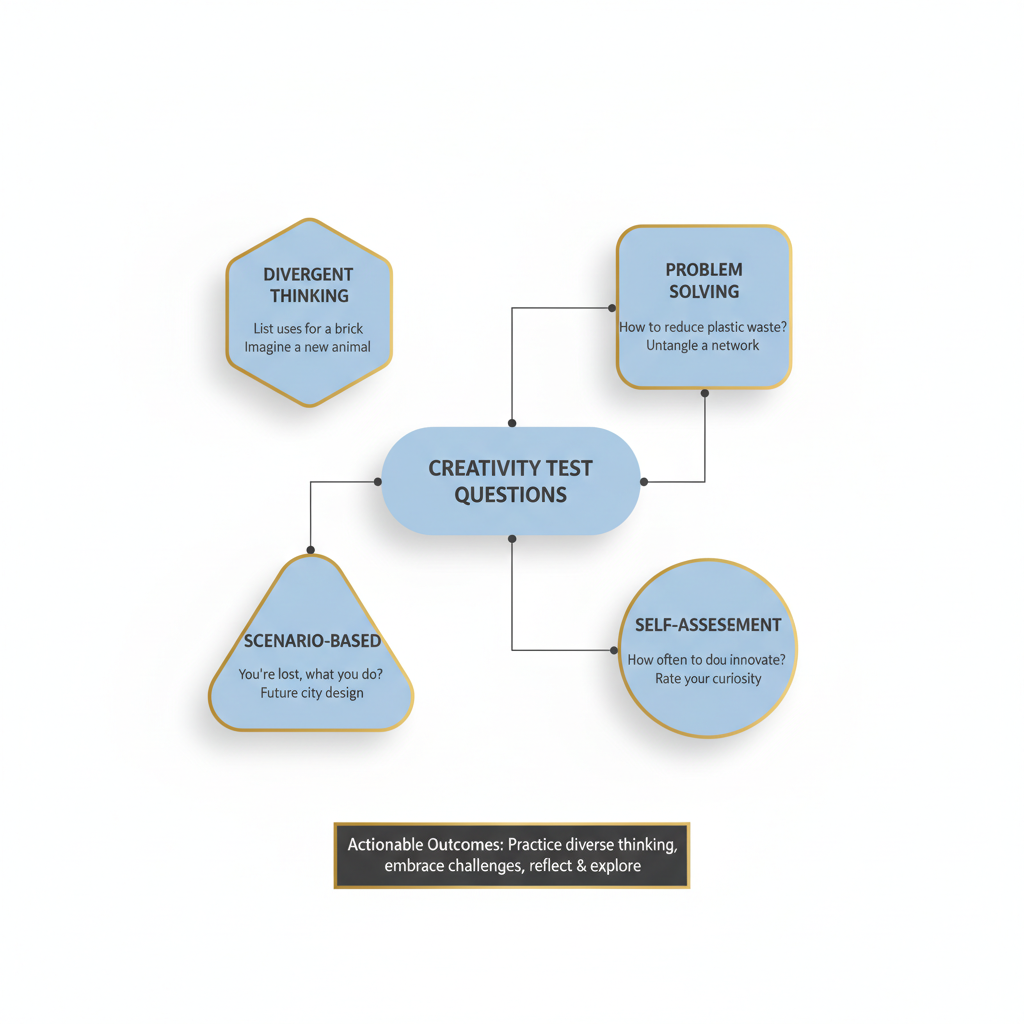
A core part of creativity is coming up with new ideas. Our creativity test includes questions designed to look at this process. We want to see how you form new thoughts, concepts, and solutions.
These questions help us understand your divergent thinking skills. Divergent thinking is how you generate many unique solutions to a single problem [4]. It’s about coming up with a lot of different ideas, not just one “right” answer. The Creative Ability Test looks at a few key parts of this process.
- Fluency: How many ideas can you come up with in a set time? High fluency shows you can think quickly.
- Flexibility: How different are your ideas? Do they come from various categories or viewpoints? This shows you can think in different ways.
- Originality: Are your ideas new and unique? We look for uncommon and fresh connections.
- Elaboration: Can you build on your first ideas and add more detail? This shows you can think things through.
For example, a question might ask you to list all the possible uses for an everyday object, like a paperclip. Another might ask you to think of different ways to improve a common experience, such as waiting in line. Your answers show us your natural creative style.
The Creative Ability Test gives you personal feedback on your idea-generating strengths. It helps you see if you naturally create many ideas, varied ideas, or very original ones. Knowing this helps you improve your brainstorming skills and be more creative.
Scenarios That Test Your Problem-Solving Approach
Creativity is not just about having ideas—it’s about using them to solve real-world problems. That’s why a large part of our creativity test uses scenarios. These are designed to test your creative problem-solving skills.
These questions check your ability to look at challenges from new angles. They show how you can think beyond the usual ways. We want to see how you combine information to create new solutions.
Consider these types of questions:
- You might be given a fictional social problem, like how to reduce plastic waste. We would then ask you to suggest a creative solution that could grow to a large scale.
- Another scenario might be a design challenge. For example, how would you design a shared space where people can have privacy but also feel connected?
- We also look at how you deal with limits. You may be asked to solve a problem with few resources or within certain rules.
These scenarios don’t have one right answer. Instead, they show your mental flexibility and your skill in convergent thinking. This is the process of bringing different ideas together to find the best solution.
The Creative Ability Test helps you find your unique problem-solving style. Are you good at finding the main part of a problem? Are you skilled at looking at problems in new ways? Our personal feedback gives you tips to improve your practical, creative skills. This helps you use creative thinking more effectively in any situation.
Items That Evaluate Your Openness to New Experiences
Openness to experience is a key personality trait linked to creativity [5]. A good creativity test will measure this trait. It looks at your willingness to explore new ideas, values, and feelings.
This trait shows how curious and adventurous you are. It also shows how comfortable you feel when things are unclear or complex. People who are high in openness are often imaginative and open to new ideas. They love to learn and explore.
Questions that measure openness might ask you to rate how much you agree with statements like these:
- “I enjoy thinking about abstract ideas.”
- “I am interested in learning about different cultures.”
- “I look for chances to try new things.”
- “I find beauty in different forms of art and expression.”
- “I am comfortable when there is no clear right or wrong answer.”
Your answers help us see your basic attitude toward creativity. A high level of openness means you are more likely to explore new or different paths. You will also be more open to new solutions.
The Creative Ability Test shows you how your level of openness affects your creative potential. We help you understand how to develop this trait. By trying new things, you naturally expand the way you think. This leads to more creativity and personal growth in all parts of your life.
How Can You Find a Reliable Psychology Spectrum Test Online?
Why Free Quizzes May Not Tell the Whole Story
You’ve probably seen lots of “psychology spectrum test” quizzes online. Many promise fast insights into your creativity, but most are just for entertainment. They often lack scientific proof. Their questions can be overly simple, and the results are not backed by research [6].
These quizzes usually give you generic feedback, not personalized advice. As a result, they don’t explore what really makes you creative. Relying on them can be misleading because they may not reflect your true creative talents. To truly understand yourself, you need a better approach. A reliable test is the best way to see your full potential.
What to Look for in a Science-Backed Assessment
Finding a good online creativity test takes a bit of care. A reliable test gives you useful insights into your creative strengths. Here’s what to look for:
- Based on Real Science: The test should be built on accepted psychological principles and modern research. This ensures it is accurate and trustworthy.
- Tested for Accuracy: A good test has been thoroughly checked to prove it measures what it says it does (validity). It should also give you consistent results if you take it more than once (reliability) [7].
- A Complete Picture: Look for a test that covers different parts of creativity, like thinking of new ideas, solving problems, and being open to new things. A 30-question test, for example, can provide a good overview.
- Clear, Helpful Feedback: Your results should be easy to follow and give you practical advice. Look for personalized tips you can use to improve your creative skills.
- Honest and Open: Find out who made the test. Trustworthy platforms explain how their test works and share the research behind it.
A quality test does more than put you in a box. It gives you a deeper understanding of yourself. You can then use this knowledge to grow.
Take the First Step to Unlock Your Creativity
Understanding how you create is a powerful step toward personal and professional growth. When you choose a science-backed test, you get clear answers. This turns confusion into useful self-knowledge.
Our Creative Ability Test offers just that. Our 30-question, science-backed assessment explores your unique creative style. We give you personalized feedback and practical tips to develop your creativity. You will discover your specific strengths and learn how to use them to solve real-world problems and come up with new ideas.
Start your journey today. Unlock your true creative potential and empower yourself with insights that matter.
Frequently Asked Questions
What is the difference between a creativity test and a psychopath test?
These two tests have very different goals. A creativity test measures your ability to innovate. It looks at how you come up with new ideas, solve problems, and think in new ways.
Creativity tests look for positive traits. These include skills like divergent thinking, flexible problem-solving, and being open to new things. The goal is to help you understand and grow your creative skills.
In contrast, a psychopath test looks at certain personality traits. These often include a lack of empathy, a tendency to manipulate others, and antisocial behavior. These tests are clinical tools used by professionals to diagnose serious psychological conditions.
To put it simply, a creativity test helps you grow. A psychopath test identifies serious mental health issues. The two are completely unrelated.
Are psychology spectrum tests for adults only?
Many psychology tests, including creativity tests, are made for adults. The questions are based on adult life and thinking. The feedback is also aimed at helping adults grow in their careers and personal lives.
However, some creativity tests are adjusted for younger people. These versions are made to be right for their age. They look at things like imaginative play or problem-solving skills that are a good fit for kids and teens.
The Creative Ability Test is designed for people from all walks of life. It’s great for students, professionals, or anyone who wants to learn about their creativity. It helps a wide range of people improve and grow.
How accurate are online psychology spectrum tests?
The accuracy of online psychology tests can differ a lot. It all comes down to the science behind them. Many free online quizzes are just for fun and are not backed by research. They may not give you useful or trustworthy results.
However, a well-made online psychology test can be very accurate. These tests are based on solid psychological research. They are carefully tested to make sure they work. This ensures they reliably measure what they claim to measure [8].
Key signs of an accurate online test include:
- Based on Science: The test is built on proven psychological research.
- Reliability: The test consistently produces similar results when taken multiple times under similar conditions.
- Validity: The test accurately measures the skill it’s supposed to, like creative or flexible thinking.
- Created by Experts: The test is designed by professionals in psychology and testing.
- Personalized Results: The feedback you get is specific to you, not generic. It gives you clear, helpful advice.
The Creative Ability Test is an example of a test backed by science. It is designed to give you accurate, personal feedback on your creative skills. While no test can tell you everything, a good one provides a solid starting point for understanding yourself and finding ways to grow. It helps you learn about your own creative style.
Sources
- https://www.apa.org/topics/personality/traits
- https://psycnet.apa.org/record/1987-17520-001
- https://www.sciencedirect.com/science/article/abs/pii/S016641151630137X
- https://psychology.iresearchnet.com/developmental-psychology/cognitive-development/divergent-thinking/
- https://bigfivepersonalitytest.com/openness-to-experience/
- https://www.apa.org/news/press/releases/2012/03/psychological-tests
- https://www.psychologicalscience.org/index.php/news/releases/standards-for-evidence-in-psychological-research.html
- https://www.apa.org/topics/testing-assessment/assessments