Tag: psychology

  • What is a Maturity Test in Psychology? (And What It Reveals)

    What is a Maturity Test in Psychology? (And What It Reveals)

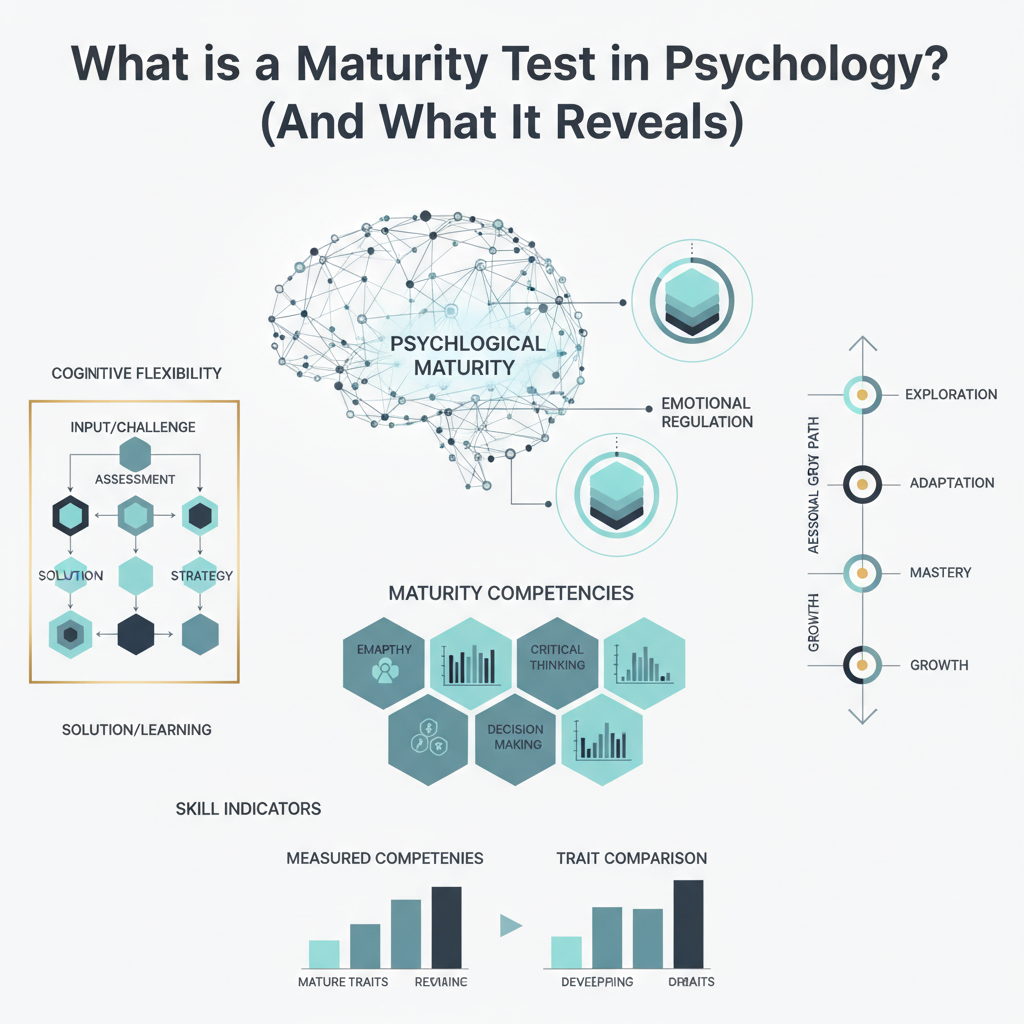
    A maturity test in psychology is an assessment designed to evaluate an individual’s emotional, social, and cognitive development, independent of their chronological age. It measures traits like emotional regulation, empathy, responsibility, and complex problem-solving to provide insight into a person’s overall psychological growth and readiness.

    Many of us think maturity is just about getting older or reaching a certain age. But in psychology, true maturity goes much deeper. It involves your emotional intelligence, social skills, and cognitive development. It’s not about becoming a “grown-up” and stopping there. Instead, it’s an ongoing process of building key skills that help you grow and solve problems. Understanding this is the first step to learning more about who you are and who you can be.

    So, what does a psychological maturity test measure? It can reveal your unique strengths. These science-based tests are designed to show your thinking styles, emotional resilience, and creative potential. By looking at things like emotional regulation, cognitive flexibility, and openness to new experiences, these tests clarify how you handle challenges and relate to others. They also show how you find new ideas and overcome creative blocks. This article will guide you through these fascinating psychological tests, showing how they offer practical ways to improve your Self-Awareness and boost your creativity.

    What Does ‘Maturity’ Really Mean in Psychology?

    Moving Beyond Chronological Age

    What is maturity? Many people think it’s just about age. But it’s more than that. True maturity isn’t just about getting older. It’s not about the number of years you’ve lived [1]. Instead, maturity is about your personal growth. It’s how you handle life’s challenges and understand yourself and others.

    People mature at different speeds. Some seem mature from a young age, while others take more time. Our creative journeys are all different, too. Understanding maturity helps us appreciate these differences. It helps us see a person’s true potential. This is a key part of personal growth.

    The Role of Emotional, Social, and Cognitive Development

    True maturity has a few key parts. You develop them throughout your life. They are essential for happiness and success. Let’s look at what they are:

    • Emotional Maturity: This is about knowing yourself. You understand your feelings and can manage them well. It means you can handle stress and setbacks in a healthy way. You can also understand how others feel and handle disagreements calmly.
    • Social Maturity: This part is about how you interact with others. It means you can read social situations and build healthy relationships. You also take responsibility for your actions. Socially mature people work well with others and make a positive impact on their communities.
    • Cognitive Maturity: This is about your thinking skills. It includes how you think critically and solve problems. If you are cognitively mature, you can see issues from different sides. You are also good at adapting to new information. This is called cognitive flexibility [2]. Being flexible in this way is key for creative thinking.

    These three areas of maturity are connected. For example, managing your emotions helps you push through creative blocks. Understanding other people helps you improve your creative work. Thinking carefully about ideas leads to new ones. The Creative Ability Test looks at your cognitive skills. It helps you see how you solve problems. It also shows how open you are to new experiences. These are all important for growing your creative potential. Our science-backed test gives you personal insights. It helps you unlock these parts of yourself.

    How Does a Psychological Maturity Test Work?

    Key Areas of Assessment

    To understand psychological maturity, we look at several key areas of your development. These tests do more than check your age; they show how you handle life’s challenges. For our Creative Ability Test users, this helps you see how well you can use your creative potential in the real world.

    A full psychological maturity test looks at areas that greatly affect creative thinking and problem-solving. Here are some of the most important ones:

    • Emotional Regulation: This is your ability to handle feelings in a healthy way. Mature people can manage stress, frustration, and failure without getting overwhelmed. This skill is key for creative work, which often means facing challenges and not giving up [3].
    • Cognitive Flexibility: This measures how easily you can change your point of view or adapt your thinking. It’s a key part of solving problems creatively, helping you come up with different ideas and see solutions from new angles.
    • Social Understanding (Empathy): Your ability to understand and share the feelings of others. Empathy boosts creativity by helping you see what people need, create solutions that work for them, and tell powerful stories.
    • Problem-Solving Skills: This looks at how you face challenges. A mature person often uses organized yet creative ways to solve problems. They look past easy answers to find better, more lasting solutions.
    • Self-Awareness: Understanding your own strengths, weaknesses, and what drives you. This insight is important for personal growth and for using your creative energy well.
    • Responsibility and Initiative: Your willingness to take charge of tasks and move projects forward. In creative projects, this means seeing an idea through from start to finish.
    • Resilience: Your ability to bounce back from setbacks. Creative work often includes rejection or failure, so resilience is needed to keep making progress and learning.

    What These Tests Aim to Uncover

    Psychological maturity tests are made to give you a better understanding of your inner world. They show patterns in how you think, feel, and act. If you’re interested in creativity, these insights are very helpful. They show how your level of maturity can either help or hurt your creative work.

    Specifically, these tests can show you:

    • Your Unique Thinking Styles: The tests clarify how you handle information and new situations. This includes seeing if you tend to use divergent thinking (coming up with many ideas) or convergent thinking (finding the one best solution).
    • Areas for Creative Growth: By showing specific areas of maturity, these tests point out where you can build skills to help your creativity. For example, if you need to work on emotional regulation, improving it can lead to a more consistent creative flow.
    • The Connection Between Emotional Intelligence and Innovation: You will see how managing emotions, understanding others, and being self-aware directly help you to innovate and solve tough problems creatively.
    • Practical Insights for Personal and Professional Development: The results give you practical advice. They show you how to use a more mature approach to improve your creative work, whether for personal projects, school, or your job.
    • How to Apply Mature Approaches to Complex Problems: When you understand your maturity level, you can face challenges with a more balanced view. This leads to more thoughtful, effective, and creative solutions.

    Ultimately, a psychological maturity test is a tool for self-discovery, especially when it comes to creativity. It helps you understand your current skills and find ways to unlock your full creative potential.

    What is an Emotional Maturity Test in Psychology?

    Emotional maturity is your ability to understand and handle your emotions. It means you can react to situations in a calm and balanced way. This isn’t about your age in years. Instead, it’s about your inner growth. Developing emotional maturity can improve many parts of your life, including relationships, work, and creativity.

    A psychology test for maturity often looks at these emotional skills. It checks how well you handle difficult feelings. It also measures your ability to get along with others. Understanding your emotional maturity can be very helpful. It shows you areas where you can grow and improve as a person.

    Signs of Emotional Maturity

    You can see emotional maturity in key actions and ways of thinking. These signs lead to better self-awareness and decision-making. They also help you become more resilient. Knowing these signs helps you see how you’re doing. They also show you areas where you can grow.

    • Self-Awareness: You understand your own emotions and how they affect your thoughts and actions. This is key to personal growth.
    • Impulse Control: You can manage your reactions. You think before you speak or act, even in stressful moments [4]. This stops you from making hasty choices.
    • Empathy: You can understand and share what others are feeling. This helps you form deeper connections and solve problems with kindness.
    • Responsibility: You accept responsibility for your actions and don’t blame others for your mistakes. This shows you are accountable.
    • Adaptability: You can handle change and new situations well. You face unexpected problems with a flexible attitude. This is important for dealing with life’s surprises.
    • Resilience: You bounce back from hard times. You learn from your mistakes instead of letting them bring you down. This strength helps build character.
    • Conflict Resolution: You handle arguments in a positive way. You look for solutions instead of making things worse. This helps you get along better with people.
    • Boundary Setting: You set healthy limits in your relationships. You respect your needs and the needs of others. This builds mutual respect.

    These traits are not set in stone. You can work on and improve them over time. Understanding them is the first step to having better control over yourself.

    How Emotional Regulation Connects to Creativity

    Emotional regulation, or managing your feelings, is a key part of emotional maturity. It’s also closely connected to creativity. This important skill lets you handle and react to your feelings. It helps create a good mindset for new ideas. This can help you reach your full creative potential.

    Here is how managing your emotions improves creativity:

    • Managing Creative Frustration: Being creative can be challenging. You might face creative blocks or other problems. Good emotional regulation helps you keep going. You can handle frustration without giving up.
    • Openness to New Ideas: When your emotions are in check, you are more open to different points of view. This helps you think outside the box and come up with many new ideas.
    • Handling Critique: Creative work often gets feedback from others. Emotional maturity helps you take helpful criticism. You can use it to improve your work without getting upset.
    • Risk-Taking and Exploration: New ideas often involve taking risks and trying new things. Good emotional control makes you less afraid to fail. It helps you try bigger, bolder ideas.
    • Sustaining Focus: Creative projects require a lot of focus. Emotional control helps you stay focused. It reduces distractions from your own feelings, letting you dive deeper into your work.

    Studies show a clear link between managing emotions and creative work [5]. When you can manage your emotions, your mind is clearer. This clear state of mind is perfect for new ideas to grow. The Creative Ability Test can help you understand your ability to think in different ways. This works together with emotional regulation. Both are key to building a strong creative mindset. By controlling your emotions, you boost your ability to create and solve problems in new ways.

    How Is Maturity Linked to Creative Problem-Solving?
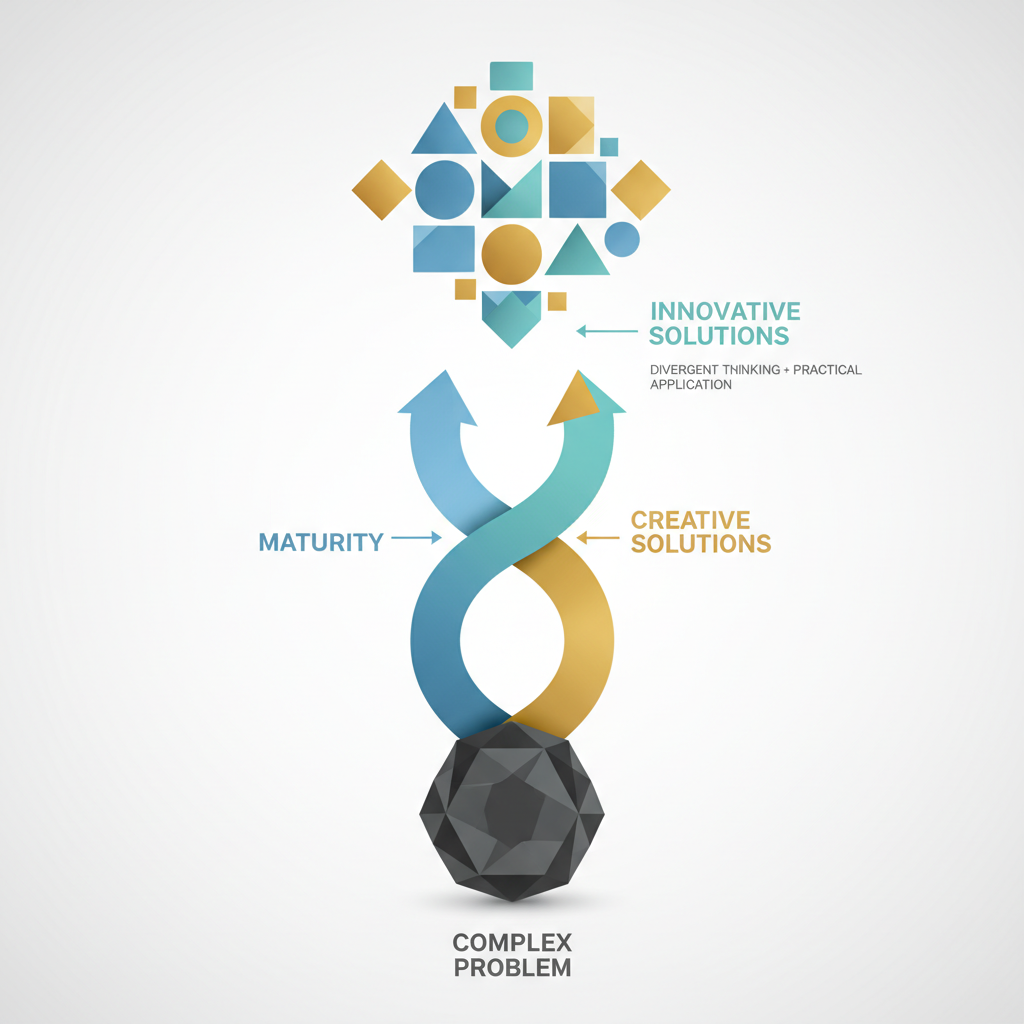
    An infographic depicting a central problem branching into two paths, one representing maturity and the other creative solutions, converging to form innovative geometric solutions, illustrating their link.
    An abstract, educational infographic illustrating the link between maturity and creative problem-solving. Visualize a central complex problem node (charcoal) at the base, branching upwards into two distinct, intertwined pathways: one representing “Maturity” (soft blues) and the other “Creative Solutions” (gold/teal accents). Show these pathways converging and expanding into a cluster of innovative, geometric solution shapes at the top, emphasizing how maturity supports divergent thinking and practical application. Use minimalist, vector-based geometric shapes with subtle gradients. No people, no cartoon elements. Layout should utilize negative space for clarity, maintaining a professional and approachable aesthetic.

    Cognitive Flexibility and Seeing New Perspectives

    Maturity improves your cognitive flexibility. This is your brain’s ability to adapt its thinking. You can easily switch between different ideas or tasks. When you’re mature, you often see problems from many sides. You aren’t stuck on just one approach.

    This flexible mindset is key for creative problem-solving. It helps you explore new ideas and change direction when a solution isn’t working. This ability helps you find truly creative answers.

    Think of a designer with a tough client project. A flexible designer won’t just stick to old habits. Instead, they will look at many different solutions. They might mix different styles or tools. This leads to new and surprising results.

    To build cognitive flexibility, you need to question your assumptions. It also means seeking out new information and being open to different points of view.

    • Practice divergent thinking: Brainstorm many uses for a common object.
    • Learn new skills: Step outside your comfort zone regularly.
    • Seek diverse opinions: Talk to people who think differently.
    • Reflect on setbacks: Understand what went wrong and how to adjust.

    Understanding your own cognitive flexibility is an important step. Our Creative Ability Test can help you find these strengths and see how you think. This knowledge can help you improve your creative problem-solving skills.

    Using Experience to Fuel Innovation

    Maturity brings a lot of experience, from both successes and failures. These past lessons are more than just memories—they are powerful tools for innovation. Mature people can use this knowledge to solve current problems in new ways.

    Experience teaches you useful patterns and shows you what to avoid. This helps you stop repeating mistakes. More importantly, it helps you connect ideas that don’t seem related. These connections often lead to breakthrough ideas.

    For example, an experienced chef doesn’t just follow recipes. They understand how ingredients work and remember past flavor combinations. This deep knowledge lets them invent unique dishes. Their experience fuels their creativity in the kitchen.

    Using your experience creatively is a skill. It’s more than just remembering things. It requires you to think about your past and connect the dots.

    • Keep a reflection journal: Write down key lessons from your projects.
    • Review past work: Look for patterns and see what worked well.
    • Mentor others: Teaching others strengthens your own understanding.
    • Seek feedback actively: Get other people’s views on your experiences.

    The Creative Ability Test looks at how you handle information and use your past experiences. It can show your potential for new ideas. Our personalized feedback gives you strategies to make the most of your unique insights.

    Resilience in the Face of Creative Blocks

    Creative problem-solving is not always a smooth process. It’s common to face blocks, setbacks, and frustration. This is where maturity helps. Mature people can manage their emotions and have the ability to keep going source: https://greatergood.berkeley.edu/topic/resilience/definition. This resilience is key for creative success.

    When you face a creative block, it’s easy to give up. But a mature mindset sees it as a temporary challenge and a chance to think more deeply. Instead of just pushing harder, mature people might step back, re-think their approach, or look for new inspiration. They know that patience and persistence are key.

    Imagine a software developer who finds a tricky bug. A less mature person might feel overwhelmed, get frustrated, and give up. A mature developer, however, will work through the problem step-by-step. They will ask for help or try different ways to fix it. Their resilience keeps the project moving forward.

    Building creative resilience involves a few key habits.

    • Embrace a growth mindset: See challenges as learning opportunities.
    • Practice self-compassion: Be kind to yourself during struggles.
    • Develop coping strategies: Take breaks, exercise, or meditate.
    • Seek supportive communities: Share challenges and get encouragement.
    • Celebrate small wins: Acknowledge your progress to keep going.

    Our assessment does more than find your creative traits. It also gives you insights into your resilience and helps you understand how you react to challenges. This self-awareness helps you build stronger coping skills. You can learn to turn creative blocks into opportunities for growth.

    How Can You Develop Your Psychological Maturity?
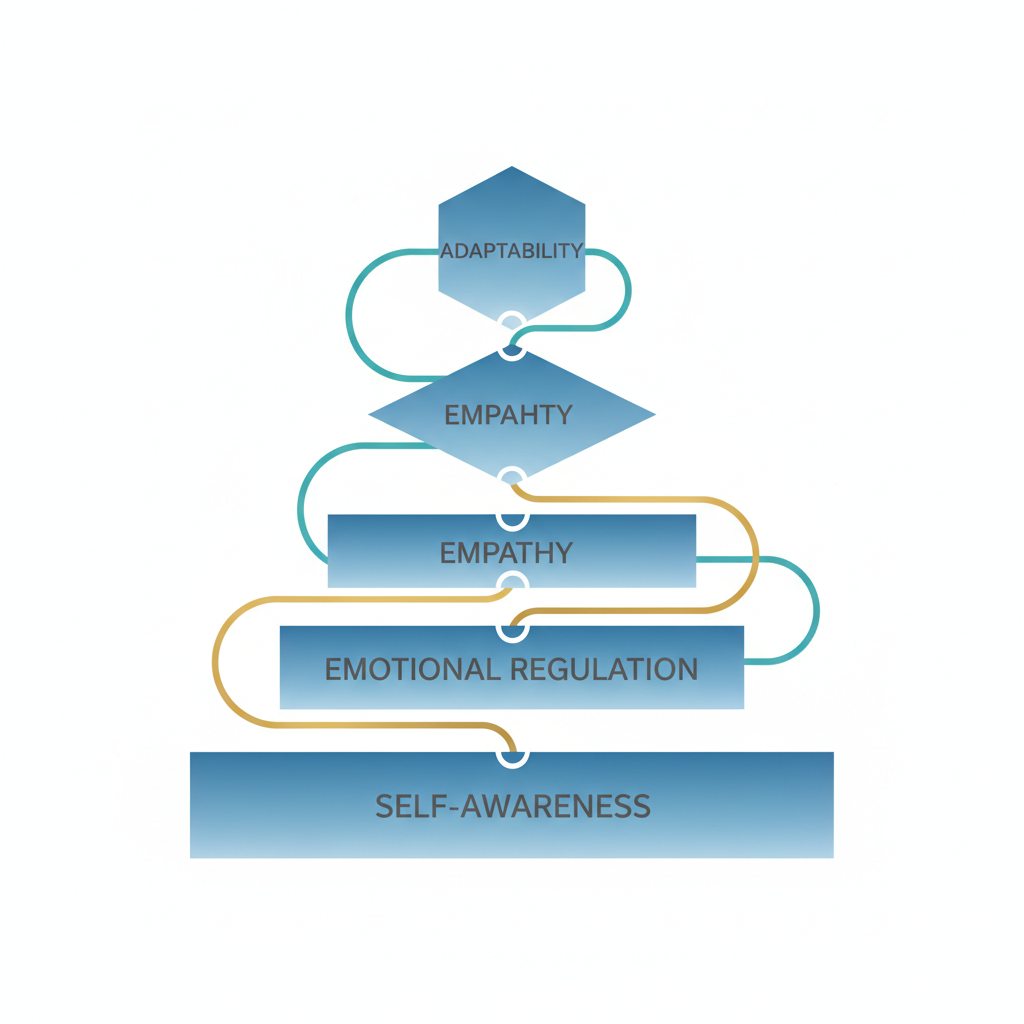
    An infographic showing psychological maturity as a series of layered, interconnected geometric steps, each representing a developmental stage, progressing upwards.
    A clean, educational infographic presenting the developmental stages of psychological maturity. Visualize a layered system or a vertical progression of three to four distinct, interconnected geometric steps or platforms. Each step represents a stage of maturity (e.g., self-awareness, emotional regulation, empathy, adaptability), building upon the previous one. Use a gradient of soft blues, whites, and charcoal, with gold or teal accents highlighting the progression and interconnection. The style is minimalist, vector-based, and professional, using clean geometric shapes. Negative space should be ample, with short labels for each stage. No people, no cartoon elements.

    Practical Steps for Self-Awareness

    Psychological maturity starts with knowing yourself. Self-awareness is key. This means understanding your emotions, thoughts, strengths, and weaknesses.

    It also helps you see how these things affect your creative process. When you know yourself, you can use your unique thinking style more effectively.

    Here are practical steps to improve your self-awareness:

    • Reflect Regularly: Set aside time each day to think. Ask yourself what caused your emotions or how you handled a challenge.
    • Keep a Journal: Writing down your thoughts and feelings can show you patterns. It helps you understand your reactions and creative ideas.
    • Seek Feedback: Ask trusted friends or coworkers for their honest thoughts. Learn how others see your work style and creative input.
    • Identify Your Creative Triggers: Notice which places, tasks, or moods spark your best ideas. Also, learn what blocks your creativity.
    • Engage in Mindfulness: Practice being in the moment. Mindfulness helps you notice your thoughts without judging them. This can improve your focus and creative thinking [6].
    • Use Self-Assessment Tools: Science-backed tests, like those on the Creative Ability Test platform, offer unbiased feedback. They can show you your skills in flexible thinking, coming up with new ideas, and solving problems.

    By doing this, you build a strong foundation of self-awareness. You become more in tune with your creative potential. This leads to more focused and effective personal growth.

    Building Empathy and Responsibility

    Psychological maturity is more than just self-awareness. It’s also about understanding the world around you. Empathy and responsibility are key parts of this.

    Empathy is understanding how others feel and think. Responsibility is taking ownership of your actions and promises. Both are important for working well with others and solving problems in new ways.

    Consider these ways to build empathy and responsibility:

    • Practice Active Listening: Pay close attention when others speak. Try to understand their point of view, even if it’s different from yours. This gives you new perspectives for creative solutions.
    • Seek Diverse Perspectives: Talk with people from different backgrounds. Their unique experiences can spark new ideas and creative thinking [7].
    • Put Yourself in Others’ Shoes: Before you react, try to see the situation from their perspective. This helps you understand and respond more thoughtfully.
    • Take Ownership: Accept the results of your decisions, good or bad. Learning from mistakes is a great way to grow.
    • Follow Through on Commitments: Be someone others can count on at work and in your personal life. This builds trust and shows you are mature.
    • Volunteer or Mentor: Helping others can teach you about different challenges. It also builds your sense of social responsibility.

    When you build empathy and responsibility, you become better at teamwork. It also helps you create solutions for the wider community. This is what drives real innovation.

    Enhancing Your Problem-Solving Skills

    A key sign of psychological maturity is handling tough problems well. This is tied to your creative problem-solving skills. A mature approach means being flexible, resilient, and strategic when facing challenges.

    The Creative Ability Test focuses on skills like flexible and original thinking. These are key to becoming a better problem-solver.

    Here’s how to improve these key skills:

    • Break Down Complex Problems: Big problems can feel like too much. Break them into smaller, easier pieces. This makes it easier to find creative solutions.
    • Try Different Ideas: Come up with many possible solutions without judging them right away. Brainstorm freely and explore unusual ideas. This gives you more creative tools to work with.
    • Be More Flexible: Be willing to change your approach. If one solution doesn’t work, try another. Being able to adapt is key to innovation.
    • Learn from Failure: View mistakes as chances to learn. Figure out what went wrong and change your plan. This helps you become more resilient, which is a big part of maturity.
    • Ask for Feedback: Be open to helpful feedback on your solutions. Different opinions can show you what you missed or lead to better ideas.
    • Practice Lateral Thinking: Look for solutions that aren’t obvious. Connect ideas that seem unrelated to find new ways to solve problems [8]. This expands your creative thinking.
    • Use Proven Methods: Learn and use problem-solving methods. Frameworks like design thinking can help you work through hard problems.

    By working on these skills, you’ll develop a stronger, more mature way to handle challenges. You’ll go from feeling uncertain to using clear strategies for growth. This changes how you innovate and find success.

    How Can Understanding Maturity Unlock Your Creative Potential?

    An infographic showing a stylized key representing 'understanding maturity' unlocking a geometric lock, releasing a vibrant explosion of abstract idea clusters and cognitive network lines, symbolizing creative potential.
    An abstract, educational infographic demonstrating how understanding maturity unlocks creative potential. Visualize a stylized, minimalist “lock” icon (charcoal and soft blue) at the bottom, representing dormant creative potential. Above it, a distinct, geometric “key” icon (gold or teal accent), representing ‘Understanding Maturity,’ is perfectly aligned to open it. Upon opening, an explosion of abstract, colorful (soft blues, gold, teal) idea clusters and interconnected cognitive network lines emanates upwards and outwards from the lock, filling the top half of the visual field. The style is vector-based, professional, and uses clean geometric shapes with subtle gradients. No people, no cartoon elements.

    Understanding psychological maturity is key to unlocking your creative potential. This isn’t about age, but how you handle challenges, learn from experience, and connect with the world. As you mature, your creativity naturally grows. You become a more effective and innovative thinker.

    Maturity and creativity are closely linked. A mature mindset helps creativity grow. It helps you handle the ups and downs of any creative process. It also gives you the mental and emotional tools you need to innovate. Our Creative Ability Test shows you this connection in your own thinking. It offers personal insights into how your maturity affects your creative work.

    Embrace Cognitive Flexibility and New Perspectives

    Mental maturity improves your creative problem-solving. It allows you to see beyond the obvious solution. Instead of sticking to what you know, you look for new ways of thinking. This skill is known as cognitive flexibility. Mature thinkers can easily switch perspectives. They combine different ideas to find unique solutions. For example, a mature person can see a problem from many angles. They aren’t tied to strict assumptions. This openness is key to creative thinking.

    • Broaden Your View: Maturity helps you escape fixed mindsets. You become more open to new solutions.
    • Connect Unrelated Ideas: It allows you to find links between ideas that seem unconnected. This leads to new insights.
    • Challenge Assumptions: You question the way things are normally done. This is vital for true innovation [9].

    Our assessment helps you understand your own cognitive flexibility. It shows you how well you come up with different ideas. You can use this knowledge to practice new ways of thinking on purpose.

    Cultivate Emotional Resilience for Creative Persistence

    Creativity is rarely a smooth journey. It often involves setbacks, criticism, and frustration. Emotional maturity gives you the resilience to keep going. You learn to manage these negative feelings, so you don’t give up when an idea fails. Instead, you see it as a chance to learn. This persistence is vital for any creative project. A mature person knows that mistakes are part of the process. They don’t let the fear of failure stop their imagination.

    • Navigate Setbacks: You build the strength to push through creative blocks and bounce back from criticism.
    • Manage Frustration: Controlling your emotions keeps frustration from stopping your progress, so you can stay focused.
    • Embrace Experimentation: You become more willing to take risks and try new things without worrying about being perfect.

    The Creative Ability Test highlights your creative traits. It shows where more emotional maturity can help you stick with your creative work. This leads to more consistent and powerful creative results.

    Drive Innovation Through Experience and Reflection

    Maturity brings experience, and the wisdom to learn from it. This combination drives innovation. Mature people don’t just gather knowledge; they think about it deeply. They learn from past wins and losses. This reflection helps them see patterns and predict future needs. As a result, they create solutions that are original, relevant, and effective.

    Think about a product designer. A less mature designer might jump on a trendy solution. But a mature designer thinks about user feedback and past trends. They combine different insights to create a more thoughtful and successful product. Using your past experiences well is a sign of creative maturity. It helps you go from just having ideas to creating real innovation.

    Actionable Growth with the Creative Ability Test

    The Creative Ability Test is a unique way to understand this link. Our 30-question test is based on science and measures different sides of your creativity. It provides personal feedback. You will learn about your creative strengths and thinking styles. More importantly, it shows where a more mature outlook can boost your creative work. We give you practical strategies to grow your creativity for personal and professional success.

    Seeing your maturity through a creative lens turns confusion into self-awareness. It helps you move from inconsistent results to steady creative growth. You get a clear path to using your creativity to solve real-world problems and innovate. Start your journey today. Discover how unlocking your psychological maturity can unleash your full creative potential.

    Frequently Asked Questions

    What questions are asked in a maturity test?

    Maturity tests don’t ask simple “yes” or “no” questions. Instead, they look at how you think, feel, and make decisions. They aim to see how you handle different life situations and challenges.

    These tests look at several key areas of personal growth. For example, you might be given an imaginary situation. You would then describe how you would likely act or feel.

    Common themes explored in maturity tests include:

    • Emotional Regulation: How you handle stress, anger, and disappointment. Can you think before you act?
    • Perspective-Taking: Your ability to see things from another person’s point of view. This shows empathy and flexible thinking.
    • Problem-Solving: How you break down problems and find solutions. Do you think about future results?
    • Self-Awareness: Your understanding of your own strengths, weaknesses, and motivations. Do you reflect on your personal growth?
    • Responsibility and Accountability: How you take ownership of your actions. Can you learn from mistakes and fulfill commitments?

    These questions help create a picture of your emotional and mental state [10]. Knowing these things is key for personal growth. It also connects to your creative potential. Creative people are often good at thinking in different ways and handling stress. These are signs of maturity. In the same way, our Creative Ability Test shows your unique thinking strengths. It helps you understand how you solve problems and come up with new ideas.

    Is there a maturity test for kids?

    Yes, there are many types of tests for children. They are often called developmental or readiness tests. They are very different from maturity tests for adults.

    Their main goal is to check a child’s progress for their age. These checks, or milestones, cover a few key areas [11]. Experts use these tests to make sure children are developing as expected.

    Key areas assessed in children’s maturity tests include:

    • Social Development: How a child interacts with peers and adults. Can they share or take turns?
    • Emotional Readiness: Their ability to express feelings appropriately. Do they manage minor frustrations?
    • Cognitive Skills: Problem-solving, memory, and logical thinking for their age. Can they follow simple instructions?
    • Language Skills: How well they understand and use words. Can they communicate their needs?
    • Motor Skills: Both fine motor (e.g., drawing) and gross motor (e.g., running) abilities.

    These tests are usually given by doctors, psychologists, or teachers. They help find any possible delays in development. Finding these early allows for quick support and help. Encouraging a child’s natural curiosity and flexible thinking from a young age is key to growing their future creativity.

    How is a relationship maturity test different?

    A relationship maturity test looks at how people act in a partnership. It checks if someone is ready for a healthy, long-term relationship. This is different from a general maturity test, which looks at overall personal growth.

    These tests look at how you act in a relationship. They explore your ability to make and keep strong bonds with others. They also look at how you handle conflict and closeness. The goal is to predict how successful and happy a relationship might be [12].

    Key qualities assessed in a relationship maturity test include:

    • Effective Communication: Your ability to express needs clearly and listen actively.
    • Empathy and Understanding: Can you genuinely consider your partner’s feelings and perspective?
    • Conflict Resolution: How you handle disagreements in a positive way. Can you find solutions that work for both of you?
    • Trust and Commitment: Your capacity for loyalty and long-term dedication.
    • Emotional Support: Providing comfort and encouragement to your partner.
    • Shared Responsibility: Contributing fairly to the partnership.

    Our Creative Ability Test focuses on your personal creative skills, but these skills are useful in other areas, too. For example, empathy and problem-solving are key for mature relationships. They also help you be more creative when you work with others. These traits help you create new things with a team and build an environment where different ideas are welcome.


    Sources

    1. https://www.psychologytoday.com/us/blog/finding-strength/201905/emotional-maturity
    2. https://hbr.org/2022/04/the-power-of-cognitive-flexibility
    3. https://www.apa.org/topics/emotion/regulation
    4. https://www.apa.org/topics/impulsivity
    5. https://psycnet.apa.org/record/2012-30043-001
    6. https://www.apa.org/topics/mindfulness/meditation
    7. https://hbr.org/2016/11/why-diverse-teams-are-smarter
    8. https://www.edwdebono.com/lateral-thinking
    9. https://hbr.org/2016/01/how-to-increase-your-cognitive-flexibility
    10. https://www.simplypsychology.org/personality-tests.html
    11. https://www.cdc.gov/ncbddd/actearly/milestones/index.html
    12. https://www.gottman.com/blog/what-is-relationship-maturity/
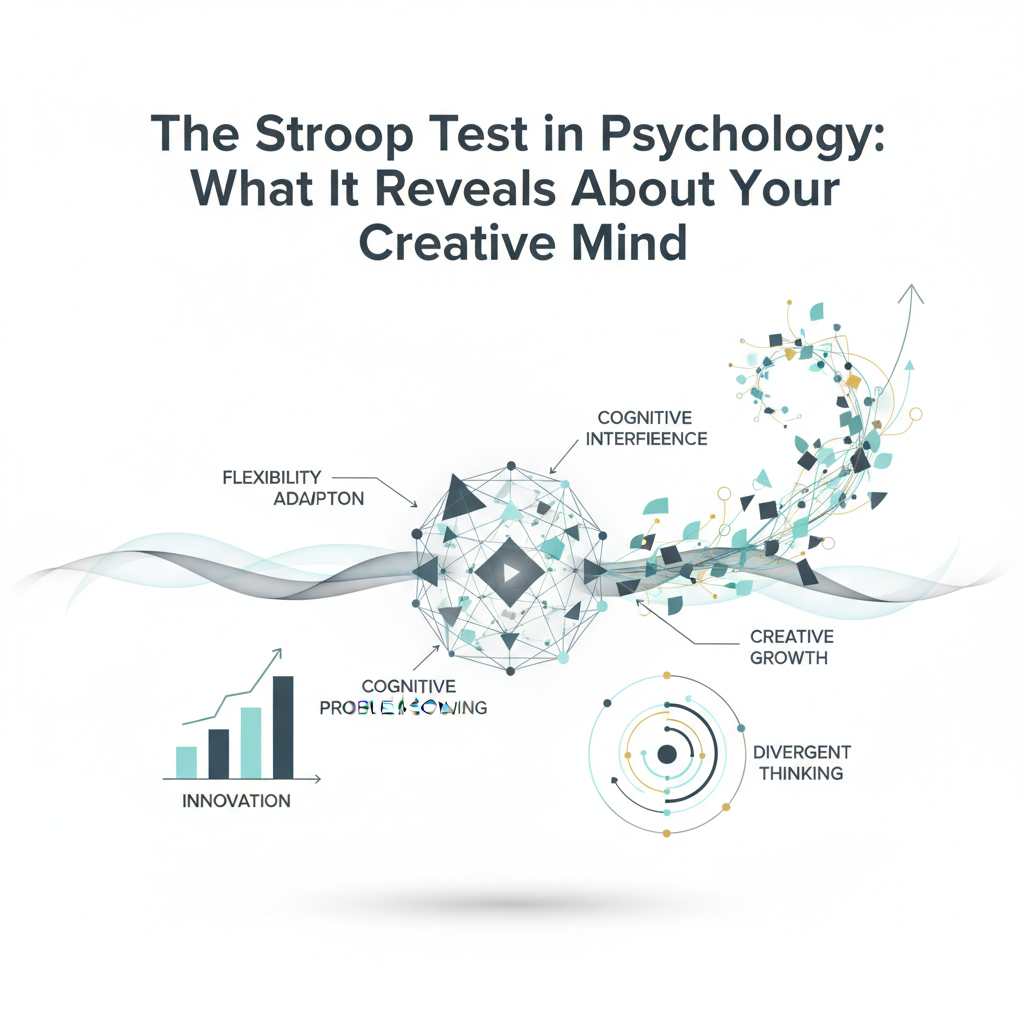
  • The Stroop Test in Psychology: What It Reveals About Your Creative Mind

    The Stroop Test in Psychology: What It Reveals About Your Creative Mind

    The Stroop test in psychology is a classic experiment demonstrating interference in a person’s reaction time. Participants are shown a word for a color that is printed in a different color’s ink (e.g., the word ‘blue’ printed in red) and must name the ink color, not the word. It is primarily used to measure cognitive functions like selective attention, processing speed, and cognitive flexibility.

    Have you ever felt mentally “stuck,” trying to focus on one task while another thought keeps pulling your attention away? Our minds are constantly balancing information, especially when we’re trying to solve a hard problem or have a creative idea. The “Stroop test in psychology” is a simple experiment that offers a clear look into these cognitive abilities. It’s more than a quick brain teaser; it’s a scientific tool for understanding how your attention, mental control, and creative potential work.

    This article will explain the Stroop effect—what it is, how it works, and what it measures. We’ll explore how this fundamental assessment reveals your mental flexibility, processing speed, and ability to tune out distractions. These skills are key parts of a creative mind. You’ll discover how understanding these areas can improve your problem-solving skills and boost your creative thinking. This gives you practical insights into your own strengths, helping you grow personally and professionally.

    Our goal is to make complex psychological ideas easy to understand and give you useful takeaways. We want you to have a deeper appreciation for how your mind works. Let’s start by looking at what the Stroop Effect is.

    What is the Stroop Effect in Psychology?

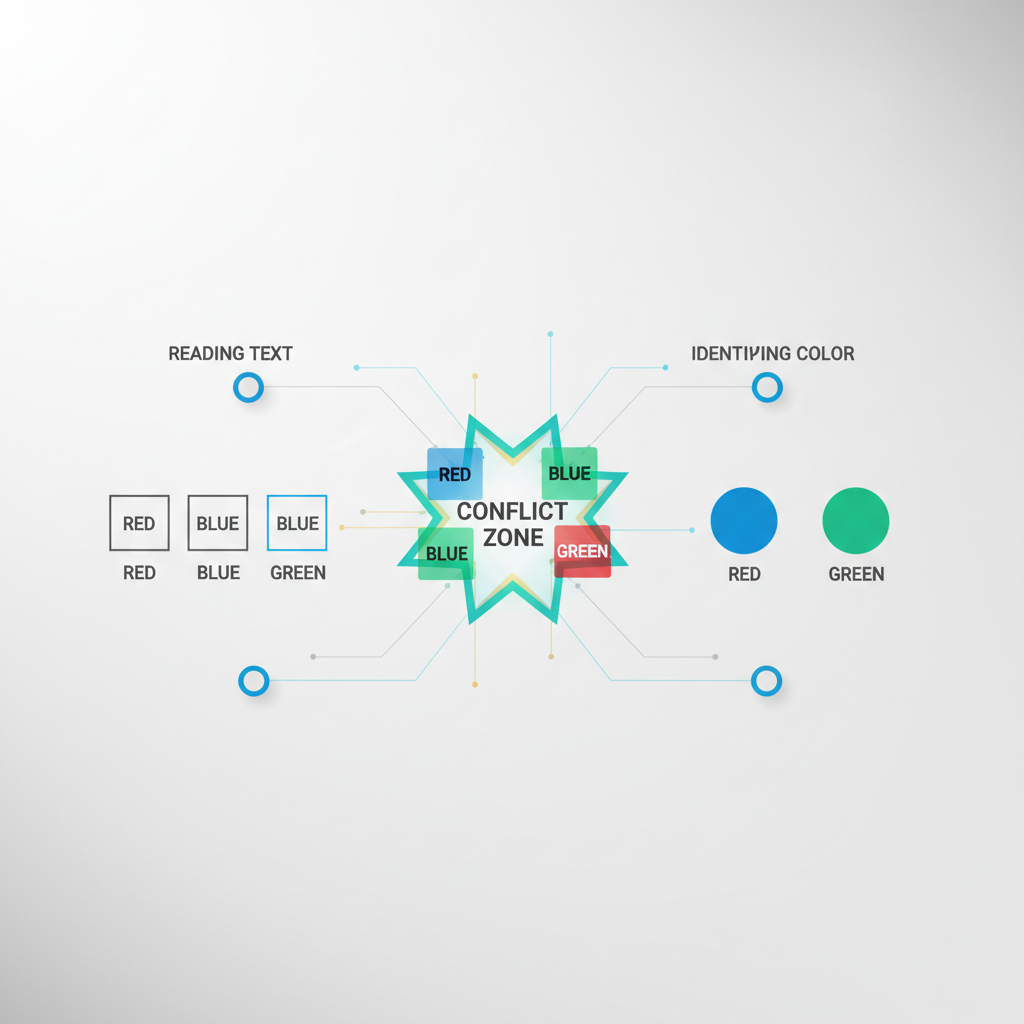
    An abstract infographic illustrating the Stroop Effect, showing two conflicting cognitive pathways converging into a central interference zone, representing the challenge in processing conflicting information.
    An abstract, educational infographic visualizing the Stroop Effect in psychology. Depict a cognitive network diagram with two conflicting information pathways, one for reading text and one for identifying color, converging and creating a central ‘interference’ node or ‘conflict zone’. Use clean geometric shapes, subtle gradients, and connecting lines to illustrate the brain’s processing struggle. The style should be minimalist, vector-based, professional, and approachable. Use a color palette of soft blues, whites, and charcoal, with gold or teal accents to highlight the conflict. Ensure ample negative space for potential short labels. No humans, no cartoon elements.

    A Simple Explanation of the Classic Test

    The Stroop Effect is a surprising effect in psychology. It shows what happens when your brain gets mixed signals. At its heart, the test measures your focus and attention.

    Imagine seeing a list of color words. The catch is that the ink color of each word is often different from the word itself.

    • For example, you might see the word “RED” printed in blue ink.
    • Or the word “BLUE” printed in yellow ink.
    • Your job is to say the ink color, not read the word.

    Most people find this task much harder than it sounds. That’s the Stroop Effect. It shows that some brain processes, like reading, are automatic. Understanding this helps us see how our minds work. It also gives us a peek into our mental flexibility, which is a big part of being creative.

    Why Your Brain Gets Confused: The Psychology of Interference

    Your brain gets mixed up during the Stroop test because of something called interference. Our minds work very fast, but some tasks are harder to control than others. For most adults, reading is a skill we’ve practiced so much that it’s become automatic [source: https://www.simplypsychology.org/stroop-effect.html].

    Naming a color, however, takes more deliberate focus. When you see the word “RED” in blue ink, your brain automatically wants to read the word. But the task is to name the color. This creates a conflict in your brain.

    This inner struggle highlights a few key ideas:

    • Automatic vs. Controlled Processing: Automatic tasks are things we do without thinking, like reading. Controlled tasks, like naming the ink color, need our full attention.
    • Selective Attention: The test shows how hard it is to focus on one thing (the ink color) while ignoring a distraction (the word). Your brain struggles to filter out the word.
    • Processing Speed: The hesitation before you name the ink color shows how long it takes your brain to sort out the confusion.

    Struggling with this test isn’t a weakness. It just gives us a peek at how your brain is wired. It shows how your mind juggles competing information. For creative people, understanding this is useful. It can help you manage complex problems without feeling overwhelmed. This knowledge can build your focus and mental flexibility—both essential for creative thinking.

    What does the Stroop test measure?

    Measuring Selective Attention and Focus

    The Stroop test is a great way to see how well you manage your attention. It measures selective attention—your brain’s ability to focus on what matters while ignoring distractions. Think of it as a mental filter.

    During the test, your brain automatically tries to read the word. But your goal is to ignore the word and focus only on the ink color. This mental conflict reveals how well your brain can direct its focus. Good selective attention is key for deep creative work, helping you stay on track by filtering out distracting thoughts as you brainstorm or develop ideas.

    By understanding this skill, you can improve your creative process. For example, you can train yourself to focus better while solving problems. This can lead to more creative solutions and better use of your mental energy [1].

    Assessing Cognitive Flexibility and Task-Switching

    The Stroop test also reveals your cognitive flexibility. This is your brain’s ability to adapt your thinking, switch between different tasks, and see things from new angles. It’s a key part of creative thinking.

    In a Stroop task, your brain has to fight the urge to read the word. Then, it has to switch to the harder task of naming the color. This mental workout is a direct test of your task-switching skills. Strong cognitive flexibility allows you to:

    • Approach problems from multiple angles.
    • Generate diverse ideas without getting stuck.
    • Adapt your plans when new information emerges.

    The Creative Ability Test explores these skills further. It helps you understand how you shift gears in your mind, which is key for finding new perspectives and breakthrough ideas [2].

    Evaluating Your Brain’s Processing Speed

    The Stroop test also measures your brain’s processing speed. This is how quickly your brain can take in, understand, and react to information.

    In the test, a faster processing speed usually means you can answer more quickly, especially when the word and color don’t match. While it doesn’t directly measure creativity, fast processing is a basic skill that supports many creative tasks.

    Think about how quickly you connect ideas or remember information. A quick processing speed frees up mental energy. This gives your brain more room for deep creative thinking and complex problem-solving [3]. By improving your processing speed, you can make your creative process smoother and boost your overall thinking skills.

    The Link Between the Stroop Effect and Creative Problem-Solving

    Understanding the Stroop effect can help you become a better creative problem-solver. The test shows how core brain functions like these affect your ability to be creative.

    Your selective attention, cognitive flexibility, and processing speed are all essential for creativity. For example, strong inhibitory control—the ability to block out distractions—is key. It helps you focus on one part of a problem, which can lead to deeper insights. Likewise, strong cognitive flexibility helps you to:

    • Break free from conventional thinking patterns.
    • Explore unusual associations.
    • Discover novel solutions.

    The Creative Ability Test measures these skills and other parts of creativity. It gives you personalized feedback to help you use your unique mental strengths. This helps you apply your creativity in the real world, from everyday challenges to major new ideas.

    How Does the Stroop Test Work?

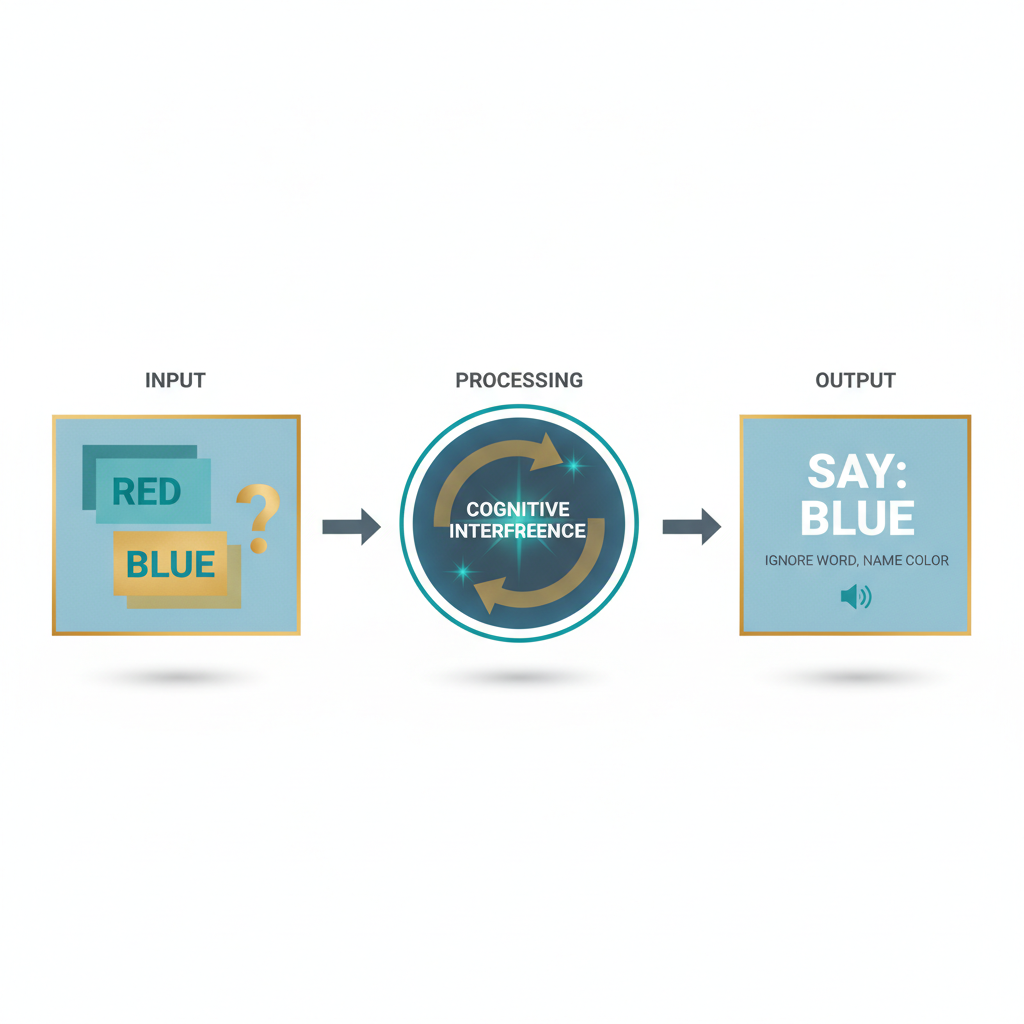
    A minimalist infographic illustrating the steps of the Stroop Test, showing conflicting input stimuli, cognitive processing with interference, and the resulting response.
    An abstract, educational infographic visualizing the operational mechanics of the Stroop Test. Create a simplified, stepwise process diagram using clean geometric shapes and directional arrows. Show an ‘Input’ stage with conflicting stimuli (e.g., the word ‘RED’ colored blue), a ‘Processing’ stage where cognitive interference occurs, and an ‘Output’ stage representing the required response (e.g., naming the color ‘blue’ despite the word). Use layered elements and subtle gradients to represent the cognitive layers involved. The style should be minimalist, vector-based, professional, and approachable. Use a color palette of soft blues, whites, and charcoal, with gold or teal accents to emphasize key stages or points of conflict. Maintain visual hierarchy and ample negative space for short labels. No humans, no cartoon elements.

    Congruent vs. Incongruent: A Step-by-Step Example

    The Stroop test is a simple way to see how your brain handles information. It shows the conflict between what you do automatically and what you do on purpose. Understanding how it works can teach you about mental focus and flexibility, which are important skills for creative thinking.

    Here’s how the classic Stroop test typically works:

    1. The Setup: You will see a series of words. Your task is simple: say the color of the ink the word is written in. Try to be as fast and accurate as you can.
    2. The Congruent Condition: Imagine the word “RED” is printed in red ink. This is a congruent trial because the word and the color match. Your brain processes this easily. There’s no conflict, so you can say “Red” right away. This shows how your brain works well when information lines up.
    3. The Incongruent Condition: Now, imagine the word “RED” is printed in blue ink. This is an incongruent trial. Your brain now has a conflict. Your automatic reaction is to read the word “RED,” but your task is to name the ink color, “Blue.”
    4. The Stroop Effect in Action: This conflict slows you down and makes you more likely to make a mistake. Your automatic habit of reading gets in the way of your goal to name the color. Your brain has to work harder to ignore the word. This extra effort uses your selective attention and cognitive control. Most people take longer to name the color in incongruent trials than in congruent ones [4].

    This struggle to ignore an automatic habit and focus on a task is a key part of cognitive control. The ability to direct your attention and manage distractions is very useful for creative problem-solving. It helps you find new ideas instead of getting stuck in old ways of thinking.

    Try a Quick Stroop Effect Game Online

    The best way to understand the Stroop effect is to try it yourself. You can find online versions of the test on many psychology and educational websites. Playing it for a few minutes will give you a real look at how your own brain works.

    When you play a quick Stroop game, pay attention to:

    • Your Reaction Time: Notice how much longer it takes to respond when the word and color don’t match. This shows how strong your automatic reading habit is.
    • Your Error Rate: See if you make more mistakes when the word and color clash. This shows moments where your brain’s control slips a little.
    • Your Mental Effort: Feel the mental “push” it takes to name the ink color instead of reading the word. This is your brain working to ignore the conflicting message.

    Trying the game gives you a clear example of your mental focus and flexibility in action. It’s a small workout for your brain that shows you how it handles competing information. You can use this skill to become more creative. For example, it helps you look at problems in new ways or ignore the usual ideas when you need a fresh solution. You can try a version of the test here [5].

    Are There Different Versions of the Stroop Test?

    The Emotional Stroop Test

    The classic Stroop test uses color words, but some versions add a twist. One is the Emotional Stroop Test. Here, you see words that trigger strong feelings instead of words like “red” or “blue.”

    For example, you might see words like “fear,” “sadness,” “joy,” or “success.” Your task is the same: say the ink color of each word as fast as you can. But the feeling behind the word can slow you down.

    This slowdown is called emotional interference. It happens because our brains naturally pay more attention to emotional words [6]. You get drawn into the word’s meaning, even when you’re trying to focus on its color.

    Understanding this effect can help you be more creative:

    • Manage Emotions: Creative work requires focus. This test shows how easily emotions can distract you. When you learn to manage these feelings, you can concentrate better on creative tasks.
    • Think Flexibly: Strong emotions can make you feel stuck in one way of thinking. When you notice this happening, you can learn to shift your focus. This helps you think more flexibly and move past emotional blocks.
    • Know Yourself: Noticing which words slow you down can show you what you’re sensitive to. This self-awareness is key for personal growth and finding new ways to be creative.

    At Creative Ability Test, we focus on understanding these mental patterns. When you see how emotions affect your focus, you get tools to improve your creative process. This helps you grow steadily and perform your best.

    Numerical and Spatial Variations

    The Stroop test is very flexible. Psychologists have created other versions to study different mental skills. Two examples are the numerical and spatial tests.

    Numerical Stroop Test

    This version uses numbers. Imagine seeing the number ‘3’ shown on the screen several times. Your job is to count how many times it appears. The challenge is that the number’s value (‘three’) can interfere with your count [7].

    For example, if the number ‘3’ appears four times, your brain wants to think “three” even though you need to count “four.” This conflict shows how automatic reading numbers is for us. The test measures how well you can ignore the wrong information.

    This test reveals how flexible your thinking is. Creative work often requires you to look past the obvious and focus on a specific detail. This skill is essential for coming up with new ideas.

    Spatial Stroop Test

    The Spatial Stroop Test uses location and direction. You might see a word like “UP” or “DOWN” on a screen. But the word’s position might not match its meaning. For example, the word “UP” could show up at the bottom of the screen.

    Your task is to say where the word is (top or bottom), not read what it says. Just like the other tests, the word’s meaning can slow you down. This shows how your brain handles confusing signals about location.

    These variations show a lot about your creative thinking:

    • Be More Flexible: These tests challenge your brain to adapt by switching rules. This mental flexibility is key for brainstorming and discovering new possibilities.
    • Solve Problems Better: Learning to ignore these distractions is great practice for problem-solving. It trains your brain to filter out noise and focus on what’s important, helping you find creative solutions.
    • Focus on Details: The tests show how hard it can be to pay attention to one thing and ignore another. Getting better at this skill helps you analyze things more deeply and produce more thoughtful creative work.

    These different Stroop tests show that mental focus has many parts. At Creative Ability Test, our assessments explore these areas. We give you personalized feedback on your mental strengths to help you use your creativity in practical, everyday situations.

    How Can Understanding the Stroop Effect Boost Your Creativity?

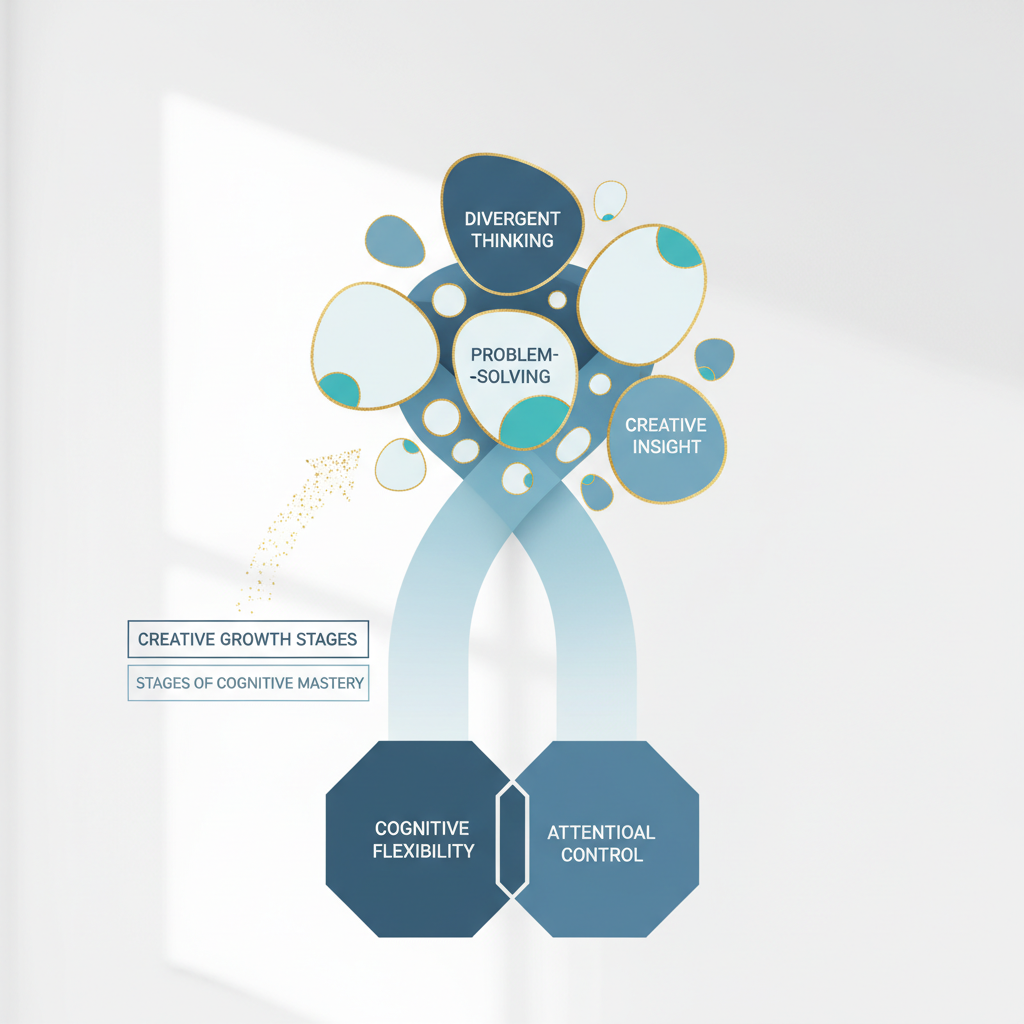
    An abstract infographic showing a progression from cognitive flexibility and attentional control, enhanced by understanding the Stroop Effect, to boosted creative thinking, problem-solving, and insight.
    An abstract, educational infographic visualizing how understanding the Stroop Effect can boost creativity. Depict a layered system or a progressive pathway, starting from ‘Cognitive Flexibility’ and ‘Attentional Control’ (represented by foundational geometric shapes) and leading upwards or outwards to ‘Divergent Thinking’, ‘Problem-Solving’, and ‘Creative Insight’ (represented by expanding, interconnected shapes or idea clusters). Use subtle gradients and accent highlights to show growth and connection. The style should be minimalist, vector-based, professional, and approachable. Use a color palette of soft blues, whites, and charcoal, with gold or teal accents to highlight creative outcomes. Incorporate negative space for short labels indicating stages of creative growth. No humans, no cartoon elements.

    Improving Your Focus for Deeper Work

    The Stroop Effect shows how our brains work. Some tasks, like reading, are automatic. But other tasks, like naming a color while ignoring the word itself, require deliberate focus.

    This struggle shows why managing distractions is so important for creative work. Staying focused helps you explore complex ideas without losing your train of thought.

    Deep focus means concentrating on one task without getting distracted. It’s how you come up with truly new solutions and insights. Research shows that being focused can make you more creative [8].

    Here are a few ways to improve your focus for creative work:

    • Minimize Distractions: Create a quiet workspace. Turn off notifications. Avoid multitasking.
    • Practice Single-Tasking: Focus on one creative task at a time. Finish it before starting the next one.
    • Engage in Mindfulness: Short meditation exercises can improve your ability to focus. This helps you stay present.
    • Schedule Focused Blocks: Set aside specific times for uninterrupted creative work. Protect this time from interruptions.

    Understanding how your mind works, including your ability to focus, is a key benefit of the Creative Ability Test. Our test measures your ability to pay attention and offers strategies to improve this vital skill. Better focus leads to stronger creative output and problem-solving.

    Enhancing Cognitive Flexibility for Innovative Thinking

    To beat the Stroop Effect, you need cognitive flexibility. This is your brain’s ability to switch tasks or adapt to new rules. You have to ignore your automatic urge to read the word and instead focus on naming the color.

    This mental flexibility is key to innovation. Creative people are great at looking at problems from different angles. They connect ideas that don’t seem related and try a new approach when the first one doesn’t work.

    Cognitive flexibility helps you see things in new ways. It encourages “divergent thinking”—the skill of coming up with many different ideas. Studies show a strong link between this flexibility and creative problem-solving [9].

    To build your cognitive flexibility and be more innovative, try these tips:

    • Embrace Novelty: Try new activities regularly. Learn a new skill or take up a new hobby. Explore subjects that are new to you.
    • Solve Puzzles and Brain Teasers: Do activities that challenge you to think differently, like riddles or logic games.
    • Challenge Assumptions: When you face a problem, question your first instincts. Look for other ways to see it.
    • Practice Brainstorming: Come up with as many ideas as you can without judging them. Allow for wild or unusual connections.

    The Creative Ability Test measures your cognitive flexibility. Our test gives you a full picture of this key creative skill, and our personalized feedback offers practical tips to improve it. These strategies will help you adapt, innovate, and think outside the box. Unlock your creative potential by understanding how your mind works.

    Frequently Asked Questions

    How is a Stroop test interpreted?

    A Stroop test shows how well your brain handles conflicting information. It measures your cognitive control, which includes your attention and how efficiently you process things.

    When you take a Stroop test, experts look at a few key measurements:

    • Reaction Time: This is how fast you respond. A quicker response means your brain is working efficiently.
    • Accuracy: This is how many answers you get right. A high score shows good focus.
    • The Interference Effect: This is the most important measurement. It compares your reaction time in easy trials (where the word and color match) to your time in hard trials (where they conflict). A big difference in your times suggests a stronger “Stroop effect” [4].

    A smaller interference effect is a good sign. It means you have strong selective attention and cognitive flexibility. In other words, you’re good at focusing on a task and ignoring distractions. These skills are key for creative thinking, exploring new ideas, and solving problems.

    Understanding your results gives you a peek into how your brain works. You can see how you deal with mental conflict. This knowledge can help you improve your focus and adaptability, which are essential for boosting your creativity.

    Can I take a real Stroop test online?

    Yes, you can find many versions of the Stroop test online. They’re a fun way to see the effect for yourself and a great introduction to the concept. But it’s important to know the difference between online tests and clinical ones.

    For an official psychological assessment, you need a standardized test given by a qualified professional [10]. These formal tests guarantee accurate conditions and interpretation, and they are used for clinical diagnosis or research.

    Still, online versions are great for learning more about yourself. They help you understand the concept by seeing it in action. While our Creative Ability Test does not have a Stroop test, our comprehensive 30-question platform measures similar core skills. These include cognitive flexibility, divergent thinking, and problem-solving. We give you personalized insights into your creative strengths and offer clear strategies to help you grow.

    If you take an online Stroop test, try to find one from a trusted source, like a university or a psychology website. They usually explain the results in a simple way. Remember, even a basic online test can spark curiosity about your brain’s amazing abilities.

    What are some real-world Stroop effect examples?

    The Stroop effect happens all around us, not just in a lab. It shows up in our daily lives in small ways. These examples help show how your brain works and why it’s important to avoid mental overload.

    Here are a few common scenarios:

    • Reading Traffic Signs: Imagine a “STOP” sign painted green. Your brain automatically reads the word “STOP” but sees the color green, which usually means “GO.” This conflict slows down your reaction time.
    • Following a Recipe: You’re following a recipe that says to add “white sugar,” but the sugar is in a red container. For a split second, the red color might distract you from the word “sugar,” making you hesitate.
    • Brand Logos and Advertising: Some ads use colors that clash with a brand name to get your attention. This can create a small Stroop effect, making the brand name a little harder to read at first glance.
    • Multitasking in a Noisy Environment: You’re trying to have a conversation in a noisy room. Your brain has to work hard to focus on the voice you want to hear and ignore all the other sounds. This is like the Stroop test, where you have to ignore the word and focus on the color.
    • Using Digital Interfaces: You see a button that says “Submit” but is colored red. Since we usually associate red with “Cancel” or “Stop,” this mismatch can make you pause or even click the wrong thing.

    These examples show that our brains use extra energy to sort through conflicting information. When you notice the Stroop effect in your life, you can change your environment to reduce distractions and improve your focus. This awareness can free up mental space, making it easier to be creative and find new solutions.


    Sources

    1. https://www.ncbi.nlm.nih.gov/pmc/articles/PMC3372274/
    2. https://www.frontiersin.org/articles/10.3389/fpsyg.2014.00451/full
    3. https://www.ncbi.nlm.nih.gov/pmc/articles/PMC2856407/
    4. https://www.simplypsychology.org/stroop-effect.html
    5. https://faculty.washington.edu/chudler/java/words.html
    6. https://pubmed.ncbi.nlm.nih.gov/11794711/
    7. https://psycnet.apa.org/record/2012-07406-001
    8. https://www.scientificamerican.com/article/how-focusing-can-boost-creativity/
    9. https://positivepsychology.com/cognitive-flexibility/
    10. https://www.ncbi.nlm.nih.gov/pmc/articles/PMC8900010/

  • A Guide to the Most Common Intelligence Tests in Psychology

    A Guide to the Most Common Intelligence Tests in Psychology

    An intelligence test in psychology is a scientifically designed assessment used to measure a range of cognitive abilities, including reasoning, problem-solving, and abstract thinking. These standardized tools provide a score, commonly known as an IQ (Intelligence Quotient), to understand an individual’s mental aptitude relative to a larger population.

    Do you ever wonder how your mind works, how you solve problems, or what your mental strengths are? The human brain has amazing potential, and for centuries, psychologists have worked to understand it. Knowing your mental abilities is about more than just labels. It gives you real insight into how you think, learn, and create. This journey begins with using proven tools designed to help you understand yourself better.

    A key part of this exploration involves intelligence tests in psychology. These tests are not simple measures of “smartness.” Instead, they provide a detailed look at different thinking skills. They help identify your strengths in areas like verbal skills, logical reasoning, and processing speed. This offers a clearer picture of how you handle challenges and develop ideas. Learning about a standardized intelligence test can help you appreciate how your own mind works and contributes to your abilities.

    This article will be your guide through the world of intelligence tests. We’ll explain what makes a standardized intelligence test reliable and review some of the best intelligence test options used today, like the Wechsler Adult Intelligence Scale (WAIS) and Raven’s Progressive Matrices. We will also cover the specific mental skills they measure. Most importantly, we’ll show how understanding these core parts of intelligence can give you deeper insights into your own way of thinking and boost your creative potential.

    What is an Intelligence Test in Psychology?

    Understanding the Purpose of Cognitive Measurement

    Intelligence tests are advanced tools used to measure mental skills like reasoning, problem-solving, and learning. The main goal is to understand a person’s thinking strengths. These tests also show how you process information.

    This careful measurement is a key part of psychological assessment [1]. It offers a clear look into how people think. Understanding these basic skills helps us see the full range of human abilities, including your own creative talent and how you create new ideas.

    Beyond the IQ Score: What These Tests Reveal

    An intelligence test gives you more than just an IQ score. Modern tests provide a detailed profile of your thinking skills. They break intelligence down into different parts to show how your mind works. For example, they measure your verbal skills and perceptual reasoning (how you solve visual problems). They also measure your working memory and how fast you process information.

    These details are very useful. They help you understand your own thinking style. For instance, a high score in perceptual reasoning suggests you are good at solving problems visually. A strong working memory means you can handle several ideas at once. This understanding can lead to personal growth. It shows you how you handle challenges and learn new things.

    These tests can also point out specific thinking skills you can work on. Knowing your mental profile builds self-awareness and helps you find ways to improve. This is especially important for creative people because it relates to flexible thinking. While many tests focus on finding one correct answer, they still map out your basic mental tools. You need these tools to use your creativity in the real world to invent and solve problems.

    Our Creative Ability Test builds on this by focusing on your creative strengths. It offers real strategies to improve these skills. You can move from just understanding your thinking to taking steps to boost your creativity.

    What is a standardized intelligence test?

    The Importance of Norms and Uniform Procedures

    To understand your mental strengths, you need a solid starting point. That’s the purpose of standardized tests. They are more than just a quick quiz. They offer a fair and consistent way to measure your abilities. This approach gives you accurate insights into how you think.

    What Does “Standardized” Really Mean?

    A “standardized” test is one where everyone takes it and is scored in the same way. Imagine a test where some people got more time or different instructions. You couldn’t compare the results. Standard rules make sure the test is fair for everyone.

    For example, everyone gets the same questions, time limits, and testing environment. This consistency makes it possible to compare scores fairly.

    The Power of Norms

    Norms are like a benchmark. They are based on the scores of a large, diverse group of people who have already taken the test. This group, or “normative sample,” is chosen to be a good snapshot of the general population [2].

    When you take the test, your score is compared to these norms. This shows you how your performance compares to others in your age group. It puts your score into perspective. For instance, a score of “X” on its own means little. But knowing that “X” is higher than 80% of your peers gives it real meaning.

    At Creative Ability Test, we use these same strict principles. We provide a consistent testing experience and show how your results compare to a broad range of creative thinkers. This helps you move from guessing about your skills to gaining useful self-knowledge.

    Reliability and Validity in Psychological Testing

    When you take a test to learn about your mind, you need to trust the results. This trust is built on two key ideas: reliability and validity. They are the foundation of any good psychological test.

    Reliability: Consistent Results Every Time

    Imagine a measuring tape that gives you a different length each time you measure the same object. That would be unreliable. Reliability means a test gives consistent results. If you took a reliable test a few times, your scores would be about the same.

    This consistency is very important. It means your score isn’t just a fluke; it truly reflects your abilities. A reliable test gives you feedback you can count on.

    Validity: Measuring What Matters

    Validity is even more important than reliability. It asks: Does the test actually measure what it claims to measure? A test can be reliable (consistent) but not valid (accurate). For instance, a scale might consistently read 5 pounds too high. It’s reliable, but not valid.

    The main idea is simple: the test must actually measure what it’s supposed to measure [3]. For an intelligence test, it must truly measure intelligence. For a creativity test, it must genuinely capture aspects of creative thinking.

    When a test is valid, you can trust what it tells you. The insights you get will be meaningful for your personal and professional growth.

    At Creative Ability Test, our 30-question assessment is built on proven scientific methods. We focus on making our test both reliable and valid. This way, you get personal and practical insights into your creative strengths, mental flexibility, and problem-solving skills. You’ll go from simply wondering about your creativity to using it with confidence in the real world.

    What are the most common intelligence tests?

    Understanding different intelligence tests can be helpful. While your creativity relies on different skills, it’s useful to know how traditional intelligence tests work. These tests mostly measure convergent thinking, which is the ability to find a single, correct answer. However, real innovation often comes from divergent thinking—the skill of generating many unique solutions. Our Creative Ability Test focuses on these key creative skills.

    Here, we’ll look at some of the best-known intelligence tests in psychology. Each one offers a different view of our cognitive abilities and helps us appreciate the many ways our minds work. This guide also shows how our platform can help you explore and enhance your creative thinking.

    Wechsler Adult Intelligence Scale (WAIS)

    The Wechsler Adult Intelligence Scale (WAIS) is a widely used and detailed test for adults aged 16 to 90. Many psychologists consider it the top standard for measuring adult intelligence [source: https://www.apa.org/pubs/books/wechsler-adult-intelligence-scale-fifth-edition]. The WAIS provides a Full Scale IQ score and also gives scores in four main areas.

    • Verbal Comprehension Index (VCI): This measures your ability to understand and use spoken information. It shows your language skills and ability to reason with words.
    • Perceptual Reasoning Index (PRI): The PRI tests your non-verbal reasoning and visual-spatial skills. It looks at how you solve problems using pictures and designs.
    • Working Memory Index (WMI): This index measures your ability to hold and work with information in your mind. It shows how well you can focus and concentrate.
    • Processing Speed Index (PSI): The PSI measures how quickly you can process simple visual information. It reflects your mental speed.

    The WAIS helps identify cognitive strengths and areas that need improvement. This information can be very useful for guiding education or career choices. However, the test largely measures skills for convergent problem-solving. Creative ideas, in contrast, often come from divergent thinking. Our Creative Ability Test helps you explore these unique creative pathways.

    Stanford-Binet Intelligence Scales

    The Stanford-Binet Intelligence Scales have a long history and are among the oldest intelligence tests. First created in the early 1900s, they measure thinking skills across a wide age range, from two-year-olds to adults [source: https://www.apa.org/pubs/books/stanford-binet-intelligence-scales-fifth-edition]. The test measures five key cognitive factors:

    • Fluid Reasoning: This is your ability to solve new problems and think flexibly.
    • Knowledge: This assesses your general knowledge and vocabulary.
    • Quantitative Reasoning: This measures your understanding of math concepts.
    • Visual-Spatial Processing: This looks at your ability to understand visual relationships.
    • Working Memory: Similar to the WAIS, this measures how you manage information in your mind.

    The Stanford-Binet is very useful for understanding how thinking skills develop. It offers insights into different mental processes. However, like the WAIS, it focuses mainly on traditional intelligence. It helps us see one side of the coin, while our platform helps you see the other. We focus on boosting the creative side of your mind, including flexible thinking and generating original ideas.

    Raven’s Progressive Matrices

    Raven’s Progressive Matrices is different from other intelligence tests because it is non-verbal. Instead of using words, the test asks you to complete visual patterns using logic. This design makes it a “culture-fair” test, as it aims to reduce bias from language or cultural knowledge [source: https://psychology.jrank.org/pages/530/Raven-s-Progressive-Matrices.html].

    The Raven’s test primarily measures fluid intelligence—your ability to solve new problems, see relationships, and adapt to new situations. This skill is key for effective problem-solving and contributes to cognitive flexibility, which is a cornerstone of creativity. Our Creative Ability Test helps you develop this flexibility, empowering you to see more connections and generate a wider range of solutions that can lead to breakthrough thinking.

    Woodcock-Johnson Tests of Cognitive Abilities

    The Woodcock-Johnson Tests of Cognitive Abilities (WJ IV) is a broad test that measures a wide range of thinking skills. It covers general intelligence, specific cognitive functions, and academic achievement. It’s often used in schools to help identify learning disabilities or giftedness [source: https://www.hmhco.com/assessments/woodcock-johnson-iv].

    The WJ IV is known for being very thorough, providing a detailed profile of a person’s cognitive strengths and weaknesses. This level of detail is helpful, but its main goal is diagnostic and academic. It focuses on established cognitive skills. Our Creative Ability Test complements this by targeting the active parts of creative thinking, like innovation and openness to new experiences. We offer practical strategies to build on your unique creative potential.

    Individual vs. Group Intelligence Tests

    Intelligence tests can be given one-on-one or to a group. Each approach has its own pros and cons, and understanding the difference helps clarify how they are used.

    Feature Individual Intelligence Tests Group Intelligence Tests
    Administration Given one-on-one by a trained psychologist. Given to many people at once.
    Examples WAIS, Stanford-Binet, Woodcock-Johnson. School readiness tests, military aptitude tests.
    Depth of Insight Gives a detailed, in-depth understanding of cognitive processes. Allows for behavioral observation. Offers a broad, general assessment of cognitive abilities. Limited behavioral observation.
    Cost & Time More expensive and time-consuming. More cost-effective and time-efficient.
    Purpose Used for clinical diagnosis, personal education plans, and in-depth psychological reviews. Used for screening, large-scale assessment, and identifying general cognitive trends.
    Flexibility The examiner can adapt the test based on the person’s needs. Has a strict format with little to no flexibility.

    Individual tests offer deep, personalized insights and can reveal small details in a person’s thinking. Group tests are efficient for screening large numbers of people and providing a general overview. Our Creative Ability Test aligns with the spirit of personalized insight. It’s a detailed 30-question assessment that helps you discover your creative strengths. We provide a deep dive into your unique thinking styles, followed by personal feedback and practical strategies to support your personal and professional growth.

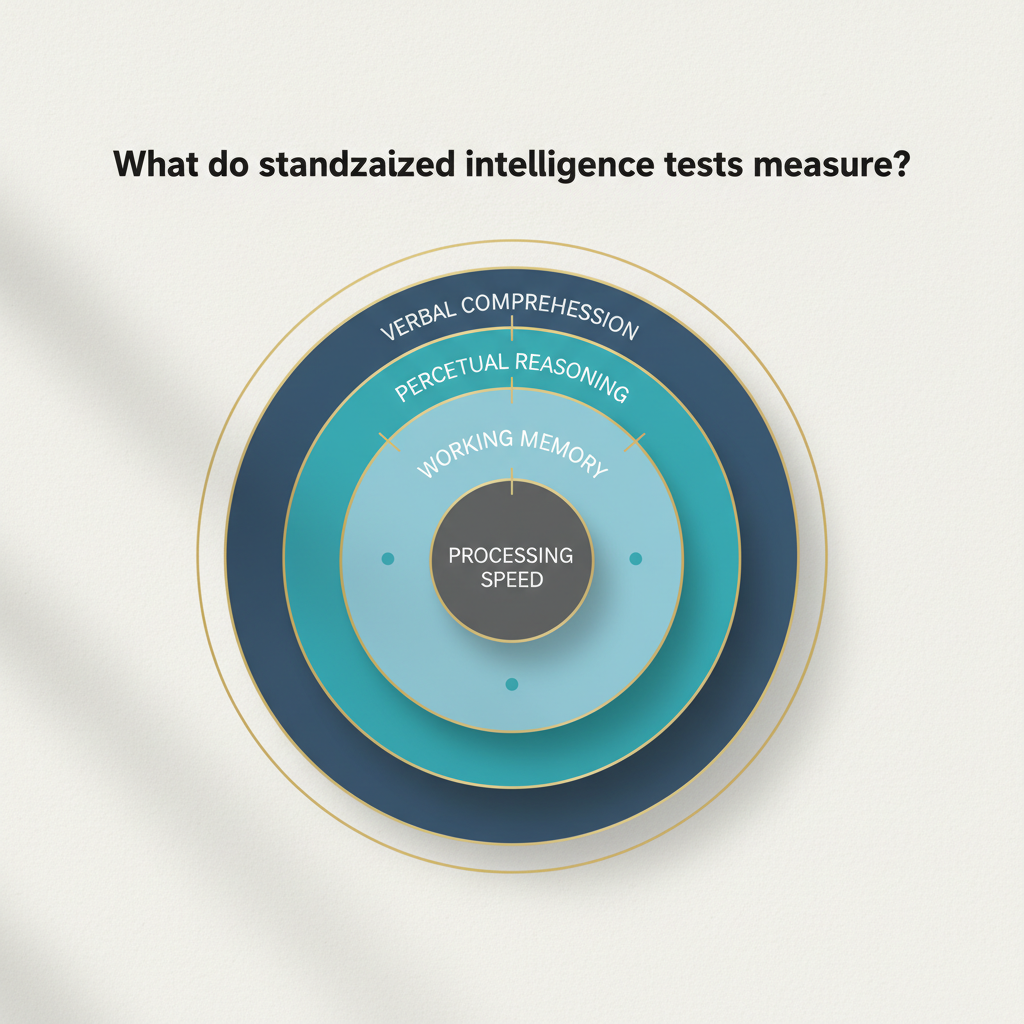
    What do standardized intelligence tests measure?

    Infographic showing a multi-layered, concentric chart representing different cognitive domains measured by standardized intelligence tests, such as verbal comprehension and working memory.
    Abstract, educational infographic for an article section titled ‘What do standardized intelligence tests measure?’. The visualization should be a minimalist, vector-based competency graph or multi-layered assessment chart. It displays concentric or stacked geometric layers, each representing a different cognitive domain measured by intelligence tests (e.g., Verbal Comprehension, Perceptual Reasoning, Working Memory, Processing Speed). Each layer uses a distinct shade of soft blue or charcoal, with gold or teal accent lines to highlight key components. Short, professional labels indicate the cognitive skill measured by each layer or section. The overall structure suggests a comprehensive and structured assessment of various intellectual dimensions. Clean geometric shapes, subtle gradients, and ample negative space contribute to a professional and approachable aesthetic.

    Standardized intelligence tests look at different mental skills. They show how your mind works with information. These tests are more than just a single “IQ” score—they evaluate specific mental functions. Learning about these areas can highlight your unique thinking style and show how you approach challenges.

    While these tests once focused on traditional intelligence, their different parts offer valuable insights for creative thinking. They reveal the core cognitive strengths that support your ability to innovate and solve problems in new ways.

    Verbal Comprehension and Reasoning

    Verbal comprehension is your ability to understand and use language. It looks at your vocabulary, general knowledge, and how you solve problems using words. It also measures how well you can express your ideas.

    For example, a test might ask you to define a word or explain how two concepts are related. This skill is key for clear communication. Strong verbal skills help you explain complex ideas and understand different points of view [4].

    Connection to Creativity: Creativity often starts with a clear understanding of a topic. A large vocabulary and a wide range of knowledge help you make new connections. This allows you to look at problems from different angles and find original solutions. Our Creative Ability Test helps improve your communication skills. It shows how understanding concepts can lead to new forms of expression and more powerful creative results.

    Perceptual and Fluid Reasoning

    This skill measures your ability to solve new problems without using prior knowledge. It’s about spotting patterns, seeing how shapes relate to each other, and “thinking on your feet.” You look at new information and quickly find a solution.

    Tasks might include finishing visual patterns or solving puzzles with abstract shapes. This skill is crucial for being adaptable and handling new situations well.

    Connection to Creativity: This is a key part of creative problem-solving. It helps you see new connections and adapt to change. Fluid reasoning is all about flexible thinking, which lets you explore many different possibilities. This is a core part of creative thinking. Our platform measures your mental flexibility and your skill at finding new patterns, which is vital for innovation. Knowing this helps you actively develop new ways of looking at things.

    Working Memory Capacity

    Working memory is your mental workspace. It measures your ability to hold and use information in your mind for short periods. It’s about managing several pieces of information at once to complete a task. A simple example is remembering a phone number while you are dialing it.

    Another example is following instructions with multiple steps. This requires focus and mental effort. It shows your ability to pay attention. A strong working memory helps with complex thinking [5].

    Connection to Creativity: A strong working memory is very useful for creative work. It lets you juggle many ideas and limitations at the same time. You can hold different possibilities in your mind at once, which helps with tasks like design and revision. It also helps you connect unrelated concepts to create brand-new solutions. Our platform gives you insights to improve your creative process. We show you how to manage information better, helping you hold on to and develop your ideas.

    Processing Speed and Efficiency

    Processing speed is how quickly you can do simple mental tasks, like scanning for information or making a quick decision. It measures how efficiently your brain works to complete tasks both quickly and accurately. This is often tested with timed activities, such as matching symbols or doing simple coding exercises.

    When you can process things quickly, you spend less time on basic mental tasks. This frees up your mind for more complex thinking and shows your overall cognitive efficiency.

    Connection to Creativity: While not a direct measure of creativity, processing speed is a big help. When your mind works efficiently, it frees up brainpower for bigger ideas. This allows you to explore more possibilities in less time and quickly test out your creative solutions. It also helps you weigh different creative options faster. Our insights offer ways to improve your mental performance. We help you use your cognitive strengths well, which improves your creative problem-solving speed and flow. You can move from an idea to a finished product more easily.

    How Do Intelligence and Creativity Connect?

    Infographic illustrating the connection between intelligence and creativity, depicted as two overlapping conceptual networks of geometric shapes, showing shared and distinct cognitive functions.
    Abstract, educational infographic for an article on intelligence tests and creativity. Title: How Do Intelligence and Creativity Connect? A conceptual visualization featuring two distinct, interconnected geometric networks or abstract brains. One network, primarily in soft blues and charcoal, represents ‘Intelligence’ with nodes for analytical reasoning, logic, and problem-solving. The other network, using soft blues with prominent gold or teal accents, represents ‘Creativity’ with nodes for divergent thinking, innovation, and imagination. Subtle, arcing lines or overlapping zones illustrate points of connection, synergy, and interdependence between the two networks, demonstrating how they influence and enhance each other. Minimalist, vector-based design with clean geometric shapes and subtle gradients. Ample negative space for short labels indicating specific cognitive functions and their intersection points. Professional and approachable style, suitable for an audience curious about creativity and self-improvement.

    Convergent Thinking (Measured by IQ Tests) vs. Divergent Thinking (Key to Creativity)

    Intelligence and creativity can seem like two different things. But they are closely related ways of thinking. Understanding how they differ helps us appreciate both IQ tests and creativity assessments.

    What is Convergent Thinking?

    Convergent thinking is a focused way of solving problems. It means using logic to find the single best answer. The goal is to be precise and accurate.

    Most traditional intelligence tests measure convergent thinking. These tests present problems that have only one correct answer. Examples include:

    • Solving math problems
    • Answering multiple-choice questions
    • Finding the missing piece in a pattern

    These tests measure skills like verbal comprehension, logical reasoning, and processing speed [6]. A high score shows you have strong analytical skills and can solve problems well when there’s one right answer.

    What is Divergent Thinking?

    Divergent thinking is the opposite. It’s about exploring many possibilities and coming up with lots of unique ideas. This process encourages imagination and open-ended solutions.

    Divergent thinking is a key part of creativity. It is all about brainstorming and expanding on new ideas. Our Creative Ability Test is designed to measure these skills, including your ability for:

    • Fluency: Produce a large number of ideas.
    • Flexibility: Generate ideas from different categories.
    • Originality: Create unique and uncommon ideas.
    • Elaboration: Develop ideas with greater detail.

    So, while IQ tests measure how well you find one answer, creativity tests reveal how well you can invent many solutions.

    Using These Insights to Unlock Your Creative Potential

    Understanding how these two types of thinking work together is powerful. It helps you see your own strengths and shows you how to improve your creative skills.

    How Insights Drive Growth:

    Knowing your strengths helps you choose the right approach for different challenges. For example, you might use convergent thinking to define a problem clearly. Then, you can switch to divergent thinking to explore many possible solutions.

    Our 30-question assessment measures more than a typical intelligence test. It gives you personalized feedback that shows you where you shine creatively and where you can improve.

    Here’s how you can apply this in practice:

    • Problem Solving: When facing a tough problem, first brainstorm many ideas (divergent). Then, use critical thinking to pick the best options (convergent).
    • Innovation: To create something new, you need novel ideas. This relies on divergent thinking. Afterward, you use convergent skills to refine and implement them.
    • Personal Development: When you know your thinking style, you can practice deliberately. This helps you build both your analytical and creative abilities.

    It’s empowering to know that creativity is a skill you can build. This knowledge gives you the confidence to take action. Our platform offers practical strategies to help you think more flexibly and come up with new ideas. You’ll learn how to apply your creativity to real-world challenges.

    Ultimately, understanding the link between intelligence and creativity changes how you approach challenges. You’ll go from knowing about creativity to actively using it to solve problems. Discover your creative potential with our science-backed assessment and personalized guidance.

    How to Approach Taking an Intelligence Test

    The Role of Professional Psychologists

    Taking a formal intelligence test is a big step. These tests aren’t simple quizzes—they are powerful tools used by psychologists.

    A professional psychologist is needed to use these tests correctly. They have special training and understand the details of giving and scoring them.

    Most importantly, a psychologist explains what your results mean. They put your scores into context so you get a clear picture of your thinking skills [7].

    A psychologist can identify your specific cognitive strengths and areas for improvement. This is much more than just a single score. Their guidance helps you use this information in your life. This personal feedback is very helpful for both personal and professional growth.

    For example, knowing your working memory capacity can help you find better ways to study. Seeing strong reasoning skills might point to a talent for solving problems. This knowledge empowers you to make the most of your unique way of thinking.

    This careful, professional method is very different from online quizzes. It gives you real, useful insights about yourself.

    A Note on Free Online IQ and Brain-Based Intelligence Tests

    The internet is full of “free IQ tests” that promise quick insights into your intelligence. However, it’s important to be cautious. Most of these tests are not scientifically sound.

    Online tests are often just for fun. They usually haven’t been properly tested or proven. This means their questions might not measure your thinking skills correctly, and their scoring methods are often unchecked. As a result, the scores can be misleading.

    A real intelligence test takes years to develop. It is based on a lot of research and is tested on large, diverse groups of people. This process ensures the test is accurate and consistent [8]. Free online tests cannot match this level of science.

    However, you can still understand your cognitive strengths. Platforms like the Creative Ability Test offer assessments based on science. We focus on specific parts of creativity, which are different from general intelligence.

    Our 30-question test measures your creative potential. It looks at your cognitive flexibility, problem-solving skills, and openness to new ideas. We give you personal feedback with practical tips to boost your creative thinking. This method offers real insights for self-improvement. It helps you turn confusion into a clear plan for growth. You will get a better understanding of your creative strengths and learn how to use them.

    Frequently Asked Questions About Intelligence Tests

    What is an example of a standardized intelligence test?

    A great example is the Wechsler Adult Intelligence Scale (WAIS). It’s a well-known test used by psychologists. It measures different thinking skills in adults. The WAIS gives a clear picture of a person’s mental strengths and weaknesses. [9]

    Standardized tests like the WAIS are designed to be fair. Everyone gets the same questions and instructions. Scores are compared to those of a large group of people. This shows how your performance stacks up against others. It provides a reliable way to measure thinking skills.

    Learning about your thinking skills can teach you a lot about yourself. You can see how your mind works. Tests like the WAIS focus on “convergent thinking,” which is about finding one correct answer. This is an important skill. It builds a foundation for the “divergent thinking” skills our Creative Ability Test helps you explore.

    What are the 4 types of intelligence tests?

    Instead of “types,” it’s more useful to think about the different thinking skills that intelligence tests measure. Major tests like the WAIS or Stanford-Binet look at several aspects of intelligence. They usually cover four main areas:

    • Verbal Comprehension: This measures how well you understand and use words. It looks at your vocabulary, word-based reasoning, and ability to express yourself. Strong verbal skills help you communicate well and share creative ideas.
    • Perceptual Reasoning (or Fluid Reasoning): This tests your skill at solving new problems. It involves thinking visually and abstractly, like finding patterns or solving puzzles. This skill is key for creative problem-solving and seeing connections others might miss. [10]
    • Working Memory: This measures your ability to hold and work with information in your head. It’s important for complex tasks, like following several steps at once. A strong working memory helps you manage many ideas when you’re brainstorming or developing a project.
    • Processing Speed: This tests how quickly and accurately you can handle visual information. It shows how efficient your thinking is. Being a fast processor helps you react quickly to new information and generate ideas on the fly.

    Understanding these four areas gives you a better sense of your own thinking style. Our Creative Ability Test builds on this. It explores how these core skills support your creative potential, focusing on strengths like flexible and innovative thinking.

    Is the SB test still used today?

    Yes, the Stanford-Binet (SB) Intelligence Scales are still widely used. With a long history in psychology, the test has been updated many times to stay current and accurate. Today’s version is the Stanford-Binet Intelligence Scales, Fifth Edition (SB5). [11]

    The SB5 is a complete test that measures thinking skills in people of all ages, from two-year-olds to adults. It is used to identify learning challenges and giftedness. It also helps with educational planning and clinical diagnosis. Its careful design makes the results trustworthy.

    Learning about tests like the Stanford-Binet shows how we measure human potential. For anyone curious about their own skills, a science-backed test can provide clear answers. It turns “I don’t know” into useful self-knowledge. This is what our Creative Ability Test is all about—helping you understand and grow your unique creative strengths.


    Sources

    1. https://www.apa.org/topics/intelligence/assessment
    2. https://www.apa.org/education-career/guide/standardized-tests
    3. https://www.simplypsychology.org/validity.html
    4. https://www.apa.org/education-career/guide/science-psychology/intelligence
    5. https://psycnet.apa.org/record/2013-11915-001
    6. https://www.apa.org/education-career/guide/intelligence-tests
    7. https://www.apa.org/education-career/guide/science-psychology
    8. https://psychcentral.com/lib/what-is-a-standardized-test
    9. https://www.pearsonassessments.com/professional-assessments/cultural-linguistic/psychological/wechsler-adult-intelligence-scale-fourth-edition-wais-iv.html
    10. https://www.ncbi.nlm.nih.gov/pmc/articles/PMC3054522/
    11. https://www.riversideinsights.com/products/stanford-binet-intelligence-scales-fifth-edition/SB5

  • A Guide to the 7 Key Personality Assessment Models

    A Guide to the 7 Key Personality Assessment Models

    Personality assessment models are structured frameworks used in psychology to measure and categorize individual personality traits. Popular models include the Big Five (OCEAN), the Myers-Briggs Type Indicator (MBTI), and the Enneagram, which help individuals understand their behaviors, preferences, and strengths for personal and professional growth.

    Have you ever wondered about the unique patterns in how you think, react, and face challenges? Understanding yourself is the first step to unlocking your full potential, especially your natural creativity. This process is made easier with personality assessment in psychology, which offers proven ways to understand your strengths, preferences, and motivations.

    These tools are much more than simple labels; they are designed for real personal and professional growth. By exploring personality inventories in psychology, you can see how your personality shapes your cognitive flexibility, problem-solving strategies, and your openness to new experiences. Whether it’s a C Jung personality test or a look into a Carl Jung cognitive functions test, these assessments explain different creative traits and thinking styles. They provide useful practical tips for improving creativity and help you build innovative thinking skills for every part of your life.

    This guide will introduce you to seven of the most well-known personality models. We’ll break down their main ideas and show you how each one can help you see your strengths, motivations, and creative potential in a new light. Get ready to turn self-discovery into clear awareness and practical steps for growth.

    What Are Personality Assessment Models and Why Do They Matter?

    An abstract network diagram showing the concept of personality assessment models at its center, with lines connecting to various benefits like self-understanding, career alignment, and personal growth.
    A clean, educational infographic. Central concept: ‘Personality Assessment Models’ represented by a stylized, interconnected network diagram or idea cluster. Surrounding nodes represent ‘Self-Understanding’, ‘Career Alignment’, ‘Team Dynamics’, ‘Personal Growth’. Use minimalist, vector-based geometric shapes with subtle gradients. Color palette: soft blues, whites, charcoal, with gold or teal accents. Ample negative space for clarity. Professional and approachable style, no humans or cartoons.

    Understanding the Science of You

    Have you ever wondered what makes you unique? Personality tests offer a way to understand yourself better. These tools use psychology to map out your patterns of thinking, feeling, and behaving.

    Think of them as a guide to self-discovery. They help you see your main traits, preferences, and motivations. In short, these models give you a clear way to understand yourself.

    Psychologists use many different tests. These include well-known models like the Big Five (OCEAN) and theories from Jungian psychology [1]. These tools help us understand why people act the way they do. Instead of just guessing, they provide insights based on data.

    Exploring these models can help you understand:

    • Your main personality traits.
    • How you interact with the world around you.
    • What motivates your decisions.
    • Your typical response to challenges.
    • Areas where you have natural strengths.

    Understanding your personality is a powerful step toward self-awareness. This knowledge creates a solid base for personal growth.

    How Personality Insights Fuel Creativity and Growth

    Understanding your personality is more than just finding a label. It can spark your creativity and help you grow. When you know how you think, you can find new ways to create and solve problems better.

    For example, if you know you love to explore, you can look for new experiences to boost your divergent thinking skills. And if you know you’re mentally flexible, you can adapt to change and welcome new ideas more easily.

    Here’s how knowing your personality can help:

    • Find Your Creative Strengths: Discover if you’re a natural at brainstorming or better at careful planning. This helps you focus on what you do best.
    • Become More Adaptable: See how your personality affects your ability to look at things differently. This is a key skill for new ideas.
    • Solve Problems Better: Learn your natural way of facing challenges. This helps you find more creative and effective solutions.
    • Support Your Personal Growth: Find out where you have room to grow, like building new habits or changing your mindset.
    • Build Confidence: When you understand your creative skills, you’ll trust your gut and be more willing to take creative risks.

    When you understand your creative side, you can take clear, confident action. Our science-backed Creative Ability Test is designed to help. It offers personal feedback and practical tips for using your creativity every day [2]. This helps you move from being creative once in a while to growing your skills consistently. Your path from basic understanding to real innovation will become much clearer.

    The 7 Most Influential Personality Assessment Models Explained

    The Big Five (OCEAN) Model: The Gold Standard in Psychology

    The Big Five, often remembered by the acronym OCEAN, is a key model in personality psychology. It breaks personality down into five main traits. Researchers trust it because it is scientifically valid and reliable [3]. Many see it as the strongest model available.

    Understanding your Big Five traits can give you deep insights. It shows how you interact with the world and face challenges. This knowledge can directly affect how you create and solve problems.

    • Openness to Experience: This trait measures your imagination, curiosity, and interest in new things. People high in openness often welcome new ideas. They look for different points of view. This helps with creative, out-of-the-box thinking.
    • Conscientiousness: This trait shows how organized, disciplined, and goal-oriented you are. Conscientious people are careful with details and don’t give up easily. These skills are vital for turning creative ideas into real results.
    • Extraversion: Extraversion shows how social, energetic, and assertive you are. Extraverts often get energy from being with others. They might enjoy brainstorming in groups and sharing ideas freely. This can lead to new creative ideas.
    • Agreeableness: This trait measures how cooperative, kind, and understanding you are. Agreeable people work well in teams. They create a good atmosphere for creative teamwork.
    • Neuroticism (Emotional Stability): Neuroticism is about how you handle emotions and stress. Lower neuroticism (which means higher emotional stability) often leads to more resilience. This helps you take creative risks and stick with projects.

    Learning your Big Five profile helps you understand your natural tendencies. You can then use these strengths to improve your creative problem-solving. Our Creative Ability Test provides similar science-backed insights. It helps you understand your own cognitive flexibility and openness to new experiences.

    The Myers-Briggs Type Indicator (MBTI): Understanding Your Preferences

    The Myers-Briggs Type Indicator (MBTI) is a very popular personality test used around the world. It gives you a way to understand your personal preferences [4]. Katharine Cook Briggs and Isabel Myers created it during World War II. They based it on Carl Jung’s theory of psychological types.

    The MBTI helps you find your preferences in four key areas. These preferences combine to make up 16 different personality types.

    • Extraversion (E) or Introversion (I): How you focus your energy. Do you prefer the outer world of people and things, or your inner world of ideas and thoughts?
    • Sensing (S) or Intuition (N): How you take in information. Do you focus on facts and details, or on patterns, possibilities, and what might happen next? Intuition is often linked with creative thinking.
    • Thinking (T) or Feeling (F): How you make decisions. Do you prefer to use logic and facts, or do you consider people’s feelings and values?
    • Judging (J) or Perceiving (P): How you like to live your life. Do you prefer a planned and organized life, or one that is flexible and spontaneous? Perceiving is often linked to being adaptable and open to creative ideas.

    Although scientists debate its validity, the MBTI is still a popular tool for self-discovery. It gives people a common language to talk about their differences. Understanding your MBTI type can show you your favorite ways to think creatively. It can also show you how you might handle new challenges. This self-awareness is a great tool for personal growth and new ideas.

    The Enneagram: Exploring Motivations and Fears

    The Enneagram is a personality system that shows how people can change and grow. It outlines nine connected personality types. Each type has a core motivation, fear, and desire. It looks at the “why” behind what you do [5]. Unlike models that focus on traits, the Enneagram explores your deeper reasons for acting.

    Learning your Enneagram type can be life-changing. It shows you patterns in how you think, feel, and act. This knowledge is key for personal growth and for getting past creative blocks.

    • Type 1 – The Reformer: Ethical and has a strong sense of purpose, but can be too hard on themselves.
    • Type 2 – The Helper: Caring and giving, but can forget to take care of their own needs.
    • Type 3 – The Achiever: Can adapt and is driven to succeed, but can be too focused on their image.
    • Type 4 – The Individualist: Expressive and creative, but may struggle with self-doubt. These types often have many creative strengths.
    • Type 5 – The Investigator: Insightful and innovative, but can be distant from others. Their deep thinking leads to unique solutions.
    • Type 6 – The Loyalist: Committed and responsible, but can be anxious.
    • Type 7 – The Enthusiast: Spontaneous and loves adventure, but may try to avoid dealing with pain. Their love for life can inspire new ideas.
    • Type 8 – The Challenger: Confident and makes decisions easily, but can be confrontational.
    • Type 9 – The Peacemaker: Easy-going and supportive, but can avoid conflict and new challenges.

    The Enneagram helps you observe yourself and grow. By knowing your core motivations, you can break free from unhelpful patterns. You can also use your unique motivations for better creative work. It helps you use your creativity in the real world, turning confusion about yourself into useful self-knowledge.

    Jungian Psychology & Archetypes: The Foundation of Many Tests

    Carl Jung, a famous Swiss psychiatrist, created a field called analytical psychology. His ideas are the foundation for many modern personality theories and tests. He introduced new concepts like the collective unconscious and archetypes [6]. He also studied different ways of thinking, which shaped how we understand personality today.

    Jung’s ideas help us understand the deeper parts of our personality. They show how universal patterns can affect our minds and creative styles.

    • Archetypes: These are universal patterns and images, like The Hero, The Sage, The Innocent, and The Creator. They come from a shared human unconscious. Understanding these patterns can give you insight into your natural roles and creative urges.
    • The Collective Unconscious: This is a pool of shared experiences and knowledge that all humans have. You are born with it; you don’t learn it. This suggests we all share a source for our creative ideas.
    • Cognitive Functions: Jung identified four main ways of thinking:
      • Thinking: Making decisions based on logic and facts.
      • Feeling: Making decisions based on values and how they affect people.
      • Sensing: Noticing information using your five senses.
      • Intuition: Seeing possibilities, patterns, and what might happen next. This is strongly linked to creative ideas and thinking ahead.

    Understanding these Jungian ideas gives you a rich way to think about your personality. It helps you analyze your creative strengths and thinking styles. You can see how hidden patterns might affect your own approach to solving problems and creating new things. This connects to our platform’s goal of understanding the different sides of creativity.

    The DISC Model: A Focus on Workplace Behavior

    The DISC model is a test that focuses on behavior. It helps people understand their own and others’ communication styles. It’s often used at work to help teams and develop leaders [7]. DISC groups behaviors you can see into four main styles: Dominance, Influence, Steadiness, and Conscientiousness.

    Knowing your DISC style, and the styles of your coworkers, can change how you work together. It leads to better communication and teamwork. This directly improves a team’s creativity and problem-solving skills.

    • Dominance (D): People with a high ‘D’ style are direct, decisive, and focused on results. They often take the lead on creative projects and push new ideas forward.
    • Influence (I): High ‘I’ people are enthusiastic, social, and persuasive. They are great at brainstorming, inspiring others, and getting support for new ideas.
    • Steadiness (S): People with a high ‘S’ style are patient, supportive, and dependable. They bring stability to projects and make sure creative work gets finished.
    • Conscientiousness (C): High ‘C’ people are analytical, careful, and focused on details. They make sure work is high-quality, gather information, and improve creative ideas to get the best results.

    The DISC model gives you practical ideas on how different styles can help create a more creative workplace. It shows why having different approaches to problem-solving is so valuable. By understanding these behaviors, you can help your team work better together. This helps create new solutions and allows people to grow professionally through their creative work.

    Strengths-Based Assessments: Highlighting Your Positive Traits

    Strengths-based assessments come from the field of positive psychology. They focus on finding and building on your natural talents. Instead of focusing on your weaknesses, these tools show you what you’re good at. They encourage you to use these strengths to grow personally and professionally [8].

    Popular examples are CliftonStrengths (once called StrengthsFinder) and the VIA Character Strengths survey. They help people see the unique things they have to offer.

    Focusing on your strengths has several key benefits:

    • Builds Confidence: Understanding what you are naturally good at makes you more self-assured. This encourages you to try new creative things.
    • Increases Engagement: When you use your strengths, you are more engaged and motivated. This leads to more consistent creative work.
    • Targets Development: You can use your strengths to improve in other areas. This can help you get past creative blocks or learn new skills.
    • Uses Your Natural Talents: Knowing what you’re naturally good at helps you solve problems more effectively. It lets you handle tasks with more ease and creativity.
    • Guides Personal Growth: These tests give you useful information. They guide you on how to use your unique skills to improve yourself.

    Focusing on your strengths helps you turn confusion about your creativity into useful self-knowledge. It shows you how to use your unique skills to be more creative. This fits perfectly with our platform’s goal of helping you find and grow your creative potential.

    Projective Tests: Uncovering the Unconscious Mind

    Projective tests are a different kind of personality assessment. They show people unclear images or prompts. The idea is that people will share their inner thoughts, feelings, and hidden motives in their answers [9]. They are different from standard questionnaires that ask direct questions.

    These tests are often used by therapists, but they can give a peek into the deeper parts of your personality. They can show hidden things that affect your creativity or cause blocks.

    • Rorschach Inkblot Test: This is the most famous example. You look at a series of inkblots and say what you see. Your answers can show how you see the world, what you’re feeling, and how you think.
    • Thematic Apperception Test (TAT): You are shown a series of emotional but unclear pictures and asked to tell a story about each one. This can show hidden desires, conflicts, or how you relate to others.
    • Sentence Completion Tests: These ask you to finish incomplete sentences. For example, “My biggest fear is…” or “I feel happy when…”

    It is important to know that scientists debate whether these tests are valid and reliable, especially compared to tests like the Big Five. However, they can provide deep, descriptive information. This information can give a more detailed look at how a person sees the world. If you are curious about how your unconscious mind affects your creativity, these tests offer a different way to look at it.

    What tests do psychologists use to assess personality?

    Objective Tests vs. Projective Tests

    Psychologists use different tools to understand personality. These tools fall into two main types: objective tests and projective tests. Each type gives a unique look into who we are and how we think.

    Objective Tests: Measuring with Precision

    Objective tests are the most common way to assess personality. They use clear questions with set answers, like true/false, yes/no, or rating scales. Because the format is consistent, scoring and understanding the results are simple.

    Many objective tests are based on solid science. They give reliable and valid results [10]. This means they consistently measure what they’re supposed to. They are great for spotting specific traits, like those in the Big Five (OCEAN) personality model.

    Objective tests are also very useful for creativity. They can measure traits tied to creative thinking, such as openness to new experiences and flexible thinking. Our Creative Ability Test is an objective test designed to help you scientifically understand your creative strengths.

    Projective Tests: Uncovering Deeper Meanings

    Projective tests work differently. They show you unclear images, like inkblots or vague pictures, and ask what you see. The idea is that your free-form answers reveal hidden thoughts and feelings.

    The Rorschach Inkblot Test is a famous example. Another is the Thematic Apperception Test (TAT). While these tests are interesting, they have drawbacks. Scoring can depend on the expert’s opinion, making it subjective. Their results are often less reliable and valid than objective tests for assessing personality [9].

    While some people enjoy the creative freedom of these tests, objective tests offer more practical, useful insights for understanding and improving your creative skills.

    Self-Report Inventories (Questionnaires)

    Self-report inventories, or questionnaires, are the foundation of objective testing. In these tests, you simply answer questions about your own thoughts, feelings, and actions. Your answers give a direct look into how you view yourself.

    Psychologists often use these questionnaires because they are efficient and easy to use. They can gather lots of information quickly. A well-designed test gives a clear picture of different parts of your personality.

    How They Connect to Creativity

    Questionnaires are especially useful for exploring creativity. They help us look at specific parts of your creative thinking, such as:

    • Openness to Experience: How willing you are to explore new ideas and try new things.
    • Cognitive Flexibility: How easily you can switch between different ways of thinking.
    • Divergent Thinking: Your ability to come up with many different solutions to a problem.
    • Problem-Solving Approaches: The ways you prefer to solve problems.
    • Willingness to Take Risks: How comfortable you are with stepping outside your comfort zone.

    Our 30-question Creative Ability Test is a self-report questionnaire based on science. It measures these key parts of creativity. Answering honestly provides the most accurate results. This information gives you personalized tips to help you grow.

    The Role of Psychometric Assessments in Psychology

    Psychometrics is the science of psychological measurement. It makes sure tests are accurate and meaningful, not just interesting. This science is built on three key ideas:

    • Reliability: A reliable test provides consistent results. If you take it again, your score should be about the same.
    • Validity: A valid test measures what it’s supposed to measure. For instance, a creativity test should actually measure creative thinking, not something else like general intelligence.
    • Standardization: The test is given and scored the same way for everyone. This makes it possible to compare results fairly.

    These principles are very important. They provide unbiased, evidence-based information that helps us understand people’s differences. This information can then guide personal growth.

    Empowering Your Creative Journey

    Scientific tests are key to understanding your creative potential. They turn uncertainty into clear self-awareness you can act on. They help pinpoint your unique creative strengths. For example, you might be great at coming up with new ideas or looking at problems in a new way.

    The Creative Ability Test is built on these solid scientific principles, which guarantees that your results are reliable and valid. Our personalized feedback helps you:

    • Understand your unique creative thinking styles.
    • Pinpoint specific areas for improvement.
    • Get practical tips to boost your creative skills.
    • Use these insights to solve real-world problems.
    • Feel more confident in your creative abilities.

    By using a science-based test, you get a clear roadmap to unlock your full creative potential. It gives you a structured way to keep growing and improving.

    How Can You Use Personality Assessments for Growth?

    A layered infographic showing a progression of steps for personal growth using personality assessments, moving from self-discovery to actionable insights and enhanced creative potential.
    A clean, instructional infographic illustrating ‘Growth through Personality Assessments’. Visualize a layered system or milestone progression, showing steps from ‘Self-Discovery’ to ‘Actionable Insights’ to ‘Enhanced Creativity’ and ‘Achieved Potential’. Use minimalist, vector-based layered geometric shapes, possibly with an upward arrow or ascending path motif. Subtle gradients, soft blues, whites, charcoal, with gold or teal accents. Ample negative space. Professional and approachable, no humans or cartoons.

    Choosing the Right Assessment for Your Goals

    Learning about yourself is a powerful process. Personality tests can help guide you. But choosing the right one is key to making real progress. Let your goals guide your choice. Do you want a clearer career path? Are you hoping to improve relationships? Or maybe you want to unlock your creative side?

    There are many reliable tests to choose from. The Big Five (OCEAN) model, for example, measures broad personality traits. The Enneagram explores core motivations. DISC focuses on observable behaviors. Each test gives you a different way to understand yourself. But they focus on very different things.

    Think about the science behind a test. Look for tools backed by research. These tools give you more reliable results [10]. Our Creative Ability Test, for example, is based on scientific research. It’s designed to help you understand your unique creative strengths.

    To make a good choice, ask yourself:

    • What specific area of my life do I want to explore?
    • Am I looking for broad personality traits or a targeted skill assessment?
    • How will these insights help me achieve my objectives?

    If you want to grow your creative skills, a specialized tool is very helpful. It focuses directly on your mental flexibility, problem-solving skills, and openness. This focused approach gives you practical steps to become more innovative.

    Applying Insights for Professional Development

    Understanding your personality can really help your career. You’ll go from feeling unsure to knowing how to take action. You’ll get a clear picture of your strengths and areas for growth. This knowledge helps you perform better at work. It also improves your teamwork and leadership skills.

    Think about how your personality affects your work style. Someone who is very analytical does well with data-focused jobs. Someone who is very open often does well in creative settings. Your test results give you a roadmap. They highlight where you naturally shine. They also show you where you can improve.

    Here are some practical ways to use what you learn:

    • Strengthen Communication: Adapt your style to better connect with colleagues. Understand different perspectives.
    • Optimize Teamwork: Find your best role within a team. Use your unique strengths.
    • Enhance Leadership: Be a more genuine leader. Understand what motivates your team members.
    • Target Skill Development: Focus on improving areas that support your career goals. For instance, an introverted leader might practice public speaking.
    • Foster Innovation: Use your creative thinking styles to solve complex problems. Introduce fresh ideas.

    The Creative Ability Test gives you personalized feedback. It helps you see your own creative thinking patterns. This means you can use what you learn to be more innovative. You can solve problems at work with fresh creativity. It gives you a clear strategy for professional growth.

    Connecting Personality Traits to Your Creative Potential

    Your personality and your creativity are closely connected. Some personality traits are strongly linked to creativity. For example, “Openness to Experience,” a core Big Five trait, often predicts creative success [11]. This trait reflects curiosity and a willingness to explore new ideas.

    Our Creative Ability Test goes deeper. It looks at different parts of your creativity. This includes mental flexibility and divergent thinking. Mental flexibility is your ability to see things from different angles. Divergent thinking is your ability to come up with many different ideas. Both are signs of a very creative person.

    When you understand how you think creatively, you can unlock your potential. You learn your main thinking styles. Do you like to brainstorm lots of ideas? Or do you prefer to carefully improve on existing ones? Knowing this helps you handle tasks better. It also builds confidence in your natural talents.

    Here’s how knowing your creative traits can help you:

    • Identify Strengths: Recognize your unique creative skills. Focus on what you do best.
    • Overcome Blocks: Understand why you get stuck on certain tasks. Create specific plans to move forward.
    • Cultivate New Approaches: Practice mental flexibility exercises. Find new ways to solve problems.
    • Personalize Growth: Get practical tips that fit your profile. They are designed to improve your creative thinking.
    • Apply to Real-World Challenges: Use your insights for innovation in any field. From art to engineering, creativity is a valuable skill.

    The Creative Ability Test is a complete 30-question assessment. It gives you personalized feedback on your creative strengths. You’ll get a clear picture of your current skills. This knowledge is the first step to improving your creative performance. It helps you move from just knowing about creativity to using it with purpose. Our platform gives you practical tips to keep getting better.

    Frequently Asked Questions

    What are the five types of personality assessment?

    Knowing your personality can help you be more creative. Personality tests show you different sides of yourself. Psychologists group these tests into five main types. Each type can reveal your strengths, how you think, and where you can grow.

    • Self-Report Inventories: These are tests where you answer questions about yourself, often with multiple-choice or a rating scale. The Big Five (OCEAN) is a well-known example. They are great for learning about your known traits, like being open to new experiences, which is tied to creativity [12].
    • Projective Tests: These tests show you unclear images, like inkblots. You then say what you see or create a story about them. The goal is to reveal thoughts you may not be aware of. While not a direct measure of creativity, they can show if you are imaginative or see things differently.
    • Observational Measures: This method involves watching how you act in certain situations. For example, an expert might watch how you solve a new problem or work with a group. This provides a real-world look at your creative skills in action.
    • Performance-Based Tests: For these tests, you do tasks that measure specific skills. For instance, you might be asked to brainstorm as many ideas as possible for a problem. This directly measures your ability to think in new directions, which is a key part of creativity [13].
    • Interviews: A trained expert asks you a series of questions. Some interviews have set questions, while others are more like a natural conversation. They offer a deep, personal look at what drives you and how you solve problems.

    Each type offers a different point of view. Together, they give you a full picture of your personality. This knowledge helps you use your creative strengths.

    What are the three types of personality assessments?

    While some models list five types, a simpler way is to group personality tests into three main kinds. This makes it easier to understand how we measure personality. These types are great for learning about your own creative thinking and how you face challenges.

    • Self-Report Measures (Objective Tests): These are the most common type. You simply answer questions about what you think, feel, and do. The Creative Ability Test is a good example of this type of test, backed by science. It helps you find creative strengths like your ability to adapt your thinking or be open to new things. The results are clear and easy to measure.
    • Projective Measures: These tests try to reveal parts of your personality you aren’t aware of. They use unclear images or ask you to tell stories, which lets you “project” your inner thoughts. While they don’t give a direct creativity score, they can show how you use your imagination.
    • Behavioral Measures: This type looks at what you actually do. Instead of asking how you’d act, it watches you in action. This could be in a real-life situation or a specific task. For example, watching you solve a puzzle shows your problem-solving style. This gives a realistic look at how you use your creativity.

    Each of these types helps you learn more about yourself. Self-report and behavioral tests are especially good for measuring and improving your creative thinking skills.

    What is the most common method of assessing personality?

    The most common way to measure personality is the self-report inventory. This is a questionnaire where you answer questions about yourself. You usually respond to statements on a scale, like from “strongly agree” to “strongly disagree.”

    They are so popular for a few reasons:

    • Ease of Administration: They are easy to give to many people at once, especially online.
    • Standardization: The questions and scoring are the same for everyone. This makes it fair to compare results between people.
    • Objectivity (in scoring): Results are scored with numbers, not opinions. This removes personal bias.
    • Cost-Effectiveness: They usually cost less and take less time than interviews or observation.
    • Direct Insights: They show you how you see yourself. This is key to understanding your own creative side.

    Well-known examples include the Big Five personality test and our own Creative Ability Test. Our 30-question test is a self-report inventory backed by science. It measures key parts of creativity, like flexible thinking, problem-solving, and being open to new things. These insights help you understand your creative strengths so you can find practical ways to grow.

    Self-report tests are used in many areas, from research to personal growth [14]. They give you useful, personalized information about your creative style.

    Ready to Discover Your Creative Potential?

    An abstract infographic illustrating creative potential as a central glowing core with multiple branching pathways and radiating ideas, symbolizing exploration and diverse creative outputs.
    A compelling and encouraging infographic visualizing ‘Discovering Creative Potential’. A central abstract element representing ‘potential’ (e.g., a glowing core or expanding sphere) with multiple branching, divergent pathways or radiating ideas, symbolizing exploration and varied creative outputs. Use minimalist, vector-based geometric shapes with subtle gradients and accent highlights. Color palette: soft blues, whites, charcoal, with prominent gold or teal accents. Generous negative space for impact. Professional and approachable, no humans or cartoons.

    You’ve explored personality tests and seen how powerful they are. These tools offer deep insights into who you are and how you interact with the world.

    But how does this connect to your creativity? The link is stronger than you might think. Your personality traits don’t just influence your creative thinking—they also shape how you solve problems.

    Unlocking Your Unique Creative Code

    Creativity isn’t just for artists. It’s a vital skill for solving problems, generating new ideas, and adapting to change.

    Psychology shows that certain traits encourage creativity. For example, openness to experience is a key ingredient for creative success [15]. This trait means you’re curious, enjoy new and unconventional ideas, and are willing to explore different perspectives.

    Our Creative Ability Test goes deeper than general personality. It focuses on the specific aspects of your creativity to help you understand your unique creative code.

    When you understand your creative strengths and natural thinking style, you gain clarity that you can apply in practical ways.

    The Creative Ability Test helps you uncover these key areas:

    • Cognitive Flexibility: Your ability to switch between different concepts, adapt to new demands, and easily see things from various angles.
    • Divergent Thinking: Your skill for generating many diverse ideas, which is crucial for brainstorming and exploring countless possibilities.
    • Problem-Solving Skills: How you apply innovative solutions and approach challenges with fresh perspectives to tackle them effectively.
    • Openness to New Experiences: The way you embrace novelty, welcome unconventional ideas, and seek out new knowledge and adventures.

    Your Path to Creative Mastery Starts Here

    Our Creative Ability Test uses a science-backed approach. The 30-question assessment provides clear results, giving you a detailed look at your creative strengths and highlighting areas for growth.

    You’ll receive personalized, easy-to-understand feedback that interprets your results and gives you actionable strategies to enhance your creativity.

    Think of it as a roadmap guiding you from creative uncertainty to clear self-awareness. This journey toward structured growth can transform your personal and professional life.

    Here’s what you can expect by taking our test:

    • Comprehensive Insights: Understand the different dimensions of your creativity and gain clarity on your thinking styles.
    • Tailored Strategies: Get practical tips designed to boost your specific creative abilities.
    • Enhanced Problem-Solving: Learn to apply your creativity to real-world challenges and develop innovative solutions.
    • Personal & Professional Growth: Foster a creative mindset that benefits all areas of your life and career.
    • Science-Backed Guidance: Receive reliable information from a platform built on scientifically supported methods.

    Ready to Ignite Your Imagination?

    Curious about your creative potential? Want to unlock new ways of thinking? Our platform is designed to empower individuals, students, and professionals just like you.

    Take the next step. Discover your unique creative strengths today. Begin your journey toward innovative thinking and personal growth.

    The Creative Ability Test empowers you to use your natural creativity and turn your ideas into reality. Your creative adventure awaits.


    Sources

    1. https://www.simplypsychology.org/personality-theories.html
    2. https://creativeabilitytest.com/
    3. https://www.psychologytoday.com/us/basics/big-5-personality
    4. https://www.myersbriggs.org/my-mbti-personality-type/
    5. https://www.enneagraminstitute.com/how-the-enneagram-system-works
    6. https://www.britannica.com/biography/Carl-Jung
    7. https://www.discprofile.com/what-is-disc/
    8. https://www.gallup.com/cliftonstrengths/en/253683/what-is-cliftonstrengths.aspx
    9. https://www.simplypsychology.org/projective-tests.html
    10. https://www.apa.org/education-career/guide/science-psychology
    11. https://www.ncbi.nlm.nih.gov/pmc/articles/PMC3212891/
    12. https://www.simplypsychology.org/personality-tests.html
    13. https://psychology.iresearchnet.com/experimental-psychology/cognition/divergent-thinking/
    14. https://www.apa.org/education-career/guide/personality-assessment
    15. https://www.psychologicalscience.org/observer/openness-to-experience-and-creativity