Tag: Problem-solving skills

  • What Is a Situational Test in Psychology? A Guide with Examples

    What Is a Situational Test in Psychology? A Guide with Examples

    A situational test in psychology, also known as a Situational Judgement Test (SJT), is an assessment tool used to evaluate behavioral and cognitive abilities in hypothetical, work-relevant scenarios. It measures how an individual might react to a situation by asking them to choose the most and least effective responses from a set of options, providing insight into their problem-solving, decision-making, and interpersonal skills.

    Have you ever wondered how you react to tricky problems or make decisions under pressure? Understanding your natural instincts is key to unlocking your creative potential. A powerful tool in psychological assessment for this is the situational test. These scientific tests offer a unique look into your problem-solving style, showing how you handle real-world challenges when it matters most.

    This guide explains what situational tests are, how they work, and what they can reveal about your creative and decision-making skills. We’ll explore how these tests measure more than just textbook knowledge. They evaluate your cognitive flexibility, divergent thinking, and practical innovation skills in everyday situations. By using clear explanations and relatable examples, we aim to help you better understand your own problem-solving abilities and offer useful tips for personal and professional growth.

    What Is a Situational Test in Psychology?

    Understanding Situational Judgement Tests (SJTs)

    A Situational Judgement Test (SJT) is a powerful assessment tool used in psychology. It gives you realistic, work-related scenarios and asks you to choose the best way to respond. These tests don’t check what you’ve memorized. Instead, they look at your judgment, decision-making, and Problem-Solving Skills in specific situations. [1] They show how you naturally react and apply your thinking to complex challenges.

    For example, SJTs reveal how you handle challenges and think creatively under pressure. They also show how flexible you are when looking for different solutions. Because these tests are designed to feel like real-world problems, they offer a practical look at your behavior and potential.

    SJTs can reveal key parts of how you handle problems, including:

    • Cognitive Flexibility: Your willingness to adapt and consider new ideas.
    • Problem-Solving Skills: How you analyze issues and develop effective solutions.
    • Decision-Making: The logic and values guiding your choices.
    • Creative Thinking: Your ability to come up with new and useful ideas.
    • Interpersonal Skills: How you interact and work with others.

    Understanding these areas can help you become more creative. It helps you clearly see your own strengths and weaknesses.

    The Goal: Assessing Real-World Behavior

    The main goal of a situational test is simple: to see how you would behave in real-world situations. While traditional tests measure knowledge, SJTs focus on how you use your skills. They show your judgment in tough situations, offering a more complete picture of your abilities.

    This type of test is very useful for understanding creativity. Creativity is not just about having ideas; it’s about using them well. SJTs can show how you use your creative strengths, like finding new ways to solve problems or dealing with ambiguous problems. Studies show that SJTs can be good predictors of job performance and success [2].

    By copying real-life challenges, these tests give you personal feedback about your natural reactions. This self-awareness is key to your growth. It helps you see where your creative thinking is strongest and where you can improve your problem-solving skills. The goal is to help you move from just understanding creativity to actively using it for your personal and professional development.

    How Do Situational Tests Assess Your Thinking Style?
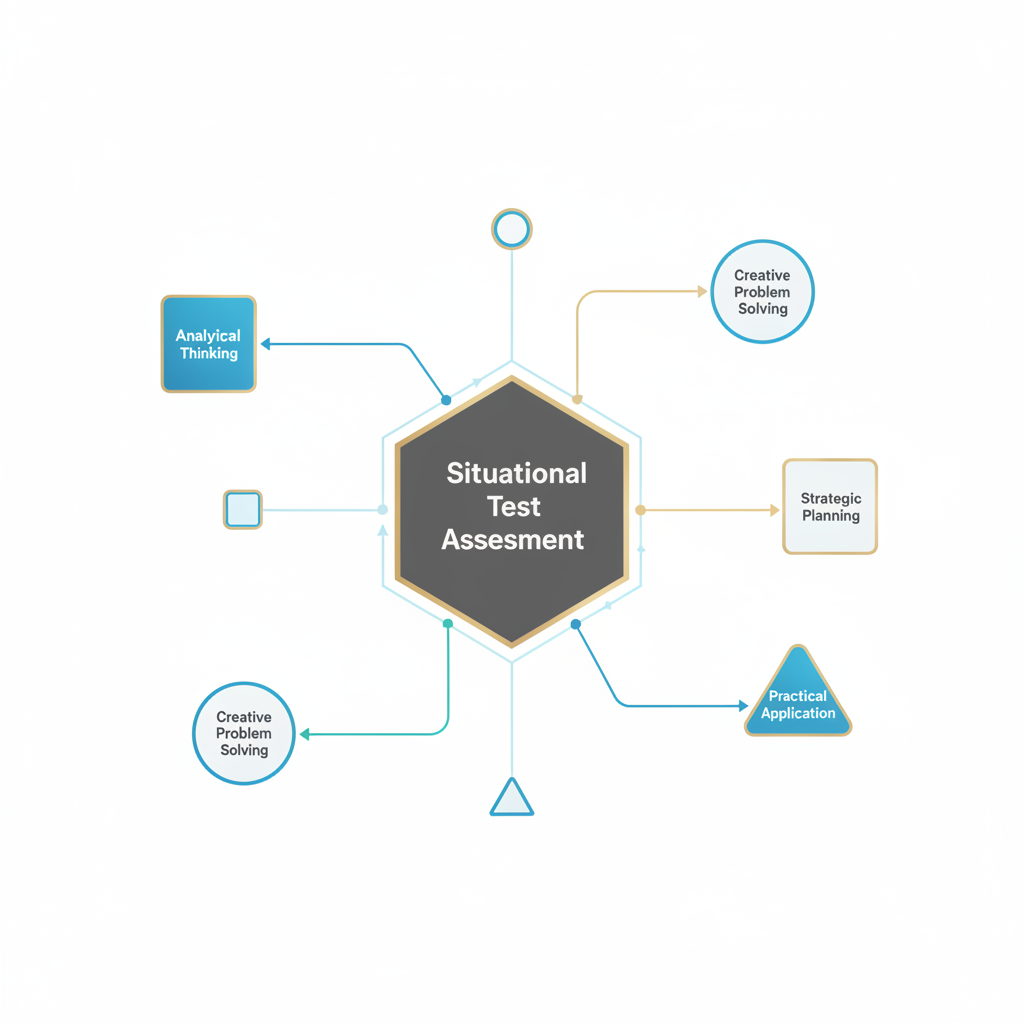
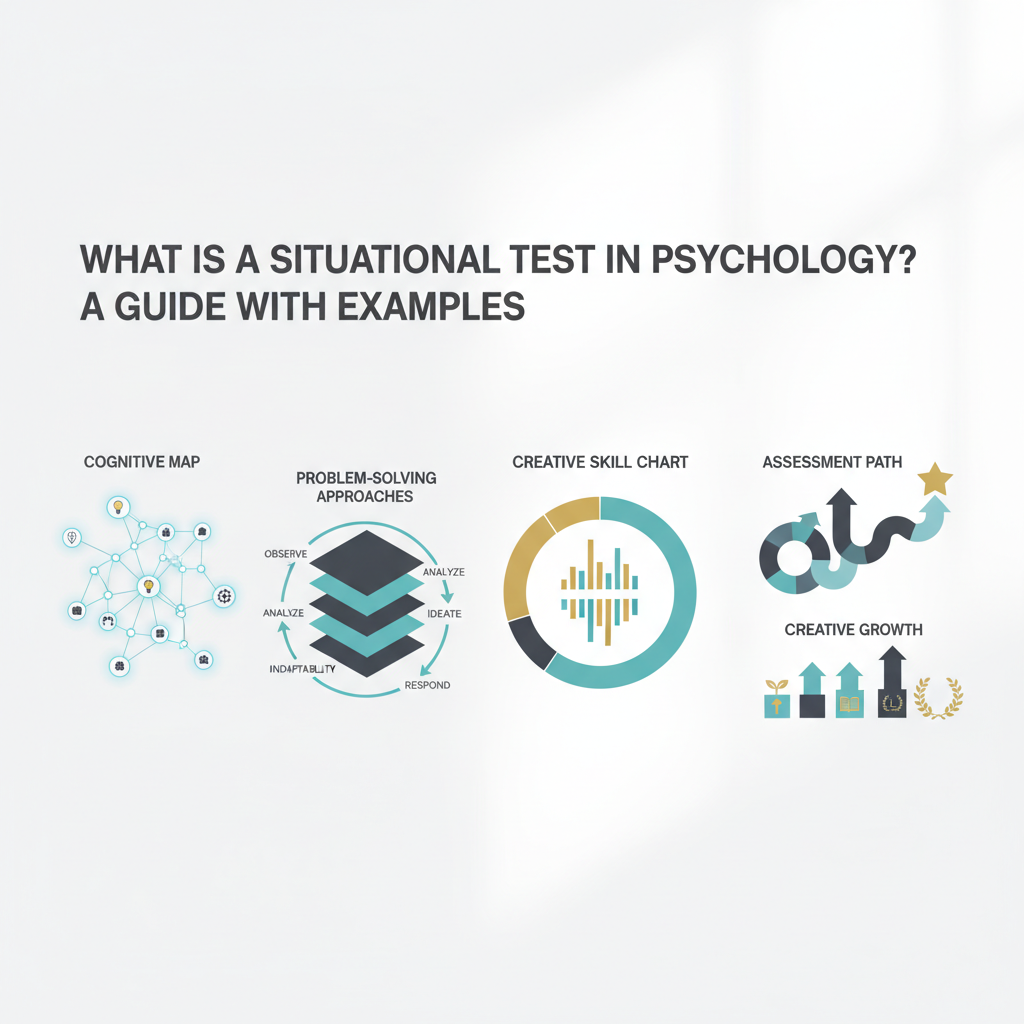
    An infographic showing a cognitive network diagram, where a central node branches out to illustrate how situational tests assess various thinking styles through interconnected geometric shapes.
    An abstract, educational infographic visualizing a cognitive network diagram or mind map. A central geometric node represents ‘Situational Test Assessment’, branching out into various interconnected, minimalist geometric nodes. These peripheral nodes represent different ‘Thinking Styles’ or assessment dimensions like ‘Analytical Thinking’, ‘Creative Problem Solving’, ‘Practical Application’, and ‘Strategic Planning’. The nodes are connected by thin, clean lines with subtle gradients, creating a professional and approachable vector-based visualization. The color palette features soft blues, whites, and charcoal, with gold and teal accents on key nodes and pathways to signify the assessment flow. The layout ensures ample negative space, providing structured grouping and clear visual hierarchy. No humans, photographs, or cartoon elements.

    Presenting Realistic Scenarios

    Situational tests put you in realistic, hypothetical situations. These scenarios are like challenges you might face in real life or at professional settings. The goal is to see how you naturally think and act in different circumstances.

    Unlike tests that measure memorized facts, situational tests look at your practical judgment. There isn’t a single “right” answer. Instead, they want to see your unique way of solving complex problems.

    For example, you might face a team conflict or a surprise project delay. How you handle these situations shows your core thinking style. Do you focus on teamwork? Do you look for new solutions? Your choices offer valuable insights.

    This method helps show your creative problem-solving skills. It shows if you can come up with new ideas when things are unclear. You also see how you adjust your thinking based on new information. [3]

    Evaluating Your Judgment and Problem-Solving

    When you take a situational test, you get a scenario with several options for what to do. Each option shows a different way of thinking or making a decision. Your choice, and your reasons for it, help measure your judgment.

    Evaluators look for several key things:

    • Critical Thinking: How well do you understand the problem? Can you spot the root causes?
    • Decision-Making: Can you make good choices under pressure? Do you consider the pros and cons?
    • Problem-Solving Approach: Do you follow a clear process? Or do you try creative and new solutions?
    • Strategic Thinking: Do you think about the long-term results? How do your actions affect other people?

    Your answers show your mental flexibility. This is your ability to switch between different ways of thinking. It’s a key part of creativity. For example, The Creative Ability Test explores how you use this flexibility for innovation.

    Understanding how you tend to solve problems is powerful. It helps you see where your creative thinking is strongest. It also shows you where you can develop new skills for growth.

    Measuring Key Competencies

    Situational tests are great tools for measuring key skills. These are the skills and behaviors you need to succeed in many areas of life. They go beyond technical knowledge.

    Common skills they measure include:

    • Communication: How well you share ideas and listen to others.
    • Teamwork: How you work with others and help the group succeed.
    • Leadership: Your ability to lead, motivate, and inspire people.
    • Adaptability: How well you adjust to new situations and challenges.
    • Initiative: Being willing to take action and get things done.
    • Emotional Intelligence: Understanding your emotions and the emotions of others.

    Many of these skills are closely linked to creativity. For example, adaptability is key for exploring many different solutions freely. Good communication also helps you share and improve your creative ideas.

    The Creative Ability Test gives a complete assessment. It measures specific parts of creativity, like mental flexibility and being open to new experiences. By understanding these traits, you get insights tailored to you. You learn how to use your unique thinking style for problem-solving and innovation.

    This self-awareness turns uncertainty about your skills into useful knowledge. You go from guessing about your creative potential to truly understanding it. This leads to clear strategies for growth. Our science-based approach ensures these insights are both reliable and practical.

    What Can Situational Tests Reveal About Your Creativity?
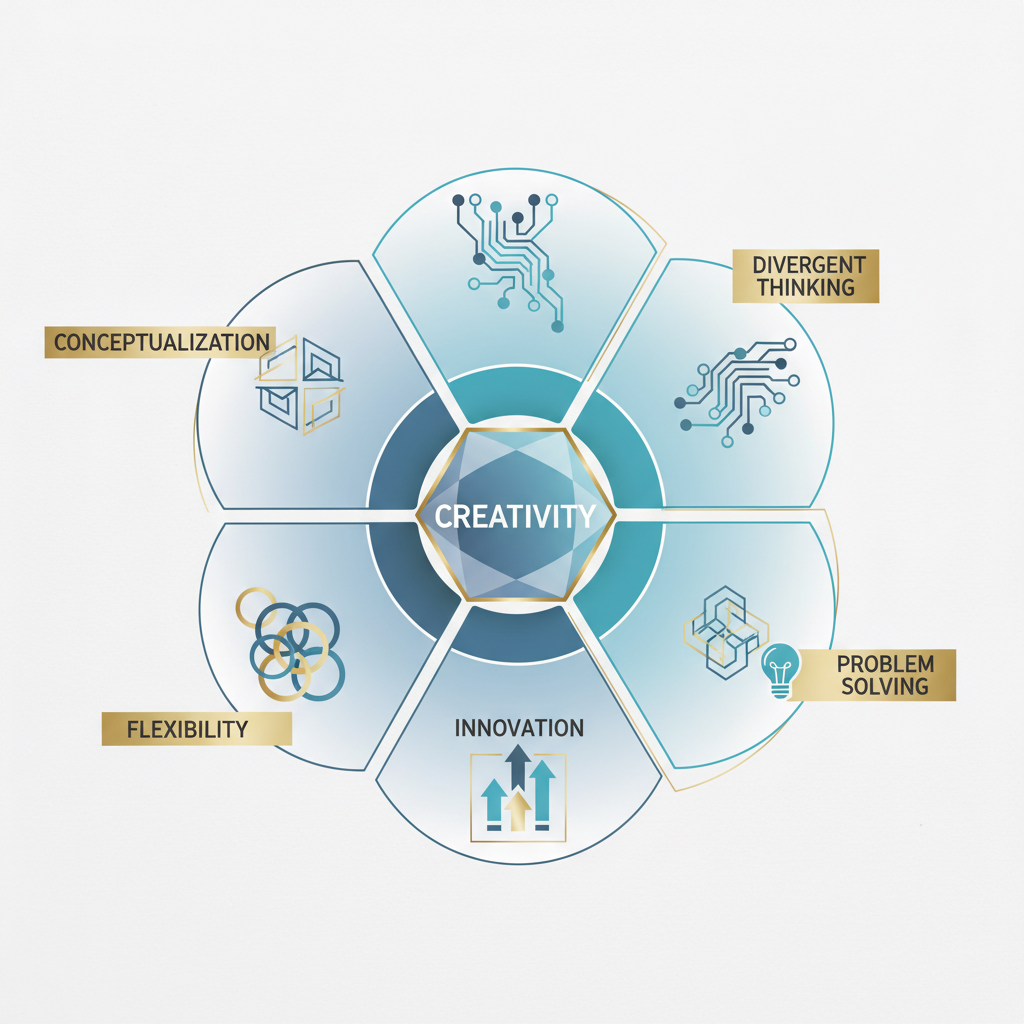
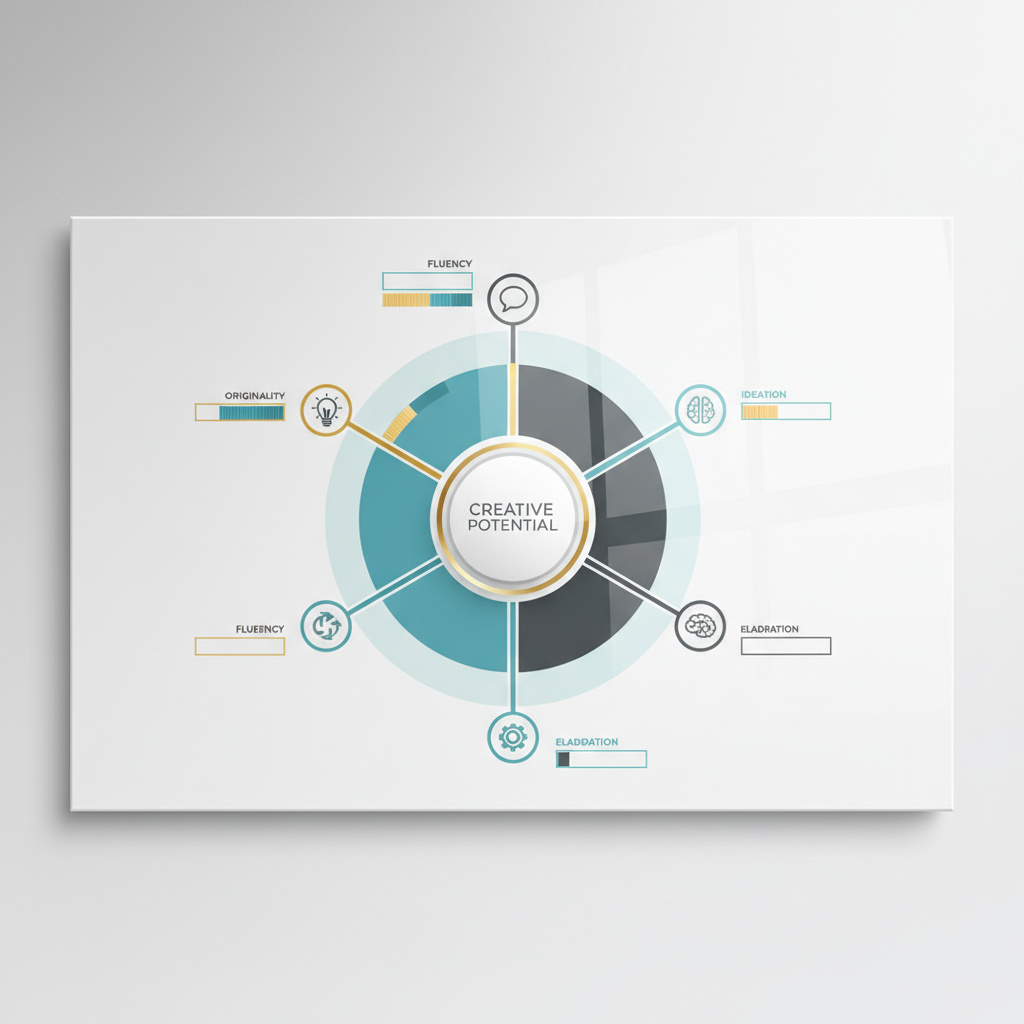
    An infographic depicting a multi-faceted assessment chart, shaped like a radar or competency map, revealing various dimensions of creativity through interconnected geometric segments.
    An abstract, educational infographic visualizing a multi-dimensional competency map or radar chart centered on ‘Creativity’. The chart branches out into distinct, interconnected geometric segments, each representing a dimension of creativity such as ‘Divergent Thinking’, ‘Problem Solving’, ‘Innovation’, and ‘Flexibility’. The design uses a minimalist, vector-based style with clean geometric shapes and subtle gradients. The primary color palette includes soft blues, whites, and charcoal, with gold and teal accents highlighting key areas and pathways. Ample negative space is incorporated around each segment for conceptual labels, maintaining visual hierarchy and a professional, approachable aesthetic. No humans, photographs, or cartoon elements.

    Assessing Your Approach to Vague Problems

    Situational tests often give you problems without a single, clear solution. These are called ambiguous problems. How you respond to these open-ended challenges reveals a lot about your creative thinking. When faced with uncertainty, do you search for new solutions, or do you stick to familiar paths?

    Creativity thrives in these situations. It encourages you to look beyond standard answers and consider multiple viewpoints to generate fresh ideas. This ability to explore new possibilities is a key part of thinking outside the box.

    For example, imagine a project deadline is suddenly moved up. A standard approach might be to simply work longer hours. A creative approach, however, could involve rethinking the project’s goals, using resources in a new way, or finding a completely different method to get the job done faster.

    Our assessment helps you understand how you handle these kinds of problems. It highlights your natural desire to be creative when clear answers are hard to find.

    Identifying Your Problem-Solving Style

    Everyone solves problems differently. Some prefer a step-by-step approach, while others rely on intuition. Situational tests are great at showing these natural tendencies. They reveal whether you typically use familiar solutions or search for completely new ones.

    Creative people often share certain traits. These include a willingness to experiment and a desire to connect ideas that seem unrelated. They might be good at brainstorming freely, thinking of many possibilities, or turning simple concepts into well-developed solutions.

    Understanding your natural style is powerful because it allows you to use your strengths. For example, if you’re good at combining different ideas, you can find roles that reward that skill. If you tend to be more analytical, you can practice techniques to boost your creative thinking.

    Our 30-question assessment offers insights into these habits. It helps you see how you use creativity in real-life situations. Knowing yourself is the first step to improving your creative skills.

    Highlighting Your Mental Flexibility

    Mental flexibility is a key part of creativity. It’s the ability to switch between different ideas or tasks. It also involves thinking about several concepts at once. This skill is essential for adapting to new information and changing situations [4].

    In a situational test, your flexibility shows when you face an unexpected twist. Do you rigidly stick to your first plan? Or do you quickly adjust and consider new solutions? People with high flexibility can easily change direction. They can look at problems from different angles and explore new paths.

    This trait helps you overcome mental blocks and break free from old thinking habits. For instance, if one approach fails, mental flexibility lets you quickly shift to a new one, sparking innovation.

    Our platform helps you measure your cognitive flexibility. We explain how this skill builds your creative potential and offer practical tips to develop it. This can greatly improve how you solve problems and come up with new ideas.

    Situational Test in Psychology Examples

    Example 1: The Team Project Dilemma

    Imagine you’re leading an important team project. Suddenly, a team member suggests a big change. This idea goes against the original plan everyone agreed on. Some team members are frustrated, feeling their work is being wasted. The deadline is also getting close.

    What would be your immediate response? Would you:

    • Dismiss the new idea quickly to keep things moving?
    • Listen carefully and encourage the team to explore its good points?
    • Call a meeting to discuss the new idea, even if it causes a small delay?
    • Find a way to use parts of the new idea without major changes?

    This scenario tests your leadership, problem-solving, and flexibility. A creative leader doesn’t just stick to the plan; they know when to change course. This means weighing new information and including different viewpoints. Your reaction shows how you handle new ideas in a team. It shows if you welcome or resist change for a better result.

    Example 2: The Unexpected Client Request

    You’re almost finished with a project for a key client, and everything is on track. Then, the client asks for a major, last-minute feature. This wasn’t in the original plan. Adding it would take more resources and could delay the project. But, doing it could also make your relationship with the client much stronger.

    How would you handle this situation? Consider these options:

    • Politely say no, pointing to the original agreement?
    • Agree right away, without checking the impact?
    • Talk openly with the client about the costs in time and money?
    • Brainstorm creative, alternative ideas that partly meet the request?

    This example tests how well you adapt and solve problems under pressure. It also checks your ability to find clever solutions. Your response shows how well you can think outside the box. Can you come up with several solutions to a surprise problem? This includes finding outcomes where everyone wins. It also shows how comfortable you are with unclear situations. Great creative thinkers turn challenges into chances to innovate.

    Example 3: The Resource Shortage Challenge

    Your team is working on an exciting new project. Halfway through, a sudden budget cut means you lose 30% of your money [5]. On top of that, a key supplier can’t provide a part you need. You have to continue the project with much less money and a missing part.

    What is your strategic approach? Would you:

    • Scale back the project to focus only on the most important parts?
    • Look for other funding or new suppliers right away?
    • Redesign the whole project to work with what you have?
    • Ask your team to brainstorm creative new ways to meet the goals?

    This scenario tests your resilience, creative problem-solving, and ability to succeed with limitations. Creativity often grows when resources are tight, forcing you to think in new ways. This encourages ‘scrappy innovation.’ Your choices show how well you can reuse what you already have. They also show your ability to come up with new solutions. This helps you make progress even with major setbacks. Our Creative Ability Test can show if you naturally welcome these challenges and use them to spark new ideas.

    How Can You Prepare for a Situational Test?
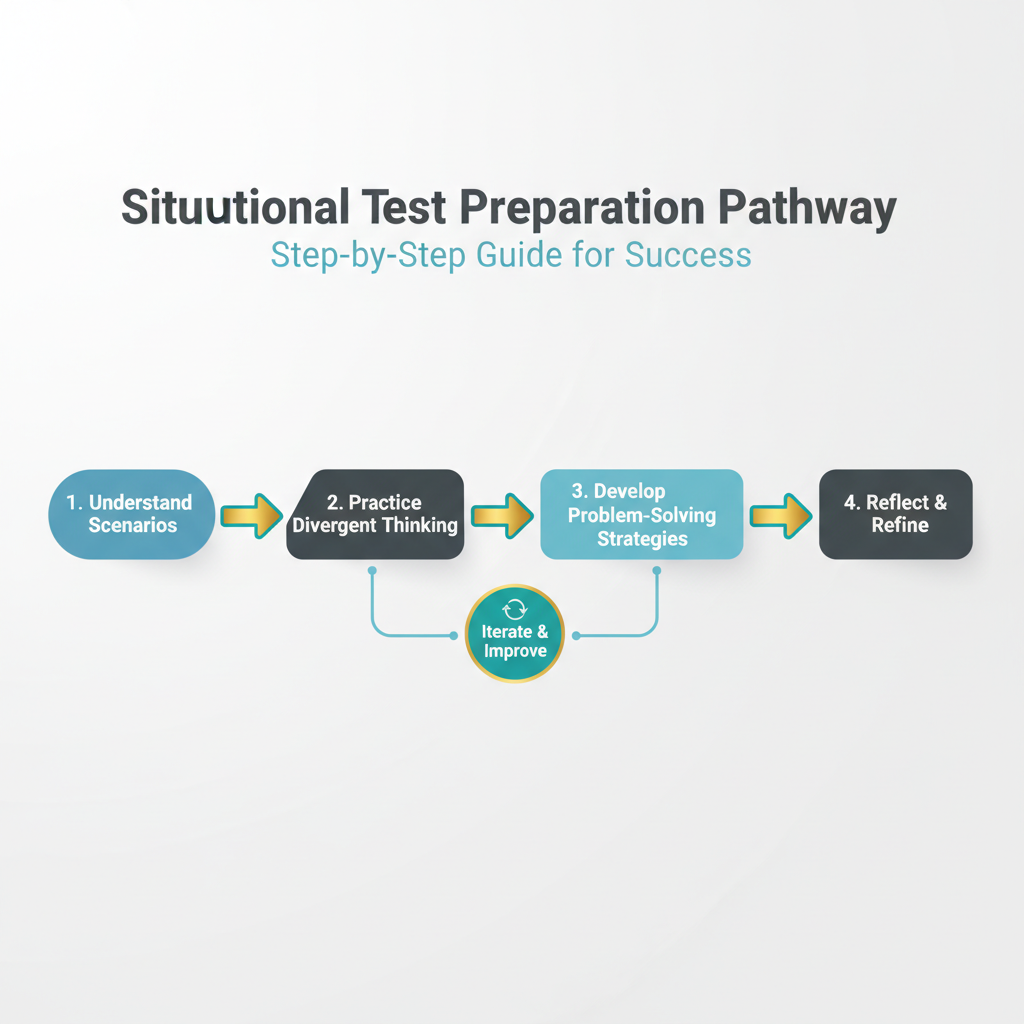
    An infographic illustrating a clear, step-by-step preparation pathway for situational tests, represented by interconnected geometric shapes.
    A clean, instructional infographic illustrating a sequential, step-by-step preparation pathway for situational tests. The visual uses a series of interconnected, minimalist geometric shapes (e.g., rectangles, circles, or abstract blocks) arranged in a clear progression, forming a pathway. Each shape represents a distinct preparation phase, such as ‘Understand Scenarios’, ‘Practice Divergent Thinking’, ‘Develop Problem-Solving Strategies’, and ‘Reflect & Refine’. The design is vector-based, professional, and approachable, using soft blues, whites, and charcoal as dominant colors, with gold and teal accents highlighting progression arrows and key shapes. Significant negative space surrounds each step for clarity and emphasis. No humans, photographs, or cartoon elements.

    Understand the Core Competencies Being Assessed

    To prepare for a situational test, you first need to understand its goal. These tests don’t use trick questions. They measure skills and behaviors that are key to success in a specific role. Companies look for people with strong problem-solving, communication, teamwork, and ethical skills. They also test your creativity, like how you handle new or unclear problems.

    Think about what the job requires and how you already show those qualities. For example, a test might see how you create new ideas under pressure or handle competing tasks.

    Key skills often tested include:

    • Problem-solving: How you analyze a situation and find good solutions.
    • Adaptability: How well you adjust to new information or changing situations.
    • Communication: Your ability to share ideas clearly and listen well.
    • Teamwork: How you work with others and contribute to a group.
    • Leadership: Your ability to take charge and guide others.
    • Resilience: How you deal with setbacks and stay positive.
    • Ethical Judgment: Your commitment to doing the right thing.

    Knowing what skills are being tested helps you shape your answers. You can show your strengths and creative thinking more easily. Our Creative Ability Test can help you find your unique creative style, which gives you a new way to understand these skills.

    Practice with Example Questions

    Practice is a key part of preparing. Working through sample questions helps you get used to the format and common situations. You can find practice tests on career websites and other online platforms.

    But just answering questions isn’t enough. You should also focus on why you chose an answer. Think about what makes one action better than another in a situation. This helps build your judgment.

    When you practice, follow these steps:

    • Read carefully: Make sure you understand the situation and the challenge.
    • Identify key people: Who is involved and what do they need?
    • Brainstorm solutions: Think of all the possible ways to handle the situation.
    • Consider the results: Think about the short-term and long-term effects of each option.
    • Choose the best option: Pick the answer that best shows the skills and ethics the company wants.
    • Explain your choice: Know the reasons for your answer. This will help you learn.

    This kind of practice makes you more flexible in your thinking. It gets you ready to think on your feet and solve real-world problems.

    Reflect on Your Own Experiences

    Your own experiences are a great way to learn. Think about times you faced a challenge or had to make a big decision. How did you handle it? What happened? Thinking about this shows you your natural way of solving problems.

    Think about specific times when you:

    • Resolved a conflict on a team.
    • Adapted to an unexpected change.
    • Created a new solution for a tough problem.
    • Communicated a complex idea clearly.
    • Took initiative or led a project.

    Look closely at these moments. What did you learn? How did you use your unique way of thinking? Knowing your patterns will help you face new situations with more confidence. This self-awareness, which tools like the Creative Ability Test can help build, is key to growing your career. It helps you talk about your strengths and show what you can do in a test.

    Frequently Asked Questions

    What is the difference between a situational test and a situational judgement test?

    People often use these terms to mean the same thing, but there’s a small difference. A situational test is a broad term. It gives you a realistic work scenario and asks how you would respond. This shows how you solve problems and use your judgment.

    A situational judgement test (SJT) is a specific type of situational test. In an SJT, you get a list of possible actions for each scenario. Your task is to evaluate these options. You might rank them from best to worst, or pick the most and least effective choices [6]. Both test types show how you naturally handle challenges and make decisions.

    These tests help us see how you think and apply creativity to real-world problems. The Creative Ability Test, for instance, looks closely at the thinking behind your choices to reveal your creative strengths.

    What skills do situational tests measure?

    Situational tests measure a wide range of skills that are important for success. They show how you use practical intelligence and creative thinking in different situations.

    Key skills measured often include:

    • Problem-Solving: How you analyze tough situations and find good solutions. Creative thinkers often bring a unique perspective to this.
    • Decision-Making: How you consider different options and make choices, especially when it’s stressful. This shows your judgment and ability to think ahead.
    • Communication: How you share information and listen to others. Good communication is essential for putting creative ideas into action.
    • Teamwork and Collaboration: How you work with other people to reach a common goal. Working together creatively often leads to new ideas.
    • Leadership Potential: Your ability to guide, motivate, and take the first step. Leaders often encourage creative problem-solving.
    • Adaptability and Flexibility: How you handle new situations or unexpected problems. This is a key part of cognitive flexibility.
    • Resilience: How you bounce back from setbacks and keep going. Creative people often see challenges as chances to learn.
    • Ethics and Integrity: How you stick to your principles and values when making difficult choices.

    By looking at these skills, situational tests give a full picture of your abilities. They show how you use your creative strengths in practice. Our Creative Ability Test helps you see these connections more clearly and improve your problem-solving skills.

    Are there right or wrong answers on a situational test?

    Most situational tests, especially Situational Judgement Tests, don’t have one single “right” or “wrong” answer. Instead, responses are scored on how effective they are and how well they match the key skills needed for a role [7].

    Some answers are better than others, and some are clearly not ideal. Your choices show your judgment and how you prefer to handle things. This gives us a good look at your thinking style and how you use your creativity.

    The goal is to understand how you naturally solve problems and make decisions. It’s not about getting a perfect score, but about self-awareness and growth. The Creative Ability Test provides personalized feedback to help you see your creative patterns. This allows you to improve your approach for better results.


    Sources

    1. https://www.shl.com/shl-products/situational-judgment-test/
    2. https://psycnet.apa.org/record/2012-09419-001
    3. https://onlinelibrary.wiley.com/doi/abs/10.1111/peps.12269
    4. https://hbr.org/2020/09/cognitive-flexibility-is-a-superpower-in-an-uncertain-world
    5. https://hbr.org/2014/10/how-to-do-more-with-less-money
    6. https://www.siop.org/Business-Resources/Assessment-Tools/Situational-Judgment-Tests
    7. https://www.emerald.com/insight/content/doi/10.1108/02683940210453715/full/html
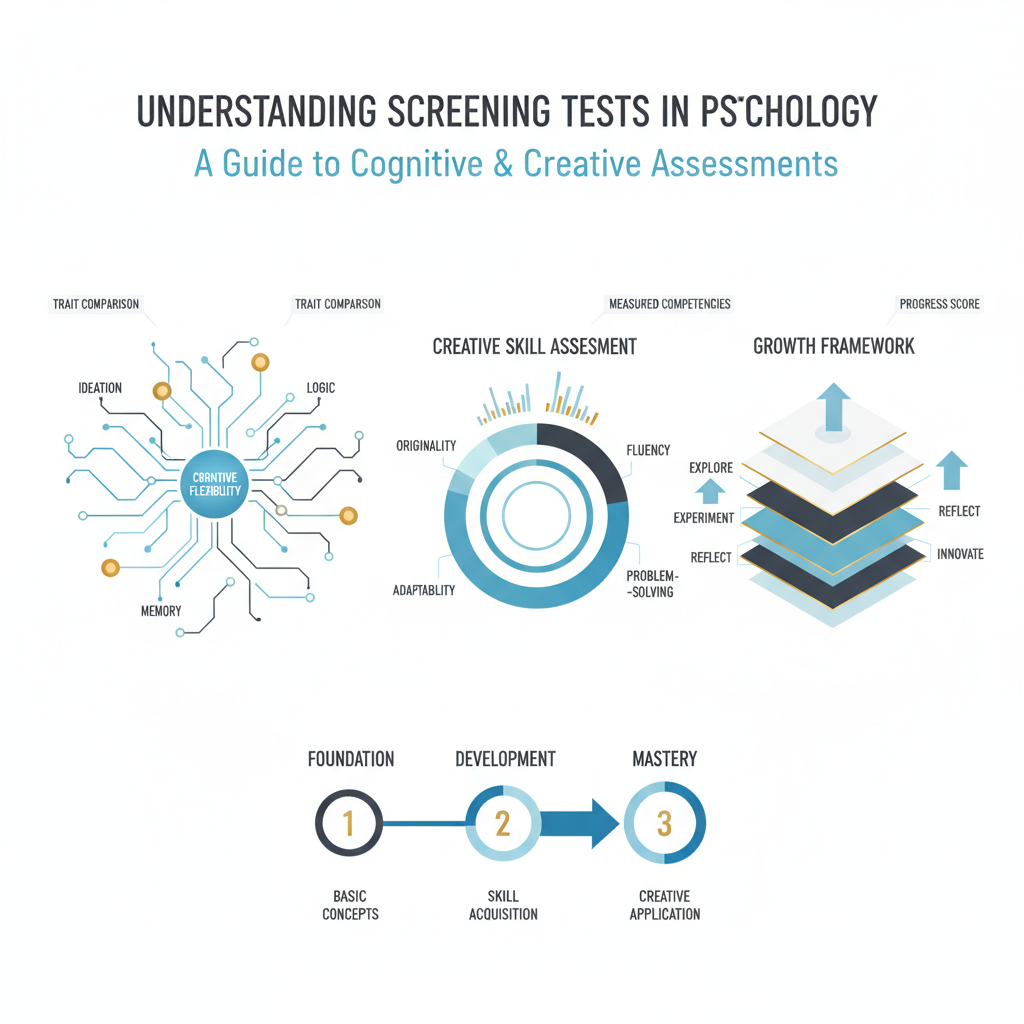
  • Understanding Screening Tests in Psychology: A Guide to Cognitive & Creative Assessments

    Understanding Screening Tests in Psychology: A Guide to Cognitive & Creative Assessments

    A screening test in psychology is a brief assessment tool designed to quickly identify potential characteristics, cognitive strengths, or risks for certain conditions. Its purpose is not to provide a diagnosis but to determine if a more in-depth evaluation is warranted, whether for clinical insight or for understanding personal traits like creativity.

    Have you ever wondered about your unique way of thinking and solving problems? Understanding your natural abilities is the first step to unlocking your full potential. Psychology offers many tools to help, and screening tests are one of the most accessible. These initial assessments offer a glimpse into your cognitive processes and creativity, revealing strengths you might not know you have.

    This article is your guide to psychological screening tests. We’ll explain what these tests are, how they differ from diagnostic tools, and the many areas they cover—from memory and reasoning to your creative potential. You’ll learn how a reliable screening test can highlight your unique thinking styles, offering practical ideas for personal growth and problem-solving in your daily life and at work.

    Whether you’re curious about your cognitive flexibility, want to boost your creative thinking, or simply wish to understand the psychology behind innovation, a well-designed screening test is a clear, objective starting point. It’s a great step towards self-discovery, giving you the knowledge to build on your natural talents. Let’s begin by defining what a psychological screening test is.

    What Is a Screening Test in Psychology?

    The Purpose of a Preliminary Assessment

    A psychological screening test is a helpful first step. It’s a quick way to get a glimpse into how a person thinks. Think of it as a flashlight that shines a light on specific areas for a closer look.

    These tests help find your strengths and areas that need more focus. They give you a general overview without requiring a full, in-depth evaluation. For example, in schools, a screening can identify different learning styles [1]. For Professional Development, it might show leadership skills or how you prefer to work in a team.

    When it comes to creativity, screening tests like our Creative Ability Test are very powerful. They help you discover your unique creative skills and thinking styles. Our science-based test looks at different parts of your creativity, such as your mental flexibility, how you solve problems, and your openness to new ideas. This gives you useful insights into how your mind creates new solutions and thoughts.

    The main goal is to give you more self-awareness. This awareness helps you grow both personally and professionally. It helps you:

    • Identify your natural creative talents.
    • Understand your favorite ways to solve problems.
    • Pinpoint areas where you can grow your creativity.
    • Use your strengths effectively in everyday situations.

    In the end, a preliminary assessment gives you a clear starting point. It takes you from being unsure about your abilities to having a clear awareness you can act on.

    Screening vs. Diagnosis: Knowing the Difference

    It’s important to know the difference between a screening test and a diagnosis. While both are types of assessments, their goals and detail are very different. A screening test gives you a first look. On the other hand, a diagnosis is a final, in-depth evaluation.

    A screening test is designed to give a general picture. It suggests you might have certain traits or points out areas of interest. For example, a creativity screening shows your thinking styles. It doesn’t label you “creative” or “uncreative.” Instead, it shows how you handle challenges and come up with ideas.

    In contrast, a diagnosis is a complete process done by a qualified professional. It includes detailed assessments, interviews, and information from several sources. A diagnosis results in a specific clinical label or the identification of a condition [2]. It is used to guide treatment plans or other interventions.

    Here’s an analogy: A screening test is like a general health check-up. It might show that certain areas need more attention. A diagnosis, however, is like seeing a specialist after that check-up. The specialist confirms a condition and recommends a specific treatment. Our Creative Ability Test is only a screening tool. It offers valuable insights into your creative potential but does not provide any kind of psychological diagnosis.

    Knowing this difference is key. It helps you use these tools in the right way. Our platform offers a powerful, science-backed screening for creativity. It’s a guide to help you understand and improve your skills. It gives you personal insights and tips for growth, helping you develop your creative thinking without any clinical meaning.

    What Are the Different Types of Psychological Screening Tests?

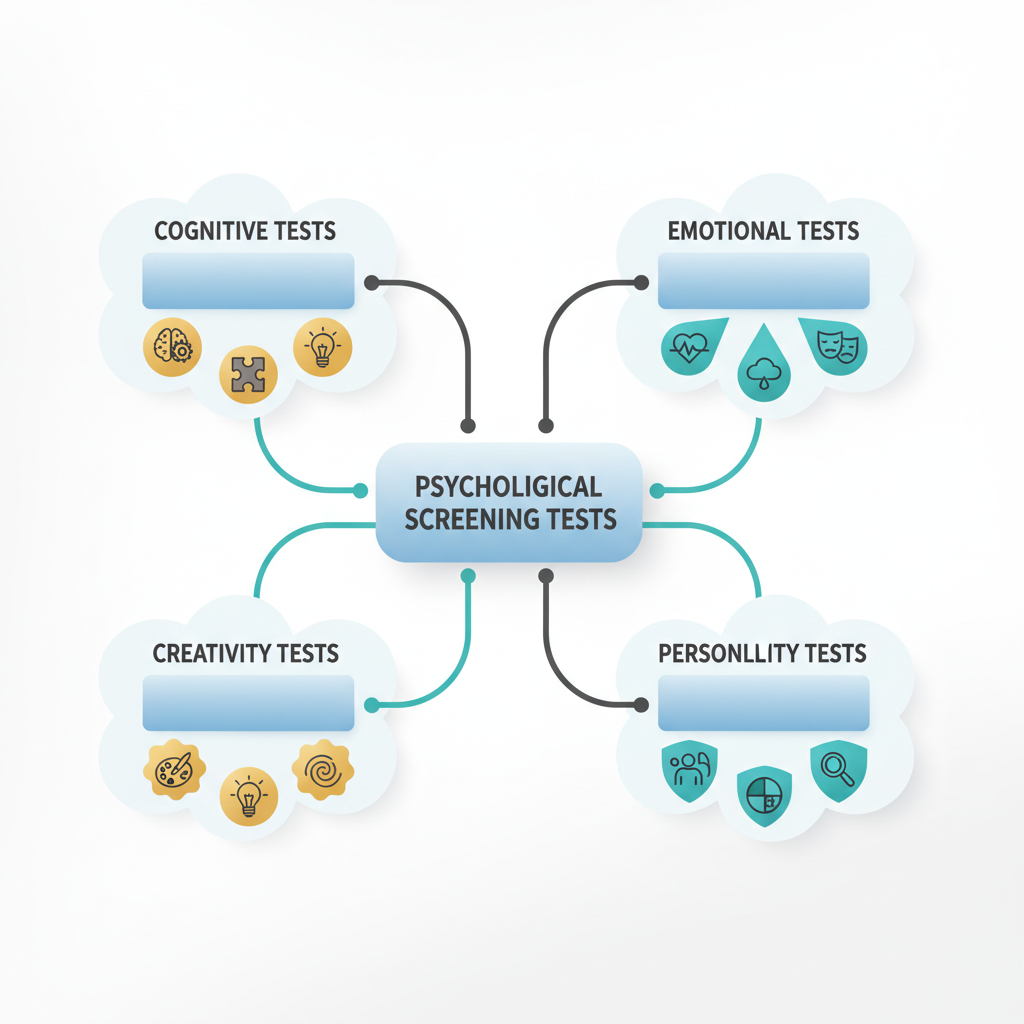
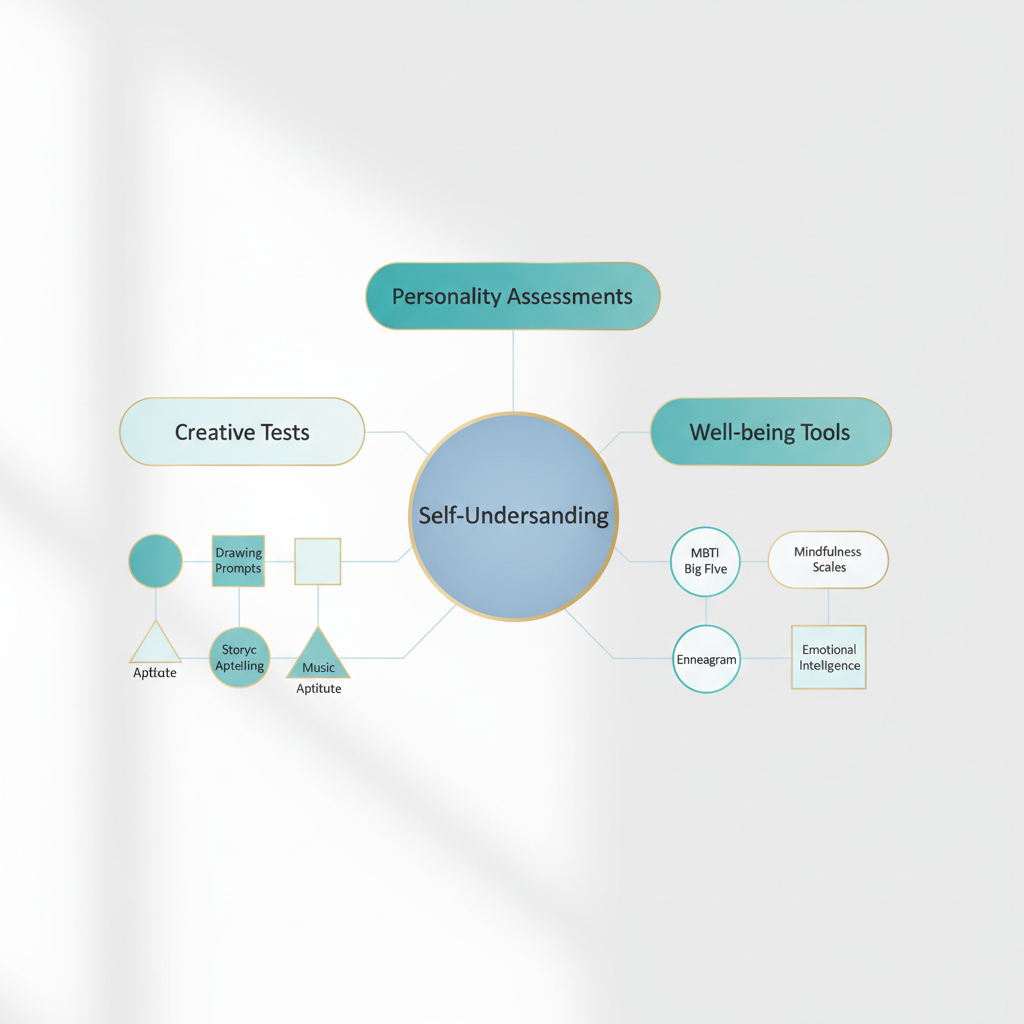
    Infographic displaying a mind map of different psychological screening test types, branching from a central concept into various categories like cognitive, emotional, and creativity tests.
    A minimalist, vector-based infographic showcasing the different types of psychological screening tests. Use clean geometric shapes, soft blues, whites, charcoal, with gold or teal accents. The visual should be a clear mind map or an idea cluster diagram, with a central node representing ‘Psychological Screening Tests’ branching out into distinct categories (e.g., Cognitive, Emotional, Creativity, Personality). Each category should have illustrative sub-nodes or simple, abstract icons. Use subtle gradients for clarity and engagement. Leave open areas for short category headers or labels. No humans, no cartoon elements. Focus on clarity, conceptual representation, and professional, educational branding.

    Clinical Screening for Mental Health

    Screening tests have many important uses. A common type is the mental health screening. These tests are early detection tools that help identify possible signs of a mental health condition.

    These screenings often look for common issues like depression, anxiety, stress, or substance use. They are usually quick, self-report questionnaires. People use them to get a basic idea of their emotional well-being.

    It’s important to know that a screening is not a diagnosis. It simply suggests if you should see a mental health professional for a full evaluation. This helps people get support sooner [3], which can lead to better outcomes.

    cognitive screening for Abilities like Memory and Reasoning

    Cognitive screening is another key type of test. These tests measure mental skills like memory, attention, problem-solving, and processing speed. They help us understand how our brains function.

    People use these screenings for many reasons. They can spot changes in thinking skills over time or find a person’s learning strengths and weaknesses. For example, a test might show someone is good at verbal reasoning but has slower processing speed.

    These tests often use standard tasks, like puzzles or special memory exercises. The results give you a helpful look at your cognitive profile. Knowing your cognitive abilities is important, as it helps you manage school, work, and daily life. Plus, cognitive flexibility is a key part of creative thinking.

    Creativity Screening for Innovative Potential

    Creativity tests are a fascinating and growing field. They are designed to understand your potential for innovation. They measure the different parts of creative thinking and problem-solving.

    These tests look at how you come up with new ideas. They check your ability for divergent thinking, which means finding many unique solutions to one problem. They also measure your openness to new experiences, along with your curiosity and imagination.

    A good creativity test gives you a detailed look at your unique thinking style. It helps you find your true creative strengths. For example, our Creative Ability Test is a 30-question assessment based on science. It reveals several sides of your creativity. Our approach is based on proven methods.

    The results are practical. They give you clear self-awareness and next steps. You get personalized feedback with strategies that match your creative profile. This helps you build your creative skills consistently.

    Here are key benefits of understanding your creative potential:

    • Better Problem-Solving: Learn to see challenges in new ways. This helps you find creative solutions at home and at work.
    • Personal Growth: Finding your creative strengths builds confidence. It also encourages you to keep learning and improving.
    • Career Growth: Creativity is a valuable skill at work. Understanding and growing it can open up new career opportunities and help you bring new ideas to your job.
    • More Cognitive Flexibility: You get better at adapting your thinking. This makes it easier to switch between different ideas and points of view.

    We use clear explanations and simple examples to make creativity easy to understand. Our platform helps you take what you learn about your creativity and use it in your daily life. This turns a basic understanding into real-world innovation.

    How Can a Screening Test Help You Understand Your Strengths?

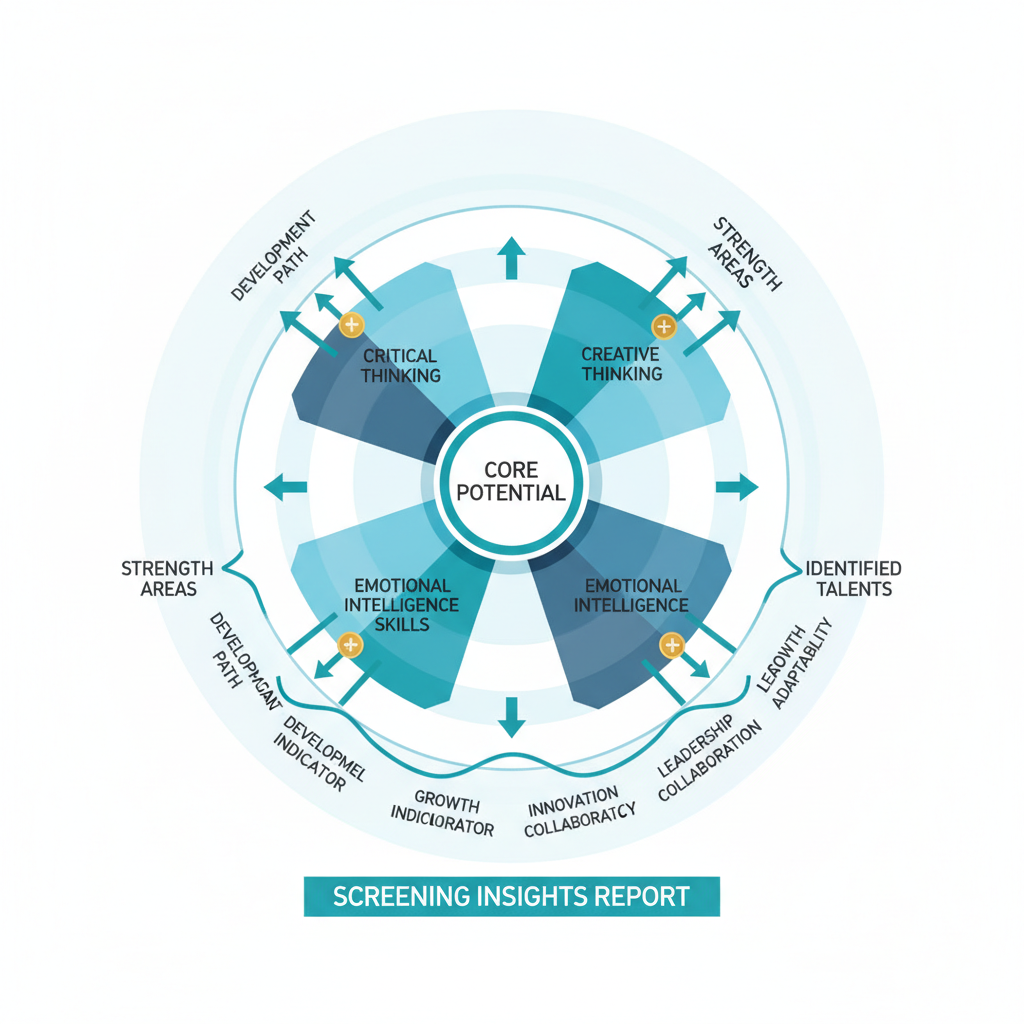
    Infographic visualizing how a screening test helps identify individual strengths, depicted as a competency graph with radiating segments indicating different skill areas and growth potential.
    A minimalist, vector-based infographic illustrating how a screening test helps individuals understand their strengths. Use clean geometric shapes, soft blues, whites, charcoal, with gold or teal accents. The visual should be a competency graph or a layered system showing growth and skill identification. Represent different areas of strength radiating from a central point or as stacked, interconnected layers, with indicators for development and potential. Maintain visual hierarchy and structured grouping. No humans, no cartoon elements. Focus on clarity, conceptual representation, and professional, educational branding.

    Find Your Thinking and Creative Skills

    Knowing your unique skills is a powerful first step. A good screening test helps you find your natural thinking and creative strengths. Think of it as a compass that points you toward what you do best.

    For example, the Creative Ability Test is a 30-question test based on science. It helps show the different parts of your creative ability. It looks at more than just simple answers to see how your mind works.

    You might discover talents in several key areas:

    • Divergent Thinking: This is how you come up with many different ideas. It’s key for brainstorming and finding more than one solution.
    • Cognitive Flexibility: This is how easily you can change the way you think. It helps you adjust to new situations.
    • Problem Sensitivity: This is a skill for seeing problems others might miss. It’s often the first step to solving a problem well.
    • Originality: The test can show your skill for creating new and unique ideas. These ideas are often different from what’s common.
    • Openness to Experience: This shows how open you are to new ideas and concepts. It’s a key part of creative thinking [4].

    Finding these talents gives you a clear picture. It turns unclear feelings about yourself into solid facts about your skills.

    Get Real Advice for Personal Growth

    Knowing your strengths is just the first step. A good screening test gives you advice you can actually use. You get more than just scores; you get real guidance for improving yourself.

    The Creative Ability Test gives you feedback just for you. It explains what your results mean. It also suggests specific ways to improve, based on your profile. This helps you go from just knowing your skills to actually building them.

    Consider these benefits:

    • Better Self-Awareness: You get to know your own creative thinking style better. This is the foundation for personal growth.
    • Focused Improvement: You get specific tips for your creative skills, not just general advice. For example, if you’re good at divergent thinking, you might get advice on how to choose your best ideas.
    • Build Confidence: Understanding your natural talents can boost your confidence. This makes it easier to take on new challenges.
    • A Clear Path to Grow: The results give you a roadmap to improve your creative skills. It helps turn your creativity into a skill you can count on.

    In the end, these insights are your guide. They help you develop your own creative style and lead to real personal growth.

    Use Your Strengths to Solve Problems

    Your creative strengths are more than just ideas. They are real tools you can use to solve problems and create new things. A screening test shows you how to use them in your daily life.

    For example, say you find out you’re highly original. You can use this skill at work on purpose. You could suggest new solutions to your team or help create new products.

    Here are a few ways to use your strengths:

    • At Work: Use your divergent thinking to brainstorm new ideas in meetings. Use your cognitive flexibility to adjust when a project changes.
    • In Your Personal Life: If you’re good at spotting problems, you can find the real cause of your own challenges. Then, you can use your creative skills to find new solutions.
    • For School: Students can use their imagination to come up with great essay ideas. They can also use creative thinking to handle tough research questions.
    • For Business Owners: Entrepreneurs can use their openness to new things to find gaps in the market. This helps them create new and exciting business ideas.

    The Creative Ability Test helps you connect the dots. It links your natural creative talent with real-world use. This allows you to handle challenges better. It also helps you bring a fresh approach to your personal and professional life.

    How Does a Creativity Screening Test Work?

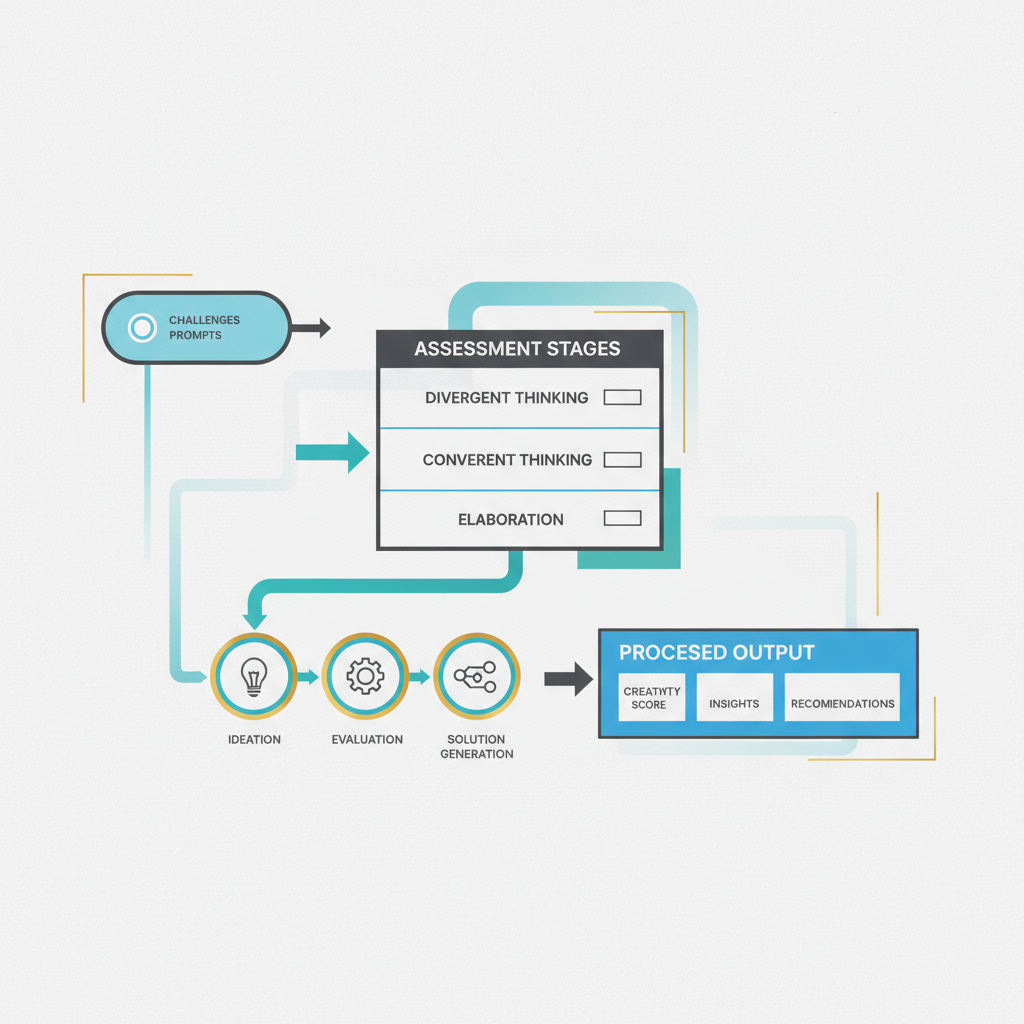
    Infographic showing the structured process of a creativity screening test, from initial input to evaluated insights, using abstract geometric shapes and a competency map layout.
    A minimalist, vector-based infographic illustrating the process of a creativity screening test. Use clean geometric shapes, soft blues, whites, charcoal, with gold or teal accents. The visual should depict a structured assessment chart or competency map, showing various stages of evaluation from initial input (e.g., challenges, prompts) to processed output (e.g., scores, insights). Use subtle gradients or accent highlights for clarity and engagement. Leave open areas for short infographic labels or competency indicators. No humans, no cartoon elements. Focus on clarity, conceptual representation, and professional, educational branding.

    Measuring Key Dimensions like Divergent Thinking

    Creativity is a mix of different skills. Our Creative Ability Test is a science-based, 30-question test that helps measure them. It is designed to show your unique creative strengths.

    One key skill is divergent thinking. This is the ability to come up with many ideas from a single starting point [5]. For example, “How many uses can you think of for a brick?” Someone with strong divergent thinking will list many different and original answers.

    Other key skills include:

    • Fluency: This is the total number of ideas you can generate. More ideas often lead to better ones.
    • Originality: This measures how unique your ideas are. We look for new and surprising connections.
    • Elaboration: This is your ability to add details to an idea. Rich details make your concepts stronger and more complete.
    • Cognitive Flexibility: This is your ability to look at things in new ways. It helps you find fresh solutions to problems.
    • Openness to Experience: This personality trait is closely linked to creativity [6]. It’s about being open to new experiences and unusual ideas.

    Our test questions are designed to make you think broadly and explore many solutions. This approach gives a clear picture of your creative strengths.

    Interpreting Your Results for Practical Use

    When you finish the Creative Ability Test, you get a personal report. This report is more than just a score. It gives you details about your creative style and how you think.

    Your results show your strengths clearly. For example, you might be great at divergent thinking, which means you can easily brainstorm lots of ideas. Or, a high originality score suggests you often come up with new and unique concepts.

    The feedback also explains how you think. Can you connect ideas that seem unrelated? Do you spot patterns others miss? Knowing this helps you use your natural strengths better.

    The report also shows areas where you can improve. This isn’t about weakness. It’s about potential. For example, you could work on your elaboration skills by learning to add more detail to your ideas.

    We explain each point with clear examples. This makes it easy to understand how your creative skills work in real life. Knowing this helps you use your creativity with more confidence.

    Using Feedback to Enhance Your Creative Skills

    The best part of a creativity test is the feedback you can use. It’s not just about knowing your score. It’s about using that knowledge to grow your skills.

    Your Creative Ability Test report includes helpful tips. These tips are designed to improve your creative thinking. They help you use what you’ve learned to solve real problems.

    Here are a few ways to use your feedback:

    • Targeted Practice: If you want to improve cognitive flexibility, practice looking at problems from different angles. This helps train your brain to think in new ways.
    • Boost Brainstorming: To improve fluency, try quick brainstorming sessions. Write down every idea that comes to mind. More ideas can lead to better ideas.
    • Cultivate Originality: Read about different topics, travel, and explore new cultures. New experiences are great for sparking original ideas.
    • Refine Ideas: To get better at elaboration, take a simple idea and add to it. Ask yourself, “How can I add more detail?” or “What if…?”
    • Problem-Solving Application: Use your strengths to solve problems. If you’re good at divergent thinking, start by listing many possible solutions before choosing the best one.

    These tips are based on your personal results. They turn knowledge into simple, clear actions. Studies show that creativity can be improved with practice [7].

    By using these techniques regularly, you can improve your creative skills. This helps with both personal and professional growth. You will get better at solving problems and creating new things. Our test is a guide on your journey to becoming more creative.

    What Should You Look for in an Online Screening Test?

    The Importance of Scientific Grounding

    When exploring your creative potential, it’s important to choose an online screening test carefully. The most critical factor is its scientific basis. This means the test is built on established psychological research and uses proven methods.

    A test with a scientific basis offers reliable and valid results. Reliability means the test consistently measures what it’s supposed to. Validity means it accurately measures creativity, not another trait. Think of it like a trusted tool—you want it to work correctly every time [8].

    Without this foundation, test results can be misleading. They might be entertaining but won’t offer real value for personal growth. Furthermore, these tests can’t truly help you understand your unique creative style.

    The Creative Ability Test, for example, is evidence-based. Our 30-question assessment is based on deep research in cognitive psychology and creativity. This commitment to science gives you accurate, trustworthy insights into your creative strengths.

    Look for clear information about how the test was made. Does it mention specific research or psychological theories? This transparency builds trust. It assures you that your results are based on solid science.

    Ensuring Clarity and Actionable Feedback

    A good online screening test should do more than just give you a “score.” It should provide feedback that is both clear and practical. You need to understand what your results mean in everyday life. Vague statements don’t help you improve.

    Good feedback makes complex ideas simple. It breaks down your creative profile into easy-to-understand parts. For example, it might explain your skill in coming up with new ideas. It could also highlight your mental flexibility or openness to new experiences.

    Beyond explanations, the feedback should offer practical tips. These tips help you build your creative skills. They turn abstract ideas into real steps you can take for personal and professional growth [9].

    The Creative Ability Test excels in this area. We provide personalized feedback that outlines your specific strengths. It also identifies areas where you can grow your creativity. Our aim is to move you from feeling unsure to having a clear, useful understanding of yourself.

    When looking at a test, ask yourself:

    • Are the results easy for a beginner to understand?
    • Does the feedback offer specific examples or scenarios?
    • Are there practical tips for applying these insights daily?
    • Does it inspire confidence and a clear path for improvement?

    Choosing a test with clear, practical feedback helps you use your creativity to solve real-world problems and innovate.

    Understanding the Scope: What the Test Can and Can’t Tell You

    It’s important to have realistic expectations for any screening test. An online test offers useful information, but it is not a final diagnosis or a full life assessment. Its purpose is to give you a first look at specific parts of your thinking and creative skills [10].

    A creativity test, like the Creative Ability Test, identifies your current creative potential and thinking styles. It measures things like your ability to generate new ideas. It also looks at how you approach problems creatively. This is a snapshot of your skills at this moment in time.

    What a test *can* tell you:

    • Your main creative thinking styles.
    • Your creative strengths, such as original thinking.
    • Potential ways you can grow your creativity.
    • How to use your creativity in different situations.
    • A starting point for creating your own growth plan.

    What a test *cannot* tell you:

    • If you are “creative” or “not creative.” Creativity changes and grows.
    • A full psychological diagnosis. This is not a clinical tool.
    • If you will succeed in a creative field. It shows potential, not your destiny.
    • Every detail of your personality. It focuses on creativity and thinking skills.

    Our platform is designed to empower you. We help you understand your creative strengths and unique skills. The Creative Ability Test offers a starting point for self-discovery. It guides you toward improving your creative thinking. This allows you to embrace personal growth and find new ways to solve problems.

    Frequently Asked Questions

    What are some psychological testing examples?

    Psychological tests give us helpful insights into how people think and behave. They help us understand ourselves better. They come in many different forms, and each one has a special purpose.

    Here are some common examples:

    • Cognitive Ability Tests: These tests check your mental skills. They measure areas like memory, problem-solving, and reasoning. Our Creative Ability Test, for example, looks at how flexible your thinking is. That’s a big part of being creative.
    • Personality Assessments: These tests show your unique personality traits. They can show how you connect with the world around you. For example, some measure your openness to experience. This trait is closely linked to creativity.
    • Creativity Screening Tests: These tests measure your potential for new ideas. They look at your imagination and ability to brainstorm. The Creative Ability Test is a prime example. It helps you find your unique creative strengths and thinking styles.
    • Clinical Diagnostic Tests: Experts use these to check for mental health conditions. They help diagnose conditions like anxiety or depression. They are very important for creating treatment plans.
    • Neuropsychological Tests: These tests check how your brain is working. They can find issues with specific brain skills. For example, they might test attention or language skills.

    Each type of test gives you a different way to learn about yourself. Knowing these types helps you pick the right tool for your own growth. [11]

    Can you take a psych evaluation test online for free?

    Yes, you can find many free psychological quizzes and screeners online. They cover a wide range of topics, like personality or creative style.

    But, it’s important to know the difference between them:

    • Informal Quizzes: Most free tests are just for fun or curiosity. They often aren’t backed by science. This means the results may not be accurate. They only give you a basic look.
    • Scientifically Validated Assessments: Professional tests, like the Creative Ability Test, are based on real research. Our 30-question test is backed by science. It gives you feedback you can trust and use. We use methods that are proven to work.

    Free tests are a good place to start if you’re curious. But they usually don’t offer the deep insights needed to truly grow. Using a trusted, science-backed test has real benefits. You get personal insights and useful tips. This helps you boost your creativity and grow as a person.

    What is a mental health test online?

    An online mental health test is a screening tool. It helps people check for symptoms of common conditions. These often include anxiety, depression, or stress.

    Here’s what you should know about them:

    • Purpose: Their goal is to help you become more self-aware. They help you see if you might have certain symptoms. This can be the first step to getting help.
    • Not Diagnostic: It’s important to remember these tests can’t give you a diagnosis. Only a qualified mental health professional can do that. An online test isn’t a substitute for a full evaluation by an expert.
    • Guidance to Support: If a screening shows you might have an issue, it will usually suggest you see a professional. This advice is key to getting help when you need it.
    • Focus Difference: Mental health tests focus on your well-being. Creative tests focus on your strengths. Our Creative Ability Test, for example, helps you understand and improve your creative thinking. This helps you grow personally and professionally.

    These online tools are a helpful first step. Always talk to a mental health professional if you have concerns. They can give you expert guidance and support. [12]


    Sources

    1. https://www.niu.edu/citl/resources/guides/instructional-guide/learning-styles/index.shtml
    2. https://www.apa.org/topics/psychological-assessment
    3. https://www.nimh.nih.gov/health/topics/mental-health-screenings
    4. https://psycnet.apa.org/record/2012-07502-001
    5. https://en.wikipedia.org/wiki/Divergent_thinking
    6. https://www.psychologytoday.com/us/blog/the-wide-open-world/201908/the-link-between-openness-and-creativity
    7. https://psycnet.apa.org/record/2017-06283-001
    8. https://www.apa.org/education-career/guide/assessment-research
    9. https://cft.vanderbilt.edu/guides-sub-pages/writing-good-feedback/
    10. https://www.ncbi.nlm.nih.gov/pmc/articles/PMC8900010/
    11. https://www.apa.org/education-career/guide/testing
    12. https://www.nami.org/About-Mental-Illness/Diagnosing-Mental-Illness/Online-Screenings

  • The Sternberg Intelligence Test: An Ultimate Guide to Practical, Analytical & Creative Thinking

    The Sternberg Intelligence Test: An Ultimate Guide to Practical, Analytical & Creative Thinking

    The Sternberg intelligence test, based on the Triarchic Theory of Intelligence, assesses three distinct types of intelligence: analytical, creative, and practical. Unlike traditional IQ tests that focus mainly on academic skills, it provides a broader view of intelligence by evaluating real-world problem-solving and innovative thinking. This approach helps identify a person’s unique cognitive strengths.

    Have you ever felt that traditional intelligence tests don’t measure everything you can do? For a long time, being ‘smart’ just meant being good at schoolwork or logic puzzles. But intelligence is much more than that. It’s also about how you create, adapt, and handle real-world challenges. This wider view is the basis of the Sternberg Intelligence Test. It helps us see all our mental strengths and our creative potential.

    This article will explain the Sternberg Intelligence Test and its Triarchic Theory of Intelligence. We will look at the three types of intelligence it covers: analytical, creative, and practical. These types are separate but work together. By learning about each one, you’ll better understand your own thinking styles. You’ll see how you break down problems, come up with new ideas, and use what you know in daily life.

    Understanding the Sternberg model can help you, whether you want to improve your problem-solving, grow personally, or just learn about your own creativity. We’ll show you how using these different kinds of intelligence can change how you face challenges. You’ll learn new ways to innovate and get tips for strengthening each of these key areas. Get ready to discover more about yourself and see how a good balance of these skills can unlock your creative ability and help you navigate the world with more confidence.

    What Is the Sternberg Intelligence Test?

    Moving Beyond Traditional IQ

    For a long time, IQ tests were the main way to measure intelligence. These tests focused on logic and language skills. But they often missed other important human abilities.

    However, real intelligence is much more than that. Creative thinking, for instance, is key for new ideas. Practical skills are needed for everyday life. Traditional IQ scores didn’t show this full picture.

    As a result, many experts wanted a wider view. They knew that a deeper understanding of intelligence could help people do better at work and in life. This change led to new theories that gave better insights into our mental strengths.

    Understanding these different parts of intelligence helps you see your own unique skills. It supports you as you grow and improve yourself.

    Introducing the Triarchic Theory of Intelligence

    Because old IQ tests had limits, Dr. Robert J. Sternberg offered a new idea. This well-known psychologist created the Triarchic Theory of Intelligence [1]. His work changed how we think about being smart.

    Sternberg’s theory says that intelligence isn’t just one thing. Instead, it is made of three different but connected parts. This gives us a much broader view of what it means to be “smart.”

    These three types of intelligence work together to help us succeed in life. They are:

    • Analytical Intelligence: This is our skill for analyzing, judging, and comparing information. It helps us solve problems in traditional academic settings.
    • Creative Intelligence: This involves coming up with new ideas and dealing with new situations. It is about thinking outside the box.
    • Practical intelligence: This is the ability to use knowledge in real-world situations. It helps us adapt to our environment or change it to fit our needs.

    This complete theory helps you explore your own thinking styles. It helps you understand your strengths in solving problems and coming up with new ideas. It also shows how these different forms of intelligence lead to overall success and personal growth.

    What Are the 3 Types of Sternberg Intelligence?

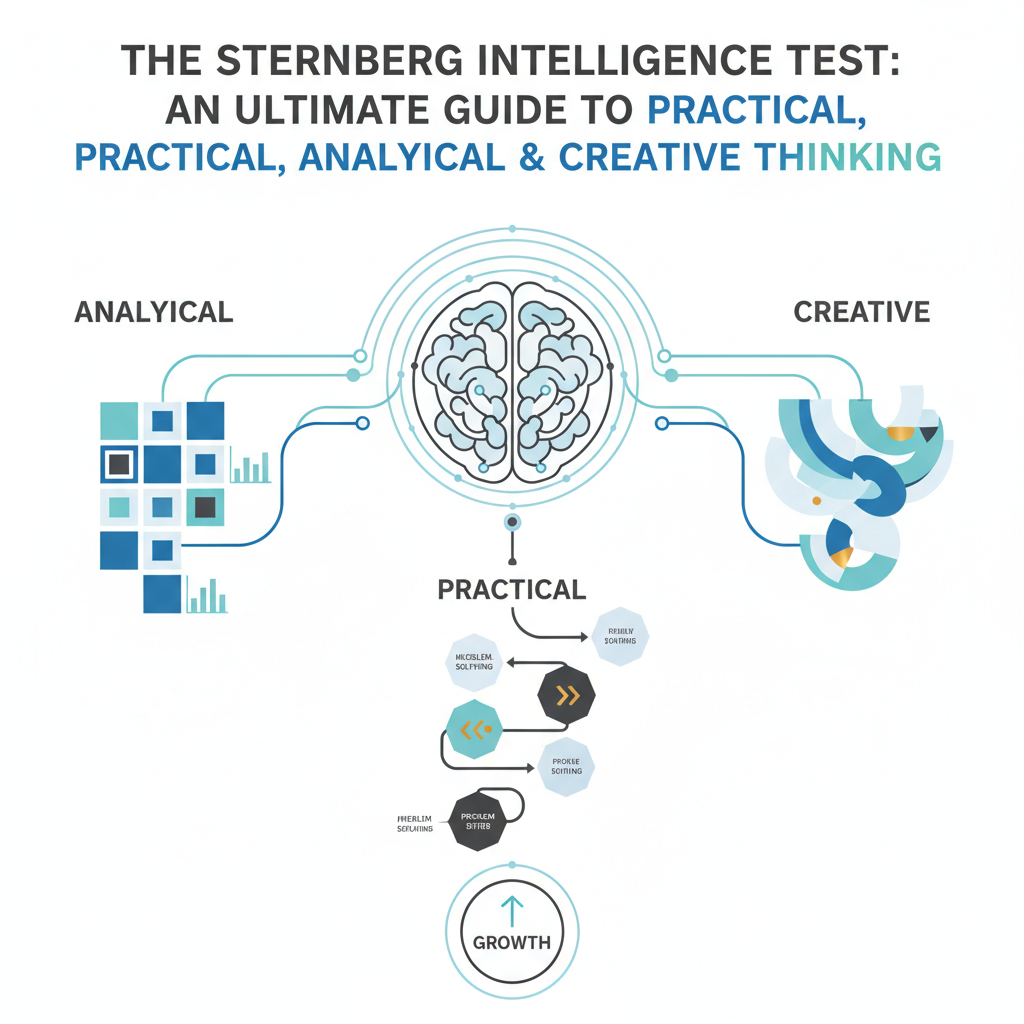
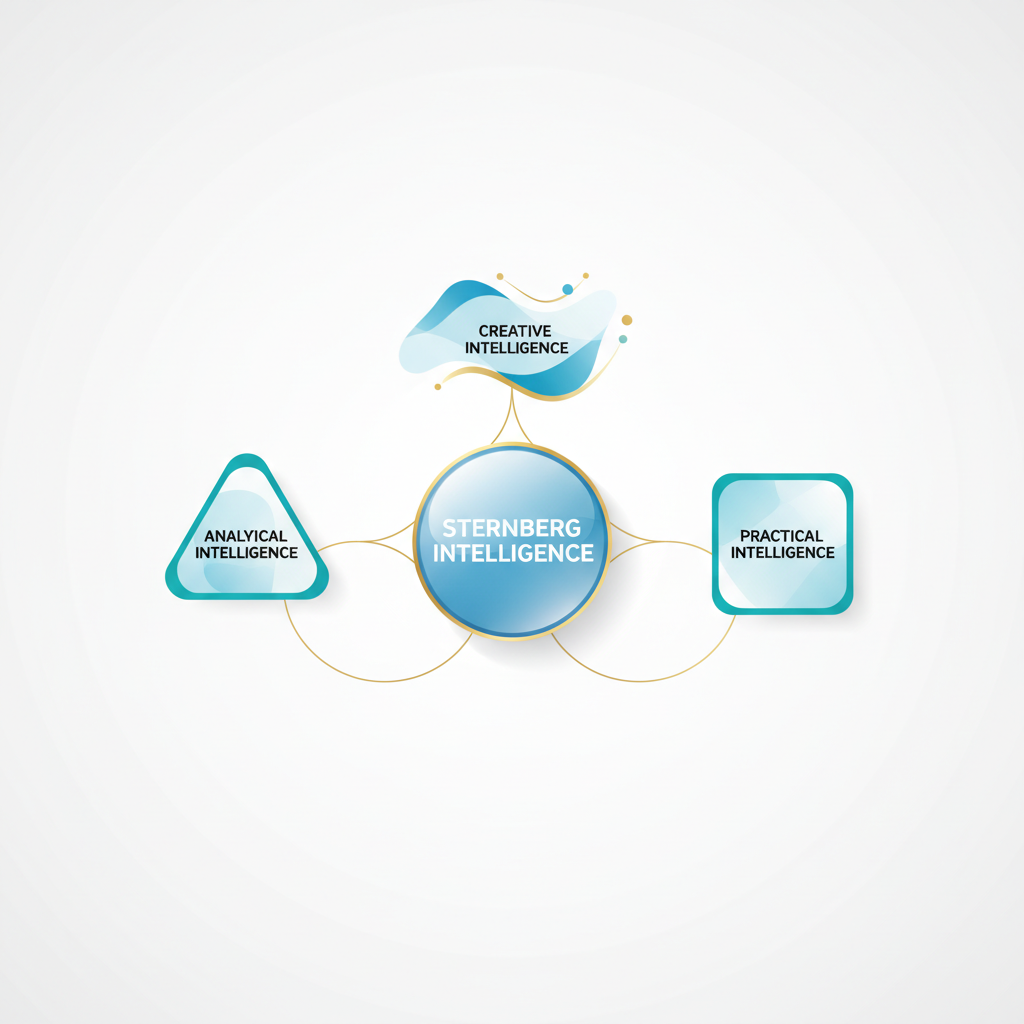
    An infographic showing a central concept of Sternberg Intelligence branching into three distinct, interconnected geometric shapes representing Analytical, Creative, and Practical intelligences.
    An abstract, educational infographic illustrating the three distinct types of Sternberg Intelligence. A central, rounded geometric shape represents ‘Sternberg Intelligence’ and branches out into three interconnected, unique geometric shapes. Each branching shape represents one intelligence type (Analytical, Creative, Practical), with subtle gradients in soft blues and whites, highlighted by gold or teal accents. The composition is minimalist, vector-based, professional, and approachable, with clear negative space for short labels. No humans, no cartoon elements.

    Analytical Intelligence: The Problem Solver

    Analytical intelligence is what many traditional intelligence tests measure. Sometimes called “componential” intelligence, it involves the mental skills you use to analyze, evaluate, and compare information [2]. Think of it as your inner academic.

    This intelligence is key for breaking problems down into smaller parts. It helps you understand cause and effect. You use analytical intelligence when you:

    • Evaluate arguments and evidence.
    • Solve complex logical puzzles.
    • Identify patterns and connections.
    • Critique ideas or plans.

    If you want to be a creative problem-solver, strong analytical skills are essential. They help you see if your new ideas will work and spot any potential problems. This ensures your creative ideas are not only imaginative but also practical and effective.

    Creative Intelligence: The Innovator

    Creative intelligence is about how you handle new situations. Also known as “experiential” intelligence, it means using what you already know to come up with new ideas and solutions. This is where innovation truly shines.

    This type of intelligence is all about imagination and fresh perspectives. It helps you think outside the box. You use creative intelligence when you:

    • Invent unique solutions to problems.
    • Come up with new ideas.
    • Connect different pieces of information in new ways.
    • Adapt to new situations quickly.
    • Imagine different possibilities.

    Our Creative Ability Test is specifically designed to explore and measure this intelligence. It looks at your ability to think flexibly, generate many ideas, and stay open to new things. When you understand your creative intelligence, you can use your unique way of thinking to grow and innovate.

    Practical Intelligence: The Real-World Navigator

    Practical intelligence is your ability to apply what you know to real-world situations. It’s often called “street smarts” or common sense. This intelligence, also known as “contextual” intelligence, helps you adapt to, shape, or choose new environments.

    This practical wisdom helps you put ideas into action. You use practical intelligence daily when you:

    • Solve everyday problems effectively.
    • Navigate social situations.
    • Understand unspoken rules.
    • Manage tasks and projects efficiently.
    • Apply knowledge to achieve goals.

    When you have a brilliant creative idea, practical intelligence helps you turn it into reality. It helps you figure out what will actually work in a real situation. Improving this skill means you can bring your creative solutions to life and handle any challenge that comes up.

    How Does the Sternberg Triarchic Abilities Test (STAT) Work?

    What to Expect from the Test Questions

    The Sternberg Triarchic Abilities Test (STAT) is not just a memory test. It tests your mind in three different ways. This assessment shows your unique mental strengths. It helps you see how you solve different problems.

    Each part of the STAT looks at a specific type of intelligence. You will see different kinds of questions. These might include multiple-choice, short-answer, or scenario-based tasks.

    • Analytical Questions: These test your critical thinking. You might solve analogies, complete number sequences, or interpret logical statements. The goal is to break down problems and find the one right answer.
    • Creative Questions: This part tests your ability to come up with new ideas. You could be asked to invent a unique story. You might also design a new product or suggest different solutions to a common problem. These questions look for original and clever thinking. [3]
    • Practical Questions: Here, you use what you know in real-life situations. Imagine you are given a practical problem at work or in daily life. You then choose the most effective solution. These tasks measure your “street smarts” and how well you adapt.

    The STAT questions push you to think in flexible ways. They are not always about finding one perfect answer. Instead, they look at how you think and solve problems. This approach gives a fuller picture of what you can do.

    Interpreting Your Results for Personal Growth

    Receiving your STAT results is an exciting step. It’s more than just a score. It gives you a detailed map of your unique cognitive profile. Understanding this is a powerful tool for learning about yourself and growing.

    Your results will show your strengths in all three types of intelligence. For example, you might be great at creative thinking. This means you’re good at coming up with new ideas. Or maybe your practical intelligence is a high point, meaning you’re great at solving everyday problems.

    Understanding your creative strengths is especially helpful. The STAT can reveal:

    • Divergent Thinking: Your ability to come up with many different ideas from one starting point.
    • Originality: How unique and uncommon your ideas tend to be.
    • Cognitive Flexibility: How easily you can change your point of view and try new approaches.
    • Openness to Experience: How willing you are to explore new ideas and try unusual methods.

    How can you use this information? Your profile gives you useful information you can act on. You can use your strongest type of intelligence to your advantage. You can also see which areas you might want to improve. For example, if you are strong in creative intelligence, you could look for jobs that require new ideas. If you want to improve your practical intelligence, you could practice solving real-life problems. [4]

    Remember, these results are not fixed labels. They are a starting point for growth. They help you grow your skills more effectively. At Creative Ability Test, we use these insights to help you. We help you turn what you’ve learned into personal strategies. This guidance helps you continue to develop your creative skills. It turns uncertainty into confident self-awareness.

    Why Does Sternberg’s Model Matter for Your Creativity?

    Connecting Creative Intelligence to Your Potential

    Sternberg’s model is a great way to understand your creative skills. It shows that creativity isn’t just a mysterious talent. Instead, it defines Creative Intelligence as a specific skill you can measure.

    This type of intelligence is all about creating new ideas. It helps you see problems in new ways and come up with fresh solutions. It also encourages you to question old habits and think with imagination.

    Understanding your creative intelligence is key to reaching your full potential. Our Creative Ability Test assessment helps you find your unique creative strengths. You will discover your personal approach to challenges and how you create original thoughts.

    As a result, you get a clear look at your:

    • Divergent thinking abilities: How many different ideas can you produce?
    • Cognitive flexibility: How easily can you switch perspectives?
    • Novelty generation: How adept are you at creating something truly new?
    • Risk-taking in ideation: Are you comfortable exploring unusual ideas?

    These insights are practical, not just theory. They give you a clear path for growth. You learn how to use your natural creative style well in your personal and professional life.

    Using a Balanced Approach to Solve Problems

    True innovation often needs more than one type of intelligence. Sternberg’s Triarchic Theory shows the power of using a balanced approach. It highlights how combining analytical, creative, and practical skills leads to better problem-solving.

    Think about a tough problem you’re facing. You might start by breaking it down with logic. This is where your analytical intelligence shines. You identify the main parts of the problem and any potential roadblocks. For instance, you could analyze market data for a new product idea [5].

    However, analysis alone can lead to the usual answers. This is where creative intelligence becomes essential. It lets you brainstorm fresh, unusual solutions. You can think outside the box and imagine possibilities others might miss. Perhaps you see a completely new product feature or a different way to deliver a service.

    Finally, practical intelligence turns your ideas into reality. It helps you figure out what is possible and how to make it work. You consider real-world limits, like your budget and timeline, and create a solid plan. This intelligence makes sure your great ideas can succeed in your environment.

    By understanding your profile across all three intelligences, you can develop a more well-rounded approach. Our complete 30-question Creative Ability Test assessment provides this valuable insight. It offers personal feedback and clear next steps. These tools help you strengthen any area you choose, making you a more flexible and effective problem-solver.

    How Can You Enhance Your Triarchic Intelligences?

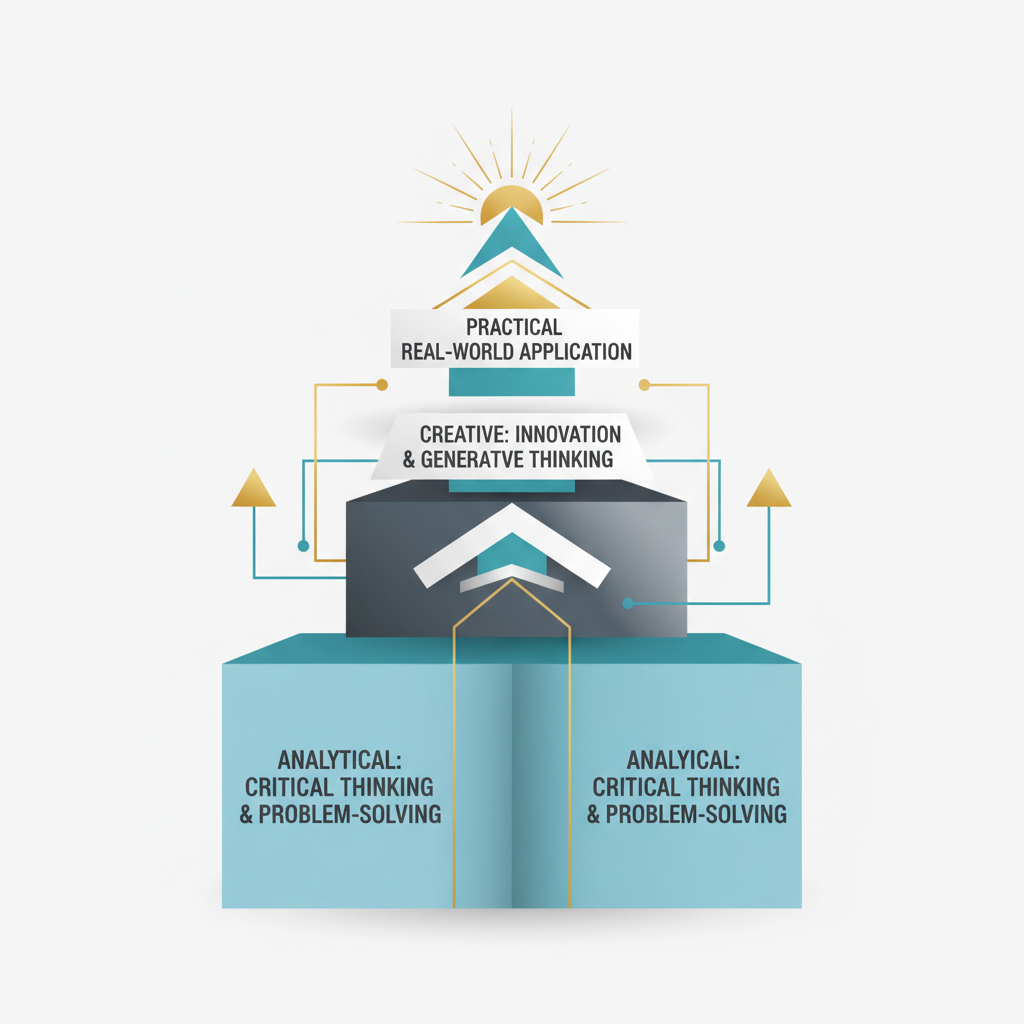
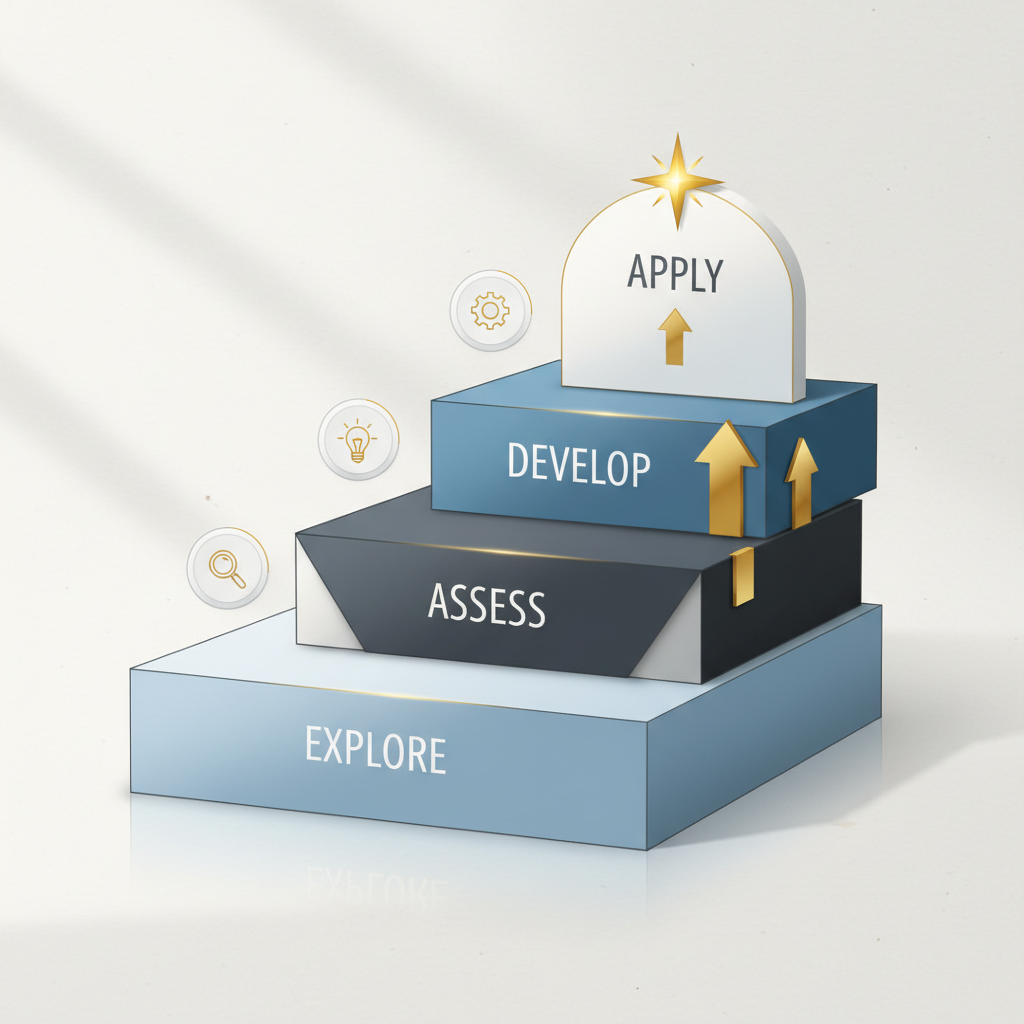
    An infographic illustrating a layered, upward progression of strategies and steps designed to enhance an individual's triarchic intelligences, using geometric shapes and accent colors.
    An abstract, educational infographic presenting strategies for enhancing triarchic intelligences. Visualize this as a layered system showing growth, a milestone progression, or an upward-moving framework. Utilize clean, ascending geometric shapes or interlocking segments, each representing an actionable strategy or step towards improvement. The color palette includes soft blues, whites, and charcoal, with prominent gold or teal accents to signify progress and impact. The style is minimalist, vector-based, professional, and approachable, designed with negative space for concise labels. No humans, no cartoon elements.

    Understanding how you think, whether with a framework like Sternberg’s or a detailed assessment like the Creative Ability Test, is just the first step. The real power comes from actively improving your skills. This includes strengthening your analysis, expanding your creativity, and sharpening your real-world problem-solving. The Creative Ability Test also offers personal feedback and clear steps to build on your unique creative talents.

    Practical Tips for Boosting Analytical Skills

    Analytical intelligence helps you break down problems, study information, and make good decisions. It involves critical thinking and logic. Here are several effective ways to strengthen these important skills.

    • Engage with Logic Puzzles: Regularly solve puzzles like Sudoku, crosswords, or riddles. These activities train your brain to see patterns and find solutions. They also sharpen your mind.
    • Practice Critical Reading: When you read, don’t just absorb facts. Question the author’s ideas and look at their evidence. Think about other points of view. This helps you understand things more deeply.
    • Break Down Complex Problems: When you face a big challenge, divide it into smaller, manageable parts. Look at each part on its own. This makes big tasks feel less overwhelming.
    • Ask “Why” Repeatedly: Don’t stop at the first answer. Keep asking “why” to find the real cause of a problem. This habit helps you understand things on a deeper level.
    • Learn Basic Coding: Coding requires you to think in a clear, logical way. It teaches you how to structure instructions and fix errors. This is a great way to practice your analytical skills.
    • Reflect on Decisions: After you make a choice, think about what happened. Ask yourself what went well and what you could do better next time. This helps you make better decisions in the future [6].

    Strong analytical skills also support your creativity. They help you judge new ideas carefully and improve your innovative solutions. Our platform gives you insights into how your analytical side affects your creative work.

    Strategies to Nurture Your Creative Thinking

    Creative intelligence is all about coming up with new ideas, thinking outside the box, and using your imagination. It is a key part of innovation and personal growth. The Creative Ability Test is designed to measure and improve these skills. Here are some practical strategies to unlock your creative potential.

    • Embrace Divergent Thinking Exercises: Set aside time to brainstorm freely without judging your ideas. For example, try to list all the possible uses for a common object like a brick. This practice helps you generate more ideas [7].
    • Explore New Experiences: Step out of your comfort zone. Visit new places, try a new hobby, or learn about different cultures. New experiences give you fresh ideas and help you see things in new ways.
    • Practice Mind Mapping: Start with a main idea and draw branches to related words, ideas, and images. This visual tool helps you organize your thoughts and spark new connections.
    • Challenge Assumptions: Question the way things are usually done. Ask “What if…?” to explore new possibilities. New ideas often start by challenging old ones.
    • Engage in Creative Play: Give yourself free time for fun activities like drawing, writing stories, or making up music. Being playful helps you feel less self-conscious and express yourself more freely.
    • Keep an “Idea Journal”: Write down any idea, thought, or question that you have. Even small thoughts can sometimes grow into big ideas later on.

    At Creative Ability Test, we understand that creativity is a skill you can grow. Our personalized feedback helps you find your unique creative strengths. We then offer clear steps to build on your specific thinking style. This helps you use your creativity in all parts of your life.

    Ways to Improve Your Practical Intelligence

    Practical intelligence is your ability to handle real-world situations, solve everyday problems, and deal with people. It is often called “street smarts” or common sense. It connects what you know with what you can actually do.

    • Learn from Experience: Think about your past successes and failures. Figure out what worked and what did not in real life. Use these lessons to make better choices next time.
    • Observe and Emulate: Pay attention to how other people solve problems or interact well. Learn from their methods and try them yourself. This is a powerful way to learn from real-life examples.
    • Seek and Apply Feedback: Ask people for feedback on your work and your decisions. Be open to helpful advice. Use this information to improve how you do things.
    • Develop Strong Communication Skills: Clear communication is key to success in the real world. Practice listening carefully and saying what you mean simply. This builds better relationships and prevents misunderstandings.
    • Set Realistic Goals: Know your strengths and weaknesses. Set goals you can actually reach with the time and resources you have. This helps you avoid frustration and make steady progress.
    • Practice Problem-Solving in Context: Use your analytical and creative skills on the challenges you face every day. Focus on finding solutions that work for your specific situation. This makes your practical skills stronger.

    By improving your practical intelligence, you can turn insights from your Creative Ability Test results into real achievements. You will go from just knowing your potential to using it with confidence to solve real-world problems. This leads to both personal and professional growth.

    Frequently Asked Questions

    What are the Sternberg intelligence types?

    Robert Sternberg’s Triarchic Theory of Intelligence offers a new way to think about intelligence. It looks beyond traditional IQ scores and suggests there are three main types of intelligence. These types work together to help us navigate the world and solve problems. Understanding them can reveal how you think and learn best [8].

    Here are the three Sternberg intelligence types:

    • Analytical Intelligence: This is your skill for academic problem-solving. It’s about analyzing, evaluating, and comparing information. People with strong analytical intelligence are good at logical reasoning and thinking critically. This skill helps you break down big problems into smaller, more manageable parts.
    • Creative Intelligence: This type is about coming up with new ideas and thinking in new ways. You use it to find novel solutions to problems. This intelligence helps you handle unfamiliar situations with flexibility. It allows you to create innovative concepts and connect ideas that seem unrelated.
    • Practical Intelligence: Often called “street smarts,” this is your ability to adapt to everyday life. It helps you solve real-world problems by applying your knowledge effectively. This intelligence helps you handle social situations and know how to get things done.

    Each type is important, and they all contribute to a balanced approach to life. Knowing your strengths in these areas can help you grow as a person and improve your problem-solving skills.

    What kind of questions are on the Sternberg Triarchic Abilities Test?

    The Sternberg Triarchic Abilities Test (STAT) is designed to measure all three types of intelligence. It uses different kinds of questions, with each format targeting a specific thinking skill. This approach provides a detailed profile of your abilities.

    Test questions often include:

    • Analytical Questions: These are often multiple-choice questions. You might solve analogies, like “Bird is to nest as human is to ,” or find patterns in a series of numbers. These questions test your ability to use logic, identify relationships, and draw conclusions.
    • Creative Questions: These tasks ask you to think outside the box. You might be asked to invent a story, design a new product, or suggest new solutions to a problem. For example, “How many different uses can you think of for a brick?” These questions measure your originality and ability to generate unique ideas.
    • Practical Questions: These questions are based on real-world situations. You might read a short story about a social conflict and choose the best way to resolve it. Or, you might be asked to analyze a business problem and suggest a practical solution. They test your ability to apply your knowledge and adapt to everyday challenges.

    The STAT shows how you use different thinking styles. This understanding is very useful. It helps you use your unique strengths, which leads to better problem-solving and new ideas.

    Can I take the Sternberg Triarchic Abilities Test online?

    The original Sternberg Triarchic Abilities Test (STAT) is mainly a tool for research and academic use [9]. Because of this, it’s not easy to find an official online version for personal use. However, the ideas behind Sternberg’s work are still very valuable and shape how we understand intelligence and creativity.

    If you’re interested in exploring your creative potential, our platform offers a great alternative. The Creative Ability Test is an assessment based on science that focuses on the “Creative Intelligence” part of Sternberg’s theory. Our 30-question test is designed to help you measure your creative strengths and how flexibly you can think.

    When you use the Creative Ability Test, you receive:

    • Personalized insights into your creative thinking style.
    • Actionable tips to improve your problem-solving skills.
    • Guidance on how to bring more innovation into your daily life.
    • A clear understanding of how to use your unique abilities.

    Our platform focuses on real results. It helps you understand and improve your creative abilities, giving you clear insights you can act on. Discover your creative potential today.


    Sources

    1. https://psychology.cornell.edu/robert-j-sternberg
    2. https://pressbooks.oer.hawaii.edu/psychology/chapter/theories-of-intelligence/
    3. https://www.apa.org/pubs/books/supp/sternberg-capstone/chapter-5-stat.pdf
    4. https://psychology.jrank.org/pages/621/Sternberg-s-Triarchic-Theory-Intelligence.html
    5. https://www.forbes.com/advisor/business/what-is-market-research/
    6. https://hbr.org/2012/05/make-better-decisions-learn-to-reflect
    7. https://psychology.iresearchnet.com/social-psychology/group/brainstorming/
    8. https://robertjsternberg.com/triarchic-theory-of-intelligence/
    9. https://psyc.umd.edu/research/laboratory/university-maryland-triarchic-abilities-test-umtat

  • Non-Verbal Intelligence Test: A Complete Guide to Types & Examples

    Non-Verbal Intelligence Test: A Complete Guide to Types & Examples

    A non-verbal intelligence test is a type of psychometric assessment designed to measure problem-solving and reasoning abilities without relying on language skills. These tests use visual puzzles, patterns, and sequences to evaluate cognitive functions like spatial reasoning, fluid intelligence, and pattern recognition, offering a fair assessment for individuals regardless of their linguistic or cultural background.

    Intelligence is more than just words. It’s also how you see patterns, solve puzzles, and handle tough challenges without speaking. A non verbal intelligence test is designed to measure this exact skill. These tests offer a look into your innate problem-solving skills, showing how you think with visuals and logic instead of language.

    Understanding your non-verbal strengths helps you learn about your thinking style, Cognitive flexibility, and natural problem-solving abilities. This self-discovery can help you grow personally and professionally by showing you how you handle new ideas and complex problems. For anyone looking to unlock their creative potential, the non verbal intelligence test in psychology provides a clear path to understanding your creative brain.

    This guide is for you if you’re exploring your own mind, want to understand different dimensions of intelligence, or are curious about using these insights in the real world. We’ll explain how these tests work and show you key examples of an online non verbal intelligence test. Prepare to discover an important part of your intelligence, which will help you better understand your strengths and improve your creativity.

    What Is a Non-Verbal Intelligence Test?

    How These Tests Measure Your Problem-Solving Skills

    A non-verbal intelligence test is a powerful tool that measures how you think without using words. Instead of language, these tests use visual patterns, shapes, and sequences to see how you solve problems.

    This approach looks beyond your vocabulary or reading skills. Instead, it focuses on your natural ability to use logic and understand space. These are key skills for handling complex situations in daily life and creative work.

    These tests also show how flexible your thinking is. This is called cognitive flexibility—your ability to switch between ideas or adapt to new information. This skill is essential for creative thinking and finding unique solutions.

    Key abilities measured by non-Verbal intelligence tests include:

    • Pattern Recognition: Identifying underlying rules in visual sequences.
    • Spatial Reasoning: Mentally manipulating objects and understanding relationships in space.
    • Logical Deduction: Drawing conclusions from given information.
    • Abstract Thinking: Grasping complex ideas that are not tied to concrete objects.
    • Problem-Solving: Applying logic to find solutions in novel situations.

    For example, you might see a series of shapes with one missing. Your task is to find the pattern and choose the correct missing shape. This simple task reveals a lot about your analytical mind.

    Understanding these strengths can boost your confidence. It helps you see how your unique way of thinking helps you solve problems and come up with new ideas. For example, The Creative Ability Test explores how these core thinking skills support your creativity and ability to innovate.

    The Role of Non-Verbal Intelligence Tests in Psychology

    Non-verbal intelligence tests are very important in psychology. They were created to measure intelligence fairly, especially for people who face language barriers or have certain learning differences [1].

    These tests also give a more complete picture of how a person thinks. They work alongside verbal tests, which focus on language skills. Using both types of tests offers a better understanding of different thinking styles.

    Specifically, non-verbal tests are valuable in several areas:

    • Helping Diverse People: They are important for individuals from different language backgrounds or those with communication challenges.
    • Identifying Strengths: These tests can reveal intellectual strengths in people who might struggle with traditional academic tasks.
    • Clinical Diagnosis: They are used to understand the thinking skills of people with neurodevelopmental conditions.
    • Educational Planning: Educators use the results to create learning plans that match a student’s non-verbal strengths.

    When you understand your non-verbal intelligence, you learn about your unique thinking skills. This self-awareness is a big step toward personal growth. It helps you use your problem-solving abilities more effectively in your personal and professional life.

    At Creative Ability Test, we focus on understanding the core parts of intelligence. This includes skills like cognitive flexibility and abstract thinking, which non-verbal tests highlight. Our scientific approach offers personalized feedback to help you use your natural creative strengths and develop practical strategies for innovation.

    What Is the Difference Between Verbal and Non-Verbal Intelligence Tests?

    Abilities Measured by Verbal Tests

    Verbal intelligence tests measure how well you understand and use language. They show how well you process information shared through words. These skills are key for communicating and sharing complex ideas.

    • Vocabulary Knowledge: How well you know words and what they mean.
    • Reading Comprehension: How well you understand what you read.
    • Verbal Reasoning: Using language to think through and solve problems.
    • General Knowledge: Knowing facts and ideas learned through words.

    For example, you might be asked to complete analogies or define abstract terms. These verbal skills help you explain creative ideas and share your unique point of view. They show you can connect different concepts using language.

    Abilities Measured by Non-Verbal Tests

    Non-verbal intelligence tests, on the other hand, look at your thinking skills without using words. They measure how you solve problems with pictures, shapes, and patterns. These tests are great for revealing your natural problem-solving skills.

    • Pattern Recognition: Finding patterns and connections in images.
    • Spatial Reasoning: Imagining and moving objects in your mind.
    • Abstract Thinking: Grasping ideas that aren’t physical objects.
    • Cognitive Flexibility: Changing your thinking when patterns or information changes.

    You might see puzzles with shapes, sequences, or complex patterns. Our Creative Ability Test focuses heavily on these non-verbal skills. It provides deep insights into your visual-spatial reasoning and ability to think outside the box, which is key for innovation and for seeing connections others might miss.

    Why Both Are Important for a Complete Picture

    To get a full picture of your creative and thinking skills, it’s important to look at both verbal and non-verbal abilities. One type of test alone can’t show all your strengths. Verbal skills help you explain and understand information using words. Non-verbal skills, on the other hand, show how you use visual logic to solve problems in new ways [2].

    Understanding both helps you grow and focus on the right areas for improvement. Consider how they work together:

    Aspect Verbal Intelligence Non-Verbal Intelligence
    Primary Focus Reasoning and communicating with words. Solving problems using images, space, and patterns.
    Key Skills Vocabulary, understanding text, clear expression. Finding patterns, understanding space, flexible thinking.
    Creative Application Sharing new ideas, persuading others, telling stories. Picturing solutions, creating designs, adapting to change.

    In the end, true creativity often uses both skills together. For example, you might picture a new product in your mind (non-verbal strength). Then, you use words to clearly explain its benefits to a team (verbal strength).

    Our Creative Ability Test is designed to measure your non-verbal creative strengths. It gives you personal feedback and clear steps to improve your problem-solving and flexible thinking. This helps you turn curiosity into true self-awareness and supports your ongoing growth, both personally and professionally.

    What Are the Main Types of Non-Verbal Intelligence Tests?

    Understanding the different types of non-verbal intelligence tests can teach you a lot about how you see the world. These tests use images instead of words to show your natural problem-solving skills. They also highlight your ability to use logic and think creatively. By exploring these tests, you can find your unique mental strengths. This knowledge helps you boost your overall creative potential.

    At Creative Ability Test, we believe that understanding how you think is the key to new ideas. Non-verbal tests are a great tool for this. They help us see the many ways intelligence and creativity can show up. Let’s look at some of the most well-known types of non-verbal intelligence tests.

    Raven’s Progressive Matrices

    Raven’s Progressive Matrices (RPM) is one of the best-known non-verbal intelligence tests. It tests how well you can reason with shapes and patterns. The test shows you a series of visual patterns with one piece missing. Your job is to pick the correct missing piece from a few options. The patterns get harder as you go, which challenges your mind more and more.

    What does RPM test? It mainly checks your non-verbal fluid intelligence [3]. Fluid intelligence is the ability to:

    • Spot complex patterns.
    • Understand how shapes relate to each other.
    • Create new ideas.
    • Use logic to solve new problems.

    These skills are key for creative problem-solving. They help you find connections that others might miss. Good fluid intelligence helps you think in flexible ways. This lets you change your thinking for new situations. By solving these visual puzzles, you strengthen your ability to innovate. This helps you tackle challenges from new angles and build a strong base for creative thinking.

    Test of Nonverbal Intelligence (TONI)

    The Test of Nonverbal Intelligence (TONI) is another great way to look at non-verbal reasoning. It’s made to be free of language and cultural bias. This makes it fair for many different people. You answer questions about abstract shapes. These questions test your overall thinking skills. You can point, nod, or gesture to give your answers, so you don’t need to speak or read.

    TONI is great for understanding basic problem-solving skills. It tests your ability to handle:

    • Categorization.
    • Analogical reasoning.
    • Sequential reasoning.
    • Thinking of many ideas based on what you see.

    These are all important parts of creativity. For example, analogical reasoning helps you use what you know in one area to solve a problem in another. This is a key part of innovative thinking. Your TONI results can show your natural talent for new ideas. They also show how well you connect ideas that seem unrelated. Knowing this about yourself can spark personal growth and help you develop your own creative ways of thinking.

    Wechsler Nonverbal Scale of Ability (WNV)

    The Wechsler Nonverbal Scale of Ability (WNV) is a complete non-verbal test. It gives a detailed look at your thinking skills. It’s often used for people who have trouble with language or communication. This test uses several smaller tests, called subtests. Each one focuses on a different part of non-verbal intelligence, like visual-spatial reasoning and problem-solving.

    The WNV offers a well-rounded view of your mental strengths. It tests skills like:

    • Matrix Reasoning: Completing patterns and sequences.
    • Coding: Matching symbols to geometric shapes quickly.
    • Picture Completion: Finding missing parts in pictures.
    • Block Design: Recreating patterns using blocks.

    Your results on the WNV subtests can shed light on your creative style. For example, good block design skills point to strong spatial reasoning. This is helpful in fields like architecture or design. High scores in matrix reasoning show you are good at abstract thinking. This helps create new solutions in many different areas. These insights give you custom ways to grow your creativity at work and in your personal life.

    Universal Nonverbal Intelligence Test (UNIT)

    The Universal Nonverbal Intelligence Test (UNIT) is another useful tool. It measures intelligence without using any words. It focuses on key thinking skills, including memory, reasoning, and skills with numbers. Like TONI, UNIT reduces cultural and language bias. This makes the test fair and accurate for many people.

    UNIT gives a full picture of your skills using several subtests. These include:

    • Symbolic Memory: Remembering sequences of abstract symbols.
    • Analogic Reasoning: Solving visual analogies.
    • Spatial Memory: Recalling where objects were located.
    • Object Matching: Finding similarities between objects.

    Your UNIT results can help you understand how you think. For instance, strong spatial memory helps you picture complex ideas in your mind. This is key for combining ideas in new ways. Great analogic reasoning helps you come up with brand new ideas. When you know your strengths, you can use them to solve real-world problems. This encourages new ways of thinking in everything you do. The Creative Ability Test builds on these ideas, helping you turn what you learn about your mind into real steps for creative growth.

    How Can You Prepare for an Online Non-Verbal Intelligence Test?

    Common Question Formats and Examples

    To prepare for an online non-verbal intelligence test, it helps to know how it’s structured. These tests check your ability to solve problems using pictures and shapes. They measure your fluid intelligence, which is your ability to reason and think flexibly [4]. You’ll see different visual puzzles that need you to look closely and use logic.

    Here are some common question formats you might see:

    • Matrix Reasoning: You see a grid of shapes with a missing piece. Your task is to pick the correct option to complete the pattern. This format tests if you can spot relationships and visual rules. It is like solving a visual logic puzzle.
    • Series Completion: You will see a sequence of shapes in a specific order. You must figure out what comes next in the sequence. Each item follows a clear rule, like a change in size, rotation, shading, or number. The key is to understand how the pattern is changing.
    • Odd-One-Out: You are shown a set of four or five figures. All but one of them share a common feature. Your goal is to find the single figure that doesn’t fit the pattern. This tests your ability to analyze details and spot what’s different.
    • Spatial Reasoning: These questions might ask you to rotate shapes in your mind. For example, you might see a 3D object and have to find which options match the original after it’s been turned. Other tasks include picturing how a folded paper would look unfolded or how shapes fit together. They test your spatial awareness.

    Tips for Improving Your Pattern Recognition Skills

    Improving your pattern recognition skills can really help you do better on non-verbal intelligence tests. These skills are also important for solving problems creatively. Here are a few simple ways to train your brain:

    • Engage in Visual Puzzles: Do jigsaw puzzles, Sudoku, and logic grids regularly. These activities train your brain to find connections and patterns, and they improve your focus.
    • Play Strategy Games: Games like chess and checkers require you to think ahead. They help you guess the next move and see patterns as they develop. This sharpens your planning skills.
    • Observe Your Environment: Pay more attention to the details around you. Notice patterns in buildings, in nature, or even on everyday objects. Look for repeating shapes, colors, or designs. This practice builds your observation skills.
    • Learn Basic Coding or Logic: Learning the basics of coding or logic can be very helpful. It teaches you to break down big problems into smaller, manageable steps. This improves your step-by-step thinking.
    • Practice Drawing or Sketching: Creative activities like drawing can improve your spatial awareness. They help you understand shapes, sizes, and how objects relate to each other. This is a big help for visual reasoning.
    • Use Online Brain Training Apps: Many apps have games made to improve brain skills, like pattern matching and spatial puzzles. Look for apps that use exercises backed by research.
    • Cultivate a Growth Mindset: Believe that you can get better. Be curious when you face a challenge. See mistakes as chances to learn. This positive outlook helps you keep improving your skills.

    Remember, regular practice makes your brain stronger. Your creative potential also grows with these efforts. Our Creative Ability Test platform helps you see how your thinking skills contribute to your unique creative style.

    Finding Reputable Practice Tests

    Choosing good practice materials is key to preparing well. There are many resources online, but their quality can be very different. Look for sources that are backed by research and give clear explanations.

    Consider these options for finding trustworthy practice tests:

    • Educational Institutions and Psychological Associations: Look for materials from universities or professional psychology groups. These sources often have tested questions or links to official tests. They follow scientific standards [5].
    • Reputable Test Publishers: Major companies that publish educational and psychological tests often provide practice versions. These are made by experts in test design to be accurate and useful.
    • Online Platforms Specializing in Cognitive Assessments: Choose platforms that explain how their tests work and mention the science behind them. Look for positive reviews from other users.
    • Books on Non-Verbal Reasoning: Many educational books focus on non-verbal reasoning. They usually have a lot of practice questions with detailed explanations for the answers.
    • Mindfulness and Logic Puzzle Books: While not exactly test prep, these books help you build the basic skills you need. They improve your focus and problem-solving abilities, making them a good way to prepare indirectly.

    When looking at a practice test, always check for clear information. A good test will tell you what it measures and what the results mean. Avoid free, unproven quizzes on random websites. They might not be like the real test in format or difficulty.

    Understanding your thinking skills is about more than just a test score. Platforms like Creative Ability Test give you a better understanding of how you think. We help you see how your problem-solving style connects to your creativity. Our tests offer feedback just for you, which helps you learn more about yourself and grow.

    Frequently Asked Questions

    What are some non verbal intelligence test examples?

    Non-verbal IQ tests measure your ability to reason without using words. They use shapes, patterns, and images to see how you solve problems. These tests show your natural ability to think, which is key for creative problem-solving.

    Here are a few common examples:

    • Raven’s Progressive Matrices (RPM): This popular test shows you a series of visual patterns with one missing piece. You have to pick the right piece to complete the pattern. It mainly tests your ability to see patterns and think abstractly [6].
    • Test of Nonverbal Intelligence (TONI): The TONI uses abstract shapes to measure intelligence without language. It works well for people from different backgrounds, making it a good way to test reasoning skills alone.
    • Wechsler Nonverbal Scale of Ability (WNV): This test is for people from age 4 to 89. It uses visual puzzles like finishing a pattern or completing a picture. It gives a full picture of non-verbal thinking skills.
    • Universal Nonverbal Intelligence Test (UNIT): This test focuses on memory and reasoning using visuals. It provides a full non-verbal IQ test for kids and teens.

    Knowing about these tests shows you the different ways intelligence can be measured. It can also help you improve your own visual problem-solving skills, which are important for creative thinking.

    What is the TONI-4 Test of Nonverbal Intelligence?

    The TONI-4, or Test of Nonverbal Intelligence, Fourth Edition, is a well-known non-verbal intelligence test. It measures your ability to reason and solve problems. Importantly, you don’t need language, reading, writing, or fine motor skills to take it.

    The test shows you a series of abstract shapes and patterns. Your job is to find the rule or relationship in the pattern and use it to solve a puzzle. It’s like solving visual puzzles that get harder as you go.

    The TONI-4 is useful for a few key reasons:

    • It’s Culturally Fair: Because it doesn’t use words, it’s fair to people no matter what language they speak or where they’re from.
    • Measures Pure Reasoning: It tests your logic and ability to see connections, not just what you’ve learned in school.
    • Broad Application: Psychologists use it with many different people, especially those who have trouble with language or come from different language backgrounds [7].

    Understanding tests like the TONI-4 shows how skills like flexible thinking and pattern recognition are measured. These skills are key to creative and innovative problem-solving.

    How is a non verbal IQ test used for Autism?

    Non-verbal IQ tests are very important for assessing people with Autism Spectrum Disorder (ASD). Many people with autism find verbal communication difficult. This can make regular, word-based IQ tests feel challenging or give inaccurate results.

    Non-verbal IQ tests get around these challenges. They use images and symbols to focus on visual thinking and problem-solving. This gives a much clearer picture of a person’s true thinking skills. That information is incredibly valuable.

    Here’s how these tests help:

    • Bypassing Language Deficits: They offer a better way to measure intelligence for people who have trouble speaking or understanding language.
    • Identifying Strengths: People with ASD often have strong visual skills and are good at seeing patterns. Non-verbal tests do a great job of showing these strengths.
    • Informing Support: The results help teachers and therapists create custom learning plans. These plans can use a person’s visual strengths to help them grow in other areas.
    • Guiding Development: When you understand someone’s thinking skills, you can create a personal plan to help them grow. This makes their development more effective.

    In the end, non-verbal IQ tests provide a fair and complete picture. They reveal the unique thinking styles of people with autism, helping them grow and reach their full potential.

    Can you find a non verbal intelligence test online for free with answers?

    You can find many “free non-verbal intelligence tests” online, but be careful. Most free tests are not scientifically proven or standardized. This means the results may not be an accurate measure of your thinking skills.

    Official tests given by psychologists are carefully created and researched to be reliable and accurate. They give you a true look at your cognitive skills. But, these official tests usually cost money and must be given by a professional.

    Still, free online tests can be useful in a few ways:

    • Practice and Exposure: They help you get used to the types of questions you’ll see, like pattern puzzles. This lets you see what the challenges are like.
    • Skill Development: Practicing with visual puzzles can improve your ability to see patterns and think logically. These are important skills for creativity and problem-solving.
    • Curiosity and Self-Exploration: They can make you curious about the different ways we think. This can be a fun way to learn more about yourself.

    For real, science-backed insights into your creative potential, consider a platform like Creative Ability Test. Our assessments go beyond a basic IQ score. We give you a full look at your creative strengths and offer clear steps to help you grow. This helps you use your creativity in the real world and think in new ways.


    Sources

    1. https://www.apa.org/education-career/guide/nonverbal-assessment
    2. https://www.apa.org/education-career/guide/science-psychology
    3. https://www.sciencedirect.com/topics/psychology/fluid-intelligence
    4. https://www.simplypsychology.org/fluid-and-crystallized-intelligence.html
    5. https://www.apa.org/
    6. https://www.sciencedirect.com/topics/psychology/ravens-progressive-matrices
    7. https://www.proedinc.com/products/8991

  • A Guide to Specialized and Applied Tests for Creativity & Self-Discovery

    A Guide to Specialized and Applied Tests for Creativity & Self-Discovery

    Specialized and applied tests are assessments designed to measure specific psychological traits, cognitive abilities, or behavioral patterns. These can range from creativity tests that evaluate divergent thinking to color psychology tests that explore personality, offering structured insights for personal development, professional growth, and self-discovery.

    Do you ever wonder how your mind works? Or how you approach challenges and come up with new ideas? Learning about yourself is a powerful journey that often starts with being curious about your own potential, especially your creative skills. Understanding your creative strengths isn’t just about art. It’s about discovering how you solve problems, your cognitive flexibility, and your ability to innovate in everyday life.

    This guide introduces specialized and applied tests designed to give you these insights. From color psychology tests that reveal personality traits, like the Lüscher color test online, to assessments of your divergent thinking and Creative intelligence, these tools offer more than just scores. They provide a clear path to seeing your natural talents, understanding your thinking styles, and finding practical ways to grow personally and professionally. We believe that knowing your creative ability is the first step toward improving it, turning uncertainty into useful self-awareness.

    What Are Specialized and Applied Tests for Self-Understanding?

    An infographic depicting a network diagram with a central concept of self-understanding, branching out to different categories of specialized and applied tests, like creativity and personality assessments.
    Minimalist, vector-based infographic: A professional and approachable cognitive network diagram or idea cluster representing specialized and applied tests for self-understanding. Clean geometric shapes, connected by subtle lines, in soft blues, whites, and charcoal, with gold or teal accents. Central node for ‘Self-Understanding,’ branching out to categories like ‘Creative Tests,’ ‘Personality Assessments,’ ‘Well-being Tools.’ Subtle gradients. Open areas for category headers. No humans. Educational, abstract visualization.

    Why These Tests Matter for Personal Growth

    Getting to know yourself is a powerful journey. Specialized tests offer deep insights into who you are. They go beyond simple observations and give you a structured way to explore your traits, preferences, and potential.

    These aren’t just “fun psychology tests for students.” They are tools based on real science. They help you uncover parts of your personality, thinking styles, and emotions. For example, some tests explore how you see the world, while others reveal your creative potential. These insights are key to meaningful personal growth.

    Here’s why these tests are so valuable:

    • Enhanced Self-Awareness: Get a clearer picture of your strengths and areas for improvement, including your unique “creative genius.”
    • Targeted Personal Growth: Use what you learn to focus on specific areas and create a personal plan for improvement.
    • Improved Problem-Solving: Understand your thinking patterns, like divergent thinking, to find new ways to solve challenges.
    • Boosted Confidence: Knowing your abilities empowers you to be your true self with more confidence.
    • Professional Development: Learn about your creative intelligence and work style to guide your career and help you work better with others.
    • Greater Innovation: Pinpoint your creative strengths to make space for breakthrough ideas, both at work and at home.

    The Creative Ability Test, for example, is a key part of this journey. It offers a clear, evidence-based assessment that helps you understand your unique creative potential. It takes you from feeling unsure to having clear insights you can use. It also gives you practical steps to use your strengths well.

    How to Use This Guide for Insight

    Think of this guide as your map. It will help you explore the many different types of specialized tests. We’ll look at everything from visual tests, like the Lüscher Color Test [1], to detailed creativity assessments.

    Our goal is to give you useful insights. As you read, stay curious and think about how each test relates to your own life. This helps turn information into true understanding. We’ll explain complex ideas simply and give you practical tips along the way.

    Consider these points as you explore:

    • Explore Broadly: Look at different kinds of tests, from creative thinking quizzes to deeper psychological analyses.
    • Understand the “Why”: Learn what each test is designed to show you and the science behind it.
    • Focus on Application: Think about how you can use these insights to improve your creativity and your life.
    • Reflect and Connect: Ask yourself how the information connects to your own experiences to deepen your self-awareness.
    • Embrace Your Unique Path: Remember, there’s no single “right” answer in self-discovery. Celebrate your unique mix of traits.

    While this guide covers many topics, remember the Creative Ability Test is your partner for creativity. Our platform has a science-based, 30-question assessment that gives you personal feedback on your creative strengths. We help you change how you see your own creativity, giving you a clear plan to grow and use your potential in the real world.

    • What Is a Psychology Spectrum Test? Learn what a psychology spectrum test is and how it can be used to map your traits. Discover how this approach can reveal new aspects of your personality and creative potential.

    How Do Visual & Projective Tests Reveal Personality?

    The Lüscher Color Test: What Your Color Choices Say

    Visual tests can be powerful tools for self-discovery. They help reveal our hidden thoughts and feelings. The Lüscher Color Test is a great example. It suggests that the colors you prefer can reveal a lot about your personality and current emotional state.

    Developed by Dr. Max Lüscher, this test is more than a simple color quiz. It uses a special set of colored cards. First, you arrange the colors you like most. Then, you rank the ones you dislike. These choices are analyzed using a standard system [2].

    What can your color choices tell you?

    • Emotional Balance: Your selections can point to your mood and how you deal with stress.
    • Motivation and Desires: They may show your hidden needs and what really drives you.
    • Personality Traits: The test can offer clues about the core parts of your character.

    Learning from these insights helps you understand yourself better. It can guide you toward managing your emotions more effectively. For creative people, this self-awareness can clear emotional blocks and improve self-expression. It also helps you connect with your inner world, which can spark new ideas.

    The Cube, Shape, and Forest Tests: Interpreting Symbolic Stories

    Some tests ask you to imagine a scene or an object and then describe it. These creative exercises offer a peek into your mind. They can show how you see yourself, other people, and the world.

    These are not “right or wrong” tests. Instead, they encourage you to look inward. Your descriptions are unique to you. They often represent your hidden thoughts and feelings [3].

    Let’s look at some popular examples:

    • The Cube Test: Imagine a cube. Describe its size, material, and location. This can reflect how you see yourself.
    • The Ladder Test: Imagine a ladder. What does it look like and where does it lead? This may represent your goals and path in life.
    • The Forest Test: Imagine walking through a forest. Who is with you? What do you see? This can reveal things about your relationships and your view on life.
    • Shape Psychology Tests: Choosing a simple shape (like a square, circle, or triangle) can show your communication style and how you prefer to solve problems.

    These symbolic stories show how you think and face challenges. For creative people, these tests are a great way to strengthen imagination and find new perspectives. They help you understand how you think about abstract ideas. This skill is key for solving problems in new ways and coming up with fresh ideas.

    Understanding Kokology and Other psychological games

    Kokology is a fun approach to self-discovery. It’s a popular Japanese game [4]. It asks simple questions about everyday situations. Your answers might seem small, but their interpretations can offer surprising insights into your personality and behavior.

    How does Kokology work?

    • You are given a short, imaginative scenario.
    • You answer a question about what you would do or see.
    • Each answer is then connected to a deeper meaning about your personality.

    For example, you might imagine finding a key. Where did you find it? What does it look like? Your response could show your attitude toward risks or opportunities. Games like this make learning about yourself fun. They take away the pressure you might feel with a formal test.

    Besides Kokology, many other psychological games exist. These can be quick quizzes or thought experiments. They often look at how you make decisions, react to situations, or what you secretly want.

    These fun approaches are a great way to get curious about yourself. They help you think about your creative side and see what sparks your ideas. By playing these “games,” you get simple, easy-to-understand insights. This helps you recognize your creative strengths and use them to grow and think differently in your daily life.

    How Can You Measure Your Creative Potential?

    An abstract infographic showing a radial chart with segments representing different measurable aspects of creative potential, like originality and flexibility, highlighted with accent colors.
    Minimalist, vector-based infographic: A professional and approachable competency graph or radial chart illustrating the measurement of creative potential. Clean geometric shapes in soft blues, whites, and charcoal, with gold or teal accents highlight different creative dimensions like originality, fluency, and flexibility. Subtle gradients. Open areas for short labels. No humans. Educational, abstract visualization.

    Exploring Creative Intelligence and IQ tests

    Many people link intelligence with IQ tests. These tests usually measure convergent thinking, which is your ability to find a single correct answer. But creativity is different.

    Creative intelligence includes a wider range of skills. It involves divergent thinking, problem-solving, and coming up with new ideas. It’s about exploring many possible solutions instead of just one. Standard IQ tests often overlook these important creative skills [5].

    That’s why specialized tests are needed. They help you understand your own creative strengths. These tools look at more than just academic intelligence. They show how you imagine, adapt, and create new things.

    The Adobe Creative Type Quiz and What it Means

    The Adobe Creative Type Quiz is a fun and popular tool that helps people find their creative personality type. This playful quiz might call you a Visionary, Producer, or Thinker.

    Taking this quiz can be a great first step to learning about yourself. It’s a fun way to think about how you like to create and express your ideas. It also helps you better understand your creative habits.

    However, it’s important to know that this quiz is not a scientific test. It offers general insights, not exact, science-backed measurements. For a deeper look at your creative potential, a more structured and scientific approach is better.

    Verbal and Divergent Thinking Tests (like the Brick Test)

    Divergent thinking is a key part of creativity. It’s the ability to come up with many different ideas. This way of thinking is vital for creating new things and solving problems.

    Verbal and divergent thinking tests measure this skill directly. A classic example is the “Brick Test,” where you list as many uses for a brick as you can. The goal is to give a wide variety of original answers. These tests measure a few key parts of creative thinking:

    • Fluency: The total number of ideas you generate.
    • Flexibility: How many different types of ideas you have.
    • Originality: How unique or unusual your ideas are.
    • Elaboration: How much detail you add to each idea.

    These tests give you a good look into your creative process and how you solve problems. Understanding these areas helps you use your natural strengths and shows you where you can grow. These ideas are also the basis for more detailed creativity tests.

    The Creative Ability Test: A Scientific Approach

    The Creative Ability Test is a scientific way to measure your creative potential. Our test goes beyond simple quizzes. It’s a complete assessment based on solid psychological research. This 30-question test is designed to explore multiple sides of your creativity.

    We focus on providing insights backed by evidence to help you understand your unique creative profile. The test looks at key areas like:

    • Cognitive flexibility
    • Problem-solving skills
    • Openness to new experiences
    • Divergent thinking abilities
    • Innovative thinking tendencies

    The result is more than just a score. You get personalized feedback with practical tips that fit your personal style. These insights help you see your creative strengths and find areas for growth. They also guide you on how to use your creativity in the real world [6].

    The Creative Ability Test turns uncertainty into clear self-awareness. It helps you move from inconsistent creativity to steady growth. It shows you how to use your creativity to solve problems and create new things. Discover your unique potential and get personal, practical tips for your own growth and career.

    What Tests Help You Understand Your Mental & Emotional Well-being?

    An Introduction to Mental Health and Psycho Tests

    Getting to know your mental and emotional health is a big part of self-discovery. This can also have a big impact on your creative journey. Mental health tests and psychological tools offer a look into your inner world. They help you find your strengths, see your challenges, and grow as a person.

    These tests are not just for clinical diagnosis. Many are made for self-exploration and awareness. They can help you understand your emotional patterns and ways of thinking. They also help you see how your inner state affects your relationships and creative work.

    When we say “psycho tests” here, we mean different kinds of self-assessment tools. They help you learn about different parts of your mind. They give you a structured way to think about your feelings, thoughts, and actions. This process often shows you areas where you can grow. It also points out strengths you might not have noticed.

    Many people find these tests empowering. They turn vague feelings into clear ideas you can act on [7]. This is like how the Creative Ability Test helps you understand your unique creative strengths. Both types of tests give you a starting point. Then, they offer personal ways to improve.

    In short, these tools are guides. They help you navigate your emotional world. Understanding yourself better can make you a more flexible thinker. It can also help you be more creative and better at solving problems.

    Mental Fitness and Psychological Well-being Assessments

    Mental fitness is more than just not having a mental illness. It means building resilience, emotional intelligence, and a positive mindset. Well-being tests help you measure these important areas. They give you a snapshot of your emotional health and how you cope with stress.

    These tests often look at a few key areas:

    • Resilience: Your ability to bounce back from stress. This is key for getting through creative blocks.
    • Emotional Intelligence (EQ): Understanding and managing your emotions, as well as seeing and influencing the emotions of others. A high EQ leads to better teamwork and more ideas.
    • Stress Management: How well you handle daily stress. Good coping skills prevent burnout and keep your creative energy high.
    • Growth Mindset: Believing your abilities can grow with hard work. This mindset helps you keep learning and trying new creative things.
    • Self-Compassion: Being kind to yourself, especially when things are hard. It helps you take risks without fearing failure.

    Knowing your mental fitness level helps you see where you can improve. For example, if a test shows low resilience, you can practice mindfulness or new ways to solve problems. These simple steps can help you take on tough creative challenges. They help you keep going, no matter what you’re working on. Improving your mental fitness helps your creative work. It allows you to approach new ideas with more confidence and handle surprises better.

    • Psychological Capital Questionnaire (PCQ): Measure your psychological capital, including hope, efficacy, resilience, and optimism. Learn how the PCQ can help you identify your core strengths and unlock your full potential.

    Exploring Happiness, Motivation, and Self-Awareness Tests

    Besides finding challenges, many tests can show you how to be happier and more fulfilled. Tests for happiness, motivation, and self-awareness are a key part of self-discovery. They help you find what truly drives you and makes you happy.

    Happiness Tests: These tests often look at different parts of your well-being. They might measure things like positive feelings, engagement, purpose, and good relationships [8]. Knowing this helps you create a life and find activities that make you happier. Being happier often makes you more open to new experiences, which is a key trait for creative people.

    Motivation Tests: What drives you? Motivation tests find your inner drivers. Do you thrive on challenge, autonomy, mastery, or a sense of purpose? Finding your main motivators can help you make better choices. It helps you pick projects and roles that are a good fit for you. When your work fits you, it’s easier to find your creative flow and stick with your goals.

    Self-Awareness Tests: These tools help you better understand your values, strengths, and personal views. They help you figure out what’s really important to you. Better self-awareness is the foundation for true creative expression. It lets you use your real experiences and ideas in your work. It also gives you a clearer direction in your life and career. For example, if you know you’re curious, you might try a new art form or a new way to solve problems.

    By taking these tests, you learn about your inner world. Instead of guessing how you feel, you get a clear way to understand it. This change helps you use your creative potential more effectively. It helps you face challenges with more insight and strength. In the end, these tests show that self-discovery is a continuous, empowering journey.

    • 7 Psychology-Backed Happiness Tests: Measure your overall life satisfaction and emotional well-being with these psychology-backed happiness tests. Gain valuable insights into what truly brings you joy and fulfillment.
    • Self-Awareness Test (Psychology): Uncover the foundation of personal and creative growth with a psychology-based self-awareness test. Learn to identify your core values, strengths, and hidden potential to better guide your journey.

    Which Tests Explore Your Behaviors and Mindset?

    Understanding Your Attitude, Schemas, and Psychological Flexibility

    Your mindset and behaviors shape your daily life. They affect how you think, feel, and act. Certain tests can help you explore these deeper parts of yourself. Understanding them is key to reaching your full potential.

    What Shapes Your Mindset?

    Your attitude, schemas, and psychological flexibility are powerful forces. They have a big impact on your creativity and problem-solving skills. Let’s look at each one.

    • Attitude: This is your general outlook on life. It’s how you approach situations and people. A positive attitude often makes you more open. It encourages new ideas and creative thinking. On the other hand, a rigid attitude can block innovation.
    • Schemas: These are mental shortcuts. They are patterns our brains use to organize information [9]. Schemas help us understand the world quickly. But they can also lead to fixed ways of thinking, which can block creative solutions. Learning to spot your schemas can help you break free from limiting patterns.
    • Psychological Flexibility: This is your ability to adapt. It means you can adjust your thoughts and actions to fit new situations. People who are flexible tend to be more resilient and better at solving complex problems. This skill is vital for creativity, as it helps you change direction and explore new points of view.

    Why This Matters for Creativity

    Understanding these parts of yourself gives you deep self-awareness. You’ll see how your inner world affects what you create. For example, a growth mindset helps you persevere through creative challenges. By spotting rigid schemas, you can challenge them and open the door to fresh ideas. Improving your psychological flexibility helps you embrace uncertainty and adapt your creative methods when needed.

    For example, our Creative Ability Test looks at your openness to new experiences. This trait is closely tied to psychological flexibility. The test helps you see how willing you are to explore new ideas. Your personalized feedback will then offer tips to help you build a more adaptive and creative mindset.

    • Schema Test Psychology: Explore how your core beliefs and mental models shape your reality and creative thinking. Understanding your schemas can help you break free from limiting patterns and foster innovation.

    Intuition and Common Sense Tests

    Intuition and common sense are key skills for making decisions. They also play a big part in creative problem-solving. While there aren’t always formal “tests” for them, you can still find ways to measure these qualities.

    The Balance of Intuition and Logic

    Intuition is your gut feeling. It’s the ability to understand something right away, without conscious reasoning. Creative breakthroughs often come from these intuitive leaps. A sudden insight can connect unrelated ideas and reveal new possibilities.

    Common sense, on the other hand, is about practical judgment. It means using basic reasoning to make good decisions. It keeps your ideas grounded and makes sure they are realistic. Common sense helps turn creative concepts into workable plans.

    Exploring These Strengths

    Many online quizzes and scenario-based questions can help you explore these areas. They give you puzzles or dilemmas to solve. How you respond shows if you tend to rely on quick instinct or careful thought. These exercises often include:

    • Decision-making scenarios: These ask how you would react to unforeseen challenges.
    • Pattern recognition puzzles: These test your ability to spot trends quickly.
    • Ethical dilemmas: These explore your moral compass and practical judgment.

    Improving both intuition and common sense adds to your creative toolkit. It helps you come up with new ideas and then turn them into practical solutions. Building self-awareness in these areas is a powerful step. It helps you move from feeling uncertain to having clear, actionable insights.

    • Intuition Test Psychology: Discover the psychology behind intuitive intelligence and learn how it impacts your creative process. Explore methods to measure and strengthen your intuition for better decision-making.

    Tests for Leadership, Relationships, and Motivation

    Your mindset and behaviors also affect how you interact with others and what motivates you. Tests in these areas offer useful insights. They can help you use your creativity in group settings and support your personal growth.

    Applying Creativity Beyond Yourself

    Understanding these areas is key to applying your skills in the real world. It helps you lead, work with others, and stay motivated. This takes you beyond general advice to insights that are specific to you.

    • Leadership Tests: These tests identify your leadership style. For example, some leaders are visionaries who inspire new ideas. Others are more practical and focus on getting things done. Creative leaders empower their teams and create environments where new ideas can flourish. Understanding your style helps you build a more creative culture.
    • Relationship Style Tests: These explore how you communicate and prefer to work with others. Creativity often thrives in diverse teams. Knowing your interaction style helps you connect better with people and build stronger partnerships. This improves how the group solves problems and comes up with new ideas.
    • Motivation Assessments: These reveal what truly drives you. Are you motivated by challenges, a desire to become an expert, or the need to make an impact? Motivation that comes from within is a key part of staying creative over the long term [10]. Understanding what motivates you helps you shape your life and work so you can stay enthusiastic about your creative projects.

    Personalized Growth and Professional Development

    These tests give you clear insights into your strengths and show you where you can improve. For example, if you learn you are a leader who influences others, you can use that skill to inspire creative projects. If you find you prefer teamwork, you can look for group projects. Understanding your motivation helps you set creative goals you can actually reach. This turns inconsistent creative work into a structured plan for growth. For example, the Creative Ability Test provides a starting point by helping you understand your core creative strengths. This knowledge then shows you how to lead, relate to others, and motivate yourself to make a greater creative impact.

    • 5 Creative Relationship Psychology Tests: Use psychology-based quizzes to gain deeper insights into your relationships. These creative tests can help you and your partner understand your communication styles and connection better.

    Fun and Applied Tests for Creative Exploration

    • Creative Hobby Quiz: Not sure which creative outlet is right for you? Take our creative hobby quiz to find a new passion that matches your unique personality and creative style.

    What is Test Taking Anxiety and How Can You Manage It?

    Identifying the Signs of Test Anxiety

    Test anxiety is common. It’s more than just feeling nervous before a test. This type of stress can seriously hurt your performance. It is a big problem on tests that measure skills like creativity or problem-solving.

    Knowing the signs is the first step to managing it. Test anxiety shows up in a few different ways. You might notice physical, emotional, or mental signs.

    • Physical Symptoms: Your body reacts to stress. You might notice a racing heart, quick breathing, or sweating. Headaches, an upset stomach, or tight muscles are also common. These feelings can make it hard to focus.
    • Emotional Symptoms: You might feel dread, fear, or even panic. It’s common to feel overwhelmed or helpless. Feeling irritable or unable to relax are also key signs. These emotions can make it hard to think clearly.
    • Cognitive Symptoms: This can really affect your creative thinking. Your mind might go blank, even if you know the material. It’s common to have trouble focusing on questions. You might get stuck on negative thoughts or worry about failing. This makes it harder to think creatively and come up with new ideas. [11]

    When you spot these signs, you can admit you’re feeling anxious. This is the first step to taking action. For example, on a creative thinking test, a blank mind blocks your best ideas. Managing anxiety helps you use all of your creative skills.

    Practical Strategies for a Calm Mindset

    To manage test anxiety, you need to prepare your mind and body. These tips can help you go into any test, including the Creative Ability Test, with more confidence. They help you show what you can really do.

    Before the Assessment

    • Prepare Thoroughly: Know the test format and types of questions. For creativity tests, practice brainstorming and solving open-ended problems. When you know what to expect, you’ll feel less nervous.
    • Simulate the Environment: Take practice tests in a similar setting to the real one. This helps you get used to the time limit and makes the process feel more comfortable.
    • Prioritize Sleep: Get 7-9 hours of good sleep the night before. A rested mind is sharper and handles stress better. Sleep has a big impact on how well you think.
    • Eat Nourishing Meals: Eat healthy food to fuel your brain. Avoid too much caffeine or sugar. Steady energy levels help you focus.
    • Familiarize Yourself with the Platform: If the test is online, like the Creative Ability Test, take a moment to learn the platform. Knowing where to find everything will prevent surprises.

    During the Assessment

    • Practice Deep Breathing: If you feel anxious, take slow, deep breaths. Breathe in through your nose for a count of four. Hold for seven. Breathe out slowly through your mouth for eight. This simple exercise helps your body relax. [12]
    • Practice Mindfulness: Focus on the present moment. Notice what’s around you, your breath, or how your hands feel on the keyboard. This helps turn your focus away from anxious thoughts.
    • Challenge Negative Thoughts: Replace negative thoughts with positive ones. Instead of thinking, “I can’t do this,” tell yourself, “I am prepared, and I will do my best.”
    • Read Instructions Carefully: Take your time to understand each question. Rushing can cause mistakes and make you more anxious.
    • Manage Your Time: Pace yourself during the test. If a question is too hard, skip it and come back later. This keeps you from feeling overwhelmed.

    After the Assessment (for future growth)

    You can grow by learning from your experiences. Look back at how you did without being too hard on yourself. Think about what worked well and what you can do better next time. This helps you build a growth mindset, which is key for developing creativity.

    By using these tips, you can feel less anxious during tests. You can also tap into your creative strengths and unique ways of thinking. The Creative Ability Test is a science-backed way to learn more about yourself. Managing your anxiety helps you get the most out of that journey. This will lead to better insights for your personal and professional growth.

    • How to Overcome Test Taking Anxiety: Learn how to manage stress and calm your mind before an assessment. Our guide offers 10 practical strategies to help you overcome test-taking anxiety and perform your best.

    Discover Your Creative Strengths Today

    A layered infographic showing an upward progression of steps or stages for discovering and developing creative strengths, using abstract geometric shapes.
    Minimalist, vector-based infographic: A professional and approachable layered system or milestone progression illustrating the journey to discover and enhance creative strengths. Ascending, clean geometric shapes forming layers or steps, in soft blues, whites, and charcoal, with gold or teal accents indicating progress. Each layer represents a stage such as ‘Explore,’ ‘Assess,’ ‘Develop,’ ‘Apply.’ Subtle gradients. Open areas for short labels or indicators. No humans. Educational, abstract visualization.

    Unlocking your creativity is a powerful journey. It helps you find hidden strengths and think in new ways. When you understand your creative style, it helps you grow as a person and in your career.

    Wondering how to measure your creativity? Many people want practical tips they can use in the real world. The key is moving from being unsure to having clear, useful knowledge about yourself. This change can be empowering.

    The Creative Ability Test shows you the way. It’s a trusted tool based on science. Our 30-question test helps you understand how your creative mind works. We use proven methods to give you practical advice you can actually use.

    Our test looks at your creativity from different angles. It measures how easily you can switch between ideas and how well you come up with many unique thoughts. It also checks your problem-solving skills and your openness to new things. This gives you a complete picture of your creative strengths.

    You’ll get feedback that’s made just for you. It shows you what you’re good at and where you can improve. We give you simple tips to boost your creative thinking. This advice helps you use your creativity every day and solve problems with confidence.

    The Creative Ability Test can be a turning point. It helps you go from feeling stuck to growing steadily. You’ll learn how your creative mind works and how to use it for new ideas. Our goal is to give you personal, practical advice that builds your creative confidence. Research shows that knowing your creative process makes you a better problem-solver [13].

    Ready to find your unique creative strengths? Start your journey today. Take the Creative Ability Test to unlock your full potential and build a more creative future.

    Frequently Asked Questions

    Is the Lüscher color test accurate?

    The Lüscher Color Test is a personality test that uses colors to understand your feelings and traits. In the test, you simply pick colors in the order you prefer. The creator, Max Lüscher, believed your color choices reveal your unconscious thoughts.

    But is it scientifically accurate? Most psychologists do not consider the test to be a valid scientific tool. There is little proof that it works consistently, and results often change. Because of this, it is not used for professional diagnosis. It’s better used as a tool for self-reflection that can spark fun conversations and personal insights. [14]

    In contrast, tests that are backed by science use careful, proven methods. They are built on extensive research to ensure they are reliable and accurate. Our Creative Ability Test, for example, gives you insights based on evidence. It helps you understand your creative strengths by measuring skills like flexible thinking. Our goal is to give you clear feedback that you can use.

    What is a creativity test in psychology?

    A creativity test in psychology measures different parts of your creative skills. These tests aren’t just about artistic talent. Instead, they look at how your mind works. They explore how you come up with new ideas and solve problems in unique ways.

    Psychological creativity tests often measure a few key areas, such as:

    • Divergent Thinking: Your ability to come up with many different and original ideas. For example, listing all the possible uses for a common object.
    • Convergent Thinking: Your skill at finding the single best answer to a problem using logic.
    • Cognitive Flexibility: How easily you can switch between different ways of thinking to solve a problem.
    • Originality: How new or unique your ideas are compared to others.
    • Elaboration: Your ability to take a simple idea and add details to make it better.

    These kinds of tests give you useful information. They help you see your creative strengths and find areas where you can grow. The Creative Ability Test is a complete, 30-question test based on science. It helps you get a deeper understanding of your creative mind. You will receive personal feedback to help you build more creativity into your daily life.

    What are some fun psychology tests for students?

    Many fun psychology tests can get you thinking. They are often used for self-discovery and are more casual than tests a doctor might use. Here are a few popular examples:

    • The Cube Test: In this imagination-based test, you picture a cube in a desert. Its size, location, and what it’s made of can show parts of your personality. You also imagine other items like a ladder and a horse, and each one stands for a different part of your life.
    • Kokology: This is a series of Japanese psychological games that use “what-if” situations. Your choices are thought to show your attitudes about yourself and your relationships. For example, you might be asked to describe a dream scenario.
    • The Forest Test: Here, you imagine walking through a forest. You might encounter animals, a river, or other challenges. How you react can reveal your values and how you handle problems.
    • The Desert Test (similar to The Cube): You picture yourself walking through a desert. The items you bring and what you see can offer clues about your coping skills and priorities.

    These tests are great conversation starters and a fun way to think about yourself. They can be a simple introduction to psychology for students. However, it’s important to remember they are mostly for entertainment. They don’t have the scientific proof or in-depth results that a tool like the Creative Ability Test provides. Our platform focuses on proven methods to give you useful advice for real creative growth.

    How can I test my creative thinking?

    Testing your creative thinking is about understanding how your mind comes up with new ideas and solves problems. Here are a few good ways to check your creative skills:

    • Take a Science-Backed Test:
      • The Creative Ability Test is made for exactly this. Our 30-question test measures different parts of your creativity, like original thinking and problem-solving skills. You’ll get feedback that is tailored to you, along with useful tips to improve. It’s a complete and reliable way to understand your creative strengths.
    • Try Brainstorming Exercises:
      • Try the “Alternative Uses Task.” List as many uses as you can for a common item (like a brick or a paperclip). Try to be original.
      • Do “Unusual Connections.” Pick two unrelated words and find creative ways to connect them.
    • Solve Puzzles with No Single Answer:
      • Try brain teasers or puzzles that require thinking outside the box. They force you to challenge normal ways of thinking.
      • Look for everyday problems and brainstorm multiple, fresh solutions for them.
    • Think About Your Own Process:
      • Pay attention to how you solve problems. When do you feel most creative? What places or situations help you come up with good ideas?
      • Keep an idea journal. Write down new thoughts and notice how you connect ideas that seem unrelated.
    • Ask for Feedback:
      • Share your ideas with friends or coworkers you trust. Ask them what they think. Do they see your solutions as original? Do they think you approach problems in flexible ways?

    Understanding your creativity is a process. It starts with curiosity and leads to real self-knowledge. Our platform gives you personal feedback that helps you go from being creative only some of the time to having a clear plan for growth. Start exploring with the Creative Ability Test today. Find out what you’re capable of and get tips you can actually use.


    Sources

    1. https://www.luscher-color.com/the-test/
    2. https://psycnet.apa.org/record/1971-08144-001
    3. https://www.psychologytoday.com/us/blog/head-games/201202/your-secret-messages-your-unconscious
    4. https://books.google.com/books?id=019BBAAAQBAJ
    5. https://www.apa.org/news/press/releases/2005/03/iq-creativity
    6. https://www.creativityatwork.com/2012/03/02/the-science-of-creativity/
    7. https://www.apa.org/topics/assessment
    8. https://ppc.sas.upenn.edu/
    9. https://www.simplypsychology.org/what-is-a-schema.html
    10. https://hbr.org/2012/12/how-to-kill-creativity
    11. https://adaa.org/understanding-anxiety/test-anxiety
    12. https://www.health.harvard.edu/mind-and-mood/relaxation-techniques-breath-control-helps-quell-errant-stress-response
    13. https://hbr.org/2012/08/creativity-is-a-process-not-a-skill
    14. https://www.psychologytoday.com/us/blog/the-power-attention/201201/what-your-favorite-color-says-about-you