A Jungian personality test is an assessment based on Carl Jung’s theory of psychological types. It aims to identify an individual’s innate preferences for how they perceive the world and make decisions, revealing underlying cognitive functions that shape their thinking style, communication, and approach to creativity.
Have you ever wondered how your mind works when you’re trying to come up with new ideas or solve a tough problem? Most of us know we have a creative side, but it can be hard to pinpoint our specific strengths and use them well. What if a system like Jungian personality theory could show you how your mind is wired? It can reveal not just your personality traits, but also the source of your unique creativity.
This article explores the Jungian personality test and how Carl Jung’s ideas offer a new way to see your creative talents. We’ll go beyond simple labels to look at cognitive functions—the ways you naturally process information and make choices. These functions directly affect how you solve problems, think innovatively, and find new perspectives. By understanding your “c jung personality test” results, you’ll learn more about your natural talents and find clear paths for improvement.
Discovering your Carl Jung cognitive functions test profile isn’t just about labeling yourself. It’s about unlocking practical ways to support your personal and professional growth. We will make these concepts easy to understand, with clear explanations and useful tips to help you apply what you learn to real-life creative tasks. Let’s begin exploring this powerful tool for self-discovery.
What is a Jungian Personality Test?
From Psychological Theory to Self-Discovery
A Jungian personality test is based on the ideas of Carl Jung, a pioneering Swiss psychiatrist. He believed everyone has natural preferences that shape how we see the world and make decisions. This theory is known as “psychological types” [1].
Jung believed that understanding your preferences leads to powerful self-discovery. It reveals your natural thinking style, highlights your strengths, and points to areas for growth. This helps you understand your unique way of engaging with the world.
For creative people, this knowledge can be transformative. It helps you find your natural creative strengths, see how you come up with ideas, and learn your preferred ways to solve problems. Our platform makes these complex Jungian ideas easy to understand. We provide clear, practical insights to help you move from theory to practical self-awareness, giving you more confidence in your creative potential.
How is this different from other personality tests?
Many common personality assessments focus on traits. They often describe your typical behaviors, like whether you are organized or extraverted. While these tests offer a useful overview of your personality, a Jungian test goes deeper.
It explores your core mental processes. Carl Jung identified key functions like Sensing, Intuition, Thinking, and Feeling [2]. These functions explain how you take in information and how you make decisions. It’s not just about what you do; it’s about your mind’s preferred operating system.
This different approach is especially helpful for creativity. It shows you how you naturally think and solve problems. Other tests might just give you a label, but a Jungian test explains your thought process. This provides clear steps you can take to develop your creative abilities. It moves beyond a simple description and gives you a guide for growth and innovation.
What Are the Core Concepts Behind a C. Jung Personality Test?
Understanding Cognitive Functions
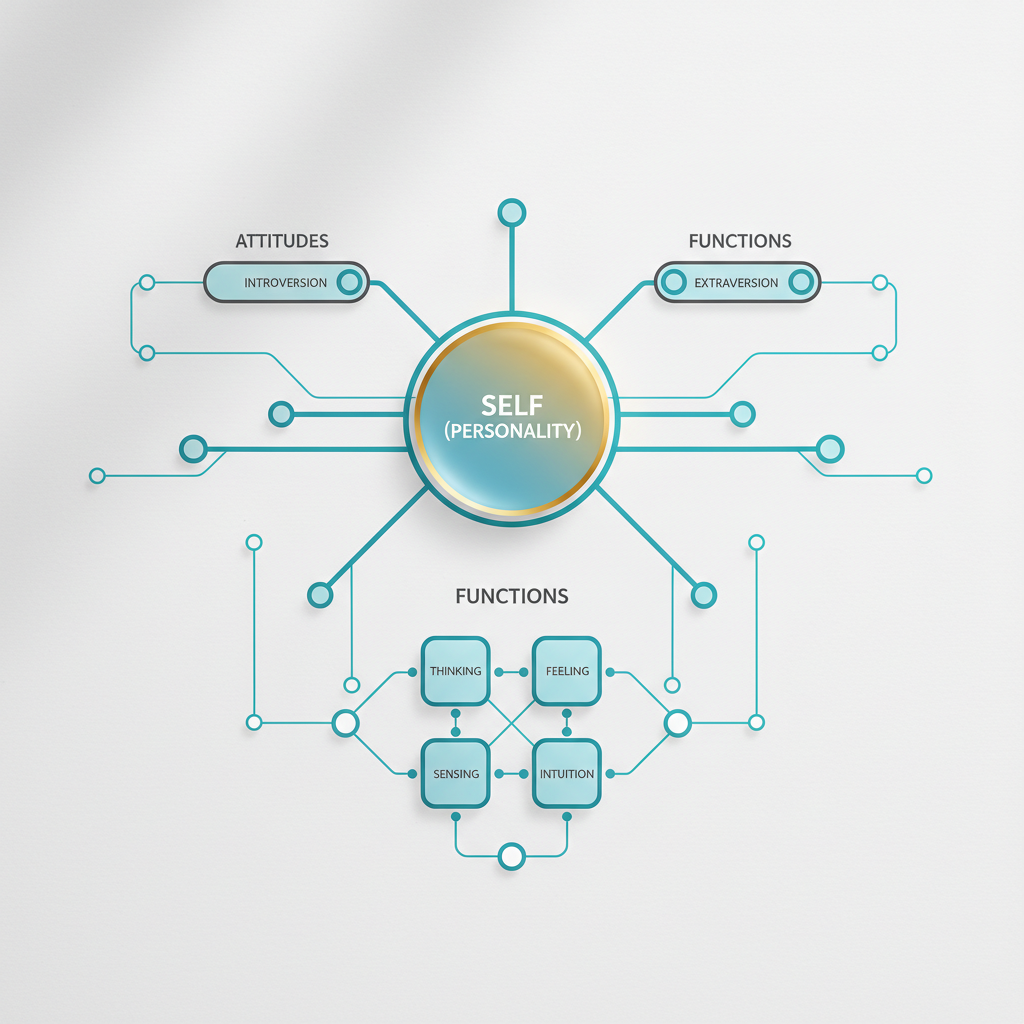
Carl Jung’s work introduced “cognitive functions.” These are the different ways our minds take in information and make choices. Think of them as your brain’s favorite tools. They affect how you see the world and tackle creative problems.
Jung described four main functions, and each has an introverted and extraverted version. These functions show your natural mental strengths. For example, some people focus on facts, while others prefer to explore new possibilities.
A Jungian personality test, like the Creative Ability Test, can show you your main functions. This gives you a clear picture of your natural creative style. You will learn how you tend to find inspiration and solve problems.
Here are the core cognitive functions:
- Sensing (S): This function is about real-world details. People strong in Sensing focus on the here and now. They notice facts they can see and touch, and they enjoy practical, hands-on work. They are great at turning ideas into something real.
- Intuition (N): Intuition is about seeing the bigger picture. It connects ideas and imagines what could be. People with strong Intuition are often called visionaries. They enjoy exploring abstract ideas in their creative work [3].
- Thinking (T): The Thinking function uses logic and facts. People who use it look for rational explanations and organized solutions. Their creative work often involves solving problems in a structured way.
- Feeling (F): The Feeling function is about values and people. People who use it think about the emotional side of their work. Their creative projects often try to connect with others or express something personal.
Learning about your cognitive functions gives you helpful insights. It helps you use your natural creative talents. It also shows you where you could try new ways to be more innovative.
The Role of Introversion and Extraversion
Jung also talked about two main attitudes: Introversion and Extraversion. These describe where you get your mental energy. It’s about whether you feel energized by the outer world or your inner world.
Many people think introverts are shy and extraverts are loud. But Jung’s ideas are more detailed. They’re about where you get your energy and direct your focus [2].
Let’s explore how these attitudes influence your creative flow:
- Extraversion (E): An extraverted approach sends energy outward. Extraverts get energy from being with others and taking action. In creative work, they often do well in group settings. They like to talk through ideas and create things others can see and touch. They tend to make quick prototypes and ask for feedback early.
- Introversion (I): An introverted approach sends energy inward. Introverts get energy from being alone with their thoughts. Their creative process is often quiet and thoughtful. They may spend a lot of time planning and perfecting ideas in their head before sharing them. This helps them build rich, detailed ideas.
Knowing your type helps you create a better work environment. An extravert might want a brainstorming meeting. An introvert, on the other hand, may need quiet time to think. Both ways are great for sparking new ideas.
Exploring Jungian Archetypes
Jungian archetypes are basic human patterns found everywhere. They live in our shared, collective unconscious. You can see these patterns in myths, stories, and art from all over the world [4]. Think of them as original models for our feelings and actions. They help us understand deep-seated aspects of your personality.
Finding your archetypes can teach you a lot about your creative side. They show why you connect with certain stories or ideas. They can also highlight your main motivations and strengths. Knowing this can boost your creative work and help you solve problems.
Here are a few common archetypes and their connection to creative strengths:
- The Innocent: Represents optimism and purity. Creatively, this archetype inspires fresh perspectives and innovative solutions that cut through complexity.
- The Sage: Embodies wisdom and truth-seeking. Those aligned with The Sage excel at research, analysis, and developing well-reasoned, impactful ideas.
- The Explorer: Driven by discovery and freedom. This archetype fuels curiosity and a desire to break new ground, leading to original and unconventional creative work.
- The Creator: The ultimate archetype for innovation. It represents the desire to build, invent, and bring something new into existence. This is a powerful force behind artistic and entrepreneurial projects.
- The Hero: Symbolizes courage and mastery. Creatively, The Hero drives us to overcome obstacles and pursue ambitious projects, transforming challenges into opportunities.
Understanding which archetypes you relate to gives you powerful self-knowledge. It shows you what truly drives you. In turn, this can make your creative purpose clearer. By using these patterns, you can find new ways to be creative and solve problems.
How Does Your Jungian Personality Connect to Creativity?
Identifying Your Natural Creative Strengths
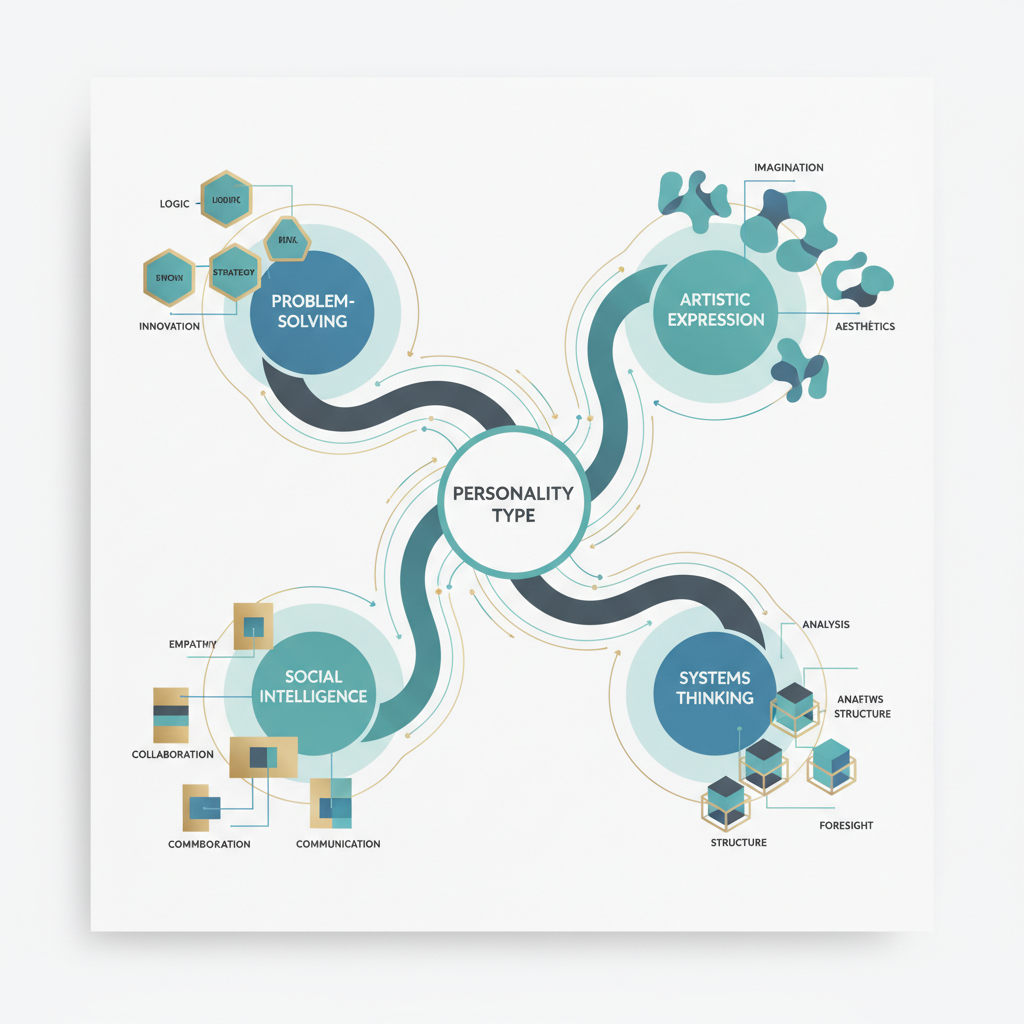
Your Jungian personality type is a great way to see your natural creative talents. It shows how you process information and see the world. When you understand your type, you can find and use your best creative skills.
Each of the eight cognitive functions helps you be creative in a different way. For instance, people with strong Introverted Intuition (Ni) are often good at seeing future possibilities and connecting different ideas. This helps them come up with new concepts [5].
In contrast, people with Extroverted Sensing (Se) are often creative in a hands-on way. They enjoy working with physical materials and acting on what’s in front of them. Think of a chef creating a new dish on the fly or an artist trying new textures.
The Creative Ability Test helps you find these key strengths. It shows you how you think. This knowledge helps you lean into your natural talents. You can then build a creative style that feels right for you.
Your Jungian profile doesn’t put you in a box. Instead, it helps you see your unique creative gifts. Knowing them helps you grow them. It gives you a base for personal growth and for solving problems in new ways.
Consider these different creative styles based on strong functions:
- Introverted Intuition (Ni): Visionary ideas, complex theories, long-range planning, symbolic art.
- Extroverted Intuition (Ne): Brainstorming, exploring multiple options, playful experiments.
- Introverted Sensing (Si): Detailed memory, proven methods, honoring traditions in new ways, craftsmanship.
- Extroverted Sensing (Se): Hands-on creation, improvisation, physical performance, enjoying beauty.
- Introverted Thinking (Ti): Logical problem-solving, designing systems, creative analysis, strategic planning.
- Extroverted Thinking (Te): Getting things done, organizing projects, practical new ideas, leadership.
- Introverted Feeling (Fi): Artistic expression, projects based on your values, authentic storytelling, personal insights.
- Extroverted Feeling (Fe): Creating with others, inspiring people, new ideas for communities, team building.
Using Your Cognitive Functions for Better Problem-Solving
Every problem needs a creative solution. Your main cognitive functions guide how you naturally solve problems. Understanding them helps you face challenges better. It turns confusion into a clear plan.
If you lead with a Thinking function, you probably solve problems with logic. You like to analyze facts and break issues down step-by-step. This is great for finding the real cause of a problem and making a clear plan.
On the other hand, if you lead with a Feeling function, you may think about people first. You focus on harmony and outcomes that align with your values. This is key for solutions that need empathy and support from others.
Let’s look at how different functions help with problem-solving:
- Thinking functions (Ti, Te) focus on logic and efficiency. They help you analyze information, set goals, and carry out practical solutions.
- Feeling functions (Fi, Fe) focus on values and people. They guide you to create solutions that help people and encourage teamwork.
- Sensing functions (Si, Se) focus on the here-and-now and solid facts. They help you check the current situation and find practical, immediate solutions.
- Intuitive functions (Ni, Ne) look toward future possibilities and patterns. They help you imagine new options and prepare for future challenges.
When you know your main problem-solving style, you can use it with purpose. You’ll feel more confident in your natural skills. The Creative Ability Test explains these styles clearly so you can use them in real life. It guides you from basic quizzes to useful, personal advice.
Balancing Your Functions to Enhance Innovation
Your main functions are your strengths, but you can grow by developing your other functions too. This isn’t about changing who you are. It’s about adding new tools to your thinking toolkit. This helps you see things from new angles and think more flexibly [6].
Every Jungian type has a stack of functions. Your dominant function is the one you use most. The others support it. Your less-developed functions have a lot of room for growth. Working on these can unlock new ways to be creative.
For example, if you lead with Introverted Thinking (Ti), you are probably great at logical analysis. If you also work on your Extroverted Feeling (Fe), you could get better at creating with others. You could share your ideas more convincingly and inspire your team.
The Creative Ability Test gives you practical tips for this kind of growth. It shows you how to practice using your less-used functions. This helps you become a more balanced and complete problem-solver. You’ll get personal feedback and strategies to help you improve.
Here are practical tips to balance your functions and spark new ideas:
- Try different activities: If you’re a planner, try a spontaneous creative task. If you’re hands-on, try brainstorming new concepts.
- Seek different views: Listen to people who think differently than you do. This challenges your usual way of thinking.
- Practice mindfulness: Notice how you first react to a problem. Then, consciously try a different approach.
- Look back on past problems: Think about how using a different cognitive function could have led to a better result.
- Journal your ideas: Write down thoughts and feelings you usually ignore. This helps bring different parts of yourself together.
Using all of your Jungian functions gives you more power. It takes you from a limited view to using your creativity to solve tough problems. This helps you grow and be creative more consistently.
How Can You Interpret Your Test Results for Personal Growth?
A Beginner’s Guide to Your Personality Type
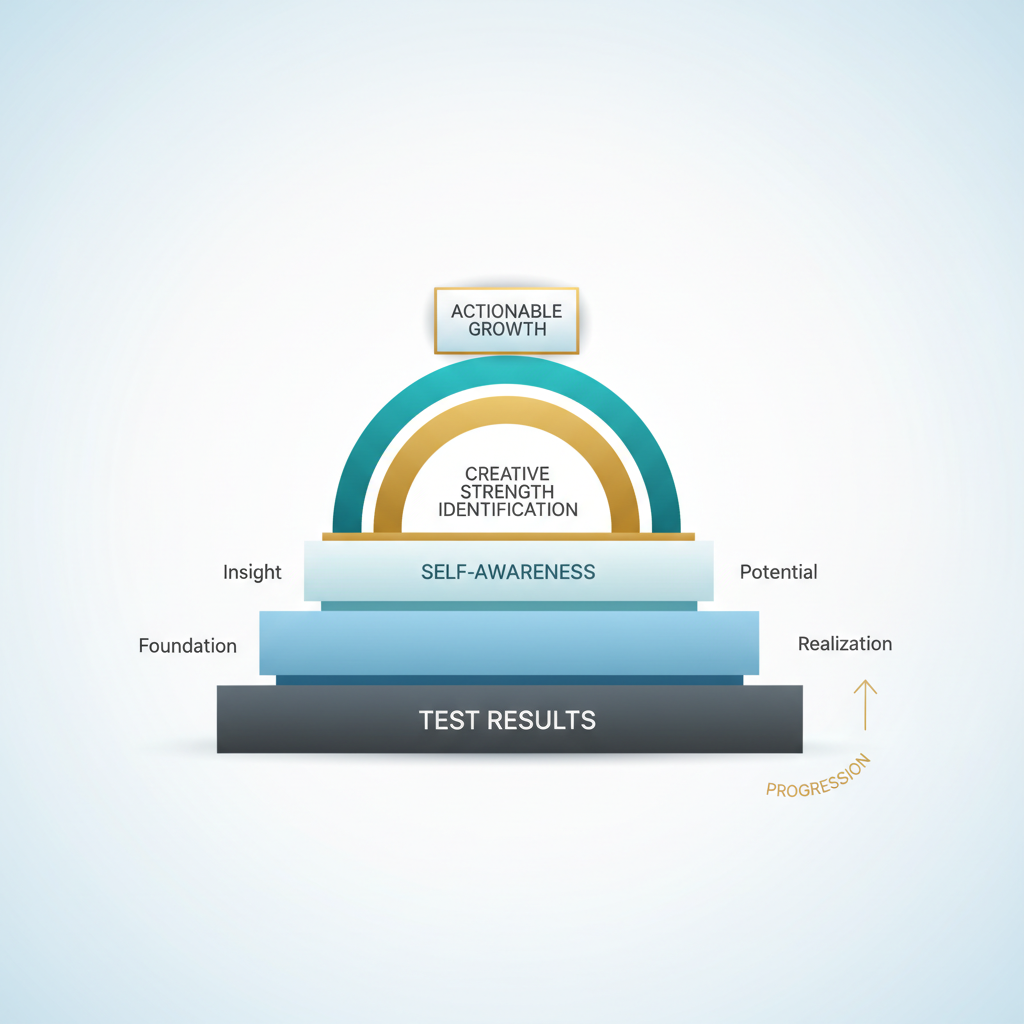
Getting your Jungian personality test results is an exciting first step toward self-discovery. Think of your results as a personal map of how your mind works. These mental preferences shape how you see the world and make decisions.
Each personality type has a “dominant” function—the mental tool you use most naturally. It’s the way of thinking that feels effortless to you. For instance, if Intuition is your dominant function, you might come up with creative ideas easily. If Thinking is dominant, you’re likely skilled at logical analysis.
This isn’t about putting yourself in a box. Instead, it’s a starting point for understanding your natural creative strengths. The Creative Ability Test is designed to give you these insights, moving beyond simple labels. It shows you how your unique way of thinking fuels your creativity. With this self-awareness, you can use your talents more effectively and find new areas to grow.
Your personality type highlights:
- Your most comfortable creative approaches.
- How you naturally solve problems.
- Your preferred way to process information.
- The environments where you feel most creative.
Actionable Tips to Nurture Your Weaker Functions
Everyone has mental functions they use less often. Think of them as “weaker” or undeveloped, not as flaws. Working on them is like adding new tools to your creative toolkit. It helps you become a more flexible and well-rounded creative thinker.
Our Creative Ability Test gives you personalized feedback to help you develop these areas. Here are some simple, actionable tips to get started:
- If your Sensing (S) is weaker: Get in touch with the world around you. Try hands-on activities like crafts or cooking. Pay attention to details and what you can observe. Practice mindfulness to stay grounded in the present. This helps you turn creative ideas into real-world projects.
- If your Intuition (N) is weaker: Explore new possibilities. Brainstorm ideas without judging them. Read different types of books or visit a museum. Ask “what if” questions often. This trains your brain to connect different ideas and see the bigger picture.
- If your Thinking (T) is weaker: Strengthen your logical reasoning. List the pros and cons before making a decision. Play strategy games or join a debate club. Organize your thoughts with outlines or lists. This helps you sharpen your critical thinking, which is essential for turning good ideas into great ones.
- If your Feeling (F) is weaker: Tune into your emotions and the feelings of others. Practice listening with empathy. Think about what your core values are. Create art that expresses an emotion. This builds emotional intelligence, which is key to creating work that connects with people.
When you practice using these less-familiar functions, you actually build new connections in your brain. Research shows that challenging your mental habits makes your brain more flexible [7]. This process directly boosts your creativity, helping you become a more adaptable and innovative thinker.
Applying Your Insights in Work and Life
When you understand your personality and creative style, you can use that knowledge in powerful ways. It changes how you handle challenges and helps you succeed at work and in your personal life. The personalized insights from the Creative Ability Test make this possible.
In Your Professional Life:
- Solve Problems More Effectively: Tackle tough problems with your natural strengths, then use your developing functions to explore different angles. For example, an intuitive person can dream up big ideas, while a well-developed thinking function can sort out the details.
- Work Better with Teams: Appreciate that your teammates have different creative styles. Understanding how they think and contribute will lead to better communication and stronger ideas [8]. This helps you lead and collaborate more effectively.
- Find the Right Role: Look for jobs or projects that play to your strengths. You can also build strategies to handle tasks that are more challenging for you. This can lead to greater job satisfaction and better performance.
- Leadership and Innovation: Use your self-knowledge to lead with confidence and inspire others. Encourage different ways of thinking on your team to spark creative solutions.
In Your Personal Life:
- Personal Growth: See self-improvement as an ongoing journey. Use your insights to better understand why you do what you do. This can lead to greater self-acceptance and a stronger sense of purpose.
- Choose Fulfilling Hobbies: Pick hobbies that use your natural talents but also push you to try new things. An intuitive person might love abstract painting, while a sensing type might prefer pottery.
- Make Better Decisions: Make smarter choices by looking at decisions from all angles. Try to consciously use all of your mental functions, not just your favorite one. This leads to more balanced results.
- Improve Your Relationships: Recognize and appreciate that your friends and family think differently than you do. This can improve your communication and build stronger, more empathetic connections.
Going from feeling unsure about your creativity to having a clear path forward can be life-changing. The Creative Ability Test gives you the map and tools you need. With personalized strategies, you can use your creativity with purpose, leading to growth, success, and new ideas every day.
How Can You Find a Reliable Carl Jung Cognitive Functions Test?
What to Look for in a Quality Assessment
Finding a good Carl Jung cognitive functions test is key to understanding yourself better. A quality test does more than give you a simple label. It helps you learn how your mind works. You’ll see how you process information and make decisions. This knowledge is the first step to unlocking your creative strengths.
When you look for a Jungian cognitive functions test, keep these key things in mind:
- Scientific Grounding: Look for tests based on solid psychological research. A strong foundation means the results are useful and reliable. Good tests are built on years of study and theory [9].
- Focus on Functions, Not Just Letters: Many tests just give you a four-letter type. A truly helpful test will explain your individual cognitive functions. It should clarify how Sensing, Intuition, Thinking, and Feeling work for you. It should also show if they are introverted or extraverted.
- Detailed Results: A good test gives you more than just a type. It should offer detailed explanations of each function and show how they work together. This detail helps you understand your natural way of thinking.
- Practical Advice: The best tests show you how to use your results. They should help you apply this knowledge to your daily life. Look for practical tips you can use for personal growth and to boost your creativity.
- Easy to Use: The test itself should be easy to take. The results should be written in clear, simple language. It should avoid confusing technical terms.
Keeping these points in mind will help you choose a test that really helps you grow. It’s a path toward understanding yourself better, which will improve your creative thinking and problem-solving skills.
Moving Beyond Personality Labels to Actionable Insights
Many people take a personality test and stop at the label they receive. But the real power of a Jungian cognitive functions test is in how you use it. It helps you go beyond a simple category. It gives you practical tips for personal growth and creativity.
Think of your cognitive functions as a toolkit for your mind. When you understand these tools, you can use them better. For example, knowing your main function shows you your natural way of handling challenges. It points to where your creative energy flows most easily.
Here’s how to turn your results into real-life action:
- Identify Your Creative Strengths: Your strongest functions are your creative superpowers. For example, if you have strong Extraverted Intuition, you might be great at brainstorming new ideas. If Introverted Thinking is your strength, you might be a master at logical problem-solving. Use these natural talents.
- Develop Your Other Functions: We all have functions we use less often. Working on these can lead to more balanced thinking. For instance, if you rely on intuition, practicing observation (Sensing) can ground your ideas in reality. If you are very logical, exploring other viewpoints (Feeling) can improve your solutions. This kind of flexible thinking is a common trait in highly creative people.
- Improve Your Problem-Solving: Use what you learn on real-world problems. When you face a tough issue, try looking at it from the viewpoint of your different functions. This practice helps you find new and creative solutions.
- Build Mental Flexibility: By using all your functions on purpose, you become more mentally agile. This allows you to switch between different ways of thinking when you need to. This flexibility is key to adapting to new challenges and finding fresh solutions.
- Aim for Personal Growth: Use your results to understand different communication styles and find areas where you can grow. This self-awareness helps you keep learning and encourages the growth mindset needed for creativity.
At Creative Ability Test, we believe in this journey of self-discovery. Our science-based assessment helps you find your unique creative strengths. We provide you with personalized feedback and practical tips. These tools will help you use what you’ve learned to improve your creative thinking and problem-solving in all parts of your life.
Frequently Asked Questions
What are the main Jungian personality traits?
Carl Jung’s important work explored the deep layers of human personality. He identified key traits that shape how we interact with the world. These traits help us understand our natural preferences and what drives us.
Jung identified two core attitudes:
- Extraversion: Energy is directed outward. People with this trait often enjoy social settings. They gain energy from being with others and doing activities.
- Introversion: Energy is directed inward. People with this trait often prefer quiet time alone. They recharge through reflection and internal thought.
Beyond these attitudes, Jung outlined four main functions. These control how we see the world and make decisions:
- Sensing: A focus on real facts and what’s happening now. This style is practical and pays attention to details.
- Intuition: A focus on possibilities, patterns, and what could happen. This style is often imaginative and idea-focused.
- Thinking: A focus on logic, facts, and fairness. This style uses reason to make decisions.
- Feeling: A focus on personal values, harmony, and the impact on people. This style prioritizes empathy and relationships.
Everyone uses all these functions. However, we tend to prefer one in each pair [2]. Understanding your preferences shows your unique creative style. For example, an intuitive thinker might brainstorm new ideas. A sensing feeler might create art that creates strong feelings. Knowing this about yourself can boost your creativity.
What are cognitive functions in MBTI?
Carl Jung’s original ideas inspired more work. Isabel Myers and Katharine Briggs created the MBTI (Myers-Briggs Type Indicator) [10]. The MBTI model builds on Jung’s types and introduces eight “cognitive functions.”
These functions are different ways of thinking. They control how we take in information and make decisions. Each function is a mix of an attitude (Introverted or Extraverted) and a style of perceiving or judging.
Here are the eight cognitive functions:
- Extraverted Sensing (Se): Living in the moment. Experiencing the world in a hands-on, active way.
- Introverted Sensing (Si): Recalling past experiences and details. Valuing tradition and consistency.
- Extraverted Intuition (Ne): Exploring new possibilities and making connections. Brainstorming and seeing patterns.
- Introverted Intuition (Ni): Forming deep insights and big-picture ideas. Understanding deeper meanings and future possibilities.
- Extraverted Thinking (Te): Organizing and planning to reach goals. Focusing on logic and efficiency.
- Introverted Thinking (Ti): Analyzing information to build an internal framework. Seeking logic and accuracy.
- Extraverted Feeling (Fe): Creating social harmony and connecting with others. Focusing on group values and feelings.
- Introverted Feeling (Fi): Understanding your own values and morals. Staying true to who you are.
Your unique mix of these functions shapes your thinking style. This also directly affects how you create. For instance, strong Extraverted Intuition can help you think of many different ideas. Meanwhile, strong Introverted Thinking helps you sharpen complex ideas. The Creative Ability Test looks at similar skills, helping you understand your natural way of creating and solving problems.
How can a Jungian archetypes test help my creativity?
Jungian archetypes are universal patterns or symbols. They represent basic human roles and ideas that are part of our shared, unconscious mind [11]. They influence how we act and what we believe. Finding your main archetypes offers deep insight. It shows your natural creative drives and how you prefer to express yourself.
Consider these examples:
- The Creator: This archetype is driven to innovate and make new things. They thrive on artistic expression and are great at solving problems with new inventions.
- The Explorer: This archetype loves to discover new things. They boost creativity by questioning rules and exploring new ideas.
- The Sage: This archetype values knowledge and understanding. Their creativity comes from research and deep thinking, which helps them find new solutions.
- The Rebel: This archetype challenges rules and traditions. This can lead to new and original creative work that breaks from the norm.
Understanding your archetypes helps you find your natural creative style. It guides you toward projects that feel right for you. This builds confidence, focuses your creative energy, and helps you grow as a person.
Where can I find a Jung personality test with free results?
Many websites offer “free” Jungian personality tests or MBTI-style quizzes. These can be a fun way to start learning about yourself. However, their quality and accuracy can be very different.
To truly understand your creative strengths, you need more than a simple label. You need a test that is based on science. A reliable test provides:
- A scientific approach: It is based on real psychological research.
- Detailed results: It explains how you think, not just what type you are.
- Personalized advice: It offers practical tips to help you grow.
- A focus on creativity: It looks at skills like flexible thinking and problem-solving.
The Creative Ability Test is designed around these ideas. Our 30-question assessment gives you a clear look at your creative potential. It also provides practical tips to improve your creative thinking. Our test helps with both personal and professional growth by showing you how to use your unique creative skills. This goes beyond just “results.”
Sources
- https://jung.org/about-carl-jung/
- https://www.simplypsychology.org/carl-jung.html
- https://www.psychologytoday.com/us/blog/prescriptive-thinking/201804/the-power-intuition-0
- https://www.britannica.com/science/archetype
- https://www.psychologytoday.com/us/blog/the-power-of-mind/202102/the-role-intuition-in-creative-thinking
- https://www.ncbi.nlm.nih.gov/pmc/articles/PMC4217148/
- https://www.ncbi.nlm.nih.gov/pmc/articles/PMC6487539/
- https://hbr.org/2017/04/the-most-creative-teams-have-this-in-common
- https://www.apa.org/pubs/books/understanding-psychological-assessment
- https://www.myersbriggs.org/my-mbti-personality-type/mbti-basics/
- https://iep.utm.edu/jung-carl/#SH3c