Tag: Personal growth

  • The Test Quiz: A Complete Guide to Understanding Your Creative Potential

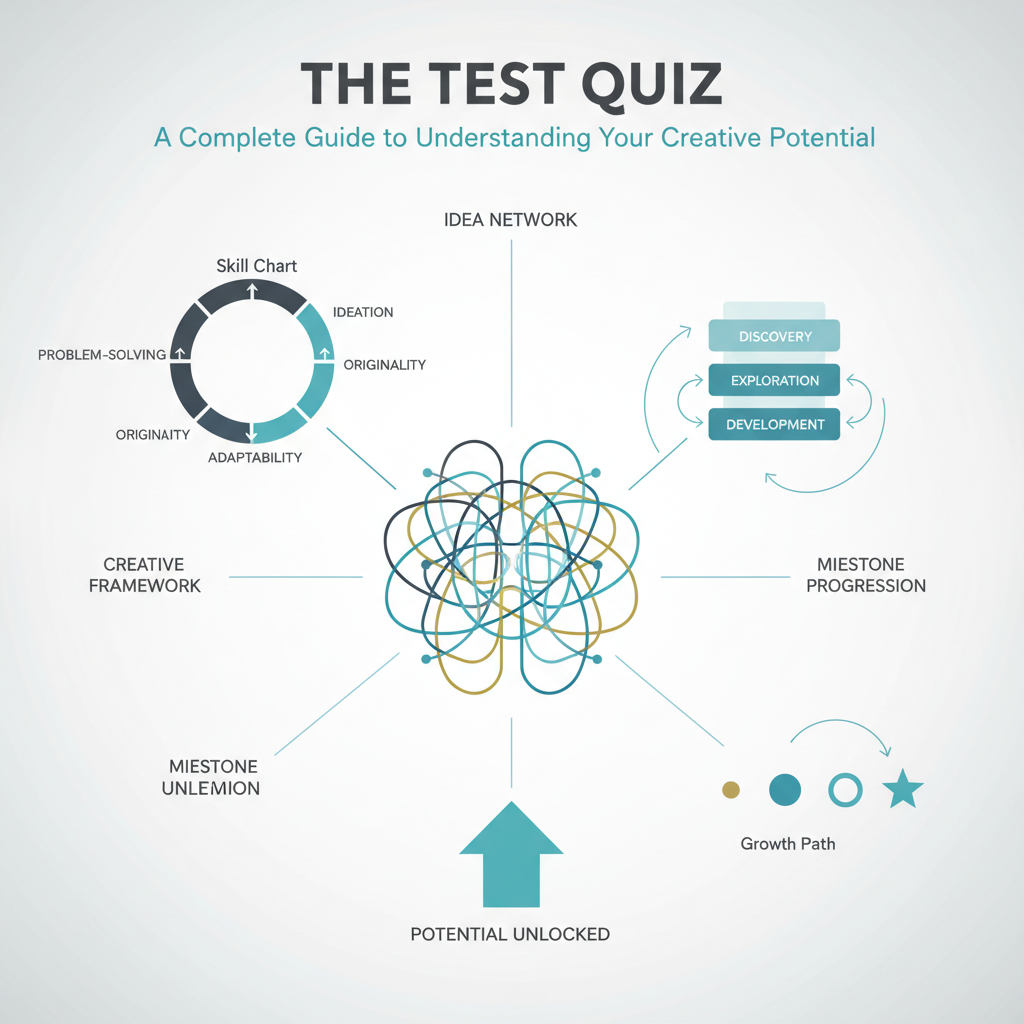
    The Test Quiz: A Complete Guide to Understanding Your Creative Potential

    A ‘test quiz’ for creativity is an assessment designed to measure your creative potential beyond simple right-or-wrong answers. The Creative Ability Test is a scientifically grounded 30-question quiz that evaluates your cognitive flexibility, problem-solving skills, and divergent thinking to provide actionable insights for personal and professional growth.

    Have you ever considered the power of your own creativity? It’s not just for artists—it’s how we solve problems and see the world in new ways. Knowing your creative potential can lead to personal and professional growth. If you’re ready for a journey of self-discovery, “the test quiz” is your starting point.

    At Creative Ability Test, we believe that understanding your creative strengths and thinking styles opens up new possibilities. Our 30-question test is based on science and gives you more than just a score. We look at key areas like your Cognitive flexibility, ability to brainstorm, and openness to new things. This gives you a clear picture of how you think. It’s more than a quiz—it’s a look into how your creative mind works.

    This guide will help you understand what “the test quiz” measures and what your results mean. Most importantly, we’ll show you how to use this knowledge in your daily life. We explain the science behind the test in simple terms and give you practical tips to boost your creative thinking. You’ll learn how to solve problems better and grow as a person. Get ready to turn your ideas into action.

    What Is ‘The Test Quiz’ for Creativity?
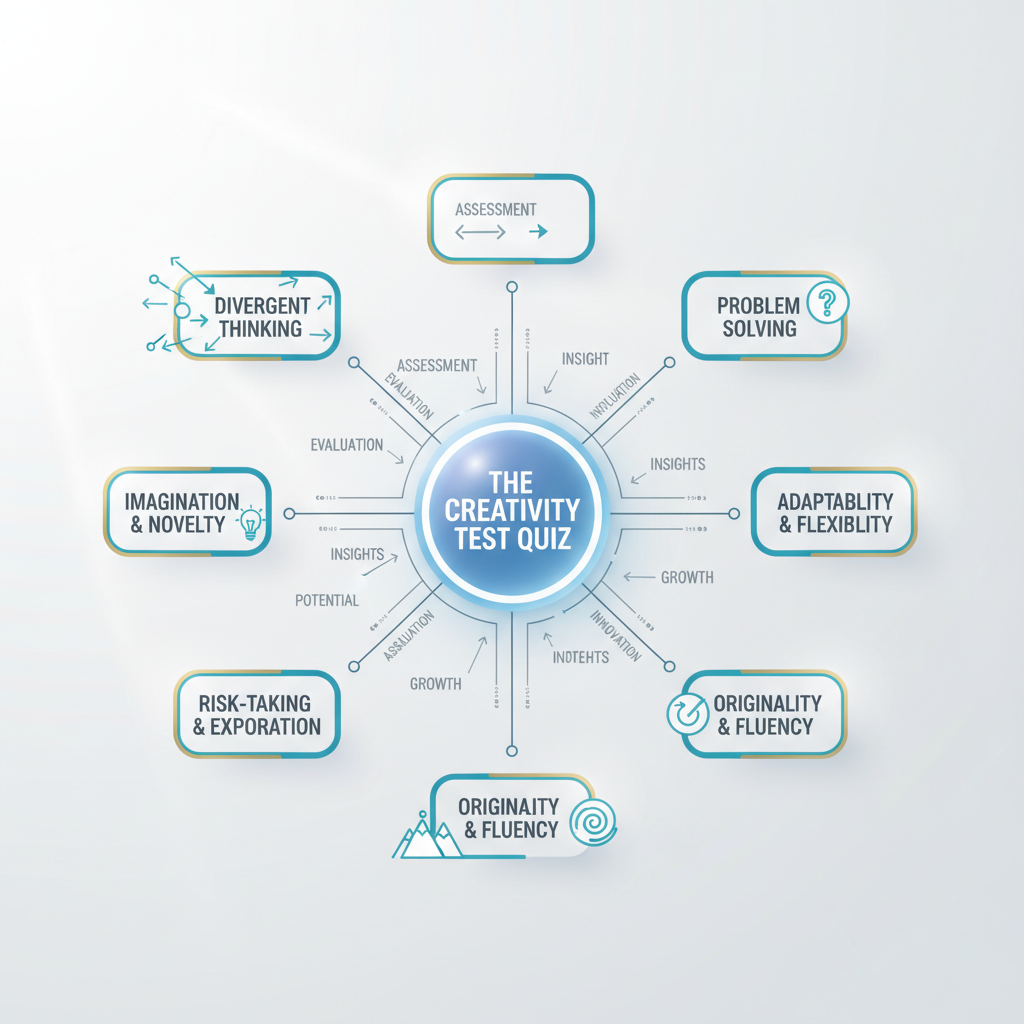
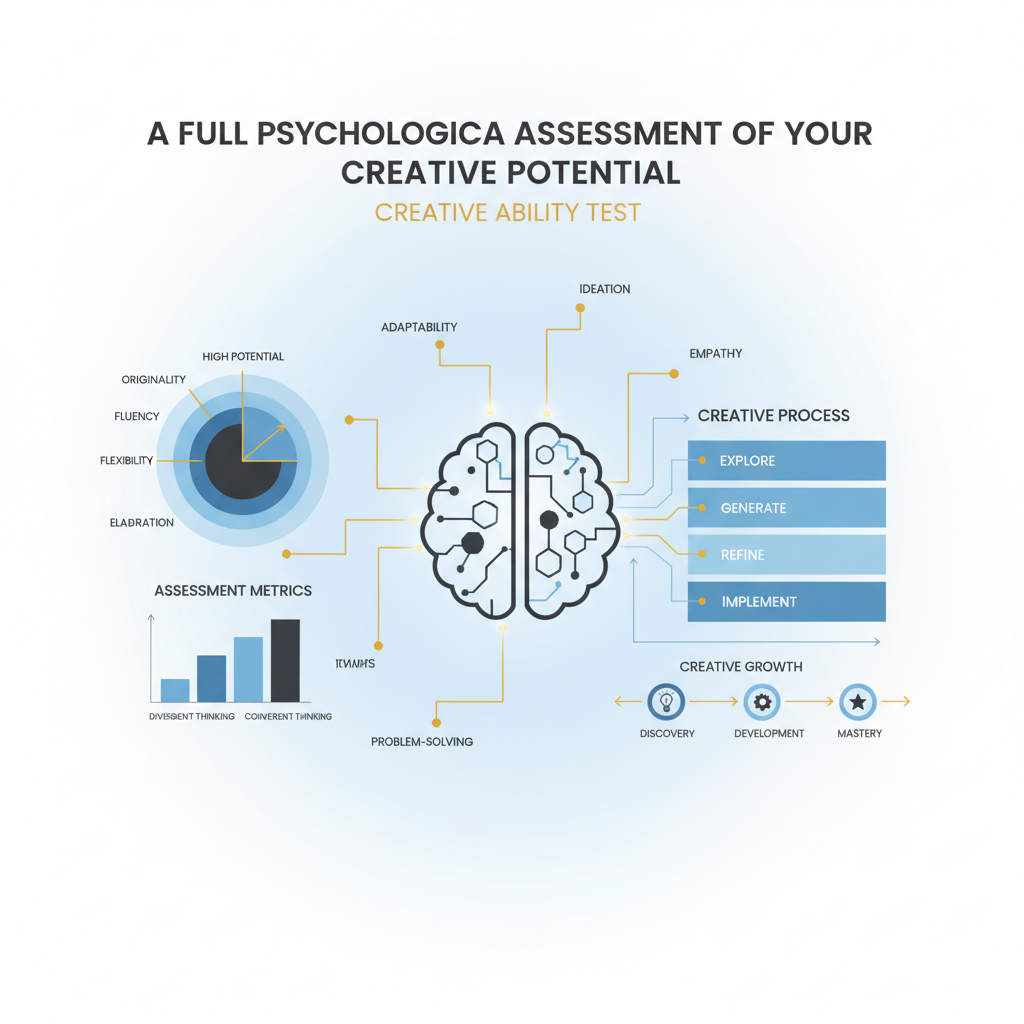
    An abstract infographic illustrating the conceptual structure and purpose of 'The Test Quiz' for creativity as a central network diagram.
    An abstract, educational infographic illustrating ‘The Test Quiz’ for creativity. Visualize a structured assessment chart or a cognitive network diagram with a central core representing the quiz, and radiating geometric shapes or nodes indicating its fundamental components and purpose. Use a minimalist, vector-based style with clean geometric shapes, subtle gradients, and accent highlights. Color palette: soft blues, whites, charcoal, with gold or teal accents. Ensure negative space for short labels. No humans, no cartoons.

    Beyond a Simple Score: What a Real Creativity Test Measures

    Many online quizzes give you a simple “creativity score.” But real creativity is more complex than that. Our platform, Creative Ability Test, goes deeper. We help you take a closer look at your unique creative mind.

    A real creativity assessment looks at you from many angles. It doesn’t just tell you *if* you’re creative—it shows you *how* you’re creative. This involves looking at your different thinking skills and styles.

    We see creativity as a skill you can grow, not a fixed trait. Our test finds your strengths in key areas. This knowledge helps you grow those strengths and use your creative potential.

    Our test looks at important parts of creativity, such as:

    • Divergent Thinking: Your ability to come up with many unique ideas. We look at how you brainstorm and find different solutions.
    • Cognitive Flexibility: How well you can switch your point of view. This shows how easily you adjust to new information or challenges.
    • Problem-Solving Skills: How you handle and solve tricky problems. This includes your ability to find new and creative solutions.
    • Openness to Experience: Your curiosity and willingness to try new things. This shows how open you are to fresh ideas.

    Understanding these parts gives you a full picture of your creativity. It helps you unlock your true potential. You’ll also get practical tips for your personal and professional life.

    The Science Behind Our 30-Question Assessment

    The Creative Ability Test isn’t just a random quiz. Our 30-question test is based on science. It uses proven psychological research and theories about creativity. This makes our test a reliable way to measure your creative skills.

    Our method is backed by evidence. We designed each question to test a specific part of your creativity. Top researchers have approved similar methods [1]. This careful process ensures your results are accurate.

    The 30 questions cover a lot of ground. They look at many different creative behaviors and ways of thinking. This helps us create a detailed profile of your creative strengths and find areas for you to grow.

    Our test is also standardized, so everyone gets the same high-quality evaluation. This means you can trust your personalized feedback. It gives you a strong starting point for learning more about yourself.

    We explain complex psychological concepts in a simple way. This makes the science of creativity easy for anyone to understand. Our goal is to give you clear, useful advice from a source you can trust.

    Why Understanding Your Creative Style Matters

    Knowing your creative style is a powerful tool. It helps you move from being unsure to feeling a confident self-awareness. Your unique way of being creative affects every part of your life.

    First, it helps you grow as a person. When you know how your mind works, you can use your natural strengths. For instance, if you’re good at divergent thinking, you can use it to solve personal problems. You can come up with new solutions for everyday challenges.

    Second, it helps your career. Companies want employees who can create new things and solve problems [2]. Knowing your creative strengths makes you a valuable team member. You can use them in group projects, planning, or to move your career forward. This helps you make a real difference at work.

    Our test gives you useful tips and clear explanations about your creative side. For example, you might learn you’re very open to new experiences. This can encourage you to explore new fields or learn new skills, broadening your world.

    In the end, this knowledge gives you power. It’s like a roadmap for being creative on purpose. You can use your talents to solve real-world problems. This will change how you approach challenges, helping you face them with more confidence and new ideas.

    What Kind of Questions Are in The Test Quiz?

    Exploring Divergent Thinking Challenges

    The Creative Ability Test looks at your divergent thinking. This is your ability to come up with many different ideas from one starting point. Think of it as a more advanced form of brainstorming.

    Our quiz gives you challenges that push you to think outside the box. You will explore many possibilities, not just the obvious ones. This helps us see how well your mind connects different ideas.

    For example, we might ask you to list as many unusual uses as possible for a common object. These questions are not about finding one “right” answer. Instead, they measure how many ideas you have and how unique they are. Research shows that this skill is a key part of creativity [3].

    By taking on these challenges, you will learn about your natural ability for:

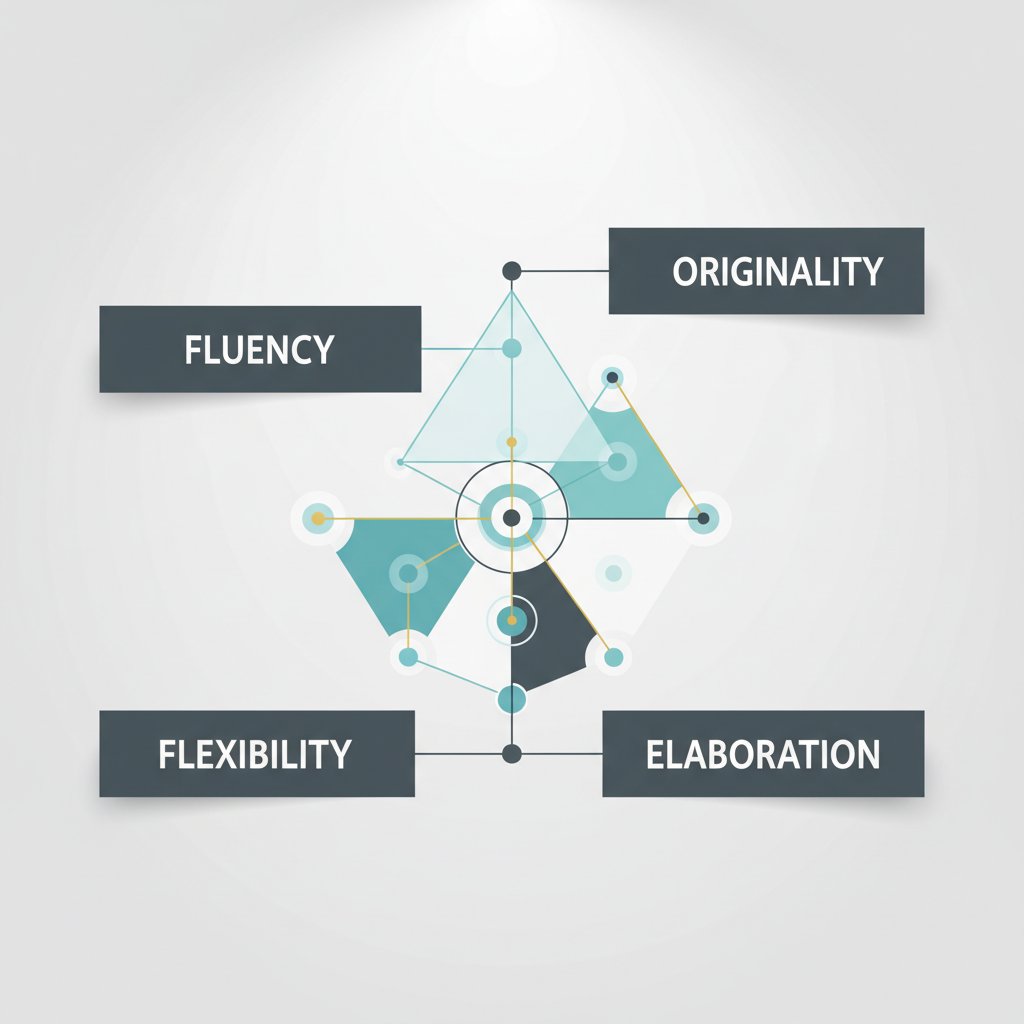
    • Idea Fluency: How many ideas you can generate.
    • Originality: How new and unique your ideas are.
    • Flexibility: The different categories your ideas fall into.
    • Elaboration: Your skill in adding details to your ideas.

    Understanding your strengths in divergent thinking helps you find new solutions. It gives you more options when you’re trying to solve a problem.

    Assessing Your Cognitive Flexibility

    Cognitive flexibility is another key part of creativity that we measure. Think of it as mental agility. It’s your ability to switch between different ways of thinking, adapt to new facts, and get past mental blocks.

    Our quiz has questions designed to test this skill. They often ask you to change your perspective. You might need to rethink your first ideas or try a new way to solve a problem.

    For instance, a question might describe a situation where the easy solution fails. You will then be asked to come up with a different plan. This shows how easily you can drop an old idea for a better one. This skill is essential for learning and adapting in a fast-changing world [4].

    By assessing your cognitive flexibility, we learn more about your ability to:

    • Adjust your thinking when you face a challenge.
    • See an issue from more than one point of view.
    • Learn from mistakes and change course.
    • Handle complex problems more easily.

    This assessment helps you understand how you react to new situations and change your ideas under pressure. This skill is valuable for both personal growth and professional success.

    Evaluating Your Openness to New Experiences

    How open you are to new experiences has a big impact on your creativity. This is a core personality trait. It shows your curiosity, imagination, and desire to explore new ideas, concepts, and cultures.

    The Creative Ability Test looks at this trait with questions about your interests. We ask about your taste for adventure, how you feel about unusual ideas, and what you like to learn about.

    We might ask if you enjoy trying new things or if you’re drawn to art and abstract ideas. People who are very open tend to seek out different experiences. This gives them more knowledge and sparks their imagination [5].

    Through this assessment, you will discover:

    • Your level of curiosity about the world.
    • How open you are to new and different ideas.
    • Your comfort level in unfamiliar situations.
    • Your interest in art and imagination.

    Understanding your openness can help you find new learning opportunities. It can encourage you to step out of your comfort zone and find new ways to grow.

    Problem-Solving Scenarios

    Creativity isn’t just about having great ideas; it’s about using them to solve real problems. The Creative Ability Test includes practical problem-solving challenges. These see how you put your creative skills to use.

    We give you realistic situations that don’t have easy answers. You will need to think in new and clever ways. For example, you might be asked to improve a common product or solve a problem for a community. These are hands-on challenges, not just theory.

    These questions show us how you apply your creative skills in practice. They reveal your ability to think ahead and come up with truly new ideas. Good problem-solving requires both creating and carrying out new solutions [6].

    By working through these scenarios, you will learn about:

    • Your ability to spot and define problems in a new light.
    • How you use creative thinking to solve practical issues.
    • Your knack for developing real, innovative solutions.
    • Your skills in imagining improvements and positive change.

    This part of the quiz connects creative thinking with real-world results. It helps you see how your creative skills can make a real difference in your life and work.

    How Do You Interpret Your Quiz Results?

    From a Score to Actionable Insights

    Your results from The Test Quiz are more than just a number. Your score is a starting point, but the real value is in the detailed insights you’ll receive. We turn this data into a personal guide to help you grow your creative skills.

    This helps you understand what your score means in the real world. You’ll learn about your creative mindset and the specific ways you think.

    We give you clear, practical steps to use your creative strengths and build on your growth areas. This helps you improve your skills and grow as a person.

    Understanding Your Personalized Feedback Report

    After the Creative Ability Test, you get a detailed, personal feedback report. This report is your guide to your unique creative style. It looks at creativity from many angles, giving you more than just a basic score.

    Every section is easy to follow. You’ll learn about how you think. For instance, you’ll see how you did with divergent thinking—the skill of coming up with lots of ideas [7]. We also look at your cognitive flexibility, which is how easily you can switch between different ideas or adapt to change.

    Your report turns complex ideas into simple, useful information. It shows how your results connect to real-world skills like problem-solving and innovation. It’s like a blueprint for how your creative mind works.

    Key areas covered in your report include:

    • Your main creative thinking styles.
    • How you approach solving problems.
    • How open you are to new experiences and ideas.
    • Insights into your imagination and original thinking.
    • How well you adapt and think flexibly.

    This report is made just for you. It’s based on proven methods to make sure your results are accurate and helpful.

    Identifying Your Unique Creative Strengths

    Your personal report shows you exactly what your creative strengths are. These are the skills where you naturally shine. Knowing what you’re good at helps build confidence.

    For example, you might be great at coming up with many new ideas quickly. This is a sign of strong divergent thinking. Or maybe you’re skilled at connecting ideas that don’t seem related, showing your ability to think associatively.

    Another strength could be your imagination. You might find it easy to picture complex solutions. These are valuable talents you can use in your personal and professional life.

    Our report helps you see these natural talents. When you know your strengths, you can focus your energy, solve problems more effectively, and use your creativity to innovate.

    Think about how your strengths show up:

    • Are you a natural brainstormer who is always full of ideas?
    • Do you see patterns others miss and come up with unique solutions?
    • Are you quick to change your perspective when facing a new problem?
    • Do you enjoy trying new or different ways of doing things?

    Finding your strengths is the first step to turning self-awareness into a powerful tool for personal growth.

    Pinpointing Areas for Growth

    The Creative Ability Test also shows you areas where you can grow. We don’t see these as weaknesses, but as opportunities to become even more creative. Creativity is a skill you can build with practice [8].

    Your report gives clear advice on how to develop these areas. For instance, if you could improve your cognitive flexibility, the report suggests ways to do that, like trying new problem-solving methods or looking at things from a different point of view.

    In the same way, if you want to strengthen your divergent thinking, you’ll get useful tips. This could mean doing brainstorming exercises or getting in the habit of questioning assumptions. These are real-world strategies you can use right away.

    Focusing on these growth areas helps you develop as a person. It makes your creative skills more consistent and sharpens your ability to solve problems, which boosts your overall capacity for innovation.

    Every growth area is a chance to learn and improve. Our goal is to give you the tools to turn any limitation into a new strength. You always have the power to grow your creative potential.

    How Can You Use Your Results for Personal and Professional Growth?

    Practical Strategies to Boost Your Creative Thinking

    Your Creative Ability Test results are a personal roadmap. They show your specific creative strengths. Now, let’s put these insights into action. You can boost your creative thinking with targeted exercises designed to train your brain.

    Unlock Your Creative Potential Daily

    Understanding your creative style is the first step. For instance, if your results show you’re good at coming up with many different ideas, focus on brainstorming. If you excel at flexible thinking, try new ways to do daily tasks. Here are some proven ways to boost your creativity:

    • Mind Mapping: Start with a central idea and branch out with related thoughts. This technique helps you see connections and make new associations.
    • SCAMPER Method: Use this checklist to generate ideas. It stands for Substitute, Combine, Adapt, Modify (Magnify, Minify), Put to another use, Eliminate, Reverse (Rearrange). This tool helps you look at existing ideas from new angles.
    • Lateral Thinking Puzzles: Try puzzles that need creative solutions. This practice helps you think outside the box and improves your problem-solving skills [9].
    • Change Your Routine: Even small changes can spark new ideas. Take a different route to work or try a new hobby. New experiences build new connections in your brain.
    • Practice Observational Drawing: Pay close attention to the details around you. Drawing helps you see things from new perspectives and trains your brain to notice what others might miss.
    • Embrace “Idea Quotas”: Challenge yourself to come up with a set number of ideas each day. Don’t judge them. More ideas often lead to better ideas.

    These are more than just exercises; they are habits that build your creative muscle. Your feedback from the test shows you the best place to start.

    Using Your Creative Talents in Your Career

    Your creative skills are valuable tools for your career. They can help you advance at work. Employers highly value creative problem-solvers. In fact, creativity is always one of the top skills companies look for [10].

    Use Your Creativity at Work

    Think about how your creative strengths can be used in your job. Are you good at solving problems in new ways? Are you open to new ideas? Here’s how to use your creativity at work:

    • Innovative Problem-Solving: Use a creative approach to workplace challenges. Come up with many possible solutions, then use critical thinking to pick the best one. This leads to better results.
    • Process Improvement: Look for ways things could work better. Use your creative eye to imagine better ways of doing things. Suggest new ideas to make work easier and faster.
    • Team Collaboration and Leadership: Help create a team environment where new ideas are welcome. Encourage open idea sharing. Your insights can inspire your coworkers and help you lead effective brainstorming sessions.
    • Project Development: Offer fresh ideas on new projects. Whether it’s product design or a marketing plan, your creativity can lead to new and better things and make your work stand out.
    • Effective Communication: Present your ideas in interesting ways. Try using storytelling or visuals. This helps your message connect better with your audience.
    • Adaptability to Change: The workplace is always changing. Your flexible thinking helps you adapt quickly. You can learn new tools and methods with ease.

    Your test results give you the words to describe your creative strengths. Use them to explain your value in interviews and performance reviews. This will help you stand out.

    Using Creativity for Everyday Problem-Solving

    Creativity isn’t just for artists or inventors. It’s a key skill for daily life. Knowing your creative profile from the test helps you handle everyday challenges with confidence and a fresh point of view.

    Navigate Daily Life with Creative Solutions

    From planning errands to solving arguments, creativity can make life smoother. It helps turn challenges into chances to learn. Here’s how to use your creative strengths in your daily routine:

    • Household Hacks: Faced with a broken item? Need to organize a cluttered space? Use your problem-solving skills to find unusual fixes or clever storage solutions.
    • Personal Planning: Planning a trip or a busy week requires flexibility. Use your creative thinking to find the best routes or develop better ways to manage your time.
    • Relationship Dynamics: Disagreements happen. Try to understand the other person and communicate creatively. Think of unique ways to solve disagreements that work for everyone.
    • Learning and Hobbies: Help yourself grow by approaching new hobbies with an open mind. Find new ways to learn skills, like using a creative trick to remember new information.
    • Budgeting and Finances: Get creative with your money. Find new ways to save, discover new income streams, or think outside of traditional budgeting methods.
    • Adapting to Unexpected Situations: Life is full of surprises. Your flexible thinking helps you change direction when needed. You can adjust plans quickly and turn challenges into minor bumps in the road.

    The insights from the test give you the confidence to tackle any problem, big or small. You’ll understand yourself better and know what actions to take. Enjoy the journey of growing your creativity.

    Frequently Asked Questions

    What are the questions in the test quiz?

    The Creative Ability Test explores how you come up with new ideas. It’s not a memory or knowledge test. Instead, our 30 questions are made to help you think differently. We focus on measuring different parts of your creative skills.

    You’ll see a few different types of questions. This helps us learn about your creative strengths. For example, we might ask you to:

    • Brainstorm multiple uses for an everyday object. This shows us your divergent thinking, which is the ability to come up with many different ideas from one starting point [11].
    • Solve open-ended problems. These situations need flexible and creative solutions.
    • Respond to visual prompts. How you see things can show how open you are to new ideas.
    • Evaluate different approaches to a challenge. This tests how you adapt your thinking to solve problems.

    Each question is designed to be fun and revealing. They show how you handle challenges and create new ideas. Our goal is to discover your natural creative style, not to trick you.

    How can I find the test quiz with answers?

    Our Creative Ability Test is a personal tool, not a typical quiz with right or wrong answers. Because of this, there is no separate answer key.

    The real “answers” are the personal insights in your detailed report. This report breaks down your unique creative style. It shows your strengths, how you think, and where you can improve.

    You get the most value by answering honestly. This gives you the clearest picture of your creative abilities. Based on your responses, we give you detailed feedback with practical tips to improve your creativity. This will help you use your creative skills in your personal and professional life.

    Is this a game or a scientific assessment?

    The Creative Ability Test is a science-based tool, not just a game or a fun online quiz. We built it using proven ideas from psychology and creativity research.

    Our 30 questions are designed to measure key parts of creativity, such as flexible thinking, divergent thinking, and openness to new ideas. Every part of our test is backed by solid research [12].

    Unlike a game, our goal is to help you grow. We give you more than just a score. You get a full, personal report with clear insights into how you think creatively. It also includes practical ways to build your creative skills.

    We want to give you a clear, useful understanding of your creative skills. This knowledge helps you grow, both personally and professionally. It helps you use your creativity in all parts of your life.


    Sources

    1. https://psycnet.apa.org/record/2012-09414-001
    2. https://hbr.org/2019/11/how-to-foster-creativity-in-your-team
    3. https://www.sciencedirect.com/science/article/abs/pii/S016773221300021X
    4. https://pubmed.ncbi.nlm.nih.gov/30449964/
    5. https://www.psychologytoday.com/us/basics/openness-experience
    6. https://hbr.org/2014/11/the-four-ways-to-approach-a-problem
    7. https://positivepsychology.com/divergent-thinking/
    8. https://hbr.org/2012/03/is-creativity-a-skill-or-a-talent
    9. https://www.sciencedirect.com/science/article/pii/S001002772030245X
    10. https://www.weforum.org/agenda/2023/05/future-of-jobs-2023-skills/
    11. https://psychology.iresearchnet.com/experimental-psychology/cognition/divergent-thinking/
    12. https://www.simplypsychology.org/creativity.html
  • Psychology and Personality Assessment: A Guide to Unlocking Your Creative Potential

    Psychology and Personality Assessment: A Guide to Unlocking Your Creative Potential

    A psychology and personality assessment is a scientifically designed tool used to measure individual traits, cognitive styles, and behavioral patterns. When focused on creativity, these assessments identify key characteristics like openness to experience, divergent thinking, and problem-solving approaches, offering a clear roadmap to understanding and enhancing your creative potential.

    Ever wonder where your best ideas come from, or how some people solve problems so creatively? Creativity is more than just being artistic. It’s a key part of how we think, find solutions, and adapt to new situations. By understanding your personal creative style, you can unlock skills you didn’t know you had and find better ways to grow.

    This article explains how a science-based psychology and personality assessment can help you discover your unique creative strengths and thinking styles. We’ll explore how different personality traits and mental habits affect your ability to innovate. Our goal is to give you clear, practical information that helps you understand your own creative mind.

    We make assessing creativity simple. This guide will help you understand the science behind your imagination. You’ll find out what these tests reveal, how personality shapes your creative work, and how to use what you learn in your daily life. Get ready to build confidence in your creative skills and apply them to real challenges.

    What Can a Psychology and Personality Assessment Reveal About You?

    Curious about your inner inventor? A personality assessment can reveal your unique way of thinking. These tools are not just simple surveys. They offer a scientific look at your creative skills and thought patterns. This helps you understand yourself better.

    A good assessment is more than just a guess. It gives you reliable, science-backed insights into your natural talents. This clear picture is key to your personal and professional growth. It can even show you strengths you never knew you had.

    Discovering Your Creative Strengths and Styles

    First, an assessment helps identify your specific creative strengths by measuring different parts of creativity. For example, you might be good at coming up with many new ideas. This is called divergent thinking. Or maybe you are skilled at finding the one best answer. This is called convergent thinking.

    You will learn about your unique cognitive styles, or your natural ways of thinking. Some people are natural “outside the box” thinkers. Others work best with a clear structure. Knowing your style helps you improve your creative process. It also lets you solve problems more effectively.

    These tests often look at several key areas:

    • Divergent Thinking: This is your skill for coming up with many different ideas. It’s key for brainstorming and finding new solutions. People who are strong in this area often see possibilities everywhere.
    • Cognitive Flexibility: Can you switch your point of view easily? Cognitive flexibility helps you adapt and look at problems from different angles. This skill is vital for solving tough problems. [1]
    • Openness to Experience: This personality trait is closely tied to creativity. It shows how willing you are to try new things and appreciate art and imagination. High openness often means you enjoy new experiences.
    • Problem-Solving Approaches: Do you prefer logical or gut-feeling methods? Some people break problems down into smaller parts. Others trust their intuition. Knowing your style helps you use it more effectively.
    • Innovation Skills: Assessments can measure your ability to be original. They show how comfortable you are with uncertainty. These insights help you develop groundbreaking ideas.

    Boosting Personal Growth and Confidence

    Gaining self-awareness is a key benefit. When you know your creative strengths, your confidence grows. You see why some tasks feel easy and why others are a struggle. This clarity is empowering.

    The results also give you practical tips for improvement. For example, if you have trouble coming up with ideas, you’ll get techniques to help. If you’re great at having unique ideas, you’ll learn how to use that skill more often. This helps you grow in a clear, focused way.

    Many people discover they are more creative than they thought. An assessment can confirm these hidden talents and give you a foundation for personal growth. You can then focus on developing your creative skills, leading to ongoing self-improvement.

    Applying Insights to Real-World Challenges

    These assessments are not just theoretical. They provide a practical guide for using what you learn. You’ll see how to apply your creativity every day—at work, in your hobbies, and in your personal life.

    For professionals, these insights are very valuable. You can improve teamwork and find new ways to solve business problems. Students can choose subjects that better match their strengths. Everyone can use their creative skills to be better innovators and problem-solvers.

    The Creative Ability Test offers a complete assessment that scientifically measures these areas. You receive personalized feedback to help you unlock your full creative potential.

    How Does Personality Influence Your Creative Potential?

    The Role of Key personality traits in Creativity

    Your personality is a key driver of your creative potential. It shapes how you think, feel, and connect with the world. Certain traits can boost your creativity, while others might hold you back.

    Psychologists often use tools like the “Big Five” personality traits to explore this link. These traits provide a solid way to understand how people differ [2]. They show us why some people are naturally more innovative.

    Creativity is complex, but some traits are common in highly creative people. Learning about these traits helps you understand yourself better. It shows you your natural tendencies for creative thinking.

    Key personality traits that influence creativity include:

    • Openness to Experience: This is one of the most important traits for creativity. It means you are curious and willing to explore new ideas.
    • Conscientiousness: While this trait can seem rigid, being somewhat conscientious helps turn creative ideas into real projects. It involves being disciplined and careful.
    • Extraversion: Engaging with others and brainstorming can spark new ideas. However, introverts also show high creativity, often through deep reflection.
    • Agreeableness: Agreeable people are often cooperative. This helps create a good environment for working on creative projects together.
    • Neuroticism (Emotional Stability): While high neuroticism can be tough, the strong emotions that come with it can sometimes fuel artistic expression.

    Our Creative Ability Test helps identify your mix of these traits. It shows you your personal creative strengths. Knowing this is key to helping you grow.

    Understanding Openness to Experience

    Openness to Experience is a key part of creativity. This trait shows how open you are to new and different ideas. People who are often innovating and exploring usually have this trait.

    People with a high degree of openness are naturally curious. They enjoy trying new things. They also appreciate art, adventure, and unusual ideas. They tend to be imaginative and love to learn [3].

    This trait helps creativity in a few ways:

    • Intellectual Curiosity: You love learning and exploring complex concepts.
    • Imagination: You can easily imagine new possibilities and abstract ideas.
    • Aesthetic Sensitivity: You appreciate beauty and artistic expression in various forms.
    • Unconventional Thinking: You are comfortable questioning the usual way of doing things and exploring different viewpoints.
    • Emotional Breadth: You experience a wide range of emotions deeply.

    For example, an open artist might try new materials. An open entrepreneur might try new business models. A scientist might explore research that combines different fields. All these actions come from a desire for new experiences and ideas.

    The Creative Ability Test measures your level of openness. It helps you see how this key trait shapes your creative style. This knowledge allows you to use your natural curiosity to your advantage.

    Connecting Cognitive Styles to Creative Problem-Solving

    Creativity isn’t just about having good ideas. It’s also about how you handle information and solve problems. Your “cognitive style” is your usual way of thinking, seeing, and remembering things. These styles affect how you solve problems in a creative way.

    Two main ways of thinking are key to creative problem-solving: divergent thinking and convergent thinking.

    • Divergent Thinking: This is the ability to generate many different ideas from a single starting point. It involves exploring multiple solutions and possibilities. Brainstorming is a classic example of divergent thinking in action [4].
    • Convergent Thinking: This style focuses on finding the one best answer to a problem. It uses logic and careful judgment. Choosing the best idea after brainstorming is an example of convergent thinking.

    To solve problems creatively, you need to switch smoothly between these two styles. First, you use divergent thinking to create lots of options. Then, you use convergent thinking to choose the best one.

    Cognitive flexibility is also very important. This is your ability to change how you think about a problem. It helps you adjust your plan when you run into something unexpected. Highly creative people are often very flexible in their thinking [5].

    Our assessment shows where you are strong in these ways of thinking. It gives you a clear picture of how you solve problems. You’ll learn how you naturally come up with ideas and make choices. This insight can help you improve your creative skills in any situation.

    What Are the Different Types of Psychology Assessments?

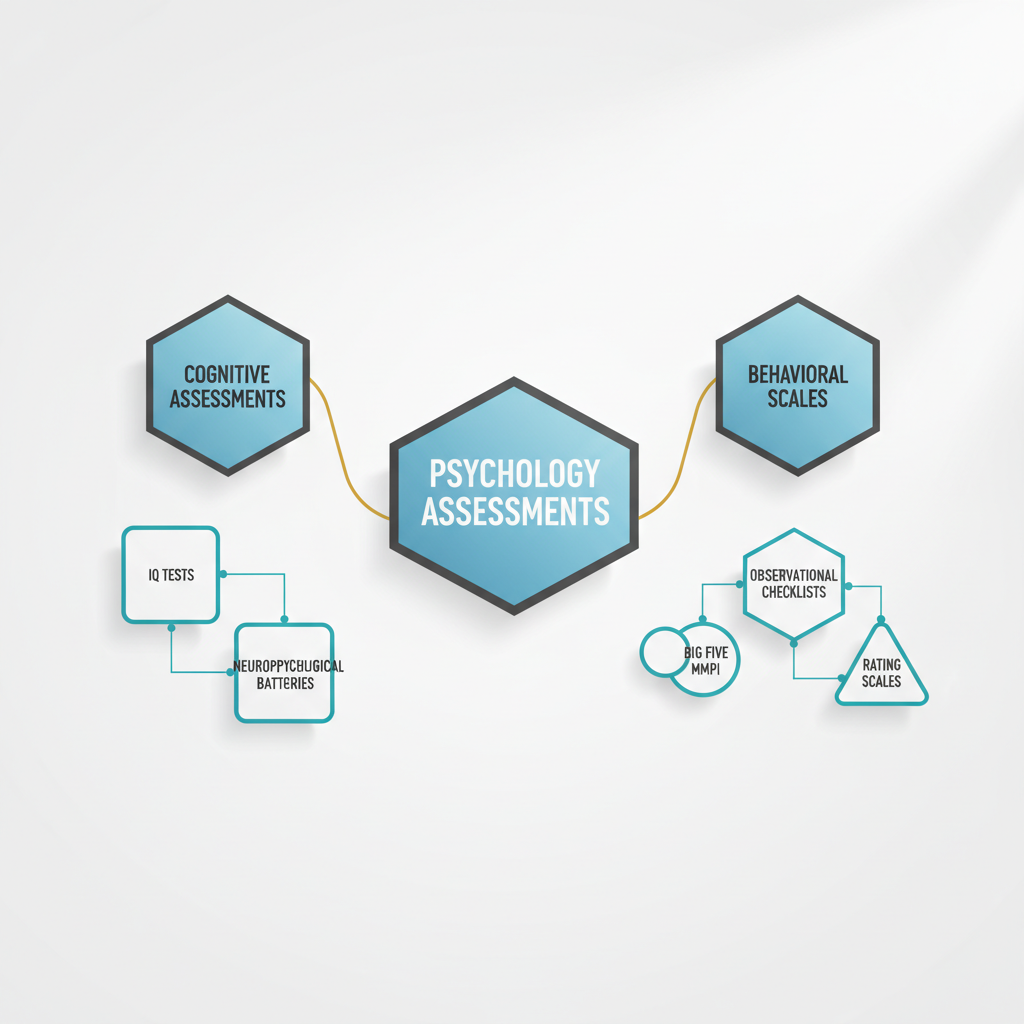
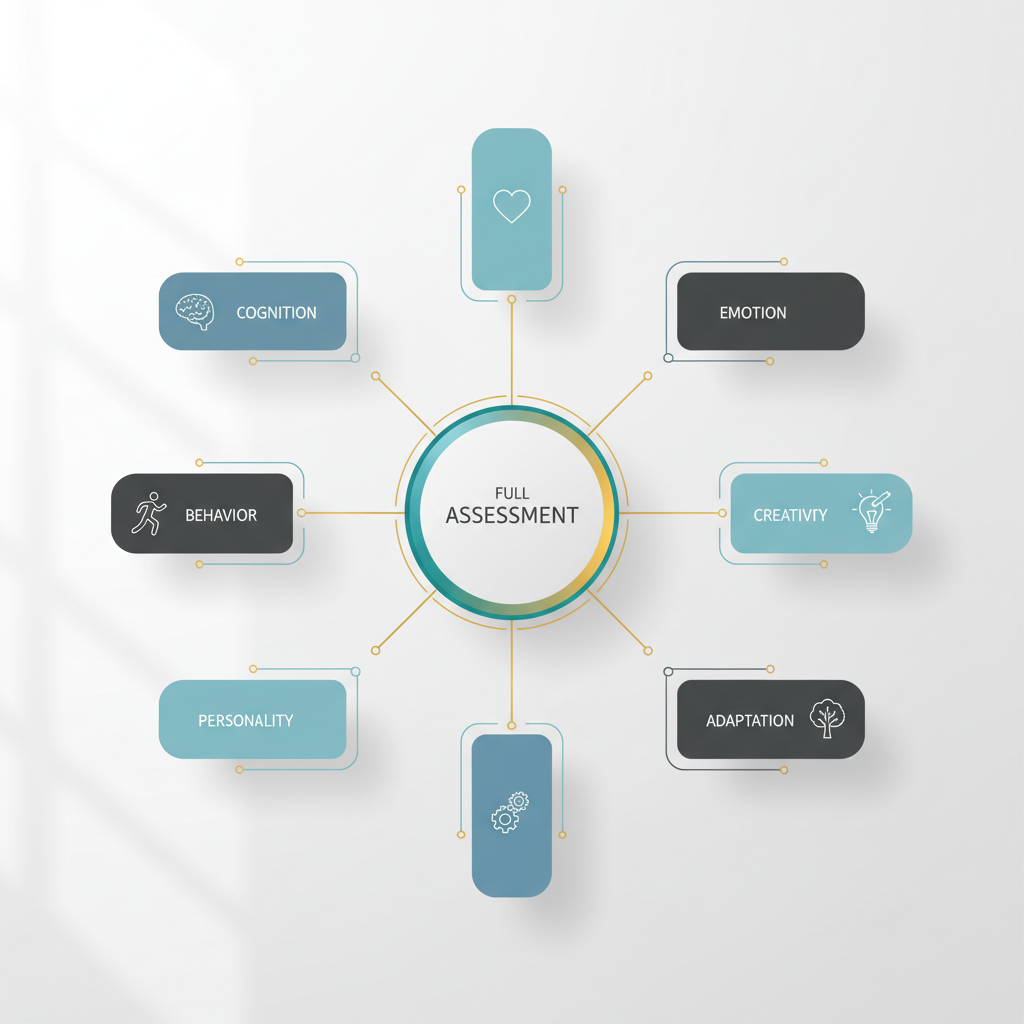
    An infographic showing a central node labeled 'Psychology Assessments' branching into three distinct geometric shapes, each representing a different type of assessment category.
    A clean, vector-based infographic presenting a conceptual overview of different types of psychology assessments. The visual features a central, abstract node or idea cluster labeled ‘Psychology Assessments’. From this central point, distinct geometric shapes branch out, each representing a major category of assessment such as ‘Cognitive Assessments’, ‘Personality Inventories’, and ‘Behavioral Scales’. Smaller, related geometric shapes or lines can emanate from these categories to suggest sub-types or specific focus areas. The color palette includes soft blues, whites, and charcoal for the main elements, with gold or teal accents used for connectors or to highlight category titles. The design incorporates ample negative space to maintain visual hierarchy and clarity for short labels. No humans, photographs, or cartoon elements.

    Self-Report Inventories vs. Projective Tests

    Want to understand your creative mind? An assessment is a great place to start. Psychologists use different tools to explore personality and creativity. The two main types are self-report inventories and projective tests.

    Self-report inventories are clear and simple. They ask you direct questions about your thoughts, feelings, and behaviors. You answer using a scale, like “strongly agree” to “strongly disagree.” These tests are easy to understand. They show you how you see yourself.

    A creativity self-report might ask how you feel about unclear situations. It may ask about how you solve problems. You might rate how much you enjoy new experiences. This method gives you data that is easy to measure and understand. The Creative Ability Test uses this scientific approach. It measures specific parts of your creativity.

    In contrast, projective tests are less direct. They use vague images or situations. A famous example is the Rorschach inkblot test [6]. Your answers are believed to show your hidden thoughts. They may reveal feelings or personality traits. The idea is that you “project” your inner self onto the vague image.

    While interesting, these tests are often subjective. Their meaning can be interpreted in many ways. This makes them less reliable for measuring specific creative skills. They are not precise enough to guide your personal growth. For useful insights into your creative strengths, self-report inventories are the better choice.

    How Scientifically-Grounded Assessments Work

    A good assessment is more than just an opinion. Scientific assessments are built on careful research. They give you reliable insights into your creative potential. This strong foundation makes them accurate and useful.

    These assessments follow key principles:

    • Validity: Does the test measure what it says it will? A valid creativity test accurately measures creative skills.
    • Reliability: Does the test give consistent results? If you take it again, your score should be about the same, unless you’ve changed.
    • Standardization: The test is given and scored the same way for everyone. This allows for fair comparisons.
    • Norms: Your results are compared to a large group of people. This shows you how your creative strengths compare to others.

    These principles help measure key parts of creativity. This includes things like divergent thinking [7]. They also measure cognitive flexibility. Both are key skills for creative problem-solving. A good assessment helps you move from being unsure to understanding yourself better. It gives you a clear path for growth. The Creative Ability Test is built on these scientific standards. It gives you personal and practical insights.

    Why Context Matters in Creativity Testing

    Creativity isn’t a fixed trait. It’s a process that changes. Your environment has a big impact on it. That’s why the context of a creativity test matters.

    Think about your daily life. You might feel more creative at home than at work under a tight deadline. Pressure can either help or hurt your ideas. Different tasks also require different types of creativity. Art is different from science or engineering.

    Your personal state matters, too. Stress, mood, and motivation all play a role. A test result is just a snapshot in time. It shows your usual ways of thinking creatively. It shows how you normally handle challenges. But it doesn’t define you forever. It simply shows your natural tendencies.

    The Creative Ability Test helps you understand your core creative strengths. It offers insights into your thinking styles. It then gives you practical tips. You can learn to be more creative in any situation. You can change your approach and use your skills in more ways. This helps you use your creativity to solve real-world problems.

    How Can an Assessment Measure Your Unique Creative Strengths?

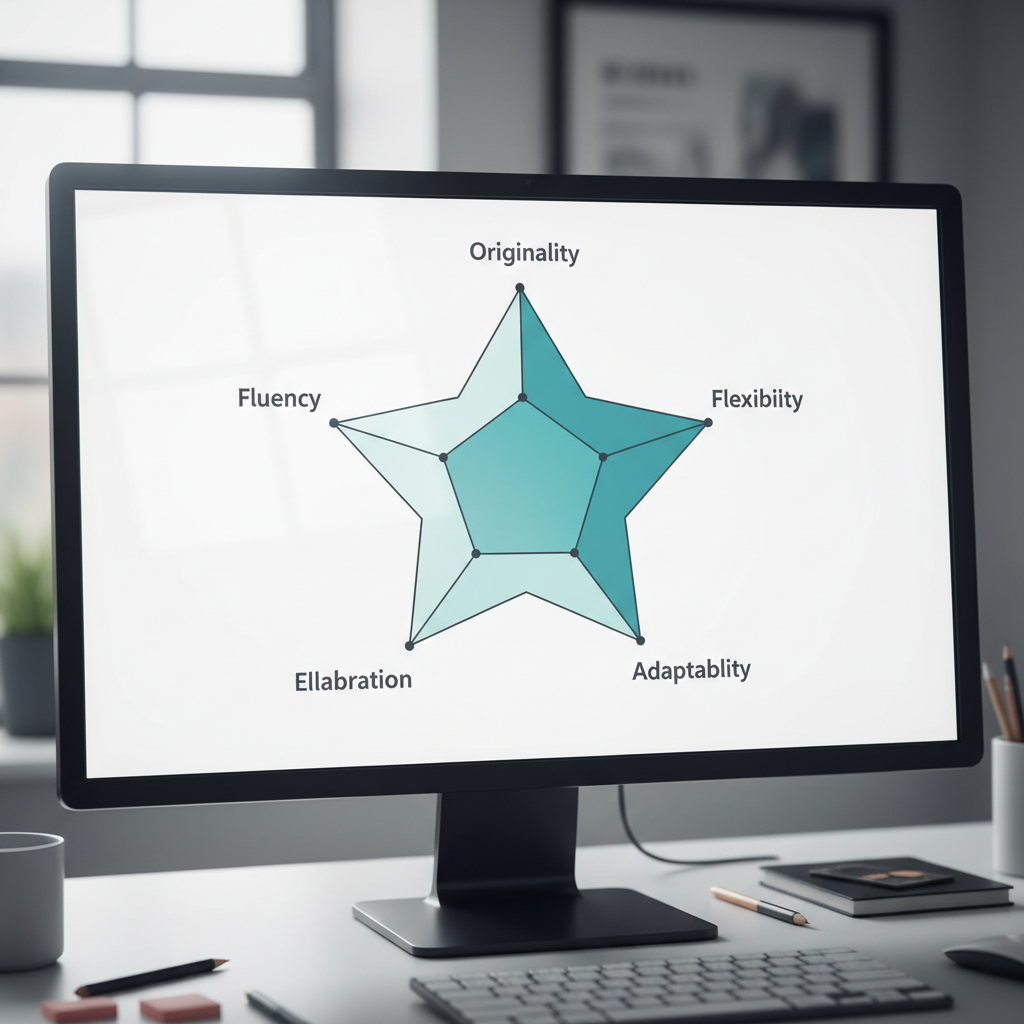
    An infographic showing a star-shaped competency graph with axes labeled for various creative strengths like originality and flexibility, filled with subtle gradients to indicate assessment scores.
    A clean, vector-based infographic representing the measurement of unique creative strengths. The visual features a star-shaped competency graph with multiple axes, each axis labeled with a specific creative strength such as ‘Originality’, ‘Fluency’, ‘Flexibility’, and ‘Elaboration’. Each axis has a subtle gradient fill, indicating a ‘score’ or ‘level’ for that strength. The overall design uses minimalist geometric shapes for structure, with soft blues, whites, and charcoal for the primary elements, and teal accents highlighting the filled areas. The layout maintains ample negative space around short text labels for clarity. No humans, photographs, or cartoon elements.

    The Role of Key personality traits in Creativity

    Your personality is a key driver of your creative potential. It shapes how you think, feel, and connect with the world. Certain traits can boost your creativity, while others might hold you back.

    Psychologists use various Personality Assessment Models to explore this link, and tools like the “Big Five” personality traits provide a solid way to understand how people differ [2]. They show us why some people are naturally more innovative.

    Creativity is complex, but some traits are common in highly creative people. Learning about these traits helps you understand yourself better. It shows you your natural tendencies for creative thinking.

    Key personality traits that influence creativity include:

    • Openness to Experience: This is one of the most important traits for creativity. It means you are curious and willing to explore new ideas.
    • Conscientiousness: While this trait can seem rigid, being somewhat conscientious helps turn creative ideas into real projects. It involves being disciplined and careful.
    • Extraversion: Engaging with others and brainstorming can spark new ideas. However, introverts also show high creativity, often through deep reflection.
    • Agreeableness: Agreeable people are often cooperative. This helps create a good environment for working on creative projects together.
    • Neuroticism (Emotional Stability): While high neuroticism can be tough, the strong emotions that come with it can sometimes fuel artistic expression.

    Our Creative Ability Test helps identify your mix of these traits. It shows you your personal creative strengths. Knowing this is key to helping you grow.

    How to Use Your Assessment Results for Personal and Professional Growth

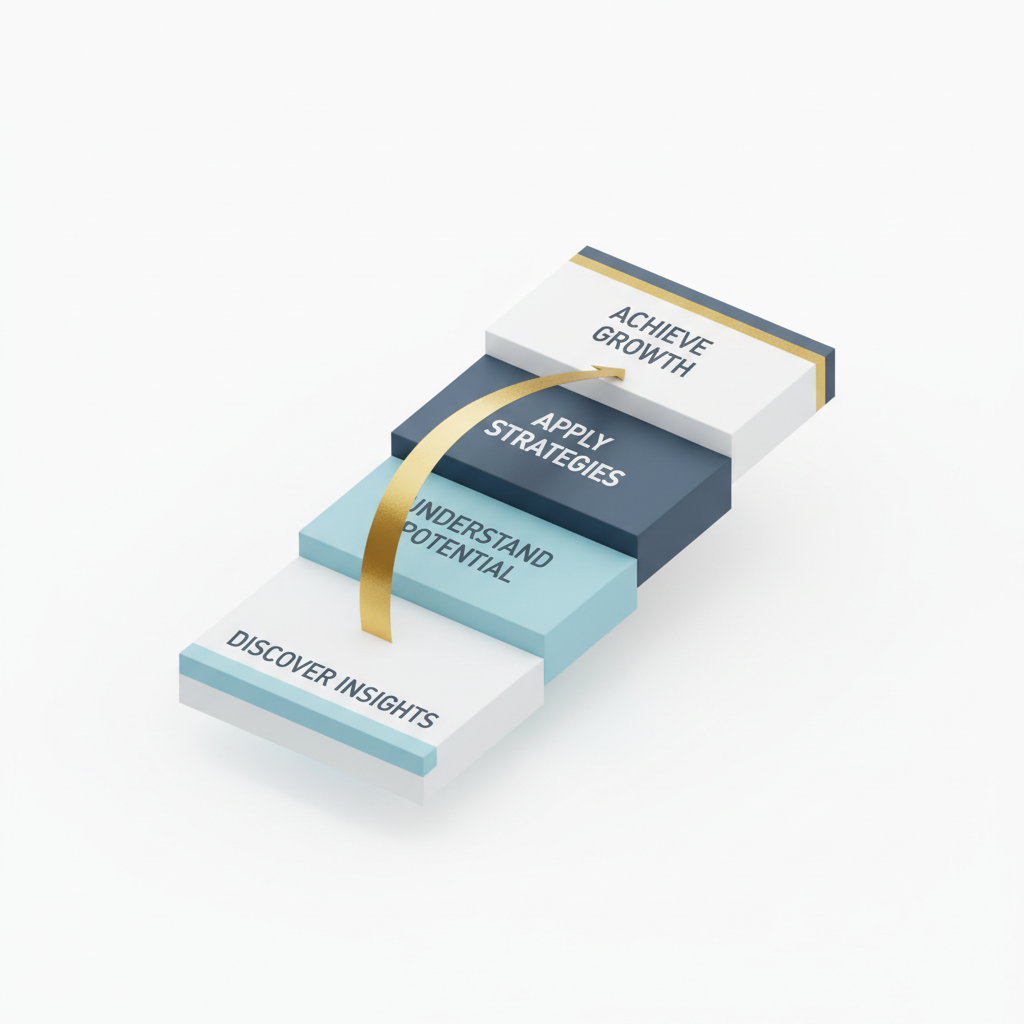
    A minimalist infographic depicting a layered, upward progression of abstract geometric shapes, symbolizing steps for personal and professional growth using assessment results.
    A minimalist, vector-based infographic illustrating a clear, stepwise progression for personal and professional growth using assessment results. The visual depicts a series of abstract, ascending geometric platforms or layers, each representing a stage of growth such as ‘Discover Insights’, ‘Understand Potential’, ‘Apply Strategies’, and ‘Achieve Growth’. A subtle, directional arrow or path connects these stages, emphasizing progression. The design utilizes soft blues, whites, and charcoal for the main structure, with elegant gold accents on the connecting elements or key growth indicators. Ample negative space is incorporated for short labels. No humans, photographs, or cartoon elements.

    Applying Insights to Your Daily Work

    Your Creative Ability Test results are a blueprint of your personal creative strengths. Using these insights can change how you work each day.

    For example, if you score high in divergent thinking, you’re great at generating ideas. You can use this skill to lead brainstorming sessions or suggest new ways to solve old problems. This makes your work more valuable.

    Also, if you have strong cognitive flexibility, you adapt easily and can switch your viewpoint quickly. This skill is very useful in busy workplaces and helps you handle unexpected challenges.

    Consider these practical ways to use your results:

    • Problem-Solving: Use your strengths to solve tough problems. If you have analytical skills, break down problems step by step. If you are more imaginative, explore new or unusual solutions.
    • Decision-Making: Use your creative thinking to weigh your choices. Think about different results before you choose a path. This leads to stronger decisions.
    • Team Collaboration: Share your creative profile with your team. This helps them understand you better. You can then use your strengths where they’re needed most. Encourage others to do the same.
    • Innovation: Look for chances to create new processes or products. Your insights can spark new ideas in your role. Many companies value creativity in their employees [8].

    Taking these steps turns self-awareness into real career growth. You’ll become a more effective and creative professional.

    Developing Strategies to Enhance Creative Thinking

    Your Creative Ability Test gives you personal feedback. It points to areas where you can improve your creativity. It shows what you do well and also where you can grow.

    Improving creativity is a skill you can learn, not just a talent. It takes practice and the right methods. Many techniques are supported by science [9].

    Here are some effective ways to boost your creative thinking:

    • Embrace Divergent Thinking Exercises: If you want to improve your divergent thinking, try “uses for an object” games. Think of as many new uses as you can for a brick or paperclip. This trains your brain to think in new ways.
    • Cultivate Cognitive Flexibility: Question what you think you know. Look at problems from different angles. Read books on new topics. Talk with people who have different views.
    • Practice Mind Mapping: This visual tool helps organize your thoughts. Start with a main idea and then add related words and concepts. It helps you make connections and create more ideas.
    • Engage in Brainstorming Sessions: Take part in or lead brainstorming. At first, focus on the number of ideas, not the quality. Don’t judge ideas right away.
    • Seek New Experiences: Trying new things sparks creativity. Travel, learn a new skill, or visit a museum. New experiences give you new ideas.
    • Reflect and Journal: Think about how you create. What worked well? What got in your way? Journaling can help you see patterns and learn about yourself.

    Using these strategies regularly will make you more creative. This helps you produce new and better ideas more often.

    Building Confidence in Your Innovative Abilities

    Many people doubt they are creative. Your test results give you proof of your natural creative strengths. Knowing this is a great way to build your confidence.

    Seeing your unique creative profile helps you understand your value. You’ll see that creativity isn’t just for art or music. It’s also about solving problems and adapting to change in all parts of your life.

    This will help you share your ideas with confidence and trust your instincts. Your test results are proof of your unique talents, which helps you overcome self-doubt.

    Consider these points for building confidence:

    • Acknowledge Your Strengths: Your report shows your natural strengths. Celebrate them. Understand how they can help you succeed.
    • Understand Your Creative Process: Knowing how you think is helpful. It lets you trust your own way of doing things. This helps you stop comparing yourself to others.
    • Embrace Imperfection: Creativity means trying new things. Not every idea will be a success. See mistakes as chances to learn. Bouncing back is an important part of being creative.
    • Share Your Ideas: Start by sharing small ideas with people you trust at work. As you get good feedback, your confidence will grow. Your voice matters.
    • Recognize Small Wins: Did you solve a problem in a new way today? Did you offer a new viewpoint? Notice these moments. They help you build confidence in your skills.

    Your Creative Ability Test is more than a score. It is a guide to understanding yourself. It gives you the power to be more creative and confident.

    Ready to Discover Your Creative Potential?

    Take the Creative Ability Test Today

    You’ve learned how psychology and personality affect creativity. Now, it’s time to take action. Discover your unique creative strengths and start your journey today.

    The Creative Ability Test gives you a clear next step. It is a 30-question test backed by science that measures different parts of your creativity. Research shows that creativity can be measured and improved [10].

    Taking the test helps you:

    • Understand your thinking style: Discover how you approach problems and come up with new ideas.
    • Identify creative strengths: Find your specific talents, such as originality and flexibility.
    • Measure cognitive agility: See how easily you adapt and think in new ways.
    • Gain personalized feedback: Get feedback and insights made just for you.
    • Access actionable strategies: Learn practical ways to boost your creativity.

    This test is more than a score—it’s a guide to help you grow. You’ll go from feeling unsure to understanding yourself clearly. Turn random bursts of creativity into steady progress and become more confident in your ideas.

    Ready to understand how your creativity works? Want to find new ways to solve problems and be more innovative?

    Take the Creative Ability Test today. Start building a future where your creative potential shines. Your journey to deeper self-discovery begins here.

    Frequently Asked Questions

    What questions are in a psychology and personality assessment?

    Psychology and personality tests ask different kinds of questions. They are designed to learn about how you think, act, and what you prefer. Our Creative Ability Test, for example, has 30 science-backed questions. Each one helps measure your unique creative strengths.

    You’ll be asked about a few key areas:

    • Cognitive Flexibility: These questions check how well you adapt your thinking. They look at how easily you switch perspectives to solve a problem.
    • Divergent Thinking: This measures your ability to come up with many unique ideas. It looks at how you brainstorm and find more than one solution.
    • Problem-Solving Skills: You may see situations that need a creative solution. These questions show how you like to handle challenges.
    • Openness to Experience: Tests often ask about your curiosity and if you’re willing to try new things. This is a key part of being creative [11].
    • Self-Reflection: Many questions will ask what you usually do or prefer. For instance, “Do you like thinking about big ideas?” or “How do you act in new situations?” This helps create a full picture of your personality.

    The goal isn’t to find a “right” answer. Instead, these questions help us understand your unique creative style and way of thinking. This gives you personal and useful tips about your strengths.

    Can I get a psychology and personality assessment for free?

    Many websites offer free “personality quizzes” or “creativity tests.” But how accurate or deep they are can vary a lot. While fun, they often don’t have the deep research and science that professional tests do.

    A truly helpful test, like our Creative Ability Test, is built on a lot of scientific work. This includes:

    • Validated Methods: Our test is based on proven psychology ideas. It uses methods backed by evidence to make sure it’s accurate and reliable [12].
    • Detailed Feedback: We give you more than just a score. You get personal feedback and tips based on your unique results.
    • Useful Growth Tips: The goal is to help you understand how you create. We also give you practical tips to improve your creative thinking and problem-solving skills.

    Paying for a high-quality test is an investment in yourself. It gives you deep, useful information for your personal and work life. While free tests are out there, they usually can’t offer this much detail or scientific backing.

    What is a personality assessment?

    A personality assessment is a tool used to measure your usual ways of thinking, feeling, and acting. Psychologists use these tests to learn more about you, including your common traits, what drives you, and what you like.

    These tests look deeper than what you see on the surface. They explore the core parts of who you are. For instance, some well-known models measure traits like neuroticism, extraversion, and conscientiousness [13]. Our Creative Ability Test focuses on the parts of personality that are important for creativity, such as:

    • Openness to Experience: How willing you are to explore new ideas, art, and different ways of thinking.
    • Cognitive Flexibility: How easily you can shift between different concepts or problem-solving approaches.
    • Curiosity: Your drive to explore and learn new things.

    By understanding these traits, a personality test helps you understand yourself better. It shows your natural strengths and where you can grow. This knowledge is very powerful. You can use it to grow as a person, succeed at work, and solve problems in new ways.


    Sources

    1. https://psycnet.apa.org/record/2012-00566-001
    2. https://www.psychologytoday.com/us/basics/big-5-personality
    3. https://journals.sagepub.com/doi/abs/10.1177/0963721415581026
    4. https://psycnet.apa.org/record/2012-00566-004
    5. https://www.sciencedirect.com/science/article/pii/S001002851930262X
    6. https://www.simplypsychology.org/rorschach-inkblot-test.html
    7. https://psychology.jrank.org/pages/183/Divergent-Thinking.html
    8. https://hbr.org/2019/04/the-most-important-skill-for-the-future-of-work-is-creativity
    9. https://www.apa.org/pubs/journals/releases/xge-a0033285
    10. https://www.apa.org/pubs/journals/releases/amp-a0033092.pdf
    11. https://psycnet.apa.org/record/2012-07316-001
    12. https://www.apa.org/pubs/books/validity-test-interpretation
    13. https://www.simplypsychology.org/big-five-personality.html

  • Creative Hobby Quiz: Find the Perfect Hobby for Your Creative Style

    Creative Hobby Quiz: Find the Perfect Hobby for Your Creative Style

    A creative hobby quiz is a tool designed to analyze your personality, thinking styles, and problem-solving skills to recommend hobbies that align with your unique creative strengths. Unlike simple personality quizzes, a scientifically-grounded assessment provides deep insights into how you innovate and create, helping you find a fulfilling hobby that fosters personal growth.

    Have you ever wanted to express yourself, create something new, or solve problems in a fresh way, but weren’t sure where to start? Creativity isn’t just for artists—it’s a key part of being human that helps us innovate, grow, and feel fulfilled. The first step to using your creativity more is understanding your personal style.

    Many people try new hobbies, but they don’t always “click.” This often happens when the activity doesn’t match our natural strengths and thinking styles. What if you could find a hobby that you love and that also sharpens your ability to think in new ways, come up with fresh ideas, and improve your problem-solving skills? A well-made quiz based on science can help you find exactly that.

    This article explains why finding the right creative outlet is so important and how a science-based approach can reveal your unique creative type. You’ll learn how different creative styles match up with certain hobbies, giving you practical tips to choose activities that suit you best. Get ready to move past generic advice and begin a journey of self-discovery to find the perfect hobby that inspires you and helps you grow.

    Why Is Finding the Right Creative Hobby So Important?

    An infographic illustrating the multi-faceted benefits of a creative hobby, shown as an expanding core surrounded by layers representing growth, skill development, and well-being.
    An abstract educational visualization representing the profound impact of finding the right creative hobby. Show a central, expanding core symbolizing personal growth and well-being, surrounded by interconnected, layered rings or segments. Each layer represents a benefit: skill development, stress reduction, self-discovery, and innovation. Use clean geometric shapes, subtle gradients in soft blues, whites, charcoal, with gold or teal accents. Ample negative space. No humans or cartoons. Minimalist, vector-based, professional, and approachable style.

    Beyond Just Passing the Time

    Many people think of creative hobbies as just a way to pass the time. But they are much more than a simple distraction. The right creative hobby can greatly improve your well-being and is a great way to grow as a person.

    Creative activities give your brain a good workout. They help it form new connections, which makes you a more flexible thinker. As a result, your problem-solving skills get stronger. Creative work is also a known way to relieve stress, offering a healthy break from daily pressures [1].

    When you choose a hobby that’s right for you, you can:

    • Lower stress and anxiety.
    • Improve your focus and concentration.
    • Express your emotions and understand yourself better.
    • Sharpen your thinking skills and mental quickness.
    • Feel a sense of purpose and accomplishment.

    These benefits show that you’re doing more than just passing time. You are actively taking care of your mind, which helps you do well in many areas of life.

    Connecting with Your Core Creative Strengths

    The real power of a creative hobby comes from matching it with your innate abilities. To find the right hobby, you need to learn about yourself. This helps you enjoy it more and get the most benefit, allowing you to reach your full creative potential.

    Everyone’s creative strengths are different. For example, you might be a “divergent thinker,” good at coming up with many new ideas. Or you might be more analytical, skilled at organizing and improving concepts. The Creative Ability Test can help you find your specific strengths by giving you personalized feedback on how you think.

    When you match your hobby to your natural creative talents:

    • You’ll feel more engaged and get into a state of “flow.”
    • Learning new skills will feel easier and more satisfying.
    • Your confidence in your creative abilities will grow.
    • You’ll develop a stronger sense of who you are.
    • It becomes a more effective way to support your personal growth.

    This focused method makes your hobby more than just fun. It becomes a powerful tool for improving your unique thinking skills. This leads to meaningful personal growth and lasting satisfaction.

    How Does a Creative Hobby Quiz Work?

    An infographic showing a three-step process for a creative hobby quiz: self-assessment, thinking style analysis, and hobby recommendations, depicted as a clear flow diagram.
    A clean, instructional infographic illustrating the structured process of a creative hobby quiz. Visualize it as a clear, sequential flow diagram or a stepwise progression with interconnected nodes. Each node represents a quiz stage: ‘Input/Self-Assessment’, ‘Analysis/Thinking Style Identification’, and ‘Output/Hobby Recommendations’. Use minimalist vector-based geometric shapes, subtle gradients, and a color palette of soft blues, whites, charcoal, with gold or teal accents for markers. Maintain ample negative space for clarity. No humans or cartoons. Professional and approachable.

    Understanding Your Creative Profile

    Many online quizzes offer quick hobby ideas. Our Creative Ability Test goes much deeper. It helps you understand your unique creative style using a 30-question, science-based test.

    This test measures your creativity in several ways. It explores how your mind naturally solves problems. It also reveals your natural strengths in different creative areas.

    The quiz gives you information about key areas, including:

    • Cognitive Flexibility: Your ability to switch between different ideas easily. People with high cognitive flexibility adapt quickly to new information and surprises [2].
    • Divergent Thinking: Your ability to create many unique solutions to one problem. This is a key part of creative thinking [3].
    • Problem-Solving Skills: How you naturally handle difficult situations. This includes whether you prefer clear rules or more open-ended challenges.
    • Openness to Experience: Your willingness to try new things and explore new ideas. This trait is often linked to creativity.

    By understanding these parts of yourself, you learn more about what you can do. You can stop guessing about your creative talents and get a clear picture of your strengths.

    Matching Your Thinking Style to Activities

    Every creative hobby uses certain cognitive strengths. A painter uses visual skills, while a writer uses language. Our quiz matches your creative profile to hobbies that are a good fit for you.

    It finds your main thinking style. Then, it suggests hobbies you will likely enjoy and be good at. For example, if you are a strong divergent thinker, you might like hobbies that let you explore freely. On the other hand, if you are good at analytical problem-solving, hobbies with clear rules might be perfect.

    Consider these examples:

    • Analytical Problem-Solvers: You might be great at puzzles, coding, or building detailed models. These hobbies use logic and clear goals.
    • Divergent Thinkers: You could enjoy abstract art, coming up with new ideas, or experimental cooking. Your mind loves creating many different possibilities.
    • Hands-On Makers: Building, sculpting, or crafting lets you create something real. You enjoy working with your hands and seeing results quickly.
    • Expressive Storytellers: Writing, playwriting, or filmmaking lets you tell stories. You enjoy sharing feelings and connecting with others.

    This matching process isn’t random. It is based on an understanding of creative psychology. As a result, our recommendations are made just for you. We aim to match your natural talents with hobbies you will find rewarding.

    Moving Beyond Generic Hobby Lists

    Most hobby lists offer the same general ideas. They rarely consider how you think. Recommending painting or knitting to everyone can lead to frustration and giving up.

    Our Creative Hobby Quiz is different. It gives you more than a list; it offers personalized advice. You will understand why a certain hobby fits your creative style. For instance, you will see how an activity uses your natural ability to switch between ideas.

    This approach helps you feel more certain about your creative side. You gain a deeper understanding of your own mind. As a result, you can try new hobbies with more confidence and excitement. It changes how you see creativity, turning simple suggestions into a real plan for growth.

    Our goal is to give you detailed, personal feedback. We want to help you use your creativity in a meaningful way. This supports personal growth, career development, and new ways of thinking. Finding the perfect hobby becomes a journey of self-discovery.

    What Creative Hobbies Align with Different Thinking Styles?

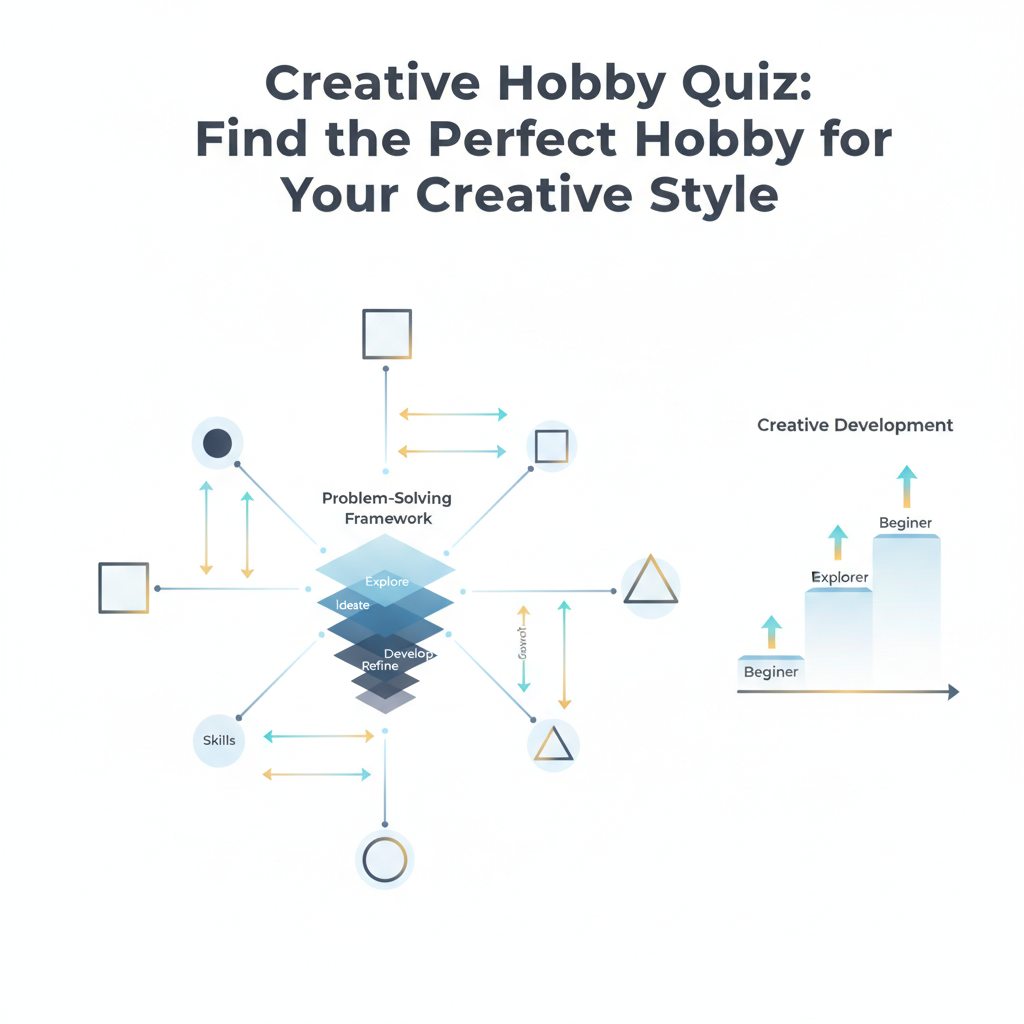
    An infographic visualizing the connection between different thinking styles (e.g., divergent, convergent) and various aligned creative hobbies using a network diagram with central hubs and branching connections.
    An abstract, educational infographic visualizing the alignment between various thinking styles and suitable creative hobbies. Present a cognitive network diagram or an idea cluster. A central hub could represent ‘Thinking Styles,’ branching out into different nodes for ‘Divergent,’ ‘Convergent,’ ‘Analytical,’ ‘Intuitive’ styles. Each style node then connects to smaller clusters or examples of ‘Creative Hobbies’ (e.g., painting, coding, writing, sculpting). Use minimalist vector shapes, interconnected lines with subtle gradients. Color palette: soft blues, whites, charcoal, with gold or teal accents to highlight connections and categories. Ample negative space. No humans or cartoons. Professional and approachable.

    Knowing how you think can unlock your creativity. Your Creative Ability Test results show your main creative strengths. This helps you pick hobbies you’ll truly enjoy. Hobbies that match your thinking style are more rewarding. They also help you grow your skills and support your personal growth.

    Let’s look at creative hobbies for different thinking styles. This guide gives you practical ideas. You can use what you learn about yourself to find a new creative hobby.

    For the Analytical Problem-Solver

    Analytical thinkers love structure and logic. You enjoy breaking down complex problems. You love finding smart, simple solutions. Your creativity often shows up in organized, step-by-step thinking. You are a careful planner who likes to get things right.

    You look for patterns and clear answers. You enjoy challenges that need a good strategy. These hobbies are perfect for your detail-oriented mind.

    • Strategic Board Games or Puzzles: Games like chess, Go, or complex puzzles use your strategic mind. They require you to think ahead. This helps you predict what will happen next [4].
    • Coding and Programming: For analytical minds, writing code is very creative. You design systems and solve problems using logic. You turn ideas into things that work.
    • Architectural Drawing or Model Building: These hobbies mix art with solid design. You have to plan the layout, choose materials, and make sure it’s stable. Every detail matters.
    • Data Visualization or Infographics: Turning data into clear, visual stories is a great creative challenge. It takes both analysis and good design skills. You make complicated information easy to understand.

    The Creative Ability Test shows your strengths in problem-solving and logic. This knowledge helps you. It helps you pick hobbies that are both challenging and fun.

    For the Divergent and Abstract Thinker

    Divergent thinkers are great at coming up with many new ideas. You like to explore lots of possibilities. You make connections between things that seem unrelated. Your mind wanders to find new solutions. Abstract thinking helps you understand big, complex ideas. You see the big picture and are okay with not having all the answers.

    Your creativity is often spontaneous and free-flowing. You like to think outside the box. Try hobbies that let you explore without limits.

    • Abstract Painting or Sculpture: These are perfect for expressing ideas and feelings freely. You can experiment with forms, colors, and textures. There are no limits to your imagination.
    • Improvisational Arts (Music, Theater, Dance): Improv requires you to think fast and come up with ideas on the spot. You create in the moment. This makes your thinking more flexible.
    • Brainstorming and Concept Development: You can turn this into a hobby. You could invent new products, create fictional worlds, or solve big problems. Your strength is coming up with a lot of different ideas [5].
    • Experimental Photography: Go beyond normal photos. Play with light, angles, and unusual subjects. Focus on creating a feeling or idea instead of a perfect picture.

    Our assessment measures your skill for divergent thinking. It also shows how open you are to new things. These results give you clear direction. They help you find hobbies that celebrate your unique ability to think outside the box.

    For the Hands-On Maker and Builder

    Hands-on makers love to create real, physical things. You enjoy turning ideas into something you can touch. You love the process of building and making. Your creativity comes from working with your hands. You feel good when you finish a project. You learn best by doing and enjoy seeing your efforts take shape.

    You are good at putting ideas into action and doing skilled work. These hobbies are a great way to use your constructive energy.

    • Woodworking or Metalworking: In these crafts, you shape materials into useful or beautiful objects. You use tools and learn new skills to build something strong and beautiful.
    • Pottery or Ceramics: Working with clay is a very hands-on hobby. You mold, sculpt, and glaze. Each piece is unique. It reflects your personal touch and skill.
    • Gardening and Landscaping: Gardening is like creating a living piece of art. You design, plant, and care for your garden. It is a hobby that keeps you creative over time.
    • DIY Home Improvement or Restoration: Doing projects around the house lets you use your practical skills. You can change a room and see the results right away.

    The Creative Ability Test assesses your practical and innovative skills. It can show if you have a knack for making things. This helps you find hobbies where you can make real things and always be learning.

    For the Expressive Storyteller

    Expressive storytellers are good at connecting with people. You use stories to share ideas and feelings. Your creativity shines when you build new worlds. You create interesting characters or tell stories about real events. You understand people well and have a natural desire to share what you think and feel.

    You are great at telling stories that people connect with. Choose hobbies that let your unique voice be heard.

    • Creative Writing (Fiction, Poetry, Screenwriting): These are all great ways to tell stories. You use words to create stories, characters, and worlds that pull readers in.
    • Podcasting or Vlogging: These digital formats let you share your voice and opinions. You can create audio or video to tell stories, share facts, or give your opinion to an audience.
    • Documentary Filmmaking or Photography: You can capture real stories and show what it means to be human. This takes a good eye for detail, empathy, and a clear storytelling vision.
    • Performance Art or Spoken Word Poetry: This is a direct and powerful way to tell a story. You use your body and voice to connect deeply with an audience.

    Our comprehensive assessment measures how open you are to new things and how well you understand emotions. These are key skills for any storyteller [6]. The personalized feedback from the Creative Ability Test can help you. It helps you find creative hobbies that amplify your unique voice.

    Ready to Discover Your Perfect Creative Hobby?

    Take the Scientifically-Grounded Creative Ability Test

    Tired of guessing which creative hobby is right for you? Generic online quizzes often give shallow advice. To find a hobby you truly love, you need to understand yourself better.

    The Creative Ability Test is different. It’s not just another hobby quiz. We use a 30-question test based on science to help you understand your creative potential.

    Our test looks at key parts of creativity, like your flexibility, problem-solving skills, and openness to new ideas. For example, learning about your skill in divergent thinking can open up new possibilities [3]. You’ll get a clear picture of your natural creative strengths.

    Our test is based on proven research, giving you a solid starting point for self-discovery. The results you get are accurate and practical. This means you can confidently find hobbies that are a perfect fit for you.

    From Quiz Results to Actionable Insights

    Taking the test is just the first step. The real value comes from your personalized results. Your report is more than just a score—it’s a detailed profile of how you think creatively. It highlights your strengths and shows you where you can grow.

    We turn complex psychological ideas into simple, useful advice. You’ll get practical tips to improve your creative skills, tailored just for you. This helps you use your creativity in everyday life, starting with choosing the right hobby.

    Here are some examples of how your results can point you to the right hobbies:

    • If your report highlights strong divergent thinking: You might excel in activities that use a lot of brainstorming. Think abstract painting, improvisational comedy, or free-form writing.
    • If you show high cognitive flexibility: Hobbies that require you to adapt and solve problems could be perfect. Try coding, garden design, or creative cooking.
    • If your strengths lie in analytical problem-solving: You might enjoy structured creative projects. Examples include intricate model building, complex puzzle design, or musical composition.

    This process turns uncertainty into useful self-knowledge. Our platform guides you in connecting your unique skills to a variety of hobbies. You get a clear path to grow and have fun, ensuring you find a creative passion that’s a perfect match.

    Frequently Asked Questions

    What makes this creative hobby quiz different from others?

    Many online quizzes give you generic hobby ideas. Our creative hobby quiz is different because it’s more than just a simple survey.

    Our quiz is based on the scientific Creative Ability Test. This means it uses proven methods to understand your unique creative style. We focus on real insights, not just entertainment.

    Our approach helps you understand how you think. It measures key parts of your creativity, like how easily you can switch between different ideas (cognitive flexibility) and how many new ideas you can generate (divergent thinking). We look deeper than just your basic preferences.

    Here’s what makes our quiz different:

    • Scientifically Grounded: Our quiz is built on psychological research to accurately assess your creative potential [7].
    • Personalized Insights: You get feedback tailored to your strengths and areas for growth, not just a generic list of hobbies.
    • Focus on Core Creative Strengths: We identify your main thinking style to help you find hobbies that truly fit you.
    • Actionable Strategies: We suggest hobbies and also give you strategies to boost your creative thinking in daily life.
    • Comprehensive Assessment: Our 30-question assessment measures multiple sides of your creativity.
    • Promotes Growth: This quiz is designed for personal growth, helping you move from feeling unsure to having a clear path forward.

    Ultimately, our quiz helps you find hobbies that match who you are. Instead of struggling with creativity, you’ll get clear strategies to help you grow. It’s all about building your confidence and making things you’re proud of.

    What kind of questions are in a hobby quiz?

    Our creative hobby quiz asks questions that make you think. They are designed to explore how your mind works. Instead of asking what hobbies you already like, we focus on how you see and interact with the world.

    The questions look at different parts of your creative thinking and how you solve problems. For example, some questions test how many ideas you can come up with (divergent thinking). Others see how you connect ideas that seem unrelated.

    We look for key creative traits like:

    • Openness to Experience: Are you open to new and different ideas?
    • Curiosity: Do you like exploring new things and asking “why?”
    • Cognitive Flexibility: Can you easily change your mind or see things from a new angle?
    • Problem-Solving Style: Do you prefer clear rules or creative ways to solve problems?
    • Preference for Novelty: Do you enjoy new and unique experiences?

    Every question uses situations you can relate to, making the quiz easy for anyone to take. The goal is to understand how you think creatively. We then give you simple, easy-to-understand results that guide you toward hobbies that are a natural fit for you.

    Is there a creative hobby quiz for adults and teens?

    Yes, absolutely. Our Creative Ability Test and hobby quiz are designed for both adults and teens. Creativity isn’t just for one age group—it’s something everyone has [8].

    Our quiz is useful for everyone. Teens can use their results to do better in school or find new ways to express themselves. Adults can apply their creative strengths at work or find hobbies that make life more enjoyable. It’s great for anyone looking for a new challenge or a path to self-discovery.

    The feedback you get is tailored to you. It’s helpful whether you’re a student, a professional, or just curious about yourself. Our quiz is a great tool for:

    • Personal Growth: Understand and enhance your unique creative strengths.
    • Educational Development: Apply creative thinking to learning and problem-solving.
    • Career Advancement: Boost innovative thinking at work.
    • Stress Reduction: Discover engaging hobbies that promote well-being.
    • Self-Discovery: Uncover hidden talents and passions.

    Anyone who wants to understand and improve their creativity can benefit. Our science-backed quiz gives you practical advice, no matter your age. It’s a great first step on a journey of learning and creative discovery.


    Sources

    1. https://www.who.int/publications/i/item/health-evidence-network-synthesis-report-67
    2. https://www.ncbi.nlm.nih.gov/pmc/articles/PMC8900010/
    3. https://en.wikipedia.org/wiki/Divergent_thinking
    4. https://journals.sagepub.com/doi/abs/10.1177/0956797613476317
    5. https://onlinelibrary.wiley.com/doi/abs/10.1002/acp.2505
    6. https://www.apa.org/pubs/journals/releases/psp-psp0000003.pdf
    7. https://www.apa.org/pubs/journals/features/xge-a0033285
    8. https://www.frontiersin.org/articles/10.3389/fpsyg.2017.02102/full

  • Take the Creative Ability Assessment: Understand Your Strengths & Potential

    Take the Creative Ability Assessment: Understand Your Strengths & Potential

    Taking the Creative Ability Test involves answering a 30-question, scientifically-grounded assessment designed to measure your unique creative strengths. Upon completion, you receive a personalized report detailing your cognitive flexibility, problem-solving skills, and actionable strategies for growth.

    Do you ever wonder how creative you really are? Many people think creativity is a rare skill meant only for artists or inventors. But in today’s world, creativity is essential. It helps you innovate, solve problems, and grow in both your work and personal life. Creativity is how you handle new situations, come up with fresh ideas, and connect concepts in surprising ways.

    At Creative Ability Test, we believe that understanding your creative style is the first step to using your full potential. We offer a scientifically grounded assessment that helps explain how you think creatively. By taking our 30-question test, you will get a clear picture of your strengths and find areas for growth. You’ll also learn about the different dimensions of your personal creativity, all based on proven research.

    This article explains what makes the Creative Ability Assessment a unique tool for self-discovery. We will explore why understanding your cognitive flexibility, divergent thinking, and innovative problem-solving skills is so important. You’ll learn how the insights from our reports can help you use your creativity in practical, everyday situations. Get ready to turn uncertainty into clear self-awareness and apply your creative talents to all areas of your life.

    What is the Creative Ability Assessment?

    An abstract infographic showing interconnected nodes and clusters, representing the various components measured in a creative ability assessment.
    Abstract, educational infographic. A minimalist, vector-based cognitive network diagram or idea cluster, depicting the multifaceted nature of a creative ability assessment. Clean geometric shapes, subtle gradients, soft blues, whites, charcoal, with gold or teal accents. Ample negative space for short conceptual labels like “Divergent Thinking”, “Innovation Potential”. No humans, professional and approachable.

    Want to understand your unique creative spark? The Creative Ability Assessment is a science-backed tool designed to help you find your natural creative strengths. This 30-question online test looks at how you think creatively and gives you a clear picture of your potential.

    Our goal is to help you discover more about yourself. We show you how your mind comes up with new ideas and what your specific creative style is. You will also learn how you approach challenges and opportunities. This assessment is a simple path to understanding yourself better.

    The test looks at several parts of creativity. It measures your mental flexibility, which is how easily you switch between different ideas. It also checks your ability to brainstorm many unique solutions to a problem [1]. We also look at your openness to new experiences, as these are key parts of innovative thinking.

    Taking this assessment gives you clarity. You get personal insights into your creative profile, which helps you use your strengths and shows you areas where you can grow. As a result, you can improve your problem-solving skills and be more creative every day, both at work and in life.

    The Creative Ability Test uses proven methods based on research in psychology. This ensures your results are reliable and meaningful. You get practical strategies, not just scores. These tips are tailored to help you build your creative skills for both personal and professional growth.

    Why Should You Take This Assessment?

    Understand Your Unique Creative Profile

    You have a unique way of seeing the world. The Creative Ability Assessment helps you discover it. This isn’t a simple “creative or not” test. Instead, our 30-question assessment explores the different parts of your personal creative style.

    When you take this assessment, you’ll get a clearer picture of:

    • Your natural strengths: Discover where your creative talents are.
    • Your thinking style: Learn if you’re better at coming up with many ideas (divergent thinking) or narrowing them down (convergent thinking).
    • Cognitive flexibility: Find out how easily you can switch viewpoints and adapt to new challenges.
    • Openness to new experiences: See how curiosity fuels your creativity.

    This deeper self-knowledge is powerful. It helps you recognize and value your own unique way of thinking.

    Gain Actionable Insights for Growth

    Getting your results is just the beginning. Our platform offers more than just scores. We provide personalized feedback designed to help you grow your creative skills.

    The insights you receive are:

    • Tailored to you: Based on your results, you get recommendations made just for you.
    • Clear and practical: We break down complex psychological concepts into simple, practical advice.
    • Growth-oriented: You’ll find practical steps to improve your creative thinking in your daily life.
    • Empowering: Learn how to use your strengths and work on areas where you can grow.

    For example, if your results show you’re great at divergent thinking, your report might suggest brainstorming techniques to make that skill even stronger. On the other hand, if you could improve your cognitive flexibility, we might suggest exercises to help you practice changing your viewpoint. These are more than just tips—they are practical steps to help you grow.

    Enhance Problem-Solving Skills

    Creativity is more than just making art. It’s a powerful tool for effective problem-solving. In today’s fast-changing world, the ability to come up with new solutions is a valuable skill.

    Taking this assessment helps you improve your problem-solving skills by:

    • Helping you think in new ways: You’ll learn to approach challenges from different angles.
    • Improving idea generation: Build your ability to use divergent thinking to come up with more solutions.
    • Strengthening your judgment: Understand how to use convergent thinking to pick the best ideas.
    • Boosting adaptability: Your improved cognitive flexibility will help you change your approach when you run into problems.

    In fact, global leaders often call creativity a critical skill for dealing with today’s business challenges [2]. This assessment gives you the mindset and tools to turn challenges into opportunities, whether you’re working on a tough project or a personal problem.

    Boost Your Professional and Personal Development

    Investing in your creativity pays off in big ways. Your career and personal life can improve when you understand and develop your creative skills.

    In your career, this assessment can help you:

    • Advance your career: Creativity is a top skill that employers are looking for [3].
    • Drive innovation: You’ll bring fresh ideas and solutions to your team.
    • Improve your leadership potential: Creative thinkers often inspire others and lead the way to growth.
    • Increase your adaptability: Handle change with confidence and new ideas.

    In your personal life, understanding your creativity helps you to:

    • Express yourself: Find new ways to feel fulfilled and find joy.
    • Build confidence: See your unique value and what you can achieve.
    • Improve daily life: Approach everyday situations in a more imaginative and positive way.

    Unlock your creative potential. Experience personal and professional growth.

    How Does the Assessment Work?

    An abstract infographic illustrating the sequential steps of an assessment process using geometric shapes and arrows.
    Abstract, educational infographic. A minimalist, vector-based stepwise process diagram or a linear milestone progression. Clean geometric shapes and arrows illustrate the flow of the assessment. Soft blues, whites, charcoal, with gold or teal accents. Negative space for short labels such as “Initiate”, “Engage”, “Analyze”, “Discover”. No humans, professional and approachable.

    Step 1: The 30-Question Journey

    Start with our 30-question assessment to discover your creative strengths. This quick online test is engaging and insightful. It is designed to explore your creative style by looking at how you solve problems and come up with new ideas.

    The questions use different scenarios to show your natural creative instincts. Your answers help us see how you think. This short test gives us the information we need to understand your potential to create and grow.

    Step 2: Our Science-Backed Methodology

    Our assessment is based on solid scientific research, not just a simple quiz. It uses proven ideas from cognitive psychology [4] and the latest studies on creativity.

    We measure key creative dimensions like divergent thinking. That’s your ability to come up with many different ideas from one starting point [5]. We also look at your cognitive flexibility, which is how easily you can switch between different ideas or ways of thinking [6].

    Every question is carefully tested to make sure it accurately measures a specific creative skill. This means you get results you can trust. Our science-backed approach helps you discover your full creative potential.

    Step 3: Your Personalized Results Report

    After you finish the assessment, you’ll get a detailed, personal report. It’s more than just a score—it’s your guide to understanding how you think. You’ll see a clear picture of your creative profile and core strengths.

    Your report explains what each creative skill means for you. You’ll learn about your thinking style and how open you are to new things. It also points out specific areas where you have the potential to grow.

    Best of all, your report gives you practical tips to boost your creativity. These are simple exercises and ideas you can use right away for your work projects or personal growth. This report is your roadmap to becoming more creative, turning self-awareness into real results.

    What Creative Traits Does the Assessment Measure?

    An abstract infographic depicting a competency chart or graph, detailing various creative traits measured by an assessment.
    Abstract, educational infographic. A minimalist, vector-based creative skill assessment chart or a competency graph, visually breaking down traits. Clean, structured layout with geometric shapes and subtle gradients. Soft blues, whites, charcoal, with gold or teal accents. Negative space for labels like “Fluency”, “Originality”, “Flexibility”, “Elaboration”. No humans, professional and approachable.

    Divergent & Convergent Thinking

    People often think creativity is just about “having ideas.” But it’s really about two different, important ways of thinking. The Creative Ability Assessment helps you understand your balance of both.

    Divergent thinking means coming up with lots of different ideas. It’s like brainstorming, where you explore many possibilities. This way of thinking helps you move past the usual solutions. The goal is to have many different kinds of ideas.

    Convergent thinking is the opposite. It’s about choosing the best idea from all your options. You narrow down your choices to find the one that works. This process helps you turn a good idea into a great solution.

    Our assessment shows you which style comes more naturally to you. Are you great at creating new ideas? Or are you better at turning those ideas into practical solutions? Knowing your balance is the first step to becoming more creative. You need both skills to truly innovate [7].

    You’ll discover how to use your strengths and improve your weaker style. This will help you solve problems more effectively in any situation.

    Cognitive Flexibility

    Cognitive flexibility is a key part of creative thinking. It’s your ability to change how you think and easily switch perspectives. This skill allows you to look at a problem from many different angles.

    This skill helps you adapt when you get new information. It also lets you switch between different tasks or plans easily. For example, someone with this skill can quickly change their marketing plan based on new customer feedback. They use new data instead of resisting it.

    Our assessment measures your cognitive flexibility. It shows how easily you let go of old ideas and accept new ones. People with high cognitive flexibility are more resilient. They adapt well in fast-changing situations.

    Improving this skill helps you create new things. It makes you a more flexible thinker. We’ll give you practical tips to build this skill. This will help you find creative solutions more often.

    Openness to New Experiences

    Openness to new experiences is an important personality trait for creativity [8]. It’s about being curious and willing to explore new ideas, values, and feelings.

    People who are open to new experiences are often very imaginative. They enjoy trying new things and learning. They aren’t afraid to question how things are done. They also seek out different points of view, which makes them natural innovators.

    Our Creative Ability Assessment measures your level of openness. It shows how comfortable you are with uncertainty and how much you enjoy variety. Knowing this is important for both your personal and professional life.

    Understanding your openness can help you find experiences that spark your creativity. We provide personalized tips to encourage you to try new things and expand your mind. This will help you unlock your natural creative talent.

    Innovative Problem-Solving Approaches

    Creativity is about solving problems. Innovative problem-solving means finding new and effective solutions to challenges. It’s more than just coming up with ideas.

    This skill combines divergent and convergent thinking with cognitive flexibility. It also uses your openness to new ideas. Our assessment looks at how you use these skills together. It shows your unique way of handling difficult problems.

    You’ll get a clear picture of how you like to work. Do you start by exploring many ideas? Or do you prefer to focus on a few and make them better? Knowing this helps you improve your creative process. You’ll be able to innovate more effectively.

    The personalized report from your Creative Ability Test is very useful. It shows your strengths in real-world situations and gives you practical advice. You’ll learn how to use your creative skills to solve everyday problems. This helps you bring new ideas to your work and life. Take the assessment today to discover these valuable insights.

    Ready to Discover Your Creative Potential?

    Do you want to explore your creative side? Maybe you feel you have ideas waiting to come out. The Creative Ability Assessment can help you unlock your potential.

    This science-backed, 30-question test offers deep insights into your mind. It helps you find your unique creative strengths. You will also understand your personal thinking style.

    Start Your Journey of Self-Discovery

    This test is more than just a quiz. It’s a big step in understanding yourself. You’ll get a clear picture of your creative talents. This helps you build on your skills in the best way.

    • Find Your Strengths: See where you are most creative.
    • Know Your Thinking Style: Learn how you solve problems and come up with ideas.
    • Get Actionable Tips: Receive custom advice to boost your creativity every day.
    • Improve Problem-Solving: Use what you learn to solve challenges at home and work.
    • Encourage Personal Growth: Connect more deeply with your creative side.

    Everyone has creative potential. Our test is designed to find yours and give you a starting point for growth. For example, knowing your score for divergent thinking can help you brainstorm better. This skill is important for many jobs [9].

    Ready to Take the Next Step?

    Your journey to more creativity begins now. Don’t let your creative talent go unused. Try our evidence-based test today. It’s a chance to grow and improve in a real way.

    Find out how your mental flexibility can lead to new solutions. See how being open to new things gives you fresh ideas. Take the Creative Ability Assessment and start changing your creative life.

    Frequently Asked Questions

    What is the meaning of this creative assessment?

    This Creative Ability Assessment is your guide to exploring your unique creative potential. Our 30-question assessment is backed by research. It gives you a clear picture of your creative strengths [10].

    The assessment is all about self-discovery. You’ll learn about your unique ways of thinking. It shows how you solve problems and come up with new ideas. It also pinpoints your biggest creative strengths and shows you where you can grow.

    Ultimately, this assessment empowers you. It turns uncertainty into useful self-knowledge. You’ll get practical insights to help you use your creativity in all parts of your life, from personal growth to your career.

    What kind of questions are in the assessment?

    Our assessment has 30 carefully designed questions. They aren’t about facts or trivia. Instead, they encourage you to think in new and flexible ways. The questions explore different sides of your creative mind.

    The questions will ask you to think about different situations. They measure key creative skills, such as:

    • Divergent Thinking: How many uses can you imagine for a common object? This measures your ability to come up with many different ideas [11].
    • Cognitive Flexibility: Can you easily shift your perspective? This explores how easily you adapt to new information.
    • Innovative Problem-Solving: How do you handle new challenges? We look at your favorite ways to find new solutions.
    • Openness to New Experiences: Are you curious about the unfamiliar? This shows how open you are to new ideas and concepts.

    There are no “right” or “wrong” answers. The questions are designed to understand how you really think. They show your natural creative style, which gives you a truly personalized look at your skills.

    Can I see sample answers or a practice test?

    We don’t offer sample answers or a practice test. We do this on purpose to protect the accuracy of your results. Your first, honest answers are key to getting a true picture of your creativity.

    When you see the questions for the first time, your natural creativity comes through. This helps us get an accurate look at your unique thinking style. You don’t need to prepare or study. Just bring your curiosity and an open mind!

    Our goal is to give you an honest look at your creative potential. Answering fresh helps us give you the most valuable, personal feedback. You’ll get tips and strategies made just for you.


    Sources

    1. https://www.apa.org/pubs/books/4317135
    2. https://www.ibm.com/downloads/cas/M7W1XQ0X
    3. https://business.linkedin.com/talent-solutions/resources/talent-blog/most-in-demand-soft-skills
    4. https://www.apa.org/topics/creativity
    5. https://www.psychologytoday.com/us/basics/creativity/divergent-thinking
    6. https://www.simplypsychology.org/cognitive-flexibility.html
    7. https://www.psychologytoday.com/us/basics/creativity
    8. https://www.sciencedirect.com/topics/psychology/openness-to-experience
    9. https://www.forbes.com/sites/forbescoachescouncil/2021/04/27/why-creativity-is-the-most-important-skill-in-the-world/?sh=223b379659b8
    10. https://www.apa.org/education-career/guide/science-creativity
    11. https://www.sciencedirect.com/topics/psychology/divergent-thinking

  • A Full Psychological Assessment of Your Creative Potential | Creative Ability Test

    A Full Psychological Assessment of Your Creative Potential | Creative Ability Test

    A full psychological assessment is a comprehensive process used to evaluate a person’s cognitive abilities, psychological functioning, and behavioral patterns. While traditionally used for clinical diagnosis, a specialized online psychoeducational assessment can focus on specific strengths like creativity, providing actionable insights into your problem-solving skills and innovative potential.

    Have you ever wondered how creative you truly are? Creativity is more than just artistic talent—it’s a key skill for solving problems, innovating, and growing in all parts of your life. It gives you the flexibility to adapt and the ability to approach challenges in your own way. Understanding your creative side can open up new opportunities, but for many, this powerful inner resource is left untapped.

    At Creative Ability Test, we believe knowing your unique creative profile is the first step to using it fully. Our platform offers a detailed approach, similar to a specialized full psychological assessment, designed to map your creative strengths and thinking styles. We look at areas like cognitive flexibility, divergent thinking, and openness to experience to give you a clear picture of how you come up with new ideas.

    This isn’t about diagnosis; it’s about discovery. Our science-based assessment gives you practical insights, helping you move from curiosity to a clear understanding of your creative psychology. You will learn about your strengths, see where you can improve, and get useful strategies to boost your creative thinking in everyday situations. Ready to explore your creative self? Let’s begin.

    What Is a Full Psychological Assessment?

    An abstract infographic illustrating a psychological assessment as a central hub with radiating lines connecting to various assessment domains like cognition, emotion, and creativity.
    Clean, instructional infographic, minimalist, vector-based. Abstract educational visualization representing a ‘Full Psychological Assessment’. Focus on a conceptual visualization of comprehensive evaluation. Use a central hub (representing ‘assessment’) with radiating connections to different domains or aspects being assessed (e.g., cognition, emotion, behavior, creativity). Utilize clean geometric shapes, subtle gradients, and gold or teal accents against soft blues, whites, and charcoal. Maintain ample negative space for implied labels. No text. No humans, no cartoons, no photographs.

    The Goal of a Full Psych Evaluation

    A full psychological assessment is a deep look into a person’s mental and emotional health. Its main goal is usually to understand challenges and find the root causes of problems. This can lead to a diagnosis and a plan for treatment [1]. However, we take a different approach that focuses on creativity.

    Here at Creative Ability Test, our aim is different. We focus on discovery and growth. Instead of looking for problems, our evaluation helps uncover your potential. We help you understand your unique creative strengths, including how you think and solve problems.

    Our main goal is simple: to empower you with self-awareness. This insight helps you grow your creative talents and use them effectively in your life. This process can lead to both personal and professional growth.

    Psychological vs. Psychoeducational Assessments Explained

    People often mix up psychological and psychoeducational assessments, but they have different goals. Understanding the difference is key to seeing how we help unlock your creative potential.

    Psychological Assessments: These are broad evaluations of a person’s mental health. They look at personality traits and emotional well-being. They often focus on areas like anxiety, depression, and other clinical conditions. These assessments use interviews and questionnaires to help diagnose mental health disorders.

    Psychoeducational Assessments: These tests are different. They focus on how you learn and think. They explore how your brain processes information and can also look at academic skills. For adults, this means understanding your mental strengths and finding what might affect your ability to solve problems or come up with new ideas. This type of assessment looks at:

    • Cognitive abilities, like memory and processing speed.
    • Academic achievement in areas like reading or math.
    • How psychological factors influence learning [2].

    At Creative Ability Test, we use ideas from psychoeducational assessments and apply them to creativity. Our online platform measures your cognitive flexibility and divergent thinking, which are key parts of being creative. We do not offer clinical diagnoses. Instead, our assessment gives you a look into your creative mind. This helps you use your unique thinking styles to your advantage.

    Consider this comparison:

    Feature Psychological Assessment Psychoeducational Assessment (as applied by Creative Ability Test)
    Primary Focus Mental health, emotions, and personality to diagnose conditions. How you think and learn to uncover creative potential and support personal growth.
    Key Outcomes Diagnosing conditions, creating treatment plans, and understanding emotional issues. Finding your creative strengths, learning your thinking style, and getting practical tips to boost creativity.
    Targeted Areas Anxiety, depression, behavioral issues, personality disorders. Cognitive flexibility, divergent thinking, problem-solving, openness to experience, innovation skills.
    Goal for User To get clinical support or treatment. To understand yourself better, grow as a person, and use your creativity in everyday life.

    Our approach gives you a clear guide to boosting your creative potential. You get useful information that you can act on right away. These insights are practical, build your confidence, and empower you to think differently and innovate.

    What are the components of a psycho educational evaluation?

    An abstract infographic showing a structured competency map with distinct sections representing various components of a psycho educational evaluation such as cognitive abilities and academic achievement.
    Clean, instructional infographic, minimalist, vector-based. Abstract educational visualization representing the components of a psycho educational evaluation. Visualize this as a structured assessment chart or a competency map. Use a multi-section grid or stacked layers, each clearly delineating a different component (e.g., Cognitive Abilities, Academic Achievement, Executive Functions, Social-Emotional Development). Employ clean geometric shapes, subtle gradients, and gold or teal accents against soft blues, whites, and charcoal. Maintain ample negative space. No text. No humans, no cartoons, no photographs.

    Cognitive and Academic Testing

    An evaluation of your thinking and learning starts by understanding your mental strengths. This includes how you think and process information. We look at key skills that directly impact your creativity.

    For example, cognitive tests measure your working memory and how fast you process information. They also check your reasoning and attention skills. These are key for connecting new ideas and solving problems creatively [3].

    Think about mental flexibility. This is your ability to switch between different ideas or methods. It is a key part of generating many unique ideas. This skill helps you brainstorm better and find new solutions.

    Academic testing also offers helpful information. It looks at basic skills like reading, writing, and math. These are often the tools you use to be creative. For instance, a strong vocabulary makes your storytelling better. Good analytical skills help you solve problems in new ways. Our tests show how these core skills boost your creative potential.

    Understanding these mental foundations helps you use your strengths. It also shows you areas where you can grow. This leads to a stronger creative process.

    Behavioral and Emotional Screening

    Your emotions and behaviors are just as important for creativity as your thinking skills. Our evaluations often include screenings to look at these areas. This helps us see your overall well-being and how you handle creative challenges.

    For instance, screenings might check your attention and focus, which are vital for getting deep into a creative project. We also look at your motivation and persistence. These traits help you push past creative blocks and finish what you start [4].

    Managing your emotions is also important. It helps you handle frustration when tasks get hard. Another key factor is being open to new experiences. This personality trait is closely tied to creativity. It means you are curious about new ideas and willing to try different approaches.

    Understanding these patterns gives you a clearer picture. It helps you see what personal habits help or hurt your creativity. This self-awareness gives you the power to build a mindset that encourages new ideas and growth.

    The Comprehensive Report and Recommendations

    The final step is the full report. This document brings together all the findings. It combines results from your thinking, academic, and emotional screenings to give a complete picture of your unique profile.

    This report is more than just numbers. It gives you personalized insights into your creative strengths and points out areas for growth. For example, it might show that you’re great at brainstorming new ideas. It could also suggest ways to become more mentally flexible.

    Most importantly, the report gives you clear, practical recommendations. These are strategies designed just for you to help unlock your creative potential. You might get specific exercises to boost original thinking or new techniques to improve your problem-solving. This report provides that guidance.

    Our Creative Ability Test works the same way. It helps turn confusion into self-awareness. It guides you from being creative sometimes to having a clear plan for growth. You’ll get personalized, practical tips that help you use your creativity in the real world. This helps you become a more innovative and effective thinker.

    How Can an Assessment Unlock Your Creative Potential?

    An abstract infographic illustrating the process of unlocking creative potential, showing a closed form transforming into an open, expanding shape with branching pathways, symbolizing growth and divergent thinking.
    Clean, instructional infographic, minimalist, vector-based. Abstract educational visualization representing how an assessment unlocks creative potential. Depict a ‘locked’ abstract shape transforming into an ‘unlocked’ or expanding shape, or a branching pathway signifying divergent thinking and growth. Use layered systems showing progression or application of creative skills. Incorporate clean geometric shapes, subtle gradients, and prominent gold or teal accents to symbolize the ‘unlocking’ or ‘growth’ effect, set against soft blues, whites, and charcoal. Maintain ample negative space. No text. No humans, no cartoons, no photographs.

    Shifting Focus from Diagnosis to Discovery

    Many psychological tests focus on identifying challenges or diagnoses. We take a different approach. Our goal shifts from looking for problems to discovering your unique potential.

    Our process focuses on understanding your natural strengths. It helps you explore how your mind creates new ideas and solves problems. We don’t look for what’s “wrong.” Instead, we highlight what makes your creative thinking powerful.

    Think of it as a journey of self-discovery where you learn more about how your mind works. This view empowers you to build on your natural abilities and guides you toward personal growth and innovation.

    When you understand your creativity, you can move past uncertainty and embrace your ability to think differently. This process is about recognizing and celebrating your unique creative gifts.

    Our Online Assessment for Creativity

    Our Creative Ability Test is a specialized online assessment designed for adults. It measures different parts of your creative potential, moving beyond traditional tests that focus on learning or behavioral issues.

    Instead, our test focuses on your mental strengths. It explores how you handle tasks that need imagination and new ideas. This 30-question assessment is based on solid science [5] and proven research in creative psychology.

    The assessment looks at key areas of creativity:

    • Cognitive Flexibility: Your ability to adapt your thinking and switch between different points of view.
    • Divergent Thinking: How well you come up with many ideas or solutions from a single starting point.
    • Problem-Solving Skills: Your personal approach to solving difficult challenges in creative ways.
    • Openness to Experience: Your willingness to explore new and unfamiliar ideas.

    This online assessment is both convenient and insightful. You can learn about your creative mind from anywhere, making it a powerful tool for your growth.

    Understanding Your Unique Creative Profile

    After the assessment, you get a detailed, personal report. This is more than just a score—it’s a full picture of your creative style. The report explains your main ways of thinking and your creative skills.

    For example, you might be strong in “ideational fluency,” which means you come up with lots of ideas fast. Or your strength might be “originality,” meaning you create truly unique concepts. Knowing these specific traits is the first step.

    Your creative profile helps you understand how you solve problems and approach new situations. This awareness is powerful. It lets you use your strengths better at home and at work.

    But you get more than just information. We provide practical tips designed just for you. These strategies help you:

    • Improve your creative thinking every day.
    • Use your creativity to solve specific problems.
    • Bring new ideas to your work.
    • Grow as a person through creative expression.

    Imagine using your strengths to come up with better ideas at work. Or you could use your “imaginative exploration” to start a new hobby. This assessment turns confusion into clarity, helping you understand and grow your creative power [6].

    Take the Creative Ability Test: Your Personalized Assessment

    Who Is This Assessment For?

    Our Creative Ability Test is for anyone who wants to understand how they think. It offers a unique look into your mind and helps you understand your natural problem-solving style.

    This personalized test is ideal for:

    • Students and Learners: Understand your mental strengths. Improve your approach to schoolwork. Find new ways to learn and create.
    • Professionals and Entrepreneurs: Advance your career. Find new solutions at work. Boost your ability to innovate and think strategically.
    • Creative Enthusiasts: Better understand your creative process. Identify your unique creative strengths. Learn how to beat creative blocks.
    • Individuals Seeking Personal Growth: Start a journey of self-discovery. Discover your hidden talents. Become a more flexible and adaptive thinker.

    If you’re curious about your potential, this test is for you. It offers a clear path to self-awareness and teaches you how to make the most of your creative skills.

    How the 30-Question Assessment Works

    The Creative Ability Test is backed by science and uses a short, 30-question format. Each question is designed to explore different parts of your creative thinking. The process is both engaging and insightful.

    Our method is based on proven ideas from cognitive psychology [7]. This ensures your results are accurate and dependable. We look at a few key areas of creativity:

    • Divergent Thinking: This measures your ability to come up with many ideas and find different, original solutions.
    • Cognitive Flexibility: We look at how easily you switch between different ideas and adapt to new information.
    • Problem-Solving Skills: The test shows how you handle difficult tasks and your natural way of getting past challenges.
    • Openness to Experience: This area measures your curiosity and how open you are to new ideas and experiences.

    This test is easy for anyone to take. You don’t need any background in psychology. Just answer each question honestly. Your answers give us a complete picture of your creative side. We turn complex psychology into simple, clear insights.

    Get Your Actionable Insights Today

    Completing the test is just the first step. Our platform gives you personal feedback right away. It’s more than a score—it’s a detailed guide made just for you.

    Your report will show your unique creative strengths and the areas where you can grow. We give you practical tips you can use now to improve your creative thinking every day.

    You will learn to:

    • Understand your main creative style.
    • Be more mentally flexible when things get tough.
    • Apply divergent thinking to solve real-world problems.
    • Create a space that sparks new ideas.
    • Use creative methods to grow personally and professionally.

    This journey helps you move from uncertainty to confident self-awareness. You will get a clear picture of your creative potential. Start changing how you think and create, and discover how powerful your mind truly is.

    Frequently Asked Questions about Psychological Assessments

    Where can I get a psychoeducational evaluation for adults?

    A full psychoeducational evaluation for an adult is a detailed assessment. It is usually performed by a licensed psychologist or neuropsychologist. These evaluations happen in person at a clinic, private practice, or university. They are used to diagnose conditions like learning disabilities, ADHD, or other cognitive challenges [8].

    These tests offer a deep look into your thinking skills, academic abilities, and emotional well-being. Each evaluation is tailored to the individual. The process involves interviews, standard tests, and close observation.

    At Creative Ability Test, we offer a specialized assessment. Our platform focuses on understanding your creative potential. It is not a diagnostic evaluation and does not identify learning disabilities. Instead, our 30-question assessment measures your creative strengths. We help you explore your flexible thinking and problem-solving skills. This gives you practical tips for personal growth and new ideas.

    If you think you might have a learning disability or ADHD, it’s important to get a traditional psychoeducational evaluation. Talk to your healthcare provider. They can refer you to a qualified professional in your area. However, if you want to understand and boost your creative mind, our assessment offers a unique, science-backed approach.

    Is a learning disability test for adults available online?

    Full diagnostic tests for learning disabilities in adults usually must be done in person. A qualified professional needs to conduct these evaluations. This makes sure the results are accurate and understood correctly. Standard tests often require a specific setting and direct interaction. This helps the professional carefully observe your behavior and responses [9].

    While some online screeners exist, they cannot give you a diagnosis. These online tools can offer early insights or suggest you might need a full evaluation. However, they cannot replace a comprehensive assessment by a licensed psychologist. A proper diagnosis is key to getting the right support and accommodations.

    The Creative Ability Test is not a learning disability assessment. Our platform has a different goal. We focus on your creative thinking skills, like brainstorming and solving problems in new ways. Our science-backed assessment helps you find your unique creative style. You get personal insights into how your mind comes up with new ideas.

    We empower you to understand your creative potential. You will learn practical ways to improve your abilities. This approach is about building on your strengths. It helps you grow personally and professionally by using your creativity.

    What’s the difference between a psychological and psychiatric evaluation?

    It’s important to know the difference between psychological and psychiatric evaluations. Both are done by mental health professionals, but they have different goals, focuses, and methods. Here’s a clear comparison:

    Feature Psychological Evaluation Psychiatric Evaluation
    Who Conducts It? Licensed Psychologists (Ph.D., Psy.D.) Psychiatrists (Medical Doctors – M.D. or D.O.)
    Primary Focus Thinking, personality, cognitive skills, emotions, and behavior. Diagnosing and medically treating mental illness, often looking at biological causes.
    Methodology Interviews, standard psychological tests (for personality, IQ, thinking, etc.), and observing behavior. Clinical interviews, medical history review, symptom assessment, sometimes physical exams or lab tests.
    Outcome Goal To understand a person’s psychological profile, diagnose mental health conditions, find cognitive strengths/weaknesses, and plan therapy. To diagnose mental illness, manage medication, and plan overall treatment (which can include therapy referrals).
    Prescribes Medication? Generally no (except in a few states with specific additional training and licensing). Yes, as medical doctors, psychiatrists can prescribe medication.

    The Creative Ability Test is similar to a psychological evaluation in some ways. We study how you think, specifically focusing on the skills used for creativity. Our goal is not a clinical diagnosis. Instead, we aim to reveal your natural creative talents. We give you a deep understanding of your unique thinking styles to help you grow as a person and solve problems in new ways.

    Our platform offers science-backed insights to guide you on your creative journey. You will understand your creative strengths and get practical tips to improve them. This is a path to discovering more about yourself and your abilities.


    Sources

    1. https://www.apa.org/topics/psychotherapy/psychological-assessment
    2. https://www.naspweb.org/resources-and-publications/resources/school-psychology-and-mental-health/school-psychology-basics/psychoeducational-assessments
    3. https://www.apa.org/topics/cognitive-psychology/cognition
    4. https://www.frontiersin.org/articles/10.3389/fpsyg.2018.02613/full
    5. https://www.apa.org/pubs/journals/features/xge-a0033190
    6. https://psycnet.apa.org/record/2012-00507-001
    7. https://www.apa.org/education-career/guide/science-psychology/cognitive
    8. https://www.apa.org/topics/psychological-assessment
    9. https://ldaamerica.org/adults/

  • Top Free Enneagram Tests for Instant Results (And What They Reveal About Your Creativity)

    Top Free Enneagram Tests for Instant Results (And What They Reveal About Your Creativity)

    You can get free Enneagram test results from several online platforms like Truity, Eclectic Energies, and Enneagram Universe. These tests provide an overview of your likely Enneagram type by analyzing your answers to a series of questions, offering insights into your core motivations, fears, and worldview.

    Many of us want to understand ourselves better. We look for tools to highlight our strengths, preferences, and blind spots to help with personal and professional growth. The Enneagram is a popular system of nine interconnected personality types that offers deep self-awareness. It provides a unique way to view our core motivations and behaviors.

    But what if this journey of self-discovery could also reveal your creative potential? Learning your Enneagram type can help you understand who you are and show you your unique style of problem-solving, innovation, and creativity. If you want to take the Enneagram test to uncover these insights, you’re in the right place.

    This article will guide you to the best free Enneagram tests online. We’ll explore how each type expresses creativity, linking personality to your ability to generate new ideas. You’ll learn how your nature shapes your innovative spirit, connecting self-discovery with creative psychology.

    Why Are People Seeking Free Enneagram Test Results?

    People are naturally curious about themselves. This desire to understand who we are leads to a high interest in personality tests. The Enneagram, especially, has become much more popular. Many people look for ways to take the Enneagram test and get free results.

    This comes from a basic human need to discover who we are. We want to understand our motives, fears, and deepest desires. The Enneagram offers a special system for this journey. It gives us a way to understand ourselves and others, offering a new perspective on why people act the way they do.

    Free online Enneagram tests make it easy for anyone to start this process. They offer a simple way to learn about ideas in psychology without being too difficult. This lets more people use the system without having to pay first.

    Why People Want Free Enneagram Results

    There are a few key reasons why people take the Enneagram test online. Usually, they are interested in personal growth and self-awareness. The Enneagram system is like a map that helps you understand your usual habits.

    • Understanding Yourself Better: People want to understand what truly drives them. They want to know the reasons behind their thoughts and actions [1]. This knowledge can highlight your strengths and show you areas where you can improve.
    • Growing as a Person and at Work: Knowing your Enneagram type can help you grow. It shows you how to build on your strengths and work on your weaknesses. This is useful in your personal life and at your job.
    • Better Relationships: When you understand your type and the types of others, it helps you connect with them. It can lead to better talks and fewer arguments. This builds stronger, happier relationships.
    • Learning About Your Creative Side: The Enneagram isn’t a creativity test, but it can show you how you approach creative tasks. Some types might be more analytical, while others are more expressive. Knowing this can be a first step to exploring your creativity more deeply.
    • Being Curious and Learning About Yourself: Many people are just curious about personality systems. They enjoy learning about themselves. It gives them an organized way to think about who they are and how they connect with the world.

    Learning about your personality type gives you a starting point. It can help you make better choices. This leads to a happier life, both personally and professionally.

    How Personality Links to Creativity

    Understanding your personality with a tool like the Enneagram gives you useful insights about yourself. It helps you see patterns in how you act and think. This knowledge can also shape how you approach creative tasks. For example, if you are an analytical type, you might solve problems in a step-by-step way. If you are an expressive type, you might lean more toward art.

    However, the Enneagram looks at your overall personality. It is a helpful tool for self-discovery. But if your main goal is to understand and improve your creative skills, a test designed for creativity is a better choice. Our science-backed Creative Ability Test does more than look at personality. It explores the specific parts of creativity. It finds your unique creative talents, how flexibly you think, and your ability to come up with new ideas. This gives you practical tips made just for you, helping you grow your creative potential. It helps you go from general self-knowledge to focused creative improvement.

    A Review of the Best Places to Take an Enneagram Test Online

    Truity: For a Detailed Look

    Want to better understand what drives you? Truity offers a popular Enneagram test. This platform provides an in-depth assessment that gives you detailed results, helping you fully explore your personality type. It also offers insights into your potential wings and subtypes. This detailed approach is great for self-discovery.

    Knowing your Enneagram type is a powerful tool for personal growth. It reveals your core fears and desires. This can also show how your natural traits affect your creative process. For example, a Type Five (The Investigator) might solve problems with deep analysis. A Type Seven (The Enthusiast) might prefer brainstorming new and exciting ideas. Knowing your type helps you use your natural strengths.

    What you can expect from Truity:

    • Detailed Results: Get an in-depth report about your likely Enneagram type and its main traits.
    • Deeper Insight: Learn about details like your wing type and subtype. This adds more depth to how you see yourself.
    • Good Questions: The test asks questions that make you think. This helps you get a clearer view of your inner world.
    • Creative Uses: See how your personality affects your creative process. This can help you find new ways to solve problems.

    Eclectic Energies: For a Quick, Classic Test

    If you want a quick introduction to the Enneagram, Eclectic Energies is a great choice. This platform offers a short, classic test that is perfect for a quick self-check. Plus, its simple format is easy for beginners to use. You get instant results on your potential type, which can make you curious to learn more about personality.

    A fast Enneagram test can be a great starting point. It helps you quickly spot patterns in how you think. This is valuable for creative people because it helps you recognize your preferred thinking styles. For example, do you prefer careful planning or jumping right in? Knowing this can help with your creative projects. It allows you to use your strengths, whether you’re brainstorming or getting things done. Even a few quick insights can help you become more creative.

    Eclectic Energies provides:

    • Quick Results: Get your likely Enneagram type right away. It’s perfect for a first look.
    • Classic Questions: The questions are simple and to the point, offering a traditional test experience.
    • Easy to Use: The website is simple and user-friendly. It’s easy to get around.
    • A Good Start: It gives you a basic understanding to build on. This can encourage you to learn more.

    Enneagram Universe: For a User-Friendly Experience

    Enneagram Universe stands out with its very user-friendly design. Taking the test here feels easy and natural. The design is clean and the questions are simple to follow, which makes for a smooth experience. It removes any roadblocks to learning about yourself. This makes it ideal for those new to personality assessments.

    An easy-to-use test helps you stay engaged. It lets you focus only on the questions, which can lead to more honest answers. When it’s easy to understand your personality, you can better link it to your creative strengths. For example, knowing you need harmony (Type Nine) might explain your collaborative style. Understanding your drive for success (Type Three) could explain your ambitious projects. Clear insights help you find real ways to grow creatively.

    Key features of Enneagram Universe include:

    • Easy Navigation: The website is easy to use. You can find the test and your results without any trouble.
    • Clear Questions: The questions are direct and easy to understand, which avoids confusion.
    • Friendly Design: The site has a welcoming look and feel. It makes taking a test a positive experience.
    • Great Starting Point: It’s an easy way to start learning about how your personality influences your creativity.

    Similar Minds: For a Different Kind of Test

    Similar Minds offers a different take on the Enneagram test. Instead of typical multiple-choice questions, it gives you statements to rate on a scale, like “strongly agree” to “strongly disagree.” This approach can show different sides of your personality. It can also give you a fresh look at your potential Enneagram type. Some people might find this style works better for them.

    Looking at your personality in new ways is a creative act. It makes you a more flexible thinker, which is a key part of creativity [2]. A different test format challenges how you usually think and encourages you to see yourself in new ways. This can help you solve creative problems. For example, if you’re stuck on a project, changing your perspective can lead to new solutions. This kind of test might reveal creative traits you hadn’t seen before.

    Why choose Similar Minds:

    • Different Question Style: You rate statements instead of picking from a list. This can give you a more detailed view of yourself.
    • Fresh Perspective: Get insights from a different kind of test. This helps you understand yourself better.
    • Makes You Think: The rating scale encourages you to think more deeply about your answers.
    • Boosts Flexible Thinking: Trying new test formats is a good mental workout. It strengthens your creative thinking skills.

    How Can Understanding Your Enneagram Type Unlock Your Creativity?

    An infographic showing a central abstract 'Creativity Core' being activated and unlocked by insights from various distinct Enneagram types, represented by connecting geometric shapes.
    An abstract, educational infographic for ‘How Can Understanding Your Enneagram Type Unlock Your Creativity?’. The visual features a central, multifaceted ‘Creativity Core’ represented by interconnected geometric shapes in soft blue and white. Surrounding it, several distinct, stylized ‘keyhole’ or ‘gear’ shapes, each subtly different in design (representing Enneagram types), lead into the core with elegant, gold-accented connecting lines. These connections illustrate ‘insights’ flowing into and activating the creativity. The overall style is minimalist, vector-based, and professional, using a palette of soft blues, whites, and charcoal, with prominent gold accents for the connections and activation points. Negative space is left for potential short conceptual labels like ‘Type X Trait,’ ‘Creative Strength,’ or ‘Unlock Potential.’ No humans, no cartoon elements, focus on clarity and conceptual representation.

    The Gut Triad (Types 8, 9, 1): Instinct and Action

    Your Enneagram type shows your creative strengths. For the Gut Triad, creativity comes from instinct. You are driven to make a real-world impact. This group includes Types 8, 9, and 1.

    Each type in this triad expresses creativity in a different way:

    • Type 8 (The Challenger): You are bold and take direct action. Your creativity helps you create new paths. You are a natural leader who can break through barriers [3]. Your projects often make a big impact and challenge the way things are done.
    • Type 9 (The Peacemaker): Your creativity comes from a desire for harmony. You are skilled at bringing different ideas together. This makes you great at group projects and blending viewpoints [4]. You find new ways to create unity and understanding.
    • Type 1 (The Reformer): You use creativity to make things better and aim for perfection. Your focus on detail leads to high-quality results. You are good at creating fair systems and organized solutions [5]. This drive ensures your work is both effective and built on strong principles.

    Knowing your natural drive helps you use your strengths. For example, a Type 8 might lead a bold new company. A Type 9 could create an inclusive community space. A Type 1 might build flawless software. Understanding what motivates you helps you focus your energy. Our Creative Ability Test offers more insight into how your thinking style supports these actions. You can discover your specific strengths, like problem-solving and flexible thinking.

    The Heart Triad (Types 2, 3, 4): Feeling and Connection

    The Heart Triad types are guided by their feelings. Their creativity comes from emotion, relationships, and self-expression. This group includes Enneagram Types 2, 3, and 4.

    Here is how each type shows creativity:

    • Type 2 (The Helper): Your creativity is driven by a desire to help people. You are good at understanding what others need. This helps you create solutions that truly make a difference [6]. You often build creative communities and inspire teamwork.
    • Type 3 (The Achiever): You use your creativity to reach goals and make an impact. You are skilled at presenting ideas in a powerful way. This makes you great at storytelling and creating fresh marketing ideas [7]. Your work is often polished and highly effective.
    • Type 4 (The Individualist): Your creativity is deeply personal and unique. You use your strong connection to emotions to create original work [8]. This makes you a natural artist or an innovator with a unique style.

    Knowing your Heart Triad type can help you understand your creative style. For example, a Type 2 might create easy-to-use products. A Type 3 could develop a powerful ad campaign. A Type 4 might make art that connects with people’s feelings. This awareness helps you use your natural gifts. Our platform measures skills like openness and emotional intelligence. This gives you clear steps to enhance your unique creative talents.

    The Head Triad (Types 5, 6, 7): Thinking and Ideas

    For the Head Triad, creativity comes from thinking and new ideas. This group includes Types 5, 6, and 7. You process the world through logic, always seeking to understand or experience something new.

    Explore the different creative styles in this triad:

    • Type 5 (The Investigator): Your creativity comes from deep knowledge and research. You enjoy solving complex problems. This leads you to create smart, detailed systems [9]. You are driven by curiosity and often have brilliant insights.
    • Type 6 (The Loyalist): You use careful planning in your creative work. You are good at spotting problems before they happen. This helps you create practical and reliable solutions [10]. Your thoughtful approach makes sure projects are well-planned and strong.
    • Type 7 (The Enthusiast): Your creativity is fueled by new ideas and experiences. You are a natural at brainstorming and thinking outside the box [11]. Your playful approach helps you come up with many fresh and exciting ideas.

    Using your Enneagram type can help you use your mental strengths. A Type 5 might develop a new theory. A Type 6 could create a solid project plan. A Type 7 might launch several new projects at once. Our 30-question assessment looks at these thinking skills. It measures how you solve problems and adapt your thinking. This gives you personal feedback and tips. You can then use your unique way of thinking to innovate.

    Beyond Personality: Why a Creativity Test Offers More Actionable Insights

    An infographic comparing the general insights from personality tests with the specific, actionable strategies derived from a detailed creativity test, shown as a split diagram.
    A clean, instructional infographic for ‘Beyond Personality: Why a Creativity Test Offers More Actionable Insights’. The visual is structured as a clear comparison using a dual-panel or side-by-side layout. The left side, labeled conceptually ‘Personality Insights’ (e.g., Enneagram), features a broad, less specific cognitive network diagram in soft blues and charcoal, showing general connections. The right side, labeled conceptually ‘Creativity Test Insights,’ presents a more detailed and intricate competency graph or a multi-axis radar chart using a mix of soft blues, white, and teal accents. This side clearly shows specific dimensions of creativity (e.g., ‘Divergent Thinking,’ ‘Problem Solving,’ ‘Innovation Potential’) with measurable indicators and distinct, outward-pointing gold arrows or small icons symbolizing ‘Actionable Strategies.’ The design is minimalist, vector-based, and professional, emphasizing clarity and practical application. Negative space is strategically used for short conceptual labels. No people, no cartoon elements, focus on conceptual representation and professional educational branding.

    From ‘Who You Are’ to ‘What You Can Create’

    Personality tests, like the Enneagram, tell you about your motivations and fears. They help you understand “who you are.” This self-awareness is a great first step for personal growth. But if you want to boost your creativity, a different approach works better.

    A creativity test focuses on something different. Instead of looking at your personality, it explores “what you can create” by measuring your creative skills. This is a key difference. It helps you turn self-awareness into real-world action.

    Understanding your creative ability is more than just knowing your personality type. It’s about finding the skills you can improve. This helps you get better at solving problems and learn how you come up with new ideas. It puts you in control of your creative growth.

    Measuring Creative Skills You Can Improve

    To truly grow your creativity, you need to understand your specific creative skills. A good creativity test measures these key areas. Think of them as the building blocks of innovation. These skills aren’t fixed—you can develop and strengthen them over time.

    Our science-based test focuses on key areas of creativity, including:

    • Divergent Thinking: Your ability to come up with many different ideas from one starting point. For example, brainstorming new uses for a paperclip. It’s about exploring all the possibilities [12].
    • Cognitive Flexibility: How easily you can switch your way of thinking. It shows how you adapt when facing a challenge. This skill is key to getting past mental blocks and seeing things in a new light.
    • Problem-Solving Skills: Creativity is often about finding new solutions to tough problems. Our test measures your ability to spot problems, understand them, and come up with original ways to move forward.
    • Openness to Experience: While this is a personality trait, it has a big impact on creativity. It’s your willingness to try new things and explore new ideas. This openness helps fuel creative thinking.

    By measuring these skills, a creativity test gives you a clear roadmap for growth. You don’t just learn *that* you are creative—you learn *how* you are creative. This insight helps you focus on specific areas to improve. It turns your potential into real, usable skills.

    Discover Your Creative Strengths with Our Science-Based Test

    If you want to go from self-reflection to actively building your creative skills, a creativity test is the perfect next step. The Creative Ability Test is a unique, research-backed tool to guide you. We offer a detailed assessment, not just another free personality quiz.

    Our 30-question test is based on proven research in creative psychology. It accurately measures your creative strengths. Our methods are tested and reliable, giving you trustworthy insights that are personalized for you. [13].

    When you finish the test, you get personalized feedback that’s more than just a score. It shows you your specific creative strengths and points out areas where you can grow. We also give you practical tips and strategies to help you improve your creative thinking at work and in your daily life.

    Ready to unlock your full creative potential? Learn how your unique thinking style can lead to new ideas. Find better ways to solve problems. Start your journey today and see the power of personal, practical insights.

    Frequently Asked Questions

    What is the best free Enneagram test?

    The “best” free Enneagram test depends on your goals. Some people want a detailed report, while others prefer a quick quiz.

    We’ve reviewed several top options, including:

    • Truity: This platform gives you a deep dive with detailed reports. You may need to provide an email to see everything.
    • Eclectic Energies: This classic test gives you fast results with a simple format.
    • Enneagram Universe: This site is easy to use and helps you understand your type.
    • Similar Minds: Try this test if you want a different style of questions. It looks at personality in a unique way.

    These tests offer good personality insights, but they don’t measure creativity directly. Our Creative Ability Test is different because it focuses only on your creative skills. It measures practical abilities like problem-solving and thinking outside the box. This gives you clear steps to boost your creativity.

    What are the 9 Enneagram types?

    The Enneagram has nine personality types. Each type has a core drive that shapes how they see the world. These types are grouped into three “triads” based on their center of intelligence: Gut, Heart, or Head.

    The Gut Triad (Instinctive & Grounded Creativity)

    • Type 8 – The Challenger: Eights are confident and protective. Their creativity is bold and action-oriented. They often challenge norms and lead innovative projects.
    • Type 9 – The Peacemaker: Nines want harmony and connection. They are creative in ways that bring people and ideas together. They offer a calm, unifying view.
    • Type 1 – The Reformer: Ones are principled and aim for perfection. Their creativity focuses on making things better and finding ethical solutions. They carefully polish their ideas until they’re just right.

    The Heart Triad (Empathetic & Expressive Creativity)

    • Type 2 – The Helper: Twos are caring and generous. They use their creativity to help others and build relationships. Their ideas often create a sense of community.
    • Type 3 – The Achiever: Threes are driven and focused on success. They use creativity to hit their goals and pitch ideas well. They are great at turning a vision into a reality.
    • Type 4 – The Individualist: Fours are unique and expressive. Their creativity is very personal and often artistic. They are known for their original and deep insights.

    The Head Triad (Analytical & Innovative Creativity)

    • Type 5 – The Investigator: Fives are observant and analytical. They use creativity to explore complex topics and become experts. Their best ideas come from a deep knowledge of a subject.
    • Type 6 – The Loyalist: Sixes are committed and responsible. They use their creativity to solve problems and create security. They are good at spotting future challenges and planning for them.
    • Type 7 – The Enthusiast: Sevens are adventurous and positive. They are most creative when trying new things and coming up with lots of ideas. They are often great visionaries and brainstormers.

    Learning your type helps you understand yourself better. But our Creative Ability Test takes it a step further. It gives you practical ways to build on your unique creative style. It focuses on real growth, not just personality labels.

    Can I get Enneagram test free results without providing an email?

    Yes, many free Enneagram tests show you your results right away without an email. For example, sites like Eclectic Energies and Similar Minds usually display your results on the screen as soon as you finish.

    However, some sites ask for your email to send you a more detailed report. This is common for tests that offer deeper insights or follow-up guides. It allows them to give you personalized feedback.

    If you care about privacy, you still have plenty of options to learn about yourself. And when you’re ready to improve your creativity, our Creative Ability Test gives you direct, useful advice. Our science-backed test focuses on your creative skills, not just your personality type. [14]

    What is an Enneagram wing test?

    Your Enneagram “wing” is one of the two types on the Enneagram circle right next to your main type. A wing adds extra flavor and detail to your personality. It has a gentle effect on how you act and what drives you. For example, a Type 9 can have an 8 wing (9w8) or a 1 wing (9w1).

    • A 9w8 might be more confident and protective than a typical 9.
    • A 9w1 might be more principled and orderly.

    Most detailed Enneagram tests will figure out your wing for you. They explain how it influences your personality. These tests often describe what your core type looks like when combined with your wing.

    A wing adds layers to your Enneagram type, and creativity has layers, too. Our Creative Ability Test measures different parts of your creative thinking, like flexible thinking and brainstorming. We give you personal feedback to help you see your unique creative strengths. Then, we offer clear steps for growth so you can reach your full potential, not just stick with a label.


    Sources

    1. https://www.enneagraminstitute.com/how-the-enneagram-can-help-you
    2. https://hbr.org/2015/11/what-is-cognitive-flexibility
    3. https://www.enneagraminstitute.com/type-8
    4. https://www.enneagraminstitute.com/type-9
    5. https://www.enneagraminstitute.com/type-1
    6. https://www.enneagraminstitute.com/type-2
    7. https://www.enneagraminstitute.com/type-3
    8. https://www.enneagraminstitute.com/type-4
    9. https://www.enneagraminstitute.com/type-5
    10. https://www.enneagraminstitute.com/type-6
    11. https://www.enneagraminstitute.com/type-7
    12. https://psycnet.apa.org/record/1968-07223-001
    13. https://www.creativityatwork.com/what-is-creativity-research-and-why-is-it-important/
    14. https://www.psychologytoday.com/us/blog/head-games/202102/the-growing-popularity-the-enneagram