Tag: Innovation

  • The Test Quiz: A Complete Guide to Understanding Your Creative Potential

    The Test Quiz: A Complete Guide to Understanding Your Creative Potential

    A ‘test quiz’ for creativity is an assessment designed to measure your creative potential beyond simple right-or-wrong answers. The Creative Ability Test is a scientifically grounded 30-question quiz that evaluates your cognitive flexibility, problem-solving skills, and divergent thinking to provide actionable insights for personal and professional growth.

    Have you ever considered the power of your own creativity? It’s not just for artists—it’s how we solve problems and see the world in new ways. Knowing your creative potential can lead to personal and professional growth. If you’re ready for a journey of self-discovery, “the test quiz” is your starting point.

    At Creative Ability Test, we believe that understanding your creative strengths and thinking styles opens up new possibilities. Our 30-question test is based on science and gives you more than just a score. We look at key areas like your Cognitive flexibility, ability to brainstorm, and openness to new things. This gives you a clear picture of how you think. It’s more than a quiz—it’s a look into how your creative mind works.

    This guide will help you understand what “the test quiz” measures and what your results mean. Most importantly, we’ll show you how to use this knowledge in your daily life. We explain the science behind the test in simple terms and give you practical tips to boost your creative thinking. You’ll learn how to solve problems better and grow as a person. Get ready to turn your ideas into action.

    What Is ‘The Test Quiz’ for Creativity?
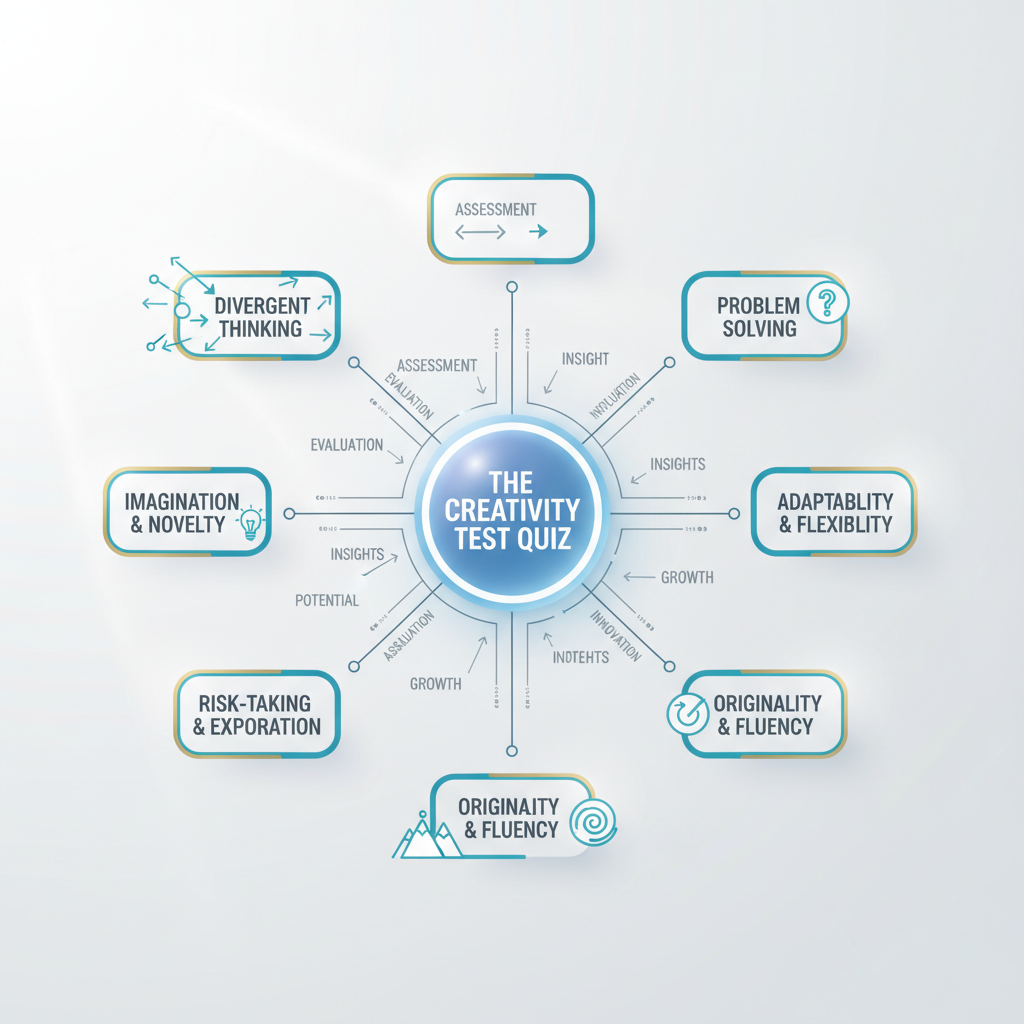
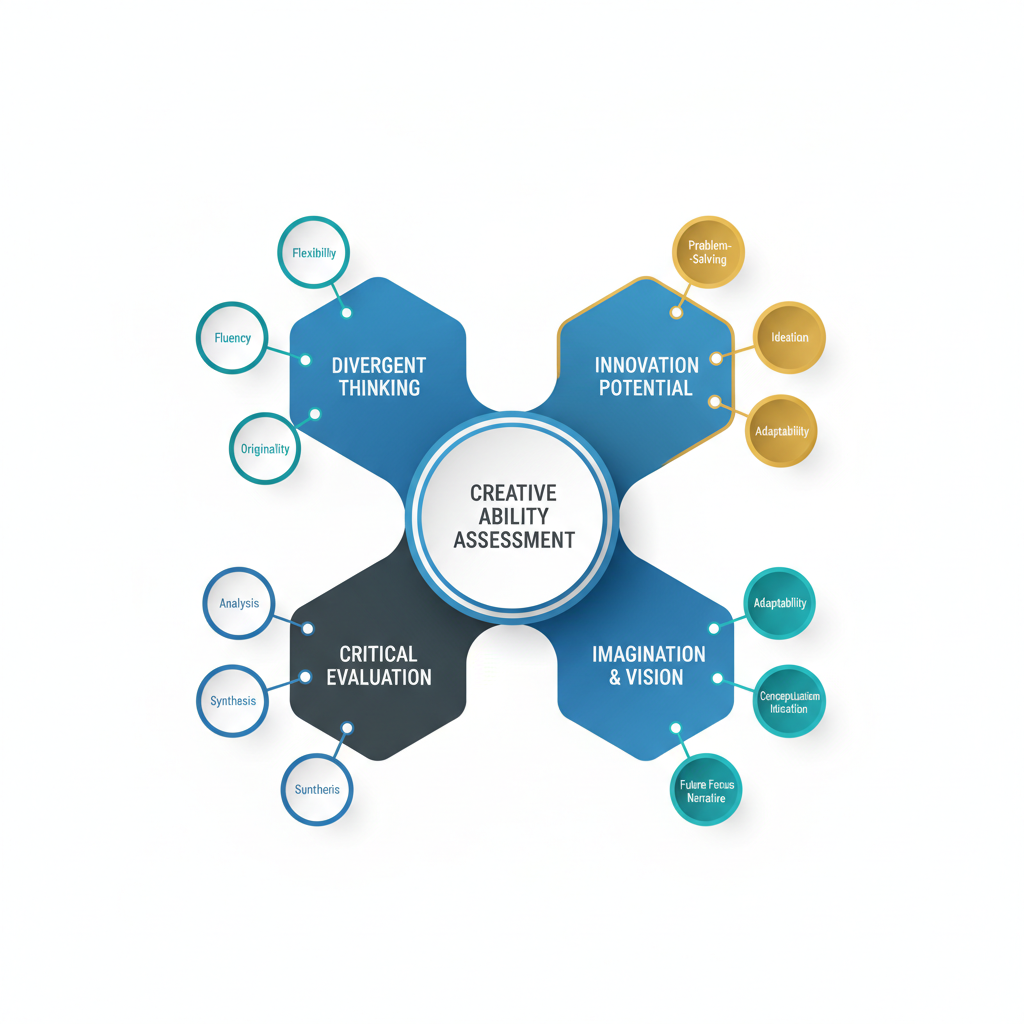
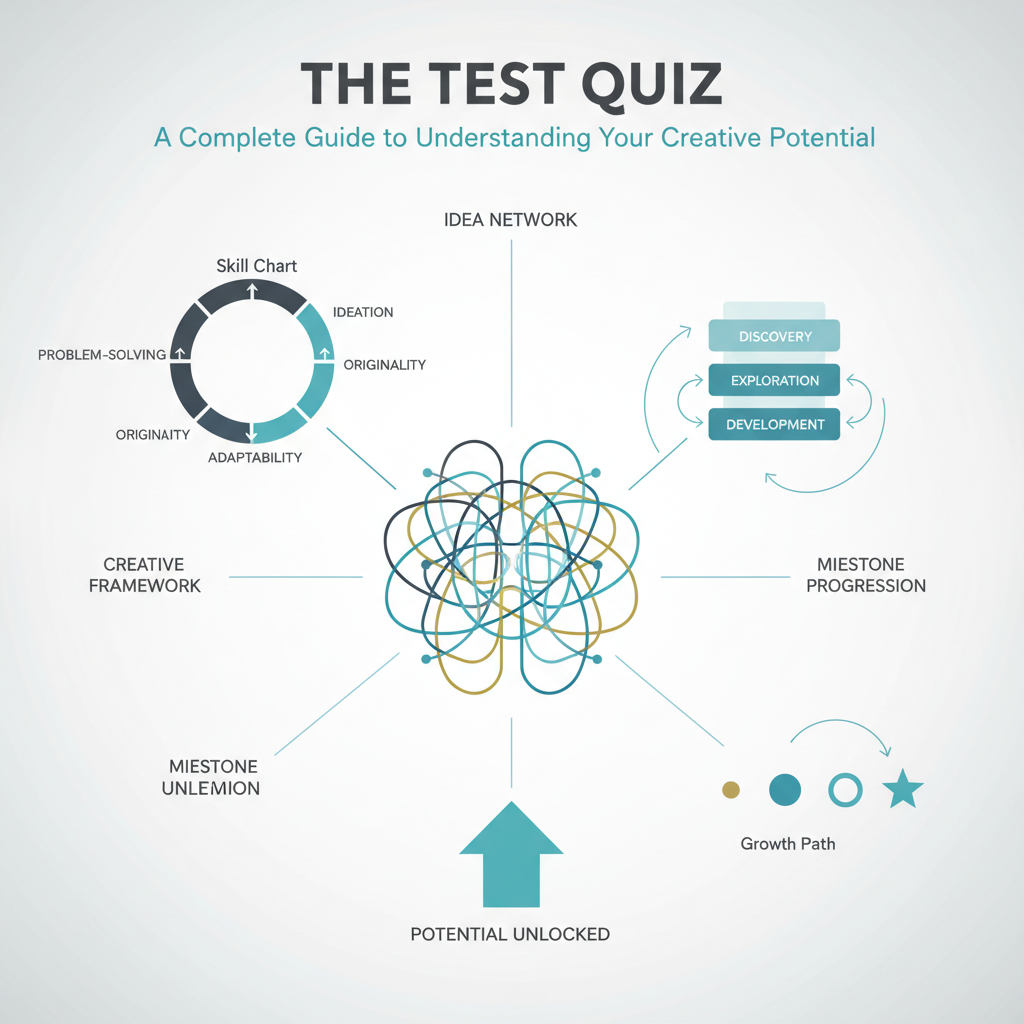
    An abstract infographic illustrating the conceptual structure and purpose of 'The Test Quiz' for creativity as a central network diagram.
    An abstract, educational infographic illustrating ‘The Test Quiz’ for creativity. Visualize a structured assessment chart or a cognitive network diagram with a central core representing the quiz, and radiating geometric shapes or nodes indicating its fundamental components and purpose. Use a minimalist, vector-based style with clean geometric shapes, subtle gradients, and accent highlights. Color palette: soft blues, whites, charcoal, with gold or teal accents. Ensure negative space for short labels. No humans, no cartoons.

    Beyond a Simple Score: What a Real Creativity Test Measures

    Many online quizzes give you a simple “creativity score.” But real creativity is more complex than that. Our platform, Creative Ability Test, goes deeper. We help you take a closer look at your unique creative mind.

    A real creativity assessment looks at you from many angles. It doesn’t just tell you *if* you’re creative—it shows you *how* you’re creative. This involves looking at your different thinking skills and styles.

    We see creativity as a skill you can grow, not a fixed trait. Our test finds your strengths in key areas. This knowledge helps you grow those strengths and use your creative potential.

    Our test looks at important parts of creativity, such as:

    • Divergent Thinking: Your ability to come up with many unique ideas. We look at how you brainstorm and find different solutions.
    • Cognitive Flexibility: How well you can switch your point of view. This shows how easily you adjust to new information or challenges.
    • Problem-Solving Skills: How you handle and solve tricky problems. This includes your ability to find new and creative solutions.
    • Openness to Experience: Your curiosity and willingness to try new things. This shows how open you are to fresh ideas.

    Understanding these parts gives you a full picture of your creativity. It helps you unlock your true potential. You’ll also get practical tips for your personal and professional life.

    The Science Behind Our 30-Question Assessment

    The Creative Ability Test isn’t just a random quiz. Our 30-question test is based on science. It uses proven psychological research and theories about creativity. This makes our test a reliable way to measure your creative skills.

    Our method is backed by evidence. We designed each question to test a specific part of your creativity. Top researchers have approved similar methods [1]. This careful process ensures your results are accurate.

    The 30 questions cover a lot of ground. They look at many different creative behaviors and ways of thinking. This helps us create a detailed profile of your creative strengths and find areas for you to grow.

    Our test is also standardized, so everyone gets the same high-quality evaluation. This means you can trust your personalized feedback. It gives you a strong starting point for learning more about yourself.

    We explain complex psychological concepts in a simple way. This makes the science of creativity easy for anyone to understand. Our goal is to give you clear, useful advice from a source you can trust.

    Why Understanding Your Creative Style Matters

    Knowing your creative style is a powerful tool. It helps you move from being unsure to feeling a confident self-awareness. Your unique way of being creative affects every part of your life.

    First, it helps you grow as a person. When you know how your mind works, you can use your natural strengths. For instance, if you’re good at divergent thinking, you can use it to solve personal problems. You can come up with new solutions for everyday challenges.

    Second, it helps your career. Companies want employees who can create new things and solve problems [2]. Knowing your creative strengths makes you a valuable team member. You can use them in group projects, planning, or to move your career forward. This helps you make a real difference at work.

    Our test gives you useful tips and clear explanations about your creative side. For example, you might learn you’re very open to new experiences. This can encourage you to explore new fields or learn new skills, broadening your world.

    In the end, this knowledge gives you power. It’s like a roadmap for being creative on purpose. You can use your talents to solve real-world problems. This will change how you approach challenges, helping you face them with more confidence and new ideas.

    What Kind of Questions Are in The Test Quiz?

    Exploring Divergent Thinking Challenges

    The Creative Ability Test looks at your divergent thinking. This is your ability to come up with many different ideas from one starting point. Think of it as a more advanced form of brainstorming.

    Our quiz gives you challenges that push you to think outside the box. You will explore many possibilities, not just the obvious ones. This helps us see how well your mind connects different ideas.

    For example, we might ask you to list as many unusual uses as possible for a common object. These questions are not about finding one “right” answer. Instead, they measure how many ideas you have and how unique they are. Research shows that this skill is a key part of creativity [3].

    By taking on these challenges, you will learn about your natural ability for:

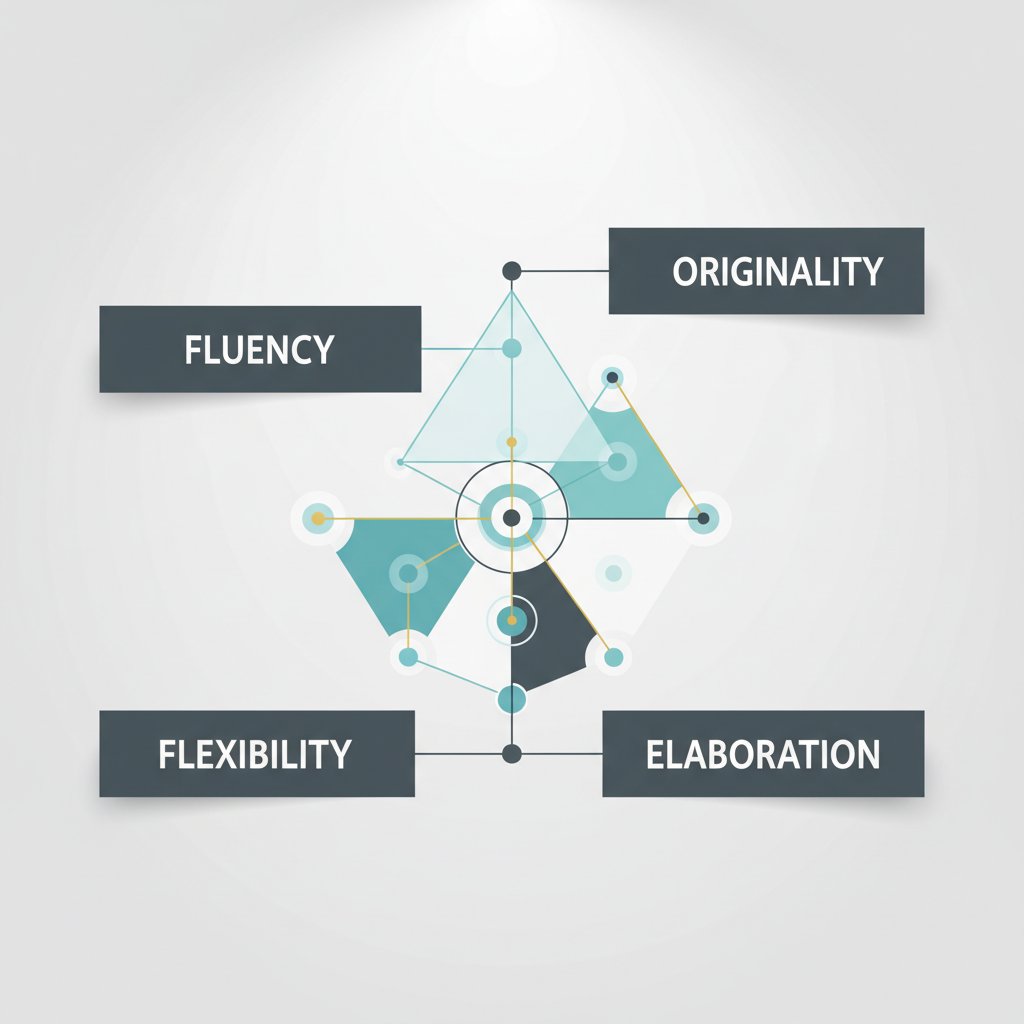
    • Idea Fluency: How many ideas you can generate.
    • Originality: How new and unique your ideas are.
    • Flexibility: The different categories your ideas fall into.
    • Elaboration: Your skill in adding details to your ideas.

    Understanding your strengths in divergent thinking helps you find new solutions. It gives you more options when you’re trying to solve a problem.

    Assessing Your Cognitive Flexibility

    Cognitive flexibility is another key part of creativity that we measure. Think of it as mental agility. It’s your ability to switch between different ways of thinking, adapt to new facts, and get past mental blocks.

    Our quiz has questions designed to test this skill. They often ask you to change your perspective. You might need to rethink your first ideas or try a new way to solve a problem.

    For instance, a question might describe a situation where the easy solution fails. You will then be asked to come up with a different plan. This shows how easily you can drop an old idea for a better one. This skill is essential for learning and adapting in a fast-changing world [4].

    By assessing your cognitive flexibility, we learn more about your ability to:

    • Adjust your thinking when you face a challenge.
    • See an issue from more than one point of view.
    • Learn from mistakes and change course.
    • Handle complex problems more easily.

    This assessment helps you understand how you react to new situations and change your ideas under pressure. This skill is valuable for both personal growth and professional success.

    Evaluating Your Openness to New Experiences

    How open you are to new experiences has a big impact on your creativity. This is a core personality trait. It shows your curiosity, imagination, and desire to explore new ideas, concepts, and cultures.

    The Creative Ability Test looks at this trait with questions about your interests. We ask about your taste for adventure, how you feel about unusual ideas, and what you like to learn about.

    We might ask if you enjoy trying new things or if you’re drawn to art and abstract ideas. People who are very open tend to seek out different experiences. This gives them more knowledge and sparks their imagination [5].

    Through this assessment, you will discover:

    • Your level of curiosity about the world.
    • How open you are to new and different ideas.
    • Your comfort level in unfamiliar situations.
    • Your interest in art and imagination.

    Understanding your openness can help you find new learning opportunities. It can encourage you to step out of your comfort zone and find new ways to grow.

    Problem-Solving Scenarios

    Creativity isn’t just about having great ideas; it’s about using them to solve real problems. The Creative Ability Test includes practical problem-solving challenges. These see how you put your creative skills to use.

    We give you realistic situations that don’t have easy answers. You will need to think in new and clever ways. For example, you might be asked to improve a common product or solve a problem for a community. These are hands-on challenges, not just theory.

    These questions show us how you apply your creative skills in practice. They reveal your ability to think ahead and come up with truly new ideas. Good problem-solving requires both creating and carrying out new solutions [6].

    By working through these scenarios, you will learn about:

    • Your ability to spot and define problems in a new light.
    • How you use creative thinking to solve practical issues.
    • Your knack for developing real, innovative solutions.
    • Your skills in imagining improvements and positive change.

    This part of the quiz connects creative thinking with real-world results. It helps you see how your creative skills can make a real difference in your life and work.

    How Do You Interpret Your Quiz Results?

    From a Score to Actionable Insights

    Your results from The Test Quiz are more than just a number. Your score is a starting point, but the real value is in the detailed insights you’ll receive. We turn this data into a personal guide to help you grow your creative skills.

    This helps you understand what your score means in the real world. You’ll learn about your creative mindset and the specific ways you think.

    We give you clear, practical steps to use your creative strengths and build on your growth areas. This helps you improve your skills and grow as a person.

    Understanding Your Personalized Feedback Report

    After the Creative Ability Test, you get a detailed, personal feedback report. This report is your guide to your unique creative style. It looks at creativity from many angles, giving you more than just a basic score.

    Every section is easy to follow. You’ll learn about how you think. For instance, you’ll see how you did with divergent thinking—the skill of coming up with lots of ideas [7]. We also look at your cognitive flexibility, which is how easily you can switch between different ideas or adapt to change.

    Your report turns complex ideas into simple, useful information. It shows how your results connect to real-world skills like problem-solving and innovation. It’s like a blueprint for how your creative mind works.

    Key areas covered in your report include:

    • Your main creative thinking styles.
    • How you approach solving problems.
    • How open you are to new experiences and ideas.
    • Insights into your imagination and original thinking.
    • How well you adapt and think flexibly.

    This report is made just for you. It’s based on proven methods to make sure your results are accurate and helpful.

    Identifying Your Unique Creative Strengths

    Your personal report shows you exactly what your creative strengths are. These are the skills where you naturally shine. Knowing what you’re good at helps build confidence.

    For example, you might be great at coming up with many new ideas quickly. This is a sign of strong divergent thinking. Or maybe you’re skilled at connecting ideas that don’t seem related, showing your ability to think associatively.

    Another strength could be your imagination. You might find it easy to picture complex solutions. These are valuable talents you can use in your personal and professional life.

    Our report helps you see these natural talents. When you know your strengths, you can focus your energy, solve problems more effectively, and use your creativity to innovate.

    Think about how your strengths show up:

    • Are you a natural brainstormer who is always full of ideas?
    • Do you see patterns others miss and come up with unique solutions?
    • Are you quick to change your perspective when facing a new problem?
    • Do you enjoy trying new or different ways of doing things?

    Finding your strengths is the first step to turning self-awareness into a powerful tool for personal growth.

    Pinpointing Areas for Growth

    The Creative Ability Test also shows you areas where you can grow. We don’t see these as weaknesses, but as opportunities to become even more creative. Creativity is a skill you can build with practice [8].

    Your report gives clear advice on how to develop these areas. For instance, if you could improve your cognitive flexibility, the report suggests ways to do that, like trying new problem-solving methods or looking at things from a different point of view.

    In the same way, if you want to strengthen your divergent thinking, you’ll get useful tips. This could mean doing brainstorming exercises or getting in the habit of questioning assumptions. These are real-world strategies you can use right away.

    Focusing on these growth areas helps you develop as a person. It makes your creative skills more consistent and sharpens your ability to solve problems, which boosts your overall capacity for innovation.

    Every growth area is a chance to learn and improve. Our goal is to give you the tools to turn any limitation into a new strength. You always have the power to grow your creative potential.

    How Can You Use Your Results for Personal and Professional Growth?

    Practical Strategies to Boost Your Creative Thinking

    Your Creative Ability Test results are a personal roadmap. They show your specific creative strengths. Now, let’s put these insights into action. You can boost your creative thinking with targeted exercises designed to train your brain.

    Unlock Your Creative Potential Daily

    Understanding your creative style is the first step. For instance, if your results show you’re good at coming up with many different ideas, focus on brainstorming. If you excel at flexible thinking, try new ways to do daily tasks. Here are some proven ways to boost your creativity:

    • Mind Mapping: Start with a central idea and branch out with related thoughts. This technique helps you see connections and make new associations.
    • SCAMPER Method: Use this checklist to generate ideas. It stands for Substitute, Combine, Adapt, Modify (Magnify, Minify), Put to another use, Eliminate, Reverse (Rearrange). This tool helps you look at existing ideas from new angles.
    • Lateral Thinking Puzzles: Try puzzles that need creative solutions. This practice helps you think outside the box and improves your problem-solving skills [9].
    • Change Your Routine: Even small changes can spark new ideas. Take a different route to work or try a new hobby. New experiences build new connections in your brain.
    • Practice Observational Drawing: Pay close attention to the details around you. Drawing helps you see things from new perspectives and trains your brain to notice what others might miss.
    • Embrace “Idea Quotas”: Challenge yourself to come up with a set number of ideas each day. Don’t judge them. More ideas often lead to better ideas.

    These are more than just exercises; they are habits that build your creative muscle. Your feedback from the test shows you the best place to start.

    Using Your Creative Talents in Your Career

    Your creative skills are valuable tools for your career. They can help you advance at work. Employers highly value creative problem-solvers. In fact, creativity is always one of the top skills companies look for [10].

    Use Your Creativity at Work

    Think about how your creative strengths can be used in your job. Are you good at solving problems in new ways? Are you open to new ideas? Here’s how to use your creativity at work:

    • Innovative Problem-Solving: Use a creative approach to workplace challenges. Come up with many possible solutions, then use critical thinking to pick the best one. This leads to better results.
    • Process Improvement: Look for ways things could work better. Use your creative eye to imagine better ways of doing things. Suggest new ideas to make work easier and faster.
    • Team Collaboration and Leadership: Help create a team environment where new ideas are welcome. Encourage open idea sharing. Your insights can inspire your coworkers and help you lead effective brainstorming sessions.
    • Project Development: Offer fresh ideas on new projects. Whether it’s product design or a marketing plan, your creativity can lead to new and better things and make your work stand out.
    • Effective Communication: Present your ideas in interesting ways. Try using storytelling or visuals. This helps your message connect better with your audience.
    • Adaptability to Change: The workplace is always changing. Your flexible thinking helps you adapt quickly. You can learn new tools and methods with ease.

    Your test results give you the words to describe your creative strengths. Use them to explain your value in interviews and performance reviews. This will help you stand out.

    Using Creativity for Everyday Problem-Solving

    Creativity isn’t just for artists or inventors. It’s a key skill for daily life. Knowing your creative profile from the test helps you handle everyday challenges with confidence and a fresh point of view.

    Navigate Daily Life with Creative Solutions

    From planning errands to solving arguments, creativity can make life smoother. It helps turn challenges into chances to learn. Here’s how to use your creative strengths in your daily routine:

    • Household Hacks: Faced with a broken item? Need to organize a cluttered space? Use your problem-solving skills to find unusual fixes or clever storage solutions.
    • Personal Planning: Planning a trip or a busy week requires flexibility. Use your creative thinking to find the best routes or develop better ways to manage your time.
    • Relationship Dynamics: Disagreements happen. Try to understand the other person and communicate creatively. Think of unique ways to solve disagreements that work for everyone.
    • Learning and Hobbies: Help yourself grow by approaching new hobbies with an open mind. Find new ways to learn skills, like using a creative trick to remember new information.
    • Budgeting and Finances: Get creative with your money. Find new ways to save, discover new income streams, or think outside of traditional budgeting methods.
    • Adapting to Unexpected Situations: Life is full of surprises. Your flexible thinking helps you change direction when needed. You can adjust plans quickly and turn challenges into minor bumps in the road.

    The insights from the test give you the confidence to tackle any problem, big or small. You’ll understand yourself better and know what actions to take. Enjoy the journey of growing your creativity.

    Frequently Asked Questions

    What are the questions in the test quiz?

    The Creative Ability Test explores how you come up with new ideas. It’s not a memory or knowledge test. Instead, our 30 questions are made to help you think differently. We focus on measuring different parts of your creative skills.

    You’ll see a few different types of questions. This helps us learn about your creative strengths. For example, we might ask you to:

    • Brainstorm multiple uses for an everyday object. This shows us your divergent thinking, which is the ability to come up with many different ideas from one starting point [11].
    • Solve open-ended problems. These situations need flexible and creative solutions.
    • Respond to visual prompts. How you see things can show how open you are to new ideas.
    • Evaluate different approaches to a challenge. This tests how you adapt your thinking to solve problems.

    Each question is designed to be fun and revealing. They show how you handle challenges and create new ideas. Our goal is to discover your natural creative style, not to trick you.

    How can I find the test quiz with answers?

    Our Creative Ability Test is a personal tool, not a typical quiz with right or wrong answers. Because of this, there is no separate answer key.

    The real “answers” are the personal insights in your detailed report. This report breaks down your unique creative style. It shows your strengths, how you think, and where you can improve.

    You get the most value by answering honestly. This gives you the clearest picture of your creative abilities. Based on your responses, we give you detailed feedback with practical tips to improve your creativity. This will help you use your creative skills in your personal and professional life.

    Is this a game or a scientific assessment?

    The Creative Ability Test is a science-based tool, not just a game or a fun online quiz. We built it using proven ideas from psychology and creativity research.

    Our 30 questions are designed to measure key parts of creativity, such as flexible thinking, divergent thinking, and openness to new ideas. Every part of our test is backed by solid research [12].

    Unlike a game, our goal is to help you grow. We give you more than just a score. You get a full, personal report with clear insights into how you think creatively. It also includes practical ways to build your creative skills.

    We want to give you a clear, useful understanding of your creative skills. This knowledge helps you grow, both personally and professionally. It helps you use your creativity in all parts of your life.


    Sources

    1. https://psycnet.apa.org/record/2012-09414-001
    2. https://hbr.org/2019/11/how-to-foster-creativity-in-your-team
    3. https://www.sciencedirect.com/science/article/abs/pii/S016773221300021X
    4. https://pubmed.ncbi.nlm.nih.gov/30449964/
    5. https://www.psychologytoday.com/us/basics/openness-experience
    6. https://hbr.org/2014/11/the-four-ways-to-approach-a-problem
    7. https://positivepsychology.com/divergent-thinking/
    8. https://hbr.org/2012/03/is-creativity-a-skill-or-a-talent
    9. https://www.sciencedirect.com/science/article/pii/S001002772030245X
    10. https://www.weforum.org/agenda/2023/05/future-of-jobs-2023-skills/
    11. https://psychology.iresearchnet.com/experimental-psychology/cognition/divergent-thinking/
    12. https://www.simplypsychology.org/creativity.html
  • Psychological Flexibility Test: What It Is & How It Boosts Creativity

    Psychological Flexibility Test: What It Is & How It Boosts Creativity

    A psychological flexibility test is an assessment designed to measure your ability to stay present and open to experiences while moving toward your values. It evaluates how well you can adapt your thoughts and behaviors to meet the demands of a situation, which is a key component of creative problem-solving and innovation.

    Have you ever felt stuck on a challenge or wished you could brainstorm new ideas more easily? We often think of creativity as a rare spark, but it’s really about how we engage with our thoughts and the world. The ability to adapt, change your viewpoint, and stay open when things get tough is more than a life skill—it’s the key to innovative thinking.

    This skill is known as psychological flexibility. A psychological flexibility test isn’t just another assessment; it’s a science-based tool to help you understand your unique thinking style and how well you adapt to new challenges. By measuring your Openness to Experience, your ability to stay present, and your focus on what matters to you, you gain a clear look at the cognitive traits that support creative problem-solving.

    In this article, we’ll explain what psychological flexibility really is and why it’s so helpful for creative work. You’ll discover how this trait can be measured, what your results mean for your creative potential, and practical tips to build a more flexible mind. Get ready to unlock new ideas and grow by understanding this vital skill.

    What Is a Psychological Flexibility Test?

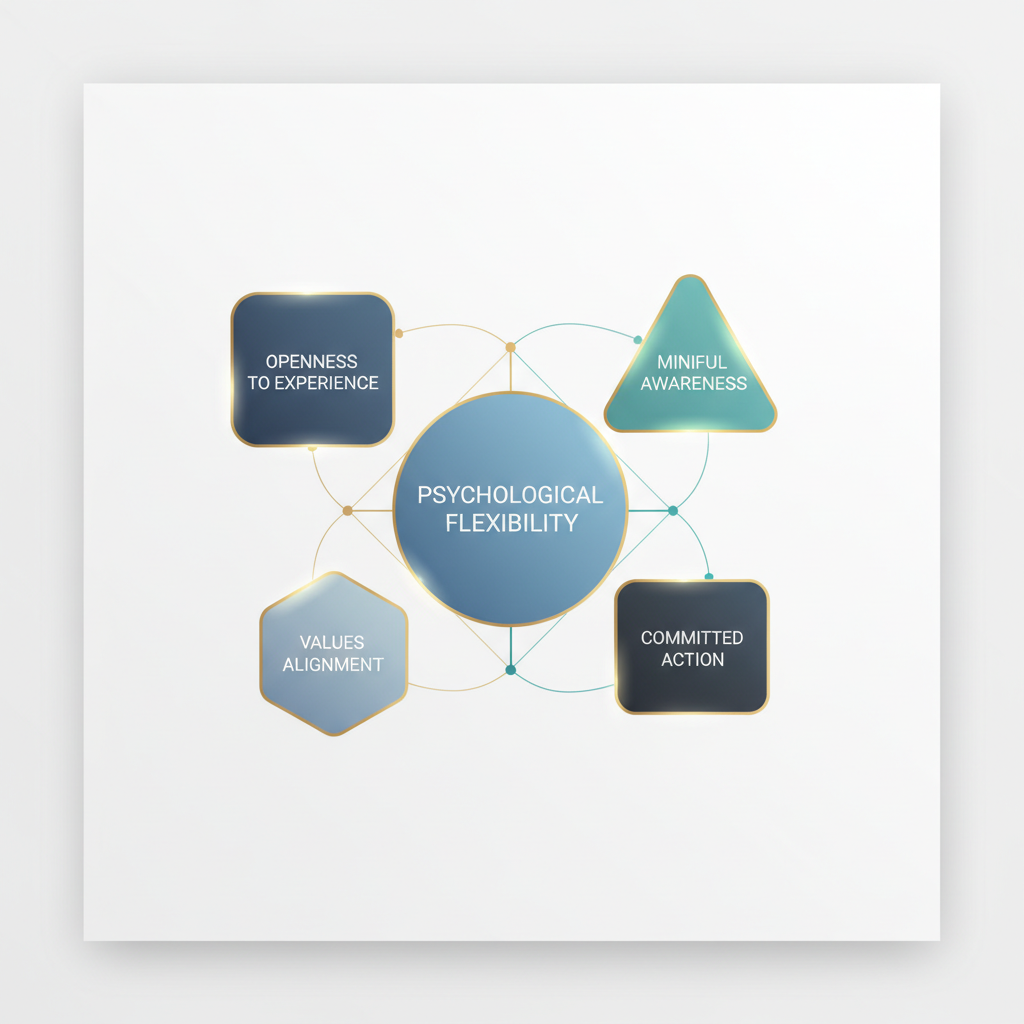
    A conceptual diagram showing psychological flexibility as a central hub with interconnected components like openness, awareness, and valued action, represented by abstract geometric shapes.
    An abstract, educational infographic illustrating the concept of psychological flexibility. Visualize a central conceptual node labeled ‘Psychological Flexibility’ with radiating, interconnected geometric shapes representing core components such as ‘Openness to Experience’, ‘Mindful Awareness’, ‘Values Alignment’, and ‘Committed Action’. Use a minimalist, vector-based style with clean geometric shapes, subtle gradients, and accent highlights. Color palette: soft blues, whites, charcoal, with gold or teal accents. Maintain ample negative space for clarity.

    Why Psychological Flexibility Matters for Creativity

    Creativity is more than just having new ideas. It’s also about acting on them, dealing with challenges, and adapting as you go. That’s where psychological flexibility comes in.

    A flexible mindset helps you welcome new experiences, explore different viewpoints, and change your approach when you face obstacles.

    Consider a designer facing a tight deadline. Or an entrepreneur adapting to market shifts. Their success often depends on their mental agility.

    Psychological flexibility helps your creative process in several ways:

    • Overcoming Blocks: You can step away from rigid thinking to find fresh solutions.
    • Exploring Diverse Ideas: You stay open to new and unusual ideas, which helps you think outside the box.
    • Adapting to Challenges: Setbacks become chances to learn and adjust. Instead of giving up, you find a new way forward.
    • Embracing Experimentation: You are more willing to try new methods. You learn from unexpected outcomes.
    • Cognitive Agility: Your mind can smoothly shift between tasks and concepts. This is vital for complex problem-solving.

    In short, psychological flexibility turns uncertainty into an opportunity for creativity. It helps you move from rigid reactions to innovative solutions.

    The Science Behind Measuring an Adaptable Mindset

    Psychological flexibility is a concept from modern psychology. It comes from a science-backed method called Acceptance and Commitment Therapy (ACT) [1]. This approach looks at how we relate to our inner thoughts and feelings.

    An adaptable mindset has a few key parts. They work together to make your mind more agile:

    • Acceptance: You make room for difficult thoughts and feelings without letting them control you.
    • Cognitive Defusion: You learn to step back from your thoughts. You see them as just thoughts, not absolute truths.
    • Contact with the Present Moment: You stay aware of what’s happening right now. This improves your focus and awareness.
    • Self-as-Context: You see yourself as separate from your thoughts and feelings. You know your experiences don’t define who you are.
    • Values: You clearly identify what truly matters to you. This guides your actions with purpose.
    • Committed Action: You take steps that align with your values, even when it feels hard.

    Measuring psychological flexibility looks at how well these parts work for you. Psychologists use scientifically validated questionnaires to do this. These tools ask how you respond to challenges to see how willing you are to adapt your thoughts and actions.

    At Creative Ability Test, we use this science. Our assessments show you how flexible your thinking is and help you understand your unique style. We connect psychology research with practical tips to help you unlock your full creative potential.

    How Can You Measure Your Psychological Flexibility?

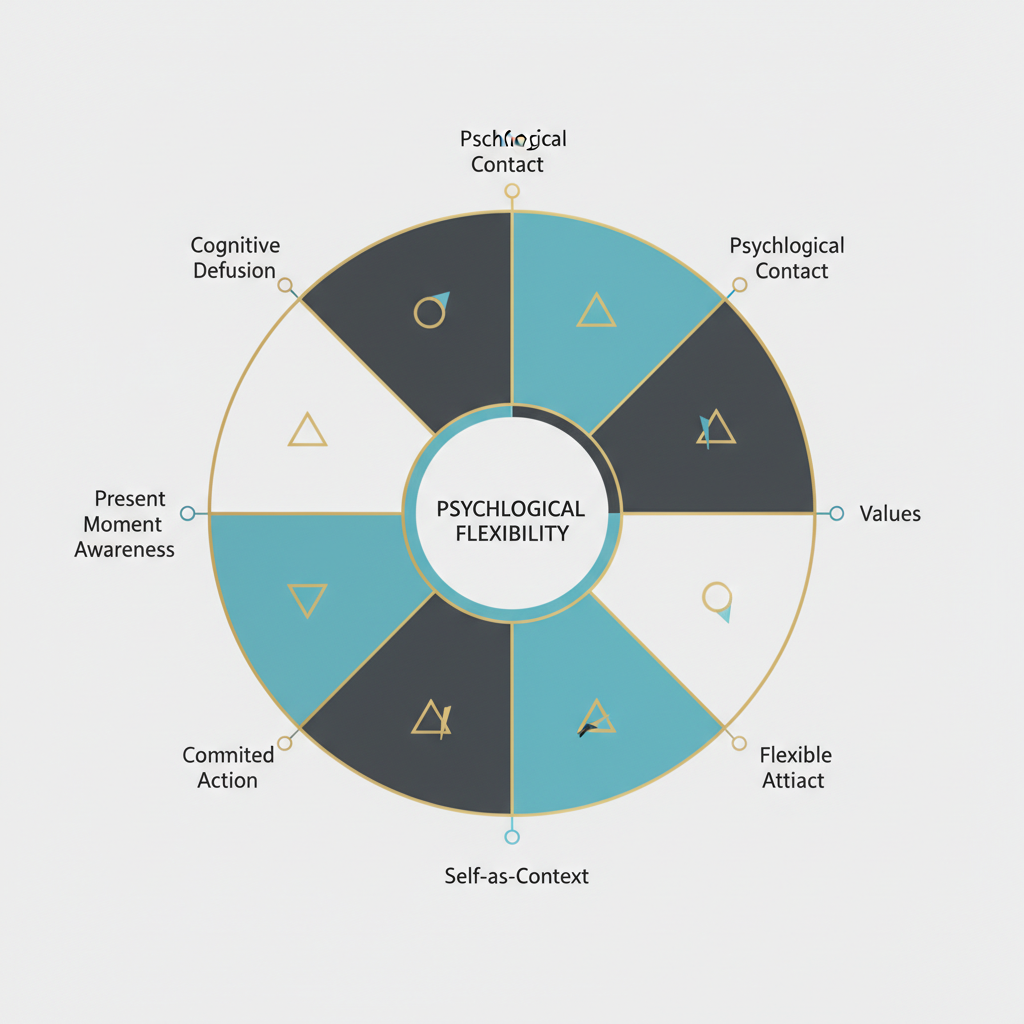
    An abstract assessment chart or competency map with multiple axes or segments, representing different dimensions used to measure psychological flexibility, depicted with clean geometric shapes.
    A clean, instructional infographic depicting a structured assessment chart or competency map for measuring psychological flexibility. The visual should be a multi-dimensional radar chart or a circular diagram with distinct segments, each representing a measurable dimension of psychological flexibility. Use minimalist, vector-based design with crisp lines and geometric shapes. Incorporate subtle gradients or accent highlights in soft blues, whites, charcoal, with gold or teal. Show abstract indicators or markers within the chart to suggest measurement points without specific numbers. Maintain a professional and approachable aesthetic with good use of negative space.

    Common Types of Flexibility Questionnaires (e.g., AAQ-II)

    To be more creative, it helps to understand your psychological flexibility. Special tests can measure this skill. These tests are usually questionnaires where you report on your own thoughts, feelings, and actions.

    A common tool is the Acceptance and Action Questionnaire-II (AAQ-II). It’s a popular way to measure psychological flexibility [2]. This test shows if a person can act on their values, even when facing uncomfortable feelings.

    Other questionnaires exist, too. They often ask about similar things, like how you handle your inner thoughts and feelings. They also check if you are willing to pursue important goals. These tests offer a clear way to measure your mental agility.

    Key Traits Assessed: Openness, Awareness, and Action

    Psychological flexibility is not just one thing. It’s a mix of several key skills. Together, these skills help you think in a flexible and creative way. They help you adapt well to challenges and come up with new ideas.

    Here are the core traits often assessed:

    • Openness to Experience: This is the willingness to feel all of your thoughts and emotions, both good and bad. Creative people often welcome new ideas and feelings. They are not afraid of the unknown. This openness leads to new ways of thinking.
    • Present Moment Awareness: This is about noticing what is happening right now. It means paying attention to your surroundings and your inner thoughts without judgment. Mindfulness is a big part of this. Being present helps you see new opportunities and find fresh solutions to problems.
    • Committed Action: This means taking action based on your values, even when it’s hard. It’s about working toward goals that matter to you. Creative work often requires you to keep going. This trait helps you push through creative blocks and move forward after setbacks.

    These traits are key to unlocking your creative potential. They help you face creative challenges with resilience. This allows you to come up with more innovative solutions.

    Connecting Flexibility to The Creative Ability Test

    The Creative Ability Test offers a complete look at your creative potential. While it is not a direct test of psychological flexibility, it measures related skills that are key for a flexible, creative mind.

    Our 30-question assessment looks at several key areas. These areas are similar to the parts of psychological flexibility:

    • Cognitive Flexibility: This part of the test checks your ability to switch between different ideas or tasks. It also measures how well you can adapt your thinking. This is directly related to being open to new ideas.
    • Openness to New Experiences: This trait measures how curious and open you are to new things. It shows how much you enjoy new situations and information. This is a key part of psychological flexibility and leads to exploration and new ideas.
    • Problem-Solving Skills: Our test looks at how you handle challenges. It checks your ability to come up with many different solutions. This requires you to be aware and take action by staying focused and putting in the effort.

    By understanding these areas, you get useful insights. The Creative Ability Test gives you personalized feedback. It helps you see how your mindset affects your creativity. It also offers practical tips to improve your mental flexibility and help you think in new ways. Our scientific method provides reliable results. This can turn uncertainty into clear self-awareness. You can use these insights to solve real-world problems, helping you grow both personally and professionally.

    What Do Your Psychological Flexibility Results Mean?

    Understanding Your Score

    Your psychological flexibility score is a useful guide. It shows how adaptable your mindset is. This test gives you a clear picture of your current strengths and highlights areas where you can grow.

    A lower score may mean you tend to stick with what you know. This can sometimes make it harder to find new ideas. However, it also means you have a great opportunity to improve.

    On the other hand, a higher score suggests you’re mentally quick. You likely enjoy new experiences and different points of view. This adaptability is a key part of creative thinking. It helps you change direction and explore different solutions. Psychological flexibility is linked to better mental health and well-being [3].

    Remember, this is not a fixed trait. It is a skill you can build over time. Our Creative Ability Test gives you personalized feedback to help you see your unique strengths and potential.

    How Your Score Affects Problem-Solving

    Psychological flexibility is a key part of creative problem-solving. An adaptable person explores many options instead of getting stuck on the first idea. This is essential for finding new solutions.

    Think about a tough problem you’ve faced. A flexible person will think of many different solutions. They look at problems in new ways and stay open to feedback. This helps them get past creative blocks.

    Flexible people are also more comfortable with uncertainty, which is a big part of trying new things. A higher score suggests you are good at divergent thinking—the skill of coming up with many different ideas [4].

    This ability helps you see opportunities where others see roadblocks, making you a great innovator. Our full Creative Ability Test offers more detail on how your flexibility affects the way you solve problems.

    Using Your Results to Grow

    Understanding your score is a great first step toward personal growth and more creativity. Think of your results as a guide to help you improve, not just a number.

    If your score shows room for improvement, that’s great news. It means you have clear steps you can take to boost your creativity. Here are a few ways to use what you’ve learned:

    • Be Mindful: Notice your thoughts and feelings without judgment. This helps you choose how to respond instead of just reacting.
    • Try New Things: Step out of your comfort zone on purpose. This makes you more adaptable.
    • Question Your Beliefs: Ask yourself why you think the way you do. This can lead to fresh ideas.
    • Seek Different Views: Talk to people who think differently than you. This helps you see the bigger picture.

    Taking these steps will build your mental flexibility over time. Our platform offers personal tips and exercises based on your results. As you practice, you’ll notice better decision-making and problem-solving skills.

    Knowing yourself is key to keep growing. It helps you face challenges with confidence and turns your creative potential into real skill. Use our science-based insights to unlock your full creative potential.

    How Can You Improve Your Psychological Flexibility?

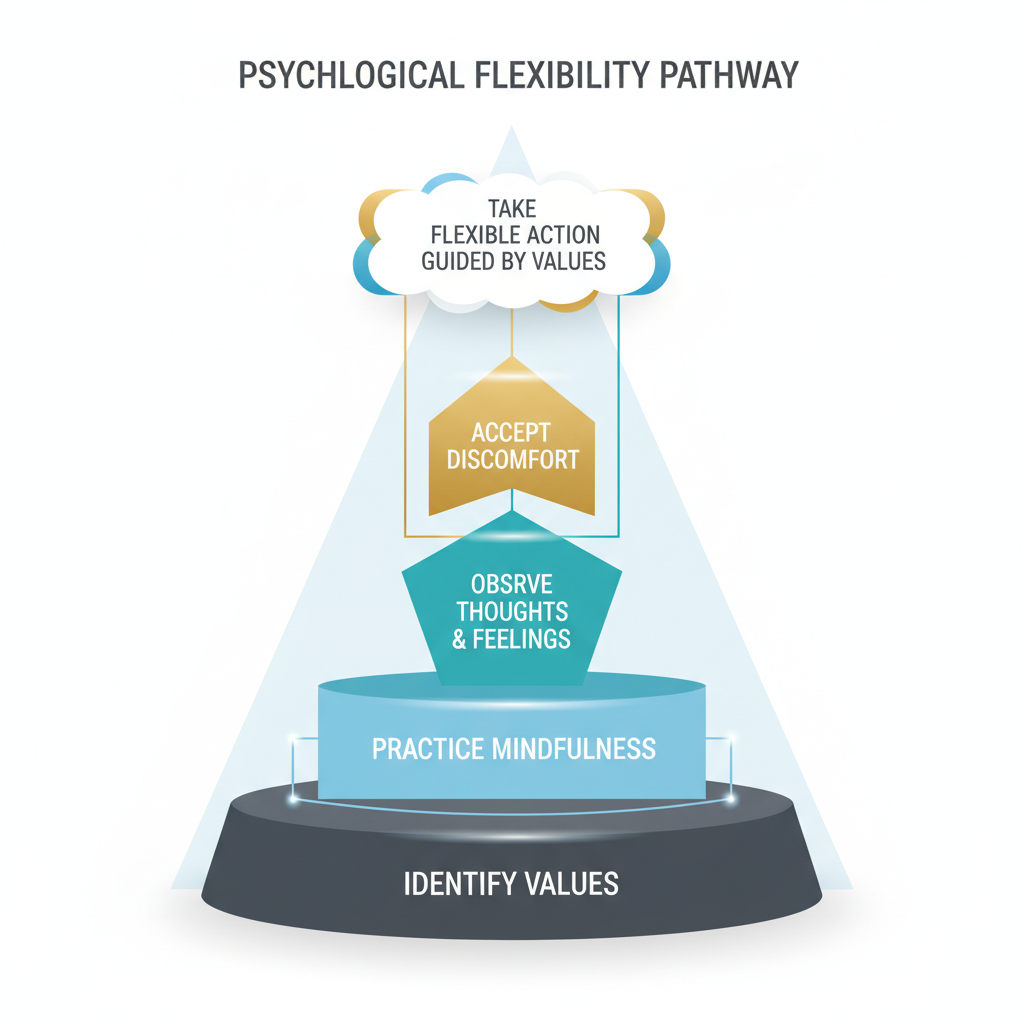
    A multi-layered diagram or step-by-step progression showing strategies and milestones for improving psychological flexibility, using abstract geometric forms.
    An abstract, educational infographic illustrating strategies for improving psychological flexibility. Visualize a layered system showing growth or a stepwise progression of actions and insights. Use a series of ascending or expanding geometric layers or interconnected milestones, with each layer/step representing a different strategy or stage of improvement (e.g., ‘Identify Values’, ‘Practice Mindfulness’, ‘Take Flexible Action’). The style should be minimalist and vector-based, using clean shapes, subtle gradients, and accent highlights in soft blues, whites, charcoal, with gold or teal. Ensure visual hierarchy and ample negative space to convey clarity and a sense of progression.

    Actionable Strategies for a More Agile Mind

    Building an agile mind is a powerful journey. It unlocks new creative potential and helps you handle life’s challenges. The Creative Ability Test supports this growth. Our insights and tools help you build lasting mental flexibility. Here are some ways to develop a more adaptable mindset:

    • Practice Mindful Awareness: Be present in the moment. Notice your thoughts and feelings without judgment. This practice clears your head and makes space for new ideas.
    • Embrace Acceptance: Acknowledge tough emotions or situations. Fighting reality drains your energy. Instead, accept what is and then decide how to move forward. This frees up mental space for creative problem-solving.
    • Clarify Your Values: Know what truly matters to you. Your values act as your compass, guiding your actions. This clarity keeps you motivated, even when you face obstacles.
    • Take Committed Action: Act in line with your values. Start with small, steady steps. Taking action, even when it’s hard, builds momentum. This helps you overcome creative blocks and get unstuck.
    • Challenge Your Thoughts (Defusion): See your thoughts for what they are: just thoughts. They aren’t facts or commands. Step back from negative self-talk. This helps you see things from different angles and opens you up to new ideas.
    • Engage in Self-Compassion: Treat yourself with kindness, especially during setbacks. Self-compassion builds resilience and encourages the kind of risk-taking that creativity needs.

    Practical Exercises to Enhance Creative Thinking

    Mental flexibility is the fuel for creative thinking. It helps you break free from rigid patterns. Here are some exercises to build your mental agility. They will also help you come up with new ideas.

    • “What Else?” Brainstorming: Pick a common object, like a paperclip. List as many other uses for it as you can. Think beyond the obvious. This exercise helps you see objects in new ways and think more broadly.
    • Perspective Shifting: Take a current problem. Try to see it from different viewpoints. How would a child, a CEO, or an artist solve it? This practice helps you find surprising solutions and builds empathy.
    • Mind Mapping: Start with a central idea. Branch out with related words, thoughts, and pictures. Don’t filter yourself. Mind mapping lets your thoughts flow freely, helping you find new connections between ideas.
    • Improvisation Prompts: Use a random prompt generator online (for example, “a talking toaster meets a lost knight”). Spend five minutes brainstorming story ideas. Don’t overthink it. This exercise makes you more comfortable with the unknown and helps you generate ideas quickly.
    • SCAMPER Method: Use the SCAMPER method on an existing product or idea. SCAMPER stands for Substitute, Combine, Adapt, Modify, Put to another use, Eliminate, and Reverse. [5] This step-by-step method sparks flexible thinking and helps you find new ways to improve things.
    • Random Word Association: Pick two words that don’t seem related, like “cloud” and “bicycle.” Try to find a connection between them. This simple exercise trains your brain to make new connections, a key skill for creativity.

    Applying Flexibility in Your Career and Daily Life

    The ability to adapt is key to success. This is true at work and in your personal life. Being mentally flexible means you can handle change well. It helps you find new solutions and do well anywhere. Our Creative Ability Test gives you insights into these key skills. It helps you use them to make a real-world impact.

    • Workplace Innovation: Projects rarely go as planned. Mental flexibility helps you adjust to new needs and face unexpected challenges. Flexible teams are also more innovative [6], which leads to better results.
    • Effective Problem-Solving: Tough problems need flexible thinking. A flexible mindset lets you look at a problem from many angles. You can weigh different options before picking one. This leads to better, more creative solutions.
    • Handling Setbacks and Change: Life is full of surprises. Setbacks happen. Flexibility helps you bounce back faster. You learn from failures instead of letting them stop you. This builds deep resilience.
    • Better Collaboration: Working with others requires you to be adaptable. You need to understand different viewpoints and adjust your style to work well as a team. Flexible people improve group dynamics, creating a more positive and productive environment.
    • Personal Growth and Well-being: Trying new things is key to personal growth. Mental flexibility helps you step out of your comfort zone and learn with curiosity. This leads to constant self-improvement and a more fulfilling life.

    Frequently Asked Questions

    Can I take a psychological flexibility test online?

    Yes, you can take psychological flexibility tests online. Many websites offer these self-assessments. The tests help you see how you handle challenges and new experiences. They also offer insights into how adaptable you are.

    Our Creative Ability Test, for example, looks at cognitive flexibility, which is a key part of psychological flexibility. It helps you understand your openness to new ideas and measures how you solve problems in new ways. Taking a test like this is a great step toward more self-awareness and personal growth.

    • Gain Self-Awareness: Understand your mental agility and adaptability.
    • Identify Strengths: Discover how you naturally respond to change and uncertainty.
    • Boost Creativity: Learn how psychological flexibility supports creative thinking.
    • Personalized Insights: Receive feedback to guide your personal growth.

    What is the AAQ-II psychological flexibility test?

    The AAQ-II is the Acceptance and Action Questionnaire – II. It is a well-known and scientifically proven test. This tool measures psychological inflexibility, a key idea in Acceptance and Commitment Therapy (ACT) [7].

    In short, the test measures how well you accept difficult inner experiences like thoughts, feelings, and sensations. It also looks at your willingness to act on your values, even when it’s uncomfortable. A high score means you have more psychological inflexibility, while a low score suggests you have more flexibility.

    This flexibility is very important for creativity. When you’re flexible, you are more open to new ideas and can push through creative blocks. It helps you try new things and learn from mistakes. Understanding your AAQ-II score offers valuable insights. It shows you where you can build more mental agility for creative thinking.

    What kind of questions are on a psychological flexibility test?

    Psychological flexibility tests like the AAQ-II usually give you a list of statements. You rate each one based on how true it is for you. These questions explore how you deal with your inner experiences and your behavior. They are designed to show patterns in how you react to your thoughts and feelings.

    Common themes explored include:

    • Acceptance of Discomfort: Questions might ask if you try to avoid unpleasant feelings or thoughts. For example, “I try to push away my emotions.”
    • Cognitive Defusion: This refers to your ability to distance yourself from your thoughts. You might see thoughts as just thoughts, not absolute truths. A question could be, “My thoughts often control my actions.”
    • Being Present: Tests check your awareness of the here and now. They assess if you get caught up in past regrets or future worries. For instance, “I am often distracted by my thoughts during activities.”
    • Values-Guided Action: These questions ask about your willingness to work toward goals that matter to you, even when you face challenges or difficult emotions. A sample question might be, “I put my values into action even when it’s hard.”

    These questions help measure how open you are to new experiences and how resilient you are when facing challenges. Both are key qualities for building creativity. In a similar way, our Creative Ability Test explores your cognitive flexibility and openness. It helps you see how these traits shape your unique creative potential.


    Sources

    1. https://www.apa.org/ptsd-guideline/treatments/acceptance-commitment-therapy
    2. https://pubmed.ncbi.nlm.nih.gov/21355030/
    3. https://contextualscience.org/rft_and_act_research
    4. https://www.apa.org/education-career/guide/science-creativity
    5. https://www.creativityatwork.com/2012/05/29/scamper-a-tool-for-generating-new-ideas/
    6. https://hbr.org/2011/04/the-flexible-firm
    7. https://contextualscience.org/acceptance_action_questionnaire_ii_aaq_ii

  • Leadership Style Test (Psychology Today Inspired): Find Your Creative Approach

    Leadership Style Test (Psychology Today Inspired): Find Your Creative Approach

    A leadership style test, often featured in publications like Psychology Today, is a self-assessment designed to identify your natural approach to directing, motivating, and managing people. It analyzes your behaviors, communication patterns, and decision-making processes to categorize your style, providing valuable insights into your strengths and areas for development as a leader.

    Many leaders ask themselves: What is my leadership style, and how can I motivate my team to do great work? Effective leadership is more than just giving directions. It’s about encouraging new ideas, solving tough problems, and creatively handling challenges. Understanding your leadership style is the first step to unlocking your potential and making a real impact on your team and company.

    Your natural creativity and thinking style shape how you lead. Whether you’re motivating a team or planning for the future, your approach reflects your Cognitive flexibility and openness to new ideas. This article explores the connection between psychological insights and leadership. We’ll guide you through different leadership styles and show how your creativity plays a key role. A leadership style test can help you see yourself more clearly, explaining not just what you do, but how your creative mind guides every decision.

    What is a Leadership Style Test?

    The Psychology Behind Identifying Leadership Traits

    A leadership style test is more than a simple quiz. It is a structured assessment designed to show how you naturally guide others. These tests are based on psychological theories and research. They help us understand how people interact, motivate, and make decisions in a group.

    Understanding your leadership traits gives you powerful insights. It reveals your natural strengths and areas where you can improve. This self-awareness is key to being a good leader in any professional or personal setting. It allows you to adapt your style to fit different situations and teams.

    Psychologists have studied leadership for decades. They examine behavior and personality characteristics to predict leadership effectiveness. They also explore how leaders can inspire new ideas and encourage teamwork. For example, some leaders naturally empower their teams, while others prefer a more direct, hands-on approach.

    Our Creative Ability Test, while focused on creativity, is closely tied to these ideas. It explores how your unique thinking style influences your potential as a leader. We examine creative traits like:

    • Cognitive flexibility: Your ability to adapt your thinking.
    • Divergent thinking: Generating many different solutions to a problem.
    • Problem-solving skills: How you approach and solve challenges.
    • Openness to experience: Your willingness to try new ideas.

    These skills are essential for effective leadership. They shape how you lead and inspire creativity in others.

    Why Your Creative Style Influences Your Leadership

    Leadership is not just about giving orders or managing tasks. It’s about vision, inspiration, and finding new solutions. Your creative style plays a big part in this. It shapes how you solve problems, act on opportunities, and guide your team.

    Think about your creative strengths. Do you enjoy open brainstorming sessions? Or are you more analytical when solving problems? Your preferences affect how you lead. For example, a leader who is good at divergent thinking will encourage their team to explore new and unusual ideas.

    Your creative style also affects how you empower your team. A leader who is flexible in their thinking can easily navigate change. They encourage team members to think outside the box. This creates an environment where new ideas can thrive and builds a culture of continuous improvement.

    Understanding your creative leadership style offers many benefits:

    • Better Problem-Solving: Use creative thinking to solve tough challenges.
    • Improved Team Engagement: Create a space where all ideas are welcome.
    • Strategic Vision: Use your creative outlook to spot new opportunities.
    • Adaptability: Quickly change your approach when things shift.
    • Personal Growth: Learn about yourself to become a stronger leader.

    Our assessment helps connect these dots. It shows how your creative potential can become real leadership strengths. This knowledge helps you lead with more impact and authenticity. You can then build your own strategies to grow, turning self-awareness into action.

    How Do Major Leadership Styles Impact Creativity?

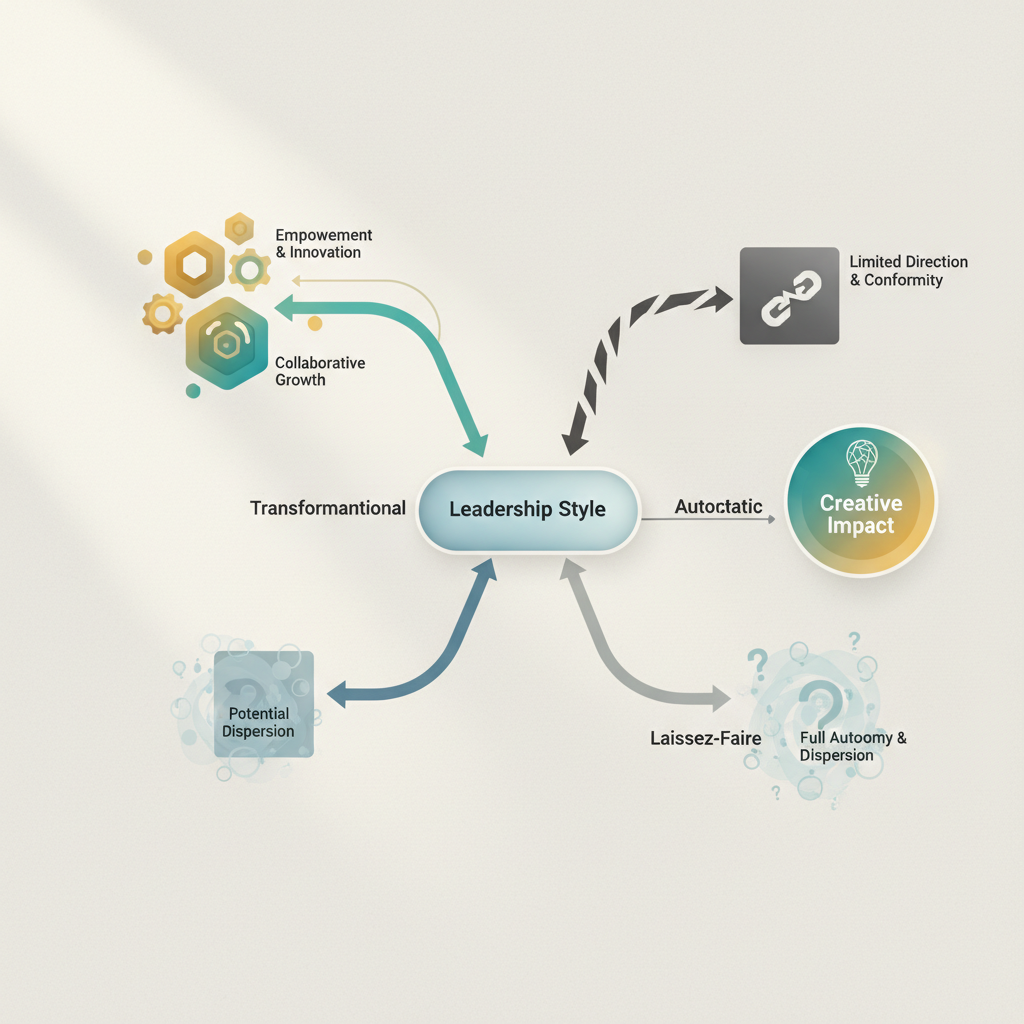
    Infographic showing a branching diagram with different leadership styles leading to varying creative impacts, highlighted with blue, charcoal, and gold accents.
    An abstract educational infographic visualizing how different leadership styles influence creative outcomes. The central concept is a branching pathway diagram. A central ‘Leadership Style’ node in soft blue splits into multiple distinct pathways, each representing a major leadership style (e.g., Transformational, Autocratic, Laissez-Faire). Each pathway flows towards a ‘Creative Impact’ node, depicted as an idea cluster or a competency graph. The connections and nodes use clean geometric shapes with subtle gradients. Gold or teal accents highlight the positive impact pathways, while charcoal indicates less favorable ones. Short, minimal text labels indicate the style and its general impact (e.g., ‘Empowerment’, ‘Direction’, ‘Autonomy’). Ample negative space provides clarity and structured grouping, reflecting a professional and insightful tone.

    Knowing how leadership styles affect creativity is key for anyone who wants to unlock their full creative potential or encourage new ideas in a team. Your leadership style and creative style influence each other. The Creative Ability Test can show you your strengths and give you a personal look at how you think and solve problems. This knowledge helps you adapt your leadership style to build an environment where new ideas can thrive.

    Transformational Leadership: Inspiring Innovation

    Transformational leaders are visionaries. They inspire their teams to do amazing things. They paint a clear picture of the future and encourage everyone to work together for a common goal.

    This style is great for creativity. Transformational leaders create a safe space for new ideas. Team members feel comfortable taking smart risks because they know their ideas are welcome, even if they challenge the norm.

    These leaders are great at getting people to think. They push their teams to question old ideas and think for themselves [1]. This approach helps people explore new solutions.

    For example, a transformational leader might tell their design team to “think completely outside the box.” They support big ideas, even if they seem wild at first. This can lead to brand-new products.

    To cultivate this style:

    • Communicate a clear and inspiring vision.
    • Encourage team members to challenge existing processes.
    • Provide mentorship and support for personal growth.
    • Celebrate innovative thinking and learning from mistakes.

    Democratic Leadership: Fostering Collaboration

    Democratic leaders include their team in making decisions. They ask for everyone’s opinion. This style is all about talking openly and letting everyone take part.

    This approach is a natural fit for creativity because it brings in many different ideas. When you hear from everyone, you are more likely to find a unique solution. It also makes team members feel like they own the project’s success.

    Research shows that including employees in decisions makes them happier and better at their jobs, which helps build a creative workplace [2]. When everyone feels heard, it’s easier to share unusual ideas.

    Imagine a marketing team creating a new campaign. A democratic leader guides the discussion and makes sure every voice is heard. This teamwork often creates a better, more complete strategy than one person could alone.

    To leverage democratic leadership for creativity:

    • Actively solicit ideas and feedback from all team members.
    • Facilitate open discussion and debate.
    • Create opportunities for group problem-solving.
    • Ensure everyone feels empowered to contribute.

    Servant Leadership: Empowering Creative Potential

    Servant leaders focus on what their team needs to grow. Their main goal is to serve their team, helping them improve and do their best work. They always put their people first.

    This leadership style builds a very supportive atmosphere. It gives people the freedom to be creative without fear. When leaders remove roadblocks and provide resources, team members feel secure. This freedom is key for exploring and trying new things.

    One study found that servant leadership boosts creativity by making employees feel safe and confident [3]. People are more willing to try new things. They feel confident in their abilities.

    For example, a leader might notice a team member is interested in a new software tool. The leader invests in training and gives them time to learn. This support helps the employee use their new skills to find creative solutions at work.

    To embrace servant leadership for creativity:

    • Focus on the individual growth and well-being of your team.
    • Provide necessary resources and eliminate roadblocks.
    • Listen actively to concerns and aspirations.
    • Offer mentorship and coaching to develop skills.

    Autocratic Leadership: When Structure Helps (and Hurts) Creativity

    Autocratic leaders make decisions on their own. They are in full control and expect the team to follow directions without asking for input. This style has a clear chain of command.

    In certain urgent situations, this structure can actually help creativity. If a project needs a specific creative idea done quickly, an autocratic leader gives clear, firm direction. This helps avoid getting stuck overthinking things and makes the next steps clear.

    However, this style has major downsides for creativity. It often shuts down independent thinking and risk-taking. Team members may be afraid to share new ideas because they don’t want to question the leader’s orders. This can seriously hurt innovation in the long run.

    For example, during a crisis, an autocratic leader can quickly decide on a marketing message. This allows the team to act fast and stay focused. But if the goal is to create a totally new product, this approach can stop different ideas from being shared. This holds back major breakthroughs.

    Understanding this balance is key:

    • Recognize when clear, immediate direction is essential (e.g., emergencies).
    • Be aware that this style can hinder spontaneous idea generation.
    • In most creative endeavors, prioritize input and autonomy.
    • Use your insights from a leadership style test to know when to adapt your approach.

    How Can You Discover Your Dominant Leadership Style?

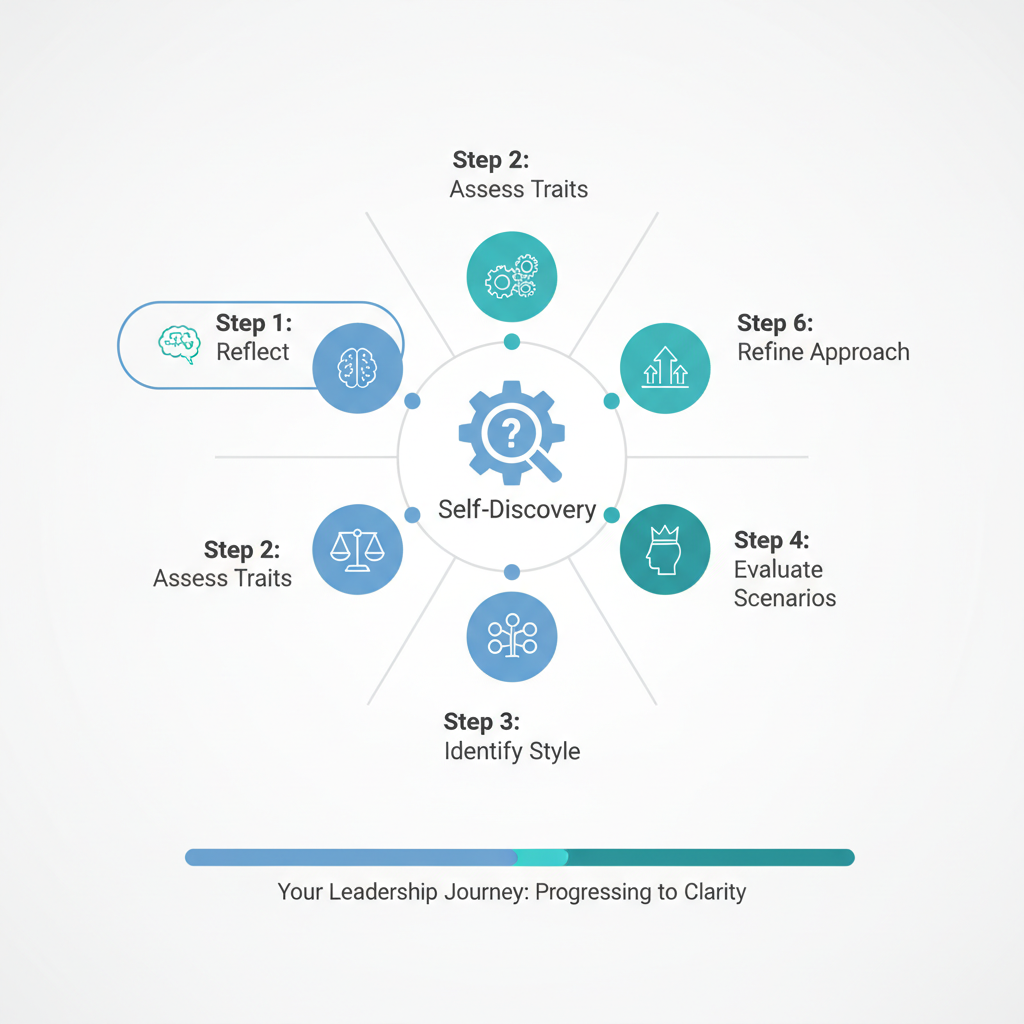
    Infographic displaying a stepwise progression or competency graph for self-discovery of leadership style, using geometric shapes and blue, white, charcoal, and teal colors.
    A minimalist, vector-based infographic illustrating a stepwise process or a self-assessment chart for discovering one’s dominant leadership style. The visual features a structured competency graph or a scoring matrix. It starts with a central ‘Self-Discovery’ icon (perhaps a magnifying glass or a question mark within a gear) in soft blue. Around it, several numbered steps or categories branch out, represented by clean geometric shapes (rectangles, circles, triangles) connected by subtle lines, forming a journey or progression. Each step or category has a small icon symbolizing introspection, assessment, or reflection. A progress bar or a layered system visually suggests growth and understanding. Soft blues, whites, and charcoal form the primary palette, with teal accents indicating progress or key insights. Short labels like ‘Step 1: Reflect’, ‘Step 2: Assess Traits’, ‘Step 3: Identify Style’ are used, maintaining an encouraging and practical tone with ample negative space.

    Take Our Free 5-Minute Leadership & Creativity Quiz

    Knowing your leadership style is a powerful first step. It shows how you inspire, guide, and work with others. It also highlights how your creativity shapes your approach. Our free 5-minute Leadership & Creativity Quiz is a quick way to learn more. This quiz helps you find your main leadership style and see how you use creativity in your role.

    This isn’t just a simple quiz—it’s a tool based on science. It’s a starting point to help you understand yourself better. You’ll learn about your natural tendencies and discover how to encourage new ideas in any situation.

    By taking this quiz, you begin a journey to:

    • Recognize your core leadership tendencies.
    • Understand your creative strengths as a leader.
    • Identify areas for personal growth.
    • Gain the self-awareness you need to lead more effectively.

    Interpreting Your Results for Personal Growth

    Getting your quiz results is exciting, but the real value is in understanding them. Your main leadership style isn’t just a label. It’s a starting point for growth. It shows you how you make decisions, solve problems, and communicate with others.

    Think about how your style connects to creativity. For example, a “Transformational” leader might naturally encourage out-of-the-box thinking. A “Democratic” leader might be great at brainstorming with a team. Your results point out these connections. They show how your leadership style affects your creative work and your team’s creativity.

    See your main style as a strength, and find ways to use its creative advantages. Research shows that self-aware leaders build stronger teams and get better results [4]. Use your results to build this important self-awareness. This clarity will help you use your strengths and improve on your weaknesses.

    Remember, growth is a journey. Think of your quiz results as your personal roadmap. They can guide you to unlock your full potential as a creative leader.

    Actionable Steps to Enhance Your Leadership Abilities

    Understanding your leadership and creative style is the first step. Real change comes from taking action. Here are practical ways to build on your strengths and improve other areas:

    • Build on Your Natural Style: If you have a democratic style, ask for more team input. If you’re a transformational leader, focus on sharing a clear, inspiring vision. Lean into what you do best.
    • Expand Your Creative Toolkit: Find new creative methods that fit your style. For example, if you like structure, try brainstorming tools like mind mapping or SCAMPER. They can help your team think more creatively. Our Creative Ability Test provides tools for this.
    • Practice Flexible Thinking: Regularly question your own assumptions and seek out different viewpoints. This will help you adapt your leadership style to different situations and solve tough problems with more creativity.
    • Seek Feedback and Reflect: Ask trusted colleagues for honest feedback about your leadership. Compare what they say with your quiz results. Use this information to reflect and keep improving.
    • Lead by Example with Creativity: Be open to new ideas and encourage experimentation. Show resilience when a creative project doesn’t work out. Your team will follow your example.
    • Empower Your Team’s Creativity: Give your team creative challenges. Provide the resources they need for new projects. Create a safe space where everyone feels comfortable sharing their ideas, even unusual ones.

    Every leader can be a creative leader. When you use these strategies, you turn knowledge into action. You start to actively shape your leadership journey and create an environment where everyone can be creative.

    What is a Color Leadership Style Test?

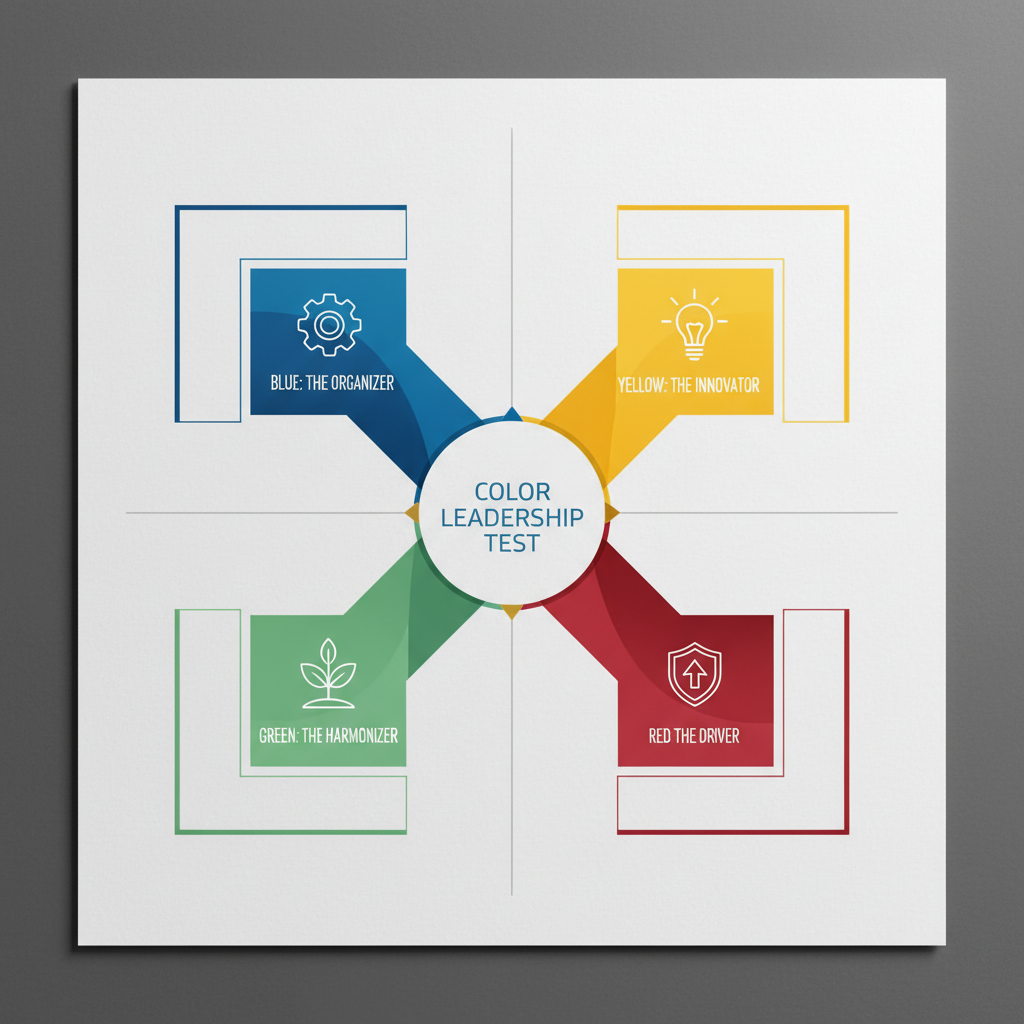
    Infographic illustrating a color leadership style test, with a central hub branching out to four distinct color segments, each representing a leadership characteristic using abstract icons and geometric shapes.
    An abstract, educational infographic explaining the concept of a Color Leadership Style Test. The core visual is a segmented wheel or a conceptual spectrum of colors (e.g., Red, Blue, Green, Yellow) presented as clean geometric shapes with subtle gradients. Each color segment is linked to a distinct leadership style. The central point might be labeled ‘Color Leadership Test’ in soft blue. From this center, lines extend to four distinct quadrants or segments, each representing a different color and its associated leadership characteristic. Small, abstract icons within each colored segment represent the core trait (e.g., a gear for ‘Organizer’ (Blue), a lightbulb for ‘Innovator’ (Yellow)). The overall design is minimalist and professional, using soft blues, whites, and charcoal, with the specific test colors (red, blue, green, yellow, but rendered abstractly as color blocks, not literal paint swatches) highlighted subtly to represent their associated concepts. Teal or gold accents could be used for readability or key takeaways. Negative space emphasizes clarity and structured representation.

    Color Leadership Style Tests are popular tools that group leadership traits into different color profiles. They offer a simple, clear way to understand your natural leadership style. Instead of using complex terms, they use colors to represent different ways of behaving.

    For example, one color might stand for a visionary leader who gets things done. Another might represent a leader who is collaborative and people-focused. This simple color system helps you quickly understand your core leadership habits.

    How Colors Relate to Creative Leadership

    These color profiles are often used for general leadership, but they also reveal a lot about your creative leadership style. The colors show how you handle innovation, solve problems, and work with your team on creative projects. Knowing your “color” helps you use your strengths more effectively.

    Here’s how different styles contribute to creative work:

    • Red (e.g., Driver/Action-Oriented): Leaders with this color are great at starting new projects. They push for bold ideas and get things done fast. This style is excellent for launching creative projects quickly.
    • Yellow (e.g., Socializer/Enthusiast): A yellow leader inspires excitement and teamwork. They create a space where everyone feels comfortable sharing ideas. This is crucial for brainstorming and coming up with new concepts.
    • Green (e.g., Supporter/Harmonizer): Green leaders focus on teamwork and personal well-being. They create a safe space for trying new things, which helps build a team’s creative confidence and sense of psychological safety.
    • Blue (e.g., Analyzer/Thinker): Blue leaders bring structure and clear thinking to the creative process. They make sure ideas are carefully checked and improved. This is key for turning rough ideas into solid, finished solutions.

    Remember, most people are a mix of these colors. But knowing your main colors helps you see your go-to approach for leading creative work. [5]

    Benefits of Understanding Your Color Leadership Style

    Understanding your color leadership style has several benefits, especially for your creative skills. These tests give you a clear way to see your personal preferences. This provides practical insights into how you naturally lead and contribute to a team.

    • Enhanced Self-Awareness: You’ll understand your natural strengths and potential blind spots as a leader. This awareness is the first step to growing as a leader.
    • Improved Team Dynamics: When you know your style, you can better appreciate how others work. This helps you build stronger, more creative teams.
    • Better Communication: Understanding how you and your team prefer to communicate leads to fewer misunderstandings. This is essential for any creative teamwork.
    • Strategic Development: You can learn to adapt your style to fit different situations. This flexibility helps you support creativity effectively, whether your team needs inspiration, organization, or support.

    By understanding these styles, you can create an environment where creativity thrives. Once you know your natural habits, you can work on developing new skills on purpose. This helps you create a clear plan to improve your leadership and creative work.

    At Creative Ability Test, we focus on providing science-backed insights into your unique cognitive style. While color tests are good for quick reflection, our scientific 30-question assessment gives you a deeper, more personal understanding. It shows your specific strengths in areas like flexible and original thinking. Our detailed approach turns your uncertainty into clear self-awareness you can act on. It guides you from being creative sometimes to growing your skills consistently.

    How Does a 16 Personalities Test Relate to Leadership?

    The 16 Personalities test is a tool for understanding your natural tendencies. It looks at your preferences in four key areas that shape how you see the world and lead others.

    The test places you into one of 16 personality types. Each type gives you a glimpse into how you think and make decisions. By understanding your type, you can build self-awareness and become a more effective leader.

    How Your Personality Shapes Your Creative Leadership

    Your personality has a big impact on your leadership style, from how you connect with your team to how you encourage new ideas. Here’s a look at how it works:

    • How You Gather Information: Do you prefer hard facts (Sensing) or focus on future possibilities (Intuition)? A Sensing leader might use data to find creative answers, while an Intuitive leader may encourage big-picture brainstorming.
    • How You Make Decisions: Leaders who rely on logic (Thinking) tend to use objective facts. Those who focus on harmony (Feeling) often seek group agreement. Both can spark creativity, just in different ways.
    • Where You Get Your Energy: Extroverted leaders like to brainstorm out loud with their team. Introverted leaders may prefer to think things through alone. Both approaches are great for coming up with new ideas.
    • How You Structure Work: Judging types like plans and organization, while Perceiving types prefer flexibility and being spontaneous. This affects how you manage creative projects. For instance, a Judging leader might use structured workshops, while a Perceiving leader could create a more open space for exploration.

    Different personality types shine in different leadership roles. For example, an “Advocate” (INFJ) may inspire a team with a strong vision, while a “Commander” (ENTJ) might push for new ideas with clear plans and quick decisions. Both styles can lead to great creative results [6].

    Go Beyond Personality to Boost Your Creative Leadership

    The 16 Personalities test is great for self-discovery. It tells you about your natural preferences, but that’s just the beginning. To grow as a creative leader, you need to build specific creative skills.

    Our platform can help you measure your creative strengths directly. Our 30-question assessment looks at the key parts of creativity, like how you come up with ideas, solve problems, and think flexibly.

    Knowing your personality type is a great first step. Our Creative Ability Test takes you further by giving you simple, practical ways to improve. You’ll learn how to use your creativity more effectively as a leader, turning knowledge into real growth. Find out how to unlock your unique creative style today.

    Frequently Asked Questions

    What is a good free leadership style test?

    Many people look for free tests to learn about themselves. A good free test can give you a first look at how you like to lead.

    These tests make you think about yourself. They help you understand how you lead and work with others. For example, trusted sites like Psychology Today offer quizzes based on well-known psychology ideas [7]. Many business schools and HR blogs also offer free, simple versions of these tests.

    But it’s important to know their limits. Free tests are often not as scientific or detailed as paid ones. They are a great starting point if you are curious. For real, useful insights into your creative leadership skills, our platform offers a special, science-based test.

    Knowing your natural creative strengths is key. This helps you find your best leadership style.

    What are the 7 main leadership styles?

    There are many models, but a few main leadership styles are very common. Each style is different. It affects how teams create new ideas and solve problems [8].

    Here are seven common leadership styles:

    • Autocratic Leadership: The leader makes decisions alone, with little input from others. This can be effective in a crisis.
    • Democratic Leadership: Leaders include team members in making decisions. This encourages teamwork and often boosts creativity.
    • Laissez-faire Leadership: Leaders give very little direction, so employees have a lot of freedom. This can work well with highly skilled teams.
    • Transformational Leadership: Leaders inspire and motivate their teams to reach shared goals. This style is great for encouraging new ideas and growth.
    • Transactional Leadership: Leaders focus on watching over the team, staying organized, and getting work done. They use rewards and punishments.
    • Servant Leadership: The leader puts the team’s needs first. They help others grow and succeed.
    • Pace-setting Leadership: Leaders set high standards for everyone, including themselves. This can lead to fast results.

    Each style has its pros and cons. The best leaders change their approach. They match their style to the situation and their team’s needs. Understanding these styles helps you improve your own creative leadership skills.

    Is there a leadership style quiz suitable for students?

    Yes, absolutely! Leadership style quizzes are great for students. They offer many benefits early in your school and work life.

    Here’s why they are valuable for students:

    • Self-Discovery: Students learn about their natural habits. This helps them see how they affect others.
    • Better Teamwork: Knowing your style helps with group projects. It leads to better teamwork and helps solve disagreements.
    • Ready for a Career: Understanding leadership prepares students for future jobs. It gives them key professional skills.
    • Creative Problem-Solving: Identifying your leadership style can help you be more creative. You can find new solutions to school challenges.

    Leadership isn’t just for managers. It’s about how you influence, communicate, and encourage others. For students, these quizzes can build confidence and offer ideas for personal growth. They also show you how to use your creative strengths in school and in other activities. Our platform offers science-based insights. It helps students understand their creative skills. This is a key tool for any new leader.

    How can I find a leadership style test online?

    It’s easy to find a leadership style test online. A quick search will give you many options. Start by using terms like “leadership style quiz,” “free leadership assessment,” or “leadership style test psychology.”

    When you search, look for tests that offer:

    • Clear Explanations: The test should clearly define each leadership style.
    • Useful Feedback: It should give you ideas you can use to grow.
    • Credibility: Look for tests from trusted sources, like universities or well-known psychology websites.
    • Relevance to Creativity: Consider if the test connects leadership with new ideas.

    Be careful with quizzes that are too simple. They may not be based on science. For a deep, science-based look at your creative leadership style, our platform offers detailed tests. We provide personal advice to help you use your creative skills in real leadership situations. Your journey to understanding yourself better starts with choosing the right tools.


    Sources

    1. https://www.verywellmind.com/what-is-intellectual-stimulation-5203710
    2. https://www.ukessays.com/essays/business/the-effects-of-democratic-leadership-on-employees-job-satisfaction-business-essay.php
    3. https://www.frontiersin.org/articles/10.3389/fpsyg.2021.688863/full
    4. https://hbr.org/2018/01/what-self-awareness-really-is-and-how-to-cultivate-it
    5. https://www.forbes.com/sites/carolinecastrillon/2021/04/24/heres-how-to-discover-your-leadership-style/?sh=2684784a3b83
    6. https://www.psychologytoday.com/us/blog/prescriptions-life/201804/the-power-understanding-your-personality-type-in-the-workplace
    7. https://www.psychologytoday.com/us/tests/career/leadership-style-test
    8. https://online.maryville.edu/blog/seven-common-leadership-styles/

  • Take the Creative Ability Assessment: Understand Your Strengths & Potential

    Take the Creative Ability Assessment: Understand Your Strengths & Potential

    Taking the Creative Ability Test involves answering a 30-question, scientifically-grounded assessment designed to measure your unique creative strengths. Upon completion, you receive a personalized report detailing your cognitive flexibility, problem-solving skills, and actionable strategies for growth.

    Do you ever wonder how creative you really are? Many people think creativity is a rare skill meant only for artists or inventors. But in today’s world, creativity is essential. It helps you innovate, solve problems, and grow in both your work and personal life. Creativity is how you handle new situations, come up with fresh ideas, and connect concepts in surprising ways.

    At Creative Ability Test, we believe that understanding your creative style is the first step to using your full potential. We offer a scientifically grounded assessment that helps explain how you think creatively. By taking our 30-question test, you will get a clear picture of your strengths and find areas for growth. You’ll also learn about the different dimensions of your personal creativity, all based on proven research.

    This article explains what makes the Creative Ability Assessment a unique tool for self-discovery. We will explore why understanding your cognitive flexibility, divergent thinking, and innovative problem-solving skills is so important. You’ll learn how the insights from our reports can help you use your creativity in practical, everyday situations. Get ready to turn uncertainty into clear self-awareness and apply your creative talents to all areas of your life.

    What is the Creative Ability Assessment?

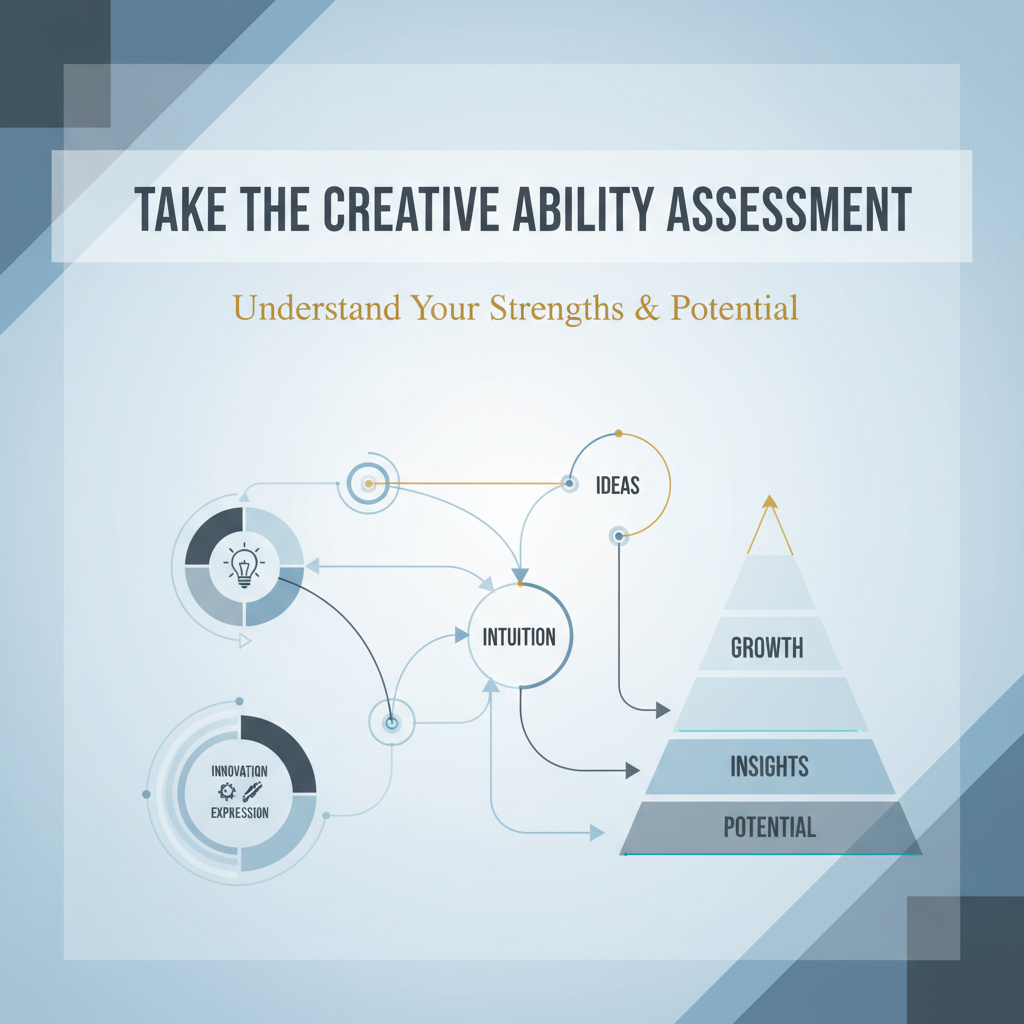
    An abstract infographic showing interconnected nodes and clusters, representing the various components measured in a creative ability assessment.
    Abstract, educational infographic. A minimalist, vector-based cognitive network diagram or idea cluster, depicting the multifaceted nature of a creative ability assessment. Clean geometric shapes, subtle gradients, soft blues, whites, charcoal, with gold or teal accents. Ample negative space for short conceptual labels like “Divergent Thinking”, “Innovation Potential”. No humans, professional and approachable.

    Want to understand your unique creative spark? The Creative Ability Assessment is a science-backed tool designed to help you find your natural creative strengths. This 30-question online test looks at how you think creatively and gives you a clear picture of your potential.

    Our goal is to help you discover more about yourself. We show you how your mind comes up with new ideas and what your specific creative style is. You will also learn how you approach challenges and opportunities. This assessment is a simple path to understanding yourself better.

    The test looks at several parts of creativity. It measures your mental flexibility, which is how easily you switch between different ideas. It also checks your ability to brainstorm many unique solutions to a problem [1]. We also look at your openness to new experiences, as these are key parts of innovative thinking.

    Taking this assessment gives you clarity. You get personal insights into your creative profile, which helps you use your strengths and shows you areas where you can grow. As a result, you can improve your problem-solving skills and be more creative every day, both at work and in life.

    The Creative Ability Test uses proven methods based on research in psychology. This ensures your results are reliable and meaningful. You get practical strategies, not just scores. These tips are tailored to help you build your creative skills for both personal and professional growth.

    Why Should You Take This Assessment?

    Understand Your Unique Creative Profile

    You have a unique way of seeing the world. The Creative Ability Assessment helps you discover it. This isn’t a simple “creative or not” test. Instead, our 30-question assessment explores the different parts of your personal creative style.

    When you take this assessment, you’ll get a clearer picture of:

    • Your natural strengths: Discover where your creative talents are.
    • Your thinking style: Learn if you’re better at coming up with many ideas (divergent thinking) or narrowing them down (convergent thinking).
    • Cognitive flexibility: Find out how easily you can switch viewpoints and adapt to new challenges.
    • Openness to new experiences: See how curiosity fuels your creativity.

    This deeper self-knowledge is powerful. It helps you recognize and value your own unique way of thinking.

    Gain Actionable Insights for Growth

    Getting your results is just the beginning. Our platform offers more than just scores. We provide personalized feedback designed to help you grow your creative skills.

    The insights you receive are:

    • Tailored to you: Based on your results, you get recommendations made just for you.
    • Clear and practical: We break down complex psychological concepts into simple, practical advice.
    • Growth-oriented: You’ll find practical steps to improve your creative thinking in your daily life.
    • Empowering: Learn how to use your strengths and work on areas where you can grow.

    For example, if your results show you’re great at divergent thinking, your report might suggest brainstorming techniques to make that skill even stronger. On the other hand, if you could improve your cognitive flexibility, we might suggest exercises to help you practice changing your viewpoint. These are more than just tips—they are practical steps to help you grow.

    Enhance Problem-Solving Skills

    Creativity is more than just making art. It’s a powerful tool for effective problem-solving. In today’s fast-changing world, the ability to come up with new solutions is a valuable skill.

    Taking this assessment helps you improve your problem-solving skills by:

    • Helping you think in new ways: You’ll learn to approach challenges from different angles.
    • Improving idea generation: Build your ability to use divergent thinking to come up with more solutions.
    • Strengthening your judgment: Understand how to use convergent thinking to pick the best ideas.
    • Boosting adaptability: Your improved cognitive flexibility will help you change your approach when you run into problems.

    In fact, global leaders often call creativity a critical skill for dealing with today’s business challenges [2]. This assessment gives you the mindset and tools to turn challenges into opportunities, whether you’re working on a tough project or a personal problem.

    Boost Your Professional and Personal Development

    Investing in your creativity pays off in big ways. Your career and personal life can improve when you understand and develop your creative skills.

    In your career, this assessment can help you:

    • Advance your career: Creativity is a top skill that employers are looking for [3].
    • Drive innovation: You’ll bring fresh ideas and solutions to your team.
    • Improve your leadership potential: Creative thinkers often inspire others and lead the way to growth.
    • Increase your adaptability: Handle change with confidence and new ideas.

    In your personal life, understanding your creativity helps you to:

    • Express yourself: Find new ways to feel fulfilled and find joy.
    • Build confidence: See your unique value and what you can achieve.
    • Improve daily life: Approach everyday situations in a more imaginative and positive way.

    Unlock your creative potential. Experience personal and professional growth.

    How Does the Assessment Work?

    An abstract infographic illustrating the sequential steps of an assessment process using geometric shapes and arrows.
    Abstract, educational infographic. A minimalist, vector-based stepwise process diagram or a linear milestone progression. Clean geometric shapes and arrows illustrate the flow of the assessment. Soft blues, whites, charcoal, with gold or teal accents. Negative space for short labels such as “Initiate”, “Engage”, “Analyze”, “Discover”. No humans, professional and approachable.

    Step 1: The 30-Question Journey

    Start with our 30-question assessment to discover your creative strengths. This quick online test is engaging and insightful. It is designed to explore your creative style by looking at how you solve problems and come up with new ideas.

    The questions use different scenarios to show your natural creative instincts. Your answers help us see how you think. This short test gives us the information we need to understand your potential to create and grow.

    Step 2: Our Science-Backed Methodology

    Our assessment is based on solid scientific research, not just a simple quiz. It uses proven ideas from cognitive psychology [4] and the latest studies on creativity.

    We measure key creative dimensions like divergent thinking. That’s your ability to come up with many different ideas from one starting point [5]. We also look at your cognitive flexibility, which is how easily you can switch between different ideas or ways of thinking [6].

    Every question is carefully tested to make sure it accurately measures a specific creative skill. This means you get results you can trust. Our science-backed approach helps you discover your full creative potential.

    Step 3: Your Personalized Results Report

    After you finish the assessment, you’ll get a detailed, personal report. It’s more than just a score—it’s your guide to understanding how you think. You’ll see a clear picture of your creative profile and core strengths.

    Your report explains what each creative skill means for you. You’ll learn about your thinking style and how open you are to new things. It also points out specific areas where you have the potential to grow.

    Best of all, your report gives you practical tips to boost your creativity. These are simple exercises and ideas you can use right away for your work projects or personal growth. This report is your roadmap to becoming more creative, turning self-awareness into real results.

    What Creative Traits Does the Assessment Measure?

    An abstract infographic depicting a competency chart or graph, detailing various creative traits measured by an assessment.
    Abstract, educational infographic. A minimalist, vector-based creative skill assessment chart or a competency graph, visually breaking down traits. Clean, structured layout with geometric shapes and subtle gradients. Soft blues, whites, charcoal, with gold or teal accents. Negative space for labels like “Fluency”, “Originality”, “Flexibility”, “Elaboration”. No humans, professional and approachable.

    Divergent & Convergent Thinking

    People often think creativity is just about “having ideas.” But it’s really about two different, important ways of thinking. The Creative Ability Assessment helps you understand your balance of both.

    Divergent thinking means coming up with lots of different ideas. It’s like brainstorming, where you explore many possibilities. This way of thinking helps you move past the usual solutions. The goal is to have many different kinds of ideas.

    Convergent thinking is the opposite. It’s about choosing the best idea from all your options. You narrow down your choices to find the one that works. This process helps you turn a good idea into a great solution.

    Our assessment shows you which style comes more naturally to you. Are you great at creating new ideas? Or are you better at turning those ideas into practical solutions? Knowing your balance is the first step to becoming more creative. You need both skills to truly innovate [7].

    You’ll discover how to use your strengths and improve your weaker style. This will help you solve problems more effectively in any situation.

    Cognitive Flexibility

    Cognitive flexibility is a key part of creative thinking. It’s your ability to change how you think and easily switch perspectives. This skill allows you to look at a problem from many different angles.

    This skill helps you adapt when you get new information. It also lets you switch between different tasks or plans easily. For example, someone with this skill can quickly change their marketing plan based on new customer feedback. They use new data instead of resisting it.

    Our assessment measures your cognitive flexibility. It shows how easily you let go of old ideas and accept new ones. People with high cognitive flexibility are more resilient. They adapt well in fast-changing situations.

    Improving this skill helps you create new things. It makes you a more flexible thinker. We’ll give you practical tips to build this skill. This will help you find creative solutions more often.

    Openness to New Experiences

    Openness to new experiences is an important personality trait for creativity [8]. It’s about being curious and willing to explore new ideas, values, and feelings.

    People who are open to new experiences are often very imaginative. They enjoy trying new things and learning. They aren’t afraid to question how things are done. They also seek out different points of view, which makes them natural innovators.

    Our Creative Ability Assessment measures your level of openness. It shows how comfortable you are with uncertainty and how much you enjoy variety. Knowing this is important for both your personal and professional life.

    Understanding your openness can help you find experiences that spark your creativity. We provide personalized tips to encourage you to try new things and expand your mind. This will help you unlock your natural creative talent.

    Innovative Problem-Solving Approaches

    Creativity is about solving problems. Innovative problem-solving means finding new and effective solutions to challenges. It’s more than just coming up with ideas.

    This skill combines divergent and convergent thinking with cognitive flexibility. It also uses your openness to new ideas. Our assessment looks at how you use these skills together. It shows your unique way of handling difficult problems.

    You’ll get a clear picture of how you like to work. Do you start by exploring many ideas? Or do you prefer to focus on a few and make them better? Knowing this helps you improve your creative process. You’ll be able to innovate more effectively.

    The personalized report from your Creative Ability Test is very useful. It shows your strengths in real-world situations and gives you practical advice. You’ll learn how to use your creative skills to solve everyday problems. This helps you bring new ideas to your work and life. Take the assessment today to discover these valuable insights.

    Ready to Discover Your Creative Potential?

    Do you want to explore your creative side? Maybe you feel you have ideas waiting to come out. The Creative Ability Assessment can help you unlock your potential.

    This science-backed, 30-question test offers deep insights into your mind. It helps you find your unique creative strengths. You will also understand your personal thinking style.

    Start Your Journey of Self-Discovery

    This test is more than just a quiz. It’s a big step in understanding yourself. You’ll get a clear picture of your creative talents. This helps you build on your skills in the best way.

    • Find Your Strengths: See where you are most creative.
    • Know Your Thinking Style: Learn how you solve problems and come up with ideas.
    • Get Actionable Tips: Receive custom advice to boost your creativity every day.
    • Improve Problem-Solving: Use what you learn to solve challenges at home and work.
    • Encourage Personal Growth: Connect more deeply with your creative side.

    Everyone has creative potential. Our test is designed to find yours and give you a starting point for growth. For example, knowing your score for divergent thinking can help you brainstorm better. This skill is important for many jobs [9].

    Ready to Take the Next Step?

    Your journey to more creativity begins now. Don’t let your creative talent go unused. Try our evidence-based test today. It’s a chance to grow and improve in a real way.

    Find out how your mental flexibility can lead to new solutions. See how being open to new things gives you fresh ideas. Take the Creative Ability Assessment and start changing your creative life.

    Frequently Asked Questions

    What is the meaning of this creative assessment?

    This Creative Ability Assessment is your guide to exploring your unique creative potential. Our 30-question assessment is backed by research. It gives you a clear picture of your creative strengths [10].

    The assessment is all about self-discovery. You’ll learn about your unique ways of thinking. It shows how you solve problems and come up with new ideas. It also pinpoints your biggest creative strengths and shows you where you can grow.

    Ultimately, this assessment empowers you. It turns uncertainty into useful self-knowledge. You’ll get practical insights to help you use your creativity in all parts of your life, from personal growth to your career.

    What kind of questions are in the assessment?

    Our assessment has 30 carefully designed questions. They aren’t about facts or trivia. Instead, they encourage you to think in new and flexible ways. The questions explore different sides of your creative mind.

    The questions will ask you to think about different situations. They measure key creative skills, such as:

    • Divergent Thinking: How many uses can you imagine for a common object? This measures your ability to come up with many different ideas [11].
    • Cognitive Flexibility: Can you easily shift your perspective? This explores how easily you adapt to new information.
    • Innovative Problem-Solving: How do you handle new challenges? We look at your favorite ways to find new solutions.
    • Openness to New Experiences: Are you curious about the unfamiliar? This shows how open you are to new ideas and concepts.

    There are no “right” or “wrong” answers. The questions are designed to understand how you really think. They show your natural creative style, which gives you a truly personalized look at your skills.

    Can I see sample answers or a practice test?

    We don’t offer sample answers or a practice test. We do this on purpose to protect the accuracy of your results. Your first, honest answers are key to getting a true picture of your creativity.

    When you see the questions for the first time, your natural creativity comes through. This helps us get an accurate look at your unique thinking style. You don’t need to prepare or study. Just bring your curiosity and an open mind!

    Our goal is to give you an honest look at your creative potential. Answering fresh helps us give you the most valuable, personal feedback. You’ll get tips and strategies made just for you.


    Sources

    1. https://www.apa.org/pubs/books/4317135
    2. https://www.ibm.com/downloads/cas/M7W1XQ0X
    3. https://business.linkedin.com/talent-solutions/resources/talent-blog/most-in-demand-soft-skills
    4. https://www.apa.org/topics/creativity
    5. https://www.psychologytoday.com/us/basics/creativity/divergent-thinking
    6. https://www.simplypsychology.org/cognitive-flexibility.html
    7. https://www.psychologytoday.com/us/basics/creativity
    8. https://www.sciencedirect.com/topics/psychology/openness-to-experience
    9. https://www.forbes.com/sites/forbescoachescouncil/2021/04/27/why-creativity-is-the-most-important-skill-in-the-world/?sh=223b379659b8
    10. https://www.apa.org/education-career/guide/science-creativity
    11. https://www.sciencedirect.com/topics/psychology/divergent-thinking

  • A Full Psychological Assessment of Your Creative Potential | Creative Ability Test

    A Full Psychological Assessment of Your Creative Potential | Creative Ability Test

    A full psychological assessment is a comprehensive process used to evaluate a person’s cognitive abilities, psychological functioning, and behavioral patterns. While traditionally used for clinical diagnosis, a specialized online psychoeducational assessment can focus on specific strengths like creativity, providing actionable insights into your problem-solving skills and innovative potential.

    Have you ever wondered how creative you truly are? Creativity is more than just artistic talent—it’s a key skill for solving problems, innovating, and growing in all parts of your life. It gives you the flexibility to adapt and the ability to approach challenges in your own way. Understanding your creative side can open up new opportunities, but for many, this powerful inner resource is left untapped.

    At Creative Ability Test, we believe knowing your unique creative profile is the first step to using it fully. Our platform offers a detailed approach, similar to a specialized full psychological assessment, designed to map your creative strengths and thinking styles. We look at areas like cognitive flexibility, divergent thinking, and openness to experience to give you a clear picture of how you come up with new ideas.

    This isn’t about diagnosis; it’s about discovery. Our science-based assessment gives you practical insights, helping you move from curiosity to a clear understanding of your creative psychology. You will learn about your strengths, see where you can improve, and get useful strategies to boost your creative thinking in everyday situations. Ready to explore your creative self? Let’s begin.

    What Is a Full Psychological Assessment?

    An abstract infographic illustrating a psychological assessment as a central hub with radiating lines connecting to various assessment domains like cognition, emotion, and creativity.
    Clean, instructional infographic, minimalist, vector-based. Abstract educational visualization representing a ‘Full Psychological Assessment’. Focus on a conceptual visualization of comprehensive evaluation. Use a central hub (representing ‘assessment’) with radiating connections to different domains or aspects being assessed (e.g., cognition, emotion, behavior, creativity). Utilize clean geometric shapes, subtle gradients, and gold or teal accents against soft blues, whites, and charcoal. Maintain ample negative space for implied labels. No text. No humans, no cartoons, no photographs.

    The Goal of a Full Psych Evaluation

    A full psychological assessment is a deep look into a person’s mental and emotional health. Its main goal is usually to understand challenges and find the root causes of problems. This can lead to a diagnosis and a plan for treatment [1]. However, we take a different approach that focuses on creativity.

    Here at Creative Ability Test, our aim is different. We focus on discovery and growth. Instead of looking for problems, our evaluation helps uncover your potential. We help you understand your unique creative strengths, including how you think and solve problems.

    Our main goal is simple: to empower you with self-awareness. This insight helps you grow your creative talents and use them effectively in your life. This process can lead to both personal and professional growth.

    Psychological vs. Psychoeducational Assessments Explained

    People often mix up psychological and psychoeducational assessments, but they have different goals. Understanding the difference is key to seeing how we help unlock your creative potential.

    Psychological Assessments: These are broad evaluations of a person’s mental health. They look at personality traits and emotional well-being. They often focus on areas like anxiety, depression, and other clinical conditions. These assessments use interviews and questionnaires to help diagnose mental health disorders.

    Psychoeducational Assessments: These tests are different. They focus on how you learn and think. They explore how your brain processes information and can also look at academic skills. For adults, this means understanding your mental strengths and finding what might affect your ability to solve problems or come up with new ideas. This type of assessment looks at:

    • Cognitive abilities, like memory and processing speed.
    • Academic achievement in areas like reading or math.
    • How psychological factors influence learning [2].

    At Creative Ability Test, we use ideas from psychoeducational assessments and apply them to creativity. Our online platform measures your cognitive flexibility and divergent thinking, which are key parts of being creative. We do not offer clinical diagnoses. Instead, our assessment gives you a look into your creative mind. This helps you use your unique thinking styles to your advantage.

    Consider this comparison:

    Feature Psychological Assessment Psychoeducational Assessment (as applied by Creative Ability Test)
    Primary Focus Mental health, emotions, and personality to diagnose conditions. How you think and learn to uncover creative potential and support personal growth.
    Key Outcomes Diagnosing conditions, creating treatment plans, and understanding emotional issues. Finding your creative strengths, learning your thinking style, and getting practical tips to boost creativity.
    Targeted Areas Anxiety, depression, behavioral issues, personality disorders. Cognitive flexibility, divergent thinking, problem-solving, openness to experience, innovation skills.
    Goal for User To get clinical support or treatment. To understand yourself better, grow as a person, and use your creativity in everyday life.

    Our approach gives you a clear guide to boosting your creative potential. You get useful information that you can act on right away. These insights are practical, build your confidence, and empower you to think differently and innovate.

    What are the components of a psycho educational evaluation?

    An abstract infographic showing a structured competency map with distinct sections representing various components of a psycho educational evaluation such as cognitive abilities and academic achievement.
    Clean, instructional infographic, minimalist, vector-based. Abstract educational visualization representing the components of a psycho educational evaluation. Visualize this as a structured assessment chart or a competency map. Use a multi-section grid or stacked layers, each clearly delineating a different component (e.g., Cognitive Abilities, Academic Achievement, Executive Functions, Social-Emotional Development). Employ clean geometric shapes, subtle gradients, and gold or teal accents against soft blues, whites, and charcoal. Maintain ample negative space. No text. No humans, no cartoons, no photographs.

    Cognitive and Academic Testing

    An evaluation of your thinking and learning starts by understanding your mental strengths. This includes how you think and process information. We look at key skills that directly impact your creativity.

    For example, cognitive tests measure your working memory and how fast you process information. They also check your reasoning and attention skills. These are key for connecting new ideas and solving problems creatively [3].

    Think about mental flexibility. This is your ability to switch between different ideas or methods. It is a key part of generating many unique ideas. This skill helps you brainstorm better and find new solutions.

    Academic testing also offers helpful information. It looks at basic skills like reading, writing, and math. These are often the tools you use to be creative. For instance, a strong vocabulary makes your storytelling better. Good analytical skills help you solve problems in new ways. Our tests show how these core skills boost your creative potential.

    Understanding these mental foundations helps you use your strengths. It also shows you areas where you can grow. This leads to a stronger creative process.

    Behavioral and Emotional Screening

    Your emotions and behaviors are just as important for creativity as your thinking skills. Our evaluations often include screenings to look at these areas. This helps us see your overall well-being and how you handle creative challenges.

    For instance, screenings might check your attention and focus, which are vital for getting deep into a creative project. We also look at your motivation and persistence. These traits help you push past creative blocks and finish what you start [4].

    Managing your emotions is also important. It helps you handle frustration when tasks get hard. Another key factor is being open to new experiences. This personality trait is closely tied to creativity. It means you are curious about new ideas and willing to try different approaches.

    Understanding these patterns gives you a clearer picture. It helps you see what personal habits help or hurt your creativity. This self-awareness gives you the power to build a mindset that encourages new ideas and growth.

    The Comprehensive Report and Recommendations

    The final step is the full report. This document brings together all the findings. It combines results from your thinking, academic, and emotional screenings to give a complete picture of your unique profile.

    This report is more than just numbers. It gives you personalized insights into your creative strengths and points out areas for growth. For example, it might show that you’re great at brainstorming new ideas. It could also suggest ways to become more mentally flexible.

    Most importantly, the report gives you clear, practical recommendations. These are strategies designed just for you to help unlock your creative potential. You might get specific exercises to boost original thinking or new techniques to improve your problem-solving. This report provides that guidance.

    Our Creative Ability Test works the same way. It helps turn confusion into self-awareness. It guides you from being creative sometimes to having a clear plan for growth. You’ll get personalized, practical tips that help you use your creativity in the real world. This helps you become a more innovative and effective thinker.

    How Can an Assessment Unlock Your Creative Potential?

    An abstract infographic illustrating the process of unlocking creative potential, showing a closed form transforming into an open, expanding shape with branching pathways, symbolizing growth and divergent thinking.
    Clean, instructional infographic, minimalist, vector-based. Abstract educational visualization representing how an assessment unlocks creative potential. Depict a ‘locked’ abstract shape transforming into an ‘unlocked’ or expanding shape, or a branching pathway signifying divergent thinking and growth. Use layered systems showing progression or application of creative skills. Incorporate clean geometric shapes, subtle gradients, and prominent gold or teal accents to symbolize the ‘unlocking’ or ‘growth’ effect, set against soft blues, whites, and charcoal. Maintain ample negative space. No text. No humans, no cartoons, no photographs.

    Shifting Focus from Diagnosis to Discovery

    Many psychological tests focus on identifying challenges or diagnoses. We take a different approach. Our goal shifts from looking for problems to discovering your unique potential.

    Our process focuses on understanding your natural strengths. It helps you explore how your mind creates new ideas and solves problems. We don’t look for what’s “wrong.” Instead, we highlight what makes your creative thinking powerful.

    Think of it as a journey of self-discovery where you learn more about how your mind works. This view empowers you to build on your natural abilities and guides you toward personal growth and innovation.

    When you understand your creativity, you can move past uncertainty and embrace your ability to think differently. This process is about recognizing and celebrating your unique creative gifts.

    Our Online Assessment for Creativity

    Our Creative Ability Test is a specialized online assessment designed for adults. It measures different parts of your creative potential, moving beyond traditional tests that focus on learning or behavioral issues.

    Instead, our test focuses on your mental strengths. It explores how you handle tasks that need imagination and new ideas. This 30-question assessment is based on solid science [5] and proven research in creative psychology.

    The assessment looks at key areas of creativity:

    • Cognitive Flexibility: Your ability to adapt your thinking and switch between different points of view.
    • Divergent Thinking: How well you come up with many ideas or solutions from a single starting point.
    • Problem-Solving Skills: Your personal approach to solving difficult challenges in creative ways.
    • Openness to Experience: Your willingness to explore new and unfamiliar ideas.

    This online assessment is both convenient and insightful. You can learn about your creative mind from anywhere, making it a powerful tool for your growth.

    Understanding Your Unique Creative Profile

    After the assessment, you get a detailed, personal report. This is more than just a score—it’s a full picture of your creative style. The report explains your main ways of thinking and your creative skills.

    For example, you might be strong in “ideational fluency,” which means you come up with lots of ideas fast. Or your strength might be “originality,” meaning you create truly unique concepts. Knowing these specific traits is the first step.

    Your creative profile helps you understand how you solve problems and approach new situations. This awareness is powerful. It lets you use your strengths better at home and at work.

    But you get more than just information. We provide practical tips designed just for you. These strategies help you:

    • Improve your creative thinking every day.
    • Use your creativity to solve specific problems.
    • Bring new ideas to your work.
    • Grow as a person through creative expression.

    Imagine using your strengths to come up with better ideas at work. Or you could use your “imaginative exploration” to start a new hobby. This assessment turns confusion into clarity, helping you understand and grow your creative power [6].

    Take the Creative Ability Test: Your Personalized Assessment

    Who Is This Assessment For?

    Our Creative Ability Test is for anyone who wants to understand how they think. It offers a unique look into your mind and helps you understand your natural problem-solving style.

    This personalized test is ideal for:

    • Students and Learners: Understand your mental strengths. Improve your approach to schoolwork. Find new ways to learn and create.
    • Professionals and Entrepreneurs: Advance your career. Find new solutions at work. Boost your ability to innovate and think strategically.
    • Creative Enthusiasts: Better understand your creative process. Identify your unique creative strengths. Learn how to beat creative blocks.
    • Individuals Seeking Personal Growth: Start a journey of self-discovery. Discover your hidden talents. Become a more flexible and adaptive thinker.

    If you’re curious about your potential, this test is for you. It offers a clear path to self-awareness and teaches you how to make the most of your creative skills.

    How the 30-Question Assessment Works

    The Creative Ability Test is backed by science and uses a short, 30-question format. Each question is designed to explore different parts of your creative thinking. The process is both engaging and insightful.

    Our method is based on proven ideas from cognitive psychology [7]. This ensures your results are accurate and dependable. We look at a few key areas of creativity:

    • Divergent Thinking: This measures your ability to come up with many ideas and find different, original solutions.
    • Cognitive Flexibility: We look at how easily you switch between different ideas and adapt to new information.
    • Problem-Solving Skills: The test shows how you handle difficult tasks and your natural way of getting past challenges.
    • Openness to Experience: This area measures your curiosity and how open you are to new ideas and experiences.

    This test is easy for anyone to take. You don’t need any background in psychology. Just answer each question honestly. Your answers give us a complete picture of your creative side. We turn complex psychology into simple, clear insights.

    Get Your Actionable Insights Today

    Completing the test is just the first step. Our platform gives you personal feedback right away. It’s more than a score—it’s a detailed guide made just for you.

    Your report will show your unique creative strengths and the areas where you can grow. We give you practical tips you can use now to improve your creative thinking every day.

    You will learn to:

    • Understand your main creative style.
    • Be more mentally flexible when things get tough.
    • Apply divergent thinking to solve real-world problems.
    • Create a space that sparks new ideas.
    • Use creative methods to grow personally and professionally.

    This journey helps you move from uncertainty to confident self-awareness. You will get a clear picture of your creative potential. Start changing how you think and create, and discover how powerful your mind truly is.

    Frequently Asked Questions about Psychological Assessments

    Where can I get a psychoeducational evaluation for adults?

    A full psychoeducational evaluation for an adult is a detailed assessment. It is usually performed by a licensed psychologist or neuropsychologist. These evaluations happen in person at a clinic, private practice, or university. They are used to diagnose conditions like learning disabilities, ADHD, or other cognitive challenges [8].

    These tests offer a deep look into your thinking skills, academic abilities, and emotional well-being. Each evaluation is tailored to the individual. The process involves interviews, standard tests, and close observation.

    At Creative Ability Test, we offer a specialized assessment. Our platform focuses on understanding your creative potential. It is not a diagnostic evaluation and does not identify learning disabilities. Instead, our 30-question assessment measures your creative strengths. We help you explore your flexible thinking and problem-solving skills. This gives you practical tips for personal growth and new ideas.

    If you think you might have a learning disability or ADHD, it’s important to get a traditional psychoeducational evaluation. Talk to your healthcare provider. They can refer you to a qualified professional in your area. However, if you want to understand and boost your creative mind, our assessment offers a unique, science-backed approach.

    Is a learning disability test for adults available online?

    Full diagnostic tests for learning disabilities in adults usually must be done in person. A qualified professional needs to conduct these evaluations. This makes sure the results are accurate and understood correctly. Standard tests often require a specific setting and direct interaction. This helps the professional carefully observe your behavior and responses [9].

    While some online screeners exist, they cannot give you a diagnosis. These online tools can offer early insights or suggest you might need a full evaluation. However, they cannot replace a comprehensive assessment by a licensed psychologist. A proper diagnosis is key to getting the right support and accommodations.

    The Creative Ability Test is not a learning disability assessment. Our platform has a different goal. We focus on your creative thinking skills, like brainstorming and solving problems in new ways. Our science-backed assessment helps you find your unique creative style. You get personal insights into how your mind comes up with new ideas.

    We empower you to understand your creative potential. You will learn practical ways to improve your abilities. This approach is about building on your strengths. It helps you grow personally and professionally by using your creativity.

    What’s the difference between a psychological and psychiatric evaluation?

    It’s important to know the difference between psychological and psychiatric evaluations. Both are done by mental health professionals, but they have different goals, focuses, and methods. Here’s a clear comparison:

    Feature Psychological Evaluation Psychiatric Evaluation
    Who Conducts It? Licensed Psychologists (Ph.D., Psy.D.) Psychiatrists (Medical Doctors – M.D. or D.O.)
    Primary Focus Thinking, personality, cognitive skills, emotions, and behavior. Diagnosing and medically treating mental illness, often looking at biological causes.
    Methodology Interviews, standard psychological tests (for personality, IQ, thinking, etc.), and observing behavior. Clinical interviews, medical history review, symptom assessment, sometimes physical exams or lab tests.
    Outcome Goal To understand a person’s psychological profile, diagnose mental health conditions, find cognitive strengths/weaknesses, and plan therapy. To diagnose mental illness, manage medication, and plan overall treatment (which can include therapy referrals).
    Prescribes Medication? Generally no (except in a few states with specific additional training and licensing). Yes, as medical doctors, psychiatrists can prescribe medication.

    The Creative Ability Test is similar to a psychological evaluation in some ways. We study how you think, specifically focusing on the skills used for creativity. Our goal is not a clinical diagnosis. Instead, we aim to reveal your natural creative talents. We give you a deep understanding of your unique thinking styles to help you grow as a person and solve problems in new ways.

    Our platform offers science-backed insights to guide you on your creative journey. You will understand your creative strengths and get practical tips to improve them. This is a path to discovering more about yourself and your abilities.


    Sources

    1. https://www.apa.org/topics/psychotherapy/psychological-assessment
    2. https://www.naspweb.org/resources-and-publications/resources/school-psychology-and-mental-health/school-psychology-basics/psychoeducational-assessments
    3. https://www.apa.org/topics/cognitive-psychology/cognition
    4. https://www.frontiersin.org/articles/10.3389/fpsyg.2018.02613/full
    5. https://www.apa.org/pubs/journals/features/xge-a0033190
    6. https://psycnet.apa.org/record/2012-00507-001
    7. https://www.apa.org/education-career/guide/science-psychology/cognitive
    8. https://www.apa.org/topics/psychological-assessment
    9. https://ldaamerica.org/adults/

  • Top 7 Psych Personality Tests to Reveal Your Creative Potential (2024)

    Top 7 Psych Personality Tests to Reveal Your Creative Potential (2024)

    A psych personality test is a scientifically designed assessment used to understand an individual’s distinct character traits, emotional patterns, and cognitive styles. Popular examples like the Big Five (OCEAN test) and MBTI provide a structured psych profile that offers insights into your strengths, weaknesses, and how you approach creative challenges and interact with the world.

    Have you ever wondered what makes you creative? Maybe you’ve had a great idea or found a new way to solve a problem and wished you knew how your mind worked. Creativity isn’t just for artists. It’s a key skill that helps us grow, succeed at work, and deal with a complex world. When you understand your own creative style, you can find new ways to approach challenges and opportunities.

    The good news is that it’s easy to learn more about your creative potential. This article will introduce you to psychological assessment and show you top psych personality test options. These tests can reveal your unique creative strengths and ways of thinking. You’ll learn about different tests, from detailed ones that offer personal insights to popular tools like the ocean test psychology. We’ll explain how these tests work and what concepts like cognitive flexibility and divergent thinking mean in simple terms.

    Ready to learn more about yourself? By exploring these reliable psychology character test options, you’ll better understand your natural talents. You will see how your personality affects your problem-solving skills and learn practical ways to improve them. Instead of guessing, you can use your psych profile test results to build creative confidence. These insights can be used for real-world projects and personal growth. Let’s unlock your creative power together.

    What Can a Psych Personality Test Reveal About Your Creativity?

    An abstract diagram showing 'Creative Potential' as a central node, branching into multiple clusters representing different facets of creativity like divergent thinking and imagination, revealed by personality tests.
    An abstract, educational infographic illustrating the various dimensions of creativity revealed by personality tests. Visualize a central concept node ‘Creative Potential’ with multiple branching pathways or idea clusters emanating outwards. Each cluster represents a different aspect of creativity, such as ‘Divergent Thinking,’ ‘Originality,’ ‘Problem-solving Acumen,’ and ‘Imagination.’ Use clean geometric shapes, subtle gradients, and connecting lines to show relationships. The color palette should feature soft blues, whites, and charcoal, with gold accents for emphasis. Ensure ample negative space for clarity and a minimalist, vector-based style. No human figures or cartoon elements.

    Have you ever wondered what makes some people so creative? A personality test can offer a look into your unique creative style. These tests aren’t about labels. Instead, they show you the specific traits and ways of thinking that spark your imagination and help you solve problems.

    Taking a personality test helps you understand yourself better. You’ll learn how your key traits affect your creative side. This knowledge helps you use your strengths and build new skills. It also shows you how to be more creative in all parts of your life.

    Discover Your Creative Style

    A good personality test does more than scratch the surface. It looks at the foundations of your creativity. You’ll learn about your natural tendencies and thinking patterns. Knowing this is key for personal growth and professional success.

    Here’s what a quality personality test can show you about your creative style:

    • Openness to Experience: This is a key part of creativity. It’s your willingness to explore new ideas and try new things. People who are high in openness are often more imaginative and insightful. This trait is strongly linked to creative ability in many areas [1].
    • Cognitive Flexibility: This is your ability to switch your point of view. It also shows how easily you adapt to new situations. Flexible thinkers can connect ideas that seem unrelated, which is key for creative problem-solving.
    • Divergent vs. Convergent Thinking: A test can show which thinking style you prefer. Divergent thinking is about creating lots of new ideas. Convergent thinking is about finding the single best solution. Knowing your balance helps you improve at both.
    • Problem-Solving Approaches: Learn how you naturally solve problems. Do you like logical, step-by-step plans? Or do you prefer to use your intuition and think outside the box? Knowing this helps you improve your approach.
    • Potential for Innovation: Your overall results can show your ability to innovate. This includes how open you are to change and how ready you are to create new solutions.

    Using Your Results to Grow

    Understanding these traits is the first step. The real value comes from using what you learn. A good personality test turns complex results into practical advice. It helps replace uncertainty with clear self-awareness.

    Your personality test results can give you:

    • Personalized Strategies: Get advice tailored to your creative strengths. This can help you overcome specific creative blocks.
    • Better Self-Awareness: See the patterns in how you think and act. This makes you more aware of your own creative process.
    • Targeted Growth: Find specific areas where you can build your creativity. This might mean practicing idea-generating exercises or trying new things.
    • More Confidence: Discover your hidden creative talents. This boosts your confidence in your own abilities. You’ll feel more ready to take on new creative projects.
    • Real-World Application: Learn how to use what you’ve learned to solve everyday problems. This helps you be more innovative at work, in school, or in your hobbies.

    At Creative Ability Test, our science-based 30-question test measures different sides of your creativity. It gives you personalized feedback and practical tips. We help you measure, understand, and grow your creative potential. Take our personality test today to unlock your full creative power.

    The 7 Best Psychology Personality Tests for Creative Self-Discovery

    A structured infographic chart comparing seven different psychology personality tests, with visual indicators for the creative attributes each test assesses.
    A professional and approachable infographic presenting a competency graph or scoring matrix for the ‘7 Best Psychology Personality Tests.’ The visualization should feature seven distinct, structured columns or sections, each clearly representing a different personality test. Within each section, incorporate subtle visual indicators (e.g., small abstract icons or minimalist shapes) to signify key creative attributes or dimensions assessed by that particular test (e.g., ‘Openness,’ ‘Ideation Fluency,’ ‘Risk-taking’). Use a minimalist, vector-based style with clean geometric shapes. The color palette should utilize soft blues, whites, and charcoal, with teal accents to highlight each test’s characteristics. Maintain clear visual hierarchy and negative space for easy readability. No human figures or cartoon elements.

    Knowing your personality is a great way to unlock your creative potential. Psychology personality tests offer a clear path to learn about your thinking styles, preferences, and natural strengths. These insights can show you how you solve problems, create ideas, and innovate.

    Here, we explore several tests. Some are backed by science and give a deep analysis. Others are a lighter, more fun way to learn about yourself. Each test can help you link your personality to your creativity. This helps you grow personally and professionally.

    1. The Creative Ability Test: Measure Your Innovation Potential

    The Creative Ability Test (CAT) is a special tool made to measure and improve your creative skills. It goes beyond general personality traits. It focuses on how you create ideas, handle new challenges, and think in new ways. This platform has a 30-question test based on science.

    It also gives you personalized feedback. You get practical tips to boost creativity in your life and work. The CAT focuses on flexible thinking, coming up with many ideas, and being open to new things. These are key parts of being creative.

    Our detailed test turns confusion about your potential into clear self-awareness. You’ll get useful insights to help you use creativity to solve real problems and innovate.

    • Key Focus: Measures creative thinking, innovation skills, and flexible thinking.
    • Benefits for Creativity: Gives you a custom plan to improve your creative process. It shows your strengths and where you can grow.
    • Why It Stands Out: Based on solid research, the CAT gives personal, practical tips. It makes complex ideas easy for anyone to use.

    2. The Big Five (OCEAN) Test: Understand Your Core Traits

    The Big Five personality model, often known as OCEAN, is one of the most respected systems in psychology. It looks at five main areas of personality: Openness to Experience, Conscientiousness, Extraversion, Agreeableness, and Neuroticism.

    Each trait is a spectrum. High scores in “Openness to Experience” are strongly linked to creativity [2]. This trait shows how willing you are to explore new ideas and experiences.

    Knowing your Big Five profile gives you a good starting point. It shows how your main traits affect your creative style. For example, being very conscientious might make your creative work neat and detailed. Being an extrovert could help you work creatively with others.

    • Key Focus: Assesses five basic parts of personality.
    • Benefits for Creativity: Helps you see how your natural traits help or hurt your creativity. It points to “Openness” as a key factor.
    • Practical Tip: Think about how your “Openness” level shows up in your daily habits. Do you look for new things to try?

    3. The 16 Personalities Test (MBTI): Discover Your Personality Type

    The 16 Personalities Test is based on the Myers-Briggs Type Indicator (MBTI). It sorts people into 16 personality types. It uses four pairs of traits: Introversion/Extraversion, Sensing/Intuition, Thinking/Feeling, and Judging/Perceiving.

    While scientists debate how reliable it is, this test is very popular for self-discovery [3]. It helps many people understand what they prefer. It also gives them words to describe how they see the world.

    People with high Intuition (N) and Perception (P) scores are often naturally creative. They are open to new ideas and like thinking about possibilities. Knowing your type helps you use your natural strengths. It also shows you how to work best in a creative team.

    • Key Focus: Places people into 16 distinct personality types based on their preferences.
    • Benefits for Creativity: Gives you a way to understand your creative style. It shows how your preferences affect how you brainstorm and solve problems.
    • Actionable Insight: Think about how your type’s strengths, like “intuitive” thinking, can help your projects.

    4. Divergent Thinking Tests: Assess Your Idea Generation Skills

    Divergent thinking is a key part of creativity. It means coming up with many different ideas from one starting point. These tests measure how well you brainstorm and solve problems in new ways. A well-known example is the Torrance Tests of Creative Thinking (TTCT) [4].

    A common exercise is the “Alternative Uses Test.” You list as many new uses as you can for a simple object, like a brick. Another is the “Consequences Test.” You think of different results for a made-up situation.

    These tests look at a few different things. They check your fluency (number of ideas), flexibility (range of categories), originality (uniqueness of ideas), and elaboration (detail in ideas). Improving your divergent thinking skills will make you more innovative.

    • Key Focus: Directly measures your ability to come up with a wide range of creative ideas.
    • Benefits for Creativity: Gives you a clear look at your idea-generation skills. It offers real ways to get better at brainstorming and problem-solving.
    • Growth Strategy: Practice these exercises often. For example, set a timer and list new uses for things around your house.

    5. The Fisher Temperament Inventory: Explore Your Brain’s Chemistry

    Dr. Helen Fisher’s research connects personality traits to your brain’s chemistry. Her Temperament Inventory identifies four main types of temperament: Explorer (dopamine system), Builder (serotonin system), Director (testosterone system), and Negotiator (estrogen system) [5].

    Each type has its own creative strengths. For example, Explorers are curious and love new things, making them natural innovators. Builders focus on details, which is great for finishing creative projects. Directors are decisive thinkers. Negotiators are team players who see the big picture.

    Knowing your main temperament gives you a unique view of yourself. It shows your natural way of handling creative work. This can help you create the right workspace for you. It also points you to projects that fit your style.

    • Key Focus: Links personality to brain chemistry and temperament.
    • Benefits for Creativity: Shows your basic creative style and what comes naturally to you. It suggests the best ways for you to be creative.
    • Self-Discovery Tip: Think about how your main temperament affects whether you prefer to work alone or with others.

    6. Visual Personality Quizzes: Fun Psychology Tests with Pictures

    Visual personality quizzes are a different, more intuitive way to learn about yourself. These “psych profile tests” use images, colors, or patterns. You choose what you like best. Then, you get a short personality summary based on your choices.

    These “fun psychology personality tests” aren’t scientific, but they are still useful. They are engaging and easy for beginners. They can make you curious about your personality and creative preferences in a fun way.

    Think of them as an easy start to self-discovery. They can be a quick, simple way to notice certain traits in yourself. This may inspire you to try a more detailed test, like the Creative Ability Test, for more insight.

    • Key Focus: Uses images for quick and fun personality insights.
    • Benefits for Creativity: A fun, easy way to start thinking about your preferences. It can be a first step to self-awareness.
    • Approach: Use these for entertainment and simple reflection. Enjoy seeing how you react to different images.

    7. ‘Which Character Are You?’ Quizzes: A Fun Look at Your Profile

    ‘Which character are you?’ quizzes are a popular and fun type of “psychology character test.” They match your answers to the traits of fictional characters from movies, books, or TV shows. These quizzes are for fun, not for serious psychological analysis.

    But even though they’re playful, they can be useful. They make personality traits easy to understand and remember. By matching with a character, you might notice strengths or creative styles in yourself you hadn’t seen before.

    These quizzes are a fun way to start understanding yourself. They help you think about yourself in a low-pressure, engaging way. You might learn something new about yourself while having fun. Remember to use them for fun and out of curiosity.

    • Key Focus: Matches your personality to fictional characters for fun.
    • Benefits for Creativity: Makes personality ideas easier to relate to. It can make you curious about your own creative “character.”
    • Engagement Tip: Think about which parts of the character you connect with. How do those traits show up in your creative work?

    How Do Personality Traits Influence Creative Thinking?

    An abstract network diagram illustrating how core personality traits such as openness and conscientiousness influence different aspects of creative thinking, including idea generation and originality.
    An abstract and insightful infographic depicting the influence of personality traits on creative thinking. Visualize a layered system or a cognitive network diagram where foundational ‘Personality Traits’ (e.g., ‘Openness to Experience,’ ‘Conscientiousness,’ ‘Extroversion’) are represented as distinct, interconnected nodes or layers at the base. From these foundational elements, show branching pathways, flowing lines, or radiating connections extending outwards to influence various aspects of ‘Creative Thinking’ processes, such as ‘Idea Generation,’ ‘Persistence,’ ‘Risk-taking,’ and ‘Originality.’ Use clean geometric shapes, subtle gradients, and directional markers. The color palette should be soft blues, whites, and charcoal, with gold or teal accents to highlight the connections. The style should be minimalist, vector-based, with plenty of negative space for conceptual clarity. No human figures or cartoon elements.

    Openness to Experience: The Gateway to Creativity

    Your personality traits show how your mind works and how creative you naturally are. One of the most important traits for creativity is Openness to Experience. It’s a key part of the Big Five (OCEAN) personality model.

    People who are high in Openness are curious by nature. They like new ideas, different experiences, and abstract thoughts. They also tend to have active imaginations. This trait is a powerful boost for creative thinking.

    Think about how this trait shapes how you see the world:

    • Curiosity: You love to learn and question the way things are done. This helps you explore and discover new things.
    • Love of Beauty: You feel moved by art, music, and nature. This can inspire you to create.
    • Active Imagination: You have a strong inner world. You can easily imagine new possibilities that others don’t see.
    • Need for Variety: You get bored with routine and prefer new experiences. This pushes you to find different solutions.

    Research shows a strong link between Openness to Experience and creativity [6]. People with high Openness are often good at divergent thinking, which means they come up with many unique ideas. They are also more likely to do creative things. Knowing your own level of openness is a great first step to understanding your creative potential. Our Creative Ability Test measures qualities related to this trait, giving you a clear picture of your natural creative strengths.

    Connecting Your Psych Profile Test to Problem-Solving

    Knowing your personality is about more than just self-awareness. It gives you real insights into how you solve problems. The results from your psych profile test can show you how you face challenges, whether you like logical steps or creative jumps.

    For example, a person high in Openness to Experience might try many unusual ideas first. In contrast, someone high in Conscientiousness may prefer a structured, step-by-step solution. Both ways are valuable. Knowing your natural style helps you adjust when you need to.

    Here is how these insights can improve your problem-solving:

    • Know Your Strengths: Your results show your natural mental strengths. Are you great at brainstorming new ideas or at analyzing details?
    • Find Your Weak Spots: Knowing your usual approach shows you where you can improve. Maybe you need to practice thinking of more ideas, or perhaps you need to get better at narrowing them down.
    • Become More Flexible: Being flexible means changing your thinking to fit the situation. Your test insights can help you practice different ways of thinking so you can switch gears when a solution isn’t working.
    • Match Your Strategy to the Problem: You can choose the best way to tackle a challenge. If a problem needs a completely new idea, use your open-minded side. If it requires careful, exact work, rely on your structured thinking.

    The Creative Ability Test gives you personalized feedback to help you understand your creative style. It also provides practical tips you can use to make the most of your strengths when solving problems. This helps you turn your potential into real results.

    Using Test Results for Personal and Professional Growth

    Your journey with our tests is more than just getting a score. It’s a powerful tool for growth. The insights from a test like our Creative Ability Test can guide both your personal and professional development.

    Here’s how to turn your test results into real growth:

    • Personal Growth:
      • Build Self-Confidence: Knowing and accepting your unique creative strengths will make you more confident.
      • Embrace Your Style: Creativity shows up in many forms. Learn to understand and develop your own creative voice.
      • Discover More About Yourself: Use your results to think about your interests. Match your hobbies and activities with what truly inspires you.
      • Grow Your Curiosity: If your results show you’re less open, try seeking out new experiences. Read different kinds of books or learn a new skill.
    • Professional Development:
      • Boost Innovation at Work: Use your creative insights to come up with fresh ideas for new products or better processes.
      • Work Better with Teams: Understand how your creative style fits with others. Appreciating different ways of thinking on your team creates a more innovative workplace.
      • Become a Stronger Leader: Encourage creative problem-solving by leading the way. Use what you know about personality to inspire your team.
      • Advance Your Career: Use your improved creative skills, which are highly valued in today’s fast-changing job market. This can open up new opportunities for you [7].

    The Creative Ability Test is more than a score—it’s a personalized roadmap for growth. It gives you practical steps to develop your creative potential. Our platform supports your journey, from understanding your personality to using your creativity in real life. We help you go from simple self-assessment to getting specific, useful tips for growth.

    What is the Name of Personality Test in Psychology?

    Trait-Based Tests vs. Type-Based Tests

    Personality tests usually fall into two main groups: trait-based and type-based. Knowing the difference helps you understand your results and use them to boost your creativity.

    What are Trait-Based Tests?

    Trait-based tests measure different parts of your personality on a scale. Instead of putting you in a box, they show that everyone has a certain amount of each trait. Together, these traits create your unique personality profile. Think of it like a spectrum. For example, instead of being either “creative” or “not creative,” you might score high on openness to experience—a key trait for creativity.

    • Focus: How much of a certain trait do you have?
    • Outcome: Gives you a detailed score for different traits.
    • Benefit for Creativity: Helps you spot specific strengths, like flexible or original thinking. This lets you focus on areas for growth.

    The Creative Ability Test uses a similar approach. It gives you a detailed look at different parts of your creative potential. This helps you find areas to improve and use your unique creative strengths.

    What are Type-Based Tests?

    By contrast, type-based tests sort people into distinct groups or “types.” They place you in a single category that best describes how you tend to think or act. For example, you might be labeled an “innovator” or a “strategist.”

    • Focus: Which type fits you best?
    • Outcome: Puts you into a single personality type.
    • Benefit for Creativity: Offers a simple overview of your style. This can be a good starting point for thinking about your creativity.

    While type-based tests give a quick snapshot, trait-based tests like the Creative Ability Test offer deeper insights you can act on. They help you understand your creative style and problem-solving skills in more detail.

    Common Personality Tests in Psychology

    There are many types of personality tests in psychology. Each one gives you a different way to look at yourself. Here are a few well-known tests:

    • The Big Five (OCEAN) Test: This is a popular trait-based test used by psychologists. It measures five key traits: Openness to Experience, Conscientiousness, Extraversion, Agreeableness, and Neuroticism. The “Openness to Experience” trait is strongly linked to creativity and new ideas [8].
    • The 16 Personalities Test (MBTI – Myers-Briggs Type Indicator): This well-known, type-based test sorts people into one of 16 personality types. It looks at your preferences, like how you see the world and make choices. It’s popular for self-discovery, but many scientists question its validity [9].
    • Divergent Thinking Tests: These tests measure your ability to come up with many unique ideas from one starting point. They are designed to measure a key part of creative thinking. A classic example is asking you to list all the uses for a brick.
    • The Creative Ability Test: Our platform offers a 30-question assessment based on science. It measures several parts of your creative potential, like how flexibly you think and how open you are to new things. It gives you personalized feedback and real steps to improve your creative strengths. Instead of just giving you a label, it focuses on growth and ideas you can actually use.

    Choosing the right test depends on what you want to learn. If you want practical advice for growing your creative skills, a specialized test is your best bet.

    Finding a Credible Personality Test

    With so many tests online, it’s important to know how to find a good one. A reliable test gives you real insights you can use to grow, both personally and professionally.

    Here’s what to look for:

    • Scientific Grounding: Look for tests made by psychologists or researchers. They should be based on solid psychological theories and research. The test should be proven to be valid (it measures what it says it does) and reliable (it provides consistent results).
    • Clear Purpose and Focus: A good test clearly explains what it measures and why. To learn about your creativity, pick a test made to measure creative thinking or problem-solving.
    • Actionable Insights: The best tests do more than just give you a label. They give you personal feedback, point out your strengths, and offer clear steps for improvement. This helps you use what you’ve learned about yourself in real life.
    • Transparency: Good tests are open about how they work, how to understand the results, and what their limits are. They don’t make wild promises.

    Many “free personality tests” online are fun, but they often aren’t backed by science. Their results might not be deep or accurate enough to help you truly improve [10].

    The Creative Ability Test was designed with these ideas in mind. It’s a test based on solid research. Our 30-question test gives you detailed, personal insights into your creative abilities. We also give you practical tips to boost your creative thinking and problem-solving skills. This helps you clearly see your strengths and find real ways to be more innovative.

    How to Choose the Right Online Personality Test for You

    Choosing the right online personality test is a key step to unlocking your creative potential. With so many options, it can be hard to know where to start. But by asking a few key questions, you can find a test that fits your goals.

    A good test should be a reliable guide on your creative journey. It does more than give you a label—it offers clear steps for growth and real-world use. Let’s explore how to choose the best test for you.

    Clarify Your Creative Goals

    Before you take a personality test, think about what you want to learn. Are you just curious about your personality? Or do you want to measure and improve your creative thinking? Knowing your goal will help you choose the right test.

    • For Self-Discovery: If you want to understand your general character traits, a broad test like the Big Five or MBTI can be helpful. They provide a good starting point.
    • For Creativity Assessment: To measure your creative potential, find a test designed for it. Look for tools that measure flexible thinking, idea generation, and openness to new things. These are key for innovation.
    • For Problem-Solving & Innovation: If you want to solve real-world problems, pick a test with practical tips. It should help you turn your results into action. For example, knowing your creative style can improve how you solve problems.

    When you know your goal, you can pick a test that gives you useful results.

    Understand Different Test Approaches

    Online personality tests work in different ways. Some look at general traits, while others focus on specific mental skills. Knowing the difference helps you make a smart choice.

    • Trait-Based Tests: These tests measure different parts of your personality. The Big Five (OCEAN) test, for example, scores you on Openness, Conscientiousness, Extraversion, Agreeableness, and Neuroticism. A high score in openness is often linked to creativity [source: https://www.apa.org/pubs/journals/releases/psp-874558.pdf].
    • Type-Based Tests: Tests like 16 Personalities (MBTI) put you into a specific personality type. While popular, they are often less scientific than trait-based tests [source: https://www.psychologytoday.com/us/blog/give-and-take/201309/goodbye-mbti-hello-big-five]. They can be fun but may not offer deep creative insights.
    • Creativity-Specific Assessments: These tests are made to measure creativity directly. They look at things like idea generation, imagination, and creating new things. For instance, a test might ask you to list all the possible uses for a paperclip. This directly checks your ability to come up with many different ideas.

    To fully understand your creative skills, a test focused on creativity is usually the best option.

    Prioritize Scientific Credibility

    A test’s accuracy depends on its scientific backing. Look for tests that are based on real evidence.

    • Grounded in Research: A good test is created by psychologists or researchers. It should be built on proven theories and methods.
    • Validated Assessments: Check if the test has been validated. This means research has shown that it accurately measures what it’s supposed to. This makes your results reliable.
    • Transparency: Trustworthy sites explain how their test works. They should make it clear how their questions connect to psychological concepts.

    For example, the Creative Ability Test uses a science-backed, 30-question assessment. It gives you solid insights into your creative strengths and mental flexibility. This means you get feedback that is both accurate and useful.

    Seek Actionable Insights and Practical Strategies

    A good personality test should give you more than just a score. It should offer clear explanations and useful advice.

    • Beyond Labels: Look for a test that explains what your results mean. It should clearly describe your creative traits and thinking styles in a way that is easy to understand.
    • Personalized Feedback: Generic results are not very helpful. Find a test that gives you feedback tailored to you, highlighting your unique strengths and areas for improvement.
    • Actionable Tips: The best tests give you power. They offer real strategies to boost your creative thinking and problem-solving skills. For example, if you are good at generating many ideas, the test might give you tips on how to brainstorm even better.

    The Creative Ability Test provides personalized feedback and practical strategies. It helps you grow your creativity for both personal and professional goals, moving you from confusion to clear progress.

    Consider the Depth of the Assessment

    The length of a test affects how deep your results will be. Some quick quizzes are just for fun, while others offer a more complete analysis.

    • Comprehensive vs. Quick Quizzes: Short, fun personality quizzes can be enjoyable, but they usually don’t offer the detail needed for real growth. A longer test, like a 30-question assessment, can explore many sides of your creativity.
    • Multiple Dimensions of Creativity: Creativity is complex and involves many different mental skills. A good test will measure different aspects like originality, fluency, and flexibility. This gives you a fuller picture of your ability to innovate.

    The Creative Ability Test is a complete platform that measures these different sides of creativity. It gives you insight into your creative strengths, mental flexibility, and openness. This detailed approach gives you insights that build your confidence.

    Choose a Platform Committed to Growth

    The right online personality test should support your personal growth. It should help you use your creativity in everyday life.

    • Emphasis on Growth: Look for a platform that presents your results as a chance to grow. It should guide you on how to improve your creative skills.
    • Supportive Guidance: The test should have an encouraging and positive tone. It should also explain complex ideas in a simple way.
    • Connecting Insights to Life: A good platform shows you how your creative style fits into your daily and work life. It should use examples you can relate to.

    The Creative Ability Test is designed to be your guide. We focus on growth, self-discovery, and using your creative insights in the real world. We help you move from basic knowledge to deep, practical understanding.

    Frequently Asked Questions

    What are the types of personality tests in psychology?

    Personality tests are tools that help us understand how we tend to think, feel, and behave. They can show you more about your creative strengths and the way you prefer to think.

    Generally, these tests fall into a few main categories:

    • Objective Tests (Self-Report Inventories): These are the most common. You answer a list of questions about yourself. Your answers are then scored and compared to the results of a large group of people.
      • How they help creativity: They often measure traits like openness to experience, which is strongly linked to creativity [11]. They can help you see which parts of your personality boost or block your creative expression.
    • Projective Tests: These show you unclear prompts, like inkblots or incomplete sentences, and ask what you see. The idea is that your answers reveal hidden thoughts and feelings.
      • How they help creativity: While not a direct measure of creativity, how you interpret these prompts can tap into your imagination and offer a new way to understand yourself.
    • Type-Based Tests: These tests sort you into a specific personality type. A famous example is the Myers-Briggs Type Indicator (MBTI), which suggests 16 different types.
      • How they help creativity: Knowing your “type” can help you recognize your natural way of solving problems and working with others—both key parts of being creative.
    • Trait-Based Tests: Instead of a fixed type, these tests measure your personality traits on a scale. The Big Five (OCEAN) is a great example, showing where you score on different traits.
      • How they help creativity: These tests are great for identifying specific skills linked to creativity, like your ability to come up with new ideas or adapt your thinking.

    Understanding these types helps you pick the right test for your goals. Our Creative Ability Test, for example, is an objective, trait-based test that gives you practical insights into your creative skills.

    What is the OCEAN test in psychology?

    The OCEAN test is also known as the “Big Five” personality traits. It’s a trusted, science-backed model in psychology. It suggests that we can describe personality using five main areas. These traits are measured on a scale, meaning you fall somewhere along the line for each one.

    Each letter in OCEAN stands for a different personality trait:

    • O is for Openness to Experience: This shows how willing you are to try new things and how curious and imaginative you are. People high in openness are often creative and like exploring new ideas.
      • Creative Connection: This is the trait most connected to creativity. People high in openness are more likely to think outside the box and explore new solutions, which boosts their creative potential.
    • C is for Conscientiousness: This describes how organized, responsible, and disciplined you are. It’s about being focused on goals and paying attention to detail.
      • Creative Connection: While not a creative trait itself, conscientiousness helps creative work by providing the discipline to turn good ideas into finished projects.
    • E is for Extraversion: This trait shows how outgoing and sociable you are. Extraverts are often energetic and enjoy being around other people.
      • Creative Connection: Extraversion can help creativity in group settings. Extraverts often enjoy sharing ideas and brainstorming with others.
    • A is for Agreeableness: This measures how cooperative, kind, and friendly you are. Agreeable people tend to value getting along with others.
      • Creative Connection: Agreeableness is helpful when working on creative teams. It encourages good teamwork and feedback, which helps new ideas grow.
    • N is for Neuroticism (or Emotional Stability): This relates to how you handle your emotions, especially stress and anxiety. Low neuroticism means you are more emotionally stable.
      • Creative Connection: While some creative people can be anxious, being emotionally balanced often helps you stay focused and bounce back from creative setbacks.

    The OCEAN model is a simple but thorough way to understand your personality. To improve your creativity, learning about your Openness to Experience score is especially helpful. It can encourage you to look at things in new ways and grow your imagination.

    Are free personality tests in psychology accurate?

    The accuracy of free personality tests can be very different. It depends on the science behind them and what they are designed for.

    Many online quizzes are just for fun. They might offer some quick thoughts, but they usually aren’t backed by science. This means they haven’t been carefully tested for reliability (if you get the same results over time) or validity (if they actually measure what they say they do) [12]. Because of this, their results may not be a true picture of your personality.

    However, some free tests are shorter versions of real, science-backed assessments. These can give you a general idea, but they might not have the detail and accuracy of the full version. The key differences are usually:

    • Methodology: Good tests are made with careful research using lots of people and data. Fun, free quizzes often skip this process.
    • Expertise: Science-based tests are created by psychologists and other experts. Most online quizzes are not.
    • Depth of Feedback: Validated tests give you detailed, personalized feedback with practical advice. Free quizzes often give you generic results.

    For real self-improvement and trustworthy insights into your creative skills, it’s best to use a test based on solid science. The Creative Ability Test, for example, uses a proven method to provide accurate, practical tips, helping you understand and grow your creative skills with confidence.

    What psychological test can I take to know my personality?

    Choosing the right psychological test depends on what you want to learn. Are you curious about your personality in general, or do you want to know more about your creative skills and thinking style?

    Here are some great options for different goals:

    • For General Personality Understanding (Trait-Based):
      • The Big Five (OCEAN) Test: This is a well-respected, science-backed test. It tells you where you score on the five core personality traits: Openness, Conscientiousness, Extraversion, Agreeableness, and Neuroticism. It’s great for a general overview of your character and how traits like Openness affect your creative side.
    • For General Personality Understanding (Type-Based):
      • The 16 Personalities Test (based on MBTI): This popular test puts you into one of 16 personality types. It helps you understand your preferences for how you get your energy, take in information, make decisions, and organize your life. This can give you a simple way to see how you handle creative tasks.
    • For Specific Creative Potential and Thinking Styles:
      • The Creative Ability Test: If your main goal is to measure and grow your creativity, this is the perfect choice. It is a science-backed, 30-question test designed to show you your creative strengths, your ability to think in new ways, your problem-solving skills, and your openness to new experiences. You get personalized feedback and practical tips to build your creativity.
      • Divergent Thinking Tests: Tests like the Torrance Tests of Creative Thinking measure how well you can come up with many different and original ideas from one starting point. They are excellent for understanding your idea-generation skills.

    To really get to know your personality and use your creativity, start with a clear goal. If creativity is your focus, a test like the Creative Ability Test will give you the most direct and useful advice. It provides a clear path from understanding yourself to using your creativity in your daily life.


    Sources

    1. https://www.psychologytoday.com/us/basics/openness-experience
    2. https://www.sciencedirect.com/science/article/abs/pii/S019188691500300X
    3. https://www.psychologytoday.com/us/blog/prescriptions-life/202102/the-myers-briggs-type-indicator-a-brief-critical-review
    4. https://creativeeducationfoundation.org/resources/torrance-tests-of-creative-thinking/
    5. https://www.helenfisher.com/the-four-broad-basic-styles-of-thinking-and-behaving-that-i-call-temperaments/
    6. https://journals.sagepub.com/doi/abs/10.1177/1088868307302792
    7. https://www.weforum.org/agenda/2023/05/future-of-jobs-2023-top-skills/
    8. https://psycnet.apa.org/record/1997-04660-001
    9. https://journals.sagepub.com/doi/abs/10.1177/1089268005284814
    10. https://www.psychologytoday.com/us/blog/give-and-take/201311/good-and-bad-personality-tests
    11. https://journals.sagepub.com/doi/abs/10.1177/1088868310389278
    12. https://www.psychologicalscience.org/observer/what-s-wrong-with-the-mbti