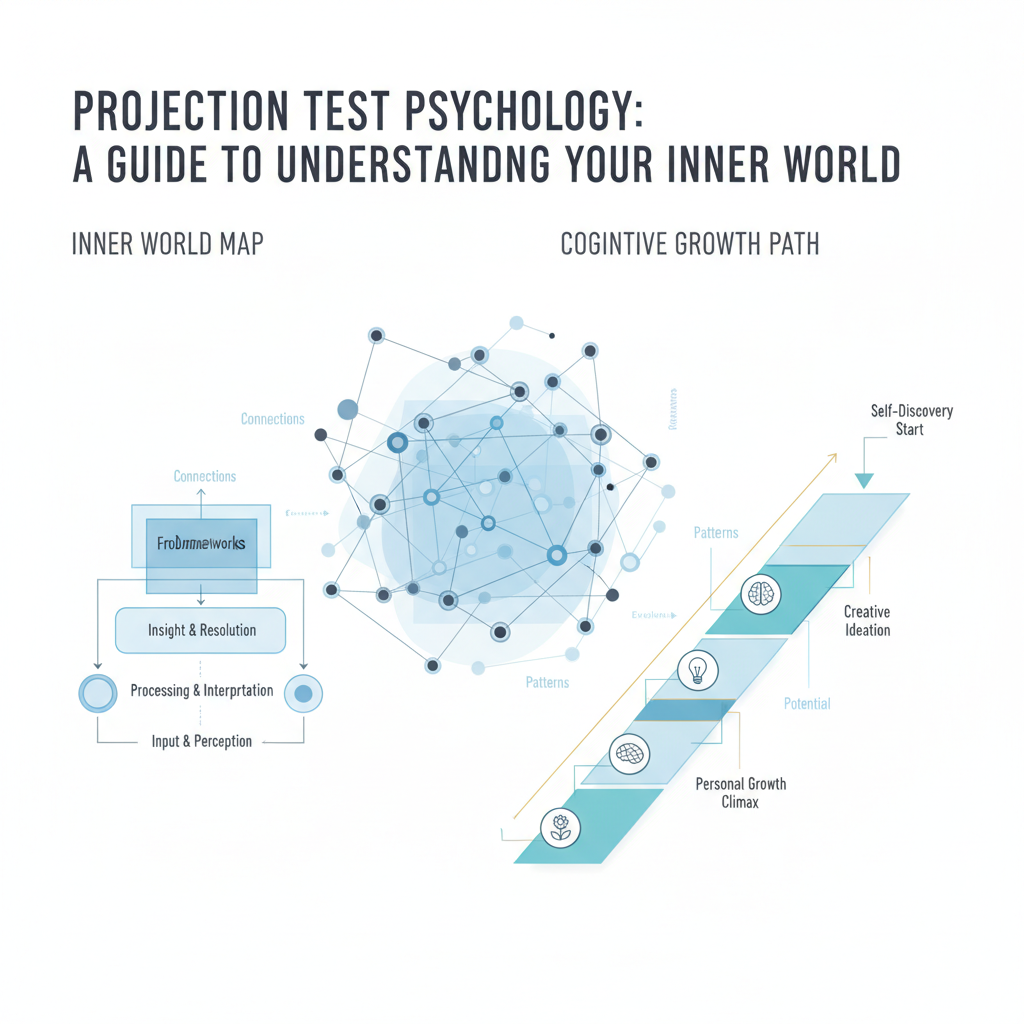
A projection test in psychology is a type of personality assessment where an individual responds to ambiguous stimuli, like an inkblot, drawing, or incomplete sentence. The fundamental idea is that by interpreting the vague prompt, the person projects their unconscious needs, fears, and values onto it. This allows psychologists to gain qualitative insights into a person’s inner world that might not be revealed through direct questioning.
What shapes the way you see the world, come up with new ideas, or solve problems? A lot of it comes from your inner world. Your thoughts and feelings guide your actions, often without you even realizing it. This article explores projective psychology, a powerful way to reveal these hidden parts of your personality and unlock your creative potential.
Unlike a standard quiz with direct questions, a projective personality test uses vague prompts, such as images or unfinished sentences. The goal is to have you “project” your own thoughts and feelings onto them. Your response isn’t random—it’s a reflection of your thinking style, motivations, and creative strengths. Understanding your own projections can lead to greater self-awareness and offer a clearer view of how you tackle challenges.
This guide explains the core ideas of projective psychology, showing how these interesting methods work and what they reveal. We’ll cover everything from drawing tests to sentence completion examples, making these tools easy to understand. You’ll learn how to use the insights for personal growth, more flexible thinking, and a deeper understanding of your creative self. Let’s start by defining what a projective personality test is.
What is a Projective Personality Test?
How Projection Uncovers Hidden Thoughts
A projective personality test explores your inner world, giving you a look at your thoughts, feelings, and motives. These tests use unclear images or prompts, and you explain what you see in your own way.
The main idea is “projection.” This is a process where we put our own thoughts and feelings onto unclear situations. For example, when you see a shapeless inkblot, your mind tries to make sense of it. How you fill in the gaps shows your unique ways of thinking and feeling.
This method helps reveal hidden thoughts and parts of your personality you may not know you have. These can include subconscious desires, fears, and creative ideas. Learning about them can greatly improve your self-awareness and boost your creative problem-solving skills.
Through projection, we gain insights into:
- How you solve problems in your own way.
- The real reasons behind your choices.
- What might be blocking your creativity and why.
- Your emotional reactions to various situations.
- How easily you can adapt your thinking.
By bringing these things to light, you can find new ways to grow and improve your creative skills. This helps you better understand how your own mind works creatively.
The Difference Between Projective and objective tests
Psychological assessments usually come in two main types: projective tests and objective tests. Each has its own advantages and provides different kinds of information about your personality and skills.
Objective personality tests are structured, with clear questions or statements. You typically respond by choosing from set answers, like true/false, yes/no, or a rating scale. On these tests, you report on yourself to measure specific personality traits. They are designed to be easy to score and understand [1].
For example, a test on extroversion might ask, “Do you enjoy large social gatherings?” The answers are easy to measure. The Creative Ability Test is an example of an objective test. It scientifically measures different parts of your creativity and gives you personalized feedback you can use.
Projective personality tests, on the other hand, work differently. They use unclear prompts where there are no right or wrong answers. You can respond however you like. A trained expert is needed to interpret the results by looking for patterns in your answers.
Think of it like exploring your inner world without a set map. This can reveal deeper parts of your personality that you aren’t aware of. It might show your unique ways of thinking creatively or how you approach new ideas.
Here is a comparison:
| Feature | Projective Tests | Objective Tests |
|---|---|---|
| Stimuli | Unclear, open-ended | Structured, clear questions |
| Response Format | Free association, storytelling, drawing | Multiple choice, true/false, rating scales |
| Interpretation | Based on expert opinion | Based on a set scoring system |
| Focus | Hidden thoughts and feelings, overall personality | Specific traits, known attitudes, measurable skills |
| Example | Rorschach Inkblot Test, Thematic Apperception Test (TAT) | Creative Ability Test, Myers-Briggs Type Indicator (MBTI) |
Both types of tests offer useful information. Objective tests, like the Creative Ability Test, give you clear data you can use to understand and improve your creative strengths. Projective tests can add to this by offering a deeper look into your hidden thought patterns. Together, they give a more complete picture, helping you on your path to self-improvement and creative growth.
What is the main goal of a projective test?
Accessing the Unconscious Mind
Projective tests are a special way to look into your inner world. Their main goal is to get past your conscious thoughts to uncover your unconscious mind. This is where hidden feelings and ideas exist, some that you may not even know you have.
These tests use vague images or prompts, like an inkblot or an unfinished story. How you interpret them is a projection of your inner self. This process can show hidden patterns and motives that affect how you see the world and what you do.
For creative people, this process is incredibly useful. Understanding these deeper parts of yourself can help you:
- Unlock new sources of inspiration.
- Reveal your natural thinking styles.
- Help identify hidden creative strengths.
- Provide insights into personal growth areas.
By connecting with your unconscious, you gain self-awareness. This new understanding is a powerful tool that helps you work through creative challenges and use your unique talents to the fullest.
Identifying Underlying Conflicts and Motivations
Projective tests do more than just access the unconscious; they also find specific things going on inside you. They can identify hidden conflicts, like old issues or internal struggles. For example, a fear of failure often stops people from taking creative risks. [2]
These tests also show what truly motivates you. Some motives might fuel your best ideas, while others could be holding you back without you realizing it. Understanding these core drivers is key. It helps you face your roadblocks and build on your natural strengths.
Here is how this can boost your creativity:
- Overcoming Blocks: Identify mental blocks or anxieties that can prevent new ideas from forming.
- Boosting Confidence: Recognize positive drives and build on them to grow your creative confidence.
- Refining Problem-Solving: Understand your personal way of facing challenges to create strategies that work for you.
- Fostering Innovation: Use insights from your unconscious to come up with new and original ideas.
This self-knowledge can change your creative process. It helps you think in new ways, turning uncertainty into useful awareness. This leads to major personal and professional growth. You will gain practical insights that help you use your creativity in everyday situations.
What are the four types of projective techniques?

Association Techniques (Inkblots & Words)
Association techniques are a common creative tool. You are shown something vague, like an inkblot or a word. Your task is to say the first thing that pops into your head. This immediate reaction can reveal your hidden thoughts and feelings.
The main idea is that when there are no right or wrong answers, your mind fills in the gaps. You create your own meaning from a blank slate.
Common examples include:
- Rorschach Inkblot Test: You look at a series of inkblots and describe what you see [source: https://www.psychologytoday.com/us/basics/rorschach-test].
- Word Association Test (WAT): You respond with the first word that comes to mind after hearing a specific word.
How this boosts creativity: The connections you make show how you think outside the box, a key part of creativity. When you see how your mind links ideas, you can get better at brainstorming. It shows your ability to find different meanings in things. This skill is essential for solving problems in new ways. Our Creative Ability Test helps you discover your own mental agility.
Construction Techniques (Story Telling)
Construction techniques ask you to build something, usually a story. You might look at a vague picture and then tell a full story about what’s going on.
This exercise pushes you to organize your thoughts into characters, a plot, and an ending. The kind of story you tell reveals a lot about your personality.
The most famous example is the Thematic Apperception Test (TAT) [source: https://www.apa.org/pubs/books/thematic-apperception-test]. You look at several pictures and create a story for each.
How this boosts creativity: Storytelling shows your unique style of imagination. It reveals how you see relationships and what drives people. This helps you understand your own way of creating stories and reading social cues. These skills are key to developing strong ideas and building better connections in your work and life.
Completion Techniques (Finishing Sentences)
Completion techniques are simple. You are given the start of a sentence, and your task is to finish it. The sentence starters are intentionally open-ended.
How you finish the sentence can show your true feelings and beliefs. It sheds light on how you think and how you might handle different situations in life.
The Sentence Completion Test (SCT) is a primary example. It typically includes prompts like “My greatest strength is…” or “I wish I could…” [source: https://www.ncbi.nlm.nih.gov/pmc/articles/PMC4337283/].
How this boosts creativity: The way you complete sentences shows your way of thinking. It reveals how you see problems and possibilities. Knowing these patterns helps you improve your problem-solving skills and how you express yourself. Our platform helps you explain your creative process, giving you the confidence to share your ideas. This supports your personal and creative growth.
Expressive Techniques (Drawing & Play)
Expressive techniques let you create without using words. This can mean drawing, painting, or playing. These activities offer a way to express feelings that are hard to describe verbally.
What you create is a window into your inner world. Experts look at the shape, subject, and style of your work. This gives them clues about how you see yourself and how you feel.
Popular expressive techniques include:
- House-Tree-Person (HTP) Test: You draw a house, a tree, and a person [source: https://www.ncbi.nlm.nih.gov/pmc/articles/PMC5477027/].
- Draw-A-Person (DAP) Test: You simply draw a person.
- Kinetic Family Drawing: You draw your family doing something.
How this boosts creativity: These exercises tap into your visual imagination. They show how you organize what you see and share complex ideas without words. This is vital for design and innovation. Understanding your own visual style can open up new ways to communicate and solve problems. The Creative Ability Test helps you explore this side of yourself and gives you useful tips to improve your creative work.
Exploring Common Projective Tests
The Rorschach Inkblot Test
The Rorschach Inkblot Test is a well-known personality test that helps you explore how you see things. It uses a series of abstract images to offer a glimpse into your thought patterns.
During the test, you look at ten abstract inkblots. Some are black and white, and others have color. Your task is simple: say what you see in each one. You share the first thoughts that come to mind.
Psychologists analyze your answers to learn about your inner world, such as your thoughts and feelings. They also see how you view the world around you [3]. For creative people, this test can show:
- Divergent Thinking: Your ability to come up with many different ideas from a single image.
- Perceptual Flexibility: How easily you can change your viewpoint and see new things.
- Unique Insights: The unconventional or original ways you find meaning in unclear images.
Learning how you interpret these inkblots can reveal your creative strengths. It also shows how you solve problems that don’t have clear answers.
The Thematic Apperception Test (TAT)
The Thematic Apperception Test (TAT) explores your natural storytelling skills. It uses pictures to inspire stories, offering a look into your motivations and emotions.
You are shown a set of unclear pictures, often of people in different situations. For each picture, you are asked to tell a full story. Your story should cover what led to the scene, what is happening now, and what might happen next. You also describe the characters’ thoughts and feelings [4].
The TAT can reveal your deep-seated needs and driving forces. It can also uncover hidden conflicts or how you relate to others. To boost creativity, the TAT provides insight into:
- Narrative Construction: Your skill in creating interesting stories and linking ideas together.
- Empathy and Perspective-Taking: Your ability to understand and describe the feelings of others.
- Problem-Solving Styles: The way you handle challenges in the stories you create.
This test shows how you make sense of the world and highlights your imagination. Both are key parts of creative thinking and innovation.
The Sentence Completion Test (SCT)
The Sentence Completion Test (SCT) is a simple tool that lets you express your thoughts and feelings directly. Unlike other tests, this method is much less ambiguous.
You receive a list of incomplete sentences, called “sentence stems.” Your job is to finish each one with the first thought that comes to mind. Examples might be “My greatest fear is…” or “I feel happiest when…”
Psychologists use this test to identify attitudes, beliefs, and emotions. It can show your personal concerns and goals [5]. To understand your creative side, the SCT can reveal:
- Cognitive Patterns: Common themes or ways of thinking in your answers.
- Emotional Openness: Your comfort in sharing feelings, which is often a source of creativity.
- Problem-Solving Perspectives: How you view challenges and opportunities.
The SCT offers a look at your inner thoughts and feelings. Understanding this can help you use your strengths to grow and think in new ways.
The House-Tree-Person (HTP) Test
The House-Tree-Person (HTP) test is a well-known drawing test. It uses simple drawings to explore how you see yourself. The test helps link your inner feelings to the world around you.
You are asked to draw a house, a tree, and a person on different pieces of paper. After you finish, you may be asked questions about your drawings, like “Who lives in this house?” or “What kind of tree is this?”
The HTP test reveals your relationship with your surroundings and other people. Developed by John Buck, it provides rich symbolic information [6]. The different elements often symbolize:
- The House: Represents your home life and family connections.
- The Tree: Symbolizes your energy, growth, and connection to the world.
- The Person: Reflects your self-image and how you interact with others.
This creative task offers a glimpse into your subconscious mind. It shows your emotional connection to core parts of your life. This awareness can improve your self-understanding and help you solve problems creatively.
The Draw-A-Person (DAP) Test
The Draw-A-Person (DAP) test is another common drawing test. It’s a direct way to explore your self-image. The test often reveals how you see yourself and other people.
For this test, you simply draw a person. You might also be asked to draw someone of the opposite sex. The instructions are kept very simple to encourage free expression. Karen Machover made its use and interpretation popular [7].
This test helps to understand personality and emotional growth. It is especially useful for learning about a child’s emotional health. For personal growth, the DAP test can show:
- Self-Perception: How you symbolically show yourself and your body.
- Body Image: Your inner feelings about your physical self.
- Social Awareness: How you see and connect with others.
This type of creative exercise encourages self-reflection. It offers a new way to look at your own identity. This can help you build confidence and grow as a person.
The Word Association Test (WAT)
The Word Association Test (WAT) explores the connections in your mind. It looks at your first reaction to certain words. This test can reveal hidden connections and emotional responses.
During the test, an examiner reads a list of words. After each word, you say the very first word that comes to your mind. The time it takes for you to respond is also often noted [8].
Carl Jung first developed the WAT to find hidden “complexes,” or emotional patterns. It offers a look into how flexibly you think. To help develop your creativity, the WAT can show:
- Cognitive Flexibility: Your ability to quickly make different connections between ideas.
- Divergent Thinking: The variety and originality of your immediate associations.
- Emotional Connectivity: Which words or ideas carry an emotional charge for you.
This exercise offers a glimpse into your intuitive thoughts. It helps you see how you come up with ideas. This knowledge is important for improving your creative and problem-solving skills.
How Can Insights from Projective Psychology Boost Creativity?
Understanding Your Unique Problem-Solving Style
Projective psychology offers a unique way of looking at things. It helps us see how we unconsciously react to the world around us. Understanding your internal responses reveals your natural problem-solving style. For example, some people intuitively connect ideas that seem unrelated. Others prefer a more structured, logical approach.
Your unique style comes from your deep-seated thought patterns. These patterns often emerge when you face unclear situations. Recognizing them helps you use your strengths. It also shows you areas where you might need to try a different approach. This self-knowledge is a powerful creative tool.
The Creative Ability Test measures different aspects of creativity. It provides insight into your mental flexibility and your ability to think in new ways. This adds to the self-awareness you gain from projective concepts. As a result, you get a clear picture of your creative strengths. You also learn how to use them effectively to solve challenges.
Overcoming Creative Blocks by Recognizing Patterns
Creative blocks can be frustrating. They often feel like hitting a wall. However, projective psychology suggests these blocks are not random. They often come from underlying patterns in your thinking. For instance, a fear of judgment might unconsciously stop new ideas. Similarly, habitual ways of thinking can limit possibilities. These internal patterns can prevent breakthroughs.
By exploring your reactions to complex situations, you can identify these patterns. Perhaps you consistently avoid risk. Or maybe you tend to over-analyze instead of generating different ideas. Recognizing these patterns in your thoughts and actions is the first step. This awareness allows you to consciously challenge them. Then, you can explore new approaches.
Here are practical ways to address creative blocks:
- Identify the Trigger: What situations or thoughts usually lead to a block? Try to pinpoint specific moments.
- Question Assumptions: Challenge your first ideas or solutions. Are you applying old experiences to new problems?
- Shift Perspective: Try to see the problem from someone else’s point of view. What would a child or an expert do?
- Embrace Imperfection: Give yourself permission for “bad” ideas. Perfectionism often fuels creative paralysis [9].
- Take a Break: Sometimes, stepping away lets your unconscious mind work on the problem. New connections often form during rest.
Understanding these inner workings helps you clear mental hurdles. As a result, your creative ideas can flow more freely.
Using Self-Awareness for Personal Growth
Deeper self-awareness is key to personal growth. Projective insights reveal your hidden motivations and the way you see things. This understanding lets you guide your own creative journey. You learn to value your unique perspective. You can also create an environment where creativity can flourish.
When you understand your inner world, you gain confidence. You recognize your natural talents. This empowers you to take creative risks. You become more open to new experiences and develop more flexible thinking. These are all crucial parts of being more creative.
The Creative Ability Test gives you personalized feedback. It highlights your creative strengths and areas for development. This practical self-awareness helps you move from simply understanding yourself to actively growing. You receive practical tips to encourage your creative thinking. Ultimately, this leads to continuous personal and professional growth.
Are projective tests reliable?
The Debate on Validity and Scoring
It’s tricky to know if projective tests are truly reliable. For decades, psychologists have debated if these tests are scientific. Reliability means a test gives consistent results. Validity means it measures what it’s supposed to measure [10].
Many older projective tests struggle with this. For example, scoring is often a matter of opinion. Different experts might see the same answer in very different ways. This creates inconsistent results.
It’s also hard to standardize these tests. Objective tests have clear right or wrong answers, but projective tests don’t. This makes it tough to collect data in a consistent way. Without clear standards, it’s hard to compare one person’s results to another. That’s why they are rarely used to make a final diagnosis.
This debate shows why it’s so important to use tests backed by science. Our Creative Ability Test, for example, uses a proven, evidence-based method. It offers consistent and measurable insights into your creative skills. This way, you can be sure you’re getting reliable feedback to help you grow.
How These Tests Are Used in Modern Psychology
Even with the debate, projective tests are still used in psychology today. They are often used as extra tools to get a deeper understanding of a person. They can help explore hidden thoughts and feelings [11].
For example, a therapist might use one to build a connection with a client. The test can help people share feelings they find hard to put into words. It can reveal hidden conflicts or what truly drives a person. This is very helpful in therapy.
But therapists rarely use these tests alone to make a diagnosis. Instead, they are used with other, more objective tests. They add more detail to a person’s overall evaluation. Think of them as a window into someone’s inner world, helping professionals understand them better.
For creativity, these tests can hint at unique ways of thinking. They might show a new approach to solving problems. But they don’t give you clear scores or a path to get better. Our Creative Ability Test is different. It gives you real data on your creative strengths and clear steps you can take to improve.
Connecting Insights to Actionable Growth
Whether these tests are scientifically reliable or not, any kind of self-reflection can help you grow. Projective tests encourage you to look inward. This process helps you explore your own mind and can reveal hidden parts of your personality or the way you think [12].
If you’re interested in creativity, even a personal answer can be useful. It might show that you enjoy thinking in abstract ways or have a unique style of solving problems. Thinking about these things helps you understand yourself better. This self-awareness is key to becoming more creative.
For instance, your answer to a vague image might show you see connections that others don’t. This is a key part of creative thinking. Once you know this about yourself, you can use that skill on purpose to solve new problems. This is how you turn a personal insight into a real-world tool.
The Creative Ability Test helps you turn insights into action. Our science-backed tests show you exactly where your creative strengths are. Then, we give you personalized tips to help you become a more flexible thinker and a better problem-solver. You’ll go from just knowing your potential to actually growing it.
Frequently Asked Questions
What is an example of a projective question?
A projective question is intentionally vague. It asks you to respond to something that has no single meaning. Your unique answers can reveal your inner thoughts and feelings.
Consider this classic example: “What might this look like?” This question is often paired with an inkblot. The famous Rorschach Inkblot Test uses this approach [13].
Another common type asks you to tell a story. For instance, “Tell a story about what is happening in this picture.” This comes from the Thematic Apperception Test (TAT) [14]. Your story can show what motivates you or how you solve problems. You might see your own experiences in the characters or situations.
These questions avoid asking you things directly. Instead, they tap into your subconscious thoughts. This helps us understand your unique perspective and creative style. For example, how you interpret an abstract image can show your ability to think in new and different ways.
What are the main characteristics of a projective test?
Projective tests offer a look into your unique way of thinking. They are different from standard personality tests. These tests are great for exploring creativity and individual thought processes.
Here are their main characteristics:
- Vague Prompts: Projective tests use unclear items, like inkblots, unfinished sentences, or pictures. This lack of clear meaning encourages you to interpret them in your own way.
- Open-Ended Answers: There are no right or wrong answers. You can respond freely and in as much detail as you like. This allows for honest self-expression.
- Indirect Approach: They do not ask direct questions about your personality. Instead, they learn about you from your interpretations. This helps reveal deeper parts of how you think and feel.
- Focus on the Subconscious: These tests aim to uncover hidden desires, fears, or motivations. They explore parts of your mind you might not be aware of.
- Looking at the Big Picture: A trained professional looks at the overall pattern of your responses. They look for themes, symbols, and emotional tones. This provides a full picture of your personality.
- Revealing How You Think: The way you interpret the vague material can highlight your creative thinking patterns. It shows how flexible your thinking is and how you approach problems.
Ultimately, these tests help you understand yourself better. They provide insights into your inner world. This understanding can help you grow as a person and be more creative.
Can you take a free projection test online?
Yes, you can find many free “projection tests” online. These often include simple versions of classic tests. For example, you might find digital inkblots or drawing prompts. However, you should be careful with these tests.
Most free online tests are not scientifically proven. They often give very general feedback. This feedback may not be accurate or personal. Also, it takes a lot of training to interpret these tests correctly. A qualified psychologist uses their professional knowledge to analyze the answers. Online quizzes usually can’t offer that kind of deep analysis.
While online tests can be fun, they rarely give you useful advice for personal growth. They are very different from tests that are based on science. For a deeper look at your creative potential, consider a platform like Creative Ability Test.
Our platform offers a complete 30-question test. It is designed to measure different sides of your creativity. We give you personal feedback and practical tips. This helps you understand and improve your creative thinking. Our method is based on solid research about creativity. We ensure you get advice you can trust and use. This supports your personal growth, career development, and innovative thinking.
Sources
- https://www.simplypsychology.org/objective-tests.html
- https://psycnet.apa.org/record/2012-05452-001
- https://www.psychologytoday.com/us/basics/rorschach
- https://www.simplypsychology.org/tat.html
- https://www.apa.org/pubs/books/4317208
- https://www.researchgate.net/publication/232467269_The_House-Tree-Person_Projective_Technique_An_Integrated_Approach
- https://www.simplypsychology.org/draw-a-person-test.html
- https://www.britannica.com/science/word-association-test
- https://www.psychologytoday.com/us/blog/the-power-attention/202102/the-perfectionism-paralysis-creative-blocks
- https://www.simplypsychology.org/projective-tests.html
- https://www.apa.org/pubs/books/projective-techniques
- https://positivepsychology.com/self-reflection-questions/
- https://www.simplypsychology.org/rorschach-inkblot-test.html
- https://www.verywellmind.com/what-is-the-thematic-apperception-test-2795874