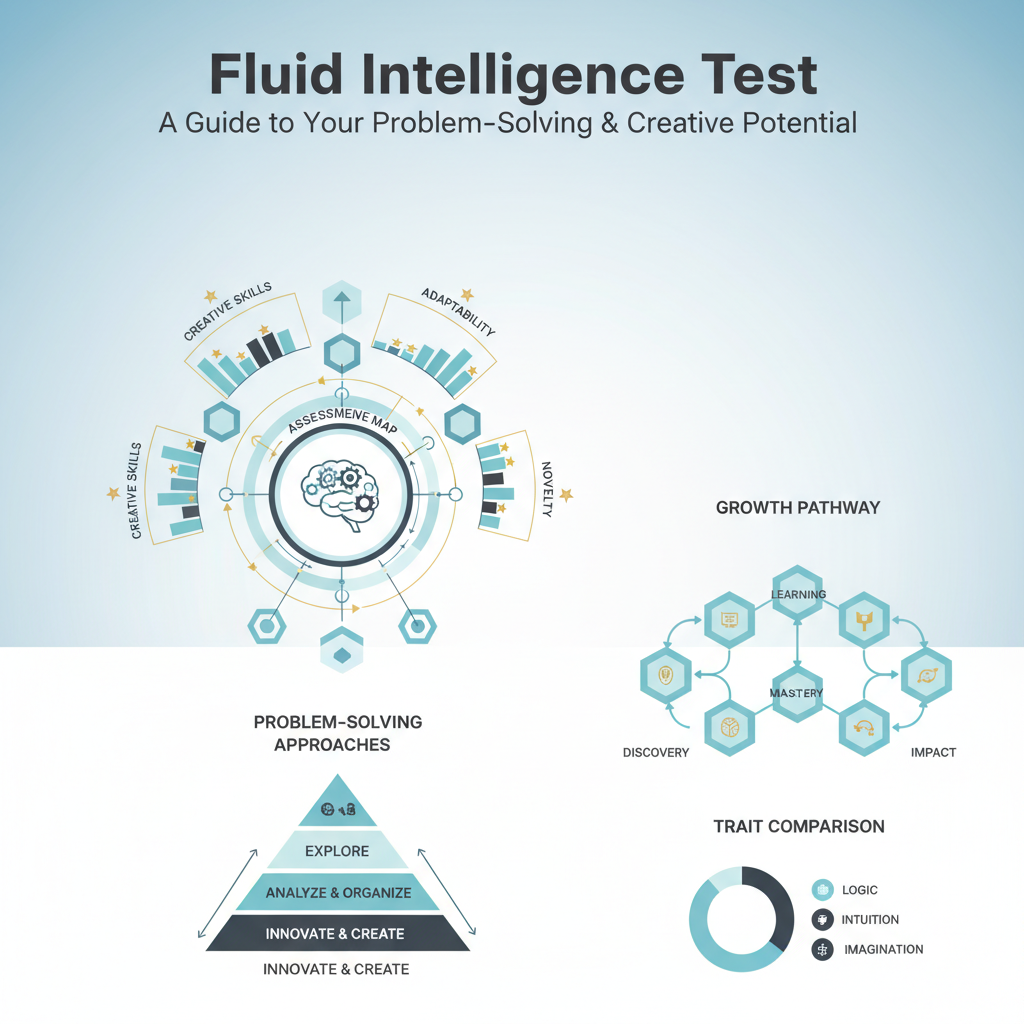
A non-verbal intelligence test is a type of psychometric assessment designed to measure problem-solving and reasoning abilities without relying on language skills. These tests use visual puzzles, patterns, and sequences to evaluate cognitive functions like spatial reasoning, fluid intelligence, and pattern recognition, offering a fair assessment for individuals regardless of their linguistic or cultural background.
Intelligence is more than just words. It’s also how you see patterns, solve puzzles, and handle tough challenges without speaking. A non verbal intelligence test is designed to measure this exact skill. These tests offer a look into your innate problem-solving skills, showing how you think with visuals and logic instead of language.
Understanding your non-verbal strengths helps you learn about your thinking style, Cognitive flexibility, and natural problem-solving abilities. This self-discovery can help you grow personally and professionally by showing you how you handle new ideas and complex problems. For anyone looking to unlock their creative potential, the non verbal intelligence test in psychology provides a clear path to understanding your creative brain.
This guide is for you if you’re exploring your own mind, want to understand different dimensions of intelligence, or are curious about using these insights in the real world. We’ll explain how these tests work and show you key examples of an online non verbal intelligence test. Prepare to discover an important part of your intelligence, which will help you better understand your strengths and improve your creativity.
What Is a Non-Verbal Intelligence Test?
How These Tests Measure Your Problem-Solving Skills
A non-verbal intelligence test is a powerful tool that measures how you think without using words. Instead of language, these tests use visual patterns, shapes, and sequences to see how you solve problems.
This approach looks beyond your vocabulary or reading skills. Instead, it focuses on your natural ability to use logic and understand space. These are key skills for handling complex situations in daily life and creative work.
These tests also show how flexible your thinking is. This is called cognitive flexibility—your ability to switch between ideas or adapt to new information. This skill is essential for creative thinking and finding unique solutions.
Key abilities measured by non-Verbal intelligence tests include:
- Pattern Recognition: Identifying underlying rules in visual sequences.
- Spatial Reasoning: Mentally manipulating objects and understanding relationships in space.
- Logical Deduction: Drawing conclusions from given information.
- Abstract Thinking: Grasping complex ideas that are not tied to concrete objects.
- Problem-Solving: Applying logic to find solutions in novel situations.
For example, you might see a series of shapes with one missing. Your task is to find the pattern and choose the correct missing shape. This simple task reveals a lot about your analytical mind.
Understanding these strengths can boost your confidence. It helps you see how your unique way of thinking helps you solve problems and come up with new ideas. For example, The Creative Ability Test explores how these core thinking skills support your creativity and ability to innovate.
The Role of Non-Verbal Intelligence Tests in Psychology
Non-verbal intelligence tests are very important in psychology. They were created to measure intelligence fairly, especially for people who face language barriers or have certain learning differences [1].
These tests also give a more complete picture of how a person thinks. They work alongside verbal tests, which focus on language skills. Using both types of tests offers a better understanding of different thinking styles.
Specifically, non-verbal tests are valuable in several areas:
- Helping Diverse People: They are important for individuals from different language backgrounds or those with communication challenges.
- Identifying Strengths: These tests can reveal intellectual strengths in people who might struggle with traditional academic tasks.
- Clinical Diagnosis: They are used to understand the thinking skills of people with neurodevelopmental conditions.
- Educational Planning: Educators use the results to create learning plans that match a student’s non-verbal strengths.
When you understand your non-verbal intelligence, you learn about your unique thinking skills. This self-awareness is a big step toward personal growth. It helps you use your problem-solving abilities more effectively in your personal and professional life.
At Creative Ability Test, we focus on understanding the core parts of intelligence. This includes skills like cognitive flexibility and abstract thinking, which non-verbal tests highlight. Our scientific approach offers personalized feedback to help you use your natural creative strengths and develop practical strategies for innovation.
What Is the Difference Between Verbal and Non-Verbal Intelligence Tests?
Abilities Measured by Verbal Tests
Verbal intelligence tests measure how well you understand and use language. They show how well you process information shared through words. These skills are key for communicating and sharing complex ideas.
- Vocabulary Knowledge: How well you know words and what they mean.
- Reading Comprehension: How well you understand what you read.
- Verbal Reasoning: Using language to think through and solve problems.
- General Knowledge: Knowing facts and ideas learned through words.
For example, you might be asked to complete analogies or define abstract terms. These verbal skills help you explain creative ideas and share your unique point of view. They show you can connect different concepts using language.
Abilities Measured by Non-Verbal Tests
Non-verbal intelligence tests, on the other hand, look at your thinking skills without using words. They measure how you solve problems with pictures, shapes, and patterns. These tests are great for revealing your natural problem-solving skills.
- Pattern Recognition: Finding patterns and connections in images.
- Spatial Reasoning: Imagining and moving objects in your mind.
- Abstract Thinking: Grasping ideas that aren’t physical objects.
- Cognitive Flexibility: Changing your thinking when patterns or information changes.
You might see puzzles with shapes, sequences, or complex patterns. Our Creative Ability Test focuses heavily on these non-verbal skills. It provides deep insights into your visual-spatial reasoning and ability to think outside the box, which is key for innovation and for seeing connections others might miss.
Why Both Are Important for a Complete Picture
To get a full picture of your creative and thinking skills, it’s important to look at both verbal and non-verbal abilities. One type of test alone can’t show all your strengths. Verbal skills help you explain and understand information using words. Non-verbal skills, on the other hand, show how you use visual logic to solve problems in new ways [2].
Understanding both helps you grow and focus on the right areas for improvement. Consider how they work together:
| Aspect | Verbal Intelligence | Non-Verbal Intelligence |
|---|---|---|
| Primary Focus | Reasoning and communicating with words. | Solving problems using images, space, and patterns. |
| Key Skills | Vocabulary, understanding text, clear expression. | Finding patterns, understanding space, flexible thinking. |
| Creative Application | Sharing new ideas, persuading others, telling stories. | Picturing solutions, creating designs, adapting to change. |
In the end, true creativity often uses both skills together. For example, you might picture a new product in your mind (non-verbal strength). Then, you use words to clearly explain its benefits to a team (verbal strength).
Our Creative Ability Test is designed to measure your non-verbal creative strengths. It gives you personal feedback and clear steps to improve your problem-solving and flexible thinking. This helps you turn curiosity into true self-awareness and supports your ongoing growth, both personally and professionally.
What Are the Main Types of Non-Verbal Intelligence Tests?
Understanding the different types of non-verbal intelligence tests can teach you a lot about how you see the world. These tests use images instead of words to show your natural problem-solving skills. They also highlight your ability to use logic and think creatively. By exploring these tests, you can find your unique mental strengths. This knowledge helps you boost your overall creative potential.
At Creative Ability Test, we believe that understanding how you think is the key to new ideas. Non-verbal tests are a great tool for this. They help us see the many ways intelligence and creativity can show up. Let’s look at some of the most well-known types of non-verbal intelligence tests.
Raven’s Progressive Matrices
Raven’s Progressive Matrices (RPM) is one of the best-known non-verbal intelligence tests. It tests how well you can reason with shapes and patterns. The test shows you a series of visual patterns with one piece missing. Your job is to pick the correct missing piece from a few options. The patterns get harder as you go, which challenges your mind more and more.
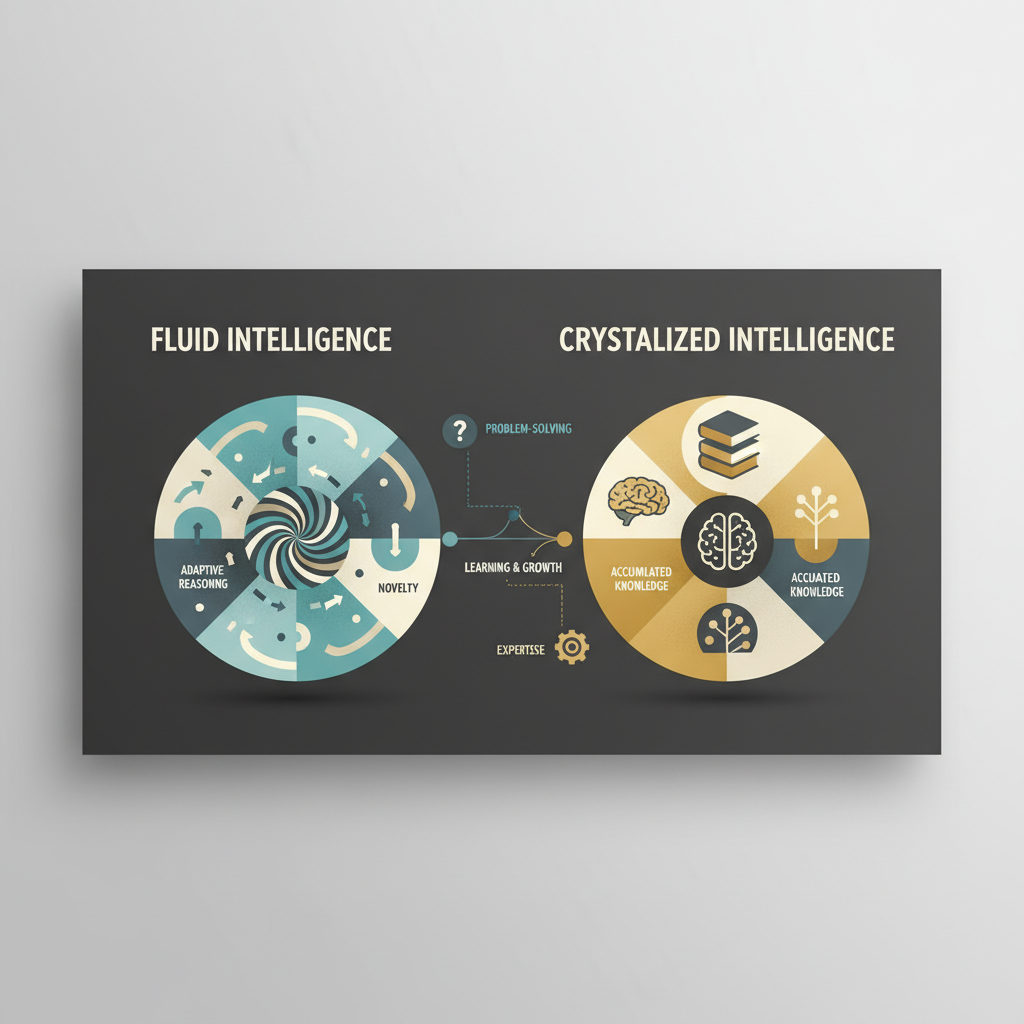
What does RPM test? It mainly checks your non-verbal fluid intelligence [3]. Fluid intelligence is the ability to:
- Spot complex patterns.
- Understand how shapes relate to each other.
- Create new ideas.
- Use logic to solve new problems.
These skills are key for creative problem-solving. They help you find connections that others might miss. Good fluid intelligence helps you think in flexible ways. This lets you change your thinking for new situations. By solving these visual puzzles, you strengthen your ability to innovate. This helps you tackle challenges from new angles and build a strong base for creative thinking.
Test of Nonverbal Intelligence (TONI)
The Test of Nonverbal Intelligence (TONI) is another great way to look at non-verbal reasoning. It’s made to be free of language and cultural bias. This makes it fair for many different people. You answer questions about abstract shapes. These questions test your overall thinking skills. You can point, nod, or gesture to give your answers, so you don’t need to speak or read.
TONI is great for understanding basic problem-solving skills. It tests your ability to handle:
- Categorization.
- Analogical reasoning.
- Sequential reasoning.
- Thinking of many ideas based on what you see.
These are all important parts of creativity. For example, analogical reasoning helps you use what you know in one area to solve a problem in another. This is a key part of innovative thinking. Your TONI results can show your natural talent for new ideas. They also show how well you connect ideas that seem unrelated. Knowing this about yourself can spark personal growth and help you develop your own creative ways of thinking.
Wechsler Nonverbal Scale of Ability (WNV)
The Wechsler Nonverbal Scale of Ability (WNV) is a complete non-verbal test. It gives a detailed look at your thinking skills. It’s often used for people who have trouble with language or communication. This test uses several smaller tests, called subtests. Each one focuses on a different part of non-verbal intelligence, like visual-spatial reasoning and problem-solving.
The WNV offers a well-rounded view of your mental strengths. It tests skills like:
- Matrix Reasoning: Completing patterns and sequences.
- Coding: Matching symbols to geometric shapes quickly.
- Picture Completion: Finding missing parts in pictures.
- Block Design: Recreating patterns using blocks.
Your results on the WNV subtests can shed light on your creative style. For example, good block design skills point to strong spatial reasoning. This is helpful in fields like architecture or design. High scores in matrix reasoning show you are good at abstract thinking. This helps create new solutions in many different areas. These insights give you custom ways to grow your creativity at work and in your personal life.
Universal Nonverbal Intelligence Test (UNIT)
The Universal Nonverbal Intelligence Test (UNIT) is another useful tool. It measures intelligence without using any words. It focuses on key thinking skills, including memory, reasoning, and skills with numbers. Like TONI, UNIT reduces cultural and language bias. This makes the test fair and accurate for many people.
UNIT gives a full picture of your skills using several subtests. These include:
- Symbolic Memory: Remembering sequences of abstract symbols.
- Analogic Reasoning: Solving visual analogies.
- Spatial Memory: Recalling where objects were located.
- Object Matching: Finding similarities between objects.
Your UNIT results can help you understand how you think. For instance, strong spatial memory helps you picture complex ideas in your mind. This is key for combining ideas in new ways. Great analogic reasoning helps you come up with brand new ideas. When you know your strengths, you can use them to solve real-world problems. This encourages new ways of thinking in everything you do. The Creative Ability Test builds on these ideas, helping you turn what you learn about your mind into real steps for creative growth.
How Can You Prepare for an Online Non-Verbal Intelligence Test?
Common Question Formats and Examples
To prepare for an online non-verbal intelligence test, it helps to know how it’s structured. These tests check your ability to solve problems using pictures and shapes. They measure your fluid intelligence, which is your ability to reason and think flexibly [4]. You’ll see different visual puzzles that need you to look closely and use logic.
Here are some common question formats you might see:
- Matrix Reasoning: You see a grid of shapes with a missing piece. Your task is to pick the correct option to complete the pattern. This format tests if you can spot relationships and visual rules. It is like solving a visual logic puzzle.
- Series Completion: You will see a sequence of shapes in a specific order. You must figure out what comes next in the sequence. Each item follows a clear rule, like a change in size, rotation, shading, or number. The key is to understand how the pattern is changing.
- Odd-One-Out: You are shown a set of four or five figures. All but one of them share a common feature. Your goal is to find the single figure that doesn’t fit the pattern. This tests your ability to analyze details and spot what’s different.
- Spatial Reasoning: These questions might ask you to rotate shapes in your mind. For example, you might see a 3D object and have to find which options match the original after it’s been turned. Other tasks include picturing how a folded paper would look unfolded or how shapes fit together. They test your spatial awareness.
Tips for Improving Your Pattern Recognition Skills
Improving your pattern recognition skills can really help you do better on non-verbal intelligence tests. These skills are also important for solving problems creatively. Here are a few simple ways to train your brain:
- Engage in Visual Puzzles: Do jigsaw puzzles, Sudoku, and logic grids regularly. These activities train your brain to find connections and patterns, and they improve your focus.
- Play Strategy Games: Games like chess and checkers require you to think ahead. They help you guess the next move and see patterns as they develop. This sharpens your planning skills.
- Observe Your Environment: Pay more attention to the details around you. Notice patterns in buildings, in nature, or even on everyday objects. Look for repeating shapes, colors, or designs. This practice builds your observation skills.
- Learn Basic Coding or Logic: Learning the basics of coding or logic can be very helpful. It teaches you to break down big problems into smaller, manageable steps. This improves your step-by-step thinking.
- Practice Drawing or Sketching: Creative activities like drawing can improve your spatial awareness. They help you understand shapes, sizes, and how objects relate to each other. This is a big help for visual reasoning.
- Use Online Brain Training Apps: Many apps have games made to improve brain skills, like pattern matching and spatial puzzles. Look for apps that use exercises backed by research.
- Cultivate a Growth Mindset: Believe that you can get better. Be curious when you face a challenge. See mistakes as chances to learn. This positive outlook helps you keep improving your skills.
Remember, regular practice makes your brain stronger. Your creative potential also grows with these efforts. Our Creative Ability Test platform helps you see how your thinking skills contribute to your unique creative style.
Finding Reputable Practice Tests
Choosing good practice materials is key to preparing well. There are many resources online, but their quality can be very different. Look for sources that are backed by research and give clear explanations.
Consider these options for finding trustworthy practice tests:
- Educational Institutions and Psychological Associations: Look for materials from universities or professional psychology groups. These sources often have tested questions or links to official tests. They follow scientific standards [5].
- Reputable Test Publishers: Major companies that publish educational and psychological tests often provide practice versions. These are made by experts in test design to be accurate and useful.
- Online Platforms Specializing in Cognitive Assessments: Choose platforms that explain how their tests work and mention the science behind them. Look for positive reviews from other users.
- Books on Non-Verbal Reasoning: Many educational books focus on non-verbal reasoning. They usually have a lot of practice questions with detailed explanations for the answers.
- Mindfulness and Logic Puzzle Books: While not exactly test prep, these books help you build the basic skills you need. They improve your focus and problem-solving abilities, making them a good way to prepare indirectly.
When looking at a practice test, always check for clear information. A good test will tell you what it measures and what the results mean. Avoid free, unproven quizzes on random websites. They might not be like the real test in format or difficulty.
Understanding your thinking skills is about more than just a test score. Platforms like Creative Ability Test give you a better understanding of how you think. We help you see how your problem-solving style connects to your creativity. Our tests offer feedback just for you, which helps you learn more about yourself and grow.
Frequently Asked Questions
What are some non verbal intelligence test examples?
Non-verbal IQ tests measure your ability to reason without using words. They use shapes, patterns, and images to see how you solve problems. These tests show your natural ability to think, which is key for creative problem-solving.
Here are a few common examples:
- Raven’s Progressive Matrices (RPM): This popular test shows you a series of visual patterns with one missing piece. You have to pick the right piece to complete the pattern. It mainly tests your ability to see patterns and think abstractly [6].
- Test of Nonverbal Intelligence (TONI): The TONI uses abstract shapes to measure intelligence without language. It works well for people from different backgrounds, making it a good way to test reasoning skills alone.
- Wechsler Nonverbal Scale of Ability (WNV): This test is for people from age 4 to 89. It uses visual puzzles like finishing a pattern or completing a picture. It gives a full picture of non-verbal thinking skills.
- Universal Nonverbal Intelligence Test (UNIT): This test focuses on memory and reasoning using visuals. It provides a full non-verbal IQ test for kids and teens.
Knowing about these tests shows you the different ways intelligence can be measured. It can also help you improve your own visual problem-solving skills, which are important for creative thinking.
What is the TONI-4 Test of Nonverbal Intelligence?
The TONI-4, or Test of Nonverbal Intelligence, Fourth Edition, is a well-known non-verbal intelligence test. It measures your ability to reason and solve problems. Importantly, you don’t need language, reading, writing, or fine motor skills to take it.
The test shows you a series of abstract shapes and patterns. Your job is to find the rule or relationship in the pattern and use it to solve a puzzle. It’s like solving visual puzzles that get harder as you go.
The TONI-4 is useful for a few key reasons:
- It’s Culturally Fair: Because it doesn’t use words, it’s fair to people no matter what language they speak or where they’re from.
- Measures Pure Reasoning: It tests your logic and ability to see connections, not just what you’ve learned in school.
- Broad Application: Psychologists use it with many different people, especially those who have trouble with language or come from different language backgrounds [7].
Understanding tests like the TONI-4 shows how skills like flexible thinking and pattern recognition are measured. These skills are key to creative and innovative problem-solving.
How is a non verbal IQ test used for Autism?
Non-verbal IQ tests are very important for assessing people with Autism Spectrum Disorder (ASD). Many people with autism find verbal communication difficult. This can make regular, word-based IQ tests feel challenging or give inaccurate results.
Non-verbal IQ tests get around these challenges. They use images and symbols to focus on visual thinking and problem-solving. This gives a much clearer picture of a person’s true thinking skills. That information is incredibly valuable.
Here’s how these tests help:
- Bypassing Language Deficits: They offer a better way to measure intelligence for people who have trouble speaking or understanding language.
- Identifying Strengths: People with ASD often have strong visual skills and are good at seeing patterns. Non-verbal tests do a great job of showing these strengths.
- Informing Support: The results help teachers and therapists create custom learning plans. These plans can use a person’s visual strengths to help them grow in other areas.
- Guiding Development: When you understand someone’s thinking skills, you can create a personal plan to help them grow. This makes their development more effective.
In the end, non-verbal IQ tests provide a fair and complete picture. They reveal the unique thinking styles of people with autism, helping them grow and reach their full potential.
Can you find a non verbal intelligence test online for free with answers?
You can find many “free non-verbal intelligence tests” online, but be careful. Most free tests are not scientifically proven or standardized. This means the results may not be an accurate measure of your thinking skills.
Official tests given by psychologists are carefully created and researched to be reliable and accurate. They give you a true look at your cognitive skills. But, these official tests usually cost money and must be given by a professional.
Still, free online tests can be useful in a few ways:
- Practice and Exposure: They help you get used to the types of questions you’ll see, like pattern puzzles. This lets you see what the challenges are like.
- Skill Development: Practicing with visual puzzles can improve your ability to see patterns and think logically. These are important skills for creativity and problem-solving.
- Curiosity and Self-Exploration: They can make you curious about the different ways we think. This can be a fun way to learn more about yourself.
For real, science-backed insights into your creative potential, consider a platform like Creative Ability Test. Our assessments go beyond a basic IQ score. We give you a full look at your creative strengths and offer clear steps to help you grow. This helps you use your creativity in the real world and think in new ways.
Sources
- https://www.apa.org/education-career/guide/nonverbal-assessment
- https://www.apa.org/education-career/guide/science-psychology
- https://www.sciencedirect.com/topics/psychology/fluid-intelligence
- https://www.simplypsychology.org/fluid-and-crystallized-intelligence.html
- https://www.apa.org/
- https://www.sciencedirect.com/topics/psychology/ravens-progressive-matrices
- https://www.proedinc.com/products/8991