Tag: Creativity Measurement

  • How Are Creativity Tests Made? A Guide to Test Development in Psychological Assessment

    How Are Creativity Tests Made? A Guide to Test Development in Psychological Assessment

    Test development in psychological assessment is the systematic process of creating a valid and reliable tool to measure a psychological trait, like creativity. It involves five key stages: conceptualization, construction, tryout, analysis, and revision. This rigorous process ensures the test accurately provides meaningful and actionable insights into one’s abilities.

    Have you ever wondered what makes a creative mind tick? Or how your own way of thinking helps you solve problems and innovate? Creativity often feels mysterious, but it’s a skill that can be understood, measured, and developed. At Creative Ability Test, we believe unlocking your creative potential begins with self-awareness, based on scientific research.

    But how do you measure something as complex as creativity? This is a key question in the science of psychological assessment. A well-designed creativity test is more than a simple quiz. It is built through a careful process to ensure it is accurate, reliable, and offers useful insights. Understanding this process helps you interpret your results and feel confident in your strategies for personal growth and professional development.

    From the first idea to the final version, every step in building a creativity test is designed to accurately uncover your strengths, thinking styles, and problem-solving abilities. So, why does all this scientific care matter when you want to discover your unique creative potential?

    Why Does Quality Test Development Matter for Assessing Your Creativity?

    Creativity helps us solve problems and innovate. If you want to understand your own creative potential, you need a good way to measure it. But measuring creativity isn’t simple. That’s why high-quality psychological tests are so important. They give you meaningful and reliable insights you can trust.

    Imagine taking a test that doesn’t really capture your strengths. The results would be confusing or even misleading. A poorly designed test gives you inaccurate feedback, which can hold back your self-discovery and growth. This is why the development process is the foundation of any good creativity assessment.

    The Keys to a Reliable Test

    A well-developed creativity test gives you a clear picture of your abilities. It uses scientific methods to measure different parts of your creative mind. This careful process ensures the test truly reflects your skills and gives you consistent results over time. Our tests are built on two key principles:

    • Reliability: Consistency You Can Trust
      A reliable test gives you consistent results. If you took it again, your score would be similar. This shows it dependably measures your creative traits.
    • Validity: Measuring What Truly Matters
      A valid test measures what it claims to measure—in this case, creativity. This includes aspects like divergent thinking or cognitive flexibility. It ensures the questions are actually assessing your creative abilities. Reliability and validity are the cornerstones of psychological testing, making sure assessments are both consistent and accurate [1].

    When a test is both reliable and valid, you get insights you can use for personal and professional growth. It turns uncertainty into clear self-awareness. At Creative Ability Test, we take this careful approach so you can fully trust your results.

    What This Means for Your Creative Journey

    A high-quality test directly impacts your experience by helping you understand your creative strengths and identify areas for growth. This allows us to provide personalized feedback and practical strategies tailored just for you.

    For example, if your test shows a strength in divergent thinking, you can focus on new ways to solve problems. Or, if it suggests you could improve your cognitive flexibility, we’ll offer tips to help you see things from different perspectives. You can only get these kinds of specific insights from a carefully designed test.

    Our commitment to quality test design provides several key benefits:

    • Accurate Self-Awareness: Get a true understanding of your creative potential, moving from general curiosity to deep insight.
    • Useful Growth Strategies: Receive practical tips based on your unique profile to help you improve your creative thinking.
    • Confidence in Your Results: Trust the scientific basis of your assessment so you can apply your strengths effectively.
    • Personalized Development: Identify your specific creative thinking styles and innovation skills to support your growth.

    At Creative Ability Test, we believe in supporting your creativity with proven scientific methods. Our 30-question assessment is carefully designed to deliver detailed insights that guide you toward unlocking your full creative potential.

    What are the 5 stages of test development?
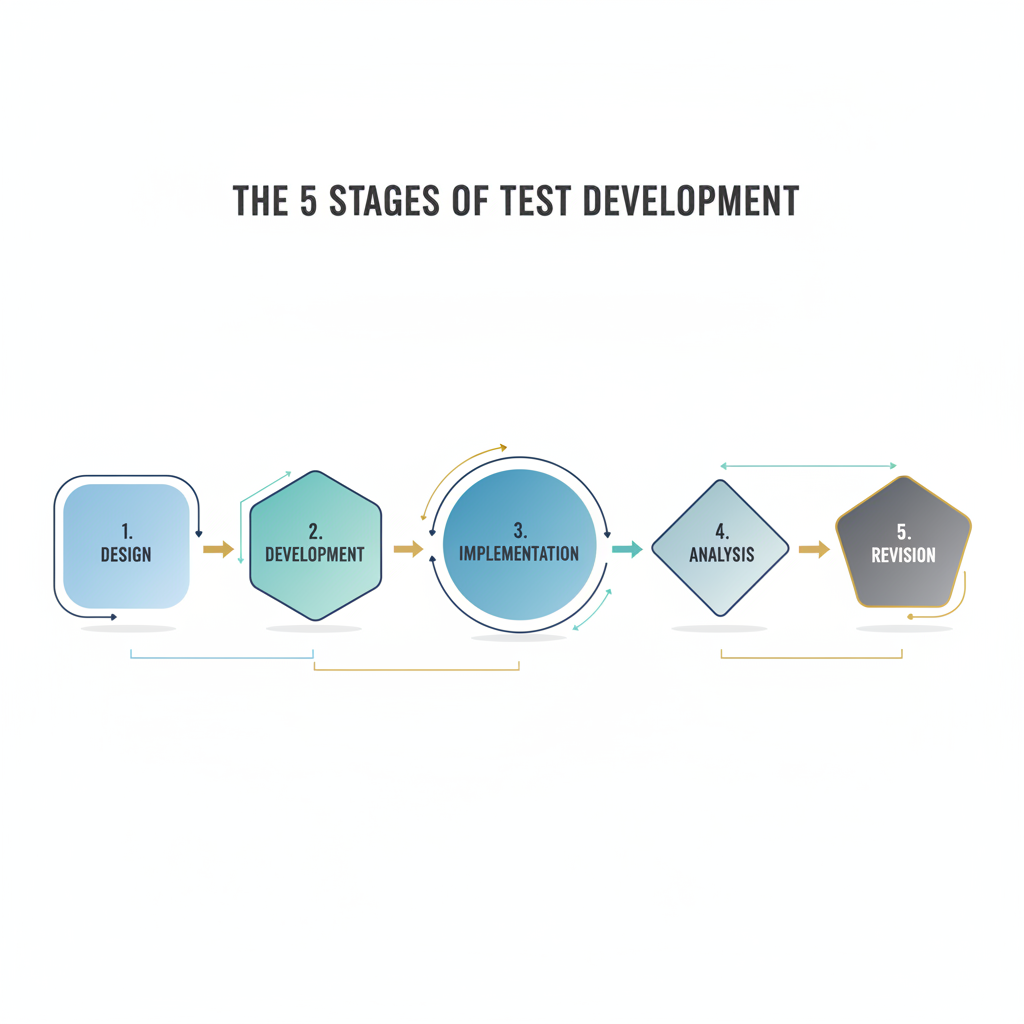
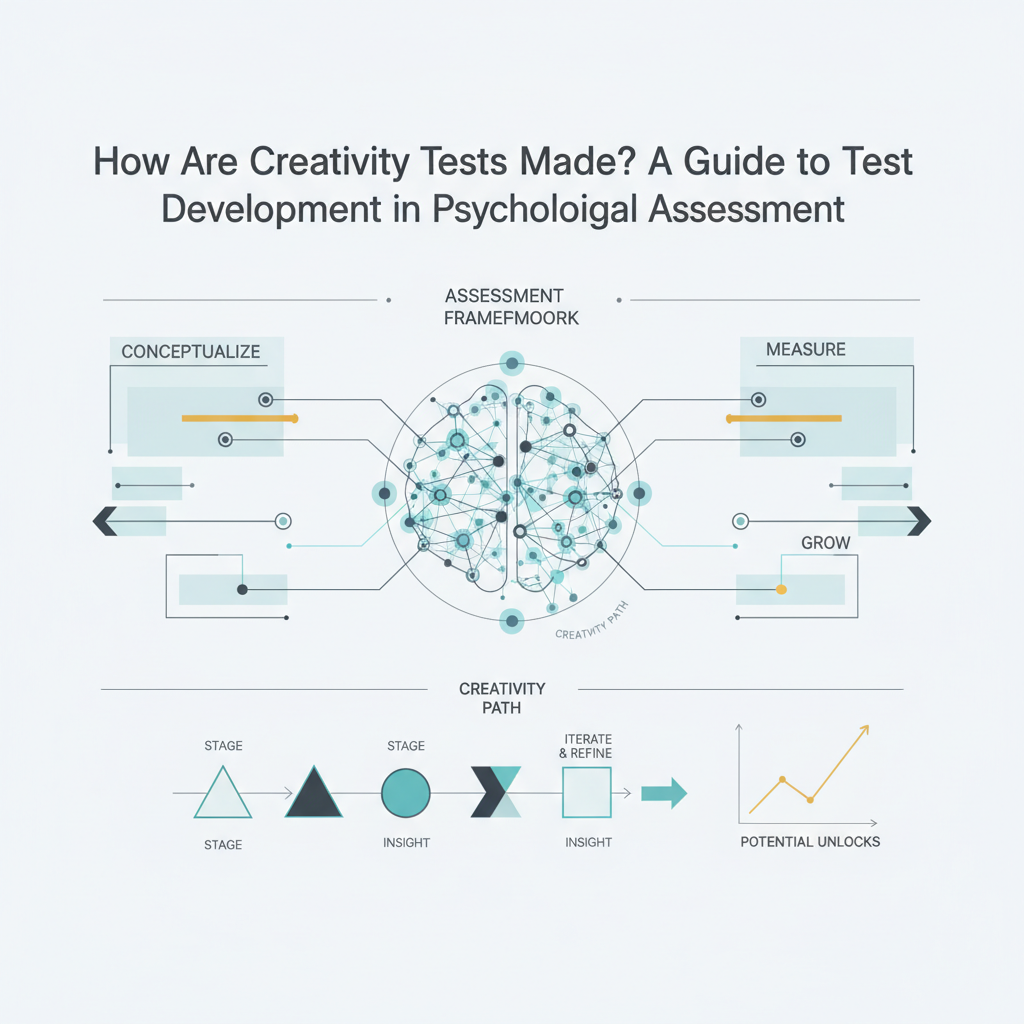
    A clean, sequential infographic illustrating five distinct stages of test development using abstract geometric shapes and subtle color gradients.
    An abstract, educational infographic featuring a clean, minimalist vector-based design. The visual displays five distinct, interconnected geometric shapes arranged sequentially, representing the 5 stages of test development. Each stage is subtly highlighted with a soft gradient or accent color. The color palette includes soft blues, whites, and charcoal, with gold or teal accents for clarity. Negative space is used effectively to separate stages, and simple labels or directional markers can be placed within or beside each shape. No human figures or cartoon elements. The overall style is professional and approachable, suitable for explaining a process.

    Creating a trustworthy test for something as unique as creativity is a careful process. We want to make sure the results you get are accurate and genuinely helpful. At Creative Ability Test, our method uses proven principles from psychological testing. This organized approach ensures the test is scientific and reliable, giving you meaningful insights into your creative potential.

    There are five key stages to creating any high-quality psychological test. Following these steps helps us build a tool that measures what it claims to measure.

    Stage 1: Test Conceptualization – What Are We Trying to Measure?

    The first step is to define the main idea of the test. We start by asking basic questions: What exactly is creativity? Which parts of it should we measure?

    This stage involves a deep dive into the psychology of creativity [2]. We pinpoint key areas like divergent thinking, cognitive flexibility, and problem-solving. This plan becomes the foundation for the entire test. Our goal for the Creative Ability Test is to give you a complete picture of your unique creative strengths.

    • Defining Creativity: We decide which facets of creativity are most relevant. For example, originality, fluency, or elaboration.
    • Identifying the Audience: Our test is designed for a broad audience. This includes students, professionals, and anyone curious about their potential.
    • Setting the Purpose: The test aims to provide actionable insights. These insights help foster personal growth and professional development.

    With a clear plan, every question has a specific job. This makes sure the test gives you a full picture of how your creative mind works.

    Stage 2: Test Construction – How Do We Write Good Questions?

    Once the plan is clear, we start writing the questions. This is where our ideas turn into a real test. Writing good questions is both an art and a science.

    Our experts create questions that are clear, fair, and truly test creative skills. We use different question styles to suit various ways of thinking. For example, some tasks might ask you to come up with many ideas, while others might ask you to find a unique solution to a problem.

    • Item Generation: We create a pool of potential questions. These questions align with the defined creativity dimensions.
    • Response Formats: We choose appropriate ways for you to answer. This might include open-ended responses or multiple-choice scenarios.
    • Scoring Criteria: We develop clear rules for evaluating answers. This ensures fair and consistent measurement of creative output.

    Every one of our 30 questions is designed with care to measure your cognitive flexibility and innovative thinking. This careful process helps build a solid foundation for accurate results.

    Stage 3: Test Tryout – Does the Test Work With Real People?

    After writing the first draft, we move to a critical tryout phase. We give the test to a sample group of people who are similar to our final audience.

    Think of this stage as a beta test. We collect early data and feedback to see how people respond to the questions. Do they understand the instructions? Are any questions too hard or too easy? This feedback helps us improve the overall experience.

    • Pilot Testing: The test is given to a diverse group of individuals.
    • Gathering Qualitative Feedback: We ask participants about their experience. What did they find confusing? What was engaging?
    • Initial Data Collection: We observe response patterns. This gives us a first look at question performance.

    Testing with real people is essential. It makes sure the test is easy to use and works well. Our goal is to make your experience with the Creative Ability Test as smooth and helpful as possible.

    Stage 4: Item Analysis – Which Questions Are the Most Effective?

    Using data from the tryout, we carefully analyze every question. This process uses statistics to see how each one performed.

    We check several things for each question. Does it distinguish between people with higher and lower creative skills? Is it too easy or too difficult? We flag any questions that aren’t working well. This detailed review makes the final test much more accurate.

    • Difficulty Index: We measure how challenging each question is.
    • Discrimination Index: We assess if a question distinguishes between high- and low-scoring individuals.
    • Distractor Analysis: For multiple-choice questions, we check if incorrect options are plausible.

    This scientific step improves the test. It ensures every question plays a useful role in measuring your creative potential and provides you with accurate, personal feedback.

    Stage 5: Test Revision – How Do We Refine the Final Assessment?

    In the final stage, we refine the test based on our analysis. We make adjustments to ensure the test is as clear, valid (measures what it should), and reliable (provides consistent results) as possible.

    We get rid of questions that don’t work and rewrite any confusing instructions. Sometimes, we even create new questions from scratch. This cycle of improvement makes sure the Creative Ability Test is strong and scientifically sound, giving you the most accurate results.

    • Removing/Modifying Items: Poorly performing questions are eliminated or revised.
    • Improving Instructions: We ensure all directions are clear and easy to follow.
    • Establishing Norms: We develop comparison data. This helps contextualize your scores against a broader population.

    This complete revision process is key to delivering a test that is both detailed and perfectly suited for you. It helps you get useful insights and clear steps for personal and professional growth.

    How does test development in psychological assessment work in practice? An example

    Knowing how a creativity test is made gives you a better understanding of your results. You can see the science behind how we measure your creative potential. Let’s look at how this works, using divergent thinking as an example.

    Defining the Goal: Measuring Divergent Thinking

    Every good test starts with a clear goal. For our test, the goal is to measure a specific creative skill called divergent thinking. This is your ability to come up with many unique ideas from a single starting point [3].

    Here’s why measuring divergent thinking is so important:

    • It’s a key part of overall creativity.
    • It shows your ability to think flexibly.
    • It helps you see many different possibilities.
    • It’s vital for problem-solving and new ideas.

    Our goal is to measure this key skill. We want to see how many different ideas you can come up with and how unique they are. This first step makes sure every question has a clear, measurable purpose.

    Writing and Reviewing Questions

    After setting our goal, we start writing the test questions. This step requires a lot of thought and review by experts.

    The process usually includes:

    • Brainstorming Question Types: We think about different kinds of questions to ask. For divergent thinking, we often ask people to list unusual uses for an everyday object or come up with many ideas for a specific situation.
    • Drafting Questions: We write each question carefully to be clear and easy to understand. The questions are designed to be engaging, fair to everyone, and encourage many different creative answers.
    • Expert Review: Psychologists and test-development experts review every question. They check for things like:

      • Is the question clear and easy to understand?
      • Does it really measure divergent thinking?
      • Are there any confusing instructions or biases?
      • Is there a clear way to score the open-ended answers?
    • Pilot Testing: A small group of people takes an early version of the test. Their feedback is extremely helpful. This is how we find and fix any confusing questions or instructions before the test is widely used.

    This careful process makes sure our 30-question Creative Ability Test is accurate and measures your creative strengths well.

    Gathering Data and Refining the Test

    After writing the test, we check if it works in the real world. This means we collect data and use it to make scientific improvements.

    Key steps in this phase include:

    • Large-Scale Data Collection: We give the test to a large, diverse group of people. This group should be similar to the people who will eventually take the test, which gives us a large set of data to work with.
    • Item Analysis: We analyze how well each question performs.

      • Difficulty: Is a question too easy or too hard? For creativity, we want questions that get a wide variety of answers.
      • Discrimination: Does this question help separate high-scoring creative people from low-scoring ones? This tells us the question is a good measure of creativity.
    • Reliability Checks: We check if the test gives consistent results. A reliable test means your scores should be stable and not change randomly [4].
    • Validity Studies: We make sure the test actually measures what it’s supposed to: divergent thinking. We might do this by comparing its results to scores from other well-known creativity tests. This proves the test is accurate.
    • Refinement and Revision: Based on all this data, we revise or remove questions that don’t work well. The test is polished to be as accurate as possible. We repeat this process as needed to ensure the test is high quality.
    • Norming: The final step is to create a baseline for comparison. We do this by comparing your score to the scores of a large group of people. This allows us to give you personalized feedback and show you how your creativity compares to others.

    This thorough, scientific process is what makes the Creative Ability Test so effective. It ensures your results are accurate and give you useful insights. Our science-backed approach helps you understand and grow your creative potential.

    How Can You Trust the Results of a Psychological Test?

    Understanding Reliability: Consistency is Key

    Reliability is a key part of any trustworthy psychological test. In simple terms, it means a test gives you consistent results. Think of a bathroom scale: you expect it to show the same weight each time, as long as your weight hasn’t changed. A reliable creativity test works the same way.

    If your creative abilities stay the same, your score should also stay the same when you retake the test. This consistency helps you trust your results [5]. You can feel confident acting on the insights and strategies we provide.

    We ensure the Creative Ability Test is highly reliable. Psychologists check for reliability in a few key ways:

    • Test-Retest Reliability: This means giving the same test to the same people twice over a period of time. If the scores from both tests are similar, the test is reliable.
    • Internal Consistency: This checks if all the questions in a test are working together to measure the same thing. For instance, all 30 questions in our test are designed to measure different sides of your creativity.

    A reliable assessment lets you accurately track your creative growth. It gives you a dependable starting point for real-world growth strategies. You can trust our personalized feedback, knowing it’s based on a solid, consistent measure of your creative potential.

    Understanding Validity: Does the Test Measure What It Claims?

    While reliability is about consistency, validity is about accuracy. Validity asks a simple question: Does this test truly measure what it claims to? For a creativity test, this means it must actually measure your creative thinking, not something else like memory or general knowledge.

    Imagine a “creativity” test that just asked you to recall historical dates. That test would not be a valid way to measure creativity. The Creative Ability Test, however, is carefully designed to give you true insights into your unique creative strengths [6].

    Psychologists look at several types of validity to ensure a test is meaningful:

    • Content Validity: This checks if the test covers all the important parts of creativity. Our 30-question assessment explores key areas like divergent thinking, cognitive flexibility, and openness to new experiences.
    • Construct Validity: This ensures the test is based on established psychological theories about creativity. Our assessment is built on solid research in the field of creative psychology.
    • Criterion Validity: This checks if test scores can predict creative behavior in the real world. For example, higher scores on our test should connect to more innovative problem-solving in your life.

    Understanding validity means you can trust that your results are really about your creative potential. This empowers you to use these insights for personal growth, professional development, and to boost your innovation skills. Our scientific method ensures that you get valid, useful insights that are easy to understand and apply.

    How This Process Helps You Discover Your Creative Potential

    Creating a reliable psychological test is a detailed process. It ensures that the assessment you take is accurate, fair, and truly helpful. This careful work, from the first idea to the final version, directly benefits you. It helps you clearly understand your own creative potential.

    The steps used to build and test an assessment are crucial. They aren’t just academic exercises. Instead, they help you discover more about yourself. This leads to useful insights for your personal and professional growth.

    Gain Clear Self-Awareness of Your Creative Strengths

    A well-made creativity test acts like a clear mirror, reflecting your specific creative strengths. The careful design of questions ensures this accuracy. You will understand aspects like your cognitive flexibility and divergent thinking. Cognitive flexibility is your ability to switch perspectives. Divergent thinking helps you generate many ideas. [7] It also highlights your unique approaches to solving problems.

    • Discover Your Thinking Style: Are you a “big picture” person who naturally connects different ideas? Or do you excel at improving existing concepts in new ways? A science-backed test helps make this clear.
    • Pinpoint Specific Abilities: You will learn if you are strong in originality, fluency, or elaboration. These are key parts of creative thinking.
    • Understand Your Natural Inclinations: The assessment reveals your natural tendencies, like how open you are to new experiences or how comfortable you are with uncertainty.

    Unlock Practical Strategies for Creative Growth

    The scientific process behind the Creative Ability Test delivers meaningful results. These results are more than just scores; they are translated into practical tips to help you improve your creative skills. For example, if you score high in divergent thinking, you might get tips on how to refine your best ideas. If you need to work on cognitive flexibility, the feedback will offer specific exercises.

    Here is how a strong test development process helps you grow:

    • Personalized Feedback: You receive advice that is tailored to your unique profile, moving beyond generic tips.
    • Targeted Practice: You get specific strategies to strengthen areas that need development, such as learning new brainstorming techniques.
    • Real-World Application: The guidance helps you apply your creativity to everyday challenges, from personal projects to professional tasks.
    • Confidence Building: Understanding your creative potential boosts your self-assurance, encouraging you to take on new challenges.

    Foster Innovation and Problem-Solving Skills

    Understanding the science behind creativity helps you become more innovative and a better problem-solver. The test development process carefully identifies the core parts of creative ability. This allows the Creative Ability Test to measure them well. As a result, you gain a deeper appreciation for how your mind works.

    For example, if the test shows you have strong idea-generation skills, you can use this strength to create solutions at work. If your results point to a need for more cognitive flexibility, you can practice skills that help you approach problems from different angles. These insights help you move from being creative sometimes to having a clear plan for growth. This turns your understanding of creativity into real-world innovation.

    Ultimately, a well-made test like the Creative Ability Test is a tool for self-discovery. It gives you a reliable, science-based map to your creative potential. This helps you use your strengths and develop new creative skills, leading to greater self-awareness and impactful innovation.

    Frequently Asked Questions

    What are the types of test development in psychological assessment?

    Psychological test development is the process of creating tools to measure human traits. There are a few main types. Each one gives a unique look at a person’s skills or personality.

    Knowing these types helps you see the science behind the tests. You can also see how tests like the Creative Ability Test give you personal feedback. Here are the main types:

    • Norm-Referenced Tests: These tests compare your score to a large group of people. For example, if you get a 70 on a creativity test, it might mean you scored higher than 85% of people your age. Our Creative Ability Test gives you this kind of comparison. It helps you see how your creative strengths stack up against others.
    • Criterion-Referenced Tests: These tests measure your skills against a set standard. A driving test is a good example. You either meet the standard and pass, or you don’t. The focus is on what you can do, not how you compare to others.
    • Ipsative Tests: Ipsative tests compare your scores on different parts of the same test. They show your personal pattern of strengths and preferences. For instance, an ipsative creativity test might show if you are better at coming up with ideas or putting them into action. This helps you find your own creative style for personal growth. [8]

    Our platform often combines parts of these different test types. This gives you a full and useful look at your creative potential. We give you data that compares you to others and also paints a clear picture of your personal creative style.

    Can you provide a test development in psychology example?

    Let’s look at how we build a part of the Creative Ability Test. Our goal is to measure divergent thinking. That’s your ability to come up with many unique ideas from one starting point. It’s a key part of creative problem-solving.

    1. Defining the Goal: First, we decide what “divergent thinking” means for our users. We define it by looking at the number of ideas (fluency), the variety of ideas (flexibility), and how unique they are (originality). This makes sure the test measures a useful part of creativity for your personal growth.

    2. Writing and Reviewing Questions: Next, we write the test questions, or prompts. For example, we might ask, “List all the possible uses for a brick.” We create many questions like this. Our experts check them to make sure they are clear and fair. The goal is to encourage many different creative answers.

    3. Developing Scoring Rules: Then, we create clear rules for scoring answers. For the “brick” example, we might count the total number of ideas (fluency). We would also group the ideas into different types (flexibility). We also check how unique the ideas are (originality). This scientific method makes sure the scoring is fair and consistent.

    4. Gathering Data: We have a diverse group of people take the test. This shows us how people really answer the questions. We look for patterns in their responses. This step is key to making the test accurate and relevant.

    5. Analyzing and Refining: After we have the data, we look at each question closely. We ask: “Does this question really measure divergent thinking?” and “Are the scores consistent?” We fix or remove any questions that are confusing or don’t work well. This process of testing and improving makes sure the final test is strong. It gives you trustworthy, useful insights into your creative potential.

    This careful process makes sure your Creative Ability Test results are meaningful. They provide a solid starting point for boosting your creative skills and growing as a person.

    What are the 5 stages of test development?

    Creating a high-quality psychological test, like our Creative Ability Test, is a careful process. It makes sure the results are accurate and useful. The process has five main stages. Each stage builds on the one before it to make sure the test is trustworthy and measures what it’s supposed to. [9]

    1. Stage 1: Test Conceptualization – What Are We Measuring? In this first stage, we define the test’s purpose. We decide which creative skill we want to measure, like mental flexibility or openness to new things. We also think about who will take the test and how they will use the results for personal or professional growth.

    2. Stage 2: Test Construction – How Do We Write Good Questions? This is where we write the actual test questions. We choose the best formats, like multiple-choice or open-ended answers. We write clear questions that are fair to everyone. We also create exact rules for scoring. Our goal is to make sure every question helps measure the creative skill we are focused on.

    3. Stage 3: Test Tryout – Does the Test Work With Real People? In this stage, we create a pilot version of the test. We have a group of people who are like our intended test-takers try it out. This helps us find any confusing questions or other problems. It’s a key step to get early feedback.

    4. Stage 4: Item Analysis – Which Questions Are Most Effective? We study the data from the test tryout. This helps us see how well each question worked. We look at whether a question can tell the difference between people with high and low scores on the skill. We also check for any unfairness. This analysis helps us pick the best questions for the final test.

    5. Stage 5: Test Revision – How Do We Finalize the Test? Based on our analysis, we improve the test. We fix or remove questions that didn’t work well. We might also change the scoring rules. This final step makes sure the test is ready to go. It ensures the Creative Ability Test gives you trustworthy and useful insights into your creative potential.

    By following these scientific steps, we make sure the Creative Ability Test is a tool you can trust. It helps you understand and improve your creative thinking for use in everyday life.


    Sources

    1. https://www.psychologytools.com/articles/what-is-reliability-and-validity-in-psychological-assessment/
    2. https://www.apa.org/education-career/guide/psychology-testing
    3. https://psycnet.apa.org/record/1968-07205-001
    4. https://psycnet.apa.org/record/2012-05537-000
    5. https://www.simplypsychology.org/reliability.html
    6. https://www.simplypsychology.org/validity.html
    7. https://www.apa.org/pubs/journals/releases/xlm-a0038898.pdf
    8. https://dictionary.apa.org/ipsative-assessment
    9. https://pressbooks.library.ryerson.ca/psychtests/chapter/test-development/
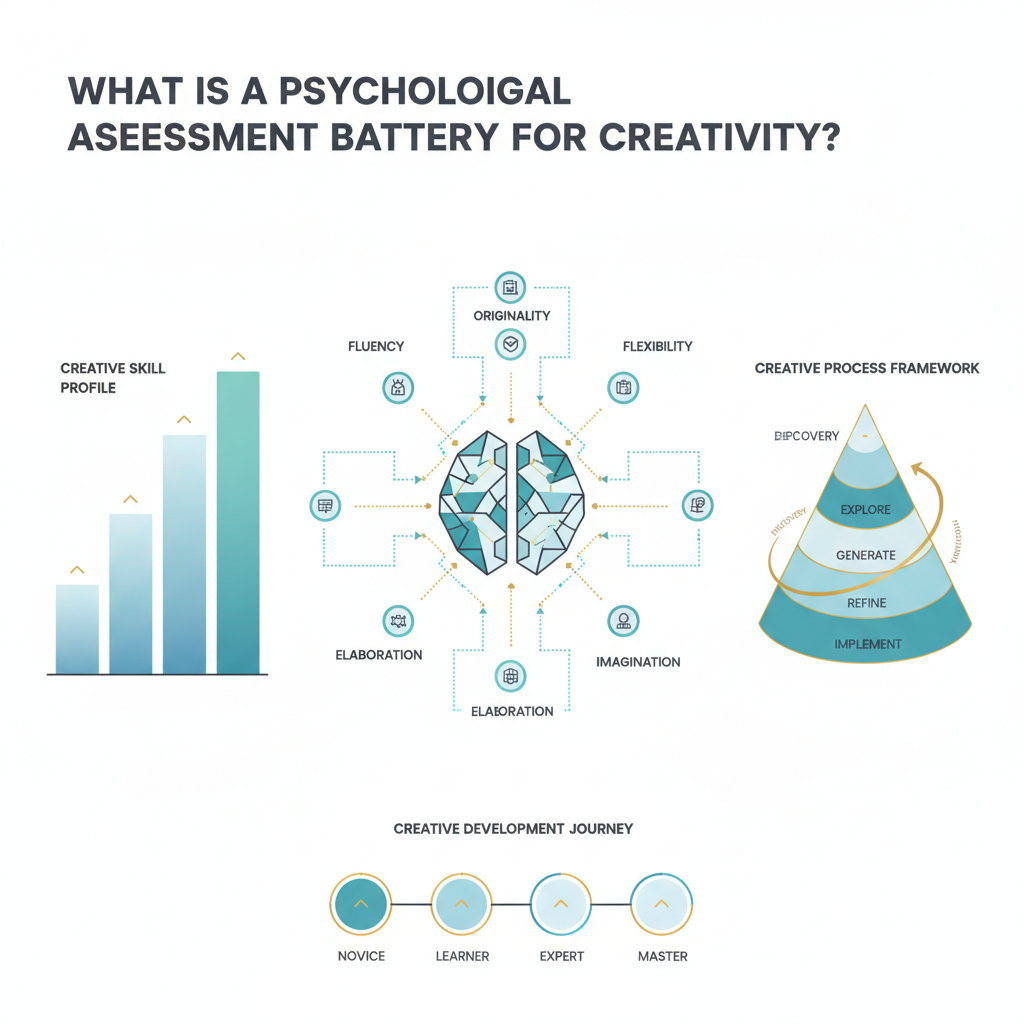
  • What Is a Psychological Assessment Battery for Creativity?

    What Is a Psychological Assessment Battery for Creativity?

    A psychological assessment battery is a collection of tests used together to gain a comprehensive understanding of an individual’s cognitive and emotional functioning. In the context of creativity, this approach allows for a detailed evaluation of various skills like divergent thinking, problem-solving, and cognitive flexibility, providing a holistic view of one’s creative potential.

    We know that creativity is important for new ideas, personal growth, and solving daily problems. But how do you measure something with so many parts? It’s more than just being artistic or having ideas. To truly understand your creative side, you need more than a single test. This is where a psychological assessment battery for creativity can help by offering a complete view of the strengths that make up your innovative mind.

    Imagine learning not just *if* you are creative, but *how* you are creative. A psychological battery test is not a single quiz. It’s a carefully chosen set of assessments that work together to show your complete creative thinking styles. Using proven questions, it examines skills like your Cognitive flexibility, your ability to generate original ideas (divergent thinking), and your unique ways of solving problems. Our goal at Creative Ability Test is to give you useful advice and personalized strategies to use these strengths in your personal and professional life.

    This article explains what a psychological assessment battery for creativity is, how it’s structured, and the valuable information it provides. By looking at the science behind these evaluations, you’ll learn how to identify your natural creative strengths, understand how you think, and get practical tips to improve your problem-solving skills. This is a chance to turn uncertainty about your creative potential into clear, useful self-awareness.

    What Is a Psychological Assessment Battery?

    A conceptual diagram showing a central hub representing a 'Psychological Assessment Battery' connected to several distinct geometric shapes, illustrating a collection of integrated tests.
    An abstract, educational visualization representing ‘What Is a Psychological Assessment Battery?’. The image features a central hub or core labeled ‘Psychological Assessment Battery’, from which multiple clean, distinct geometric shapes (representing individual tests or modules) are linked. These shapes vary in size and form but are cohesively connected, illustrating a structured collection of assessments. Subtle gradients in soft blues, whites, and charcoal define the shapes, with gold or teal accents highlighting the connections, emphasizing the integrated nature of a battery. Ample negative space ensures clarity. No people, no cartoon elements.

    What Is a Test ‘Battery’ in Psychology?

    In psychology, a “battery” isn’t a power source. It’s a group of different tests. You can think of it like a toolbox filled with special tools for assessment.

    Each test in the battery measures a specific part of a person’s cognitive abilities, personality traits, or behavior. This method helps experts get a fuller, more complete picture than just one test ever could.

    For instance, to assess a complex skill like creativity, a psychologist might use several tests. Each one would look at different thinking styles or ways of solving problems. Together, the results create a detailed picture of a person’s creative style and potential.

    Why a Single Test Isn’t Enough

    Think about trying to understand a whole forest by looking at just one tree. A single psychological test gives you only a small peek into a person’s complex mind. Skills like creativity have many different layers.

    One test might measure a specific skill well, but it will miss other important parts. For example, a test could show you can come up with many ideas. But it might not show how original those ideas are or how easily you can change your thinking.

    Creativity involves many different skills and traits, such as:

    • Divergent thinking: The ability to come up with many different ideas.
    • Cognitive flexibility: The skill of switching between different ways of thinking.
    • Problem-solving skills: Using creative ideas to overcome challenges.
    • Originality: Creating new and unique solutions.
    • Openness to new experiences: A willingness to try new things and think differently.

    Because creativity has so many parts, a full evaluation needs more than one tool. A test battery lets us look at all these different sides. This gives a complete picture of your creative strengths and where you can grow [1].

    That’s why the Creative Ability Test is a science-based, 30-question assessment that works like a specialized battery. Our test measures the many sides of creativity. This gives you personalized and useful insights that show your true creative style.

    How Is a ‘Test Battery’ Used to Measure Creativity?

    Moving Beyond Clinical Use to Personal Growth

    In the past, psychological tests were mainly used in clinical settings. They helped diagnose conditions or understand how the mind works [2]. But that has changed a lot. Today, these powerful tools are widely used for personal growth and self-discovery.

    This change is great for anyone who wants to understand their own creativity. A creativity test isn’t about finding flaws or “diagnosing” a problem. Instead, it’s a helpful guide that shows you your unique creative strengths and ways of thinking.

    Think of it as a journey to understand yourself better. You’ll get a clear picture of how you come up with new ideas. You’ll learn your natural way of solving problems. This knowledge is very empowering.

    • Discover Your Strengths: Find out where your creative genius really shines.
    • Understand Your Process: Learn how you naturally take on new challenges.
    • Foster Growth: Find areas where you can purposefully grow your creative skills.

    This modern approach helps people just like you. It’s not about finding problems. It’s about unlocking your natural potential. It turns uncertainty about your creative skills into self-awareness you can actually use.

    The Creative Ability Test as a Specialized Battery

    Creativity is complex and has many sides. It involves different ways of thinking and parts of your personality [3]. That’s why you can’t measure it with just one simple question. This is where a specialized psychological assessment battery becomes so important.

    The Creative Ability Test is designed for this exact purpose. It’s a complete, specialized creativity test. Our 30-question assessment is backed by science and does more than scratch the surface. It looks deeply into the different parts of your creative mind.

    This whole-picture approach gives you a complete view of your creative potential. We go beyond generic quizzes to offer you personal and practical insights.

    Here’s how our platform functions as your dedicated creativity test:

    • Comprehensive Assessment: Our 30 questions cover a wide range of signs of creativity.
    • Multi-Dimensional Measurement: We look at things like your ability to brainstorm, think flexibly, and stay open to new experiences. This gives you a more detailed understanding.
    • Backed by Science: Our methods are based on proven research into creativity. This ensures you get trustworthy results.
    • Personalized Insights: You get feedback that is specific to you. It points out your unique creative strengths and areas where you can grow.
    • Actionable Strategies: The test gives you practical tips. These help you improve your creative thinking and problem-solving skills in your daily life.

    By taking the Creative Ability Test, you get more than just a score. You unlock a deeper understanding of yourself. You’ll go from having a basic idea of your creativity to using it for personal growth, career development, and new ways of thinking.

    What Key Traits Does a Creativity Assessment Battery Measure?

    A minimalist radar chart visualizing key creative traits like Fluency and Originality, showing a profile across different dimensions of creativity.
    An abstract, educational visualization representing ‘What Key Traits Does a Creativity Assessment Battery Measure?’. The image depicts a modern, vector-based skill assessment chart, like a competency graph or multi-axis radar chart. Each axis or segment represents a distinct creative trait (e.g., Fluency, Originality, Flexibility, Elaboration), indicated by short labels. A central polygon or shape illustrates a ‘score’ or ‘profile’ across these traits, filled with soft blue gradients and outlined with a gold or teal accent. The overall design is clean, professional, and uses charcoal for background elements against white space. No people, no cartoon elements.

    Divergent and Convergent Thinking

    Creativity is often seen as one skill, but it’s more complex. It actually involves two different ways of thinking. A good creativity test measures both divergent and convergent thinking.

    Divergent thinking is your ability to come up with many different ideas. Think of it as brainstorming. You explore a wide range of possibilities without judgment. This skill is key to finding lots of potential solutions. For example, you might list countless uses for a common object like a paperclip.

    Convergent thinking is the opposite. It’s your ability to narrow down those many ideas to find the best one. You pick the most fitting solution. This requires critical thinking and logic. For that paperclip, you might choose the most practical use based on a specific problem.

    You need both for real creative success. Our assessment helps you understand your balance between these two powerful ways of thinking. It shows your strengths in creating and choosing ideas.

    Cognitive Flexibility

    Cognitive flexibility is a key part of creative thinking. It’s about being mentally agile. This trait is the ability to change your point of view and adapt your thinking quickly. It means you can look at problems from different angles.

    Imagine facing a complex challenge. Someone with high cognitive flexibility can easily switch gears. They can change their approach if one idea isn’t working. This helps you get past mental blocks and find new solutions.

    For instance, think about planning a new marketing campaign. A flexible thinker might look at it from the customer’s point of view. Then, they’ll consider it from the sales team’s perspective. After that, they might think like a competitor. Looking at the problem from all sides leads to stronger solutions.

    Our assessment helps you understand how flexible your thinking is. It gives you insight into how well you adapt. Knowing this helps you handle change more effectively.

    Problem-Solving Approaches

    Creativity isn’t just about art. At its core, it’s about solving problems. A good assessment looks at how you face challenges. It examines your unique ways of solving problems creatively.

    This involves several key parts:

    • Identifying the core issue: Seeing beyond surface symptoms.
    • Reframing problems: Viewing challenges in new and innovative ways.
    • Developing novel solutions: Coming up with original answers.
    • Persistence: Staying resilient when facing obstacles.

    Think of a common problem at home, like a cluttered room. A creative problem-solver wouldn’t just tidy up. They might redesign the space. They would create a new system to stay organized. Our platform shows your natural tendencies in these areas. It helps you use your creativity for challenges at home and at work.

    Originality and Idea Generation

    Originality is at the heart of innovation. It’s the ability to come up with truly unique ideas that others don’t usually think of. Idea generation is about how many new ideas you can create. It’s about bringing new thoughts to life.

    Originality means your ideas stand out. They make your work or solutions different. This quality goes beyond the usual answers. For example, instead of just improving a product, an original idea might be a totally new one that solves an unmet need. This is where breakthroughs happen.

    Our assessment measures how original your ideas are. It also checks how good you are at generating ideas in general. Understanding this helps you grow your unique creative spark and share your most innovative thoughts.

    Openness to New Experiences

    Openness to New Experiences is a key personality trait. It’s strongly linked to creative potential [4]. This trait is about your willingness to explore new ideas, concepts, and unusual experiences. It is about curiosity and a desire to learn.

    People who are very open tend to be:

    • Intellectually curious and eager to learn.
    • Aesthetically sensitive and appreciative of art.
    • Adventurous and willing to try new things.
    • Emotionally aware and reflective.

    This trait acts as fuel for creativity. It encourages you to step outside your comfort zone and look for different kinds of inspiration. This expands the way you see the world. For example, someone who is very open might try a new type of food or read about a complex scientific theory. These experiences give them a richer point of view and more material for creative thought.

    Our assessment helps measure how open you are to new things. It links this trait to your overall creative potential. This understanding helps you find new ways to grow and expand your creative horizons.

    What Does a Psychological Battery Test and Evaluation Involve?

    Step 1: The Assessment Experience

    Your creative journey starts with a simple, engaging assessment. This isn’t just one test. Instead, you’ll go through a series of fun activities and questions. Each task helps us understand how you think creatively.

    Our Creative Ability Test, for example, has 30 science-backed questions. Each one is a chance to explore your mind. You’ll solve different kinds of problems and use your imagination. There are no right or wrong answers here. Your honest responses are what count. They show us your natural creative instincts.

    The online format is easy to use. You can complete the test at your own pace in a comfortable setting. This helps you express yourself freely. This first step is all about exploring your creative potential.

    Step 2: Analyzing Your Comprehensive Profile

    After you finish the test, our experts get to work. They carefully analyze your answers. We don’t just add up scores. Instead, we look at how your answers connect. This gives us a complete picture of your creative profile.

    Our team of psychologists and data scientists uses proven models to analyze your results. They look for patterns in your thinking and measure key traits like:

    • Divergent Thinking: How many unique ideas can you generate?
    • Cognitive Flexibility: Can you easily shift perspectives and approaches?
    • Originality: Are your ideas fresh and uncommon?
    • Problem-Solving Approaches: What strategies do you naturally employ?
    • Openness to Experience: How receptive are you to new ideas and concepts?

    This detailed review shows how you naturally create and solve problems. It helps us understand your unique thinking style. Our scientific approach ensures your results are accurate and useful [5]. By combining these measurements, we create a clear picture of your creative strengths and areas for growth.

    Step 3: Receiving Personalized, Actionable Insights

    In the final step, you get your results. We send you a personalized report based on our detailed analysis. It’s more than just scores. The report explains what your results mean in simple, easy-to-understand language. This helps you clearly see your unique creative strengths.

    Your personalized insights will include:

    • Specific Strengths: See where you shine creatively. For example, you may be great at brainstorming or finding unique solutions.
    • Growth Opportunities: Find areas where you can build your creative skills. For instance, you might try practicing new ways to solve problems.
    • Practical Strategies: Get tips and exercises made just for you. They are designed to fit your thinking style and help you become more innovative.
    • Real-World Applications: Learn how to use your creativity every day, at home or at work. You’ll be able to tackle challenges with a fresh point of view.

    This feedback turns confusion into clarity. You’ll go from wondering about your creativity to knowing how to improve it. Our goal is to give you the tools you need. We want you to use your creative strengths to solve problems and create new ideas.

    Can You Give a Psychological Assessment Battery Example?

    A General Clinical Example

    Let’s use a general clinical example to see how a psychological assessment battery works. Imagine someone is having trouble with focus and mood. One test alone can’t fully explain these complex issues.

    That’s why a full clinical battery is used. It combines different tests to get a complete picture. This helps professionals find the root causes of a person’s struggles. [6]

    This type of battery typically includes:

    • Cognitive Ability Tests: These test skills like attention, memory, and how quickly you process information. For example, a Wechsler Adult Intelligence Scale (WAIS) might be used.
    • Personality Inventories: Tools like the Minnesota Multiphasic Personality Inventory (MMPI) look at personality traits and emotional patterns.
    • Symptom Checklists: Questionnaires like the Beck Depression Inventory (BDI) measure how severe certain symptoms are.
    • Behavioral Observations: Clinicians also observe behavior during the assessment process.

    By combining the results from these tools, clinicians get a much clearer picture. This allows them to make an accurate diagnosis and create an effective treatment plan. This varied approach is key to understanding complex human behavior.

    An Example Focused on Creative Potential

    Now, let’s look at a psychological assessment battery designed for creativity. Unlike a clinical one, this type of assessment aims to find your unique creative strengths and potential. It gives you a complete map of your creative mind.

    A strong creativity assessment battery, like the one offered by Creative Ability Test, uses a mix of science-backed questions. These questions look at different parts of creative thinking. This ensures a complete review of your skills. [7]

    This kind of battery might test:

    • Divergent Thinking: This measures your skill at coming up with many unique ideas from one starting point. For instance, you might be asked to list all possible uses for a common object.
    • Convergent Thinking: This tests your ability to find the single best answer to a problem. It uses logic and judgment.
    • Cognitive Flexibility: This looks at how easily you can switch between different ways of thinking. It’s important for handling new challenges.
    • Problem-Solving Approaches: The battery looks at how you solve open-ended problems. It shows your favorite creative methods.
    • Originality and Elaboration: This tests how unique your ideas are and how well you can add details to them.
    • Openness to Experience: This personality trait is closely linked to creativity. It shows how open you are to new ideas and experiences.

    The Creative Ability Test covers these areas in its 30-question assessment. It moves beyond simple “right or wrong” answers. Instead, it captures the details of your creative process. As a result, you receive personalized feedback.

    This feedback goes beyond just scores. It includes practical tips based on your results. You learn how to use your strengths. You also discover practical ways to improve in other areas. This turns creative ideas into real skills. You can then use them in your personal and professional life. [8]

    Ultimately, a creativity assessment gives you more self-awareness. It helps you understand your unique creative potential. This understanding is the first step to improving your innovative thinking and problem-solving skills.

    How Can Understanding Your ‘Creativity Battery’ Help You?

    A layered diagram showing a progression pathway starting from 'Assessment Insights' and leading to benefits like 'Enhanced Self-Awareness' and 'Innovative Problem-Solving'.
    An abstract, educational visualization representing ‘How Can Understanding Your ‘Creativity Battery’ Help You?’. The image displays a layered system or a milestone progression pathway, illustrating growth and application. It starts with a base layer labeled ‘Assessment Insights’ (representing understanding the battery results) and branches upwards through several interconnected, clean geometric shapes or steps. Each subsequent layer or step represents a benefit or application, such as ‘Enhanced Self-Awareness’, ‘Targeted Skill Development’, and ‘Innovative Problem-Solving’. Subtle gradients in soft blues and whites signify progression, with gold or teal accents on arrows or connecting lines. The composition uses ample negative space to denote distinct stages. No people, no cartoon elements.

    Identifying Your Natural Creative Strengths

    Understanding your “Creativity Battery” helps you learn about yourself. It shows you what your unique creative talents are. Think of it as a personalized map of your creative mind. This assessment is more than just a simple label. It points out the specific mental skills you use to come up with new ideas.

    For example, you might be great at brainstorming. This means you can come up with many ideas easily. Or, you could have strong mental flexibility, which helps you switch viewpoints without effort. The Creative Ability Test pinpoints these key strengths. Knowing this builds confidence by showing you where your natural talents are. Recognizing these strengths is the first step to focusing on what you do best. When you understand your creative style, you can feel more fulfilled and perform better [9].

    You will discover:

    • Your main thinking style: Do you come up with ideas quickly, or do you carefully piece them together?
    • Your natural talents: Where does your creativity come to you most easily?
    • Your mental superpowers: Maybe you’re great at connecting different ideas.
    • Your problem-solving style: How do you usually handle tough problems?

    This insight helps you use your natural abilities and apply them in your daily life.

    Finding Opportunities for Growth

    No one is creatively perfect, and everyone has areas where they can grow. Your “Creativity Battery” also highlights these areas. This isn’t about finding weaknesses. Instead, it points out specific ways you can improve. This helps you build your creative skills with a clear purpose.

    Perhaps your results show you could get better at choosing the best idea from a list. Or maybe you could work on making your ideas more unique. The Creative Ability Test gives you practical steps for these areas that are tailored to your profile, not just generic tips. Having a growth mindset is a big help when learning new skills [10]. You’ll get useful tools to broaden your creative abilities. This organized method helps you get past creative blocks and turns challenges into exciting ways to learn.

    Key growth areas often include:

    • Generating more ideas: Learn ways to come up with more new and varied ideas.
    • Becoming more flexible: Do exercises to see things from new angles and get comfortable with uncertainty.
    • Solving problems better: Find strategies for more creative and effective solutions.
    • Being more original: Use methods to think outside the box.

    With personalized guidance, you can build a more well-rounded creative skillset.

    Applying Insights to Real-World Challenges

    The real power of your “Creativity Battery” comes from using what you learn. This isn’t just theory—it’s about getting real results. The insights from the test have direct, real-world benefits. You learn to use your unique creative strengths to handle challenges at home and work more effectively. For example, if you’re good at brainstorming, you can lead a team session to find new solutions. Or, if you have original ideas, you can suggest fresh marketing campaigns.

    This knowledge also helps you see challenges as chances to be creative, so you can move from feeling uncertain to feeling confident in your abilities. This leads to innovative solutions. Creative problem-solving is a key skill for success in today’s work world [11]. We provide clear explanations and simple examples to show you how to tap into your creative potential. You’ll feel more confident facing any situation with a creative outlook, which changes how you solve problems and come up with new ideas.

    Practical applications include:

    • Personal Growth: Finding creative ways to manage stress or pursue hobbies.
    • Professional Development: Innovating at work or excelling in new roles.
    • Problem-Solving: Handling daily challenges with a fresh point of view.
    • Strategic Planning: Developing forward-thinking strategies in any field.

    Ultimately, understanding your creative battery helps you unlock your full potential and guides you toward a more innovative and fulfilling life.

    Frequently Asked Questions

    What is psychological assessment?

    Psychological assessment is a structured way of gathering information about a person. It uses a mix of tools and methods, such as tests, interviews, and observations.

    The main goal is to understand a person’s abilities, strengths, and unique qualities. It offers insights into personality, thought processes, and emotional well-being [2]. This understanding can then be used for personal development or to help solve problems.

    On our platform, we use psychological assessment to focus on your creative potential. We go beyond traditional clinical uses and instead offer a path to self-discovery and growth, helping you identify your unique creative thinking styles.

    What is an example of a test battery in psychology?

    In psychology, a “test battery” is a set of different tests given together to get a complete picture of a person. For instance, a clinical battery might look at thinking skills like memory, attention, and decision-making to help diagnose conditions like ADHD or learning disabilities.

    However, test batteries are used in many other areas, too. The Creative Ability Test is a great example of a battery focused entirely on creativity. Instead of a single test, our battery includes multiple parts, and each one measures a different aspect of your creative mind.

    Our battery examines key areas such as:

    • Divergent Thinking: Your ability to generate many unique ideas.
    • Cognitive Flexibility: How easily you switch between different perspectives.
    • Problem-Solving Approaches: Your natural methods for tackling challenges creatively.
    • Openness to New Experiences: Your willingness to explore novel concepts.

    By combining these assessments, we provide a complete view of your creative strengths. This deeper understanding helps support your personal growth.

    How does a psychological battery test and evaluation work online?

    Taking a psychological test battery online is simple and convenient. Our platform guides you through each step to make the experience smooth and engaging.

    Here’s how the process works with the Creative Ability Test:

    • Step 1: Take the Assessment. You’ll start by answering a series of 30 scientifically-based questions. These questions are designed to explore different sides of your creative thinking. You can complete them at your own pace.
    • Step 2: Get Your Profile Analysis. After you finish, our system analyzes your answers using proven methods. It then creates a detailed profile that highlights your creative strengths and unique thinking styles.
    • Step 3: Receive Actionable Insights. Finally, you get your personalized results in a clear, easy-to-understand report. We explain your creative potential and offer practical strategies to help you improve specific skills. This turns insight into action, helping you grow in a structured way.

    Our online platform makes it easy to measure and understand your creativity. We deliver insights directly to you, encouraging personal development and new ways of thinking.

    What is reliability in psychological testing?

    In psychological testing, reliability means consistency. A reliable test produces the same results over and over again. Think of a scale: if it shows the same weight each time you step on it, it’s reliable. In the same way, a reliable psychological test gives you similar scores if you retake it under the same conditions.

    Reliability is crucial for any assessment because it ensures the results are trustworthy. Without it, test scores would be random or change too much, making them meaningless for understanding your abilities.

    There are different ways to measure reliability:

    • Test-Retest Reliability: This measures consistency over time. If you take the same test twice, your scores should be similar.
    • Internal Consistency: This checks if different items within a single test measure the same concept. All parts should work together smoothly.

    The Creative Ability Test is built on scientific principles, and we make high reliability a priority. This means you can trust your results. Our assessment consistently and accurately measures your creative potential [12]. This gives you the confidence to use our strategies for real-world growth.


    Sources

    1. https://www.apa.org/education-career/guide/tests
    2. https://www.apa.org/education-career/guide/assessment
    3. https://www.journals.uchicago.edu/doi/abs/10.1086/721204
    4. https://www.frontiersin.org/journals/psychology/articles/10.3389/fpsyg.2016.00297/full
    5. https://www.apa.org/monitor/2013/04/assessing-creativity
    6. https://www.apa.org/education-career/guide/assessments
    7. https://psycnet.apa.org/record/2012-00507-001
    8. https://www.psychologytoday.com/us/basics/creativity
    9. https://positivepsychology.com/self-awareness-skills/
    10. https://hbr.org/2014/11/what-having-a-growth-mindset-actually-means
    11. https://www.weforum.org/agenda/2023/05/future-jobs-report-2023-top-skills/
    12. https://www.apa.org/pi/about/publications/caregivers/practice-settings/assessment/reliability-validity

  • A Guide to Standardized Psychology: How It Measures Your Creative Potential

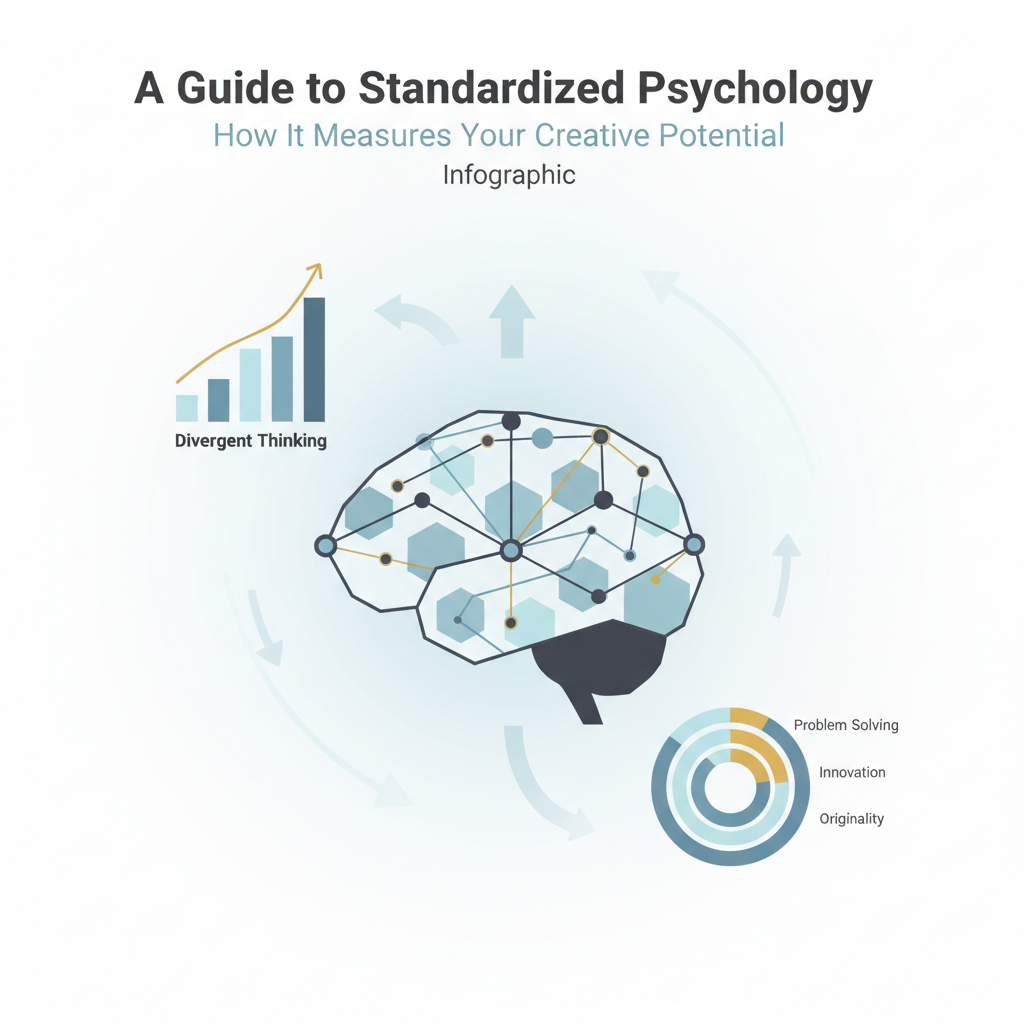
    A Guide to Standardized Psychology: How It Measures Your Creative Potential

    In psychology, standardization is the process of administering and scoring tests and assessments in a consistent and uniform way for all participants. This ensures that the results are objective and reliable, allowing for fair comparisons between individuals and establishing a clear baseline for measuring traits like creativity.

    Have you ever wanted to measure your imagination or your unique way of solving problems? Creativity is more than just an idea—it’s a key skill for your personal and professional life. While many of us feel creative, it takes more than intuition to understand and use that potential. You need a clear, scientific way to learn about yourself.

    That’s where standardized psychology comes in. At Creative Ability Test, we know that to give you useful insights, our assessment must be fair, consistent, and based on science. Unlocking your creative potential starts with self-awareness. Our test helps you move from uncertainty to clear, practical strategies. With this solid foundation, you can confidently explore your cognitive flexibility, divergent thinking, and openness to new experiences.

    In this guide, we’ll explore standardized psychology and explain why it’s essential for any reliable assessment of creativity. We’ll show you what standardization means and how it allows our creative ability test to provide personalized, trustworthy insights. These insights can empower you to improve your creative skills and become a master at solving problems.

    What is Standardized Psychology and Why Does It Matter?

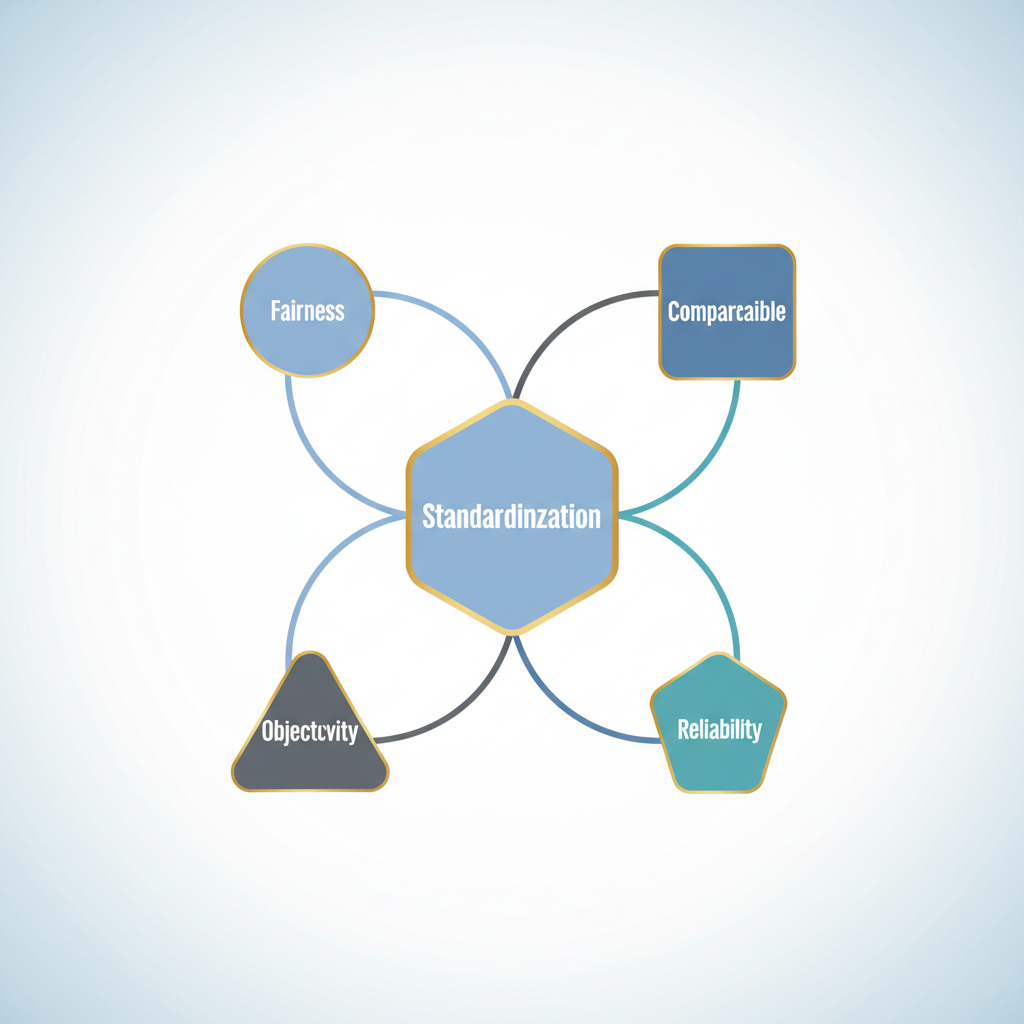
    An infographic showing 'Standardized Psychology' as a central concept branching out to 'Fairness', 'Comparability', 'Objectivity', and 'Reliability' with geometric shapes and lines.
    An abstract, educational infographic visualizing the core concept of ‘Standardized Psychology’. A central, clean geometric shape labeled ‘Standardization’ radiates outward to connect with other geometric shapes representing ‘Fairness’, ‘Comparability’, ‘Objectivity’, and ‘Reliability’. Each connection is a subtle gradient line. The overall style is minimalist and vector-based, using soft blues, whites, and charcoal, with gold or teal accents for highlights. Ample negative space allows for short labels. No humans or cartoon elements. Professional and approachable aesthetic.

    Defining Standardization in a Simple Way

    What does it mean for something to be “standardized” in psychology? It just means a test is fair and consistent for everyone who takes it. Think of it like a recipe. If everyone follows the same steps and uses the same ingredients, their cakes will turn out nearly the same. Similarly, standardization means everyone takes a test under the same conditions.

    This covers everything from the questions you see to how your answers are scored. It removes any guesswork. This process gives you a reliable way to understand your unique skills.

    When it comes to your creative potential, this means your results are truly about you. They aren’t swayed by outside factors during the test. This helps you trust your results.

    The Goal: Fairness and Consistency

    The main goals of standardization are fairness and consistency. These two things are key for any useful test, especially when measuring complex traits like creativity.

    • Ensuring Fairness: Everyone gets the same instructions and questions. This consistency means no one has an unfair advantage or disadvantage. It allows your creative strengths to shine through.
    • Promoting Consistency: The test setting, rules, and scoring are the same for everyone. This careful method makes sure results can be compared from person to person and stay reliable over time. It ensures that psychological assessments are given, scored, and understood the same way for all participants [1].

    Why does this matter for your creative journey? It ensures your results truly show your natural talents. You can see how you compare to others or track your growth over time. Standardization makes this possible.

    It turns opinions into clear, useful facts. This foundation helps you understand your unique creative thinking styles and gives you solid steps for personal and professional growth.

    How Does Standardization Make a Psychology Test Reliable?

    A good test must be reliable. This means it consistently measures what it’s supposed to measure. For our Creative Ability Test, reliability ensures your results accurately reflect your creative potential. The key to making a test reliable is standardization.

    Standardization means using a strict set of rules for the test. These rules reduce outside influences and make the experience fair for everyone. They also allow for accurate comparisons between people. This way, you get dependable insights into your unique creative strengths.

    Consistent Test Administration

    Imagine taking a test where some people get extra time while others get clearer instructions. That would make the scores unfair, right?

    To be reliable, a test must be given the same way every time. This ensures every test-taker has the same experience. Here’s what that involves:

    • Identical Instructions: Everyone receives the exact same guidelines. This prevents confusion.
    • Standardized Environment: Testing conditions are similar for all to minimize distractions.
    • Fixed Time Limits: Each section has a set time limit, ensuring a level playing field.
    • Uniform Procedures: The process is the same for everyone from start to finish. This prevents accidental bias.

    When measuring creativity, it’s very important to be consistent. This makes sure that score differences come from actual differences in creative thinking, not from different test conditions. It’s why your Creative Ability Test results are accurate and easy to compare [2].

    Uniform Scoring Procedures

    Standardization is also key for scoring. A test isn’t reliable if different scorers give the same answer different points. Uniform scoring rules fix this problem.

    This means we use clear, objective rules to grade every answer. These rules ensure:

    • Objective Criteria: We use clear scoring guides that leave no room for personal opinion.
    • No Scorer Bias: Every answer is judged by the same standards, removing the scorer’s personal views.
    • Measurable Results: Creativity can seem abstract, but it can be measured. Our test looks at specific areas like originality, fluency, and cognitive flexibility.
    • Consistent Scores: The same answer will always get the same score, which makes the test fair and accurate.

    Uniform scoring is essential for the Creative Ability Test. It makes sure our test accurately measures your unique way of thinking. This gives you a reliable score for your creative potential.

    Removing Bias for objective results

    Bias can easily sneak into any test, making the results unfair and unreliable. Standardization helps remove that bias. The goal is to get results that are truly objective.

    When a test removes bias, it is fair to everyone. Here’s what that means:

    • Fairness for Everyone: The test is designed to be fair for people from all backgrounds.
    • Focus on True Ability: Your score shows your creative skills, not outside factors like your culture or test-taking history.
    • Trustworthy Results: With less bias, you can trust your results and feel confident in your personalized feedback.
    • Universal Measures: We measure core creative thinking skills that aren’t tied to specific knowledge or culture [3].

    The Creative Ability Test is built on these principles. Our scientific method provides unbiased results. This gives you a clear and accurate picture of your creative strengths and areas for growth, empowering you to improve your innovation skills and support your personal development.

    What Is a Standardised Procedures Psychology Example?

    Example in a General Cognitive Test

    Imagine taking a test that measures your thinking skills. This might include problem-solving or logical reasoning. For the results to be fair, everyone must take the test under the same conditions.

    This is why standard rules are so important. Test administrators follow strict guidelines, giving the exact same instructions to every test-taker. The time limits are also the same for everyone. The testing environment is kept the same for all participants as well [4].

    Here are the key parts of a standard test:

    • Uniform Instructions: Everyone gets the exact same directions. This makes sure they understand what to do.
    • Consistent Time Limits: Every section has a set time limit. This prevents anyone from having an unfair advantage.
    • Identical Scoring Rules: Answers are graded with the same rules. This removes personal opinion from the scoring.
    • Controlled Environment: Distractions like noise are kept to a minimum. This gives every test-taker an equal chance to focus.

    This careful process makes sure that score differences come from real differences in thinking skills, not from how the test was given.

    How the Creative Ability Test Applies It

    At Creative Ability Test, we use these same strict rules to ensure fair and accurate insights into your creativity. Our 30-question test is designed to measure different parts of your creativity, including flexible thinking, idea generation, and being open to new things.

    We believe it’s powerful to understand your unique way of thinking. Here’s how we use standard rules on our platform:

    • Clear, Consistent Questions: Every user gets the same set of questions. They are designed to bring out your creative side.
    • Objective Scoring System: We use a science-backed system to score your answers. It looks at the originality, number, and detail of your ideas. This makes the scoring fair.
    • Uniform Experience: Our online platform gives everyone the same test experience. The way questions are shown and timed is the same for all users.
    • Research-Backed Framework: Our test is based on solid creativity research. This ensures your results are accurate and trustworthy.

    By using standard rules, we can provide you with truly personal feedback. You gain a clear understanding of your creative strengths. You also discover areas to improve your creative thinking. This helps you go from feeling unsure about your creativity to knowing how to use it.

    Our platform offers more than just a score. It provides practical strategies to help you use your creativity to solve problems and grow as a person. You will learn to use your unique creative skills in the real world.

    Understanding Standardization and Norms in Psychology

    What Are Norms?

    Your creative potential is more than just a test score. That’s why psychological tests use a process called standardization to ensure they are fair and consistent. However, a raw score alone doesn’t tell you the whole story.

    This is where “norms” come in. Norms give your score context and meaning. They are based on the typical scores of a specific group of people who have already taken the test [5]. Think of them as benchmarks or points of reference.

    When you take the Creative Ability Test, we compare your results to the scores of a large, diverse group. This “normative group” has already completed the same test. Their combined scores show what is considered an “average” or “typical” result for different creative skills.

    In short, norms answer a key question: What does my score mean compared to others? They turn a simple number into a useful insight about your abilities.

    How Norms Help You Understand Your Score

    Without norms, your test score is just a number. For example, if you answered 25 questions correctly, what does that mean? Is that score good, average, or exceptional?

    Norms give your score context. They turn your raw score into an easier-to-understand measurement, like a percentile rank. A percentile shows the percentage of people in the comparison group who scored the same as you or lower [6].

    Here are a couple of simple examples:

    • If you score in the 75th percentile for divergent thinking: This means you scored higher than 75% of people in the comparison group. It suggests you have a strong ability to generate many different ideas.
    • If you score in the 50th percentile for cognitive flexibility: This means your ability to switch between thinking styles is about average for the group. It also shows an area with room for growth.

    Norms give you a clear picture of your creative strengths. They show where you excel and where you might want to improve. This process turns simple data into helpful insights about yourself.

    Putting Your Creativity in Context

    Using norms to understand your scores is empowering. It’s more than just a simple comparison—it’s a roadmap for personal growth. Your Creative Ability Test results use norms to show where your unique creative talents stand out.

    For example, a high score in “openness to new experiences” confirms your natural curiosity. This might inspire you to explore new hobbies or take on different projects.

    The personalized feedback on the Creative Ability Test goes even further. It turns these insights into practical tips. You’ll learn how to use your strengths and find ways to grow in other areas. This helps you use your creativity in daily life, from solving problems at work to trying new things on your own [7].

    Ultimately, using tests with clear norms changes how you see yourself. It helps you unlock your full creative potential and guides you toward personal growth and self-discovery.

    How the Creative Ability Test Uses Standardized Psychology for You

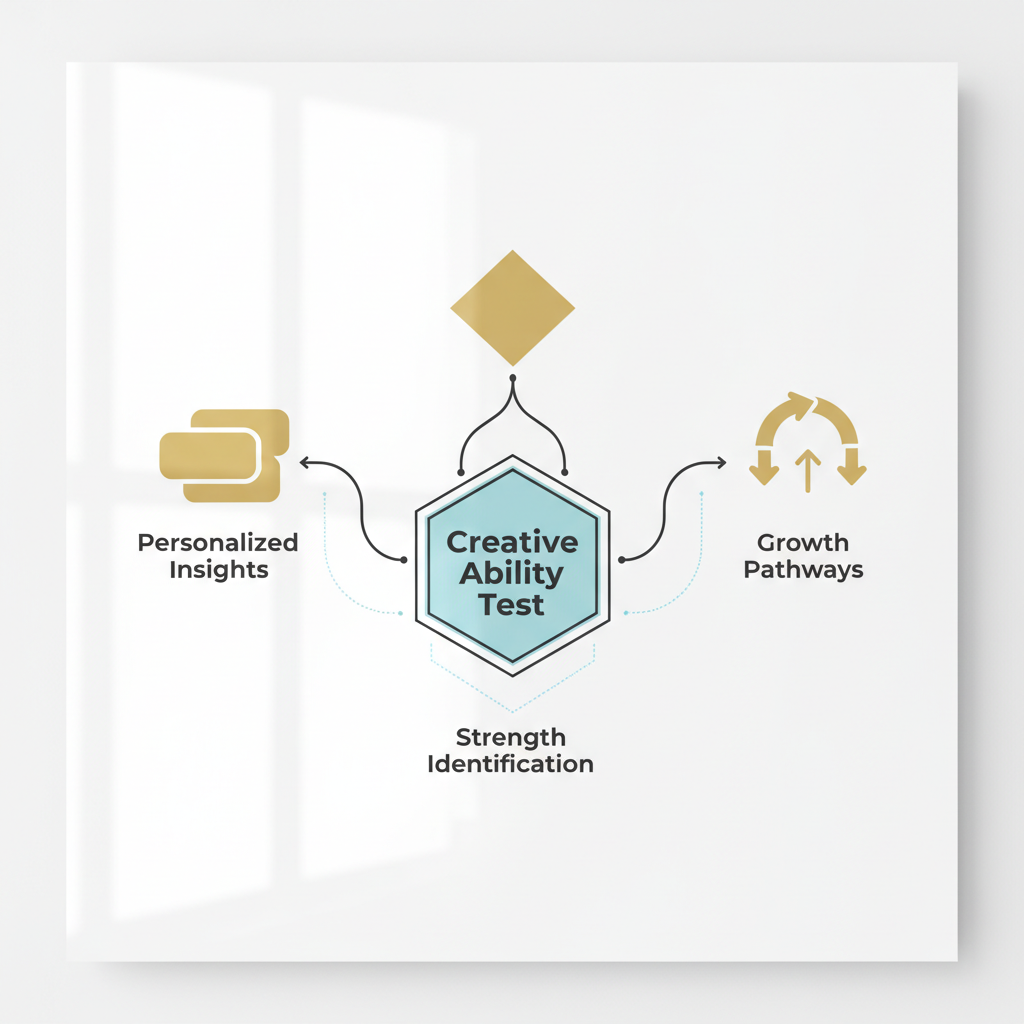
    An infographic visualizing how a standardized creative ability test provides personalized insights, identifies strengths, and outlines growth pathways for the individual.
    An abstract, educational infographic representing the application of standardized psychology to creative ability assessment for personal growth. A central icon or geometric shape labeled ‘Creative Ability Test’ feeds into a layered system or branching pathways that lead to ‘Personalized Insights’, ‘Strength Identification’, and ‘Growth Pathways’. Each outcome is represented by distinct, clean geometric shapes or clusters, interconnected to show progression and application. The design is minimalist, vector-based, utilizing soft blues, whites, and charcoal, with gold accents for the positive outcomes. Ample negative space for short, impactful labels. No humans or cartoon elements.

    Our Scientific Approach to Creativity

    The Creative Ability Test is built on proven principles from psychology. This scientific approach ensures your results are accurate and meaningful. Our 30-question assessment is carefully designed to measure the different parts of your creativity.

    We use psychometrics—the science of psychological measurement—to build reliable and valid tests [8]. We focus on key areas of creativity, including:

    • Divergent Thinking: Your ability to generate many unique ideas.
    • Cognitive Flexibility: How easily you can switch between different perspectives.
    • Problem-Solving Skills: Your approach to new and unfamiliar challenges.
    • Openness to Experience: Your receptiveness to new ideas and concepts.

    Every question is rigorously tested to ensure it measures what it’s supposed to. The test is given under consistent conditions, and our scoring is objective. This process removes bias, giving you a fair and reliable snapshot of your creative strengths.

    Personalized Insights You Can Trust

    Our scientific method allows us to provide truly personal insights. To give your score meaning, we compare your results to a large, diverse group of people (known as a normative sample) [9]. This puts your creative abilities into context.

    Instead of just a number, you get a detailed report that explains your unique creative profile. It highlights your strengths and identifies areas for growth. Because our methods are scientifically validated, you can trust this information.

    Understanding your creative style builds confidence. You might discover a talent for brainstorming unique solutions or a knack for connecting unrelated ideas. We present these insights in a beginner-friendly way, making complex traits easy to grasp. This helps you gain actionable self-awareness.

    Turning Your Results into Real Growth

    The Creative Ability Test does more than just measure your skills—it empowers you to grow. Your personalized report is a roadmap from understanding to action. We provide practical strategies tailored to your unique creative profile.

    For example, if you want to improve your cognitive flexibility, we’ll offer exercises to help you see problems from new angles. If divergent thinking is a strength, we’ll suggest ways to use it more effectively at work or in daily life. Here’s what you might explore:

    • Boost Innovation Skills: Apply structured brainstorming techniques.
    • Enhance Problem-Solving: Use creative thinking to overcome obstacles.
    • Foster Personal Growth: Embrace new experiences and learning opportunities.
    • Develop Creative Confidence: Regularly practice and apply your unique creative abilities.

    Our goal is to help you transform. You’ll move from being uncertain about your potential to having clear strategies for growth. By learning to apply your creativity in real-world situations, you can turn your insights into tangible skills and make creativity a part of everything you do.

    Frequently Asked Questions

    What is a standardized psychology test?

    A standardized psychology test is given the same way every time. This means everyone takes the test under the same conditions, with the same instructions, materials, and scoring rules [10].

    The main goal is fairness. By removing potential bias, the test can make sure the results accurately measure what they are supposed to. For creativity, this means your unique potential is measured objectively. It also allows for meaningful comparisons between results.

    The Creative Ability Test uses this approach. Our science-backed assessment provides reliable insights, helping you get a clear understanding of your creative strengths and thinking styles.

    What are some standardized psychology questions?

    Standardized psychology questions are often tasks or scenarios, not just simple multiple-choice items. They are designed to let you show specific ways you think or act.

    For creativity tests, questions might include:

    • Divergent Thinking Tasks: You might be asked to list many different uses for a common object. For example, “What are all the things you can do with a paperclip?” These questions measure your ability to generate many unique ideas.
    • Problem-Solving Scenarios: You could be given an open-ended problem and asked to propose new solutions. This shows how you apply creative thought in practical ways.
    • Imagination Prompts: Some tasks ask you to build a story or imagine a what-if situation. These assess how flexible and imaginative your thinking is.
    • Preference and Experience Questions: You might answer questions about your openness to new experiences, curiosity, and willingness to take risks. These traits are vital for creative potential.

    Our 30-question Creative Ability Test is designed this way. It looks at different aspects of your creative thinking to understand your unique approach to challenges.

    How does standardization relate to reliability in psychology?

    Standardization is key to making a psychology test reliable. Reliability means a test produces similar results over and over again [11]. Think of it like a good measuring tape—you expect it to show the same length every time you measure.

    Here’s how standardization ensures a test is reliable:

    • Consistent Administration: Every test-taker gets the same instructions and environment. This reduces the chance that outside factors will change the results.
    • Uniform Scoring: The scoring rules are clear and objective. This removes personal opinion from the process, so different evaluators would arrive at the same score.
    • Reduced Error: By keeping test conditions the same, standardization cuts down on random errors that could make the results less accurate.

    Ultimately, a reliable test gives you confidence in your scores. For the Creative Ability Test, this means your insights are trustworthy. You can depend on our personalized feedback to support your journey toward growing your creative potential.


    Sources

    1. https://dictionary.apa.org/standardized-test
    2. https://www.apa.org/education-career/guide/test-reliability
    3. https://psycnet.apa.org/doiLanding?doi=10.1037%2Fa0024474
    4. https://www.apa.org/education-career/guide/standardized-tests
    5. https://www.apa.org/pi/about/publications/clps/glossary
    6. https://www.simplypsychology.org/standardization.html
    7. https://hbr.org/2016/11/what-it-takes-to-be-creative
    8. https://www.apa.org/education-career/guide/science-psychology
    9. https://psychology.jrank.org/pages/446/Normative-Data.html
    10. https://www.apa.org/pubs/books/standardization-psychological-tests
    11. https://www.sciencedirect.com/topics/medicine-and-dentistry/reliability-psychology