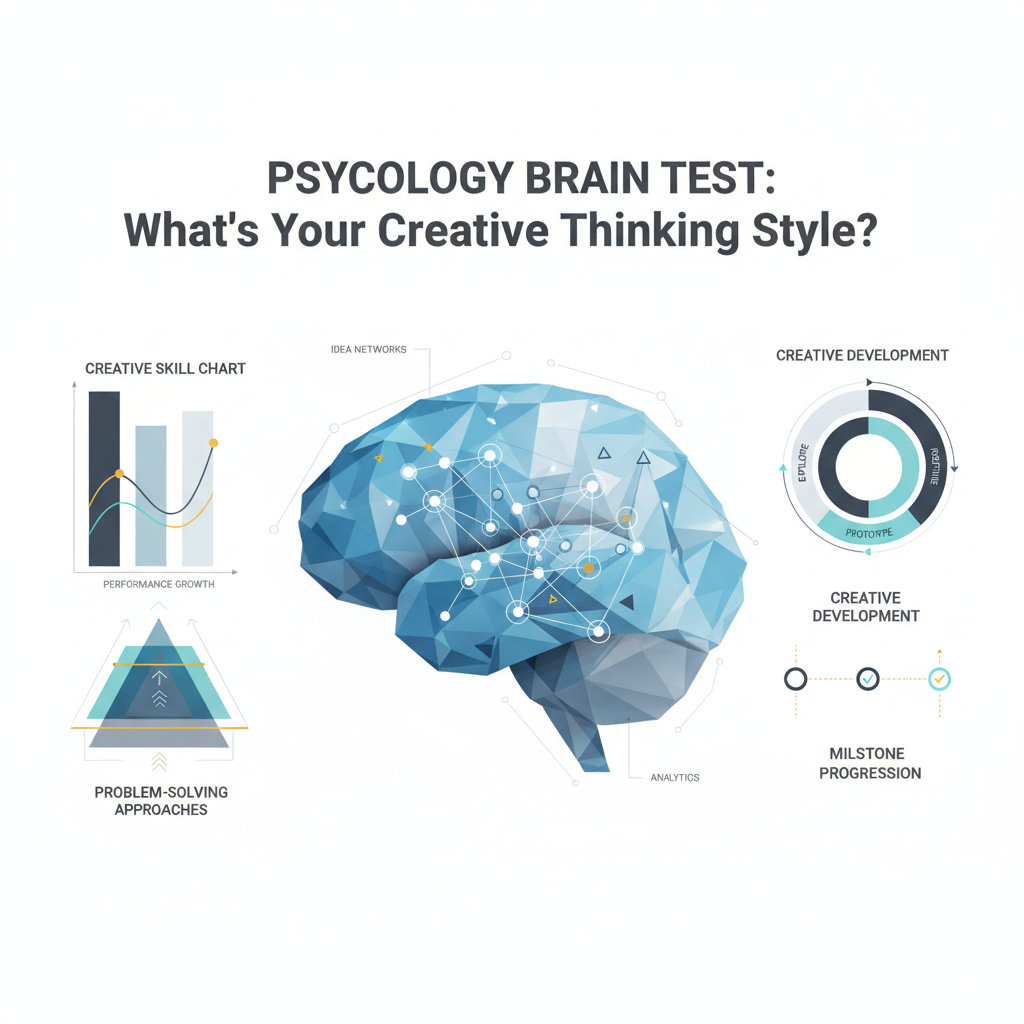
A psychology brain test is an assessment designed to measure cognitive functions, thinking styles, and psychological traits. These tests use scientifically-backed questions to provide insights into areas like problem-solving skills, cognitive flexibility, and creative potential, helping you understand how your mind uniquely operates.
Have you ever wondered how your mind creates new ideas, solves tough problems, or finds surprising connections? Creativity isn’t just for artists—it’s a key skill that helps everyone innovate, grow, and succeed. By understanding your personal creative style, you can unlock your potential, helping you face challenges and grab new opportunities with confidence.
This article will explain how a science-based psychology brain test can show you your unique creative thinking style. We’ll look at the mental skills that spark innovation, from cognitive flexibility to divergent thinking. By identifying your strengths and how you approach problems, you can get a clear picture of how your creative mind works.
Get ready to gain useful self-awareness and feel empowered by what you learn. This knowledge goes deeper than what you’d find in a generic quiz. We’ll explain how this type of assessment gives you a clear, fact-based view of your creative process, going beyond surface-level tips. Let’s begin by exploring what a psychology brain test truly reveals about you.
What Can a Psychology Brain Test Reveal About You?
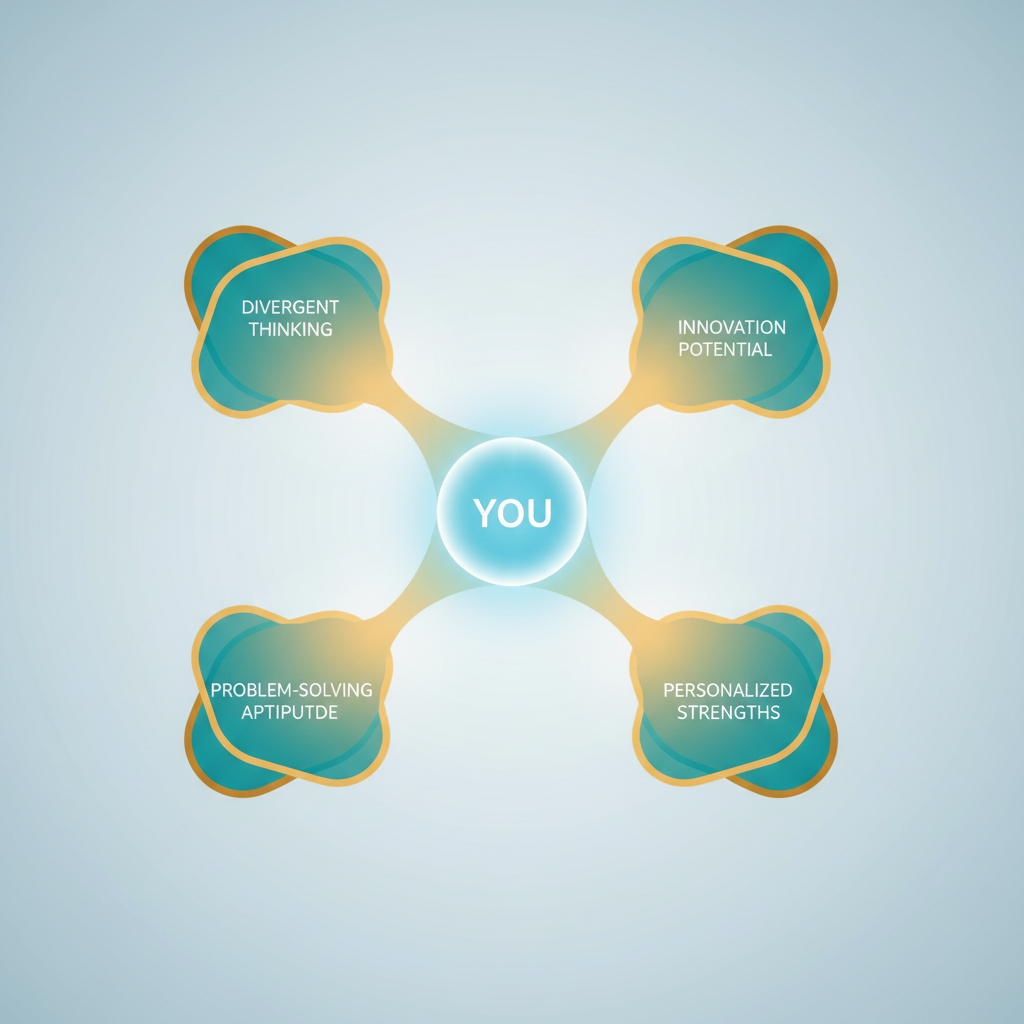
Create an abstract, educational infographic visualizing the concept of self-discovery through a psychology brain test. The visual should feature a central glowing ‘You’ node, from which several clean, vector-based geometric pathways branch outwards. Each pathway leads to a distinct insight cluster, labeled with short, concise text such as ‘Divergent Thinking,’ ‘Problem-Solving Aptitude,’ ‘Innovation Potential,’ and ‘Personalized Strengths.’ Use a color palette of soft blues and whites for the background and core elements, with subtle gold and teal gradients highlighting the pathways and insight clusters. The overall style should be minimalist and professional, with ample negative space. No humans or cartoon elements. Focus on conceptual representation of growth and understanding.
A psychology test for creativity looks at how your mind works. It’s more than just a general personality quiz. This kind of test scientifically measures how you come up with ideas and solve problems.
This type of test helps you understand your natural creative strengths. It also shows you how you approach challenges. You can learn about your personal thinking style and see where you can improve.
What a Creativity Test Reveals
A good test can show you many interesting things about your creative mind. It makes it clear how you process information and how flexible your thinking is.
Your Specific Creative Strengths: Are you best at brainstorming new ideas, innovating, or making existing ideas better? A test can highlight your natural talents.
Cognitive Flexibility: See how easily you can change your point of view. This skill is key to handling new situations and finding different solutions [1].
Divergent Thinking Abilities: Find out how many unique ideas you can come up with. This shows your power to brainstorm and be original.
Convergent Thinking Skills: Check your ability to choose the best idea from a list of options. This is important for turning ideas into real-world solutions.
Your Unique Problem-Solving Approach: Learn about your go-to methods for solving hard problems. Do you break them into smaller parts or look for hidden connections?
Learning these things about yourself can be powerful. Instead of wondering about your creative skills, you gain clear self-awareness. This knowledge is very valuable for both your personal and professional life.
The Creative Ability Test gives you this deep level of understanding. Our 30-question test is based on science and shows your creative thinking style. You’ll get personal feedback and useful tips to help you build your creative skills for everyday situations.
How Do Psychology Tests Measure Brain Function?
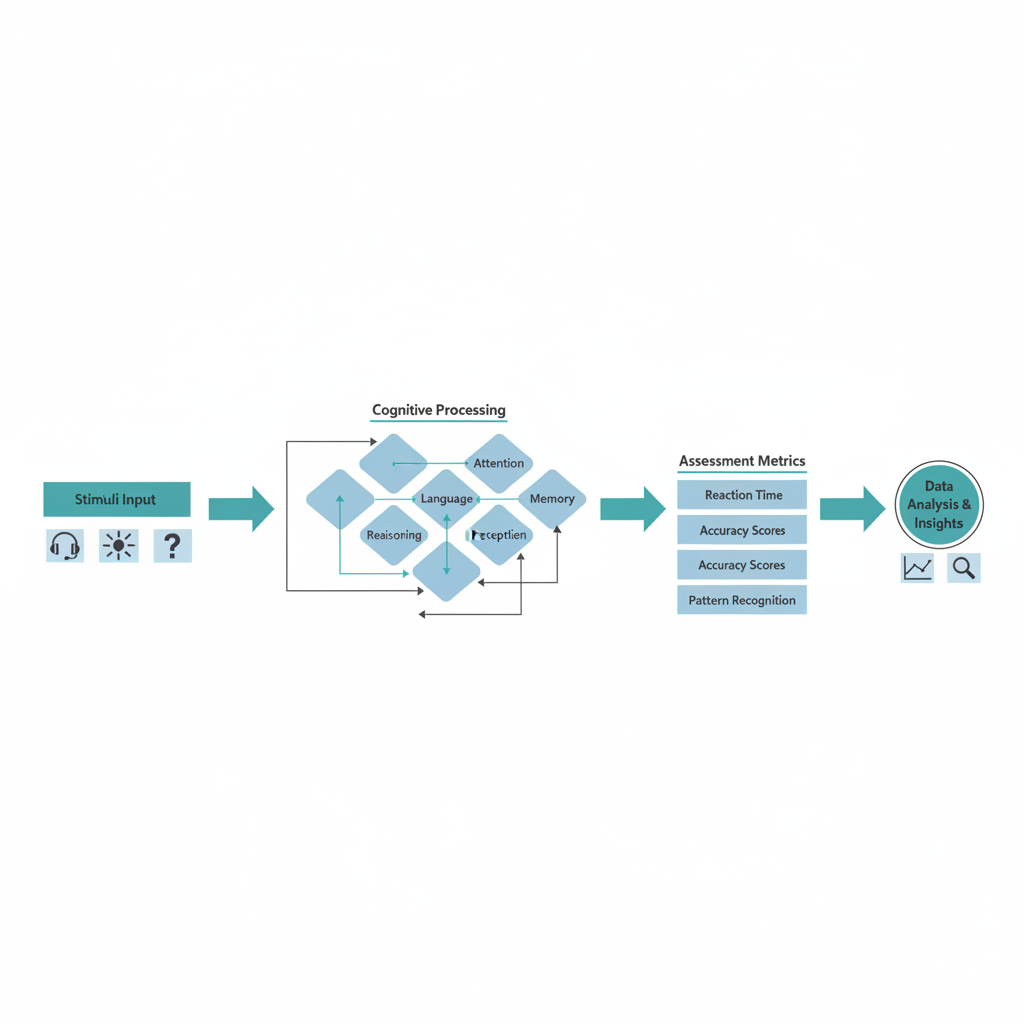
Design an abstract, educational infographic illustrating the systematic process of how psychology tests measure brain function. The visual should be a layered system or a stepwise process diagram composed of clean geometric shapes and connecting lines. Start with an input phase, labeled ‘Stimuli Input,’ flowing into a central ‘Cognitive Processing’ section represented by interlinked conceptual modules (e.g., ‘Attention,’ ‘Memory,’ ‘Reasoning’). This then leads to an ‘Assessment Metrics’ phase, culminating in ‘Data Analysis & Insights.’ Use a professional, vector-based, minimalist style with a color palette of charcoal and soft blues for the main structure, accented with teal for directional arrows and key labels. Ensure clear visual hierarchy and ample negative space. No human or cartoon elements. The focus is on a structured, conceptual explanation.
Understanding how your brain fuels creativity is fascinating. Psychology tests don’t just guess your creative strengths. Instead, they use proven scientific methods. They look at the specific mental processes behind new ideas. This approach helps you get clear, useful insights into your unique skills. These tests also move beyond popular myths and focus on how your brain really works.
Beyond Left Brain vs. Right Brain Myths
You’ve probably heard that “left-brain” people are analytical and “right-brain” people are creative. This is a common myth. In reality, modern brain science tells a different story [2]. Creativity isn’t stuck on one side of your brain. Instead, it comes from different brain networks working together. These networks cross both sides of the brain. So, a good psychology test measures how these parts work together. It looks at how different areas team up to create new ideas.
Our assessment is based on this science. It recognizes that creative thinking involves your whole brain. You will discover how different parts of your mind contribute to your unique creative style. This goes beyond simple labels and offers a more detailed, accurate picture of your potential.
Assessing Cognitive Flexibility and Adaptability
A key part of creativity is cognitive flexibility. This is your brain’s ability to switch between different ideas or tasks. It also means changing how you think in new situations [3]. Psychology tests measure this key skill. A flexible mind can easily look at problems in new ways and come up with many different solutions. Think of a designer who can switch from a product’s look to its engineering challenges. That’s cognitive flexibility in action. It’s essential for innovation.
The Creative Ability Test helps you understand your level of cognitive flexibility. It reveals how easily you can:
Shift perspectives when facing a challenge.
Generate varied ideas, not just sticking to one approach.
Adapt your strategies when initial plans don’t work.
Combine new information with what you already know.
Understanding your cognitive flexibility helps you. You can then work on making this skill stronger. This leads to more innovative problem-solving in all parts of your life.
Measuring Divergent and Convergent Thinking
Creative thinking has two main modes: divergent and convergent thinking. Psychology tests effectively measure both. They are equally important for bringing ideas to life.
Divergent Thinking: This is the ability to come up with many different ideas from a single starting point. Think of brainstorming, where you explore a wide range of possibilities. The goal is quantity and variety. For example, if asked to list uses for a brick, a divergent thinker might list building, a paperweight, a weapon, a doorstop, or even a tool for cracking nuts.
Convergent Thinking: This is the ability to narrow down many options to find the single best solution. It uses logic and judgment. After a brainstorming session, convergent thinking helps you pick the most workable or innovative idea. For instance, after listing many brick uses, convergent thinking would help you pick the most practical one for a specific situation.
Our 30-question assessment is carefully designed. It evaluates both your divergent and convergent abilities. By understanding your strengths, you can improve your creative process. Maybe you’re great at coming up with ideas but need practice selecting the best one, or vice versa. This insight is incredibly valuable for personal growth and innovation.
Understanding Your Unique Problem-Solving Approach
Everyone solves problems differently. Your unique creative style shapes how you handle challenges. Psychology tests can reveal these personal patterns. They help you pinpoint your go-to strategies. This includes how you see problems, process information, and find solutions. For example, some people are highly intuitive and rely on gut feelings. Others are more analytical and prefer structured, logical steps.
The Creative Ability Test provides personalized feedback. It maps out your specific creative style. You will discover:
Whether you tend to be an “idea person” or a “doer.”
How you usually approach complex problems.
Your natural tendency toward new ideas or practical solutions.
Strengths in specific areas like originality, elaboration, or fluency.
This deep self-awareness can be a game-changer. It moves you from uncertainty about your creative potential to a clear understanding you can act on. You can then use your strengths with purpose and work on areas for growth. This leads to more effective problem-solving and more innovation in your daily life and career.
What Are the Benefits of a Cognitive Brain Test?
Enhance Your Creative Problem-Solving Skills
To be more creative, you first need to understand how your mind works. A brain test can map out your unique thinking style. It shows you how you come up with new ideas and pick the best solutions.
For example, our test shows if you are strong in divergent thinking. This is the skill of creating many different ideas from one starting point [4]. With this knowledge, you can brainstorm better. You’ll also learn to look at problems from new angles, which is key to finding creative solutions.
The test also measures your cognitive flexibility. This is your ability to switch between ideas and adapt to new information. When you understand these skills, you can improve how you solve problems. You can then use these skills in any situation, from big work projects to everyday choices.
Discover how you generate ideas.
Improve your brainstorming skills.
Learn to tackle problems from new angles.
Strengthen your thinking to adapt more easily.
Identify Strengths for Personal and Professional Growth
Knowing your natural creative strengths is a big advantage. Our science-backed brain test helps you understand yourself on a deeper level. It gives you personalized feedback on your unique creative skills and thinking styles.
For example, you might find you have a talent for connecting ideas that don’t seem related. This is a key part of associative thinking, which is vital for finding new solutions [5]. Or, you might be great at picturing complex ideas or adapting quickly to change.
When you know your talents, you can use them to your advantage at work. A marketer could use associative thinking to create exciting campaigns. An engineer could use visualization skills to design new products. This knowledge also helps you grow as a person. You can pick hobbies and learning paths that fit your natural creative style. This brings more joy and satisfaction to your life.
Understand your creative mind on a deeper level.
Receive personal feedback on your unique strengths.
Use your talents to advance your career.
Find more joy in your creative pursuits.
Gain Actionable Insights to Boost Innovation
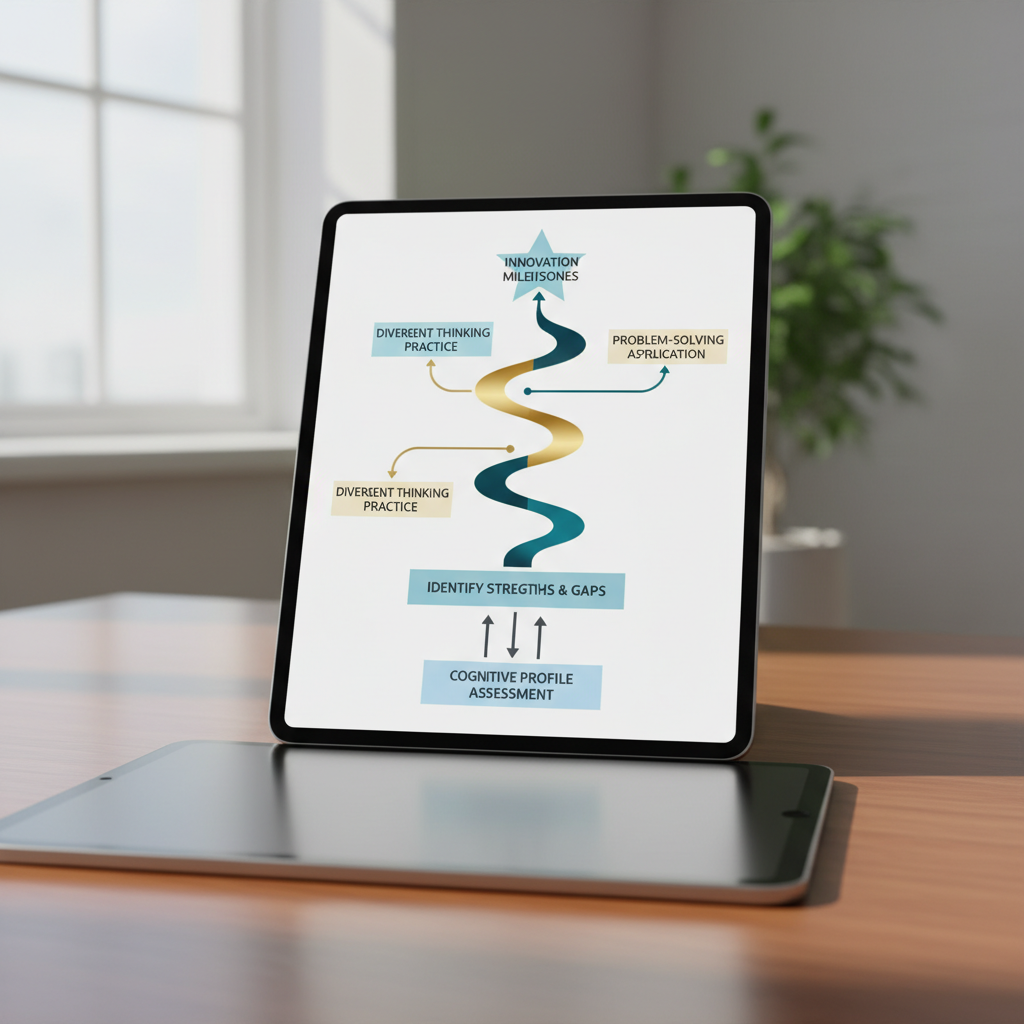
In our fast-changing world, innovation is more important than ever. A cognitive brain test is more than just a test—it gives you clear, practical tips to help you become more innovative.
Our results show your unique creative profile and where you can improve. For example, if you often get stuck in old habits, we give you practical strategies to try new approaches. This includes techniques like ‘design thinking’ or ‘lateral thinking’ to spark fresh ideas [6].
This turns the simple wish to be creative into a real plan for growth. You’ll go from having occasional creative moments to a more focused, effective approach. Our test provides personal strategies to help you build an innovative mindset. With these insights, you can confidently share fresh ideas and drive progress at work and in life.
Get clear, practical tips for innovation.
Learn strategies to overcome creative blocks.
Turn your creative goals into a structured plan.
Develop an innovative mindset for lasting progress.
How Can You Test Your Brain for Creativity?
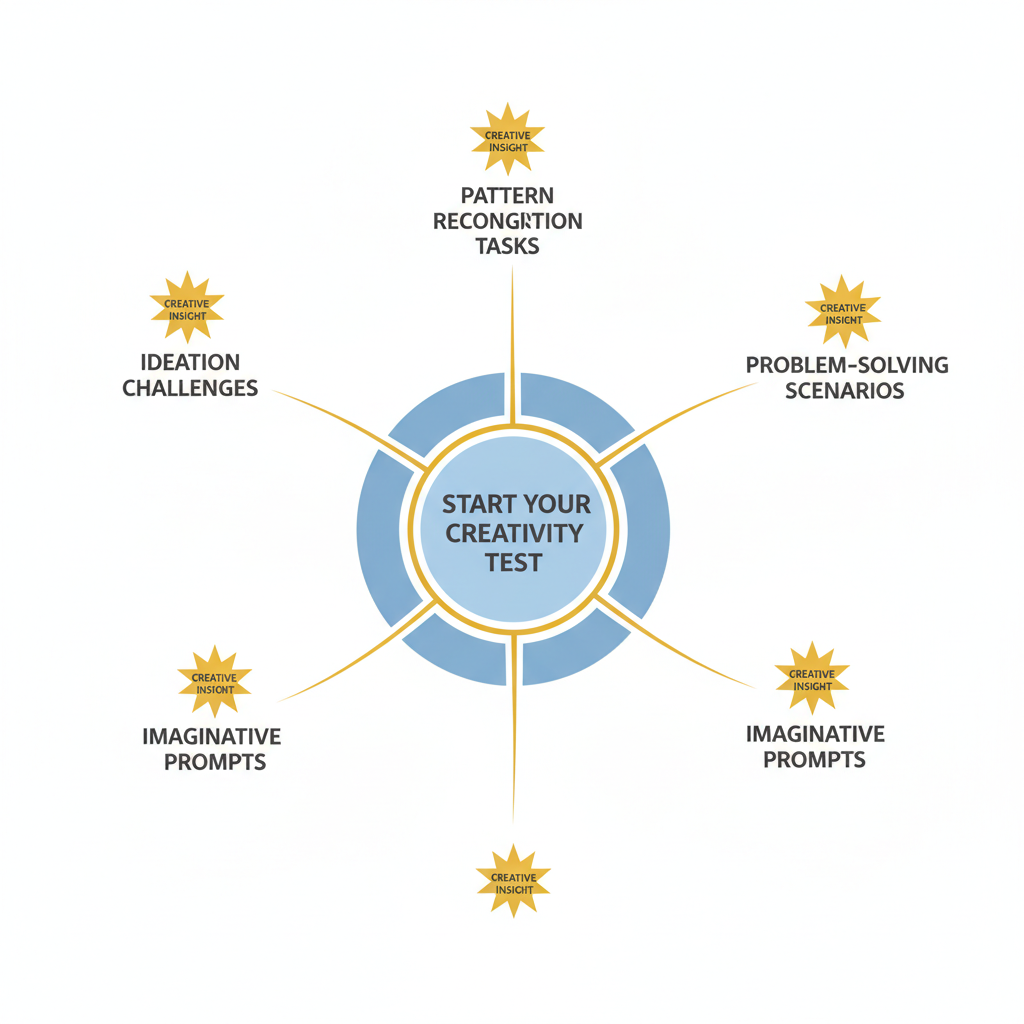
Develop an abstract, educational infographic that serves as a guide for testing one’s brain for creativity. The visual should represent ‘divergent thinking pathways’ or a ‘competency map.’ Begin with a central ‘Start Your Creativity Test’ node, from which multiple distinct pathways or branches emerge. Each branch represents a different method or area of creative assessment, clearly labeled with short text like ‘Ideation Challenges,’ ‘Pattern Recognition Tasks,’ ‘Problem-Solving Scenarios,’ and ‘Imaginative Prompts.’ Each pathway culminates in a ‘Creative Insight’ indicator. The style should be vector-based, minimalist, and professional, utilizing soft blues, whites, and charcoal for the core structure, with gold accents highlighting the pathways and insights. Ample negative space should be used for clarity. No humans or cartoon elements. Focus on actionable steps and conceptual assessment methods.
What to Expect from the Creative Ability Test
Curious about your creative mind? The Creative Ability Test is a science-based quiz that shows you how you come up with new ideas and solve problems. It’s designed to be insightful and encouraging.
You’ll answer 30 questions that explore different sides of your creative thinking. We don’t look for “right” or “wrong” answers. Instead, we want to understand how you think. For example, how do you take on a new challenge? What gets your imagination going?
The test looks at key skills like flexible thinking, idea generation, and problem-solving. Flexible thinking is your ability to see things from different angles. Idea generation helps you come up with many ideas. We also look at your unique way of solving problems and your openness to new things, a trait closely tied to creativity [7].
The test is clear and easy to follow, with no confusing jargon. By the end, you’ll have a much deeper understanding of your creative potential. Think of it as a journey of self-discovery.
Interpreting Your Personalized Results
After you finish the test, you’ll get personalized feedback. It’s not just a score. It’s a detailed report on your creative strengths and areas where you can improve.
Your results will explain different styles of creative thinking. For example, you might be great at “divergent thinking,” which means you come up with lots of ideas quickly. Or you might be strong in “convergent thinking,” where you’re good at narrowing down ideas to find the best one. We also look at how you connect ideas that don’t seem related.
We make sure the feedback is easy to understand. We turn complex data into simple insights about what makes your creative mind tick. You’ll learn about your specific mental strengths and your go-to style for solving problems.
This detailed report is designed to build your confidence and give you a clear path for growth. You’ll see how your creative traits can be a source of strength. Understanding yourself is the first step to turning uncertainty into useful self-awareness.
Applying Your Insights in Real-World Scenarios
Knowing your creative style is great, but using that knowledge is what really makes a difference. Your personalized report gives you practical tips to help you use your creative strengths every day.
Here are some ways to apply your insights:
Solve Problems More Creatively: Learn techniques that fit your thinking style. For example, if you come up with ideas easily, lean into brainstorming. Then, use different strategies to pick the best ones.
Grow in Your Career: Bring your creative strengths to your job. If you’re a flexible thinker, you can adapt to new projects easily, making you a key innovator on any team.
Be More Innovative: Use your unique problem-solving skills to create new solutions. Your report will show you how to turn your ideas into reality. Creative thinking is a top skill many companies are looking for [8].
Encourage Personal Growth: Try new ways of thinking in your everyday life. You can learn to face personal challenges with a fresh outlook, leading to more satisfaction and growth.
Make Better Decisions: See how your creative style affects your choices. Knowing this helps you make smarter decisions by looking at more options.
The Creative Ability Test is more than just a quiz—it’s a tool for real-world growth. When you start using these strategies, you’ll see real improvements at home and at work, helping you to innovate and succeed.
Frequently Asked Questions
What is a brain type test?
A “brain type test” is a tool that helps you understand how you think. It looks at how you process information, solve problems, and come up with new ideas. Instead of putting you in a box, it offers a closer look at your personal thinking style.
At Creative Ability Test, we use science to look at different parts of your creativity. We help you explore your:
Cognitive Flexibility: How well you adapt your thinking [9] and see things from new angles.
Divergent Thinking: How easily you come up with many different ideas.
Convergent Thinking: Your skill at finding the one best answer to a problem.
Problem-Solving Approaches: The ways you prefer to solve difficult problems.
Learning about these areas gives you a clear picture of your creative side. This helps you use your strengths and shows you where you can grow.
Is there a free psychology brain test?
Yes, you can find many free psychology brain tests and quizzes online. However, it’s important to know what they are for. Most free options are just for fun and are not backed by science. This means their results might be general or not very accurate.
For real insights, it’s better to use a test based on scientific research. The Creative Ability Test, for example, is built on proven psychological studies. Our 30-question test gives you:
A Complete Picture: We measure many different sides of your creativity.
Personal Feedback: You get insights that are specific to you.
Useful Tips: We give you practical ways to improve your creative skills.
A Research-Based Method: Our test is based on solid science.
Using a trusted test gives you self-knowledge you can act on. It helps you move from guessing to growing with a clear plan. This allows you to use your creativity well in your life and work.
How can I test my brain with a quiz?
Taking a quiz to test your brain is easy, especially with a psychology-based tool like ours. The Creative Ability Test offers a simple way to understand your creative thinking. Here’s how it works:
Take the Test: You’ll answer 30 carefully chosen questions. These questions explore how you think, create, and prefer to work.
Get Your Personal Results: When you finish, you get a detailed report. It clearly explains your creative strengths and thinking style.
Get Useful Tips: Our report gives you practical advice to boost your creative skills. You’ll learn how to use this information to solve problems and be more innovative in your daily life.
This process changes how you see your own creativity. It helps you unlock your full potential. Start your journey of discovery and growth today.
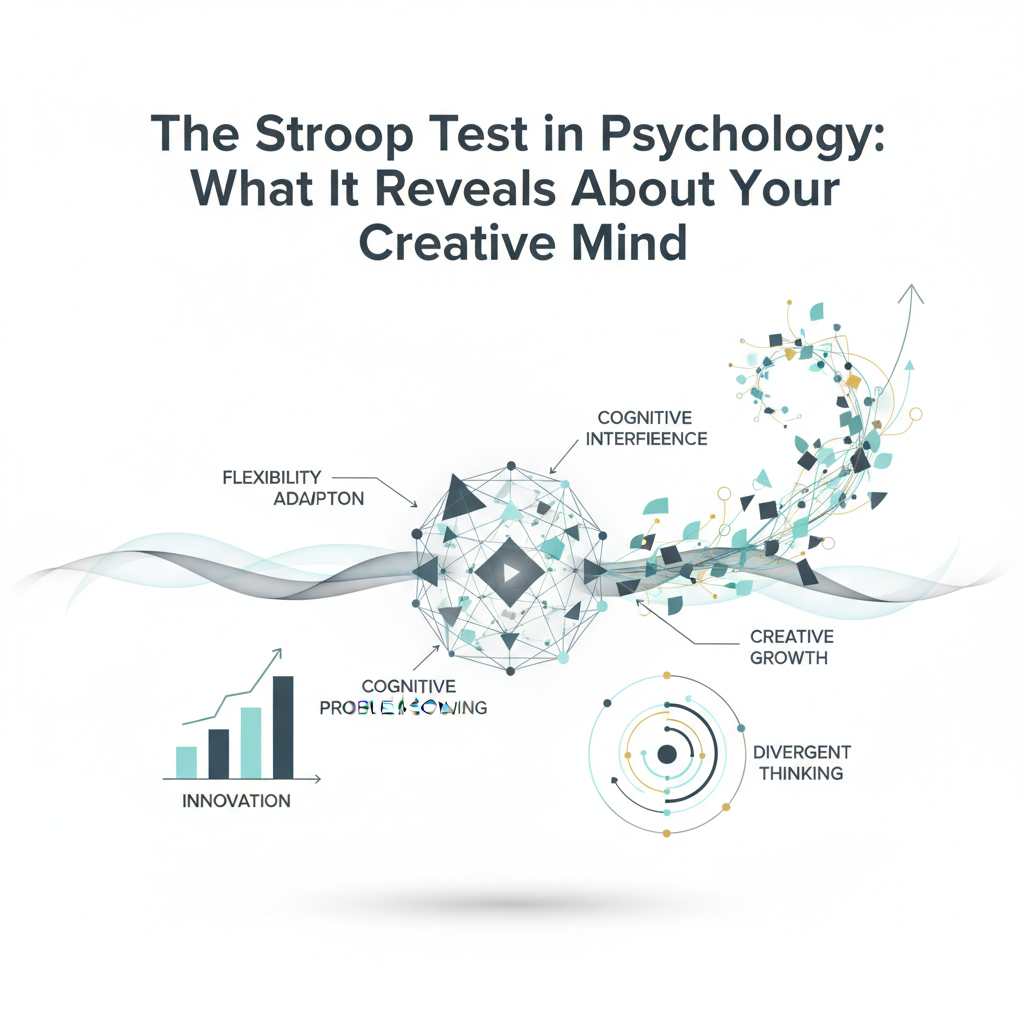
The Stroop test in psychology is a classic experiment demonstrating interference in a person’s reaction time. Participants are shown a word for a color that is printed in a different color’s ink (e.g., the word ‘blue’ printed in red) and must name the ink color, not the word. It is primarily used to measure cognitive functions like selective attention, processing speed, and cognitive flexibility.
Have you ever felt mentally “stuck,” trying to focus on one task while another thought keeps pulling your attention away? Our minds are constantly balancing information, especially when we’re trying to solve a hard problem or have a creative idea. The “Stroop test in psychology” is a simple experiment that offers a clear look into these cognitive abilities. It’s more than a quick brain teaser; it’s a scientific tool for understanding how your attention, mental control, and creative potential work.
This article will explain the Stroop effect—what it is, how it works, and what it measures. We’ll explore how this fundamental assessment reveals your mental flexibility, processing speed, and ability to tune out distractions. These skills are key parts of a creative mind. You’ll discover how understanding these areas can improve your problem-solving skills and boost your creative thinking. This gives you practical insights into your own strengths, helping you grow personally and professionally.
Our goal is to make complex psychological ideas easy to understand and give you useful takeaways. We want you to have a deeper appreciation for how your mind works. Let’s start by looking at what the Stroop Effect is.
What is the Stroop Effect in Psychology?
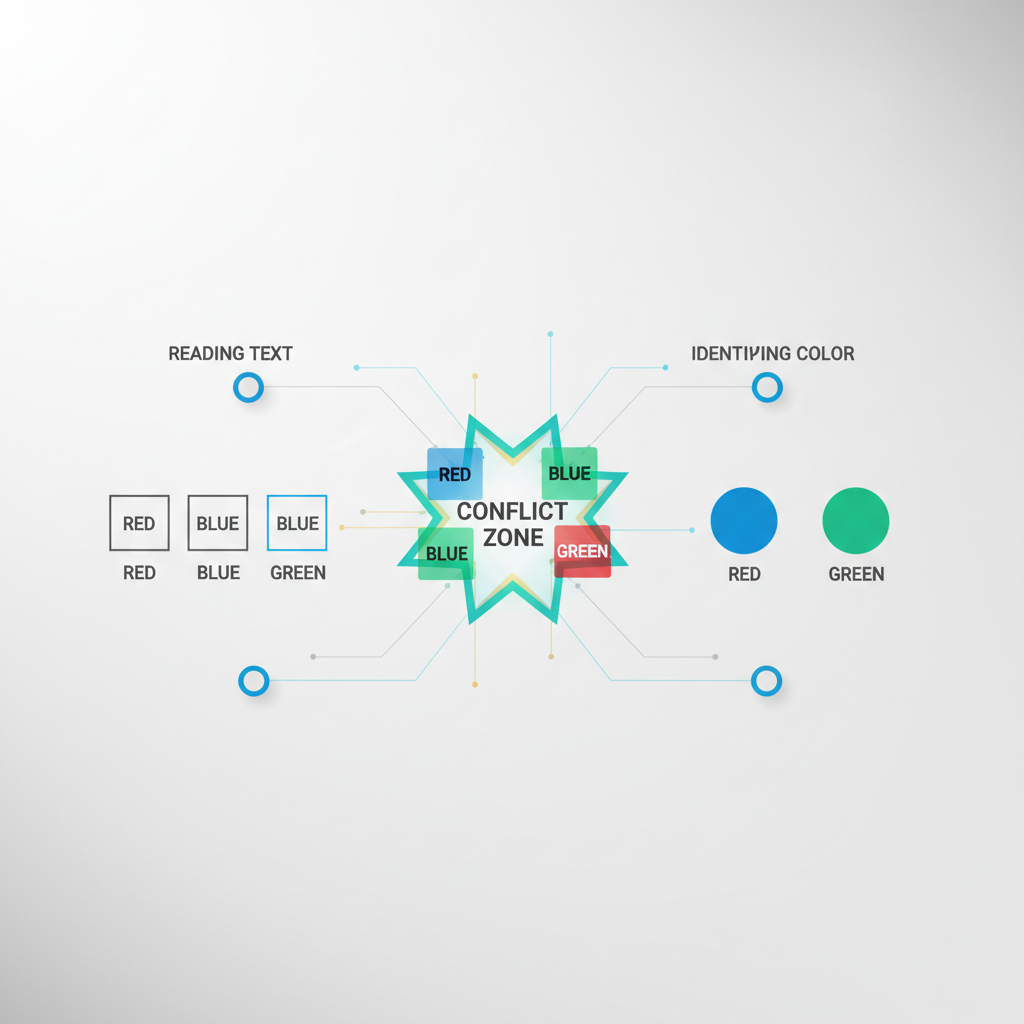
An abstract, educational infographic visualizing the Stroop Effect in psychology. Depict a cognitive network diagram with two conflicting information pathways, one for reading text and one for identifying color, converging and creating a central ‘interference’ node or ‘conflict zone’. Use clean geometric shapes, subtle gradients, and connecting lines to illustrate the brain’s processing struggle. The style should be minimalist, vector-based, professional, and approachable. Use a color palette of soft blues, whites, and charcoal, with gold or teal accents to highlight the conflict. Ensure ample negative space for potential short labels. No humans, no cartoon elements.
A Simple Explanation of the Classic Test
The Stroop Effect is a surprising effect in psychology. It shows what happens when your brain gets mixed signals. At its heart, the test measures your focus and attention.
Imagine seeing a list of color words. The catch is that the ink color of each word is often different from the word itself.
For example, you might see the word “RED” printed in blue ink.
Or the word “BLUE” printed in yellow ink.
Your job is to say the ink color, not read the word.
Most people find this task much harder than it sounds. That’s the Stroop Effect. It shows that some brain processes, like reading, are automatic. Understanding this helps us see how our minds work. It also gives us a peek into our mental flexibility, which is a big part of being creative.
Why Your Brain Gets Confused: The Psychology of Interference
Your brain gets mixed up during the Stroop test because of something called interference. Our minds work very fast, but some tasks are harder to control than others. For most adults, reading is a skill we’ve practiced so much that it’s become automatic [source: https://www.simplypsychology.org/stroop-effect.html].
Naming a color, however, takes more deliberate focus. When you see the word “RED” in blue ink, your brain automatically wants to read the word. But the task is to name the color. This creates a conflict in your brain.
This inner struggle highlights a few key ideas:
Automatic vs. Controlled Processing: Automatic tasks are things we do without thinking, like reading. Controlled tasks, like naming the ink color, need our full attention.
Selective Attention: The test shows how hard it is to focus on one thing (the ink color) while ignoring a distraction (the word). Your brain struggles to filter out the word.
Processing Speed: The hesitation before you name the ink color shows how long it takes your brain to sort out the confusion.
Struggling with this test isn’t a weakness. It just gives us a peek at how your brain is wired. It shows how your mind juggles competing information. For creative people, understanding this is useful. It can help you manage complex problems without feeling overwhelmed. This knowledge can build your focus and mental flexibility—both essential for creative thinking.
What does the Stroop test measure?
Measuring Selective Attention and Focus
The Stroop test is a great way to see how well you manage your attention. It measures selective attention—your brain’s ability to focus on what matters while ignoring distractions. Think of it as a mental filter.
During the test, your brain automatically tries to read the word. But your goal is to ignore the word and focus only on the ink color. This mental conflict reveals how well your brain can direct its focus. Good selective attention is key for deep creative work, helping you stay on track by filtering out distracting thoughts as you brainstorm or develop ideas.
By understanding this skill, you can improve your creative process. For example, you can train yourself to focus better while solving problems. This can lead to more creative solutions and better use of your mental energy [1].
Assessing Cognitive Flexibility and Task-Switching
The Stroop test also reveals your cognitive flexibility. This is your brain’s ability to adapt your thinking, switch between different tasks, and see things from new angles. It’s a key part of creative thinking.
In a Stroop task, your brain has to fight the urge to read the word. Then, it has to switch to the harder task of naming the color. This mental workout is a direct test of your task-switching skills. Strong cognitive flexibility allows you to:
Approach problems from multiple angles.
Generate diverse ideas without getting stuck.
Adapt your plans when new information emerges.
The Creative Ability Test explores these skills further. It helps you understand how you shift gears in your mind, which is key for finding new perspectives and breakthrough ideas [2].
Evaluating Your Brain’s Processing Speed
The Stroop test also measures your brain’s processing speed. This is how quickly your brain can take in, understand, and react to information.
In the test, a faster processing speed usually means you can answer more quickly, especially when the word and color don’t match. While it doesn’t directly measure creativity, fast processing is a basic skill that supports many creative tasks.
Think about how quickly you connect ideas or remember information. A quick processing speed frees up mental energy. This gives your brain more room for deep creative thinking and complex problem-solving [3]. By improving your processing speed, you can make your creative process smoother and boost your overall thinking skills.
The Link Between the Stroop Effect and Creative Problem-Solving
Understanding the Stroop effect can help you become a better creative problem-solver. The test shows how core brain functions like these affect your ability to be creative.
Your selective attention, cognitive flexibility, and processing speed are all essential for creativity. For example, strong inhibitory control—the ability to block out distractions—is key. It helps you focus on one part of a problem, which can lead to deeper insights. Likewise, strong cognitive flexibility helps you to:
Break free from conventional thinking patterns.
Explore unusual associations.
Discover novel solutions.
The Creative Ability Test measures these skills and other parts of creativity. It gives you personalized feedback to help you use your unique mental strengths. This helps you apply your creativity in the real world, from everyday challenges to major new ideas.
How Does the Stroop Test Work?
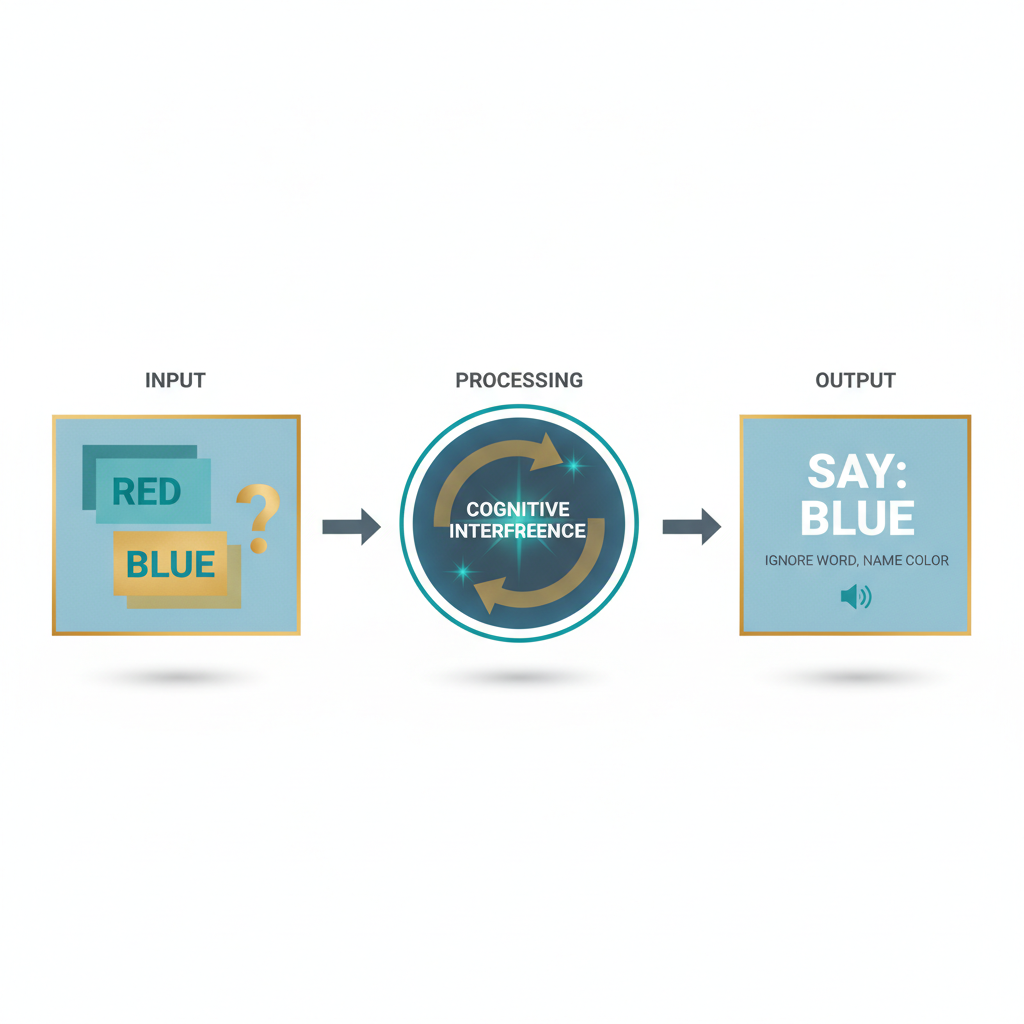
An abstract, educational infographic visualizing the operational mechanics of the Stroop Test. Create a simplified, stepwise process diagram using clean geometric shapes and directional arrows. Show an ‘Input’ stage with conflicting stimuli (e.g., the word ‘RED’ colored blue), a ‘Processing’ stage where cognitive interference occurs, and an ‘Output’ stage representing the required response (e.g., naming the color ‘blue’ despite the word). Use layered elements and subtle gradients to represent the cognitive layers involved. The style should be minimalist, vector-based, professional, and approachable. Use a color palette of soft blues, whites, and charcoal, with gold or teal accents to emphasize key stages or points of conflict. Maintain visual hierarchy and ample negative space for short labels. No humans, no cartoon elements.
Congruent vs. Incongruent: A Step-by-Step Example
The Stroop test is a simple way to see how your brain handles information. It shows the conflict between what you do automatically and what you do on purpose. Understanding how it works can teach you about mental focus and flexibility, which are important skills for creative thinking.
Here’s how the classic Stroop test typically works:
The Setup: You will see a series of words. Your task is simple: say the color of the ink the word is written in. Try to be as fast and accurate as you can.
The Congruent Condition: Imagine the word “RED” is printed in red ink. This is a congruent trial because the word and the color match. Your brain processes this easily. There’s no conflict, so you can say “Red” right away. This shows how your brain works well when information lines up.
The Incongruent Condition: Now, imagine the word “RED” is printed in blue ink. This is an incongruent trial. Your brain now has a conflict. Your automatic reaction is to read the word “RED,” but your task is to name the ink color, “Blue.”
The Stroop Effect in Action: This conflict slows you down and makes you more likely to make a mistake. Your automatic habit of reading gets in the way of your goal to name the color. Your brain has to work harder to ignore the word. This extra effort uses your selective attention and cognitive control. Most people take longer to name the color in incongruent trials than in congruent ones [4].
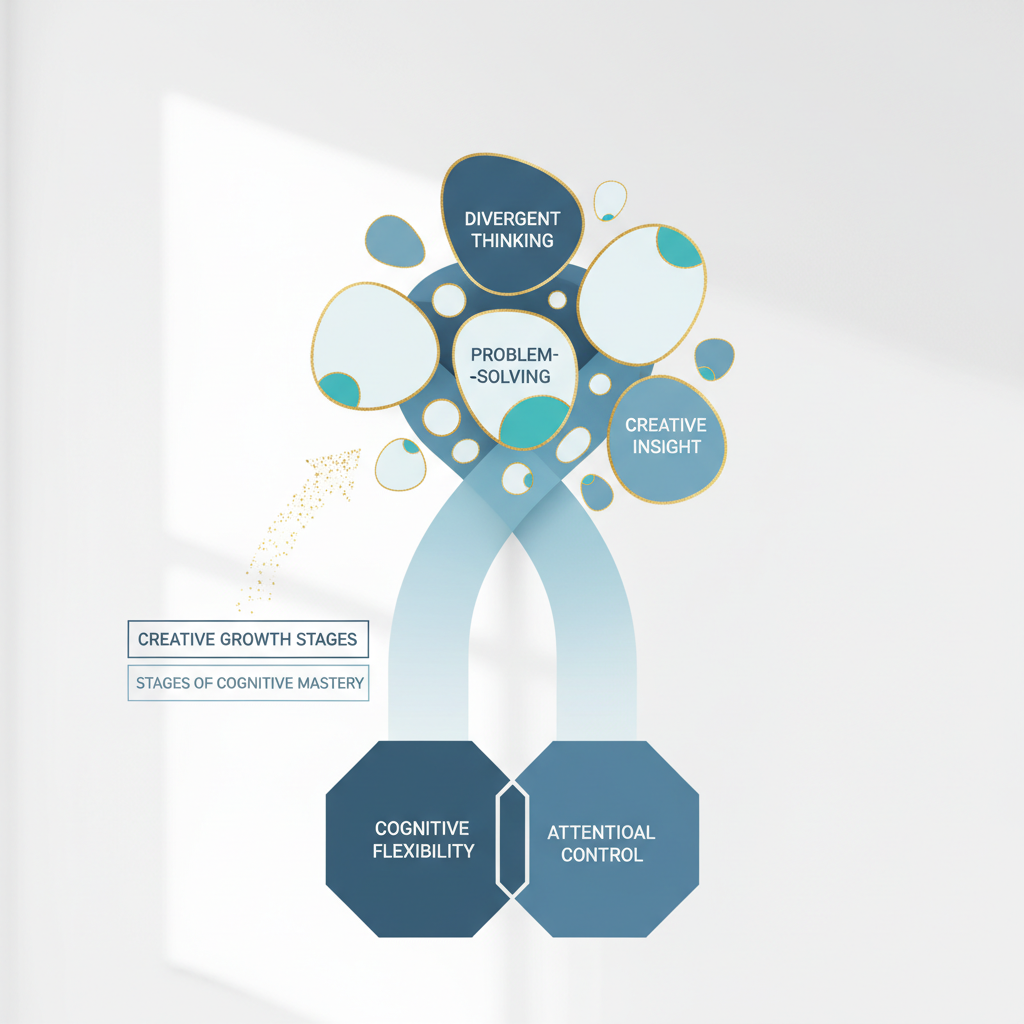
This struggle to ignore an automatic habit and focus on a task is a key part of cognitive control. The ability to direct your attention and manage distractions is very useful for creative problem-solving. It helps you find new ideas instead of getting stuck in old ways of thinking.
Try a Quick Stroop Effect Game Online
The best way to understand the Stroop effect is to try it yourself. You can find online versions of the test on many psychology and educational websites. Playing it for a few minutes will give you a real look at how your own brain works.
When you play a quick Stroop game, pay attention to:
Your Reaction Time: Notice how much longer it takes to respond when the word and color don’t match. This shows how strong your automatic reading habit is.
Your Error Rate: See if you make more mistakes when the word and color clash. This shows moments where your brain’s control slips a little.
Your Mental Effort: Feel the mental “push” it takes to name the ink color instead of reading the word. This is your brain working to ignore the conflicting message.
Trying the game gives you a clear example of your mental focus and flexibility in action. It’s a small workout for your brain that shows you how it handles competing information. You can use this skill to become more creative. For example, it helps you look at problems in new ways or ignore the usual ideas when you need a fresh solution. You can try a version of the test here [5].
Are There Different Versions of the Stroop Test?
The Emotional Stroop Test
The classic Stroop test uses color words, but some versions add a twist. One is the Emotional Stroop Test. Here, you see words that trigger strong feelings instead of words like “red” or “blue.”
For example, you might see words like “fear,” “sadness,” “joy,” or “success.” Your task is the same: say the ink color of each word as fast as you can. But the feeling behind the word can slow you down.
This slowdown is called emotional interference. It happens because our brains naturally pay more attention to emotional words [6]. You get drawn into the word’s meaning, even when you’re trying to focus on its color.
Understanding this effect can help you be more creative:
Manage Emotions: Creative work requires focus. This test shows how easily emotions can distract you. When you learn to manage these feelings, you can concentrate better on creative tasks.
Think Flexibly: Strong emotions can make you feel stuck in one way of thinking. When you notice this happening, you can learn to shift your focus. This helps you think more flexibly and move past emotional blocks.
Know Yourself: Noticing which words slow you down can show you what you’re sensitive to. This self-awareness is key for personal growth and finding new ways to be creative.
At Creative Ability Test, we focus on understanding these mental patterns. When you see how emotions affect your focus, you get tools to improve your creative process. This helps you grow steadily and perform your best.
Numerical and Spatial Variations
The Stroop test is very flexible. Psychologists have created other versions to study different mental skills. Two examples are the numerical and spatial tests.
Numerical Stroop Test
This version uses numbers. Imagine seeing the number ‘3’ shown on the screen several times. Your job is to count how many times it appears. The challenge is that the number’s value (‘three’) can interfere with your count [7].
For example, if the number ‘3’ appears four times, your brain wants to think “three” even though you need to count “four.” This conflict shows how automatic reading numbers is for us. The test measures how well you can ignore the wrong information.
This test reveals how flexible your thinking is. Creative work often requires you to look past the obvious and focus on a specific detail. This skill is essential for coming up with new ideas.
Spatial Stroop Test
The Spatial Stroop Test uses location and direction. You might see a word like “UP” or “DOWN” on a screen. But the word’s position might not match its meaning. For example, the word “UP” could show up at the bottom of the screen.
Your task is to say where the word is (top or bottom), not read what it says. Just like the other tests, the word’s meaning can slow you down. This shows how your brain handles confusing signals about location.
These variations show a lot about your creative thinking:
Be More Flexible: These tests challenge your brain to adapt by switching rules. This mental flexibility is key for brainstorming and discovering new possibilities.
Solve Problems Better: Learning to ignore these distractions is great practice for problem-solving. It trains your brain to filter out noise and focus on what’s important, helping you find creative solutions.
Focus on Details: The tests show how hard it can be to pay attention to one thing and ignore another. Getting better at this skill helps you analyze things more deeply and produce more thoughtful creative work.
These different Stroop tests show that mental focus has many parts. At Creative Ability Test, our assessments explore these areas. We give you personalized feedback on your mental strengths to help you use your creativity in practical, everyday situations.
How Can Understanding the Stroop Effect Boost Your Creativity?
An abstract, educational infographic visualizing how understanding the Stroop Effect can boost creativity. Depict a layered system or a progressive pathway, starting from ‘Cognitive Flexibility’ and ‘Attentional Control’ (represented by foundational geometric shapes) and leading upwards or outwards to ‘Divergent Thinking’, ‘Problem-Solving’, and ‘Creative Insight’ (represented by expanding, interconnected shapes or idea clusters). Use subtle gradients and accent highlights to show growth and connection. The style should be minimalist, vector-based, professional, and approachable. Use a color palette of soft blues, whites, and charcoal, with gold or teal accents to highlight creative outcomes. Incorporate negative space for short labels indicating stages of creative growth. No humans, no cartoon elements.
Improving Your Focus for Deeper Work
The Stroop Effect shows how our brains work. Some tasks, like reading, are automatic. But other tasks, like naming a color while ignoring the word itself, require deliberate focus.
This struggle shows why managing distractions is so important for creative work. Staying focused helps you explore complex ideas without losing your train of thought.
Deep focus means concentrating on one task without getting distracted. It’s how you come up with truly new solutions and insights. Research shows that being focused can make you more creative [8].
Here are a few ways to improve your focus for creative work:
Minimize Distractions: Create a quiet workspace. Turn off notifications. Avoid multitasking.
Practice Single-Tasking: Focus on one creative task at a time. Finish it before starting the next one.
Engage in Mindfulness: Short meditation exercises can improve your ability to focus. This helps you stay present.
Schedule Focused Blocks: Set aside specific times for uninterrupted creative work. Protect this time from interruptions.
Understanding how your mind works, including your ability to focus, is a key benefit of the Creative Ability Test. Our test measures your ability to pay attention and offers strategies to improve this vital skill. Better focus leads to stronger creative output and problem-solving.
Enhancing Cognitive Flexibility for Innovative Thinking
To beat the Stroop Effect, you need cognitive flexibility. This is your brain’s ability to switch tasks or adapt to new rules. You have to ignore your automatic urge to read the word and instead focus on naming the color.
This mental flexibility is key to innovation. Creative people are great at looking at problems from different angles. They connect ideas that don’t seem related and try a new approach when the first one doesn’t work.
Cognitive flexibility helps you see things in new ways. It encourages “divergent thinking”—the skill of coming up with many different ideas. Studies show a strong link between this flexibility and creative problem-solving [9].
To build your cognitive flexibility and be more innovative, try these tips:
Embrace Novelty: Try new activities regularly. Learn a new skill or take up a new hobby. Explore subjects that are new to you.
Solve Puzzles and Brain Teasers: Do activities that challenge you to think differently, like riddles or logic games.
Challenge Assumptions: When you face a problem, question your first instincts. Look for other ways to see it.
Practice Brainstorming: Come up with as many ideas as you can without judging them. Allow for wild or unusual connections.
The Creative Ability Test measures your cognitive flexibility. Our test gives you a full picture of this key creative skill, and our personalized feedback offers practical tips to improve it. These strategies will help you adapt, innovate, and think outside the box. Unlock your creative potential by understanding how your mind works.
Frequently Asked Questions
How is a Stroop test interpreted?
A Stroop test shows how well your brain handles conflicting information. It measures your cognitive control, which includes your attention and how efficiently you process things.
When you take a Stroop test, experts look at a few key measurements:
Reaction Time: This is how fast you respond. A quicker response means your brain is working efficiently.
Accuracy: This is how many answers you get right. A high score shows good focus.
The Interference Effect: This is the most important measurement. It compares your reaction time in easy trials (where the word and color match) to your time in hard trials (where they conflict). A big difference in your times suggests a stronger “Stroop effect” [4].
A smaller interference effect is a good sign. It means you have strong selective attention and cognitive flexibility. In other words, you’re good at focusing on a task and ignoring distractions. These skills are key for creative thinking, exploring new ideas, and solving problems.
Understanding your results gives you a peek into how your brain works. You can see how you deal with mental conflict. This knowledge can help you improve your focus and adaptability, which are essential for boosting your creativity.
Can I take a real Stroop test online?
Yes, you can find many versions of the Stroop test online. They’re a fun way to see the effect for yourself and a great introduction to the concept. But it’s important to know the difference between online tests and clinical ones.
For an official psychological assessment, you need a standardized test given by a qualified professional [10]. These formal tests guarantee accurate conditions and interpretation, and they are used for clinical diagnosis or research.
Still, online versions are great for learning more about yourself. They help you understand the concept by seeing it in action. While our Creative Ability Test does not have a Stroop test, our comprehensive 30-question platform measures similar core skills. These include cognitive flexibility, divergent thinking, and problem-solving. We give you personalized insights into your creative strengths and offer clear strategies to help you grow.
If you take an online Stroop test, try to find one from a trusted source, like a university or a psychology website. They usually explain the results in a simple way. Remember, even a basic online test can spark curiosity about your brain’s amazing abilities.
What are some real-world Stroop effect examples?
The Stroop effect happens all around us, not just in a lab. It shows up in our daily lives in small ways. These examples help show how your brain works and why it’s important to avoid mental overload.
Here are a few common scenarios:
Reading Traffic Signs: Imagine a “STOP” sign painted green. Your brain automatically reads the word “STOP” but sees the color green, which usually means “GO.” This conflict slows down your reaction time.
Following a Recipe: You’re following a recipe that says to add “white sugar,” but the sugar is in a red container. For a split second, the red color might distract you from the word “sugar,” making you hesitate.
Brand Logos and Advertising: Some ads use colors that clash with a brand name to get your attention. This can create a small Stroop effect, making the brand name a little harder to read at first glance.
Multitasking in a Noisy Environment: You’re trying to have a conversation in a noisy room. Your brain has to work hard to focus on the voice you want to hear and ignore all the other sounds. This is like the Stroop test, where you have to ignore the word and focus on the color.
Using Digital Interfaces: You see a button that says “Submit” but is colored red. Since we usually associate red with “Cancel” or “Stop,” this mismatch can make you pause or even click the wrong thing.
These examples show that our brains use extra energy to sort through conflicting information. When you notice the Stroop effect in your life, you can change your environment to reduce distractions and improve your focus. This awareness can free up mental space, making it easier to be creative and find new solutions.
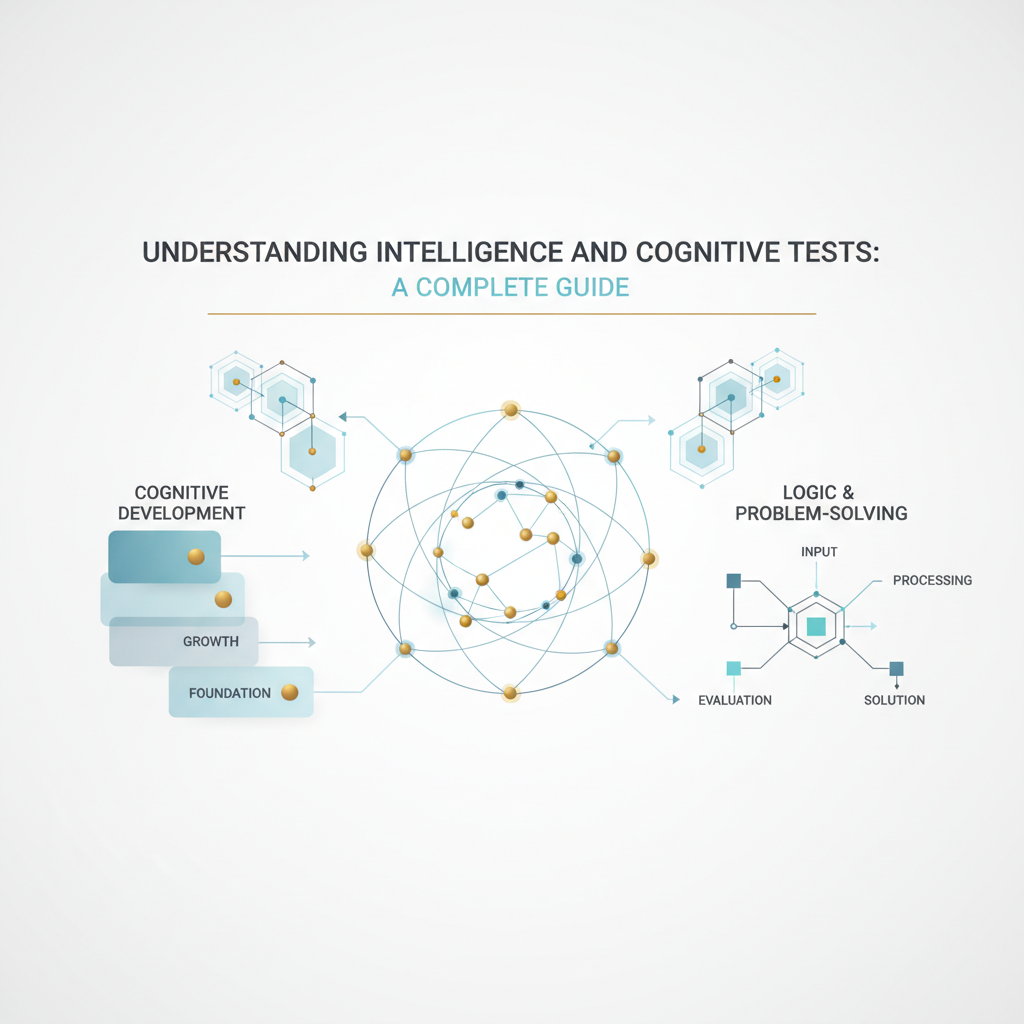
Intelligence and cognitive tests are standardized assessments designed to measure various mental abilities, including reasoning, problem-solving, memory, and comprehension. Psychologists use these tools to evaluate an individual’s intellectual potential, cognitive strengths, and areas for development, providing insights into different facets of human intellect.
Have you ever stopped to think about how powerful your mind is? Your ability to solve problems, generate ideas, and handle complex situations comes from a unique set of mental skills. For centuries, we have been fascinated by what makes us think, learn, and create. Today, intelligence tests and other cognitive assessments provide a scientific way to understand these processes. They offer insights that go beyond a simple score and connect directly to your creative potential.
This guide will break down the world of intelligence and cognitive tests. We’ll explore what a standard intelligence test measures and look at modern assessments for emotional intelligence and flexible thinking. You’ll learn why these tests are so valuable, not just in school, but for anyone interested in personal and professional growth. By understanding your specific mental strengths, you can improve your problem-solving skills, think more innovatively, and tap into your own creativity.
Whether you want to know where to take an IQ test, which test is best for you, or how these tools work, this guide can help. We will explore the strong connection between intelligence and creativity. Let’s begin by explaining what intelligence and cognitive tests are and why they matter.
What Are Intelligence and Cognitive Tests?
The Difference Between Intelligence and Cognitive Ability
People often use the words “intelligence” and “cognitive ability” as if they mean the same thing. While they are closely related, they describe different parts of how our minds work.
Intelligence is your general ability to learn, reason, solve problems, and adapt to new situations. It’s a broad skill. Think of it as the total horsepower of your mind.
On the other hand, cognitive abilities are the specific mental skills you use to do things. They are the building blocks of intelligence. Think of them as the individual tools in your mental toolbox. [1]
Here are the key differences:
Intelligence: A broad concept. It shows how well you use your mental tools.
Cognitive Abilities: Specific mental skills. These include memory, attention, processing speed, and problem-solving.
For example, quickly switching between ideas during a brainstorm is a cognitive ability called “cognitive flexibility.” Your intelligence is shown in how well you use that flexibility to come up with new solutions.
At Creative Ability Test, we understand this difference. Our platform helps you discover the specific cognitive abilities that power your creativity. We focus on finding your unique strengths in areas like divergent thinking and cognitive flexibility. This helps you understand your creative potential and find ways to grow it.
Why These Tests Are Used in Psychology
Psychologists use intelligence and cognitive tests for many important reasons. These tests offer a clear look into how people think, learn, and interact with the world.
Here are the main ways they are used:
Understanding Individual Differences: Tests show us the unique ways different people process information. This is key for creating personalized learning plans.
Educational Planning: They can identify different learning styles or point out where someone might struggle. Schools use this to improve their teaching methods.
Clinical Diagnosis: Psychologists use these tests to help diagnose conditions that affect how the brain works, such as learning disabilities or other developmental disorders.
Research and Development: Scientists study how we think to better understand the brain. This research helps find new ways to support mental health and performance. [2]
Career Guidance: Knowing your cognitive strengths can help you choose a career path that matches your natural skills to the right job.
Psychologist Gifted Testing: These assessments are used to identify individuals with exceptional intellectual potential, helping to guide educational and developmental pathways. Learn more in our complete guide to gifted testing.
If you’re interested in self-improvement, these tests are powerful tools. They give you a clear map of your mind. For example, knowing your cognitive strengths can show you why you’re good at certain creative tasks. It also points out areas where practice can make a big difference.
Creative Ability Test uses this scientific approach. Our 30-question test is designed to measure your creativity and related cognitive skills. We turn complex psychological ideas into clear, useful feedback. This helps you move beyond just taking a test to truly understanding and improving your creative process. Our goal is to build your confidence and guide your creative growth.
What is standardization in intelligence testing?
The Role of Norms and Validity
To understand your creativity, you need reliable insights. That’s why standardized tests are so important. They make sure that creativity tests provide consistent results every time. This creates a fair way to compare scores and gives you a clear picture of your unique strengths.
When you take a test, it’s helpful to compare your score to others. That’s what norms are for. Norms are the average scores from a large, diverse group of people. They show how your score compares to theirs. For example, a score of 120 doesn’t mean much on its own. But if you know the average is 100, your score suddenly makes sense. We use norms to give you a personalized look at your creative skills, showing you where you stand in areas like creative problem-solving.
Validity is another key idea. It asks a simple question: does the test actually measure what it says it does? A valid test truly measures your creative skills. Without validity, the results are meaningless. A test is checked for different types of validity to make sure it’s solid:
Content validity: Does the test cover all important parts of creativity? Our 30-question test looks at many different sides of creativity to give you a full picture.
Construct validity: Does the test measure the idea of creativity in a way that lines up with accepted ideas in psychology? [3].
Predictive validity: Can the test suggest future success in creative tasks? Does it show your potential for innovative thinking?
When you know a test is valid, you can trust your results. It means our platform gives you useful information about your creative strengths. As a result, you get practical insights you can use to grow.
Ensuring Fairness and Accuracy in Measurement
A good test isn’t just valid; it’s also reliable. Reliability simply means the test gives you consistent results. For example, if you took our test twice without any change in your skills, you’d expect to get a similar score. When a test is reliable, you can trust the insights it gives you. This lets you confidently track your growth over time and provides a solid base for improving your creativity.
Standardized tests also focus on fairness. They are designed to reduce bias related to culture, language, or background. The questions are made to be clear and fair for everyone, without favoring any specific group. For instance, a good test avoids phrases or references that only people from one culture would understand. This creates a level playing field, so your results reflect your true creative potential.
When a test is both reliable and valid, it is accurate. An accurate test gives you a precise measurement of your skills, which is key for self-improvement. Our science-based approach is built on accuracy. We provide clear, easy-to-understand explanations of your creative traits and what your results mean. This helps you gain insights that build your confidence.
Knowing a test is fair and accurate gives you the power to act. You can feel confident using our personalized strategies to improve your ability to think in new ways and solve problems. You’ll move from feeling uncertain to having a clear path forward. This leads to a deeper understanding of yourself and helps you keep growing and innovating.
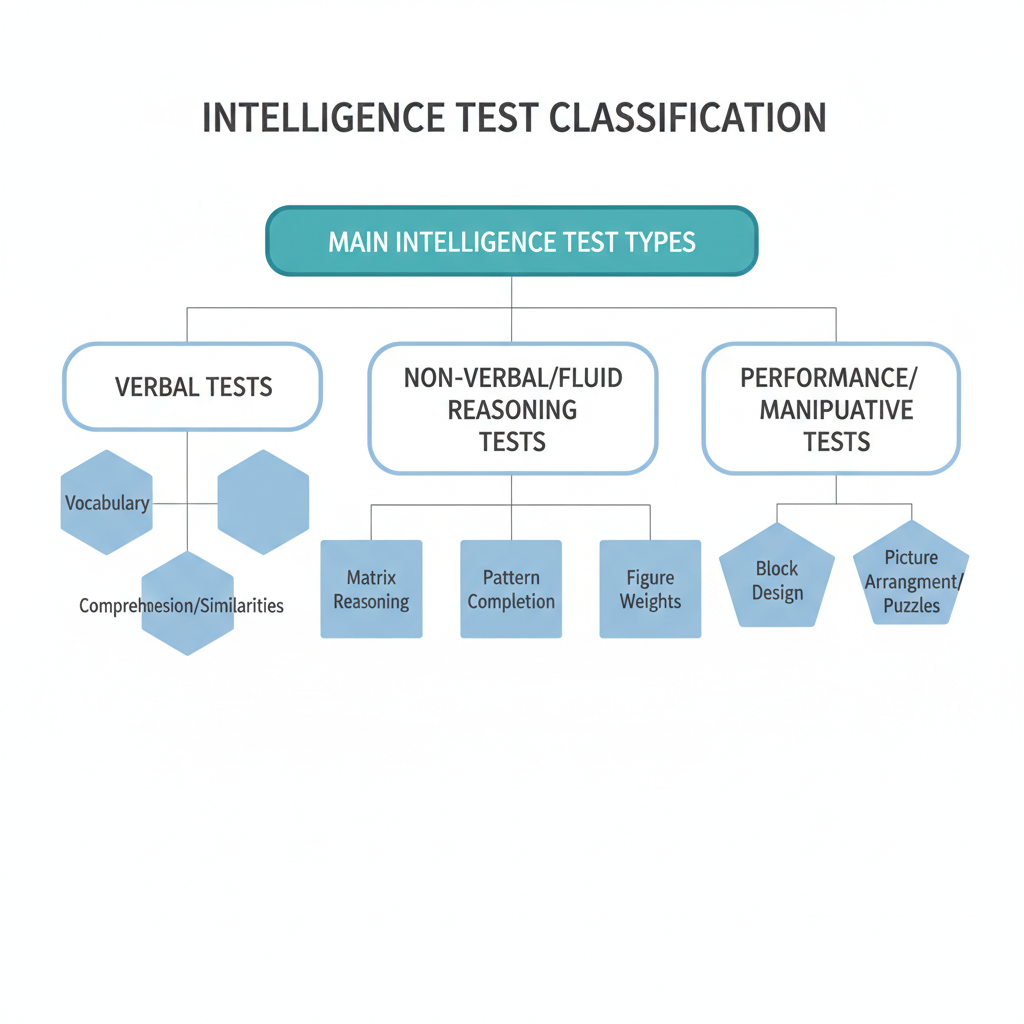
What Are the Main Types of Intelligence Tests in Psychology?
A minimalist, vector-based infographic presenting a structured competency map or classification chart of the main types of intelligence tests in psychology. The visual organizes different test categories (e.g., ‘Verbal’, ‘Non-Verbal’, ‘Performance’) as distinct, geometrically shaped nodes connected by subtle lines or arranged in a clear hierarchy. Each node has short labels representing test types or sub-categories. Use soft blues, whites, and charcoal for the main structure, with gold or teal accents for key category headers. Emphasize clean lines, ample negative space, and professional clarity. No humans, no cartoon elements.
Verbal and Non-Verbal Intelligence Tests: Understand the key differences between tests that rely on language and those that use visual puzzles to measure cognitive skills. Read our simple guide to both test types.
Individual vs. Group Tests
Intelligence tests come in two main formats: individual and group. Knowing the difference is important.
Personalized Pace: The expert can adjust the test to your speed.
Detailed Observation: They can see your thought process, which offers a deeper understanding.
Deeper Insights: These tests can show your specific strengths and weaknesses.
Creative Problem-Solving: They can show how you handle new problems, which is a key part of creativity.
Group intelligence tests are given to many people at once. They use the same instructions for everyone and often have a time limit. These tests save time and money when testing large groups. For example, some school entrance exams are group tests.
Efficiency: Many people can be tested at the same time.
Standardization: Everyone gets the same instructions.
General Screening: They are good for getting a broad sense of people’s abilities.
Initial Insights: Group tests can provide a first look at thinking skills.
While group tests are useful, individual tests often give a more complete picture. They are better at showing different ways of thinking, which is important for creativity.
Verbal Intelligence Tests
Verbal intelligence tests measure how well you understand and use language. They look at your vocabulary, comprehension, and reasoning with words. Good verbal skills are essential for communicating and sharing complex ideas.
Common tasks in verbal tests include:
Vocabulary: Explaining what words mean.
Analogies: Finding connections between ideas (e.g., “Cat is to Kitten as Dog is to ______”).
General Knowledge: Answering questions about common facts.
Reading Comprehension: Reading a passage and explaining its meaning.
For creative people, being good with words is a big advantage. It helps you explain new ideas clearly and share detailed solutions with others. This skill helps you brainstorm new possibilities and put them into practice.
Non-Verbal and Performance Tests
Non-verbal intelligence tests check your problem-solving skills without using words. They focus on reasoning with pictures, understanding space, and spotting patterns. They are also known as “performance tests.”
These tests show how flexible your thinking is and how you process visual details. This kind of intelligence is often key to hands-on creativity in fields like design, engineering, and art.
Common tasks in non-verbal tests include:
Block Design: Arranging blocks to match a picture.
Picture Completion: Finding what’s missing in an image.
Matrix Reasoning: Finishing a sequence of patterns.
Spatial Puzzles: Turning shapes around in your mind.
Solving these puzzles shows you can think in pictures and understand abstract ideas. These skills are basic tools for creative problem-solving. They help you “see” solutions that others might miss. The Creative Ability Test, for example, also looks at this kind of flexible thinking to help you find your unique creative strengths.
Standardized Intelligence Tests (IQ Tests)
Standardized intelligence tests are better known as “IQ tests.” Their goal is to provide a number, or score, that represents a person’s thinking skills. These tests are carefully created and checked to make sure they are fair and reliable [4].
Standardization makes the test fair. It means everyone takes and is scored on the test in the same way. This allows results to be compared accurately. Your score is compared to the scores of a large group of people who represent the general public.
The final IQ score offers a quick look at different thinking skills, such as reasoning, memory, and how quickly you process information. A score of 100 is typically the average.
While IQ tests measure important skills, they don’t tell the whole story about creativity. Creativity is more than just standard intelligence. It includes unique ways of thinking, being open to new things, and the ability to brainstorm many different ideas.
The Creative Ability Test looks deeper than a standard IQ score. It measures the specific parts of your creative thinking. It helps you see how your thinking skills can lead to new ideas. This platform gives you personal feedback and practical steps to help you grow. It helps you move from being unsure about your skills to knowing how to improve them, supporting your creative growth in a clear, structured way.
Traditional Intelligence Tests: Get a comprehensive overview of traditional intelligence tests, what they measure, and how they provide a baseline for understanding cognitive abilities. Read our complete guide to traditional tests.
A Closer Look at Wechsler Intelligence Tests (WAIS & WISC)
When people talk about intelligence tests, they often mention the Wechsler Intelligence Scales. These well-designed tests give us a deep look into how our minds work. They are a key tool in psychology for understanding a person’s thinking style.
At Creative Ability Test, we focus on your creative potential. Still, learning about tests like the Wechsler scales can give you a fuller picture of your thinking strengths. It helps show how basic thinking skills are the foundation for your creativity.
Wechsler Adult Intelligence Scale (WAIS)
The Wechsler Adult Intelligence Scale (WAIS) is a top intelligence test for adults. It measures the thinking skills of people from 16 to 90 years old. [5] This test does more than give you a single IQ score. It creates a detailed map of your different mental strengths.
Learning about your thinking style can be powerful. It shows you how you handle information, solve problems, and adjust to new challenges. For example, strong language skills can help you explain complex creative ideas. Good visual skills can help you picture new solutions.
Wechsler Intelligence Scale for Children (WISC)
The Wechsler Intelligence Scale for Children (WISC) is like the WAIS, but it’s made for kids. It measures the thinking skills of children and teens from 6 to 16 years old. [6] This test helps find a child’s learning style and mental strengths. This allows parents and teachers to give them the right kind of support.
Understanding a child’s thinking style early on is very helpful. It lets us encourage their unique way of thinking. It also helps them build key skills for creative work and problem-solving from a young age. This strong start can unlock a child’s full creative potential.
What These Scales Measure
The WAIS and WISC are very detailed tests. They measure intelligence in a few key areas of thinking. These areas show the different ways we process information and engage with the world. Together, they create a complete picture of a person’s mental abilities.
Both tests typically assess four main index scores:
Verbal Comprehension Index (VCI): This measures how well you understand and use language. It shows your ability to learn facts and reason with words.
Perceptual Reasoning Index (PRI): This assesses your ability to think without words. It includes solving visual puzzles and seeing patterns.
Working Memory Index (WMI): Working memory is your mental workspace for holding and using information. This index measures how much you can hold and work with in your mind at one time.
Processing Speed Index (PSI): This measures how quickly and accurately you can scan and understand visual information. It shows how fast and efficient your mind is at certain tasks.
Each of these indices plays a role in our creative abilities. For instance:
Verbal Comprehension helps you explain new ideas clearly. It also helps you understand complicated project instructions.
Perceptual Reasoning is key for visual arts and design. It helps you see new connections between ideas that seem unrelated. This is a big part of creative thinking.
Working Memory lets you juggle several ideas at once when you brainstorm. It helps you link different pieces of information to create new solutions. This mental flexibility is key for innovation.
Processing Speed helps you come up with ideas quickly and change your creative approach when needed. It allows you to switch smoothly between different ways of thinking.
By learning about these core thinking skills, you get a better look at your personal thinking style. This isn’t just about an IQ score. It’s about understanding the building blocks of your creativity. You can use this knowledge to grow personally and professionally.
At Creative Ability Test, we build on these ideas. Our 30-question test measures how your thinking skills turn into real-world creative abilities. We provide personal feedback and clear steps you can take. This helps you improve your creative thinking and problem-solving skills.
Exploring Emotional Intelligence (EQ) Tests
What is Emotional Intelligence?
Emotional Intelligence (EQ) is more than just book smarts. It’s your ability to understand and manage your own emotions. It also includes recognizing and influencing the emotions of others. This important skill affects every part of your life, from your relationships and career to your general well-being.
Many experts believe EQ is just as important as IQ [source: https://hbr.org/2017/02/what-makes-a-leader]. A strong EQ helps you handle challenges well. It also improves communication and teamwork. For creative people, EQ is a special advantage. It helps you pick up on subtle emotions. This can inspire creative work that is more powerful and relatable.
Emotional intelligence includes several key parts:
Self-Awareness: Knowing your own emotions, strengths, weaknesses, values, and goals. This helps you understand what drives your creativity.
Self-Regulation: Controlling your impulses and thinking before you act. This helps you bounce back from creative blocks.
Motivation: Having a strong inner drive to succeed. This pushes you to keep developing new ideas.
Empathy: Understanding how others feel. This helps you create solutions and art that truly connect with people.
Social Skills: Building good relationships and networks. Strong social skills make it easier to work with others and share ideas.
Understanding your EQ helps you grow personally and professionally. Just as the Creative Ability Test shows your creative strengths, EQ insights show how you connect with the world around you.
Common EQ Assessments (e.g., MSCEIT)
Different tests can measure emotional intelligence. These tools give you a better sense of your emotional skills. They often show you areas where you can improve.
One of the most trusted, well-researched EQ tests is the Mayer-Salovey-Caruso Emotional Intelligence Test (MSCEIT) [source: https://www.eiconsortium.org/assessments/msceit.html]. Unlike quizzes where you rate yourself, the MSCEIT is an ability-based test. It gives you different situations and asks you to find the best emotional response. This measures your actual skill, not just how skilled you think you are.
The MSCEIT measures four main areas of emotional intelligence:
Perceiving Emotions: Recognizing emotions in faces, images, voices, and art.
Using Emotions: Using emotions to help you think and solve problems.
Understanding Emotions: Understanding emotional language and how different feelings are related.
Managing Emotions: Managing emotions in yourself and others. This is key for leading creative teams well.
Taking an EQ test can teach you a lot about yourself. It gives you a starting point for understanding your emotional skills. This knowledge helps you pinpoint what to work on. For example, better emotional control can prevent creative burnout. More empathy can lead to new ideas that are focused on people. Like the insights from the Creative Ability Test, this information gives you clear steps for improvement.
How to Improve Your Emotional Intelligence
Emotional intelligence isn’t fixed. It’s a skill you can build and improve over time. With practice, you can raise your EQ. This can lead to more creativity and a greater sense of fulfillment.
Here are practical ways to boost your emotional intelligence:
Practice Self-Reflection: Set aside time each day to think about your feelings. Ask yourself why you felt or acted a certain way. Writing in a journal can help.
Seek Feedback: Ask trusted friends or colleagues for their honest thoughts. Find out how your emotions affect them. Helpful feedback can show you what you might be missing.
Observe Others: Pay attention to more than just words. Notice people’s body language and tone of voice. This will improve your empathy and social awareness.
Mindful Breathing: When you feel overwhelmed, stop and take a few deep breaths. This simple action helps you control strong emotions and think more clearly.
Practice Active Listening: Focus completely on what someone is saying. Don’t interrupt. Try to understand their point of view before you reply. This makes you a better communicator.
Learn from Setbacks: See challenges as chances to grow. Think about the emotions involved when something goes wrong. Plan how you could handle it differently in the future.
Build Empathy: Read books and watch films about different kinds of people. Try to understand different points of view. This broadens your understanding of others.
Practice Saying No: Know your limits and be clear about them in a respectful way. This shows self-respect and helps you manage your energy.
Improving your EQ is a big help on your creative journey. Better self-awareness helps you understand your own creative style. Good social skills make it easier to create with others. And managing your emotions helps you push through creative blocks. The Creative Ability Test shows you your creative strengths. Building your EQ adds another layer to that, helping you use your creative talents more effectively.
Understanding Cognitive Psychology Tests
A minimalist, vector-based infographic illustrating key areas covered by cognitive psychology tests. The visual is a conceptual mind map or idea cluster, with a central node ‘Cognitive Tests’ in charcoal branching out to distinct, geometrically defined sub-areas like ‘Memory’, ‘Attention’, ‘Problem Solving’, ‘Language’, and ‘Perception’ in soft blue, with gold/teal highlights for emphasis. Each sub-area node might contain smaller conceptual icons or short labels representing specific assessment aspects. The layout uses ample negative space for readability and features clean lines with subtle gradients. No humans, no cartoon elements.
Cognitive psychology is the study of our mental processes. These are the complex ways our minds work, shaping how we think, learn, and see the world. Three key processes are memory, perception, and attention. They form the foundation for all higher-level thinking, including creativity.
Psychology Brain Tests: Curious about what a psychology brain test can reveal? These assessments help you understand your unique cognitive and creative thinking style. Find out what’s your creative thinking style.
When we understand these core functions, we can unlock our creative potential. Our creative ability test provides insights into how you use these skills. This helps you develop personal strategies for growth.
Assessing Cognition: Memory, Perception, and Attention
Memory: The Storehouse of Ideas
Memory is more than just recalling facts. It’s how we save and recall information. Different types of memory play a unique role in creativity:
Working Memory: Think of this as your mental workbench. It holds information for a short time while you work with it. Creative problem-solving uses working memory to manage many ideas at once [7].
Long-Term Memory: This is a vast storehouse of all our knowledge and experiences. Pulling different kinds of information from long-term memory is key. This allows us to connect unrelated concepts and form new ideas.
Memory Tests in Psychology: Understand the different types of memory tests used by psychologists and what they reveal about your cognitive functions. Read our guide to memory tests and quizzes.
Improving your memory can directly boost your ability to innovate. It helps you draw on a wider range of past experiences and knowledge.
Perception: Shaping Our Reality
Perception is how we interpret what we sense. It turns raw data, like sights and sounds, into meaningful experiences. Creative people often have a unique way of seeing the world. They notice details others might miss and connect ideas that seem unrelated.
Perception Tests in Psychology: Explore how perception tests reveal your unique way of interpreting the world, a foundational skill for unlocking creative insights. Learn how seeing differently unlocks creativity.
For example, an artist might see colors and shapes in a fresh way. A scientist might spot patterns in data that lead to breakthroughs. Your ability to see things differently is a powerful creative tool.
Attention: Focusing Creative Energy
Attention is our ability to focus our mental energy. It means choosing what to focus on while ignoring distractions. There are several types of attention:
Sustained Attention: This is your ability to stay focused for a long time. It’s essential for deep work and solving tough problems.
Selective Attention: This means focusing on one thing while tuning out others. It helps you sharpen your ideas and stay on task.
Divided Attention: This is your ability to multitask. It lets you track several creative ideas at the same time.
Strong focus allows you to engage more deeply with creative tasks. It helps you explore ideas fully and bring your creative visions to life. Our assessment highlights how your attention patterns support your unique creative style.
The Stroop Test: Measuring Cognitive Flexibility
Cognitive flexibility is a key part of creative thinking. It allows us to adapt, switch perspectives, and overcome mental blocks. A classic tool for measuring this skill is the Stroop Test.
What is the Stroop Test?
The Stroop Test is a simple but challenging task. You are shown words printed in different colors. Your job is to name the color of the ink, not read the word. For example, if the word “RED” is printed in blue ink, you must say “blue.” [8]
What it Measures
This test shows a conflict between your brain’s automatic and controlled processes. Reading is automatic for most adults, but naming a color requires controlled focus. Any delay or mistakes you make show your level of cognitive flexibility. It shows how well you can:
Basically, the Stroop Test measures how well your brain can adapt and switch gears.
The Creative Link: Why Cognitive Flexibility Matters
Creative people are often very good at cognitive flexibility. They can easily switch between different ways of thinking. This allows them to explore many different solutions. It helps them rethink problems when their first approach doesn’t work. This flexibility is key for divergent thinking, a core part of creativity.
Your Creative Ability Test results help you understand your cognitive flexibility. We provide strategies to improve this skill. This helps you create more innovative ideas and solve complex problems.
Fluid vs. Crystallized Intelligence Tests
Intelligence isn’t just one single thing. Psychologists often break it down into two main types: fluid and crystallized intelligence. Both are important, but they help our creative skills in different ways.
Fluid Intelligence (Gf)
Fluid intelligence is your ability to reason and solve new problems. It helps you see complex patterns and handle new information without past experience. Think of it as your raw mental horsepower. Fluid intelligence is often strongest in young adulthood and slowly declines over time [9].
Tests for fluid intelligence often include:
Abstract reasoning puzzles.
Pattern recognition tasks.
Logic problems.
Figural analysis.
Fluid Intelligence Test: Discover how fluid intelligence tests assess your ability to solve new problems and think abstractly, which are key components of your creative potential. Learn more about testing your fluid intelligence.
This type of intelligence is great for coming up with truly original ideas. It helps with creative thinking and solving problems in new situations.
Crystallized Intelligence (Gc)
Crystallized intelligence, on the other hand, is the knowledge and skills you’ve gathered over time. This includes your vocabulary, general knowledge, and expertise. It grows with experience and education and tends to increase throughout your adult life.
Examples of tasks measuring crystallized intelligence include:
Vocabulary tests.
General knowledge questions.
Arithmetic skills.
Understanding of cultural concepts.
This intelligence helps us combine what we already know in new ways. It fuels creativity by giving us a deep well of knowledge to pull from. This leads to smart innovations and practical ideas.
The Creative Synergy
Both fluid and crystallized intelligence are essential for creativity. Fluid intelligence provides the spark for new ideas. It helps us see new patterns. Crystallized intelligence provides the fuel. It gives us the knowledge needed to develop and improve those ideas. A strong balance between the two is ideal for consistent creative work.
The Creative Ability Test helps you understand your personal mix of these cognitive skills. This awareness lets you use your strengths and helps you build a more complete creative toolkit.
Visual Spatial and Perception Tests
Visual-spatial skills are key to many parts of daily life, especially in creative fields. These skills are about understanding and working with visual information. They help us picture solutions and design new concepts.
What Are Visual Spatial Abilities?
Visual-spatial ability is your skill in:
Mentally rotating objects in three dimensions.
Understanding how parts fit together to form a whole.
Navigating and remembering spaces and locations.
Interpreting visual patterns and forms.
Visual Perception IQ Test: Learn how tests focusing on visual perception can offer unique insights into your creative mind and problem-solving abilities. Read our guide to visual perception IQ tests.
This includes tasks like reading a map, assembling furniture, or imagining how a complex system works.
Perception in Action
Perception, in this context, is about how well you process what you see. It’s about making sense of visual information. This includes identifying shapes, telling colors apart, understanding depth, and recognizing objects from different angles.
These tests often include:
Block Design: Arranging blocks to match a given pattern.
Picture Completion: Identifying missing parts of an image.
Visual Puzzles: Assembling pieces to form a complete picture [10].
Mental Rotation: Deciding if two objects shown are the same, even if one is rotated.
The Creative Advantage
Strong visual-spatial skills are a huge plus for creativity. They help people to:
Visualize complex ideas: Artists, architects, and engineers use these skills to picture their designs before making them.
Solve problems creatively: Seeing the “big picture” helps solve many problems. Visual thinkers can map out solutions in their minds.
Innovate in design: Understanding how visual elements work together leads to better, more appealing designs.
Improve abstract thinking: Picturing abstract concepts can make them easier to understand and work with.
The Creative Ability Test helps you discover your strengths in these areas. By understanding your visual-spatial skills, you can use these insights to improve your problem-solving and innovation.
What are the different types of intelligence tests based on theories?
Howard Gardner’s Multiple Intelligences (Multi Intelligence Test)
In 1983, Howard Gardner shared a new idea: intelligence isn’t just one single skill [11]. Instead, he suggested we have many different types of intelligence. This idea goes far beyond a traditional IQ score.
Gardner’s theory encourages us to see the many ways people can be smart. It highlights our different strengths, which is key to understanding creativity. Your personal mix of these intelligences shapes how you solve problems.
Here are Gardner’s main intelligences:
Linguistic Intelligence: Good with words and language. Think of writers, poets, and speakers.
Logical-Mathematical Intelligence: Good with logic, reason, and numbers. Scientists and mathematicians are strong here.
Spatial Intelligence: Good at picturing and moving objects in your mind. Architects and artists often have this.
Musical Intelligence: A feel for rhythm, pitch, and melody. Composers and musicians have this strength.
Bodily-Kinesthetic Intelligence: Great control over your body for sports or expression. Dancers and athletes are clear examples.
Interpersonal Intelligence: Good at understanding and working with other people. Leaders and counselors show this skill.
Intrapersonal Intelligence: Good at understanding yourself, your feelings, and your motivations. Philosophers and thoughtful people often have this.
Naturalistic Intelligence: Good at seeing and grouping things in the natural world. Biologists and environmentalists use this.
Tests based on Gardner’s theory do not give you a single IQ score. Instead, they create a profile of your strengths in these different areas. Understanding your profile gives you powerful insights. It shows how you learn, create, and solve problems best. This knowledge can open up new ways for you to grow and think creatively.
For example, if you have strong spatial intelligence, you might be great at visual problem-solving. Knowing this can help you use that strength for creative tasks. It encourages you to think about how your specific talents can fuel creativity.
Sternberg’s Triarchic Theory (Practical, Creative, Analytical)
Robert Sternberg offered another important view on intelligence. His Triarchic Theory says there are three main types of intelligence [12]. These types work together to help us succeed in life.
Understanding this theory is very useful. It helps you see the many forms intelligence can take. It also shows how these different skills add to your creative potential. Let’s look at each one:
Analytical Intelligence (Componential): This is “book smarts.” It includes solving problems, thinking critically, and judging ideas. People with strong analytical skills can break down complex problems. They look at information logically. This helps when planning and reviewing creative projects.
Creative Intelligence (Experiential): This is the heart of new thinking. It means coming up with fresh ideas and unique solutions. This intelligence lets you think beyond the obvious. You can connect ideas that seem unrelated. A key part of this is divergent thinking, which helps you think outside the box. Our Creative Ability Test helps you explore these very strengths.
Practical Intelligence (Contextual): This is often called “street smarts.” It is the ability to adapt to real-world situations and solve everyday problems. People with strong practical intelligence can handle social situations well. They are also good at managing challenges. This skill ensures your creative ideas are not just new, but also useful and realistic.
Practical Intelligence Test: Learn about practical intelligence, or “street smarts,” and how this real-world problem-solving ability can significantly boost your creative output. See how practical intelligence boosts creativity.
The Sternberg Intelligence Test: Dive deep into Sternberg’s triarchic theory with this ultimate guide covering the interplay of practical, analytical, and creative thinking. Read our guide to the Sternberg Intelligence Test.
Sternberg’s theory stresses that these intelligences are not separate. They work together. For instance, you might use your analytical skills to plan a project. Then, you use creative intelligence to brainstorm new ideas. Finally, you use practical intelligence to make those ideas a reality. Knowing your balance of these three areas helps you understand yourself. It gives you clear ways to improve your problem-solving and creative skills.
Other Notable Tests: Slosson, SB5, and Raven’s Progressive Matrices
Besides these theories, many standard tests measure intelligence. These tests offer different ways of looking at our mental abilities. Each one helps us understand how we think and learn. Learning about these tools shows you just how complex intelligence is.
Here are some well-known examples:
Slosson Intelligence Test (SIT): This is a quick, one-on-one test. It measures verbal intelligence for a wide range of ages. The SIT is often used as a screening tool. It gives a fast estimate of a person’s thinking skills. Its focus on verbal skills can highlight strengths in language and communication. These skills are often vital for explaining creative ideas and working with others.
Stanford-Binet Intelligence Scales, Fifth Edition (SB5): The SB5 is a detailed, one-on-one test. It measures a full range of mental abilities, including both verbal and non-verbal skills. It gives a complete profile of a person’s intellectual strengths and weaknesses [13]. The SB5 is respected for being so thorough. It offers deep insights into different thinking skills. Understanding these skills can show how flexible your thinking is, which is a key part of creative problem-solving.
Raven’s Progressive Matrices (RPM): This is a non-verbal test. It measures your ability to reason and solve new problems. Test-takers find the missing piece in a series of patterns. The RPM is valued for being fair to people from all cultures, since it does not rely on language. Doing well on this test suggests you are good at finding patterns and using logic. These skills are very helpful for creative thinking, as they help you spot new connections and organize complex ideas.
These tests are all different, but they each contribute to a fuller picture of intelligence. They highlight different mental strengths. By understanding these tests, you can get a clearer view of your own thinking style. This insight can help you find new ways to be more creative and use your mind for personal and professional growth.
How Can Understanding Your Cognitive Profile Foster Creativity?
A minimalist, vector-based infographic illustrating the process of fostering creativity through understanding one’s cognitive profile. The central visual is a layered system or a branching pathway representing growth and application. Start with a foundational layer labeled ‘Cognitive Profile Assessment’ in soft blue. Branching upwards, show pathways like ‘Identify Strengths & Gaps’ in charcoal, leading to ‘Tailored Creative Strategies’ with gold/teal accents. Further branches show ‘Divergent Thinking Practice’, ‘Problem-Solving Application’, and ‘Innovation Milestones’. Use clean geometric shapes, subtle gradients, and ample negative space for clarity. The overall aesthetic is professional and encouraging, emphasizing actionable steps. No humans, no cartoon elements.
Connecting Cognitive Strengths to Creative Problem-Solving
Knowing your cognitive profile is a great first step. It shows you how your mind naturally works. This insight helps you unlock and boost your creative skills.
Your cognitive profile shows your favorite ways of thinking. It also points out your strengths, like memory, focus, and logic. These skills shape how you solve problems.
For example, some people are great at divergent thinking, which means coming up with many ideas fast. Others are better at convergent thinking, which is narrowing down options to find the best one. Both skills are important for solving problems creatively.
When you know your strengths, you can use them better. You learn to use your natural talents in creative work. The Creative Ability Test, for instance, can map out these thinking habits. It shows how your skills lead to new ideas [14].
By knowing your profile, you can choose which thinking skills to use. This could mean connecting ideas that don’t seem related. Or it might be looking at tough problems in new ways. In the end, it helps you solve problems more clearly and with fresh ideas.
Using Test Insights for Personal and Professional Growth
Getting insights from a detailed cognitive test is more than just knowing yourself. It gives you a roadmap for growth. Understanding your cognitive profile helps you use your unique talents to grow, both personally and professionally.
Personally, these insights can build your confidence. You discover your natural creative talents. This could be thinking flexibly, understanding big ideas, or spotting patterns. Knowing your strengths gives you the confidence to try new hobbies or learn new things with a clear goal.
For your career, knowing your cognitive profile is very valuable. It helps you find jobs where your creative thinking can shine. You can adjust how you work on projects and with teams. For example, if you’re good at divergent thinking, you could lead brainstorming sessions. If you have strong analytical skills, you can help polish new ideas.
The feedback from tests like the Creative Ability Test gives you practical tips. These tips are designed to help you improve. This could mean becoming a more flexible thinker or a better problem-solver. It turns knowing yourself into a plan for action. It helps you go from being creative once in a while to growing your skills steadily.
Boosting Confidence: Discovering your natural talents and creative intelligence.
Targeted Skill Development: Identifying specific thinking skills to improve.
Informed Career Choices: Matching your strengths with job opportunities.
Enhanced Collaboration: Knowing how your thinking style fits with others on a team.
Overcoming Creative Blocks: Using specific strategies to break through challenges.
Actionable Steps to Enhance Your Cognitive Abilities
Your cognitive profile isn’t set in stone. It can change and grow. With focus, you can greatly improve your creative thinking skills. This helps you think in new ways and become better at solving problems.
Here are practical steps to strengthen your thinking skills, using what you’ve learned from your profile:
Try New Things: Seek out new experiences. Learn a new language or skill [15]. Travel to new places. Trying new things stimulates your brain and makes your thinking more flexible.
Practice Brainstorming: Set aside time to brainstorm without judging your ideas. Use methods like mind mapping or free association. Try to come up with as many ideas as you can, no matter how strange they seem.
Play Strategy Games: Play games like chess, puzzles, or strategy video games. These activities challenge how you solve problems, plan ahead, and pay attention. They can sharpen your analytical skills.
Practice Mindfulness: Meditation and mindfulness can improve your focus and clear your mind. A calm mind is more open to new ideas. Better focus helps you do deeper creative work.
Get Different Viewpoints: Talk to people from different backgrounds and jobs. Their unique views can expand how you think. This can show you new solutions and spark fresh ideas.
Break Your Routines: Change up your daily tasks. Take a different route to work or rearrange your desk. Small changes can break your mental habits and help you make new connections.
Keep Learning: Read books on different subjects. Watch documentaries. Take online courses. Always learning builds up what you know. This gives your brain more material to create new ideas.
Reflect and Journal: Regularly think about how you create and the challenges you face. Keep a journal for your ideas, notes, and solutions. This will help you better understand your own thinking patterns.
By doing these steps regularly, you are actively training your brain. You will build a more flexible, adaptable, and creative mind. The Creative Ability Test is a great starting point. It helps you begin a guided journey to improve yourself and master your creativity.
Frequently Asked Questions
What is an example of a standardized intelligence test?
A great example of a standardized intelligence test is the Wechsler Adult Intelligence Scale (WAIS) [16]. It’s widely used by psychologists. The WAIS measures several cognitive skills in adults and provides a complete IQ score.
Other well-known examples include the Stanford-Binet Intelligence Scales [17] and Raven’s Progressive Matrices. These tests are standardized, which means they are given, scored, and interpreted in the same way for everyone. This allows for fair and accurate comparisons between people.
Taking these tests can give you valuable insights into how you think. You can learn about your unique strengths. This self-awareness can boost your creative problem-solving and help you grow.
Is the SAT basically an IQ test?
No, the SAT is not an IQ test. They have different goals. The SAT (Scholastic Assessment Test) checks if a student is ready for college. It measures skills you learn in school, such as reading, writing, and math [18].
On the other hand, an IQ test aims to measure your general mental ability. It looks at your potential to reason and solve problems. It focuses less on what you’ve learned and more on your natural ability to think. Think of it this way: the SAT shows what you’ve learned, while an IQ test explores your mental horsepower.
While both use thinking skills, they are designed differently and have very different results. The SAT predicts how well you might do in school. IQ tests give a bigger picture of your thinking skills. Knowing the difference helps you understand these two types of tests and can guide your personal growth and educational choices.
What are the 4 types of intelligence tests?
Intelligence tests come in many forms and measure different parts of your thinking skills. Here are four common types, grouped by what they mainly measure:
Verbal Intelligence Tests: These tests check your ability to understand and use language. They often have tasks like vocabulary, reading comprehension, and thinking with words. They show how well you think with words.
Non-Verbal or Performance Tests: These tests focus on visual-spatial skills and often use pictures, shapes, and puzzles. You don’t need to use language for these tasks. They check how well you can handle objects in your mind and understand how things are arranged in space.
Standardized General Intelligence (IQ) Tests: These are complete tests that mix both word-based and visual tasks. Examples include the Wechsler scales. They aim to give an overall score of your thinking ability and provide a full picture of your cognitive skills.
Specific Ability Tests (e.g., Emotional Intelligence, Creativity): These tests look at specific areas of thinking. Emotional intelligence tests measure your ability to understand and manage emotions [19]. Creativity tests, like the Creative Ability Test, explore your creative thinking and problem-solving skills. They highlight unique thinking styles.
Each type gives you different insights into how your mind works. Learning about them helps you understand your unique strengths. This knowledge can help you grow as a person and use your skills well.
What are the 30 questions on a cognitive test?
The “30 questions” on a cognitive test often refers to a focused test, like the one from Creative Ability Test. Our platform uses a 30-question test based on scientific research. It’s designed to measure your creative potential and mental flexibility.
These questions are designed with care. They look at different parts of creativity, including:
Divergent Thinking: How you come up with many different ideas from one starting point.
Cognitive Flexibility: How easily you can change the way you think about something.
Problem-Solving Skills: How you find new ways to solve challenges.
Openness to Experience: How willing you are to explore new ideas and try new things.
After the 30 questions, the Creative Ability Test gives you personalized feedback. It’s not just about getting a score. You get real insights into your unique creative strengths. We give you practical strategies to help you improve your creative thinking. You can use these insights for personal growth, career development, and creative problem-solving. Our test helps you move from being unsure to knowing what steps to take, guiding you toward clear strategies for growth.