Tag: Creative thinking

  • The 5 Best Psychological Rigidity Tests to Measure Cognitive Flexibility

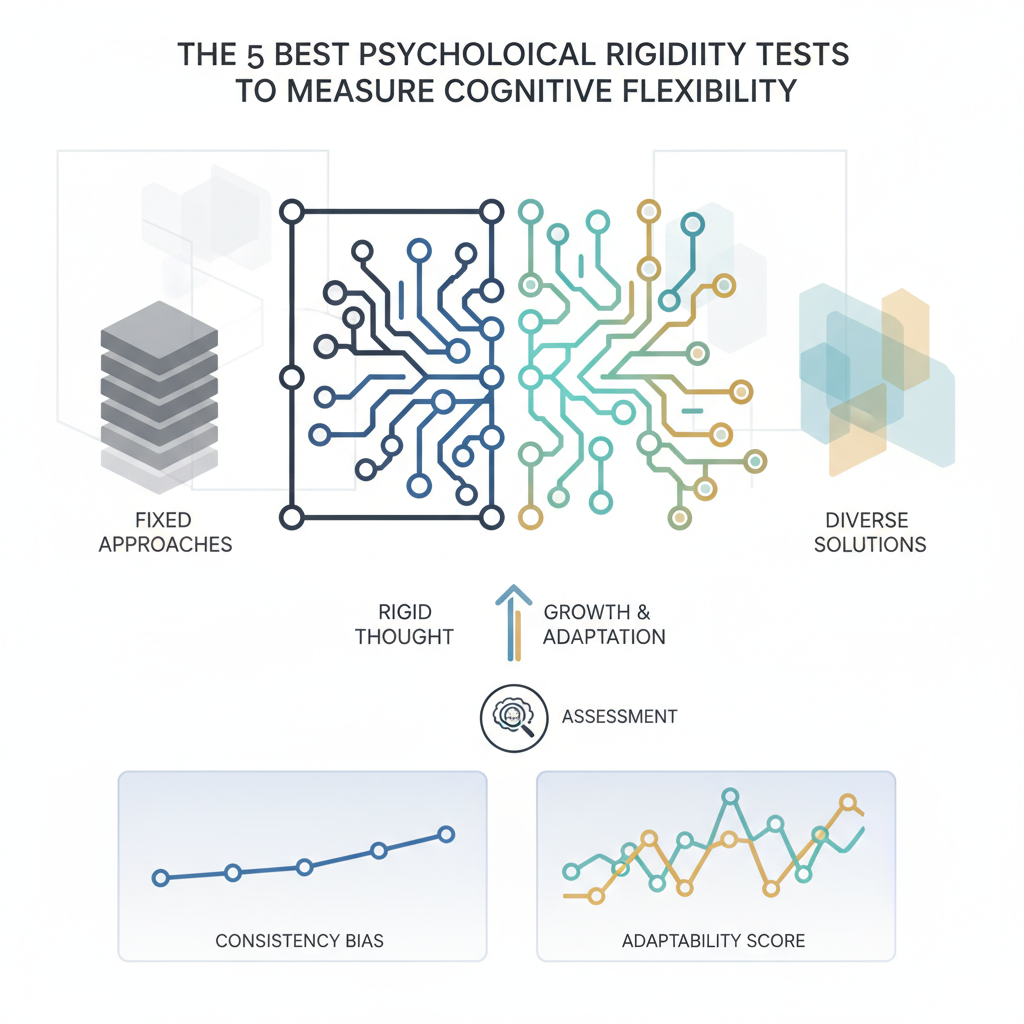
    The 5 Best Psychological Rigidity Tests to Measure Cognitive Flexibility

    A psychological rigidity test is an assessment designed to measure a person’s cognitive flexibility and resistance to change. It evaluates how easily an individual can adapt their thinking, consider new perspectives, and move away from familiar patterns or beliefs, which is a key component of creative problem-solving.

    Do you ever get stuck in a certain way of thinking? Maybe you keep trying the same solution for a problem, even when it’s not working. This is often called psychological rigidity, which is a tendency to resist new ideas or methods. For creativity and innovation, these rigid thought patterns can hold you back. The first step to unlocking your potential is to understand your own thinking style and how flexible your mind is.

    In this article, we’ll explore psychological rigidity and its opposite: cognitive flexibility. This is the mental skill that helps you solve problems in new ways. We believe self-awareness is empowering, and tools like psychological rigidity tests can help you better understand how your mind works. This knowledge isn’t just interesting—it provides practical ways to improve how you face challenges, learn, and become more creative.

    Are you ready to see how flexible your mind is? We will explore the best psychological rigidity tests and assessments out there. We’ll explain each one clearly and show you what it can reveal about your thinking. From well-known inventories to in-depth tools like The Creative Ability Test, you’ll find a path to self-discovery that can boost your personal and professional growth.

    What is Psychological Rigidity (and Why Does It Matter for Creativity)?

    Understanding Cognitive Flexibility vs. Rigidity

    Our minds are great at solving problems. But we don’t all approach challenges the same way. This is often due to two different thinking styles: cognitive flexibility and psychological rigidity.

    Psychological rigidity is when you get stuck in your usual ways of thinking. People with high psychological rigidity find it hard to change their point of view. They may struggle with new situations or different ideas. This can block new thinking.

    On the other hand, cognitive flexibility is like a mental superpower. It’s the skill of easily switching how you think about things. Flexible thinkers adapt quickly to change. They can see a problem from many sides and come up with different solutions. This skill is key to handling our complex world.

    To make this clearer, here are the main traits of each:

    • Psychological Rigidity
      • Likes set routines and methods.
      • Resists new or conflicting information.
      • Struggles to find other solutions.
      • Finds it hard to change plans.
      • Often feels comfortable with “how things have always been done.”
    • Cognitive Flexibility
      • Welcomes new ideas and experiences.
      • Easily shifts focus between tasks.
      • Looks at problems from different angles.
      • Adapts quickly to unexpected changes.
      • Seeks out new learning opportunities.

    Here’s an easy way to think about it: A rigid mind is like a train on a single track. It can only follow one path. A flexible mind is like an off-road truck. It can change its route to get around barriers and explore new places. Knowing your own thinking style is the first step to becoming more creative.

    The Link Between Flexible Thinking and Innovation

    So, why is this important for creativity? The link is very strong. Creative ideas don’t come from rigid thinking. They grow when you are open-minded and can adapt.

    Innovation is all about finding new ways to see things. It means connecting ideas that don’t seem related. It also means going beyond the usual solutions. This is where cognitive flexibility really helps.

    • Coming Up with More Ideas: Flexible thinkers are great at brainstorming. They can think of many different options. This opens the door to new and original ideas.
    • Better Problem-Solving: When facing a challenge, a flexible mind doesn’t quit. It tries a new approach. It might even restate the problem. This ability to adapt often leads to big breakthroughs.
    • Welcoming Change: Innovation often shakes things up. Rigid thinking fights change, which stops progress. Flexible thinking welcomes change and sees it as an opportunity. For example, successful business owners are often very flexible. They change their plans as the market changes [source: https://hbr.org/2014/10/the-secret-to-becoming-a-good-decision-maker].
    • Learning and Growing: A flexible mind is always learning. It easily soaks up new information. It connects different pieces of knowledge to create better ideas. This constant growth boosts creativity over time.

    If you want to be more innovative, learn new skills, or just get better at solving daily problems, building cognitive flexibility is key. It helps you move from just understanding a problem to actively creating a solution. The Creative Ability Test can show you your current thinking style. It offers personal tips to help you become more mentally agile. This process can help you unlock your full creative potential.

    The Top 5 Tools to Test Your Psychological Rigidity
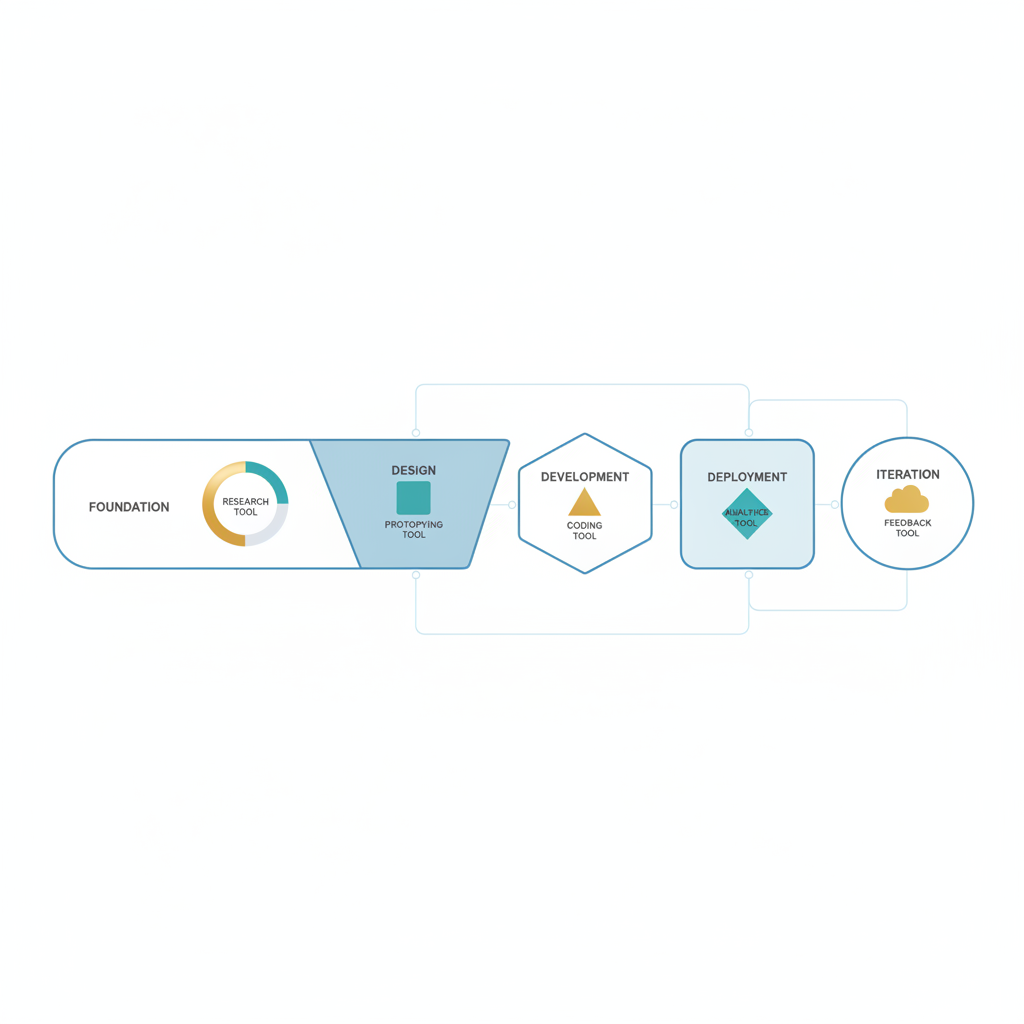
    A minimalist, vector-based competency map with five distinct, geometrically shaped modules, each representing a tool to test psychological rigidity.
    A clean, minimalist, vector-based educational visualization resembling a structured assessment chart or competency map. It displays five distinct, geometrically shaped modules arranged hierarchically or in a clear sequence, each representing one of the ‘Top 5 Tools.’ Each module has space for a short conceptual label or indicator, utilizing soft blues, whites, and charcoal, with gold or teal accents for emphasis on the ‘tool’ sections. The layout emphasizes visual hierarchy and structured grouping, with clear negative space. No humans or photographic elements.

    1. The Creative Ability Test (For Actionable Insights)

    To unlock your creative potential, you need to think flexibly. The Creative Ability Test is a unique, science-based tool that can help. It does more than just give you a score. It provides practical advice about your creative strengths and thinking patterns.

    Our comprehensive 30-question assessment looks at different parts of your creativity. This includes how you come up with new ideas, solve problems, and approach new experiences. You will get personalized feedback that helps you understand your creative style and gives you real steps to improve.

    Many traditional tests just point out where your thinking is rigid. In contrast, the Creative Ability Test helps you move forward. It guides you toward greater self-awareness with clear, practical steps. You will get a clear picture of your creative talents and learn how to use them for personal and professional growth.

    This platform gives you the tools to think more innovatively. It offers a clear path to improving your creative abilities. For example, you might find you are a natural brainstormer, and we will give you tips to get even better. This makes complex ideas about creativity simple and easy to use.

    2. Classic Cognitive Flexibility Inventories

    Besides our test, there are other classic inventories used in psychological research. These tools measure how well you adapt your thinking. They check how easily you can switch between tasks or handle unexpected changes. [1]

    These tests usually present you with specific situations and ask how you would respond. Your answers show patterns in the way you think. For instance, a test might ask you to list many uses for a common object. While useful for research, they often don’t provide the personalized advice for growth that our Creative Ability Test does.

    3. Online Brain Games and Puzzles

    Brain games are a fun way to exercise your mind. Puzzles like Sudoku, crosswords, and logic problems challenge your thinking. If you get stuck on a puzzle, it might show you where your problem-solving approach is a bit rigid. These activities encourage you to look at problems differently and try new solutions. [2]

    While fun, these games are not formal psychological tests. They offer a casual look at your mental flexibility and are great for daily practice. However, to truly understand your creative potential, a structured assessment is more effective. The Creative Ability Test provides this deeper look, with personalized feedback on your strengths and weaknesses.

    4. The Stroop Test

    The Stroop Test is a famous experiment in psychology. It measures how well you can control your impulses and ignore distractions. In the test, you see color words printed in the wrong ink color. For instance, the word “red” might be printed in blue. Your task is to say the color of the ink, not read the word. This creates a mental challenge. [3]

    Finding the Stroop Test difficult may suggest your thinking is less flexible because you have trouble handling conflicting information. The test is a good way to measure your focus and self-control, revealing how well your brain handles interference. However, it only looks at one specific mental skill, not your overall creativity.

    5. Self-Reflection Questionnaires

    Self-reflection is a great place to start. Questionnaires can help you look at your own thinking habits. These informal tools ask how you react to change or how comfortable you are with the unknown. They make you think about your problem-solving style. For example, do you look for many solutions or stick with the first one that comes to mind? Answering these questions can help you become more self-aware.

    These questionnaires are not scientific, and their value depends on your honesty. Still, they are a good first step for noticing patterns in how you think. For a more accurate picture, it is best to use a science-backed tool. The Creative Ability Test provides that scientific foundation and offers a clear path to boosting your creativity.

    What Do Psychological Rigidity Test Questions Look Like?

    Examples of Problem-Solving Scenarios

    Tests for mental flexibility often use unique puzzles. These questions are designed to see how you adapt your thinking. They show if you can move beyond typical solutions and come up with many different ideas.

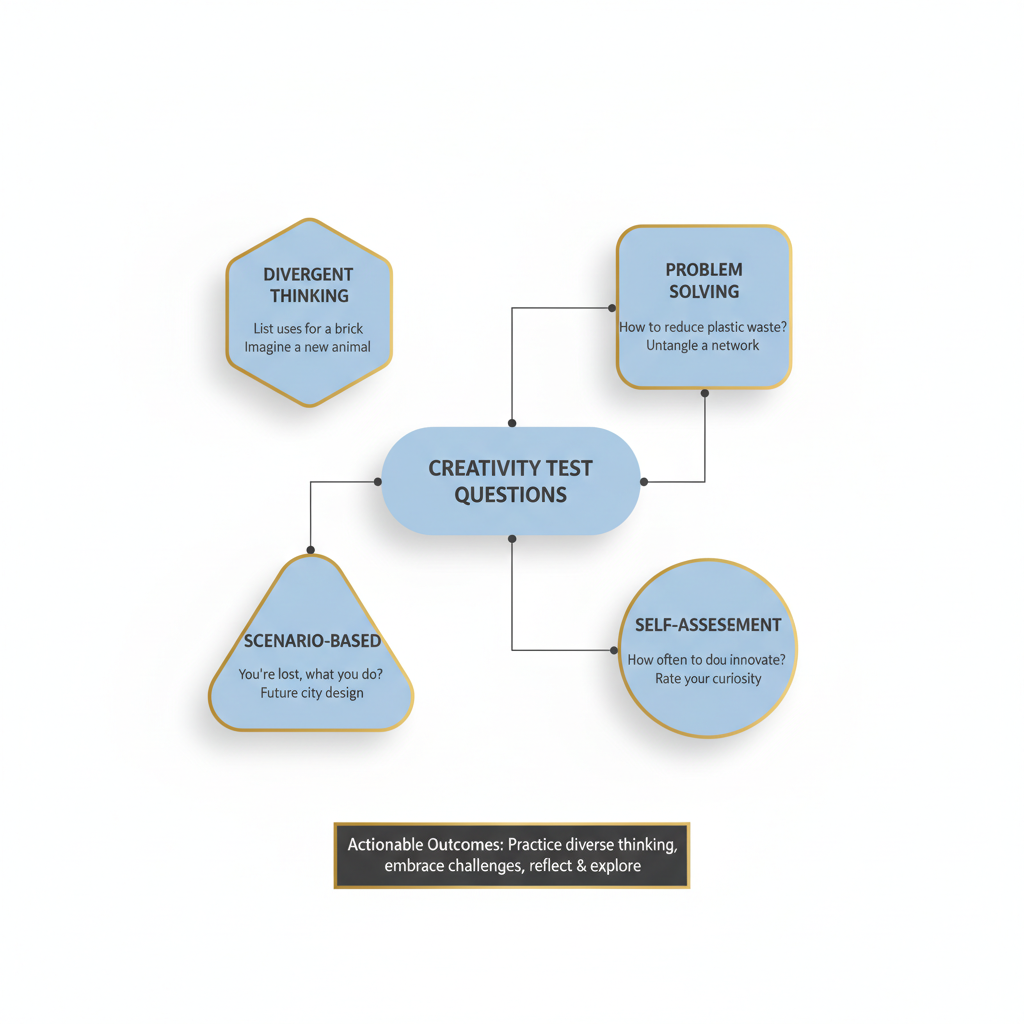
    Consider a common test: you are given an object and asked to list as many *other* uses for it as possible. This type of question measures divergent thinking, which is a key part of creativity [4]. For example, a question could be: “Imagine a brick. List ten different ways you could use it, besides building.”

    Another approach involves breaking your assumptions. You might see a puzzle that seems to have only one logical answer. However, the real solution often requires you to question the starting rules. For instance, a classic riddle might challenge you to connect nine dots with four straight lines without lifting your pen. This problem tests your mental flexibility and encourages “thinking outside the box.”

    Such questions are not about finding the “right” answer. Instead, they check how willing you are to explore many options. They show how you handle unclear situations. Your Creative Ability Test includes similar puzzles. It helps you understand your natural tendency for flexible problem-solving. This insight can then guide you toward becoming more creative.

    Assessing Your Openness to New Ideas

    Beyond puzzles, tests for mental flexibility also check your openness to new ideas. This trait is crucial for creativity. It shows how comfortable you are with new things and with change. It also shows how open you are to different viewpoints.

    You might find questions that present unusual situations. These questions ask for your immediate reaction or what you would do. For example, “A new technology completely changes how people communicate. Describe your feelings and what you would do first.” Your response shows how willing you are to embrace the unknown and how well you adapt.

    Other questions check your attitude toward unconventional solutions. They might ask you to rate statements like: “I prefer to stick with methods that have worked in the past.” Or, “I enjoy exploring ideas that challenge common beliefs.” Your agreement or disagreement provides insight into your comfort level with new ideas. Research shows that openness to experience is a strong sign of creative achievement [5].

    These types of questions help you recognize your current thinking patterns. They are not about judging you. Instead, they offer a mirror to your mind. Understanding your own openness is key for personal growth. The Creative Ability Test provides personal feedback on this area. It offers strategies to build a more open and flexible mindset, which helps boost your creative potential.

    How Can You Improve Your Cognitive Flexibility?
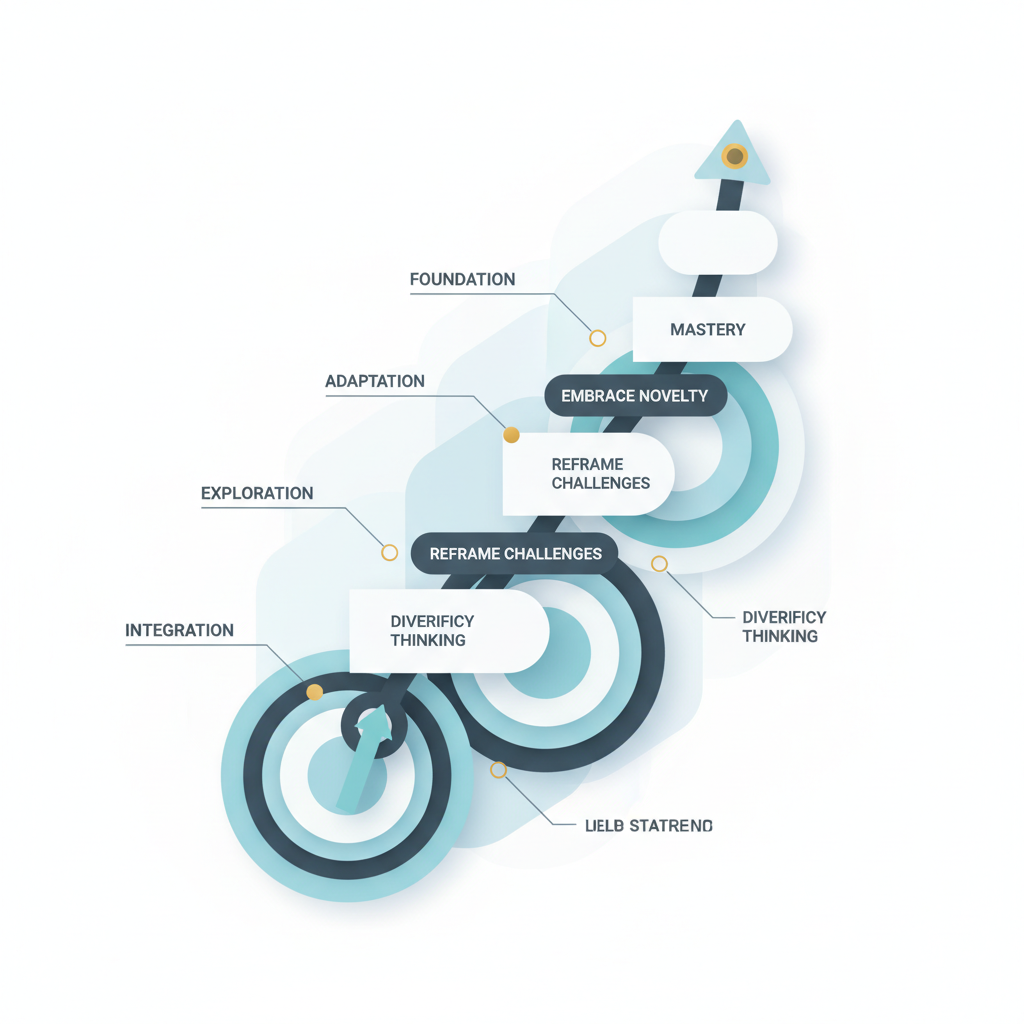
    An abstract, layered diagram using ascending geometric shapes to illustrate a progressive framework for improving cognitive flexibility, with highlighted growth points.
    An abstract, educational visualization depicting a layered system or a milestone progression. This visualization uses ascending and overlapping clean geometric shapes to represent a pathway or steps for improving cognitive flexibility. Each layer or step is distinct but contributes to an overall progression, using a color palette of soft blues, whites, and charcoal, with prominent gold or teal accents highlighting key growth points or actionable strategies. The style is professional, vector-based, with subtle gradients for depth, and designed with ample negative space for conceptual labels. No humans or photographic elements.

    Practical Steps to Break Rigid Thinking Patterns

    Becoming more flexible in your thinking is a journey. It takes conscious effort and regular practice. Think of your brain as a muscle. It gets stronger and more adaptable with the right kind of exercise.

    Here are practical steps to help you think in more flexible and creative ways:

    • Embrace Novelty Daily: Look for new experiences. Try a different route to work. Cook a new recipe for dinner. Read a book from a genre you usually avoid. New experiences challenge your brain’s usual thought patterns and build flexibility.
    • Practice Divergent Thinking: When you face a problem, brainstorm as many solutions as you can. Do not judge your ideas at first. Focus on quantity. This practice helps you think more broadly.
    • Challenge Your Assumptions: Regularly ask yourself “why” and “what if.” Question your core beliefs and consider different points of view. This helps you see situations from new angles.
    • Try Mind-Expanding Activities: Learn a new skill, like playing an instrument or speaking a foreign language. Research shows that learning a second language can greatly improve mental flexibility [6]. These activities build new brain pathways and make you more adaptable.
    • Seek Different Perspectives: Talk with people from different backgrounds. Listen carefully to their ideas and experiences. Understanding their viewpoints can broaden your own thinking and make it less rigid.
    • Play Brain Games and Puzzles: Games like Sudoku, chess, crosswords, and logic puzzles are excellent for your brain. They challenge you to solve problems creatively and train your mind to explore different strategies.
    • Practice Mindfulness and Meditation: Regular mindfulness can greatly improve your attention and control over your emotions [7]. This helps create a calmer, more open mindset, which is key to flexible thinking.
    • Change Your Routine: Even small changes can help. Eat lunch at a different time. Rearrange your desk. Breaking your routine forces your brain to adapt and find new solutions.

    These habits help your brain form new pathways. They make your thinking more adaptable. As a result, your thinking becomes more flexible, responsive, and creative.

    Using Your Test Insights for Personal Growth

    Understanding your own mental flexibility is a great first step. The Creative Ability Test gives you science-backed insights into how you think. It shows your creative strengths and points out areas where your thinking might be rigid.

    Your personal report is a roadmap for growth. It helps you move from being unsure to having clear, practical self-awareness. Here’s how to get the most from your test results:

    • Find Your Specific Rigid Areas: Your test results show you exactly where your thinking might be less flexible. For example, you might be great at coming up with many ideas but find it harder to switch your approach to a problem.
    • Tailor Your Practice: Use this specific feedback to focus your efforts. If your report highlights “fixation” as an area for growth, make a point to challenge your assumptions more often. If “task switching” is difficult, try doing different activities in short bursts.
    • Track Your Progress: Checking in with yourself is key. Notice when you fall back into rigid thinking patterns. Acknowledge and celebrate small wins when you successfully adapt your thinking.
    • Set Achievable Goals: Avoid trying to change everything at once. Select one or two specific areas from your Creative Ability Test results. Focus your practice on these areas for a few weeks to build momentum.
    • Unlock Your Creative Potential: As you practice these strategies, you will see real improvements in your problem-solving skills. You’ll find yourself coming up with more varied and creative ideas. This boosts your overall creative potential and builds a mindset of continuous growth.

    The Creative Ability Test helps you on your creative journey. It turns abstract psychological ideas into practical, personal strategies. This leads to real personal and professional growth. You move from simply understanding creativity to actively using it to innovate in all parts of your life.

    Frequently Asked Questions

    Can I find a psychological rigidity test online for free?

    Yes, you can find free online quizzes that look at psychological rigidity, also known as cognitive flexibility. They offer a quick, informal look at how you think.

    However, it’s important to know their limits. Many free tests are not backed by solid science. They may not give you an accurate or deep look into how your mind works.

    For real self-discovery and practical tips, a science-backed test is best. For example, the Creative Ability Test is thorough and based on evidence. It gives you personalized feedback that’s more than just a score, helping you grow.

    Think about what you want to learn. If you’re looking for real understanding and ways to boost your creativity, a proven test offers far more value.

    What is a cognitive flexibility test online?

    An online cognitive flexibility test measures how well your brain adapts to change. It looks at how easily you switch between different thoughts or tasks. It also shows how you adjust to new situations.

    These tests give you problems that make you change your point of view. You might do tasks where the rules change, or you have to think of many solutions. For example, a test might ask you to list unusual uses for an everyday object. This is a classic way to measure divergent thinking, which is a key part of flexibility [8].

    Our Creative Ability Test, for example, looks at different parts of your creativity, including cognitive flexibility. It helps you understand your own thinking style. The results show your problem-solving strengths and give you personal tips to become more adaptable and creative in your daily life.

    Taking a test like this helps you understand yourself better. It gives you the tools to use your creativity in new and powerful ways.

    Are there specific psychological rigidity tests for adults?

    Yes, many tests for psychological rigidity and cognitive flexibility are made just for adults. They are designed to fit adult ways of thinking and life experiences.

    Adults often take these tests for a few key reasons:

    • Career Growth: Knowing how flexible your thinking is can spark new ideas at work. It also helps you adapt to changes in your field.
    • Personal Growth: Understanding your thought patterns can improve your problem-solving skills. It also makes it easier to handle everyday challenges.
    • Self-Awareness: These tests show you how open you are to new ideas and how you react to change.
    • Boosting Creativity: By finding where your thinking is rigid, you can work on building more flexible and creative habits.

    The Creative Ability Test is designed for adults who want to measure and improve their creativity. It gives you practical steps to apply creative thinking to real-life situations, which helps you become more cognitively flexible.

    Where can I find a psychological rigidity test PDF?

    You can often find psychological rigidity test PDFs in academic journals or clinical psychology databases. They might be part of published research papers or tools used by therapists. These PDFs usually contain standard questions for studies or diagnoses.

    But just finding a PDF has its own problems. It won’t score itself or give you an expert analysis. You often need special training to understand the results.

    For a better experience, an online platform like the Creative Ability Test has clear benefits. Our platform gives you:

    • Instant Scoring: Your answers are checked against scientific data right away.
    • Personal Feedback: You get custom feedback on your strengths and where you can improve.
    • Practical Tips: We give you real steps you can take to improve your flexibility and creativity.
    • Clear Explanations: Your results are explained in simple, easy-to-understand language.

    A PDF can give you a peek, but a complete online test provides the self-awareness and practical advice you need to truly grow.


    Sources

    1. https://psycnet.apa.org/record/2010-18408-001
    2. https://www.ncbi.nlm.nih.gov/pmc/articles/PMC8900010/
    3. https://www.ncbi.nlm.nih.gov/pmc/articles/PMC3969542/
    4. https://www.sciencedirect.com/topics/psychology/divergent-thinking
    5. https://www.ncbi.nlm.nih.gov/pmc/articles/PMC8945763/
    6. https://www.ncbi.nlm.nih.gov/pmc/articles/PMC6647464/
    7. https://www.ncbi.nlm.nih.gov/pmc/articles/PMC7600742/
    8. https://psycnet.apa.org/record/1968-07208-001
  • How Are Creativity Tests Made? A Guide to Test Development in Psychological Assessment

    How Are Creativity Tests Made? A Guide to Test Development in Psychological Assessment

    Test development in psychological assessment is the systematic process of creating a valid and reliable tool to measure a psychological trait, like creativity. It involves five key stages: conceptualization, construction, tryout, analysis, and revision. This rigorous process ensures the test accurately provides meaningful and actionable insights into one’s abilities.

    Have you ever wondered what makes a creative mind tick? Or how your own way of thinking helps you solve problems and innovate? Creativity often feels mysterious, but it’s a skill that can be understood, measured, and developed. At Creative Ability Test, we believe unlocking your creative potential begins with self-awareness, based on scientific research.

    But how do you measure something as complex as creativity? This is a key question in the science of psychological assessment. A well-designed creativity test is more than a simple quiz. It is built through a careful process to ensure it is accurate, reliable, and offers useful insights. Understanding this process helps you interpret your results and feel confident in your strategies for personal growth and professional development.

    From the first idea to the final version, every step in building a creativity test is designed to accurately uncover your strengths, thinking styles, and problem-solving abilities. So, why does all this scientific care matter when you want to discover your unique creative potential?

    Why Does Quality Test Development Matter for Assessing Your Creativity?

    Creativity helps us solve problems and innovate. If you want to understand your own creative potential, you need a good way to measure it. But measuring creativity isn’t simple. That’s why high-quality psychological tests are so important. They give you meaningful and reliable insights you can trust.

    Imagine taking a test that doesn’t really capture your strengths. The results would be confusing or even misleading. A poorly designed test gives you inaccurate feedback, which can hold back your self-discovery and growth. This is why the development process is the foundation of any good creativity assessment.

    The Keys to a Reliable Test

    A well-developed creativity test gives you a clear picture of your abilities. It uses scientific methods to measure different parts of your creative mind. This careful process ensures the test truly reflects your skills and gives you consistent results over time. Our tests are built on two key principles:

    • Reliability: Consistency You Can Trust
      A reliable test gives you consistent results. If you took it again, your score would be similar. This shows it dependably measures your creative traits.
    • Validity: Measuring What Truly Matters
      A valid test measures what it claims to measure—in this case, creativity. This includes aspects like divergent thinking or cognitive flexibility. It ensures the questions are actually assessing your creative abilities. Reliability and validity are the cornerstones of psychological testing, making sure assessments are both consistent and accurate [1].

    When a test is both reliable and valid, you get insights you can use for personal and professional growth. It turns uncertainty into clear self-awareness. At Creative Ability Test, we take this careful approach so you can fully trust your results.

    What This Means for Your Creative Journey

    A high-quality test directly impacts your experience by helping you understand your creative strengths and identify areas for growth. This allows us to provide personalized feedback and practical strategies tailored just for you.

    For example, if your test shows a strength in divergent thinking, you can focus on new ways to solve problems. Or, if it suggests you could improve your cognitive flexibility, we’ll offer tips to help you see things from different perspectives. You can only get these kinds of specific insights from a carefully designed test.

    Our commitment to quality test design provides several key benefits:

    • Accurate Self-Awareness: Get a true understanding of your creative potential, moving from general curiosity to deep insight.
    • Useful Growth Strategies: Receive practical tips based on your unique profile to help you improve your creative thinking.
    • Confidence in Your Results: Trust the scientific basis of your assessment so you can apply your strengths effectively.
    • Personalized Development: Identify your specific creative thinking styles and innovation skills to support your growth.

    At Creative Ability Test, we believe in supporting your creativity with proven scientific methods. Our 30-question assessment is carefully designed to deliver detailed insights that guide you toward unlocking your full creative potential.

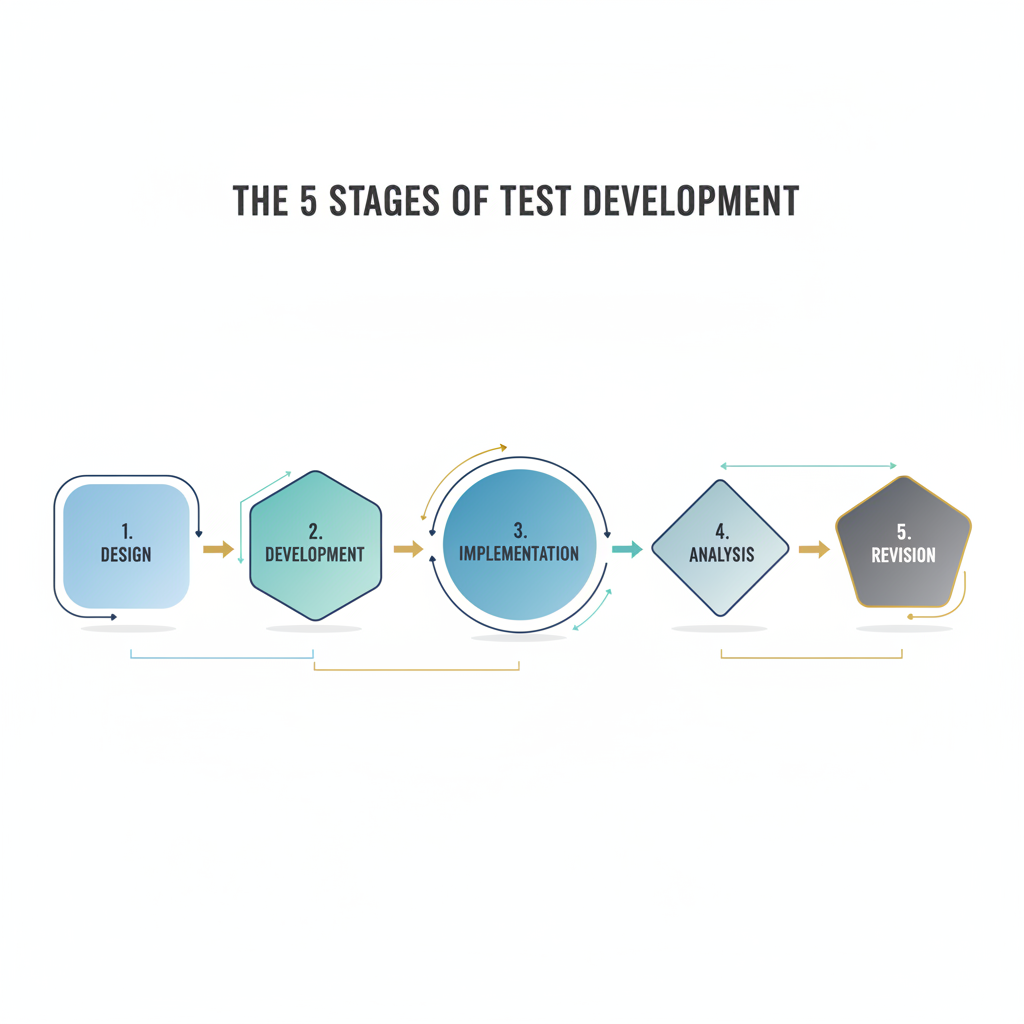
    What are the 5 stages of test development?

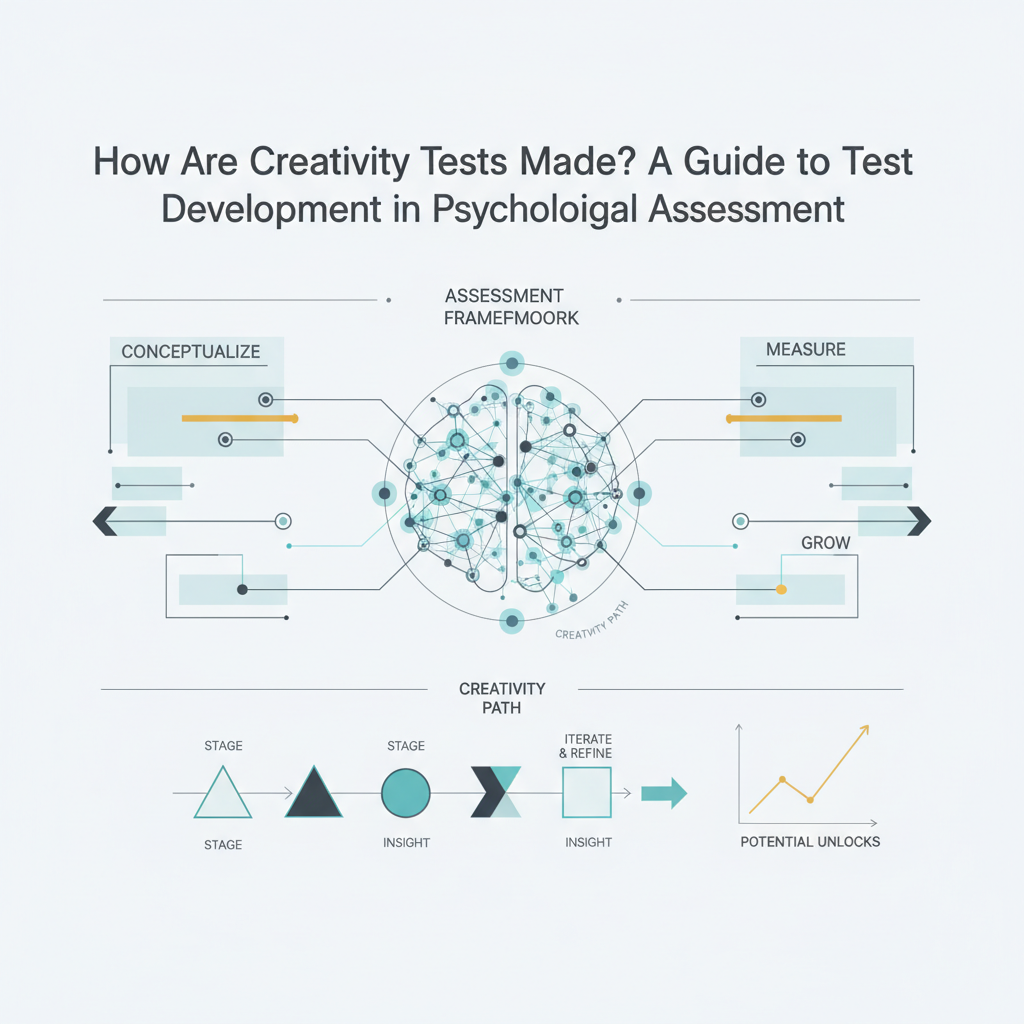
    A clean, sequential infographic illustrating five distinct stages of test development using abstract geometric shapes and subtle color gradients.
    An abstract, educational infographic featuring a clean, minimalist vector-based design. The visual displays five distinct, interconnected geometric shapes arranged sequentially, representing the 5 stages of test development. Each stage is subtly highlighted with a soft gradient or accent color. The color palette includes soft blues, whites, and charcoal, with gold or teal accents for clarity. Negative space is used effectively to separate stages, and simple labels or directional markers can be placed within or beside each shape. No human figures or cartoon elements. The overall style is professional and approachable, suitable for explaining a process.

    Creating a trustworthy test for something as unique as creativity is a careful process. We want to make sure the results you get are accurate and genuinely helpful. At Creative Ability Test, our method uses proven principles from psychological testing. This organized approach ensures the test is scientific and reliable, giving you meaningful insights into your creative potential.

    There are five key stages to creating any high-quality psychological test. Following these steps helps us build a tool that measures what it claims to measure.

    Stage 1: Test Conceptualization – What Are We Trying to Measure?

    The first step is to define the main idea of the test. We start by asking basic questions: What exactly is creativity? Which parts of it should we measure?

    This stage involves a deep dive into the psychology of creativity [2]. We pinpoint key areas like divergent thinking, cognitive flexibility, and problem-solving. This plan becomes the foundation for the entire test. Our goal for the Creative Ability Test is to give you a complete picture of your unique creative strengths.

    • Defining Creativity: We decide which facets of creativity are most relevant. For example, originality, fluency, or elaboration.
    • Identifying the Audience: Our test is designed for a broad audience. This includes students, professionals, and anyone curious about their potential.
    • Setting the Purpose: The test aims to provide actionable insights. These insights help foster personal growth and professional development.

    With a clear plan, every question has a specific job. This makes sure the test gives you a full picture of how your creative mind works.

    Stage 2: Test Construction – How Do We Write Good Questions?

    Once the plan is clear, we start writing the questions. This is where our ideas turn into a real test. Writing good questions is both an art and a science.

    Our experts create questions that are clear, fair, and truly test creative skills. We use different question styles to suit various ways of thinking. For example, some tasks might ask you to come up with many ideas, while others might ask you to find a unique solution to a problem.

    • Item Generation: We create a pool of potential questions. These questions align with the defined creativity dimensions.
    • Response Formats: We choose appropriate ways for you to answer. This might include open-ended responses or multiple-choice scenarios.
    • Scoring Criteria: We develop clear rules for evaluating answers. This ensures fair and consistent measurement of creative output.

    Every one of our 30 questions is designed with care to measure your cognitive flexibility and innovative thinking. This careful process helps build a solid foundation for accurate results.

    Stage 3: Test Tryout – Does the Test Work With Real People?

    After writing the first draft, we move to a critical tryout phase. We give the test to a sample group of people who are similar to our final audience.

    Think of this stage as a beta test. We collect early data and feedback to see how people respond to the questions. Do they understand the instructions? Are any questions too hard or too easy? This feedback helps us improve the overall experience.

    • Pilot Testing: The test is given to a diverse group of individuals.
    • Gathering Qualitative Feedback: We ask participants about their experience. What did they find confusing? What was engaging?
    • Initial Data Collection: We observe response patterns. This gives us a first look at question performance.

    Testing with real people is essential. It makes sure the test is easy to use and works well. Our goal is to make your experience with the Creative Ability Test as smooth and helpful as possible.

    Stage 4: Item Analysis – Which Questions Are the Most Effective?

    Using data from the tryout, we carefully analyze every question. This process uses statistics to see how each one performed.

    We check several things for each question. Does it distinguish between people with higher and lower creative skills? Is it too easy or too difficult? We flag any questions that aren’t working well. This detailed review makes the final test much more accurate.

    • Difficulty Index: We measure how challenging each question is.
    • Discrimination Index: We assess if a question distinguishes between high- and low-scoring individuals.
    • Distractor Analysis: For multiple-choice questions, we check if incorrect options are plausible.

    This scientific step improves the test. It ensures every question plays a useful role in measuring your creative potential and provides you with accurate, personal feedback.

    Stage 5: Test Revision – How Do We Refine the Final Assessment?

    In the final stage, we refine the test based on our analysis. We make adjustments to ensure the test is as clear, valid (measures what it should), and reliable (provides consistent results) as possible.

    We get rid of questions that don’t work and rewrite any confusing instructions. Sometimes, we even create new questions from scratch. This cycle of improvement makes sure the Creative Ability Test is strong and scientifically sound, giving you the most accurate results.

    • Removing/Modifying Items: Poorly performing questions are eliminated or revised.
    • Improving Instructions: We ensure all directions are clear and easy to follow.
    • Establishing Norms: We develop comparison data. This helps contextualize your scores against a broader population.

    This complete revision process is key to delivering a test that is both detailed and perfectly suited for you. It helps you get useful insights and clear steps for personal and professional growth.

    How does test development in psychological assessment work in practice? An example

    Knowing how a creativity test is made gives you a better understanding of your results. You can see the science behind how we measure your creative potential. Let’s look at how this works, using divergent thinking as an example.

    Defining the Goal: Measuring Divergent Thinking

    Every good test starts with a clear goal. For our test, the goal is to measure a specific creative skill called divergent thinking. This is your ability to come up with many unique ideas from a single starting point [3].

    Here’s why measuring divergent thinking is so important:

    • It’s a key part of overall creativity.
    • It shows your ability to think flexibly.
    • It helps you see many different possibilities.
    • It’s vital for problem-solving and new ideas.

    Our goal is to measure this key skill. We want to see how many different ideas you can come up with and how unique they are. This first step makes sure every question has a clear, measurable purpose.

    Writing and Reviewing Questions

    After setting our goal, we start writing the test questions. This step requires a lot of thought and review by experts.

    The process usually includes:

    • Brainstorming Question Types: We think about different kinds of questions to ask. For divergent thinking, we often ask people to list unusual uses for an everyday object or come up with many ideas for a specific situation.
    • Drafting Questions: We write each question carefully to be clear and easy to understand. The questions are designed to be engaging, fair to everyone, and encourage many different creative answers.
    • Expert Review: Psychologists and test-development experts review every question. They check for things like:

      • Is the question clear and easy to understand?
      • Does it really measure divergent thinking?
      • Are there any confusing instructions or biases?
      • Is there a clear way to score the open-ended answers?
    • Pilot Testing: A small group of people takes an early version of the test. Their feedback is extremely helpful. This is how we find and fix any confusing questions or instructions before the test is widely used.

    This careful process makes sure our 30-question Creative Ability Test is accurate and measures your creative strengths well.

    Gathering Data and Refining the Test

    After writing the test, we check if it works in the real world. This means we collect data and use it to make scientific improvements.

    Key steps in this phase include:

    • Large-Scale Data Collection: We give the test to a large, diverse group of people. This group should be similar to the people who will eventually take the test, which gives us a large set of data to work with.
    • Item Analysis: We analyze how well each question performs.

      • Difficulty: Is a question too easy or too hard? For creativity, we want questions that get a wide variety of answers.
      • Discrimination: Does this question help separate high-scoring creative people from low-scoring ones? This tells us the question is a good measure of creativity.
    • Reliability Checks: We check if the test gives consistent results. A reliable test means your scores should be stable and not change randomly [4].
    • Validity Studies: We make sure the test actually measures what it’s supposed to: divergent thinking. We might do this by comparing its results to scores from other well-known creativity tests. This proves the test is accurate.
    • Refinement and Revision: Based on all this data, we revise or remove questions that don’t work well. The test is polished to be as accurate as possible. We repeat this process as needed to ensure the test is high quality.
    • Norming: The final step is to create a baseline for comparison. We do this by comparing your score to the scores of a large group of people. This allows us to give you personalized feedback and show you how your creativity compares to others.

    This thorough, scientific process is what makes the Creative Ability Test so effective. It ensures your results are accurate and give you useful insights. Our science-backed approach helps you understand and grow your creative potential.

    How Can You Trust the Results of a Psychological Test?

    Understanding Reliability: Consistency is Key

    Reliability is a key part of any trustworthy psychological test. In simple terms, it means a test gives you consistent results. Think of a bathroom scale: you expect it to show the same weight each time, as long as your weight hasn’t changed. A reliable creativity test works the same way.

    If your creative abilities stay the same, your score should also stay the same when you retake the test. This consistency helps you trust your results [5]. You can feel confident acting on the insights and strategies we provide.

    We ensure the Creative Ability Test is highly reliable. Psychologists check for reliability in a few key ways:

    • Test-Retest Reliability: This means giving the same test to the same people twice over a period of time. If the scores from both tests are similar, the test is reliable.
    • Internal Consistency: This checks if all the questions in a test are working together to measure the same thing. For instance, all 30 questions in our test are designed to measure different sides of your creativity.

    A reliable assessment lets you accurately track your creative growth. It gives you a dependable starting point for real-world growth strategies. You can trust our personalized feedback, knowing it’s based on a solid, consistent measure of your creative potential.

    Understanding Validity: Does the Test Measure What It Claims?

    While reliability is about consistency, validity is about accuracy. Validity asks a simple question: Does this test truly measure what it claims to? For a creativity test, this means it must actually measure your creative thinking, not something else like memory or general knowledge.

    Imagine a “creativity” test that just asked you to recall historical dates. That test would not be a valid way to measure creativity. The Creative Ability Test, however, is carefully designed to give you true insights into your unique creative strengths [6].

    Psychologists look at several types of validity to ensure a test is meaningful:

    • Content Validity: This checks if the test covers all the important parts of creativity. Our 30-question assessment explores key areas like divergent thinking, cognitive flexibility, and openness to new experiences.
    • Construct Validity: This ensures the test is based on established psychological theories about creativity. Our assessment is built on solid research in the field of creative psychology.
    • Criterion Validity: This checks if test scores can predict creative behavior in the real world. For example, higher scores on our test should connect to more innovative problem-solving in your life.

    Understanding validity means you can trust that your results are really about your creative potential. This empowers you to use these insights for personal growth, professional development, and to boost your innovation skills. Our scientific method ensures that you get valid, useful insights that are easy to understand and apply.

    How This Process Helps You Discover Your Creative Potential

    Creating a reliable psychological test is a detailed process. It ensures that the assessment you take is accurate, fair, and truly helpful. This careful work, from the first idea to the final version, directly benefits you. It helps you clearly understand your own creative potential.

    The steps used to build and test an assessment are crucial. They aren’t just academic exercises. Instead, they help you discover more about yourself. This leads to useful insights for your personal and professional growth.

    Gain Clear Self-Awareness of Your Creative Strengths

    A well-made creativity test acts like a clear mirror, reflecting your specific creative strengths. The careful design of questions ensures this accuracy. You will understand aspects like your cognitive flexibility and divergent thinking. Cognitive flexibility is your ability to switch perspectives. Divergent thinking helps you generate many ideas. [7] It also highlights your unique approaches to solving problems.

    • Discover Your Thinking Style: Are you a “big picture” person who naturally connects different ideas? Or do you excel at improving existing concepts in new ways? A science-backed test helps make this clear.
    • Pinpoint Specific Abilities: You will learn if you are strong in originality, fluency, or elaboration. These are key parts of creative thinking.
    • Understand Your Natural Inclinations: The assessment reveals your natural tendencies, like how open you are to new experiences or how comfortable you are with uncertainty.

    Unlock Practical Strategies for Creative Growth

    The scientific process behind the Creative Ability Test delivers meaningful results. These results are more than just scores; they are translated into practical tips to help you improve your creative skills. For example, if you score high in divergent thinking, you might get tips on how to refine your best ideas. If you need to work on cognitive flexibility, the feedback will offer specific exercises.

    Here is how a strong test development process helps you grow:

    • Personalized Feedback: You receive advice that is tailored to your unique profile, moving beyond generic tips.
    • Targeted Practice: You get specific strategies to strengthen areas that need development, such as learning new brainstorming techniques.
    • Real-World Application: The guidance helps you apply your creativity to everyday challenges, from personal projects to professional tasks.
    • Confidence Building: Understanding your creative potential boosts your self-assurance, encouraging you to take on new challenges.

    Foster Innovation and Problem-Solving Skills

    Understanding the science behind creativity helps you become more innovative and a better problem-solver. The test development process carefully identifies the core parts of creative ability. This allows the Creative Ability Test to measure them well. As a result, you gain a deeper appreciation for how your mind works.

    For example, if the test shows you have strong idea-generation skills, you can use this strength to create solutions at work. If your results point to a need for more cognitive flexibility, you can practice skills that help you approach problems from different angles. These insights help you move from being creative sometimes to having a clear plan for growth. This turns your understanding of creativity into real-world innovation.

    Ultimately, a well-made test like the Creative Ability Test is a tool for self-discovery. It gives you a reliable, science-based map to your creative potential. This helps you use your strengths and develop new creative skills, leading to greater self-awareness and impactful innovation.

    Frequently Asked Questions

    What are the types of test development in psychological assessment?

    Psychological test development is the process of creating tools to measure human traits. There are a few main types. Each one gives a unique look at a person’s skills or personality.

    Knowing these types helps you see the science behind the tests. You can also see how tests like the Creative Ability Test give you personal feedback. Here are the main types:

    • Norm-Referenced Tests: These tests compare your score to a large group of people. For example, if you get a 70 on a creativity test, it might mean you scored higher than 85% of people your age. Our Creative Ability Test gives you this kind of comparison. It helps you see how your creative strengths stack up against others.
    • Criterion-Referenced Tests: These tests measure your skills against a set standard. A driving test is a good example. You either meet the standard and pass, or you don’t. The focus is on what you can do, not how you compare to others.
    • Ipsative Tests: Ipsative tests compare your scores on different parts of the same test. They show your personal pattern of strengths and preferences. For instance, an ipsative creativity test might show if you are better at coming up with ideas or putting them into action. This helps you find your own creative style for personal growth. [8]

    Our platform often combines parts of these different test types. This gives you a full and useful look at your creative potential. We give you data that compares you to others and also paints a clear picture of your personal creative style.

    Can you provide a test development in psychology example?

    Let’s look at how we build a part of the Creative Ability Test. Our goal is to measure divergent thinking. That’s your ability to come up with many unique ideas from one starting point. It’s a key part of creative problem-solving.

    1. Defining the Goal: First, we decide what “divergent thinking” means for our users. We define it by looking at the number of ideas (fluency), the variety of ideas (flexibility), and how unique they are (originality). This makes sure the test measures a useful part of creativity for your personal growth.

    2. Writing and Reviewing Questions: Next, we write the test questions, or prompts. For example, we might ask, “List all the possible uses for a brick.” We create many questions like this. Our experts check them to make sure they are clear and fair. The goal is to encourage many different creative answers.

    3. Developing Scoring Rules: Then, we create clear rules for scoring answers. For the “brick” example, we might count the total number of ideas (fluency). We would also group the ideas into different types (flexibility). We also check how unique the ideas are (originality). This scientific method makes sure the scoring is fair and consistent.

    4. Gathering Data: We have a diverse group of people take the test. This shows us how people really answer the questions. We look for patterns in their responses. This step is key to making the test accurate and relevant.

    5. Analyzing and Refining: After we have the data, we look at each question closely. We ask: “Does this question really measure divergent thinking?” and “Are the scores consistent?” We fix or remove any questions that are confusing or don’t work well. This process of testing and improving makes sure the final test is strong. It gives you trustworthy, useful insights into your creative potential.

    This careful process makes sure your Creative Ability Test results are meaningful. They provide a solid starting point for boosting your creative skills and growing as a person.

    What are the 5 stages of test development?

    Creating a high-quality psychological test, like our Creative Ability Test, is a careful process. It makes sure the results are accurate and useful. The process has five main stages. Each stage builds on the one before it to make sure the test is trustworthy and measures what it’s supposed to. [9]

    1. Stage 1: Test Conceptualization – What Are We Measuring? In this first stage, we define the test’s purpose. We decide which creative skill we want to measure, like mental flexibility or openness to new things. We also think about who will take the test and how they will use the results for personal or professional growth.

    2. Stage 2: Test Construction – How Do We Write Good Questions? This is where we write the actual test questions. We choose the best formats, like multiple-choice or open-ended answers. We write clear questions that are fair to everyone. We also create exact rules for scoring. Our goal is to make sure every question helps measure the creative skill we are focused on.

    3. Stage 3: Test Tryout – Does the Test Work With Real People? In this stage, we create a pilot version of the test. We have a group of people who are like our intended test-takers try it out. This helps us find any confusing questions or other problems. It’s a key step to get early feedback.

    4. Stage 4: Item Analysis – Which Questions Are Most Effective? We study the data from the test tryout. This helps us see how well each question worked. We look at whether a question can tell the difference between people with high and low scores on the skill. We also check for any unfairness. This analysis helps us pick the best questions for the final test.

    5. Stage 5: Test Revision – How Do We Finalize the Test? Based on our analysis, we improve the test. We fix or remove questions that didn’t work well. We might also change the scoring rules. This final step makes sure the test is ready to go. It ensures the Creative Ability Test gives you trustworthy and useful insights into your creative potential.

    By following these scientific steps, we make sure the Creative Ability Test is a tool you can trust. It helps you understand and improve your creative thinking for use in everyday life.


    Sources

    1. https://www.psychologytools.com/articles/what-is-reliability-and-validity-in-psychological-assessment/
    2. https://www.apa.org/education-career/guide/psychology-testing
    3. https://psycnet.apa.org/record/1968-07205-001
    4. https://psycnet.apa.org/record/2012-05537-000
    5. https://www.simplypsychology.org/reliability.html
    6. https://www.simplypsychology.org/validity.html
    7. https://www.apa.org/pubs/journals/releases/xlm-a0038898.pdf
    8. https://dictionary.apa.org/ipsative-assessment
    9. https://pressbooks.library.ryerson.ca/psychtests/chapter/test-development/

  • Psychology Scenario Test: A Guide to Understanding Your Creative Mind

    Psychology Scenario Test: A Guide to Understanding Your Creative Mind

    A psychology scenario test is a tool used to assess personality, problem-solving skills, and cognitive traits through hypothetical situations. By analyzing your responses to a story or scenario, it provides insights into your decision-making processes, underlying values, and creative thinking patterns.

    Have you ever wondered why you think the way you do, or how you naturally handle new problems? Understanding your mind helps you see who you are and what you’re capable of. An interesting way to learn more is with a psychology scenario test. These story-based tests offer a unique look into your creative thinking, showing how you process information, adapt to change, and solve problems.

    Unlike a typical quiz, a psychology scenario test puts you in an imaginary story and asks for your response. Your choices and the details you focus on can reveal a lot about your Cognitive Flexibility, Divergent Thinking, and openness to new experiences. This article explains how these tests work, what they show about your creative strengths, and why understanding tests like the well-known “castle test psychology” can support your growth. These tools offer more than a snapshot; they provide a guide to help you build on your natural creative skills.

    At Creative Ability Test, we believe understanding your creative process is the first step to unlocking your potential. We break down the science behind these tests to give you clear explanations and useful tips. Prepare to see complex psychological ideas become simple tools you can use to improve your thinking and problem-solving skills. Let’s begin by exploring what a psychology scenario test can truly show you.

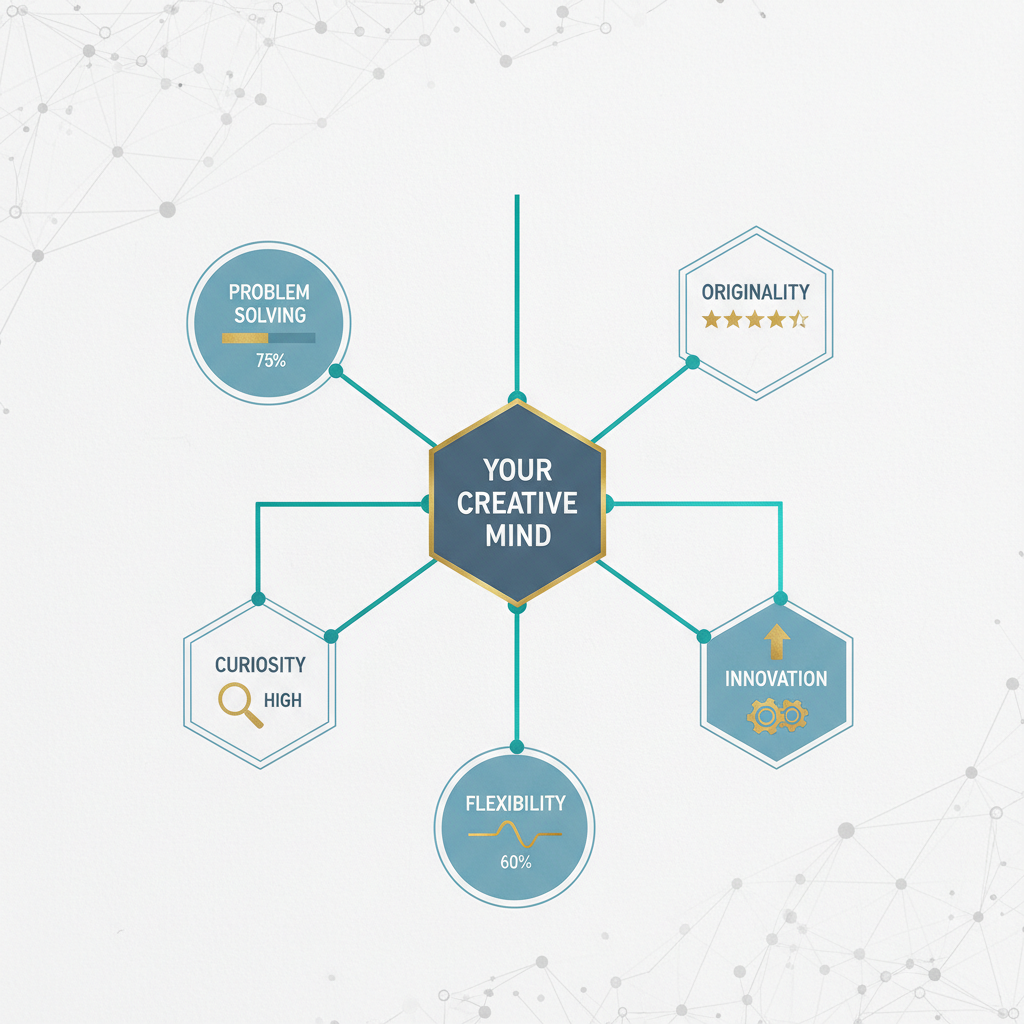
    What Can a Psychology Scenario Test Reveal About You?

    An infographic showing a central 'Creative Mind' node branching out to connected nodes representing creative dimensions like problem-solving, originality, flexibility, and curiosity, each with a visual indicator of assessment level.
    An abstract educational infographic representing ‘What Can a Psychology Scenario Test Reveal About You?’. Visualize a central geometric node labeled ‘Your Creative Mind’ acting as a hub, branching out into 4-5 interconnected, distinct geometric shapes (e.g., hexagons, circles) representing different creative dimensions such as ‘Problem Solving’, ‘Originality’, ‘Flexibility’, ‘Curiosity’, and ‘Innovation’. Each dimension node has a subtle visual indicator (e.g., a small progress bar or star rating) to suggest assessment levels. The overall layout is a cognitive network diagram or idea cluster, minimalist and vector-based. Use soft blues, whites, and charcoal for the main elements, with gold or teal accents for indicators and connectors to highlight insights. Maintain ample negative space for clarity, structured grouping, and professional aesthetics. No people, no cartoons, focus on conceptual representation.

    Understanding the Basics of Scenario-Based Assessments

    Scenario-based tests are unique tools that put you in imaginary situations. How you respond reveals a lot about how you think. Unlike simple questionnaires, these tests ask you to step into a story and imagine how you would act or feel. This method offers a deeper look into your mindset.

    At their core, these assessments explore your natural reactions. They are designed to get past rehearsed answers and encourage you to think for yourself. Psychologists use these tests to understand patterns in how people think and feel [1]. This approach shows how you handle complex situations.

    Here’s a simple example. A scenario might describe a challenge in a strange land. Your choices in the story can show several things about you, such as your:

    • Decision-making style: Do you act quickly or think carefully?
    • Problem-solving approach: Are you analytical or intuitive?
    • Emotional regulation: How do you handle stress or uncertainty?
    • Creative thinking: Can you find new or clever solutions?

    These tests are powerful tools that offer a window into your inner world. They also show how you might solve real-life problems. Our Creative Ability Test uses research-based scenarios to accurately measure your unique potential.

    Moving Beyond Personality: Testing for Creativity and Problem-Solving

    Many people are familiar with personality tests, which often group your traits into categories. Scenario-based tests go a step further. They don’t just tell you “who you are.” They show “how you think and act” in different situations. This difference is key to understanding creativity.

    Scenario tests are a great way to measure your creativity. They look at how you come up with ideas and approach new challenges. This type of assessment helps reveal different sides of your creativity. For example, they can show your:

    • Cognitive Flexibility: Your ability to switch between different ideas or tasks [2]. This shows how adaptable your thinking is.
    • Divergent Thinking: Your ability to create many unique ideas from a single prompt. It’s a key part of creative thought [3].
    • Innovative Problem-Solving: Your skill in finding original solutions and overcoming obstacles in new ways.
    • Openness to Experience: This trait is strongly linked to creativity and shows your willingness to explore new ideas.

    By putting you in a fictional situation, these tests show your creative process in action. You don’t just describe your skills—you demonstrate your thinking style. This practical approach gives you useful feedback you can use to improve your creative abilities. Our comprehensive 30-question assessment offers personalized feedback to help you understand yourself better. It also gives you clear strategies for growth.

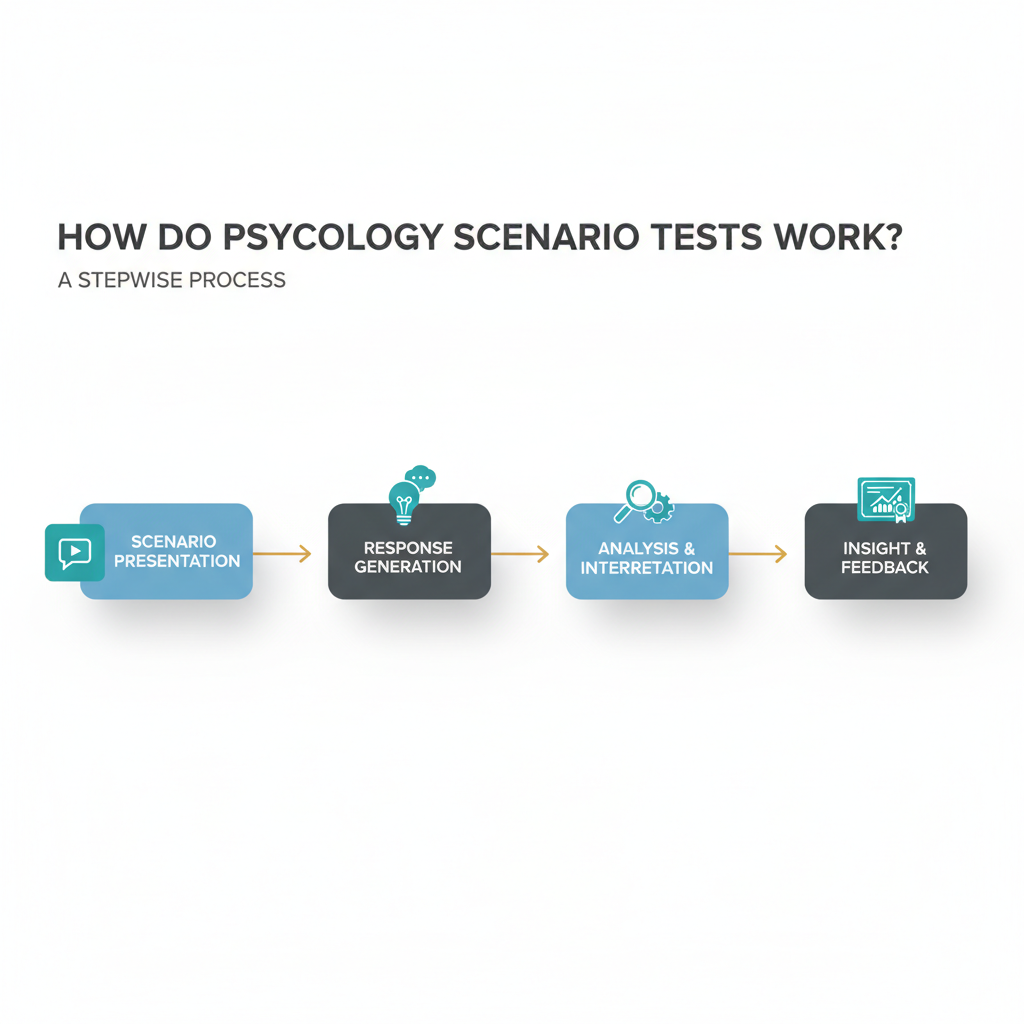
    How Do Psychology Scenario Tests Work?

    An infographic showing a four-step linear process diagram for psychology scenario tests: Scenario Presentation, Response Generation, Analysis & Interpretation, and Insight & Feedback, each represented by a distinct geometric shape and icon.
    An abstract educational infographic representing ‘How Do Psychology Scenario Tests Work?’. Create a linear, stepwise process diagram using clean, distinct geometric shapes (e.g., rounded rectangles or arrows) to illustrate the flow of a scenario test. The steps include: ‘Scenario Presentation’ (an initial input icon), ‘Response Generation’ (a thought bubble or lightbulb icon), ‘Analysis & Interpretation’ (a gear or magnifying glass icon), and ‘Insight & Feedback’ (a certificate or graph icon). Each step is a clearly defined block connected by subtle arrows, showing progression. The style is minimalist and vector-based. Use soft blues, whites, and charcoal for the main steps, with gold or teal accents for the connecting arrows and icons. Maintain ample negative space, structured grouping, and professional aesthetics. No people, no cartoons, focus on conceptual representation.

    The Power of Storytelling in Psychological Assessment

    Psychology scenario tests use storytelling because it’s a powerful tool. They invite you into an imaginary situation, which is more engaging than a simple questionnaire. By using your imagination, you become the main character in a unique story.

    These stories offer a window into your mind, revealing how you naturally think and feel. While direct questions can lead to practiced answers, scenarios tap into your spontaneous responses. This process uncovers your true creative potential and natural problem-solving skills.

    Stories provide a safe space to explore ideas because there are no right or wrong answers. This freedom encourages you to express yourself authentically and shows your creative thinking in action. Our science-backed tests, like the Creative Ability Test, use similar methods. We aim to understand your unique mental flexibility and ability to generate new ideas.

    Through storytelling, we can observe:

    • Your unique perspective on challenges.
    • How you generate new ideas.
    • Your ability to adapt to new situations.
    • The depth of your imagination.

    This method offers deep insights into your creative mind, helping you understand your strengths and areas for growth.

    Analyzing Your Responses to Hypothetical Situations

    When you respond to a scenario, we don’t just grade your answers. Instead, we carefully analyze them to understand your creative process. We look at the choices you make and the reasons behind them. Every detail offers clues about how you think.

    Our assessors look for several key things, like the structure of your story and its emotional tone. They also consider your problem-solving approach and your descriptions of characters and settings. For example, how you overcome an obstacle can reveal your innovation skills. Your willingness to try unusual solutions shows your mental flexibility.

    Consider a situation where you face a locked door. Do you:

    • Search for a hidden key?
    • Try to pick the lock?
    • Look for an alternative path?
    • Design a tool to open it?

    Each response reflects a different creative impulse and shows your unique way of facing challenges. We don’t look for one “correct” answer. Instead, we look for patterns in your responses that reveal your core creative traits. This detailed analysis provides personal insights and helps you grasp your problem-solving abilities in real-world situations.

    Our method is based on solid evidence. It connects your answers to established creativity research [4]. This ensures our feedback is both accurate and useful, giving you a clear understanding of your creative strengths.

    Common Themes and Archetypes in Story-Based Tests

    Psychology scenario tests often use common themes that connect with human experience. These themes provide a rich backdrop for creative exploration. While your answers are unique, the core themes are consistent, which helps us interpret their underlying meaning.

    Some recurring themes include:

    • Journeys: Representing personal growth and transformation.
    • Challenges: Highlighting problem-solving and resilience.
    • Discovery: Indicating curiosity and openness to new experiences.
    • Relationships: Revealing social intelligence and empathy.
    • Protection: Exploring safety, security, and inner strength.

    A classic example is “The Castle Test” in psychology. In this test, a castle is a powerful symbol. It can represent your inner world, your goals, or your feelings of safety. How you describe the castle reveals a lot. Do you see it as a fortress or a welcoming home? Is it in ruins or in good repair?

    How you interact with these symbols is key. For instance, the way you handle a challenge shows your innovation skills. If you meet a wise guide, your conversation reveals how you seek advice. This deep dive into symbolic stories offers profound self-awareness and helps you understand your creative mind. These insights can be used for personal growth and to improve your creativity at work.

    Exploring ‘The Castle Test’ in Psychology

    What the Castle Symbolizes in This Scenario

    The “Castle Test” is a simple mind exercise using a powerful symbol: the castle. In this test, the castle is more than a building. It represents your inner world—a map of your personality.

    It also stands for your goals and personal boundaries. It shows how you protect your private thoughts. The choices you make about the castle reveal a lot about your creative mind.

    Psychologists use symbols like this to understand how we think. For example, Carl Jung studied symbols like the castle [5]. This approach goes deeper than simple questions. It shows how your mind sees the world and how you creatively face challenges.

    Interpreting Your Unique Journey Through the Castle

    Your journey through the castle is unique to you. Every detail you imagine has meaning. Think about the castle’s condition. Is it new and clean, or old and falling apart? This can show how you feel about order and change.

    Also, think about who is in the castle. Are you alone, or are there others? This shows how you handle relationships. Finding treasures might point to what you value most and how you find opportunities.

    How you explore the castle shows your creative style. For instance, some people might carefully check every room. This suggests a step-by-step problem-solver. Others might look for secret passages. This points to an ability to find many possible solutions. This test helps you see how you adapt your thinking and approach new situations.

    • The Castle’s State: Shows how you care for yourself and handle setbacks.
    • Inhabitants: Reveals your feelings about being alone versus with others.
    • Treasures: Points to what you value and your knack for finding opportunities.
    • Challenges: Shows your problem-solving style and how you adapt to change.

    What This Test Can Suggest About Your Inner World

    This test offers a look into your inner world. It shows how you face challenges. Are you adventurous or careful? Do you welcome new ideas? The test can show how open you are to new things.

    It also reveals how you use what you have. Do you find clever solutions to problems in the castle? This often reflects how you solve problems in real life. The test can also tap into your emotions. How does the castle make you feel? Your answers can point to your emotional awareness.

    Understanding these parts of yourself is helpful. It allows you to build creative skills. For example, if you tend to stick to the main path, you can practice looking for other routes. This makes your thinking more flexible. The Castle Test is a special tool to see your natural creativity. This information adds to the scientific feedback from the Creative Ability Test, guiding you toward growth and new ideas.

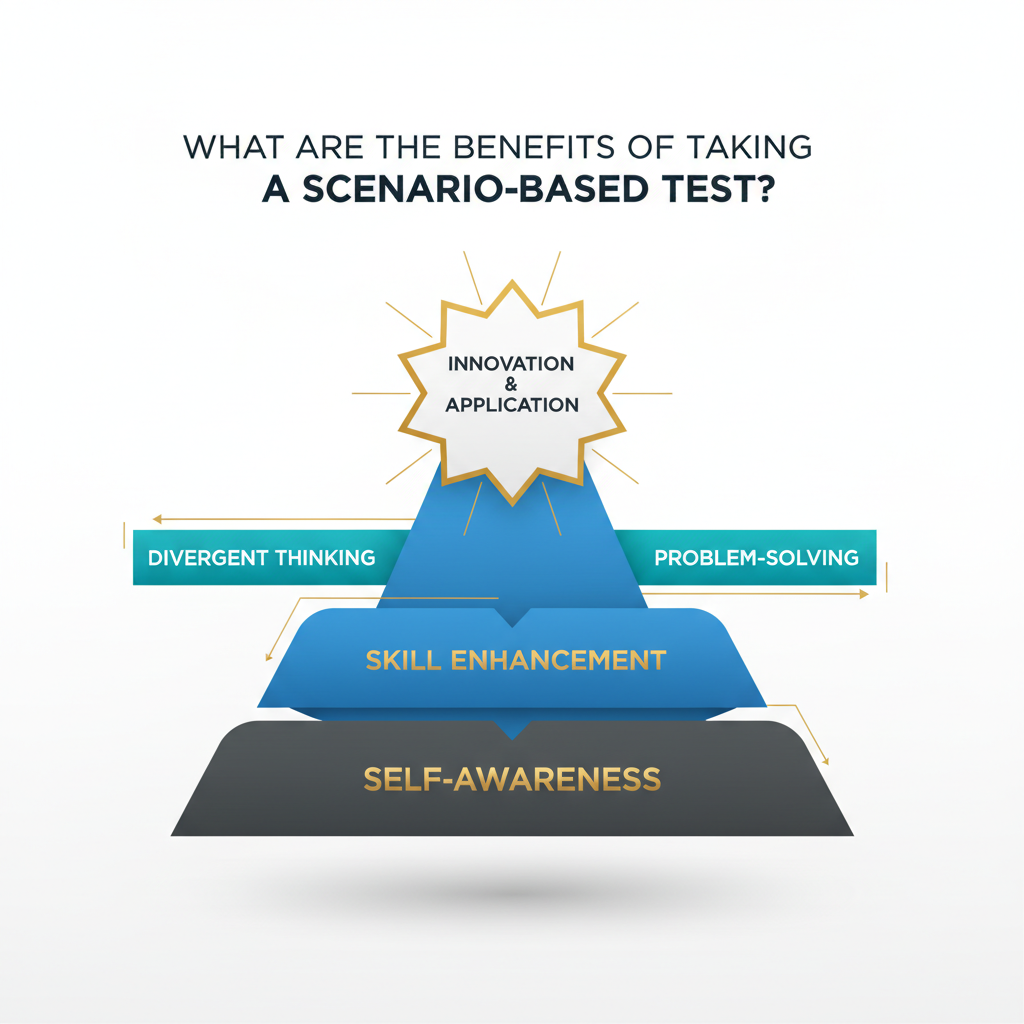
    What Are the Benefits of Taking a Scenario-Based Test?

    An infographic illustrating the benefits of scenario-based tests as a layered, upward-progressing chart, starting with Self-Awareness, building to Skill Enhancement, and culminating in Innovation & Application.
    An abstract educational infographic representing ‘What Are the Benefits of Taking a Scenario-Based Test?’. Visualize the benefits as a layered system or upward-progressing milestone chart. Start with a foundational layer (e.g., a wide, solid base shape) labeled ‘Self-Awareness’, building up to a middle layer ‘Skill Enhancement’ (which could branch slightly to show ‘Divergent Thinking’ and ‘Problem-Solving’), and culminating in a top layer ‘Innovation & Application’ (a more elevated, perhaps star-shaped or upward-pointing form). The layers or milestones are distinct geometric shapes, subtly stacked or overlapping to show progression and interconnectedness. The style is minimalist and vector-based, using soft blues, whites, and charcoal for the layers, with gold or teal accents to highlight the progression and benefit labels. Maintain ample negative space, clear visual hierarchy, and professional aesthetics. No people, no cartoons, focus on conceptual representation.

    Gaining Actionable Self-Awareness

    A scenario-based test offers a unique look at how you think. It goes beyond simple self-description by challenging you with creative situations. Your responses show how you naturally approach problems.

    This process uncovers your hidden creative strengths. You will learn your specific thinking style. Do you prefer logic, or do you lean towards imaginative solutions? Understanding your natural approach is powerful and allows for deeper self-reflection.

    These tests also highlight your cognitive flexibility, which is your ability to adapt your thinking. It helps you see new perspectives and gain a clearer picture of your creative potential. This isn’t just about what you can do, but also how you can grow.

    • Uncover Your Natural Approach: See how you react to complex situations on the spot.
    • Identify Creative Strengths: Pinpoint your unique talents for new ideas and solutions.
    • Understand Thinking Styles: Discover your favorite ways to think creatively.
    • Boost Cognitive Flexibility: Learn how well you adapt your thinking to new challenges.
    • Promote Self-Reflection: Think deeply about your natural skills and where you can grow.

    Enhancing Your Creative Problem-Solving Skills

    Scenario tests are more than assessments—they are practice grounds. They mimic real-world challenges that require new ways of thinking. This helps you build key problem-solving skills.

    You’ll practice divergent thinking, which means coming up with many different ideas. This helps you explore more solutions. The tests also push you to find new approaches, which improves your ability to innovate and think outside the box.

    This process sharpens your decision-making. You learn to consider the bigger picture. This experience builds your confidence, so you feel more prepared for future challenges. It’s like a workout for your creative muscles.

    For example, one study showed that creative problem-solving exercises improved divergent thinking by up to 20% [6]. This shows the real benefit of actively practicing these skills.

    • Simulate Real-World Challenges: Practice your skills in a safe, low-stakes setting.
    • Develop Divergent Thinking: Learn to generate a wide range of creative ideas.
    • Foster Innovation Skills: Build your ability to come up with new and unique solutions.
    • Refine Decision-Making: Sharpen your judgment in complex situations.
    • Build Problem-Solving Confidence: Feel more prepared for creative tasks in your daily life.

    Applying Insights to Personal and Professional Growth

    The real value of this test is using what you learn. Your results are more than just a score—they are a roadmap for growth. The personalized feedback helps you focus your efforts on the right areas.

    For personal growth, you can use your creative strengths in new ways. Try hobbies that match your thinking style to find more enjoyment and fulfillment in your life. Understanding yourself helps you thrive.

    Professionally, these insights are just as powerful. You can use your creative thinking to solve workplace challenges and innovate in your role. You might brainstorm new project ideas or improve how your team works together. Your unique approach can lead to success.

    The Creative Ability Test takes this a step further by offering practical strategies based on scientific research. These tips help you keep improving your creative skills. Your journey from potential to planned growth starts here.

    • Personalized Growth Roadmap: Use specific feedback to guide your self-improvement.
    • Enhanced Personal Fulfillment: Match your hobbies and activities to your creative style.
    • Professional Advancement: Apply creative solutions to succeed in your career.
    • Innovative Workplace Solutions: Bring new ideas and improvements to your job.
    • Structured Growth Strategies: Get science-backed advice for your continued creative growth.

    How to Get the Most from Your Test Results

    From Insight to Action: Using Feedback to Foster Growth

    Understanding your psychology test results is a great start. But the real value comes from turning those insights into action. Your answers show your unique way of thinking and solving problems. This feedback is a guide to help you grow your creativity.

    For example, if your path in a “castle test psychology” scenario was spontaneous, it points to strong divergent thinking. On the other hand, a structured path suggests strong convergent thinking and planning skills. Both are valuable creative skills.

    Here are practical ways to use your scenario test feedback:

    • Reflect on your thinking style: Think about how you naturally handle challenges. Do you prefer open-ended situations or clear structure?
    • Identify your creative strengths: Find the creative strengths your answers pointed out. Are you good at coming up with many ideas (ideation)? Or are you better at finding one-of-a-kind solutions (innovation)?
    • Recognize growth opportunities: Find areas where you can grow. Each result shows a skill you can develop. If the test showed you prefer familiar paths, challenge yourself to explore new viewpoints more often.
    • Keep a creativity journal: Write down your thoughts after you face a new problem. Pay attention to your creative process and what helps you find new ideas.
    • Practice cognitive flexibility: Work on being mentally flexible. Look for tasks that make you change your perspective. Try to solve a problem from different angles. This makes your mind more agile. [7]

    By acting on your feedback, you turn self-awareness into real personal growth. You learn not just what you think, but how you think. This helps you use your creativity in new and effective ways.

    Connect Your Results to Our Science-Based Test

    A psychology test like “The Castle Test” gives you a rich, personal look into your creative mind. It shows your natural reactions and how you think. But to get a full, structured understanding of your creative potential, it’s best to pair these insights with a science-based assessment.

    The Creative Ability Test provides this deeper look. It works as a powerful partner to your scenario test results. While a scenario test tells your story, our test measures the specific creative skills behind that story. This includes skills like cognitive flexibility, divergent thinking, problem-solving, and being open to new things.

    Here’s how our Creative Ability Test complements your scenario results:

    • Comprehensive Assessment: Our 30-question test goes beyond intuition. It measures different parts of your creative thinking. This gives you a clear baseline of your abilities.
    • Personalized Insights: You get a report just for you. It explains your strengths in areas like generating ideas, originality, and adaptability. It also points out specific areas where you can grow.
    • Actionable Strategies: The test doesn’t just identify your traits. It gives you practical, evidence-based strategies to boost your unique creative skills. For instance, if your scenario test showed a preference for traditional solutions, our feedback might suggest brainstorming or lateral thinking exercises.
    • Scientifically Grounded: Our method is based on established psychological research. This ensures your results are reliable and accurate. You can feel confident knowing your results are backed by science.

    Combining the personal insights from a scenario test with the clear data from the Creative Ability Test gives you a complete picture. You go from just recognizing your creative skills to actively shaping and improving them. This helps you grow personally and professionally by thinking in new, innovative ways.

    Frequently Asked Questions

    What kind of questions are in a psychology scenario test?

    Psychology scenario tests give you open-ended, imaginary situations. There is no “right” or “wrong” answer. Instead, the goal is to explore your reactions and how you think.

    For example, you might be asked to imagine: “You discover a hidden path in a dense forest. What do you do next?” Or, “You find a mysterious, unlocked box. What do you expect to be inside, and why?”

    Your answers show your unique point of view. They reveal how you think creatively and solve problems. They also show how you adapt to new situations and handle the unknown.

    These scenarios are designed to uncover your intuition and creative thinking. The questions encourage you to use your imagination, not just recall facts.

    What is a story based personality test in psychology?

    A story-based personality test asks you to create or finish a story. These tests, also called projective tests, aim to explore your deeper thoughts and feelings [1]. They don’t ask direct questions about your personality.

    For example, in “The Castle Test,” you might describe a castle, its surroundings, and a journey inside it. Your description becomes a story that offers a peek into your inner world.

    These tests can reveal:

    • Your storytelling skills.
    • Emotional responses to imagined situations.
    • Unique problem-solving approaches.
    • Your hidden values, goals, or fears.

    By looking at the story you create, psychologists can understand you better. This method helps explore your personality, your creative thinking, and how you deal with challenges.

    Are free online psychology scenario tests accurate?

    Many free online psychology scenario tests are fun. They can make you curious about yourself. However, you should be careful about how accurate they are.

    Most free tests are not backed by science. They haven’t been properly researched. This means their results might not be reliable or measure what they promise to [8]. They can offer interesting ideas, but you usually can’t act on them.

    For real self-discovery and growth, a test needs to be based on science. A truly accurate test:

    • Is created using proven research methods.
    • Is tested to make sure it’s psychologically sound.
    • Provides consistent and meaningful results.
    • Gives you personal feedback you can actually use to grow.

    The Creative Ability Test is different. It is built on a scientific foundation. Our 30-question test is based on solid creativity research. It gives you proven insights into your creative strengths and a reliable way to boost your creative potential.


    Sources

    1. https://www.simplypsychology.org/projective-tests.html
    2. https://www.apa.org/pubs/journals/features/xge-gse0000021
    3. https://www.verywellmind.com/what-is-divergent-thinking-2795029
    4. https://psycnet.apa.org/record/1988-06283-001
    5. https://www.simplypsychology.org/carl-jung.html
    6. https://www.researchgate.net/publication/262744391_Enhancing_Creative_Problem_Solving_and_Divergent_Thinking_through_a_Training_Program
    7. https://www.pnas.org/doi/10.1073/pnas.1712230115
    8. https://www.apa.org/education-career/guide/science-test-accuracy

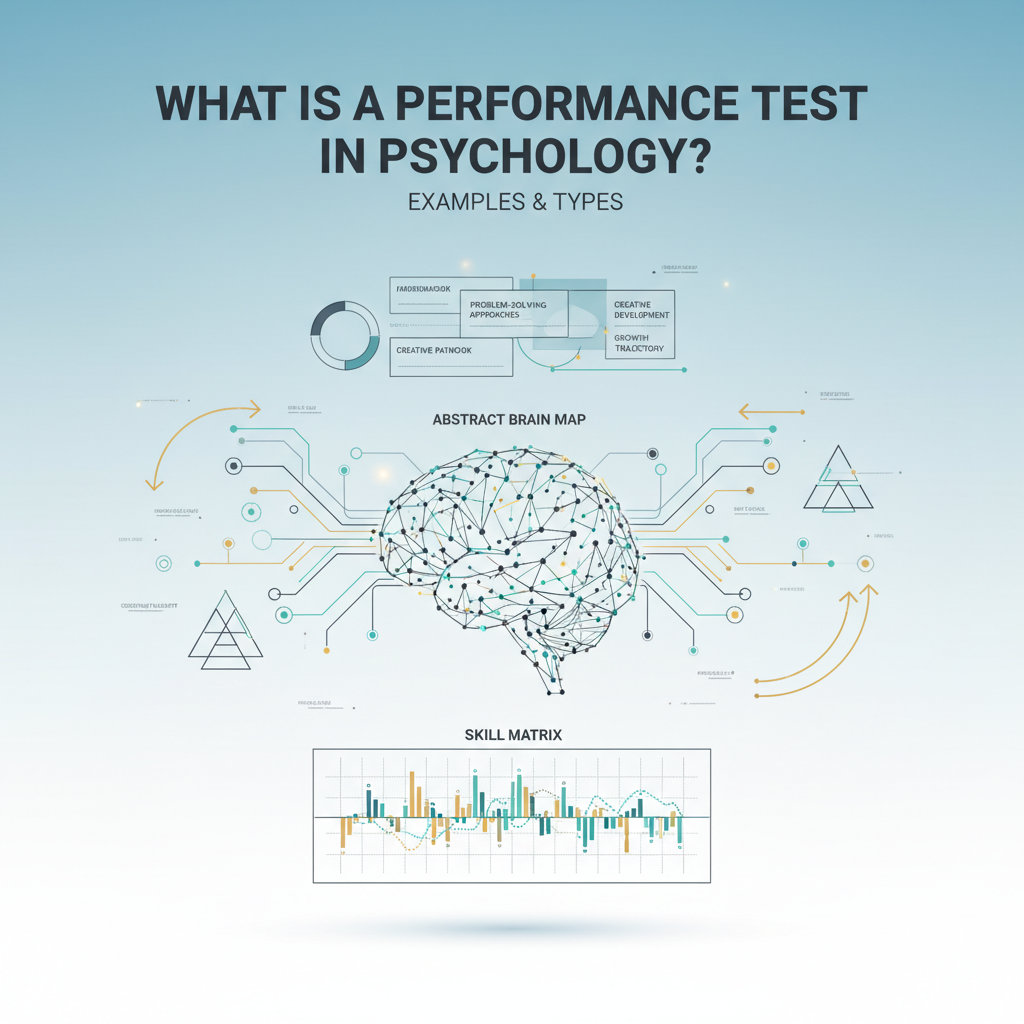
  • What is a Performance Test in Psychology? (Examples & Types)

    What is a Performance Test in Psychology? (Examples & Types)

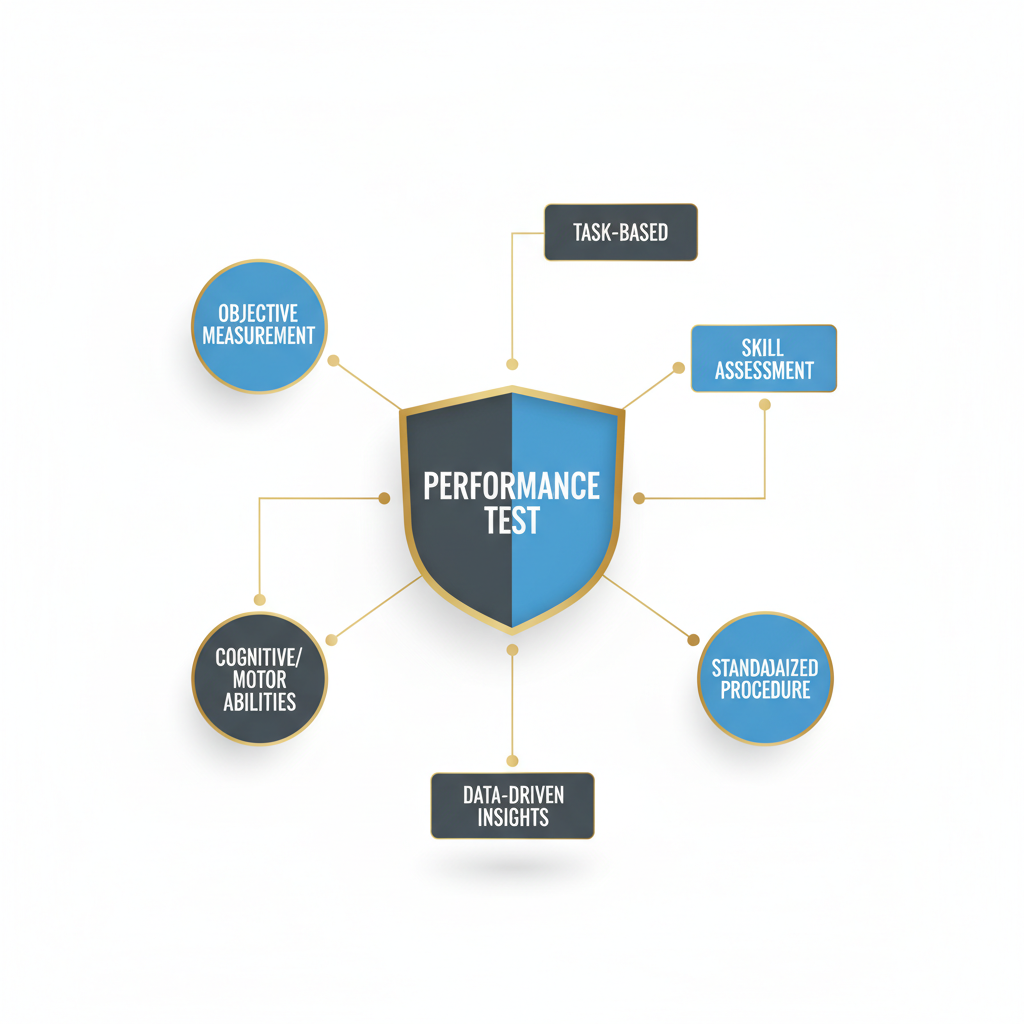
    A performance test in psychology is an assessment where an individual performs a specific task or activity, rather than just answering questions. These tests are designed to evaluate practical skills, problem-solving abilities, and aptitudes like creativity in a hands-on context, revealing how a person applies their knowledge.

    Have you ever wondered how well you handle unexpected problems, come up with new ideas, or adjust your thinking in new situations? While most tests focus on what you *know*, understanding skills like innovative problem-solving, cognitive flexibility, and creative thinking requires a different approach. It’s about measuring your practical skills and how you act when given a real task to complete.

    This is the main goal of a “performance test in psychology.” Instead of just asking questions, these scientifically grounded assessments observe how you complete a task. They watch your actions and strategies to reveal your unique strengths and thinking style. These tests offer valuable information about your ability to brainstorm, your approach to innovation, and your creative potential. In this article, we’ll explain what these tests are and why they’re so important for revealing practical skills. You’ll also learn how they can support your personal growth and help you use your creativity in the real world.

    What is a Performance Test in Psychology?

    Infographic visually defining a Performance Test in Psychology through a central concept connected to its key characteristics.
    A minimalist vector infographic defining ‘What is a Performance Test in Psychology?’. Present a central, abstract icon or shape labeled ‘Performance Test’, surrounded by several smaller, connected geometric shapes or nodes. Each node represents a key characteristic, purpose, or component (e.g., ‘Objective Measurement’, ‘Task-Based’, ‘Skill Assessment’). Use clean lines and a structured layout to convey a clear definition. Color palette includes soft blues, charcoal, and white with subtle gold highlights for emphasis. Ensure ample negative space and no human figures or cartoon elements.

    Moving Beyond Questions to Actions

    A performance test is different from a typical quiz. Instead of asking what you know or how you feel, it looks at what you actually do.

    Think of it as a hands-on assessment. This method helps us see your abilities in action. It shows your practical skills and how you use what you know.

    This kind of test is also key to understanding creativity. Creativity isn’t just an idea. It’s about making new things, solving problems, and adapting. Our platform uses this active approach. We help you go from just thinking about creativity to actually understanding and improving it.

    How It Measures What You Can Do, Not Just What You Know

    A performance test measures your skills by watching you complete specific tasks. Psychologists then review your actions and the results [1]. This is very different from traditional multiple-choice questions or self-report surveys.

    Here is how performance tests measure what you can do:

    • Hands-On Challenges: You are given a task to complete, like building a structure, solving a puzzle, or brainstorming ideas.
    • Watching Your Process: Experts observe how you approach the task. They look at your strategies and decision-making process.
    • Reviewing the Outcome: Your final product or solution is reviewed for its quality, originality, and effectiveness.
    • Real-Life Scenarios: These tests often use situations you might face in the real world. This makes the results more useful for everyday challenges.

    For creativity, these tests are especially useful. They don’t just ask if you think you’re creative. Instead, they measure your ability for things like:

    • Divergent Thinking: The ability to come up with many unique ideas from one starting point. This shows your mental flexibility.
    • Cognitive Flexibility: How easily you can shift your thinking between different ideas or methods. This is key for innovation.
    • Problem-Solving Skills: How you handle new situations and find creative solutions to unfamiliar problems.
    • Originality: We directly observe how unique and new your ideas are.

    Our 30-question assessment is a performance test based on these scientific principles. It shows you your unique creative strengths. You will get personalized insights into how you use creativity in real life. This helps you move from uncertainty to actionable self-awareness.

    What is the Importance of Performance Test in Psychology?

    Revealing practical skills and problem-solving

    Performance tests don’t just check what you know. They show what you can do when given a task. This hands-on approach is very useful in psychology. These tests show how well you apply your knowledge in real situations. They assess how you handle real-world challenges and find solutions. It’s about showing your skills, not just remembering facts. This gives a clearer picture of your true abilities.

    Think about how this applies to problem-solving. A performance test might ask you to solve a puzzle or create a strategy. This shows your thinking skills in action. For instance, these tests can measure how quickly you adapt to new information. They also see how efficiently you reach a goal [2].

    At Creative Ability Test, we focus on these practical skills. We help you understand your own way of facing challenges. This leads to clear steps for personal growth and professional development.

    Assessing Creativity and Innovative Thinking

    A powerful feature of performance tests is their ability to measure creativity directly. Creativity is not just about artistic talent. It involves coming up with new and useful ideas to solve problems. These tests offer a unique look at your innovative thinking.

    They often use open-ended tasks. You might be asked to brainstorm uses for an everyday object. Or, you could be challenged to find new solutions to a made-up problem. Such tasks directly measure divergent thinking. This is your ability to create a wide range of ideas [3].

    Performance tests also reveal how comfortable you are with unclear situations. They show how you handle challenges that don’t have a single “right” answer. This skill is vital for new ideas in any field. It highlights your flexible thinking and openness to new experiences.

    Our Creative Ability Test uses a proven scientific method. It uses performance-based questions to uncover your unique creative strengths. You get personalized feedback on your thinking styles. This helps you build on your potential for innovation.

    Understanding your creative abilities offers many benefits:

    • Uncovering Hidden Strengths: Discover creative talents you didn’t know you had.
    • Enhancing Problem-Solving: Learn to create more imaginative and effective solutions.
    • Boosting Innovation: Use creative thinking to develop new ideas at work or in your personal life.
    • Building Adaptability: Get better at handling uncertainty and embracing change.

    Providing Objective Insights into Abilities

    A key benefit of performance tests is that they are objective. They provide feedback based on what you do, not just on your feelings or beliefs. This greatly reduces personal bias.

    When you complete a task, your performance is measured directly. For example, the number of unique ideas you create is real data. This is different from simply being asked if you “think you are creative.” Because of this, performance tests offer a more accurate picture of your true abilities. This is especially true for complex skills like creativity [4].

    This objective feedback is valuable for several reasons:

    • Accurate Self-Awareness: Get a clear, unbiased view of your strengths and areas for growth.
    • Targeted Development: Get personal tips based on real evidence, making it easier to improve.
    • Tracking Progress: Objectively see how your creative skills change over time.
    • Informed Decision-Making: Make better life and career choices that match your true potential.

    At Creative Ability Test, our assessments are designed to do just that. We provide feedback based on evidence to support your journey of self-discovery. Our scientific method ensures you get results you can trust and use. These insights guide you toward real growth and better creative performance.

    How Do Maximum vs. Typical Performance Tests Differ?

    Infographic comparing Maximum Performance and Typical Performance tests side-by-side using abstract icons and labels.
    A minimalist vector infographic comparing ‘Maximum Performance’ and ‘Typical Performance’ tests. Two distinct, balanced sections, each with a primary heading and a cluster of related abstract icons or brief text labels (e.g., ‘Skill Ceiling’ vs. ‘Everyday Behavior’). Use clean geometric shapes, soft blue and charcoal colors with subtle gold accents. Emphasize clarity, structured grouping, and negative space to highlight differences and key attributes. No human figures or cartoon elements.

    Maximum Performance: Measuring Your Best Effort

    To understand your creative potential, we often look at your maximum performance. This measures what you can do at your absolute best. It shows your peak ability when you are motivated and giving your full effort [5].

    For example, imagine being asked to think of as many unique ideas as you can within a time limit. This is a classic test of maximum performance. You push yourself to think in new ways, aiming for both quality and quantity. Your Creative Ability Test has tasks designed to measure this peak creative output.

    Key characteristics of maximum performance tests include:

    • High Stakes: Participants know they are being evaluated and try to get the best possible score.
    • Clear Goals: There is a specific goal, like solving a tough problem or creating many ideas.
    • Focus on Capacity: These tests show your upper limit. They reveal what you can do under the best conditions.
    • Revealing Potential: This type of performance highlights your untapped skills and shows where your creative strengths are.

    Measuring your maximum creative performance gives us valuable insights into your potential for new ideas and innovation. This understanding helps guide you. It shows you how to unlock more of your natural creativity in everyday life.

    Typical Performance: Understanding Your Usual Behavior

    Typical performance, on the other hand, measures what you usually do in everyday life. These tests look at your regular habits and how you naturally approach situations. They don’t measure your best effort. Instead, they focus on how you normally handle tasks and problems [6].

    For example, think about how often you try new things. Or how you usually react to unexpected challenges. These are examples of your typical creative behavior. They show your consistent creative habits. Your Creative Ability Test helps you discover these everyday styles.

    Here’s what defines typical performance tests:

    • Low Stakes: People can be honest about their usual behavior because there is less pressure to perform well.
    • Self-Report Focus: These tests usually use questionnaires where you describe your own actions and feelings.
    • Real-World Relevance: They show how creativity fits into your daily life and reveal your natural problem-solving style.
    • Insights into Application: This helps us see how you use your creative strengths in real life and whether you apply them consistently.

    Both maximum and typical performance give us important information. The Creative Ability Test provides a complete picture by connecting your peak potential with your daily habits. This approach empowers you. It helps you use these insights for personal and professional growth.

    What is a Performance Test in Psychology Example?

    Tests for Cognitive and Problem-Solving Skills (e.g., Block Design)

    Performance tests measure how you think and solve problems. They go beyond simply what you can remember. Instead, they look at your ability to use information and logic to find solutions.

    A classic example is the Block Design task. In this test, you get a set of colored blocks. You then arrange them to match a picture. This task tests your spatial reasoning and your ability to break a big problem into smaller steps. It also measures how quickly you can change your strategy if something isn’t working.

    These tests help us understand how flexible your thinking is. They show your ability to think in new ways. A strong performance shows you can picture solutions in your mind and carry them out well. This skill is key to solving creative problems in everyday life.

    • Spatial Reasoning: How well you understand and work with objects in your mind.
    • Breaking Down Problems: Your skill in turning large problems into smaller parts.
    • Flexible Thinking: Your ability to switch strategies when one isn’t working.
    • Efficient Action: How well you carry out a plan to solve a problem.

    Knowing your strengths helps you grow. It helps you see where your natural problem-solving skills are. Our platform can help you find these thinking patterns and give you tips to improve them.

    Tests for Creative Thinking (e.g., Divergent Thinking Tasks)

    For many, the most exciting performance tests are the ones that focus on creativity. These tests don’t have one “right” answer. Instead, they value originality and a wide range of ideas.

    Divergent thinking tasks are a great example. These tests check your ability to come up with many unique ideas from one starting point [7]. For instance, you might be asked to list all the possible uses for a brick. Your imagination is the only limit.

    These tasks measure several key parts of your creative mind:

    • Fluency: The total number of ideas you can come up with.
    • Flexibility: The variety of categories your ideas fall into.
    • Originality: How new or uncommon your ideas are compared to others.
    • Elaboration: The amount of detail you include in each idea.

    Doing well on these tests shows you are open to new possibilities and have a strong ability to innovate. These are key skills for personal and professional success. Our science-backed test measures these areas and provides personal feedback. This helps you understand and use your creative strengths.

    You can then use what you learn to think more creatively and solve problems in any situation. This helps turn your creative potential into real-world skills.

    Tests for Motor Skills and Coordination

    While less tied to creative thinking, some performance tests also measure motor skills. These tests check your physical skill and coordination. They see how quickly and accurately you can make specific movements, from using your fingers to reacting to a trigger.

    Examples include pegboard tests, where you place pegs into small holes. Other tests might involve following a moving target on a screen. These tests are important in many fields. They help see if someone is ready for a certain job or can help people recover from injuries.

    Such tests give clear information about physical skills and show areas where you can improve. While our platform focuses on creative thinking, these examples show how wide-ranging performance tests are. They prove we can measure many different human skills by seeing them in action.

    How Do Performance Tests Relate to Your Creative Potential?

    Conceptual infographic illustrating how psychological performance tests connect to and reveal an individual's creative potential.
    A minimalist vector infographic visualizing the relationship between ‘Performance Tests’ and ‘Creative Potential.’ Depict a central ‘Creative Potential’ node or concept, surrounded by or connected to several abstract elements representing different ‘Performance Test’ outcomes or insights. Use subtle lines or pathways to illustrate how these tests reveal or contribute to understanding one’s creative abilities. Employ clean, layered geometric shapes, a palette of soft blues, whites, and charcoal, with teal accents to signify connections and growth. Maintain ample negative space for legibility. No human figures or cartoon elements.

    Measuring Your Ability to Generate Unique Ideas

    Creativity starts with new ideas. Performance tests help measure this skill directly. They go beyond theory and look at how you actually generate thoughts. These tests evaluate your ability to produce a wide range of solutions or concepts.

    For example, you might be asked to list many uses for a common object. This simple task shows your divergent thinking skills. Divergent thinking is key to creativity. It’s about exploring many possible solutions. Instead of focusing on one correct answer, you come up with many unique ones [7].

    Our Creative Ability Test uses methods based on science. It assesses how easily and flexibly you generate ideas. This shows you are open to new possibilities. It also highlights your cognitive flexibility, which is your mind’s ability to switch between different concepts. Understanding this helps you see your unique creative strengths.

    Understanding How You Approach and Solve New Problems

    Creativity is more than just having ideas. It’s also about how you use them. Performance tests offer a look into your problem-solving process. They don’t just check the final answer; they observe your method when you face a new challenge.

    When solving new problems, you show several creative skills:

    • Originality: This is about coming up with truly unique and uncommon ideas.
    • Fluency: This is how many useful ideas you can think of quickly.
    • Flexibility: This measures how many different types of ideas you explore.
    • Elaboration: This shows your ability to add rich details to your ideas.

    Our assessment looks at these areas to help you understand your personal thinking style. Do you prefer a structured plan, or are you more spontaneous? Knowing this helps you use your natural strengths. It allows you to solve real-world problems more effectively. This knowledge is key for innovation and personal growth.

    Using Feedback to Help Your Creativity Grow

    Unlocking your creative potential is a journey. Performance tests give you a clear starting point. They offer useful feedback on your unique creative style. This personal information is a powerful tool that turns uncertainty into a clear plan for improvement.

    Here’s how this feedback helps you:

    • Targeted Improvement: If you are good at fluency, you can focus on making your ideas better. If flexibility is an area for growth, you can practice seeing things from different angles.
    • Better Problem-Solving: Understanding your creative style helps you approach challenges differently. You can use your strengths on purpose, which leads to more innovative solutions.
    • Career Growth: Creativity is valued in many jobs. Our feedback gives you practical tips to boost your innovation skills and support your professional goals.
    • Personal Growth: Gaining confidence in your creative skills is powerful. It helps you build a mindset of always improving.

    The Creative Ability Test offers detailed feedback with useful tips based on your results. This guides you to improve your cognitive flexibility and divergent thinking. As a result, you go from just knowing your potential to actively growing it. Start using your creativity in meaningful ways today.

    Frequently Asked Questions

    What are the 4 types of psychological tests?

    Psychological tests are tools that help you understand yourself. They measure how you think, feel, and act. These assessments give you valuable self-awareness and often fall into four main types:

    • Ability/Aptitude Tests: These tests check your potential to learn or do certain tasks. For example, they might measure your thinking skills or creative talent. Our Creative Ability Test helps you find your unique creative strengths.
    • Achievement Tests: These tests measure what you already know. They check your current skills or knowledge in a specific subject, like a final exam for a class.
    • Personality Tests: These explore your typical ways of thinking, feeling, and acting. They can show personality traits like being introverted, organized, or open to new things [source: https://www.apa.org/education-career/guide/science-psychology].
    • Neuropsychological Tests: These tests check how your brain is working, especially after an injury or illness. They look at skills like memory, focus, and problem-solving.

    Knowing these types helps you see how a creative test fits in. It’s a great tool for personal growth.

    What is a typical performance test example?

    A typical performance test shows how you usually act. It’s not about your best effort, but your everyday approach. These tests reveal your natural tendencies and consistent patterns.

    Imagine a test asks you to brainstorm uses for a common object, like a brick. The goal isn’t to find the “best” answer, but to see how your ideas naturally flow. This kind of task shows how you think creatively in a low-pressure setting. It’s different from a “maximum performance” test, which pushes you to get the highest score possible.

    This type of test helps you discover your natural problem-solving style. It gives you a starting point for understanding your creative strengths and offers useful tips on how you create new ideas.

    How does a performance test differ from a verbal test in psychology?

    Performance tests and verbal tests measure abilities in different ways. It’s important to know how they are different.

    • Performance Tests: These tests require you to do a task, not just talk about it. You might solve a puzzle, handle an object, or come up with new ideas. For example, our Creative Ability Test asks you to complete creative tasks. This shows your skills in action and is great for seeing how you apply your creative thinking.
    • Verbal Tests: These tests use words. You answer questions by writing, speaking, or reading. Vocabulary tests and essays are common examples. They measure what you know and how well you can explain it with language.

    The main difference is action versus words. Performance tests show what you can do, while verbal tests show what you know. Both are valuable, but performance tests give a clearer picture of your creative skills in action. They connect ideas to real-world use.

    What is an example of a group test in Psychology?

    A group test in psychology is when many people are tested at the same time. This method is efficient and ensures everyone takes the test under the same conditions. This makes it fair to compare the results.

    A common example is a creativity test given to an entire class. Imagine a teacher gives all students the same design challenge, materials, and time limit. For instance, the task could be to “design a new type of transportation.” Everyone’s work is then graded using the same rules. This is a group test because it measures the creative skills of many people at once [source: https://psycnet.apa.org/record/2012-00507-000].

    These tests are often used in schools or workplaces. They help find patterns or individual strengths in a group. For example, a test could find which students are best at brainstorming many ideas. This information is useful for creating training and development programs.


    Sources

    1. https://www.apa.org/pubs/books/4318090
    2. https://psycnet.apa.org/record/2012-09413-004
    3. https://www.sciencedirect.com/topics/psychology/divergent-thinking
    4. https://www.journals.uchicago.edu/doi/full/10.1086/665988
    5. https://psycnet.apa.org/record/2012-07383-001
    6. https://www.sciencedirect.com/science/article/pii/B9780123743322002573
    7. https://www.apa.org/education-career/guide/divergent-thinking

  • Observation Test in Psychology: A Guide to Methods and Insights

    Observation Test in Psychology: A Guide to Methods and Insights

    An observation test in psychology is a research method where a researcher observes and records the behavior of individuals or groups in a specific setting. Unlike a traditional test with questions, it involves systematically watching subjects to gather data on their actions, interactions, and responses, either in a natural environment (naturalistic observation) or a manipulated one (controlled observation).

    Do you truly see the world around you, or do you just look? In our busy world, keen observation is more than just a useful skill. It helps you find new ideas, solve complex problems, and boost your creativity. The way you perceive and process your surroundings shapes everything from small insights to major breakthroughs. This isn’t a rare talent; it’s a cognitive ability that anyone can develop. Psychology offers a scientific way to understand and improve it.

    This article will introduce you to the observation test in psychology, including its core methods and insights. We’ll explain how techniques like naturalistic and controlled observation are used to study behavior. More importantly, you’ll see how understanding these scientific approaches can sharpen your own creative thinking. Get ready to learn how better observation skills can make you a more flexible thinker, lead to new ideas, and provide practical tools for growth and problem-solving in your life. First, let’s define what an observation test in psychology is.

    What is an Observation Test in Psychology?

    In psychology, an observation test isn’t just a formal exam. It’s about a deeper idea: how we notice and understand the world around us. Psychologists use observation as a key research tool. They watch and record behaviors to understand how people think. It’s a basic way to learn about the mind and how we connect with the world.

    But for creativity, observation is much more active. It’s a key skill that pushes you to see the small details and look past what’s obvious. This is more than just seeing. It requires you to pay close attention on purpose.

    Good observation skills are essential for creative thinking. They help build your cognitive flexibility. You learn to see patterns and notice things that are out of place. This skill directly helps your problem-solving and improves your divergent thinking. By observing closely, you gather unique details that you can use to create new ideas.

    At Creative Ability Test, we understand this important link. Our 30-question assessment helps you explore your unique thinking styles, including how you naturally see and understand the world. When you know your observational strengths, you learn more about your creative process. This helps you gain real, useful insights. You learn how to use your unique point of view, which can help you grow both personally and professionally.

    Importance of observation test in psychology

    Observation tests are key tools in psychology. They offer a unique window into how people behave. These tests are not just for researchers; they also give valuable insights to anyone curious about their own creative thinking and problem-solving styles. By watching and understanding actions, we can find patterns. These patterns often show hidden strengths and ways to improve our creative skills.

    Understanding observation helps you see the science behind assessments like The Creative Ability Test. It shows how we move from simply guessing about creativity to gaining real, useful self-knowledge.

    Provides Realistic Behavioral Insights

    Observation allows psychologists to see how people act in real life. This is powerful because it goes beyond what people say they do and shows what they actually do. For example, someone might claim to be very organized, but observation could show they are more spontaneous and flexible. This kind of flexibility is often a key part of creative problem-solving.

    These real-world insights are vital. They help us understand skills like flexible thinking and coming up with many ideas. They show how people naturally react to challenges. Watching someone solve a complex puzzle, for instance, can reveal their unique thinking style. Do they brainstorm lots of ideas? Do they plan every step carefully? Such details give a clearer, more accurate picture than questionnaires alone. In fact, studies often favor observation for capturing natural social behaviors [1].

    • Uncovers Natural Responses: See how people react in unscripted situations.
    • Reveals Hidden Patterns: Identify behaviors people might not notice in themselves.
    • Links Theory to Practice: Connect psychological ideas to everyday actions.
    • Highlights True Creative Styles: See if someone works best under pressure or with more time to think.

    For you, this means you can better understand your own creative habits. The Creative Ability Test, while a formal assessment, is built on this kind of behavioral research. This helps explain your personal results in a way that connects to your own life.

    Generates New Ideas and Hypotheses

    Observation is a great way to spark new ideas. By simply watching, researchers can spot unusual behaviors or unexpected connections. This often leads to new ideas to test (or hypotheses) about how the mind works. Sometimes, these observations can inspire whole new theories about creativity.

    Imagine watching children play. You might see that some kids combine toys in unique ways to invent new games. This could lead to an idea about the early signs of creative thinking. These first observations then help guide more organized research. They help us better understand the creative process. This cycle of watching, asking questions, and testing is how science moves forward.

    From a personal growth perspective, building your own observation skills can do the same. It can help you:

    • Spot Trends: Notice patterns in the problems and solutions around you.
    • Question Assumptions: Challenge what you think you know by seeing what is really happening.
    • Inspire Innovation: Use everyday details as starting points for new ideas.
    • Develop Personal Theories: Form your own ideas about how you and others think creatively.

    The Creative Ability Test encourages this kind of self-discovery. It helps you put words to the creative styles you may already use without thinking about it. This gives you a clearer path to improve your creative skills.

    Enhances Validity of Research

    For a psychological assessment to be credible, it must be valid—meaning it measures what it claims to measure. Observation tests are very important for this. They help double-check other research methods. For example, surveys are useful, but people do not always see themselves clearly. Direct observation can confirm or correct what people report about themselves [2].

    When what we see in observation matches what people report, it makes the research findings stronger. This gives us a more complete and trustworthy picture of behavior. Combining different types of information this way makes the research more valid. It ensures that psychological ideas are based on real-world proof, not just theories.

    This dedication to scientific quality is the foundation of the Creative Ability Test. We use proven methods to ensure the feedback you get is both trustworthy and practical. By understanding why observation matters, you can be more confident in your assessment results. This knowledge helps you to:

    • Trust Your Results: Feel confident that the feedback on your creativity is based on science.
    • Apply Insights Effectively: Use reliable information to make real improvements.
    • Understand Creative Psychology: Learn how different parts of creativity are accurately measured.
    • Achieve Growth: Build on a solid foundation of trustworthy knowledge about yourself.

    What Are the Main Types of Observation Methods?

    A minimalist infographic displaying a central node 'Observation Methods' connected to several distinct geometric shapes, each representing and labeling a different type of observation method.
    An abstract, educational infographic illustrating ‘What Are the Main Types of Observation Methods?’. The visual is a minimalist, vector-based cognitive network diagram. A central circular node labeled ‘Observation Methods’ is connected by clean lines to several distinct, geometric shapes representing different categories of observation methods. Each method shape has a subtle gradient and a short, clear label. The layout uses ample negative space to ensure clarity. Color palette: soft blues, whites, charcoal for labels, with teal accents for connections and highlights. Professional, approachable style, no human elements.

    What is Naturalistic Observation in Psychology?

    Naturalistic observation is watching people in their usual environment. Researchers watch without interfering. The goal is to see real, natural actions. This helps us understand how people truly act in their daily lives.

    For example, you could watch a team brainstorm in their office. You would see how they interact without guiding them. This provides a great look at how creative groups work together. It shows how ideas develop on their own.

    Understanding this method can make you more aware of creativity. You learn to spot small details and patterns that are easy to miss in controlled settings. This skill is key for solving problems and creating new things.

    • Benefits for Creativity:
    • See creativity in a real-life setting.
    • Discover how people solve problems on their own.
    • Find where inspiration naturally comes from.

    However, it’s hard to control all the factors. Because of this, it’s tough to prove that one thing causes another [source: https://www.simplypsychology.org/naturalistic-observation.html].

    What is Controlled Observation in Psychology?

    Controlled observation happens in a set-up environment, like a lab. Researchers can control certain factors and give people specific tasks. The goal is to see how they react under these exact conditions.

    Imagine giving a group a creative challenge, like designing a new product. You watch them work in a controlled room. This lets you study their creative process closely and see how flexible their thinking is. You can also easily compare different problem-solving styles.

    This method is reliable for testing a specific idea. It helps pinpoint what affects creative results. This makes it great for testing theories about creativity. The findings can help create new ways to encourage innovation.

    • Key Aspects for Creative Insight:
    • Lets you focus on specific creative steps.
    • You can change factors to see their effect.
    • Provides clear data on creative reactions.

    However, the lab setting can make people act differently. This means the results might not always apply to real-world situations [source: https://www.tutor2u.net/psychology/reference/observational-techniques-controlled-and-naturalistic-observation].

    What is Participant Observation?

    In participant observation, the researcher becomes part of the group they are studying. They actively join in with the activities. This gives them an insider’s view and a deeper understanding of the situation.

    For example, a researcher might join an innovation team. They would take part in brainstorming and design work. This gives them direct experience of how the team creates together. It helps them understand the group’s dynamics and see how ideas are born and improved.

    This method provides rich, detailed information. It uncovers the small details of creative behavior that an outsider would miss. You get a much deeper feel for the group’s shared creative process.

    • Strengths for Understanding Creativity:
    • Offers deep insight into group creativity in its natural setting.
    • Helps you understand the feelings involved in creating.
    • Shows the unwritten rules of a creative group.

    However, it can be hard for the researcher to stay neutral. Their presence might also change how the group acts [source: https://research-methodology.net/research-methods/qualitative-research/participant-observation/].

    What is Non-Participant Observation?

    In non-participant observation, the researcher watches from a distance. They do not interact with the people being studied. The goal is to remain separate and record behavior without influencing it.

    For example, you could watch a workshop through a one-way mirror. You would record how people handle creative tasks and work together. This provides an unbiased view and lowers the chance of affecting their natural behavior.

    This method is great for gathering unbiased information. It helps in spotting patterns in behavior. These patterns can show common creative strategies and highlight effective ways to innovate. You get a clear view of how people create.

    • Benefits for Creative Assessment:
    • Leads to more objective data by reducing the observer’s influence.
    • Allows you to watch a wide range of actions without interfering.
    • Great for studying creative behavior in public settings.

    However, this method may not provide deep insight. It can be hard to understand the reasons behind people’s actions without knowing the context [source: https://www.open.edu/openlearn/ocw/mod/oucontent/view.php?id=80453&section=1.2].

    Understanding these methods gives you a foundation for looking at creative thinking. In the same way, our Creative Ability Test uses structured, science-based methods. It gives you personalized insights into your creative strengths and problem-solving styles. This journey helps turn uncertainty into useful self-awareness.

    How Can Sharpening Your Observation Skills Boost Creativity?

    A layered infographic showing a progression from 'Observation Skills' through 'Enhanced Awareness' and 'Divergent Thinking' to 'Boosted Creativity,' using interconnected geometric shapes.
    An abstract, educational infographic showcasing ‘How Can Sharpening Your Observation Skills Boost Creativity?’. The visual depicts a minimalist, vector-based layered system demonstrating progressive growth. A foundational layer labeled ‘Observation Skills’ forms the base. Above it, successive geometric layers or interconnected pathways ascend, representing ‘Enhanced Awareness’, ‘Divergent Thinking’, and culminating in a prominent, upward-pointing shape labeled ‘Boosted Creativity’. Subtle gradients add depth, and clean lines maintain clarity. Gold accents highlight the creativity outcome. Color palette: soft blues, whites, charcoal for labels, with gold accents for emphasis. Professional, approachable style, no human elements.

    Observation is a key skill for creativity. It’s not just about looking. It’s about actively noticing, analyzing, and understanding the world around you. This focus helps you see things differently and sparks new ideas.

    When you improve your observation skills, your thinking becomes more flexible. This helps you move past old ways of thinking. Our Creative Ability Test helps you understand your creative strengths. It also gives you strategies to grow these important skills.

    Seeing Problems from New Angles

    Big creative ideas often come from looking at old problems in new ways. Good observation skills help you notice details or patterns that others miss. This lets you see challenges from a completely new angle.

    For example, think about opening a package. If you watch people struggle with it, you might see what the real problems are. Maybe they don’t have the right tools, or the design is clumsy. Noticing this can lead to a new, easy-to-use solution.

    It’s like looking at something you know well, but for the first time. This challenges what you think you know. It’s a key part of solving problems. You stop focusing on “what is” and start imagining “what could be.” Studies show that redefining a problem is a key part of creative problem-solving [3].

    • Break free from routine: Observing closely helps you question norms.
    • Identify hidden needs: You spot user frustrations others miss.
    • Challenge assumptions: Look beyond surface-level issues for deeper understanding.
    • Generate unique solutions: New angles lead to truly innovative answers.

    Our assessment shows you how flexible your thinking is. This skill is key to seeing problems from different angles. We give you practical advice to improve this important creative strength.

    Finding Inspiration in Everyday Details

    The world is full of potential ideas. But many people walk through it without really seeing what’s there. Improving your observation skills can turn everyday things into a source of endless inspiration.

    Artists, writers, and scientists often get ideas from the world around them. A strange texture, a new mix of colors, or a certain sound can spark a new thought. For example, the famous physicist Richard Feynman got an idea just by watching a wobbly plate [4]. This led him to new ideas about how particles spin.

    When you pay closer attention, you build a large mental library of what you’ve seen. This library is where new ideas can grow. It helps you think of many different possibilities, a key part of creativity. It also builds curiosity and wonder, which are needed to keep growing creatively.

    • Practice mindful observation: Actively engage your senses in daily life.
    • Document your findings: Keep an observation journal or sketchbook.
    • Notice sensory details: Pay attention to sights, sounds, smells, and textures.
    • Stay curious: Ask “why” or “how” about everyday things.

    Our platform helps you become more open to new experiences. Being open is key to finding inspiration everywhere. We provide personal strategies to help you use your surroundings to spark your creativity.

    Connecting Seemingly Unrelated Ideas

    Creativity is often about connecting ideas that seem unrelated. When you observe carefully, you collect a lot of different information. This makes it easier to link ideas that didn’t seem connected before.

    Imagine watching a busy ant colony, and later seeing how a shipping company works. What you learned from both could help you improve a delivery system. This kind of connection is a powerful way to come up with new solutions.

    A great example is Johannes Gutenberg. He saw how grape presses and coin punches worked. By combining these two different technologies, he invented the printing press. This changed how people share information forever. His ability to connect what he saw led to a huge creative breakthrough.

    Developing this skill helps you see patterns and possibilities no one else does. It helps you think in new and flexible ways. These skills are important for solving problems and for personal growth.

    • Broaden your interests: Expose yourself to many different fields and subjects.
    • Look for analogies: How does something work in one area that might apply to another?
    • Brainstorm connections: Deliberately link random objects or concepts.
    • Embrace “aha!” moments: These often arise from combining stored observations.

    The Creative Ability Test measures your ability to think of many different ideas. It also looks at how well you make unique connections. Our personal feedback gives you tips to get better at making these creative connections, helping you become a more creative thinker.

    How to Apply Observational Skills in Your Daily Life

    A step-by-step infographic illustrating how to apply observational skills in daily life, from noticing details to taking innovative action, depicted with clean geometric shapes.
    An abstract, educational infographic visualizing ‘How to Apply Observational Skills in Your Daily Life’. The visual is a minimalist, vector-based stepwise process diagram. A clear starting point, a simple geometric shape labeled ‘Daily Life Observations’, leads via connecting lines and arrows to a series of sequential, distinct geometric steps, each with a short action-oriented label (e.g., ‘Notice Details’, ‘Identify Patterns’, ‘Formulate Insights’, ‘Innovative Action’). The flow concludes with a goal-oriented shape. Ample negative space ensures readability. Color palette: soft blues, whites, charcoal for labels, with teal accents highlighting the actionable steps. Professional, approachable style, no human elements.

    Improving your observation skills is a great way to boost your creativity. It helps you see the world in a new way. This isn’t just for researchers—it has real benefits for everyone.

    By paying more attention in your daily life, you can learn to think more flexibly. You’ll also get better at solving problems. These are key skills measured by the Creative Ability Test. Here are some simple ways to use observation every day.

    Practice Mindful People-Watching

    Observation skills aren’t just for scientists. You can improve yours every day. A great way to do this is by mindfully watching people.

    This means more than just a quick look. It’s about paying close attention. You watch without judging and notice the small things. When you do this, you’ll start to see a lot more around you.

    Mindful people-watching boosts your creativity. It helps you find new ways of seeing things. It can also give you new ideas for solving problems.

    Here’s how to start:

    • Choose a setting: Go to a cafe, park, or public square. A place with a lot of activity is best.
    • Focus on details: Notice body language, interactions, and facial expressions. See how people move and talk.
    • Ask open-ended questions: Wonder about their stories. Where are they going? What do they want?
    • Avoid assumptions: Just watch what is actually happening. Don’t try to guess the meaning or judge right away. This helps you think more flexibly.
    • Connect observations: Think about how different things are related. How does one person’s action affect someone else?

    Doing this every day can change how you see problems. It trains your brain to find connections. Over time, it helps you build divergent thinking skills, which are key to creativity.

    Keep an Observation Journal

    A simple but powerful way to improve your observation skills is to keep a journal. This isn’t just a diary—it’s a special place to write down what you notice.

    A journal helps you pay attention on purpose. It gives your observations structure, which helps make new ideas and insights clearer.

    This practice directly improves your creative skills. It trains your mind to remember more details. It also builds a personal source of inspiration you can use for creative problem-solving.

    Try these steps for your journal:

    • Daily entries: Spend a few minutes each day writing down what you observed in your surroundings.
    • Use all senses: Describe sights, sounds, smells, and textures. What do you feel? What do you hear?
    • Be descriptive: Instead of “a dog,” write “a scruffy terrier with one floppy ear.” Being specific is important.
    • Sketch or doodle: Drawing can capture details that words might miss. You don’t have to be an artist.
    • Reflect and connect: After writing down what you see, think about it. Do you notice any patterns or surprising connections?

    Looking back at your journal can spark new ideas. It shows you patterns in how you see things. This organized method strengthens your creative thinking and helps you use what you’ve learned to solve problems.

    Challenge Your Assumptions

    Our brains use shortcuts to handle information. These shortcuts, or assumptions, help us get through the day. But they can also limit what we notice and how creative we are.

    Questioning your assumptions is key to better observation. It makes you look past your first impressions. As a result, you can find hidden details and new viewpoints.

    This practice is essential for new ideas. It makes your thinking more flexible. It also helps you with divergent thinking, which means looking for many different solutions to a problem instead of just the obvious one.

    Here’s how to challenge what you assume:

    • Identify your beliefs: When you’re in a situation, notice your first thoughts. What do you assume is true?
    • Ask “Why?”: Look closer at those beliefs. Why do you assume that? What proof do you have?
    • Consider alternatives: What if the opposite were true? Think about other explanations. This opens up new ways of thinking.
    • Seek different views: Talk to people from other backgrounds. Their ideas can show you what you’re missing [5].
    • Try small experiments: Test your assumptions in the real world. See if they are actually true.

    By regularly questioning what you think you know, you’ll improve your observation skills. You will start to see things more clearly. This helps you approach problems with real curiosity, leading to new creative solutions and personal growth.

    Frequently Asked Questions

    What is an example of controlled observation in psychology?

    Controlled observation means studying behavior in a carefully planned setting. Researchers control certain factors to see how one thing affects another. It is a very focused way to learn.

    A classic example is watching children play with new toys in a lab. For each child, the room and the toys are exactly the same. Researchers often watch from behind a one-way mirror so they don’t disturb the children. They record specific actions, like sharing or solving a problem. This consistency helps them identify what causes different behaviors.

    Understanding these controlled settings can boost creativity. We can design spaces, like an “innovation lab” with specific tools, to encourage new ideas. This shows how your own environment affects your creative flow. Our Creative Ability Test offers tips for improving your personal creative space.

    What is a naturalistic observation psychology example?

    Naturalistic observation is watching behavior in a real-life setting. The researcher doesn’t get involved. This method provides a true look at how people or animals act naturally.

    For example, a psychologist might watch children playing in a park to see how they interact or solve problems on their own. The researcher just observes and takes notes without changing anything. This shows how children really behave, which might be different than in a lab.

    This method is important for understanding creativity in the real world. Watching an artist find inspiration on a walk or engineers working together shows how creativity happens naturally. These insights can help you be more creative in your daily life. Our platform helps you connect these real-world ideas to your personal creative style.

    What is an observation test game?

    An observation test game is an activity that tests how well you notice details. In these games, you might have to spot differences, find hidden objects, or remember what you saw. They are designed to help you improve your focus.

    Think of “spot the difference” or “hidden object” games. They train your brain to see small details and quickly understand what you’re looking at. This skill is very helpful for solving problems creatively.

    Being a better observer makes you more creative. When you notice more details around you, you come up with more new ideas. Good observation is a key part of flexible thinking, which is something measured by the Creative Ability Test. By improving your observation skills, you can find new perspectives and solutions.

    What is structured observation in psychology?

    In structured observation, researchers use a set plan to record behavior. They often use checklists or rating scales to categorize what they see. This approach makes sure every observation is consistent.

    For example, a researcher watching a team brainstorm would use a prepared checklist. It might track “the number of new ideas” or “how often people build on each other’s ideas.” Every action is clearly defined, which makes it easier to analyze the data and compare different groups.

    This method is a great way to study how creativity works. It helps us find the specific actions that lead to breakthroughs. When you understand these patterns, you can use them in your own work. Our Creative Ability Test uses proven methods to show you your own creative thinking style. This gives you practical tips for personal and professional growth, helping you turn creative insights into action.


    Sources

    1. https://opentext.wsu.edu/psychology/chapter/observational-studies/
    2. https://www.simplypsychology.org/observation.html
    3. https://journals.sagepub.com/doi/abs/10.1177/0013164415582301
    4. https://feynmanlectures.caltech.edu/I_20.html
    5. https://hbr.org/2017/04/how-to-overcome-your-own-bias
  • The California Psychological Inventory: A Guide for Creative Thinkers

    The California Psychological Inventory: A Guide for Creative Thinkers

    The California Psychological Inventory (CPI) is a self-report personality assessment designed to evaluate an individual’s interpersonal behavior and social interaction. It measures everyday traits like dominance, sociability, and self-control to provide a comprehensive profile of a person’s character and typical way of interacting with others in various settings.

    Have you ever wondered what drives the way you think, solve problems, and come up with new ideas? Your personality is more than just a list of traits. It’s the foundation for how you interact with the world, face challenges, and unleash our creative potential. Understanding yourself better can reveal powerful insights into how you innovate and grow.

    The California Psychological Inventory (CPI) is a respected and widely used tool for understanding human behavior. This comprehensive personality test offers a detailed look at your social style, values, and how you think. In this guide, we will explore what the CPI measures, look at its key personality traits, and show how its insights can reveal your creative strengths and opportunities for growth.

    Whether you are a student, a professional, or just someone interested in self-improvement, learning about the link between personality and creativity is a valuable step. Join us as we explain the California Psychological Inventory and its connection to creative thinking. You’ll discover how knowing yourself better can boost your creativity and improve your problem-solving skills.

    What is the California Psychological Inventory (CPI)?

    The California Psychological Inventory (CPI) is a well-known personality assessment. It offers a detailed look at human behavior. This tool helps you understand your social interactions, personal strengths, and motivations.

    Unlike some tests, the CPI focuses on “normal” personality traits rather than clinical disorders. It highlights characteristics that affect everyday life, like leadership, empathy, and self-control. This makes it a practical tool for self-discovery.

    The Purpose of the CPI

    The main goal of the CPI is to provide a deep sense of self-understanding. It helps you grasp your unique personality profile. This knowledge supports personal growth and professional development.

    The assessment describes and predicts behavior. It measures how you interact with the world and explores your inner values. This gives you a clear framework for self-reflection. Understanding these parts of yourself is key to using your creative strengths.

    The CPI is built on solid research. It helps identify traits like your preferred thinking styles and how you approach problems. As a result, it offers practical advice that can improve your creative skills in real ways.

    Who Uses the CPI Test?

    Many groups find the CPI useful, from individuals to large organizations. Because it has a wide range of uses, the test is a flexible tool for insight and growth.

    Here are some common users of the CPI:

    • Organizations: Businesses use the CPI for leadership development and talent management. It helps them build stronger teams and identify high-potential employees [1].
    • Coaches and Counselors: These professionals use the CPI to guide clients with career counseling and personal development. Understanding a client’s personality helps them create better strategies.
    • Educational Institutions: Universities and colleges use the CPI to help students with career guidance. It also supports leadership training programs.
    • Individuals: Many people take the CPI for self-exploration. Understanding their unique traits helps them make better life choices and improve their personal effectiveness.

    Knowing your CPI profile can unlock your potential and show you how you innovate. This understanding is key for creative thinkers. For example, it can reveal how open you are to new ideas or your willingness to take risks. These insights are a powerful first step on your creative journey. The Creative Ability Test builds on this foundation, offering specific details about your creative potential.

    What Key Personality Traits Does the CPI Assess?

    An infographic showing a competency map or assessment chart with various personality traits as labeled segments, highlighted with subtle gradients.
    Create an abstract, educational, vector-based infographic. Visualize a clean, minimalist competency map or a structured assessment chart. Display different personality traits as distinct, labeled segments or nodes, using clean geometric shapes with subtle gradients and accent highlights in soft blues, whites, charcoal, with gold or teal. Ensure ample negative space for labels and maintain a professional, approachable aesthetic suitable for a guide on creativity assessment. No human figures or cartoon elements.

    Understanding the Four Main Categories

    The California Psychological Inventory (CPI) gives you a deep look at your personality. It groups many different traits into four main categories. This structure provides a simple way to understand complex human behavior. It helps you see yourself more clearly and improve how you interact with the world.

    Each category focuses on a different part of your personality. By exploring them, you can find your strengths and see where you can grow. This organized method makes it easier to use what you learn about yourself. It helps support your journey of self-discovery.

    Interpersonal Style and Orientation

    This category looks at how you relate to other people. It checks your style in social situations. These traits are important for teamwork and leadership. They affect your ability to connect with and influence others.

    Key traits in this area include:

    • Dominance: How comfortable you are with leading or influencing groups. Strong dominance often helps in pushing new ideas forward.
    • Sociability: How much you enjoy being around other people. Those who are very sociable often do well in group brainstorming.
    • Empathy: Your ability to understand how others feel. Empathy is key for user-focused design and new ideas.
    • Self-Acceptance: Your confidence in who you are. This helps you stay strong when dealing with creative challenges or negative feedback.

    Understanding your social style helps you work better on team projects and improves your communication. These insights can change how you work with others on creative tasks. You will learn to use your social strengths more effectively.

    Internal Values and Norms

    This section looks at your inner compass. It reviews your values, beliefs, and how you follow rules. These traits show your sense of responsibility. They also show how you handle ethics and self-control.

    Important traits covered here are:

    • Responsibility: How reliable and committed you are. This is key for finishing complex creative projects.
    • Self-Control: Your ability to manage your impulses. This helps you stay focused on long-term creative goals.
    • Tolerance: How open you are to different ideas. This brings in new viewpoints, which is essential for innovation.
    • Achievement Orientation: Your drive to meet your goals. This gives you the persistence to do groundbreaking work.

    Knowing your internal values helps you make better decisions. It gives you a strong base for ethical and focused creative work. This understanding also guides your personal and professional growth. It helps you match your actions with your core beliefs. The CPI helps measure these core parts of your personality [2].

    Cognitive and Intellectual Functioning

    This category delves into your thinking processes. It looks at how you learn, solve problems, and use information. These traits are especially important for creative thinkers. They show your unique ways of thinking.

    The CPI measures traits such as:

    • Intellectual Efficiency: How quickly you can understand new ideas. This helps with fast prototyping and coming up with ideas.
    • Flexibility: How open you are to new ideas and change. Being mentally flexible helps you think in new and different ways.
    • Originality: Your habit of creating unique and unusual ideas. This is a key part of creative problem-solving.
    • Independence: Your desire to think for yourself. Thinking independently often leads to major breakthroughs.

    Looking at these traits helps you understand your creative mind. It shows your natural problem-solving skills. For example, high flexibility means you can easily change your approach. This is very helpful when brainstorming or facing unexpected problems.

    While the CPI gives a general overview, our Creative Ability Test goes deeper. Our 30-question test is designed to measure these creative skills. We give you personal feedback on your thinking strengths to help you improve your creative abilities. You get useful tips for applying these traits, leading to clear growth in your thinking and innovation skills.

    How Does the CPI Relate to Creativity?

    An infographic illustrating a cognitive network diagram with central CPI concepts branching out and connecting to various aspects of creativity, using clean geometric shapes.
    Generate an abstract, educational, vector-based infographic illustrating the relationship between the CPI and creativity. Use a cognitive network diagram or an idea cluster, featuring interconnected nodes and pathways. CPI traits should be central or clearly linked to various aspects of creative thinking and potential. Employ clean geometric shapes with subtle gradients and accent highlights in soft blues, whites, charcoal, with gold or teal. Emphasize clarity, professional aesthetics, and leave negative space for conceptual labels. No human figures or cartoon elements.

    Identifying Traits that Support Creative Thinking

    The California Psychological Inventory (CPI) is a personality test. It doesn’t directly measure creativity, but some of the traits it looks for can support creative thinking. People with strong creative skills often share certain personality traits.

    Understanding these connections can help you learn more about yourself. You can see how your personality might affect the way you solve problems and come up with new ideas.

    Some CPI traits that help build a creative mindset include:

    • Flexibility and Adaptability: People who are open to new things and can easily change their way of thinking are often more creative. They welcome change and are not stuck on traditional solutions.
    • Autonomy and Independence: Creative thinkers often like to work alone and question the way things are usually done. They trust their own judgment and are not afraid to try something different [3].
    • Tolerance for Ambiguity: Creative people are comfortable with things being uncertain or complex. They can handle having several competing ideas at once without needing a quick answer, which is key for original thought.
    • Self-Acceptance and Confidence: A strong sense of self and the confidence to share your ideas are important. This helps people share new ideas without worrying about what others think.
    • Originality (indirectly): While not a direct measure, a mix of independence and openness can lead to original thinking. These traits encourage you to think beyond the obvious solution.

    If you see these traits in your CPI profile, it may show your potential for creative growth. This gives you a starting point for developing your skills.

    Using Personality Insights for Personal Growth

    Your CPI personality results can be a powerful tool for personal growth and for boosting your creativity. When you understand your natural tendencies, you can choose to build habits that lead to new ideas.

    For example, if your CPI profile shows you tend to conform, you can make an effort to question common assumptions. If you are very practical, you could try brainstorming a wide range of ideas before choosing one.

    Here are ways to use your CPI results to become more creative:

    • Targeted Skill Development: Find out if any of your personality traits might be holding back your creativity. If so, you can work on skills to balance them out.
    • Self-Awareness: Knowing yourself better helps you see your typical ways of thinking. This allows you to change your approach on purpose when you face a creative challenge.
    • Building on Strengths: If your CPI shows you are flexible, look for projects where that trait can shine. This can give you an edge in creative work.
    • Overcoming Blocks: Sometimes, personality traits can cause creative blocks. If you know what they are, you can find ways to get unstuck.
    • Informed Practice: Let your personality profile guide how you practice being creative. For example, if you like structure, make time for open-ended brainstorming.

    Your journey to becoming more creative starts with understanding yourself. The CPI is one way to look at your personality to help you on this journey. But tests designed specifically for creativity are the best way to measure and improve your creative skills.

    Where the CPI Falls Short for Measuring Creativity

    To be clear, the California Psychological Inventory (CPI) is not a creativity test. Its main purpose is to describe personality in everyday situations. While it can show traits that support creativity, it doesn’t directly measure your creative talent or thinking skills.

    The CPI looks at long-term personality traits. It doesn’t measure the active thinking processes that are key to creativity. This includes skills like brainstorming, problem-solving, and originality [4].

    The CPI falls short in a few key areas:

    • Direct Creative Skills: It doesn’t measure your ability to come up with new ideas, link unrelated concepts, or build on a starting point.
    • Creative Output: The CPI can’t predict if you will produce creative work or find new solutions.
    • Problem-Solving Approaches: It doesn’t look at how you handle complex or unclear problems in a creative way.
    • Cognitive Flexibility: While related to a flexible personality, the CPI doesn’t directly measure your mental ability to see things from a new angle or rethink a problem.
    • Specific Thinking Styles: It doesn’t identify different creative styles, like whether you are a big-picture thinker or more experimental.

    To get a clear and useful picture of your creative potential, you need a test designed for creativity. For example, a test like the Creative Ability Test is based on science and directly measures different parts of creativity. It gives you personal feedback on your creative strengths and practical steps to improve. This is an important difference to understand if you are serious about developing your creative skills.

    California Psychological Inventory Score Interpretation: How Does It Work?

    A Beginner’s Guide to Reading Your Results

    Reading your California Psychological Inventory (CPI) results might seem difficult at first. But it helps to see it as a journey of self-discovery. Your CPI report gives you a detailed look at your personality. It shows how you interact with the world and how your unique traits shape your thoughts and actions.

    Think of your report as a personal map. It shows your natural tendencies and potential areas for growth. We encourage you to look beyond single scores. Instead, focus on the bigger patterns you see. These patterns reveal your main tendencies and can offer deep insights into your creative mindset.

    The CPI is not about labeling you. It’s about giving you a framework to understand yourself. This framework helps you see your social and personal traits. By understanding them, you can use your strengths more effectively. You can also find new ways to solve problems creatively.

    What the Scales and Scores Mean

    The CPI uses many scales to measure different parts of your personality. It has 20 “folk scales” that describe everyday behaviors and attitudes [5]. There are also several other special scales. Each scale gives you a number score, which shows where you fall on a specific trait.

    Here’s a simple way to think about these scales and scores:

    • Understanding Each Scale: Each scale title describes a specific part of your personality. For example, “Independence” measures your self-reliance, while “Flexibility” measures your openness to change. These are key parts of creative thinking.
    • Interpreting Your Score: Your score on each scale shows how much of that trait you have. Scores are often shown as percentiles. A score in the 70th percentile means you scored higher than 70% of the people in the comparison group.
    • Connecting to Creativity: Many CPI scales are directly related to creative potential. A high score in “Intellectual Efficiency” suggests strong thinking skills, which helps with tough problems. A high “Self-Acceptance” score can mean you are confident in your own ideas, which helps you think in new and different ways.
    • The Big Picture: It’s more helpful to see how the scales work together. For example, high “Dominance” combined with high “Empathy” could point to a charismatic leader who can inspire creative teamwork.

    Scores are usually shown on a graph, which makes them easy to see. Look for the high and low points across the scales. These will highlight your strongest personality traits. They can also show you where you might want to build new creative habits.

    Applying Your Insights in a Practical Way

    Understanding your CPI results is just the start. The real value is in using what you’ve learned to improve your creative skills and grow as a person. Here are some practical ways to use your CPI insights:

    • Use Your Creative Strengths: Find the scales where you scored high. Are you high in “Independence”? Use this to trust your own vision. Are you high in “Flexibility”? Welcome new perspectives in your creative work.
    • Work on Areas for Growth: Look at the scales where your scores are lower. If “Self-Control” is a challenge, try setting aside focused time for creative work. This can help you finish projects.
    • Become More Flexible in Your Thinking: The CPI can show if you tend to be a more rigid or a more flexible thinker. If you prefer structure, make an effort to seek out different views. Try brainstorming without judging any ideas.
    • Improve Problem-Solving: Think about how your personality traits affect your approach to challenges. Do you prefer to analyze data (“Intellectual Efficiency”) or talk with others for solutions (“Sociability”)? Try using both methods for more creative results.
    • Encourage Personal Growth: Use your CPI results to focus on self-improvement. For example, if you want to be a more inspiring creative leader, work on understanding traits like “Responsibility” and “Social Presence.”
    • Reflect and Experiment: Your CPI results give you a starting point, but personal growth requires action. Try new ways of thinking and behaving. See how these changes affect your creative work.

    The CPI offers useful personality insights, but its main focus is on general behavior. For a closer look at creativity, special tests can be helpful. Platforms like Creative Ability Test can give you specific feedback on skills like flexible thinking, idea generation, and innovation. These tests provide practical steps to boost your creativity. When you combine personality insights with creativity tests, you get a powerful guide for ongoing growth.

    What Are the California Psychological Inventory Questions Like?

    Format and Style of Questions

    The California Psychological Inventory, or CPI, asks about your everyday life. It focuses on your usual behaviors and what you prefer. Most questions are in a true-or-false format. You just decide if a statement describes you or not.

    This assessment has a lot of questions. For example, the CPI Form 434 has 434 items [5]. This large number of questions helps create a full picture of your personality. The questions are usually clear and simple. They do not try to trick you or hide their meaning.

    The CPI is a “self-report” inventory. This means you answer questions about yourself. It’s different from tests where you have to explain abstract images. Instead, you think about your own actions and feelings. This direct approach gives clear results. This helps you get useful insights into your personality.

    Sample Themes Explored in the Assessment

    The CPI looks at many parts of your personality. These topics help paint a picture of who you are. Learning about these areas shows how you connect with the world. It also shows what drives you and how you solve problems. These insights are key for personal growth and creativity.

    Here are some of the main topics:

    • Interpersonal Style: Questions check how you get along with others. This covers your social skills, empathy, and how you feel in groups. For example, do you enjoy leading? Are you a good listener? Knowing your social style can help you work better with others on creative projects.
    • Internal Values and Norms: This section looks at your sense of responsibility, self-control, and how you follow rules. It explores your honesty and sense of duty. These traits affect your creative focus and how you approach new ideas.
    • Cognitive and Intellectual Functioning: You’ll find questions about how you think and if you’re open to new ideas. This relates to your ability to think of new ideas and solve problems. This area is important for creative thinking and being mentally flexible.
    • Achievement and Motivation: The CPI also measures your drive to succeed and your leadership potential. It looks at your desire to achieve goals and be independent. High motivation is a great tool for long-term creative work and making new ideas a reality.
    • Self-Acceptance and Well-Being: Questions explore your confidence and sense of self-worth. They also ask how comfortable you are with yourself. Feeling good about yourself can give you the confidence to take creative risks and try new things.

    By looking at these topics, the CPI gives a well-rounded view of your personality. These insights can help you understand your natural tendencies. Then, you can use your strengths to boost your creative skills. This creates a strong base for personal growth and new ideas.

    CPI vs. The Creative Ability Test: What’s the Difference?

    A minimalist infographic comparing the California Psychological Inventory (CPI) and a Creative Ability Test, using two distinct columns or layered sections to highlight their differences in a professional, vector style.
    Design an abstract, educational, vector-based infographic for a clear comparison between the California Psychological Inventory (CPI) and a generic Creative Ability Test. Use a minimalist comparison matrix or a split, layered system with two distinct sections, clearly outlining the unique features, assessment focus, or outcomes of each. Incorporate clean geometric shapes, subtle gradients, and accent highlights in soft blues, whites, charcoal, with gold or teal. Ensure a professional, approachable style with ample negative space for comparative labels. No human figures or cartoon elements.

    Focus: General Personality vs. Creative Potential

    The California Psychological Inventory (CPI) and the Creative Ability Test are for different things. Each test gives you a unique look at yourself. Knowing how they differ helps you pick the right one for your goals.

    The CPI is a well-known personality test. It looks at your overall character, like your social style, self-control, and leadership potential. The goal is to give you a full picture of how you engage with the world. In short, it shows you your lasting personality traits.

    The Creative Ability Test, on the other hand, focuses only on your creative strengths. It measures key parts of creativity, such as flexible thinking, idea generation (divergent thinking), and new ways of solving problems. Our science-backed, 30-question test shows your creative potential. It also helps you see how you tackle new ideas and challenges. [6]

    So, the CPI gives you a broad overview of your personality. The Creative Ability Test takes a focused look at your creative mind. Both are useful, but they explore different parts of who you are.

    Outcomes: Understanding Behavior vs. Enhancing Innovation

    The results from each test lead to different actions you can take. Both tests help you understand yourself better, but they help you grow in different ways.

    CPI results give you a look at your everyday behavior. They can explain your leadership style or how you work in a team. They also help you understand how you make decisions. This is helpful for career planning or making teams work better. It shows you why you act the way you do in certain situations.

    In contrast, the Creative Ability Test is about real, practical growth. It gives you personalized feedback and clear steps to improve your creative and problem-solving skills. You learn practical ways to generate more ideas. This helps you bring more innovation into your life. Our test goes beyond just understanding. It gives you a clear plan for doing more and improving what you create. This means you can apply what you learn to real challenges. [7]

    To sum it up: The CPI helps you understand your personality. The Creative Ability Test gives you the tools to grow and use your creative skills.

    Which Assessment is Right for You?

    Which test is right for you? It all depends on your goals. Both can lead to valuable self-discovery. Think about what you want to learn and how you’ll use that knowledge.

    Choose the California Psychological Inventory if you want to:

    • Get a big-picture view of your personality.
    • Learn about your social style and leadership skills.
    • Find career paths that match your core traits.
    • Understand your habits in social situations.

    Opt for the Creative Ability Test if your primary focus is to:

    • Discover your unique creative strengths.
    • Get personalized tips to improve your creative thinking.
    • Become better at flexible and creative thinking.
    • Learn how to use your creativity to solve problems.
    • Find new ways to grow, both personally and professionally.

    In the end, you might find that both tests are helpful. Understanding your core personality from the CPI can support what you learn about your creativity. For example, knowing you’re a resilient person can explain why you stick with tough creative projects. But if your main goal is to measure, understand, and grow your creative skills, the Creative Ability Test is the perfect tool. It gives you a clear, science-backed way to develop your natural talents for innovation.

    Frequently Asked Questions

    Can you take the California Psychological Inventory test for free?

    Generally, no, you cannot take the full California Psychological Inventory (CPI) for free. It is a professional, copyrighted psychological test.

    The CPI is meant to be given by a professional. It’s used by trained experts, like psychologists or counselors. They explain the results to offer deep insights into a person’s personality and behavior.

    This process makes sure the test is accurate and used correctly. It also means you get helpful feedback that makes sense for you. You might find unofficial “CPI-like” quizzes online, but these are not scientifically proven. These free versions are not as reliable as the real CPI test.

    However, if you want to understand and grow your creative skills, the Creative Ability Test is another option. Our platform offers a science-based test focused only on creativity. It is designed to give you easy-to-understand, personal insights into your creative strengths.

    What is the reliability and validity of the California Psychological Inventory?

    The California Psychological Inventory (CPI) is a well-respected psychological test. It is known for being reliable and valid.

    Reliability means the test is consistent. If you take the CPI multiple times, your results should be similar each time. This shows it measures personality traits in a stable way [8].

    Validity means the test measures what it says it measures. The CPI has proven to be valid. It accurately measures different parts of your personality and behavior. This makes it a trusted tool for career planning, leadership training, and personal growth [8].

    Because it is a strong scientific tool, it is widely used. Researchers and professionals trust the CPI’s results to make important decisions. Understanding your personality with a proven test can be a powerful step toward self-awareness and personal growth.

    Similarly, the Creative Ability Test is built on a strong scientific foundation. Our 30-question test is both reliable and valid. This ensures you get accurate, useful insights into your unique creative skills.

    Where can I find the California Psychological Inventory PDF?

    You cannot download the official California Psychological Inventory (CPI) as a PDF to take on your own. The CPI is a protected test, and only qualified professionals can get it.

    These strict rules protect the test’s quality. They prevent the test from being used incorrectly and make sure the results are explained properly. Certified experts receive special training to give the test, score it, and explain the results.

    Because of this, you won’t find a real, free CPI PDF online. To take the CPI, you need to contact a psychologist, a career counselor, or a company that uses the test. They can give you the test properly and provide professional feedback.

    If you want an easy way to explore your creativity, the Creative Ability Test is a great solution. Our platform has a user-friendly online test. It gives you personal insights and tips to help you grow your creative skills.


    Sources

    1. https://www.cpp.com/products/cpi/applications.aspx
    2. https://www.cpp.com/products/cpi/index.aspx
    3. https://psycnet.apa.org/record/1988-12502-001
    4. https://www.psychologytoday.com/us/blog/the-creativity-post/201201/what-is-creativity-0
    5. https://www.cpp.com/products/cpi/cpi_info.aspx
    6. https://www.apa.org/education-career/guide/science-psychology
    7. https://www.researchgate.net/publication/232491500_Assessing_Creative_Potential_From_Psychometric_to_Pragmatic_Approaches
    8. https://www.cpp.com/products/cpi/reliability_validity.aspx

  • Psychometric Assessment of Personality in Psychology: A Guide to Unlocking Your Creative Potential

    Psychometric Assessment of Personality in Psychology: A Guide to Unlocking Your Creative Potential

    A psychometric assessment of personality in psychology is a standardized, scientific method used to measure an individual’s mental capabilities and behavioral style. These tests are designed to be objective and are used to evaluate traits like openness, cognitive flexibility, and problem-solving skills, providing reliable insights into a person’s character and creative potential.

    Many of us are curious about our own creativity. We might wonder how our way of thinking helps us innovate, solve problems, or express ourselves. What if there was a scientific way to understand how your creative mind works? This article explores psychometric assessment of personality in psychology, showing how these tools offer real insight into who you are and how you create.

    Unlike online quizzes, these tests go deeper. They provide a reliable, evidence-based way to explore the personality traits and thinking styles that drive your creativity. By understanding these parts of yourself—from your mental flexibility to your openness to experience—you can gain practical self-awareness. This knowledge helps you identify your creative strengths, find areas for growth, and build a strategy to boost your innovative thinking in all parts of your life.

    In this guide, we will explain how these assessments work, which key personality traits link to creativity, and how you can use this information to unlock your full potential. Get ready to understand your thinking style better and discover how to nurture your natural ability to innovate and inspire.

    What is a Psychometric Assessment of Personality in Psychology?

    Going Beyond Simple Labels: A Scientific Approach

    Understanding yourself is a powerful journey. A scientific personality assessment can help you explore who you are. It goes beyond simple labels to give you deep, evidence-based insights into your traits and thinking styles. This scientific approach helps you understand the “why” behind your behavior and your true potential.

    Psychometrics is the science behind psychological measurement [1]. When used for personality, it relies on carefully designed tools to objectively measure parts of who you are. The goal is to give you a reliable and accurate picture of your personality. This is key to understanding human potential, including creativity.

    For creativity, Psychometric assessments are very useful. They help spot the personality traits linked to new ideas, like openness and curiosity. These tests look at how you solve problems and think flexibly. They also measure your ability to brainstorm many unique ideas at once.

    The Creative Ability Test is built on this scientific approach. It shows your creative strengths and thinking patterns, helping you understand your natural talent for innovation. It also points out areas where you can improve. We explain complex ideas in a simple way, so you can build confidence and grow your creative skills.

    How Is This Different From a Standard Personality Quiz?

    You’ve probably taken many online personality quizzes that tell you which animal you are or your creative color. While fun, these are very different from a scientific assessment. Knowing the difference is important if you want to truly understand yourself.

    Here’s how a scientific assessment is different from a standard personality quiz:

    • Scientific Foundation: Scientific assessments are based on deep psychological research and theories. They are developed by experts. Standard quizzes are usually just for entertainment and aren’t backed by science.
    • Rigorous Development: Our assessments are thoroughly tested to ensure they are accurate (they measure what they claim to) and reliable (they provide consistent results). Casual quizzes don’t go through this process.
    • standardized questions: Scientific tests use carefully worded questions that are the same for everyone. This allows for fair, unbiased comparisons. Online quizzes often use questions that are unclear or can be interpreted in different ways.
    • Actionable Insights: The results from a scientific assessment give you useful advice. You get clear, personal feedback with steps you can take to grow. Standard quizzes usually offer vague or fun results with no real guidance.
    • Focus on Potential: Our scientific approach highlights your cognitive flexibility and problem-solving skills. It identifies your unique ways of thinking creatively. A typical quiz gives you a simple label but no clear path for personal growth.

    The Creative Ability Test gives you insights backed by science. Our 30-question assessment explores different aspects of your creativity. We provide personal feedback that shows how your personality affects your creative skills. This helps you turn uncertainty into self-awareness and move from inconsistent results to a clear plan for growth. You get more than a score; you get a roadmap for your creative journey.

    How Do These Assessments Measure Personality and Creativity?

    Infographic showing how psychometric assessments measure creativity, represented by interconnected geometric shapes illustrating various creative dimensions and influencing personality traits on a competency map.
    A minimalist, vector-based infographic illustrating ‘How Do These Assessments Measure Personality and Creativity?’. The central concept is a clean, structured competency map. A primary geometric shape (e.g., a hexagon) labeled ‘Creativity Potential’ in a soft blue gradient is at the center. Connected by charcoal lines are several smaller, distinct geometric shapes (e.g., circles, squares) representing key dimensions like ‘Divergent Thinking’, ‘Openness to Experience’, ‘Problem Sensitivity’, and ‘Originality’, each with a subtle teal or gold accent highlight. Around these, a lighter, semi-transparent layer of geometric shapes (e.g., abstract polygons) represents ‘Influencing Personality Traits’, subtly interacting with the creative dimensions. Short, clear labels indicate assessment metrics. The layout maintains ample negative space and visual hierarchy. No people, no cartoons, professional and educational aesthetic.

    What Makes a Creativity Test Accurate?

    To understand how creativity tests work, we need to look at two key ideas: validity and reliability. These principles make sure a test gives you results you can trust. Without them, a test is just guessing.

    Validity asks a simple question: Does this test actually measure creativity? A valid creativity test measures your creative skills, not just something related like your vocabulary. For example, a valid test for “divergent thinking” will accurately show how well you can come up with many different ideas [2].

    Reliability is all about consistency. If you take the same test a few times, will you get similar results? A reliable test gives you a steady score, building your trust in the feedback you receive.

    Our Creative Ability Test is built on this scientific foundation. We’ve designed it to be both valid and reliable, so you can be confident that your results and personalized feedback are accurate.

    Key Personality Traits for Creativity

    Creativity isn’t one single thing. It’s a mix of different personality traits. Our assessment explores these traits to show how your personality can help or hinder your creative side. Research shows a clear link between certain personality traits and creative potential [3].

    Here are some of the key personality traits linked to creativity:

    • Openness to Experience: This is one of the strongest signs of creativity. People high in openness are curious, imaginative, and welcome new ideas. They enjoy exploring unusual concepts and trying new things.
    • Conscientiousness (in moderation): Being organized and disciplined can be helpful, but not to an extreme. A balanced approach helps you follow through on ideas without becoming too rigid to think freely.
    • Extraversion and Introversion: Both personality types can be creative in their own ways. Extraverts often come up with ideas by talking with others. Introverts may find their best ideas through quiet, deep thinking.
    • Emotional Stability: People who are calm and less prone to worry can focus better and push through creative blocks. This steady mindset is important for doing innovative work.

    Knowing where you stand on these traits gives you a starting point. It helps you understand your natural creative tendencies. Our 30-question assessment explores these areas to reveal how your unique personality shapes your creative skills.

    From Personality Insights to Creative Strengths

    Knowing your personality traits is the first step. The real power of our assessment is turning those insights into real-world creative strengths. We don’t just label you. We show you how you create and how you can get even better.

    Your test results are like a personal guide to your creativity. They show your natural ways of thinking and solving problems. This goes beyond guesswork and gives you practical knowledge. For instance, if you score high on openness, you are probably great at thinking in new directions and coming up with a lot of original ideas.

    The Creative Ability Test helps you:

    • Understand Your Creative Thinking Style: Learn if you’re a natural idea generator, a careful planner, or a flexible problem-solver. Every style has its own benefits.
    • Identify Specific Strengths: Discover what you’re best at, whether it’s curiosity, imagination, or the ability to switch between different ideas. You can use these skills at work and in your personal life.
    • Pinpoint Areas for Growth: Everyone has room to improve their creative skills. Our assessment points you toward the best opportunities to grow.
    • Apply Creativity to Real-World Challenges: See how your unique creative profile helps you solve problems, from small daily tasks to big new projects.

    This process turns confusion about your creative skills into clear self-awareness. You’ll understand your strengths and get practical tips for improvement. This helps you use your creativity in every part of your life.

    What Are the Benefits of a Psychometric Approach to Self-Discovery?

    Infographic depicting the benefits of psychometric self-discovery as a layered, expanding diagram, showing progression from initial insights to understanding strengths, growth areas, and unlocking creative potential.
    A minimalist, vector-based infographic illustrating ‘What Are the Benefits of a Psychometric Approach to Self-Discovery?’. The visual represents growth and discovery as a layered, abstract, expanding spiral or concentric rings. The core is a small, charcoal circle labeled ‘Self-Insight’, emanating outwards are larger, clean geometric rings or segments, each representing a benefit: ‘Awareness of Strengths’, ‘Clarified Growth Paths’, ‘Unlocked Potential’, ‘Personalized Creative Strategy’. Each layer uses soft blues and whites with subtle gradients, and key labels or indicators are highlighted with gold or teal accents. The overall aesthetic is professional, approachable, with significant negative space for clarity and an emphasis on expansion and progression. No people, no cartoons.

    What Are the Benefits of a Psychometric Approach to Self-Discovery?

    A journey of self-discovery is life-changing, and a psychometric approach makes that journey even better. It replaces guesswork with a clear, science-backed map of your inner world. This method gives you deep insights into how you think and create, helping you understand your true creative potential.

    Our Creative Ability Test uses this approach to help you find your unique strengths. The practical knowledge you gain can empower you in your personal life and at work.

    Gaining Actionable Self-Awareness

    To grow, you first need to understand yourself. A psychometric assessment gives you this key insight by shining a light on your natural creative abilities. You learn about your mental flexibility and your openness to new experiences, both of which are essential for creativity.

    This is more than just self-reflection; it’s feedback based on data. You get a clear picture of your creative thinking styles, which builds confidence and shows you where you can improve.

    Here’s what you get with actionable self-awareness:

    • Uncovering Hidden Strengths: Find creative talents you didn’t know you had. Many people underestimate their natural ability to be creative [4].
    • Clarifying Your Thinking: Learn if you lean towards divergent thinking (coming up with many ideas) or convergent thinking (narrowing down to the best solution).
    • Understanding Your Motivations: Discover what truly inspires you to be creative. This helps you use your natural drive more effectively.
    • Personalized Feedback: Get specific insights based on your unique results. This feedback helps you understand *why* you think the way you do.

    This deep self-awareness is a powerful tool. It helps turn vague goals into clear plans so you can actively support your creative mind.

    Identifying Your Unique Problem-Solving Style

    Creativity is often about solving problems in new ways. A psychometric test helps you find your natural approach. Everyone has a unique problem-solving style, and learning yours is empowering because it lets you use your strengths effectively.

    Do you love tackling big, new ideas? Or are you better at improving what’s already there? The Creative Ability Test helps you see your patterns. Knowing this is important for your own growth and for working better with a team.

    Knowing your problem-solving style offers several advantages:

    • Optimizing Your Approach: You can pick tasks and projects that match your natural strengths, leading to more success and happiness.
    • Improving Collaboration: Learn how your style fits with others on your team. This helps everyone work together better and come up with new ideas.
    • Adapting to Challenges: When you face a new problem, you’ll know how to adjust your approach and use the best strategy for the situation.
    • Enhancing Innovation: When you know what you bring to the table, you can look for more chances to be creative, whether in small daily tasks or on big projects.

    Knowing your own style also helps you appreciate how others think. You learn to value different points of view, which makes you a more flexible and effective problem-solver.

    Building a Strategy for Personal and Professional Growth

    An assessment is more than just a snapshot of where you are now—it’s a starting point for growth. A psychometric approach gives you practical strategies to improve your creative skills. It helps you move from simply understanding yourself to actively getting better.

    The results from your test act as a personal guide. You can focus on specific areas you want to improve, like thinking more flexibly or getting better at brainstorming new ideas. This clear plan helps you grow faster.

    A clear growth strategy empowers you in many ways:

    • Targeted Skill Development: Get practical tips to build specific creative skills, so you can be sure your effort is well spent.
    • Overcoming Creative Blocks: Figure out what’s causing you to feel stuck and use the right strategies to get past it.
    • Career Advancement: Use creative problem-solving at work to open up new opportunities and feel more satisfied in your job.
    • Personal Enrichment: Bring more creativity into your hobbies and daily life for a richer, more enjoyable experience.
    • Sustained Learning: Build a habit of always improving. The assessment gives you a plan for your ongoing creative journey.

    Ultimately, a psychometric assessment like the Creative Ability Test gives you power. It replaces uncertainty with clear self-awareness and helps you grow in a structured way. You get the tools you need to use your creativity well in all parts of your life.

    How Can You Use Your Assessment Results to Enhance Creativity?

    Infographic illustrating a progressive, multi-step framework for using psychometric assessment results to enhance creativity, showing a pathway from insights to practical application and skill development.
    A minimalist, vector-based infographic illustrating ‘How Can You Use Your Assessment Results to Enhance Creativity?’. The visual is a clean, progressive milestone pathway. It starts with a prominent geometric shape (e.g., a stylized diamond) in soft blue, labeled ‘Assessment Results’. From this central point, a series of interconnected, clean vector arrow-like shapes or chevrons flow horizontally or vertically, each representing a step in enhancing creativity: ‘Understand Strengths’, ‘Address Growth Areas’, ‘Develop New Skills’, ‘Apply to Challenges’. Each step has a subtle gradient fill and is accented with gold or teal highlights. Small, abstract, geometric icons (e.g., a lightbulb for ‘Develop New Skills’) are subtly placed within each step. The overall layout features ample negative space, clear directional flow, and a professional, educational tone. No people, no cartoons.

    Understanding Your Cognitive Flexibility and Openness

    Your Creative Ability Test results give you a deep look into your unique mental strengths. Two key areas it measures are cognitive flexibility and openness to experience. Understanding these traits helps you unlock your creative potential.

    Cognitive flexibility is your brain’s ability to switch easily between different ideas. It’s also about how well you adapt to new situations, change your point of view, and come up with different solutions. If you have high cognitive flexibility, you can explore many options instead of getting stuck on one.

    Openness to experience is a key part of your personality. It shows how willing you are to try new things. It includes being curious and wanting variety. People with high openness enjoy mental challenges and are more open to new ways of thinking. This can greatly boost their creative work [source: https://psycnet.apa.org/record/1997-04022-014].

    Your test results show you where you stand in these areas. For example, a high score in cognitive flexibility means you likely adapt easily and come up with many solutions. A lower score isn’t a weakness—it just shows you an area where you can grow. Think of it as a clear path for improvement. Your results give you a personal starting point to build these important creative skills.

    Practical Tips to Nurture Your Creative Abilities

    Understanding your results is the first step. The real progress begins when you use what you’ve learned. Here are practical tips to boost your creativity. These ideas can help you grow, no matter your current scores.

    • Embrace New Experiences: Actively seek out new situations. Visit a new place or try a different hobby. This broadens your perspective and feeds your openness to experience.
    • Practice Divergent Thinking: Set aside time for brainstorming. Focus on quantity over quality at first. For any problem, generate as many ideas as you can. This strengthens your cognitive flexibility.
    • Challenge Your Assumptions: When you face a problem, question the obvious. Ask “What if…?” or “Why not…?” This helps you break free from your usual way of thinking.
    • Engage in Mindful Observation: Pay closer attention to your surroundings. Notice details you normally miss. This practice sharpens your observation skills and helps you make new connections.
    • Learn Something New Daily: Read articles outside your usual interests. Watch documentaries on different topics. Always learning gives you more ideas to work with.
    • Seek Diverse Perspectives: Talk about ideas with people from different backgrounds. Their unique views can challenge your thinking and lead to new, creative solutions.
    • Allocate “Thinking Time”: Set aside time to let your mind wander without a specific goal. This often leads to unexpected breakthroughs.
    • Experiment and Play: Don’t be afraid to fail. Treat creative projects as experiments. Being playful takes the pressure off and encourages new ideas.

    By adding these tips to your daily routine, you will strengthen your creative mind. You’ll go from knowing your potential to making it a reality. Your journey of personal growth starts now.

    The Creative Ability Test: A Path to Actionable Insights

    The Creative Ability Test is more than just a score—it’s a roadmap for your growth. Our science-backed, 30-question test looks at many sides of your creativity. It gives you a full picture of your unique strengths.

    You get feedback that is tailored to you. It highlights your specific creative talents and points out areas for growth. We turn complex ideas into simple, practical advice. Our goal is to help you on your path of self-discovery.

    The test helps you replace uncertainty with self-awareness. It guides you from feeling creatively inconsistent to growing in a focused way. You’ll learn how to apply your creativity to solve real-world problems and bring new ideas to your personal and professional life.

    By using these personal insights, you can create a clear plan for growth. You will learn to apply creative thinking to any challenge with confidence. The Creative Ability Test is your trusted partner in unlocking and improving your creative potential. Start your journey to continuous improvement and new ways of thinking today.

    Frequently Asked Questions

    What is a psychometric assessment in psychology?

    A psychometric assessment is a scientific way to measure parts of your mind. It fairly measures things like your abilities, personality traits, and creative potential. These tests are carefully made and based on proven ideas in psychology.

    Think of it as a map of your mind. It helps us understand how you think and solve problems. Unlike simple quizzes, these assessments offer results you can trust [5].

    At Creative Ability Test, we use these scientific methods to measure your creative strengths. We check how easily you can think in new ways. We also look at your openness to new experiences. This approach gives you real information to help you understand your creative side.

    What are some psychometric personality test questions and answers?

    Psychometric tests don’t have “right” or “wrong” answers. Instead, they learn about your preferences and how you tend to act. They use different types of questions to build a picture of your personality. For instance, you might see a statement and be asked how much you agree with it.

    Here are common types of statements you might see:

    • Likert Scale Questions: You rate how much you agree with a statement. For example, “I enjoy exploring new ideas, even unusual ones.” Your options might be “Strongly Disagree” to “Strongly Agree.”
    • Situational Judgment Tests: You’re given a situation and asked to choose the best response. This shows your practical problem-solving style.
    • Forced-Choice Questions: You have to choose one statement from a pair. Both options might seem positive. This helps show what you value most.

    Your “answers” don’t create a score. Instead, the pattern of your choices builds a profile. This profile highlights specific traits linked to creativity, such as your:

    • Openness to Experience: Are you curious and open to new things?
    • Cognitive Flexibility: Can you look at things from different angles?
    • Divergent Thinking: Can you come up with many different ideas?

    Our Creative Ability Test reads these patterns to give you clear feedback you can use. This feedback helps you understand your creative mind and shows you where you can grow. This is a journey to learn about yourself, not a pass-or-fail exam.

    What is in a psychometric assessment of personality assignment?

    Taking a test like our Creative Ability Test is more than just answering questions. It’s a guided way to understand yourself better. Think of it as a personal plan to boost your creativity.

    Your assessment includes a few key parts:

    • The Assessment Itself: This is a 30-question, scientifically based test that measures different parts of your creativity.
    • Personalized Feedback: You get a detailed report that explains your unique creative strengths and points out areas for growth.
    • Actionable Strategies: We give you useful tips based on your results to help you develop your creative thinking.
    • Insights into Creative Psychology: You’ll learn more about the science of creativity and how it applies to you.
    • Real-World Application Guidance: We show you how to use what you learn in your daily life, at work, or for personal projects.

    This process helps you move from feeling unsure to having a clear awareness of your skills. It guides you toward focused creative growth. The Creative Ability Test gives you the tools you need to unlock and use your full creative potential.


    Sources

    1. https://www.apa.org/education-career/guide/science-psychological-assessment
    2. https://psycnet.apa.org/record/2012-09419-001
    3. https://journals.sagepub.com/doi/10.1177/1745691617709322
    4. https://hbr.org/2012/03/we-are-all-creative
    5. https://www.apa.org/topics/testing/psychological-assessment

  • What Is a Psychology Spectrum Test? (And How It Reveals Your Creativity)

    What Is a Psychology Spectrum Test? (And How It Reveals Your Creativity)

    A psychology spectrum test is an assessment designed to measure where an individual’s traits fall along a continuum. These tests can range from clinical tools for diagnosing conditions to self-discovery instruments that map cognitive styles, such as your unique approach to creativity and problem-solving.

    Have you ever wondered how your mind comes up with new ideas or solves tough problems? Many people see creativity as a mysterious gift you’re either born with or not. But the truth is more interesting: creativity isn’t a single talent. It’s a mix of different thinking styles and traits that everyone has. This is the first step to understanding your personal creative landscape. In this article, we’ll explain what a psychology spectrum test is and how it can show you your unique creative potential and approach to new ideas.

    Unlike a generic quiz, a science-based psychology spectrum test is a powerful tool for self-discovery and growth. It helps you move beyond simple labels like “creative” or “not creative” to understand the specific ways your mind works. By measuring traits like cognitive flexibility, openness to new experiences, and divergent thinking, these assessments give you a clear, personalized picture of your strengths. This isn’t just about labels; it’s about getting useful insights that help you grow personally, improve at work, and solve real-world problems with confidence and creativity.

    What Exactly Is a Psychology Spectrum Test?

    An infographic showing a central 'Psychology Spectrum Test' node branching into multiple spectrum lines, each representing a psychological dimension, using geometric shapes.
    An abstract, educational infographic illustrating “What Exactly Is a Psychology Spectrum Test?”. Visualize a central node representing “Psychology Spectrum Test” with multiple, distinct, geometrically shaped pathways or ‘spectrum’ bars extending outwards. Each pathway is labeled with a generic psychological dimension. Use a minimalist, vector-based style with soft blues, whites, charcoal, and gold accents. Ensure ample negative space for clarity, embodying a knowledgeable and supportive guide in creativity assessment, making complex ideas accessible and actionable.

    Understanding Psychological Spectrums vs. Categories

    In psychology, it’s helpful to see personal traits on a “spectrum” instead of in rigid “categories.” Categories sort people into fixed groups. For example, some might see people as either “creative” or “not creative.” But this black-and-white view is very limiting.

    A spectrum, on the other hand, shows that most human traits exist on a scale. This means you can have different levels of a trait. Instead of being just one thing or another, you simply have more or less of it. Most psychologists agree that traits like creativity work this way [1].

    For creativity, this way of thinking is empowering. It means that everyone has creative potential. Your creativity isn’t an on/off switch—it’s more like a dial. Our test helps you see where your dial is set for different types of creativity.

    Seeing creativity as a spectrum has several key benefits:

    • Encourages Growth: It shows you can always develop and improve your creative skills.
    • Provides Nuance: You get a better feel for your specific creative strengths and unique ways of thinking.
    • Avoids Labels: It moves beyond simple labels to give you a richer view of your personal creativity.
    • Personalized Insights: It helps identify your unique mix of creative traits, which is key for focused growth.

    Therefore, knowing where you are on the creativity spectrum is powerful. It gives you useful insights about yourself. You can stop wondering about your potential and start understanding how you truly think and innovate.

    The Difference Between Clinical Tests and Self-Discovery Tools

    When you hear “psychology test,” you might think of tests used to diagnose medical conditions. It’s important to know the difference between these and self-discovery tools. Both are useful, but they have very different goals and uses.

    Clinical Psychology Tests are medical tools used for diagnosis. They are given and explained by licensed professionals, like therapists or doctors. These tests help diagnose conditions such as depression, anxiety, or ADHD and are used to create treatment plans. Their main goal is to find and understand mental health challenges.

    Self-Discovery Tools, such as The Creative Ability Test, have a different goal. These tools are made to help you understand your personality, skills, and ways of thinking. They focus on personal growth, strengths, and what you can improve. Our test is based on science and gives you insights into how you create, think flexibly, and solve problems.

    Here’s a clear comparison:

    Feature Clinical Psychology Tests Self-Discovery Tools (e.g., Creative Ability Test)
    Primary Goal Diagnose and treat health conditions. Personal growth, self-awareness, finding strengths.
    Administrator Licensed professionals (therapists, doctors). Usually taken on your own; backed by science.
    Focus Area Problems, disorders, medical issues. Strengths, potential, thinking styles, positive psychology.
    Outcome A medical diagnosis and treatment plan. Personal insights and tips for growth.
    Example Tests for anxiety, depression, etc. Creativity assessments, personality inventories, skill tests.

    The Creative Ability Test is a powerful self-discovery tool, not a medical one. Its goal is to give you knowledge about your unique creativity so you can unlock your potential. It also provides practical tips to improve your creative thinking. By getting clear explanations of your creative traits and thinking styles, you can build confidence and guide your personal growth.

    How Can a Spectrum Test Reveal Your Creative Psychology?

    A radar chart-style infographic illustrating how a spectrum test maps different dimensions of creative psychology, such as fluency and originality, on a competency graph.
    An abstract, educational infographic for “How Can a Spectrum Test Reveal Your Creative Psychology?”. Depict a layered system or a radar chart-like competency graph, showing different dimensions of creativity (e.g., ‘Fluency’, ‘Originality’, ‘Flexibility’, ‘Elaboration’) mapped across a spectrum. Use subtle gradients within soft blues, whites, and charcoal, with teal highlights for emphasis. The design should be clean, vector-based, and professional, demonstrating how a test reveals individual creative profiles, emphasizing growth, self-discovery, and practical application of creative insights.

    Mapping Your Position on the Creative Thinking Spectrum

    Creativity isn’t an “on” or “off” switch. It’s more like a spectrum, and a test can show you where you fall on it.

    Instead of being labeled “creative” or “not creative,” you’ll learn about your specific creative strengths.

    For example, you might find that you lean towards:

    • Divergent Thinking: This is the ability to generate many different ideas. You might be great at brainstorming or exploring a wide range of solutions.
    • Convergent Thinking: This focuses on finding the single best solution by evaluating ideas. You might be skilled at making ideas happen.
    • Balanced Thinking: You might easily switch between exploring new ideas and focusing on the best one, allowing you to be both imaginative and practical.

    Knowing your natural tendencies helps you use your strengths more effectively. Our 30-question assessment shows where you stand in these areas, giving a clear picture of your creative style [2].

    Identifying Your Unique Problem-Solving Style

    Creative problem-solving is not a one-size-fits-all skill. A test can show your unique way of tackling challenges and highlight the methods you prefer.

    Consider how different people approach a new project. One person might start by exploring every possible angle. Another might immediately look for patterns and connections.

    Your test results will show these differences. You might learn that you tend to use:

    • Intuitive-Creative Style: You rely on gut feelings and sudden insights. Solutions might seem to just pop into your head.
    • Systematic-Creative Style: You prefer a structured process with logical steps. New ideas come from careful and organized work.
    • Collaborative-Creative Style: You do your best work when bouncing ideas off others. Working with a group brings out your best ideas.

    Knowing your style is very helpful. It allows you to use your creativity more effectively in real-world situations. You’ll also get practical tips on how to improve your problem-solving skills.

    Measuring Key Creative Traits Like Openness and Flexibility

    Creativity is built on several key psychological traits. A test does more than give you a simple “creativity score”—it measures these core traits.

    Two of the most important traits for creativity are openness and cognitive flexibility [3].

    • Openness to Experience: This trait shows your willingness to explore new ideas, emotions, and different concepts. High openness often means you are imaginative, curious, and appreciate art and beauty.
    • Cognitive Flexibility: This is your ability to switch between different ways of thinking. It allows you to adapt to new information and get past mental blocks.

    In addition, our assessment looks at other important factors. These include curiosity, imagination, and your comfort with uncertainty. These elements are all important parts of your creative potential.

    By understanding your scores for each trait, you get to know yourself better. This helps you focus on specific areas for improvement, so you can use your creativity for better problem-solving and new ideas.

    What Kind of Questions Are on a Psychology Spectrum Test for Creativity?

    An infographic designed as a mind map, showing a central node for 'Creativity Test Questions' branching into categories like divergent thinking and problem-solving, using geometric shapes.
    An abstract, educational infographic for “What Kind of Questions Are on a Psychology Spectrum Test for Creativity?”. Illustrate a mind map or an idea cluster, with a central “Creativity Test Questions” node branching into distinct, labeled geometric shapes representing various question categories (e.g., ‘Divergent Thinking’, ‘Problem Solving’, ‘Scenario-Based’, ‘Self-Assessment’). Maintain a clean, vector-based, minimalist aesthetic with soft blues, whites, charcoal, and gold accents, using structured grouping and negative space to enhance readability, providing practical insights and actionable outcomes for improving creative abilities.

    Questions That Look at How You Form Ideas

    A core part of creativity is coming up with new ideas. Our creativity test includes questions designed to look at this process. We want to see how you form new thoughts, concepts, and solutions.

    These questions help us understand your divergent thinking skills. Divergent thinking is how you generate many unique solutions to a single problem [4]. It’s about coming up with a lot of different ideas, not just one “right” answer. The Creative Ability Test looks at a few key parts of this process.

    • Fluency: How many ideas can you come up with in a set time? High fluency shows you can think quickly.
    • Flexibility: How different are your ideas? Do they come from various categories or viewpoints? This shows you can think in different ways.
    • Originality: Are your ideas new and unique? We look for uncommon and fresh connections.
    • Elaboration: Can you build on your first ideas and add more detail? This shows you can think things through.

    For example, a question might ask you to list all the possible uses for an everyday object, like a paperclip. Another might ask you to think of different ways to improve a common experience, such as waiting in line. Your answers show us your natural creative style.

    The Creative Ability Test gives you personal feedback on your idea-generating strengths. It helps you see if you naturally create many ideas, varied ideas, or very original ones. Knowing this helps you improve your brainstorming skills and be more creative.

    Scenarios That Test Your Problem-Solving Approach

    Creativity is not just about having ideas—it’s about using them to solve real-world problems. That’s why a large part of our creativity test uses scenarios. These are designed to test your creative problem-solving skills.

    These questions check your ability to look at challenges from new angles. They show how you can think beyond the usual ways. We want to see how you combine information to create new solutions.

    Consider these types of questions:

    • You might be given a fictional social problem, like how to reduce plastic waste. We would then ask you to suggest a creative solution that could grow to a large scale.
    • Another scenario might be a design challenge. For example, how would you design a shared space where people can have privacy but also feel connected?
    • We also look at how you deal with limits. You may be asked to solve a problem with few resources or within certain rules.

    These scenarios don’t have one right answer. Instead, they show your mental flexibility and your skill in convergent thinking. This is the process of bringing different ideas together to find the best solution.

    The Creative Ability Test helps you find your unique problem-solving style. Are you good at finding the main part of a problem? Are you skilled at looking at problems in new ways? Our personal feedback gives you tips to improve your practical, creative skills. This helps you use creative thinking more effectively in any situation.

    Items That Evaluate Your Openness to New Experiences

    Openness to experience is a key personality trait linked to creativity [5]. A good creativity test will measure this trait. It looks at your willingness to explore new ideas, values, and feelings.

    This trait shows how curious and adventurous you are. It also shows how comfortable you feel when things are unclear or complex. People who are high in openness are often imaginative and open to new ideas. They love to learn and explore.

    Questions that measure openness might ask you to rate how much you agree with statements like these:

    • “I enjoy thinking about abstract ideas.”
    • “I am interested in learning about different cultures.”
    • “I look for chances to try new things.”
    • “I find beauty in different forms of art and expression.”
    • “I am comfortable when there is no clear right or wrong answer.”

    Your answers help us see your basic attitude toward creativity. A high level of openness means you are more likely to explore new or different paths. You will also be more open to new solutions.

    The Creative Ability Test shows you how your level of openness affects your creative potential. We help you understand how to develop this trait. By trying new things, you naturally expand the way you think. This leads to more creativity and personal growth in all parts of your life.

    How Can You Find a Reliable Psychology Spectrum Test Online?

    Why Free Quizzes May Not Tell the Whole Story

    You’ve probably seen lots of “psychology spectrum test” quizzes online. Many promise fast insights into your creativity, but most are just for entertainment. They often lack scientific proof. Their questions can be overly simple, and the results are not backed by research [6].

    These quizzes usually give you generic feedback, not personalized advice. As a result, they don’t explore what really makes you creative. Relying on them can be misleading because they may not reflect your true creative talents. To truly understand yourself, you need a better approach. A reliable test is the best way to see your full potential.

    What to Look for in a Science-Backed Assessment

    Finding a good online creativity test takes a bit of care. A reliable test gives you useful insights into your creative strengths. Here’s what to look for:

    • Based on Real Science: The test should be built on accepted psychological principles and modern research. This ensures it is accurate and trustworthy.
    • Tested for Accuracy: A good test has been thoroughly checked to prove it measures what it says it does (validity). It should also give you consistent results if you take it more than once (reliability) [7].
    • A Complete Picture: Look for a test that covers different parts of creativity, like thinking of new ideas, solving problems, and being open to new things. A 30-question test, for example, can provide a good overview.
    • Clear, Helpful Feedback: Your results should be easy to follow and give you practical advice. Look for personalized tips you can use to improve your creative skills.
    • Honest and Open: Find out who made the test. Trustworthy platforms explain how their test works and share the research behind it.

    A quality test does more than put you in a box. It gives you a deeper understanding of yourself. You can then use this knowledge to grow.

    Take the First Step to Unlock Your Creativity

    Understanding how you create is a powerful step toward personal and professional growth. When you choose a science-backed test, you get clear answers. This turns confusion into useful self-knowledge.

    Our Creative Ability Test offers just that. Our 30-question, science-backed assessment explores your unique creative style. We give you personalized feedback and practical tips to develop your creativity. You will discover your specific strengths and learn how to use them to solve real-world problems and come up with new ideas.

    Start your journey today. Unlock your true creative potential and empower yourself with insights that matter.

    Frequently Asked Questions

    What is the difference between a creativity test and a psychopath test?

    These two tests have very different goals. A creativity test measures your ability to innovate. It looks at how you come up with new ideas, solve problems, and think in new ways.

    Creativity tests look for positive traits. These include skills like divergent thinking, flexible problem-solving, and being open to new things. The goal is to help you understand and grow your creative skills.

    In contrast, a psychopath test looks at certain personality traits. These often include a lack of empathy, a tendency to manipulate others, and antisocial behavior. These tests are clinical tools used by professionals to diagnose serious psychological conditions.

    To put it simply, a creativity test helps you grow. A psychopath test identifies serious mental health issues. The two are completely unrelated.

    Are psychology spectrum tests for adults only?

    Many psychology tests, including creativity tests, are made for adults. The questions are based on adult life and thinking. The feedback is also aimed at helping adults grow in their careers and personal lives.

    However, some creativity tests are adjusted for younger people. These versions are made to be right for their age. They look at things like imaginative play or problem-solving skills that are a good fit for kids and teens.

    The Creative Ability Test is designed for people from all walks of life. It’s great for students, professionals, or anyone who wants to learn about their creativity. It helps a wide range of people improve and grow.

    How accurate are online psychology spectrum tests?

    The accuracy of online psychology tests can differ a lot. It all comes down to the science behind them. Many free online quizzes are just for fun and are not backed by research. They may not give you useful or trustworthy results.

    However, a well-made online psychology test can be very accurate. These tests are based on solid psychological research. They are carefully tested to make sure they work. This ensures they reliably measure what they claim to measure [8].

    Key signs of an accurate online test include:

    • Based on Science: The test is built on proven psychological research.
    • Reliability: The test consistently produces similar results when taken multiple times under similar conditions.
    • Validity: The test accurately measures the skill it’s supposed to, like creative or flexible thinking.
    • Created by Experts: The test is designed by professionals in psychology and testing.
    • Personalized Results: The feedback you get is specific to you, not generic. It gives you clear, helpful advice.

    The Creative Ability Test is an example of a test backed by science. It is designed to give you accurate, personal feedback on your creative skills. While no test can tell you everything, a good one provides a solid starting point for understanding yourself and finding ways to grow. It helps you learn about your own creative style.


    Sources

    1. https://www.apa.org/topics/personality/traits
    2. https://psycnet.apa.org/record/1987-17520-001
    3. https://www.sciencedirect.com/science/article/abs/pii/S016641151630137X
    4. https://psychology.iresearchnet.com/developmental-psychology/cognitive-development/divergent-thinking/
    5. https://bigfivepersonalitytest.com/openness-to-experience/
    6. https://www.apa.org/news/press/releases/2012/03/psychological-tests
    7. https://www.psychologicalscience.org/index.php/news/releases/standards-for-evidence-in-psychological-research.html
    8. https://www.apa.org/topics/testing-assessment/assessments

  • The Sternberg Intelligence Test: An Ultimate Guide to Practical, Analytical & Creative Thinking

    The Sternberg Intelligence Test: An Ultimate Guide to Practical, Analytical & Creative Thinking

    The Sternberg intelligence test, based on the Triarchic Theory of Intelligence, assesses three distinct types of intelligence: analytical, creative, and practical. Unlike traditional IQ tests that focus mainly on academic skills, it provides a broader view of intelligence by evaluating real-world problem-solving and innovative thinking. This approach helps identify a person’s unique cognitive strengths.

    Have you ever felt that traditional intelligence tests don’t measure everything you can do? For a long time, being ‘smart’ just meant being good at schoolwork or logic puzzles. But intelligence is much more than that. It’s also about how you create, adapt, and handle real-world challenges. This wider view is the basis of the Sternberg Intelligence Test. It helps us see all our mental strengths and our creative potential.

    This article will explain the Sternberg Intelligence Test and its Triarchic Theory of Intelligence. We will look at the three types of intelligence it covers: analytical, creative, and practical. These types are separate but work together. By learning about each one, you’ll better understand your own thinking styles. You’ll see how you break down problems, come up with new ideas, and use what you know in daily life.

    Understanding the Sternberg model can help you, whether you want to improve your problem-solving, grow personally, or just learn about your own creativity. We’ll show you how using these different kinds of intelligence can change how you face challenges. You’ll learn new ways to innovate and get tips for strengthening each of these key areas. Get ready to discover more about yourself and see how a good balance of these skills can unlock your creative ability and help you navigate the world with more confidence.

    What Is the Sternberg Intelligence Test?

    Moving Beyond Traditional IQ

    For a long time, IQ tests were the main way to measure intelligence. These tests focused on logic and language skills. But they often missed other important human abilities.

    However, real intelligence is much more than that. Creative thinking, for instance, is key for new ideas. Practical skills are needed for everyday life. Traditional IQ scores didn’t show this full picture.

    As a result, many experts wanted a wider view. They knew that a deeper understanding of intelligence could help people do better at work and in life. This change led to new theories that gave better insights into our mental strengths.

    Understanding these different parts of intelligence helps you see your own unique skills. It supports you as you grow and improve yourself.

    Introducing the Triarchic Theory of Intelligence

    Because old IQ tests had limits, Dr. Robert J. Sternberg offered a new idea. This well-known psychologist created the Triarchic Theory of Intelligence [1]. His work changed how we think about being smart.

    Sternberg’s theory says that intelligence isn’t just one thing. Instead, it is made of three different but connected parts. This gives us a much broader view of what it means to be “smart.”

    These three types of intelligence work together to help us succeed in life. They are:

    • Analytical Intelligence: This is our skill for analyzing, judging, and comparing information. It helps us solve problems in traditional academic settings.
    • Creative Intelligence: This involves coming up with new ideas and dealing with new situations. It is about thinking outside the box.
    • Practical intelligence: This is the ability to use knowledge in real-world situations. It helps us adapt to our environment or change it to fit our needs.

    This complete theory helps you explore your own thinking styles. It helps you understand your strengths in solving problems and coming up with new ideas. It also shows how these different forms of intelligence lead to overall success and personal growth.

    What Are the 3 Types of Sternberg Intelligence?

    An infographic showing a central concept of Sternberg Intelligence branching into three distinct, interconnected geometric shapes representing Analytical, Creative, and Practical intelligences.
    An abstract, educational infographic illustrating the three distinct types of Sternberg Intelligence. A central, rounded geometric shape represents ‘Sternberg Intelligence’ and branches out into three interconnected, unique geometric shapes. Each branching shape represents one intelligence type (Analytical, Creative, Practical), with subtle gradients in soft blues and whites, highlighted by gold or teal accents. The composition is minimalist, vector-based, professional, and approachable, with clear negative space for short labels. No humans, no cartoon elements.

    Analytical Intelligence: The Problem Solver

    Analytical intelligence is what many traditional intelligence tests measure. Sometimes called “componential” intelligence, it involves the mental skills you use to analyze, evaluate, and compare information [2]. Think of it as your inner academic.

    This intelligence is key for breaking problems down into smaller parts. It helps you understand cause and effect. You use analytical intelligence when you:

    • Evaluate arguments and evidence.
    • Solve complex logical puzzles.
    • Identify patterns and connections.
    • Critique ideas or plans.

    If you want to be a creative problem-solver, strong analytical skills are essential. They help you see if your new ideas will work and spot any potential problems. This ensures your creative ideas are not only imaginative but also practical and effective.

    Creative Intelligence: The Innovator

    Creative intelligence is about how you handle new situations. Also known as “experiential” intelligence, it means using what you already know to come up with new ideas and solutions. This is where innovation truly shines.

    This type of intelligence is all about imagination and fresh perspectives. It helps you think outside the box. You use creative intelligence when you:

    • Invent unique solutions to problems.
    • Come up with new ideas.
    • Connect different pieces of information in new ways.
    • Adapt to new situations quickly.
    • Imagine different possibilities.

    Our Creative Ability Test is specifically designed to explore and measure this intelligence. It looks at your ability to think flexibly, generate many ideas, and stay open to new things. When you understand your creative intelligence, you can use your unique way of thinking to grow and innovate.

    Practical Intelligence: The Real-World Navigator

    Practical intelligence is your ability to apply what you know to real-world situations. It’s often called “street smarts” or common sense. This intelligence, also known as “contextual” intelligence, helps you adapt to, shape, or choose new environments.

    This practical wisdom helps you put ideas into action. You use practical intelligence daily when you:

    • Solve everyday problems effectively.
    • Navigate social situations.
    • Understand unspoken rules.
    • Manage tasks and projects efficiently.
    • Apply knowledge to achieve goals.

    When you have a brilliant creative idea, practical intelligence helps you turn it into reality. It helps you figure out what will actually work in a real situation. Improving this skill means you can bring your creative solutions to life and handle any challenge that comes up.

    How Does the Sternberg Triarchic Abilities Test (STAT) Work?

    What to Expect from the Test Questions

    The Sternberg Triarchic Abilities Test (STAT) is not just a memory test. It tests your mind in three different ways. This assessment shows your unique mental strengths. It helps you see how you solve different problems.

    Each part of the STAT looks at a specific type of intelligence. You will see different kinds of questions. These might include multiple-choice, short-answer, or scenario-based tasks.

    • Analytical Questions: These test your critical thinking. You might solve analogies, complete number sequences, or interpret logical statements. The goal is to break down problems and find the one right answer.
    • Creative Questions: This part tests your ability to come up with new ideas. You could be asked to invent a unique story. You might also design a new product or suggest different solutions to a common problem. These questions look for original and clever thinking. [3]
    • Practical Questions: Here, you use what you know in real-life situations. Imagine you are given a practical problem at work or in daily life. You then choose the most effective solution. These tasks measure your “street smarts” and how well you adapt.

    The STAT questions push you to think in flexible ways. They are not always about finding one perfect answer. Instead, they look at how you think and solve problems. This approach gives a fuller picture of what you can do.

    Interpreting Your Results for Personal Growth

    Receiving your STAT results is an exciting step. It’s more than just a score. It gives you a detailed map of your unique cognitive profile. Understanding this is a powerful tool for learning about yourself and growing.

    Your results will show your strengths in all three types of intelligence. For example, you might be great at creative thinking. This means you’re good at coming up with new ideas. Or maybe your practical intelligence is a high point, meaning you’re great at solving everyday problems.

    Understanding your creative strengths is especially helpful. The STAT can reveal:

    • Divergent Thinking: Your ability to come up with many different ideas from one starting point.
    • Originality: How unique and uncommon your ideas tend to be.
    • Cognitive Flexibility: How easily you can change your point of view and try new approaches.
    • Openness to Experience: How willing you are to explore new ideas and try unusual methods.

    How can you use this information? Your profile gives you useful information you can act on. You can use your strongest type of intelligence to your advantage. You can also see which areas you might want to improve. For example, if you are strong in creative intelligence, you could look for jobs that require new ideas. If you want to improve your practical intelligence, you could practice solving real-life problems. [4]

    Remember, these results are not fixed labels. They are a starting point for growth. They help you grow your skills more effectively. At Creative Ability Test, we use these insights to help you. We help you turn what you’ve learned into personal strategies. This guidance helps you continue to develop your creative skills. It turns uncertainty into confident self-awareness.

    Why Does Sternberg’s Model Matter for Your Creativity?

    Connecting Creative Intelligence to Your Potential

    Sternberg’s model is a great way to understand your creative skills. It shows that creativity isn’t just a mysterious talent. Instead, it defines Creative Intelligence as a specific skill you can measure.

    This type of intelligence is all about creating new ideas. It helps you see problems in new ways and come up with fresh solutions. It also encourages you to question old habits and think with imagination.

    Understanding your creative intelligence is key to reaching your full potential. Our Creative Ability Test assessment helps you find your unique creative strengths. You will discover your personal approach to challenges and how you create original thoughts.

    As a result, you get a clear look at your:

    • Divergent thinking abilities: How many different ideas can you produce?
    • Cognitive flexibility: How easily can you switch perspectives?
    • Novelty generation: How adept are you at creating something truly new?
    • Risk-taking in ideation: Are you comfortable exploring unusual ideas?

    These insights are practical, not just theory. They give you a clear path for growth. You learn how to use your natural creative style well in your personal and professional life.

    Using a Balanced Approach to Solve Problems

    True innovation often needs more than one type of intelligence. Sternberg’s Triarchic Theory shows the power of using a balanced approach. It highlights how combining analytical, creative, and practical skills leads to better problem-solving.

    Think about a tough problem you’re facing. You might start by breaking it down with logic. This is where your analytical intelligence shines. You identify the main parts of the problem and any potential roadblocks. For instance, you could analyze market data for a new product idea [5].

    However, analysis alone can lead to the usual answers. This is where creative intelligence becomes essential. It lets you brainstorm fresh, unusual solutions. You can think outside the box and imagine possibilities others might miss. Perhaps you see a completely new product feature or a different way to deliver a service.

    Finally, practical intelligence turns your ideas into reality. It helps you figure out what is possible and how to make it work. You consider real-world limits, like your budget and timeline, and create a solid plan. This intelligence makes sure your great ideas can succeed in your environment.

    By understanding your profile across all three intelligences, you can develop a more well-rounded approach. Our complete 30-question Creative Ability Test assessment provides this valuable insight. It offers personal feedback and clear next steps. These tools help you strengthen any area you choose, making you a more flexible and effective problem-solver.

    How Can You Enhance Your Triarchic Intelligences?

    An infographic illustrating a layered, upward progression of strategies and steps designed to enhance an individual's triarchic intelligences, using geometric shapes and accent colors.
    An abstract, educational infographic presenting strategies for enhancing triarchic intelligences. Visualize this as a layered system showing growth, a milestone progression, or an upward-moving framework. Utilize clean, ascending geometric shapes or interlocking segments, each representing an actionable strategy or step towards improvement. The color palette includes soft blues, whites, and charcoal, with prominent gold or teal accents to signify progress and impact. The style is minimalist, vector-based, professional, and approachable, designed with negative space for concise labels. No humans, no cartoon elements.

    Understanding how you think, whether with a framework like Sternberg’s or a detailed assessment like the Creative Ability Test, is just the first step. The real power comes from actively improving your skills. This includes strengthening your analysis, expanding your creativity, and sharpening your real-world problem-solving. The Creative Ability Test also offers personal feedback and clear steps to build on your unique creative talents.

    Practical Tips for Boosting Analytical Skills

    Analytical intelligence helps you break down problems, study information, and make good decisions. It involves critical thinking and logic. Here are several effective ways to strengthen these important skills.

    • Engage with Logic Puzzles: Regularly solve puzzles like Sudoku, crosswords, or riddles. These activities train your brain to see patterns and find solutions. They also sharpen your mind.
    • Practice Critical Reading: When you read, don’t just absorb facts. Question the author’s ideas and look at their evidence. Think about other points of view. This helps you understand things more deeply.
    • Break Down Complex Problems: When you face a big challenge, divide it into smaller, manageable parts. Look at each part on its own. This makes big tasks feel less overwhelming.
    • Ask “Why” Repeatedly: Don’t stop at the first answer. Keep asking “why” to find the real cause of a problem. This habit helps you understand things on a deeper level.
    • Learn Basic Coding: Coding requires you to think in a clear, logical way. It teaches you how to structure instructions and fix errors. This is a great way to practice your analytical skills.
    • Reflect on Decisions: After you make a choice, think about what happened. Ask yourself what went well and what you could do better next time. This helps you make better decisions in the future [6].

    Strong analytical skills also support your creativity. They help you judge new ideas carefully and improve your innovative solutions. Our platform gives you insights into how your analytical side affects your creative work.

    Strategies to Nurture Your Creative Thinking

    Creative intelligence is all about coming up with new ideas, thinking outside the box, and using your imagination. It is a key part of innovation and personal growth. The Creative Ability Test is designed to measure and improve these skills. Here are some practical strategies to unlock your creative potential.

    • Embrace Divergent Thinking Exercises: Set aside time to brainstorm freely without judging your ideas. For example, try to list all the possible uses for a common object like a brick. This practice helps you generate more ideas [7].
    • Explore New Experiences: Step out of your comfort zone. Visit new places, try a new hobby, or learn about different cultures. New experiences give you fresh ideas and help you see things in new ways.
    • Practice Mind Mapping: Start with a main idea and draw branches to related words, ideas, and images. This visual tool helps you organize your thoughts and spark new connections.
    • Challenge Assumptions: Question the way things are usually done. Ask “What if…?” to explore new possibilities. New ideas often start by challenging old ones.
    • Engage in Creative Play: Give yourself free time for fun activities like drawing, writing stories, or making up music. Being playful helps you feel less self-conscious and express yourself more freely.
    • Keep an “Idea Journal”: Write down any idea, thought, or question that you have. Even small thoughts can sometimes grow into big ideas later on.

    At Creative Ability Test, we understand that creativity is a skill you can grow. Our personalized feedback helps you find your unique creative strengths. We then offer clear steps to build on your specific thinking style. This helps you use your creativity in all parts of your life.

    Ways to Improve Your Practical Intelligence

    Practical intelligence is your ability to handle real-world situations, solve everyday problems, and deal with people. It is often called “street smarts” or common sense. It connects what you know with what you can actually do.

    • Learn from Experience: Think about your past successes and failures. Figure out what worked and what did not in real life. Use these lessons to make better choices next time.
    • Observe and Emulate: Pay attention to how other people solve problems or interact well. Learn from their methods and try them yourself. This is a powerful way to learn from real-life examples.
    • Seek and Apply Feedback: Ask people for feedback on your work and your decisions. Be open to helpful advice. Use this information to improve how you do things.
    • Develop Strong Communication Skills: Clear communication is key to success in the real world. Practice listening carefully and saying what you mean simply. This builds better relationships and prevents misunderstandings.
    • Set Realistic Goals: Know your strengths and weaknesses. Set goals you can actually reach with the time and resources you have. This helps you avoid frustration and make steady progress.
    • Practice Problem-Solving in Context: Use your analytical and creative skills on the challenges you face every day. Focus on finding solutions that work for your specific situation. This makes your practical skills stronger.

    By improving your practical intelligence, you can turn insights from your Creative Ability Test results into real achievements. You will go from just knowing your potential to using it with confidence to solve real-world problems. This leads to both personal and professional growth.

    Frequently Asked Questions

    What are the Sternberg intelligence types?

    Robert Sternberg’s Triarchic Theory of Intelligence offers a new way to think about intelligence. It looks beyond traditional IQ scores and suggests there are three main types of intelligence. These types work together to help us navigate the world and solve problems. Understanding them can reveal how you think and learn best [8].

    Here are the three Sternberg intelligence types:

    • Analytical Intelligence: This is your skill for academic problem-solving. It’s about analyzing, evaluating, and comparing information. People with strong analytical intelligence are good at logical reasoning and thinking critically. This skill helps you break down big problems into smaller, more manageable parts.
    • Creative Intelligence: This type is about coming up with new ideas and thinking in new ways. You use it to find novel solutions to problems. This intelligence helps you handle unfamiliar situations with flexibility. It allows you to create innovative concepts and connect ideas that seem unrelated.
    • Practical Intelligence: Often called “street smarts,” this is your ability to adapt to everyday life. It helps you solve real-world problems by applying your knowledge effectively. This intelligence helps you handle social situations and know how to get things done.

    Each type is important, and they all contribute to a balanced approach to life. Knowing your strengths in these areas can help you grow as a person and improve your problem-solving skills.

    What kind of questions are on the Sternberg Triarchic Abilities Test?

    The Sternberg Triarchic Abilities Test (STAT) is designed to measure all three types of intelligence. It uses different kinds of questions, with each format targeting a specific thinking skill. This approach provides a detailed profile of your abilities.

    Test questions often include:

    • Analytical Questions: These are often multiple-choice questions. You might solve analogies, like “Bird is to nest as human is to ,” or find patterns in a series of numbers. These questions test your ability to use logic, identify relationships, and draw conclusions.
    • Creative Questions: These tasks ask you to think outside the box. You might be asked to invent a story, design a new product, or suggest new solutions to a problem. For example, “How many different uses can you think of for a brick?” These questions measure your originality and ability to generate unique ideas.
    • Practical Questions: These questions are based on real-world situations. You might read a short story about a social conflict and choose the best way to resolve it. Or, you might be asked to analyze a business problem and suggest a practical solution. They test your ability to apply your knowledge and adapt to everyday challenges.

    The STAT shows how you use different thinking styles. This understanding is very useful. It helps you use your unique strengths, which leads to better problem-solving and new ideas.

    Can I take the Sternberg Triarchic Abilities Test online?

    The original Sternberg Triarchic Abilities Test (STAT) is mainly a tool for research and academic use [9]. Because of this, it’s not easy to find an official online version for personal use. However, the ideas behind Sternberg’s work are still very valuable and shape how we understand intelligence and creativity.

    If you’re interested in exploring your creative potential, our platform offers a great alternative. The Creative Ability Test is an assessment based on science that focuses on the “Creative Intelligence” part of Sternberg’s theory. Our 30-question test is designed to help you measure your creative strengths and how flexibly you can think.

    When you use the Creative Ability Test, you receive:

    • Personalized insights into your creative thinking style.
    • Actionable tips to improve your problem-solving skills.
    • Guidance on how to bring more innovation into your daily life.
    • A clear understanding of how to use your unique abilities.

    Our platform focuses on real results. It helps you understand and improve your creative abilities, giving you clear insights you can act on. Discover your creative potential today.


    Sources

    1. https://psychology.cornell.edu/robert-j-sternberg
    2. https://pressbooks.oer.hawaii.edu/psychology/chapter/theories-of-intelligence/
    3. https://www.apa.org/pubs/books/supp/sternberg-capstone/chapter-5-stat.pdf
    4. https://psychology.jrank.org/pages/621/Sternberg-s-Triarchic-Theory-Intelligence.html
    5. https://www.forbes.com/advisor/business/what-is-market-research/
    6. https://hbr.org/2012/05/make-better-decisions-learn-to-reflect
    7. https://psychology.iresearchnet.com/social-psychology/group/brainstorming/
    8. https://robertjsternberg.com/triarchic-theory-of-intelligence/
    9. https://psyc.umd.edu/research/laboratory/university-maryland-triarchic-abilities-test-umtat

  • What Is a Psychological Assessment Battery for Creativity?

    What Is a Psychological Assessment Battery for Creativity?

    A psychological assessment battery is a collection of tests used together to gain a comprehensive understanding of an individual’s cognitive and emotional functioning. In the context of creativity, this approach allows for a detailed evaluation of various skills like divergent thinking, problem-solving, and cognitive flexibility, providing a holistic view of one’s creative potential.

    We know that creativity is important for new ideas, personal growth, and solving daily problems. But how do you measure something with so many parts? It’s more than just being artistic or having ideas. To truly understand your creative side, you need more than a single test. This is where a psychological assessment battery for creativity can help by offering a complete view of the strengths that make up your innovative mind.

    Imagine learning not just *if* you are creative, but *how* you are creative. A psychological battery test is not a single quiz. It’s a carefully chosen set of assessments that work together to show your complete creative thinking styles. Using proven questions, it examines skills like your Cognitive flexibility, your ability to generate original ideas (divergent thinking), and your unique ways of solving problems. Our goal at Creative Ability Test is to give you useful advice and personalized strategies to use these strengths in your personal and professional life.

    This article explains what a psychological assessment battery for creativity is, how it’s structured, and the valuable information it provides. By looking at the science behind these evaluations, you’ll learn how to identify your natural creative strengths, understand how you think, and get practical tips to improve your problem-solving skills. This is a chance to turn uncertainty about your creative potential into clear, useful self-awareness.

    What Is a Psychological Assessment Battery?

    A conceptual diagram showing a central hub representing a 'Psychological Assessment Battery' connected to several distinct geometric shapes, illustrating a collection of integrated tests.
    An abstract, educational visualization representing ‘What Is a Psychological Assessment Battery?’. The image features a central hub or core labeled ‘Psychological Assessment Battery’, from which multiple clean, distinct geometric shapes (representing individual tests or modules) are linked. These shapes vary in size and form but are cohesively connected, illustrating a structured collection of assessments. Subtle gradients in soft blues, whites, and charcoal define the shapes, with gold or teal accents highlighting the connections, emphasizing the integrated nature of a battery. Ample negative space ensures clarity. No people, no cartoon elements.

    What Is a Test ‘Battery’ in Psychology?

    In psychology, a “battery” isn’t a power source. It’s a group of different tests. You can think of it like a toolbox filled with special tools for assessment.

    Each test in the battery measures a specific part of a person’s cognitive abilities, personality traits, or behavior. This method helps experts get a fuller, more complete picture than just one test ever could.

    For instance, to assess a complex skill like creativity, a psychologist might use several tests. Each one would look at different thinking styles or ways of solving problems. Together, the results create a detailed picture of a person’s creative style and potential.

    Why a Single Test Isn’t Enough

    Think about trying to understand a whole forest by looking at just one tree. A single psychological test gives you only a small peek into a person’s complex mind. Skills like creativity have many different layers.

    One test might measure a specific skill well, but it will miss other important parts. For example, a test could show you can come up with many ideas. But it might not show how original those ideas are or how easily you can change your thinking.

    Creativity involves many different skills and traits, such as:

    • Divergent thinking: The ability to come up with many different ideas.
    • Cognitive flexibility: The skill of switching between different ways of thinking.
    • Problem-solving skills: Using creative ideas to overcome challenges.
    • Originality: Creating new and unique solutions.
    • Openness to new experiences: A willingness to try new things and think differently.

    Because creativity has so many parts, a full evaluation needs more than one tool. A test battery lets us look at all these different sides. This gives a complete picture of your creative strengths and where you can grow [1].

    That’s why the Creative Ability Test is a science-based, 30-question assessment that works like a specialized battery. Our test measures the many sides of creativity. This gives you personalized and useful insights that show your true creative style.

    How Is a ‘Test Battery’ Used to Measure Creativity?

    Moving Beyond Clinical Use to Personal Growth

    In the past, psychological tests were mainly used in clinical settings. They helped diagnose conditions or understand how the mind works [2]. But that has changed a lot. Today, these powerful tools are widely used for personal growth and self-discovery.

    This change is great for anyone who wants to understand their own creativity. A creativity test isn’t about finding flaws or “diagnosing” a problem. Instead, it’s a helpful guide that shows you your unique creative strengths and ways of thinking.

    Think of it as a journey to understand yourself better. You’ll get a clear picture of how you come up with new ideas. You’ll learn your natural way of solving problems. This knowledge is very empowering.

    • Discover Your Strengths: Find out where your creative genius really shines.
    • Understand Your Process: Learn how you naturally take on new challenges.
    • Foster Growth: Find areas where you can purposefully grow your creative skills.

    This modern approach helps people just like you. It’s not about finding problems. It’s about unlocking your natural potential. It turns uncertainty about your creative skills into self-awareness you can actually use.

    The Creative Ability Test as a Specialized Battery

    Creativity is complex and has many sides. It involves different ways of thinking and parts of your personality [3]. That’s why you can’t measure it with just one simple question. This is where a specialized psychological assessment battery becomes so important.

    The Creative Ability Test is designed for this exact purpose. It’s a complete, specialized creativity test. Our 30-question assessment is backed by science and does more than scratch the surface. It looks deeply into the different parts of your creative mind.

    This whole-picture approach gives you a complete view of your creative potential. We go beyond generic quizzes to offer you personal and practical insights.

    Here’s how our platform functions as your dedicated creativity test:

    • Comprehensive Assessment: Our 30 questions cover a wide range of signs of creativity.
    • Multi-Dimensional Measurement: We look at things like your ability to brainstorm, think flexibly, and stay open to new experiences. This gives you a more detailed understanding.
    • Backed by Science: Our methods are based on proven research into creativity. This ensures you get trustworthy results.
    • Personalized Insights: You get feedback that is specific to you. It points out your unique creative strengths and areas where you can grow.
    • Actionable Strategies: The test gives you practical tips. These help you improve your creative thinking and problem-solving skills in your daily life.

    By taking the Creative Ability Test, you get more than just a score. You unlock a deeper understanding of yourself. You’ll go from having a basic idea of your creativity to using it for personal growth, career development, and new ways of thinking.

    What Key Traits Does a Creativity Assessment Battery Measure?

    A minimalist radar chart visualizing key creative traits like Fluency and Originality, showing a profile across different dimensions of creativity.
    An abstract, educational visualization representing ‘What Key Traits Does a Creativity Assessment Battery Measure?’. The image depicts a modern, vector-based skill assessment chart, like a competency graph or multi-axis radar chart. Each axis or segment represents a distinct creative trait (e.g., Fluency, Originality, Flexibility, Elaboration), indicated by short labels. A central polygon or shape illustrates a ‘score’ or ‘profile’ across these traits, filled with soft blue gradients and outlined with a gold or teal accent. The overall design is clean, professional, and uses charcoal for background elements against white space. No people, no cartoon elements.

    Divergent and Convergent Thinking

    Creativity is often seen as one skill, but it’s more complex. It actually involves two different ways of thinking. A good creativity test measures both divergent and convergent thinking.

    Divergent thinking is your ability to come up with many different ideas. Think of it as brainstorming. You explore a wide range of possibilities without judgment. This skill is key to finding lots of potential solutions. For example, you might list countless uses for a common object like a paperclip.

    Convergent thinking is the opposite. It’s your ability to narrow down those many ideas to find the best one. You pick the most fitting solution. This requires critical thinking and logic. For that paperclip, you might choose the most practical use based on a specific problem.

    You need both for real creative success. Our assessment helps you understand your balance between these two powerful ways of thinking. It shows your strengths in creating and choosing ideas.

    Cognitive Flexibility

    Cognitive flexibility is a key part of creative thinking. It’s about being mentally agile. This trait is the ability to change your point of view and adapt your thinking quickly. It means you can look at problems from different angles.

    Imagine facing a complex challenge. Someone with high cognitive flexibility can easily switch gears. They can change their approach if one idea isn’t working. This helps you get past mental blocks and find new solutions.

    For instance, think about planning a new marketing campaign. A flexible thinker might look at it from the customer’s point of view. Then, they’ll consider it from the sales team’s perspective. After that, they might think like a competitor. Looking at the problem from all sides leads to stronger solutions.

    Our assessment helps you understand how flexible your thinking is. It gives you insight into how well you adapt. Knowing this helps you handle change more effectively.

    Problem-Solving Approaches

    Creativity isn’t just about art. At its core, it’s about solving problems. A good assessment looks at how you face challenges. It examines your unique ways of solving problems creatively.

    This involves several key parts:

    • Identifying the core issue: Seeing beyond surface symptoms.
    • Reframing problems: Viewing challenges in new and innovative ways.
    • Developing novel solutions: Coming up with original answers.
    • Persistence: Staying resilient when facing obstacles.

    Think of a common problem at home, like a cluttered room. A creative problem-solver wouldn’t just tidy up. They might redesign the space. They would create a new system to stay organized. Our platform shows your natural tendencies in these areas. It helps you use your creativity for challenges at home and at work.

    Originality and Idea Generation

    Originality is at the heart of innovation. It’s the ability to come up with truly unique ideas that others don’t usually think of. Idea generation is about how many new ideas you can create. It’s about bringing new thoughts to life.

    Originality means your ideas stand out. They make your work or solutions different. This quality goes beyond the usual answers. For example, instead of just improving a product, an original idea might be a totally new one that solves an unmet need. This is where breakthroughs happen.

    Our assessment measures how original your ideas are. It also checks how good you are at generating ideas in general. Understanding this helps you grow your unique creative spark and share your most innovative thoughts.

    Openness to New Experiences

    Openness to New Experiences is a key personality trait. It’s strongly linked to creative potential [4]. This trait is about your willingness to explore new ideas, concepts, and unusual experiences. It is about curiosity and a desire to learn.

    People who are very open tend to be:

    • Intellectually curious and eager to learn.
    • Aesthetically sensitive and appreciative of art.
    • Adventurous and willing to try new things.
    • Emotionally aware and reflective.

    This trait acts as fuel for creativity. It encourages you to step outside your comfort zone and look for different kinds of inspiration. This expands the way you see the world. For example, someone who is very open might try a new type of food or read about a complex scientific theory. These experiences give them a richer point of view and more material for creative thought.

    Our assessment helps measure how open you are to new things. It links this trait to your overall creative potential. This understanding helps you find new ways to grow and expand your creative horizons.

    What Does a Psychological Battery Test and Evaluation Involve?

    Step 1: The Assessment Experience

    Your creative journey starts with a simple, engaging assessment. This isn’t just one test. Instead, you’ll go through a series of fun activities and questions. Each task helps us understand how you think creatively.

    Our Creative Ability Test, for example, has 30 science-backed questions. Each one is a chance to explore your mind. You’ll solve different kinds of problems and use your imagination. There are no right or wrong answers here. Your honest responses are what count. They show us your natural creative instincts.

    The online format is easy to use. You can complete the test at your own pace in a comfortable setting. This helps you express yourself freely. This first step is all about exploring your creative potential.

    Step 2: Analyzing Your Comprehensive Profile

    After you finish the test, our experts get to work. They carefully analyze your answers. We don’t just add up scores. Instead, we look at how your answers connect. This gives us a complete picture of your creative profile.

    Our team of psychologists and data scientists uses proven models to analyze your results. They look for patterns in your thinking and measure key traits like:

    • Divergent Thinking: How many unique ideas can you generate?
    • Cognitive Flexibility: Can you easily shift perspectives and approaches?
    • Originality: Are your ideas fresh and uncommon?
    • Problem-Solving Approaches: What strategies do you naturally employ?
    • Openness to Experience: How receptive are you to new ideas and concepts?

    This detailed review shows how you naturally create and solve problems. It helps us understand your unique thinking style. Our scientific approach ensures your results are accurate and useful [5]. By combining these measurements, we create a clear picture of your creative strengths and areas for growth.

    Step 3: Receiving Personalized, Actionable Insights

    In the final step, you get your results. We send you a personalized report based on our detailed analysis. It’s more than just scores. The report explains what your results mean in simple, easy-to-understand language. This helps you clearly see your unique creative strengths.

    Your personalized insights will include:

    • Specific Strengths: See where you shine creatively. For example, you may be great at brainstorming or finding unique solutions.
    • Growth Opportunities: Find areas where you can build your creative skills. For instance, you might try practicing new ways to solve problems.
    • Practical Strategies: Get tips and exercises made just for you. They are designed to fit your thinking style and help you become more innovative.
    • Real-World Applications: Learn how to use your creativity every day, at home or at work. You’ll be able to tackle challenges with a fresh point of view.

    This feedback turns confusion into clarity. You’ll go from wondering about your creativity to knowing how to improve it. Our goal is to give you the tools you need. We want you to use your creative strengths to solve problems and create new ideas.

    Can You Give a Psychological Assessment Battery Example?

    A General Clinical Example

    Let’s use a general clinical example to see how a psychological assessment battery works. Imagine someone is having trouble with focus and mood. One test alone can’t fully explain these complex issues.

    That’s why a full clinical battery is used. It combines different tests to get a complete picture. This helps professionals find the root causes of a person’s struggles. [6]

    This type of battery typically includes:

    • Cognitive Ability Tests: These test skills like attention, memory, and how quickly you process information. For example, a Wechsler Adult Intelligence Scale (WAIS) might be used.
    • Personality Inventories: Tools like the Minnesota Multiphasic Personality Inventory (MMPI) look at personality traits and emotional patterns.
    • Symptom Checklists: Questionnaires like the Beck Depression Inventory (BDI) measure how severe certain symptoms are.
    • Behavioral Observations: Clinicians also observe behavior during the assessment process.

    By combining the results from these tools, clinicians get a much clearer picture. This allows them to make an accurate diagnosis and create an effective treatment plan. This varied approach is key to understanding complex human behavior.

    An Example Focused on Creative Potential

    Now, let’s look at a psychological assessment battery designed for creativity. Unlike a clinical one, this type of assessment aims to find your unique creative strengths and potential. It gives you a complete map of your creative mind.

    A strong creativity assessment battery, like the one offered by Creative Ability Test, uses a mix of science-backed questions. These questions look at different parts of creative thinking. This ensures a complete review of your skills. [7]

    This kind of battery might test:

    • Divergent Thinking: This measures your skill at coming up with many unique ideas from one starting point. For instance, you might be asked to list all possible uses for a common object.
    • Convergent Thinking: This tests your ability to find the single best answer to a problem. It uses logic and judgment.
    • Cognitive Flexibility: This looks at how easily you can switch between different ways of thinking. It’s important for handling new challenges.
    • Problem-Solving Approaches: The battery looks at how you solve open-ended problems. It shows your favorite creative methods.
    • Originality and Elaboration: This tests how unique your ideas are and how well you can add details to them.
    • Openness to Experience: This personality trait is closely linked to creativity. It shows how open you are to new ideas and experiences.

    The Creative Ability Test covers these areas in its 30-question assessment. It moves beyond simple “right or wrong” answers. Instead, it captures the details of your creative process. As a result, you receive personalized feedback.

    This feedback goes beyond just scores. It includes practical tips based on your results. You learn how to use your strengths. You also discover practical ways to improve in other areas. This turns creative ideas into real skills. You can then use them in your personal and professional life. [8]

    Ultimately, a creativity assessment gives you more self-awareness. It helps you understand your unique creative potential. This understanding is the first step to improving your innovative thinking and problem-solving skills.

    How Can Understanding Your ‘Creativity Battery’ Help You?

    A layered diagram showing a progression pathway starting from 'Assessment Insights' and leading to benefits like 'Enhanced Self-Awareness' and 'Innovative Problem-Solving'.
    An abstract, educational visualization representing ‘How Can Understanding Your ‘Creativity Battery’ Help You?’. The image displays a layered system or a milestone progression pathway, illustrating growth and application. It starts with a base layer labeled ‘Assessment Insights’ (representing understanding the battery results) and branches upwards through several interconnected, clean geometric shapes or steps. Each subsequent layer or step represents a benefit or application, such as ‘Enhanced Self-Awareness’, ‘Targeted Skill Development’, and ‘Innovative Problem-Solving’. Subtle gradients in soft blues and whites signify progression, with gold or teal accents on arrows or connecting lines. The composition uses ample negative space to denote distinct stages. No people, no cartoon elements.

    Identifying Your Natural Creative Strengths

    Understanding your “Creativity Battery” helps you learn about yourself. It shows you what your unique creative talents are. Think of it as a personalized map of your creative mind. This assessment is more than just a simple label. It points out the specific mental skills you use to come up with new ideas.

    For example, you might be great at brainstorming. This means you can come up with many ideas easily. Or, you could have strong mental flexibility, which helps you switch viewpoints without effort. The Creative Ability Test pinpoints these key strengths. Knowing this builds confidence by showing you where your natural talents are. Recognizing these strengths is the first step to focusing on what you do best. When you understand your creative style, you can feel more fulfilled and perform better [9].

    You will discover:

    • Your main thinking style: Do you come up with ideas quickly, or do you carefully piece them together?
    • Your natural talents: Where does your creativity come to you most easily?
    • Your mental superpowers: Maybe you’re great at connecting different ideas.
    • Your problem-solving style: How do you usually handle tough problems?

    This insight helps you use your natural abilities and apply them in your daily life.

    Finding Opportunities for Growth

    No one is creatively perfect, and everyone has areas where they can grow. Your “Creativity Battery” also highlights these areas. This isn’t about finding weaknesses. Instead, it points out specific ways you can improve. This helps you build your creative skills with a clear purpose.

    Perhaps your results show you could get better at choosing the best idea from a list. Or maybe you could work on making your ideas more unique. The Creative Ability Test gives you practical steps for these areas that are tailored to your profile, not just generic tips. Having a growth mindset is a big help when learning new skills [10]. You’ll get useful tools to broaden your creative abilities. This organized method helps you get past creative blocks and turns challenges into exciting ways to learn.

    Key growth areas often include:

    • Generating more ideas: Learn ways to come up with more new and varied ideas.
    • Becoming more flexible: Do exercises to see things from new angles and get comfortable with uncertainty.
    • Solving problems better: Find strategies for more creative and effective solutions.
    • Being more original: Use methods to think outside the box.

    With personalized guidance, you can build a more well-rounded creative skillset.

    Applying Insights to Real-World Challenges

    The real power of your “Creativity Battery” comes from using what you learn. This isn’t just theory—it’s about getting real results. The insights from the test have direct, real-world benefits. You learn to use your unique creative strengths to handle challenges at home and work more effectively. For example, if you’re good at brainstorming, you can lead a team session to find new solutions. Or, if you have original ideas, you can suggest fresh marketing campaigns.

    This knowledge also helps you see challenges as chances to be creative, so you can move from feeling uncertain to feeling confident in your abilities. This leads to innovative solutions. Creative problem-solving is a key skill for success in today’s work world [11]. We provide clear explanations and simple examples to show you how to tap into your creative potential. You’ll feel more confident facing any situation with a creative outlook, which changes how you solve problems and come up with new ideas.

    Practical applications include:

    • Personal Growth: Finding creative ways to manage stress or pursue hobbies.
    • Professional Development: Innovating at work or excelling in new roles.
    • Problem-Solving: Handling daily challenges with a fresh point of view.
    • Strategic Planning: Developing forward-thinking strategies in any field.

    Ultimately, understanding your creative battery helps you unlock your full potential and guides you toward a more innovative and fulfilling life.

    Frequently Asked Questions

    What is psychological assessment?

    Psychological assessment is a structured way of gathering information about a person. It uses a mix of tools and methods, such as tests, interviews, and observations.

    The main goal is to understand a person’s abilities, strengths, and unique qualities. It offers insights into personality, thought processes, and emotional well-being [2]. This understanding can then be used for personal development or to help solve problems.

    On our platform, we use psychological assessment to focus on your creative potential. We go beyond traditional clinical uses and instead offer a path to self-discovery and growth, helping you identify your unique creative thinking styles.

    What is an example of a test battery in psychology?

    In psychology, a “test battery” is a set of different tests given together to get a complete picture of a person. For instance, a clinical battery might look at thinking skills like memory, attention, and decision-making to help diagnose conditions like ADHD or learning disabilities.

    However, test batteries are used in many other areas, too. The Creative Ability Test is a great example of a battery focused entirely on creativity. Instead of a single test, our battery includes multiple parts, and each one measures a different aspect of your creative mind.

    Our battery examines key areas such as:

    • Divergent Thinking: Your ability to generate many unique ideas.
    • Cognitive Flexibility: How easily you switch between different perspectives.
    • Problem-Solving Approaches: Your natural methods for tackling challenges creatively.
    • Openness to New Experiences: Your willingness to explore novel concepts.

    By combining these assessments, we provide a complete view of your creative strengths. This deeper understanding helps support your personal growth.

    How does a psychological battery test and evaluation work online?

    Taking a psychological test battery online is simple and convenient. Our platform guides you through each step to make the experience smooth and engaging.

    Here’s how the process works with the Creative Ability Test:

    • Step 1: Take the Assessment. You’ll start by answering a series of 30 scientifically-based questions. These questions are designed to explore different sides of your creative thinking. You can complete them at your own pace.
    • Step 2: Get Your Profile Analysis. After you finish, our system analyzes your answers using proven methods. It then creates a detailed profile that highlights your creative strengths and unique thinking styles.
    • Step 3: Receive Actionable Insights. Finally, you get your personalized results in a clear, easy-to-understand report. We explain your creative potential and offer practical strategies to help you improve specific skills. This turns insight into action, helping you grow in a structured way.

    Our online platform makes it easy to measure and understand your creativity. We deliver insights directly to you, encouraging personal development and new ways of thinking.

    What is reliability in psychological testing?

    In psychological testing, reliability means consistency. A reliable test produces the same results over and over again. Think of a scale: if it shows the same weight each time you step on it, it’s reliable. In the same way, a reliable psychological test gives you similar scores if you retake it under the same conditions.

    Reliability is crucial for any assessment because it ensures the results are trustworthy. Without it, test scores would be random or change too much, making them meaningless for understanding your abilities.

    There are different ways to measure reliability:

    • Test-Retest Reliability: This measures consistency over time. If you take the same test twice, your scores should be similar.
    • Internal Consistency: This checks if different items within a single test measure the same concept. All parts should work together smoothly.

    The Creative Ability Test is built on scientific principles, and we make high reliability a priority. This means you can trust your results. Our assessment consistently and accurately measures your creative potential [12]. This gives you the confidence to use our strategies for real-world growth.


    Sources

    1. https://www.apa.org/education-career/guide/tests
    2. https://www.apa.org/education-career/guide/assessment
    3. https://www.journals.uchicago.edu/doi/abs/10.1086/721204
    4. https://www.frontiersin.org/journals/psychology/articles/10.3389/fpsyg.2016.00297/full
    5. https://www.apa.org/monitor/2013/04/assessing-creativity
    6. https://www.apa.org/education-career/guide/assessments
    7. https://psycnet.apa.org/record/2012-00507-001
    8. https://www.psychologytoday.com/us/basics/creativity
    9. https://positivepsychology.com/self-awareness-skills/
    10. https://hbr.org/2014/11/what-having-a-growth-mindset-actually-means
    11. https://www.weforum.org/agenda/2023/05/future-jobs-report-2023-top-skills/
    12. https://www.apa.org/pi/about/publications/caregivers/practice-settings/assessment/reliability-validity