Tag: Cognitive Psychology

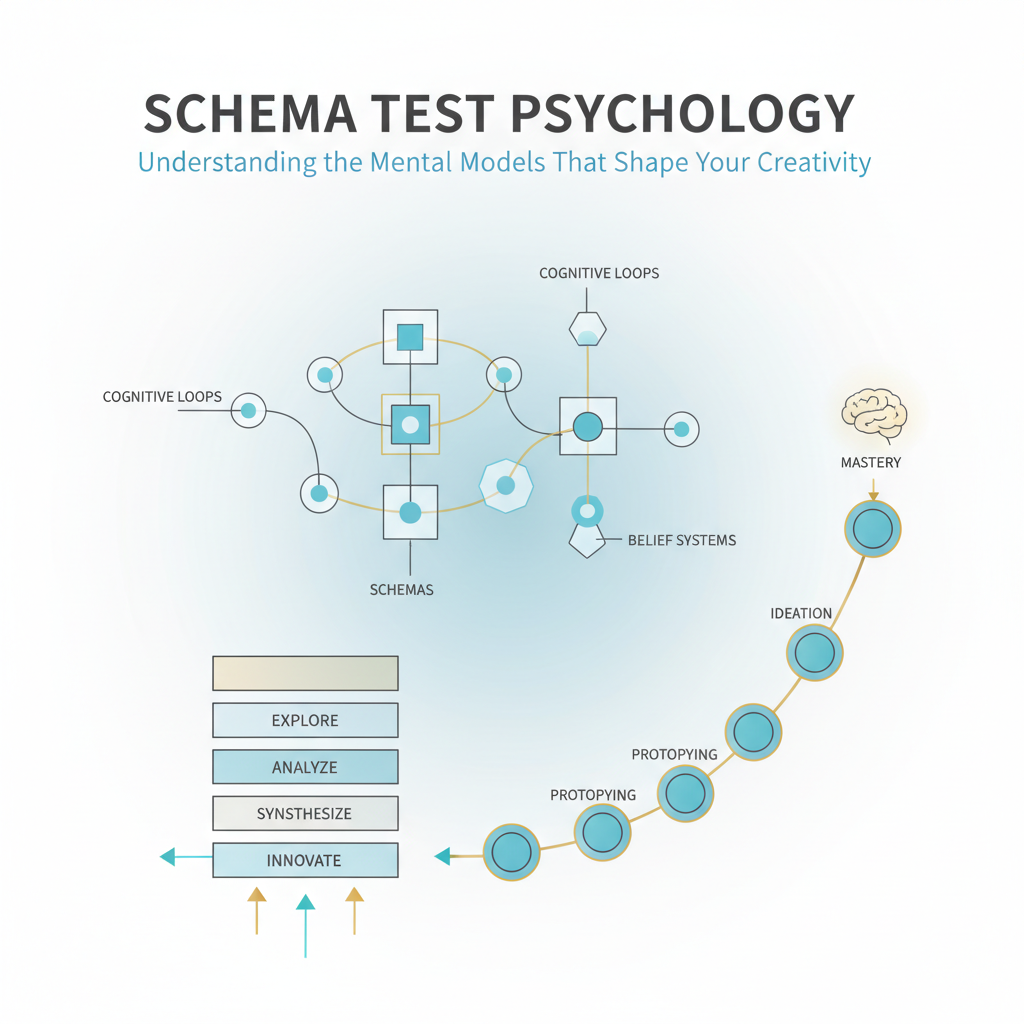
  • Schema Test Psychology: Understanding the Mental Models That Shape Your Creativity

    Schema Test Psychology: Understanding the Mental Models That Shape Your Creativity

    A schema test in psychology, such as the Young Schema Questionnaire, is a clinical tool used to identify early maladaptive schemas—deep-seated, negative patterns of thinking and feeling developed in childhood. While used in therapy, the broader concept of ‘schemas’ as mental frameworks is also key to understanding how your unique thinking patterns and assumptions shape your creative problem-solving abilities.

    Do some ideas come to you easily, while others feel like a struggle? Your mind is always building invisible guides, or “mental models,” that shape how you see the world. These models affect how you solve problems and how creative you are, influencing everything from daily choices to big breakthroughs. Understanding them is the first step to unlocking your creative potential.

    This article explores schema test psychology and how these thinking patterns affect your creative strengths and weaknesses. By learning if your mental models are flexible or fixed, you can better understand how you think. We will guide you through these ideas in a simple, science-backed way, showing you how a structured approach can light up your path to growth.

    Get ready to better understand how you solve problems. We’ll show you how to find your own creative patterns and give you practical ways to change them. You will discover clear steps to encourage innovation and personal growth, turning uncertainty about your creative skills into useful self-awareness.

    What is a Schema Test in Psychology?
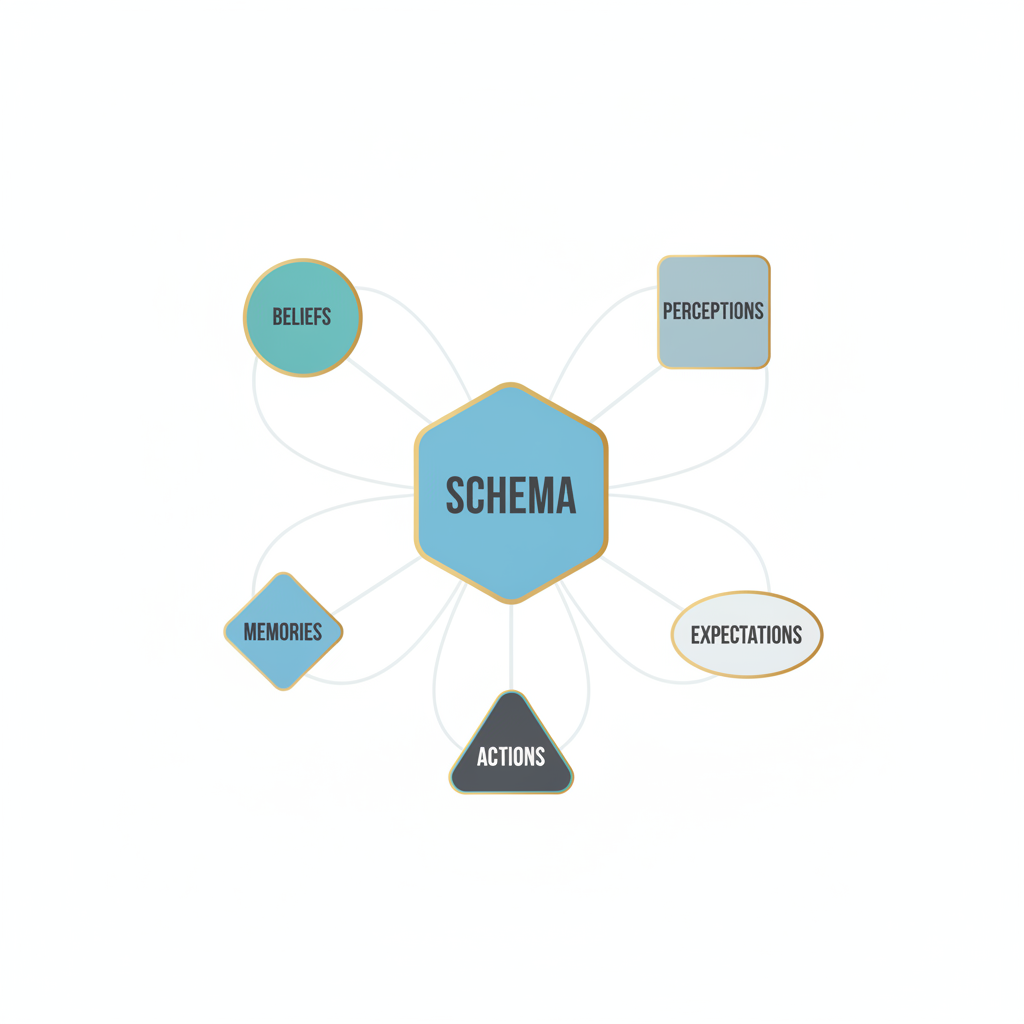
    A minimalist cognitive network diagram showing a central 'Schema' node connected to multiple smaller nodes representing beliefs, perceptions, and actions, illustrating their interconnectedness.
    Abstract, educational infographic: A central geometric shape representing a ‘Schema’ connected by clean, vector lines to several smaller, distinct geometric nodes labeled with short, conceptual terms like ‘Beliefs’, ‘Perceptions’, ‘Actions’. The overall visual is a cognitive network diagram or idea cluster, emphasizing interconnectedness and foundational mental models. Style is minimalist, professional, and approachable with clean geometric shapes. Color palette: soft blues, whites, charcoal, with subtle gold or teal accents highlighting the central schema. Ample negative space allows for clear visual hierarchy.

    What is a Schema Test in Psychology?

    The Clinical Definition of a Schema

    In psychology, a “schema” is a basic mental blueprint. Think of it as a shortcut your mind uses to understand the world. Schemas are deep-seated patterns that guide how you think, feel, and act.

    Schemas help you quickly sort through new information. They form based on your early life experiences and shape how you see yourself, other people, and the world.

    For example, a child who is often praised for trying hard might develop a belief that “effort leads to success.” This belief then shapes their motivation and persistence in the future.

    These mental models are powerful. They guide your expectations and reactions to life’s challenges. Schemas are a key idea in cognitive psychology [1].

    How Schema Tests Identify Maladaptive Patterns

    While schemas are necessary, not all of them are helpful. An “unhelpful schema” is a negative pattern that causes emotional pain or holds you back in life. These patterns often develop when your needs weren’t met as a child.

    Schema tests are psychological tools that help identify these unhelpful patterns. They are usually questionnaires or surveys that ask about your core beliefs, feelings, and how you tend to act.

    The goal is to find repeating patterns that may be holding you back. For example, a test might point to a “defectiveness/shame” schema. This means you might carry a deep, constant feeling of being flawed or not good enough.

    Identifying these schemas is the first step toward making a positive change. It helps you understand why certain situations trigger strong reactions. This self-awareness is key to personal growth.

    When you understand these unhelpful patterns, you gain the power to challenge them. You can then start to build healthier, more supportive beliefs. Seeing the old pattern is the key to creating a new one [2].

    Beyond Clinical Schemas: What Are Your Creative Schemas?

    Defining Schemas in the Context of Creativity

    In creativity, schemas are your mind’s internal blueprints. They are your usual patterns of thought that shape how you see the world. These mental frameworks guide how you process information, generate ideas, and approach new challenges.

    Think of them as mental shortcuts that help your brain manage information. For example, a chef has a “flavor pairing” schema to guide their cooking. A software engineer might use a “problem decomposition” schema to break down complex code. These schemas are not about something being wrong; they are about your unique way of thinking.

    Understanding your creative schemas is a powerful tool. It reveals your natural tendencies and shows you where you can expand your thinking. The Creative Ability Test helps uncover these core mental models, showing you how your mind uniquely handles creative tasks.

    How Your Mental Models Impact Problem-Solving

    Your mental models have a big impact on how you solve problems. They guide your first steps, which can either open up or limit your options. Strong mental models can make hard tasks easier by offering a quick path to a familiar answer. However, they can also cause “functional fixedness” [3]. This means you only see things in their usual roles and miss new ways to use them.

    Here’s a simple example. You need to hang a picture. If your mental model for “hanging things” only includes a hammer and nail, you’re stuck without them. A more flexible view might include tape, hooks, or even balancing the frame. This wider view leads to more creative solutions. Your mental models decide your first move and shape the solutions you imagine.

    The Creative Ability Test explores these effects. It helps you see your own problem-solving habits. When you understand them, you can choose to explore more options. This lets you tackle challenges with more flexibility and find new, better solutions.

    Recognizing Rigid vs. flexible thinking Patterns

    Your thinking patterns exist on a scale. On one end is rigid thinking, and on the other is flexible thinking. Both can be useful, but knowing your main style is key to improving.

    Signs of Rigid Thinking:

    • You stick to familiar methods.
    • You find it hard to adapt when things change.
    • You prefer outcomes you can predict.
    • You struggle to see other points of view.
    • You feel uncomfortable when plans change.

    Signs of Flexible Thinking:

    • You welcome new ideas.
    • Adapting to change is easy for you.
    • You enjoy exploring different solutions.
    • You can easily see a problem from many sides.
    • You are open to trying new things and taking risks.

    Flexible thinking is essential for creativity and new ideas. It lets you connect unrelated concepts and change course when you face a challenge. Studies show that mental flexibility is a key part of creative intelligence [4].

    Think about your own habits. Do you usually fall back on “the way it’s always been done”? Or do you actively look for new approaches? The Creative Ability Test can identify your natural tendencies. It gives you a clear picture of your thinking patterns. This knowledge helps you build more mental flexibility and unlock your creative potential.

    How Can You Identify and Test Your Creative Thinking Patterns?
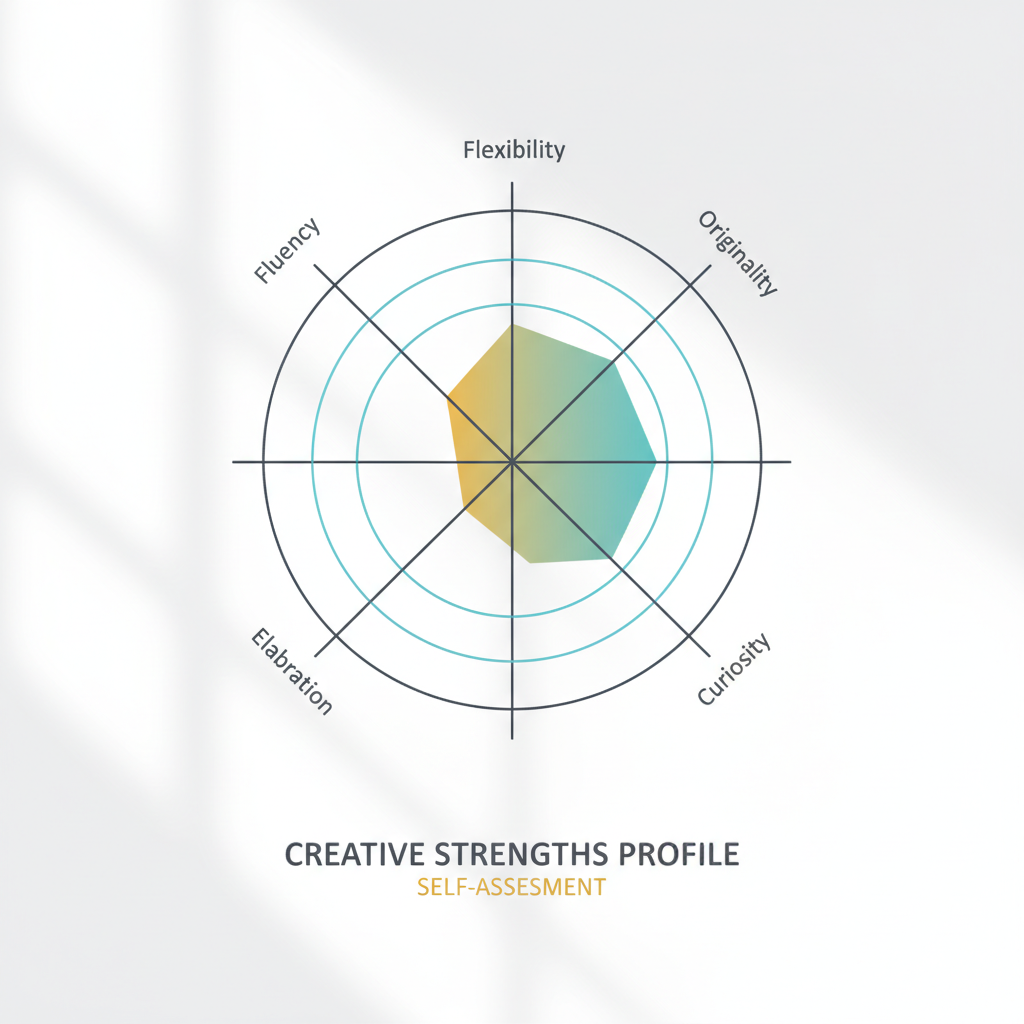
    A multi-axis radar chart visualizing different creative thinking patterns such as fluency, flexibility, and originality, depicted with professional, minimalist vector graphics.
    Abstract, educational infographic: A clean, vector-based creative skill assessment chart, specifically a multi-axis radar chart (spider chart) with four to five axes. Each axis represents a dimension of creative thinking, labeled with short, conceptual terms like ‘Fluency’, ‘Flexibility’, ‘Originality’, ‘Elaboration’. The chart has a data overlay (represented by a filled shape) indicating scores, using subtle gradients or a gold/teal accent for the filled area. Style is professional, minimalist, with clear geometric lines and ample negative space. Color palette: soft blues, whites, charcoal for the chart structure, with gold or teal accents for the assessment data. The visual emphasizes self-assessment and understanding creative strengths.

    The Role of Divergent and Convergent Thinking

    To understand how you think creatively, you need to know about two key ideas: divergent and convergent thinking. They are different, but they work together in any creative project.

    Divergent thinking: Generating Ideas

    Divergent thinking is all about coming up with lots of different ideas. It’s an open and exploratory process. Think of it as brainstorming without judgment, where you cast a wide net for possibilities. This means thinking outside the box and finding many solutions to one problem.

    Key characteristics of divergent thinking include:

    • Fluency: Coming up with a large number of ideas.
    • Originality: Creating unique and new ideas.
    • Flexibility: Shifting between different types of ideas.
    • Elaboration: Adding detail to build on and improve ideas.

    For example, if asked “How many uses can you think of for a brick?”, divergent thinking pushes you to list everything from building a house to using it as a paperweight or even an art sculpture [5].

    Convergent Thinking: Selecting and Refining Ideas

    After you have a lot of ideas, convergent thinking helps you choose the best one. This process is focused on finding the single most fitting solution. It uses evaluation, critical thinking, and logic. You take your wide range of ideas and shape them into something that works.

    Convergent thinking helps you to:

    • Analyze and weigh your options.
    • Find patterns and connections.
    • Use logical reasoning.
    • Select the best or most practical solution.

    A strong creative process uses both. Divergent thinking creates options, and convergent thinking turns those options into reality. Knowing which style you prefer can reveal a lot about how you create.

    Assessing Your cognitive flexibility and Openness

    Besides divergent and convergent thinking, two other traits are key to your creativity: cognitive flexibility and openness to experience. These qualities affect how well you handle new situations and ideas.

    Cognitive Flexibility: Adapting Your Mindset

    Cognitive flexibility is your brain’s ability to switch between different ideas or tasks. It helps you adjust your thinking when you get new information or when things change. This skill lets you see problems from new angles and try a different approach if your first one doesn’t work.

    High cognitive flexibility often means you can:

    • Pivot easily between different ideas or solutions.
    • See problems from various viewpoints.
    • Learn quickly from new experiences.
    • Get past mental roadblocks with ease.

    In contrast, rigid thinking makes it hard to break free from old habits, which can block new ideas.

    Openness to Experience: Embracing the New

    Openness to experience is a core personality trait that is closely tied to creativity. It reflects your willingness to explore new ideas, feelings, and experiences [6]. People who are high in openness tend to be curious, imaginative, and have an appreciation for art and beauty.

    This trait directly boosts your creativity by:

    • Encouraging you to explore unusual ideas.
    • Fostering a desire to experiment.
    • Making you more receptive to different views.
    • Driving a need for new and stimulating experiences.

    Looking at these traits helps you see how well you welcome change and new information. They are essential for creative growth and for solving problems well.

    Discovering Your Strengths with the Creative Ability Test

    If you want to understand your own mix of creative skills, an objective test is the best way. The Creative Ability Test offers a science-backed method to learn about your personal creative style.

    How the Test Works

    Our 30-question test is designed to measure several sides of your creativity. It gives you a deeper look than just your own opinion, with insights into your:

    • Cognitive flexibility.
    • Problem-solving approaches.
    • Openness to new experiences.
    • Ability to both generate and select ideas.

    The test is based on proven creativity research to ensure your results are reliable and meaningful.

    Personalized Insights for Growth

    When you finish the test, you’ll get personalized feedback. Your report will explain your creative strengths and show you where you can improve. It’s more than a score—it’s a guide for your growth.

    You will gain:

    • Actionable self-awareness: Get a clear picture of your unique creative style.
    • Growth strategies: Get practical tips to improve your creative skills.
    • Application insights: Learn how to use your creative strengths in real life.

    The Creative Ability Test helps turn confusion about your creative skills into clear, useful knowledge. It helps you move from unpredictable results to a solid plan for improvement. Start your journey to discover and boost your creative abilities today.

    How Do You Reshape Schemas to Enhance Creativity?
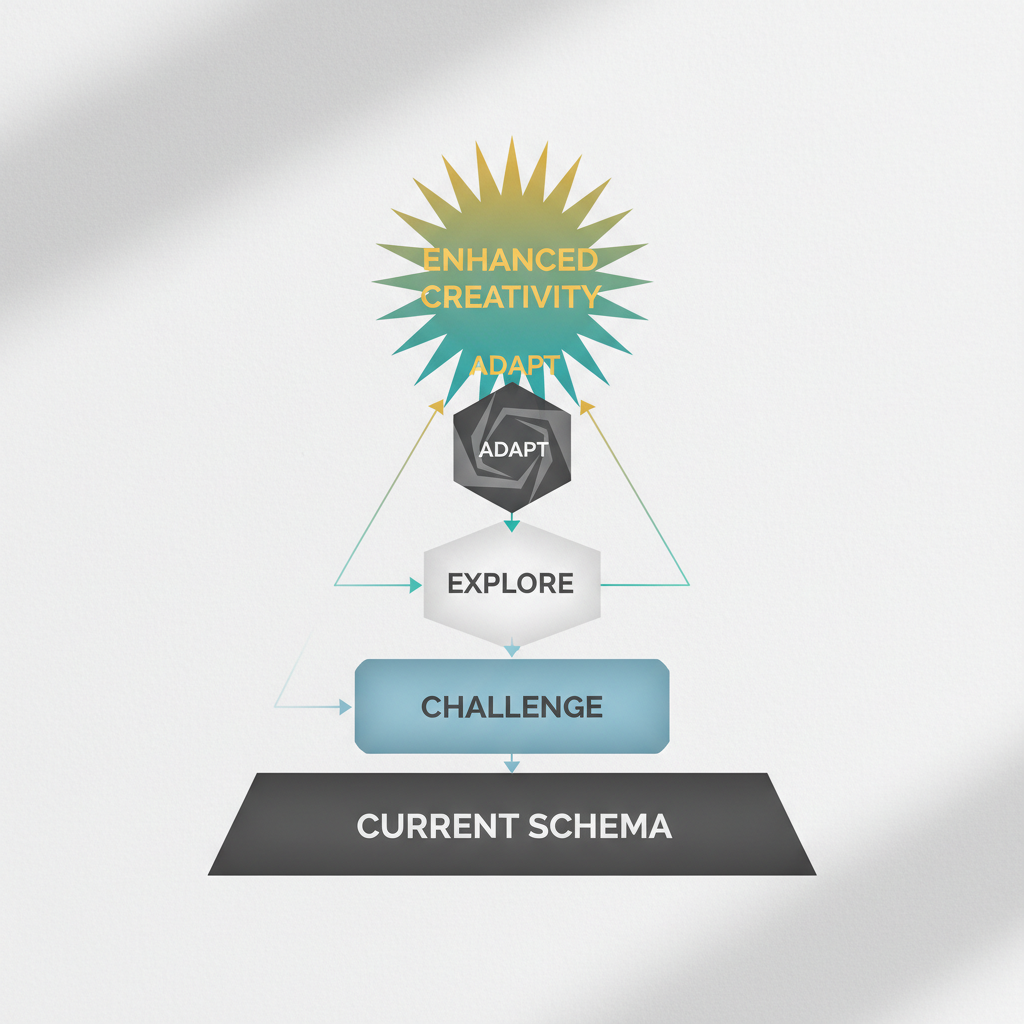
    A layered, step-by-step infographic showing the progression from a 'Current Schema' to 'Enhanced Creativity' through stages of challenging, exploring, and adapting, using minimalist geometric shapes.
    Abstract, educational infographic: A layered system showing growth and transformation, represented by a series of ascending or expanding geometric layers or steps. The bottom layer represents a ‘Current Schema’, transitioning upwards through stages like ‘Challenge’, ‘Explore’, ‘Adapt’, to a top layer representing ‘Enhanced Creativity’. Each layer is a distinct, clean geometric shape, subtly increasing in size or complexity, connected by subtle vector arrows or pathways. Style is minimalist, professional, and approachable with clean geometric forms and subtle gradients or accent highlights. Color palette: soft blues, whites, charcoal, with gold or teal accents used for the ‘Enhanced Creativity’ layer and directional markers. Ample negative space to maintain clarity of progression.

    Practical Steps to Challenge Rigid Thinking

    Knowing your mental habits is the first step to unlocking your potential. But just knowing about them isn’t enough. You have to actively challenge your rigid thinking. This process starts with self-awareness.

    Rigid thinking often comes from old mental shortcuts. These shortcuts may have helped you in the past, but they can block new ideas now. The key is to notice when you’re using them.

    • Question Your Assumptions: Many creative blocks come from beliefs you’ve never questioned. Ask yourself: “Is this truly the only way?” or “What if I assume the opposite?” This simple act can open new paths.
    • Actively Seek New Perspectives: Go out of your way to find different viewpoints. Read books you wouldn’t normally choose. Talk to people with different backgrounds. This expands how you see the world.
    • Embrace “What If” Scenarios: Playfully explore “what if” situations. Imagine solutions with no budget, no time, or unlimited resources. This practice helps you think in new directions.
    • Break Down Problems: Big problems can feel overwhelming. Divide them into smaller, more manageable parts. Each piece might need a different solution. This keeps one rigid habit from taking over.
    • Practice Mindful Observation: Notice how you react to new ideas. Do you dismiss them quickly? Or do you pause to consider their value? Being more self-aware helps you catch rigid responses early [7].

    By using these steps regularly, you can break down inflexible thought patterns. You’ll train your mind to be more flexible and creative.

    Strategies for Building More Flexible Mental Models

    Challenging rigid thinking is an ongoing process. Once you find areas to improve, you need ways to build more flexible ways of thinking. This means forming new habits and mental approaches.

    Flexible thinking helps you adapt quickly. It helps you find new solutions when things change. Here are some proven strategies:

    • Engage in Divergent Thinking Exercises: These exercises push you to explore many possible solutions. Brainstorm ideas without judgment. Use tools like mind mapping or the SCAMPER method (Substitute, Combine, Adapt, Modify, Put to another use, Eliminate, Reverse) to come up with varied concepts.
    • Learn Something New Regularly: Learning a new skill forces your brain to make new connections. This could be a new language, a musical instrument, or a coding skill. This directly improves your mental flexibility.
    • Seek and Embrace Constructive Feedback: Feedback gives you an outside view of your ideas. It helps you see your own blind spots. See criticism as a chance to make your ideas better.
    • Practice Metacognition: This means “thinking about your thinking.” Regularly think about how you solved a problem. What thinking patterns did you use? How could you have done it differently? This helps you better control how you think [8].
    • Cultivate a Growth Mindset: Believe that you can improve your skills with effort. This mindset helps you keep going. It helps you learn from challenges instead of avoiding them.

    The Creative Ability Test gives you personal insights into your thinking flexibility. It shows you which areas to focus on for the biggest impact. This test helps you create a plan for your own growth.

    Applying New Creative Frameworks to Real-World Challenges

    Changing your thinking habits isn’t just a theory. The real value is using these new, flexible ways of thinking on real-world problems. Putting what you know into action is how true innovation happens.

    When you face a challenge, your new thinking habits give you a fresh perspective. You can see opportunities where others only see roadblocks. This leads to better and more creative solutions.

    • Re-frame the Problem: Instead of focusing on symptoms, look for the real causes. Define the challenge in a few different ways. For example, change “how to make people buy more” to “how to help people fulfill their needs.” This simple change can reveal completely new solutions.
    • Adopt an Iterative Approach: Don’t try to be perfect on the first try. Create small versions of your idea to test. Get feedback, and then make improvements. This process helps you learn and adapt as you go.
    • Collaborate with Diverse Teams: Work with people who have different skills and backgrounds. Their unique ways of thinking will challenge and improve your own. This teamwork often leads to breakthrough ideas.
    • Use Storytelling to Present Solutions: New ideas can be hard for people to accept. Tell a story about your solution. Explain the problem, the journey, and the positive result. This makes your ideas easier to understand and more convincing.
    • Leverage Personalized Insights: The Creative Ability Test gives you a clear map of your unique creative strengths. Use this information to choose the best approach for you. For instance, if you are good at coming up with many ideas, focus on that. If you are better at choosing the best idea, focus on that skill.

    By using these strategies, you’ll gain confidence in your creative skills. Your creativity will become more consistent and you’ll see real growth. The Creative Ability Test provides the starting point, with personal, practical tips to guide you in solving problems and creating new things.

    Frequently Asked Questions

    What is a maladaptive schema test in psychology?

    A maladaptive schema test is a tool used in psychology. It helps find negative patterns in how you think and act. These patterns, called schemas, usually start in childhood. They can change how you see yourself and the world around you. These schemas often cause problems in relationships and everyday life [9].

    While these tests are mainly for diagnosis, anyone can benefit from understanding their schemas. These fixed ways of thinking can hold back your creativity. For example, a belief that you will fail might keep you from trying new things. Our Creative Ability Test is different. It focuses on your creative thinking patterns. It helps you find and build on the habits that boost your creativity and growth.

    Can you take a schema test online for free?

    Yes, you can find many free, informal “schema tests” online. But it’s important to know what they can and can’t do. Most free quizzes are just for self-reflection. They are not meant for a clinical diagnosis or for deep psychological information. For that, you need a formal test from a professional. A professional can guide you and explain the results to give you a full picture of your schemas.

    If you want to understand your creative thinking patterns, our Creative Ability Test is a better fit. It’s a 30-question test based on science. You get feedback tailored just for you. The test looks at your creative strengths, how you adapt your thinking, and your problem-solving skills. While it isn’t free, it gives you useful tips. You get deep, personal insights to improve your creativity, which is more practical than a generic quiz.

    What kind of questions are on a schema test in psychology?

    Questions on a clinical schema test ask about your deepest beliefs, feelings, and actions. They explore how you feel in different situations and how you see yourself, other people, and the future. You might see statements like, “I don’t fit in,” or “I am often criticized” [9]. Your answers help find schemas like abandonment, defectiveness, or a feeling of not getting enough emotional support.

    In contrast, the Creative Ability Test asks about your creative thinking. It looks at how you handle problems and come up with ideas. Our test looks at things like:

    • Divergent Thinking: How easily can you find many solutions to a problem?
    • Cognitive Flexibility: Can you change your point of view or adapt to new details?
    • Problem-Solving Approaches: Do you like using logical steps or following your intuition?
    • Openness to Experience: Are you curious about new or unusual ideas?

    These questions give you a clear picture of your creative strengths. They show you your main creative styles. This knowledge can help you use your skills to grow at work and in your personal life.


    Sources

    1. https://dictionary.apa.org/schema
    2. https://www.schematherapy.com/the-schema-therapy-model
    3. https://www.simplypsychology.org/functional-fixedness.html
    4. https://psycnet.apa.org/record/2012-30040-001
    5. https://psychology.iresearchnet.com/experimental-psychology/cognition/divergent-thinking/
    6. https://www.simplypsychology.org/big-five-personality.html
    7. https://greatergood.berkeley.edu/topic/mindfulness/definition
    8. https://www.apa.org/education-career/guide/science-education/metacognition
    9. https://schematherapy.com/wp-content/uploads/The-Schema-Therapy-Model.pdf
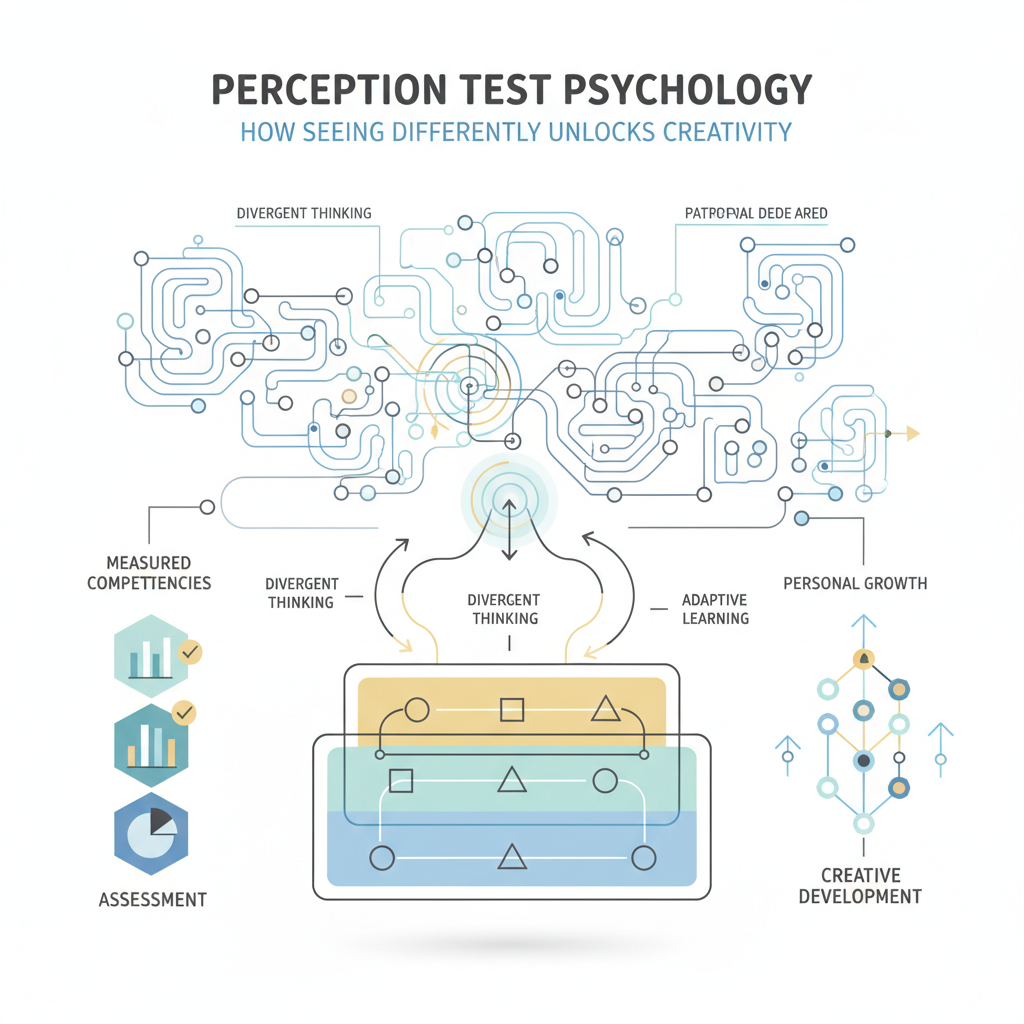
  • Perception Test Psychology: How Seeing Differently Unlocks Creativity

    Perception Test Psychology: How Seeing Differently Unlocks Creativity

    In psychology, a perception test is an assessment designed to evaluate how an individual organizes, identifies, and interprets sensory information to understand their environment. These tests reveal unique cognitive patterns that are fundamental to creative thinking, problem-solving, and generating novel ideas.

    Have you ever noticed how two people can see the same thing in completely different ways? This difference in perception is more than a trick of the mind—it’s a key to unlocking creativity. The way you interpret the world isn’t just a personal quirk. It’s the very foundation for new ideas and creative problem-solving.

    To boost your creative potential, it helps to understand how your mind works. Your perception—how you make sense of the world and connect unrelated things—shapes your ability to think in new ways. It allows you to find clever solutions, see new patterns, and tackle problems from a fresh angle. This article will explore the link between how you see the world and your natural creativity, giving you a better understanding of your own thinking style.

    We’ll look at how different aspects of perception fuel divergent thinking and new ideas. Instead of just looking at the surface, we’ll explore the deeper ways your mind works. You’ll discover the powerful role your unique viewpoint plays in your creativity and learn how to use it for personal and professional growth.

    What Is a Perception Test in Psychology?

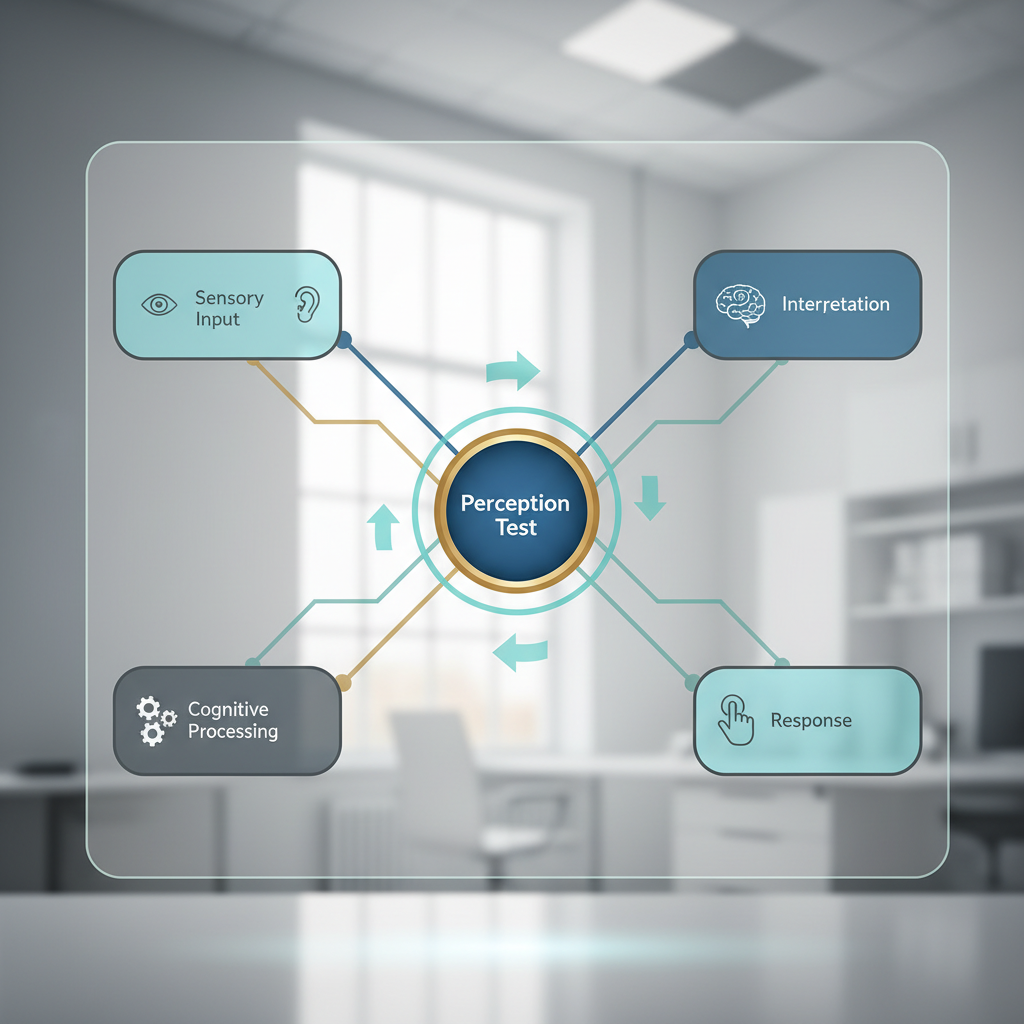
    An infographic showing a central 'Perception Test' node branching into 'Sensory Input', 'Interpretation', 'Cognitive Processing', and 'Response', illustrating its components.
    An abstract, educational infographic illustrating ‘What Is a Perception Test in Psychology?’. The visualization features a central node labeled ‘Perception Test’ with clean, geometric branches extending outwards to represent key components: ‘Sensory Input’, ‘Interpretation’, ‘Cognitive Processing’, and ‘Response’. Each component is depicted with a subtle icon or sub-node, maintaining a minimalist, vector-based, and professional style. The color palette consists of soft blues, whites, and charcoal, with gold or teal accents highlighting connections. The layout uses ample negative space for clarity, emphasizing a structured, hierarchical understanding of the concept.

    Why Your Perception Is the Foundation of Creativity

    Perception is how you see, hear, and feel the world. It’s your brain’s way of turning sensory information into meaningful experiences. Your unique way of seeing things is the very foundation of your creativity.

    Creativity doesn’t start with an idea. It starts with how you notice things, organize information, and connect different concepts. When you understand your own perception, you unlock your natural ability to create and solve problems.

    For example, an artist sees shapes in a cloud. A scientist spots a small irregularity in data. An entrepreneur finds an unmet need in the market. These are all acts of perception. It’s not just about seeing, but about interpreting things in a new way [1]. A perception test in psychology can help reveal these underlying ways of thinking.

    At the Creative Ability Test, we get this connection. We help you explore your perceptual strengths and give you practical insights. By understanding your unique way of seeing, you can improve your creative thinking and problem-solving skills.

    Going Beyond Just What You See

    Perception is more than just sight. It’s how we process everything we sense—what we hear, touch, and even feel inside. It also involves how your mind works, like how it filters information, decides what’s important, and builds an understanding of the world.

    Take Cognitive flexibility, for example. This is a key trait for creativity. It’s the ability to shift your perspective and look at problems from different angles. This skill depends on how you perceive possibilities. Without it, your creativity can feel stuck.

    Another key skill is divergent thinking. This means coming up with many different ideas from one starting point [2]. Your ability to do this is tied to how many connections you can see and how open you are to new ideas. Perception tests can show us these mental habits.

    The Creative Ability Test explores these areas to reveal your unique thinking style. For instance, some people are great at noticing small details, while others excel at seeing the big picture. Both are key to creativity. Our assessment explains these complex traits in a simple way, helping you build confidence and grow. Understanding how you perceive the world is a powerful first step to unlocking your creativity.

    How Does Perception Directly Influence Your Creative Ability?

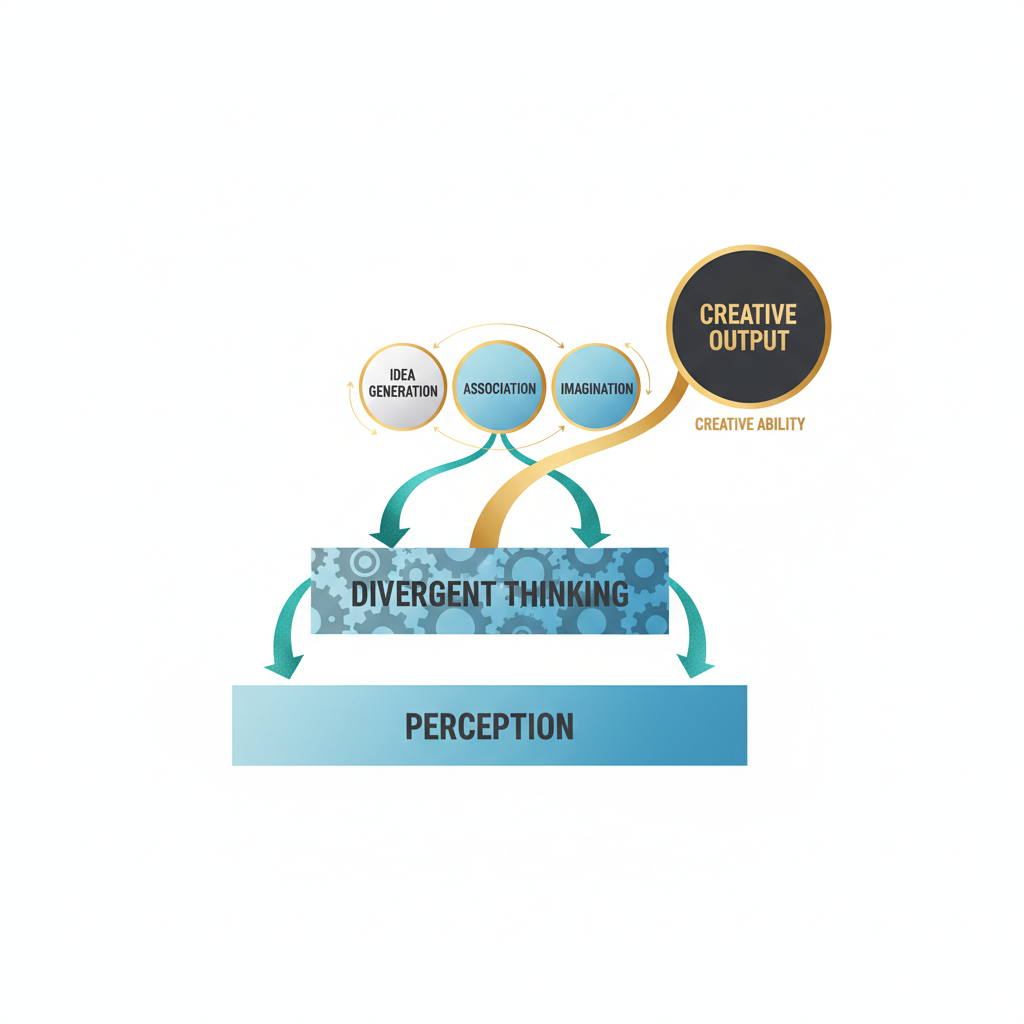
    An infographic with a layered diagram showing 'Perception' as a base, flowing into 'Divergent Thinking', then 'Idea Generation', and finally 'Creative Output', illustrating their direct influence.
    An abstract, educational infographic visualizing the influence of perception on creative ability. The image uses a layered, interconnected diagram. ‘Perception’ forms a foundational layer, feeding into ‘Divergent Thinking’, which then leads to ‘Idea Generation’, culminating in ‘Creative Output’. Arrows and subtle gradients demonstrate the flow and direct influence between these stages. The design is minimalist, vector-based, and professional, using clean geometric shapes. The color scheme incorporates soft blues, whites, and charcoal, with gold or teal accents emphasizing the pathway. Ample negative space ensures clear visual hierarchy and readability.

    Connecting Perception to Problem-Solving

    Your creativity starts with how you see the world. It’s not just about sight, but also how you interpret information. The way you see things shapes how you solve problems.

    Think about a tough situation. Some people only see problems, while others see opportunities. This difference comes from their point of view. Changing your viewpoint is key to innovative problem-solving.

    When you see a problem in a new light, you find new solutions. You can look at the challenge from a different angle. This often leads to ideas others miss. For example, a designer might see a broken chair not as trash, but as material for a new piece of art. This change in perspective unlocks creative potential.

    Our Creative Ability Test helps you understand your unique way of seeing things. It shows you how you naturally solve problems and gives you insights into your creative style. You’ll also get practical tips to improve these skills.

    Learning to see things in new ways is important. It changes how you handle daily challenges and helps you come up with big ideas. You stop just seeing a problem and start creating the solution.

    Cognitive Flexibility: The Skill of Shifting Perspectives

    Cognitive flexibility is your brain’s power to adapt. It’s about switching between different ideas or ways of thinking. This skill is key to creativity because it lets you see things from many angles.

    Imagine brainstorming for a project. A person with high cognitive flexibility can jump from one idea to another with ease. They can quickly switch their thinking and don’t get stuck on one approach. This helps them create a wider range of options.

    This skill helps you look at things from a fresh angle. It means you can change your approach if something isn’t working. For example, if a chef runs out of an ingredient, they can quickly find a substitute. They can create an equally delicious dish using different ingredients.

    Research shows a strong link between cognitive flexibility and creative problem-solving [3]. It helps you break free from stiff, routine thinking. This opens the door to brand-new ideas and helps you handle complex situations with ease.

    The Creative Ability Test measures parts of your cognitive flexibility. It shows you where you’re naturally strong. It also gives you exercises made just for you. These tips will help you get better at changing your point of view, leading to more creative and flexible thinking.

    Here are practical ways to boost your cognitive flexibility:

    • Engage in diverse activities: Try new hobbies or learn a new skill regularly.
    • Practice divergent thinking: Brainstorm many ideas without judgment.
    • Challenge assumptions: Ask “why not?” or “what if?” more often.
    • Seek varied opinions: Discuss ideas with people from different backgrounds.

    Pattern recognition and Innovative Ideas

    Creativity is often about seeing connections. It’s about finding patterns where others see only a mess. But it’s also about breaking old patterns on purpose. These two skills together are key to innovation.

    Pattern recognition helps you see how things are related. You might connect ideas that don’t seem to belong together. This can lead to surprising and smart solutions. For example, a musician combines different melodies to make a new song because they can spot patterns that sound good together.

    New ideas often come from this skill. You might see a common problem in one area and use a solution from a completely different one. Mixing ideas like this is a great way to be more creative.

    For example, the inventor of Velcro noticed burrs sticking to his dog’s fur. He saw a natural pattern of tiny hooks and loops. This idea led to a whole new way to fasten things. He saw a pattern in nature and used it to create new technology.

    Our Creative Ability Test helps you understand your own way of seeing patterns. It shows how you connect ideas. You’ll get a clear picture of your strengths in divergent thinking, which is the ability to come up with many different ideas.

    By understanding this, you can improve your innovative thinking. You’ll learn to trust your gut when you spot unusual connections. This helps you create truly original ideas and makes you a better problem-solver and innovator.

    Improving your pattern recognition skills can greatly boost your creative work. You’ll get better at spotting trends and challenging the usual way of doing things. Both skills are important for your personal and professional growth.

    What Are Common Examples of Perception Tests?

    Visual perception tests

    Visual perception tests explore how you interpret what you see. They reveal your unique way of seeing and understanding the world around you. This can offer useful insights into your creative thinking style.

    Two well-known examples are the Rorschach Inkblot Test and the Thematic Apperception Test (TAT).

    • Rorschach Inkblot Test: This classic test shows you abstract inkblots and asks you to describe what you see. There are no “right” or “wrong” answers. Instead, psychologists analyze your interpretations to understand your thought processes and emotional responses [4]. For creativity, your ability to find different patterns and meanings can show strong creative thinking skills.
    • Thematic Apperception Test (TAT): The TAT uses a series of picture cards with vague scenes. Your task is to tell a story about each picture, including what led to the scene and what the characters are feeling. This reveals your inner motivations, emotions, and how you view social situations [5]. In a creative context, it shows your storytelling skills, imagination, and problem-solving abilities.

    These tests show that everyone interprets information differently. They also demonstrate how your inner thoughts and feelings can shape what you see. Understanding these personal differences is key to unlocking your creative potential. Our Creative Ability Test focuses on the thinking skills behind these unique viewpoints, offering practical advice you can use.

    Depth Perception Tests

    Depth perception is your ability to judge distances between objects. It also helps you understand how they are arranged in space. This skill is essential for getting around in the physical world.

    However, it also applies to how you handle complex ideas. Good depth perception can help you see different layers within a problem. It allows you to imagine solutions from multiple angles. This skill is a direct support for innovative thinking.

    Common ways to test depth perception include:

    • Stereo Vision Tests: These tests use special glasses to view images that create a 3D effect. Your ability to see a single 3D image shows how well you perceive depth.
    • Distance Judgement Tasks: You may be asked to estimate how far away different objects are. You might also be asked to arrange objects in order based on how far away they seem.

    Improving your spatial awareness and visualization skills can have a big impact on your creative problem-solving. It lets you think beyond just two dimensions. This leads to a deeper, more detailed understanding of challenges and opportunities.

    Auditory and Other Sensory Tests

    Perception isn’t just about sight. Our other senses also play a key role in creativity and how we experience the world. Auditory perception, for instance, is how you hear, interpret, and make sense of sounds.

    • Auditory Perception: Tests may ask you to tell the difference between sounds, find patterns in noise, or pinpoint where a sound is coming from. This skill is vital for musicians, but it also helps anyone who needs to listen for small details in conversations or notice subtle cues in their environment. It helps you gather important information, which can lead to unique ideas.
    • Other Sensory Perceptions: Touch, taste, and smell also add to our rich experience of the world. While not often formally tested for creativity, they have a big impact on our experiences. Being more aware of all your senses can inspire many different kinds of creative work. Think of a chef creating new flavors or a designer thinking about how a product feels to the touch.

    Using information from multiple senses at once makes your thinking more flexible. It gives you a wider understanding of any situation. This big-picture view helps you see connections that others might miss. Our platform helps you understand how these broader skills add to your creative profile. This allows you to use your unique sensory awareness to solve problems and innovate.

    How Can Understanding Your Perception Unlock Your Potential?

    How you see things is a powerful tool. It shapes your view of the world. Learning about your unique style offers big advantages and can help you unlock your full creative potential.

    This understanding helps you move from just knowing to taking action. You can build on your natural talents. The Creative Ability Test provides this key insight. It guides you toward personal growth and new ways of thinking.

    Identify Your Creative Strengths

    To understand how you see things is to understand how you think. It reveals your unique creative gifts. Are you good at finding new patterns? Can you easily change your point of view? These are creative strengths.

    The Creative Ability Test helps pinpoint these areas. It shows how your brain processes information, including your:

    • Cognitive Flexibility: Your ability to switch thinking styles. You can adapt quickly to new problems.
    • Divergent Thinking: How many unique ideas you can generate. This shows your creativity and originality.
    • Pattern Recognition: Your skill in finding connections. You see order in details that seem unrelated.
    • Openness to Experience: Your willingness to explore new ideas. You are comfortable with new or unclear things.

    Knowing these strengths gives you confidence. You can use them to take on any creative challenge. This helps you move from guessing to taking clear action.

    Develop Actionable Strategies for Growth

    These insights are more than just facts about yourself. They are starting points for growth. Once you know your creative style, you can take action. The Creative Ability Test gives you personal feedback with practical steps to follow.

    For example, if you are great at creating many ideas, you might learn new ways to improve them. If you want to be more flexible in your thinking, you can practice looking at problems from different angles. These strategies are designed to:

    • Expand Your Perspective: Learn new ways to see a problem and challenge your own beliefs.
    • Enhance Problem-Solving: Use specific thinking tools to break down complex issues.
    • Boost Idea Generation: Try exercises that spark new ideas and help you get past creative blocks.
    • Refine Decision-Making: Look at a wider range of options to make better creative choices.

    This organized plan helps you improve. It turns inconsistent creative moments into a reliable skill. You build a clear path to get better over time.

    Apply Your Insights to Real-World Challenges

    The real power in understanding yourself is using that knowledge. These are tools to make a real impact in your daily life, both at work and at home.

    For example, a designer creating a new product can use their creative style to better guess what users need. By seeing problems from many angles, they can find more creative solutions. A student working on a big project can use their strength in finding patterns to organize information better.

    Your unique way of seeing things helps you be more innovative. It improves problem-solving and helps you connect with others in team settings. Here’s how you can use these insights:

    • In Your Career: Solve work problems with a fresh perspective. Lead better brainstorming sessions. Adapt more quickly to changes in your field.
    • In Your Studies: Take on school challenges creatively. Connect ideas from different subjects. Come up with unique research questions.
    • In Personal Life: Find creative solutions to everyday problems. Communicate better by understanding other views. Express yourself in more original ways.

    The Creative Ability Test guides you through this change. It helps turn what you learn about yourself into real success. You will move from simply knowing about creativity to using it in meaningful ways.

    How Can You Test Your Own Perceptual and Creative Skills?

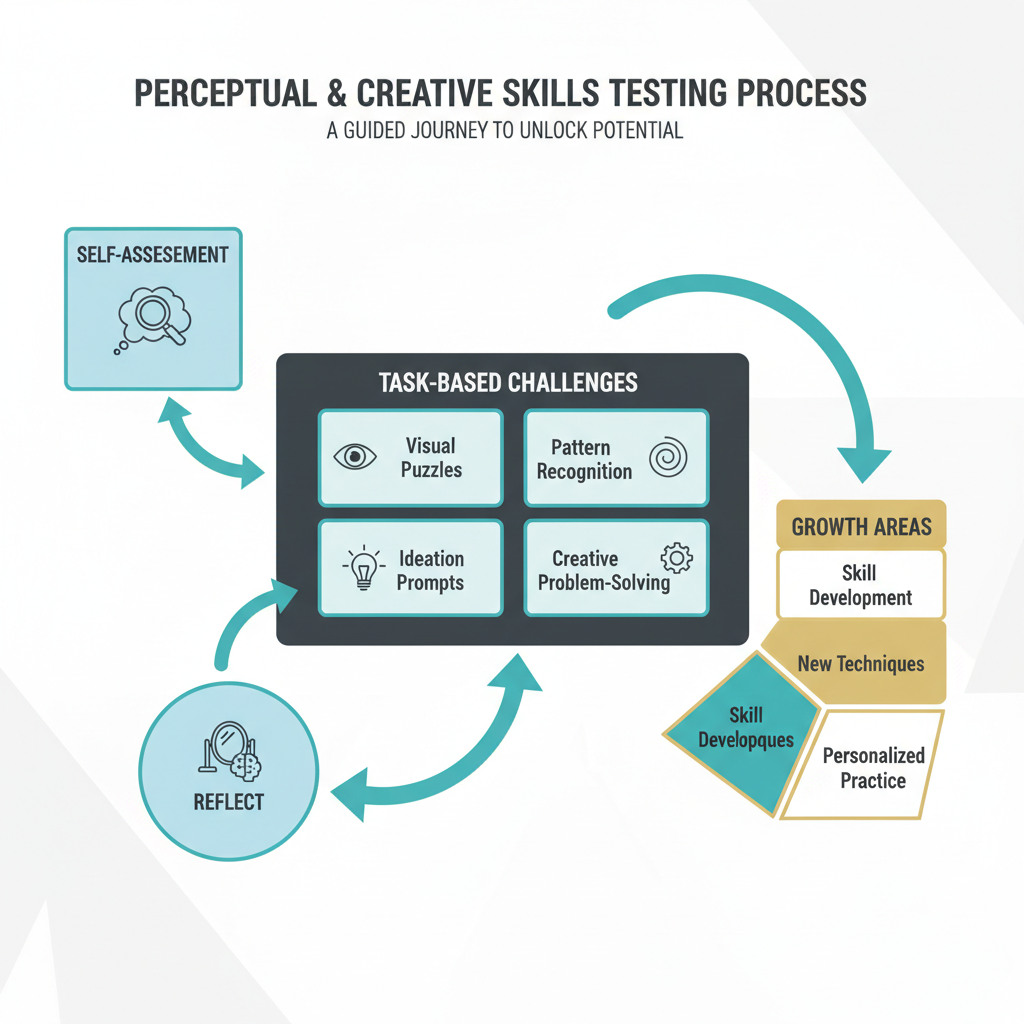
    An infographic showing a four-step process diagram for testing skills: 'Self-Assessment', 'Task-Based Challenges', 'Reflection', and 'Growth Areas', connected by arrows.
    An abstract, educational infographic outlining the process for testing perceptual and creative skills. The visualization is a multi-step process diagram with distinct, clean geometric shapes representing each stage: ‘Self-Assessment’, ‘Task-Based Challenges’, ‘Reflection’, and ‘Growth Areas’. Arrows clearly connect these stages, indicating a progressive pathway. The style is minimalist, vector-based, and professional, utilizing soft blues, whites, and charcoal, with gold or teal accents to highlight the steps. The layout provides ample negative space around each element for short labels and ensures clear visual grouping and hierarchy.

    Discover Your Creative Profile with the Creative Ability Test

    Have you ever wondered how to measure something as personal as creativity? While some tests look at how you see things, understanding your full creative potential takes a deeper look. The Creative Ability Test offers exactly that.

    Our 30-question, science-backed test explores different parts of your creative mind. It goes beyond simple guesswork, giving you a clear picture of your unique creative profile. You’ll learn about your thinking styles and how you solve problems.

    Understand How You See the World

    The way you see the world is the starting point for your creativity. It shapes your ability to come up with new ideas. The Creative Ability Test shows you your unique perceptual strengths, highlighting how you process sights and ideas. Knowing this is a powerful first step toward growing your creative skills.

    For example, some people are great at finding patterns where others see only chaos. Others notice small details that can spark big ideas. Our test helps you find these natural talents. Research shows that these abilities are a key part of creative problem-solving [6].

    What the Creative Ability Test Reveals

    Our test is designed to show you the key parts of your creativity. It goes deeper than surface-level quizzes to give you a real look at how your mind works. You will discover:

    • Cognitive Flexibility: Your ability to switch viewpoints and adapt to new information. This is a key skill for fresh thinking.
    • Divergent Thinking: How well you can brainstorm many different ideas from one starting point. This is often called “thinking outside the box.”
    • Problem-Solving Skills: Your unique approach to difficult challenges and how you use creativity to find solutions.
    • Openness to Experience: How willing you are to explore new concepts and unusual ideas, which helps you grow as a person.
    • Innovation Potential: Your natural ability to create new and useful solutions. This is important for your career.

    Personalized Insights for Growth

    After the test, you’ll get a personalized report that’s easy to understand. It breaks down complex ideas into simple, useful tips. You’ll see your creative strengths clearly and find specific areas where you can build new habits.

    This isn’t just about where you are now—it’s about helping you grow. You’ll get practical advice to improve your creativity. For example, you might learn ways to become a more flexible thinker or try new “outside the box” exercises. These custom tips help you use your creativity every day, from personal hobbies to work challenges.

    Unlock Your Full Creative Potential

    Think of the Creative Ability Test as your guide. It helps you move from wondering about your creative talent to truly understanding it. You’ll get a clear plan for growth, which helps turn random bursts of creativity into a reliable skill. Our platform gives you a clear path to understand and use your creativity well. Start your journey to more creative confidence and a bigger impact today.

    Frequently Asked Questions

    What kind of questions are in a perception test?

    Perception tests look at how you see the world around you. They often show you unclear images or situations. Then, they ask you to describe what you see. These aren’t typical quizzes with right or wrong answers. Instead, they look at your personal way of processing information. This shows your unique perceptual style. Understanding this style can unlock your creative potential. It shows how you might solve problems differently than others.

    Here are common elements you might encounter:

    • Ambiguous Images: You might see shapes or scenes that can be seen in multiple ways. For instance, an image might look like two faces to one person, but a vase to another. [7] Your answer shows your unique point of view.
    • Incomplete Information: Some tests give you only partial information. They ask you to fill in the gaps or guess what happens next. This tests your ability to infer and imagine. These skills are key to creative thinking.
    • Sensory Challenges: You might be asked to identify small differences in sounds, textures, or even tastes. These tasks check how sensitive you are to details. This attention to detail can spark new ideas.
    • Problem Scenarios: You could be given a situation and asked how you see the real problems. You might also describe how you would find a solution. This reveals your problem-solving style.

    In the end, these questions are designed to find your mental flexibility. They show how open you are to new ways of seeing things. This is a key part of being creative.

    What does a visual perception test measure in psychology?

    A visual perception test does more than just check your eyesight. It measures how your brain understands and sorts what you see. Psychologists use these tests to understand how the mind works. They show how you make sense of the visual world. This, in turn, has a big impact on your creative thinking.

    These tests can measure:

    • Pattern Recognition: Your ability to find and understand repeating patterns. This skill is crucial for spotting trends and making connections. For instance, designers often use strong pattern recognition to create new things.
    • Figure-Ground Perception: How you separate a specific object (figure) from its background (ground). This impacts your focus. It also affects your ability to ignore distractions. This is key in problem-solving.
    • Visual Discrimination: Your ability to notice small differences between objects or images. Improving this skill helps you see details others might miss. Seeing these details often leads to new ideas.
    • Spatial Relationships: Your understanding of how objects relate to each other in space. This is key for picturing solutions and designing new products. Architects, for example, rely heavily on this.
    • Cognitive Flexibility: Your willingness to change how you see things when shown unclear images. This ability is a sign of very creative people. They can see many possibilities in one image. [8]
    • Personality Traits and Thinking Styles: Some visual tests, like the Rorschach, can offer clues about your personality. They also show how you usually handle unclear situations. This gives clues about your overall thinking style.

    Understanding your visual strengths gives you powerful insights. It shows you how your unique way of seeing fuels your creativity. The Creative Ability Test is not a perception test, but it does help you find your creative thinking styles. It gives you personal strategies to help you grow.

    Can you take a perception test online?

    Yes, you can find many perception tests online. These range from fun optical illusions to more structured mental exercises. Many websites offer tests that measure specific skills, such as visual discrimination or spatial reasoning.

    However, it’s important to know the different types:

    • For Fun and Self-Exploration: Many websites have quick, fun perception quizzes. These often show how easily our brains can be tricked. They are great if you’re curious or want to learn about yourself.
    • Research-Based Assessments: Universities and researchers often use online perception tasks. They collect data on how the mind works. They help us better understand the human mind.
    • Clinical Psychological Assessments: Formal perception tests used for a diagnosis usually need a trained professional. These are not usually given online. They follow strict rules and need an expert to explain the results. [9]

    The Creative Ability Test focuses on your creative thinking and problem-solving skills. While it’s not a direct “perception test,” it looks at related mental skills. Our 30-question test helps you understand how you process information. It reveals your unique thinking styles. These styles are key for coming up with new ideas and solutions. You will get useful insights. You can also improve your mental flexibility, which will boost your creative potential.

    What is the Thematic Apperception Test?

    The Thematic Apperception Test (TAT) is a well-known psychological test. Created in the 1930s by Henry Murray and Christiana Morgan, it uses a series of unclear images. [10] These images often show people in different social situations. Your task is to tell a story about each picture. You describe what led to the scene, what is happening, what the characters are thinking and feeling, and what the outcome will be.

    Here’s why the TAT is important:

    • Projective Nature: Because the images are unclear, your answers are thought to show your own hidden thoughts, feelings, and wishes. You explain the picture based on what’s going on inside you.
    • Insights into Personality: Psychologists look for repeating themes, feelings, and problems in your stories. This can show parts of your personality. It also shows what drives you and how you cope with stress.
    • Perception and Interpretation: The TAT is a great example of how what you see shapes your reality. How you see the images offers deep insights. It shows how you understand social situations and build stories.
    • Connection to Creativity: While it’s not a creativity test, the TAT does use creative thinking. It requires you to tell creative stories and find meaning in unclear situations. These are key skills for creating new things and solving problems. Think of it as creating a story on the spot.

    Understanding how you see and explain stories is key to creative growth. The Creative Ability Test helps you use these strengths. It helps you better understand your creative styles. You can then use these insights in your daily life and at work. This helps you to create new things and grow.


    Sources

    1. https://psycnet.apa.org/record/1987-00996-001
    2. https://www.sciencedirect.com/topics/psychology/divergent-thinking
    3. https://www.ncbi.nlm.nih.gov/pmc/articles/PMC8949572/
    4. https://www.simplypsychology.org/rorschach-test.html
    5. https://www.verywellmind.com/what-is-the-thematic-apperception-test-2795810
    6. https://www.apa.org/pubs/journals/releases/xlm-a0033104.pdf
    7. https://www.simplypsychology.org/ambiguous-figures.html
    8. https://psycnet.apa.org/record/2012-00566-001
    9. https://www.apa.org/topics/psychotherapy/choosing-therapist
    10. https://www.simplypsychology.org/tat.html

  • Intuition Test Psychology: How to Measure Your Intuitive Intelligence

    Intuition Test Psychology: How to Measure Your Intuitive Intelligence

    An intuition test in psychology is an assessment designed to measure an individual’s preference for intuitive versus analytical thinking. It evaluates how you process information, make decisions based on ‘gut feelings,’ and recognize patterns unconsciously, providing insights into your cognitive style and creative problem-solving abilities.

    Have you ever made a decision based purely on a “gut feeling,” only to find it was surprisingly accurate? Or perhaps you’ve experienced a sudden flash of insight that unlocked a complex problem? This powerful, often elusive inner compass is what we call intuition. Far from being mere guesswork, intuition is a fascinating aspect of our cognitive architecture, silently guiding our perceptions and choices in ways we often don’t consciously recognize. It’s a fundamental part of how we process information and respond to the world around us.

    Understanding this innate ability can unlock new dimensions of self-awareness and significantly enhance your creative problem-solving skills. This article delves into the intriguing world of intuition test psychology, exploring how this rapid, unconscious processing influences our thinking and decision-making. We’ll uncover what truly defines intuitive intelligence, how it interweaves with creativity, and why assessing your own intuitive strengths through an intuitive intelligence test can provide invaluable insights for both personal growth and professional development.

    Prepare to embark on a journey that decodes the science behind your hunches, offering practical ways to harness this powerful cognitive resource. We’ll begin by demystifying what an intuition test truly is in the realm of psychology, distinguishing it from purely analytical thought and revealing the profound role of unconscious processing.

    What Is an Intuition Test in Psychology?

    Defining Intuition vs. analytical thinking

    Understanding how we think is key to unlocking our creative potential. Our minds process information in many ways. Two primary modes are intuition and analytical thinking.

    Intuition is often called a “gut feeling.” It is a quick, automatic judgment. This process happens without conscious reasoning. For instance, you might instantly know which design feels “right” for a project. This immediate understanding draws on past experiences and knowledge, even if you cannot pinpoint why [1].

    Conversely, analytical thinking involves a logical, step-by-step approach. It requires conscious effort. When you analyze, you break down a problem into smaller parts. You evaluate each piece of data carefully. For example, solving a complex math problem uses analytical thought. It relies on rules, facts, and deliberate reasoning.

    Here is a simple comparison:

    • Intuition: Fast, unconscious, holistic, based on patterns, feels like a “hunch.”
    • Analytical Thinking: Slow, conscious, sequential, based on logic, feels like “reasoning.”

    Both intuition and analytical thinking are valuable. Creative individuals often use both. They might start with an intuitive spark. Then, they use analytical thought to refine and test that idea. Understanding your dominant style can improve your creative process significantly. It helps you know when to trust your gut and when to dig deeper with logic.

    The Role of Unconscious Processing in Decision-Making

    Intuition is not magic. It stems from the powerful processes of our unconscious mind. Our brains constantly process vast amounts of information. This happens below our conscious awareness. This unconscious activity plays a crucial role in decision-making and creative insight.

    Think of your unconscious mind as a massive data processor. It sifts through countless experiences, memories, and learned patterns. It does this without you even realizing it. When facing a new situation, your brain quickly matches it to similar past scenarios. It then offers a rapid “solution” or “feeling.” This is how your gut feeling emerges.

    For example, a seasoned designer might look at a new client brief. Instantly, they sense a particular color palette or layout will work best. This isn’t random. It’s the culmination of years of design experience. Their unconscious mind has recognized patterns and connections. It then presents these insights as an intuitive flash.

    This rapid processing is incredibly efficient. It helps us navigate complex situations quickly. Many creative breakthroughs originate here. The “aha!” moment often feels sudden. However, it is usually the result of significant unconscious work. Our Creative Ability Test helps you explore how these cognitive styles influence your unique problem-solving abilities. It shows how you can leverage both conscious and unconscious strengths for personal growth.

    How Does Intuition Connect to Creativity and Problem-Solving?

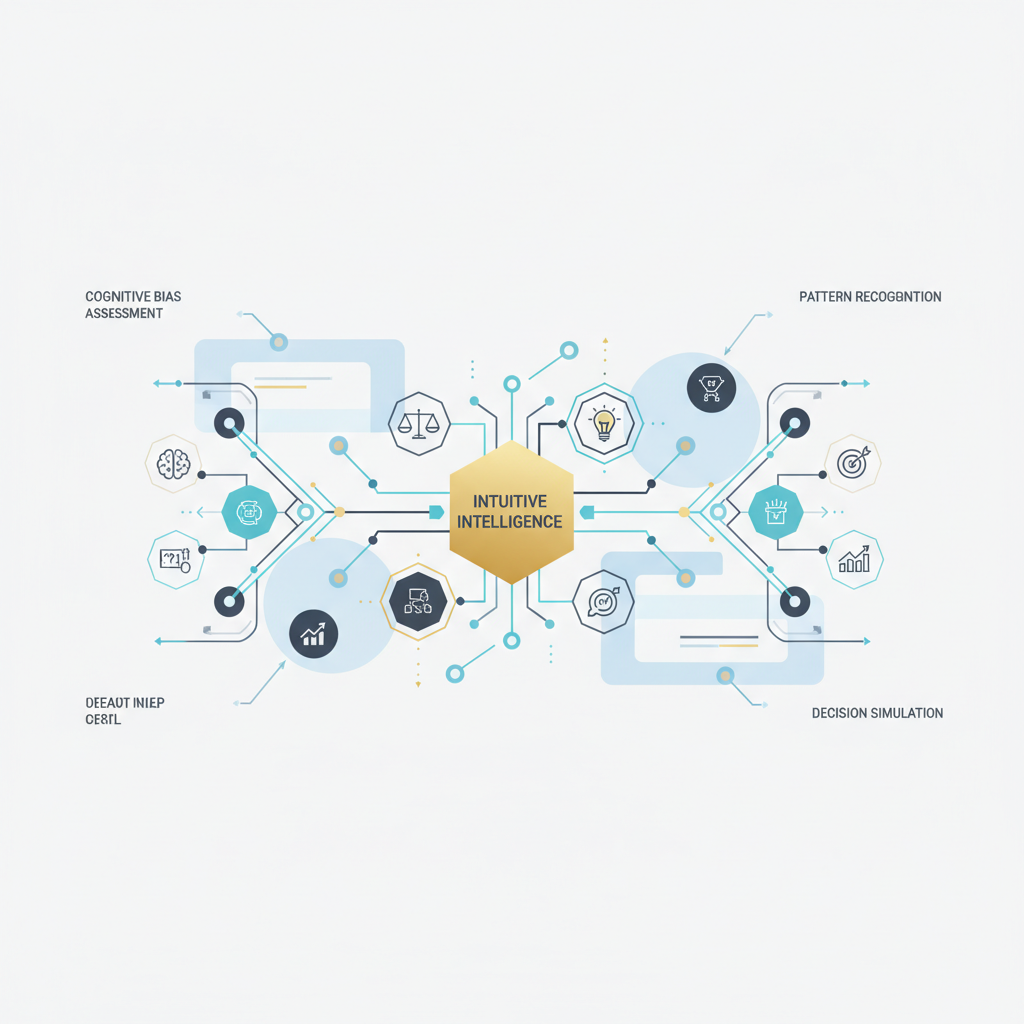
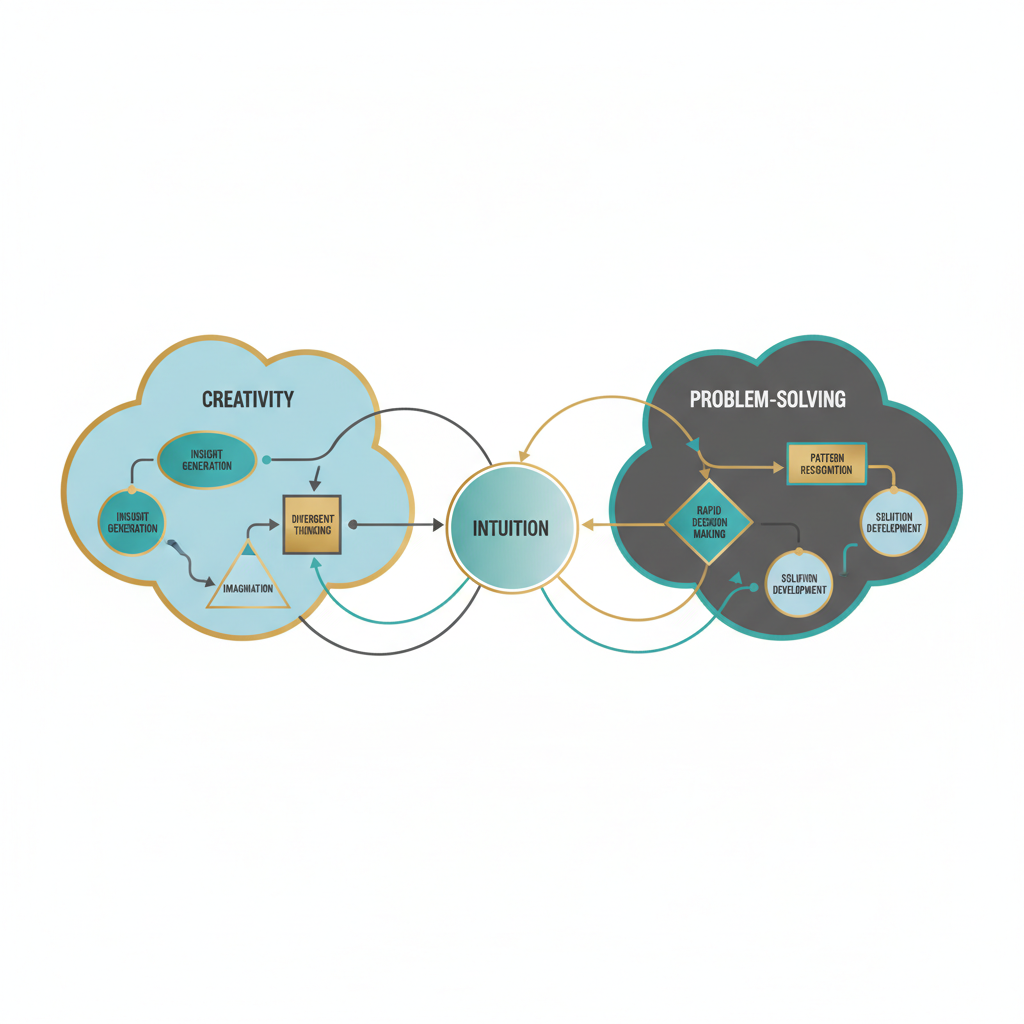
    An infographic showing a network diagram illustrating how intuition connects to and influences creativity and problem-solving, with key concepts like insight and pattern recognition linked visually.
    An abstract, educational infographic visualizing the connection between intuition, creativity, and problem-solving. Use a minimalist, vector-based style with clean geometric shapes, subtle gradients, and gold or teal accent highlights on a soft blue, white, and charcoal palette. The visual should be a cognitive network diagram or an idea cluster. A central node labeled ‘Intuition’ branches out into distinct, interconnected clusters for ‘Creativity’ and ‘Problem-Solving’. These clusters contain smaller, distinct labeled nodes representing concepts like ‘Insight Generation’, ‘Divergent Thinking’, ‘Pattern Recognition’, and ‘Rapid Decision Making’. Ensure ample negative space for clarity and short infographic labels.

    Intuition as a Spark for divergent thinking

    Intuition acts as a powerful catalyst for creativity. It helps us generate novel ideas and solutions. This connection is especially evident in divergent thinking.

    Divergent thinking is the ability to produce many varied ideas. These ideas often explore multiple potential solutions. It is a cornerstone of creative problem-solving.

    Our intuitive mind works rapidly. It connects seemingly unrelated pieces of information. This process happens below our conscious awareness. As a result, it can lead to sudden “aha!” moments. These are sparks of inspiration [2].

    Think of it as a mental shortcut. Intuition helps you jump past logical steps. It allows for a flow of fresh perspectives. This ability is crucial for overcoming mental blocks.

    Here’s how intuition fuels divergent thinking:

    • Idea Generation: It helps you quickly brainstorm diverse possibilities.
    • Pattern Recognition: It allows you to spot hidden connections. These links can lead to innovative concepts.
    • Breaking Assumptions: Intuition encourages you to question existing norms. This opens doors to truly unique solutions.
    • Unlocking Potential: It helps tap into your subconscious knowledge. This rich internal resource is often overlooked.

    Understanding this connection is vital. It reveals how your mind truly generates creativity. Our Creative Ability Test helps you uncover your strengths. It identifies how you combine intuitive insights with other cognitive skills.

    Using Gut Feelings to Navigate Complex Problems

    Complex problems often lack clear-cut solutions. This is where analytical thinking alone can falter. Intuition, or “gut feeling,” becomes an invaluable guide.

    Gut feelings are not random guesses. Instead, they are rapid assessments. They synthesize vast amounts of past experiences and knowledge. This happens almost instantaneously [3]. Our brains process complex data at an unconscious level. Then, they deliver a feeling or an inclination.

    Consider a challenging decision in business. Or a difficult personal choice. Pure logic might present many equal options. Your intuition can provide a strong leaning. It points towards the most promising path. This happens even without explicit reasons.

    Navigating complexity effectively means balancing approaches. You need both analytical rigor and intuitive wisdom. Intuition helps you:

    • Prioritize Information: It highlights what truly matters. This helps you focus on relevant data.
    • Identify Risks: It can signal potential pitfalls. These might be invisible to pure logic.
    • Make Swift Decisions: In time-sensitive situations, intuition is critical. It allows for quick, informed choices.
    • Explore Uncharted Territory: When data is scarce, intuition guides exploration. It points towards viable new directions.

    Learning to trust your gut is a skill. It develops with self-awareness and practice. Our platform helps you understand your intuitive profile. This knowledge empowers you to make better decisions. It strengthens your creative problem-solving abilities.

    Real-World Examples of Intuition Driving Innovation

    History is rich with examples. Intuition has consistently driven groundbreaking innovation. These moments transcend pure logical deduction.

    A classic example comes from science. Nobel laureate Albert Einstein spoke of intuition. He stated it was “the only real valuable thing” [4]. His theories often emerged from intuitive leaps. These were later verified through rigorous analysis.

    In business, leaders often rely on their intuition. They make strategic decisions in uncertain markets. Steve Jobs, for instance, famously followed his intuition. This guided many of Apple’s innovative product designs. He focused on user experience and aesthetics. His gut feelings shaped entire industries [5].

    Artists and designers also tap into intuition. They create works that resonate deeply. A sudden insight can transform a blank canvas. It can turn raw material into a masterpiece. This reflects an intuitive understanding of beauty and emotion.

    These examples highlight a critical lesson. Intuition is not magical. It is a powerful cognitive process. It blends experience, knowledge, and subconscious processing. This blend unlocks new possibilities.

    You can also cultivate your intuitive intelligence. This enhances your creative potential. Our scientifically grounded Creative Ability Test provides actionable strategies. It helps you strengthen this vital skill. Discover how your unique intuitive style can drive your next big idea.

    What Does Science Say About Intuitive Intelligence?

    Cognitive psychology‘s View on Intuitive Judgments

    Science recognizes intuition as a real and powerful cognitive process. It is not just a mysterious “gut feeling.” Cognitive psychology offers significant insights into how intuition works. Researchers often use a “dual-process theory” to explain our thinking [6].

    This theory suggests two main systems:

    • System 1: Fast, Intuitive Thinking. This system operates quickly and automatically. It relies on experience and pattern recognition. It processes information effortlessly. This is where intuitive judgments arise.
    • System 2: Slow, Analytical Thinking. This system is deliberate and effortful. It engages logical reasoning and critical analysis. We use it for complex problems.

    Intuition, or System 1, helps us make rapid decisions. It quickly spots patterns from past experiences. This can be very useful in familiar situations. For example, an experienced artist might instinctively know which color to use. They don’t consciously analyze every option. Their brain has learned to recognize the right choice. Our Creative Ability Test helps you understand your unique blend of these thinking styles. This understanding fosters greater self-awareness.

    Is Intuition a Learnable Skill?

    The good news is, intuition is indeed a skill you can develop. It is not simply something you are born with. Experts across many fields often exhibit highly refined intuition. Consider a seasoned chess player. They ‘feel’ the right move without lengthy calculation. This intuition comes from years of practice and extensive pattern recognition. Their brains have processed countless scenarios.

    You can cultivate your intuitive abilities. This involves several intentional practices:

    • Broaden Your Experiences: New challenges provide more data for your System 1.
    • Practice Deliberate Reflection: Review your decisions, both good and bad. Understand what factors contributed.
    • Seek Feedback: Learn how well your initial judgments align with actual outcomes.
    • Engage in Creative Exercises: Activities that foster divergent thinking strengthen your intuitive leaps.

    Developing intuition enhances your creative problem-solving. It helps you generate novel ideas quickly. Our platform at Creative Ability Test provides actionable strategies. These are designed to strengthen both your analytical and intuitive thinking skills. We guide you toward structured growth.

    Distinguishing Genuine Intuition from Cognitive Biases

    While intuition is powerful, not every “gut feeling” is accurate. Sometimes, what feels like intuition is actually a cognitive bias. Cognitive biases are systematic errors in thinking. They occur when we process information. They are mental shortcuts that can lead to flawed judgments [7].

    Common cognitive biases include:

    • Confirmation Bias: We tend to favor information that confirms our existing beliefs.
    • Availability Heuristic: We overestimate the likelihood of events that are easily recalled.
    • Anchoring Bias: We rely too heavily on the first piece of information offered.

    Distinguishing genuine intuition from a bias is crucial. True intuition often arises from deep expertise. It is a rapid, accurate assessment based on relevant experience. Biases, however, can cloud your judgment. They limit your creative solutions. They prevent you from seeing new possibilities. Therefore, cultivating critical self-reflection is vital.

    To refine your intuitive judgments:

    • Question your initial assumptions.
    • Seek out diverse perspectives and information.
    • Pause before acting on strong gut feelings, especially in unfamiliar situations.

    Our assessment helps you understand your own thinking patterns. This includes how you process information. Such self-awareness empowers you to challenge potential biases. This leads to more robust creative insights and better decision-making.

    What Kinds of Intuition Tests Exist?

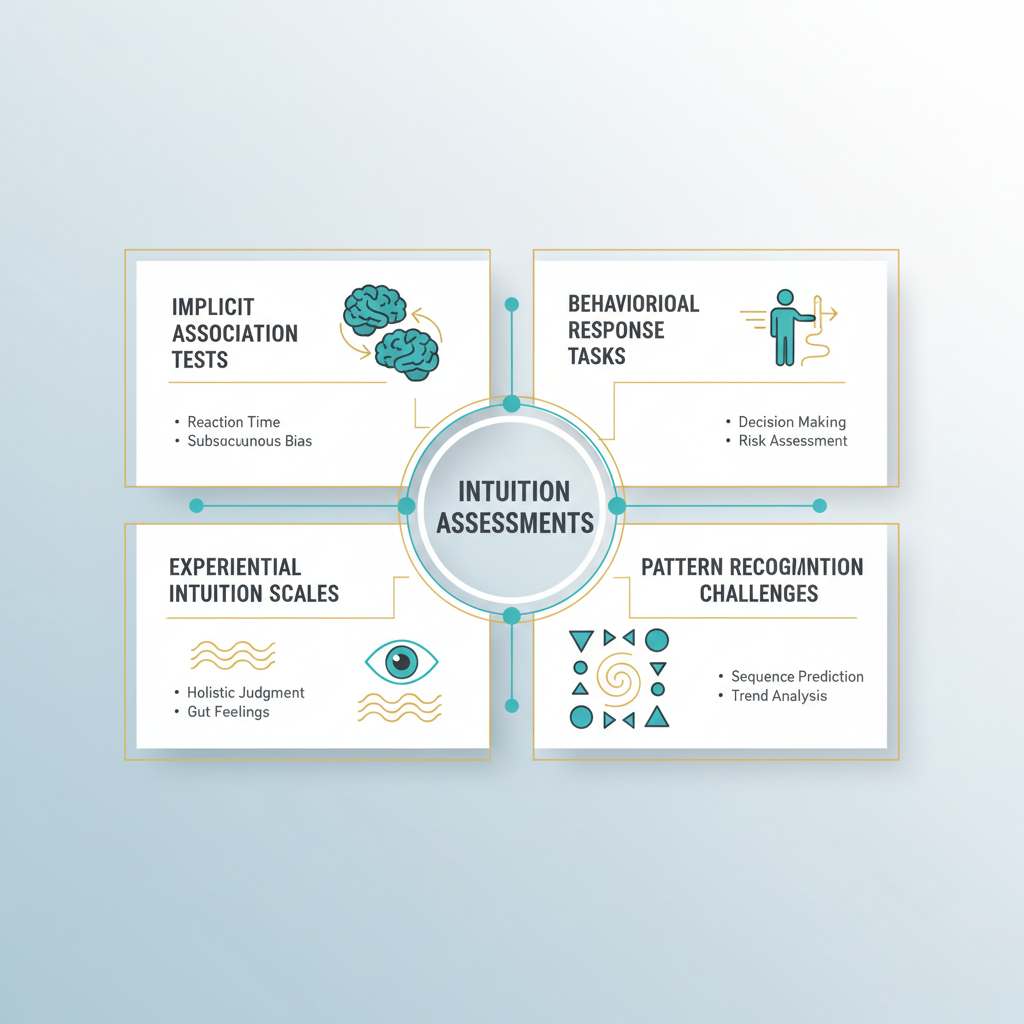
    An infographic displaying a structured chart or map categorizing different types of intuition tests, with distinct sections for each test kind and symbolic representations.
    An abstract, educational infographic presenting various kinds of intuition tests. The visualization should be a structured assessment chart or competency map, rendered in a minimalist, vector-based style using clean geometric shapes, subtle gradients, and gold or teal accent highlights on a soft blue, white, and charcoal palette. The chart should classify different categories of intuition tests using a grid or matrix format with distinct blocks for each type (e.g., ‘Implicit Association Tests’, ‘Behavioral Response Tasks’, ‘Experiential Intuition Scales’, ‘Pattern Recognition Challenges’). Each block should have a symbolic icon or shape representing its nature. Maintain clear visual hierarchy and ample negative space for short labels and category headers.

    Picture-Based Intuition Tests

    Picture-based intuition tests invite you to trust your immediate gut feelings. These assessments use visual stimuli. They tap into your rapid, unconscious processing abilities.

    Here’s how they often work:

    • Symbol Recognition: You might see a series of abstract symbols or images. Then, you choose which one feels “right” or predict a hidden image.
    • Pattern Prediction: Some tests ask you to anticipate the next image in a sequence. You rely on non-verbal cues and subtle patterns.
    • Emotional Interpretation: Others present faces or scenes. You quickly assess underlying emotions or potential outcomes.

    These tests aim to bypass overthinking. They reveal your spontaneous responses. This direct approach can highlight your capacity for quick insight. It reflects a key aspect of creative thinking: forming novel connections rapidly [8].

    Scenario and Question-Based Assessments

    Scenario and question-based assessments offer a different window into your intuition. They present you with real-world dilemmas or hypothetical situations. Your choices reveal your intuitive tendencies.

    Typically, these tests involve:

    • Decision-Making Dilemmas: You read a short story or problem. Then, you select the action that feels most appropriate.
    • Problem-Solving Scenarios: You face a complex situation. You choose between analytical steps or an intuitive leap.
    • Preference Questions: These questions probe your natural inclination. Do you prefer detailed data or a strong gut feeling when making choices?

    This type of assessment measures how intuition guides practical decisions. It shows how you integrate information. Intuitive problem-solving is vital for innovation. It helps you generate unique solutions, especially in uncertain situations.

    Measuring Your Cognitive Style: The Analytical-Intuitive Spectrum

    We all process information differently. Many models describe cognitive styles. One important distinction is between analytical and intuitive thinking. It’s not an either/or choice. Instead, most people operate somewhere along a spectrum.

    Consider these two key thinking styles:

    • Analytical Thinking: This style is logical, sequential, and data-driven. It breaks problems into smaller parts. You systematically evaluate each component.
    • Intuitive Thinking: This style is holistic, rapid, and pattern-focused. It often operates unconsciously. You grasp the “big picture” quickly.

    Tests designed to measure your cognitive style use questionnaires. They often include self-report inventories. These tools evaluate your preference for processing information [9]. Understanding your position on this spectrum is a powerful form of self-awareness. It helps you improve your decision-making and problem-solving strategies.

    For instance, knowing if you lean more analytical or intuitive can transform your approach to challenges. It allows you to consciously develop a more balanced perspective. Our Creative Ability Test helps you understand your unique blend of cognitive styles. It highlights how these styles fuel your creative potential. By understanding your strengths, you gain actionable insights for growth.

    How Can You Improve Your Intuition?

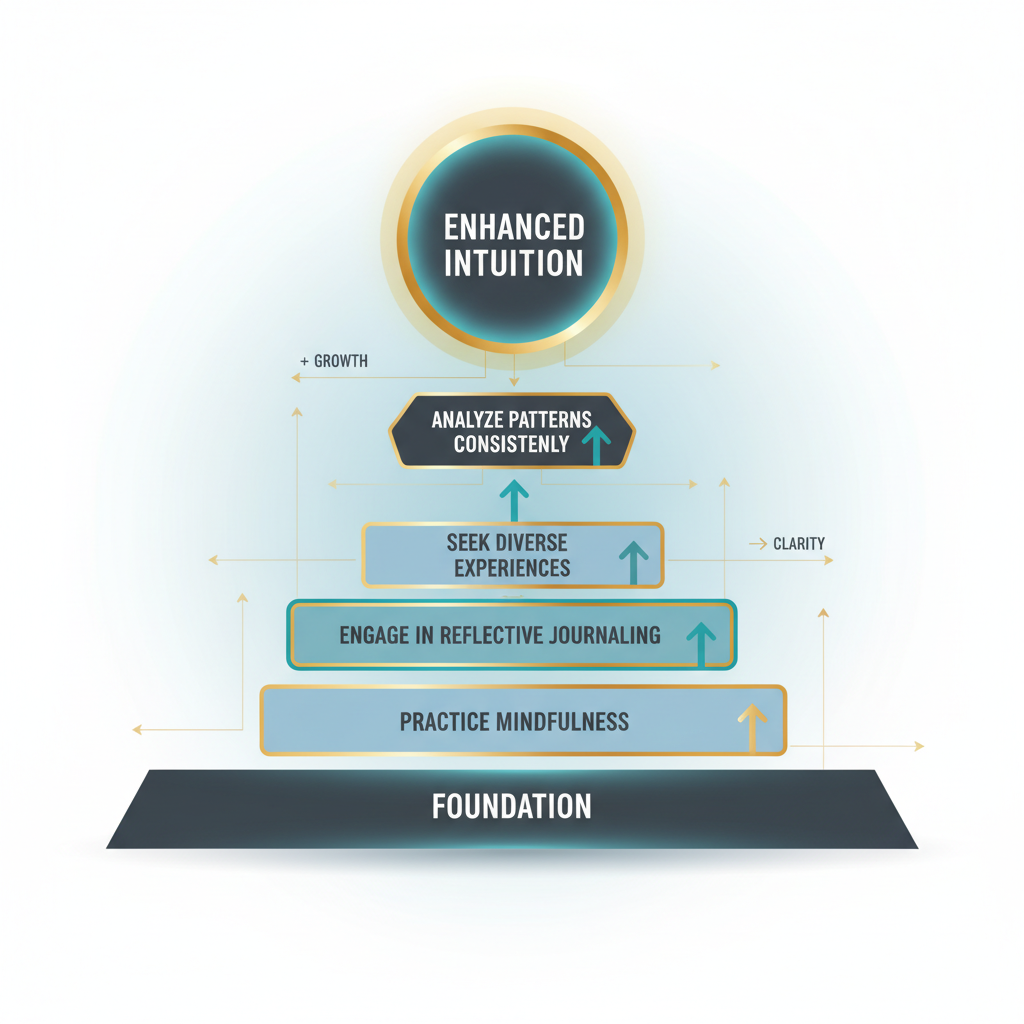
    An infographic showing a multi-layered progression or pathway with distinct steps, illustrating various strategies and actions to improve and develop one's intuition.
    An abstract, educational infographic illustrating strategies to improve intuition. The visual should be a layered system or a milestone progression, rendered in a minimalist, vector-based style using clean geometric shapes, subtle gradients, and gold or teal accent highlights on a soft blue, white, and charcoal palette. The progression should depict a pathway or ascending layers with distinct, labeled steps or stages representing actionable improvement strategies (e.g., ‘Practice Mindfulness’, ‘Engage in Reflective Journaling’, ‘Seek Diverse Experiences’, ‘Analyze Patterns Consistently’). Each stage or layer should build upon the last, suggesting growth and development. Utilize negative space effectively for short labels and directional markers.

    Developing your intuition is a journey of self-discovery. It involves honing your inner radar. Furthermore, it allows you to make more informed decisions. By enhancing this crucial skill, you gain deeper insights. You can also unlock greater creative potential. Our platform, Creative Ability Test, helps you understand your unique cognitive style. This understanding is the first step toward strengthening your intuitive abilities.

    Practical Exercises to Strengthen Your Intuitive Abilities

    Intuition, like any skill, improves with practice. Integrating specific exercises into your daily routine can sharpen your intuitive edge. These practices help you listen more closely to your inner voice. Consequently, you will start recognizing patterns more quickly.

    • Daily Reflection Journaling: Dedicate time each day to write. Document your feelings and initial impressions. Note down your decisions and their outcomes. This practice builds self-awareness. It also helps you identify recurring intuitive cues [10].
    • “Guess the Outcome” Game: Before an event, make a conscious prediction. This could be a small event. For example, guess who will call you next. Or, predict the end of a story. Compare your guess with the actual outcome. This strengthens your predictive sense.
    • Pay Attention to Body Sensations: Your body often provides intuitive signals. Notice feelings like a gut knot or a sense of lightness. These physical cues offer valuable insights. Learning their meaning is key to trusting your intuition.
    • Engage in Creative Activities: Hobbies like painting, writing, or playing music foster intuitive thinking. They bypass the rational mind. This allows your subconscious to express itself freely.
    • Practice Quick Decision-Making: In low-stakes situations, try making decisions quickly. Avoid overthinking. For example, choose a restaurant in seconds. Reflect on the outcome later. This builds confidence in your snap judgments.

    These exercises guide you toward a more intuitive approach. They help you integrate intuitive intelligence into your daily life. Over time, you will find your creative problem-solving skills expanding.

    Mindfulness and Its Impact on Inner Awareness

    Mindfulness is a powerful tool for cultivating intuition. It involves being present in the moment. Furthermore, it means observing your thoughts and feelings without judgment. This practice quiets the constant chatter of the analytical mind. Consequently, it creates space for intuitive insights to emerge.

    • Meditation Practices: Regular meditation reduces mental noise. It enhances your ability to perceive subtle cues. Even a few minutes daily can make a significant difference. Numerous studies link mindfulness meditation to improved cognitive functions [11].
    • Focused Breathing: Simple breathing exercises can ground you. They bring your attention to the present. This practice helps calm your nervous system. It makes you more receptive to inner guidance.
    • Body Scan Meditation: Direct your attention to different parts of your body. Notice any sensations. This exercise enhances your awareness of physical intuitive signals. It helps you recognize where your “gut feelings” reside.
    • Mindful Observation: Take time to observe your surroundings closely. Pay attention to details. Do this without judgment or labeling. This heightens your observational skills. It also sharpens your ability to pick up on non-obvious information.

    Through mindfulness, you develop a deeper connection with your inner self. This enhanced inner awareness is fundamental. It empowers you to better understand and utilize your intuitive intelligence. The Creative Ability Test can further illuminate how mindfulness aligns with your creative potential.

    Learning to Trust Your Gut in a Data-Driven World

    We live in an era rich with information. Data often guides our decisions. However, true wisdom often blends data with intuition. Learning to trust your gut feeling is crucial. It becomes especially important in complex, uncertain situations. Your intuition can synthesize vast amounts of information. It can do this subconsciously. Then, it offers a holistic perspective.

    • Recognize Intuition’s Strengths: Intuition excels when data is incomplete or ambiguous. It is powerful in social interactions or creative problem-solving. It offers a quick, holistic understanding.
    • Understand Cognitive Biases: Not every gut feeling is genuine intuition. Some are biases or emotional reactions. Learn to distinguish between them. For instance, fear can sometimes masquerade as intuition. Educating yourself on common biases is helpful [12].
    • Integrate Intuition with Data: View intuition as a valuable input. Combine it with analytical data. Use data to validate your gut feeling. Conversely, use intuition to explore data’s unseen implications. This balanced approach leads to robust decision-making.
    • Start Small and Reflect: Practice trusting your intuition in low-stakes decisions. Observe the outcomes. This builds confidence over time. It helps you refine your ability to discern accurate intuitive prompts.
    • Seek Diverse Perspectives: Discuss your intuitive insights with trusted peers. Their analytical views can provide helpful checks. This collaborative process refines both your intuitive and logical thinking.

    By learning to wisely trust your intuition, you transform your decision-making. You move from uncertainty to actionable self-awareness. This leads to more innovative solutions. Furthermore, it fosters deeper personal growth. The Creative Ability Test provides personalized feedback. It helps you understand your unique blend of analytical and intuitive strengths. This guides you towards structured growth strategies. Therefore, you can apply your creativity effectively in real-world contexts.

    How Can You Discover Your Own Creative and Intuitive Profile?

    The Creative Ability Test Approach

    Unlocking your creative and intuitive profile begins with self-awareness. The Creative Ability Test offers a scientifically grounded path to this understanding. It is a comprehensive 30-question assessment. This tool helps you explore the unique ways your mind generates ideas and solves problems.

    Our methodology is rooted in established creative psychology. It examines multiple dimensions of your cognitive style. This includes aspects directly linked to intuitive processing. Understanding these areas provides a clearer picture of your creative strengths. It also reveals opportunities for growth.

    The Creative Ability Test specifically measures:

    • Divergent Thinking: This is your ability to generate many varied ideas from a single prompt [13]. It is often a cornerstone of intuitive leaps.
    • Cognitive Flexibility: This reflects how easily you shift perspectives. It shows how you adapt to new information. Flexible thinkers can process intuitive signals more effectively.
    • Problem-Solving Skills: We assess your approach to challenges. This includes your capacity for novel solutions.
    • Openness to Experience: This personality trait correlates with both creativity and intuition. It shows your receptiveness to new ideas and feelings.

    By mapping these traits, the test helps you see connections. You will better understand how your innate creativity influences your intuitive judgments. Furthermore, it highlights how you can consciously nurture both abilities. The aim is to move from general curiosity to specific, actionable self-knowledge.

    Understanding Your Personalized Results for Growth

    Receiving your Creative Ability Test results is just the first step. Our platform delivers personalized feedback. This insight clarifies your unique creative profile. It translates complex psychological data into understandable terms. Therefore, you gain a clear picture of where you excel.

    Your results include detailed explanations of your scores. They highlight your dominant creative thinking styles. Moreover, they point out areas where you can intentionally develop. For instance, if you score high in divergent thinking, you might learn strategies to refine those ideas. Conversely, if cognitive flexibility is lower, we offer exercises to expand your adaptability. This personalized guidance transforms potential into practical skills.

    The benefits of understanding your profile are significant. You move from simply wondering about your potential to actively cultivating it. This journey empowers you with specific strategies:

    • Enhance Your Creative Thinking: Learn tailored techniques to boost idea generation. Discover new ways to approach challenges.
    • Refine Intuitive Insights: Understand how your creative style impacts your gut feelings. Develop a stronger trust in your informed intuition.
    • Improve Problem-Solving: Apply your unique creative strengths to real-world dilemmas. Innovate more effectively in personal and professional contexts.
    • Boost Self-Confidence: Gain validation for your existing strengths. Build confidence in areas you wish to grow [14].

    This comprehensive approach ensures you don’t just measure your creativity. You learn how to apply it. You also gain actionable strategies to foster consistent growth. This process helps you evolve from uncertainty to confident, structured creative and intuitive performance.

    Frequently Asked Questions

    Where can I find an intuition test psychology online?

    You will find many online quizzes and tests claiming to measure intuition. However, their scientific basis varies significantly. For reliable insights, seek assessments from reputable psychological research bodies or academic platforms.

    These tests often focus on your cognitive style. They examine your preference for quick, intuitive judgments. They also assess your reliance on gut feelings versus deliberate analysis.

    At Creative Ability Test, our 30-question assessment measures your creative potential. It provides valuable insights into skills closely related to intuition. These include cognitive flexibility, divergent thinking, and problem-solving approaches. Our personalized feedback empowers you to understand and enhance these vital abilities for self-improvement and innovation.

    What makes an intuition test scientific?

    A truly scientific intuition test relies on rigorous psychological principles. It is not just a collection of interesting questions. Scientific tests are built on established theories of cognition and decision-making.

    Key elements of a scientific test include:

    • Validity: This means the test actually measures what it claims to measure. Does it truly assess intuition, or something else?
    • Reliability: A reliable test yields consistent results over time. If you take it again, your score should be similar.
    • Normative Data: Results are compared against a large, diverse group. This helps interpret your score meaningfully. It shows how your intuition compares to others.
    • Empirical Research: The test design and its scoring methods are supported by research findings. [15]

    Such tests are often developed through extensive research and peer review. They offer objective insights into your cognitive processes. This moves beyond mere anecdotal evidence.

    At Creative Ability Test, our assessment is scientifically grounded. We use evidence-based methodology to explore your creative strengths. This ensures you receive accurate, actionable insights for personal growth.

    How do intuition tests using pictures work?

    Intuition tests using pictures often tap into our unconscious processing. They aim to bypass slower, analytical thought. Instead, they provoke immediate, gut-level responses.

    Here’s how they typically function:

    • Rapid Presentation: Images are often shown very quickly. This leaves little time for conscious deliberation.
    • Ambiguity: Pictures might be abstract, ambiguous, or convey subtle emotional cues. Your brain quickly tries to make sense of them.
    • Pattern Recognition: Intuition excels at recognizing patterns. It identifies connections even when data is incomplete. Picture tests leverage this ability.
    • Emotional and Subliminal Cues: Your brain reacts to colors, shapes, and hidden details. These reactions can be pre-conscious. They guide your immediate judgments. [16]

    Your task might be to choose which picture feels “right.” You might guess what happens next. You could also describe your initial feeling. This method helps reveal your intuitive decision-making style.

    These picture-based assessments highlight your ability to process information implicitly. This is a key component of creative thinking. It helps you form novel connections quickly.

    Is there a free intuitive intelligence test?

    Yes, many websites offer free “intuitive intelligence” tests. These can be engaging and provide a fun way to reflect on your thinking style. However, it is crucial to approach them with a critical eye.

    Most free tests lack the scientific rigor of paid, validated assessments. They might not have been developed through extensive research. They also often lack robust validity and reliability measures.

    These free options often serve as:

    • Entertainment: They offer a quick, interesting self-reflection tool.
    • Introductory Tools: They might spark your curiosity about intuition and cognition.
    • General Guides: They can give a broad, non-scientific idea of your preferences.

    For a truly insightful and actionable understanding of your cognitive strengths, invest in a professionally developed assessment. Our Creative Ability Test provides a comprehensive, scientifically grounded evaluation. It offers personalized feedback and strategies to enhance your creative potential. This investment leads to meaningful self-discovery and growth. You gain clarity on how your mind works to solve problems and innovate.


    Sources

    1. https://greatergood.berkeley.edu/article/item/is_your_gut_always_right
    2. https://hbr.org/2012/12/how-intuition-helps-us-innovate
    3. https://www.psychologytoday.com/us/blog/mind-matters/202107/the-science-gut-feelings-and-intuition
    4. https://www.einstein.org/
    5. https://www.businessinsider.com/steve-jobs-intuition-2016-10
    6. https://www.simplypsychology.org/dual-process-theory.html
    7. https://www.verywellmind.com/what-is-a-cognitive-bias-2794963
    8. https://psycnet.apa.org/record/1987-19097-001
    9. https://journals.sagepub.com/doi/abs/10.1177/0013164402062002008
    10. https://greatergood.berkeley.edu/article/item/five_ways_to_strengthen_your_intuition
    11. https://www.apa.org/topics/mindfulness/meditation
    12. https://www.psychologytoday.com/us/blog/head-games/202202/6-steps-trust-your-intuition-wisely
    13. https://psycnet.apa.org/record/2012-07440-001
    14. https://www.tandfonline.com/doi/abs/10.1080/02673843.2018.1506509
    15. https://www.apa.org/pubs/books/4317134
    16. https://www.frontiersin.org/articles/10.3389/fpsyg.2018.00693/full