Tag: Cognitive insights

  • 10 Popular Psychological Tests and What They Reveal About Your Mind

    10 Popular Psychological Tests and What They Reveal About Your Mind

    Popular psychological tests are standardized assessments designed to measure abstract concepts like personality, intelligence, aptitude, and cognitive abilities. Famous examples include personality inventories like the Myers-Briggs Type Indicator (MBTI), intelligence scales like the Stanford-Binet, and projective tests like the Rorschach Inkblot Test, all used to gain deeper insights into the human mind.

    Have you ever wondered how your mind works? What drives your choices, shapes your personality, or sparks your best ideas? This curiosity is why popular psychological tests have been used for decades. They offer a look into how we think, feel, and what we’re capable of.

    Psychological tests are a structured way to learn more about yourself. They can help you discover your personality traits or measure your cognitive abilities. But these tools can also show your creative strengths, how you think, and your approach to solving problems. Understanding these parts of yourself is key for personal and professional growth.

    In this article, we will look at 10 well-known psychological assessments. We’ll explain their purpose and what they can reveal about you. These science-based tests shed light on everything from your personality to your creative potential, giving you useful insights to better understand and build on your strengths.

    Why Are We So Curious About Psychological Tests?

    From Self-Discovery to Professional Growth

    We are all curious about ourselves. We want to understand what makes us tick. Psychological tests can help us on this journey by giving us a clear look into how our minds work.

    These tests can reveal hidden talents and show us how we think. For example, you might learn you are good at divergent thinking, which means you can come up with many new ideas easily. Knowing this about yourself helps you grow.

    Here’s how these insights can help you:

    • Better Self-Awareness: Understand your strengths, like your creative skills and how you solve problems.
    • Personal Growth: Knowing how you think builds confidence. It helps you make better choices for your future by using your natural talents.
    • Career Growth: Learning about your mental flexibility is a big advantage. It helps you adapt to new challenges and become a better innovator at work.

    Knowing your creative style helps you succeed. For instance, if you are open to new things, you’ll be more willing to embrace change—a key skill for innovation. The Creative Ability Test offers these personal insights. It turns confusion into clear, useful knowledge about yourself.

    Understanding the Science Behind the Questions

    You might wonder how psychological tests work. They are not just for fun. Good tests are based on solid science and are designed to give you information you can trust.

    So, what does that mean?

    • Reliability: A reliable test gives you the same results over and over. Think of a good scale—it shows the same weight every time you step on it.
    • Validity: A valid test measures what it’s supposed to measure. So, a creativity test should actually measure your creativity, not something else [1].

    Experts carefully design these questions using deep research on how people think and act. Specialists build and improve these tests to make sure the questions accurately measure specific skills.

    Our Creative Ability Test meets these high standards. It is a 30-question test based on science. It measures several parts of creativity, including mental flexibility, how you generate new ideas, and your openness to new experiences. Our methods are based on proven creativity research, so you get feedback that is both accurate and helpful. This scientific approach ensures your personalized tips for growth really work. You can trust the insights from your results.

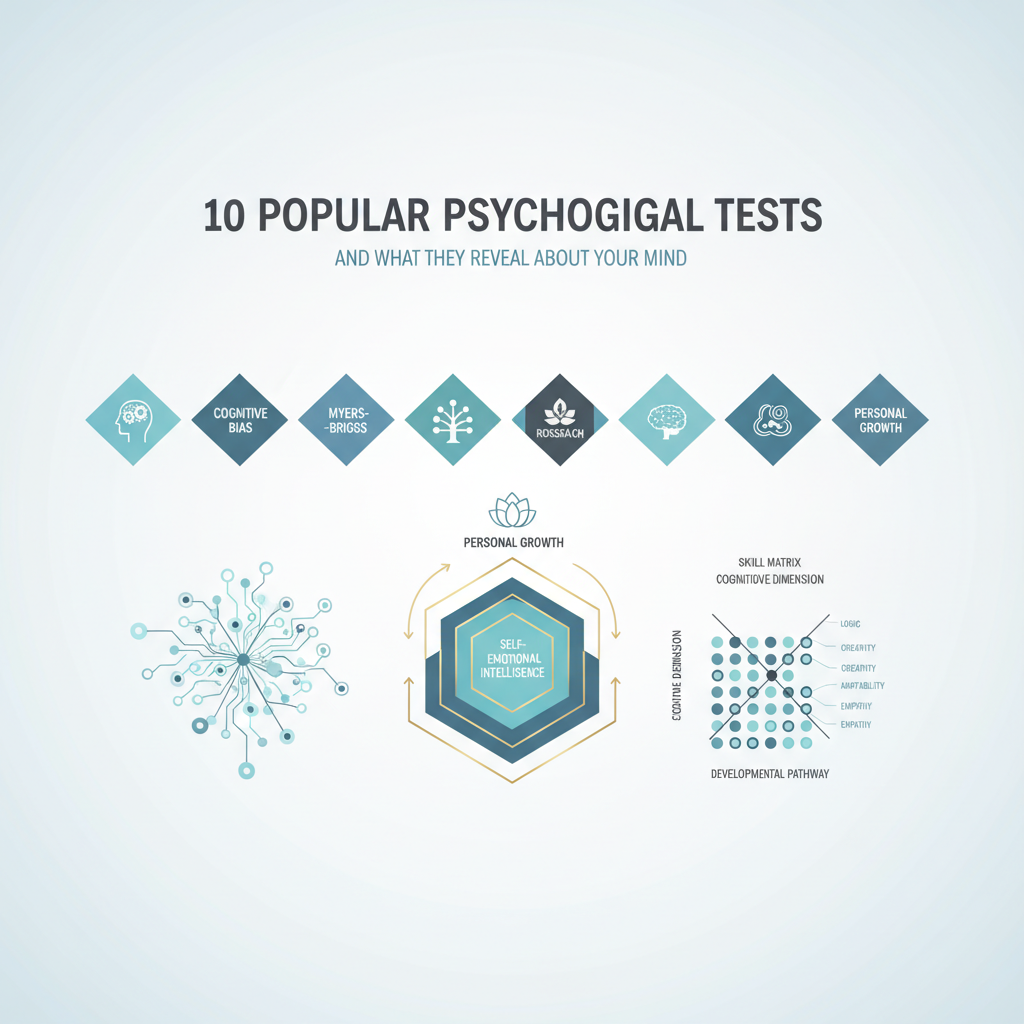
    10 Famous Psychological Tests Explained

    Infographic presenting a structured grid or chart with ten distinct, minimalist geometric icons. Each icon visually represents one of the ten famous psychological tests, offering a clean, abstract overview of their conceptual focus in a vector art style.
    Produce a minimalist, vector-based infographic structured as a competency chart or a grid overview. The color palette should be soft blues, whites, charcoal, and gold accents. The infographic needs to visually represent ten distinct ‘slots’ or sections, each corresponding to one famous psychological test. Each slot should contain a unique, abstract geometric icon or a small, distinct shape to symbolize the nature or focus of that test, without explicitly naming it. The arrangement should be clean, organized, and professional, using subtle gradients and ample negative space to ensure clarity and easy comprehension, suitable for an educational overview without direct text explanation.

    The Rorschach Inkblot Test

    The Rorschach Inkblot Test is one of the most famous psychological tests. Hermann Rorschach created it in 1921. The test is known for its unique visual approach.

    In this test, you look at ten ambiguous inkblots. Some are black and white, while others have color. Your task is to describe what you see in each one.

    What It Reveals:

    • It helps reveal your personality characteristics.
    • It also looks at your emotional functioning.
    • How you see these shapes can hint at your underlying thought patterns.

    If you’re curious about creative thinking, interpreting abstract forms can be very insightful. This test shows how you find meaning in vague images. This skill is key for creative thinking and solving problems in new ways.

    The Thematic Apperception Test (TAT)

    The Thematic Apperception Test (TAT) asks you to be a storyteller. It was created in the 1930s by Henry Murray and Christiana Morgan. The test uses a set of pictures that are both interesting and unclear.

    For each picture, you create a story. You’ll describe what’s happening, what led to the scene, and what the characters are thinking and feeling. Finally, you explain how the story ends.

    What It Reveals:

    • It helps psychologists understand your hidden needs and motivations.
    • It also reveals how you view the social world.
    • Your stories can show common themes in your thinking.

    Storytelling is a core creative skill. The TAT shows your ability to use imagination and build a story. These skills are key for creating new ideas and sharing them well.

    The Myers-Briggs Type Indicator (MBTI)

    The Myers-Briggs Type Indicator (MBTI) is a popular questionnaire you fill out yourself. Isabel Myers and Katharine Briggs created it based on Carl Jung’s theory of psychological types. The test helps people learn about their own personality preferences.

    It sorts people into one of 16 different personality types. These types are based on your preferences in four areas:

    • Extraversion (E) or Introversion (I): How you focus your energy.
    • Sensing (S) or Intuition (N): How you perceive information.
    • Thinking (T) or Feeling (F): How you make decisions.
    • Judging (J) or Perceiving (P): How you prefer to live your outer life.

    What It Reveals:

    • It offers insight into how you make decisions.
    • It helps you understand how you interact with others.
    • It can show what kind of learning and work environments you prefer.

    Knowing your MBTI type can give you helpful clues about your creative style. For instance, people with a strong “Intuition” preference often show great creative potential [2]. Knowing your type can help you use your natural strengths for creative projects and personal growth.

    The Big Five Personality Traits (OCEAN Model)

    The Big Five, also known as the OCEAN model, is a common framework for personality. It describes personality using five main traits. This model is backed by a lot of research and offers a simple way to talk about personality.

    These five traits are:

    • Openness to Experience: How much you enjoy art, adventure, new ideas, and new experiences.
    • Conscientiousness: How organized, disciplined, and responsible you are.
    • Extraversion: How energetic, positive, and sociable you are.
    • Agreeableness: How compassionate and cooperative you tend to be.
    • Neuroticism (Emotional Stability): How easily you feel negative emotions.

    What It Reveals:

    • It gives a broad overview of your core personality.
    • It helps predict how you might act in different situations.
    • It’s a reliable way to understand why people are different.

    When it comes to creativity, “Openness to Experience” is the most important trait. It is consistently linked to creative thinking and innovation [3]. Becoming more open can boost your creative potential. Our Creative Ability Test helps you explore how your unique traits support your creative journey.

    The Minnesota Multiphasic Personality Inventory (MMPI)

    The Minnesota Multiphasic Personality Inventory (MMPI) is a detailed psychological test. It is mainly used to assess mental health issues, but it also explores personality traits. This test is widely used in clinical settings to help professionals understand a person’s mental health.

    The MMPI is a long questionnaire with hundreds of true/false questions. These questions cover a wide range of topics, including health, attitudes, and unusual experiences.

    What It Reveals:

    • It helps diagnose mental health conditions.
    • It points out specific personality traits.
    • It offers insights into emotional and behavioral patterns.

    While this is not a direct measure of creativity, mental well-being is crucial. A healthy mind helps you think flexibly and solve problems. These skills are essential for being creative. Understanding your mental health can help your creativity grow.

    The Stanford-Binet Intelligence Scale

    The Stanford-Binet Intelligence Scale is one of the oldest intelligence tests, first developed in the early 20th century. This test measures thinking skills in people of all ages and looks at different types of intelligence.

    The test has several parts, or subtests. These tasks measure skills like verbal and math reasoning, as well as visual-spatial skills. It also tests your working memory and problem-solving abilities.

    What It Reveals:

    • It gives you an IQ score, which shows your general thinking ability.
    • It helps find your specific mental strengths and weaknesses.
    • It can be used for educational and developmental planning.

    High intelligence can help with solving complex problems, which is often part of creative work. But creativity is more than just a traditional IQ score. Our Creative Ability Test focuses on the unique aspects of creative potential. This helps you understand how you come up with new ideas.

    The Wechsler Adult Intelligence Scale (WAIS)

    The Wechsler Adult Intelligence Scale (WAIS) is another leading intelligence test. David Wechsler created it specifically for adults. The test measures different parts of a person’s thinking ability.

    The WAIS is broken down into several main scores, including Verbal Comprehension, Perceptual Reasoning, Working Memory, and Processing Speed. Each main score is made up of several subtests that measure different thinking skills.

    What It Reveals:

    • It provides a full-scale IQ score.
    • It offers detailed insight into your thinking strengths and weaknesses.
    • It helps in clinical diagnosis and educational assessments.

    Your thinking abilities are the foundation for creative thought. Creative people often use these mental tools in flexible and unusual ways. The WAIS shows how your mind processes information. Our platform helps you apply these cognitive strengths to creative challenges.

    Projective Tests (e.g., Draw-A-Person)

    Projective tests are a type of psychological test where people respond to unclear prompts or images. These tests are designed to reveal hidden thoughts, feelings, and conflicts. They offer a less structured way to look at personality.

    Examples include the Draw-A-Person Test, where you simply draw a person. Other tests might ask you to complete sentences or tell stories about pictures. The lack of specific instructions allows for free expression.

    What They Reveal:

    • They can highlight unique expressive styles.
    • They offer clues about how a person sees themselves.
    • They may reveal hidden emotions or worries.

    The freedom in these tests taps into your imagination. Your unique interpretations and artistic choices reflect your creative expression. These tests hint at how you see the world from your own unique point of view.

    Tests for Specific Conditions (e.g., Beck Depression Inventory)

    Many psychological tests focus on specific conditions. These tests help find or diagnose different mental health issues. They are key tools in clinical psychology that help guide treatment and support.

    The Beck Depression Inventory (BDI) is a common example that helps measure the severity of depression. Other tests might screen for anxiety, ADHD, or trauma-related symptoms. These are usually questionnaires you fill out yourself.

    What They Reveal:

    • They offer a standard way to measure how severe symptoms are.
    • They help with diagnosing specific mental health disorders.
    • They track how well treatment is working over time.

    Your mental health has a direct impact on your creative potential. Taking care of any mental health issues can free up your mind, which allows for greater focus and flexibility. A healthy mind helps your creative ideas flow better. Putting your mental health first is a big step toward personal growth and more creativity.

    Creativity Assessments (e.g., Torrance Tests of Creative Thinking)

    Creativity assessments are designed to directly measure creative thinking. They move beyond traditional intelligence tests to focus on how you come up with new ideas. They also look at how you solve problems in new ways.

    The Torrance Tests of Creative Thinking (TTCT) are a leading example. Developed by E. Paul Torrance, they use different tasks that often involve divergent thinking. They ask you to come up with many ideas from one starting point.

    What They Reveal:

    • Fluency: How many ideas you can come up with.
    • Originality: How unique your ideas are.
    • Flexibility: How many different types of ideas you have.
    • Elaboration: How detailed your ideas are.

    These tests prove that creativity can be measured scientifically. They show that creativity has many different parts and is a skill that can be understood and developed. Our Creative Ability Test builds on this foundation. It offers a science-based test of your unique creative strengths. You get personal insights and real steps you can take to boost your creative potential.

    How Do General Psychology Tests Relate to Creativity?
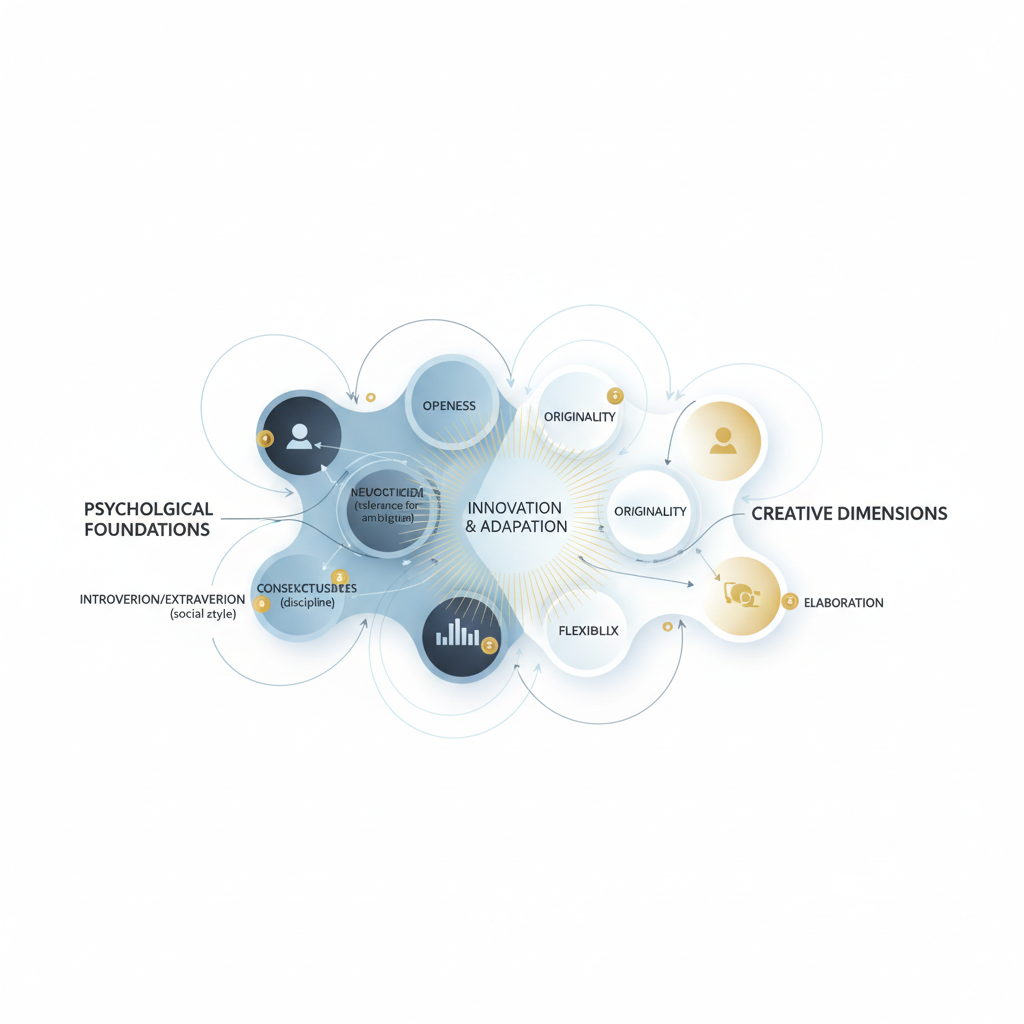
    Infographic showing a network diagram connecting abstract representations of general psychological foundations with creative dimensions, highlighting their interconnectedness and influence through subtle lines and an overlapping central area, in a minimalist vector style.
    Create a minimalist, vector-based infographic with soft blues, whites, charcoal, and gold accents. The infographic should depict a cognitive network diagram or an idea cluster illustrating the relationship between general psychological traits and creativity. Use clean geometric shapes, lines, and subtle gradients. Show a central overlapping area or interconnected nodes. One cluster represents ‘Psychological Foundations’ with abstract shapes, and another represents ‘Creative Dimensions’ also with abstract shapes. Connecting lines or subtle flows indicate their interrelation and influence. The layout should have ample negative space for implied labels or conceptual indicators, maintaining a professional and educational aesthetic suitable for understanding complex ideas.

    Uncovering Thinking Styles and Cognitive Flexibility

    While many popular psychological tests don’t measure creativity directly, they can give you useful hints. These tests show key parts of how you think. Understanding them is the first step to unlocking your creative potential.

    General psychology tests often show your thinking styles. They reveal how you process information and solve problems. Creative thinking depends on certain mental strengths.

    One key strength is cognitive flexibility. This is your ability to switch between different ways of thinking. It helps you see things from many angles. Flexible thinkers can adapt easily to new challenges. This skill is vital for coming up with new ideas.

    Tests can also hint at your divergent thinking skills. This is the ability to come up with many different ideas. For example, some tests show how well you connect ideas. Problem-solving tasks show if you look for creative solutions. This gives you a starting point.

    Key mental traits linked to creativity include:

    • Cognitive Flexibility: Easily switching between different ideas.
    • Problem-Solving Skills: Finding new solutions to problems.
    • Pattern Recognition: Seeing connections others might miss.
    • Idea Generation: Coming up with many different ideas.

    These general tests help you understand your basic mental skills. But a special test, like the Creative Ability Test, goes deeper. It measures how your thinking style leads to creative results. It also gives you personal tips to use your mental strengths for innovation.

    Connecting Personality Traits to Creative Potential

    Your personality plays a big part in your creative journey. Many psychological tests, especially for personality, can show this connection. They reveal natural tendencies that can help or hurt your creativity.

    The “Big Five” personality traits are very helpful. Among them, “Openness to Experience” is a great sign of creativity [4]. People high in openness are often:

    • Curious about the world.
    • Imaginative and artistic.
    • Intellectually adventurous.
    • Willing to try new things.
    • Open to unconventional ideas.

    These traits are the building blocks of creative thinking. They encourage you to explore and create. But other traits help, too. For example, being conscientious helps people finish projects and turn ideas into reality. Introversion can lead to deep, focused thought, while extraversion can help with group brainstorming. Both paths can lead to creativity.

    Knowing this helps you understand yourself better. It shows how your natural tendencies can help you be more creative. For instance, if you are a highly open person, you likely enjoy new experiences. This knowledge can help you.

    However, personality tests give a general picture. The Creative Ability Test builds on this by turning these ideas into useful advice. It helps you use your personal traits to improve your creative problem-solving and grow as a person. Your personality becomes a guide to creating new things.

    Ready to Explore Your Own Creative Potential?
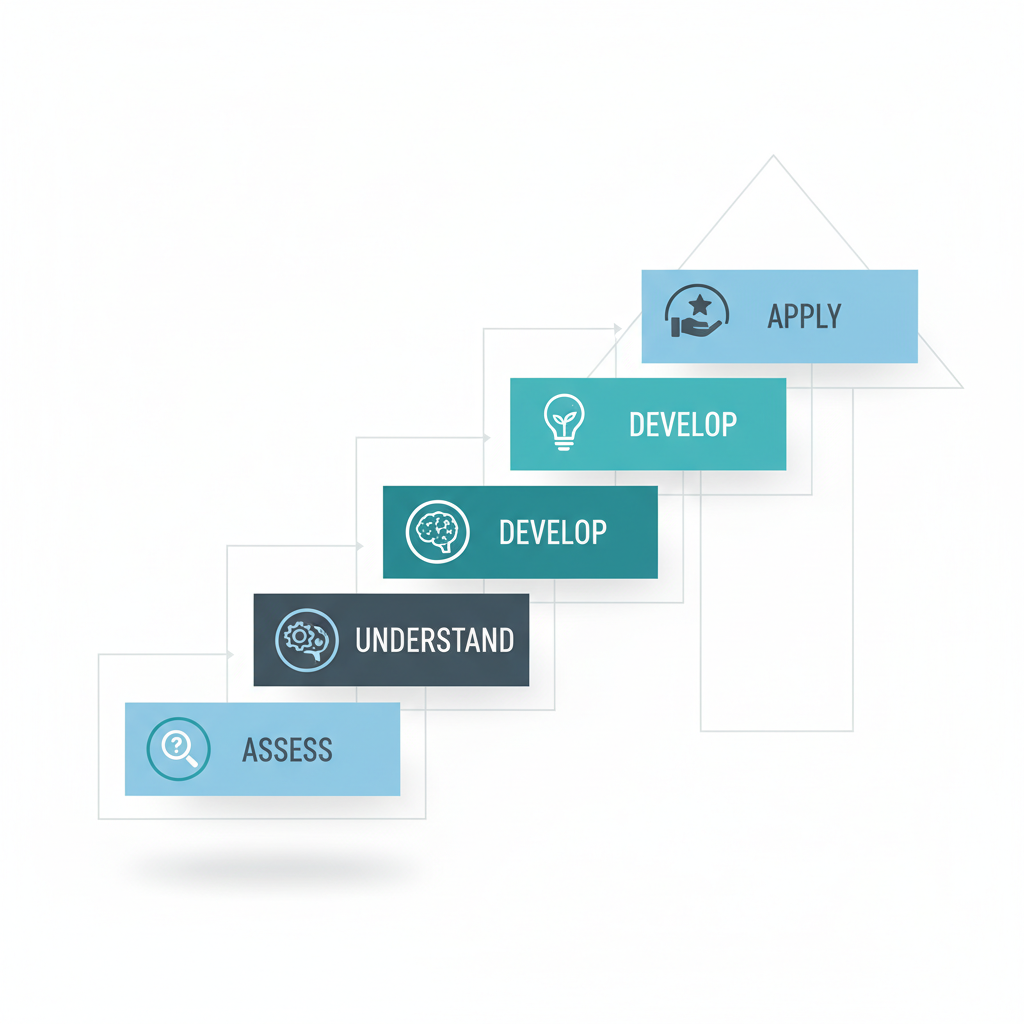
    Infographic illustrating a layered growth framework or a progressive pathway using geometric shapes. Each layer or step has an abstract icon representing stages like 'Assess,' 'Understand,' 'Develop,' and 'Apply,' symbolizing the journey to enhancing creative potential in a minimalist vector style.
    Design a clean, instructional infographic using a minimalist, vector-based style with soft blues, whites, charcoal, and teal accents. The visual should represent a clear progression or a layered framework for exploring and enhancing creative potential. Use a series of ascending or branching geometric shapes, like a staircase or a flow diagram with distinct steps. Each step or layer should have an abstract icon or a unique shape representing stages such as ‘Assess,’ ‘Understand,’ ‘Develop,’ and ‘Apply.’ The overall layout should convey growth and practical application, with clear visual hierarchy and ample negative space to guide the viewer, avoiding any human figures or cartoon elements.

    Introducing the Creative Ability Test

    You may have tried other personality tests. Now, it’s time to discover your creative side. The Creative Ability Test is a clear path to understanding yourself better. It’s a powerful, science-based test made just for you.

    Our test helps you measure, understand, and improve your creative skills. We believe everyone has a creative spark. The first step to using it is to understand it.

    This 30-question test is more than a simple quiz. It looks at the key parts of creativity, like your ability to think in new ways, solve problems, and stay open to new ideas. Our method is based on proven research, so you get reliable and useful advice [5].

    The Creative Ability Test is a personal journey. It helps you go from being unsure about your creative talents to knowing them clearly. This knowledge gives you clear steps for improvement. It’s a great tool for students, professionals, or anyone who wants to think more creatively.

    What Your Results Can Teach You

    Taking the Creative Ability Test gives you more than just a score. It’s like a map of your creative mind. Your personal report will highlight these key areas:

    • Your Creative Strengths: Find out where you shine. Are you great at brainstorming lots of ideas, or are you better at finding one-of-a-kind solutions?
    • Unique Thinking Styles: See how you naturally solve problems. Learn if you use divergent thinking (coming up with many options) or convergent thinking (finding the single best answer).
    • Cognitive Flexibility: Learn how easily you can change your point of view and adapt your thinking. This is key for handling tricky problems and sparking new ideas.
    • Problem-Solving Abilities: Get a clear picture of how you solve problems. You’ll learn to use creative thinking for challenges at work and in your daily life.
    • Openness to Experience: See how open you are to new ideas, experiences, and different ways of doing things. This is a big part of being creative.

    Your results give you practical steps you can take. For example, if you’re good at divergent thinking, you’ll get tips on how to brainstorm better. If you need to work on cognitive flexibility, you’ll get exercises to help you think in new ways.

    This process turns a vague idea of creativity into clear, useful advice just for you. You’ll go from feeling creative only some of the time to having a clear plan to improve. Our goal is to help you use your creative skills with confidence in all parts of your life, helping you grow personally and professionally.

    Frequently Asked Questions

    What are popular psychological tests for students?

    Students often take psychological tests to learn more about themselves, their learning styles, and possible career paths. These tests offer helpful insights for personal growth and success in school.

    Here are some popular types of tests that can help students:

    • Personality Inventories: Tools like the Big Five Personality Traits (often called OCEAN for Openness, Conscientiousness, Extraversion, Agreeableness, Neuroticism) help students understand their main personality traits. For example, being open to new experiences is closely tied to creative thinking and a desire to explore new ideas [6].
    • Career Aptitude Tests: These tests look at a student’s interests and skills to suggest good career options. They can show where a student’s natural talents, like creative problem-solving, could shine.
    • Learning Style Assessments: While the science behind some of these is debated, they aim to help students figure out how they learn best. Knowing your learning style can lead to better study habits and keep you more engaged.
    • Creativity Assessments: For students who want to be more innovative, tests like the Torrance Tests of Creative Thinking measure brainstorming skills. Understanding your creative strengths, like originality, helps you use them in your studies and future job. Our Creative Ability Test gives you specific details on these skills, helping you grow your creative talent.

    These tools give students specific, useful information about themselves. They offer a clear picture of their strengths and areas where they can improve.

    What are the 4 types of psychological tests?

    Psychological tests are grouped into types based on what they measure and how they work. Understanding these types helps to see what they are for and how they can be used.

    Here are four main types of psychological tests:

    • Personality Tests: These measure a person’s typical patterns of thinking, feeling, and acting. Examples include the Myers-Briggs Type Indicator (MBTI) and the Big Five Personality Traits. They help show how a person interacts with the world. Traits like openness to experience are good signs of creative talent.
    • Intelligence/Ability Tests: These are made to measure thinking skills and intellectual potential. The Wechsler Adult Intelligence Scale (WAIS) is a famous example. These tests can show how well someone can think flexibly and solve problems, which are key parts of creativity.
    • Aptitude Tests: These tests predict how well a person might learn a new skill in the future. They measure natural talents for certain tasks. For instance, a test might show a natural strength in language or spatial skills, which can both support creativity.
    • Projective Tests: Unlike tests with clear right or wrong answers, these use vague images, like inkblots (Rorschach Test) or pictures (Thematic Apperception Test). The idea is that people reveal their hidden thoughts and feelings in their answers. While experts often debate how reliable they are, these tests aim to uncover deeper emotions.

    Each type gives you a different way to look at your mind. If you’re interested in creativity, seeing these different tests shows how many parts of your mind work together to make you innovative.

    Are there fun psychological tests to do on friends?

    Absolutely! There are many fun and casual “psychological” quizzes you can do with friends. They are great for starting conversations and helping you think about yourselves in a relaxed way.

    Here are a few ideas for fun, informal activities:

    • Personality Quizzes: Many online quizzes based on pop culture or simple psychology ideas can be a lot of fun. They might tell you “Which Disney character are you?” or “What’s your spirit animal?” These are great icebreakers.
    • “Would You Rather” Scenarios: Giving friends tough choices can show what they value, what’s important to them, and how they solve problems.
    • Quick Creative Challenges: Ask friends to draw something from a simple idea, or brainstorm as many uses for a common object as they can. This gives you a peek at how creative they are on the spot.
    • Simplified “Lie Detector” Games: Asking basic questions and watching reactions can be a fun way to interact. Just remember, these games are only for entertainment.

    While these activities are great for bonding, it’s important to know they aren’t scientific. They don’t offer the reliable, deep insights that come from real, validated assessments. For true self-discovery and real steps to boost your creativity, platforms like Creative Ability Test offer a trusted approach based on science. We help you use your creativity to solve problems and create new things.


    Sources

    1. https://www.apa.org/pubs/glossary/validity
    2. https://www.myersbriggs.org/my-mbti-personality-type/mbti-basics/
    3. https://psycnet.apa.org/record/2013-09415-001
    4. https://psycnet.apa.org/record/2009-08246-003
    5. https://www.frontiersin.org/articles/10.3389/fpsyg.2017.02100/full
    6. https://psycnet.apa.org/record/2012-07302-001
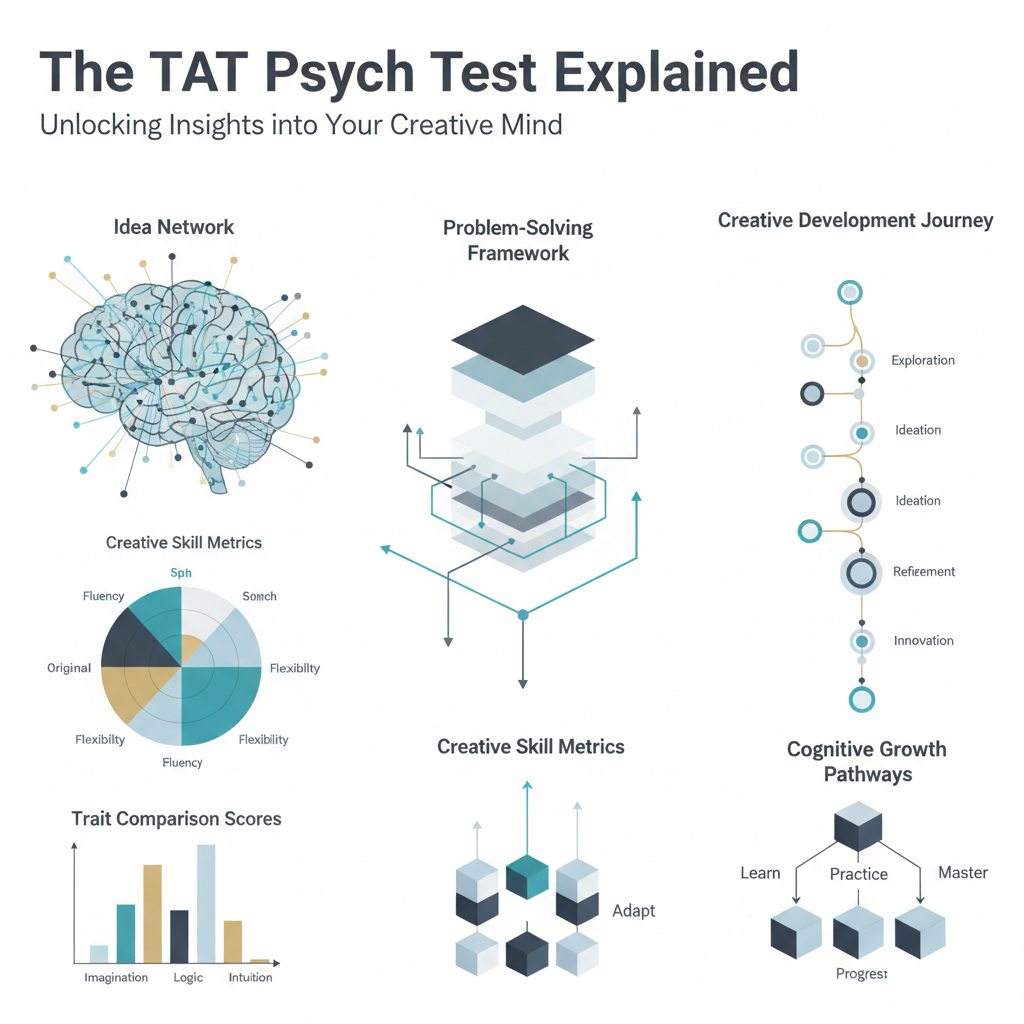
  • The TAT Psych Test Explained: Unlocking Insights into Your Creative Mind

    The TAT Psych Test Explained: Unlocking Insights into Your Creative Mind

    The Thematic Apperception Test (TAT) is a projective psychological test where individuals are shown ambiguous pictures and asked to create stories about them. These narratives are analyzed to reveal a person’s underlying motives, concerns, and their unique way of perceiving the social world, offering insights into personality and thought patterns.

    Have you ever wondered what drives your imagination or how you approach challenges? Understanding how your mind works can reveal your personal strengths, especially your creativity. One historic psychological tool used to explore these thoughts and feelings is the Thematic Apperception Test, often called the tat psych test.

    The TAT in psychology offers a glimpse into how people see the world and tell stories about unclear situations. While it’s often used for personality assessment, the test can also uncover a lot about a person’s creative thinking, problem-solving style, and emotions. In this article, we’ll explain what the TAT is, how it works, and what it might reveal about your own creativity and approach to challenges.

    Join us as we explore the TAT psych test. We’ll then look at how modern, science-based assessments, like those from Creative Ability Test, offer real-world strategies to help you develop and use your creative talents.

    What is the TAT Psych Test?

    An infographic showing the core elements of the Thematic Apperception Test (TAT) as a central node connected to concepts like projective assessment and narrative interpretation.
    An abstract, educational infographic illustrating the core components of the TAT Psych Test. Visualize a central ‘core’ node labeled ‘TAT Test’ connected by minimalist, vector-based lines to several surrounding geometric shapes, each representing a key aspect: ‘Thematic Apperception’, ‘Projective Assessment’, and ‘Narrative Interpretation’. Use soft blues, whites, and charcoal, with gold or teal accents for clarity. Maintain ample negative space for implied labels. The overall style is professional, approachable, with subtle gradients.

    A Beginner’s Guide to the Thematic Apperception Test

    The Thematic Apperception Test, or TAT, is a fascinating tool used in psychology. It provides a unique look into how a person sees the world.

    Psychologists Henry Murray and Christiana Morgan created the TAT in the 1930s at Harvard University [1]. It’s a type of “projective test.” Unlike a multiple-choice quiz, these tests let you respond freely. There are no right or wrong answers.

    During the TAT, you look at a series of pictures that are open to interpretation. These images often show people in different situations. For each picture, your task is to tell a story. You’ll describe what you think led up to the scene, what’s happening now, and what might happen next. You’ll also talk about what the characters are thinking and feeling.

    The process is very engaging. It uses your imagination and storytelling skills. By doing this, the test helps psychologists understand your unique way of seeing things.

    The Goal: Revealing Unconscious Thoughts and Motives

    The main goal of the TAT is to uncover hidden thoughts and feelings. It’s designed to reveal unconscious desires and motivations. These are parts of ourselves that we may not be fully aware of or able to easily express.

    As you tell a story, you project your own experiences onto the pictures. For example, a character’s struggles might show how you deal with challenges. Their hopes could reflect your own goals. This “projection” gives valuable clues about your usual reactions and feelings.

    Understanding these hidden stories about yourself is powerful. It can lead to greater self-awareness. This insight is important for personal growth and creativity. It shows how your inner thoughts affect the way you solve problems and come up with new ideas.

    Also, recognizing these hidden parts of yourself can change the way you think. It can help you solve problems more effectively. You get a clearer view of your creative strengths, including how you see challenges and create new solutions.

    How Does the TAT in Psychology Work?

    A step-by-step infographic illustrating the TAT process, from image presentation and story creation to interpretation and insight generation.
    A clean, instructional infographic depicting the step-by-step process of how the TAT Psych Test works. Use a sequential flow diagram with interconnected geometric shapes, arrows, and subtle gradients. Start with ‘Image Presentation’, leading to ‘Story Creation’, then ‘Interpretation’, and finally ‘Insight Generation’. Incorporate minimalist, vector-based design, soft blues, whites, charcoal, with gold or teal accents. Ensure structured grouping and clear visual hierarchy, with open areas for short conceptual labels.

    The Role of Ambiguous Pictures (TAT Cards)

    The Thematic Apperception Test (TAT) uses a set of special pictures, often called TAT cards. Each card shows a scene that is purposely unclear or ambiguous. For instance, one card might show a young boy staring at a violin. Another could show a man and a woman in a vague situation. This lack of clear detail is a key part of the test.

    The pictures act as a blank canvas for your mind. They don’t have a set story, so they invite you to fill in the gaps. Psychologists believe this vagueness encourages you to project your own inner world onto the images. You use your own experiences, feelings, and ways of thinking. This process reveals your underlying thoughts and creative side. [2]

    In short, the cards do not have a “right” answer. Instead, they encourage a very personal response. This helps show how differently people see things and use their imagination. It also highlights your natural creativity.

    The Art of Storytelling in Psychological Assessment

    When you see a TAT card, you are asked to tell a complete story about it. This is more than just describing what you see. You need to create a whole story, like making up a short story on the spot.

    A good TAT story usually includes a few key parts:

    • What led up to the scene? Explain what happened before the image.
    • What is currently happening? Describe the actions and what people are doing.
    • What are the characters thinking and feeling? Go into their inner thoughts and emotions.
    • What will be the outcome? Give the story an ending.

    This storytelling process reveals a lot. It shows how creative you are with stories. It also shows how you make sense of things with little information. The way you build the plot, characters, and emotions provides useful insights. It helps show how flexible your thinking is and how deep your imagination goes. Seeing your thinking style in action is a key part of the TAT’s value. It offers a glimpse into your unconscious mind.

    What Do Psychologists Look For in Your Stories?

    When analyzing your TAT stories, psychologists look for repeating themes and specific details. They are not judging your storytelling skills. Instead, they are looking at the meaning behind your story. The goal is to understand what drives you, your inner conflicts, and how you deal with challenges. They look at how you organize your ideas and show emotion.

    Key areas of focus include:

    • Common Themes: Do your stories often involve ambition, failure, relationships, or conflict? These patterns can reveal your main concerns.
    • Character Identification: Which character do you relate to the most? This can show how you see yourself or who you want to be.
    • Emotional Tone: Are your stories generally optimistic, pessimistic, anxious, or hopeful? This reflects your overall outlook on life.
    • Narrative Complexity: How complex and detailed are your plots? This suggests your level of cognitive processing and how deep your imagination goes.
    • Problem-Solving Approaches: How do characters solve their problems? This hints at your own ways of handling obstacles.

    For example, someone who often tells stories about overcoming challenges may be very resilient. Someone who frequently tells stories about new ideas might be a very creative thinker. These interpretations help build a picture of your personality and creative potential. They go deeper than what’s on the surface. The TAT aims to uncover deeper parts of how you think and feel, including your unique creative strengths and thinking styles.

    What Can the TAT Reveal About Your Creative Thinking?

    An infographic using a network diagram to show how the TAT reveals aspects of creative thinking, such as divergent thinking, narrative fluency, and emotional expression.
    An abstract, educational infographic visualizing how the TAT can reveal aspects of creative thinking. Design a ‘creative mind’ represented by an interconnected cognitive network diagram or an idea cluster. Different nodes, depicted as clean geometric shapes with subtle gradients, represent ‘Divergent Thinking’, ‘Narrative Fluency’, ‘Emotional Expression’, and ‘Problem-Solving Approaches’. Use soft blues, whites, charcoal, with gold or teal accents to highlight connections and insights. The style is minimalist, vector-based, professional, and approachable, with negative space for conceptual indicators.

    Assessing Narrative Creativity and Imagination

    The Thematic Apperception Test (TAT) asks you to create stories from unclear pictures. This process shows your creativity and imagination. The stories you tell reveal how your mind comes up with ideas and links different thoughts together.

    When you create a story, several parts of your creativity are at work:

    • Originality: Are your stories new and different? Do they go beyond obvious interpretations? Originality shows your ability to think differently.
    • Fluency of Ideas: How easily do you come up with ideas? A story with many details and plot points points to a strong imagination.
    • Flexibility: Can you change viewpoints or add surprising twists? This shows you can think in flexible ways, which is a key part of creativity.
    • Elaboration: Do you add depth with descriptions, feelings, and character growth? Telling a detailed story shows a powerful imagination.

    For instance, a picture of a boy and a violin could inspire different stories. It might be about a future music star, a child feeling pressured by his parents, or even a magical violin that takes him to a new world. Each story shows a different way of thinking. Understanding these styles helps you see your own creative strengths.

    Understanding Your Problem-Solving Approaches

    Besides showing your imagination, the TAT can also reveal how you solve problems. Every good story has a problem and a solution. How your characters handle problems often shows how you deal with challenges in real life.

    Think about these points in your stories:

    • Identifying Challenges: What problems do your characters face? How clearly do you explain them?
    • Solution Generation: Do your characters find normal or new solutions? Creative people often try many different ways to solve a problem.
    • Resourcefulness: Do they use what’s available in clever or unexpected ways? This highlights your ability to think on your feet.
    • Adaptability: Do they change their plans when new problems come up? This shows you can bounce back and adapt, which is important for handling tough situations.

    For example, if a character is trapped, do they plan a careful escape (analytical thinking)? Do they try a lot of different ideas until one works (divergent thinking)? Or do they use a normal object in a new way to solve the problem (innovative thinking)? Looking at these patterns can show you your natural problem-solving style and your ability to come up with new ideas.

    Connecting Emotional Insight to Creative Expression

    Creativity and emotion are often closely linked. The TAT can show how you handle and share emotions in your creative work. The feelings, reasons, and problems you give your characters can show how well you understand emotions.

    This connection is powerful for several reasons:

    • Authentic Expression: Stories with real feelings are more powerful. When you can fill your stories with true emotion, it shows your creative voice is more genuine.
    • Empathy and Perspective-Taking: Creating characters with deep and varied feelings shows you have empathy. This skill is key to seeing things from other points of view, which is a big part of creative problem-solving [3].
    • Emotional Depth: Do your stories explore feelings like hope, sadness, or joy in a detailed way? This shows you can use your own emotional experiences to make your creative work better.
    • Relatability: When your characters’ problems and successes feel real, it’s often because you understand human emotions. This makes the things you create more powerful.

    By looking at the emotions in your TAT stories, you can learn how your feelings power your creativity. This knowledge can help you use your feelings on purpose to create richer, more meaningful work.

    Are There Limitations to the TAT Psych Test?

    Why Interpretation Can Be Subjective

    A main weakness of the Thematic Apperception Test (TAT) is that it’s based on interpretation. When you tell a story about an unclear picture, the meaning isn’t always obvious. As a result, different psychologists might find different meanings in the very same story.

    For example, one psychologist might see your story as a sign of a creative imagination. Another might focus on hidden worries. This difference in opinion makes the TAT less reliable. There is no single, standard way to score the TAT [4].

    This makes it hard to compare results between people, or even for the same person at different times. Because of this, the results can say as much about the psychologist as they do about you. At Creative Ability Test, our goal is to offer clear, consistent, and science-backed insights into your unique creativity.

    Why Context Matters in Testing

    Another key problem with the TAT is context. Your mood, your surroundings, or even the person giving the test can influence your answers. A story told on a stressful day might be very different from one you tell on a relaxed day. Therefore, a single TAT session may not show your full creative ability.

    True creativity has many sides, and it doesn’t always show up in one situation. The TAT also focuses mainly on storytelling. It can miss other important parts of creativity, such as:

    • Thinking flexibly
    • Coming up with many ideas
    • Solving problems in new ways
    • Being open to new experiences

    To get a full picture, a test needs to look at all these areas and be less affected by your mood or surroundings. Our science-backed Creative Ability Test provides a structured way to measure your skills. It gives you a wider, more reliable view of your creative strengths, helping you get clear and useful insights about yourself.

    Beyond the TAT: Modern Ways to Assess Your Creativity

    From Projective Tests to Structured Assessments

    Tests like the Thematic Apperception Test (TAT) can offer deep insights into your unconscious thoughts. But interpreting these tests is often subjective, meaning results can vary. Because of this, modern psychology saw the need for more consistent methods.

    Older tests relied on an expert’s interpretation, which made them less consistent. So, new methods were created. These new tests focus on being objective and reliable.

    Today, structured tests are more common. They ask clear questions to measure specific creative skills, like divergent thinking. They also use standard scoring. This makes the results more reliable and trustworthy [5].

    This change has many benefits. The data is more consistent, and it’s easier to track your progress. As a result, measuring creativity is now more accessible. These tests turn an abstract idea like “potential” into clear, useful insights.

    How the Creative Ability Test Offers Actionable Insights

    The Creative Ability Test is a perfect example of this modern approach. Our platform provides a clear, structured test. We go beyond subjective opinions and give you data-backed insights into how you think creatively.

    Our 30-question test measures key parts of your creativity. This includes skills like cognitive flexibility, problem-solving, and your openness to new things. Our method is based on proven scientific research into creativity [6].

    After the test, you get personalized feedback that’s more than just a score. It shows you your unique creative strengths and points out areas where you can grow. We then give you practical tips to help you improve your creative thinking in real ways.

    Think about how you can use creativity to solve real-world problems. For example, knowing your score for divergent thinking can help you brainstorm better ideas for a project. In the same way, understanding your cognitive flexibility can help you adapt to change. Our insights help you feel more confident and become more innovative.

    The Creative Ability Test helps you understand your creative side. It gives you a clear path for personal and professional growth. Discover what you’re capable of with our trusted, science-backed test.

    Frequently Asked Questions

    What are some Tat psych test questions?

    The Thematic Apperception Test (TAT) doesn’t use questions like a normal quiz. Instead, you are shown unclear pictures, called TAT cards, to spark your imagination.

    A psychologist will show you a card and ask you to tell a story about it. This encourages you to create a complete story. You become the storyteller, making up a narrative from scratch.

    Typical prompts help you build your story:

    • “Tell me what is happening in this picture.”
    • “What led up to this scene?”
    • “What are the characters thinking and feeling?”
    • “What will be the outcome of this situation?”

    These prompts are designed to help you think more freely. They tap into your imagination and your natural ways of thinking. The stories you tell show how you see things, what drives you, and how you creatively solve problems.

    Can you take a Tat psych test online for free?

    You cannot take a real, official TAT psych test online for free. The most important part of the TAT is having a professional interpret your stories. A licensed psychologist or trained clinician is needed to analyze your answers properly. [7]

    Online versions you might find are often simplified and cannot provide accurate psychological insights. These online tests lack the expert evaluation needed for a real assessment. A real TAT is given in a specific way and requires a deep knowledge of psychology.

    However, if you just want to check your creative skills, there are good, science-based online tests. The Creative Ability Test offers a structured way to measure different parts of your creativity. Our 30-question assessment gives you personalized feedback. You get practical tips to improve your creative thinking in everyday life.

    This approach gives you clear information about your strengths and areas for growth. It’s a trusted way to understand and improve your creative skills.

    What is a Tat in psychology example?

    Imagine a TAT card showing a young boy looking at a violin on a table. The image is intentionally unclear and has no obvious story.

    Here are a few ways someone might interpret this picture:

    • Aspirations and Talent: The boy dreams of becoming a musician and is thinking about his future.
    • Burden and Pressure: The violin is a symbol of pressure from his parents to practice.
    • Curiosity and Discovery: The boy just found the violin and is curious about how it sounds.
    • Loss and Remembrance: The violin belonged to someone important, and the boy is feeling sad or nostalgic.

    A psychologist would analyze the themes, feelings, and structure of your stories. They would look for repeated patterns, which can reveal your core needs, what drives you, and how you usually handle challenges. Your unique story also shows your imagination and how you find meaning in unclear situations. This is a key part of creative thinking.


    Sources

    1. https://www.simplypsychology.org/thematic-apperception-test.html
    2. https://www.apa.org/pubs/books/thematic-apperception-test-manual
    3. https://greatergood.berkeley.edu/topic/empathy/definition
    4. https://www.simplypsychology.org/tat.html
    5. https://www.apa.org/monitor/2014/12/testing-testing
    6. https://www.frontiersin.org/articles/10.3389/fpsyg.2016.01236/full
    7. https://www.apa.org/pubs/books/thematic-apperception-test