Psychologist-led gifted testing is a formal evaluation conducted by a licensed psychologist to identify an individual’s advanced cognitive abilities and potential. The process typically involves standardized IQ tests, achievement tests, and clinical observation to determine if a person’s abilities fall within the gifted range, often for educational placement or personal understanding.
Have you ever wondered about your true potential, or that of a child you care for? Understanding a person’s unique abilities can be an exciting but complex journey. For many, the first step is a professional evaluation with a psychologist. This gifted testing is about more than just high scores. It helps you recognize the unique ways a person thinks, learns, and creates, setting them up for future growth.
This guide will explain gifted testing and what it means to be identified as gifted. We’ll look beyond typical school performance at areas like flexible thinking, advanced problem-solving skills, and being open to new experiences. Knowing about these strengths provides a clear plan to support growth, improve learning, and develop natural talents for life and work.
This article is a resource for anyone who wants to understand a person’s strengths, explore school options, or learn more about how they think. We will cover the different types of tests, the important role of a psychologist, and what the costs are. We’ll also discuss how creativity helps show a person’s full potential. You’ll gain useful information to help build self-awareness and encourage growth.
What is Psychologist-Led Gifted Testing?
The Role of a Psychologist in Identifying Giftedness
Gifted testing led by a psychologist takes a closer look at how a person thinks and learns. It is about more than just scores. A psychologist is a trained expert who understands the details of intelligence, learning, and behavior.
Their role is very important. Using special tools and their knowledge, they can accurately identify giftedness. They also look at the whole person, including their strengths, challenges, and thinking styles.
Psychologists do more than give tests. They explain what complex results mean, which leads to helpful insights. They also create personal recommendations to help individuals reach their full potential [1].
Key responsibilities of a psychologist in this process include:
- Comprehensive Assessment: Selecting and using proven tests to measure different thinking skills and learning styles.
- Holistic Understanding: Looking at intellectual, social, emotional, and creative growth to get a complete picture of the person.
- Expert Interpretation: Analyzing test data to explain what the scores really mean and to identify specific areas of giftedness.
- Personalized Guidance: Offering specific strategies to support school success, personal growth, and creative thinking.
- Advocacy and Support: Guiding parents and teachers to make sure the right educational settings and resources are used.
Key Signs That Might Suggest a Need for Testing
Finding out someone is gifted can be an exciting process. Certain signs often point to advanced abilities, not just in school but also in unique ways of thinking and solving problems. Seeing these signs may mean it’s time for gifted testing with a psychologist.
Both children and adults can show these signs. They often point to a mind that works differently, with deep curiosity and strong reasoning skills.
Consider these common signs:
- Exceptional Curiosity: Asking deep, thoughtful questions and always wanting to learn more. Their desire for knowledge can seem endless.
- Rapid Learning: Understanding new ideas quickly and with less repetition, which makes them fast learners.
- Advanced Vocabulary: Using words that are advanced for their age and explaining complex ideas clearly.
- Strong Memory: Easily remembering facts, details, and past experiences over long periods.
- Unusual Problem-Solving: Approaching challenges in creative ways and looking for new solutions instead of common ones.
- Intense Focus: Concentrating deeply on tasks that interest them, often without noticing distractions.
- High Levels of Creativity: Showing originality and a natural ability to imagine new possibilities and think in different ways.
- Emotional Intensity: Experiencing feelings deeply and sometimes having strong reactions to things like unfairness or beauty.
These signs point to unique strengths. Testing can be a great way to explore these qualities, helping to better understand and support them.
How Testing Can Unlock Personal and Academic Growth
Gifted testing with a psychologist is a powerful tool that does more than just identify talent. It can open up a path for major personal and academic growth, providing insights that can be life-changing.
Understanding a person’s specific gifted profile is key. This knowledge helps create the right learning plans and an environment where they can thrive. It replaces guesswork with clear, helpful strategies.
Here’s how testing can drive growth:
- Targeted Educational Planning: Test results show specific strengths, allowing for learning plans that are customized to the individual’s pace and style.
- Enhanced Self-Awareness: People learn about their unique thinking abilities, which builds confidence and helps them understand how they learn best.
- Strategies for Challenges: Gifted individuals also face challenges. Testing can find areas for improvement, like organization or managing emotions, and provide practical strategies to help.
- Nurturing Creative Potential: Many gifted people are highly creative. Testing can highlight these strengths and offer guidance on how to develop skills for thinking in new ways.
- Preventing Underachievement: Without the right challenges, gifted individuals can lose interest in school. Testing helps ensure their education is engaging, which prevents boredom and poor performance.
- Personalized Growth Trajectories: The detailed feedback acts as a roadmap for personal development and lifelong learning, turning uncertainty into useful self-awareness.
- Applying Creativity to Problem-Solving: Understanding one’s creative thinking style helps in using those strengths to solve real-world problems, leading to new ideas and better solutions.
Ultimately, gifted testing gives people the tools to use their unique talents fully. It provides the foundation for success in school and in life, leading to a richer, more fulfilling journey.
What tests are used for gifted testing?
Standardized IQ and cognitive ability tests
Standardized IQ and cognitive ability tests are often the first step in understanding a person’s intellectual abilities. These tests show unique thinking styles and strengths. They are designed to measure potential, not just what someone has learned.
These tests identify cognitive abilities by looking at different aspects of intelligence. For example, they measure how well a person processes information and solves novel problems [2].
Commonly used tests in gifted assessments include:
- Wechsler Intelligence Scale for Children (WISC): This popular test measures verbal comprehension, visual-spatial reasoning, fluid reasoning, working memory, and processing speed.
- Stanford-Binet Intelligence Scales: This test covers five cognitive skills: fluid reasoning, knowledge, quantitative reasoning, visual-spatial processing, and working memory.
- Cognitive Abilities Test (CogAT): The CogAT is often given in schools and measures reasoning skills in verbal, nonverbal, and quantitative areas.
These tests provide useful information. They help psychologists understand a person’s key thinking skills and show how that person learns and processes information.
academic achievement tests
While cognitive tests measure potential, academic achievement tests measure what a person has already learned. They check skill levels in subjects like reading, writing, and mathematics.
These tests add to IQ scores by showing how a person’s potential is used in school. A high score means the person understands the subject well and can apply what they’ve learned.
Examples of widely used academic achievement tests include:
- Woodcock-Johnson IV Tests of Achievement (WJ IV ACH): This detailed test measures academic skills like reading, writing, and math. It also checks oral language and academic fluency.
- Wechsler Individual Achievement Test (WIAT-4): The WIAT-4 measures what a student has learned in areas like oral language, reading, written expression, and mathematics.
These tests show a person’s specific academic strengths and identify areas where they could excel. This information helps in creating the right learning plan for them.
Beyond IQ: Assessing Creative Thinking and Problem-Solving
Giftedness is more than just high IQ scores and school success. True potential also involves flexible thinking and creative problem-solving. That’s why creative thinking is so important.
Testing for creativity gives a fuller picture of someone’s abilities. It shows how they face challenges and come up with new ideas. This wider view helps complete the picture of their potential.
Creative thinking has a few key parts:
- Divergent Thinking: This is the ability to come up with many different answers to one problem, also known as thinking “outside the box.”
- Cognitive Flexibility: This is the ability to see things from different angles and adapt your thinking. It helps you explore new possibilities [3].
- Originality: This is about how unique an idea is, focusing on thoughts that are completely new.
- Elaboration: This is the ability to build on an idea by adding details to the first thought.
Understanding these creative strengths can be powerful. It’s not just about being “smart”—it’s about seeing your own creative side. It shows you how you handle tough problems. For example, a creative person might see ten ways to reuse an old object, while someone else sees only one.
Our Creative Ability Test is a great way to explore this. It goes beyond standard IQ tests. This science-based, 30-question test gives you personal feedback and shows you your unique creative strengths.
You’ll get practical tips to improve your creative thinking, help you grow, and strengthen your problem-solving skills. Discovering these abilities can change how you face challenges and help you think creatively in all parts of your life.
How to Navigate the Gifted Testing Process
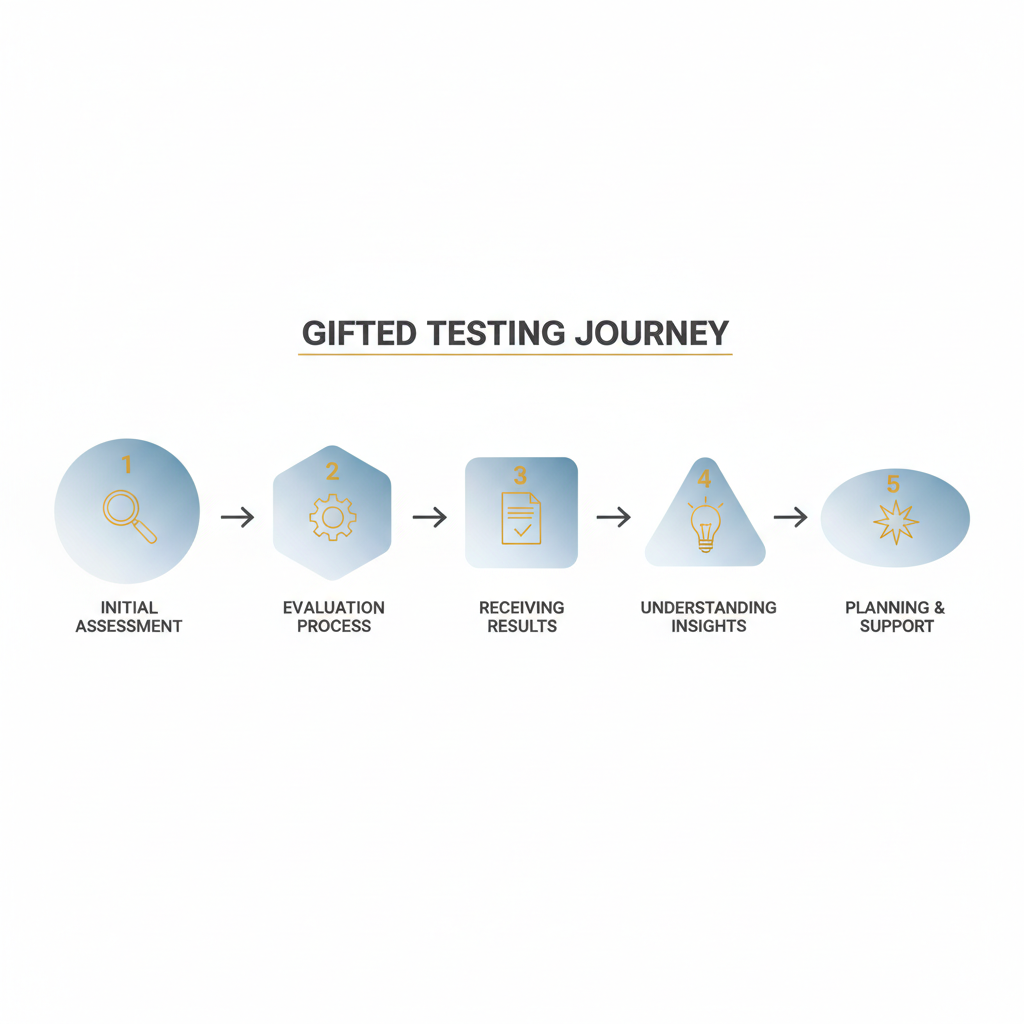
Step 1: Initial Consultation and Goals
The first step to understanding giftedness is meeting with a psychologist. In this first meeting, you’ll talk about what you’ve seen and what your concerns are.
This meeting helps set the goals for testing. The psychologist will listen to your family’s story to understand your specific questions.
You’ll likely talk about:
- Your observations: What skills or behaviors have you seen?
- Developmental milestones: When did they learn certain skills?
- School performance: How are they doing in school?
- Social and emotional health: Are there any challenges or special needs?
- Past assessments: Have they been tested before?
This talk helps decide if testing is the right choice. It makes sure the tests will answer your questions. Our goal is to give you clear information and helpful advice.
Step 2: The Assessment Session
After the first meeting, it’s time for the assessment. A licensed psychologist will lead the session in a comfortable and supportive setting. This helps the person being tested do their best.
Testing can take a few hours or happen over several days [4]. There will be breaks to make sure no one gets too tired. The psychologist uses standard tests to measure thinking skills and academic knowledge.
A good assessment looks at more than just test scores. It also explores creative thinking and problem-solving. This gives a fuller picture of a person’s abilities, not just an IQ score. We believe creativity shows unique strengths, which is why we test for it.
How to prepare for the test:
- Get a good night’s sleep.
- Eat a healthy meal beforehand.
- Bring items that help them feel comfortable.
The goal of the session is to understand how the person thinks. We want to find their unique strengths and learning styles.
Step 3: Understanding the Feedback and Report
After the test, the psychologist writes a detailed report. You will go over this report together in a feedback session. This meeting is important for understanding the results. The psychologist will explain the test scores and what they mean in a simple way, turning data into clear, helpful advice.
The full report usually includes:
- An explanation of all test results.
- A list of specific thinking strengths.
- Areas where they can grow and develop.
- Personalized suggestions for school.
- Ways to support their talents at home.
- Tips for supporting their social and emotional needs.
This report helps you understand how your child learns best. It acts as a guide for how to support them. For example, it might suggest advanced classes or creative problem-solving groups.
This information helps you be a better advocate for them. You can help them reach their full potential. The goal isn’t just to label someone as “gifted,” but to support their overall growth. This includes building creative skills they can use in real life. Understanding the report is the first step to helping them grow and improve.
What does psychologist gifted testing cost?
Standardized IQ and Cognitive Ability Tests
Standardized IQ and cognitive ability tests are often the first step in understanding a person’s intellectual abilities. These tests show unique thinking styles and strengths. They are designed to measure potential, not just what someone has learned.
These tests identify cognitive abilities by looking at different aspects of what intelligence and cognitive tests are designed to measure. For example, they evaluate how well a person processes information and solves novel problems [2].
Commonly used tests in gifted assessments include:
- Wechsler Intelligence Scale for Children (WISC): This popular test measures verbal comprehension, visual-spatial reasoning, fluid reasoning, working memory, and processing speed.
- Stanford-Binet Intelligence Scales: This test covers five cognitive skills: fluid reasoning, knowledge, quantitative reasoning, visual-spatial processing, and working memory.
- Cognitive Abilities Test (CogAT): The CogAT is often given in schools and measures reasoning skills in verbal, nonverbal, and quantitative areas.
These tests provide useful information. They help psychologists understand a person’s key thinking skills and show how that person learns and processes information.
Can You Find Psychologist Gifted Testing Online?
The Rise of Remote Assessments
The digital age has changed many professional services, including psychology and testing. Remote testing has become more common [5]. It’s easier for many people to access, especially those who want to learn about their creative potential or unique thinking skills.
Online platforms make special tests more convenient. You can take them from your own home. This removes the barrier of distance and offers flexibility for busy schedules. As a result, more people can explore their abilities.
But this shift online also shows a critical need. Tests must be based on science and come from trusted sources. This ensures the results are meaningful. Good online tools can help you understand your unique way of thinking and show you how you solve problems creatively.
For example, understanding your cognitive flexibility is important. This shows how easily you can change your thinking. Divergent thinking skills are also important because they help you come up with many unique ideas. Our platform focuses on measuring these key areas. It offers a structured way to discover your creative skills.
Comparing Online Professional Testing vs. Free Quizzes
The internet has many options for self-testing. But not all online tests are the same. It’s important to know the difference. Professional online testing gives you insights that are backed by science. Free online quizzes often don’t have this scientific basis.
Professional tests are made by experts using proven ideas from psychology. These tests are standardized, researched, and tested to make sure they are accurate and reliable. They measure specific skills, like creative problem-solving or innovation.
Key differences include:
- Scientific Basis: Professional tests are based on research. Free quizzes often use questions without a scientific backing.
- Standardization: Good tests compare your results to a large, diverse group. This gives your score meaning. Quizzes usually don’t have this.
- Reliability: A reliable test gives you similar results over time. The results from casual quizzes can change a lot.
- Validity: A valid test measures what it says it will. Many free quizzes don’t really measure creativity or gifted traits.
- Personalized Feedback: Professional tests offer detailed reports with clear next steps to help you improve. Free quizzes usually give very basic feedback.
Free quizzes can be fun, but they rarely help you understand yourself better. They can’t offer clear ways to improve. Our platform, Creative Ability Test, closes this gap. It’s both easy to access and based on science. You get insights just for you that help you build on your creative strengths.
How to Verify the Credibility of an Online Service
Choosing an online testing service requires care. You want to get accurate and valuable insights, so always check if the service is trustworthy. Look for clear signs that it’s based on science. This ensures you get a high-quality test.
Consider the following factors:
- Scientific Foundation: Does the service explain its methods? Are its tests based on real psychological research? Good platforms will share their sources.
- Expert Development: Who made the test? Are they qualified psychologists or cognitive scientists? Look for information about the creators’ background and expertise.
- Transparency: Is the testing process explained clearly? Do they tell you how they interpret the results? Being open builds trust.
- Privacy and Security: How is your personal data handled? A trustworthy service will have a strong privacy policy to protect your information.
- Type of Feedback: Does it offer detailed feedback with clear steps? General results are less helpful. Feedback tailored to you helps you grow.
- Avoid Big Promises: Be careful of services that promise to make you a genius overnight. Real tests offer a more balanced view of your potential.
By checking these points, you can make a better choice and tell the difference between useful tools and unreliable ones. A trustworthy online platform offers more than just a score. It gives you a path to self-discovery and helps you unlock your unique creative skills, leading to personal and professional growth.
Beyond Traditional Testing: Why Creativity Matters
Is High IQ the Only Measure of Giftedness?
Many people think being gifted just means having a high IQ. A high IQ does show strong skills in logic and analysis. It reflects how well a person can solve traditional problems, like those needing abstract reasoning and critical thinking. But using IQ alone to define giftedness doesn’t tell the whole story. [6]
Giftedness is much more than just an IQ score. It includes many different human abilities, such as creativity, leadership, and artistic talent. Standard tests often overlook creativity, but it’s a strong sign of unique potential. True giftedness often mixes a sharp mind with creative thinking.
Focusing only on IQ misses an important part of a person’s potential. This narrow view can stop us from seeing someone’s true strengths and prevent them from discovering their unique abilities. We believe in looking at the whole person, including their creativity and how they adapt their thinking.
Identifying Creative Strengths for a Complete Picture
Creativity is more than being good at art. It is a basic human skill for coming up with new things. It helps us solve difficult problems and leads to new ideas in every field. Finding your creative strengths helps you understand yourself better. It shows you how you face challenges in your own way.
These strengths are very important in today’s world. Many jobs now need creative problem-solvers. Companies look for people who can adapt and come up with new ideas. [7] Knowing your own creative style gives you an edge. It helps you use your unique way of thinking to your advantage.
Key creative strengths often include:
- Divergent Thinking: The ability to come up with many different ideas.
- Cognitive Flexibility: Shifting your point of view with ease. You can adapt to new information.
- Originality: Producing new and unique ideas.
- Elaboration: Adding rich detail to ideas. You build on a starting point.
- Problem Sensitivity: Noticing problems or gaps that others miss.
- Imagination: Forming new images and concepts in your mind.
These abilities work well with traditional thinking skills. Together, they make a person stronger and more adaptable. Knowing these strengths gives you a full picture of your potential. It goes beyond what you know and shows how you think and create.
Using Tools Like the Creative Ability Test to Discover Your Potential
Knowing your creative strengths is the first step. The next step is to measure and grow them. This is where tools based on science can really help. The Creative Ability Test is designed for exactly this. It gives you a complete look at your creative mind.
Our platform offers a detailed, 30-question assessment. It measures different parts of your creativity, like divergent thinking and cognitive flexibility. After, you get personalized feedback that highlights your unique strengths and points out areas where you can grow.
Here is how the Creative Ability Test helps you:
- Scientifically Grounded: Our test is based on solid research about creativity. This means you get trustworthy results. [8]
- Comprehensive Assessment: We look at many sides of your creativity to give you a complete picture.
- Personalized Insights: You receive feedback that is customized for you. No generic results here.
- Actionable Strategies: We give you useful tips to help you grow your creativity every day. You can use them in your daily life.
- Empowering Self-Awareness: Discovering your creative potential builds confidence. It helps you grow personally and in your career.
The Creative Ability Test is more than a simple quiz. It offers a clear path to understanding and improving your creative skills. Unlock your potential. Turn uncertainty into useful insights about yourself. Start your journey to more creative thinking today.
Frequently Asked Questions
Can I find a gifted child test online for free?
You can find many free quizzes online that say they test for giftedness. But these are not the same as a professional evaluation.
Real gifted testing is a detailed process. It must be done by a trained psychologist who uses proven, standardized tests.
Free online quizzes are often not accurate or reliable. They can’t give you a real diagnosis or a full picture of your child’s skills. They can be a starting point if you’re curious, but that’s all.
For trustworthy results, always go to a professional. This will give you information you can actually use.
What do gifted test sample questions look like?
Gifted tests look at many different thinking skills, not just one. They are made to see how children think and solve problems. A trained psychologist gives these tests in a controlled setting.
Because of this, you won’t find real sample questions online. This keeps the tests fair and accurate. But we can describe the types of skills they measure:
- Verbal Reasoning: These questions test how well a child understands words and ideas. For example, a child might be asked to explain how a boat and a car are similar. This shows how they connect concepts.
- Non-Verbal (Perceptual) Reasoning: These tasks use puzzles and patterns instead of words. A child might have to finish a sequence of shapes or find what’s missing in a picture. This tests problem-solving skills that don’t depend on language.
- Quantitative Reasoning: This area uses math and number puzzles. A child might be asked to find the next number in a series or solve a math story problem. This shows their skill with numbers and logic.
- Working Memory: These tasks check a child’s ability to hold information in their mind. For example, they might be asked to repeat a list of numbers backwards. This tests how well they can store and use information in the short term.
- Processing Speed: This measures how quickly a child can understand and respond to information. A task might be to find and mark all the circles on a page full of shapes as fast as they can.
A full evaluation looks at all these areas together. This gives a complete picture of a child’s thinking skills, including creativity. Knowing these strengths helps support your child’s growth.
Where can I find a psychologist for gifted testing near me?
Finding the right psychologist is a key step. A good professional will give you a reliable and helpful evaluation. Here are a few ways to find one:
- Professional Organizations: National and state groups for psychologists have online lists you can search. Look for someone who specializes in child or educational psychology, as they often test for giftedness. For example, the American Psychological Association has a “Psychologist Locator” [9].
- Referrals: Ask your child’s school counselor, doctor, or other parents for recommendations. They may know trusted experts in your area.
- University Psychology Departments: Local universities may have psychology clinics that offer testing. These services are usually overseen by expert professors and use up-to-date methods.
- Online Directories: You can use websites like Psychology Today or GoodTherapy to search for psychologists near you. Be sure to check their qualifications and experience.
- Gifted Education Organizations: Groups that focus on gifted children often have lists of experts they recommend. This can be a great place to look.
When you find a psychologist, ask them some key questions. Ask about their experience with gifted testing, what tests they use, and how they share the results. Knowing what to expect helps you get the most out of the evaluation and better understand your child.
Sources
- https://www.apa.org/topics/education/gifted-children
- https://www.apa.org/education-career/guide/science-psychology/psychology-testing
- https://psycnet.apa.org/record/2012-07494-001
- https://www.nagc.org/resources/getting-started-gifted-education/identifying-gifted-children
- https://www.apa.org/news/apa/2020/03/telehealth-psychological-services
- https://www.simplypsychology.org/multiple-intelligences.html
- https://www.worldeconomicforum.org/agenda/2023/05/future-of-jobs-2023-skills-employers-want/
- https://www.frontiersin.org/articles/10.3389/fpsyg.2017.00977/full
- https://locator.apa.org/