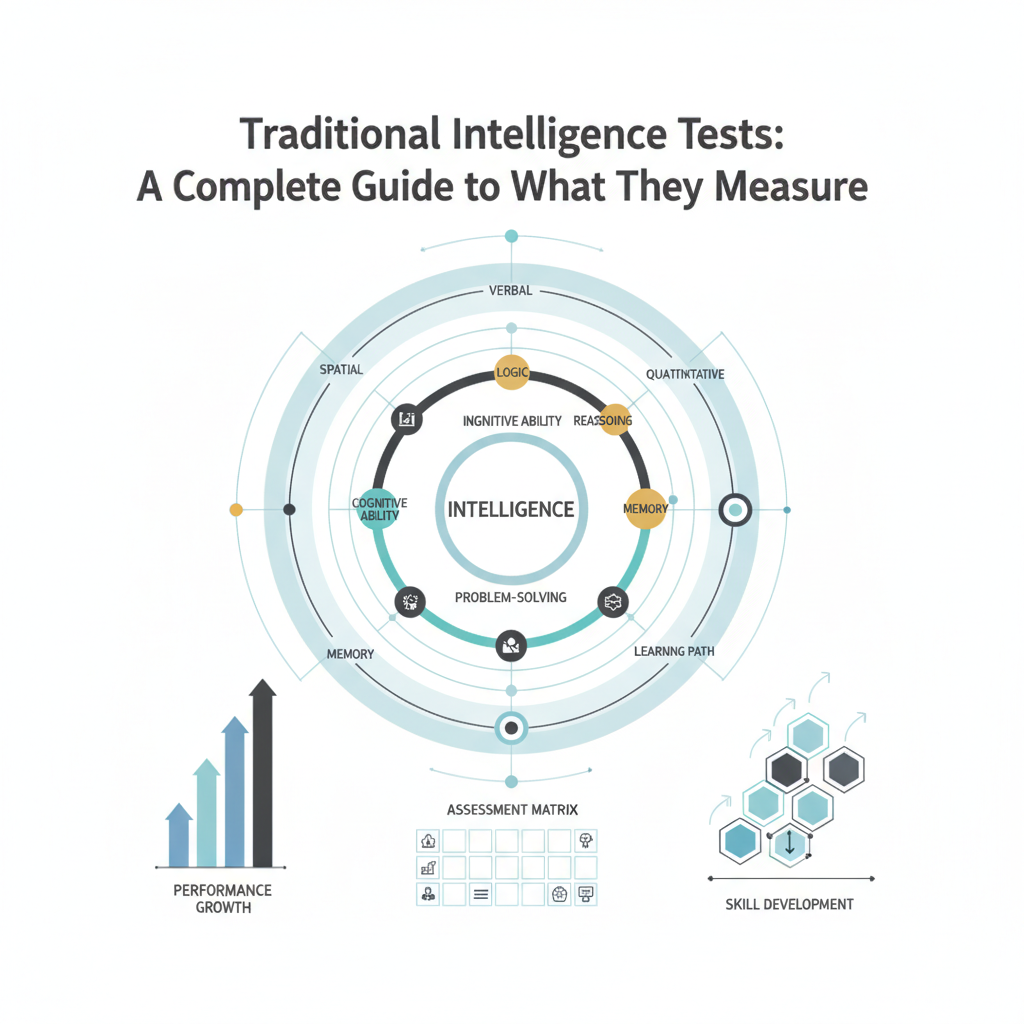
Traditional intelligence tests, commonly known as IQ tests, are standardized assessments designed to measure specific cognitive abilities like logical reasoning, verbal comprehension, working memory, and processing speed. They produce a score that compares an individual’s performance against a statistically normative group. These tests primarily evaluate convergent thinking—finding a single correct answer—and typically do not measure creativity, emotional intelligence, or practical skills.
For a long time, the idea of “intelligence” has fascinated us, leading to questions about how it’s measured and what it really means. When we think about assessing cognitive ability, traditional intelligence tests often come to mind. These tests have been important in education, psychology, and personal growth, offering a look into how we think. But what do these tests actually measure, and how do they work?
This article will guide you through the world of traditional intelligence tests. We’ll explore their basic ideas, common formats, and the thinking skills they are designed to measure. While these tests are useful for measuring certain kinds of problem-solving and reasoning, they only show one part of our mental abilities. To get a complete picture of human potential, it’s important to understand what these tests can and cannot do.
As we explore what traditional intelligence tests measure, we’ll also look at the bigger picture of our mental strengths. We will see how different thinking styles contribute to our skills and help us understand abilities that standard tests often overlook—like creativity, cognitive flexibility, and divergent thinking. Let’s begin by looking at the basics of traditional intelligence testing.
What Are Traditional Intelligence Tests and How Do They Work?
Defining Intelligence in a Traditional Sense
Traditional intelligence tests measure a specific set of mental skills. In this context, “intelligence” usually means a person’s ability to use logic and solve problems. The main focus is on analytical skills, including how quickly you process information and learn from experience.
These tests check your ability to learn and use new information. They also measure how well you solve problems with clear solutions. This view of intelligence has been popular for over a century, but it only shows one part of a person’s mental ability.
For example, a traditional test might see how fast you can spot patterns. It could also measure your skill in using logic to find a single correct answer. While these skills are important, this approach doesn’t capture the full range of human intelligence [1]. It often overlooks creative thinking.
Understanding the IQ Score
The Intelligence Quotient, or IQ, is a score that comes from traditional intelligence tests. It is meant to be a standard way to measure thinking skills. This score compares how you did on the test to a larger group of people.
An average IQ score is 100. Most people score somewhere in the 85-115 range. A score above 100 suggests you performed better than the average person in your age group. On the other hand, a score below 100 suggests you performed below average [2].
It’s important to know what an IQ score means. It’s a look at certain thinking skills at one point in time. It does not measure your full potential. It also doesn’t measure things like emotional intelligence or creative problem-solving. Understanding this helps you explore your real mental strengths.
Common Formats and Question Types
Traditional intelligence tests use different formats to check various thinking skills. The tests are usually broken into several parts, with each part focusing on a specific skill. Most questions are designed to have a single “correct” answer.
Here are common types of questions you might see:
- Verbal Reasoning: These questions test your language skills, such as vocabulary and understanding. For example, “Bird is to nest as human is to…?”
- Perceptual Reasoning (Non-Verbal): These tasks test how you solve problems using images, patterns, and shapes. An example is figuring out the next shape in a sequence.
- Working Memory: This part tests how well you can hold and use information in your mind. This might involve repeating a sequence of numbers or letters.
- Processing Speed: These tasks measure how fast you can do simple mental tasks, like matching symbols or using a code.
- Quantitative Reasoning: These questions test your math skills. They can include basic math, number patterns, and logic problems, such as “2, 4, 8, 16, ___.”
While these formats are good at measuring analytical skills, they focus on finding a single correct answer. Creativity, however, relies on generating many unique solutions and ideas. The Creative Ability Test, for example, explores these other ways of thinking. It helps you discover your ability to think in new ways and solve problems creatively.
What are the 4 types of intelligence tests?
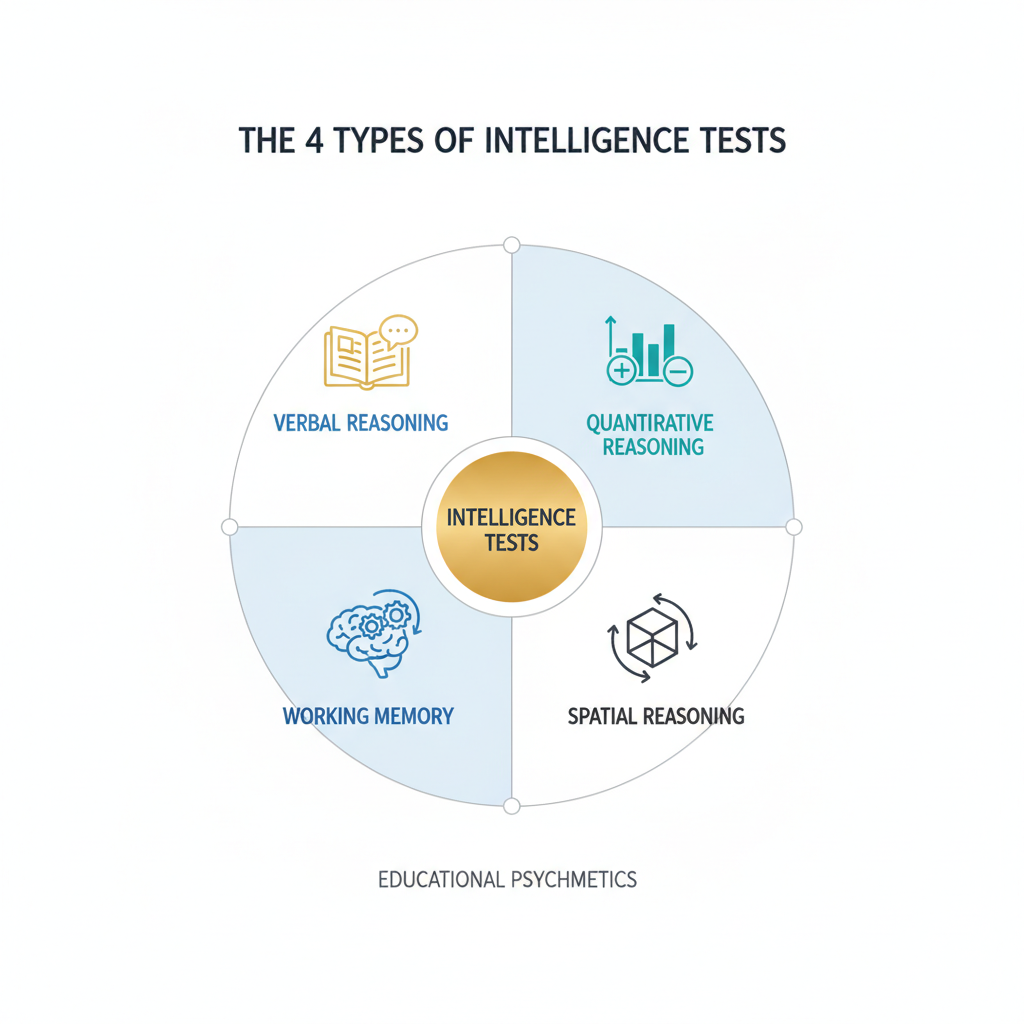
Traditional intelligence tests measure certain thinking skills, but they come in many different types. Learning about these types helps you see what they test and what they miss. This is especially true when it comes to your own creative potential.
Individual Tests (e.g., WAIS, Stanford-Binet)
Individual intelligence tests are given to one person at a time by a trained professional. This one-on-one setting allows the expert to observe how someone solves problems. It also offers a better understanding of their thinking skills.
These tests are often very thorough and look at many different types of thinking. They are especially useful for clinical needs or when a deep understanding of someone’s abilities is required.
- Wechsler Adult Intelligence Scale (WAIS): This popular test measures various thinking skills in adults. It provides scores for verbal comprehension, perceptual reasoning, working memory, and processing speed [source: https://www.pearsonassessments.com/store/us/en/products/P100000185/wechsler-adult-intelligence-scale%26reg%3B—fourth-edition.html].
- Stanford-Binet Intelligence Scales: Used for people from age two to adulthood, the Stanford-Binet measures five factors of thinking ability. These include fluid reasoning, knowledge, quantitative reasoning, visual-spatial processing, and working memory [source: https://www.pearsonassessments.com/store/us/en/products/P100000302/stanford-binet-intelligence-scales%252C-fifth-edition.html].
While these tests work well for some evaluations, they take a lot of time and need a trained expert to give and score them. They offer a snapshot of traditional intelligence but don’t show the full picture of your creative thinking.
Group Tests (e.g., Raven’s Progressive Matrices)
Unlike individual tests, group intelligence tests can be given to many people at the same time. This makes them a practical choice for large groups, like in schools or companies.
These tests usually use a multiple-choice format, which makes them easy to score. They tend to focus on specific thinking skills instead of a wide range.
- Raven’s Progressive Matrices: This non-verbal test measures abstract reasoning. Test-takers find the missing piece that completes a pattern. It is often seen as a culture-fair test because it uses few words and does not rely on cultural knowledge [source: https://www.pearsonassessments.com/store/us/en/products/P100000578/ravens-2.html].
Group tests are useful and save money. However, they don’t capture the small details of how a person thinks like an individual test can. They also focus on finding a single correct answer, not on finding new or creative solutions.
Verbal Scales
Verbal scales on intelligence tests mainly measure your language skills and what you’ve learned. These sections check how well you understand and use words, ideas, and general facts.
How you do on verbal scales can show your ability to learn from school and life. Your score often reflects your cultural and educational background.
Common tasks on verbal scales include:
- Vocabulary: Defining words or finding words with similar meanings.
- Comprehension: Explaining common sayings or answering questions about social rules.
- Information: Answering questions about general knowledge.
- Arithmetic Reasoning: Solving math-based word problems.
These scales are good for predicting success in school and showing language skill. However, they may not fully measure the intelligence of people from different language backgrounds or those who excel outside of traditional school subjects.
Performance (Non-Verbal) Scales
Performance scales, also known as non-verbal scales, measure problem-solving skills that don’t depend on language. Instead, they test things like visual thinking, how fast you process information, and hands-on skills.
These scales are especially helpful for testing people who face language barriers or come from different cultures. They show how well you handle visual information and solve real-world problems.
Typical tasks on performance scales include:
- Block Design: Using colored blocks to copy a pattern.
- Picture Completion: Spotting the missing detail in a picture.
- Matrix Reasoning: Choosing the right piece to finish an abstract pattern.
- Symbol Search: Finding specific symbols in a group as quickly as possible.
Performance scales offer a different way to look at intelligence. They show your ability to solve hands-on problems and analyze visual details. While useful, these scales still mainly test for a single correct answer. They don’t measure the kind of broad, imaginative thinking that is key to creativity.
Why Don’t Traditional Intelligence Tests Measure Creativity?
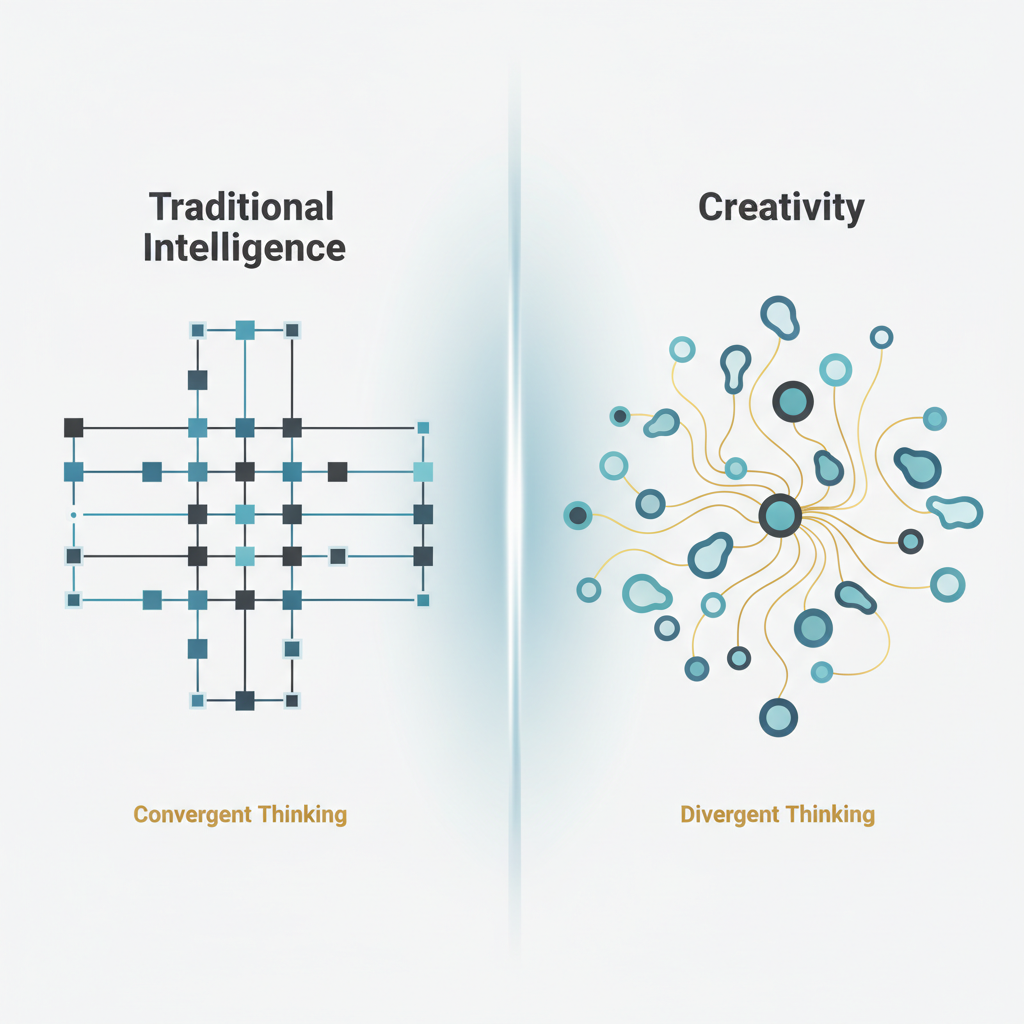
Convergent vs. Divergent Thinking: The Key Difference
Most intelligence tests measure convergent thinking. This means finding one single, correct answer to a question. A multiple-choice test is a good example. You have to pick the one right option. This skill is about remembering facts, using logic, and solving clear problems.
Creativity, on the other hand, uses divergent thinking. This is the ability to generate many different ideas from one starting point. Instead of narrowing down, you are expanding your thoughts. Divergent thinking helps you find new connections and fresh approaches. It is key to innovation and solving complex problems. [3]
Here’s a simple comparison of the two thinking styles:
- Convergent Thinking:
- Seeks one best answer.
- Relies on logic and established rules.
- Often tested by IQ questions.
- Measures speed and accuracy.
- Divergent Thinking:
- Generates many unique ideas.
- Explores various possibilities.
- Essential for creative problem-solving.
- Values novelty and breadth of thought.
This is why traditional tests can miss the mark. They don’t measure the broad, imaginative nature of divergent thinking. Our Creative Ability Test is different. It’s designed to show you your divergent thinking strengths and help you understand how you come up with new ideas.
The Focus on ‘Correct’ Answers
Standard intelligence tests are all about finding the one “right” answer. They ask questions like, “What comes next in this sequence?” where only one answer is correct. Your score is based on how quickly and accurately you can find it. This rewards a specific type of logical skill.
Creativity is different. It rarely follows a single “correct” path and is comfortable with unclear answers. Creative solutions are often surprising, new, and one-of-a-kind. They go beyond the usual rules. A truly new idea might not fit into any “correct” box.
This is why many highly creative people don’t always score high on IQ tests. Their minds are built to explore possibilities, not find one expected answer. Those tests aren’t designed to measure original thinking. Our Creative Ability Test looks at how you handle open-ended problems. It shows your skill in creating new and valuable ideas.
What These Tests Overlook: Originality, Flexibility, and Elaboration
Besides overlooking divergent thinking, IQ tests also miss key parts of creativity. These skills are essential for knowing a person’s creative potential, but they don’t show up on standard tests.
- Originality: This is about how new and unique your ideas are. Is an idea common, or is it truly different? IQ tests don’t ask for original ideas; they test what you already know.
- Flexibility: This is the ability to see things from different angles and try new approaches. A flexible thinker can easily switch between types of ideas. IQ tests usually stick to one rigid way of thinking.
- Elaboration: This is your skill at adding detail to an idea. Can you take a simple thought and build it into a complete plan? IQ tests look for short, simple answers instead.
These skills are the signs of a creative mind. They are essential for solving real-world problems, which often have no single right answer. These challenges require original thoughts, flexible thinking, and detailed plans. Standard intelligence tests can’t measure these skills, so they only show a small part of a person’s abilities.
The Creative Ability Test is designed to fill this gap. It measures these key creative skills. We help you see your unique strengths in originality, flexibility, and elaboration. This gives you clear insights to help you grow your creativity.
How Can You Discover Your Full Cognitive Potential?
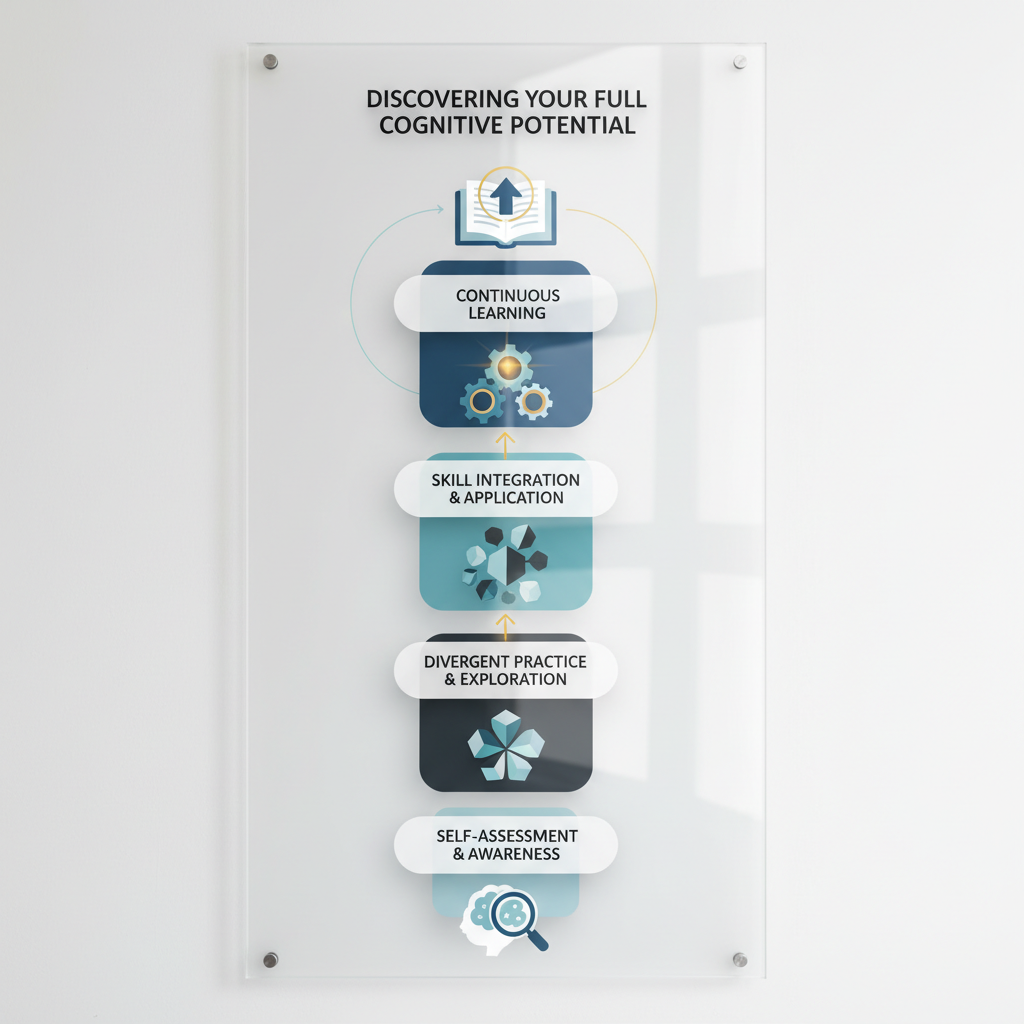
Understanding the Value of Creative Assessment
Standard intelligence tests often miss a key part of your thinking skills. They focus on finding the one “correct” answer. But your true potential is much broader. It includes your ability to be creative, innovative, and flexible in your thinking.
When you understand your creative strengths, you open up new possibilities. It helps you approach problems in new ways. You can also develop creative solutions in your personal and professional life. Creativity is not just for artists; it is an important skill for everyone.
A creative assessment helps you see your unique thinking styles. It measures skills like divergent thinking, which is the ability to come up with many different ideas. It also looks at your cognitive flexibility, or how easily you can switch between different perspectives. These insights are key for personal and professional growth. They show you where your best problem-solving skills are.
Measuring Your Creative Strengths with the Creative Ability Test
The Creative Ability Test is a science-backed way to learn about yourself. Our platform provides a full 30-question test. It is designed to measure different parts of your creativity.
Our test is more than just “yes” or “no” questions. It explores your flexible thinking and problem-solving skills. It also assesses your openness to new experiences, a key trait for creative people [4]. Our method is based on solid research, which means you get reliable results you can trust.
Taking the Creative Ability Test turns uncertainty into useful self-knowledge. You receive feedback that is specific to your strengths. This feedback highlights your unique creative style. For example, you might be great at creating new ideas or building on existing ones. These insights are easy to understand and help you learn more about how you think.
Our platform helps you get specific, practical information instead of general guesses. You will gain a clear picture of your creative potential. This gives you a strong foundation for your personal and professional growth.
Actionable Steps to Enhance Your Creative Thinking
Knowing your creative strengths is the first step. The next is to actively develop them. Creativity is like a muscle—it gets stronger the more you use it. Here are practical ways to boost your creative skills:
- Embrace Divergent Thinking: Brainstorm without judgment. The goal is to generate as many ideas as possible, no matter how unusual. For now, focus on quantity, not quality.
- Seek New Experiences: Step outside your comfort zone often. Read different kinds of books, visit new places, or try new hobbies. New experiences help your brain make new connections [5].
- Challenge Assumptions: Question the things you take for granted. Ask “why?” or “what if?” about everyday situations. This helps you break out of old thinking habits.
- Practice Mind Mapping: Visually connect ideas around a central topic. This method helps organize your thoughts and discover how different ideas are linked.
- Engage in Play: Make time for play without rules. This can be anything from doodling to building with blocks. Play can reduce mental blocks and help you think more flexibly.
- Reflect and Journal: Regularly write down your thoughts, ideas, and what you observe. This helps you process information and can spark new ideas.
- Collaborate with Others: Discuss ideas with people from different backgrounds. New perspectives can offer fresh angles and challenge your own views.
- Learn a New Skill: Mastering something new, even if it is not related to your work, makes your thinking more flexible. It teaches your brain new ways to solve problems.
By using these tips regularly, you can turn the insights from your assessment into real progress. You will notice better problem-solving skills and an improved ability to innovate. This simple plan helps you use creativity in all parts of your life.
Frequently Asked Questions About Intelligence Testing
What do traditional intelligence tests evaluate?
Traditional intelligence tests mainly measure a set of mental skills. These skills are often important for doing well in school and for certain kinds of problem-solving.
These tests usually measure:
- Logical Reasoning: How you understand and use logic.
- Verbal Comprehension: How well you understand and use language, including vocabulary and reading skills.
- Spatial Reasoning: How well you can picture and move objects in your mind.
- Quantitative Aptitude: Your ability to use math to reason and solve problems.
- Memory: Both short-term (working memory) and long-term memory recall.
- Processing Speed: How fast and accurately you can do simple mental tasks.
These tests focus on finding one “correct” answer. This is called convergent thinking. However, they usually don’t measure creativity, original ideas, or the ability to find many solutions to a problem [6]. Understanding your creative side offers another important view of your mental potential.
What is the role of an intelligence test in education?
In schools, intelligence tests have been used in several ways. They help give a better sense of a student’s thinking skills.
They are often used for:
- Identifying Learning Needs: Helping teachers find students who may need extra help or special learning plans.
- Academic Placement: Helping decide if students should be in gifted programs or other specific classes.
- Predicting Academic Performance: Giving an idea of how well a student might do in school [7].
- Understanding Cognitive Profiles: Showing a student’s strengths and weaknesses in different areas of thinking.
However, it’s important to remember that these tests only show part of the picture. They don’t measure a student’s creativity or new ideas. Being creative is more and more important in our changing world. Testing and supporting creativity gives a more complete view of a student’s potential.
What is the history of intelligence testing?
The history of intelligence testing began in the early 20th century in France.
Here are some key moments:
- Alfred Binet and Théodore Simon (Early 1900s): They created the first useful intelligence test. It was designed to find children in French schools who needed extra educational help [8].
- The IQ Concept: German psychologist William Stern came up with the “Intelligence Quotient” (IQ). It created a standard score to compare people.
- Stanford-Binet Test (Early 1900s, US): Lewis Terman at Stanford University changed Binet’s test for use in the United States. It became the famous Stanford-Binet test.
- World War I Applications: The U.S. Army used intelligence tests to screen new soldiers. This took the tests beyond just schools.
- Evolving Understanding: Over time, our idea of intelligence has changed a lot. Experts now agree that intelligence has many parts. This includes important skills like emotional and creative thinking.
Today, traditional tests are still used, but more people see the value of broader tests. These tools measure a wider range of human skills, including creativity. They help people reach their full mental potential.
What are some examples of intelligence tests in psychology?
Psychology uses several well-known intelligence tests. These tests help measure different kinds of thinking skills.
Some of the most common examples include:
- Wechsler Adult Intelligence Scale (WAIS): This is one of the most common intelligence tests for adults. It measures language skills, reasoning, working memory, and how quickly you process information [9].
- Wechsler Intelligence Scale for Children (WISC): This is like the WAIS, but it is made for children and teens.
- Stanford-Binet Intelligence Scales: This test measures five areas: reasoning, knowledge, math skills, visual-spatial skills, and working memory. It can be used for people of many different ages.
- Raven’s Progressive Matrices: This is a non-verbal test that measures abstract reasoning. People look at a pattern and choose the missing piece to complete it [10]. It is designed to be less affected by language or cultural background.
These tests offer good information about specific mental skills. However, they are different from tests like the Creative Ability Test. Our platform helps you discover your own creative strengths, your ability to think in new directions, and your unique ways of solving problems.
Sources
- https://www.apa.org/education-career/guide/science-psychology/intelligence
- https://www.britannica.com/science/intelligence-test
- https://psycnet.apa.org/record/1957-04660-001
- https://www.sciencedirect.com/science/article/pii/S016028960600007X
- https://news.harvard.edu/gazette/story/2011/04/new-experiences-new-neurons/
- https://www.simplypsychology.org/intelligence.html
- https://www.apa.org/education-career/guide/science-psychology/intelligence-testing
- https://www.britannica.com/science/intelligence-test/History-of-intelligence-testing
- https://www.pearsonassessments.com/store/us/en/products/clinical-assessments/intelligence/wechsler-adult-intelligence-scale-%7c-fourth-edition/p/100000371.html
- https://www.pearsonassessments.com/store/us/en/products/clinical-assessments/neuropsychology/ravens-2/p/100000305.html