A psychology scenario test is a tool used to assess personality, problem-solving skills, and cognitive traits through hypothetical situations. By analyzing your responses to a story or scenario, it provides insights into your decision-making processes, underlying values, and creative thinking patterns.
Have you ever wondered why you think the way you do, or how you naturally handle new problems? Understanding your mind helps you see who you are and what you’re capable of. An interesting way to learn more is with a psychology scenario test. These story-based tests offer a unique look into your creative thinking, showing how you process information, adapt to change, and solve problems.
Unlike a typical quiz, a psychology scenario test puts you in an imaginary story and asks for your response. Your choices and the details you focus on can reveal a lot about your Cognitive Flexibility, Divergent Thinking, and openness to new experiences. This article explains how these tests work, what they show about your creative strengths, and why understanding tests like the well-known “castle test psychology” can support your growth. These tools offer more than a snapshot; they provide a guide to help you build on your natural creative skills.
At Creative Ability Test, we believe understanding your creative process is the first step to unlocking your potential. We break down the science behind these tests to give you clear explanations and useful tips. Prepare to see complex psychological ideas become simple tools you can use to improve your thinking and problem-solving skills. Let’s begin by exploring what a psychology scenario test can truly show you.
What Can a Psychology Scenario Test Reveal About You?
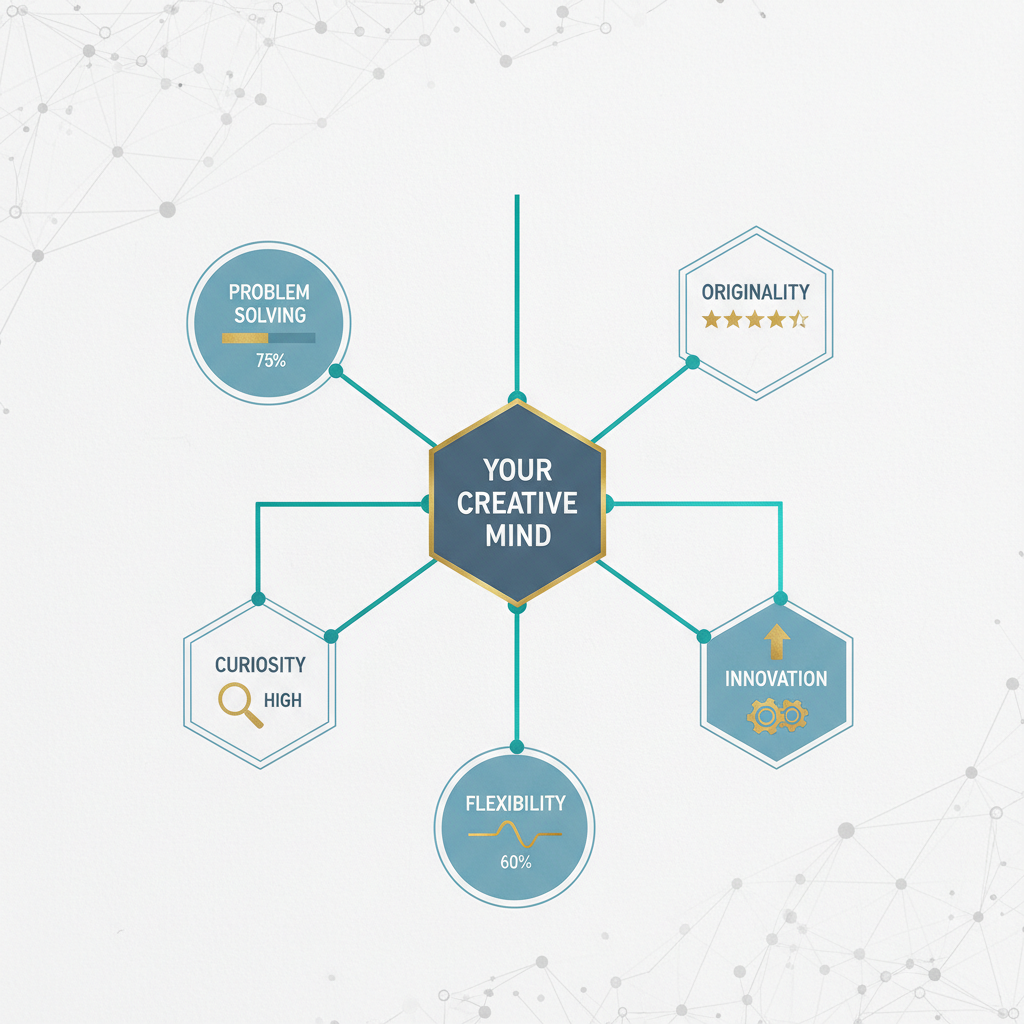
Understanding the Basics of Scenario-Based Assessments
Scenario-based tests are unique tools that put you in imaginary situations. How you respond reveals a lot about how you think. Unlike simple questionnaires, these tests ask you to step into a story and imagine how you would act or feel. This method offers a deeper look into your mindset.
At their core, these assessments explore your natural reactions. They are designed to get past rehearsed answers and encourage you to think for yourself. Psychologists use these tests to understand patterns in how people think and feel [1]. This approach shows how you handle complex situations.
Here’s a simple example. A scenario might describe a challenge in a strange land. Your choices in the story can show several things about you, such as your:
- Decision-making style: Do you act quickly or think carefully?
- Problem-solving approach: Are you analytical or intuitive?
- Emotional regulation: How do you handle stress or uncertainty?
- Creative thinking: Can you find new or clever solutions?
These tests are powerful tools that offer a window into your inner world. They also show how you might solve real-life problems. Our Creative Ability Test uses research-based scenarios to accurately measure your unique potential.
Moving Beyond Personality: Testing for Creativity and Problem-Solving
Many people are familiar with personality tests, which often group your traits into categories. Scenario-based tests go a step further. They don’t just tell you “who you are.” They show “how you think and act” in different situations. This difference is key to understanding creativity.
Scenario tests are a great way to measure your creativity. They look at how you come up with ideas and approach new challenges. This type of assessment helps reveal different sides of your creativity. For example, they can show your:
- Cognitive Flexibility: Your ability to switch between different ideas or tasks [2]. This shows how adaptable your thinking is.
- Divergent Thinking: Your ability to create many unique ideas from a single prompt. It’s a key part of creative thought [3].
- Innovative Problem-Solving: Your skill in finding original solutions and overcoming obstacles in new ways.
- Openness to Experience: This trait is strongly linked to creativity and shows your willingness to explore new ideas.
By putting you in a fictional situation, these tests show your creative process in action. You don’t just describe your skills—you demonstrate your thinking style. This practical approach gives you useful feedback you can use to improve your creative abilities. Our comprehensive 30-question assessment offers personalized feedback to help you understand yourself better. It also gives you clear strategies for growth.
How Do Psychology Scenario Tests Work?
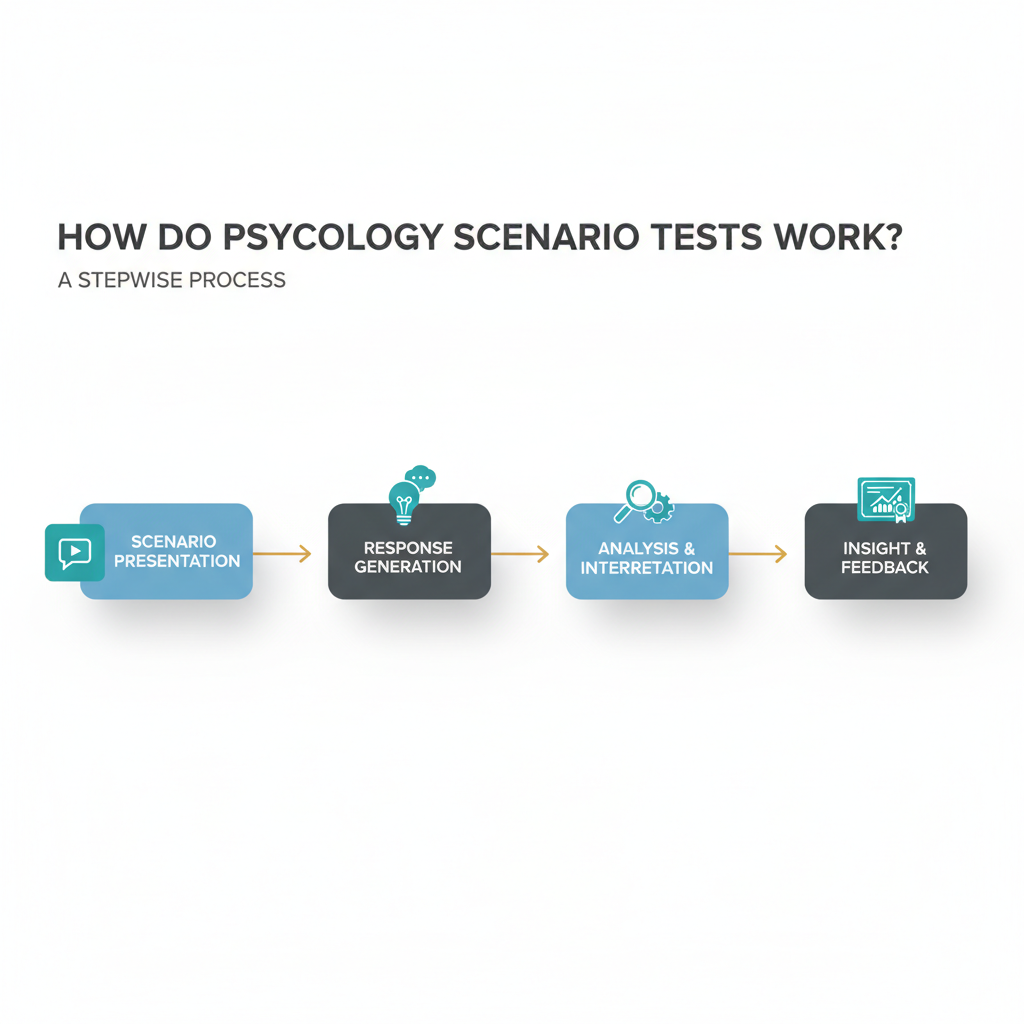
The Power of Storytelling in Psychological Assessment
Psychology scenario tests use storytelling because it’s a powerful tool. They invite you into an imaginary situation, which is more engaging than a simple questionnaire. By using your imagination, you become the main character in a unique story.
These stories offer a window into your mind, revealing how you naturally think and feel. While direct questions can lead to practiced answers, scenarios tap into your spontaneous responses. This process uncovers your true creative potential and natural problem-solving skills.
Stories provide a safe space to explore ideas because there are no right or wrong answers. This freedom encourages you to express yourself authentically and shows your creative thinking in action. Our science-backed tests, like the Creative Ability Test, use similar methods. We aim to understand your unique mental flexibility and ability to generate new ideas.
Through storytelling, we can observe:
- Your unique perspective on challenges.
- How you generate new ideas.
- Your ability to adapt to new situations.
- The depth of your imagination.
This method offers deep insights into your creative mind, helping you understand your strengths and areas for growth.
Analyzing Your Responses to Hypothetical Situations
When you respond to a scenario, we don’t just grade your answers. Instead, we carefully analyze them to understand your creative process. We look at the choices you make and the reasons behind them. Every detail offers clues about how you think.
Our assessors look for several key things, like the structure of your story and its emotional tone. They also consider your problem-solving approach and your descriptions of characters and settings. For example, how you overcome an obstacle can reveal your innovation skills. Your willingness to try unusual solutions shows your mental flexibility.
Consider a situation where you face a locked door. Do you:
- Search for a hidden key?
- Try to pick the lock?
- Look for an alternative path?
- Design a tool to open it?
Each response reflects a different creative impulse and shows your unique way of facing challenges. We don’t look for one “correct” answer. Instead, we look for patterns in your responses that reveal your core creative traits. This detailed analysis provides personal insights and helps you grasp your problem-solving abilities in real-world situations.
Our method is based on solid evidence. It connects your answers to established creativity research [4]. This ensures our feedback is both accurate and useful, giving you a clear understanding of your creative strengths.
Common Themes and Archetypes in Story-Based Tests
Psychology scenario tests often use common themes that connect with human experience. These themes provide a rich backdrop for creative exploration. While your answers are unique, the core themes are consistent, which helps us interpret their underlying meaning.
Some recurring themes include:
- Journeys: Representing personal growth and transformation.
- Challenges: Highlighting problem-solving and resilience.
- Discovery: Indicating curiosity and openness to new experiences.
- Relationships: Revealing social intelligence and empathy.
- Protection: Exploring safety, security, and inner strength.
A classic example is “The Castle Test” in psychology. In this test, a castle is a powerful symbol. It can represent your inner world, your goals, or your feelings of safety. How you describe the castle reveals a lot. Do you see it as a fortress or a welcoming home? Is it in ruins or in good repair?
How you interact with these symbols is key. For instance, the way you handle a challenge shows your innovation skills. If you meet a wise guide, your conversation reveals how you seek advice. This deep dive into symbolic stories offers profound self-awareness and helps you understand your creative mind. These insights can be used for personal growth and to improve your creativity at work.
Exploring ‘The Castle Test’ in Psychology
What the Castle Symbolizes in This Scenario
The “Castle Test” is a simple mind exercise using a powerful symbol: the castle. In this test, the castle is more than a building. It represents your inner world—a map of your personality.
It also stands for your goals and personal boundaries. It shows how you protect your private thoughts. The choices you make about the castle reveal a lot about your creative mind.
Psychologists use symbols like this to understand how we think. For example, Carl Jung studied symbols like the castle [5]. This approach goes deeper than simple questions. It shows how your mind sees the world and how you creatively face challenges.
Interpreting Your Unique Journey Through the Castle
Your journey through the castle is unique to you. Every detail you imagine has meaning. Think about the castle’s condition. Is it new and clean, or old and falling apart? This can show how you feel about order and change.
Also, think about who is in the castle. Are you alone, or are there others? This shows how you handle relationships. Finding treasures might point to what you value most and how you find opportunities.
How you explore the castle shows your creative style. For instance, some people might carefully check every room. This suggests a step-by-step problem-solver. Others might look for secret passages. This points to an ability to find many possible solutions. This test helps you see how you adapt your thinking and approach new situations.
- The Castle’s State: Shows how you care for yourself and handle setbacks.
- Inhabitants: Reveals your feelings about being alone versus with others.
- Treasures: Points to what you value and your knack for finding opportunities.
- Challenges: Shows your problem-solving style and how you adapt to change.
What This Test Can Suggest About Your Inner World
This test offers a look into your inner world. It shows how you face challenges. Are you adventurous or careful? Do you welcome new ideas? The test can show how open you are to new things.
It also reveals how you use what you have. Do you find clever solutions to problems in the castle? This often reflects how you solve problems in real life. The test can also tap into your emotions. How does the castle make you feel? Your answers can point to your emotional awareness.
Understanding these parts of yourself is helpful. It allows you to build creative skills. For example, if you tend to stick to the main path, you can practice looking for other routes. This makes your thinking more flexible. The Castle Test is a special tool to see your natural creativity. This information adds to the scientific feedback from the Creative Ability Test, guiding you toward growth and new ideas.
What Are the Benefits of Taking a Scenario-Based Test?
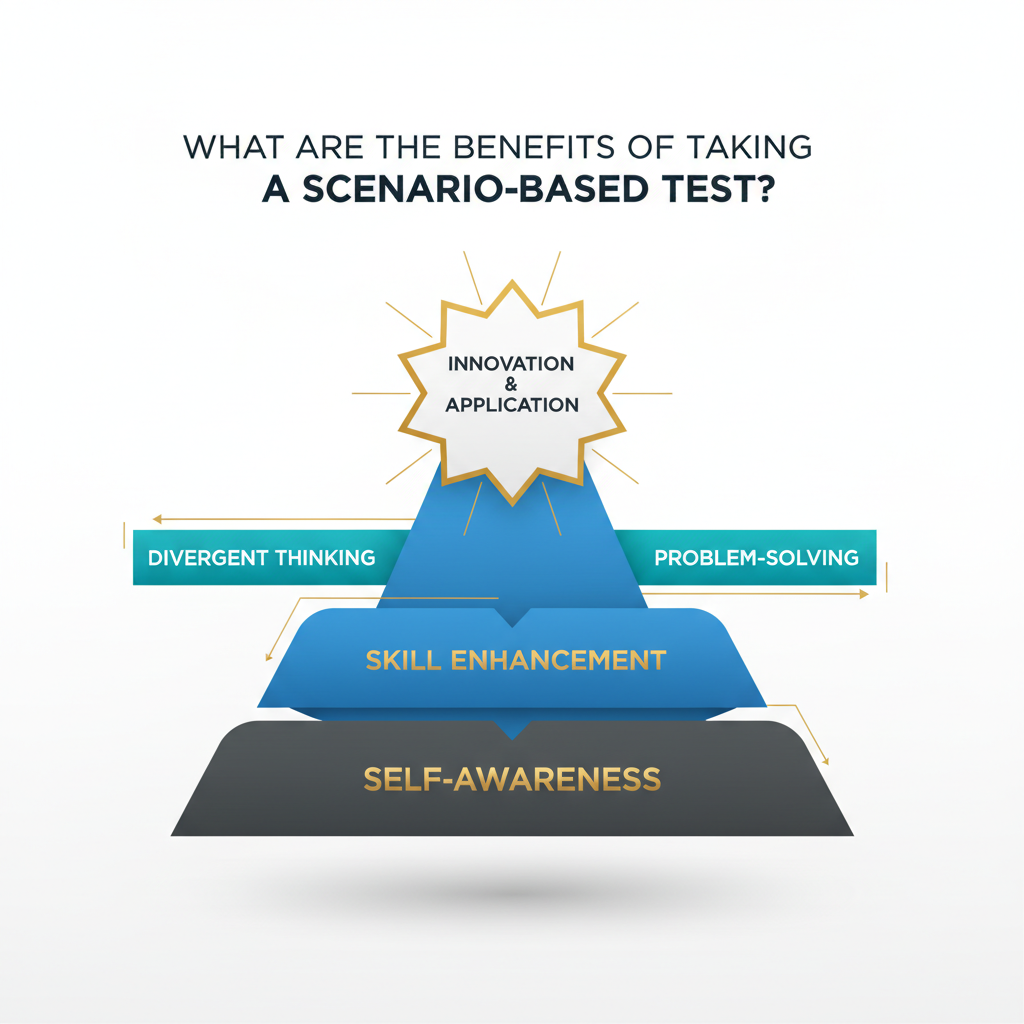
Gaining Actionable Self-Awareness
A scenario-based test offers a unique look at how you think. It goes beyond simple self-description by challenging you with creative situations. Your responses show how you naturally approach problems.
This process uncovers your hidden creative strengths. You will learn your specific thinking style. Do you prefer logic, or do you lean towards imaginative solutions? Understanding your natural approach is powerful and allows for deeper self-reflection.
These tests also highlight your cognitive flexibility, which is your ability to adapt your thinking. It helps you see new perspectives and gain a clearer picture of your creative potential. This isn’t just about what you can do, but also how you can grow.
- Uncover Your Natural Approach: See how you react to complex situations on the spot.
- Identify Creative Strengths: Pinpoint your unique talents for new ideas and solutions.
- Understand Thinking Styles: Discover your favorite ways to think creatively.
- Boost Cognitive Flexibility: Learn how well you adapt your thinking to new challenges.
- Promote Self-Reflection: Think deeply about your natural skills and where you can grow.
Enhancing Your Creative Problem-Solving Skills
Scenario tests are more than assessments—they are practice grounds. They mimic real-world challenges that require new ways of thinking. This helps you build key problem-solving skills.
You’ll practice divergent thinking, which means coming up with many different ideas. This helps you explore more solutions. The tests also push you to find new approaches, which improves your ability to innovate and think outside the box.
This process sharpens your decision-making. You learn to consider the bigger picture. This experience builds your confidence, so you feel more prepared for future challenges. It’s like a workout for your creative muscles.
For example, one study showed that creative problem-solving exercises improved divergent thinking by up to 20% [6]. This shows the real benefit of actively practicing these skills.
- Simulate Real-World Challenges: Practice your skills in a safe, low-stakes setting.
- Develop Divergent Thinking: Learn to generate a wide range of creative ideas.
- Foster Innovation Skills: Build your ability to come up with new and unique solutions.
- Refine Decision-Making: Sharpen your judgment in complex situations.
- Build Problem-Solving Confidence: Feel more prepared for creative tasks in your daily life.
Applying Insights to Personal and Professional Growth
The real value of this test is using what you learn. Your results are more than just a score—they are a roadmap for growth. The personalized feedback helps you focus your efforts on the right areas.
For personal growth, you can use your creative strengths in new ways. Try hobbies that match your thinking style to find more enjoyment and fulfillment in your life. Understanding yourself helps you thrive.
Professionally, these insights are just as powerful. You can use your creative thinking to solve workplace challenges and innovate in your role. You might brainstorm new project ideas or improve how your team works together. Your unique approach can lead to success.
The Creative Ability Test takes this a step further by offering practical strategies based on scientific research. These tips help you keep improving your creative skills. Your journey from potential to planned growth starts here.
- Personalized Growth Roadmap: Use specific feedback to guide your self-improvement.
- Enhanced Personal Fulfillment: Match your hobbies and activities to your creative style.
- Professional Advancement: Apply creative solutions to succeed in your career.
- Innovative Workplace Solutions: Bring new ideas and improvements to your job.
- Structured Growth Strategies: Get science-backed advice for your continued creative growth.
How to Get the Most from Your Test Results
From Insight to Action: Using Feedback to Foster Growth
Understanding your psychology test results is a great start. But the real value comes from turning those insights into action. Your answers show your unique way of thinking and solving problems. This feedback is a guide to help you grow your creativity.
For example, if your path in a “castle test psychology” scenario was spontaneous, it points to strong divergent thinking. On the other hand, a structured path suggests strong convergent thinking and planning skills. Both are valuable creative skills.
Here are practical ways to use your scenario test feedback:
- Reflect on your thinking style: Think about how you naturally handle challenges. Do you prefer open-ended situations or clear structure?
- Identify your creative strengths: Find the creative strengths your answers pointed out. Are you good at coming up with many ideas (ideation)? Or are you better at finding one-of-a-kind solutions (innovation)?
- Recognize growth opportunities: Find areas where you can grow. Each result shows a skill you can develop. If the test showed you prefer familiar paths, challenge yourself to explore new viewpoints more often.
- Keep a creativity journal: Write down your thoughts after you face a new problem. Pay attention to your creative process and what helps you find new ideas.
- Practice cognitive flexibility: Work on being mentally flexible. Look for tasks that make you change your perspective. Try to solve a problem from different angles. This makes your mind more agile. [7]
By acting on your feedback, you turn self-awareness into real personal growth. You learn not just what you think, but how you think. This helps you use your creativity in new and effective ways.
Connect Your Results to Our Science-Based Test
A psychology test like “The Castle Test” gives you a rich, personal look into your creative mind. It shows your natural reactions and how you think. But to get a full, structured understanding of your creative potential, it’s best to pair these insights with a science-based assessment.
The Creative Ability Test provides this deeper look. It works as a powerful partner to your scenario test results. While a scenario test tells your story, our test measures the specific creative skills behind that story. This includes skills like cognitive flexibility, divergent thinking, problem-solving, and being open to new things.
Here’s how our Creative Ability Test complements your scenario results:
- Comprehensive Assessment: Our 30-question test goes beyond intuition. It measures different parts of your creative thinking. This gives you a clear baseline of your abilities.
- Personalized Insights: You get a report just for you. It explains your strengths in areas like generating ideas, originality, and adaptability. It also points out specific areas where you can grow.
- Actionable Strategies: The test doesn’t just identify your traits. It gives you practical, evidence-based strategies to boost your unique creative skills. For instance, if your scenario test showed a preference for traditional solutions, our feedback might suggest brainstorming or lateral thinking exercises.
- Scientifically Grounded: Our method is based on established psychological research. This ensures your results are reliable and accurate. You can feel confident knowing your results are backed by science.
Combining the personal insights from a scenario test with the clear data from the Creative Ability Test gives you a complete picture. You go from just recognizing your creative skills to actively shaping and improving them. This helps you grow personally and professionally by thinking in new, innovative ways.
Frequently Asked Questions
What kind of questions are in a psychology scenario test?
Psychology scenario tests give you open-ended, imaginary situations. There is no “right” or “wrong” answer. Instead, the goal is to explore your reactions and how you think.
For example, you might be asked to imagine: “You discover a hidden path in a dense forest. What do you do next?” Or, “You find a mysterious, unlocked box. What do you expect to be inside, and why?”
Your answers show your unique point of view. They reveal how you think creatively and solve problems. They also show how you adapt to new situations and handle the unknown.
These scenarios are designed to uncover your intuition and creative thinking. The questions encourage you to use your imagination, not just recall facts.
What is a story based personality test in psychology?
A story-based personality test asks you to create or finish a story. These tests, also called projective tests, aim to explore your deeper thoughts and feelings [1]. They don’t ask direct questions about your personality.
For example, in “The Castle Test,” you might describe a castle, its surroundings, and a journey inside it. Your description becomes a story that offers a peek into your inner world.
These tests can reveal:
- Your storytelling skills.
- Emotional responses to imagined situations.
- Unique problem-solving approaches.
- Your hidden values, goals, or fears.
By looking at the story you create, psychologists can understand you better. This method helps explore your personality, your creative thinking, and how you deal with challenges.
Are free online psychology scenario tests accurate?
Many free online psychology scenario tests are fun. They can make you curious about yourself. However, you should be careful about how accurate they are.
Most free tests are not backed by science. They haven’t been properly researched. This means their results might not be reliable or measure what they promise to [8]. They can offer interesting ideas, but you usually can’t act on them.
For real self-discovery and growth, a test needs to be based on science. A truly accurate test:
- Is created using proven research methods.
- Is tested to make sure it’s psychologically sound.
- Provides consistent and meaningful results.
- Gives you personal feedback you can actually use to grow.
The Creative Ability Test is different. It is built on a scientific foundation. Our 30-question test is based on solid creativity research. It gives you proven insights into your creative strengths and a reliable way to boost your creative potential.
Sources
- https://www.simplypsychology.org/projective-tests.html
- https://www.apa.org/pubs/journals/features/xge-gse0000021
- https://www.verywellmind.com/what-is-divergent-thinking-2795029
- https://psycnet.apa.org/record/1988-06283-001
- https://www.simplypsychology.org/carl-jung.html
- https://www.researchgate.net/publication/262744391_Enhancing_Creative_Problem_Solving_and_Divergent_Thinking_through_a_Training_Program
- https://www.pnas.org/doi/10.1073/pnas.1712230115
- https://www.apa.org/education-career/guide/science-test-accuracy
Leave a Reply