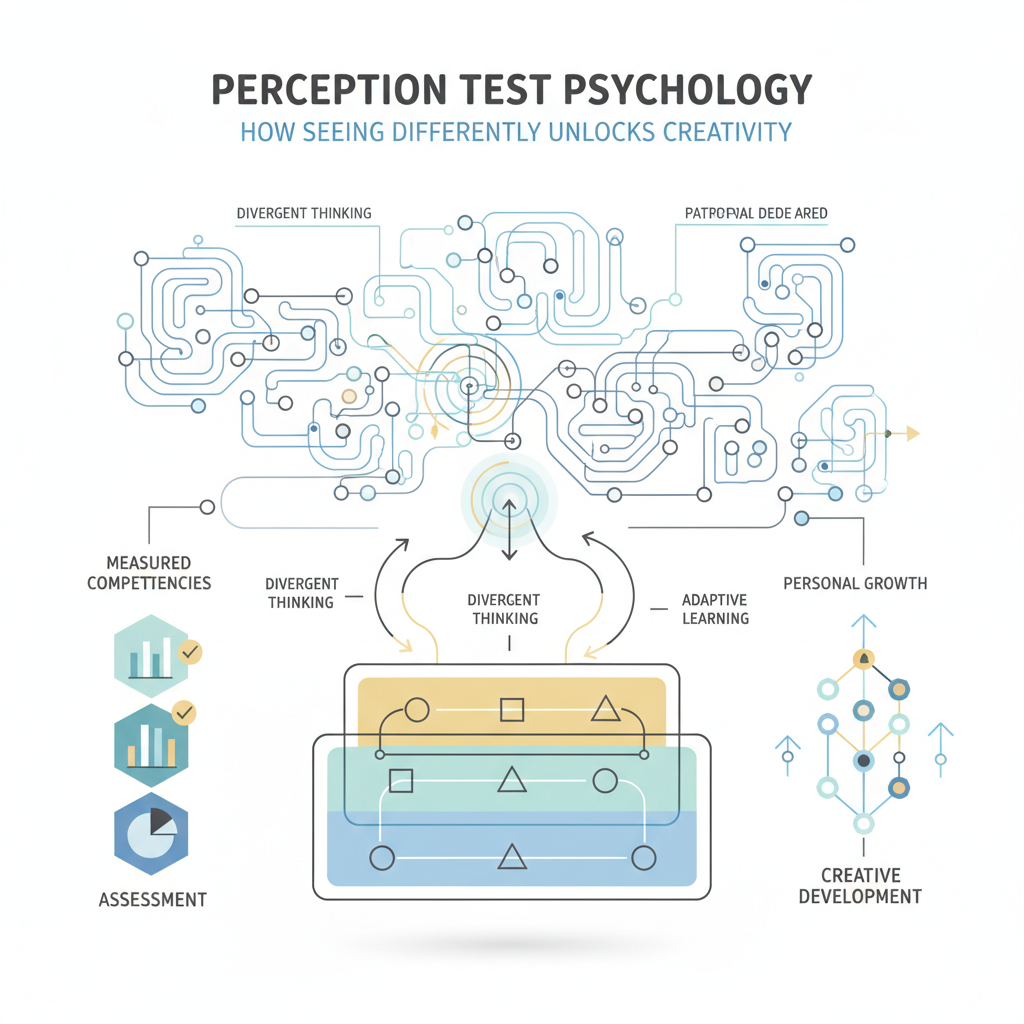
In psychology, a perception test is an assessment designed to evaluate how an individual organizes, identifies, and interprets sensory information to understand their environment. These tests reveal unique cognitive patterns that are fundamental to creative thinking, problem-solving, and generating novel ideas.
Have you ever noticed how two people can see the same thing in completely different ways? This difference in perception is more than a trick of the mind—it’s a key to unlocking creativity. The way you interpret the world isn’t just a personal quirk. It’s the very foundation for new ideas and creative problem-solving.
To boost your creative potential, it helps to understand how your mind works. Your perception—how you make sense of the world and connect unrelated things—shapes your ability to think in new ways. It allows you to find clever solutions, see new patterns, and tackle problems from a fresh angle. This article will explore the link between how you see the world and your natural creativity, giving you a better understanding of your own thinking style.
We’ll look at how different aspects of perception fuel divergent thinking and new ideas. Instead of just looking at the surface, we’ll explore the deeper ways your mind works. You’ll discover the powerful role your unique viewpoint plays in your creativity and learn how to use it for personal and professional growth.
What Is a Perception Test in Psychology?

Why Your Perception Is the Foundation of Creativity
Perception is how you see, hear, and feel the world. It’s your brain’s way of turning sensory information into meaningful experiences. Your unique way of seeing things is the very foundation of your creativity.
Creativity doesn’t start with an idea. It starts with how you notice things, organize information, and connect different concepts. When you understand your own perception, you unlock your natural ability to create and solve problems.
For example, an artist sees shapes in a cloud. A scientist spots a small irregularity in data. An entrepreneur finds an unmet need in the market. These are all acts of perception. It’s not just about seeing, but about interpreting things in a new way [1]. A perception test in psychology can help reveal these underlying ways of thinking.
At the Creative Ability Test, we get this connection. We help you explore your perceptual strengths and give you practical insights. By understanding your unique way of seeing, you can improve your creative thinking and problem-solving skills.
Going Beyond Just What You See
Perception is more than just sight. It’s how we process everything we sense—what we hear, touch, and even feel inside. It also involves how your mind works, like how it filters information, decides what’s important, and builds an understanding of the world.
Take Cognitive flexibility, for example. This is a key trait for creativity. It’s the ability to shift your perspective and look at problems from different angles. This skill depends on how you perceive possibilities. Without it, your creativity can feel stuck.
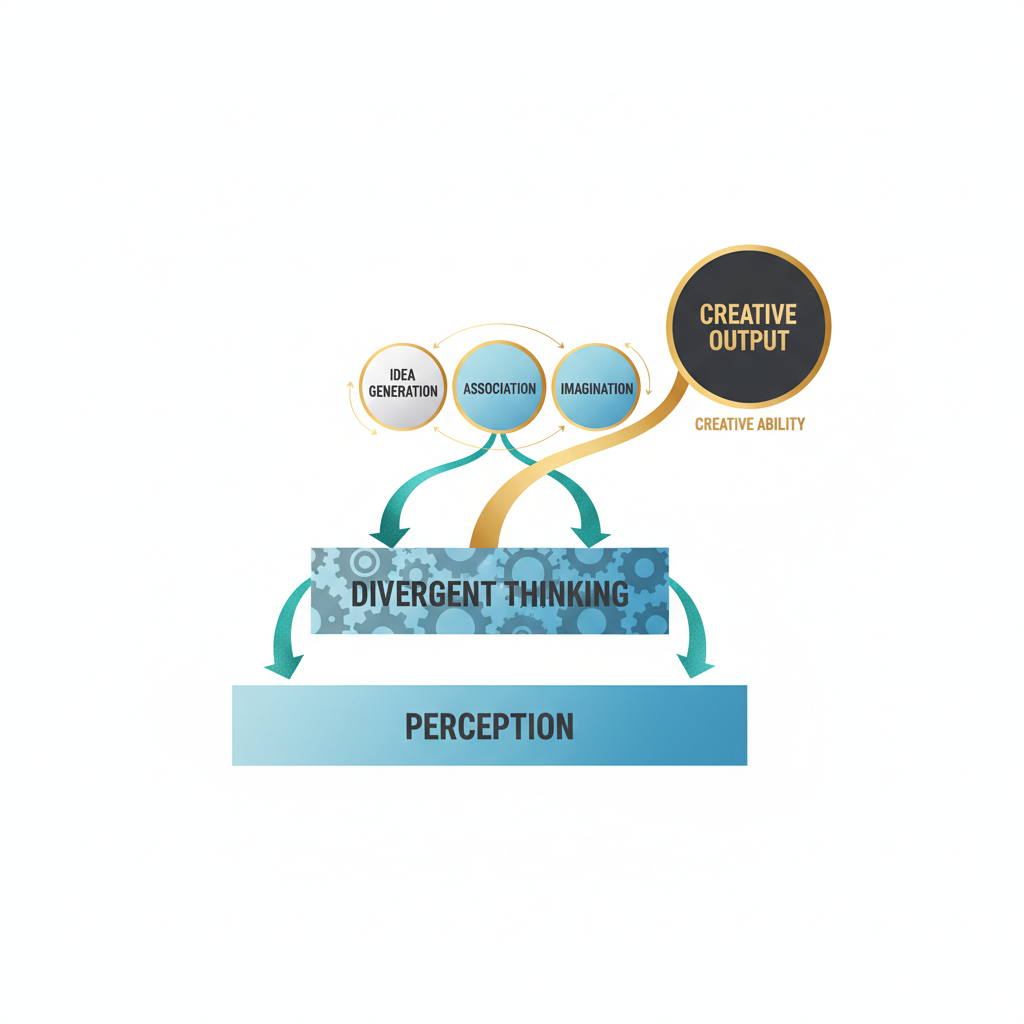
Another key skill is divergent thinking. This means coming up with many different ideas from one starting point [2]. Your ability to do this is tied to how many connections you can see and how open you are to new ideas. Perception tests can show us these mental habits.
The Creative Ability Test explores these areas to reveal your unique thinking style. For instance, some people are great at noticing small details, while others excel at seeing the big picture. Both are key to creativity. Our assessment explains these complex traits in a simple way, helping you build confidence and grow. Understanding how you perceive the world is a powerful first step to unlocking your creativity.
How Does Perception Directly Influence Your Creative Ability?
Connecting Perception to Problem-Solving
Your creativity starts with how you see the world. It’s not just about sight, but also how you interpret information. The way you see things shapes how you solve problems.
Think about a tough situation. Some people only see problems, while others see opportunities. This difference comes from their point of view. Changing your viewpoint is key to innovative problem-solving.
When you see a problem in a new light, you find new solutions. You can look at the challenge from a different angle. This often leads to ideas others miss. For example, a designer might see a broken chair not as trash, but as material for a new piece of art. This change in perspective unlocks creative potential.
Our Creative Ability Test helps you understand your unique way of seeing things. It shows you how you naturally solve problems and gives you insights into your creative style. You’ll also get practical tips to improve these skills.
Learning to see things in new ways is important. It changes how you handle daily challenges and helps you come up with big ideas. You stop just seeing a problem and start creating the solution.
Cognitive Flexibility: The Skill of Shifting Perspectives
Cognitive flexibility is your brain’s power to adapt. It’s about switching between different ideas or ways of thinking. This skill is key to creativity because it lets you see things from many angles.
Imagine brainstorming for a project. A person with high cognitive flexibility can jump from one idea to another with ease. They can quickly switch their thinking and don’t get stuck on one approach. This helps them create a wider range of options.
This skill helps you look at things from a fresh angle. It means you can change your approach if something isn’t working. For example, if a chef runs out of an ingredient, they can quickly find a substitute. They can create an equally delicious dish using different ingredients.
Research shows a strong link between cognitive flexibility and creative problem-solving [3]. It helps you break free from stiff, routine thinking. This opens the door to brand-new ideas and helps you handle complex situations with ease.
The Creative Ability Test measures parts of your cognitive flexibility. It shows you where you’re naturally strong. It also gives you exercises made just for you. These tips will help you get better at changing your point of view, leading to more creative and flexible thinking.
Here are practical ways to boost your cognitive flexibility:
- Engage in diverse activities: Try new hobbies or learn a new skill regularly.
- Practice divergent thinking: Brainstorm many ideas without judgment.
- Challenge assumptions: Ask “why not?” or “what if?” more often.
- Seek varied opinions: Discuss ideas with people from different backgrounds.
Pattern recognition and Innovative Ideas
Creativity is often about seeing connections. It’s about finding patterns where others see only a mess. But it’s also about breaking old patterns on purpose. These two skills together are key to innovation.
Pattern recognition helps you see how things are related. You might connect ideas that don’t seem to belong together. This can lead to surprising and smart solutions. For example, a musician combines different melodies to make a new song because they can spot patterns that sound good together.
New ideas often come from this skill. You might see a common problem in one area and use a solution from a completely different one. Mixing ideas like this is a great way to be more creative.
For example, the inventor of Velcro noticed burrs sticking to his dog’s fur. He saw a natural pattern of tiny hooks and loops. This idea led to a whole new way to fasten things. He saw a pattern in nature and used it to create new technology.
Our Creative Ability Test helps you understand your own way of seeing patterns. It shows how you connect ideas. You’ll get a clear picture of your strengths in divergent thinking, which is the ability to come up with many different ideas.
By understanding this, you can improve your innovative thinking. You’ll learn to trust your gut when you spot unusual connections. This helps you create truly original ideas and makes you a better problem-solver and innovator.
Improving your pattern recognition skills can greatly boost your creative work. You’ll get better at spotting trends and challenging the usual way of doing things. Both skills are important for your personal and professional growth.
What Are Common Examples of Perception Tests?
Visual perception tests
Visual perception tests explore how you interpret what you see. They reveal your unique way of seeing and understanding the world around you. This can offer useful insights into your creative thinking style.
Two well-known examples are the Rorschach Inkblot Test and the Thematic Apperception Test (TAT).
- Rorschach Inkblot Test: This classic test shows you abstract inkblots and asks you to describe what you see. There are no “right” or “wrong” answers. Instead, psychologists analyze your interpretations to understand your thought processes and emotional responses [4]. For creativity, your ability to find different patterns and meanings can show strong creative thinking skills.
- Thematic Apperception Test (TAT): The TAT uses a series of picture cards with vague scenes. Your task is to tell a story about each picture, including what led to the scene and what the characters are feeling. This reveals your inner motivations, emotions, and how you view social situations [5]. In a creative context, it shows your storytelling skills, imagination, and problem-solving abilities.
These tests show that everyone interprets information differently. They also demonstrate how your inner thoughts and feelings can shape what you see. Understanding these personal differences is key to unlocking your creative potential. Our Creative Ability Test focuses on the thinking skills behind these unique viewpoints, offering practical advice you can use.
Depth Perception Tests
Depth perception is your ability to judge distances between objects. It also helps you understand how they are arranged in space. This skill is essential for getting around in the physical world.
However, it also applies to how you handle complex ideas. Good depth perception can help you see different layers within a problem. It allows you to imagine solutions from multiple angles. This skill is a direct support for innovative thinking.
Common ways to test depth perception include:
- Stereo Vision Tests: These tests use special glasses to view images that create a 3D effect. Your ability to see a single 3D image shows how well you perceive depth.
- Distance Judgement Tasks: You may be asked to estimate how far away different objects are. You might also be asked to arrange objects in order based on how far away they seem.
Improving your spatial awareness and visualization skills can have a big impact on your creative problem-solving. It lets you think beyond just two dimensions. This leads to a deeper, more detailed understanding of challenges and opportunities.
Auditory and Other Sensory Tests
Perception isn’t just about sight. Our other senses also play a key role in creativity and how we experience the world. Auditory perception, for instance, is how you hear, interpret, and make sense of sounds.
- Auditory Perception: Tests may ask you to tell the difference between sounds, find patterns in noise, or pinpoint where a sound is coming from. This skill is vital for musicians, but it also helps anyone who needs to listen for small details in conversations or notice subtle cues in their environment. It helps you gather important information, which can lead to unique ideas.
- Other Sensory Perceptions: Touch, taste, and smell also add to our rich experience of the world. While not often formally tested for creativity, they have a big impact on our experiences. Being more aware of all your senses can inspire many different kinds of creative work. Think of a chef creating new flavors or a designer thinking about how a product feels to the touch.
Using information from multiple senses at once makes your thinking more flexible. It gives you a wider understanding of any situation. This big-picture view helps you see connections that others might miss. Our platform helps you understand how these broader skills add to your creative profile. This allows you to use your unique sensory awareness to solve problems and innovate.
How Can Understanding Your Perception Unlock Your Potential?
How you see things is a powerful tool. It shapes your view of the world. Learning about your unique style offers big advantages and can help you unlock your full creative potential.
This understanding helps you move from just knowing to taking action. You can build on your natural talents. The Creative Ability Test provides this key insight. It guides you toward personal growth and new ways of thinking.
Identify Your Creative Strengths
To understand how you see things is to understand how you think. It reveals your unique creative gifts. Are you good at finding new patterns? Can you easily change your point of view? These are creative strengths.
The Creative Ability Test helps pinpoint these areas. It shows how your brain processes information, including your:
- Cognitive Flexibility: Your ability to switch thinking styles. You can adapt quickly to new problems.
- Divergent Thinking: How many unique ideas you can generate. This shows your creativity and originality.
- Pattern Recognition: Your skill in finding connections. You see order in details that seem unrelated.
- Openness to Experience: Your willingness to explore new ideas. You are comfortable with new or unclear things.
Knowing these strengths gives you confidence. You can use them to take on any creative challenge. This helps you move from guessing to taking clear action.
Develop Actionable Strategies for Growth
These insights are more than just facts about yourself. They are starting points for growth. Once you know your creative style, you can take action. The Creative Ability Test gives you personal feedback with practical steps to follow.
For example, if you are great at creating many ideas, you might learn new ways to improve them. If you want to be more flexible in your thinking, you can practice looking at problems from different angles. These strategies are designed to:
- Expand Your Perspective: Learn new ways to see a problem and challenge your own beliefs.
- Enhance Problem-Solving: Use specific thinking tools to break down complex issues.
- Boost Idea Generation: Try exercises that spark new ideas and help you get past creative blocks.
- Refine Decision-Making: Look at a wider range of options to make better creative choices.
This organized plan helps you improve. It turns inconsistent creative moments into a reliable skill. You build a clear path to get better over time.
Apply Your Insights to Real-World Challenges
The real power in understanding yourself is using that knowledge. These are tools to make a real impact in your daily life, both at work and at home.
For example, a designer creating a new product can use their creative style to better guess what users need. By seeing problems from many angles, they can find more creative solutions. A student working on a big project can use their strength in finding patterns to organize information better.
Your unique way of seeing things helps you be more innovative. It improves problem-solving and helps you connect with others in team settings. Here’s how you can use these insights:
- In Your Career: Solve work problems with a fresh perspective. Lead better brainstorming sessions. Adapt more quickly to changes in your field.
- In Your Studies: Take on school challenges creatively. Connect ideas from different subjects. Come up with unique research questions.
- In Personal Life: Find creative solutions to everyday problems. Communicate better by understanding other views. Express yourself in more original ways.
The Creative Ability Test guides you through this change. It helps turn what you learn about yourself into real success. You will move from simply knowing about creativity to using it in meaningful ways.
How Can You Test Your Own Perceptual and Creative Skills?
Discover Your Creative Profile with the Creative Ability Test
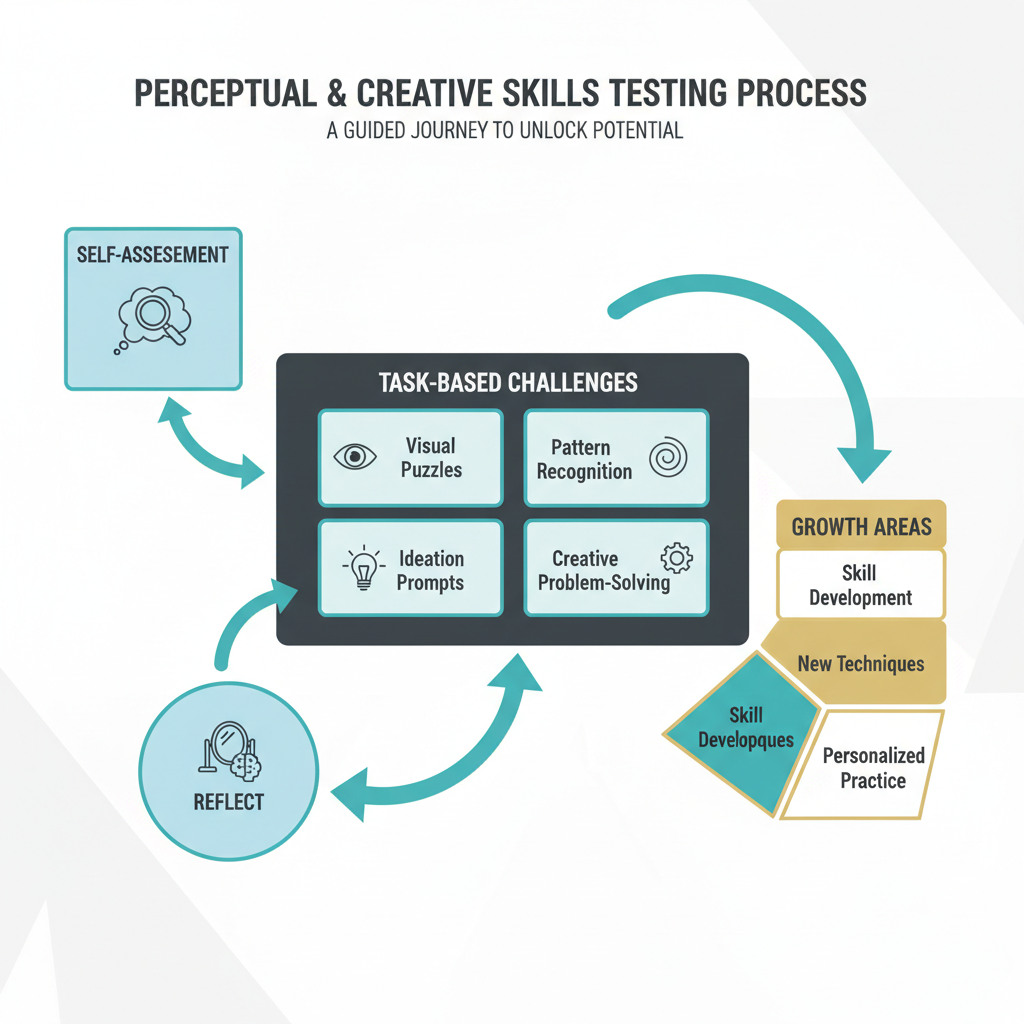
Have you ever wondered how to measure something as personal as creativity? While some tests look at how you see things, understanding your full creative potential takes a deeper look. The Creative Ability Test offers exactly that.
Our 30-question, science-backed test explores different parts of your creative mind. It goes beyond simple guesswork, giving you a clear picture of your unique creative profile. You’ll learn about your thinking styles and how you solve problems.
Understand How You See the World
The way you see the world is the starting point for your creativity. It shapes your ability to come up with new ideas. The Creative Ability Test shows you your unique perceptual strengths, highlighting how you process sights and ideas. Knowing this is a powerful first step toward growing your creative skills.
For example, some people are great at finding patterns where others see only chaos. Others notice small details that can spark big ideas. Our test helps you find these natural talents. Research shows that these abilities are a key part of creative problem-solving [6].
What the Creative Ability Test Reveals
Our test is designed to show you the key parts of your creativity. It goes deeper than surface-level quizzes to give you a real look at how your mind works. You will discover:
- Cognitive Flexibility: Your ability to switch viewpoints and adapt to new information. This is a key skill for fresh thinking.
- Divergent Thinking: How well you can brainstorm many different ideas from one starting point. This is often called “thinking outside the box.”
- Problem-Solving Skills: Your unique approach to difficult challenges and how you use creativity to find solutions.
- Openness to Experience: How willing you are to explore new concepts and unusual ideas, which helps you grow as a person.
- Innovation Potential: Your natural ability to create new and useful solutions. This is important for your career.
Personalized Insights for Growth
After the test, you’ll get a personalized report that’s easy to understand. It breaks down complex ideas into simple, useful tips. You’ll see your creative strengths clearly and find specific areas where you can build new habits.
This isn’t just about where you are now—it’s about helping you grow. You’ll get practical advice to improve your creativity. For example, you might learn ways to become a more flexible thinker or try new “outside the box” exercises. These custom tips help you use your creativity every day, from personal hobbies to work challenges.
Unlock Your Full Creative Potential
Think of the Creative Ability Test as your guide. It helps you move from wondering about your creative talent to truly understanding it. You’ll get a clear plan for growth, which helps turn random bursts of creativity into a reliable skill. Our platform gives you a clear path to understand and use your creativity well. Start your journey to more creative confidence and a bigger impact today.
Frequently Asked Questions
What kind of questions are in a perception test?
Perception tests look at how you see the world around you. They often show you unclear images or situations. Then, they ask you to describe what you see. These aren’t typical quizzes with right or wrong answers. Instead, they look at your personal way of processing information. This shows your unique perceptual style. Understanding this style can unlock your creative potential. It shows how you might solve problems differently than others.
Here are common elements you might encounter:
- Ambiguous Images: You might see shapes or scenes that can be seen in multiple ways. For instance, an image might look like two faces to one person, but a vase to another. [7] Your answer shows your unique point of view.
- Incomplete Information: Some tests give you only partial information. They ask you to fill in the gaps or guess what happens next. This tests your ability to infer and imagine. These skills are key to creative thinking.
- Sensory Challenges: You might be asked to identify small differences in sounds, textures, or even tastes. These tasks check how sensitive you are to details. This attention to detail can spark new ideas.
- Problem Scenarios: You could be given a situation and asked how you see the real problems. You might also describe how you would find a solution. This reveals your problem-solving style.
In the end, these questions are designed to find your mental flexibility. They show how open you are to new ways of seeing things. This is a key part of being creative.
What does a visual perception test measure in psychology?
A visual perception test does more than just check your eyesight. It measures how your brain understands and sorts what you see. Psychologists use these tests to understand how the mind works. They show how you make sense of the visual world. This, in turn, has a big impact on your creative thinking.
These tests can measure:
- Pattern Recognition: Your ability to find and understand repeating patterns. This skill is crucial for spotting trends and making connections. For instance, designers often use strong pattern recognition to create new things.
- Figure-Ground Perception: How you separate a specific object (figure) from its background (ground). This impacts your focus. It also affects your ability to ignore distractions. This is key in problem-solving.
- Visual Discrimination: Your ability to notice small differences between objects or images. Improving this skill helps you see details others might miss. Seeing these details often leads to new ideas.
- Spatial Relationships: Your understanding of how objects relate to each other in space. This is key for picturing solutions and designing new products. Architects, for example, rely heavily on this.
- Cognitive Flexibility: Your willingness to change how you see things when shown unclear images. This ability is a sign of very creative people. They can see many possibilities in one image. [8]
- Personality Traits and Thinking Styles: Some visual tests, like the Rorschach, can offer clues about your personality. They also show how you usually handle unclear situations. This gives clues about your overall thinking style.
Understanding your visual strengths gives you powerful insights. It shows you how your unique way of seeing fuels your creativity. The Creative Ability Test is not a perception test, but it does help you find your creative thinking styles. It gives you personal strategies to help you grow.
Can you take a perception test online?
Yes, you can find many perception tests online. These range from fun optical illusions to more structured mental exercises. Many websites offer tests that measure specific skills, such as visual discrimination or spatial reasoning.
However, it’s important to know the different types:
- For Fun and Self-Exploration: Many websites have quick, fun perception quizzes. These often show how easily our brains can be tricked. They are great if you’re curious or want to learn about yourself.
- Research-Based Assessments: Universities and researchers often use online perception tasks. They collect data on how the mind works. They help us better understand the human mind.
- Clinical Psychological Assessments: Formal perception tests used for a diagnosis usually need a trained professional. These are not usually given online. They follow strict rules and need an expert to explain the results. [9]
The Creative Ability Test focuses on your creative thinking and problem-solving skills. While it’s not a direct “perception test,” it looks at related mental skills. Our 30-question test helps you understand how you process information. It reveals your unique thinking styles. These styles are key for coming up with new ideas and solutions. You will get useful insights. You can also improve your mental flexibility, which will boost your creative potential.
What is the Thematic Apperception Test?
The Thematic Apperception Test (TAT) is a well-known psychological test. Created in the 1930s by Henry Murray and Christiana Morgan, it uses a series of unclear images. [10] These images often show people in different social situations. Your task is to tell a story about each picture. You describe what led to the scene, what is happening, what the characters are thinking and feeling, and what the outcome will be.
Here’s why the TAT is important:
- Projective Nature: Because the images are unclear, your answers are thought to show your own hidden thoughts, feelings, and wishes. You explain the picture based on what’s going on inside you.
- Insights into Personality: Psychologists look for repeating themes, feelings, and problems in your stories. This can show parts of your personality. It also shows what drives you and how you cope with stress.
- Perception and Interpretation: The TAT is a great example of how what you see shapes your reality. How you see the images offers deep insights. It shows how you understand social situations and build stories.
- Connection to Creativity: While it’s not a creativity test, the TAT does use creative thinking. It requires you to tell creative stories and find meaning in unclear situations. These are key skills for creating new things and solving problems. Think of it as creating a story on the spot.
Understanding how you see and explain stories is key to creative growth. The Creative Ability Test helps you use these strengths. It helps you better understand your creative styles. You can then use these insights in your daily life and at work. This helps you to create new things and grow.
Sources
- https://psycnet.apa.org/record/1987-00996-001
- https://www.sciencedirect.com/topics/psychology/divergent-thinking
- https://www.ncbi.nlm.nih.gov/pmc/articles/PMC8949572/
- https://www.simplypsychology.org/rorschach-test.html
- https://www.verywellmind.com/what-is-the-thematic-apperception-test-2795810
- https://www.apa.org/pubs/journals/releases/xlm-a0033104.pdf
- https://www.simplypsychology.org/ambiguous-figures.html
- https://psycnet.apa.org/record/2012-00566-001
- https://www.apa.org/topics/psychotherapy/choosing-therapist
- https://www.simplypsychology.org/tat.html
Leave a Reply