An observation test in psychology is a research method where a researcher observes and records the behavior of individuals or groups in a specific setting. Unlike a traditional test with questions, it involves systematically watching subjects to gather data on their actions, interactions, and responses, either in a natural environment (naturalistic observation) or a manipulated one (controlled observation).
Do you truly see the world around you, or do you just look? In our busy world, keen observation is more than just a useful skill. It helps you find new ideas, solve complex problems, and boost your creativity. The way you perceive and process your surroundings shapes everything from small insights to major breakthroughs. This isn’t a rare talent; it’s a cognitive ability that anyone can develop. Psychology offers a scientific way to understand and improve it.
This article will introduce you to the observation test in psychology, including its core methods and insights. We’ll explain how techniques like naturalistic and controlled observation are used to study behavior. More importantly, you’ll see how understanding these scientific approaches can sharpen your own creative thinking. Get ready to learn how better observation skills can make you a more flexible thinker, lead to new ideas, and provide practical tools for growth and problem-solving in your life. First, let’s define what an observation test in psychology is.
What is an Observation Test in Psychology?
In psychology, an observation test isn’t just a formal exam. It’s about a deeper idea: how we notice and understand the world around us. Psychologists use observation as a key research tool. They watch and record behaviors to understand how people think. It’s a basic way to learn about the mind and how we connect with the world.
But for creativity, observation is much more active. It’s a key skill that pushes you to see the small details and look past what’s obvious. This is more than just seeing. It requires you to pay close attention on purpose.
Good observation skills are essential for creative thinking. They help build your cognitive flexibility. You learn to see patterns and notice things that are out of place. This skill directly helps your problem-solving and improves your divergent thinking. By observing closely, you gather unique details that you can use to create new ideas.
At Creative Ability Test, we understand this important link. Our 30-question assessment helps you explore your unique thinking styles, including how you naturally see and understand the world. When you know your observational strengths, you learn more about your creative process. This helps you gain real, useful insights. You learn how to use your unique point of view, which can help you grow both personally and professionally.
Importance of observation test in psychology
Observation tests are key tools in psychology. They offer a unique window into how people behave. These tests are not just for researchers; they also give valuable insights to anyone curious about their own creative thinking and problem-solving styles. By watching and understanding actions, we can find patterns. These patterns often show hidden strengths and ways to improve our creative skills.
Understanding observation helps you see the science behind assessments like The Creative Ability Test. It shows how we move from simply guessing about creativity to gaining real, useful self-knowledge.
Provides Realistic Behavioral Insights
Observation allows psychologists to see how people act in real life. This is powerful because it goes beyond what people say they do and shows what they actually do. For example, someone might claim to be very organized, but observation could show they are more spontaneous and flexible. This kind of flexibility is often a key part of creative problem-solving.
These real-world insights are vital. They help us understand skills like flexible thinking and coming up with many ideas. They show how people naturally react to challenges. Watching someone solve a complex puzzle, for instance, can reveal their unique thinking style. Do they brainstorm lots of ideas? Do they plan every step carefully? Such details give a clearer, more accurate picture than questionnaires alone. In fact, studies often favor observation for capturing natural social behaviors [1].
- Uncovers Natural Responses: See how people react in unscripted situations.
- Reveals Hidden Patterns: Identify behaviors people might not notice in themselves.
- Links Theory to Practice: Connect psychological ideas to everyday actions.
- Highlights True Creative Styles: See if someone works best under pressure or with more time to think.
For you, this means you can better understand your own creative habits. The Creative Ability Test, while a formal assessment, is built on this kind of behavioral research. This helps explain your personal results in a way that connects to your own life.
Generates New Ideas and Hypotheses
Observation is a great way to spark new ideas. By simply watching, researchers can spot unusual behaviors or unexpected connections. This often leads to new ideas to test (or hypotheses) about how the mind works. Sometimes, these observations can inspire whole new theories about creativity.
Imagine watching children play. You might see that some kids combine toys in unique ways to invent new games. This could lead to an idea about the early signs of creative thinking. These first observations then help guide more organized research. They help us better understand the creative process. This cycle of watching, asking questions, and testing is how science moves forward.
From a personal growth perspective, building your own observation skills can do the same. It can help you:
- Spot Trends: Notice patterns in the problems and solutions around you.
- Question Assumptions: Challenge what you think you know by seeing what is really happening.
- Inspire Innovation: Use everyday details as starting points for new ideas.
- Develop Personal Theories: Form your own ideas about how you and others think creatively.
The Creative Ability Test encourages this kind of self-discovery. It helps you put words to the creative styles you may already use without thinking about it. This gives you a clearer path to improve your creative skills.
Enhances Validity of Research
For a psychological assessment to be credible, it must be valid—meaning it measures what it claims to measure. Observation tests are very important for this. They help double-check other research methods. For example, surveys are useful, but people do not always see themselves clearly. Direct observation can confirm or correct what people report about themselves [2].
When what we see in observation matches what people report, it makes the research findings stronger. This gives us a more complete and trustworthy picture of behavior. Combining different types of information this way makes the research more valid. It ensures that psychological ideas are based on real-world proof, not just theories.
This dedication to scientific quality is the foundation of the Creative Ability Test. We use proven methods to ensure the feedback you get is both trustworthy and practical. By understanding why observation matters, you can be more confident in your assessment results. This knowledge helps you to:
- Trust Your Results: Feel confident that the feedback on your creativity is based on science.
- Apply Insights Effectively: Use reliable information to make real improvements.
- Understand Creative Psychology: Learn how different parts of creativity are accurately measured.
- Achieve Growth: Build on a solid foundation of trustworthy knowledge about yourself.
What Are the Main Types of Observation Methods?
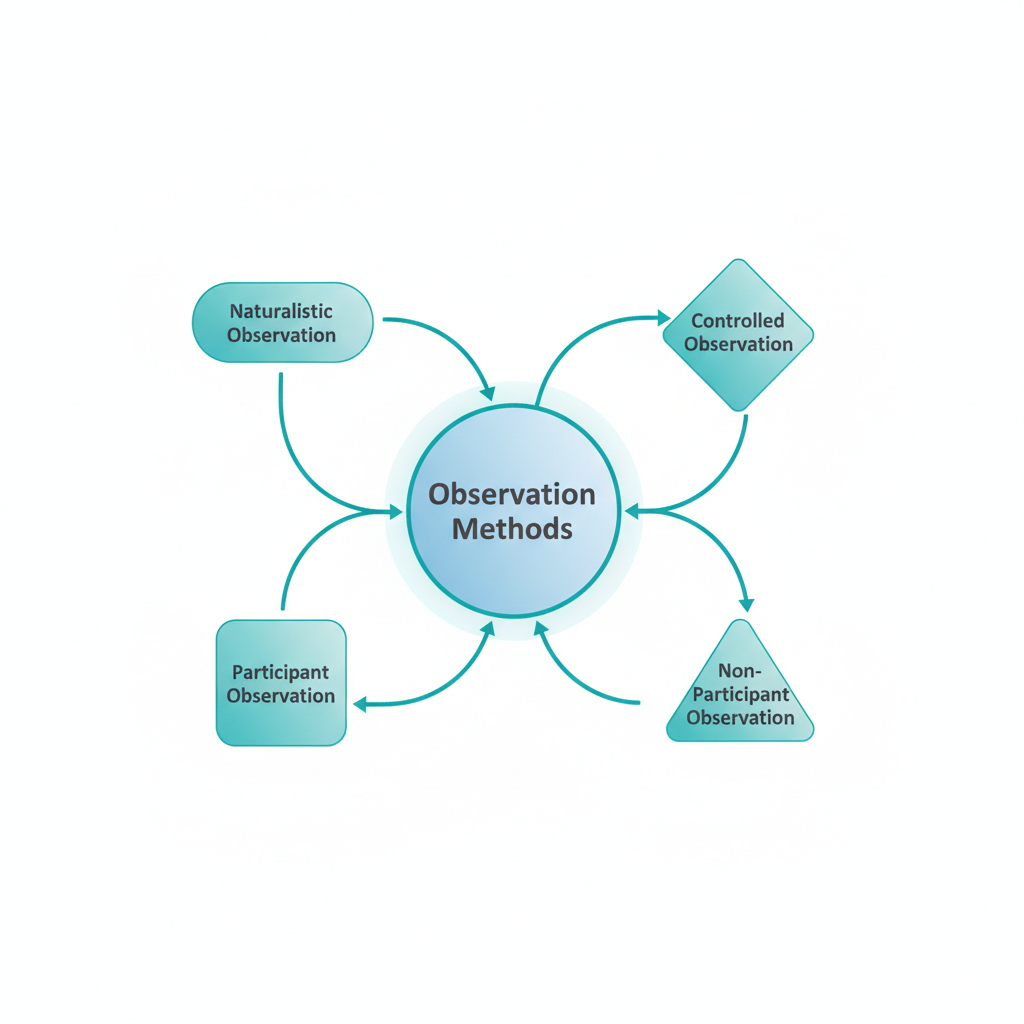
What is Naturalistic Observation in Psychology?
Naturalistic observation is watching people in their usual environment. Researchers watch without interfering. The goal is to see real, natural actions. This helps us understand how people truly act in their daily lives.
For example, you could watch a team brainstorm in their office. You would see how they interact without guiding them. This provides a great look at how creative groups work together. It shows how ideas develop on their own.
Understanding this method can make you more aware of creativity. You learn to spot small details and patterns that are easy to miss in controlled settings. This skill is key for solving problems and creating new things.
- Benefits for Creativity:
- See creativity in a real-life setting.
- Discover how people solve problems on their own.
- Find where inspiration naturally comes from.
However, it’s hard to control all the factors. Because of this, it’s tough to prove that one thing causes another [source: https://www.simplypsychology.org/naturalistic-observation.html].
What is Controlled Observation in Psychology?
Controlled observation happens in a set-up environment, like a lab. Researchers can control certain factors and give people specific tasks. The goal is to see how they react under these exact conditions.
Imagine giving a group a creative challenge, like designing a new product. You watch them work in a controlled room. This lets you study their creative process closely and see how flexible their thinking is. You can also easily compare different problem-solving styles.
This method is reliable for testing a specific idea. It helps pinpoint what affects creative results. This makes it great for testing theories about creativity. The findings can help create new ways to encourage innovation.
- Key Aspects for Creative Insight:
- Lets you focus on specific creative steps.
- You can change factors to see their effect.
- Provides clear data on creative reactions.
However, the lab setting can make people act differently. This means the results might not always apply to real-world situations [source: https://www.tutor2u.net/psychology/reference/observational-techniques-controlled-and-naturalistic-observation].
What is Participant Observation?
In participant observation, the researcher becomes part of the group they are studying. They actively join in with the activities. This gives them an insider’s view and a deeper understanding of the situation.
For example, a researcher might join an innovation team. They would take part in brainstorming and design work. This gives them direct experience of how the team creates together. It helps them understand the group’s dynamics and see how ideas are born and improved.
This method provides rich, detailed information. It uncovers the small details of creative behavior that an outsider would miss. You get a much deeper feel for the group’s shared creative process.
- Strengths for Understanding Creativity:
- Offers deep insight into group creativity in its natural setting.
- Helps you understand the feelings involved in creating.
- Shows the unwritten rules of a creative group.
However, it can be hard for the researcher to stay neutral. Their presence might also change how the group acts [source: https://research-methodology.net/research-methods/qualitative-research/participant-observation/].
What is Non-Participant Observation?
In non-participant observation, the researcher watches from a distance. They do not interact with the people being studied. The goal is to remain separate and record behavior without influencing it.
For example, you could watch a workshop through a one-way mirror. You would record how people handle creative tasks and work together. This provides an unbiased view and lowers the chance of affecting their natural behavior.
This method is great for gathering unbiased information. It helps in spotting patterns in behavior. These patterns can show common creative strategies and highlight effective ways to innovate. You get a clear view of how people create.
- Benefits for Creative Assessment:
- Leads to more objective data by reducing the observer’s influence.
- Allows you to watch a wide range of actions without interfering.
- Great for studying creative behavior in public settings.
However, this method may not provide deep insight. It can be hard to understand the reasons behind people’s actions without knowing the context [source: https://www.open.edu/openlearn/ocw/mod/oucontent/view.php?id=80453§ion=1.2].
Understanding these methods gives you a foundation for looking at creative thinking. In the same way, our Creative Ability Test uses structured, science-based methods. It gives you personalized insights into your creative strengths and problem-solving styles. This journey helps turn uncertainty into useful self-awareness.
How Can Sharpening Your Observation Skills Boost Creativity?
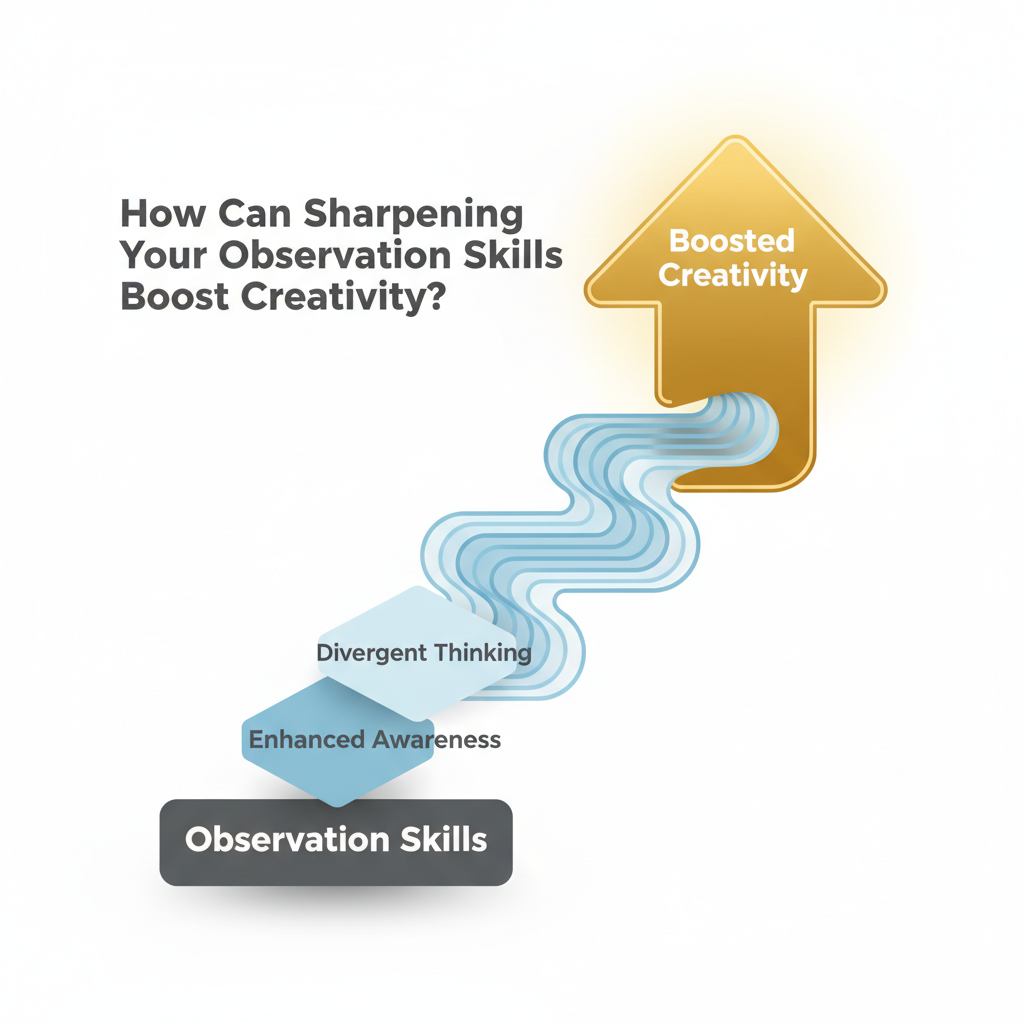
Observation is a key skill for creativity. It’s not just about looking. It’s about actively noticing, analyzing, and understanding the world around you. This focus helps you see things differently and sparks new ideas.
When you improve your observation skills, your thinking becomes more flexible. This helps you move past old ways of thinking. Our Creative Ability Test helps you understand your creative strengths. It also gives you strategies to grow these important skills.
Seeing Problems from New Angles
Big creative ideas often come from looking at old problems in new ways. Good observation skills help you notice details or patterns that others miss. This lets you see challenges from a completely new angle.
For example, think about opening a package. If you watch people struggle with it, you might see what the real problems are. Maybe they don’t have the right tools, or the design is clumsy. Noticing this can lead to a new, easy-to-use solution.
It’s like looking at something you know well, but for the first time. This challenges what you think you know. It’s a key part of solving problems. You stop focusing on “what is” and start imagining “what could be.” Studies show that redefining a problem is a key part of creative problem-solving [3].
- Break free from routine: Observing closely helps you question norms.
- Identify hidden needs: You spot user frustrations others miss.
- Challenge assumptions: Look beyond surface-level issues for deeper understanding.
- Generate unique solutions: New angles lead to truly innovative answers.
Our assessment shows you how flexible your thinking is. This skill is key to seeing problems from different angles. We give you practical advice to improve this important creative strength.
Finding Inspiration in Everyday Details
The world is full of potential ideas. But many people walk through it without really seeing what’s there. Improving your observation skills can turn everyday things into a source of endless inspiration.
Artists, writers, and scientists often get ideas from the world around them. A strange texture, a new mix of colors, or a certain sound can spark a new thought. For example, the famous physicist Richard Feynman got an idea just by watching a wobbly plate [4]. This led him to new ideas about how particles spin.
When you pay closer attention, you build a large mental library of what you’ve seen. This library is where new ideas can grow. It helps you think of many different possibilities, a key part of creativity. It also builds curiosity and wonder, which are needed to keep growing creatively.
- Practice mindful observation: Actively engage your senses in daily life.
- Document your findings: Keep an observation journal or sketchbook.
- Notice sensory details: Pay attention to sights, sounds, smells, and textures.
- Stay curious: Ask “why” or “how” about everyday things.
Our platform helps you become more open to new experiences. Being open is key to finding inspiration everywhere. We provide personal strategies to help you use your surroundings to spark your creativity.
Connecting Seemingly Unrelated Ideas
Creativity is often about connecting ideas that seem unrelated. When you observe carefully, you collect a lot of different information. This makes it easier to link ideas that didn’t seem connected before.
Imagine watching a busy ant colony, and later seeing how a shipping company works. What you learned from both could help you improve a delivery system. This kind of connection is a powerful way to come up with new solutions.
A great example is Johannes Gutenberg. He saw how grape presses and coin punches worked. By combining these two different technologies, he invented the printing press. This changed how people share information forever. His ability to connect what he saw led to a huge creative breakthrough.
Developing this skill helps you see patterns and possibilities no one else does. It helps you think in new and flexible ways. These skills are important for solving problems and for personal growth.
- Broaden your interests: Expose yourself to many different fields and subjects.
- Look for analogies: How does something work in one area that might apply to another?
- Brainstorm connections: Deliberately link random objects or concepts.
- Embrace “aha!” moments: These often arise from combining stored observations.
The Creative Ability Test measures your ability to think of many different ideas. It also looks at how well you make unique connections. Our personal feedback gives you tips to get better at making these creative connections, helping you become a more creative thinker.
How to Apply Observational Skills in Your Daily Life
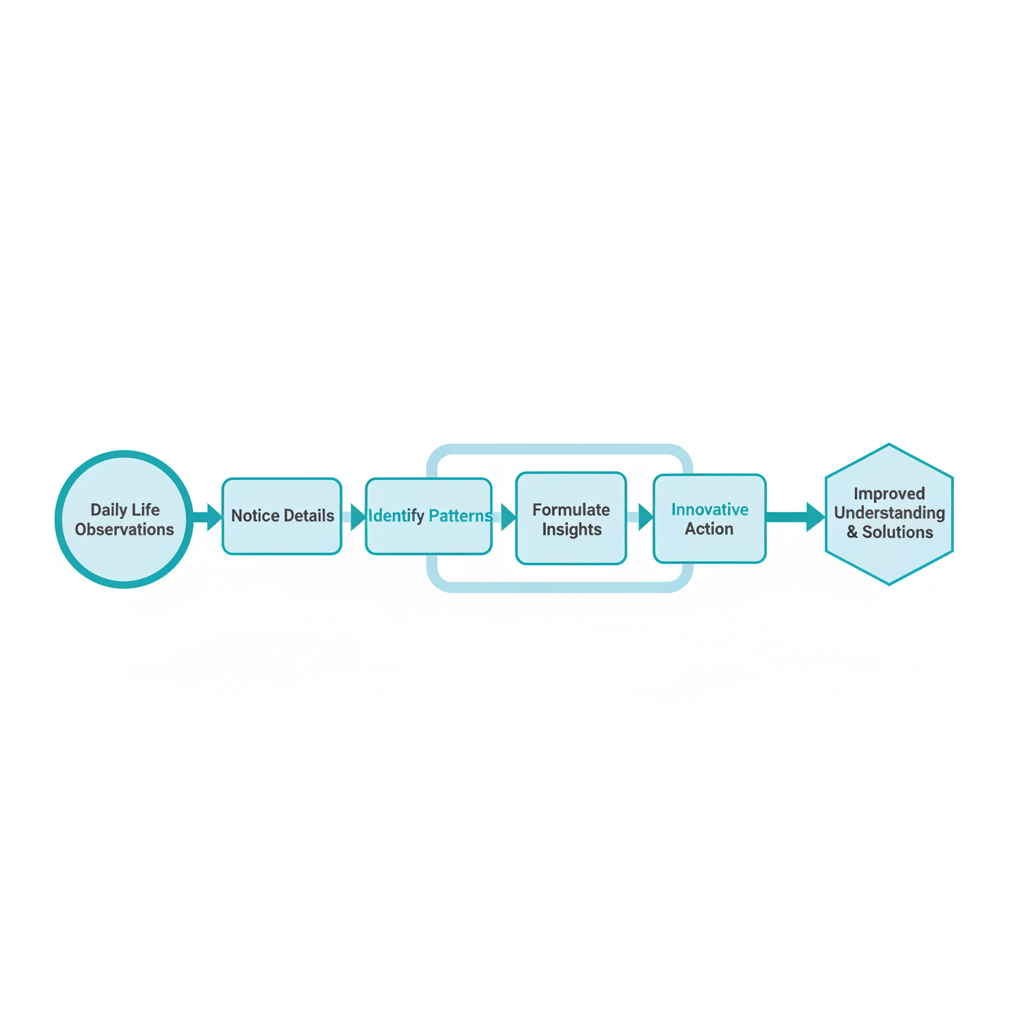
Improving your observation skills is a great way to boost your creativity. It helps you see the world in a new way. This isn’t just for researchers—it has real benefits for everyone.
By paying more attention in your daily life, you can learn to think more flexibly. You’ll also get better at solving problems. These are key skills measured by the Creative Ability Test. Here are some simple ways to use observation every day.
Practice Mindful People-Watching
Observation skills aren’t just for scientists. You can improve yours every day. A great way to do this is by mindfully watching people.
This means more than just a quick look. It’s about paying close attention. You watch without judging and notice the small things. When you do this, you’ll start to see a lot more around you.
Mindful people-watching boosts your creativity. It helps you find new ways of seeing things. It can also give you new ideas for solving problems.
Here’s how to start:
- Choose a setting: Go to a cafe, park, or public square. A place with a lot of activity is best.
- Focus on details: Notice body language, interactions, and facial expressions. See how people move and talk.
- Ask open-ended questions: Wonder about their stories. Where are they going? What do they want?
- Avoid assumptions: Just watch what is actually happening. Don’t try to guess the meaning or judge right away. This helps you think more flexibly.
- Connect observations: Think about how different things are related. How does one person’s action affect someone else?
Doing this every day can change how you see problems. It trains your brain to find connections. Over time, it helps you build divergent thinking skills, which are key to creativity.
Keep an Observation Journal
A simple but powerful way to improve your observation skills is to keep a journal. This isn’t just a diary—it’s a special place to write down what you notice.
A journal helps you pay attention on purpose. It gives your observations structure, which helps make new ideas and insights clearer.
This practice directly improves your creative skills. It trains your mind to remember more details. It also builds a personal source of inspiration you can use for creative problem-solving.
Try these steps for your journal:
- Daily entries: Spend a few minutes each day writing down what you observed in your surroundings.
- Use all senses: Describe sights, sounds, smells, and textures. What do you feel? What do you hear?
- Be descriptive: Instead of “a dog,” write “a scruffy terrier with one floppy ear.” Being specific is important.
- Sketch or doodle: Drawing can capture details that words might miss. You don’t have to be an artist.
- Reflect and connect: After writing down what you see, think about it. Do you notice any patterns or surprising connections?
Looking back at your journal can spark new ideas. It shows you patterns in how you see things. This organized method strengthens your creative thinking and helps you use what you’ve learned to solve problems.
Challenge Your Assumptions
Our brains use shortcuts to handle information. These shortcuts, or assumptions, help us get through the day. But they can also limit what we notice and how creative we are.
Questioning your assumptions is key to better observation. It makes you look past your first impressions. As a result, you can find hidden details and new viewpoints.
This practice is essential for new ideas. It makes your thinking more flexible. It also helps you with divergent thinking, which means looking for many different solutions to a problem instead of just the obvious one.
Here’s how to challenge what you assume:
- Identify your beliefs: When you’re in a situation, notice your first thoughts. What do you assume is true?
- Ask “Why?”: Look closer at those beliefs. Why do you assume that? What proof do you have?
- Consider alternatives: What if the opposite were true? Think about other explanations. This opens up new ways of thinking.
- Seek different views: Talk to people from other backgrounds. Their ideas can show you what you’re missing [5].
- Try small experiments: Test your assumptions in the real world. See if they are actually true.
By regularly questioning what you think you know, you’ll improve your observation skills. You will start to see things more clearly. This helps you approach problems with real curiosity, leading to new creative solutions and personal growth.
Frequently Asked Questions
What is an example of controlled observation in psychology?
Controlled observation means studying behavior in a carefully planned setting. Researchers control certain factors to see how one thing affects another. It is a very focused way to learn.
A classic example is watching children play with new toys in a lab. For each child, the room and the toys are exactly the same. Researchers often watch from behind a one-way mirror so they don’t disturb the children. They record specific actions, like sharing or solving a problem. This consistency helps them identify what causes different behaviors.
Understanding these controlled settings can boost creativity. We can design spaces, like an “innovation lab” with specific tools, to encourage new ideas. This shows how your own environment affects your creative flow. Our Creative Ability Test offers tips for improving your personal creative space.
What is a naturalistic observation psychology example?
Naturalistic observation is watching behavior in a real-life setting. The researcher doesn’t get involved. This method provides a true look at how people or animals act naturally.
For example, a psychologist might watch children playing in a park to see how they interact or solve problems on their own. The researcher just observes and takes notes without changing anything. This shows how children really behave, which might be different than in a lab.
This method is important for understanding creativity in the real world. Watching an artist find inspiration on a walk or engineers working together shows how creativity happens naturally. These insights can help you be more creative in your daily life. Our platform helps you connect these real-world ideas to your personal creative style.
What is an observation test game?
An observation test game is an activity that tests how well you notice details. In these games, you might have to spot differences, find hidden objects, or remember what you saw. They are designed to help you improve your focus.
Think of “spot the difference” or “hidden object” games. They train your brain to see small details and quickly understand what you’re looking at. This skill is very helpful for solving problems creatively.
Being a better observer makes you more creative. When you notice more details around you, you come up with more new ideas. Good observation is a key part of flexible thinking, which is something measured by the Creative Ability Test. By improving your observation skills, you can find new perspectives and solutions.
What is structured observation in psychology?
In structured observation, researchers use a set plan to record behavior. They often use checklists or rating scales to categorize what they see. This approach makes sure every observation is consistent.
For example, a researcher watching a team brainstorm would use a prepared checklist. It might track “the number of new ideas” or “how often people build on each other’s ideas.” Every action is clearly defined, which makes it easier to analyze the data and compare different groups.
This method is a great way to study how creativity works. It helps us find the specific actions that lead to breakthroughs. When you understand these patterns, you can use them in your own work. Our Creative Ability Test uses proven methods to show you your own creative thinking style. This gives you practical tips for personal and professional growth, helping you turn creative insights into action.
Leave a Reply