Category: Personality Assessment Models

  • The California Psychological Inventory: A Guide for Creative Thinkers

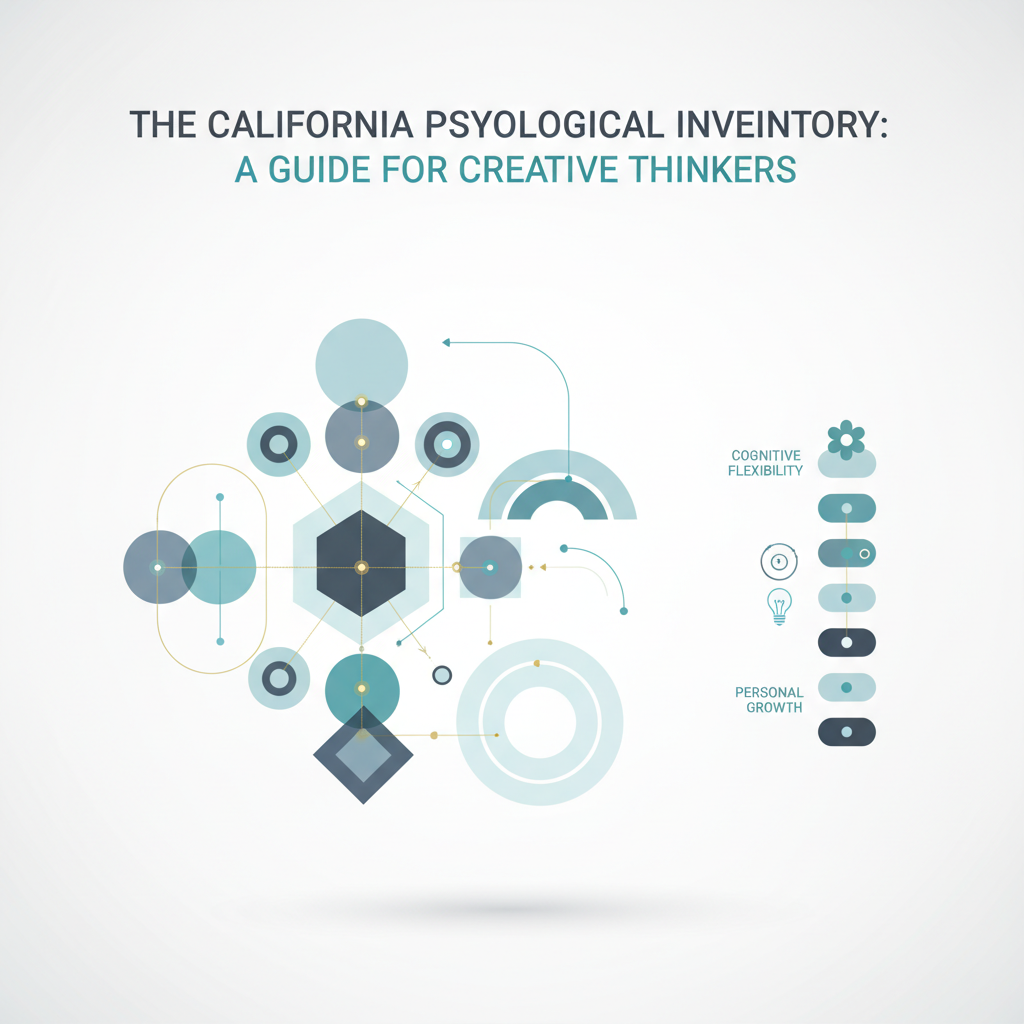
    The California Psychological Inventory: A Guide for Creative Thinkers

    The California Psychological Inventory (CPI) is a self-report personality assessment designed to evaluate an individual’s interpersonal behavior and social interaction. It measures everyday traits like dominance, sociability, and self-control to provide a comprehensive profile of a person’s character and typical way of interacting with others in various settings.

    Have you ever wondered what drives the way you think, solve problems, and come up with new ideas? Your personality is more than just a list of traits. It’s the foundation for how you interact with the world, face challenges, and unleash our creative potential. Understanding yourself better can reveal powerful insights into how you innovate and grow.

    The California Psychological Inventory (CPI) is a respected and widely used tool for understanding human behavior. This comprehensive personality test offers a detailed look at your social style, values, and how you think. In this guide, we will explore what the CPI measures, look at its key personality traits, and show how its insights can reveal your creative strengths and opportunities for growth.

    Whether you are a student, a professional, or just someone interested in self-improvement, learning about the link between personality and creativity is a valuable step. Join us as we explain the California Psychological Inventory and its connection to creative thinking. You’ll discover how knowing yourself better can boost your creativity and improve your problem-solving skills.

    What is the California Psychological Inventory (CPI)?

    The California Psychological Inventory (CPI) is a well-known personality assessment. It offers a detailed look at human behavior. This tool helps you understand your social interactions, personal strengths, and motivations.

    Unlike some tests, the CPI focuses on “normal” personality traits rather than clinical disorders. It highlights characteristics that affect everyday life, like leadership, empathy, and self-control. This makes it a practical tool for self-discovery.

    The Purpose of the CPI

    The main goal of the CPI is to provide a deep sense of self-understanding. It helps you grasp your unique personality profile. This knowledge supports personal growth and professional development.

    The assessment describes and predicts behavior. It measures how you interact with the world and explores your inner values. This gives you a clear framework for self-reflection. Understanding these parts of yourself is key to using your creative strengths.

    The CPI is built on solid research. It helps identify traits like your preferred thinking styles and how you approach problems. As a result, it offers practical advice that can improve your creative skills in real ways.

    Who Uses the CPI Test?

    Many groups find the CPI useful, from individuals to large organizations. Because it has a wide range of uses, the test is a flexible tool for insight and growth.

    Here are some common users of the CPI:

    • Organizations: Businesses use the CPI for leadership development and talent management. It helps them build stronger teams and identify high-potential employees [1].
    • Coaches and Counselors: These professionals use the CPI to guide clients with career counseling and personal development. Understanding a client’s personality helps them create better strategies.
    • Educational Institutions: Universities and colleges use the CPI to help students with career guidance. It also supports leadership training programs.
    • Individuals: Many people take the CPI for self-exploration. Understanding their unique traits helps them make better life choices and improve their personal effectiveness.

    Knowing your CPI profile can unlock your potential and show you how you innovate. This understanding is key for creative thinkers. For example, it can reveal how open you are to new ideas or your willingness to take risks. These insights are a powerful first step on your creative journey. The Creative Ability Test builds on this foundation, offering specific details about your creative potential.

    What Key Personality Traits Does the CPI Assess?

    An infographic showing a competency map or assessment chart with various personality traits as labeled segments, highlighted with subtle gradients.
    Create an abstract, educational, vector-based infographic. Visualize a clean, minimalist competency map or a structured assessment chart. Display different personality traits as distinct, labeled segments or nodes, using clean geometric shapes with subtle gradients and accent highlights in soft blues, whites, charcoal, with gold or teal. Ensure ample negative space for labels and maintain a professional, approachable aesthetic suitable for a guide on creativity assessment. No human figures or cartoon elements.

    Understanding the Four Main Categories

    The California Psychological Inventory (CPI) gives you a deep look at your personality. It groups many different traits into four main categories. This structure provides a simple way to understand complex human behavior. It helps you see yourself more clearly and improve how you interact with the world.

    Each category focuses on a different part of your personality. By exploring them, you can find your strengths and see where you can grow. This organized method makes it easier to use what you learn about yourself. It helps support your journey of self-discovery.

    Interpersonal Style and Orientation

    This category looks at how you relate to other people. It checks your style in social situations. These traits are important for teamwork and leadership. They affect your ability to connect with and influence others.

    Key traits in this area include:

    • Dominance: How comfortable you are with leading or influencing groups. Strong dominance often helps in pushing new ideas forward.
    • Sociability: How much you enjoy being around other people. Those who are very sociable often do well in group brainstorming.
    • Empathy: Your ability to understand how others feel. Empathy is key for user-focused design and new ideas.
    • Self-Acceptance: Your confidence in who you are. This helps you stay strong when dealing with creative challenges or negative feedback.

    Understanding your social style helps you work better on team projects and improves your communication. These insights can change how you work with others on creative tasks. You will learn to use your social strengths more effectively.

    Internal Values and Norms

    This section looks at your inner compass. It reviews your values, beliefs, and how you follow rules. These traits show your sense of responsibility. They also show how you handle ethics and self-control.

    Important traits covered here are:

    • Responsibility: How reliable and committed you are. This is key for finishing complex creative projects.
    • Self-Control: Your ability to manage your impulses. This helps you stay focused on long-term creative goals.
    • Tolerance: How open you are to different ideas. This brings in new viewpoints, which is essential for innovation.
    • Achievement Orientation: Your drive to meet your goals. This gives you the persistence to do groundbreaking work.

    Knowing your internal values helps you make better decisions. It gives you a strong base for ethical and focused creative work. This understanding also guides your personal and professional growth. It helps you match your actions with your core beliefs. The CPI helps measure these core parts of your personality [2].

    Cognitive and Intellectual Functioning

    This category delves into your thinking processes. It looks at how you learn, solve problems, and use information. These traits are especially important for creative thinkers. They show your unique ways of thinking.

    The CPI measures traits such as:

    • Intellectual Efficiency: How quickly you can understand new ideas. This helps with fast prototyping and coming up with ideas.
    • Flexibility: How open you are to new ideas and change. Being mentally flexible helps you think in new and different ways.
    • Originality: Your habit of creating unique and unusual ideas. This is a key part of creative problem-solving.
    • Independence: Your desire to think for yourself. Thinking independently often leads to major breakthroughs.

    Looking at these traits helps you understand your creative mind. It shows your natural problem-solving skills. For example, high flexibility means you can easily change your approach. This is very helpful when brainstorming or facing unexpected problems.

    While the CPI gives a general overview, our Creative Ability Test goes deeper. Our 30-question test is designed to measure these creative skills. We give you personal feedback on your thinking strengths to help you improve your creative abilities. You get useful tips for applying these traits, leading to clear growth in your thinking and innovation skills.

    How Does the CPI Relate to Creativity?

    An infographic illustrating a cognitive network diagram with central CPI concepts branching out and connecting to various aspects of creativity, using clean geometric shapes.
    Generate an abstract, educational, vector-based infographic illustrating the relationship between the CPI and creativity. Use a cognitive network diagram or an idea cluster, featuring interconnected nodes and pathways. CPI traits should be central or clearly linked to various aspects of creative thinking and potential. Employ clean geometric shapes with subtle gradients and accent highlights in soft blues, whites, charcoal, with gold or teal. Emphasize clarity, professional aesthetics, and leave negative space for conceptual labels. No human figures or cartoon elements.

    Identifying Traits that Support Creative Thinking

    The California Psychological Inventory (CPI) is a personality test. It doesn’t directly measure creativity, but some of the traits it looks for can support creative thinking. People with strong creative skills often share certain personality traits.

    Understanding these connections can help you learn more about yourself. You can see how your personality might affect the way you solve problems and come up with new ideas.

    Some CPI traits that help build a creative mindset include:

    • Flexibility and Adaptability: People who are open to new things and can easily change their way of thinking are often more creative. They welcome change and are not stuck on traditional solutions.
    • Autonomy and Independence: Creative thinkers often like to work alone and question the way things are usually done. They trust their own judgment and are not afraid to try something different [3].
    • Tolerance for Ambiguity: Creative people are comfortable with things being uncertain or complex. They can handle having several competing ideas at once without needing a quick answer, which is key for original thought.
    • Self-Acceptance and Confidence: A strong sense of self and the confidence to share your ideas are important. This helps people share new ideas without worrying about what others think.
    • Originality (indirectly): While not a direct measure, a mix of independence and openness can lead to original thinking. These traits encourage you to think beyond the obvious solution.

    If you see these traits in your CPI profile, it may show your potential for creative growth. This gives you a starting point for developing your skills.

    Using Personality Insights for Personal Growth

    Your CPI personality results can be a powerful tool for personal growth and for boosting your creativity. When you understand your natural tendencies, you can choose to build habits that lead to new ideas.

    For example, if your CPI profile shows you tend to conform, you can make an effort to question common assumptions. If you are very practical, you could try brainstorming a wide range of ideas before choosing one.

    Here are ways to use your CPI results to become more creative:

    • Targeted Skill Development: Find out if any of your personality traits might be holding back your creativity. If so, you can work on skills to balance them out.
    • Self-Awareness: Knowing yourself better helps you see your typical ways of thinking. This allows you to change your approach on purpose when you face a creative challenge.
    • Building on Strengths: If your CPI shows you are flexible, look for projects where that trait can shine. This can give you an edge in creative work.
    • Overcoming Blocks: Sometimes, personality traits can cause creative blocks. If you know what they are, you can find ways to get unstuck.
    • Informed Practice: Let your personality profile guide how you practice being creative. For example, if you like structure, make time for open-ended brainstorming.

    Your journey to becoming more creative starts with understanding yourself. The CPI is one way to look at your personality to help you on this journey. But tests designed specifically for creativity are the best way to measure and improve your creative skills.

    Where the CPI Falls Short for Measuring Creativity

    To be clear, the California Psychological Inventory (CPI) is not a creativity test. Its main purpose is to describe personality in everyday situations. While it can show traits that support creativity, it doesn’t directly measure your creative talent or thinking skills.

    The CPI looks at long-term personality traits. It doesn’t measure the active thinking processes that are key to creativity. This includes skills like brainstorming, problem-solving, and originality [4].

    The CPI falls short in a few key areas:

    • Direct Creative Skills: It doesn’t measure your ability to come up with new ideas, link unrelated concepts, or build on a starting point.
    • Creative Output: The CPI can’t predict if you will produce creative work or find new solutions.
    • Problem-Solving Approaches: It doesn’t look at how you handle complex or unclear problems in a creative way.
    • Cognitive Flexibility: While related to a flexible personality, the CPI doesn’t directly measure your mental ability to see things from a new angle or rethink a problem.
    • Specific Thinking Styles: It doesn’t identify different creative styles, like whether you are a big-picture thinker or more experimental.

    To get a clear and useful picture of your creative potential, you need a test designed for creativity. For example, a test like the Creative Ability Test is based on science and directly measures different parts of creativity. It gives you personal feedback on your creative strengths and practical steps to improve. This is an important difference to understand if you are serious about developing your creative skills.

    California Psychological Inventory Score Interpretation: How Does It Work?

    A Beginner’s Guide to Reading Your Results

    Reading your California Psychological Inventory (CPI) results might seem difficult at first. But it helps to see it as a journey of self-discovery. Your CPI report gives you a detailed look at your personality. It shows how you interact with the world and how your unique traits shape your thoughts and actions.

    Think of your report as a personal map. It shows your natural tendencies and potential areas for growth. We encourage you to look beyond single scores. Instead, focus on the bigger patterns you see. These patterns reveal your main tendencies and can offer deep insights into your creative mindset.

    The CPI is not about labeling you. It’s about giving you a framework to understand yourself. This framework helps you see your social and personal traits. By understanding them, you can use your strengths more effectively. You can also find new ways to solve problems creatively.

    What the Scales and Scores Mean

    The CPI uses many scales to measure different parts of your personality. It has 20 “folk scales” that describe everyday behaviors and attitudes [5]. There are also several other special scales. Each scale gives you a number score, which shows where you fall on a specific trait.

    Here’s a simple way to think about these scales and scores:

    • Understanding Each Scale: Each scale title describes a specific part of your personality. For example, “Independence” measures your self-reliance, while “Flexibility” measures your openness to change. These are key parts of creative thinking.
    • Interpreting Your Score: Your score on each scale shows how much of that trait you have. Scores are often shown as percentiles. A score in the 70th percentile means you scored higher than 70% of the people in the comparison group.
    • Connecting to Creativity: Many CPI scales are directly related to creative potential. A high score in “Intellectual Efficiency” suggests strong thinking skills, which helps with tough problems. A high “Self-Acceptance” score can mean you are confident in your own ideas, which helps you think in new and different ways.
    • The Big Picture: It’s more helpful to see how the scales work together. For example, high “Dominance” combined with high “Empathy” could point to a charismatic leader who can inspire creative teamwork.

    Scores are usually shown on a graph, which makes them easy to see. Look for the high and low points across the scales. These will highlight your strongest personality traits. They can also show you where you might want to build new creative habits.

    Applying Your Insights in a Practical Way

    Understanding your CPI results is just the start. The real value is in using what you’ve learned to improve your creative skills and grow as a person. Here are some practical ways to use your CPI insights:

    • Use Your Creative Strengths: Find the scales where you scored high. Are you high in “Independence”? Use this to trust your own vision. Are you high in “Flexibility”? Welcome new perspectives in your creative work.
    • Work on Areas for Growth: Look at the scales where your scores are lower. If “Self-Control” is a challenge, try setting aside focused time for creative work. This can help you finish projects.
    • Become More Flexible in Your Thinking: The CPI can show if you tend to be a more rigid or a more flexible thinker. If you prefer structure, make an effort to seek out different views. Try brainstorming without judging any ideas.
    • Improve Problem-Solving: Think about how your personality traits affect your approach to challenges. Do you prefer to analyze data (“Intellectual Efficiency”) or talk with others for solutions (“Sociability”)? Try using both methods for more creative results.
    • Encourage Personal Growth: Use your CPI results to focus on self-improvement. For example, if you want to be a more inspiring creative leader, work on understanding traits like “Responsibility” and “Social Presence.”
    • Reflect and Experiment: Your CPI results give you a starting point, but personal growth requires action. Try new ways of thinking and behaving. See how these changes affect your creative work.

    The CPI offers useful personality insights, but its main focus is on general behavior. For a closer look at creativity, special tests can be helpful. Platforms like Creative Ability Test can give you specific feedback on skills like flexible thinking, idea generation, and innovation. These tests provide practical steps to boost your creativity. When you combine personality insights with creativity tests, you get a powerful guide for ongoing growth.

    What Are the California Psychological Inventory Questions Like?

    Format and Style of Questions

    The California Psychological Inventory, or CPI, asks about your everyday life. It focuses on your usual behaviors and what you prefer. Most questions are in a true-or-false format. You just decide if a statement describes you or not.

    This assessment has a lot of questions. For example, the CPI Form 434 has 434 items [5]. This large number of questions helps create a full picture of your personality. The questions are usually clear and simple. They do not try to trick you or hide their meaning.

    The CPI is a “self-report” inventory. This means you answer questions about yourself. It’s different from tests where you have to explain abstract images. Instead, you think about your own actions and feelings. This direct approach gives clear results. This helps you get useful insights into your personality.

    Sample Themes Explored in the Assessment

    The CPI looks at many parts of your personality. These topics help paint a picture of who you are. Learning about these areas shows how you connect with the world. It also shows what drives you and how you solve problems. These insights are key for personal growth and creativity.

    Here are some of the main topics:

    • Interpersonal Style: Questions check how you get along with others. This covers your social skills, empathy, and how you feel in groups. For example, do you enjoy leading? Are you a good listener? Knowing your social style can help you work better with others on creative projects.
    • Internal Values and Norms: This section looks at your sense of responsibility, self-control, and how you follow rules. It explores your honesty and sense of duty. These traits affect your creative focus and how you approach new ideas.
    • Cognitive and Intellectual Functioning: You’ll find questions about how you think and if you’re open to new ideas. This relates to your ability to think of new ideas and solve problems. This area is important for creative thinking and being mentally flexible.
    • Achievement and Motivation: The CPI also measures your drive to succeed and your leadership potential. It looks at your desire to achieve goals and be independent. High motivation is a great tool for long-term creative work and making new ideas a reality.
    • Self-Acceptance and Well-Being: Questions explore your confidence and sense of self-worth. They also ask how comfortable you are with yourself. Feeling good about yourself can give you the confidence to take creative risks and try new things.

    By looking at these topics, the CPI gives a well-rounded view of your personality. These insights can help you understand your natural tendencies. Then, you can use your strengths to boost your creative skills. This creates a strong base for personal growth and new ideas.

    CPI vs. The Creative Ability Test: What’s the Difference?

    A minimalist infographic comparing the California Psychological Inventory (CPI) and a Creative Ability Test, using two distinct columns or layered sections to highlight their differences in a professional, vector style.
    Design an abstract, educational, vector-based infographic for a clear comparison between the California Psychological Inventory (CPI) and a generic Creative Ability Test. Use a minimalist comparison matrix or a split, layered system with two distinct sections, clearly outlining the unique features, assessment focus, or outcomes of each. Incorporate clean geometric shapes, subtle gradients, and accent highlights in soft blues, whites, charcoal, with gold or teal. Ensure a professional, approachable style with ample negative space for comparative labels. No human figures or cartoon elements.

    Focus: General Personality vs. Creative Potential

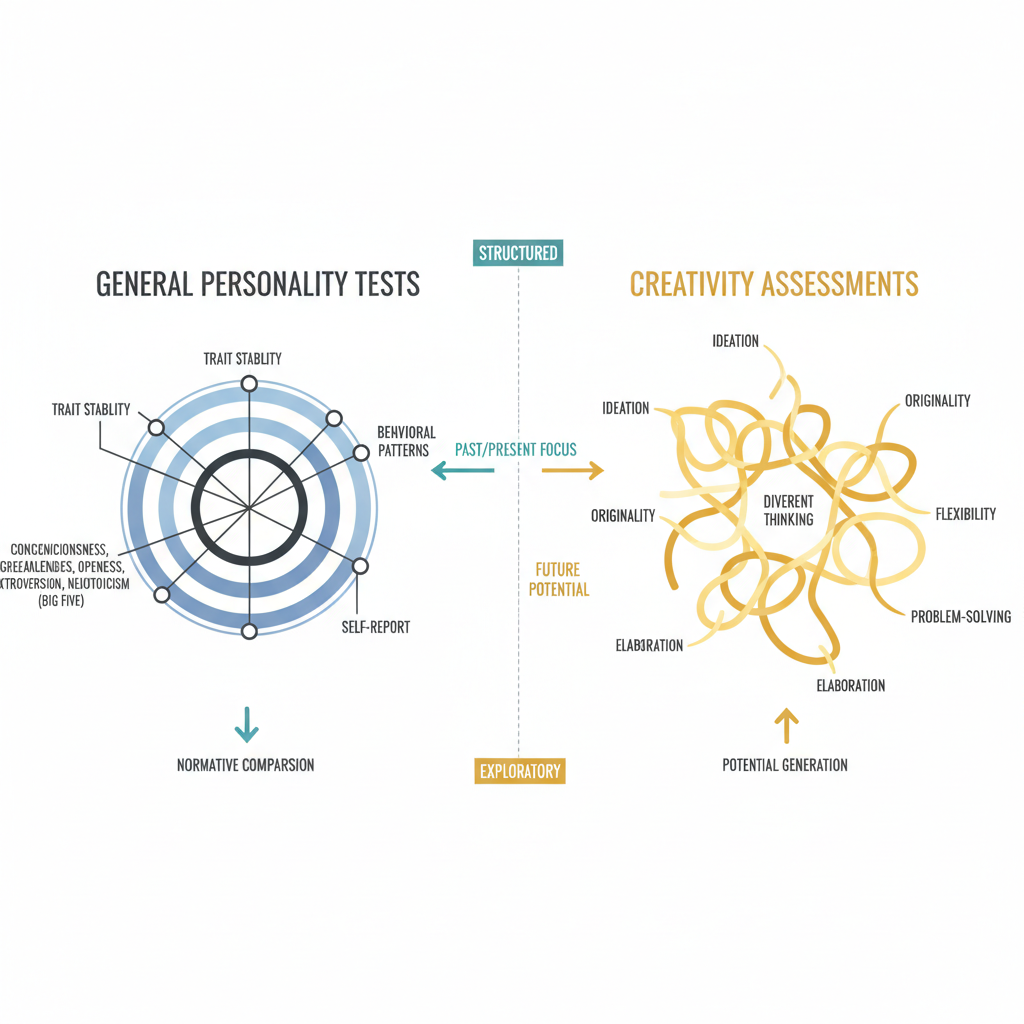
    The California Psychological Inventory (CPI) and the Creative Ability Test are for different things. Each test gives you a unique look at yourself. Knowing how they differ helps you pick the right one for your goals.

    The CPI is a well-known personality test. It looks at your overall character, like your social style, self-control, and leadership potential. The goal is to give you a full picture of how you engage with the world. In short, it shows you your lasting personality traits.

    The Creative Ability Test, on the other hand, focuses only on your creative strengths. It measures key parts of creativity, such as flexible thinking, idea generation (divergent thinking), and new ways of solving problems. Our science-backed, 30-question test shows your creative potential. It also helps you see how you tackle new ideas and challenges. [6]

    So, the CPI gives you a broad overview of your personality. The Creative Ability Test takes a focused look at your creative mind. Both are useful, but they explore different parts of who you are.

    Outcomes: Understanding Behavior vs. Enhancing Innovation

    The results from each test lead to different actions you can take. Both tests help you understand yourself better, but they help you grow in different ways.

    CPI results give you a look at your everyday behavior. They can explain your leadership style or how you work in a team. They also help you understand how you make decisions. This is helpful for career planning or making teams work better. It shows you why you act the way you do in certain situations.

    In contrast, the Creative Ability Test is about real, practical growth. It gives you personalized feedback and clear steps to improve your creative and problem-solving skills. You learn practical ways to generate more ideas. This helps you bring more innovation into your life. Our test goes beyond just understanding. It gives you a clear plan for doing more and improving what you create. This means you can apply what you learn to real challenges. [7]

    To sum it up: The CPI helps you understand your personality. The Creative Ability Test gives you the tools to grow and use your creative skills.

    Which Assessment is Right for You?

    Which test is right for you? It all depends on your goals. Both can lead to valuable self-discovery. Think about what you want to learn and how you’ll use that knowledge.

    Choose the California Psychological Inventory if you want to:

    • Get a big-picture view of your personality.
    • Learn about your social style and leadership skills.
    • Find career paths that match your core traits.
    • Understand your habits in social situations.

    Opt for the Creative Ability Test if your primary focus is to:

    • Discover your unique creative strengths.
    • Get personalized tips to improve your creative thinking.
    • Become better at flexible and creative thinking.
    • Learn how to use your creativity to solve problems.
    • Find new ways to grow, both personally and professionally.

    In the end, you might find that both tests are helpful. Understanding your core personality from the CPI can support what you learn about your creativity. For example, knowing you’re a resilient person can explain why you stick with tough creative projects. But if your main goal is to measure, understand, and grow your creative skills, the Creative Ability Test is the perfect tool. It gives you a clear, science-backed way to develop your natural talents for innovation.

    Frequently Asked Questions

    Can you take the California Psychological Inventory test for free?

    Generally, no, you cannot take the full California Psychological Inventory (CPI) for free. It is a professional, copyrighted psychological test.

    The CPI is meant to be given by a professional. It’s used by trained experts, like psychologists or counselors. They explain the results to offer deep insights into a person’s personality and behavior.

    This process makes sure the test is accurate and used correctly. It also means you get helpful feedback that makes sense for you. You might find unofficial “CPI-like” quizzes online, but these are not scientifically proven. These free versions are not as reliable as the real CPI test.

    However, if you want to understand and grow your creative skills, the Creative Ability Test is another option. Our platform offers a science-based test focused only on creativity. It is designed to give you easy-to-understand, personal insights into your creative strengths.

    What is the reliability and validity of the California Psychological Inventory?

    The California Psychological Inventory (CPI) is a well-respected psychological test. It is known for being reliable and valid.

    Reliability means the test is consistent. If you take the CPI multiple times, your results should be similar each time. This shows it measures personality traits in a stable way [8].

    Validity means the test measures what it says it measures. The CPI has proven to be valid. It accurately measures different parts of your personality and behavior. This makes it a trusted tool for career planning, leadership training, and personal growth [8].

    Because it is a strong scientific tool, it is widely used. Researchers and professionals trust the CPI’s results to make important decisions. Understanding your personality with a proven test can be a powerful step toward self-awareness and personal growth.

    Similarly, the Creative Ability Test is built on a strong scientific foundation. Our 30-question test is both reliable and valid. This ensures you get accurate, useful insights into your unique creative skills.

    Where can I find the California Psychological Inventory PDF?

    You cannot download the official California Psychological Inventory (CPI) as a PDF to take on your own. The CPI is a protected test, and only qualified professionals can get it.

    These strict rules protect the test’s quality. They prevent the test from being used incorrectly and make sure the results are explained properly. Certified experts receive special training to give the test, score it, and explain the results.

    Because of this, you won’t find a real, free CPI PDF online. To take the CPI, you need to contact a psychologist, a career counselor, or a company that uses the test. They can give you the test properly and provide professional feedback.

    If you want an easy way to explore your creativity, the Creative Ability Test is a great solution. Our platform has a user-friendly online test. It gives you personal insights and tips to help you grow your creative skills.


    Sources

    1. https://www.cpp.com/products/cpi/applications.aspx
    2. https://www.cpp.com/products/cpi/index.aspx
    3. https://psycnet.apa.org/record/1988-12502-001
    4. https://www.psychologytoday.com/us/blog/the-creativity-post/201201/what-is-creativity-0
    5. https://www.cpp.com/products/cpi/cpi_info.aspx
    6. https://www.apa.org/education-career/guide/science-psychology
    7. https://www.researchgate.net/publication/232491500_Assessing_Creative_Potential_From_Psychometric_to_Pragmatic_Approaches
    8. https://www.cpp.com/products/cpi/reliability_validity.aspx
  • Psychometric Assessment of Personality in Psychology: A Guide to Unlocking Your Creative Potential

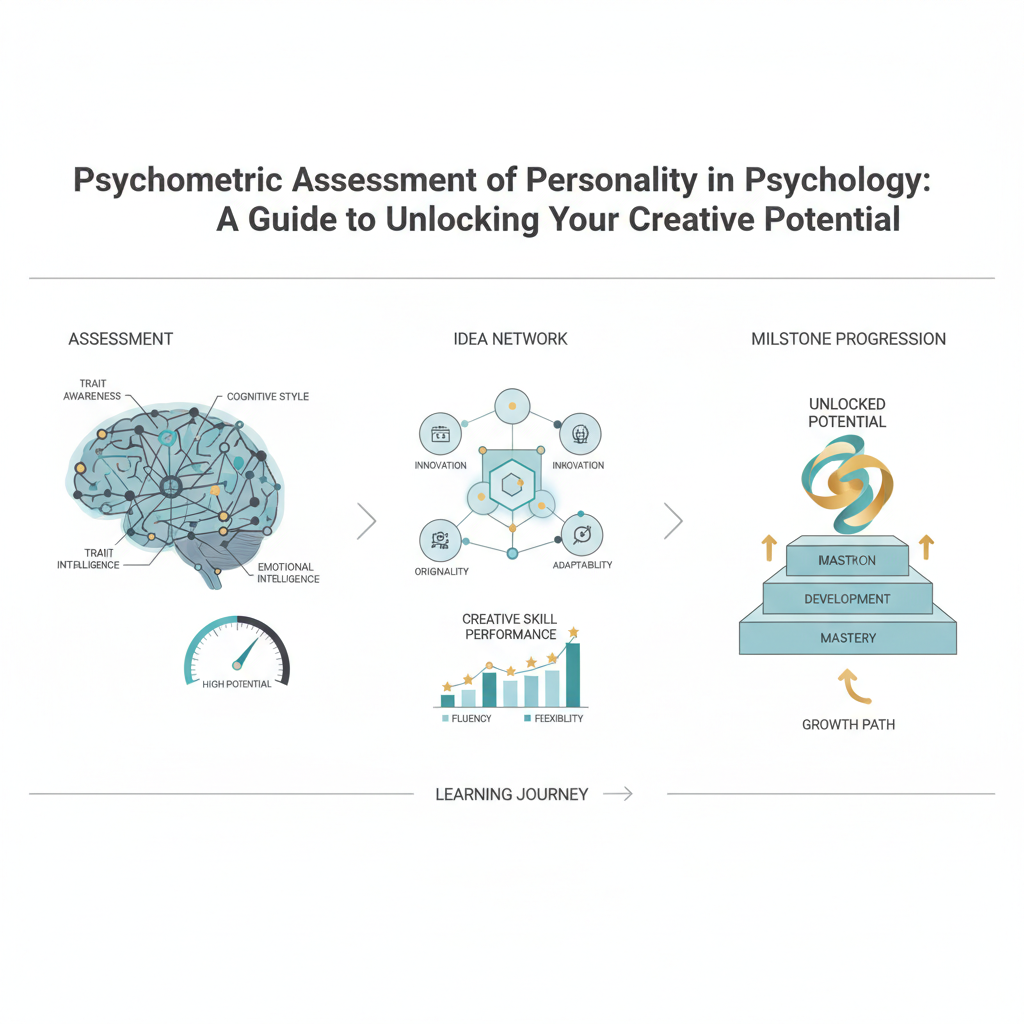
    Psychometric Assessment of Personality in Psychology: A Guide to Unlocking Your Creative Potential

    A psychometric assessment of personality in psychology is a standardized, scientific method used to measure an individual’s mental capabilities and behavioral style. These tests are designed to be objective and are used to evaluate traits like openness, cognitive flexibility, and problem-solving skills, providing reliable insights into a person’s character and creative potential.

    Many of us are curious about our own creativity. We might wonder how our way of thinking helps us innovate, solve problems, or express ourselves. What if there was a scientific way to understand how your creative mind works? This article explores psychometric assessment of personality in psychology, showing how these tools offer real insight into who you are and how you create.

    Unlike online quizzes, these tests go deeper. They provide a reliable, evidence-based way to explore the personality traits and thinking styles that drive your creativity. By understanding these parts of yourself—from your mental flexibility to your openness to experience—you can gain practical self-awareness. This knowledge helps you identify your creative strengths, find areas for growth, and build a strategy to boost your innovative thinking in all parts of your life.

    In this guide, we will explain how these assessments work, which key personality traits link to creativity, and how you can use this information to unlock your full potential. Get ready to understand your thinking style better and discover how to nurture your natural ability to innovate and inspire.

    What is a Psychometric Assessment of Personality in Psychology?

    Going Beyond Simple Labels: A Scientific Approach

    Understanding yourself is a powerful journey. A scientific personality assessment can help you explore who you are. It goes beyond simple labels to give you deep, evidence-based insights into your traits and thinking styles. This scientific approach helps you understand the “why” behind your behavior and your true potential.

    Psychometrics is the science behind psychological measurement [1]. When used for personality, it relies on carefully designed tools to objectively measure parts of who you are. The goal is to give you a reliable and accurate picture of your personality. This is key to understanding human potential, including creativity.

    For creativity, Psychometric assessments are very useful. They help spot the personality traits linked to new ideas, like openness and curiosity. These tests look at how you solve problems and think flexibly. They also measure your ability to brainstorm many unique ideas at once.

    The Creative Ability Test is built on this scientific approach. It shows your creative strengths and thinking patterns, helping you understand your natural talent for innovation. It also points out areas where you can improve. We explain complex ideas in a simple way, so you can build confidence and grow your creative skills.

    How Is This Different From a Standard Personality Quiz?

    You’ve probably taken many online personality quizzes that tell you which animal you are or your creative color. While fun, these are very different from a scientific assessment. Knowing the difference is important if you want to truly understand yourself.

    Here’s how a scientific assessment is different from a standard personality quiz:

    • Scientific Foundation: Scientific assessments are based on deep psychological research and theories. They are developed by experts. Standard quizzes are usually just for entertainment and aren’t backed by science.
    • Rigorous Development: Our assessments are thoroughly tested to ensure they are accurate (they measure what they claim to) and reliable (they provide consistent results). Casual quizzes don’t go through this process.
    • standardized questions: Scientific tests use carefully worded questions that are the same for everyone. This allows for fair, unbiased comparisons. Online quizzes often use questions that are unclear or can be interpreted in different ways.
    • Actionable Insights: The results from a scientific assessment give you useful advice. You get clear, personal feedback with steps you can take to grow. Standard quizzes usually offer vague or fun results with no real guidance.
    • Focus on Potential: Our scientific approach highlights your cognitive flexibility and problem-solving skills. It identifies your unique ways of thinking creatively. A typical quiz gives you a simple label but no clear path for personal growth.

    The Creative Ability Test gives you insights backed by science. Our 30-question assessment explores different aspects of your creativity. We provide personal feedback that shows how your personality affects your creative skills. This helps you turn uncertainty into self-awareness and move from inconsistent results to a clear plan for growth. You get more than a score; you get a roadmap for your creative journey.

    How Do These Assessments Measure Personality and Creativity?

    Infographic showing how psychometric assessments measure creativity, represented by interconnected geometric shapes illustrating various creative dimensions and influencing personality traits on a competency map.
    A minimalist, vector-based infographic illustrating ‘How Do These Assessments Measure Personality and Creativity?’. The central concept is a clean, structured competency map. A primary geometric shape (e.g., a hexagon) labeled ‘Creativity Potential’ in a soft blue gradient is at the center. Connected by charcoal lines are several smaller, distinct geometric shapes (e.g., circles, squares) representing key dimensions like ‘Divergent Thinking’, ‘Openness to Experience’, ‘Problem Sensitivity’, and ‘Originality’, each with a subtle teal or gold accent highlight. Around these, a lighter, semi-transparent layer of geometric shapes (e.g., abstract polygons) represents ‘Influencing Personality Traits’, subtly interacting with the creative dimensions. Short, clear labels indicate assessment metrics. The layout maintains ample negative space and visual hierarchy. No people, no cartoons, professional and educational aesthetic.

    What Makes a Creativity Test Accurate?

    To understand how creativity tests work, we need to look at two key ideas: validity and reliability. These principles make sure a test gives you results you can trust. Without them, a test is just guessing.

    Validity asks a simple question: Does this test actually measure creativity? A valid creativity test measures your creative skills, not just something related like your vocabulary. For example, a valid test for “divergent thinking” will accurately show how well you can come up with many different ideas [2].

    Reliability is all about consistency. If you take the same test a few times, will you get similar results? A reliable test gives you a steady score, building your trust in the feedback you receive.

    Our Creative Ability Test is built on this scientific foundation. We’ve designed it to be both valid and reliable, so you can be confident that your results and personalized feedback are accurate.

    Key Personality Traits for Creativity

    Creativity isn’t one single thing. It’s a mix of different personality traits. Our assessment explores these traits to show how your personality can help or hinder your creative side. Research shows a clear link between certain personality traits and creative potential [3].

    Here are some of the key personality traits linked to creativity:

    • Openness to Experience: This is one of the strongest signs of creativity. People high in openness are curious, imaginative, and welcome new ideas. They enjoy exploring unusual concepts and trying new things.
    • Conscientiousness (in moderation): Being organized and disciplined can be helpful, but not to an extreme. A balanced approach helps you follow through on ideas without becoming too rigid to think freely.
    • Extraversion and Introversion: Both personality types can be creative in their own ways. Extraverts often come up with ideas by talking with others. Introverts may find their best ideas through quiet, deep thinking.
    • Emotional Stability: People who are calm and less prone to worry can focus better and push through creative blocks. This steady mindset is important for doing innovative work.

    Knowing where you stand on these traits gives you a starting point. It helps you understand your natural creative tendencies. Our 30-question assessment explores these areas to reveal how your unique personality shapes your creative skills.

    From Personality Insights to Creative Strengths

    Knowing your personality traits is the first step. The real power of our assessment is turning those insights into real-world creative strengths. We don’t just label you. We show you how you create and how you can get even better.

    Your test results are like a personal guide to your creativity. They show your natural ways of thinking and solving problems. This goes beyond guesswork and gives you practical knowledge. For instance, if you score high on openness, you are probably great at thinking in new directions and coming up with a lot of original ideas.

    The Creative Ability Test helps you:

    • Understand Your Creative Thinking Style: Learn if you’re a natural idea generator, a careful planner, or a flexible problem-solver. Every style has its own benefits.
    • Identify Specific Strengths: Discover what you’re best at, whether it’s curiosity, imagination, or the ability to switch between different ideas. You can use these skills at work and in your personal life.
    • Pinpoint Areas for Growth: Everyone has room to improve their creative skills. Our assessment points you toward the best opportunities to grow.
    • Apply Creativity to Real-World Challenges: See how your unique creative profile helps you solve problems, from small daily tasks to big new projects.

    This process turns confusion about your creative skills into clear self-awareness. You’ll understand your strengths and get practical tips for improvement. This helps you use your creativity in every part of your life.

    What Are the Benefits of a Psychometric Approach to Self-Discovery?

    Infographic depicting the benefits of psychometric self-discovery as a layered, expanding diagram, showing progression from initial insights to understanding strengths, growth areas, and unlocking creative potential.
    A minimalist, vector-based infographic illustrating ‘What Are the Benefits of a Psychometric Approach to Self-Discovery?’. The visual represents growth and discovery as a layered, abstract, expanding spiral or concentric rings. The core is a small, charcoal circle labeled ‘Self-Insight’, emanating outwards are larger, clean geometric rings or segments, each representing a benefit: ‘Awareness of Strengths’, ‘Clarified Growth Paths’, ‘Unlocked Potential’, ‘Personalized Creative Strategy’. Each layer uses soft blues and whites with subtle gradients, and key labels or indicators are highlighted with gold or teal accents. The overall aesthetic is professional, approachable, with significant negative space for clarity and an emphasis on expansion and progression. No people, no cartoons.

    What Are the Benefits of a Psychometric Approach to Self-Discovery?

    A journey of self-discovery is life-changing, and a psychometric approach makes that journey even better. It replaces guesswork with a clear, science-backed map of your inner world. This method gives you deep insights into how you think and create, helping you understand your true creative potential.

    Our Creative Ability Test uses this approach to help you find your unique strengths. The practical knowledge you gain can empower you in your personal life and at work.

    Gaining Actionable Self-Awareness

    To grow, you first need to understand yourself. A psychometric assessment gives you this key insight by shining a light on your natural creative abilities. You learn about your mental flexibility and your openness to new experiences, both of which are essential for creativity.

    This is more than just self-reflection; it’s feedback based on data. You get a clear picture of your creative thinking styles, which builds confidence and shows you where you can improve.

    Here’s what you get with actionable self-awareness:

    • Uncovering Hidden Strengths: Find creative talents you didn’t know you had. Many people underestimate their natural ability to be creative [4].
    • Clarifying Your Thinking: Learn if you lean towards divergent thinking (coming up with many ideas) or convergent thinking (narrowing down to the best solution).
    • Understanding Your Motivations: Discover what truly inspires you to be creative. This helps you use your natural drive more effectively.
    • Personalized Feedback: Get specific insights based on your unique results. This feedback helps you understand *why* you think the way you do.

    This deep self-awareness is a powerful tool. It helps turn vague goals into clear plans so you can actively support your creative mind.

    Identifying Your Unique Problem-Solving Style

    Creativity is often about solving problems in new ways. A psychometric test helps you find your natural approach. Everyone has a unique problem-solving style, and learning yours is empowering because it lets you use your strengths effectively.

    Do you love tackling big, new ideas? Or are you better at improving what’s already there? The Creative Ability Test helps you see your patterns. Knowing this is important for your own growth and for working better with a team.

    Knowing your problem-solving style offers several advantages:

    • Optimizing Your Approach: You can pick tasks and projects that match your natural strengths, leading to more success and happiness.
    • Improving Collaboration: Learn how your style fits with others on your team. This helps everyone work together better and come up with new ideas.
    • Adapting to Challenges: When you face a new problem, you’ll know how to adjust your approach and use the best strategy for the situation.
    • Enhancing Innovation: When you know what you bring to the table, you can look for more chances to be creative, whether in small daily tasks or on big projects.

    Knowing your own style also helps you appreciate how others think. You learn to value different points of view, which makes you a more flexible and effective problem-solver.

    Building a Strategy for Personal and Professional Growth

    An assessment is more than just a snapshot of where you are now—it’s a starting point for growth. A psychometric approach gives you practical strategies to improve your creative skills. It helps you move from simply understanding yourself to actively getting better.

    The results from your test act as a personal guide. You can focus on specific areas you want to improve, like thinking more flexibly or getting better at brainstorming new ideas. This clear plan helps you grow faster.

    A clear growth strategy empowers you in many ways:

    • Targeted Skill Development: Get practical tips to build specific creative skills, so you can be sure your effort is well spent.
    • Overcoming Creative Blocks: Figure out what’s causing you to feel stuck and use the right strategies to get past it.
    • Career Advancement: Use creative problem-solving at work to open up new opportunities and feel more satisfied in your job.
    • Personal Enrichment: Bring more creativity into your hobbies and daily life for a richer, more enjoyable experience.
    • Sustained Learning: Build a habit of always improving. The assessment gives you a plan for your ongoing creative journey.

    Ultimately, a psychometric assessment like the Creative Ability Test gives you power. It replaces uncertainty with clear self-awareness and helps you grow in a structured way. You get the tools you need to use your creativity well in all parts of your life.

    How Can You Use Your Assessment Results to Enhance Creativity?

    Infographic illustrating a progressive, multi-step framework for using psychometric assessment results to enhance creativity, showing a pathway from insights to practical application and skill development.
    A minimalist, vector-based infographic illustrating ‘How Can You Use Your Assessment Results to Enhance Creativity?’. The visual is a clean, progressive milestone pathway. It starts with a prominent geometric shape (e.g., a stylized diamond) in soft blue, labeled ‘Assessment Results’. From this central point, a series of interconnected, clean vector arrow-like shapes or chevrons flow horizontally or vertically, each representing a step in enhancing creativity: ‘Understand Strengths’, ‘Address Growth Areas’, ‘Develop New Skills’, ‘Apply to Challenges’. Each step has a subtle gradient fill and is accented with gold or teal highlights. Small, abstract, geometric icons (e.g., a lightbulb for ‘Develop New Skills’) are subtly placed within each step. The overall layout features ample negative space, clear directional flow, and a professional, educational tone. No people, no cartoons.

    Understanding Your Cognitive Flexibility and Openness

    Your Creative Ability Test results give you a deep look into your unique mental strengths. Two key areas it measures are cognitive flexibility and openness to experience. Understanding these traits helps you unlock your creative potential.

    Cognitive flexibility is your brain’s ability to switch easily between different ideas. It’s also about how well you adapt to new situations, change your point of view, and come up with different solutions. If you have high cognitive flexibility, you can explore many options instead of getting stuck on one.

    Openness to experience is a key part of your personality. It shows how willing you are to try new things. It includes being curious and wanting variety. People with high openness enjoy mental challenges and are more open to new ways of thinking. This can greatly boost their creative work [source: https://psycnet.apa.org/record/1997-04022-014].

    Your test results show you where you stand in these areas. For example, a high score in cognitive flexibility means you likely adapt easily and come up with many solutions. A lower score isn’t a weakness—it just shows you an area where you can grow. Think of it as a clear path for improvement. Your results give you a personal starting point to build these important creative skills.

    Practical Tips to Nurture Your Creative Abilities

    Understanding your results is the first step. The real progress begins when you use what you’ve learned. Here are practical tips to boost your creativity. These ideas can help you grow, no matter your current scores.

    • Embrace New Experiences: Actively seek out new situations. Visit a new place or try a different hobby. This broadens your perspective and feeds your openness to experience.
    • Practice Divergent Thinking: Set aside time for brainstorming. Focus on quantity over quality at first. For any problem, generate as many ideas as you can. This strengthens your cognitive flexibility.
    • Challenge Your Assumptions: When you face a problem, question the obvious. Ask “What if…?” or “Why not…?” This helps you break free from your usual way of thinking.
    • Engage in Mindful Observation: Pay closer attention to your surroundings. Notice details you normally miss. This practice sharpens your observation skills and helps you make new connections.
    • Learn Something New Daily: Read articles outside your usual interests. Watch documentaries on different topics. Always learning gives you more ideas to work with.
    • Seek Diverse Perspectives: Talk about ideas with people from different backgrounds. Their unique views can challenge your thinking and lead to new, creative solutions.
    • Allocate “Thinking Time”: Set aside time to let your mind wander without a specific goal. This often leads to unexpected breakthroughs.
    • Experiment and Play: Don’t be afraid to fail. Treat creative projects as experiments. Being playful takes the pressure off and encourages new ideas.

    By adding these tips to your daily routine, you will strengthen your creative mind. You’ll go from knowing your potential to making it a reality. Your journey of personal growth starts now.

    The Creative Ability Test: A Path to Actionable Insights

    The Creative Ability Test is more than just a score—it’s a roadmap for your growth. Our science-backed, 30-question test looks at many sides of your creativity. It gives you a full picture of your unique strengths.

    You get feedback that is tailored to you. It highlights your specific creative talents and points out areas for growth. We turn complex ideas into simple, practical advice. Our goal is to help you on your path of self-discovery.

    The test helps you replace uncertainty with self-awareness. It guides you from feeling creatively inconsistent to growing in a focused way. You’ll learn how to apply your creativity to solve real-world problems and bring new ideas to your personal and professional life.

    By using these personal insights, you can create a clear plan for growth. You will learn to apply creative thinking to any challenge with confidence. The Creative Ability Test is your trusted partner in unlocking and improving your creative potential. Start your journey to continuous improvement and new ways of thinking today.

    Frequently Asked Questions

    What is a psychometric assessment in psychology?

    A psychometric assessment is a scientific way to measure parts of your mind. It fairly measures things like your abilities, personality traits, and creative potential. These tests are carefully made and based on proven ideas in psychology.

    Think of it as a map of your mind. It helps us understand how you think and solve problems. Unlike simple quizzes, these assessments offer results you can trust [5].

    At Creative Ability Test, we use these scientific methods to measure your creative strengths. We check how easily you can think in new ways. We also look at your openness to new experiences. This approach gives you real information to help you understand your creative side.

    What are some psychometric personality test questions and answers?

    Psychometric tests don’t have “right” or “wrong” answers. Instead, they learn about your preferences and how you tend to act. They use different types of questions to build a picture of your personality. For instance, you might see a statement and be asked how much you agree with it.

    Here are common types of statements you might see:

    • Likert Scale Questions: You rate how much you agree with a statement. For example, “I enjoy exploring new ideas, even unusual ones.” Your options might be “Strongly Disagree” to “Strongly Agree.”
    • Situational Judgment Tests: You’re given a situation and asked to choose the best response. This shows your practical problem-solving style.
    • Forced-Choice Questions: You have to choose one statement from a pair. Both options might seem positive. This helps show what you value most.

    Your “answers” don’t create a score. Instead, the pattern of your choices builds a profile. This profile highlights specific traits linked to creativity, such as your:

    • Openness to Experience: Are you curious and open to new things?
    • Cognitive Flexibility: Can you look at things from different angles?
    • Divergent Thinking: Can you come up with many different ideas?

    Our Creative Ability Test reads these patterns to give you clear feedback you can use. This feedback helps you understand your creative mind and shows you where you can grow. This is a journey to learn about yourself, not a pass-or-fail exam.

    What is in a psychometric assessment of personality assignment?

    Taking a test like our Creative Ability Test is more than just answering questions. It’s a guided way to understand yourself better. Think of it as a personal plan to boost your creativity.

    Your assessment includes a few key parts:

    • The Assessment Itself: This is a 30-question, scientifically based test that measures different parts of your creativity.
    • Personalized Feedback: You get a detailed report that explains your unique creative strengths and points out areas for growth.
    • Actionable Strategies: We give you useful tips based on your results to help you develop your creative thinking.
    • Insights into Creative Psychology: You’ll learn more about the science of creativity and how it applies to you.
    • Real-World Application Guidance: We show you how to use what you learn in your daily life, at work, or for personal projects.

    This process helps you move from feeling unsure to having a clear awareness of your skills. It guides you toward focused creative growth. The Creative Ability Test gives you the tools you need to unlock and use your full creative potential.


    Sources

    1. https://www.apa.org/education-career/guide/science-psychological-assessment
    2. https://psycnet.apa.org/record/2012-09419-001
    3. https://journals.sagepub.com/doi/10.1177/1745691617709322
    4. https://hbr.org/2012/03/we-are-all-creative
    5. https://www.apa.org/topics/testing/psychological-assessment

  • Psychology and Personality Assessment: A Guide to Unlocking Your Creative Potential

    Psychology and Personality Assessment: A Guide to Unlocking Your Creative Potential

    A psychology and personality assessment is a scientifically designed tool used to measure individual traits, cognitive styles, and behavioral patterns. When focused on creativity, these assessments identify key characteristics like openness to experience, divergent thinking, and problem-solving approaches, offering a clear roadmap to understanding and enhancing your creative potential.

    Ever wonder where your best ideas come from, or how some people solve problems so creatively? Creativity is more than just being artistic. It’s a key part of how we think, find solutions, and adapt to new situations. By understanding your personal creative style, you can unlock skills you didn’t know you had and find better ways to grow.

    This article explains how a science-based psychology and personality assessment can help you discover your unique creative strengths and thinking styles. We’ll explore how different personality traits and mental habits affect your ability to innovate. Our goal is to give you clear, practical information that helps you understand your own creative mind.

    We make assessing creativity simple. This guide will help you understand the science behind your imagination. You’ll find out what these tests reveal, how personality shapes your creative work, and how to use what you learn in your daily life. Get ready to build confidence in your creative skills and apply them to real challenges.

    What Can a Psychology and Personality Assessment Reveal About You?

    Curious about your inner inventor? A personality assessment can reveal your unique way of thinking. These tools are not just simple surveys. They offer a scientific look at your creative skills and thought patterns. This helps you understand yourself better.

    A good assessment is more than just a guess. It gives you reliable, science-backed insights into your natural talents. This clear picture is key to your personal and professional growth. It can even show you strengths you never knew you had.

    Discovering Your Creative Strengths and Styles

    First, an assessment helps identify your specific creative strengths by measuring different parts of creativity. For example, you might be good at coming up with many new ideas. This is called divergent thinking. Or maybe you are skilled at finding the one best answer. This is called convergent thinking.

    You will learn about your unique cognitive styles, or your natural ways of thinking. Some people are natural “outside the box” thinkers. Others work best with a clear structure. Knowing your style helps you improve your creative process. It also lets you solve problems more effectively.

    These tests often look at several key areas:

    • Divergent Thinking: This is your skill for coming up with many different ideas. It’s key for brainstorming and finding new solutions. People who are strong in this area often see possibilities everywhere.
    • Cognitive Flexibility: Can you switch your point of view easily? Cognitive flexibility helps you adapt and look at problems from different angles. This skill is vital for solving tough problems. [1]
    • Openness to Experience: This personality trait is closely tied to creativity. It shows how willing you are to try new things and appreciate art and imagination. High openness often means you enjoy new experiences.
    • Problem-Solving Approaches: Do you prefer logical or gut-feeling methods? Some people break problems down into smaller parts. Others trust their intuition. Knowing your style helps you use it more effectively.
    • Innovation Skills: Assessments can measure your ability to be original. They show how comfortable you are with uncertainty. These insights help you develop groundbreaking ideas.

    Boosting Personal Growth and Confidence

    Gaining self-awareness is a key benefit. When you know your creative strengths, your confidence grows. You see why some tasks feel easy and why others are a struggle. This clarity is empowering.

    The results also give you practical tips for improvement. For example, if you have trouble coming up with ideas, you’ll get techniques to help. If you’re great at having unique ideas, you’ll learn how to use that skill more often. This helps you grow in a clear, focused way.

    Many people discover they are more creative than they thought. An assessment can confirm these hidden talents and give you a foundation for personal growth. You can then focus on developing your creative skills, leading to ongoing self-improvement.

    Applying Insights to Real-World Challenges

    These assessments are not just theoretical. They provide a practical guide for using what you learn. You’ll see how to apply your creativity every day—at work, in your hobbies, and in your personal life.

    For professionals, these insights are very valuable. You can improve teamwork and find new ways to solve business problems. Students can choose subjects that better match their strengths. Everyone can use their creative skills to be better innovators and problem-solvers.

    The Creative Ability Test offers a complete assessment that scientifically measures these areas. You receive personalized feedback to help you unlock your full creative potential.

    How Does Personality Influence Your Creative Potential?

    The Role of Key personality traits in Creativity

    Your personality is a key driver of your creative potential. It shapes how you think, feel, and connect with the world. Certain traits can boost your creativity, while others might hold you back.

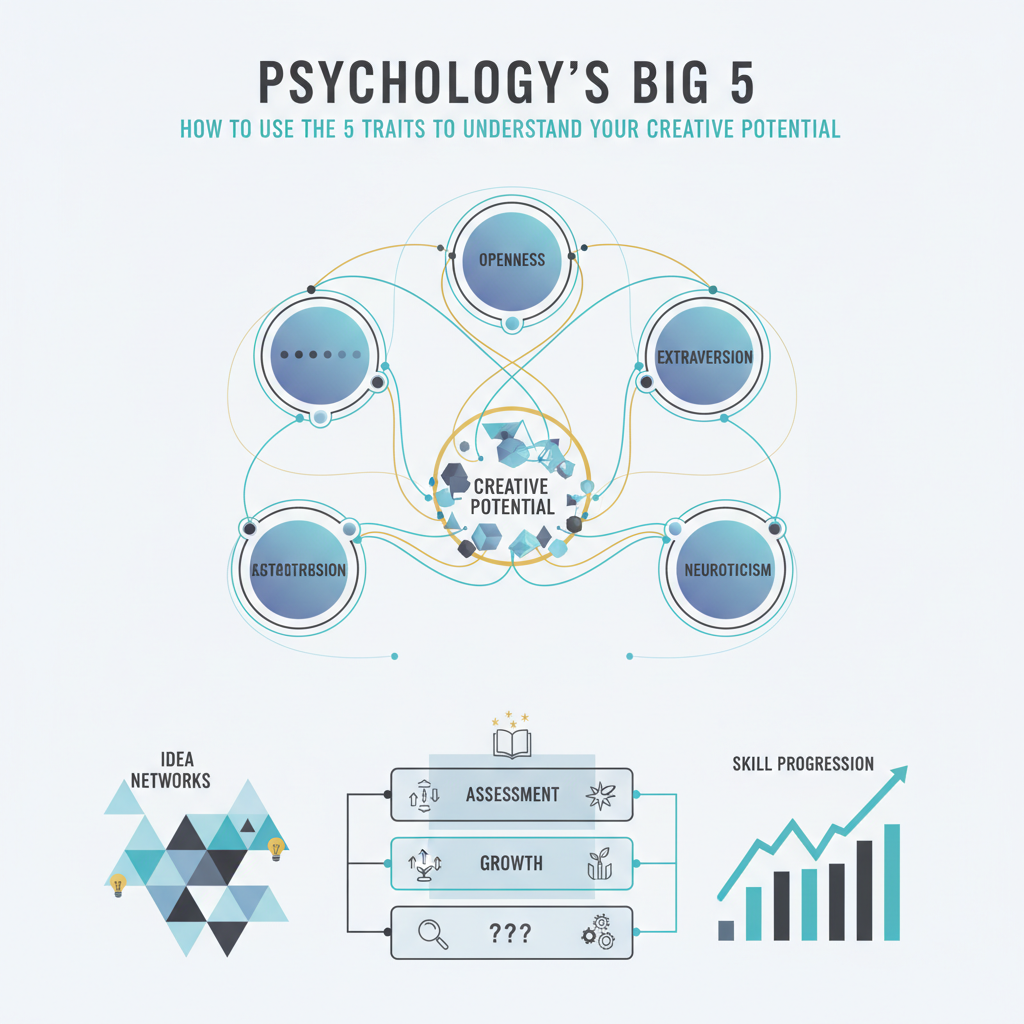
    Psychologists often use tools like the “Big Five” personality traits to explore this link. These traits provide a solid way to understand how people differ [2]. They show us why some people are naturally more innovative.

    Creativity is complex, but some traits are common in highly creative people. Learning about these traits helps you understand yourself better. It shows you your natural tendencies for creative thinking.

    Key personality traits that influence creativity include:

    • Openness to Experience: This is one of the most important traits for creativity. It means you are curious and willing to explore new ideas.
    • Conscientiousness: While this trait can seem rigid, being somewhat conscientious helps turn creative ideas into real projects. It involves being disciplined and careful.
    • Extraversion: Engaging with others and brainstorming can spark new ideas. However, introverts also show high creativity, often through deep reflection.
    • Agreeableness: Agreeable people are often cooperative. This helps create a good environment for working on creative projects together.
    • Neuroticism (Emotional Stability): While high neuroticism can be tough, the strong emotions that come with it can sometimes fuel artistic expression.

    Our Creative Ability Test helps identify your mix of these traits. It shows you your personal creative strengths. Knowing this is key to helping you grow.

    Understanding Openness to Experience

    Openness to Experience is a key part of creativity. This trait shows how open you are to new and different ideas. People who are often innovating and exploring usually have this trait.

    People with a high degree of openness are naturally curious. They enjoy trying new things. They also appreciate art, adventure, and unusual ideas. They tend to be imaginative and love to learn [3].

    This trait helps creativity in a few ways:

    • Intellectual Curiosity: You love learning and exploring complex concepts.
    • Imagination: You can easily imagine new possibilities and abstract ideas.
    • Aesthetic Sensitivity: You appreciate beauty and artistic expression in various forms.
    • Unconventional Thinking: You are comfortable questioning the usual way of doing things and exploring different viewpoints.
    • Emotional Breadth: You experience a wide range of emotions deeply.

    For example, an open artist might try new materials. An open entrepreneur might try new business models. A scientist might explore research that combines different fields. All these actions come from a desire for new experiences and ideas.

    The Creative Ability Test measures your level of openness. It helps you see how this key trait shapes your creative style. This knowledge allows you to use your natural curiosity to your advantage.

    Connecting Cognitive Styles to Creative Problem-Solving

    Creativity isn’t just about having good ideas. It’s also about how you handle information and solve problems. Your “cognitive style” is your usual way of thinking, seeing, and remembering things. These styles affect how you solve problems in a creative way.

    Two main ways of thinking are key to creative problem-solving: divergent thinking and convergent thinking.

    • Divergent Thinking: This is the ability to generate many different ideas from a single starting point. It involves exploring multiple solutions and possibilities. Brainstorming is a classic example of divergent thinking in action [4].
    • Convergent Thinking: This style focuses on finding the one best answer to a problem. It uses logic and careful judgment. Choosing the best idea after brainstorming is an example of convergent thinking.

    To solve problems creatively, you need to switch smoothly between these two styles. First, you use divergent thinking to create lots of options. Then, you use convergent thinking to choose the best one.

    Cognitive flexibility is also very important. This is your ability to change how you think about a problem. It helps you adjust your plan when you run into something unexpected. Highly creative people are often very flexible in their thinking [5].

    Our assessment shows where you are strong in these ways of thinking. It gives you a clear picture of how you solve problems. You’ll learn how you naturally come up with ideas and make choices. This insight can help you improve your creative skills in any situation.

    What Are the Different Types of Psychology Assessments?

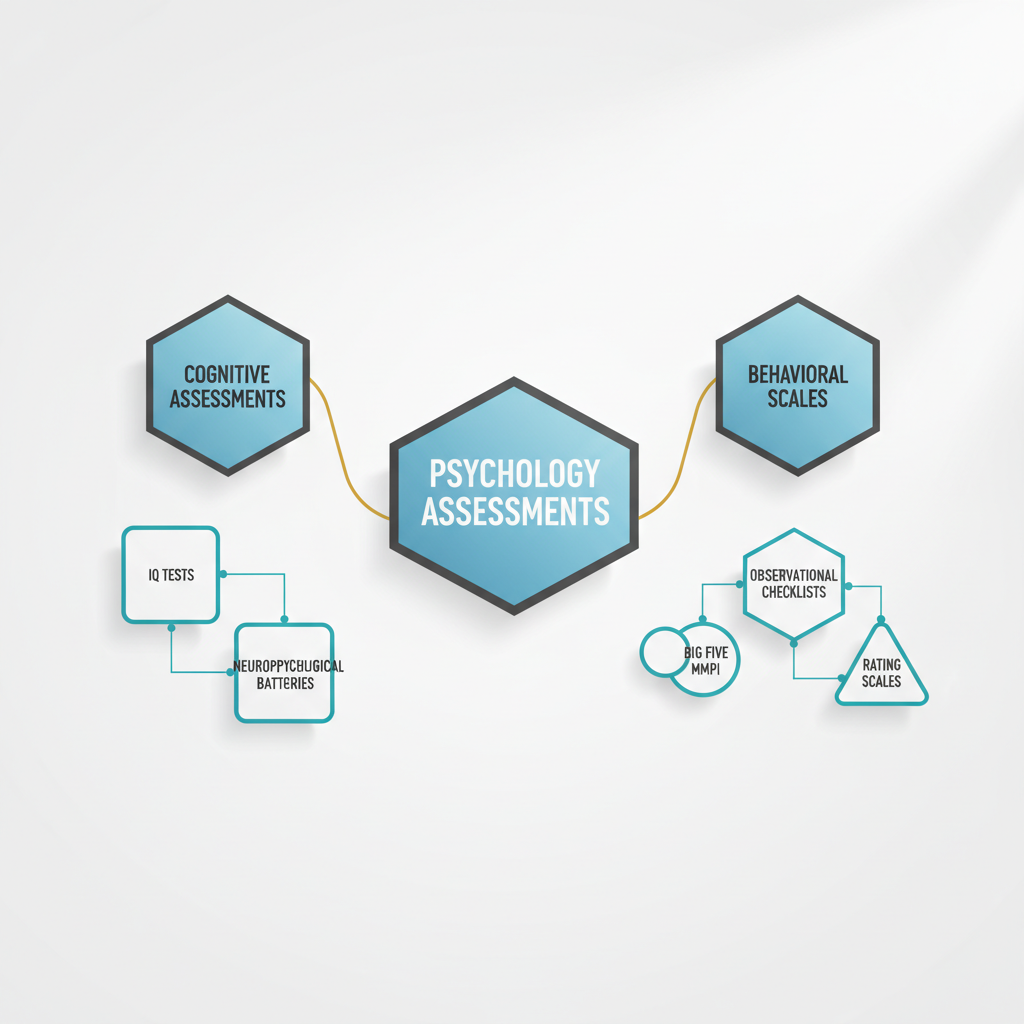
    An infographic showing a central node labeled 'Psychology Assessments' branching into three distinct geometric shapes, each representing a different type of assessment category.
    A clean, vector-based infographic presenting a conceptual overview of different types of psychology assessments. The visual features a central, abstract node or idea cluster labeled ‘Psychology Assessments’. From this central point, distinct geometric shapes branch out, each representing a major category of assessment such as ‘Cognitive Assessments’, ‘Personality Inventories’, and ‘Behavioral Scales’. Smaller, related geometric shapes or lines can emanate from these categories to suggest sub-types or specific focus areas. The color palette includes soft blues, whites, and charcoal for the main elements, with gold or teal accents used for connectors or to highlight category titles. The design incorporates ample negative space to maintain visual hierarchy and clarity for short labels. No humans, photographs, or cartoon elements.

    Self-Report Inventories vs. Projective Tests

    Want to understand your creative mind? An assessment is a great place to start. Psychologists use different tools to explore personality and creativity. The two main types are self-report inventories and projective tests.

    Self-report inventories are clear and simple. They ask you direct questions about your thoughts, feelings, and behaviors. You answer using a scale, like “strongly agree” to “strongly disagree.” These tests are easy to understand. They show you how you see yourself.

    A creativity self-report might ask how you feel about unclear situations. It may ask about how you solve problems. You might rate how much you enjoy new experiences. This method gives you data that is easy to measure and understand. The Creative Ability Test uses this scientific approach. It measures specific parts of your creativity.

    In contrast, projective tests are less direct. They use vague images or situations. A famous example is the Rorschach inkblot test [6]. Your answers are believed to show your hidden thoughts. They may reveal feelings or personality traits. The idea is that you “project” your inner self onto the vague image.

    While interesting, these tests are often subjective. Their meaning can be interpreted in many ways. This makes them less reliable for measuring specific creative skills. They are not precise enough to guide your personal growth. For useful insights into your creative strengths, self-report inventories are the better choice.

    How Scientifically-Grounded Assessments Work

    A good assessment is more than just an opinion. Scientific assessments are built on careful research. They give you reliable insights into your creative potential. This strong foundation makes them accurate and useful.

    These assessments follow key principles:

    • Validity: Does the test measure what it says it will? A valid creativity test accurately measures creative skills.
    • Reliability: Does the test give consistent results? If you take it again, your score should be about the same, unless you’ve changed.
    • Standardization: The test is given and scored the same way for everyone. This allows for fair comparisons.
    • Norms: Your results are compared to a large group of people. This shows you how your creative strengths compare to others.

    These principles help measure key parts of creativity. This includes things like divergent thinking [7]. They also measure cognitive flexibility. Both are key skills for creative problem-solving. A good assessment helps you move from being unsure to understanding yourself better. It gives you a clear path for growth. The Creative Ability Test is built on these scientific standards. It gives you personal and practical insights.

    Why Context Matters in Creativity Testing

    Creativity isn’t a fixed trait. It’s a process that changes. Your environment has a big impact on it. That’s why the context of a creativity test matters.

    Think about your daily life. You might feel more creative at home than at work under a tight deadline. Pressure can either help or hurt your ideas. Different tasks also require different types of creativity. Art is different from science or engineering.

    Your personal state matters, too. Stress, mood, and motivation all play a role. A test result is just a snapshot in time. It shows your usual ways of thinking creatively. It shows how you normally handle challenges. But it doesn’t define you forever. It simply shows your natural tendencies.

    The Creative Ability Test helps you understand your core creative strengths. It offers insights into your thinking styles. It then gives you practical tips. You can learn to be more creative in any situation. You can change your approach and use your skills in more ways. This helps you use your creativity to solve real-world problems.

    How Can an Assessment Measure Your Unique Creative Strengths?

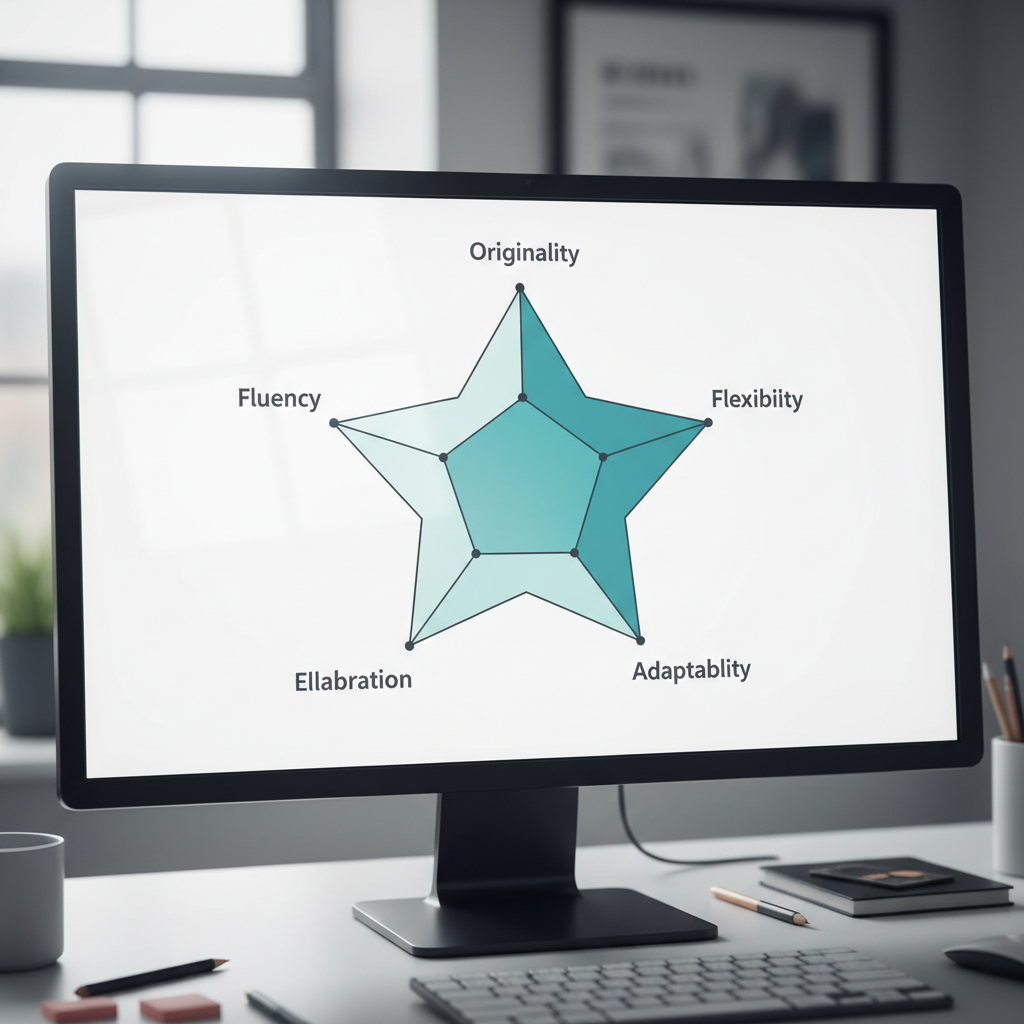
    An infographic showing a star-shaped competency graph with axes labeled for various creative strengths like originality and flexibility, filled with subtle gradients to indicate assessment scores.
    A clean, vector-based infographic representing the measurement of unique creative strengths. The visual features a star-shaped competency graph with multiple axes, each axis labeled with a specific creative strength such as ‘Originality’, ‘Fluency’, ‘Flexibility’, and ‘Elaboration’. Each axis has a subtle gradient fill, indicating a ‘score’ or ‘level’ for that strength. The overall design uses minimalist geometric shapes for structure, with soft blues, whites, and charcoal for the primary elements, and teal accents highlighting the filled areas. The layout maintains ample negative space around short text labels for clarity. No humans, photographs, or cartoon elements.

    The Role of Key personality traits in Creativity

    Your personality is a key driver of your creative potential. It shapes how you think, feel, and connect with the world. Certain traits can boost your creativity, while others might hold you back.

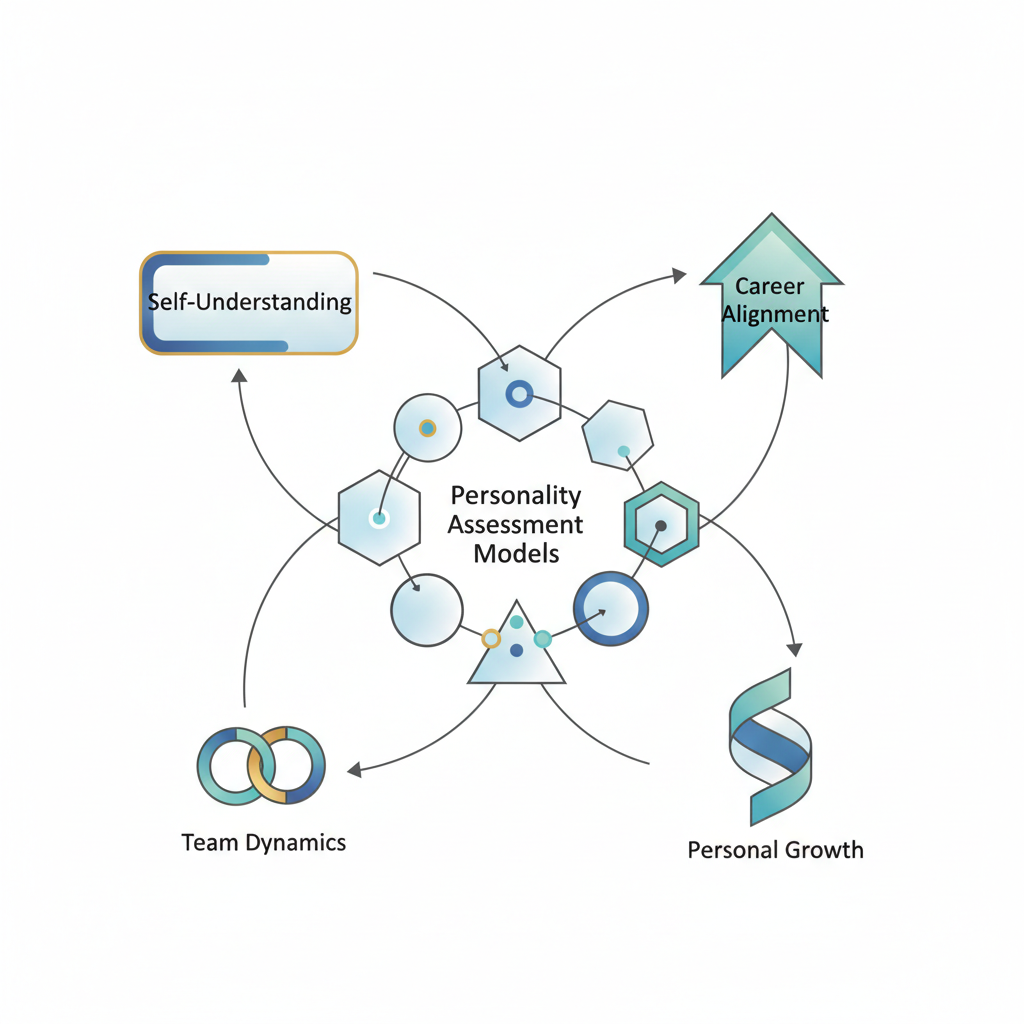
    Psychologists use various Personality Assessment Models to explore this link, and tools like the “Big Five” personality traits provide a solid way to understand how people differ [2]. They show us why some people are naturally more innovative.

    Creativity is complex, but some traits are common in highly creative people. Learning about these traits helps you understand yourself better. It shows you your natural tendencies for creative thinking.

    Key personality traits that influence creativity include:

    • Openness to Experience: This is one of the most important traits for creativity. It means you are curious and willing to explore new ideas.
    • Conscientiousness: While this trait can seem rigid, being somewhat conscientious helps turn creative ideas into real projects. It involves being disciplined and careful.
    • Extraversion: Engaging with others and brainstorming can spark new ideas. However, introverts also show high creativity, often through deep reflection.
    • Agreeableness: Agreeable people are often cooperative. This helps create a good environment for working on creative projects together.
    • Neuroticism (Emotional Stability): While high neuroticism can be tough, the strong emotions that come with it can sometimes fuel artistic expression.

    Our Creative Ability Test helps identify your mix of these traits. It shows you your personal creative strengths. Knowing this is key to helping you grow.

    How to Use Your Assessment Results for Personal and Professional Growth

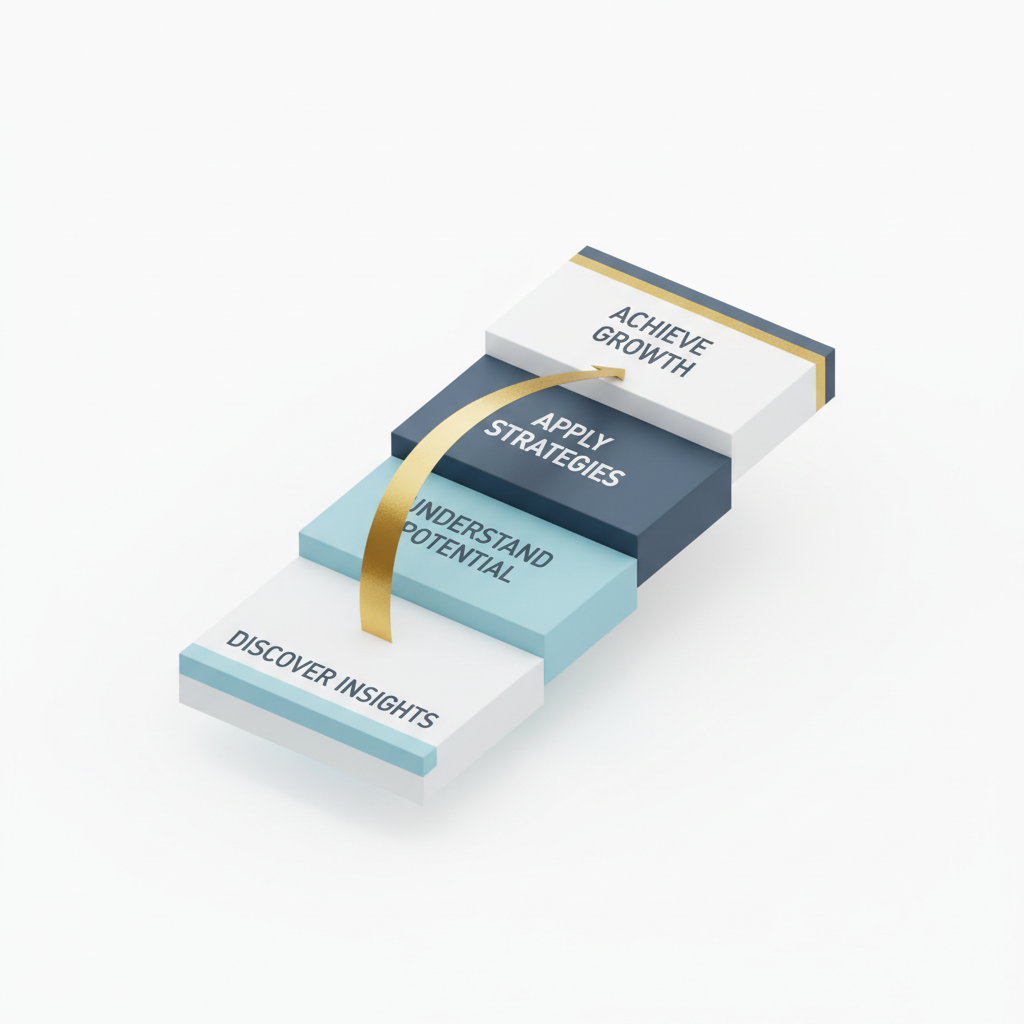
    A minimalist infographic depicting a layered, upward progression of abstract geometric shapes, symbolizing steps for personal and professional growth using assessment results.
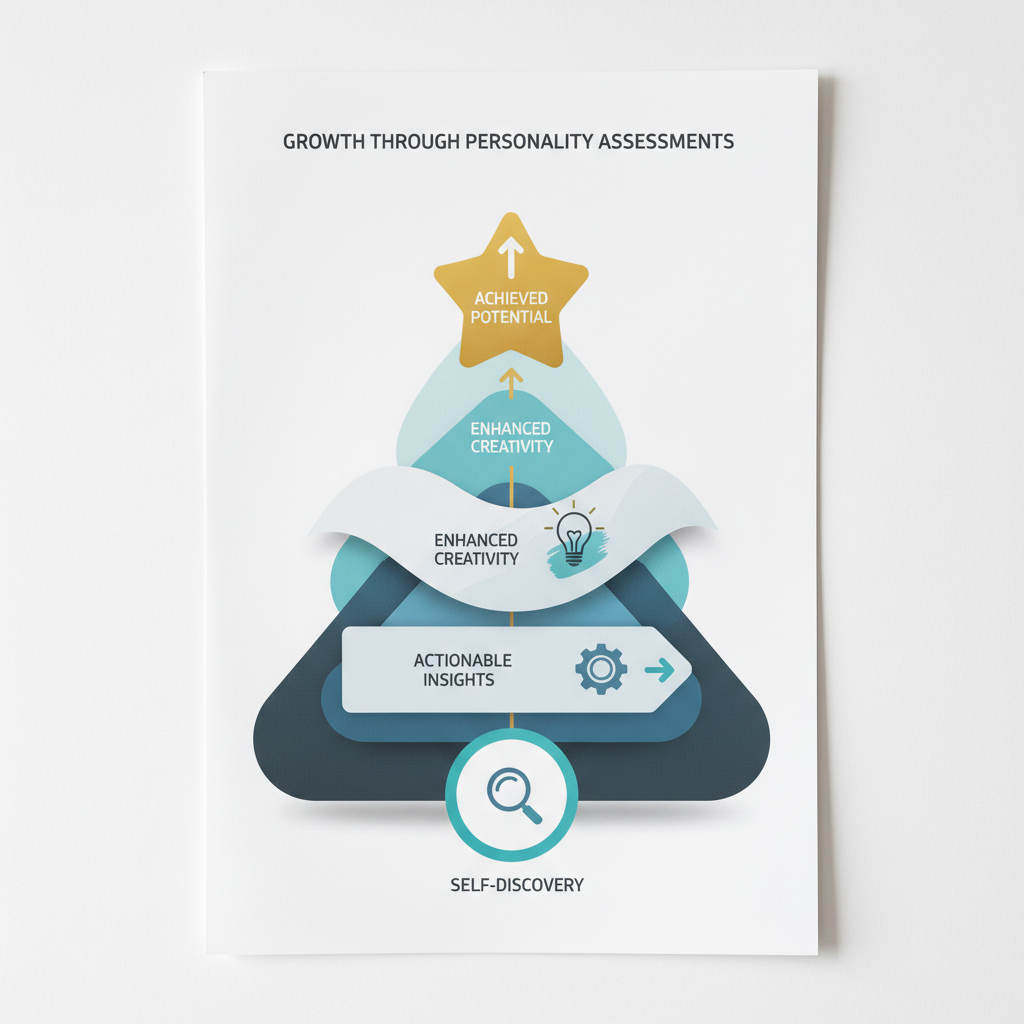
    A minimalist, vector-based infographic illustrating a clear, stepwise progression for personal and professional growth using assessment results. The visual depicts a series of abstract, ascending geometric platforms or layers, each representing a stage of growth such as ‘Discover Insights’, ‘Understand Potential’, ‘Apply Strategies’, and ‘Achieve Growth’. A subtle, directional arrow or path connects these stages, emphasizing progression. The design utilizes soft blues, whites, and charcoal for the main structure, with elegant gold accents on the connecting elements or key growth indicators. Ample negative space is incorporated for short labels. No humans, photographs, or cartoon elements.

    Applying Insights to Your Daily Work

    Your Creative Ability Test results are a blueprint of your personal creative strengths. Using these insights can change how you work each day.

    For example, if you score high in divergent thinking, you’re great at generating ideas. You can use this skill to lead brainstorming sessions or suggest new ways to solve old problems. This makes your work more valuable.

    Also, if you have strong cognitive flexibility, you adapt easily and can switch your viewpoint quickly. This skill is very useful in busy workplaces and helps you handle unexpected challenges.

    Consider these practical ways to use your results:

    • Problem-Solving: Use your strengths to solve tough problems. If you have analytical skills, break down problems step by step. If you are more imaginative, explore new or unusual solutions.
    • Decision-Making: Use your creative thinking to weigh your choices. Think about different results before you choose a path. This leads to stronger decisions.
    • Team Collaboration: Share your creative profile with your team. This helps them understand you better. You can then use your strengths where they’re needed most. Encourage others to do the same.
    • Innovation: Look for chances to create new processes or products. Your insights can spark new ideas in your role. Many companies value creativity in their employees [8].

    Taking these steps turns self-awareness into real career growth. You’ll become a more effective and creative professional.

    Developing Strategies to Enhance Creative Thinking

    Your Creative Ability Test gives you personal feedback. It points to areas where you can improve your creativity. It shows what you do well and also where you can grow.

    Improving creativity is a skill you can learn, not just a talent. It takes practice and the right methods. Many techniques are supported by science [9].

    Here are some effective ways to boost your creative thinking:

    • Embrace Divergent Thinking Exercises: If you want to improve your divergent thinking, try “uses for an object” games. Think of as many new uses as you can for a brick or paperclip. This trains your brain to think in new ways.
    • Cultivate Cognitive Flexibility: Question what you think you know. Look at problems from different angles. Read books on new topics. Talk with people who have different views.
    • Practice Mind Mapping: This visual tool helps organize your thoughts. Start with a main idea and then add related words and concepts. It helps you make connections and create more ideas.
    • Engage in Brainstorming Sessions: Take part in or lead brainstorming. At first, focus on the number of ideas, not the quality. Don’t judge ideas right away.
    • Seek New Experiences: Trying new things sparks creativity. Travel, learn a new skill, or visit a museum. New experiences give you new ideas.
    • Reflect and Journal: Think about how you create. What worked well? What got in your way? Journaling can help you see patterns and learn about yourself.

    Using these strategies regularly will make you more creative. This helps you produce new and better ideas more often.

    Building Confidence in Your Innovative Abilities

    Many people doubt they are creative. Your test results give you proof of your natural creative strengths. Knowing this is a great way to build your confidence.

    Seeing your unique creative profile helps you understand your value. You’ll see that creativity isn’t just for art or music. It’s also about solving problems and adapting to change in all parts of your life.

    This will help you share your ideas with confidence and trust your instincts. Your test results are proof of your unique talents, which helps you overcome self-doubt.

    Consider these points for building confidence:

    • Acknowledge Your Strengths: Your report shows your natural strengths. Celebrate them. Understand how they can help you succeed.
    • Understand Your Creative Process: Knowing how you think is helpful. It lets you trust your own way of doing things. This helps you stop comparing yourself to others.
    • Embrace Imperfection: Creativity means trying new things. Not every idea will be a success. See mistakes as chances to learn. Bouncing back is an important part of being creative.
    • Share Your Ideas: Start by sharing small ideas with people you trust at work. As you get good feedback, your confidence will grow. Your voice matters.
    • Recognize Small Wins: Did you solve a problem in a new way today? Did you offer a new viewpoint? Notice these moments. They help you build confidence in your skills.

    Your Creative Ability Test is more than a score. It is a guide to understanding yourself. It gives you the power to be more creative and confident.

    Ready to Discover Your Creative Potential?

    Take the Creative Ability Test Today

    You’ve learned how psychology and personality affect creativity. Now, it’s time to take action. Discover your unique creative strengths and start your journey today.

    The Creative Ability Test gives you a clear next step. It is a 30-question test backed by science that measures different parts of your creativity. Research shows that creativity can be measured and improved [10].

    Taking the test helps you:

    • Understand your thinking style: Discover how you approach problems and come up with new ideas.
    • Identify creative strengths: Find your specific talents, such as originality and flexibility.
    • Measure cognitive agility: See how easily you adapt and think in new ways.
    • Gain personalized feedback: Get feedback and insights made just for you.
    • Access actionable strategies: Learn practical ways to boost your creativity.

    This test is more than a score—it’s a guide to help you grow. You’ll go from feeling unsure to understanding yourself clearly. Turn random bursts of creativity into steady progress and become more confident in your ideas.

    Ready to understand how your creativity works? Want to find new ways to solve problems and be more innovative?

    Take the Creative Ability Test today. Start building a future where your creative potential shines. Your journey to deeper self-discovery begins here.

    Frequently Asked Questions

    What questions are in a psychology and personality assessment?

    Psychology and personality tests ask different kinds of questions. They are designed to learn about how you think, act, and what you prefer. Our Creative Ability Test, for example, has 30 science-backed questions. Each one helps measure your unique creative strengths.

    You’ll be asked about a few key areas:

    • Cognitive Flexibility: These questions check how well you adapt your thinking. They look at how easily you switch perspectives to solve a problem.
    • Divergent Thinking: This measures your ability to come up with many unique ideas. It looks at how you brainstorm and find more than one solution.
    • Problem-Solving Skills: You may see situations that need a creative solution. These questions show how you like to handle challenges.
    • Openness to Experience: Tests often ask about your curiosity and if you’re willing to try new things. This is a key part of being creative [11].
    • Self-Reflection: Many questions will ask what you usually do or prefer. For instance, “Do you like thinking about big ideas?” or “How do you act in new situations?” This helps create a full picture of your personality.

    The goal isn’t to find a “right” answer. Instead, these questions help us understand your unique creative style and way of thinking. This gives you personal and useful tips about your strengths.

    Can I get a psychology and personality assessment for free?

    Many websites offer free “personality quizzes” or “creativity tests.” But how accurate or deep they are can vary a lot. While fun, they often don’t have the deep research and science that professional tests do.

    A truly helpful test, like our Creative Ability Test, is built on a lot of scientific work. This includes:

    • Validated Methods: Our test is based on proven psychology ideas. It uses methods backed by evidence to make sure it’s accurate and reliable [12].
    • Detailed Feedback: We give you more than just a score. You get personal feedback and tips based on your unique results.
    • Useful Growth Tips: The goal is to help you understand how you create. We also give you practical tips to improve your creative thinking and problem-solving skills.

    Paying for a high-quality test is an investment in yourself. It gives you deep, useful information for your personal and work life. While free tests are out there, they usually can’t offer this much detail or scientific backing.

    What is a personality assessment?

    A personality assessment is a tool used to measure your usual ways of thinking, feeling, and acting. Psychologists use these tests to learn more about you, including your common traits, what drives you, and what you like.

    These tests look deeper than what you see on the surface. They explore the core parts of who you are. For instance, some well-known models measure traits like neuroticism, extraversion, and conscientiousness [13]. Our Creative Ability Test focuses on the parts of personality that are important for creativity, such as:

    • Openness to Experience: How willing you are to explore new ideas, art, and different ways of thinking.
    • Cognitive Flexibility: How easily you can shift between different concepts or problem-solving approaches.
    • Curiosity: Your drive to explore and learn new things.

    By understanding these traits, a personality test helps you understand yourself better. It shows your natural strengths and where you can grow. This knowledge is very powerful. You can use it to grow as a person, succeed at work, and solve problems in new ways.


    Sources

    1. https://psycnet.apa.org/record/2012-00566-001
    2. https://www.psychologytoday.com/us/basics/big-5-personality
    3. https://journals.sagepub.com/doi/abs/10.1177/0963721415581026
    4. https://psycnet.apa.org/record/2012-00566-004
    5. https://www.sciencedirect.com/science/article/pii/S001002851930262X
    6. https://www.simplypsychology.org/rorschach-inkblot-test.html
    7. https://psychology.jrank.org/pages/183/Divergent-Thinking.html
    8. https://hbr.org/2019/04/the-most-important-skill-for-the-future-of-work-is-creativity
    9. https://www.apa.org/pubs/journals/releases/xge-a0033285
    10. https://www.apa.org/pubs/journals/releases/amp-a0033092.pdf
    11. https://psycnet.apa.org/record/2012-07316-001
    12. https://www.apa.org/pubs/books/validity-test-interpretation
    13. https://www.simplypsychology.org/big-five-personality.html

  • A Beginner’s Guide to the DISC Psychology Test: Understand Your Style

    A Beginner’s Guide to the DISC Psychology Test: Understand Your Style

    The DISC psychology test is a behavioral self-assessment tool designed to help individuals understand their personality and communication styles. It categorizes behavior into four primary types: Dominance (D), Influence (I), Steadiness (S), and Conscientiousness (C). These insights are commonly used for personal development, improving teamwork, and enhancing professional relationships.

    Have you ever wondered why you react to things the way you do? Or why some tasks feel easy while others are a challenge? Understanding your behavioral style is a key step toward self-awareness and reaching your full potential. The DISC test offers a simple way to explore your personality and how you interact with the world.

    A DISC profile is often used for teamwork, but its benefits go much further. If you’re interested in personal or professional growth, knowing your natural tendencies is a big help. It shows you how you solve problems and approach creative tasks. This helps you understand your strengths, find your ideal work environment, and use your natural style to build your skills.

    This beginner’s guide makes the DISC model easy to understand. We will explain its four main styles—Dominance, Influence, Steadiness, and Conscientiousness—with clear descriptions. You’ll learn what each style means, how it affects your daily life, and how this knowledge can help you grow and be more creative. Let’s dive into this insightful behavioral assessment.

    What Is the DISC Psychology Test?

    A Brief History of the DISC Model

    Knowing ourselves is a key step to unlocking our full potential. This means understanding our unique ways of thinking and creating.

    The DISC model is a helpful tool for this self-discovery. As a behavioral assessment tool, it helps us learn about our personal preferences and habits.

    The DISC model comes from the work of psychologist William Moulton Marston, a key researcher in the early 1900s. Marston studied how our emotions affect our behavior.

    In his 1928 book, “Emotions of Normal People,” Marston introduced his theory [1]. He suggested that people show four main types of behavior.

    These types describe how we interact with the world around us. Marston believed our actions are linked to our emotions. It’s important to know that DISC is not a personality test. Instead, it measures how we behave and focuses on “how” we do things.

    Over the years, Marston’s theory grew. Researchers created assessment tools from his model. These tools help us gain insight into our own style and better understand others.

    This understanding is key to better communication and teamwork, which are vital for creative problem-solving and new ideas.

    What Does DISC Stand For?

    DISC stands for four main behavioral styles. Each style shows a common way people think, act, and connect with others. Knowing your main style reveals your natural strengths and areas where you can grow.

    These four styles explain different ways of handling tasks, facing challenges, and working in a team. Here is what each letter means:

    • D – Dominance: People with a high “D” style are often direct and decisive. They focus on results and overcoming challenges. They like to take charge and are driven to act quickly to reach their goals.
    • I – Influence: The “I” style describes people who are optimistic and outgoing. They enjoy being social and are often persuasive and inspiring. They thrive on teamwork and sharing ideas.
    • S – Steadiness: Those with a high “S” style are often sympathetic and cooperative. They value stability and enjoy supporting others. As patient and reliable team players, they focus on creating consistency and harmony.
    • C – Conscientiousness: The “C” style describes people who are careful and precise. They focus on accuracy, quality, and logic. As analytical thinkers, they pay close attention to details and rules.

    Understanding these styles helps you recognize your natural habits. This awareness can improve how you create. For example, a “D” type might quickly turn new ideas into action. An “S” type can make sure the team works well together on a creative project. A “C” type might carefully perfect an idea, while an “I” type could inspire the team with great enthusiasm.

    Learning about your DISC profile gives you useful self-awareness. It shows how your behavior affects your creative approach. This knowledge is a great addition to the insights from assessments like the Creative Ability Test. Together, they offer a more complete picture of your potential.

    What Do the Four DISC Personality Types Mean?

    An infographic showing four interconnected nodes representing the DISC personality types: Dominance, Influence, Steadiness, and Conscientiousness, with their core attributes.
    An abstract, educational infographic illustrating the four DISC personality types. Visualize as a clean, minimalist vector-based diagram with four distinct, interconnected nodes or clusters, each representing D, I, S, and C. Each node should have small, symbolic icons or short text labels for its key attributes (e.g., ‘Dominance’ with an upward arrow, ‘Influence’ with speech bubbles, ‘Steadiness’ with an anchor, ‘Conscientiousness’ with a magnifying glass). Use soft blues, whites, charcoal, with gold or teal accents for hierarchy and clarity. Maintain ample negative space.

    The DISC test is a powerful tool for understanding yourself. It shows your natural behavioral style and how you interact with the world. By learning about the four DISC personality types, you can gain valuable insights into how you communicate, solve problems, and approach creative work.

    Knowing your main DISC style gives you a new perspective. It shows how you start projects, handle challenges, work with others, and process information. This self-awareness is key to unlocking your full creative potential. It helps you use your strengths and find effective ways to grow.

    D – Dominance: Direct & Decisive

    People with a “D” style are direct and focused on results. They are driven by challenges and eager to achieve their goals. They tend to be decisive and take charge. These individuals do best in environments that require quick action and bold solutions.

    Their creative process is focused on effectiveness. They quickly spot problems and find efficient ways to solve them. D-styles enjoy leading creative projects, pushing boundaries, and delivering clear results. For example, a “D” might imagine a new product and immediately start planning how to create it. They prefer to move past endless brainstorming and get to work [2].

    Creative Strengths:

    • Quickly identifies core problems and workable solutions.
    • Drives innovative projects forward with urgency.
    • Takes calculated risks to achieve creative breakthroughs.
    • Focuses on practical use and measurable results.

    Tips for Growth:

    • Practice patience during the early brainstorming phase.
    • Involve others in decision-making to get more perspectives.
    • Listen actively to different viewpoints before acting.
    • Be open to making changes and improvements, not just getting immediate results.

    I – Influence: Optimistic & Outgoing

    The “I” style describes people who are enthusiastic and outgoing. They love connecting with others and are skilled at inspiring them. They are naturally optimistic and enjoy lively social settings. These individuals often bring energy and excitement to any group.

    When it comes to creativity, “I” styles are great at brainstorming and generating new ideas. They often get collaborative projects started. Their ability to share a vision persuasively helps get people on board. An “I” personality might be the one to rally a team around a bold, imaginative idea. They see exciting possibilities and inspire the group to take action.

    Creative Strengths:

    • Generates many different and creative ideas.
    • Inspires and motivates teams during creative projects.
    • Leads lively brainstorming and idea-sharing sessions.
    • Connects ideas that don’t seem related to form new insights.

    Tips for Growth:

    • Focus on how deep and realistic ideas are, not just on the number of ideas.
    • Develop structured plans to follow through on big visions.
    • Pay attention to details that might affect project success.
    • Seek feedback from more analytical thinkers to improve concepts.

    S – Steadiness: Sympathetic & Cooperative

    “S” style people are patient and supportive. They value harmony and cooperation, which makes them reliable team members. They prioritize stability and consistency. These individuals create a calm and predictable environment and often act as the glue that holds a group together.

    Their creative contribution is their ability to improve and carry out ideas. They make sure creative solutions are practical and sustainable. S-styles are thorough and see things through to the end, ensuring great ideas become reality. They build agreement and provide steady support. For instance, an “S” might carefully plan the steps needed to complete a creative project. They are great at making sure everyone is on board [3].

    Creative Strengths:

    • Carefully improves and perfects existing ideas.
    • Makes sure creative solutions are practical and can be done.
    • Encourages teamwork and builds agreement around new ideas.
    • Provides consistent support throughout the creative process.

    Tips for Growth:

    • Be open to starting new and unfamiliar creative projects.
    • Embrace change and adapt as project needs evolve.
    • Speak up with original ideas, even if they challenge the norm.
    • Take on leadership roles in creative problem-solving.

    C – Conscientiousness: Concerned & Correct

    People with a “C” style are analytical and detail-oriented. They value accuracy and precision. They prefer to work in an organized way and seek high-quality outcomes. These individuals often approach tasks with careful planning and thorough research.

    In a creative setting, “C” styles are critical thinkers who evaluate ideas carefully. They make sure solutions are logical and well-supported. Their strength is in refining concepts, identifying potential flaws, and improving the quality of the final work. A “C” personality might spend a lot of time researching a problem to ensure the solution is strong and accurate before sharing it. They prioritize facts and logic above all else.

    Creative Strengths:

    • Conducts thorough research to inform creative decisions.
    • Checks ideas for how realistic, accurate, and effective they are.
    • Develops detailed, high-quality, and strong creative solutions.
    • Ensures work is done with precision and attention to detail.

    Tips for Growth:

    • Practice brainstorming without judging ideas right away.
    • Be comfortable with uncertainty and imperfection in early creative stages.
    • Trust your intuition more often, along with data and logic.
    • Collaborate with “I” or “D” styles to spark new directions.

    How Can Understanding Your DISC Profile Enhance Your Creativity?

    An infographic illustrating a layered system where DISC profile insights lead to self-awareness, tailored creative strategies, and practical creative application.
    An abstract, educational infographic demonstrating how a DISC profile enhances creativity. Visualize a clean, minimalist vector-based diagram featuring a layered system or a multi-step pathway. Start with a foundational layer labeled ‘DISC Profile Insight’, branching into pathways or circular segments representing ‘Self-Awareness’, ‘Tailored Strategies’, and ‘Creative Application’. Use subtle gradients and accent highlights in gold or teal. Emphasize growth and practical application. Soft blues, whites, and charcoal dominant. Maintain visual hierarchy and open areas for labels.

    A DISC profile is a powerful tool for understanding your behavioral style. It shows how your natural habits shape the way you create. This knowledge can help you find new ways to innovate and solve problems.

    The Creative Ability Test works well with this, showing your specific creative strengths. Using both tests gives you a full picture of your potential. Together, they turn confusion into clear self-awareness [4].

    Connecting Your Behavioral Style to Creative Strengths

    Your DISC profile shows your natural behaviors. These behaviors affect how you handle creative work. When you know your style, you can use your natural talents more effectively. It also helps you build new creative skills.

    Here is how each DISC style often connects to creative strengths:

    • D – Dominance: Direct & Decisive Innovators
      • Dominant styles are often bold and challenge how things are usually done.
      • They are great at creating new ideas quickly.
      • They push projects forward with confidence.
      • Their strength is in carrying out new ideas and overcoming challenges.
    • I – Influence: Optimistic & Outgoing Ideators
      • Influencing types bring excitement and energy to brainstorming.
      • They are great at brainstorming lots of different ideas.
      • They do well in groups, inspiring others to share their thoughts.
      • Their creativity often involves creative storytelling and convincing others.
    • S – Steadiness: Sympathetic & Cooperative Refiners
      • Steady individuals are thoughtful when they approach creative work.
      • They are excellent at improving ideas and making sure they are practical.
      • They create calm and supportive spaces for creative teamwork.
      • Their strength is in improving existing ideas with careful, steady work.
    • C – Conscientiousness: Concerned & Correct Strategists
      • Conscientious styles use detail and logic in their creative thinking.
      • They are great at solving problems by analyzing them to find the best solutions.
      • They fully research and test ideas before putting them into action.
      • Their creativity often involves organized planning and careful work.

    Understanding these connections is a good first step. It shows you where your creativity is strongest and also highlights areas for growth. Our Creative Ability Test provides personal feedback to help you build on these natural strengths.

    Using DISC Insights for Better Team Collaboration

    Creative breakthroughs often happen in teams. When different types of people work together, new ideas appear. Knowing your team’s DISC profiles improves how you work together. It reduces conflict and boosts innovation [5].

    Here’s how to improve creative teamwork:

    • Leverage Diverse Thinking:
      • Let a D-style person lead with bold new ideas.
      • Ask an I-style to run brainstorming sessions to get everyone sharing.
      • Trust an S-style to make sure everyone is heard and ideas are discussed calmly.
      • Have a C-style check ideas to see if they are practical and find any problems.
    • Improve Communication:
      • Change how you talk to match each style. Be direct with D-styles, energetic with I-styles, patient with S-styles, and logical with C-styles.
      • This avoids misunderstandings and makes everyone feel included.
    • Assign Roles Strategically:
      • A D-style might lead a project to develop a new product.
      • An I-style is great for marketing or coming up with brand ideas.
      • An S-style can manage how a project is carried out and keep the team working well together.
      • A C-style might be perfect for research, quality control, or analyzing data.

    When you understand each person’s style, you can build better creative teams. Our platform helps you see the details of creative talent. This leads to better teamwork and more creative results for your group.

    Identifying Your Unique Problem-Solving Approach

    Every challenge needs a solution. Your DISC profile affects how you naturally solve problems and shapes your strategy for finding answers. Knowing this helps you become a better and more flexible problem-solver.

    Here’s how each DISC style often tackles challenges:

    • D – Dominance: The Decisive Solution-Seeker
      • They quickly find the main problem.
      • They prefer direct action and quick solutions.
      • They are good at making fast decisions under pressure.
      • Their focus is on getting results and beating challenges.
    • I – Influence: The Collaborative Ideator
      • They ask others for ideas and brainstorm many options.
      • They enjoy creative thinking and unusual solutions.
      • Their approach is often positive and open to new ideas.
      • They use their influence to get support for their solutions.
    • S – Steadiness: The Patient, Practical Resolver
      • They look at problems carefully from all sides.
      • They focus on steady solutions that cause few problems.
      • They prefer agreement and proven, practical methods.
      • Their strength is in carrying out solutions smoothly for long-term success.
    • C – Conscientiousness: The Analytical Strategist
      • They carefully gather data and check all the facts.
      • They make detailed plans and look at possible risks.
      • Their solutions are based on logic, facts, and proof.
      • They make sure every detail is right before starting.

    Knowing your natural problem-solving style gives you power. You can use your strengths more effectively. It also shows you where you may need to change your approach. For example, a D-style might learn to pause and gather more data, while a C-style might practice brainstorming more creative ideas.

    Our Creative Ability Test shows your mental flexibility and creative thinking skills. These skills are key to becoming a better problem-solver. With these tools, you can face any challenge with more confidence and success.

    How Is a DISC Assessment Different From a Creativity Test?

    An infographic comparing a DISC assessment, focusing on behavioral tendencies, with a creativity test, focusing on divergent thinking and problem-solving.
    An abstract, educational infographic contrasting a DISC Assessment with a Creativity Test. Visualize as a clean, minimalist vector-based comparison chart or a dual-column layout. One side represents ‘DISC Assessment’ with elements like ‘Behavioral Tendencies’ and ‘Interaction Style’. The other side represents ‘Creativity Test’ with elements like ‘Divergent Thinking’ and ‘Problem Solving’. Use distinct visual indicators (e.g., different icons or subtle color shifts between the two columns) and connecting lines or arrows to highlight their separate focuses. Employ soft blues, whites, charcoal, with gold or teal accents for key distinctions. Focus on clarity and conceptual representation.

    Behavioral Style vs. Creative Potential

    Understanding yourself is a journey. While DISC and creativity tests both offer useful insights, they look at different parts of who you are. Knowing the difference is key to seeing the full picture.

    A DISC assessment focuses on your behavior. It shows how you tend to act, communicate, and interact with others. For example, it can reveal if you are comfortable with risk or prefer working in a team. It highlights how you usually respond to different situations, including how you generally solve problems and make decisions.

    In contrast, a creativity test, like the one from Creative Ability Test, measures your potential for new ideas. It explores your unique thinking styles and natural ability to be innovative. This assessment looks at key parts of creativity, such as divergent thinking, cognitive flexibility, and your skill at solving problems in new ways. [6]

    The table below outlines the main differences between these two powerful tests:

    Feature DISC Assessment Creativity Test (Creative Ability Test)
    What it Measures Behavior, communication style, and emotional responses. Thinking skills for new ideas, problem-solving, and innovation.
    Core Focus How you act and interact with your environment. How you think creatively and find new solutions.
    Primary Outcome Insights into how you work with others and your best work style. Understanding of your creative strengths, thinking styles, and potential.
    Best For Improving communication, teamwork, and leadership. Boosting innovation, problem-solving, and creative skills.

    One test shows how you naturally interact with others. The other reveals your capacity for innovation. Both are needed to get a complete picture of yourself.

    Using Both Assessments for Complete Self-Discovery

    Using insights from both a DISC and a creativity test gives you a much deeper understanding of yourself. DISC shows how you like to work and communicate. Our creativity test reveals what unique creative power you have. Together, they give you a complete map of your personal strengths.

    This combined approach helps you grow both personally and professionally. You can move from feeling unsure to having self-awareness you can act on. You can turn inconsistent creativity into a clear plan for growth. Here are the key benefits:

    • Complete Self-Awareness: Get a full picture of your strengths. Understand both your communication style and your creative abilities. This clearer view helps you understand yourself better.
    • Personalized Growth Plans: Create plans that fit your natural behavior and boost your creative strengths. This makes your personal development more effective.
    • Better Problem-Solving: Use your DISC style to tackle challenges in an organized way. Then, apply your creative skills to find new and better solutions.
    • Stronger Teamwork: See how your behavior affects how you create with others. This insight helps improve team collaboration and leads to more innovation.
    • Focused Development: Pinpoint specific ways to grow your creative thinking. Connect this growth to your natural behaviors to build confidence and keep improving.

    Creative Ability Test provides practical strategies to help you build on your unique creative skills. When paired with DISC insights, you can unlock your full potential. Start this journey of self-discovery to grow your creativity for personal, professional, and innovative success. Your path to greater innovation begins here.

    What Are the Practical Applications of the DISC Test?

    In Professional Development

    Understanding your DISC profile helps you in your career. It shows your natural style for working with others, handling tasks, and solving problems. It also highlights what you bring to a team, including your own creative style.

    Using DISC insights gives you a clear understanding of your work style. You can use your strengths and adjust your approach to grow and come up with new ideas.

    • Enhanced Communication: Knowing your DISC style, and the styles of your colleagues, helps you adjust how you communicate. This prevents mix-ups and builds better work relationships. For example, a “D” type prefers direct, to-the-point communication, while an “S” type values warmth and support.
    • Optimized Team Collaboration: Different DISC profiles bring different points of view to a project. A team with a mix of styles can create better ideas and solutions. It makes sure everything is considered—from big ideas to careful planning—which leads to stronger creative results [7].
    • Improved Problem-Solving: Your DISC style affects how you solve problems. A “C” style might use logic and data, while an “I” style is great at brainstorming new ideas. Understanding these differences helps teams use the best strategies for each challenge.
    • Strategic Career Pathing: Knowing your DISC profile helps you find jobs that fit your natural strengths. This leads to more happiness at work and lets you use your creativity where it counts. It shows you where your style can lead to new ideas.

    This knowledge helps you create a clear plan for your professional growth. You get better at using your creative skills in your job.

    For Personal Growth and Relationships

    The benefits of a DISC assessment are also useful outside of work. It is a great tool for self-discovery, helping you understand what drives you, what you fear, and why you react in certain ways. This helps you handle personal challenges and build stronger relationships.

    Instead of general advice, you get practical insights about yourself. This encourages you to think about your own behavior and be more curious about others.

    • Deepened Self-Awareness: Discovering your main DISC style explains why you act and react the way you do. This is key to personal growth and helps you understand your own creative process, whether it’s organized or more spontaneous.
    • Stronger Personal Relationships: When you understand the styles of your family and friends, you can change how you talk to them and what you expect. This leads to less conflict and stronger, more supportive relationships. For example, knowing a loved one is an “S” type can remind you to be patient and supportive.
    • Effective Conflict Resolution: When you disagree with someone, DISC can help you see their side. This helps you have better conversations, find common ground, and lower stress in your relationships.
    • Goal Setting and Motivation: Knowing what motivates you helps you set goals that you can and want to achieve. This includes creative hobbies that match your personality and energy levels.

    Using these insights gives you a clear understanding of your personal potential. You learn about your creative strengths and can use this knowledge to improve all parts of your life.

    In Leadership and Management

    For leaders and managers, the DISC test is a great tool for building strong teams and encouraging new ideas. It gives you practical tips on how to lead, motivate, and support different kinds of people.

    This lets you move beyond generic management styles and use personal approaches that get results. It helps you apply creative leadership to solve problems and drive innovation.

    • Tailored Communication and Motivation: Leaders can change their communication style to match each team member. This makes sure messages are understood and that people feel motivated, which helps unlock each person’s creativity. A “D” might be motivated by challenges, while an “I” thrives on recognition and group brainstorming.
    • Strategic Team Building and Delegation: Understanding your team’s strengths helps you build well-rounded teams. You can assign tasks to people whose styles are the best fit for the job. This improves both speed and creativity.
    • Effective Coaching and Development: DISC provides a way to offer specific feedback and create development plans. Leaders can coach people in a way that uses their natural talents. This helps them grow and handle challenges well.
    • Conflict Mediation: Managers can use DISC to handle team conflicts better. By understanding what drives each person, leaders can find solutions that respect everyone and keep the team working well together.
    • Fostering Innovation: A leader who knows their team’s DISC profiles can create a place where all types of creative thinking are welcome. They can encourage “I” types to brainstorm freely and “C” types to carefully review ideas, leading to more innovative solutions [8].

    As a leader, using DISC helps you guide your team with a clear plan for growth. You learn how to bring out your team’s creative best, leading to real growth and new ideas.

    How Can You Find a DISC Psychology Test Online?

    What to Look for in a Quality Assessment

    A reliable DISC psychology test is key to understanding your behavioral style. A good assessment gives you deep insights that can improve how you communicate, collaborate, and create.

    As you look at your options, choose tests that are backed by science and offer practical advice. This will help you gain real self-awareness and move from being unsure about your style to clearly knowing your strengths.

    Here are key things to look for when choosing a DISC assessment:

    • Scientific Validity and Reliability: A good test is backed by research and consistently measures what it’s supposed to. Look for assessments supported by psychological studies [9]. This makes sure the results accurately reflect your style.
    • Comprehensive and Personalized Reports: A great DISC test gives you more than just a score. It provides a detailed report that explains your style, what it means, and offers personal feedback. It should also give you practical tips to help you grow and communicate better.
    • Clear, Understandable Language: The best tests explain complex psychological ideas in a simple way. They use clear language without a lot of jargon, so you can easily understand and use your results.
    • Actionable Insights for Growth: A quality DISC profile doesn’t just describe you—it gives you practical advice. It should offer tips to improve communication, handle conflict, and boost your creative problem-solving. Knowing your DISC style can help you find new ways to tackle challenges and innovate.
    • Qualified and Reputable Provider: Choose a provider known for their expertise in psychological tests. A reputable company will often give you extra resources or support to help you make sense of your results.
    • Privacy and Data Security: Make sure the platform protects your personal information. Read their privacy policy before you take any test.

    Understanding Free vs. Paid Test Options

    When you look for a DISC test, you’ll find free and paid versions. They differ in depth and reliability. The right choice for you depends on your goals.

    Many free tests can give you a quick introduction to the DISC model. But for deeper results, a paid assessment is usually a better choice. It provides the science-backed, detailed insights you need for real growth.

    Here is a comparison to help you choose:

    Feature Free DISC Tests Paid DISC Tests
    Scientific Basis Often not backed by science. May be simplified versions. Developed and tested by psychologists to be accurate and reliable [10].
    Report Depth Usually give short, generic results with little explanation. Give detailed, personal reports with charts and insights into your behavior.
    Actionable Insights Rarely include practical tips for how to use your results. Provide clear advice for personal and professional growth, including skills like creative teamwork.
    Reliability & Consistency Results can change a lot and may not always be accurate. Designed to be very reliable. They give you consistent results over time, making them a trustworthy tool.
    Support & Resources Usually offer no extra support or learning materials. Often come with extra materials, workshops, or coaching to help you understand your results.
    Cost Free, which is great if you’re just curious. Costs money, which reflects their higher quality and detail.

    If you’re serious about personal and professional growth, investing in a paid, high-quality DISC assessment is the best choice. It turns uncertainty into clear self-awareness. This helps you apply your new insights to solve problems and innovate.

    Frequently Asked Questions about the DISC Test

    What are the DISC personality types?

    The DISC model sorts behavior into four main styles. Each style shows how people prefer to act and engage with others. Understanding these types gives you insight into how you communicate and solve problems, which affects your creativity.

    • D – Dominance: Direct & Decisive

      People with a high ‘D’ style are direct, driven, and focused on results. They like challenges and prefer to act quickly. When being creative, ‘D’ types are great at brainstorming new solutions under pressure. They can quickly start new projects and push for change.

    • I – Influence: Optimistic & Outgoing

      High ‘I’ people are often enthusiastic, optimistic, and social. They love working with and inspiring others. Their creative strength is coming up with many different ideas. They are great at boosting a group’s creativity and getting people to share their thoughts freely.

    • S – Steadiness: Sympathetic & Cooperative

      People with a strong ‘S’ style are patient, supportive, and cooperative. They value stability and consistency. Creatively, ‘S’ types use a thoughtful, step-by-step approach. They are good at refining ideas, making sure they will work in the real world, and getting the team to agree on new projects.

    • C – Conscientiousness: Concerned & Correct

      High ‘C’ people are typically analytical, precise, and detail-oriented. They aim for accuracy and high standards. They contribute creatively by analyzing ideas, testing assumptions, and making sure new concepts are workable. They help turn broad ideas into clear, practical plans.

    Each style offers a unique approach to solving problems and creating new things. Knowing your main styles, and the styles of others, can improve how you create things together.

    How do I interpret DISC personality test results?

    Interpreting your DISC results is about understanding yourself better, not just putting yourself in a box. The results show your preferred ways of behaving. This helps you use your strengths and see where you can improve, especially with creativity and problem-solving.

    Here’s how to approach your results:

    • Understand Your Primary Style: Your report will likely point out one or two main styles. This is your most natural way of thinking and acting. For example, a high ‘I’ suggests you’re naturally good at coming up with creative ideas.
    • Recognize Your Blend: Most people are a mix of all four styles in different amounts. Your unique blend shows the details of your personality. It explains why you might change your approach in different situations.
    • Connect to Creative Strengths: Think about how your profile affects your creativity. Are you a natural at creating ideas (I)? Are you good at questioning the usual way of doing things (D)? Do you prefer to perfect ideas (C) or get the team to agree (S)? Your DISC results can help you find your creative strengths.
    • Identify Growth Areas: The report can also show you the styles you use less often. For instance, a high ‘C’ might struggle with quick, on-the-spot brainstorming. Knowing this helps you work on those areas to become more flexible in your thinking and stretch your creative muscles.
    • Apply Insights Practically: Use this knowledge to communicate better, work more effectively with others, and improve how you solve problems. For example, if you have a high ‘D’ style, you could make an effort to listen with more understanding when working on creative projects with a team [11].

    Ultimately, understanding your DISC results helps you see your natural creative style. This allows you to use your strengths more effectively in your personal and professional life.

    Can I get a DISC psychology test as a PDF?

    Yes, some providers offer DISC tests that give you results as a PDF. You might download a questionnaire or get a PDF report after finishing a test online. While PDFs are easy to print or share, they often have some downsides.

    Interactive online platforms usually offer a better experience. They give you feedback that is personal and interactive, not just plain text. A good online test, like those from Creative Ability Test, usually includes:

    • Detailed Analysis: More in-depth explanations of your specific profile.
    • Actionable Strategies: Practical tips based on your style. These can help you think more creatively or work better with others.
    • Personalized Growth Plans: Suggestions for becoming a more flexible thinker and a better problem-solver.
    • Engaging Visuals: Graphs and charts that make complex data easy to understand.

    While a PDF gives you basic information, a full online assessment helps you learn more about yourself. It can unlock your creative potential by giving you personalized advice and clear steps to take.

    Where can I find a free DISC psychology test online?

    Many websites offer free DISC tests. A quick search will show you many options. These can be a good starting point for a basic introduction to the DISC model.

    However, it’s important to think about the quality of free tests and whether they are backed by science. The quality of the insights and the reliability of the results can vary a lot:

    • Limited Depth: Free tests often provide a very basic summary. They might only give you a single letter or a short description. They usually don’t have the detailed, subtle analysis you get from paid tests that have been proven to work.
    • Scientific Validity: Good assessments are based on a lot of research and proven methods. Many free tests may not have this strong scientific support [12]. This means their results might not accurately show your true behavior style.
    • Actionable Insights: One of the most valuable things about any psychological test is the useful advice it gives. Free tests rarely offer personal advice for how to improve or specific tips for boosting your creative thinking based on your results.

    If you want to truly understand your creative strengths and get practical tips to improve, it’s worth paying for a good assessment. Platforms that use methods based on science, like Creative Ability Test, focus on giving detailed feedback. They provide helpful advice for your personal and professional growth. When looking at free options, be curious but careful. Understand that they are not as thorough as paid, science-backed tests.


    Sources

    1. https://www.williammaul.com/what-is-disc/
    2. https://www.forbes.com/sites/carolinecastrillon/2021/04/18/unlock-your-potential-the-power-of-the-disc-assessment/?sh=698e0a297e68
    3. https://www.psychologytoday.com/us/basics/personality/big-five-personality-traits
    4. https://hbr.org/2018/01/why-self-awareness-is-the-most-important-leadership-skill-of-all
    5. https://www.forbes.com/sites/forbescoachescouncil/2023/12/11/unlocking-innovation-the-power-of-diverse-teams/
    6. https://en.wikipedia.org/wiki/Creativity_quotient
    7. https://www.forbes.com/sites/forbescoachescouncil/2023/06/07/how-to-build-a-more-effective-team-through-di-sc-assessments/
    8. https://www.gallup.com/workplace/236465/why-employee-strengths-matter-talent-management.aspx
    9. https://www.apa.org/pubs/journals/features/amp-a0038814
    10. https://www.journals.uchicago.edu/doi/abs/10.1086/209193
    11. https://www.discprofile.com/what-is-disc/interpreting-your-graph
    12. https://www.forbes.com/sites/forbescoachescouncil/2021/04/13/what-to-look-for-in-an-assessment-tool/

  • A Guide to Personality Inventories in Psychology: Understanding the Tools of Self-Discovery

    A Guide to Personality Inventories in Psychology: Understanding the Tools of Self-Discovery

    Personality inventories in psychology are self-report questionnaires designed to measure different aspects of an individual’s character and psychological makeup. These assessment tools use a series of questions or statements about a person’s behaviors, feelings, and thoughts to provide structured insights into various personality scales and traits.

    Have you ever wondered what makes you, you? What guides your choices, shapes your relationships, and forms your view of the world? This journey of self-discovery is a natural part of being human. In psychology, we use helpful tools called personality inventories in psychology to guide you. These science-based tests provide a clear way to understand the different sides of your character.

    This guide offers a clear look at personality assessment in psychology. We will explain what these tests are, how they work, and what they can reveal about you. We’ll explore different personality tests in psychology, from general tests for common traits to more specific ones. This will help you understand the different personality scales psychology uses. Our goal is to help you see how these tools can support personal growth, improve self-awareness, and guide your career.

    General personality tests provide valuable information about your core traits. But a full understanding of your potential goes beyond these basic characteristics. Just as personality scales help show who you are, other tools can show how you think, create, and solve problems. As you explore personality tests, remember that your creative side is also important. Understanding it, with tools like the Creative Ability Test, adds another layer to your self-awareness and personal growth.

    What is a personality inventory in psychology?

    The Role of Self-Report Questionnaires

    A personality inventory is a useful tool in psychology. It helps us see how people differ. Most of these inventories are self-report questionnaires. In these surveys, you answer questions about yourself. Your answers show your unique ways of thinking, feeling, and acting.

    When you take a self-report questionnaire, you are the expert on your own experiences. You respond to statements or questions about different parts of your life. For example, you might rate how much you agree with a statement like, “I enjoy trying new things.” Your answers help create a profile of you.

    These questionnaires are designed with scientific care. They aim for results that are consistent and accurate. They also provide a structured way to explore your inner world. This process can show your creative strengths and thinking styles. Understanding these things is key for personal growth and creating new ideas.

    Benefits of self-report questionnaires include:

    • Direct Self-Insight: You think about your own traits. This helps you know yourself better.
    • Efficiency: They can be given to many people at once, quickly.
    • Standardization: Everyone answers the same questions. This makes the results fair and easy to compare.
    • Focus on Specific Traits: They look at specific parts of personality. For instance, the Creative Ability Test focuses on parts of creativity like flexible thinking and openness.

    By answering questions about yourself, these questionnaires reveal your unique potential. They help you move from uncertainty to clear self-awareness. This clarity helps you improve and use your creative abilities.

    Objective vs. projective tests

    Personality tests usually fall into two main types: objective and projective. Each type offers a different way to understand personality.

    Objective Personality Tests

    Objective tests are highly structured and have clear questions. Answers are limited to set choices, like “True/False” or a rating scale (e.g., “Strongly Agree” to “Strongly Disagree”). They’re called “objective” because the scoring is standardized. This means the results are interpreted the same way no matter who scores the test. They are based on data and statistical testing, which makes them very reliable and accurate tools in psychology [1].

    Examples of objective tests include the Minnesota Multiphasic Personality Inventory (MMPI) and the Big Five personality model (OCEAN). These tools give a clear, measurable profile of your personality traits. The Creative Ability Test uses an objective, science-based method to measure specific parts of your creativity. This approach ensures you get consistent results and advice you can act on. We give personal feedback and practical tips that are based on evidence.

    Projective Personality Tests

    Projective tests, on the other hand, use unclear images or scenes. You are asked to say what you see in them. For example, you might describe an inkblot or create a story about a picture. The idea is that you “project” your hidden thoughts and feelings onto the image. The answers are open-ended and unique to each person.

    Examples include the Rorschach Inkblot Test and the Thematic Apperception Test (TAT). Interpreting these tests is more subjective and depends heavily on the expert’s skill and training. While they can offer deep insights, psychologists often debate their scientific accuracy and consistency compared to objective tests [2].

    Here is a brief comparison:

    Feature Objective Tests Projective Tests
    Structure Structured, clear questions Unclear images, open questions
    Responses Set choices (e.g., True/False, scales) Open-ended, personal answers
    Scoring Standardized, number-based Subjective, based on interpretation
    Reliability & Validity Generally high, evidence-based Often debated, lower consistency
    Approach Direct measurement of traits Indirect look at unconscious thoughts

    At Creative Ability Test, we use the objective approach. Our 30-question assessment gives you clear, measurable results. This helps you truly understand your creative strengths. We offer a structured path to help you go from a limited understanding to using your creativity for problem-solving and innovation.

    What is a personality assessment in psychology?

    An infographic showing the conceptual process and components of a personality assessment as a layered, geometric diagram.
    A minimalist, vector-based infographic visually explaining ‘What is a personality assessment in psychology?’. The image features a central, abstract concept of ‘self-discovery’ or ‘understanding’ represented by a glowing gold circle or core. This core is surrounded by two or three concentric, translucent soft blue geometric layers (e.g., squares, circles, or irregular polygons with rounded edges), each layer representing a different aspect or stage of the assessment process (e.g., ‘Data Collection,’ ‘Analysis,’ ‘Insights’). Thin charcoal lines or subtle gradients define these layers. Small, abstract icons or placeholders for short labels in charcoal or teal are positioned within each layer to indicate key elements. The overall composition is clean, with significant negative space, promoting a sense of clarity and professionalism suitable for an educational context, emphasizing growth and practical application of creative insights.

    More Than Just a Test: A Detailed Process

    A personality assessment is more than just a questionnaire. It’s a detailed process where psychologists use various tools to get a complete picture of you. These tools explore how you think, feel, and typically behave.

    Think of it like putting together a puzzle where each piece helps you understand yourself better. This overall view is important because it highlights your unique strengths and pinpoints areas for growth. For instance, an assessment might show you are very open, a key trait for embracing new ideas and creative thinking.

    An assessment also clarifies your problem-solving style. Do you brainstorm many different ideas (divergent thinking), or do you prefer to narrow down options to find the best solution (convergent thinking)? Learning the why behind your actions gives you deeper self-knowledge and helps you grow.

    Our 30-question Creative Ability Test is a part of this process. It’s based on science and helps you understand your creative potential. You’ll get clear, detailed insights that lead to practical strategies for growth.

    The Purpose of Personality Assessment

    The main goal of a personality assessment is to help you understand yourself better. It clarifies your unique psychological makeup, which is valuable knowledge. You can learn about your motivations, typical reactions, and natural talents.

    For individuals, this brings greater self-awareness, helping you make better personal choices and improve relationships. Professionals often use these assessments for career development and to build stronger, more effective teams [3].

    When used to look at creativity, these assessments can be eye-opening. They help uncover your specific thinking style. For example, do you generate many ideas quickly (divergent thinking), or are you better at refining concepts to find the best one (convergent thinking)?

    Our Creative Ability Test focuses on this, helping you pinpoint your creative strengths. You’ll receive practical strategies to boost your innovative thinking. Ultimately, these assessments give you the tools to use your full potential, leading to personal growth and more innovation in your life and work.

    What are the 5 personality inventory?

    An Introduction to the Big Five (OCEAN)

    Knowing yourself is a great way to unlock your creative potential. A popular tool in psychology for this is the “Big Five” personality traits. This model uses the acronym OCEAN to offer a full picture of human personality. It helps us understand our basic nature [4].

    The Big Five covers five main areas of personality. These traits tend to stay stable over time and affect how we think, feel, and act. By learning about them, you can better understand what you naturally prefer. This insight helps you tackle creative challenges and see your unique thinking style. In the end, it helps you find personal ways to grow.

    Openness to Experience

    Openness to Experience is about how willing you are to try new things. It includes being curious and having a good imagination. People high in openness love variety and thinking about new ideas. They often enjoy learning new things. This trait is a big part of being creative and original.

    • Key Characteristics: Imaginative, curious, insightful, wide range of interests, adventurous.
    • Connection to Creativity: If you have high openness, you probably enjoy exploring new ideas. You are happy to try things in a different way. This helps you think outside the box and come up with fresh concepts.
    • Actionable Insight: Follow your curiosity. Look for new experiences and different points of view. Try new creative methods often. For example, if you usually draw, try writing a short story. This keeps your creative skills sharp.

    Conscientiousness

    Conscientiousness is about how organized and determined you are. It includes self-control, being responsible, and working toward goals. People with high conscientiousness are usually reliable. They are great at planning and getting things done. While it might seem like it’s just about being neat, this trait is key for turning creative ideas into reality.

    • Key Characteristics: Organized, disciplined, diligent, punctual, efficient.
    • Connection to Creativity: This trait helps you organize your creative work. It gives you the drive to finish your projects. It’s the focus you need to keep going, because even great ideas need a plan.
    • Actionable Insight: Set clear goals for your projects. Build a regular creative routine. For example, set aside time each day to think of ideas or practice. This turns fuzzy dreams into real results.

    Extraversion

    Extraversion shows how outgoing and energetic you are. People high in extraversion love being around others. They get energy from social situations. They are often confident and talkative. This trait affects how you share your work and work with others.

    • Key Characteristics: Outgoing, energetic, assertive, sociable, enthusiastic.
    • Connection to Creativity: Extraverts often find inspiration from the world around them. They enjoy working with others on creative projects. They are usually comfortable sharing their ideas, which helps them get feedback and improve faster.
    • Actionable Insight: Use your social energy. Share your creative ideas with people you trust. Join a creative group or class. Being around others can spark new ideas and give you helpful support.

    Agreeableness

    Agreeableness is about how cooperative and caring you are. It shows if you are kind, trusting, and get along with others. Agreeable people like it when everyone is happy. They often put others first. This trait is very important for working well in a creative team.

    • Key Characteristics: Kind, cooperative, empathetic, trusting, compassionate.
    • Connection to Creativity: Being agreeable helps create a positive space for creativity. It makes it easier to give and receive helpful feedback. It also helps you connect with your audience, which can make your work more powerful.
    • Actionable Insight: Really listen to others in creative talks. Be open to what people have to say. Think about what your audience needs and how they see things. This makes working together better and improves your final work.

    Neuroticism

    Neuroticism (also called Emotional Stability) is about how you handle emotions. People high in neuroticism might feel more stress, anxiety, or mood swings. Those low in this trait are usually more calm and stable. Knowing this about yourself helps you manage your feelings when facing creative hurdles.

    • Key Characteristics: Prone to stress, anxious, moody, sensitive, easily worried.
    • Connection to Creativity: While high neuroticism can cause self-doubt, it can also lead to deep self-reflection. It can provide a wider range of emotions for your art. The key is to manage the challenges so you can create steadily.
    • Actionable Insight: Find ways to handle creative stress or negative self-talk. Practice mindfulness to stay in the moment. Take small, manageable steps in your creative work. This helps you become stronger and get through creative blocks with more confidence. It also protects your creative energy.

    What is an example of an inventory in psychology?

    The Myers-Briggs Type Indicator (MBTI)

    The Myers-Briggs Type Indicator (MBTI) is a popular personality test. It helps people learn about how they see the world and make choices. It was created by Katherine Briggs and Isabel Myers during World War II. They based their work on Carl Jung’s theory of personality types [5].

    The MBTI looks at preferences in four key areas:

    • Extraversion (E) or Introversion (I): This shows where you get your energy.
    • Sensing (S) or Intuition (N): This describes how you gather information.
    • Thinking (T) or Feeling (F): This reveals how you make decisions.
    • Judging (J) or Perceiving (P): This shows how you like to organize your world.

    Your preferences combine to form one of 16 personality types. Many people find the MBTI helpful for learning about themselves and their communication styles. It can also be used for career planning and teamwork. While the test is popular, some researchers question its scientific reliability and consistency [6]. However, it is still a common tool for self-discovery.

    The Minnesota Multiphasic Personality Inventory (MMPI)

    The Minnesota Multiphasic Personality Inventory (MMPI) is a clinical psychological test. Psychologists mainly use it to help diagnose mental health conditions. It was first developed in the late 1930s by Starke R. Hathaway and J.C. McKinley [7].

    The test is a long questionnaire with hundreds of true-or-false questions. It was created in a unique way. Questions were chosen based on how people with certain mental health conditions answered them compared to others. The MMPI also has scales to check for honesty. These scales can tell if someone is answering truthfully or trying to seem a certain way. This makes the test a strong tool for clinical use, as it helps spot inconsistent or exaggerated answers. Because it was developed so carefully, the MMPI is a key tool in psychology.

    The Sixteen Personality Factor Questionnaire (16PF)

    The Sixteen Personality Factor Questionnaire (16PF) is another solid tool for understanding personality. It was created by Raymond Cattell, who studied thousands of human traits to find the most basic ones [8]. His goal was to identify the core factors of personality. As the name suggests, the 16PF measures 16 key personality traits. These include traits like warmth, reasoning, emotional stability, dominance, and openness to change.

    The 16PF gives a detailed look at a person’s personality. Professionals use it in many areas, including:

    • Career counseling: Helping people find jobs that fit them.
    • Employee development: Identifying strengths for leadership or teamwork.
    • Clinical diagnosis: Adding to other tests to better understand someone’s traits.
    • Research: Studying the structure and development of personality.

    Learning about these tests shows that psychology offers many paths to self-discovery. Tests like the MBTI, MMPI, and 16PF give a broad view of personality. Other tools focus on more specific areas. For example, the Creative Ability Test measures your creative strengths and ways of thinking. This helps you target your personal growth and find clear steps to build on your strengths.

    How Do General Personality Tests Differ from Creativity Assessments?

    An infographic comparing general personality tests and creativity assessments using two distinct, interconnected conceptual diagrams.
    A minimalist, vector-based infographic illustrating the key differences between General Personality Tests and Creativity Assessments. The visual features two distinct, parallel conceptual diagrams or mind maps, separated but subtly connected by a central dividing line or shared axis. The ‘General Personality Tests’ side uses soft blues and charcoal, featuring a structured, perhaps radial or stacked diagram with placeholder labels indicating traits. The ‘Creativity Assessments’ side uses a more fluid, branching pathway or idea cluster diagram with gold accents, suggesting divergent thinking and potential. Key differing characteristics are represented by abstract geometric icons or short directional markers in teal or gold. The layout maintains abundant negative space, providing visual breathing room and a clear hierarchy. The style is professional, educational, and engaging for an audience seeking practical insights into self-discovery and creative potential.

    Measuring Stable Traits vs. Malleable Skills

    Personality tests look at the core parts of who you are. They often measure stable traits, like the ones in the Big Five model. These traits are long-lasting patterns in how you think, feel, and act. For example, how introverted or organized you are tends to stay the same over time [9].

    Creativity tests, however, focus on something different. They measure skills you can build. These are abilities you can grow and improve with practice. We look at how you think, solve problems, and welcome new ideas. These skills are not set in stone—they are tools you can sharpen.

    Our Creative Ability Test helps you understand these skills. It shows you how you come up with ideas, handle challenges, and think in new ways. This helps you grow your own creative talents.

    From ‘Who You Are’ to ‘What You Can Do’

    Think of it this way: personality tests answer the question, “Who are you?” They might show that you are naturally curious or very organized. This tells you a lot about your personality. They describe what you naturally prefer or how you tend to act.

    Creativity tests focus more on what you can do. They ask, “What can you do with your natural talents?” They look at your ability to think and act in new ways. For example, a personality test might say you are “Open to Experience.” A creativity test shows how you use that openness. It shows how you find new solutions or connect ideas in unique ways. This change from knowing who you are to knowing what you can do is key for growth.

    Understanding your creative skills gives you clear steps to take. It helps you use your way of thinking to solve real-world problems. This can be for anything, from everyday issues to big projects at work [10].

    Unlocking Your Potential with the Creative Ability Test

    The Creative Ability Test offers a different point of view. It focuses on the practical side of your creativity. Instead of broad traits, we show you your specific creative strengths. Our 30-question test is based on science and measures key parts of creative thinking, including:

    • Cognitive Flexibility: Your ability to switch between different ideas or ways of thinking.
    • Divergent Thinking: How well you come up with many different ideas from one starting point.
    • Problem-Solving Skills: Your unique ways of handling tough problems creatively.
    • Openness to New Experiences: Your willingness to try new things and consider unusual ideas.

    Our test gives you feedback that is tailored to you. You get practical tips to improve how you create. It turns confusion about your abilities into a clear understanding. You’ll go from hitting creative blocks to having a clear plan for growth. You get practical advice to help you innovate and grow [11].

    Discover not just who you are, but what you can achieve creatively. The Creative Ability Test helps you unlock and apply your full creative power.

    Frequently Asked Questions

    What are the five types of personality assessment?

    Understanding yourself is a powerful step. Personality tests offer different ways to gain insight. Psychologists group them into five main types.

    • Self-Report Inventories: These are questionnaires where you answer questions about your thoughts, feelings, and actions. They often use rating scales. The Big Five Inventory is a well-known example. Our Creative Ability Test is also a self-report assessment. It helps you discover your unique creative strengths.
    • Projective Tests: These tests present unclear images, like inkblots or pictures. Your responses are thought to reveal hidden parts of your personality. The Rorschach Inkblot Test is a famous projective test.
    • Observational Measures: Here, trained experts watch your behavior in specific situations. This provides a look into how you act and react. For instance, a child psychologist might watch a child play.
    • Clinical Interviews: A psychologist talks with you one-on-one. They ask about your history, experiences, and current problems. This offers a deep, personalized understanding. Interviews can be structured or more like a conversation.
    • Behavioral Assessments: These focus on directly measuring specific actions. They often involve tracking what you do in real-life settings. For example, counting how often a person does a certain activity.

    Each type offers a unique view. They help you explore different sides of your personality. Our platform uses a science-based self-report test. It measures your creative abilities and offers practical steps for growth.

    What is the most commonly used personality assessment?

    The Big Five Personality Traits model is one of the most common and well-researched personality tests in psychology. It is also known as OCEAN [4]. This model looks at five main dimensions of personality.

    • Openness to Experience: How curious and creative you are.
    • Conscientiousness: How organized and disciplined you are.
    • Extraversion: How social and outgoing you are.
    • Agreeableness: How kind and cooperative you are.
    • Neuroticism: How emotionally stable you are.

    The Big Five gives a broad overview of your personality. However, specialized tests like the Creative Ability Test go deeper. They focus on specific skills you can use. Our 30-question assessment helps you uncover your creative potential and provides personal feedback. This helps you grow both personally and professionally.

    What are personality inventories AP Psychology?

    In AP Psychology, personality inventories are key testing tools. They are standard questionnaires where you answer a series of questions about yourself. These questions are made to measure specific personality traits. They provide an “inventory” of your personality.

    Inventories are objective tests, which means they are scored in a consistent way. This makes them reliable for comparing results. Common examples studied in AP Psychology include:

    • Minnesota Multiphasic Personality Inventory (MMPI): This is a clinical test used to assess mental health issues and personality structure [12].
    • Myers-Briggs Type Indicator (MBTI): This test sorts people into 16 personality types based on how they see the world and make decisions.
    • Big Five Inventory (BFI): This measures the five main dimensions of personality we’ve already discussed: Openness, Conscientiousness, Extraversion, Agreeableness, and Neuroticism.

    These inventories help students understand how psychologists measure personality and how these tools can lead to self-discovery. Our Creative Ability Test follows this scientific approach. It offers a structured way to measure your creative thinking, helping you apply your insights to solve problems and create new ideas.

    What are the three types of personality assessments?

    To simplify, personality tests can be grouped into three main types. These different methods offer clear ways to understand a person’s unique qualities.

    1. Self-Report Questionnaires (Objective Tests): These are structured tests where you answer specific questions about yourself. Your answers are scored objectively with a standard key. This approach is efficient and allows for easy comparison. Many popular tests are in this category. Our Creative Ability Test is a great example of a science-based self-report assessment that helps you measure your creative strengths.
    2. Projective Techniques (Subjective Tests): These tests use unclear prompts, like an inkblot or a picture. You are asked to say what you see. The idea is that your answers reveal hidden parts of your personality. These methods are more open to interpretation and can provide deeper insights, but the scoring is less consistent.
    3. Observational and Behavioral Assessments: This approach involves watching a person’s behavior in a real-life or controlled setting. For example, an expert might observe how you solve a difficult problem. This provides real-world insights into how your personality shows up in your actions. This method is very useful for understanding practical skills.

    Each type provides valuable information to help you build a full picture of yourself. The Creative Ability Test uses the self-report method to provide personalized, useful insights. This feedback empowers you to build on your creative potential. Understanding your creative thinking style can change how you face challenges, helping you grow personally and professionally.


    Sources

    1. https://www.simplypsychology.org/objective-tests.html
    2. https://www.psychologytoday.com/us/basics/projective-tests
    3. https://hbr.org/2019/08/how-personality-tests-can-help-you-hire-the-right-people
    4. https://www.simplypsychology.org/big-five-personality.html
    5. https://www.myersbriggs.org/my-mbti-personality-type/mbti-basics/
    6. https://journals.sagepub.com/doi/full/10.1177/1745691617719200
    7. https://www.uoregon.edu/~sanjay/mmpi.html
    8. https://www.apa.org/pubs/books/4318104
    9. https://www.psychologytoday.com/us/basics/personality/personality-traits
    10. https://hbr.org/2019/08/the-innovation-skills-you-need-to-succeed-now
    11. https://www.forbes.com/sites/forbescoachescouncil/2021/04/13/why-creative-thinking-is-a-crucial-skill-for-personal-and-professional-growth/
    12. https://www.upenn.edu/irap/about/personality-assessments

  • Top Free Enneagram Tests for Instant Results (And What They Reveal About Your Creativity)

    Top Free Enneagram Tests for Instant Results (And What They Reveal About Your Creativity)

    You can get free Enneagram test results from several online platforms like Truity, Eclectic Energies, and Enneagram Universe. These tests provide an overview of your likely Enneagram type by analyzing your answers to a series of questions, offering insights into your core motivations, fears, and worldview.

    Many of us want to understand ourselves better. We look for tools to highlight our strengths, preferences, and blind spots to help with personal and professional growth. The Enneagram is a popular system of nine interconnected personality types that offers deep self-awareness. It provides a unique way to view our core motivations and behaviors.

    But what if this journey of self-discovery could also reveal your creative potential? Learning your Enneagram type can help you understand who you are and show you your unique style of problem-solving, innovation, and creativity. If you want to take the Enneagram test to uncover these insights, you’re in the right place.

    This article will guide you to the best free Enneagram tests online. We’ll explore how each type expresses creativity, linking personality to your ability to generate new ideas. You’ll learn how your nature shapes your innovative spirit, connecting self-discovery with creative psychology.

    Why Are People Seeking Free Enneagram Test Results?

    People are naturally curious about themselves. This desire to understand who we are leads to a high interest in personality tests. The Enneagram, especially, has become much more popular. Many people look for ways to take the Enneagram test and get free results.

    This comes from a basic human need to discover who we are. We want to understand our motives, fears, and deepest desires. The Enneagram offers a special system for this journey. It gives us a way to understand ourselves and others, offering a new perspective on why people act the way they do.

    Free online Enneagram tests make it easy for anyone to start this process. They offer a simple way to learn about ideas in psychology without being too difficult. This lets more people use the system without having to pay first.

    Why People Want Free Enneagram Results

    There are a few key reasons why people take the Enneagram test online. Usually, they are interested in personal growth and self-awareness. The Enneagram system is like a map that helps you understand your usual habits.

    • Understanding Yourself Better: People want to understand what truly drives them. They want to know the reasons behind their thoughts and actions [1]. This knowledge can highlight your strengths and show you areas where you can improve.
    • Growing as a Person and at Work: Knowing your Enneagram type can help you grow. It shows you how to build on your strengths and work on your weaknesses. This is useful in your personal life and at your job.
    • Better Relationships: When you understand your type and the types of others, it helps you connect with them. It can lead to better talks and fewer arguments. This builds stronger, happier relationships.
    • Learning About Your Creative Side: The Enneagram isn’t a creativity test, but it can show you how you approach creative tasks. Some types might be more analytical, while others are more expressive. Knowing this can be a first step to exploring your creativity more deeply.
    • Being Curious and Learning About Yourself: Many people are just curious about personality systems. They enjoy learning about themselves. It gives them an organized way to think about who they are and how they connect with the world.

    Learning about your personality type gives you a starting point. It can help you make better choices. This leads to a happier life, both personally and professionally.

    How Personality Links to Creativity

    Understanding your personality with a tool like the Enneagram gives you useful insights about yourself. It helps you see patterns in how you act and think. This knowledge can also shape how you approach creative tasks. For example, if you are an analytical type, you might solve problems in a step-by-step way. If you are an expressive type, you might lean more toward art.

    However, the Enneagram looks at your overall personality. It is a helpful tool for self-discovery. But if your main goal is to understand and improve your creative skills, a test designed for creativity is a better choice. Our science-backed Creative Ability Test does more than look at personality. It explores the specific parts of creativity. It finds your unique creative talents, how flexibly you think, and your ability to come up with new ideas. This gives you practical tips made just for you, helping you grow your creative potential. It helps you go from general self-knowledge to focused creative improvement.

    A Review of the Best Places to Take an Enneagram Test Online

    Truity: For a Detailed Look

    Want to better understand what drives you? Truity offers a popular Enneagram test. This platform provides an in-depth assessment that gives you detailed results, helping you fully explore your personality type. It also offers insights into your potential wings and subtypes. This detailed approach is great for self-discovery.

    Knowing your Enneagram type is a powerful tool for personal growth. It reveals your core fears and desires. This can also show how your natural traits affect your creative process. For example, a Type Five (The Investigator) might solve problems with deep analysis. A Type Seven (The Enthusiast) might prefer brainstorming new and exciting ideas. Knowing your type helps you use your natural strengths.

    What you can expect from Truity:

    • Detailed Results: Get an in-depth report about your likely Enneagram type and its main traits.
    • Deeper Insight: Learn about details like your wing type and subtype. This adds more depth to how you see yourself.
    • Good Questions: The test asks questions that make you think. This helps you get a clearer view of your inner world.
    • Creative Uses: See how your personality affects your creative process. This can help you find new ways to solve problems.

    Eclectic Energies: For a Quick, Classic Test

    If you want a quick introduction to the Enneagram, Eclectic Energies is a great choice. This platform offers a short, classic test that is perfect for a quick self-check. Plus, its simple format is easy for beginners to use. You get instant results on your potential type, which can make you curious to learn more about personality.

    A fast Enneagram test can be a great starting point. It helps you quickly spot patterns in how you think. This is valuable for creative people because it helps you recognize your preferred thinking styles. For example, do you prefer careful planning or jumping right in? Knowing this can help with your creative projects. It allows you to use your strengths, whether you’re brainstorming or getting things done. Even a few quick insights can help you become more creative.

    Eclectic Energies provides:

    • Quick Results: Get your likely Enneagram type right away. It’s perfect for a first look.
    • Classic Questions: The questions are simple and to the point, offering a traditional test experience.
    • Easy to Use: The website is simple and user-friendly. It’s easy to get around.
    • A Good Start: It gives you a basic understanding to build on. This can encourage you to learn more.

    Enneagram Universe: For a User-Friendly Experience

    Enneagram Universe stands out with its very user-friendly design. Taking the test here feels easy and natural. The design is clean and the questions are simple to follow, which makes for a smooth experience. It removes any roadblocks to learning about yourself. This makes it ideal for those new to personality assessments.

    An easy-to-use test helps you stay engaged. It lets you focus only on the questions, which can lead to more honest answers. When it’s easy to understand your personality, you can better link it to your creative strengths. For example, knowing you need harmony (Type Nine) might explain your collaborative style. Understanding your drive for success (Type Three) could explain your ambitious projects. Clear insights help you find real ways to grow creatively.

    Key features of Enneagram Universe include:

    • Easy Navigation: The website is easy to use. You can find the test and your results without any trouble.
    • Clear Questions: The questions are direct and easy to understand, which avoids confusion.
    • Friendly Design: The site has a welcoming look and feel. It makes taking a test a positive experience.
    • Great Starting Point: It’s an easy way to start learning about how your personality influences your creativity.

    Similar Minds: For a Different Kind of Test

    Similar Minds offers a different take on the Enneagram test. Instead of typical multiple-choice questions, it gives you statements to rate on a scale, like “strongly agree” to “strongly disagree.” This approach can show different sides of your personality. It can also give you a fresh look at your potential Enneagram type. Some people might find this style works better for them.

    Looking at your personality in new ways is a creative act. It makes you a more flexible thinker, which is a key part of creativity [2]. A different test format challenges how you usually think and encourages you to see yourself in new ways. This can help you solve creative problems. For example, if you’re stuck on a project, changing your perspective can lead to new solutions. This kind of test might reveal creative traits you hadn’t seen before.

    Why choose Similar Minds:

    • Different Question Style: You rate statements instead of picking from a list. This can give you a more detailed view of yourself.
    • Fresh Perspective: Get insights from a different kind of test. This helps you understand yourself better.
    • Makes You Think: The rating scale encourages you to think more deeply about your answers.
    • Boosts Flexible Thinking: Trying new test formats is a good mental workout. It strengthens your creative thinking skills.

    How Can Understanding Your Enneagram Type Unlock Your Creativity?

    An infographic showing a central abstract 'Creativity Core' being activated and unlocked by insights from various distinct Enneagram types, represented by connecting geometric shapes.
    An abstract, educational infographic for ‘How Can Understanding Your Enneagram Type Unlock Your Creativity?’. The visual features a central, multifaceted ‘Creativity Core’ represented by interconnected geometric shapes in soft blue and white. Surrounding it, several distinct, stylized ‘keyhole’ or ‘gear’ shapes, each subtly different in design (representing Enneagram types), lead into the core with elegant, gold-accented connecting lines. These connections illustrate ‘insights’ flowing into and activating the creativity. The overall style is minimalist, vector-based, and professional, using a palette of soft blues, whites, and charcoal, with prominent gold accents for the connections and activation points. Negative space is left for potential short conceptual labels like ‘Type X Trait,’ ‘Creative Strength,’ or ‘Unlock Potential.’ No humans, no cartoon elements, focus on clarity and conceptual representation.

    The Gut Triad (Types 8, 9, 1): Instinct and Action

    Your Enneagram type shows your creative strengths. For the Gut Triad, creativity comes from instinct. You are driven to make a real-world impact. This group includes Types 8, 9, and 1.

    Each type in this triad expresses creativity in a different way:

    • Type 8 (The Challenger): You are bold and take direct action. Your creativity helps you create new paths. You are a natural leader who can break through barriers [3]. Your projects often make a big impact and challenge the way things are done.
    • Type 9 (The Peacemaker): Your creativity comes from a desire for harmony. You are skilled at bringing different ideas together. This makes you great at group projects and blending viewpoints [4]. You find new ways to create unity and understanding.
    • Type 1 (The Reformer): You use creativity to make things better and aim for perfection. Your focus on detail leads to high-quality results. You are good at creating fair systems and organized solutions [5]. This drive ensures your work is both effective and built on strong principles.

    Knowing your natural drive helps you use your strengths. For example, a Type 8 might lead a bold new company. A Type 9 could create an inclusive community space. A Type 1 might build flawless software. Understanding what motivates you helps you focus your energy. Our Creative Ability Test offers more insight into how your thinking style supports these actions. You can discover your specific strengths, like problem-solving and flexible thinking.

    The Heart Triad (Types 2, 3, 4): Feeling and Connection

    The Heart Triad types are guided by their feelings. Their creativity comes from emotion, relationships, and self-expression. This group includes Enneagram Types 2, 3, and 4.

    Here is how each type shows creativity:

    • Type 2 (The Helper): Your creativity is driven by a desire to help people. You are good at understanding what others need. This helps you create solutions that truly make a difference [6]. You often build creative communities and inspire teamwork.
    • Type 3 (The Achiever): You use your creativity to reach goals and make an impact. You are skilled at presenting ideas in a powerful way. This makes you great at storytelling and creating fresh marketing ideas [7]. Your work is often polished and highly effective.
    • Type 4 (The Individualist): Your creativity is deeply personal and unique. You use your strong connection to emotions to create original work [8]. This makes you a natural artist or an innovator with a unique style.

    Knowing your Heart Triad type can help you understand your creative style. For example, a Type 2 might create easy-to-use products. A Type 3 could develop a powerful ad campaign. A Type 4 might make art that connects with people’s feelings. This awareness helps you use your natural gifts. Our platform measures skills like openness and emotional intelligence. This gives you clear steps to enhance your unique creative talents.

    The Head Triad (Types 5, 6, 7): Thinking and Ideas

    For the Head Triad, creativity comes from thinking and new ideas. This group includes Types 5, 6, and 7. You process the world through logic, always seeking to understand or experience something new.

    Explore the different creative styles in this triad:

    • Type 5 (The Investigator): Your creativity comes from deep knowledge and research. You enjoy solving complex problems. This leads you to create smart, detailed systems [9]. You are driven by curiosity and often have brilliant insights.
    • Type 6 (The Loyalist): You use careful planning in your creative work. You are good at spotting problems before they happen. This helps you create practical and reliable solutions [10]. Your thoughtful approach makes sure projects are well-planned and strong.
    • Type 7 (The Enthusiast): Your creativity is fueled by new ideas and experiences. You are a natural at brainstorming and thinking outside the box [11]. Your playful approach helps you come up with many fresh and exciting ideas.

    Using your Enneagram type can help you use your mental strengths. A Type 5 might develop a new theory. A Type 6 could create a solid project plan. A Type 7 might launch several new projects at once. Our 30-question assessment looks at these thinking skills. It measures how you solve problems and adapt your thinking. This gives you personal feedback and tips. You can then use your unique way of thinking to innovate.

    Beyond Personality: Why a Creativity Test Offers More Actionable Insights

    An infographic comparing the general insights from personality tests with the specific, actionable strategies derived from a detailed creativity test, shown as a split diagram.
    A clean, instructional infographic for ‘Beyond Personality: Why a Creativity Test Offers More Actionable Insights’. The visual is structured as a clear comparison using a dual-panel or side-by-side layout. The left side, labeled conceptually ‘Personality Insights’ (e.g., Enneagram), features a broad, less specific cognitive network diagram in soft blues and charcoal, showing general connections. The right side, labeled conceptually ‘Creativity Test Insights,’ presents a more detailed and intricate competency graph or a multi-axis radar chart using a mix of soft blues, white, and teal accents. This side clearly shows specific dimensions of creativity (e.g., ‘Divergent Thinking,’ ‘Problem Solving,’ ‘Innovation Potential’) with measurable indicators and distinct, outward-pointing gold arrows or small icons symbolizing ‘Actionable Strategies.’ The design is minimalist, vector-based, and professional, emphasizing clarity and practical application. Negative space is strategically used for short conceptual labels. No people, no cartoon elements, focus on conceptual representation and professional educational branding.

    From ‘Who You Are’ to ‘What You Can Create’

    Personality tests, like the Enneagram, tell you about your motivations and fears. They help you understand “who you are.” This self-awareness is a great first step for personal growth. But if you want to boost your creativity, a different approach works better.

    A creativity test focuses on something different. Instead of looking at your personality, it explores “what you can create” by measuring your creative skills. This is a key difference. It helps you turn self-awareness into real-world action.

    Understanding your creative ability is more than just knowing your personality type. It’s about finding the skills you can improve. This helps you get better at solving problems and learn how you come up with new ideas. It puts you in control of your creative growth.

    Measuring Creative Skills You Can Improve

    To truly grow your creativity, you need to understand your specific creative skills. A good creativity test measures these key areas. Think of them as the building blocks of innovation. These skills aren’t fixed—you can develop and strengthen them over time.

    Our science-based test focuses on key areas of creativity, including:

    • Divergent Thinking: Your ability to come up with many different ideas from one starting point. For example, brainstorming new uses for a paperclip. It’s about exploring all the possibilities [12].
    • Cognitive Flexibility: How easily you can switch your way of thinking. It shows how you adapt when facing a challenge. This skill is key to getting past mental blocks and seeing things in a new light.
    • Problem-Solving Skills: Creativity is often about finding new solutions to tough problems. Our test measures your ability to spot problems, understand them, and come up with original ways to move forward.
    • Openness to Experience: While this is a personality trait, it has a big impact on creativity. It’s your willingness to try new things and explore new ideas. This openness helps fuel creative thinking.

    By measuring these skills, a creativity test gives you a clear roadmap for growth. You don’t just learn *that* you are creative—you learn *how* you are creative. This insight helps you focus on specific areas to improve. It turns your potential into real, usable skills.

    Discover Your Creative Strengths with Our Science-Based Test

    If you want to go from self-reflection to actively building your creative skills, a creativity test is the perfect next step. The Creative Ability Test is a unique, research-backed tool to guide you. We offer a detailed assessment, not just another free personality quiz.

    Our 30-question test is based on proven research in creative psychology. It accurately measures your creative strengths. Our methods are tested and reliable, giving you trustworthy insights that are personalized for you. [13].

    When you finish the test, you get personalized feedback that’s more than just a score. It shows you your specific creative strengths and points out areas where you can grow. We also give you practical tips and strategies to help you improve your creative thinking at work and in your daily life.

    Ready to unlock your full creative potential? Learn how your unique thinking style can lead to new ideas. Find better ways to solve problems. Start your journey today and see the power of personal, practical insights.

    Frequently Asked Questions

    What is the best free Enneagram test?

    The “best” free Enneagram test depends on your goals. Some people want a detailed report, while others prefer a quick quiz.

    We’ve reviewed several top options, including:

    • Truity: This platform gives you a deep dive with detailed reports. You may need to provide an email to see everything.
    • Eclectic Energies: This classic test gives you fast results with a simple format.
    • Enneagram Universe: This site is easy to use and helps you understand your type.
    • Similar Minds: Try this test if you want a different style of questions. It looks at personality in a unique way.

    These tests offer good personality insights, but they don’t measure creativity directly. Our Creative Ability Test is different because it focuses only on your creative skills. It measures practical abilities like problem-solving and thinking outside the box. This gives you clear steps to boost your creativity.

    What are the 9 Enneagram types?

    The Enneagram has nine personality types. Each type has a core drive that shapes how they see the world. These types are grouped into three “triads” based on their center of intelligence: Gut, Heart, or Head.

    The Gut Triad (Instinctive & Grounded Creativity)

    • Type 8 – The Challenger: Eights are confident and protective. Their creativity is bold and action-oriented. They often challenge norms and lead innovative projects.
    • Type 9 – The Peacemaker: Nines want harmony and connection. They are creative in ways that bring people and ideas together. They offer a calm, unifying view.
    • Type 1 – The Reformer: Ones are principled and aim for perfection. Their creativity focuses on making things better and finding ethical solutions. They carefully polish their ideas until they’re just right.

    The Heart Triad (Empathetic & Expressive Creativity)

    • Type 2 – The Helper: Twos are caring and generous. They use their creativity to help others and build relationships. Their ideas often create a sense of community.
    • Type 3 – The Achiever: Threes are driven and focused on success. They use creativity to hit their goals and pitch ideas well. They are great at turning a vision into a reality.
    • Type 4 – The Individualist: Fours are unique and expressive. Their creativity is very personal and often artistic. They are known for their original and deep insights.

    The Head Triad (Analytical & Innovative Creativity)

    • Type 5 – The Investigator: Fives are observant and analytical. They use creativity to explore complex topics and become experts. Their best ideas come from a deep knowledge of a subject.
    • Type 6 – The Loyalist: Sixes are committed and responsible. They use their creativity to solve problems and create security. They are good at spotting future challenges and planning for them.
    • Type 7 – The Enthusiast: Sevens are adventurous and positive. They are most creative when trying new things and coming up with lots of ideas. They are often great visionaries and brainstormers.

    Learning your type helps you understand yourself better. But our Creative Ability Test takes it a step further. It gives you practical ways to build on your unique creative style. It focuses on real growth, not just personality labels.

    Can I get Enneagram test free results without providing an email?

    Yes, many free Enneagram tests show you your results right away without an email. For example, sites like Eclectic Energies and Similar Minds usually display your results on the screen as soon as you finish.

    However, some sites ask for your email to send you a more detailed report. This is common for tests that offer deeper insights or follow-up guides. It allows them to give you personalized feedback.

    If you care about privacy, you still have plenty of options to learn about yourself. And when you’re ready to improve your creativity, our Creative Ability Test gives you direct, useful advice. Our science-backed test focuses on your creative skills, not just your personality type. [14]

    What is an Enneagram wing test?

    Your Enneagram “wing” is one of the two types on the Enneagram circle right next to your main type. A wing adds extra flavor and detail to your personality. It has a gentle effect on how you act and what drives you. For example, a Type 9 can have an 8 wing (9w8) or a 1 wing (9w1).

    • A 9w8 might be more confident and protective than a typical 9.
    • A 9w1 might be more principled and orderly.

    Most detailed Enneagram tests will figure out your wing for you. They explain how it influences your personality. These tests often describe what your core type looks like when combined with your wing.

    A wing adds layers to your Enneagram type, and creativity has layers, too. Our Creative Ability Test measures different parts of your creative thinking, like flexible thinking and brainstorming. We give you personal feedback to help you see your unique creative strengths. Then, we offer clear steps for growth so you can reach your full potential, not just stick with a label.


    Sources

    1. https://www.enneagraminstitute.com/how-the-enneagram-can-help-you
    2. https://hbr.org/2015/11/what-is-cognitive-flexibility
    3. https://www.enneagraminstitute.com/type-8
    4. https://www.enneagraminstitute.com/type-9
    5. https://www.enneagraminstitute.com/type-1
    6. https://www.enneagraminstitute.com/type-2
    7. https://www.enneagraminstitute.com/type-3
    8. https://www.enneagraminstitute.com/type-4
    9. https://www.enneagraminstitute.com/type-5
    10. https://www.enneagraminstitute.com/type-6
    11. https://www.enneagraminstitute.com/type-7
    12. https://psycnet.apa.org/record/1968-07223-001
    13. https://www.creativityatwork.com/what-is-creativity-research-and-why-is-it-important/
    14. https://www.psychologytoday.com/us/blog/head-games/202102/the-growing-popularity-the-enneagram
  • Before You Take the Myers Briggs Test: A Guide to Creative Potential

    Before You Take the Myers Briggs Test: A Guide to Creative Potential

    To take the Myers-Briggs Test (MBTI), you can find the official, paid assessment through certified practitioners or online platforms licensed by The Myers-Briggs Company. Many unofficial, free versions, often called ’16 personality tests’, are also widely available online to help you identify your preferences across four psychological dichotomies.

    Many of us use tools to understand ourselves better. Maybe you’ve thought about taking a Myers-Briggs test to learn more about your personality. It’s a popular path to self-discovery, and many people take the test out of pure curiosity. But beyond learning if you’re an introvert or an extrovert, have you ever wondered what the MBTI can tell you about your creative side?

    The well-known MBTI psychology test helps you understand how you naturally see the world and make decisions. These insights can shed light on your thinking style, which in turn influence how you solve problems and brainstorm. However, your personality type doesn’t directly measure creative skills like innovative thinking or openness to new ideas. Creativity is a complex skill, separate from personality, that can be grown and improved.

    This article will show what the Myers-Briggs assessment can tell you about your creative side. We’ll explore how your personality type might shape your approach to new ideas. We’ll also look at the details of the MBTI, point you to where you can take a test online, and most importantly, show you how to use these insights to build on your creative strengths. Get ready to turn a simple self-assessment into real steps that unlock your full creative potential.

    What Should You Know Before You Take a Myers Briggs Test?

    An infographic illustrating a decision tree or flow chart with geometric shapes, guiding the user through important considerations before taking a Myers-Briggs test, using soft blues, whites, and gold accents.
    A minimalist, vector-based infographic depicting a structured assessment chart or competency map. It visually represents a step-by-step guide or key considerations before taking a personality test. Use clean geometric shapes, connected by subtle lines, to depict stages or points of information. Incorporate soft blues, whites, and charcoal, with gold or teal accents for highlighting important nodes or pathways. Ample negative space and structured grouping for clarity. Short labels on nodes indicating concepts like “Purpose,” “Validity,” “Interpretation.”

    The Difference Between Personality and Creativity

    Many people use the Myers-Briggs Type Indicator (MBTI) test to understand themselves better. It’s a popular way to explore personality. But it’s important to know that personality and creativity are different. They are related, but not the same thing.

    Personality is about your usual patterns of thinking, feeling, and acting. For example, it can show if you’re more introverted or extroverted. These traits affect how you interact with the world [1].

    Creativity, on the other hand, is a skill. It’s your ability to come up with new and useful ideas. This means thinking in fresh ways and solving problems. Creativity is something you can measure and improve. It includes things like:

    • Divergent Thinking: Coming up with many unique solutions.
    • Cognitive Flexibility: Shifting your viewpoint easily.
    • Originality: Creating brand-new ideas.
    • Elaboration: Building on ideas with detail.

    Some personality traits can help with creativity, but they don’t measure it. For example, people with an open personality are often creative. But being open doesn’t explain how you create. It doesn’t show your specific creative talents. Our Creative Ability Test focuses on these exact skills. We help you understand and grow them.

    How the MBTI Psychology Test Works: A Simple Guide

    The Myers-Briggs Type Indicator (MBTI) is a questionnaire you take yourself. It shows your natural preferences in how you think and act. The goal is to help you understand yourself and others.

    The test is based on Carl Jung’s idea of psychological types. It places people into one of 16 personality types. Each type is a mix of four different preferences [2].

    Here are the four pairs of choices:

    • Where you get your energy:
      • Extraversion (E): You get energy from being with others and the world around you.
      • Introversion (I): You get energy from time alone and your inner world.
    • How you get information:
      • Sensing (S): You focus on facts and details you can see and touch.
      • Intuition (N): You focus on patterns, possibilities, and what might happen.
    • How you make decisions:
      • Thinking (T): You make decisions using logic and facts.
      • Feeling (F): You make decisions based on your values and how they affect people.
    • How you like to live your life:
      • Judging (J): You like to have a plan and be organized.
      • Perceiving (P): You like to be flexible and spontaneous.

    Your mix of these preferences creates your four-letter type. For example, an “INTJ” is someone who prefers Introversion, Intuition, Thinking, and Judging. The MBTI tells you about your preferences, not your skills or abilities.

    Why Your Personality Type Is Just a Starting Point for Growth

    Knowing your personality type is a great way to understand yourself. It shows your natural tendencies and how you like to interact with the world. This is a good first step for personal growth. But your personality type is just the beginning.

    It tells you about your tendencies, not your abilities. For example, being an “N” (Intuition) might mean you like new ideas. But it doesn’t measure how good you are at creating truly new solutions. It also doesn’t give you steps to get better at brainstorming. Your personality doesn’t limit your creative potential.

    Creativity is a skill you can build. You can develop and improve it, no matter your MBTI type. Real growth happens when you have clear steps to follow. These steps help you use and sharpen your creative skills. You can learn to see things from new angles and get better at solving problems.

    Our Creative Ability Test does more than look at personality. We measure your specific creative skills. Our science-backed test shows your unique creative strengths. Then, you get feedback just for you. We give you practical ways to build your creative skills. This helps you move from knowing your preferences to actually improving your work. We give you the tools to use your creativity in the real world.

    Where Can I Take a Myers Briggs Test Online?

    Understanding Official vs. Unofficial MBTI Tests

    Many people look for a Myers-Briggs test online. But it’s good to know the difference between official and unofficial tests. The official Myers-Briggs Type Indicator (MBTI) is a formal psychological assessment. Only certified professionals can give you this test. They help you understand your results. This makes sure you get a deep and accurate picture of your personality [3].

    Official tests give you a full report. This report offers details about your natural preferences, like how you take in information and make decisions. However, official MBTI tests are not free. You usually have to pay for the test and the expert’s time to explain your results.

    On the other hand, you can find many unofficial MBTI tests online. These are usually free quizzes that sort you into one of the 16 personality types. They often use similar questions and give you a quick idea of your type. However, these free versions are not scientifically proven to be accurate or reliable. They often oversimplify complex ideas about personality. So, while they can be fun, their results may not be correct or very useful.

    Learning about your personality is a great first step in self-discovery. It helps you see how you naturally prefer to think, which can affect how you approach creative work. For instance, an introvert might like to create alone, while an extravert might do best in a group brainstorm. But personality tests like the MBTI don’t directly measure your creativity. They don’t test skills like brainstorming or problem-solving. That’s why specialized creativity assessments are so important.

    Popular Free Versions and What They Offer

    The internet is full of free personality quizzes. Many are based on the Myers-Briggs model and let you “take an MBTI test” for free. They’re popular because they are an easy way to learn about yourself. People enjoy the quick look they get into their own personality.

    Here’s what popular free versions typically offer:

    • Quick Categorization: You’ll get one of the 16 personality type codes, usually with a short description.
    • A Starting Point for Self-Reflection: These tests can make you curious about yourself and get you thinking about your preferences.
    • Entertainment Value: They are often fun to take and share with friends or coworkers.
    • Basic Personality Overview: You might get a general idea of your personality’s main aspects.

    But it’s important to know their limits. These free tests are not backed by deep psychological science. They may not be reliable, meaning your results could change if you take the test again. The feedback is often very general and doesn’t give you the personal, useful advice you’d get from a professional. Most importantly, they don’t measure your creativity. They can’t tell you about your ability to think flexibly or come up with new ideas. Knowing your personality type is a good start, but learning how to boost your creativity is a separate challenge. To actually grow your creative skills, you need a different kind of tool.

    What to Look for in a Quality Self-Assessment

    When looking for any online test, there are a few signs of quality to watch for. This helps make sure you get useful information, whether you’re exploring personality or creativity. A good test should do more than just tell you about yourself—it should help you improve.

    Consider these key elements when choosing a self-assessment:

    • Based on Science: Is the test based on real psychological research? Look for tests that are proven to be reliable and accurate [4].
    • Clear Explanations: Does it clearly explain what it measures and what your results mean? The language should be easy to follow.
    • Useful Advice: Does it give you more than just a label? A good test offers practical tips you can use to grow.
    • Personalized Feedback: General results aren’t very helpful. Look for feedback that is based on your specific answers.
    • Focus on Growth: A good test should encourage you to develop your skills. It should show you how to build on your strengths and work on your weaknesses.
    • A Complete Picture: Does it measure several different areas? For creativity, this would include things like flexible thinking and problem-solving skills.

    While personality tests can help you understand yourself, they are just the beginning. To really understand and grow your creative skills, you need a different tool. Our platform was built for exactly that. We offer a science-backed test that measures the key parts of creativity. You’ll get feedback that is tailored to you, along with practical steps to help you build on your unique creative talents.

    How Can Understanding Your Type Boost Your Creative Abilities?

    An infographic using layered, geometric shapes to illustrate how understanding one's personality type can lead to enhanced creative abilities like divergent thinking and problem-solving, accented with gold.
    A professional, vector-based infographic visualizing how understanding personality types can boost creative abilities. The design features layered systems showing growth and application of creative skills. Imagine a central core representing ‘Personality Type Insight’ from which radiating or ascending layers demonstrate ‘Divergent Thinking’, ‘Problem Solving’, and ‘Innovation’. Use clean, interlocking geometric shapes and subtle gradients. Color palette of soft blues, whites, charcoal, with vibrant gold or teal accents to emphasize growth points. Minimal text, perhaps short labels for each layer or ability.

    Understanding your natural ways of thinking is a great first step. Personality tests like the Myers-Briggs Type Indicator (MBTI) don’t measure creativity directly, but they offer a helpful framework. They help you see your preferred ways of processing information and interacting with the world. This self-awareness can greatly boost your creative potential. You learn to use your strengths and plan your approach to challenges. In the end, this leads to better problem-solving and new ideas.

    Connecting Thinking Styles to Creative Problem-Solving

    Your thinking style shapes how you face challenges. The MBTI framework shows how people prefer to make decisions. This choice is usually between Thinking (T) or Feeling (F) preferences [2]. Knowing your preference helps you see how you naturally solve problems. It also shows you where you may need to try a different approach.

    Thinking types often focus on logic and facts. They look for solutions based on evidence. This can lead to a very organized and efficient way of solving problems. Feeling types, on the other hand, consider values and how decisions affect people. They look for solutions that create harmony and show empathy. Both ways are important for creative work. A balanced view often leads to the best results.

    To solve problems creatively, it’s key to understand these styles. This helps you adjust your approach for each problem. It also helps you work well with others. Try these strategies:

    • For Thinking Types: Try to think about the human side. Ask how your solutions might affect people’s feelings or relationships. This gives your ideas more depth.
    • For Feeling Types: Practice looking at situations with logic instead of emotion. Look for facts and data. This makes your creative solutions more practical.
    • Collaborate Wisely: Team up with someone who has the opposite thinking style. This creates a powerful team for brainstorming. Together, you can explore more possibilities.

    While the MBTI is a helpful tool, our Creative Ability Test goes deeper. It directly measures how flexibly you think and solve problems. These skills are key for true innovation. You’ll get personal insights into how you handle challenges. Then, you’ll receive practical tips to improve your own creative process.

    Using Your Perception Preferences to Generate New Ideas

    Your perception preference is about how you take in information. The MBTI identifies Sensing (S) and Intuition (N) as the key ways people do this [2]. These styles greatly influence how you generate new ideas. Both are essential to the creative process. They help you notice different things about the world around you.

    Sensing types focus on facts and what’s happening now. They are good at noticing details. This strength helps them improve existing ideas in practical ways. They are great at making current solutions better. Intuitive types, on the other hand, look for patterns and think about the future. They like big-picture ideas. This allows them to dream up completely new concepts and major breakthroughs.

    Using both styles helps you find a wider range of ideas. When you go beyond your usual way of thinking, you can create much more. Here are some practical ways to generate more ideas:

    • For Sensing Types: Ask “what if?” more often. Look for connections between things that don’t seem related. Try exercises like free association.
    • For Intuitive Types: Connect your ideas to the real world. Gather specific facts and details. Think about the practical steps needed to make your vision a reality.
    • Diversify Inputs: Look for information that challenges your usual way of thinking. Read different kinds of books, watch closely, and try new experiences.
    • Mind Mapping: Use tools like mind maps to link small details with big-picture ideas. This helps bring both perception styles together.

    The Creative Ability Test directly measures your ability to brainstorm many different ideas. It also assesses your openness to new experiences. These are key parts of coming up with new ideas. You’ll get specific feedback to help you develop ways to improve your ideation skills. Our platform helps you create more original and powerful ideas.

    How Your Energy and Focus Impact Creative Work

    How you get your energy and how you focus are key parts of your creative work. The MBTI looks at Extraversion (E) vs. Introversion (I), and Judging (J) vs. Perceiving (P) [2]. Understanding these styles can help you set up the best workspace and process for you. This leads to more consistent and satisfying creative work.

    Extraverts get energy from being around others. They often do well in group brainstorming meetings. Introverts, on the other hand, recharge by being alone. They usually prefer quiet time to focus on deep creative work. In the same way, Judging types prefer structure and plans. They like having clear deadlines. Perceiving types prefer to be flexible and spontaneous. They enjoy keeping their options open.

    When you know your preferences, you can design a creative process that works for you. You can set up the right conditions to get in your natural flow state. This boosts both your productivity and your new ideas. Try these strategies:

    • For Extraverts: Join group brainstorming sessions. Talk about your ideas out loud. Ask for feedback early on.
    • For Introverts: Set aside time to work alone without interruptions. Find a quiet, distraction-free space. Think through your ideas before you share them.
    • For Judging Types: Set clear goals and small deadlines. Break your creative projects into smaller steps. Plan out your creative time.
    • For Perceiving Types: Give yourself time to explore and make changes. Be flexible with your schedule. Keep a few different ideas going at the start.
    • Hybrid Approaches: Try mixing planning with free exploration. For example, you could schedule a brainstorming meeting, but then allow free time to develop ideas without a strict plan.

    Our Creative Ability Test measures your ability to stay focused and think flexibly. These skills are key to using your energy and focus well for creative tasks. The personalized feedback helps you understand your best work environment. It also gives you tips to stay focused and use your energy in the right way. This helps you consistently do your best creative work.

    Ready for Deeper Insights? Go Beyond Personality

    An abstract infographic showing a central personality assessment node with branching pathways representing deeper insights into creative potential, using geometric shapes and teal accents.
    A minimalist, vector-based infographic illustrating the concept of moving ‘beyond personality’ for deeper creative insights. The visual features a central, foundational geometric shape (e.g., a sphere or cube) representing ‘Personality Assessment’, from which multiple, distinct branching pathways or layered frameworks emerge, symbolizing deeper explorations into ‘Cognitive Functions’, ‘Motivation’, or ‘Contextual Factors’. Use clean lines, subtle gradients, and a color palette of soft blues, whites, and charcoal, with striking teal accents to highlight the deeper insight pathways. Ample negative space to maintain clarity. Short labels for each pathway.

    What Our Creative Ability Test Measures That Personality Tests Don’t

    Personality tests like Myers-Briggs offer valuable insights into your preferences, such as how you see the world and make decisions. However, they focus on “who you are” by describing your behavioral tendencies.

    Creativity is different. It’s an active process that involves specific thinking skills. Our Creative Ability Test measures these skills, which personality tests don’t typically cover.

    Instead of just looking at preferences, our test identifies your unique creative strengths. It explores how you generate new ideas and approach tough challenges. This scientific approach gives you a clearer picture of your creative potential [5].

    Here are key areas our test measures:

    • Cognitive Flexibility: Your ability to switch between different ideas and adapt your thinking.
    • Divergent Thinking: Your capacity to generate many unique ideas for a single problem.
    • Problem-Solving Skills: How you approach challenges and find creative ways to overcome them.
    • Openness to Experience: Your willingness to explore new concepts and your comfort with uncertainty.
    • Creative Resilience: How you bounce back from setbacks and stay persistent in your creative work.

    In short, while personality tests tell you about your type, our test reveals your creative power. It shows you specific ways you can innovate and grow.

    Moving From ‘What You Are’ to ‘What You Can Do’

    Understanding your personality is a good start, but real growth comes from action. Our Creative Ability Test helps bridge this gap. It shifts the focus from who you are (static traits) to what you can do (active skills).

    Our test empowers you by showing you “what you can do” with your unique mind. For example, if you know you have strong divergent thinking skills, you can consciously use them to brainstorm better and find more innovative solutions.

    This assessment helps you see your potential and apply it in the real world. Instead of just putting yourself in a box, you’ll gain a clear understanding of your abilities. It’s about discovering your capacity to invent and nurturing your problem-solving skills.

    Your results are more than a score—they’re a roadmap. This map shows how to use your creative strengths and identifies areas for development, helping you turn insights into real progress.

    Get Actionable Steps to Enhance Your Creative Potential

    Knowing your creative profile is just the first step. The real value is in what you do with that knowledge. Our Creative Ability Test is designed to give you clear, practical steps to grow your skills, not just describe them.

    After our 30-question assessment, you’ll receive personalized feedback. It will highlight your strengths and point out areas where you can develop further.

    You’ll get practical, evidence-based strategies for creative thinking. Because they are designed for real-world use, you can start applying them immediately to encourage continuous improvement.

    Here’s what our actionable guidance helps you achieve:

    • Specific Exercises: Learn techniques to boost your idea-generation skills, like new ways to brainstorm.
    • Mindset Shifts: Develop attitudes that support creativity, like embracing curiosity and managing fear of failure.
    • Problem-Solving Frameworks: Discover structured methods for tackling complex issues with creative solutions.
    • Integration into Daily Life: Find ways to apply creativity in your daily routine for personal and professional growth.
    • Personal Growth Plan: Create a custom strategy to help you unlock your full creative potential.

    Our platform is more than a test. It’s a complete experience that guides you from uncertainty to actionable self-awareness. Begin your journey toward creative growth today and discover how to apply your creativity in all aspects of your life.

    Frequently Asked Questions

    What is the best Myers-Briggs test?

    Many people want to find the “best” Myers-Briggs test. The official Myers-Briggs Type Indicator (MBTI) is a paid tool given by trained professionals [3]. This version is designed for settings like career coaching or personal growth.

    You can also find many free quizzes online. They are based on the same ideas as the MBTI and can give you a quick look into your personality. However, these free tests are not checked for accuracy like the official one. Because of this, their results may not be reliable or offer deep insights.

    When trying to understand yourself, look for tests backed by science. The best tools offer useful tips that help you grow. While a personality test like the MBTI gives you one perspective, understanding your creativity requires a different kind of test. The Creative Ability Test is designed to scientifically measure and improve your creative skills.

    Is the MBTI test free?

    No, the official Myers-Briggs Type Indicator is not free. It requires a fee that often includes a session with a certified expert who helps you understand your results [6]. The cost covers the research and professional guidance that come with the test.

    Many websites offer free quizzes that are similar to the MBTI. They can be a fun and quick way to think about your personality. However, they are not the official test and often lack scientific support. This means the results might not be accurate or give you detailed, personal information.

    For true self-discovery, choose an assessment that is backed by science. Investing in a tested tool provides accurate feedback to help you understand your unique strengths. Our Creative Ability Test gives you detailed, personal insights into your creative potential and offers practical strategies to help you grow.

    What is MBTI personality?

    MBTI stands for Myers-Briggs Type Indicator. It is a questionnaire you fill out about yourself to help show your natural preferences. These preferences reveal how you tend to see the world and make decisions [2]. The MBTI is based on Carl Jung’s theory of psychological types.

    The test assigns you a personality “type” based on four pairs of opposites:

    • Extraversion (E) or Introversion (I): How you get your energy. Do you feel energized by being with other people or by spending time alone?
    • Sensing (S) or Intuition (N): How you take in information. Do you focus on facts and details, or on patterns and possibilities?
    • Thinking (T) or Feeling (F): How you make decisions. Do you prefer to use logic and facts, or your values and the impact on people?
    • Judging (J) or Perceiving (P): How you like to live your life. Do you prefer to be planned and organized, or flexible and spontaneous?

    These preferences combine to create one of 16 different personality types, such as ISTJ or ENFP. The MBTI helps you understand what comes naturally to you and how you communicate. However, it focuses on personality preferences. It does not measure your creative abilities or potential.

    Understanding your personality is a great first step. But to truly unlock your creative potential, you need a test designed for that specific purpose. The Creative Ability Test goes beyond personality by measuring key parts of creativity, like your ability to think flexibly and come up with new ideas. This helps you move from understanding “who you are” to discovering “what you can create.”


    Sources

    1. https://www.apa.org/topics/personality
    2. https://www.myersbriggs.org/my-mbti-personality-type/mbti-basics/
    3. https://www.myersbriggs.org/
    4. https://www.apa.org/
    5. https://www.frontiersin.org/articles/10.3389/fpsyg.2017.01314/full
    6. https://www.themyersbriggs.com/en-US/Products-and-Services/MBTI-Assessment

  • Top 7 Psych Personality Tests to Reveal Your Creative Potential (2024)

    Top 7 Psych Personality Tests to Reveal Your Creative Potential (2024)

    A psych personality test is a scientifically designed assessment used to understand an individual’s distinct character traits, emotional patterns, and cognitive styles. Popular examples like the Big Five (OCEAN test) and MBTI provide a structured psych profile that offers insights into your strengths, weaknesses, and how you approach creative challenges and interact with the world.

    Have you ever wondered what makes you creative? Maybe you’ve had a great idea or found a new way to solve a problem and wished you knew how your mind worked. Creativity isn’t just for artists. It’s a key skill that helps us grow, succeed at work, and deal with a complex world. When you understand your own creative style, you can find new ways to approach challenges and opportunities.

    The good news is that it’s easy to learn more about your creative potential. This article will introduce you to psychological assessment and show you top psych personality test options. These tests can reveal your unique creative strengths and ways of thinking. You’ll learn about different tests, from detailed ones that offer personal insights to popular tools like the ocean test psychology. We’ll explain how these tests work and what concepts like cognitive flexibility and divergent thinking mean in simple terms.

    Ready to learn more about yourself? By exploring these reliable psychology character test options, you’ll better understand your natural talents. You will see how your personality affects your problem-solving skills and learn practical ways to improve them. Instead of guessing, you can use your psych profile test results to build creative confidence. These insights can be used for real-world projects and personal growth. Let’s unlock your creative power together.

    What Can a Psych Personality Test Reveal About Your Creativity?

    An abstract diagram showing 'Creative Potential' as a central node, branching into multiple clusters representing different facets of creativity like divergent thinking and imagination, revealed by personality tests.
    An abstract, educational infographic illustrating the various dimensions of creativity revealed by personality tests. Visualize a central concept node ‘Creative Potential’ with multiple branching pathways or idea clusters emanating outwards. Each cluster represents a different aspect of creativity, such as ‘Divergent Thinking,’ ‘Originality,’ ‘Problem-solving Acumen,’ and ‘Imagination.’ Use clean geometric shapes, subtle gradients, and connecting lines to show relationships. The color palette should feature soft blues, whites, and charcoal, with gold accents for emphasis. Ensure ample negative space for clarity and a minimalist, vector-based style. No human figures or cartoon elements.

    Have you ever wondered what makes some people so creative? A personality test can offer a look into your unique creative style. These tests aren’t about labels. Instead, they show you the specific traits and ways of thinking that spark your imagination and help you solve problems.

    Taking a personality test helps you understand yourself better. You’ll learn how your key traits affect your creative side. This knowledge helps you use your strengths and build new skills. It also shows you how to be more creative in all parts of your life.

    Discover Your Creative Style

    A good personality test does more than scratch the surface. It looks at the foundations of your creativity. You’ll learn about your natural tendencies and thinking patterns. Knowing this is key for personal growth and professional success.

    Here’s what a quality personality test can show you about your creative style:

    • Openness to Experience: This is a key part of creativity. It’s your willingness to explore new ideas and try new things. People who are high in openness are often more imaginative and insightful. This trait is strongly linked to creative ability in many areas [1].
    • Cognitive Flexibility: This is your ability to switch your point of view. It also shows how easily you adapt to new situations. Flexible thinkers can connect ideas that seem unrelated, which is key for creative problem-solving.
    • Divergent vs. Convergent Thinking: A test can show which thinking style you prefer. Divergent thinking is about creating lots of new ideas. Convergent thinking is about finding the single best solution. Knowing your balance helps you improve at both.
    • Problem-Solving Approaches: Learn how you naturally solve problems. Do you like logical, step-by-step plans? Or do you prefer to use your intuition and think outside the box? Knowing this helps you improve your approach.
    • Potential for Innovation: Your overall results can show your ability to innovate. This includes how open you are to change and how ready you are to create new solutions.

    Using Your Results to Grow

    Understanding these traits is the first step. The real value comes from using what you learn. A good personality test turns complex results into practical advice. It helps replace uncertainty with clear self-awareness.

    Your personality test results can give you:

    • Personalized Strategies: Get advice tailored to your creative strengths. This can help you overcome specific creative blocks.
    • Better Self-Awareness: See the patterns in how you think and act. This makes you more aware of your own creative process.
    • Targeted Growth: Find specific areas where you can build your creativity. This might mean practicing idea-generating exercises or trying new things.
    • More Confidence: Discover your hidden creative talents. This boosts your confidence in your own abilities. You’ll feel more ready to take on new creative projects.
    • Real-World Application: Learn how to use what you’ve learned to solve everyday problems. This helps you be more innovative at work, in school, or in your hobbies.

    At Creative Ability Test, our science-based 30-question test measures different sides of your creativity. It gives you personalized feedback and practical tips. We help you measure, understand, and grow your creative potential. Take our personality test today to unlock your full creative power.

    The 7 Best Psychology Personality Tests for Creative Self-Discovery

    A structured infographic chart comparing seven different psychology personality tests, with visual indicators for the creative attributes each test assesses.
    A professional and approachable infographic presenting a competency graph or scoring matrix for the ‘7 Best Psychology Personality Tests.’ The visualization should feature seven distinct, structured columns or sections, each clearly representing a different personality test. Within each section, incorporate subtle visual indicators (e.g., small abstract icons or minimalist shapes) to signify key creative attributes or dimensions assessed by that particular test (e.g., ‘Openness,’ ‘Ideation Fluency,’ ‘Risk-taking’). Use a minimalist, vector-based style with clean geometric shapes. The color palette should utilize soft blues, whites, and charcoal, with teal accents to highlight each test’s characteristics. Maintain clear visual hierarchy and negative space for easy readability. No human figures or cartoon elements.

    Knowing your personality is a great way to unlock your creative potential. Psychology personality tests offer a clear path to learn about your thinking styles, preferences, and natural strengths. These insights can show you how you solve problems, create ideas, and innovate.

    Here, we explore several tests. Some are backed by science and give a deep analysis. Others are a lighter, more fun way to learn about yourself. Each test can help you link your personality to your creativity. This helps you grow personally and professionally.

    1. The Creative Ability Test: Measure Your Innovation Potential

    The Creative Ability Test (CAT) is a special tool made to measure and improve your creative skills. It goes beyond general personality traits. It focuses on how you create ideas, handle new challenges, and think in new ways. This platform has a 30-question test based on science.

    It also gives you personalized feedback. You get practical tips to boost creativity in your life and work. The CAT focuses on flexible thinking, coming up with many ideas, and being open to new things. These are key parts of being creative.

    Our detailed test turns confusion about your potential into clear self-awareness. You’ll get useful insights to help you use creativity to solve real problems and innovate.

    • Key Focus: Measures creative thinking, innovation skills, and flexible thinking.
    • Benefits for Creativity: Gives you a custom plan to improve your creative process. It shows your strengths and where you can grow.
    • Why It Stands Out: Based on solid research, the CAT gives personal, practical tips. It makes complex ideas easy for anyone to use.

    2. The Big Five (OCEAN) Test: Understand Your Core Traits

    The Big Five personality model, often known as OCEAN, is one of the most respected systems in psychology. It looks at five main areas of personality: Openness to Experience, Conscientiousness, Extraversion, Agreeableness, and Neuroticism.

    Each trait is a spectrum. High scores in “Openness to Experience” are strongly linked to creativity [2]. This trait shows how willing you are to explore new ideas and experiences.

    Knowing your Big Five profile gives you a good starting point. It shows how your main traits affect your creative style. For example, being very conscientious might make your creative work neat and detailed. Being an extrovert could help you work creatively with others.

    • Key Focus: Assesses five basic parts of personality.
    • Benefits for Creativity: Helps you see how your natural traits help or hurt your creativity. It points to “Openness” as a key factor.
    • Practical Tip: Think about how your “Openness” level shows up in your daily habits. Do you look for new things to try?

    3. The 16 Personalities Test (MBTI): Discover Your Personality Type

    The 16 Personalities Test is based on the Myers-Briggs Type Indicator (MBTI). It sorts people into 16 personality types. It uses four pairs of traits: Introversion/Extraversion, Sensing/Intuition, Thinking/Feeling, and Judging/Perceiving.

    While scientists debate how reliable it is, this test is very popular for self-discovery [3]. It helps many people understand what they prefer. It also gives them words to describe how they see the world.

    People with high Intuition (N) and Perception (P) scores are often naturally creative. They are open to new ideas and like thinking about possibilities. Knowing your type helps you use your natural strengths. It also shows you how to work best in a creative team.

    • Key Focus: Places people into 16 distinct personality types based on their preferences.
    • Benefits for Creativity: Gives you a way to understand your creative style. It shows how your preferences affect how you brainstorm and solve problems.
    • Actionable Insight: Think about how your type’s strengths, like “intuitive” thinking, can help your projects.

    4. Divergent Thinking Tests: Assess Your Idea Generation Skills

    Divergent thinking is a key part of creativity. It means coming up with many different ideas from one starting point. These tests measure how well you brainstorm and solve problems in new ways. A well-known example is the Torrance Tests of Creative Thinking (TTCT) [4].

    A common exercise is the “Alternative Uses Test.” You list as many new uses as you can for a simple object, like a brick. Another is the “Consequences Test.” You think of different results for a made-up situation.

    These tests look at a few different things. They check your fluency (number of ideas), flexibility (range of categories), originality (uniqueness of ideas), and elaboration (detail in ideas). Improving your divergent thinking skills will make you more innovative.

    • Key Focus: Directly measures your ability to come up with a wide range of creative ideas.
    • Benefits for Creativity: Gives you a clear look at your idea-generation skills. It offers real ways to get better at brainstorming and problem-solving.
    • Growth Strategy: Practice these exercises often. For example, set a timer and list new uses for things around your house.

    5. The Fisher Temperament Inventory: Explore Your Brain’s Chemistry

    Dr. Helen Fisher’s research connects personality traits to your brain’s chemistry. Her Temperament Inventory identifies four main types of temperament: Explorer (dopamine system), Builder (serotonin system), Director (testosterone system), and Negotiator (estrogen system) [5].

    Each type has its own creative strengths. For example, Explorers are curious and love new things, making them natural innovators. Builders focus on details, which is great for finishing creative projects. Directors are decisive thinkers. Negotiators are team players who see the big picture.

    Knowing your main temperament gives you a unique view of yourself. It shows your natural way of handling creative work. This can help you create the right workspace for you. It also points you to projects that fit your style.

    • Key Focus: Links personality to brain chemistry and temperament.
    • Benefits for Creativity: Shows your basic creative style and what comes naturally to you. It suggests the best ways for you to be creative.
    • Self-Discovery Tip: Think about how your main temperament affects whether you prefer to work alone or with others.

    6. Visual Personality Quizzes: Fun Psychology Tests with Pictures

    Visual personality quizzes are a different, more intuitive way to learn about yourself. These “psych profile tests” use images, colors, or patterns. You choose what you like best. Then, you get a short personality summary based on your choices.

    These “fun psychology personality tests” aren’t scientific, but they are still useful. They are engaging and easy for beginners. They can make you curious about your personality and creative preferences in a fun way.

    Think of them as an easy start to self-discovery. They can be a quick, simple way to notice certain traits in yourself. This may inspire you to try a more detailed test, like the Creative Ability Test, for more insight.

    • Key Focus: Uses images for quick and fun personality insights.
    • Benefits for Creativity: A fun, easy way to start thinking about your preferences. It can be a first step to self-awareness.
    • Approach: Use these for entertainment and simple reflection. Enjoy seeing how you react to different images.

    7. ‘Which Character Are You?’ Quizzes: A Fun Look at Your Profile

    ‘Which character are you?’ quizzes are a popular and fun type of “psychology character test.” They match your answers to the traits of fictional characters from movies, books, or TV shows. These quizzes are for fun, not for serious psychological analysis.

    But even though they’re playful, they can be useful. They make personality traits easy to understand and remember. By matching with a character, you might notice strengths or creative styles in yourself you hadn’t seen before.

    These quizzes are a fun way to start understanding yourself. They help you think about yourself in a low-pressure, engaging way. You might learn something new about yourself while having fun. Remember to use them for fun and out of curiosity.

    • Key Focus: Matches your personality to fictional characters for fun.
    • Benefits for Creativity: Makes personality ideas easier to relate to. It can make you curious about your own creative “character.”
    • Engagement Tip: Think about which parts of the character you connect with. How do those traits show up in your creative work?

    How Do Personality Traits Influence Creative Thinking?

    An abstract network diagram illustrating how core personality traits such as openness and conscientiousness influence different aspects of creative thinking, including idea generation and originality.
    An abstract and insightful infographic depicting the influence of personality traits on creative thinking. Visualize a layered system or a cognitive network diagram where foundational ‘Personality Traits’ (e.g., ‘Openness to Experience,’ ‘Conscientiousness,’ ‘Extroversion’) are represented as distinct, interconnected nodes or layers at the base. From these foundational elements, show branching pathways, flowing lines, or radiating connections extending outwards to influence various aspects of ‘Creative Thinking’ processes, such as ‘Idea Generation,’ ‘Persistence,’ ‘Risk-taking,’ and ‘Originality.’ Use clean geometric shapes, subtle gradients, and directional markers. The color palette should be soft blues, whites, and charcoal, with gold or teal accents to highlight the connections. The style should be minimalist, vector-based, with plenty of negative space for conceptual clarity. No human figures or cartoon elements.

    Openness to Experience: The Gateway to Creativity

    Your personality traits show how your mind works and how creative you naturally are. One of the most important traits for creativity is Openness to Experience. It’s a key part of the Big Five (OCEAN) personality model.

    People who are high in Openness are curious by nature. They like new ideas, different experiences, and abstract thoughts. They also tend to have active imaginations. This trait is a powerful boost for creative thinking.

    Think about how this trait shapes how you see the world:

    • Curiosity: You love to learn and question the way things are done. This helps you explore and discover new things.
    • Love of Beauty: You feel moved by art, music, and nature. This can inspire you to create.
    • Active Imagination: You have a strong inner world. You can easily imagine new possibilities that others don’t see.
    • Need for Variety: You get bored with routine and prefer new experiences. This pushes you to find different solutions.

    Research shows a strong link between Openness to Experience and creativity [6]. People with high Openness are often good at divergent thinking, which means they come up with many unique ideas. They are also more likely to do creative things. Knowing your own level of openness is a great first step to understanding your creative potential. Our Creative Ability Test measures qualities related to this trait, giving you a clear picture of your natural creative strengths.

    Connecting Your Psych Profile Test to Problem-Solving

    Knowing your personality is about more than just self-awareness. It gives you real insights into how you solve problems. The results from your psych profile test can show you how you face challenges, whether you like logical steps or creative jumps.

    For example, a person high in Openness to Experience might try many unusual ideas first. In contrast, someone high in Conscientiousness may prefer a structured, step-by-step solution. Both ways are valuable. Knowing your natural style helps you adjust when you need to.

    Here is how these insights can improve your problem-solving:

    • Know Your Strengths: Your results show your natural mental strengths. Are you great at brainstorming new ideas or at analyzing details?
    • Find Your Weak Spots: Knowing your usual approach shows you where you can improve. Maybe you need to practice thinking of more ideas, or perhaps you need to get better at narrowing them down.
    • Become More Flexible: Being flexible means changing your thinking to fit the situation. Your test insights can help you practice different ways of thinking so you can switch gears when a solution isn’t working.
    • Match Your Strategy to the Problem: You can choose the best way to tackle a challenge. If a problem needs a completely new idea, use your open-minded side. If it requires careful, exact work, rely on your structured thinking.

    The Creative Ability Test gives you personalized feedback to help you understand your creative style. It also provides practical tips you can use to make the most of your strengths when solving problems. This helps you turn your potential into real results.

    Using Test Results for Personal and Professional Growth

    Your journey with our tests is more than just getting a score. It’s a powerful tool for growth. The insights from a test like our Creative Ability Test can guide both your personal and professional development.

    Here’s how to turn your test results into real growth:

    • Personal Growth:
      • Build Self-Confidence: Knowing and accepting your unique creative strengths will make you more confident.
      • Embrace Your Style: Creativity shows up in many forms. Learn to understand and develop your own creative voice.
      • Discover More About Yourself: Use your results to think about your interests. Match your hobbies and activities with what truly inspires you.
      • Grow Your Curiosity: If your results show you’re less open, try seeking out new experiences. Read different kinds of books or learn a new skill.
    • Professional Development:
      • Boost Innovation at Work: Use your creative insights to come up with fresh ideas for new products or better processes.
      • Work Better with Teams: Understand how your creative style fits with others. Appreciating different ways of thinking on your team creates a more innovative workplace.
      • Become a Stronger Leader: Encourage creative problem-solving by leading the way. Use what you know about personality to inspire your team.
      • Advance Your Career: Use your improved creative skills, which are highly valued in today’s fast-changing job market. This can open up new opportunities for you [7].

    The Creative Ability Test is more than a score—it’s a personalized roadmap for growth. It gives you practical steps to develop your creative potential. Our platform supports your journey, from understanding your personality to using your creativity in real life. We help you go from simple self-assessment to getting specific, useful tips for growth.

    What is the Name of Personality Test in Psychology?

    Trait-Based Tests vs. Type-Based Tests

    Personality tests usually fall into two main groups: trait-based and type-based. Knowing the difference helps you understand your results and use them to boost your creativity.

    What are Trait-Based Tests?

    Trait-based tests measure different parts of your personality on a scale. Instead of putting you in a box, they show that everyone has a certain amount of each trait. Together, these traits create your unique personality profile. Think of it like a spectrum. For example, instead of being either “creative” or “not creative,” you might score high on openness to experience—a key trait for creativity.

    • Focus: How much of a certain trait do you have?
    • Outcome: Gives you a detailed score for different traits.
    • Benefit for Creativity: Helps you spot specific strengths, like flexible or original thinking. This lets you focus on areas for growth.

    The Creative Ability Test uses a similar approach. It gives you a detailed look at different parts of your creative potential. This helps you find areas to improve and use your unique creative strengths.

    What are Type-Based Tests?

    By contrast, type-based tests sort people into distinct groups or “types.” They place you in a single category that best describes how you tend to think or act. For example, you might be labeled an “innovator” or a “strategist.”

    • Focus: Which type fits you best?
    • Outcome: Puts you into a single personality type.
    • Benefit for Creativity: Offers a simple overview of your style. This can be a good starting point for thinking about your creativity.

    While type-based tests give a quick snapshot, trait-based tests like the Creative Ability Test offer deeper insights you can act on. They help you understand your creative style and problem-solving skills in more detail.

    Common Personality Tests in Psychology

    There are many types of personality tests in psychology. Each one gives you a different way to look at yourself. Here are a few well-known tests:

    • The Big Five (OCEAN) Test: This is a popular trait-based test used by psychologists. It measures five key traits: Openness to Experience, Conscientiousness, Extraversion, Agreeableness, and Neuroticism. The “Openness to Experience” trait is strongly linked to creativity and new ideas [8].
    • The 16 Personalities Test (MBTI – Myers-Briggs Type Indicator): This well-known, type-based test sorts people into one of 16 personality types. It looks at your preferences, like how you see the world and make choices. It’s popular for self-discovery, but many scientists question its validity [9].
    • Divergent Thinking Tests: These tests measure your ability to come up with many unique ideas from one starting point. They are designed to measure a key part of creative thinking. A classic example is asking you to list all the uses for a brick.
    • The Creative Ability Test: Our platform offers a 30-question assessment based on science. It measures several parts of your creative potential, like how flexibly you think and how open you are to new things. It gives you personalized feedback and real steps to improve your creative strengths. Instead of just giving you a label, it focuses on growth and ideas you can actually use.

    Choosing the right test depends on what you want to learn. If you want practical advice for growing your creative skills, a specialized test is your best bet.

    Finding a Credible Personality Test

    With so many tests online, it’s important to know how to find a good one. A reliable test gives you real insights you can use to grow, both personally and professionally.

    Here’s what to look for:

    • Scientific Grounding: Look for tests made by psychologists or researchers. They should be based on solid psychological theories and research. The test should be proven to be valid (it measures what it says it does) and reliable (it provides consistent results).
    • Clear Purpose and Focus: A good test clearly explains what it measures and why. To learn about your creativity, pick a test made to measure creative thinking or problem-solving.
    • Actionable Insights: The best tests do more than just give you a label. They give you personal feedback, point out your strengths, and offer clear steps for improvement. This helps you use what you’ve learned about yourself in real life.
    • Transparency: Good tests are open about how they work, how to understand the results, and what their limits are. They don’t make wild promises.

    Many “free personality tests” online are fun, but they often aren’t backed by science. Their results might not be deep or accurate enough to help you truly improve [10].

    The Creative Ability Test was designed with these ideas in mind. It’s a test based on solid research. Our 30-question test gives you detailed, personal insights into your creative abilities. We also give you practical tips to boost your creative thinking and problem-solving skills. This helps you clearly see your strengths and find real ways to be more innovative.

    How to Choose the Right Online Personality Test for You

    Choosing the right online personality test is a key step to unlocking your creative potential. With so many options, it can be hard to know where to start. But by asking a few key questions, you can find a test that fits your goals.

    A good test should be a reliable guide on your creative journey. It does more than give you a label—it offers clear steps for growth and real-world use. Let’s explore how to choose the best test for you.

    Clarify Your Creative Goals

    Before you take a personality test, think about what you want to learn. Are you just curious about your personality? Or do you want to measure and improve your creative thinking? Knowing your goal will help you choose the right test.

    • For Self-Discovery: If you want to understand your general character traits, a broad test like the Big Five or MBTI can be helpful. They provide a good starting point.
    • For Creativity Assessment: To measure your creative potential, find a test designed for it. Look for tools that measure flexible thinking, idea generation, and openness to new things. These are key for innovation.
    • For Problem-Solving & Innovation: If you want to solve real-world problems, pick a test with practical tips. It should help you turn your results into action. For example, knowing your creative style can improve how you solve problems.

    When you know your goal, you can pick a test that gives you useful results.

    Understand Different Test Approaches

    Online personality tests work in different ways. Some look at general traits, while others focus on specific mental skills. Knowing the difference helps you make a smart choice.

    • Trait-Based Tests: These tests measure different parts of your personality. The Big Five (OCEAN) test, for example, scores you on Openness, Conscientiousness, Extraversion, Agreeableness, and Neuroticism. A high score in openness is often linked to creativity [source: https://www.apa.org/pubs/journals/releases/psp-874558.pdf].
    • Type-Based Tests: Tests like 16 Personalities (MBTI) put you into a specific personality type. While popular, they are often less scientific than trait-based tests [source: https://www.psychologytoday.com/us/blog/give-and-take/201309/goodbye-mbti-hello-big-five]. They can be fun but may not offer deep creative insights.
    • Creativity-Specific Assessments: These tests are made to measure creativity directly. They look at things like idea generation, imagination, and creating new things. For instance, a test might ask you to list all the possible uses for a paperclip. This directly checks your ability to come up with many different ideas.

    To fully understand your creative skills, a test focused on creativity is usually the best option.

    Prioritize Scientific Credibility

    A test’s accuracy depends on its scientific backing. Look for tests that are based on real evidence.

    • Grounded in Research: A good test is created by psychologists or researchers. It should be built on proven theories and methods.
    • Validated Assessments: Check if the test has been validated. This means research has shown that it accurately measures what it’s supposed to. This makes your results reliable.
    • Transparency: Trustworthy sites explain how their test works. They should make it clear how their questions connect to psychological concepts.

    For example, the Creative Ability Test uses a science-backed, 30-question assessment. It gives you solid insights into your creative strengths and mental flexibility. This means you get feedback that is both accurate and useful.

    Seek Actionable Insights and Practical Strategies

    A good personality test should give you more than just a score. It should offer clear explanations and useful advice.

    • Beyond Labels: Look for a test that explains what your results mean. It should clearly describe your creative traits and thinking styles in a way that is easy to understand.
    • Personalized Feedback: Generic results are not very helpful. Find a test that gives you feedback tailored to you, highlighting your unique strengths and areas for improvement.
    • Actionable Tips: The best tests give you power. They offer real strategies to boost your creative thinking and problem-solving skills. For example, if you are good at generating many ideas, the test might give you tips on how to brainstorm even better.

    The Creative Ability Test provides personalized feedback and practical strategies. It helps you grow your creativity for both personal and professional goals, moving you from confusion to clear progress.

    Consider the Depth of the Assessment

    The length of a test affects how deep your results will be. Some quick quizzes are just for fun, while others offer a more complete analysis.

    • Comprehensive vs. Quick Quizzes: Short, fun personality quizzes can be enjoyable, but they usually don’t offer the detail needed for real growth. A longer test, like a 30-question assessment, can explore many sides of your creativity.
    • Multiple Dimensions of Creativity: Creativity is complex and involves many different mental skills. A good test will measure different aspects like originality, fluency, and flexibility. This gives you a fuller picture of your ability to innovate.

    The Creative Ability Test is a complete platform that measures these different sides of creativity. It gives you insight into your creative strengths, mental flexibility, and openness. This detailed approach gives you insights that build your confidence.

    Choose a Platform Committed to Growth

    The right online personality test should support your personal growth. It should help you use your creativity in everyday life.

    • Emphasis on Growth: Look for a platform that presents your results as a chance to grow. It should guide you on how to improve your creative skills.
    • Supportive Guidance: The test should have an encouraging and positive tone. It should also explain complex ideas in a simple way.
    • Connecting Insights to Life: A good platform shows you how your creative style fits into your daily and work life. It should use examples you can relate to.

    The Creative Ability Test is designed to be your guide. We focus on growth, self-discovery, and using your creative insights in the real world. We help you move from basic knowledge to deep, practical understanding.

    Frequently Asked Questions

    What are the types of personality tests in psychology?

    Personality tests are tools that help us understand how we tend to think, feel, and behave. They can show you more about your creative strengths and the way you prefer to think.

    Generally, these tests fall into a few main categories:

    • Objective Tests (Self-Report Inventories): These are the most common. You answer a list of questions about yourself. Your answers are then scored and compared to the results of a large group of people.
      • How they help creativity: They often measure traits like openness to experience, which is strongly linked to creativity [11]. They can help you see which parts of your personality boost or block your creative expression.
    • Projective Tests: These show you unclear prompts, like inkblots or incomplete sentences, and ask what you see. The idea is that your answers reveal hidden thoughts and feelings.
      • How they help creativity: While not a direct measure of creativity, how you interpret these prompts can tap into your imagination and offer a new way to understand yourself.
    • Type-Based Tests: These tests sort you into a specific personality type. A famous example is the Myers-Briggs Type Indicator (MBTI), which suggests 16 different types.
      • How they help creativity: Knowing your “type” can help you recognize your natural way of solving problems and working with others—both key parts of being creative.
    • Trait-Based Tests: Instead of a fixed type, these tests measure your personality traits on a scale. The Big Five (OCEAN) is a great example, showing where you score on different traits.
      • How they help creativity: These tests are great for identifying specific skills linked to creativity, like your ability to come up with new ideas or adapt your thinking.

    Understanding these types helps you pick the right test for your goals. Our Creative Ability Test, for example, is an objective, trait-based test that gives you practical insights into your creative skills.

    What is the OCEAN test in psychology?

    The OCEAN test is also known as the “Big Five” personality traits. It’s a trusted, science-backed model in psychology. It suggests that we can describe personality using five main areas. These traits are measured on a scale, meaning you fall somewhere along the line for each one.

    Each letter in OCEAN stands for a different personality trait:

    • O is for Openness to Experience: This shows how willing you are to try new things and how curious and imaginative you are. People high in openness are often creative and like exploring new ideas.
      • Creative Connection: This is the trait most connected to creativity. People high in openness are more likely to think outside the box and explore new solutions, which boosts their creative potential.
    • C is for Conscientiousness: This describes how organized, responsible, and disciplined you are. It’s about being focused on goals and paying attention to detail.
      • Creative Connection: While not a creative trait itself, conscientiousness helps creative work by providing the discipline to turn good ideas into finished projects.
    • E is for Extraversion: This trait shows how outgoing and sociable you are. Extraverts are often energetic and enjoy being around other people.
      • Creative Connection: Extraversion can help creativity in group settings. Extraverts often enjoy sharing ideas and brainstorming with others.
    • A is for Agreeableness: This measures how cooperative, kind, and friendly you are. Agreeable people tend to value getting along with others.
      • Creative Connection: Agreeableness is helpful when working on creative teams. It encourages good teamwork and feedback, which helps new ideas grow.
    • N is for Neuroticism (or Emotional Stability): This relates to how you handle your emotions, especially stress and anxiety. Low neuroticism means you are more emotionally stable.
      • Creative Connection: While some creative people can be anxious, being emotionally balanced often helps you stay focused and bounce back from creative setbacks.

    The OCEAN model is a simple but thorough way to understand your personality. To improve your creativity, learning about your Openness to Experience score is especially helpful. It can encourage you to look at things in new ways and grow your imagination.

    Are free personality tests in psychology accurate?

    The accuracy of free personality tests can be very different. It depends on the science behind them and what they are designed for.

    Many online quizzes are just for fun. They might offer some quick thoughts, but they usually aren’t backed by science. This means they haven’t been carefully tested for reliability (if you get the same results over time) or validity (if they actually measure what they say they do) [12]. Because of this, their results may not be a true picture of your personality.

    However, some free tests are shorter versions of real, science-backed assessments. These can give you a general idea, but they might not have the detail and accuracy of the full version. The key differences are usually:

    • Methodology: Good tests are made with careful research using lots of people and data. Fun, free quizzes often skip this process.
    • Expertise: Science-based tests are created by psychologists and other experts. Most online quizzes are not.
    • Depth of Feedback: Validated tests give you detailed, personalized feedback with practical advice. Free quizzes often give you generic results.

    For real self-improvement and trustworthy insights into your creative skills, it’s best to use a test based on solid science. The Creative Ability Test, for example, uses a proven method to provide accurate, practical tips, helping you understand and grow your creative skills with confidence.

    What psychological test can I take to know my personality?

    Choosing the right psychological test depends on what you want to learn. Are you curious about your personality in general, or do you want to know more about your creative skills and thinking style?

    Here are some great options for different goals:

    • For General Personality Understanding (Trait-Based):
      • The Big Five (OCEAN) Test: This is a well-respected, science-backed test. It tells you where you score on the five core personality traits: Openness, Conscientiousness, Extraversion, Agreeableness, and Neuroticism. It’s great for a general overview of your character and how traits like Openness affect your creative side.
    • For General Personality Understanding (Type-Based):
      • The 16 Personalities Test (based on MBTI): This popular test puts you into one of 16 personality types. It helps you understand your preferences for how you get your energy, take in information, make decisions, and organize your life. This can give you a simple way to see how you handle creative tasks.
    • For Specific Creative Potential and Thinking Styles:
      • The Creative Ability Test: If your main goal is to measure and grow your creativity, this is the perfect choice. It is a science-backed, 30-question test designed to show you your creative strengths, your ability to think in new ways, your problem-solving skills, and your openness to new experiences. You get personalized feedback and practical tips to build your creativity.
      • Divergent Thinking Tests: Tests like the Torrance Tests of Creative Thinking measure how well you can come up with many different and original ideas from one starting point. They are excellent for understanding your idea-generation skills.

    To really get to know your personality and use your creativity, start with a clear goal. If creativity is your focus, a test like the Creative Ability Test will give you the most direct and useful advice. It provides a clear path from understanding yourself to using your creativity in your daily life.


    Sources

    1. https://www.psychologytoday.com/us/basics/openness-experience
    2. https://www.sciencedirect.com/science/article/abs/pii/S019188691500300X
    3. https://www.psychologytoday.com/us/blog/prescriptions-life/202102/the-myers-briggs-type-indicator-a-brief-critical-review
    4. https://creativeeducationfoundation.org/resources/torrance-tests-of-creative-thinking/
    5. https://www.helenfisher.com/the-four-broad-basic-styles-of-thinking-and-behaving-that-i-call-temperaments/
    6. https://journals.sagepub.com/doi/abs/10.1177/1088868307302792
    7. https://www.weforum.org/agenda/2023/05/future-of-jobs-2023-top-skills/
    8. https://psycnet.apa.org/record/1997-04660-001
    9. https://journals.sagepub.com/doi/abs/10.1177/1089268005284814
    10. https://www.psychologytoday.com/us/blog/give-and-take/201311/good-and-bad-personality-tests
    11. https://journals.sagepub.com/doi/abs/10.1177/1088868310389278
    12. https://www.psychologicalscience.org/observer/what-s-wrong-with-the-mbti
  • Psychology’s Big 5: How to Use the 5 Traits to Understand Your Creative Potential

    Psychology’s Big 5: How to Use the 5 Traits to Understand Your Creative Potential

    The ‘Big 5’ in psychology is a scientifically validated model describing human personality through five core dimensions: Openness, Conscientiousness, Extraversion, Agreeableness, and Neuroticism (OCEAN). This framework helps explain individual differences in thoughts, feelings, and behaviors, providing crucial insights into one’s creative strengths and problem-solving styles.

    Have you ever wondered what makes you creative? Or why some ideas come easily while others are a struggle? Creativity isn’t a mystery—it’s closely tied to your personality. For decades, psychologists have studied this link, and one of the best tools for understanding it is psychology’s Big 5 personality model. This science-backed system shows how your unique traits affect your imagination, how you solve problems, and your ability to come up with new ideas.

    Learning about your Big 5 profile can be a great journey of self-discovery. It helps you stop just wondering about your creative potential and start using it. You’ll get useful insights into your thinking style, cognitive flexibility, and how open you are to new things. It’s more than just labels; it’s a practical guide to help you grow and become more creative. When you see how your personality affects your creative process, you can build on your strengths and find new ways to beat creative blocks.

    In this article, we’ll explore the Big 5 traits: Openness, Conscientiousness, Extraversion, Agreeableness, and Neuroticism (often called OCEAN). We will explain how each trait affects your creativity, give you clear examples, and show you how a big five psychology test can help you. You’ll gain a better understanding of your creative side and learn how to use this knowledge in your everyday life and work.

    What is the Big 5 Model in Psychology?

    An infographic illustrating the interconnected components of the Big 5 Model in psychology, showing a central concept linked to five distinct personality traits.
    An abstract, educational infographic visualizing the core components of the Big 5 Model in Psychology. Display a central node representing the ‘Big 5 Model’ connected to five distinct, clean geometric shapes, each representing one of the five traits (Openness, Conscientiousness, Extraversion, Agreeableness, Neuroticism). Use subtle lines or arrows to show interconnectedness, forming a cognitive network diagram or idea cluster. Employ a minimalist, vector-based style with soft blues, whites, and charcoal, highlighted with gold or teal accents for key labels. Ensure ample negative space for clarity. No human figures or cartoon elements.

    Want to understand your unique thinking style and creative side? The Big 5 Model in psychology is a great tool for understanding personality. It’s also known as the Big Five personality traits or the OCEAN model. This model helps us make sense of why people are different. It also offers a better look at how you see the world.

    So, what is the Big 5? It’s a model of five main areas of human personality. Researchers have seen these same traits in people across different cultures [1]. Think of them as the core parts of who you are. Learning about them can help you understand yourself much better.

    This science-backed model is more than just simple labels. It gives you a clear way to look at your natural habits. For example, it can show how you might react to a challenge or come up with new ideas. The Creative Ability Test uses proven methods like this one. That’s how we make sure you get feedback that’s just for you.

    The Big 5 model is a great tool for self-improvement. It helps you see your strengths and where you can grow. This is very helpful for boosting creativity and solving problems. When you know your Big 5 profile, you can tap into your natural creative skills. It helps turn confusion about yourself into clear insights you can act on.

    The five core traits are often remembered with the acronym OCEAN:

    • Openness to Experience: How imaginative, curious, and open you are to new ideas.
    • Conscientiousness: Your level of organization, discipline, and focus on goals.
    • Extraversion: How outgoing, sociable, and energetic you tend to be.
    • Agreeableness: Your tendency to be compassionate, cooperative, and kind.
    • Neuroticism: How likely you are to feel negative emotions like anxiety or sadness.

    Each of these traits is on a scale, and everyone has a bit of all five. Learning your personal mix gives you a guide for growth. It helps you understand the unique way your mind works creatively. It also shows you practical ways to improve your skills. This understanding is key for anyone who wants to use their creativity in the real world.

    How Do the Big 5 Traits Influence Your Creative Potential?

    The Link Between Personality and Innovation

    To understand your creative potential, you first need to understand yourself. Research shows a link between your personality and your creative style [2]. Creativity is not just one skill. It is a mix of different ways of thinking and acting. Your personality traits shape how you find ideas, solve problems, and make your vision a reality.

    Each of the Big 5 traits gives you a different way to be creative. For example, some traits make you great at coming up with new ideas. Others help you perfect those ideas. Some people work best by brainstorming in a group. By understanding your personality, you can find the best way to use your creative skills.

    Understanding Your Creative Strengths and Weaknesses

    Knowing your Big 5 profile helps you understand yourself better. It shows you what you’re naturally good at. It also shows you areas where you can improve. This is not about putting you in a box. It’s about helping you use your unique thinking style and get past creative blocks.

    With this knowledge, you can:

    • Find your natural creative style: Learn if you’re best at big-picture ideas, careful planning, or working with a team.
    • Use your strengths: Focus on creative tasks that fit your personality.
    • Work on your weaknesses: See where your personality might hold you back and find ways to overcome those challenges.
    • Create the right environment: Set up your workspace in a way that helps you be creative.

    For example, someone who is introverted might do their best creative work alone. But someone who is extraverted may feel more inspired after brainstorming with a group. The Creative Ability Test helps you find these connections. It gives you personalized feedback to turn what you don’t know into useful insights about yourself. You will understand your creative strengths and learn how to use them to solve real problems.

    A Step-by-Step Guide to the Five Traits (OCEAN)

    An infographic guiding through each of the five OCEAN personality traits in a clear, step-by-step visual progression.
    An abstract, educational infographic presenting a step-by-step guide to the Five Traits (OCEAN). Create a progression of five distinct, layered geometric shapes or steps, each clearly labeled with one of the OCEAN traits (Openness, Conscientiousness, Extraversion, Agreeableness, Neuroticism). Each layer should subtly build upon the previous one, using clean lines and a professional, vector-based style. Incorporate soft blues, whites, and charcoal, with gold or teal accents for emphasis on each trait’s concept. Maintain visual hierarchy and structured grouping, leaving open areas for short conceptual labels. No human figures or cartoon elements.

    Openness to Experience: The Gateway to Imagination

    Openness to Experience is about how imaginative, curious, and inventive you are. People high in this trait welcome new ideas. They enjoy abstract concepts and learning new things. It measures your willingness to explore unfamiliar territory.

    This trait is a key part of creative thinking. It helps you explore many different possibilities. Openness is the foundation for imagining new solutions and questioning the way things are.

    Think of an artist trying new materials or a scientist developing a breakthrough theory. These are great examples of Openness in action. It’s about the drive to seek out new things.

    Understanding your level of Openness helps you see your natural drive for discovery. It shows how comfortable you are with uncertainty. This insight can help you embrace new ways of thinking.

    To nurture your imagination, try these actions:

    • Seek out new experiences and learning opportunities regularly.
    • Engage with diverse perspectives and different cultures.
    • Practice brainstorming freely, without judging your ideas right away.
    • Read widely on subjects outside your usual interests.
    • Question assumptions in your daily life and work.

    Your Creative Ability Test results will show your level of Openness. This gives you insight into your imagination and how you see the world. It is a strong indicator of your creative potential.

    Conscientiousness: The Structure for Creative Output

    Conscientiousness is about how organized, disciplined, and focused on goals you are. Highly conscientious people are thorough. They value planning and carrying out tasks in an orderly way.

    Creativity can feel spontaneous, but structure is key. Conscientiousness provides the framework to turn great ideas into real results. It gives you the persistence needed for long-term creative projects. Many creative projects require consistent effort and self-discipline [3].

    Think of a writer carefully editing their novel or an inventor methodically improving a prototype. They show the power of conscientiousness. This trait helps bring big ideas to life.

    This trait helps you understand how you handle tasks. It shows your ability to finish creative projects. Your organized nature helps turn thoughts into actions.

    To be more creative and productive through structure:

    • Set clear, achievable goals for your creative projects.
    • Develop a consistent routine for your creative work.
    • Break large tasks into smaller, more manageable steps.
    • Follow through on what you promise to do.
    • Manage your time well to protect your dedicated creative time.

    The Creative Ability Test offers insight into your level of conscientiousness. It shows how your organized habits can support your creativity. This understanding helps you build habits that lead to consistent innovation.

    Extraversion: The Energy for Collaboration and Idea-Sharing

    Extraversion is about how outgoing, sociable, and energetic you are. Extraverts enjoy social situations and often get energy from interacting with other people.

    While you can be creative alone, extraversion helps creativity through teamwork. It encourages you to share ideas openly and get feedback from others. Group brainstorming sessions work best when people contribute lots of energy and diverse ideas.

    Think of a musician working with bandmates or an entrepreneur networking to solve a problem. These examples show how extraversion fuels creative exchange. It helps spark new connections and ideas.

    Knowing your extraversion level helps you use your social energy for creative tasks. It shows you the best ways to work with others to create new things. It also highlights how you can find inspiration from outside sources.

    To use your social energy for creativity:

    • Actively participate in creative workshops or group projects.
    • Seek out different kinds of feedback on your initial ideas.
    • Network with other creative people to build connections.
    • Present your work to an audience to get new perspectives.
    • Join projects that require teamwork.

    Your Creative Ability Test results help you understand how your social style affects your creative process. This shows you how you can best collaborate and share your ideas. It helps you become a more effective communicator.

    Agreeableness: The Harmony in Creative Teams

    Agreeableness is about how cooperative, kind, and trusting you are. Agreeable people value harmony and getting along with others. They focus on positive relationships.

    While it does not create new ideas directly, agreeableness helps build an environment where creativity can thrive. It encourages helpful feedback and reduces conflict in teams. This makes it safe for people to explore ideas openly.

    Think about a team member giving supportive feedback or a leader building a positive team culture. These are examples of how agreeableness helps a group be creative. It creates a safe space for new ideas.

    Your level of agreeableness affects how you work creatively with others. It shows your ability to be a team player and help people agree on ideas. This trait is key for successful long-term collaboration.

    To create a more harmonious creative environment:

    • Listen carefully to understand other people’s views.
    • Offer constructive, supportive feedback to your peers.
    • Work on projects where teamwork is important.
    • Try to find common ground before making judgments.
    • Actively build a positive and trusting creative environment.

    The Creative Ability Test can show how your agreeable nature helps your creative teamwork. It helps you build stronger creative partnerships and makes developing ideas a smoother process.

    Neuroticism: The Emotional Fuel and Hurdle for Creativity

    Neuroticism is the tendency to experience negative emotions like anxiety, moodiness, and stress. It is about how you cope with emotional challenges.

    This trait has a complex relationship with creativity. While it can lead to self-doubt, it can also fuel deep self-reflection and a drive for perfection. Some research suggests that parts of neuroticism are linked to creative potential [4].

    Think of an artist who uses deep emotions in their work. Or a writer driven by a feeling that things could be better. These examples show how strong emotions can be channeled into a unique source of creativity.

    Understanding your emotional tendencies helps you manage them. This is key for turning intense feelings into creative work. It helps you spot and overcome potential creative blocks.

    To manage your emotions for creative success:

    • Develop effective ways to manage stress and anxiety.
    • Practice being kind to yourself, especially after a creative setback.
    • Use self-reflection to give your work a deeper emotional impact.
    • Seek supportive feedback to build confidence and perspective.
    • Turn inner pressure into a drive to do thoughtful work.

    The Creative Ability Test gives you insight into how your emotions affect your creativity. It can help you turn challenges into unique creative strengths. This builds resilience for your creative journey.

    How Can You Discover Your Own Big 5 Profile?

    Taking a Big 5 Psychology Test

    Understanding your personality is a great way to unlock your creative potential. A Big 5 psychology test gives you a clear way to do this. It measures five main parts of your personality.

    These tests show your general tendencies and how you usually interact with the world. This includes your thoughts, feelings, and behaviors. Many trusted online platforms offer Big 5 tests that are backed by science [5].

    Taking a test like this is usually easy. You answer a series of questions about yourself. Your results then show your scores for each of the five traits. This gives you a good starting point for seeing patterns in how you approach creativity.

    How the Creative Ability Test Provides Deeper Insights

    While Big 5 tests offer good insights, the Creative Ability Test goes a step further. Our test is designed specifically to show you your creative potential. We turn your broad personality traits into creative strengths you can actually use.

    The Creative Ability Test is a 30-question assessment based on science. It measures several key parts of creativity, like how you adapt your thinking and come up with new ideas. It also assesses your problem-solving skills and your openness to new experiences, a trait closely linked to creativity. [6]

    Our goal is to give you more than just a score. We provide personalized feedback and practical tips tailored to you. This helps you learn not only what your creative strengths are, but also how to make them even better. We want you to use these insights for personal growth, career development, and new ways of thinking.

    Here’s how our platform gives you a richer understanding:

    • Focus on Creativity: We show you exactly how your Big 5 traits affect your creative style.
    • Detailed Test: Our 30-question test looks at the most important parts of creativity.
    • Personalized Tips: You get feedback that is specific to your individual strengths.
    • Practical Steps: We give you clear ways to become more creative and innovative.
    • Based on Science: Our test is built on solid research about creativity.
    • Easy to Understand: We explain complex ideas in a simple and clear way.

    Interpreting Your Results for Personal Growth

    Getting your results from the Creative Ability Test is exciting. But think of your results not as fixed labels, but as guides. They show your natural tendencies and where you have room to grow.

    Start by thinking about your scores. Do they match how you see yourself? For example, a high score in Openness to Experience means you are naturally curious and enjoy new ideas. This is a huge plus for creativity. On the other hand, a lower score might mean you prefer familiar ways of doing things. Knowing this can help you push yourself to try new perspectives and become a more flexible thinker.

    The Creative Ability Test helps you turn these scores into real-world actions. We provide clear, easy-to-understand explanations of what each trait means for your creative journey. Our guidance helps you feel more confident, use your strengths, and work on areas where you can improve.

    Here are key ways to use your results for personal growth:

    • Know Your Strengths: See which of your traits help you be creative. Use them to solve problems and come up with new ideas.
    • Find Areas to Grow: See where you might get stuck creatively. Create a plan to work through those challenges.
    • Become More Self-Aware: Better understand how you like to think. This helps you manage your work and feelings.
    • Set Clear Goals: Use your personalized results to make a plan for improving specific creative skills.
    • Build Confidence: Understanding your creative side is empowering and motivates you to keep growing.

    Remember, the goal is not to change who you are. It’s about understanding yourself better. This helps you use your unique personality to express yourself creatively and continue to grow, both personally and in your career.

    How to Apply Your Big 5 Insights to Boost Creativity

    An infographic outlining actionable strategies and a layered framework to leverage Big 5 insights for enhancing creative potential and problem-solving abilities.
    An abstract, educational infographic demonstrating how to apply Big 5 insights to boost creativity. Visualize this as a layered system showing growth and application of creative skills. Begin with a foundation layer representing ‘Big 5 Insights,’ leading up through several interconnected, clean geometric shapes or pathways that symbolize ‘Problem-Solving Frameworks,’ ‘Divergent Thinking,’ and culminating in ‘Enhanced Creativity.’ Use a minimalist, vector-based style with subtle gradients and accent highlights in soft blues, whites, and charcoal, with gold or teal for key growth points. Ensure no human figures or cartoon elements, focusing purely on conceptual representation and actionable outcomes.

    Practical Tips for Each Personality Trait

    Understanding your Big 5 personality profile is a great first step. The next is to use these insights to grow your creative potential. Let’s look at how you can use each trait to become more creative.

    Openness to Experience: The Explorer’s Path

    This trait is closely linked to creative potential [7].

    • If you score high: Embrace new things. Seek out different sources of inspiration. For instance, try combining ideas from unrelated fields. Write down your insights. Explore new art forms or ways to solve problems.
    • If you score low: Try new experiences on purpose. Challenge your assumptions. Read books in genres you normally avoid. Learn a simple new skill. Travel somewhere unfamiliar. This will broaden your perspective.

    Conscientiousness: Structuring Innovation

    This trait gives you the discipline needed to bring creative ideas to life.

    • If you score high: Use your natural ability to organize. Create a structure for your creative process. Set clear goals and follow through on your ideas. Work carefully to improve your projects. For example, set aside specific times for brainstorming and editing.
    • If you score low: Practice small acts of discipline. Create simple routines and use tools to manage your tasks. Break large projects into smaller steps. This helps you stay on track. Focus on one creative task at a time.

    Extraversion: The Collaborative Spark

    Extraversion can fuel teamwork and the sharing of ideas.

    • If you score high: Look for projects where you can work with others. Brainstorm openly and share your ideas freely. Go to networking events. The energy from others can spark new concepts and discussions.
    • If you score low: Prepare your thoughts before group meetings. Think about your ideas privately, then share them. Use online communities where you can contribute at your own pace. This allows you to offer thoughtful input.

    Agreeableness: Harmonizing Ideas

    Agreeableness helps create positive team dynamics and supports helpful feedback.

    • If you score high: Act as a guide in creative teams. Help resolve conflicts and build agreement among different viewpoints. Your empathy creates a positive atmosphere where ideas can flourish safely.
    • If you score low: Practice giving constructive feedback. Stand up for your ideas respectfully and challenge assumptions in a thoughtful way. Use active listening to ensure your contributions are valued and to avoid conflict.

    Neuroticism: Navigating Creative Tension

    Neuroticism can be a challenge, but it can also be a unique source of creative energy.

    • If you score high: Find healthy ways to cope with stress. Use a journal to process your feelings. See setbacks as chances to learn. Practice mindfulness to manage stress. This will free up mental space for creativity.
    • If you score low: Don’t be afraid of discomfort. Seek out challenging problems and understand that tension can lead to innovation. Don’t shy away from uncertainty. This allows you to explore difficult but rewarding creative paths.

    The Creative Ability Test gives you personalized feedback. It helps you understand these traits on a deeper level. You get practical tips to help you grow.

    Building a Personal Development Plan

    To use your Big 5 insights, you need a plan. A personal development plan turns self-awareness into real creative growth. It helps you move from knowing about yourself to taking action.

    1. Review Your Creative Ability Test Results: Start by looking closely at your Big 5 profile. Understand your unique mix of traits. How do they affect your creative strengths and challenges? Your test results are your starting point.
    2. Identify Creative Goals: What creative skills do you want to build? Do you want to write more, innovate at work, or get better at solving problems? Decide what creative success looks like for you.
    3. Leverage Your Strengths: Look at your high-scoring traits. How can they help you reach your goals? For example, high Openness is great for exploring ideas. High Conscientiousness helps you follow through. Use these natural advantages.
    4. Address Growth Areas: Think about your lower-scoring traits. How might they hold you back? Create a plan to manage these challenges. For instance, if your Agreeableness score is low, you could practice your teamwork skills. The Creative Ability Test offers specific tips.
    5. Set Actionable Steps: Break your goals into small, clear actions. Use the SMART method (specific, measurable, achievable, relevant, and time-bound). For example, “Spend 30 minutes a day on brainstorming exercises” or “Work on one new group project each month.”
    6. Monitor and Adjust: Check your progress regularly. Is your plan working? Are you seeing your creative output improve? Be flexible and change your plan as needed. Creative growth is an ongoing journey.

    This structured approach, guided by your Creative Ability Test results, leads to personalized growth. It turns personality insights into practical actions. You will learn to apply your creativity to solve real-world problems and innovate.

    Frequently Asked Questions

    What are the Big 5 personality traits with examples?

    The Big 5 is a simple model for understanding personality. It looks at five main traits that shape how we think, feel, and behave. Think of these traits as spectrums—everyone has some amount of each. Learning about them can help you understand your own creativity.

    Here are the Big 5 traits, often remembered by the acronym OCEAN, along with examples:

    • Openness to Experience: This trait is about your imagination, curiosity, and how open you are to new things. People high in openness often enjoy new ideas, art, and different experiences. It’s a key part of creative thinking. [5]

      • Example: Someone high in openness might learn a new language, explore a complex idea, or try a new painting style. They’re often the first to suggest new ideas in a group.
    • Conscientiousness: This trait covers your organization, discipline, and sense of duty. Highly conscientious people are often organized, careful, and goal-focused. They like having a plan and bring dedication to their creative work.

      • Example: A conscientious artist carefully plans their projects and works through each step. A writer with this trait meets deadlines and pays close attention to detail when editing.
    • Extraversion: This trait is about where you get your energy from. Extraverts are energized by being with people. They are often outgoing, talkative, and assertive. They tend to do well in group projects and enjoy sharing their ideas.

      • Example: An extraverted designer might enjoy networking at events, feel confident presenting ideas to clients, or lead a lively group brainstorm.
    • Agreeableness: This trait is about how you interact with others. It covers things like cooperation, kindness, and trust. In creative teams, this trait helps with teamwork and giving helpful feedback.

      • Example: An agreeable teammate might help solve a disagreement, offer supportive feedback to a coworker, or focus on keeping the team working well together.
    • Neuroticism (Emotional Stability): This trait is about how often you feel negative emotions like worry, sadness, or anger. People with low neuroticism (high emotional stability) are usually calm and emotionally stable. Strong emotions can spark creativity, but managing them is important for long-term work.

      • Example: Someone with high emotional stability can handle a creative setback calmly and learn from it. In contrast, someone with high neuroticism might turn their intense feelings into powerful art but may also struggle with self-doubt.

    Understanding where you fall on each of these scales can teach you a lot about yourself. It helps you see your natural creative strengths and shows you where you can grow.

    What is the best Big 5 test?

    The “best” Big 5 test depends on what you need it for. But a good test should always be scientifically validated. This means it has been carefully researched to make sure it’s accurate and reliable. [8]

    When looking for a Big 5 test, look for platforms that:

    • Are based on solid psychological research.
    • Give you clear, easy-to-understand results.
    • Offer useful advice, not just scores.

    The Creative Ability Test uses ideas from personality psychology, including parts of the Big 5. Our 30-question test is based on science. It helps you see how traits like Openness to Experience affect your creativity. We give you personalized feedback and real steps you can take. This helps you become more confident and self-aware as a creator. Our test focuses on real-world use, helping you build on your unique creative strengths.

    What are the Big Five personality types?

    It’s important to clear up a common misunderstanding. The Big Five are not “personality types” that you fit into. Instead, they are five broad traits, and each one is a scale. You don’t either have a trait or not—you just have more or less of it.

    For example, you aren’t just an “extravert” or an “introvert.” You land somewhere on the extraversion scale. You might be very extraverted, somewhere in the middle, or not very extraverted at all. Everyone has their own unique mix of these traits, and this mix creates your personality. Knowing this helps you understand your own creative style without feeling like you’re stuck in a box. Our platform gives you personal insights based on your unique profile, which helps you see your creative strengths and how you can grow.

    What is the OCEAN Big 5 personality test?

    An “OCEAN” Big 5 personality test is any test that measures the five main personality traits. The acronym OCEAN is a helpful way to remember them:

    • Openness to Experience
    • Conscientiousness
    • Extraversion
    • Agreeableness
    • Neuroticism (often looked at as its opposite, Emotional Stability)

    Tests that use the OCEAN model give you a full picture of your personality. They show you how these basic traits affect your daily life and your creativity. Knowing your OCEAN profile gives you useful insights about yourself. It helps you create personal strategies for creative thinking and problem-solving. This takes you beyond general self-help to real, focused growth.


    Sources

    1. https://www.apa.org/pubs/books/4317379
    2. https://hbr.org/2012/12/how-personality-shapes-creativity
    3. https://psycnet.apa.org/record/2010-02555-001
    4. https://www.sciencedirect.com/science/article/abs/pii/S019188691500057X
    5. https://www.simplypsychology.org/big-five-personality.html
    6. https://hbr.org/2016/09/the-creative-personality
    7. https://psycnet.apa.org/record/2012-00505-001
    8. https://www.frontiersin.org/articles/10.3389/fpsyg.2018.00160/full

  • A Guide to the 7 Key Personality Assessment Models

    A Guide to the 7 Key Personality Assessment Models

    Personality assessment models are structured frameworks used in psychology to measure and categorize individual personality traits. Popular models include the Big Five (OCEAN), the Myers-Briggs Type Indicator (MBTI), and the Enneagram, which help individuals understand their behaviors, preferences, and strengths for personal and professional growth.

    Have you ever wondered about the unique patterns in how you think, react, and face challenges? Understanding yourself is the first step to unlocking your full potential, especially your natural creativity. This process is made easier with personality assessment in psychology, which offers proven ways to understand your strengths, preferences, and motivations.

    These tools are much more than simple labels; they are designed for real personal and professional growth. By exploring personality inventories in psychology, you can see how your personality shapes your cognitive flexibility, problem-solving strategies, and your openness to new experiences. Whether it’s a C Jung personality test or a look into a Carl Jung cognitive functions test, these assessments explain different creative traits and thinking styles. They provide useful practical tips for improving creativity and help you build innovative thinking skills for every part of your life.

    This guide will introduce you to seven of the most well-known personality models. We’ll break down their main ideas and show you how each one can help you see your strengths, motivations, and creative potential in a new light. Get ready to turn self-discovery into clear awareness and practical steps for growth.

    What Are Personality Assessment Models and Why Do They Matter?

    An abstract network diagram showing the concept of personality assessment models at its center, with lines connecting to various benefits like self-understanding, career alignment, and personal growth.
    A clean, educational infographic. Central concept: ‘Personality Assessment Models’ represented by a stylized, interconnected network diagram or idea cluster. Surrounding nodes represent ‘Self-Understanding’, ‘Career Alignment’, ‘Team Dynamics’, ‘Personal Growth’. Use minimalist, vector-based geometric shapes with subtle gradients. Color palette: soft blues, whites, charcoal, with gold or teal accents. Ample negative space for clarity. Professional and approachable style, no humans or cartoons.

    Understanding the Science of You

    Have you ever wondered what makes you unique? Personality tests offer a way to understand yourself better. These tools use psychology to map out your patterns of thinking, feeling, and behaving.

    Think of them as a guide to self-discovery. They help you see your main traits, preferences, and motivations. In short, these models give you a clear way to understand yourself.

    Psychologists use many different tests. These include well-known models like the Big Five (OCEAN) and theories from Jungian psychology [1]. These tools help us understand why people act the way they do. Instead of just guessing, they provide insights based on data.

    Exploring these models can help you understand:

    • Your main personality traits.
    • How you interact with the world around you.
    • What motivates your decisions.
    • Your typical response to challenges.
    • Areas where you have natural strengths.

    Understanding your personality is a powerful step toward self-awareness. This knowledge creates a solid base for personal growth.

    How Personality Insights Fuel Creativity and Growth

    Understanding your personality is more than just finding a label. It can spark your creativity and help you grow. When you know how you think, you can find new ways to create and solve problems better.

    For example, if you know you love to explore, you can look for new experiences to boost your divergent thinking skills. And if you know you’re mentally flexible, you can adapt to change and welcome new ideas more easily.

    Here’s how knowing your personality can help:

    • Find Your Creative Strengths: Discover if you’re a natural at brainstorming or better at careful planning. This helps you focus on what you do best.
    • Become More Adaptable: See how your personality affects your ability to look at things differently. This is a key skill for new ideas.
    • Solve Problems Better: Learn your natural way of facing challenges. This helps you find more creative and effective solutions.
    • Support Your Personal Growth: Find out where you have room to grow, like building new habits or changing your mindset.
    • Build Confidence: When you understand your creative skills, you’ll trust your gut and be more willing to take creative risks.

    When you understand your creative side, you can take clear, confident action. Our science-backed Creative Ability Test is designed to help. It offers personal feedback and practical tips for using your creativity every day [2]. This helps you move from being creative once in a while to growing your skills consistently. Your path from basic understanding to real innovation will become much clearer.

    The 7 Most Influential Personality Assessment Models Explained

    The Big Five (OCEAN) Model: The Gold Standard in Psychology

    The Big Five, often remembered by the acronym OCEAN, is a key model in personality psychology. It breaks personality down into five main traits. Researchers trust it because it is scientifically valid and reliable [3]. Many see it as the strongest model available.

    Understanding your Big Five traits can give you deep insights. It shows how you interact with the world and face challenges. This knowledge can directly affect how you create and solve problems.

    • Openness to Experience: This trait measures your imagination, curiosity, and interest in new things. People high in openness often welcome new ideas. They look for different points of view. This helps with creative, out-of-the-box thinking.
    • Conscientiousness: This trait shows how organized, disciplined, and goal-oriented you are. Conscientious people are careful with details and don’t give up easily. These skills are vital for turning creative ideas into real results.
    • Extraversion: Extraversion shows how social, energetic, and assertive you are. Extraverts often get energy from being with others. They might enjoy brainstorming in groups and sharing ideas freely. This can lead to new creative ideas.
    • Agreeableness: This trait measures how cooperative, kind, and understanding you are. Agreeable people work well in teams. They create a good atmosphere for creative teamwork.
    • Neuroticism (Emotional Stability): Neuroticism is about how you handle emotions and stress. Lower neuroticism (which means higher emotional stability) often leads to more resilience. This helps you take creative risks and stick with projects.

    Learning your Big Five profile helps you understand your natural tendencies. You can then use these strengths to improve your creative problem-solving. Our Creative Ability Test provides similar science-backed insights. It helps you understand your own cognitive flexibility and openness to new experiences.

    The Myers-Briggs Type Indicator (MBTI): Understanding Your Preferences

    The Myers-Briggs Type Indicator (MBTI) is a very popular personality test used around the world. It gives you a way to understand your personal preferences [4]. Katharine Cook Briggs and Isabel Myers created it during World War II. They based it on Carl Jung’s theory of psychological types.

    The MBTI helps you find your preferences in four key areas. These preferences combine to make up 16 different personality types.

    • Extraversion (E) or Introversion (I): How you focus your energy. Do you prefer the outer world of people and things, or your inner world of ideas and thoughts?
    • Sensing (S) or Intuition (N): How you take in information. Do you focus on facts and details, or on patterns, possibilities, and what might happen next? Intuition is often linked with creative thinking.
    • Thinking (T) or Feeling (F): How you make decisions. Do you prefer to use logic and facts, or do you consider people’s feelings and values?
    • Judging (J) or Perceiving (P): How you like to live your life. Do you prefer a planned and organized life, or one that is flexible and spontaneous? Perceiving is often linked to being adaptable and open to creative ideas.

    Although scientists debate its validity, the MBTI is still a popular tool for self-discovery. It gives people a common language to talk about their differences. Understanding your MBTI type can show you your favorite ways to think creatively. It can also show you how you might handle new challenges. This self-awareness is a great tool for personal growth and new ideas.

    The Enneagram: Exploring Motivations and Fears

    The Enneagram is a personality system that shows how people can change and grow. It outlines nine connected personality types. Each type has a core motivation, fear, and desire. It looks at the “why” behind what you do [5]. Unlike models that focus on traits, the Enneagram explores your deeper reasons for acting.

    Learning your Enneagram type can be life-changing. It shows you patterns in how you think, feel, and act. This knowledge is key for personal growth and for getting past creative blocks.

    • Type 1 – The Reformer: Ethical and has a strong sense of purpose, but can be too hard on themselves.
    • Type 2 – The Helper: Caring and giving, but can forget to take care of their own needs.
    • Type 3 – The Achiever: Can adapt and is driven to succeed, but can be too focused on their image.
    • Type 4 – The Individualist: Expressive and creative, but may struggle with self-doubt. These types often have many creative strengths.
    • Type 5 – The Investigator: Insightful and innovative, but can be distant from others. Their deep thinking leads to unique solutions.
    • Type 6 – The Loyalist: Committed and responsible, but can be anxious.
    • Type 7 – The Enthusiast: Spontaneous and loves adventure, but may try to avoid dealing with pain. Their love for life can inspire new ideas.
    • Type 8 – The Challenger: Confident and makes decisions easily, but can be confrontational.
    • Type 9 – The Peacemaker: Easy-going and supportive, but can avoid conflict and new challenges.

    The Enneagram helps you observe yourself and grow. By knowing your core motivations, you can break free from unhelpful patterns. You can also use your unique motivations for better creative work. It helps you use your creativity in the real world, turning confusion about yourself into useful self-knowledge.

    Jungian Psychology & Archetypes: The Foundation of Many Tests

    Carl Jung, a famous Swiss psychiatrist, created a field called analytical psychology. His ideas are the foundation for many modern personality theories and tests. He introduced new concepts like the collective unconscious and archetypes [6]. He also studied different ways of thinking, which shaped how we understand personality today.

    Jung’s ideas help us understand the deeper parts of our personality. They show how universal patterns can affect our minds and creative styles.

    • Archetypes: These are universal patterns and images, like The Hero, The Sage, The Innocent, and The Creator. They come from a shared human unconscious. Understanding these patterns can give you insight into your natural roles and creative urges.
    • The Collective Unconscious: This is a pool of shared experiences and knowledge that all humans have. You are born with it; you don’t learn it. This suggests we all share a source for our creative ideas.
    • Cognitive Functions: Jung identified four main ways of thinking:
      • Thinking: Making decisions based on logic and facts.
      • Feeling: Making decisions based on values and how they affect people.
      • Sensing: Noticing information using your five senses.
      • Intuition: Seeing possibilities, patterns, and what might happen next. This is strongly linked to creative ideas and thinking ahead.

    Understanding these Jungian ideas gives you a rich way to think about your personality. It helps you analyze your creative strengths and thinking styles. You can see how hidden patterns might affect your own approach to solving problems and creating new things. This connects to our platform’s goal of understanding the different sides of creativity.

    The DISC Model: A Focus on Workplace Behavior

    The DISC model is a test that focuses on behavior. It helps people understand their own and others’ communication styles. It’s often used at work to help teams and develop leaders [7]. DISC groups behaviors you can see into four main styles: Dominance, Influence, Steadiness, and Conscientiousness.

    Knowing your DISC style, and the styles of your coworkers, can change how you work together. It leads to better communication and teamwork. This directly improves a team’s creativity and problem-solving skills.

    • Dominance (D): People with a high ‘D’ style are direct, decisive, and focused on results. They often take the lead on creative projects and push new ideas forward.
    • Influence (I): High ‘I’ people are enthusiastic, social, and persuasive. They are great at brainstorming, inspiring others, and getting support for new ideas.
    • Steadiness (S): People with a high ‘S’ style are patient, supportive, and dependable. They bring stability to projects and make sure creative work gets finished.
    • Conscientiousness (C): High ‘C’ people are analytical, careful, and focused on details. They make sure work is high-quality, gather information, and improve creative ideas to get the best results.

    The DISC model gives you practical ideas on how different styles can help create a more creative workplace. It shows why having different approaches to problem-solving is so valuable. By understanding these behaviors, you can help your team work better together. This helps create new solutions and allows people to grow professionally through their creative work.

    Strengths-Based Assessments: Highlighting Your Positive Traits

    Strengths-based assessments come from the field of positive psychology. They focus on finding and building on your natural talents. Instead of focusing on your weaknesses, these tools show you what you’re good at. They encourage you to use these strengths to grow personally and professionally [8].

    Popular examples are CliftonStrengths (once called StrengthsFinder) and the VIA Character Strengths survey. They help people see the unique things they have to offer.

    Focusing on your strengths has several key benefits:

    • Builds Confidence: Understanding what you are naturally good at makes you more self-assured. This encourages you to try new creative things.
    • Increases Engagement: When you use your strengths, you are more engaged and motivated. This leads to more consistent creative work.
    • Targets Development: You can use your strengths to improve in other areas. This can help you get past creative blocks or learn new skills.
    • Uses Your Natural Talents: Knowing what you’re naturally good at helps you solve problems more effectively. It lets you handle tasks with more ease and creativity.
    • Guides Personal Growth: These tests give you useful information. They guide you on how to use your unique skills to improve yourself.

    Focusing on your strengths helps you turn confusion about your creativity into useful self-knowledge. It shows you how to use your unique skills to be more creative. This fits perfectly with our platform’s goal of helping you find and grow your creative potential.

    Projective Tests: Uncovering the Unconscious Mind

    Projective tests are a different kind of personality assessment. They show people unclear images or prompts. The idea is that people will share their inner thoughts, feelings, and hidden motives in their answers [9]. They are different from standard questionnaires that ask direct questions.

    These tests are often used by therapists, but they can give a peek into the deeper parts of your personality. They can show hidden things that affect your creativity or cause blocks.

    • Rorschach Inkblot Test: This is the most famous example. You look at a series of inkblots and say what you see. Your answers can show how you see the world, what you’re feeling, and how you think.
    • Thematic Apperception Test (TAT): You are shown a series of emotional but unclear pictures and asked to tell a story about each one. This can show hidden desires, conflicts, or how you relate to others.
    • Sentence Completion Tests: These ask you to finish incomplete sentences. For example, “My biggest fear is…” or “I feel happy when…”

    It is important to know that scientists debate whether these tests are valid and reliable, especially compared to tests like the Big Five. However, they can provide deep, descriptive information. This information can give a more detailed look at how a person sees the world. If you are curious about how your unconscious mind affects your creativity, these tests offer a different way to look at it.

    What tests do psychologists use to assess personality?

    Objective Tests vs. Projective Tests

    Psychologists use different tools to understand personality. These tools fall into two main types: objective tests and projective tests. Each type gives a unique look into who we are and how we think.

    Objective Tests: Measuring with Precision

    Objective tests are the most common way to assess personality. They use clear questions with set answers, like true/false, yes/no, or rating scales. Because the format is consistent, scoring and understanding the results are simple.

    Many objective tests are based on solid science. They give reliable and valid results [10]. This means they consistently measure what they’re supposed to. They are great for spotting specific traits, like those in the Big Five (OCEAN) personality model.

    Objective tests are also very useful for creativity. They can measure traits tied to creative thinking, such as openness to new experiences and flexible thinking. Our Creative Ability Test is an objective test designed to help you scientifically understand your creative strengths.

    Projective Tests: Uncovering Deeper Meanings

    Projective tests work differently. They show you unclear images, like inkblots or vague pictures, and ask what you see. The idea is that your free-form answers reveal hidden thoughts and feelings.

    The Rorschach Inkblot Test is a famous example. Another is the Thematic Apperception Test (TAT). While these tests are interesting, they have drawbacks. Scoring can depend on the expert’s opinion, making it subjective. Their results are often less reliable and valid than objective tests for assessing personality [9].

    While some people enjoy the creative freedom of these tests, objective tests offer more practical, useful insights for understanding and improving your creative skills.

    Self-Report Inventories (Questionnaires)

    Self-report inventories, or questionnaires, are the foundation of objective testing. In these tests, you simply answer questions about your own thoughts, feelings, and actions. Your answers give a direct look into how you view yourself.

    Psychologists often use these questionnaires because they are efficient and easy to use. They can gather lots of information quickly. A well-designed test gives a clear picture of different parts of your personality.

    How They Connect to Creativity

    Questionnaires are especially useful for exploring creativity. They help us look at specific parts of your creative thinking, such as:

    • Openness to Experience: How willing you are to explore new ideas and try new things.
    • Cognitive Flexibility: How easily you can switch between different ways of thinking.
    • Divergent Thinking: Your ability to come up with many different solutions to a problem.
    • Problem-Solving Approaches: The ways you prefer to solve problems.
    • Willingness to Take Risks: How comfortable you are with stepping outside your comfort zone.

    Our 30-question Creative Ability Test is a self-report questionnaire based on science. It measures these key parts of creativity. Answering honestly provides the most accurate results. This information gives you personalized tips to help you grow.

    The Role of Psychometric Assessments in Psychology

    Psychometrics is the science of psychological measurement. It makes sure tests are accurate and meaningful, not just interesting. This science is built on three key ideas:

    • Reliability: A reliable test provides consistent results. If you take it again, your score should be about the same.
    • Validity: A valid test measures what it’s supposed to measure. For instance, a creativity test should actually measure creative thinking, not something else like general intelligence.
    • Standardization: The test is given and scored the same way for everyone. This makes it possible to compare results fairly.

    These principles are very important. They provide unbiased, evidence-based information that helps us understand people’s differences. This information can then guide personal growth.

    Empowering Your Creative Journey

    Scientific tests are key to understanding your creative potential. They turn uncertainty into clear self-awareness you can act on. They help pinpoint your unique creative strengths. For example, you might be great at coming up with new ideas or looking at problems in a new way.

    The Creative Ability Test is built on these solid scientific principles, which guarantees that your results are reliable and valid. Our personalized feedback helps you:

    • Understand your unique creative thinking styles.
    • Pinpoint specific areas for improvement.
    • Get practical tips to boost your creative skills.
    • Use these insights to solve real-world problems.
    • Feel more confident in your creative abilities.

    By using a science-based test, you get a clear roadmap to unlock your full creative potential. It gives you a structured way to keep growing and improving.

    How Can You Use Personality Assessments for Growth?

    A layered infographic showing a progression of steps for personal growth using personality assessments, moving from self-discovery to actionable insights and enhanced creative potential.
    A clean, instructional infographic illustrating ‘Growth through Personality Assessments’. Visualize a layered system or milestone progression, showing steps from ‘Self-Discovery’ to ‘Actionable Insights’ to ‘Enhanced Creativity’ and ‘Achieved Potential’. Use minimalist, vector-based layered geometric shapes, possibly with an upward arrow or ascending path motif. Subtle gradients, soft blues, whites, charcoal, with gold or teal accents. Ample negative space. Professional and approachable, no humans or cartoons.

    Choosing the Right Assessment for Your Goals

    Learning about yourself is a powerful process. Personality tests can help guide you. But choosing the right one is key to making real progress. Let your goals guide your choice. Do you want a clearer career path? Are you hoping to improve relationships? Or maybe you want to unlock your creative side?

    There are many reliable tests to choose from. The Big Five (OCEAN) model, for example, measures broad personality traits. The Enneagram explores core motivations. DISC focuses on observable behaviors. Each test gives you a different way to understand yourself. But they focus on very different things.

    Think about the science behind a test. Look for tools backed by research. These tools give you more reliable results [10]. Our Creative Ability Test, for example, is based on scientific research. It’s designed to help you understand your unique creative strengths.

    To make a good choice, ask yourself:

    • What specific area of my life do I want to explore?
    • Am I looking for broad personality traits or a targeted skill assessment?
    • How will these insights help me achieve my objectives?

    If you want to grow your creative skills, a specialized tool is very helpful. It focuses directly on your mental flexibility, problem-solving skills, and openness. This focused approach gives you practical steps to become more innovative.

    Applying Insights for Professional Development

    Understanding your personality can really help your career. You’ll go from feeling unsure to knowing how to take action. You’ll get a clear picture of your strengths and areas for growth. This knowledge helps you perform better at work. It also improves your teamwork and leadership skills.

    Think about how your personality affects your work style. Someone who is very analytical does well with data-focused jobs. Someone who is very open often does well in creative settings. Your test results give you a roadmap. They highlight where you naturally shine. They also show you where you can improve.

    Here are some practical ways to use what you learn:

    • Strengthen Communication: Adapt your style to better connect with colleagues. Understand different perspectives.
    • Optimize Teamwork: Find your best role within a team. Use your unique strengths.
    • Enhance Leadership: Be a more genuine leader. Understand what motivates your team members.
    • Target Skill Development: Focus on improving areas that support your career goals. For instance, an introverted leader might practice public speaking.
    • Foster Innovation: Use your creative thinking styles to solve complex problems. Introduce fresh ideas.

    The Creative Ability Test gives you personalized feedback. It helps you see your own creative thinking patterns. This means you can use what you learn to be more innovative. You can solve problems at work with fresh creativity. It gives you a clear strategy for professional growth.

    Connecting Personality Traits to Your Creative Potential

    Your personality and your creativity are closely connected. Some personality traits are strongly linked to creativity. For example, “Openness to Experience,” a core Big Five trait, often predicts creative success [11]. This trait reflects curiosity and a willingness to explore new ideas.

    Our Creative Ability Test goes deeper. It looks at different parts of your creativity. This includes mental flexibility and divergent thinking. Mental flexibility is your ability to see things from different angles. Divergent thinking is your ability to come up with many different ideas. Both are signs of a very creative person.

    When you understand how you think creatively, you can unlock your potential. You learn your main thinking styles. Do you like to brainstorm lots of ideas? Or do you prefer to carefully improve on existing ones? Knowing this helps you handle tasks better. It also builds confidence in your natural talents.

    Here’s how knowing your creative traits can help you:

    • Identify Strengths: Recognize your unique creative skills. Focus on what you do best.
    • Overcome Blocks: Understand why you get stuck on certain tasks. Create specific plans to move forward.
    • Cultivate New Approaches: Practice mental flexibility exercises. Find new ways to solve problems.
    • Personalize Growth: Get practical tips that fit your profile. They are designed to improve your creative thinking.
    • Apply to Real-World Challenges: Use your insights for innovation in any field. From art to engineering, creativity is a valuable skill.

    The Creative Ability Test is a complete 30-question assessment. It gives you personalized feedback on your creative strengths. You’ll get a clear picture of your current skills. This knowledge is the first step to improving your creative performance. It helps you move from just knowing about creativity to using it with purpose. Our platform gives you practical tips to keep getting better.

    Frequently Asked Questions

    What are the five types of personality assessment?

    Knowing your personality can help you be more creative. Personality tests show you different sides of yourself. Psychologists group these tests into five main types. Each type can reveal your strengths, how you think, and where you can grow.

    • Self-Report Inventories: These are tests where you answer questions about yourself, often with multiple-choice or a rating scale. The Big Five (OCEAN) is a well-known example. They are great for learning about your known traits, like being open to new experiences, which is tied to creativity [12].
    • Projective Tests: These tests show you unclear images, like inkblots. You then say what you see or create a story about them. The goal is to reveal thoughts you may not be aware of. While not a direct measure of creativity, they can show if you are imaginative or see things differently.
    • Observational Measures: This method involves watching how you act in certain situations. For example, an expert might watch how you solve a new problem or work with a group. This provides a real-world look at your creative skills in action.
    • Performance-Based Tests: For these tests, you do tasks that measure specific skills. For instance, you might be asked to brainstorm as many ideas as possible for a problem. This directly measures your ability to think in new directions, which is a key part of creativity [13].
    • Interviews: A trained expert asks you a series of questions. Some interviews have set questions, while others are more like a natural conversation. They offer a deep, personal look at what drives you and how you solve problems.

    Each type offers a different point of view. Together, they give you a full picture of your personality. This knowledge helps you use your creative strengths.

    What are the three types of personality assessments?

    While some models list five types, a simpler way is to group personality tests into three main kinds. This makes it easier to understand how we measure personality. These types are great for learning about your own creative thinking and how you face challenges.

    • Self-Report Measures (Objective Tests): These are the most common type. You simply answer questions about what you think, feel, and do. The Creative Ability Test is a good example of this type of test, backed by science. It helps you find creative strengths like your ability to adapt your thinking or be open to new things. The results are clear and easy to measure.
    • Projective Measures: These tests try to reveal parts of your personality you aren’t aware of. They use unclear images or ask you to tell stories, which lets you “project” your inner thoughts. While they don’t give a direct creativity score, they can show how you use your imagination.
    • Behavioral Measures: This type looks at what you actually do. Instead of asking how you’d act, it watches you in action. This could be in a real-life situation or a specific task. For example, watching you solve a puzzle shows your problem-solving style. This gives a realistic look at how you use your creativity.

    Each of these types helps you learn more about yourself. Self-report and behavioral tests are especially good for measuring and improving your creative thinking skills.

    What is the most common method of assessing personality?

    The most common way to measure personality is the self-report inventory. This is a questionnaire where you answer questions about yourself. You usually respond to statements on a scale, like from “strongly agree” to “strongly disagree.”

    They are so popular for a few reasons:

    • Ease of Administration: They are easy to give to many people at once, especially online.
    • Standardization: The questions and scoring are the same for everyone. This makes it fair to compare results between people.
    • Objectivity (in scoring): Results are scored with numbers, not opinions. This removes personal bias.
    • Cost-Effectiveness: They usually cost less and take less time than interviews or observation.
    • Direct Insights: They show you how you see yourself. This is key to understanding your own creative side.

    Well-known examples include the Big Five personality test and our own Creative Ability Test. Our 30-question test is a self-report inventory backed by science. It measures key parts of creativity, like flexible thinking, problem-solving, and being open to new things. These insights help you understand your creative strengths so you can find practical ways to grow.

    Self-report tests are used in many areas, from research to personal growth [14]. They give you useful, personalized information about your creative style.

    Ready to Discover Your Creative Potential?

    An abstract infographic illustrating creative potential as a central glowing core with multiple branching pathways and radiating ideas, symbolizing exploration and diverse creative outputs.
    A compelling and encouraging infographic visualizing ‘Discovering Creative Potential’. A central abstract element representing ‘potential’ (e.g., a glowing core or expanding sphere) with multiple branching, divergent pathways or radiating ideas, symbolizing exploration and varied creative outputs. Use minimalist, vector-based geometric shapes with subtle gradients and accent highlights. Color palette: soft blues, whites, charcoal, with prominent gold or teal accents. Generous negative space for impact. Professional and approachable, no humans or cartoons.

    You’ve explored personality tests and seen how powerful they are. These tools offer deep insights into who you are and how you interact with the world.

    But how does this connect to your creativity? The link is stronger than you might think. Your personality traits don’t just influence your creative thinking—they also shape how you solve problems.

    Unlocking Your Unique Creative Code

    Creativity isn’t just for artists. It’s a vital skill for solving problems, generating new ideas, and adapting to change.

    Psychology shows that certain traits encourage creativity. For example, openness to experience is a key ingredient for creative success [15]. This trait means you’re curious, enjoy new and unconventional ideas, and are willing to explore different perspectives.

    Our Creative Ability Test goes deeper than general personality. It focuses on the specific aspects of your creativity to help you understand your unique creative code.

    When you understand your creative strengths and natural thinking style, you gain clarity that you can apply in practical ways.

    The Creative Ability Test helps you uncover these key areas:

    • Cognitive Flexibility: Your ability to switch between different concepts, adapt to new demands, and easily see things from various angles.
    • Divergent Thinking: Your skill for generating many diverse ideas, which is crucial for brainstorming and exploring countless possibilities.
    • Problem-Solving Skills: How you apply innovative solutions and approach challenges with fresh perspectives to tackle them effectively.
    • Openness to New Experiences: The way you embrace novelty, welcome unconventional ideas, and seek out new knowledge and adventures.

    Your Path to Creative Mastery Starts Here

    Our Creative Ability Test uses a science-backed approach. The 30-question assessment provides clear results, giving you a detailed look at your creative strengths and highlighting areas for growth.

    You’ll receive personalized, easy-to-understand feedback that interprets your results and gives you actionable strategies to enhance your creativity.

    Think of it as a roadmap guiding you from creative uncertainty to clear self-awareness. This journey toward structured growth can transform your personal and professional life.

    Here’s what you can expect by taking our test:

    • Comprehensive Insights: Understand the different dimensions of your creativity and gain clarity on your thinking styles.
    • Tailored Strategies: Get practical tips designed to boost your specific creative abilities.
    • Enhanced Problem-Solving: Learn to apply your creativity to real-world challenges and develop innovative solutions.
    • Personal & Professional Growth: Foster a creative mindset that benefits all areas of your life and career.
    • Science-Backed Guidance: Receive reliable information from a platform built on scientifically supported methods.

    Ready to Ignite Your Imagination?

    Curious about your creative potential? Want to unlock new ways of thinking? Our platform is designed to empower individuals, students, and professionals just like you.

    Take the next step. Discover your unique creative strengths today. Begin your journey toward innovative thinking and personal growth.

    The Creative Ability Test empowers you to use your natural creativity and turn your ideas into reality. Your creative adventure awaits.


    Sources

    1. https://www.simplypsychology.org/personality-theories.html
    2. https://creativeabilitytest.com/
    3. https://www.psychologytoday.com/us/basics/big-5-personality
    4. https://www.myersbriggs.org/my-mbti-personality-type/
    5. https://www.enneagraminstitute.com/how-the-enneagram-system-works
    6. https://www.britannica.com/biography/Carl-Jung
    7. https://www.discprofile.com/what-is-disc/
    8. https://www.gallup.com/cliftonstrengths/en/253683/what-is-cliftonstrengths.aspx
    9. https://www.simplypsychology.org/projective-tests.html
    10. https://www.apa.org/education-career/guide/science-psychology
    11. https://www.ncbi.nlm.nih.gov/pmc/articles/PMC3212891/
    12. https://www.simplypsychology.org/personality-tests.html
    13. https://psychology.iresearchnet.com/experimental-psychology/cognition/divergent-thinking/
    14. https://www.apa.org/education-career/guide/personality-assessment
    15. https://www.psychologicalscience.org/observer/openness-to-experience-and-creativity