Category: Intelligence and Cognitive Tests

  • Multi Intelligence Test: A Guide to Discovering Your Strengths

    Multi Intelligence Test: A Guide to Discovering Your Strengths

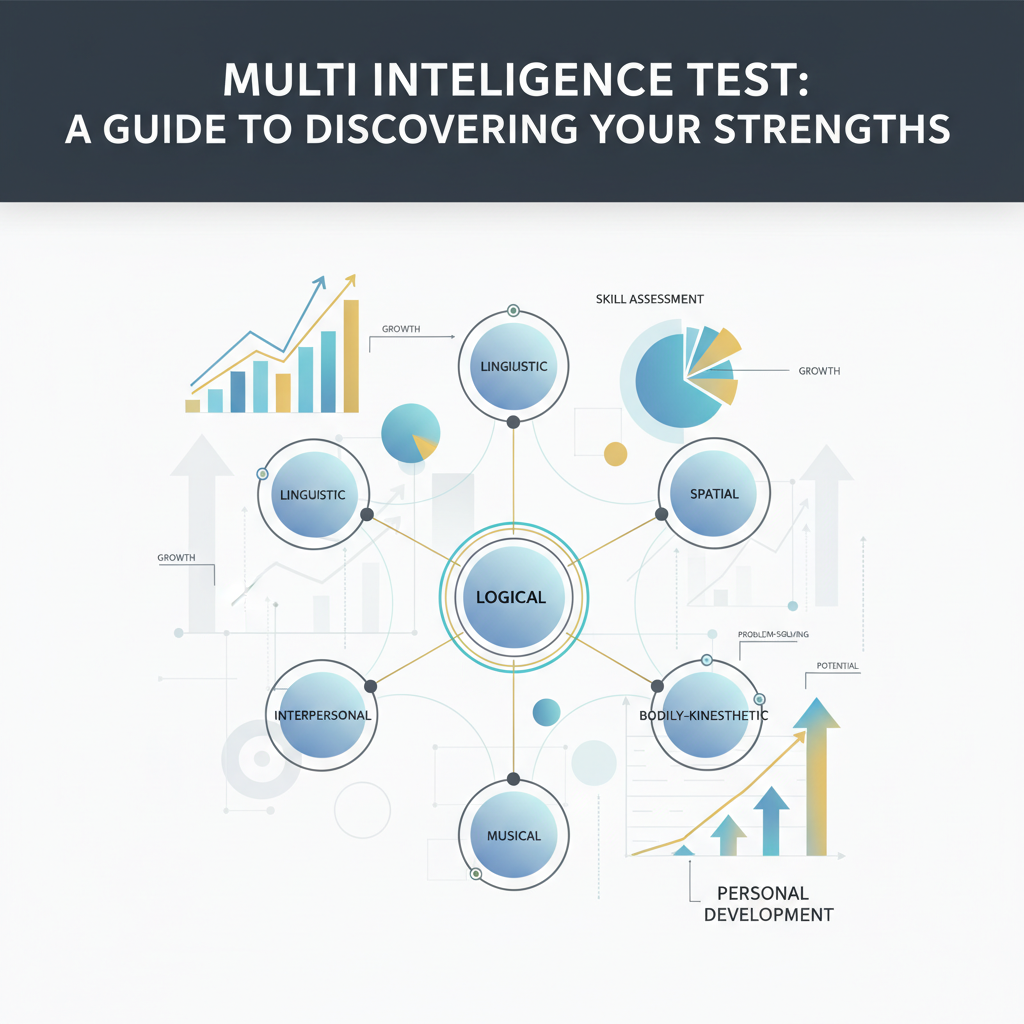
    A multi intelligence test is an assessment based on Howard Gardner’s theory that humans possess several distinct types of intelligence beyond a single general ability (IQ). These tests evaluate an individual’s strengths across different domains—such as linguistic, logical, spatial, and interpersonal—to provide a holistic view of their cognitive capabilities for personal and professional development.

    Many of us grow up thinking intelligence is a single number, like an IQ score. But we all know people who are smart in different ways. Some are good with words, others with numbers, and some are great at understanding people. What if intelligence is really a mix of different abilities? This article explores the idea of multiple intelligences, a concept that can help you understand your unique strengths and creative potential.

    Developed by Harvard psychologist Howard Gardner, the theory of multiple intelligences suggests there are many “kinds of intelligence” that go beyond just book smarts. Understanding your dominant intelligences isn’t about labeling yourself; it’s about getting to know yourself better. It helps you see how you naturally process information, solve problems, and think creatively, whether you’re “word smart,” “picture smart,” or “people smart.” This insight is a powerful tool for personal growth, allowing you to use your natural gifts in new and effective ways.

    This guide will walk you through Gardner’s theory and each of the nine types of intelligence. By understanding them, you’ll get a clearer picture of how you think, discover what makes you creative, and learn simple strategies to build on your skills. Prepare to see your intellect in a whole new way, empowering you to move forward with greater confidence in your personal and professional life.

    What Is a Multi Intelligence Test?

    Beyond the traditional IQ test

    For years, intelligence was measured by a single score, usually from an IQ test. But the traditional IQ test has limits. It mainly focuses on logical reasoning and verbal abilities, often missing other important human skills. Because of this, many people felt their real talents were overlooked.

    Creativity, for instance, is far too complex to be captured by one number. To understand your strengths, you need to look at the bigger picture. A multiple intelligence test offers this wider view. It helps you find your different talents, moving beyond just academic skills. This approach shows that people are smart and creative in many different ways.

    This method highlights your different mental strengths. It reveals how different thinking styles help solve problems and drive innovation. Our platform, the Creative Ability Test, builds on this idea. We focus on how these different intelligences contribute to your unique creative potential.

    Understanding Howard Gardner’s Theory of Multiple Intelligences

    The idea of multiple intelligences changed how we view human potential. Dr. Howard Gardner, a psychologist at Harvard, introduced this groundbreaking theory. He argued that intelligence isn’t just one thing. Instead, he suggested that people have several different types of intelligence, and each one works mostly on its own.

    Gardner’s first theory named seven intelligences, and this list later grew to nine. His work deeply changed education and psychology. It shifted our focus from a narrow idea of what it means to be “smart.” His theory suggests everyone is smart in their own way, which includes different kinds of creativity.

    Understanding these different intelligences is powerful. It helps you see where your natural talents lie. For example, one person might be strong in Linguistic intelligence, while another might shine in bodily-kinesthetic intelligence. Both are valuable, especially for creative work. Knowing your main intelligences gives you a roadmap to use your strengths, solve problems better, and grow as a person.

    The Creative Ability Test builds on this complete view. We help you discover how your specific intelligences shape your creativity. This gives you clear insights you can use to tackle real-world challenges.

    Howard Gardner’s theory helps us appreciate different talents. It suggests that:

    • Everyone has a unique mix of intelligences.
    • These intelligences can be developed and made stronger.
    • Knowing your mix helps you learn better and solve problems in new ways.
    • Creativity isn’t just for artists. It’s a skill anyone can build on using their unique intelligences.

    This wider view helps unlock your full potential and encourages you to embrace your unique ways of thinking.

    What Are the 9 Types of Intelligence?
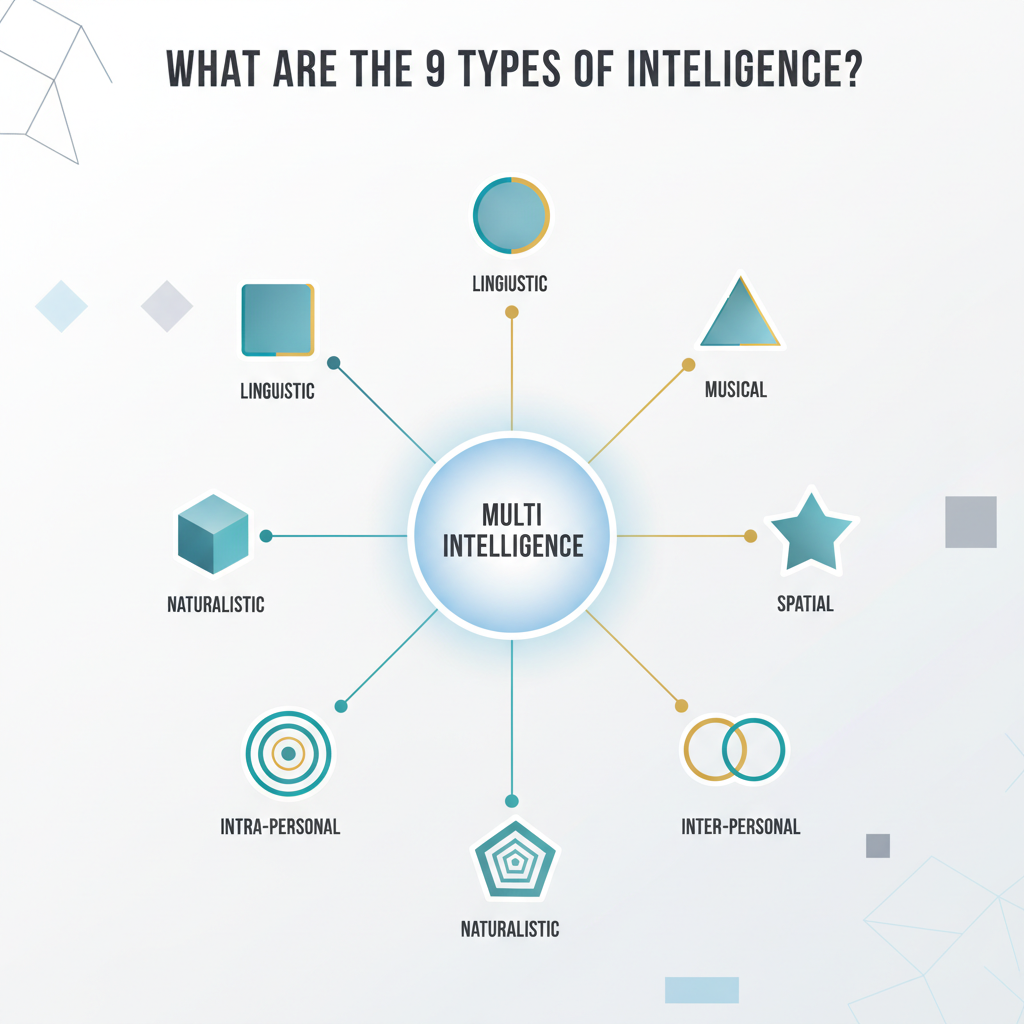
    An infographic showing a central 'Multi Intelligence' concept with nine distinct, labeled nodes radiating outwards, each representing a different type of intelligence.
    Create an abstract, educational infographic for the section ‘What Are the 9 Types of Intelligence?’. Visualize a central hub representing ‘Multi Intelligence’ with nine distinct, minimalist geometric nodes radiating outwards. Each node, connected by a clean line, symbolizes one type of intelligence. Use a minimalist, vector-based style with clean geometric shapes, subtle gradients, and accent highlights. The color palette should be soft blues, whites, and charcoal, with gold or teal accents for clarity. Ensure ample negative space around the nodes for potential short labels, maintaining a clear visual hierarchy. No humans or cartoon elements. Focus on conceptual representation suitable for professional and educational branding.

    Knowing how people excel is a great way to unlock your own creativity. Howard Gardner’s Theory of Multiple Intelligences offers a wider view of what people can do [1]. It says intelligence isn’t just one thing, like an IQ score. Instead, it covers nine different types of strengths.

    When you know these intelligences, you can find your natural talents. It also shows you the best ways to solve problems and create new things. Let’s explore each type and how it connects to your creative journey.

    Linguistic Intelligence (Word Smart)

    Linguistic intelligence is about being skilled with words. People with this strength love words. They are good at reading, writing, and speaking. They can explain their thoughts clearly and convincingly. Think of poets, novelists, or journalists.

    How it fuels creativity: This intelligence is key for storytelling. It helps you create powerful stories. You can use words to express complex ideas. It helps you brainstorm and share new ideas well. It also helps you understand different viewpoints through language.

    Develop your linguistic creativity:

    • Read widely across different genres.
    • Practice creative writing, even short stories or poems.
    • Engage in debates or public speaking groups.
    • Keep a journal to record your ideas and observations.

    Logical-Mathematical Intelligence (Number/Reasoning Smart)

    This intelligence involves logical reasoning. It includes seeing patterns and solving complex problems. People with this strength think logically. They enjoy abstract ideas and scientific questions. Scientists, engineers, and detectives often show high logical-mathematical intelligence [2].

    How it fuels creativity: Creative problem-solving often relies on logical steps. This intelligence helps you break down challenges. It lets you create step-by-step solutions. You can break down big problems into smaller parts. This leads to new and effective results.

    Develop your logical-mathematical creativity:

    • Solve puzzles and brain teasers regularly.
    • Explore coding or programming challenges.
    • Practice critical thinking by evaluating arguments.
    • Design experiments to test hypotheses, even simple ones.

    Spatial intelligence (Picture Smart)

    Spatial intelligence is the ability to see and understand the visual world. It involves changing what you see in your mind. People strong here can visualize objects and patterns. They have a good sense of direction and space. Architects, artists, and chess players often have high spatial intelligence.

    How it fuels creativity: This intelligence is key for visual arts and design. It helps you imagine new products or spaces. You can move shapes and forms around in your mind. This leads to new ideas that look good and work well. It’s also key for understanding plans and visual messages.

    Develop your spatial creativity:

    • Engage in drawing, painting, or sculpting.
    • Work on puzzles like jigsaw or 3D models.
    • Study maps and practice navigating new places.
    • Visualize your goals or solutions in your mind’s eye.

    Bodily-Kinesthetic Intelligence (Body Smart)

    This intelligence is about using your body skillfully. It involves coordination, balance, and skillful hand movements. People with this strength learn by doing. They often excel in physical activities. Dancers, athletes, surgeons, and craftspeople show this intelligence [3].

    How it fuels creativity: Physical expression can be incredibly creative. This intelligence helps create new and interesting performances. It helps in designing products that are comfortable and easy to use. It also supports hands-on problem-solving. It’s about bringing ideas to life through movement and craft.

    Develop your bodily-kinesthetic creativity:

    • Participate in sports or dance.
    • Take up a craft like pottery, woodworking, or knitting.
    • Learn a new skill that requires fine motor control.
    • Use gestures and movement to express ideas when speaking.

    Musical Intelligence (Music Smart)

    Musical intelligence is about being sensitive to rhythm, pitch, and melody. People with this strength enjoy and create music. They can recognize musical patterns easily. Composers, musicians, and singers have this natural gift.

    How it fuels creativity: Music is a universal creative language. This intelligence helps you compose original pieces. It helps you perform with emotion. You can also use music to improve focus or set a mood for creative work. It’s a direct way to express emotion.

    Develop your musical creativity:

    • Learn to play a musical instrument.
    • Experiment with composing simple melodies.
    • Listen actively to diverse music genres.
    • Notice rhythms and patterns in everyday sounds.

    Interpersonal Intelligence (People Smart)

    Interpersonal intelligence is the ability to understand others. It involves reading social cues and building relationships. People strong in this area are understanding and good communicators. Teachers, leaders, therapists, and negotiators often excel here.

    How it fuels creativity: Working together is a powerful creative tool. This intelligence helps you work effectively in teams. You can gather different viewpoints. It helps create places where new ideas can grow. Understanding what people need leads to new solutions and better designs.

    Develop your interpersonal creativity:

    • Practice active listening in conversations.
    • Participate in group projects and discussions.
    • Volunteer for roles requiring teamwork.
    • Seek out opportunities to mentor or be mentored.

    Intrapersonal Intelligence (Self Smart)

    Intrapersonal intelligence is about self-awareness. It means understanding your own emotions and motivations. People with this strength think deeply about themselves. They know their own strengths and limits. Philosophers, psychologists, and reflective artists often show high intrapersonal intelligence.

    How it fuels creativity: Knowing yourself well is key to making honest, original work. It helps you find what you’re passionate about. You can set meaningful creative goals. It allows for honest self-expression in your work. This intelligence helps you use your unique ideas.

    Develop your intrapersonal creativity:

    • Practice mindfulness or meditation.
    • Keep a reflective journal to explore thoughts.
    • Set personal goals and regularly review them.
    • Spend time in quiet contemplation.

    Naturalist Intelligence (Nature Smart)

    Naturalist intelligence involves understanding the natural world. This includes sorting plants, animals, and parts of the landscape. People with this strength observe patterns in nature. They appreciate and feel connected to their surroundings. Biologists, environmentalists, and farmers are good examples of this [4].

    How it fuels creativity: Nature is an endless source of inspiration. This intelligence can lead to designs inspired by nature. It sparks ideas for long-lasting, eco-friendly designs. You can find ideas and comparisons in nature. It also encourages you to see the big picture when solving problems.

    Develop your naturalist creativity:

    • Spend time observing nature regularly.
    • Learn about local flora and fauna.
    • Engage in gardening or outdoor activities.
    • Seek patterns and connections in the natural world.

    Existential Intelligence (Life Smart)

    Existential intelligence is about thinking about deep questions. These questions are about life, death, and why we are here. People with this strength look for meaning and purpose. They explore philosophical and spiritual ideas. Thinkers and spiritual leaders often display this intelligence.

    How it fuels creativity: This intelligence can fill your creative work with deep meaning. It lets you explore experiences that all humans share. You can explore deep themes in art or writing. It encourages new ways of thinking about life’s biggest questions. This can lead to major new ideas in philosophy or art.

    Develop your existential creativity:

    • Engage in philosophical discussions.
    • Reflect on your values and beliefs.
    • Read literature that explores deep life questions.
    • Seek out experiences that broaden your perspective.

    Understanding these nine intelligences can have a big impact on your self-discovery. It helps you find your main strengths. This knowledge is very useful for personal and career growth. Our Creative Ability Test provides personalized insights into your unique thinking styles. It helps you leverage these strengths for innovation and problem-solving.

    How Can a Multi Intelligence Test Benefit You?
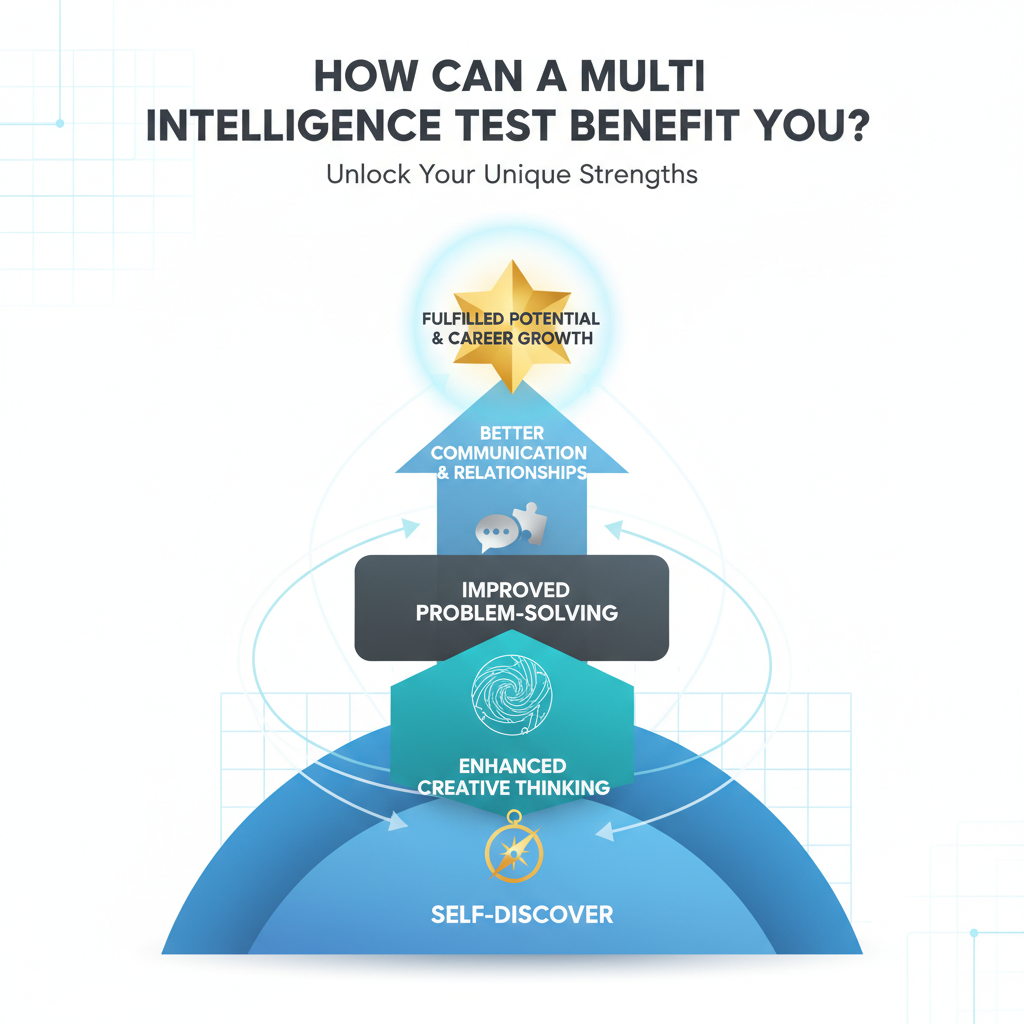
    An infographic illustrating a layered progression, showing various benefits of a Multi Intelligence Test such as self-discovery and enhanced creative thinking, represented by abstract shapes.
    Create an abstract, educational infographic for the section ‘How Can a Multi Intelligence Test Benefit You?’. Visualize a layered system or a milestone progression depicting the benefits. Each layer or step should represent a key advantage, such as self-discovery, enhanced creative thinking, or problem-solving, using abstract shapes or conceptual icons. The design should be minimalist, vector-based, and professional, utilizing clean geometric forms with subtle gradients or accent highlights. Employ a color palette of soft blues, whites, and charcoal, with gold or teal accents. Incorporate negative space for concise labels or indicators, ensuring visual clarity and structured grouping. No people or cartoon elements. Emphasize growth and practical application.

    Enhancing Personal Growth and Self-Awareness

    Understanding your unique intelligences is a powerful first step. It helps you see yourself beyond generic labels. A multiple intelligence test gives you a clearer picture of who you are.

    This self-discovery helps you grow as a person. You’ll get a better sense of how you think and learn. It also reveals your natural creative talents. For instance, someone with high Spatial Intelligence might be great at visual problem-solving or graphic design. [5]

    Knowing your strengths builds confidence. You learn to value your unique way of solving problems. This understanding can turn self-doubt into self-assurance. It confirms that your personal thinking style is valid, helping you become more comfortable with who you are.

    Here are key benefits for personal growth:

    • Discover Your Core Strengths: Find out where your natural talents lie, including the different ways you process information and share ideas.
    • Uncover Creative Styles: Learn about your unique approach to creativity. Are you a logical thinker or an artistic one? Your results offer clues.
    • Boost Self-Esteem: Understand your value and what you have to offer. This knowledge empowers you to make the most of your skills.
    • Improve Decision-Making: Make choices that line up with your natural talents, whether in hobbies, learning, or personal projects.
    • Become More Adaptable: See how your different intelligences work together. This can help you adjust to change and come up with new ideas.

    The Creative Ability Test provides personal insights. It helps you connect your intelligence profile to your creative potential. This guidance gives you practical ways to understand yourself better.

    Guiding Academic and Student Development

    For students, understanding their intelligences can be a game-changer. It changes how they approach learning. This insight helps them match their study methods to their strengths. As a result, learning becomes easier and more enjoyable. [6]

    For example, a student strong in Bodily-Kinesthetic intelligence might learn best with hands-on projects. Another student with high Linguistic intelligence learns best from reading and discussions. Recognizing these differences helps students succeed and reduces frustration with one-size-fits-all teaching methods.

    A multiple intelligence test can also help students with problem-solving. They learn to use their specific strengths to tackle academic challenges. This encourages creative thinking from a young age. For instance, a student with spatial intelligence might use diagrams to solve math problems, which is a creative way to use their strength.

    How this test supports students:

    • Find Better Ways to Learn: Students can choose study methods that match their intelligence profile. This helps them remember information and understand it better.
    • Improve Problem-Solving: Students learn to approach schoolwork using their unique mental strengths, which builds confidence in their abilities.
    • Boost Academic Performance: Using study methods that fit them often leads to better grades and a deeper interest in their subjects.
    • Develop Creative Thinking: Students discover how their intelligences drive creativity, which they can apply to projects and essays.
    • Reduce Learning Frustration: When students understand why certain methods work for them, it creates a more positive learning experience.

    The Creative Ability Test offers easy-to-understand results. It helps students see their scores clearly, empowering them to use these insights in their studies. This gives them a clear plan for academic success.

    Boosting Professional Skills and Career Choices

    In your career, understanding your intelligence profile is extremely useful. It helps you find work that matches your natural talents. This leads to greater job satisfaction, better performance, and more creative ideas. Many companies now see the value of having different types of intelligence on their teams. [7]

    This knowledge helps you find the right career path—one that uses your best skills. For example, someone with high Interpersonal Intelligence might be great in a leadership role or in working with clients. A person with Logical-Mathematical strengths could succeed in data analysis or engineering. These insights help you build a more meaningful career.

    These insights also improve teamwork. Knowing your coworkers’ strengths helps you assign tasks more effectively. It also creates a more creative and productive workplace. People with different intelligences bring unique points of view to problem-solving, which leads to better solutions.

    Key professional advantages include:

    • Smarter Career Planning: Make career decisions based on your natural abilities, which can open doors to more fulfilling jobs.
    • Better Job Performance: Use your strengths to do better in your current role and find new ways to approach your tasks.
    • Improved Teamwork: Understand how you contribute to a team and learn to value and use the different thinking styles of others.
    • Encourage Workplace Innovation: Apply your unique creativity to solve problems, leading to new ideas and breakthroughs.
    • Strengthen Leadership Skills: Learn how to motivate and communicate better by adapting your leadership style to different team members.

    The Creative Ability Test gives you practical tips to improve your creative thinking. These skills are important for problem-solving and innovation at work. Discovering your strengths can lead to major career growth.

    How Does Multiple Intelligence Connect to Creativity?
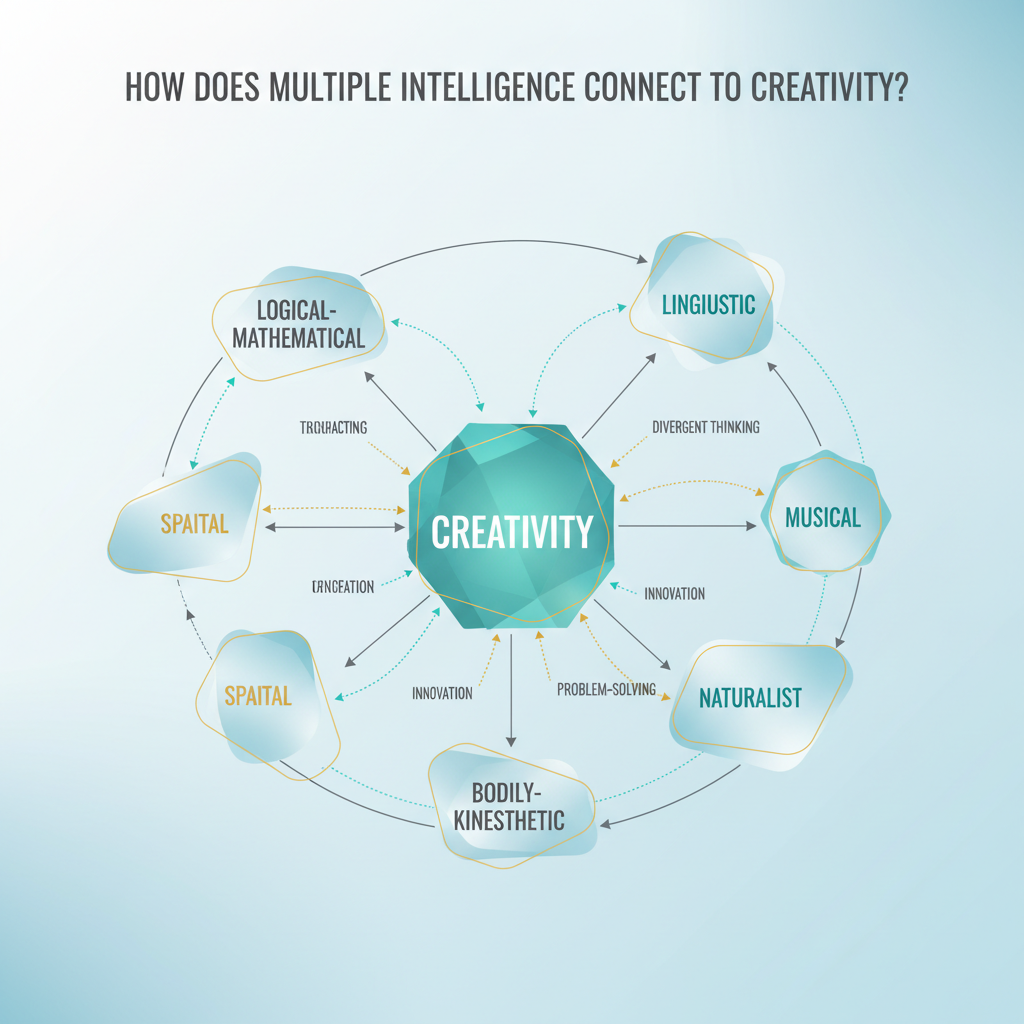
    An infographic depicting an interconnected cognitive network where various intelligence types, represented by nodes, converge and lead to a central 'Creativity' concept.
    Create an abstract, educational infographic for the section ‘How Does Multiple Intelligence Connect to Creativity?’. Visualize an interconnected cognitive network diagram or idea cluster where different intelligence types converge. Several distinct nodes, each representing a type of intelligence, should have pathways or subtle connections leading towards a central, prominent ‘Creativity’ node. Emphasize the flow and interplay between these concepts, suggesting divergent thinking and innovation. The style should be minimalist, vector-based, and approachable, using clean geometric shapes with subtle gradients and gold or teal accent highlights on a soft blue, white, and charcoal palette. Maintain ample negative space for short, directional labels. No human figures or cartoon elements. Focus on the conceptual link between intelligence and creative output.

    Creativity isn’t just one skill—it’s a process that uses many of your abilities. Howard Gardner’s theory of Multiple Intelligences offers a great way to understand this. It shows how different kinds of intelligence power your creative thinking. When you know your main intelligences, you can use your unique creative style to see problems in new ways and come up with truly innovative solutions.

    Identifying Your Creative Thinking Style

    Everyone has a unique mix of intelligences, and this mix shapes how you think creatively. Your strongest intelligences guide how you naturally come up with ideas, solve problems, and share your original thoughts.

    For example, someone with strong word skills (Linguistic Intelligence) might be great at telling stories or writing persuasive proposals. On the other hand, a person with strong visual skills (Spatial Intelligence) might imagine new designs or figure out a complex puzzle by arranging its pieces.

    Understanding your intelligence profile shows you where your creative strengths are. It points to the ways you’re most likely to have great ideas. Our science-backed Creative Ability Test helps you discover your unique style and gives you clear insights into how you naturally create. This self-awareness is the first step to reaching your full creative potential.

    • Linguistic Intelligence: Creative storytelling, effective writing, persuasive communication.
    • Logical-Mathematical Intelligence: Creative problem-solving, structured thinking, creating effective systems.
    • Spatial Intelligence: Imagining new concepts, artistic expression, designing products and spaces.
    • Bodily-Kinesthetic Intelligence: Expressive movement, hands-on building, creating original performances.
    • Musical Intelligence: Composing new music, solving problems with rhythm, creative sound design.
    • Interpersonal Intelligence: Creating ideas with others, guiding creative groups, creating solutions for people.
    • Intrapersonal Intelligence: Self-reflection that sparks new ideas, ideas for personal growth.
    • Naturalist Intelligence: Finding ideas in nature, sustainable design, understanding how systems work.
    • Existential Intelligence: Asking big questions, imagining the future, developing new ways of thinking.

    Using Your Strengths to Solve Problems

    Once you know your key intelligences, you have a real advantage. You can intentionally use these strengths to tackle any challenge. This changes problem-solving from guesswork into a focused, effective process.

    Imagine a team is having trouble communicating. Someone with strong people skills (Interpersonal Intelligence) might suggest new team activities or lead open discussions to help. In contrast, a person with strong logic skills (Logical-Mathematical Intelligence) might look at data to find the root of the communication problem.

    Using your natural strengths makes you a much better creative problem-solver. It helps you come up with more original and effective solutions. The Creative Ability Test does more than just find your strengths; it gives you practical strategies. You’ll learn how to use your unique intelligence profile to solve real-world problems with confidence and fresh ideas.

    For example:

    • If you are “Body Smart,” you might build physical models or use role-playing to work through a complex process.
    • If you are “Picture Smart,” sketching diagrams or mind maps can help you sort through complex ideas.
    • If you are “People Smart,” you could get others involved in brainstorming to use the group’s collective intelligence.

    Moving from Intelligence to Innovation

    Think of intelligence as your raw material, creativity as the engine, and innovation as the final product. Innovation is what happens when you successfully use a new, creative idea. Knowing your Multiple Intelligences is key to innovating again and again. It helps you find new solutions that have a real impact.

    Turning your potential into real change is a personal journey that starts with knowing how your mind works. For example, someone with strong self-awareness (Intrapersonal Intelligence) might create new self-help programs based on their own insights. In the same way, someone with a strong connection to nature (Naturalist Intelligence) could develop new ideas for protecting the environment [5].

    The Creative Ability Test is designed to guide you on this journey. It helps you turn your natural intelligences into real-world innovations. With our personalized feedback and practical tips, you’ll learn how to develop your own creative style. This turns your mental strengths into skills you can use. You’ll go from just knowing your potential to actively creating your future. Our platform helps you use creativity to grow professionally and find personal satisfaction.

    What to Look For in a Kinds of Intelligence Test Online?

    Ensuring the Test is Comprehensive

    When you look for an online intelligence test, a complete one is best. A good test does more than give you a quick summary. It should check many of your different mental skills. This means it needs more than just simple questions or short quizzes.

    Look for tests that are based on proven science. For example, Howard Gardner’s theory of multiple intelligences is a well-known model. Tests like this give you a full picture of your abilities. They should also have enough questions to be useful. Our Creative Ability Test has 30 questions, which helps us understand your unique ways of thinking.

    A complete test shows you all the different sides of your strengths. It helps you see how they add up to your total creative skill. A test based on science also gives you trustworthy results. It won’t give you vague feedback. Instead, you get a clear picture of your many talents. This is the best way to truly understand yourself and grow.

    Seeking Actionable Insights, Not Just Labels

    Getting a label like “word smart” or “picture smart” is a good start. But a really good intelligence test gives you more. You need useful advice you can act on. Look for tests that offer feedback made just for you. This feedback should clearly explain what your results mean for you.

    A good test won’t just put you in a box. It should give you clear ways to improve and grow. For example, it’s helpful to know you have strong spatial skills. But it’s much more useful to know how to use that skill to picture hard problems. A great test shows you how to build on your strengths and use them in your daily life.

    This helps you move from just knowing about your skills to actually using them to grow. Our Creative Ability Test is designed to give you this kind of useful advice. We help you turn what you learn about yourself into real-life improvements. This allows you to build your creative skills in a smart, focused way.

    Connecting Your Results to Real-World Application

    The main goal of any intelligence test is to help you in real life. Your results shouldn’t just be numbers on a screen. They should help you make better choices. A great test connects your strengths to everyday situations. Think about how your strongest skills can improve your life at home and at work.

    For example, good people skills can help your team be more creative together. Or, a logical mind can make solving problems at work easier. The right test gives you clear examples. It shows you how to use your unique skills well. This might help you choose a better career path [8] or find new ways to study.

    Plus, when you understand your strengths, you can be more innovative. Knowing how you like to think helps you solve problems in new ways. Our platform gives you these real-world strategies. We connect knowing yourself with growing as a person. This helps you use what you’ve learned for everything from daily tasks to your biggest goals.

    Frequently Asked Questions

    What are the 8 types of intelligence test?

    Howard Gardner’s influential theory of Multiple Intelligences says that intelligence isn’t just one single skill. Instead, it’s made up of several different types. He started with seven, later adding an eighth and a ninth. So, when people talk about the “8 types of intelligence,” they usually mean his most well-known ideas.

    A multiple intelligence test measures your strengths in these different areas. This helps you understand your unique way of thinking. Our Creative Ability Test, for example, explores how your natural strengths can affect your creative thinking and problem-solving styles.

    Here are the eight main types of intelligence:

    • Linguistic Intelligence: Skill with words, language, and writing.
    • Logical-Mathematical Intelligence: Ability to reason, do math, and think in abstract ways.
    • Spatial Intelligence: Ability to visualize, think in 3D, and understand spaces.
    • Bodily-Kinesthetic Intelligence: Skill in using your body with control and precision.
    • Musical Intelligence: Sensitivity to rhythm, pitch, melody, and sound.
    • Interpersonal Intelligence: Understanding and working well with other people.
    • Intrapersonal Intelligence: Understanding yourself, your emotions, and what motivates you.
    • Naturalist Intelligence: Recognizing and sorting patterns found in nature.

    Knowing your strongest intelligences can help you improve your creative skills. For instance, strong spatial intelligence can lead to new design ideas, while linguistic intelligence can help you tell great stories. Our platform helps you turn these strengths into practical creative strategies.

    How is a personality intelligence test different?

    It’s important to know the difference between intelligence and personality. Intelligence tests, like those based on Gardner’s theory, measure your thinking skills. They look at your ability to learn, reason, and solve problems in different areas.

    Personality tests, on the other hand, look at your typical patterns of thinking, feeling, and behaving. They show your personal traits, preferences, and social styles. Examples include tests for introversion/extraversion or conscientiousness.

    Even though they are different, intelligence and personality are connected. Personality traits can have a big impact on how you use your intelligence. For example, people high in “openness to experience” (a personality trait) often score higher on creativity tests [9]. This trait is linked to curiosity and a desire to explore new ideas.

    Our Creative Ability Test focuses on your potential to be creative. It looks at your ability to think flexibly and come up with many ideas, which are key parts of intelligence. It also explores if your approach to problems matches creative ways of thinking. This gives you personal insights, showing you not just what you can do, but how your unique style can help you be more innovative.

    Can I find a multiple intelligence test for students?

    Yes, multiple intelligence tests are widely used and very helpful for students of all ages. Teachers often use these tests to better understand how each student learns. This helps them match their teaching methods to what students are good at.

    For students, understanding their main intelligences can make a big difference. It helps them choose school subjects that fit their natural talents. It also helps them find better ways to study. For example, knowing you are strong in spatial intelligence might encourage you to use more charts and diagrams.

    Our platform connects this to creativity by helping students use their strengths to be more creative with schoolwork. It guides them to think of new ideas for projects and problems. This encourages a growth mindset and builds confidence for the future. Discovering your unique creative style early on can be a great start for personal and professional growth.

    What is an interpersonal intelligence test?

    An interpersonal intelligence test looks at how well you understand and work with other people. This type of intelligence is often called being “people smart.” People with this strength are good at noticing the moods, goals, and feelings of others. They do well in social situations.

    Key signs of strong interpersonal intelligence include:

    • Great communication skills, both spoken and unspoken.
    • A high level of empathy and sensitivity to others.
    • The ability to build connections and keep relationships strong.
    • Strong leadership and teamwork skills.
    • Skill in solving conflicts and guiding discussions.

    While our Creative Ability Test measures your creative thinking and problem-solving, interpersonal intelligence is very important for using creativity in the real world. New ideas rarely happen when you work alone. Working with others on creative projects, leading teams, and understanding customer needs all require strong people skills. Learning about your core creative strengths helps you share your ideas more effectively. It also helps you inspire and work with others on your creative projects.


    Sources

    1. https://www.niu.edu/facdev/resources/guide/learning/howard-gardners-theory-of-multiple-intelligences.shtml
    2. https://www.tec.edu.mx/en/news/campussur/careers-strong-mathematical-logical-intelligence
    3. https://howardgardner.com/multiple-intelligences/body-kinesthetic-intelligence/
    4. https://psychology.jrank.org/pages/426/Multiple-Intelligences.html
    5. https://howardgardner.com/multiple-intelligences/
    6. https://www.edutopia.org/multiple-intelligences-theory
    7. https://hbr.org/2011/04/the-power-of-multiple-intelligences
    8. https://www.careerkey.org/multiple-intelligences-theory-careers
    9. https://psycnet.apa.org/record/2012-07310-001
  • Visual Perception IQ Test: A Guide to Understanding Your Creative Mind

    Visual Perception IQ Test: A Guide to Understanding Your Creative Mind

    A visual perception IQ test is an assessment designed to measure your ability to interpret, analyze, and make sense of visual information. It evaluates skills like spatial reasoning, pattern recognition, and visual memory, which are crucial components of non-verbal intelligence and creative problem-solving.

    Do you notice small details that others miss? Can you easily picture a complex idea in your mind? Our ability to “see” is more than just eyesight—it’s a mental process that shapes how we understand the world and create new things. This is known as visual perception, a skill that plays a bigger role in creativity and problem-solving than you might think.

    This article explains what a visual perception IQ test measures and how it connects to your own creative thinking style. We’ll explore how skills like Spatial reasoning and Pattern recognition aren’t just for puzzles; they are essential for flexible thinking and innovative problem-solving. By understanding these parts of your visual perception, you can gain useful insights into your creative strengths and how you process information, helping you grow.

    As experts in creativity assessment, we believe that understanding how your mind works is the first step to unlocking your full creative potential. This article, based on scientific principles, will help you understand not just what a visual perception IQ test is, but also how you can use this knowledge to improve your problem-solving and innovation skills. Let’s explore what a Visual Perception IQ Test is and why it’s so much more than just ‘seeing’.

    What is a Visual Perception IQ Test?

    Why It’s More Than Just ‘Seeing’

    A Visual Perception IQ Test measures more than just clear eyesight. It tests how well your brain can understand, organize, and use visual information. Think of it as a way to check your mind’s visual processing power.

    This goes beyond basic sight. It involves complex thinking skills. You use these skills to see shapes, patterns, and connections in the world. For example, can you find a hidden image in a picture? Can you picture an object turning in your mind? These are examples of visual perception at work.

    Visual perception is also key for creative thinking. It lets you picture new ideas. You can move things around in your mind to create new solutions. It’s a core part of how we see, learn, and interact with the world.

    Strong visual perception helps you:

    • Quickly understand complex diagrams or instructions.
    • Notice small details others might miss.
    • Mentally plan routes or arrange objects.
    • Picture outcomes before they happen.
    • Solve problems by looking at them from different angles.

    The Link Between Visual Skills and Overall Intelligence

    Your visual skills are strongly linked to your overall thinking ability. They are a big part of what psychologists call fluid intelligence. This is your ability to solve new problems and handle new situations [1].

    This type of intelligence uses non-verbal reasoning. It lets you think in concepts and find solutions without needing past experience. Strong visual-spatial skills show a powerful ability for logical thinking. They also show that you can understand difficult ideas quickly.

    Many jobs and fields of study depend on these visual skills. Engineers, architects, artists, and surgeons all use advanced spatial reasoning every day. They need to picture structures, designs, or complex steps in their minds. Research often shows how important spatial skills are for success in STEM fields [2].

    A Visual Perception IQ Test gives you useful information about yourself. It shows how well your mind works with visual information. This mental power is a big part of your problem-solving and creative skills. Knowing your strengths helps you use them. For example, The Creative Ability Test explores how these thinking skills add to your creative style. It helps turn confusion about your potential into useful self-knowledge.

    What Key Skills Does a Visual Perception Test Measure?

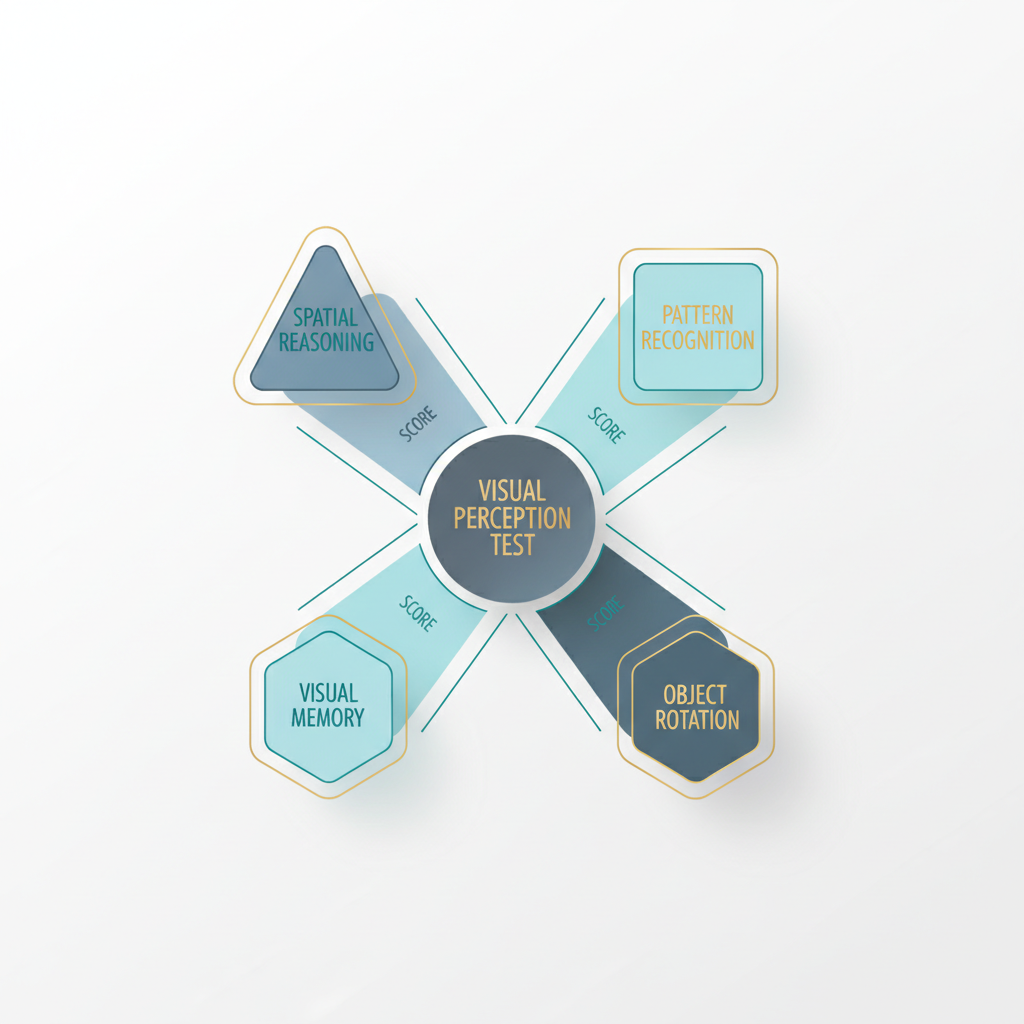
    An infographic showing a central node for 'Visual Perception Test' branching out to distinct geometric shapes representing key measurable skills like spatial reasoning and pattern recognition.
    Abstract, minimalist vector infographic. A multi-faceted competency graph or skill assessment chart. Central circular node representing ‘Visual Perception Test’, branching out into 4-5 distinct, labeled geometric segments or pillars, each representing a key skill (e.g., Spatial Reasoning, Pattern Recognition, Visual Memory, Object Rotation). Each segment has a subtle gradient indicating a ‘score’ or ‘level’. Use soft blues, whites, charcoal, with gold or teal accents for labels and highlights. Ample negative space for clarity.

    Spatial Reasoning: Mentally Manipulating Shapes

    Spatial reasoning is a key mental skill. It lets you understand and move objects in your mind. Imagine turning a 3D puzzle piece to make it fit. That’s spatial reasoning in action.

    This skill isn’t just for puzzles. It’s about seeing how different parts fit together. You might imagine building something in your head or plan the layout for a complex machine. It’s about understanding how objects relate to each other in space. [3]

    For creative people, strong spatial reasoning is very useful. It helps you:

    • Visualize new designs: Imagine new products or works of art.
    • Structure complex ideas: Turn scattered thoughts into a clear plan.
    • Solve spatial problems: See how parts fit together or how to best use a space.

    Building this skill boosts your ability to innovate. It allows you to “see” solutions before they exist. Our tests show you your spatial reasoning strengths. This helps you use them to make creative breakthroughs.

    Pattern Recognition: Finding Logic in Visuals

    Pattern recognition is your brain’s ability to find connections and order. It means finding structure in what seems like chaos. This skill helps you spot sequences, trends, and repeated themes in what you see. For example, finding a familiar face in a crowd uses pattern recognition.

    This is a basic part of problem-solving. It helps you make predictions and see connections. You can find the hidden structures in things. This skill is important in many areas. From science to music, patterns are everywhere. [4]

    In creative work, pattern recognition helps you to:

    • Identify emerging trends: Spot what’s next in design, art, or technology.
    • Uncover hidden insights: See connections others miss in data or observations.
    • Develop innovative solutions: Recognize successful patterns from one field and apply them to another.

    Our platform helps you understand your pattern recognition skills. This knowledge can change how you solve problems. You will find a clearer path to better solutions.

    Visual memory: Recalling What You’ve Seen

    Visual memory is your ability to remember what you see. It’s about recalling images, shapes, colors, and how they are arranged. Think about remembering a detailed map or a person’s face. That’s visual memory at work.

    This skill is key to learning and making decisions. It affects how you understand new things and use what you already know. Good visual memory helps you build a clearer picture in your mind and supports difficult mental tasks. [5]

    For being creative, a strong visual memory is very helpful:

    • Build a rich mental library: Keep a large collection of images and ideas in your mind.
    • Combine old ideas: Use details you remember to create something new.
    • Refine ideas: Remember past versions or feedback to make your work better.

    Understanding your visual memory can improve your creative work. Our assessments show you your strengths and give you clear steps to improve.

    Figure-ground perception: Isolating Details from a Background

    Figure-ground perception is your ability to see an object separately from its background. It lets you focus on one thing without getting distracted. Think of seeing one tree in a dense forest or finding a single word on a busy page. This skill helps you pull out what’s important.

    This skill is key for focus and clarity. It helps you decide what to look at first and ignore distractions. It’s also an important part of breaking down problems into smaller pieces. [6]

    In creative thinking, figure-ground perception gives you a real edge:

    • Identify core problems: Separate the main issue from the noise around it.
    • Focus on key details: Find the parts of a design that need the most attention.
    • Discover hidden opportunities: See patterns or solutions that blend into the background for others.

    Our Creative Ability Test helps you understand how your mind sees things, including your figure-ground perception. This knowledge helps you improve your focus. It also sharpens your skills for new ideas and growth.

    How is Visual-Spatial Intelligence Connected to Creativity?

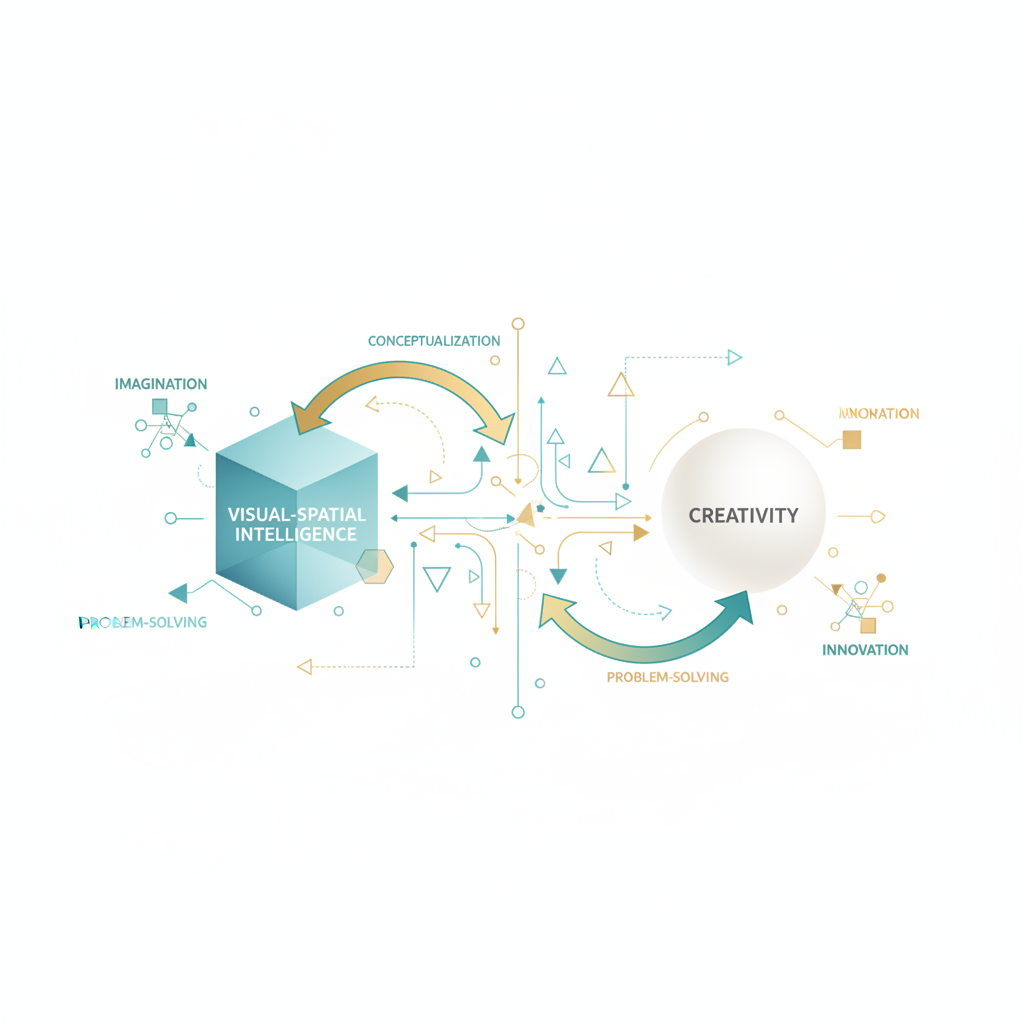
    An infographic showing two main geometric nodes, one for 'Visual-Spatial Intelligence' and one for 'Creativity', interconnected by a network of smaller shapes and lines representing their relationship.
    Abstract, minimalist vector infographic. A cognitive network diagram or idea cluster illustrating the connection between Visual-Spatial Intelligence and Creativity. Two distinct, larger geometric nodes (e.g., a cube and a sphere) representing ‘Visual-Spatial Intelligence’ and ‘Creativity’. Smaller, interconnected geometric shapes (dots, lines, arrows, smaller polygons) form pathways and clusters around and between these main nodes, symbolizing the flow of ideas, insights, and the synergistic relationship. Use soft blues, whites, charcoal, with gold or teal accents for connections and emphasis. Ample negative space.

    Visual-spatial intelligence is more than just seeing. It’s about understanding and moving objects in your mind. This key mental skill is a foundation for creativity. It helps you turn thoughts into real-world ideas. People with strong visual-spatial skills often succeed in creative fields [7]. They can imagine, design, and create more easily.

    This link shows us something important. Your ability to see shapes, patterns, and connections in your mind affects how creative you can be. Let’s look at how.

    Visualizing New Solutions

    Strong visual-spatial skills help you build and take apart ideas in your mind. You can easily turn objects around in your head. This lets you look at problems from different sides. It’s like having a mental workbench where you can try out different arrangements. This skill is key to finding many different solutions.

    This process helps a lot with divergent thinking. Divergent thinking is the skill of creating many different ideas from one starting point. Seeing information in your mind can really help this process, which is an important part of creativity [8]. You might picture a new design for a product or see how a complex system works. This mental flexibility allows you to explore endless options. The Creative Ability Test helps you see how your own visualization skills add to your creative thinking.

    Innovative Problem-Solving

    To innovate, you often need to see what isn’t there yet. Visual-spatial intelligence helps you do exactly that. You can picture complex systems in your mind and spot hidden patterns. This skill helps you move beyond the usual solutions and find new, creative approaches.

    Think about an engineer designing a new bridge. They need to picture its structure and how stable it will be. An artist might see a sculpture inside a raw block of stone. Both use visual-spatial skills to solve difficult problems in a creative way. These skills build mental flexibility, helping you think in less rigid ways. This makes you better at handling unexpected challenges. Our assessment helps you understand this link. You can then use your visual skills for real-world innovation.

    Thinking Outside the Box

    True innovation comes from thinking beyond the usual limits. Visual-spatial intelligence is your key to “thinking outside the box.” It helps you connect ideas that don’t seem related. You can build completely new situations in your mind, which allows original ideas to form.

    This skill is key for major breakthroughs. It helps you break free from old ways of thinking. You can explore big ideas in your mind. You aren’t limited by what’s right in front of you. Instead, you can create new possibilities that others might not see. For example, a visionary urban planner might picture how a city will look decades in the future. This sparks groundbreaking ideas. Our assessment helps you find your natural ability for this kind of broad thinking. It guides you in using these strengths to grow, both personally and professionally.

    What Do Visual Perception IQ Test Questions Look Like?

    Common Types of Questions and Examples

    Visual perception IQ tests test your mind in new ways. They measure how well you see, understand, and use visual details. These questions also show how you think and solve problems creatively. They help us see how you understand the world.

    Here are some common types of questions you might see:

    • Spatial Reasoning: Mental Rotation

      These questions ask you to mentally move or turn shapes. You will see one shape. Then, you must pick the option that shows the same shape, just rotated or flipped. This skill is key for jobs in design and engineering. It also helps with daily tasks. It shows you can picture different options in your head.
      Example: Which of these five options shows the first shape rotated?

      (Imagine a simple L-shaped block. Options would show it at different angles.)

    • Pattern Recognition: Identifying Sequences and Analogies

      You might see a set of images that follow a rule. Your job is to figure out what image comes next. Or, you could be asked to find a missing piece that completes a visual comparison. For example, “Shape A is to Shape B as Shape C is to what?” These questions test if you can find the logic and links between images. This is a big part of creative thinking. It helps you guess what will happen next. [source: https://www.verywellmind.com/what-is-pattern-recognition-2795325]

      Example: Complete the pattern: Circle, Square, Triangle, Circle, Square, ___?

    • Figure-Ground Perception: Isolating Details

      In these questions, a busy image has a simple shape hidden inside. You need to spot the main shape (the “figure”) from the background. This tests your focus and your eye for detail. It also shows you can find something simple in a messy picture. This is important for solving problems in new ways. It helps you ignore things that don’t matter.

      Example: Find the hidden face within this tree branch drawing.

    • Visual Memory: Recalling Details

      While harder to show with just words, some tests check your visual memory. You might look at an image for a short time. Then, you answer questions about details you remember. This measures how well your brain saves and recalls what you see. Good visual memory helps with tough problems. It lets you use what you’ve seen before.

    • 3D Visualization and Block Counting

      These questions show a stack of blocks or a 3D shape. You might need to count all the blocks, including the ones you can’t see. Or, you might be asked to pick out the same stack from a different angle. This tests if you can build and take apart objects in your mind. It’s a key skill for design and for understanding how things fit in space.

      Example: How many blocks are in this stack, assuming no floating blocks?

      (Imagine a simple pyramid of blocks with some hidden from the frontal view.)

    Tips for Approaching Visual Puzzles

    Visual perception questions can feel like a game. But they are great tools for understanding how your mind works. Be curious and open when you try them. These tips can help you do your best and learn more about how you think:

    • Break Down the Image: Don’t let a complex image overwhelm you. Look at one part at a time. See the shapes, colors, and lines. This makes the image easier to understand.
    • Look for Patterns and Rules: Most visual puzzles have a pattern or rule. Try to find the rule that controls the order or design. Think about flips, turns, or things being added or taken away.
    • Mentally Manipulate Shapes: Practice picturing objects moving in your head. Turn them, flip them, or see them from new angles. This uses your skill for seeing things in 3D.
    • Take Your Time: If you rush, you might make mistakes. Take a moment to really look at the image. Sometimes, when you pause, the answer becomes clear.
    • Consider Different Perspectives: If you don’t see an answer right away, try a new viewpoint. What if the image was upside down? What if the pattern moved in a new way? This helps you think in more flexible ways.
    • Focus on Key Details: Not every part of an image is important. Find the most important parts that will help you solve the puzzle. Ignore the details that don’t help.
    • Practice Regularly: Like any skill, you get better at visual perception with practice. Doing puzzles, playing games, and paying attention to the world around you can make your skills sharper. Practicing helps you feel more confident.

    Using these strategies can help you do better on the tests and better understand your own creative thinking. Seeing how you handle these visual puzzles gives you good clues about how you solve problems and come up with new ideas.

    How Can You Enhance Your Visual Perception Skills?

    Visual perception is how your brain understands what your eyes see. You can improve this skill with practice. Sharpening it helps you become more creative, solve problems better, and think in new ways.

    Like any skill, you get better with regular practice. This section offers simple exercises you can easily fit into your daily routine.

    Practical Exercises for Daily Life

    You don’t need a lab to boost your visual perception. Simple, everyday activities can help sharpen this important skill. Regular practice trains your brain to handle what you see more quickly and clearly [9].

    These exercises improve how well you notice things, understand space, and spot small details. Good visual perception is key to solving problems creatively and thinking in new ways.

    • Detailed Observation: Take a few minutes each day to really look at your surroundings. Notice the detailed patterns on a leaf, the way light makes shadows, or the slight differences in colors. This helps you separate objects from their background.
    • Mental Manipulation: Look at an object and try to turn it over in your mind. Picture what it looks like from different sides. This builds your spatial reasoning skills. For example, imagine a coffee mug from the top or turned upside down.
    • “I Spy” for Adults: Play a grown-up version of “I Spy.” Pick a specific color, shape, or texture around you. Try to find as many examples of it as you can. This makes you better at spotting patterns and focusing your attention.
    • Visual Recall Practice: Look at a scene or an object for a few seconds. Then, close your eyes and try to remember as many details as you can. What colors did you see? What was the shape? Where were things placed? This is a great way to improve your visual memory.
    • Sketching and Drawing: You don’t have to be an artist. Just sketching an object makes you pay close attention to its size, lines, and how its parts relate to each other. It’s a hands-on way to work with what you see.

    By adding these small practices to your day, you’ll see a big difference. You will understand and engage with the world around you better. This sharp new skill helps you think creatively and solve problems—key areas explored by the Creative Ability Test.

    Using Puzzles and Games for Training

    Puzzles and games are more than just fun. They are great tools for building your visual perception skills and offer a fun way to challenge your brain. Research shows that solving puzzles regularly is good for your mind [10].

    These activities are a lot like the challenges on a visual perception IQ test. They also give you a fun way to improve your creative thinking.

    • Jigsaw Puzzles: These classic puzzles are great for learning to see a piece separate from the background. You have to tell one piece apart from the larger picture. They also build your spatial skills as you fit shapes together.
    • Logic Puzzles (e.g., Sudoku, Kakuro): Even though they use numbers, these puzzles are all about spotting patterns and arranging things in space. They train your brain to find what’s missing in a grid.
    • Block-Building Games (e.g., Tetris): Games like Tetris require you to think fast about space. You have to spin and place shapes quickly, which improves how you process moving objects.
    • Spot-the-Difference Games: These games are designed to improve your attention to detail. They make you better at quickly finding small differences, which sharpens your observation skills.
    • 3D Puzzles and Brain Teasers: A Rubik’s Cube or other 3D puzzles require you to think in three dimensions. They challenge you to picture complex changes in your mind. This is directly linked to creative problem-solving.
    • Strategy Board Games: Games like Chess and Go help you plan using what you see. You have to picture your next moves and what might happen because of them. This teaches you to think and plan ahead.

    Playing these games is a fun and effective workout for your brain that sharpens your creative mind. The results from your Creative Ability Test can also guide you. They can show you which mental skills these games will help you build the most.

    The Role of Mindfulness and Observation

    Besides exercises and games, practicing mindfulness can also greatly improve your visual perception. Mindfulness is about being fully in the moment and noticing things without judgment or distraction [11].

    When you observe things mindfully, you train your brain to see them as they really are, not just as you expect them to be. This can lead to new ideas and discoveries.

    • Present Moment Awareness: Spend a little time each day just looking. Notice the texture of your clothes or the small details of a plant. Try not to name or judge what you see. This practice improves how your brain takes in visual information.
    • Active Listening to Your Eyes: Don’t just glance at things. Actively “listen” to what your eyes see. Which colors stand out the most? What is the main thing to look at? What patterns do you notice? This helps you connect more with what you see.
    • Challenging Assumptions: We often see what we expect to see. Mindfulness helps you look past your assumptions. Ask yourself if what you “know” about something is true. Try to see it with fresh eyes. This can spark new and creative ideas.
    • Reducing Visual Clutter: A busy mind can make it hard to see clearly. Mindfulness helps clear away mental distractions so you can focus better on what’s in front of you. This makes it easier to pick out details from a background.
    • Cultivating Beginner’s Mind: Look at everything with curiosity, as if you’re seeing it for the first time. This new viewpoint can help you notice hidden details and connections. It’s a great way to spark creative ideas.

    Adding mindfulness to your daily routine is a great all-around way to improve your visual skills and creativity. This idea fits perfectly with the Creative Ability Test, which helps you find and build on your own mental and creative strengths.

    Discover Your Strengths with the Creative Ability Test

    The ability to understand what you see is a great strength. It’s a key part of many mental skills. But creativity is much more than just what you see. It’s also how you form ideas, create new things, and solve problems.

    Learning about your creative mind can unlock your full potential. The Creative Ability Test gives you helpful insights to do just that.

    Discover Your Unique Creative Profile

    The Creative Ability Test is an accurate, science-based assessment. It goes beyond simple visual puzzles to explore how you think in new ways. This 30-question test looks at different parts of your creative mind.

    We believe creativity isn’t just one skill. It’s a mix of different mental processes. Our test measures these key areas:

    • Cognitive Flexibility: Your ability to change how you think and switch between different ideas.
    • Divergent Thinking: The skill of finding many different solutions to a single problem [12].
    • Problem-Solving Skills: How well you handle challenges with fresh and effective ideas.
    • Openness to New Experiences: Your readiness to explore new ideas and try different approaches.

    By understanding these areas, you get a clear picture of your natural creative strengths. You also see where you have room to grow.

    Turn Your Insights Into Growth

    A score by itself doesn’t help you grow. That’s why we provide personalized feedback that’s more than just a number. We turn complex ideas into clear, simple steps for you to follow.

    Your results are a roadmap just for you. This guide helps you build your creative skills, with practical tips for each area we measure. For example, if you score high in divergent thinking, we’ll suggest ways to use that strength more. If your cognitive flexibility could be better, you’ll get exercises to improve it.

    Our goal is to help you move from understanding yourself to improving yourself. We want to help you make creativity a regular part of your life.

    Real-World Benefits

    Understanding your creative mind has real benefits in your personal and professional life. You can start using what you learn right away.

    Here are some of the benefits you can expect:

    • Enhanced Self-Awareness: Learn about your natural creative style.
    • Boosted Confidence: Trust in your ability to create and share new ideas.
    • Improved Problem-Solving: Use new strategies to solve tough problems from a fresh angle.
    • Career Advancement: Use creative thinking to grow in your career and bring new ideas to your work.
    • Personal Growth: Become more flexible and imaginative in your daily life.

    The Creative Ability Test is your guide to exploring your creative potential. It gives you the tools to build a more innovative mindset and encourages you to keep learning about yourself. Start your journey to a more creative and fulfilling future today.

    Frequently Asked Questions

    What does a high visual perception IQ mean?

    A high visual perception IQ means you are good at understanding what you see. You’re great at spotting patterns, seeing how things fit together in a space, and noticing small details. You can easily picture complex ideas in your head.

    This is a valuable skill. It helps you see small details and connections that others might miss. It also boosts your creativity in many ways.

    People with strong visual skills often show:

    • Better Problem-Solving: They can picture objects or situations from different angles to find new solutions.
    • Creative Vision: They are good at imagining new designs, ideas, or art.
    • Attention to Detail: They can quickly spot mistakes or key details in what they see.
    • Strategic Thinking: They are good at planning routes, creating layouts, or organizing information.

    Knowing this is a strength helps you use it. It can help you grow in fields like design, architecture, engineering, and strategic planning. Our Creative Ability Test helps you discover these unique mental strengths. It gives you insights to help you grow and be more innovative.

    What is a visual-spatial intelligence test?

    A visual-spatial intelligence test measures how well you understand, use, and remember what you see and where things are. It tests how well you can move images around in your head. This includes picturing objects from different angles or finding your way in new places.

    This type of intelligence is a key part of how you think. It often includes:

    • Spatial Reasoning: The ability to change shapes and objects in your mind.
    • Pattern Recognition: Finding patterns and connections in what you see.
    • Visual Memory: Remembering images, places, and how things are arranged.

    Psychologist Howard Gardner named visual-spatial intelligence as one of several types of intelligence [13]. It plays a key role in many creative and professional fields. Think of artists, architects, pilots, or chess players. They all depend on strong visual-spatial skills.

    Our test at Creative Ability Test looks at many sides of your creative mind. This includes parts of your visual-spatial intelligence. We help you see how these skills add to your own creative talent.

    Can I find a visual perception IQ test online for free?

    Yes, many websites offer free “visual perception IQ tests” or quizzes. They can be a fun way to get a quick, casual look at your visual skills. They often have simple puzzles or challenges for you to solve.

    However, it’s important to know their limits. Most free online tests are not backed by science. They don’t give a full picture of your thinking skills and usually offer general feedback, not insights tailored to you.

    For a truly accurate and helpful result, consider a test that is based on science. The Creative Ability Test is a strong 30-question assessment. It measures many sides of your creativity and flexible thinking. Our platform gives you:

    • Science-Based Method: Our tests are built on scientific principles.
    • Personalized Feedback: We give you specific insights into your strengths and how you can improve.
    • Actionable Tips: You get practical advice to boost your creative thinking.
    • In-Depth Analysis: We give you more than just a score, offering a deeper understanding.

    Choosing a proven test gives you confidence in the results. It provides useful insights you can use right away for personal and professional growth.

    What is a spatial reasoning test?

    A spatial reasoning test measures your ability to picture and move 2D and 3D objects in your mind. It checks how well you can see shapes and how they relate to each other. This includes picturing how objects would look if you turned or joined them.

    These tests often use different types of questions:

    • Mental Rotation: Spotting the same shape from different angles.
    • Pattern Completion: Finding a pattern in a series of images and guessing the next one.
    • Figure Analysis: Seeing the simple parts that make up a complex shape.
    • Map Reading: Understanding directions and how places relate on a map.

    Strong spatial reasoning is a key part of innovation. It helps you “see” solutions that are not yet real. It is vital for fields like engineering, product design, and urban planning. It also helps with solving everyday problems.

    Our Creative Ability Test has questions that check your spatial reasoning. This helps you understand your unique way of thinking. We want to help you use these strengths well. This helps with both your personal and professional growth.


    Sources

    1. https://www.simplypsychology.org/fluid-and-crystallized-intelligence.html
    2. https://news.uchicago.edu/story/importance-spatial-reasoning-stem-success
    3. https://www.simplypsychology.org/spatial-reasoning.html
    4. https://www.sciencedirect.com/topics/neuroscience/pattern-recognition
    5. https://www.ncbi.nlm.nih.gov/pmc/articles/PMC8900742/
    6. https://www.simplypsychology.org/gestalt-psychology.html
    7. https://www.scientificamerican.com/article/spatial-intelligence-predicts-innovation/
    8. https://www.tandfonline.com/doi/abs/10.1080/10400419.2017.1352481
    9. https://www.health.harvard.edu/mind-and-mood/sharpen-your-mind-and-memory
    10. https://www.ncbi.nlm.nih.gov/pmc/articles/PMC3312015/
    11. https://www.mindful.org/what-is-mindfulness/
    12. https://psycnet.apa.org/record/1968-07231-001
    13. https://howardgardner.com/theories-of-intelligence/

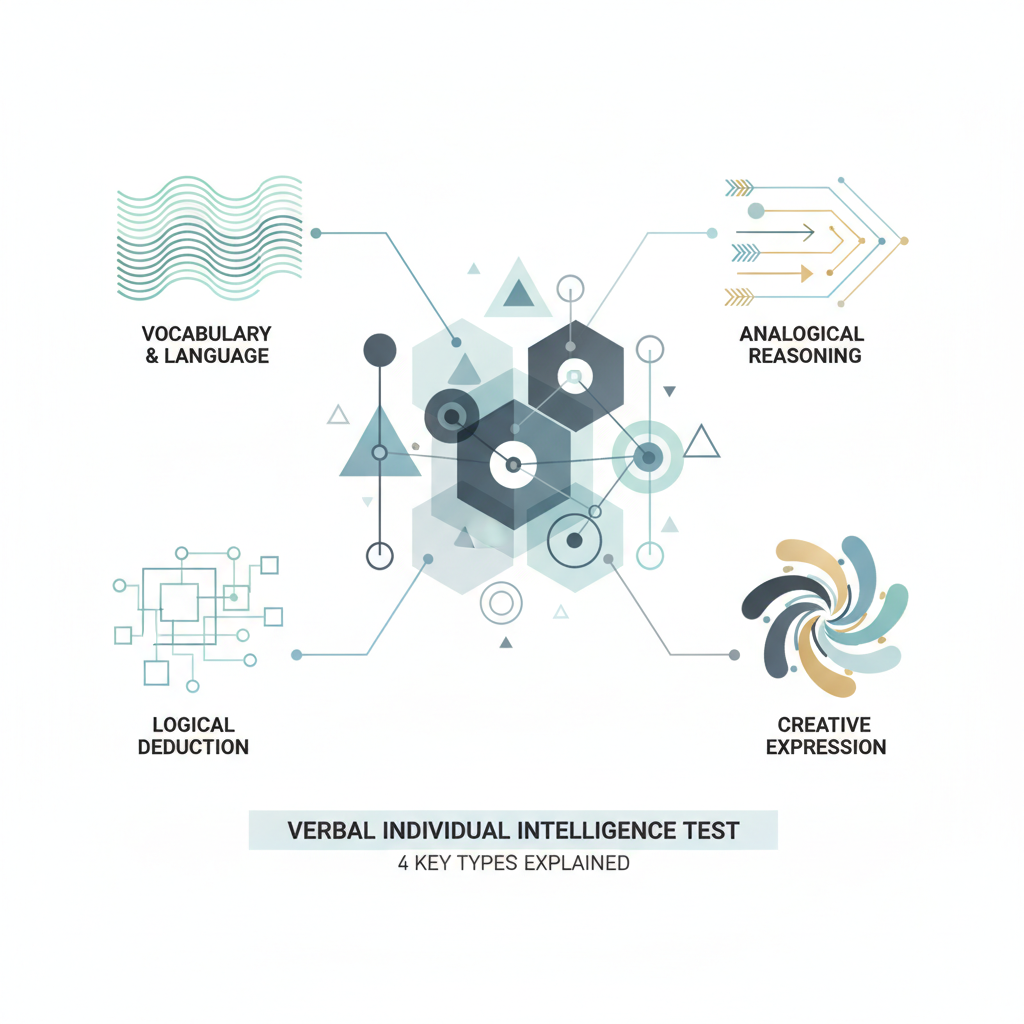
  • Verbal Individual Intelligence Test: 4 Key Types Explained

    Verbal Individual Intelligence Test: 4 Key Types Explained

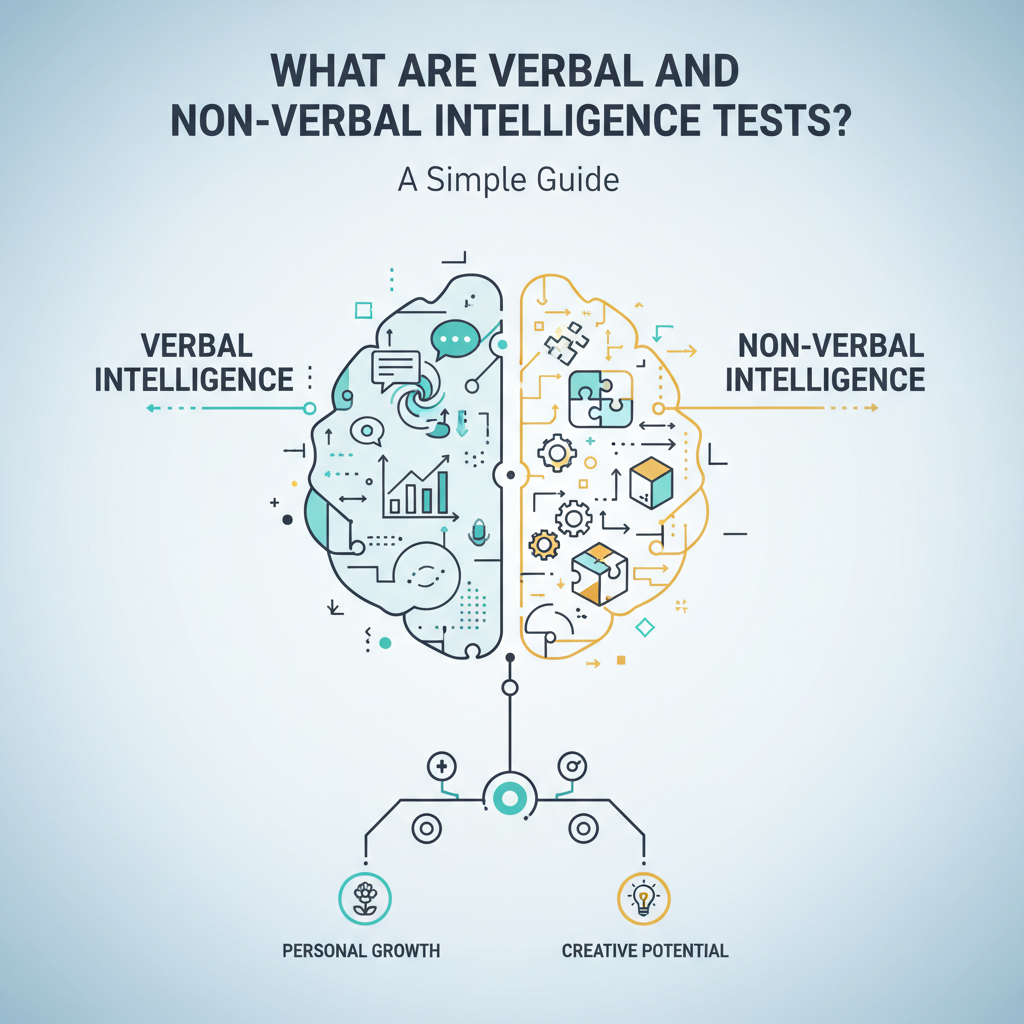
    A verbal individual intelligence test is a one-on-one assessment designed to measure a person’s cognitive abilities through language-based tasks. It evaluates key skills such as vocabulary, comprehension, verbal reasoning, and the ability to work with abstract concepts expressed through words to gauge intellectual potential.

    Words are the tools we use to form ideas, solve problems, and spark creativity. Language is more than just communication—it’s a core part of how we think and understand the world. Looking at how we use words can tell us a lot about our mental abilities, especially our creative potential. A verbal individual intelligence test does exactly this by providing a structured way to measure these important language-based skills.

    This article is your guide to verbal intelligence. We’ll explain what these tests measure and how your language strengths support your unique creative style. We will cover four key areas, from vocabulary to verbal reasoning and reading comprehension, showing what each reveals about your problem-solving abilities. Understanding these aspects of your intelligence will give you practical ways to assess and improve your creativity for personal and professional growth.

    What Is a Verbal Individual Intelligence Test?

    A verbal intelligence test is a specialized type of test. It measures how well a person can understand, use, and work with language. This test focuses on how you use words and ideas. It provides insights into your language-related thinking skills. In short, it helps us understand how you think with words.

    How It Measures Language-Based Skills

    These tests look at your language skills in different ways. They measure more than just your vocabulary. Instead, they look at how you understand and use information you hear or read. Verbal intelligence is a key part of our overall thinking skills [1].

    Here are the key language-based skills often measured:

    • Vocabulary Knowledge: This tests how well you know words and what they mean. A large vocabulary helps you think and express yourself more precisely.
    • Verbal Reasoning: This measures your ability to use logic with words. It includes tasks like finding connections between ideas or solving word puzzles.
    • Reading Comprehension: This checks how well you understand what you read. It tests your ability to find main ideas, understand implied meanings, and remember details.
    • General Information: This measures your general knowledge about the world. It shows how well you learn, remember, and share facts you’ve picked up through language.

    By looking at these areas, these tests give a complete picture. They show your skill in communicating with words and in abstract reasoning. Understanding this is important for your personal and professional life.

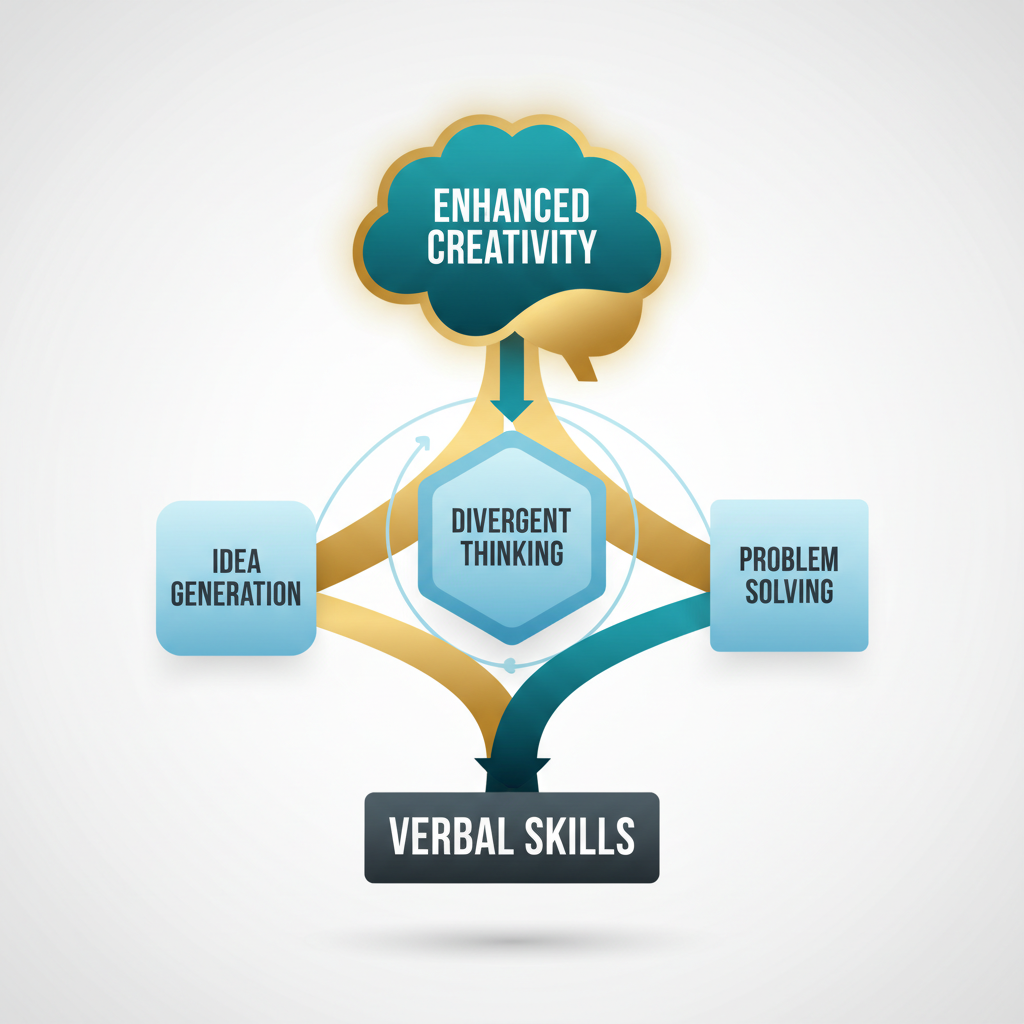
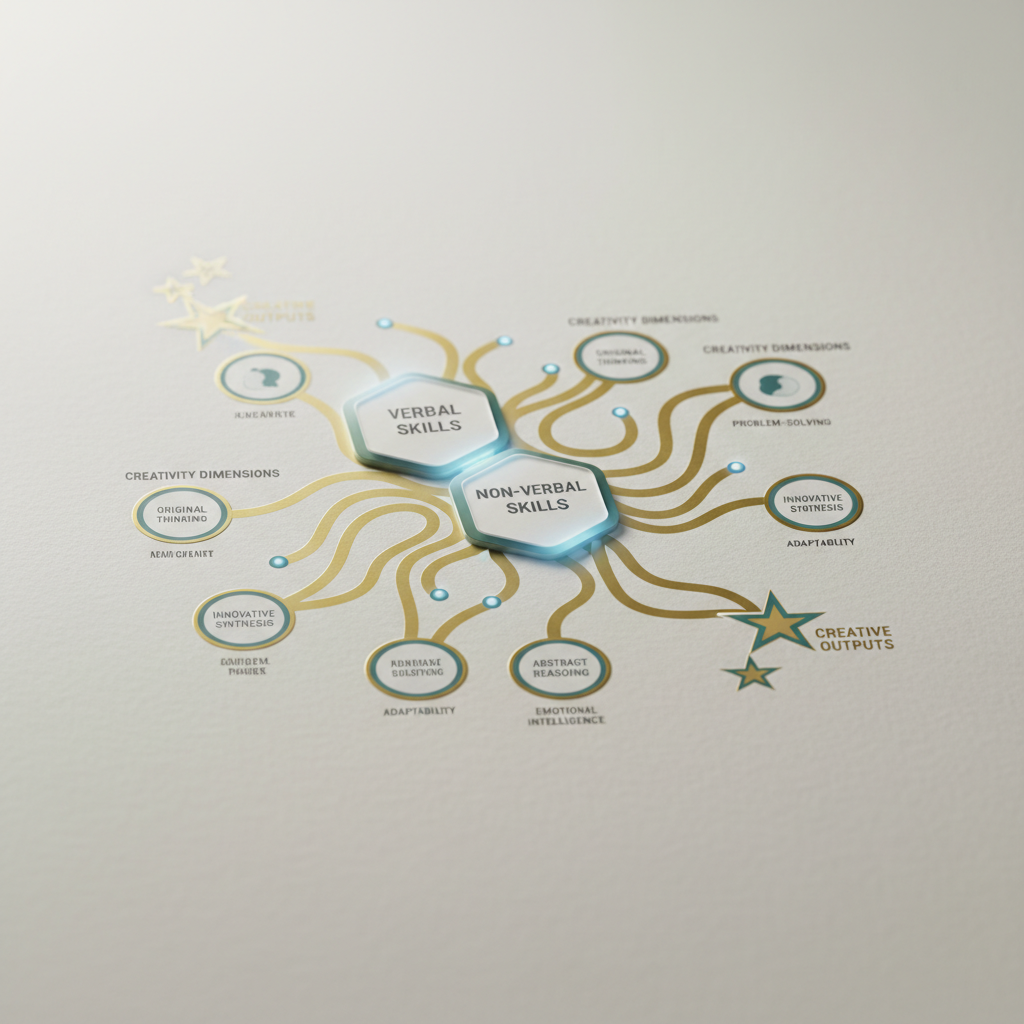
    The Connection Between Verbal Intelligence and Creativity

    You may wonder how verbal skills and creativity are linked. The connection is strong and important. Good verbal skills are not just for school. They are a key part of creative thinking and new ideas. Our Creative Ability Test recognizes this crucial relationship.

    Here’s how verbal intelligence fuels your creative potential:

    • Enhances Divergent Thinking: A large vocabulary and good reasoning skills help you come up with more ideas. You can explore a wider range of possibilities. This helps you connect ideas that seem unrelated, which is key to creative breakthroughs.
    • Improves Creative Problem-Solving: Defining a problem clearly is the first step to solving it creatively. Verbal skills help you explain problems, break them down, and share new solutions clearly.
    • Boosts Cognitive Flexibility: Creative people can often play with words and look at ideas in new ways. Good verbal skills help you change your point of view easily. This leads to more flexible and creative thinking.
    • Helps You Express Ideas: Whether writing a story or explaining a new idea, language is the main tool for creative expression. Clear communication helps others understand your unique ideas.

    Ultimately, understanding your verbal intelligence helps you. It helps you see how your language skills can be a powerful tool for creativity. Our platform, Creative Ability Test, provides personalized insights. It shows you how to use these strengths to find new opportunities and improve your innovative thinking.

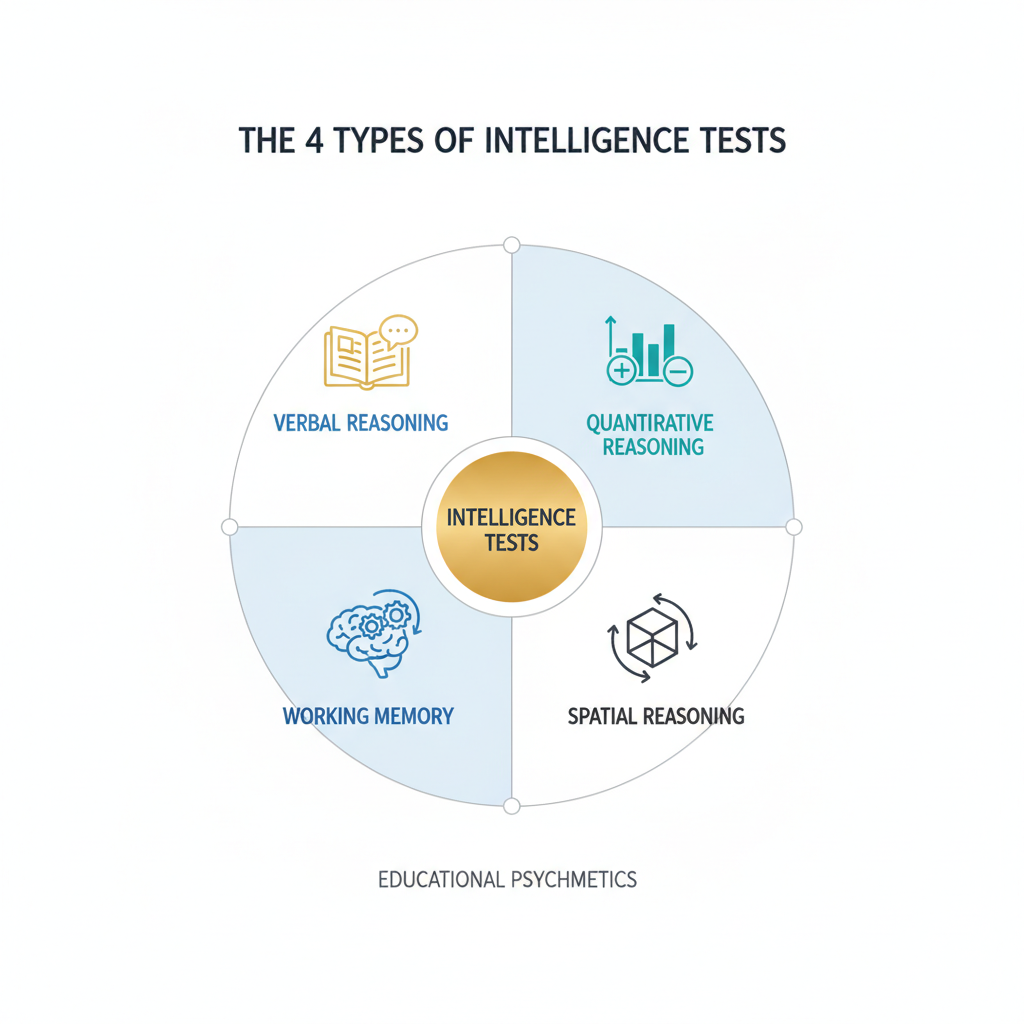
    What are the 4 types of intelligence tests?

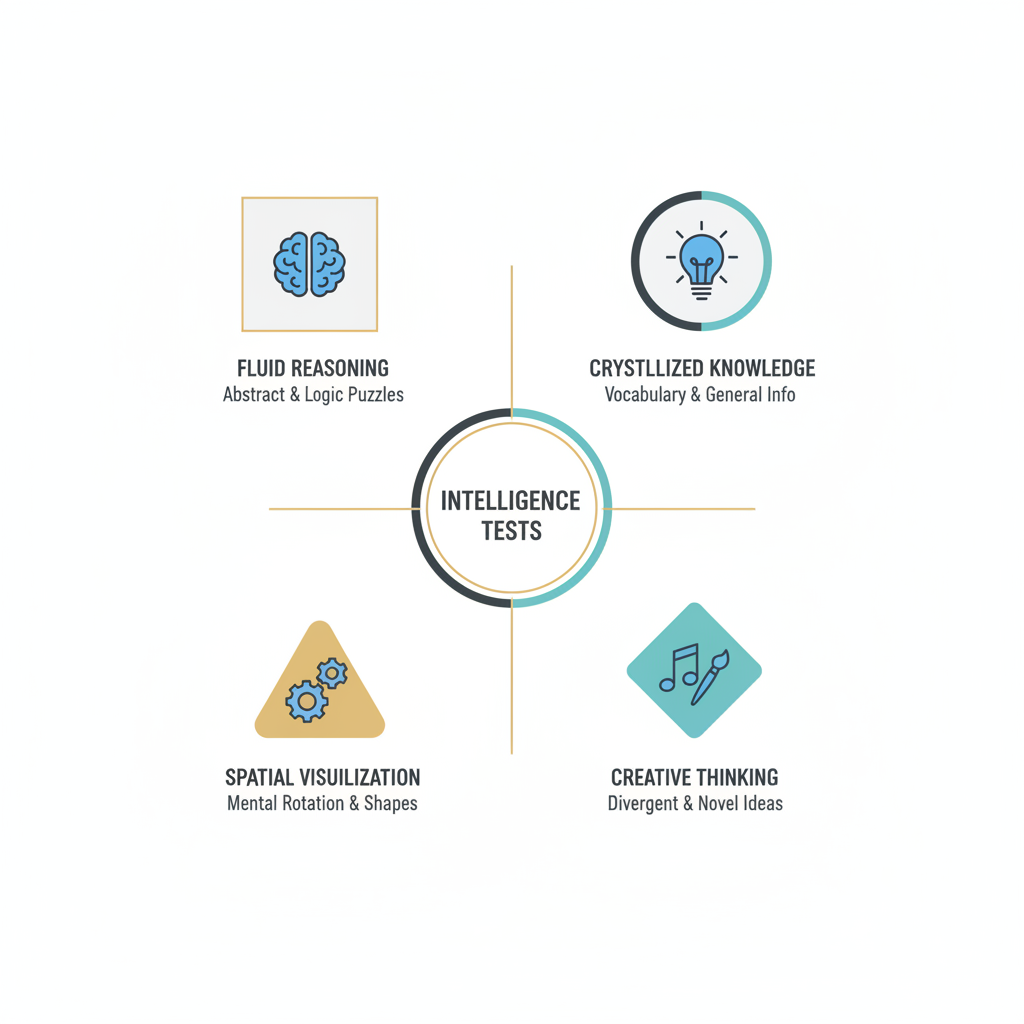
    An infographic displaying four distinct types of intelligence tests within a structured competency map, using geometric shapes and color accents.
    Minimalist vector infographic illustrating four distinct types of intelligence tests. A clean, structured competency map with four clearly separated and labeled sections. Each section uses a unique geometric shape or subtle color highlight (gold or teal accent) within a soft blue, white, and charcoal palette to represent a different test type. Connections or a central hub could visually link them as ‘intelligence tests’. Focus on clarity, professional aesthetics, and ample negative space for labels. No humans, no cartoons.

    Type 1: Vocabulary and Word Knowledge Tests

    These tests check how well you know words, their meanings, and their use in different situations. They measure the size and quality of your vocabulary.

    Knowing many words is more than just memorizing them. It shows you can understand subtle meanings and the relationships between words. This is a key skill for communicating clearly.

    For creativity, a large vocabulary gives you more ways to express your ideas. You have more words to choose from, which helps you think of new possibilities. This allows you to explain original concepts more clearly and powerfully.

    When you learn more words, your thinking becomes more flexible. You can look at problems from different viewpoints. This helps you find creative solutions and tell better stories.

    Type 2: Verbal Reasoning and Analogy Tests

    Verbal reasoning tests challenge you to see how concepts are related. You use logic and words to solve problems. These tests often use analogies, where you find a link between two words and apply it to another pair.

    These tests show how well you think logically and spot patterns. They measure your ability to think about abstract ideas. You also learn how to connect ideas that seem unrelated.

    This skill is key for solving problems creatively. A core creative skill is finding similar patterns in different areas. It helps you use a solution from one problem to solve another. This can lead to new and exciting breakthroughs.

    Improving your verbal reasoning makes your mind sharper. It helps you face tough problems with a creative approach. You’ll be able to find new ways to solve them.

    Type 3: Reading Comprehension Assessments

    Reading comprehension tests see how well you understand what you read. They measure your ability to find the main idea and important details. You also practice figuring out information that isn’t stated directly.

    These tests show how you process information and think critically. They reveal how well you learn from reading. Being able to absorb new knowledge is very important.

    This is especially important for creativity. It lets you research different subjects and combine what you learn in new ways. This information becomes the “raw material” for creative ideas. [2]

    By improving your reading skills, you build a strong base of different ideas. This is key for creating new combinations. It also helps you understand complex directions for creative projects.

    Type 4: Information and General Knowledge Scales

    These tests measure how much you know about the world. They often cover a wide range of topics, like science, history, and current events.

    These tests show your general awareness and ability to learn. They also give a sense of your cultural knowledge. It shows how much information you have stored in your mind.

    Having a lot of knowledge gives you a mental library of facts and ideas. This internal “database” is great for thinking outside the box. It helps you make surprising connections, which is the foundation of new ideas. You can pull insights from many different topics.

    Learning more about the world broadens your viewpoint. It improves your ability to connect things that seem unrelated. This increases your chances of coming up with original ideas and unique solutions for any task.

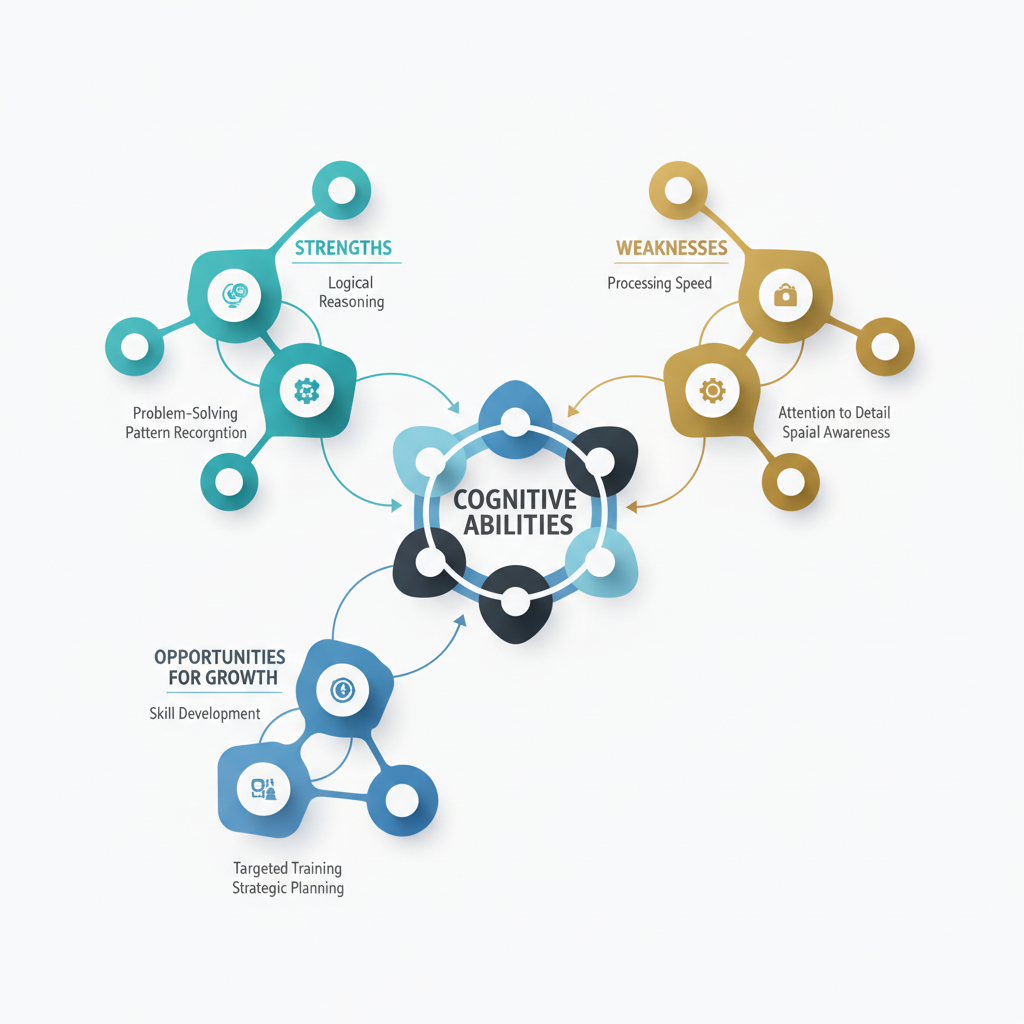
    What Do These Tests Reveal About Your Cognitive Abilities?

    An infographic using a cognitive network diagram to illustrate insights into cognitive abilities, revealing strengths, weaknesses, and opportunities.
    Abstract, educational vector infographic visualizing the insights gained from cognitive ability tests. Create a cognitive network diagram or idea cluster. Central nodes represent ‘Cognitive Abilities’ (e.g., verbal reasoning, comprehension, analytical thinking), branching out to reveal ‘Strengths’, ‘Weaknesses’, and ‘Opportunities for Growth’. Use interconnected geometric shapes and lines with subtle gradients, soft blues, whites, charcoal, and gold or teal accents. Maintain a professional, minimalist style with negative space for potential labels. No humans, no cartoons.

    Assessing Verbal Fluency and Expression

    Verbal fluency is how easily you can find and use words. It also includes how well you express your thoughts. These tests check how fast and accurately you use language.

    For example, you might be asked to list as many words as you can that start with a certain letter. Or, you could name items in a specific category. This shows the size of your vocabulary and how fast you can recall information.

    Good verbal fluency is key to being creative. It helps you:

    • Explain complex ideas clearly.
    • Share new ideas effectively.
    • Create compelling stories.
    • Persuade others with your words.

    By understanding your verbal fluency, you can see how well you share your creative ideas with the world. Research shows that language skills, including verbal fluency, are linked to better mental flexibility [3]. This flexibility is a key part of creative thinking.

    Improving how you express yourself directly helps you share original ideas. It turns abstract thoughts into clear, powerful messages.

    Gauging Abstract Thinking and Problem-Solving

    Verbal tests are a great way to measure your abstract thinking. This is your ability to understand ideas that are not physical or solid. It involves finding patterns, making connections, and seeing deeper meanings.

    These tests often include analogies or logic questions. You might need to find relationships between words or finish a sequence. This shows how you process information and come up with solutions.

    Your problem-solving skills are also closely examined. Verbal tests give you challenges that require logical and critical thinking. You use language to think through possible situations and find good answers.

    Abstract thinking and strong problem-solving skills are essential for creativity. They help you to:

    • Find the main problem in complex situations.
    • Come up with new and different solutions.
    • Connect ideas that seem unrelated.
    • Think outside the box.

    Understanding these mental skills can guide your personal growth. It helps you use your unique thinking style to solve creative challenges. This builds a more flexible and adaptive way of solving problems.

    Understanding Your Stored Knowledge

    Verbal intelligence tests also check your general knowledge. This includes facts, ideas, and information you have learned over time. It measures your ability to learn and remember things.

    Questions in this area might cover different topics, from history to science. They measure your understanding of many subjects. This reflects your curiosity and how much you know.

    A large store of knowledge is a powerful tool for creativity. It provides the raw material for new ideas. The more you know, the more connections you can make. You can combine existing ideas in new ways [4].

    This includes having a large vocabulary. A bigger vocabulary helps you think in greater detail. It lets you express your ideas with more accuracy and power.

    By knowing your strengths in general knowledge, you can use them in creative projects. Continuing to learn new things will naturally spark your creative insights. This leads to more original solutions and fresh thinking.

    How Can Understanding Verbal Skills Boost Your Creativity?

    An infographic showing a pathway from foundational verbal skills through idea generation and problem-solving, leading to enhanced creativity.
    Abstract, educational vector infographic illustrating how verbal skills boost creativity. Visualize a layered system showing growth or a branching pathway. Start with a foundational ‘Verbal Skills’ block, leading through interconnected ‘Idea Generation’, ‘Divergent Thinking’, and ‘Problem Solving’ stages, culminating in a ‘Enhanced Creativity’ outcome. Use clean geometric shapes, subtle gradients, soft blues, whites, charcoal, with gold or teal accents to highlight progression. Emphasize dynamic flow and interconnectedness with ample negative space. No humans, no cartoons.

    Using Language for Divergent Thinking

    Good language skills are a great tool for divergent thinking. This is the ability to come up with many different ideas. Instead of finding one right answer, you explore countless possibilities. Strong verbal skills help you put these different thoughts into words.

    When you brainstorm, you use words to link ideas. A large vocabulary lets you explore ideas more freely. You can switch from one idea to another more easily. You can also explore small but important differences. This helps you be more creative.

    For example, imagine you are designing a new eco-friendly product. With strong language skills, you might list related words like “sustainable,” “repurposed,” “biodegradable,” or “minimalist.” Each word can spark a new design idea. This helps you find more creative options than just the obvious ones.

    To boost your divergent thinking with language:

    • Practice Word Association: Start with one word. Then, list every related word or idea that comes to mind. Do this without judging your thoughts.
    • Engage in Freewriting: Write about a topic for a set time without stopping to edit. Let your thoughts flow freely onto the page.
    • Use Idea Journaling: Keep a journal just for new ideas. Write down thoughts, things you notice, and questions every day. Look back at them regularly to find connections.

    The Creative Ability Test helps you understand your verbal strengths. It shows how they help you think in different ways. This knowledge allows you to use language to come up with more innovative ideas.

    Improving Creative Problem-Solving Through Clearer Communication

    Solving problems creatively often means working with others and sharing your ideas well. Strong language skills are key. They help you explain tough problems clearly and describe new solutions with detail.

    Imagine you have a great new idea. If you cannot explain it well, it will not have much impact. Clear communication helps others see your vision. It makes sure your creative ideas are heard and valued. It also helps you get good feedback.

    Also, just putting a problem into words can be a creative step. How you describe a challenge changes the solutions you think of. Using the right words helps you get to the heart of the problem. It lets you explore it from different angles. This makes your problem-solving more focused and effective.

    Think about presenting a new marketing plan. Using clear, simple language helps your team understand the concept and its benefits. Good communication gets everyone on the same page. This makes it easier to put creative ideas into action. Teams with strong verbal communication skills often outperform others in innovation [5].

    To get better at creative problem-solving through communication:

    • Practice Explaining Complex Ideas: Break down complicated topics into simple terms. Try explaining them to someone who knows nothing about the subject.
    • Refine Your Pitches: Learn to sum up your ideas in a short, clear way. Focus on the main value and key benefits.
    • Seek and Give Clear Feedback: Use specific language when talking about ideas. Avoid vague comments to create a more helpful environment.

    Knowing your communication style is important. The Creative Ability Test can offer insights. This helps you improve your approach and lead more effectively when solving problems.

    Unlocking New Ideas with a Richer Vocabulary

    Your vocabulary is a toolkit for your mind, not just a list of words. Each word represents an idea, a small difference, or a point of view. A bigger vocabulary expands how you think. It helps you tell ideas apart and understand complex topics better.

    Think about the difference between “happy” and “euphoric.” Each word suggests a different feeling. Knowing these differences lets you express yourself better and explore ideas in more detail. This is important for writers, artists, and even scientists.

    A large vocabulary helps you connect ideas that do not seem related. It makes your thinking more flexible. You can use different words to describe problems in new ways and create unique comparisons. These are common ways to find breakthrough ideas.

    For instance, if you’re stuck on a design, a new word might help. You might be thinking “solid,” but then the word “translucent” comes to mind. This one word can open up new choices for materials and designs. Studies show a strong link between vocabulary size and general thinking ability [6].

    To build a richer vocabulary for creativity:

    • Read Widely: Read different types of books, authors, and subjects. Note new words and how they are used.
    • Use a Thesaurus Thoughtfully: Look up synonyms for common words, but take time to understand the small differences between them.
    • Learn Root Words: Understanding Latin and Greek roots can help you figure out the meaning of many new words.
    • Engage in Word Games: Puzzles like crosswords or Scrabble are a fun way to grow your vocabulary.

    The Creative Ability Test helps you see your verbal strengths. It shows how your word knowledge affects your creative potential. Once you understand this, you can work on building your vocabulary to help you generate fresh, innovative ideas.

    Frequently Asked Questions

    What are some examples of verbal individual intelligence test questions?

    Verbal intelligence tests check your ability to understand and use language. These skills are key to expressing creative ideas and solving tough problems. Here are some common types of questions you might see:

    • Vocabulary Tasks: You might be asked to define a word. Another common task is to choose a synonym or antonym from a list. A large vocabulary gives you more tools for creative expression.
    • Verbal Reasoning and Analogies: These questions ask you to find relationships between words. For example, “Apple is to Fruit as Carrot is to .” (The answer is Vegetable). This tests your ability to see patterns and make connections, which is a key part of creative thinking.
    • Reading Comprehension: You read a short passage and then answer questions about its main idea, details, or what it implies. Good comprehension helps you grasp complex information, a skill you need to build on new ideas.
    • Information and General Knowledge: These questions might cover a range of topics. For instance, “What is the capital of France?” A wide range of knowledge gives you more building blocks for new ideas. It helps you connect things that don’t seem related.

    Understanding these areas helps you use your unique creative strengths. Our platform explores how this kind of mental flexibility can boost your creative potential.

    Are there verbal individual intelligence tests specifically for adults?

    Yes, absolutely. Many verbal intelligence tests are designed for adults. These tests measure thinking skills in grown-ups. Verbal skills are a key part of intelligence in adults.

    A well-known example is the Wechsler Adult Intelligence Scale (WAIS). This widely used test includes several verbal subtests [7]. These subtests measure different parts of verbal intelligence, including vocabulary, comprehension, and verbal reasoning.

    Adults often take these tests for career development, educational planning, or to better understand their own thinking style. Strong verbal skills are a great help in solving complex problems. They are essential for clearly explaining new ideas and communicating creative visions at work. Understanding your verbal intelligence can show you where you can improve, helping you boost your creative thinking and communication skills.

    What is the Binet intelligence test?

    The Binet intelligence test was one of the first of its kind, pioneering the field of intelligence testing. French psychologist Alfred Binet and Theodore Simon developed it in the early 1900s. Their main goal was to find schoolchildren who needed extra help in school [8].

    A key idea from Binet was “mental age.” This compared a child’s test results to the average results of children at different ages. The first Binet tests focused heavily on verbal tasks to measure reasoning, judgment, and memory.

    The test changed a lot in the United States, where it became known as the Stanford-Binet Intelligence Scales. This version is still used today. While it doesn’t measure creativity directly, Binet’s work was revolutionary. It showed that intelligence has many different parts. It helped us begin to understand different thinking skills, including the verbal skills that are a foundation for creative thinking. Our platform builds on this history, exploring how different thinking skills add to your unique creative potential.


    Sources

    1. https://www.apa.org/topics/intelligence/understanding
    2. https://www.ncbi.nlm.nih.gov/pmc/articles/PMC8900137/
    3. https://pubmed.ncbi.nlm.nih.gov/27040409/
    4. https://www.sciencedirect.com/science/article/pii/S002210311730032X
    5. https://hbr.org/2016/11/what-google-learned-from-its-quest-to-build-the-perfect-team
    6. https://journals.sagepub.com/doi/abs/10.1177/0956797613487023
    7. https://www.apa.org/education-career/guide/science-psychology/psychology-assessment
    8. https://www.britannica.com/science/intelligence-test

  • What Are Verbal and Non-Verbal Intelligence Tests? A Simple Guide

    What Are Verbal and Non-Verbal Intelligence Tests? A Simple Guide

    Verbal and non-verbal intelligence tests are assessments that measure different cognitive abilities. Verbal tests evaluate skills related to language, such as vocabulary, comprehension, and reasoning with words. Non-verbal tests assess problem-solving abilities using visual information, like patterns and shapes, independent of language skills.

    Have you ever wondered how your mind works? Intelligence is more than just a test score. It’s a mix of different skills, from the way we communicate to how we solve puzzles without a word. Understanding these different abilities isn’t just interesting—it’s a tool for personal growth. It can help you unlock your creativity and face challenges more effectively.

    This guide explores intelligence assessment, focusing on the differences between verbal and non-verbal tests. We’ll explain what each test measures and what they reveal about your thinking style. Knowing your strengths in these areas can improve your problem-solving and creative skills. Discover why telling the difference between a verbal and a non verbal intelligence test leads to better self-awareness.

    At Creative Ability Test, we believe that self-discovery is the first step to unlocking your creative power. When you are clear about your cognitive strengths, you can build on them for innovation and personal growth. So, how do we measure these diverse kinds of intelligence, and what can they teach us about ourselves?

    How Do We Measure Different Kinds of Intelligence?

    Beyond a Single IQ Score

    For years, intelligence was often simplified to a single IQ score. But modern psychology sees it differently. We now know that human intelligence is incredibly diverse and can’t be measured by just one number.

    This wider view helps us appreciate the unique way our minds work. Leading theories, like Howard Gardner’s Multiple Intelligences, show we have many kinds of intelligence [1]. These include musical, physical, and social skills, not just traditional academic strengths.

    Understanding this is key to personal growth. It lets you move past simple labels and focus on your specific strengths. This approach builds confidence in your true potential. It also shows how different mental skills combine to boost your creativity and problem-solving.

    At Creative Ability Test, we agree with this broader view. Our platform helps you discover your different strengths. We help you move from uncertainty to clear self-awareness, giving you personalized insights into your creative potential.

    Introducing Verbal and Non-Verbal Abilities

    To understand intelligence better, experts often group abilities into different types. Two of the most basic types are verbal and non-verbal intelligence. They represent the different ways our minds handle information.

    Verbal intelligence is all about language. It’s your ability to understand, use, and think with words. This includes understanding what you read, expressing your ideas clearly, and knowing a wide vocabulary. It’s essential for communicating, learning, and sharing creative thoughts.

    On the other hand, non-verbal intelligence is about solving problems without words. It uses visual thinking, pattern recognition, and spatial awareness. Think of solving a puzzle, reading a map, or imagining an object from different angles. This skill is key for seeing connections and finding new ways to innovate.

    Both types of intelligence can be measured. A verbal test might ask about word meanings or how to complete a sentence. A non-verbal test might use shapes, patterns, or sequences. These tests offer a look into how flexibly you can think.

    Understanding these different abilities gives you powerful insights. It helps you see how you think and learn best. It also shows how these skills fuel your creativity. Many creative acts use a mix of both. For example, an inventor might picture a new product (non-verbal) and then explain its benefits (verbal). Our platform gives you feedback on these key areas, helping you use your creativity in practical, real-world situations.

    What is a verbal and nonverbal intelligence test?

    Defining Verbal Intelligence: The Power of Language

    Verbal intelligence is your ability to understand and use language well. It is about how well you understand words, phrases, and complex ideas in text and speech. This skill is essential for everyday communication and learning.

    Think of it as your brain’s language center. It helps you express thoughts clearly and understand what others mean. Strong verbal intelligence lets you handle conversations and written information with ease. For example, people with high verbal intelligence are often good at learning new languages or writing interesting stories [2].

    Key aspects of verbal intelligence include:

    • Vocabulary: Knowing many words and their meanings.
    • Verbal Reasoning: Understanding relationships between words and ideas.
    • Comprehension: Understanding the main ideas in written or spoken text.
    • Fluency: Expressing your ideas smoothly and clearly.

    This type of intelligence is closely tied to your creativity. It helps you come up with different ideas and tell interesting stories. It also helps you explain your new ideas to others. The Creative Ability Test recognizes that verbal skills are a big part of how you brainstorm and express your unique point of view.

    Defining Non-Verbal Intelligence: Solving Without Words

    Non-verbal intelligence is your ability to understand and solve problems using visual information. This means seeing patterns, picturing how shapes move, and using logic instead of words. It is often called “fluid intelligence” or “performance intelligence.”

    Imagine solving a tricky puzzle or reading a diagram without any words. That’s non-verbal intelligence at work. It lets you picture solutions in your mind and think in abstract ways. You use this skill for many daily tasks, like building furniture or finding your way in a new place. Because they don’t rely as much on language, non-verbal tests can be a fairer measure for people from different cultures [3].

    Components of non-verbal intelligence often include:

    • Pattern Recognition: Spotting patterns and connections in what you see.
    • Spatial Reasoning: Mentally picturing shapes or seeing how objects fit together.
    • Logical Deduction: Solving problems by finding the rules without using words.
    • Abstract Thinking: Understanding ideas that you can’t see or touch.

    This skill set is very useful for creativity. It helps you picture new possibilities and look at problems in new ways. Non-verbal intelligence is key for creative problem-solving and design thinking. The Creative Ability Test helps you find these visual and logical strengths. You can then use them to create unique solutions and explore your creative potential more fully.

    What does a non-verbal IQ test measure?

    Pattern Recognition

    Non-verbal IQ tests often test your skill at spotting patterns. This means finding hidden rules or connections in what you see. For example, you might see a series of shapes and have to guess the next one. It’s all about finding a rule and using it to know what comes next.

    How does this connect to creativity? Spotting patterns is key to creative thinking. It helps you see connections that other people miss. By understanding existing patterns, you can spot trends, predict what will happen, and come up with new ideas. It also helps you break old patterns to create something new and original.

    Think of a designer making a new product. They study market trends and how people behave (these are patterns). They use this knowledge to innovate, leading to a unique product people want. Improving this skill can make you a much better problem-solver.

    Spatial Reasoning

    Spatial reasoning is your ability to think about and move objects in your mind. This includes rotating shapes, picturing them from different angles, and understanding how parts fit together. For example, you might have to imagine unfolding a piece of paper. Or, you might need to figure out which 3D shape a flat pattern can make.

    This skill isn’t just for architects or engineers. It’s a key part of solving problems creatively. It lets you build models of problems in your mind. Then, you can try out different solutions without moving a thing. This is a key part of mental flexibility [4].

    Think about it: A painter pictures how to arrange a scene on a canvas. A coder imagines how data flows through an app. Improving your spatial reasoning helps you think up new ideas. It also helps you plan effective strategies in many parts of your life.

    Problem-Solving and Logic

    At its heart, a non-verbal IQ test tests your logical thinking. It gives you abstract puzzles that don’t need language or past knowledge to solve. Instead, they test your raw analytical skill. You have to figure out rules from the information you’re given and then use them in new situations.

    These tests often use grids of shapes or visual analogies. Your job is to find a rule connecting the shapes. Then, you use that rule to find the missing piece. This process trains you to tackle tough problems in a clear, step-by-step way.

    This directly fuels innovation. Strong logic skills let you break down problems. You can find the root cause and come up with smart solutions. It’s about turning a complex puzzle into a simple answer. Our Creative Ability Test helps you see how your problem-solving style boosts your creative potential. It gives you practical tips to build these skills for personal and career growth.

    How Do These Skills Connect to Your Creativity?

    An infographic illustrating connections between verbal skills, non-verbal skills, and various aspects of creativity using a network diagram with nodes and branching pathways.
    An abstract, minimalist vector-based infographic visualizing cognitive network diagrams or idea clusters. ‘Verbal Skills’ and ‘Non-Verbal Skills’ are represented as central nodes, with branching pathways connecting them to various ‘Creativity Dimensions’ like original thinking, problem-solving, and innovative synthesis. Use soft blues, whites, and charcoal, with gold or teal accents emphasizing the connections and creative outputs. Maintain ample negative space with short labels for clarity. The style is professional and approachable, focusing on conceptual representation.

    Verbal Skills and Idea Generation

    Verbal skills are key in the early stages of creativity. They help you explain your thoughts and ideas clearly. This makes brainstorming much more effective.

    Think about how you define a problem. Good verbal skills help you state challenges clearly. They also help you come up with many different ideas. You can then sort and build on these ideas.

    Here’s how verbal abilities fuel your creative process:

    • Brainstorming: You can list and describe many ideas quickly. This helps with divergent thinking, a key part of creativity.
    • Concept Development: It’s easier to turn abstract thoughts into clear descriptions. This helps you refine new ideas.
    • Storytelling: You can share your vision in a persuasive way. This helps convince others to support your creative projects.
    • Problem Definition: Stating the main problem clearly is essential. This paves the way for creative solutions.
    • Team Brainstorming: You need good language skills to share and build on ideas with others.

    In short, verbal skills help you organize, express, and share your creative thoughts. They turn quick ideas into solid plans.

    Non-Verbal Skills and Innovative Problem-Solving

    Non-verbal skills are just as important for creativity, especially for design and getting things done. This means thinking in pictures, not just words. These skills help you see solutions in your mind.

    Think about designing a new product or improving a process. Non-verbal skills help you spot patterns and connections others might miss. You can picture how objects move and fit together. This is key for hands-on innovation.

    Key ways non-verbal abilities enhance your creativity include:

    • Visualizing Solutions: You can picture how elements fit together. This is important for design, architecture, or engineering.
    • Pattern Recognition: Finding trends or spotting what’s different leads to new ideas. This is helpful for solving complex problems.
    • Spatial Reasoning: Understanding how parts fit together in a space is key. This helps you create designs that work well and look good.
    • Hands-On Creating: A lot of creative work involves building or changing things. Non-verbal skills support this kind of practical work.
    • Understanding Complex Systems: You can figure out how complex systems work without needing a long explanation. This helps you find natural solutions.

    Ultimately, non-verbal skills help you turn abstract ideas into real, working creations. They build the bridge from an idea to a finished product.

    Why a Balance is Key for Creative Potential

    True creativity thrives when verbal and non-verbal skills work together. They aren’t separate skills. Instead, they support each other perfectly. A balanced approach leads to greater innovation.

    For example, you might use non-verbal skills to spot a complex visual pattern. Then, your verbal skills help you explain why it’s important and share what you found. On the other hand, a clear verbal description of a problem can guide your non-verbal thinking to find a good design solution.

    Consider the complete creative journey:

    • From Idea to Impact: Verbal skills help you explain your first idea. Non-verbal skills then help you build and improve it.
    • Well-Rounded Problem-Solving: You can look at problems using both words and visuals. This leads to better and more original solutions [5].
    • Better Communication: You can explain complex ideas with both words and pictures. This helps your message connect with more people.
    • Adaptability: A good balance lets you switch between different ways of thinking when you need to. This flexibility is a key trait of very creative people.

    Understanding how these skills work together is a powerful step. It helps you see your own creative strengths. The Creative Ability Test offers a scientific way to explore these areas. It gives you personal insights into your thinking flexibility and problem-solving skills. Finding your balance helps you create practical steps to improve. This allows you to boost your creative skills for personal and professional growth.

    What Are Some Examples of Verbal and Non-Verbal Test Questions?

    An infographic showing abstract examples of verbal intelligence test questions with text-based symbols and non-verbal test questions with geometric patterns and sequences.
    A minimalist, vector-based infographic with a split layout. On one side, represent ‘Verbal Test Questions’ using abstract symbols for language-based tasks (e.g., a speech bubble with question marks, stacked blocks of text representing comprehension). On the other side, represent ‘Non-Verbal Test Questions’ using geometric shapes arranged in sequences or patterns (e.g., a matrix of abstract shapes for spatial reasoning, a puzzle piece fitting into a larger structure). Use soft blues, whites, and charcoal, with gold or teal accents for highlights. Short labels distinguish ‘Verbal’ and ‘Non-Verbal’ sections. The design is clean, professional, and educational.

    Common Verbal Test Examples

    Verbal tests check how well you understand and use language. They show how you process information, share ideas, and grasp difficult concepts.

    These tests also show how you think and connect ideas. This skill is key for sharing creative ideas and working well with others.

    Here are some common types of verbal test questions:

    • Analogies: These questions ask you to find the link between two words and apply it to a new pair. For example, “Apple is to Fruit as Carrot is to ______?” (Answer: Vegetable). This tests if you can spot connections and patterns.
    • Vocabulary: You may be asked to define words, find synonyms, or pick the best word for a sentence. This shows your range of vocabulary and how clearly you communicate.
    • Sentence Completion: You fill in the blanks to make a sentence logical and correct. This tests your understanding of context and subtle meanings. It also shows you can form clear thoughts.
    • Reading Comprehension: You read a text and answer questions about it. This checks if you can find and understand information in writing. It’s a key skill for figuring out tough problems.

    Knowing your verbal strengths can boost your creativity. It helps you define problems, brainstorm, and share your new solutions. Good verbal skills are the foundation for making strong arguments and telling great stories in any creative field.

    Common Non-Verbal Test Examples

    Non-verbal tests check how well you solve problems and reason with pictures and patterns. These tests don’t use words, so they measure your logic and spatial skills instead.

    They are great for showing your ability to solve problems in new ways. These skills are important when you need to picture solutions or think up new designs.

    Below are typical examples of non-verbal test questions:

    • Matrix Reasoning: You see a grid of patterns with one missing piece. Your job is to pick the right piece from several options. This tests your ability to spot the rules and patterns in the images [2].
    • Figure Completion: You are shown an incomplete picture and must choose the piece that finishes it. This tests how well you see shapes and understand how parts form a whole.
    • Block Design: You arrange blocks to copy a given design. This directly tests your ability to picture and handle objects in space. It shows if you can take a design apart in your mind and put it back together.
    • Picture Arrangement: You put a series of pictures in order to tell a story that makes sense. This tests if you can see cause-and-effect and order in pictures.

    These non-verbal skills are key to many creative tasks. They help you picture complex systems, create new products, or manage detailed projects. Building these skills helps you think differently and find new solutions.

    How Can You Apply This to Your Personal Growth?

    A layered infographic showing a progression of personal growth, starting from understanding strengths, moving through practice and application, to enhanced creative thinking, using connected geometric shapes.
    A layered system infographic, minimalist and vector-based, depicting ‘Creative Growth Strategies.’ The visual shows a progression through different levels, starting from ‘Understanding Strengths’ at the base, moving through ‘Targeted Practice’ and ‘Application to Challenges,’ and culminating in ‘Enhanced Creative Thinking’ or ‘Innovation.’ Each layer is distinct but connected, using subtle gradients and geometric shapes. Soft blues, whites, and charcoal dominate, with gold or teal accents highlighting key growth milestones. Ample negative space allows for short, impactful labels on each layer, conveying a sense of development and actionable steps for personal growth. The style is professional, encouraging, and clear.

    Identifying Your Cognitive Strengths

    Understanding your verbal and non-verbal skills is a great first step. It helps you find your unique thinking strengths. Everyone takes in information differently. Knowing how you think best gives you useful self-awareness. It shows you how you naturally solve problems and come up with ideas.

    For example, strong verbal skills often mean you are good with words. You might find it easy to explain complex thoughts. You may also enjoy making ideas clear to others. On the other hand, strong non-verbal skills suggest a talent for solving problems visually. You might quickly see patterns or how things fit together. This insight is the foundation for personal growth.

    Finding these strengths isn’t about labeling yourself. Instead, it’s about discovering your natural talents. It helps you lean into what makes you unique. This knowledge helps you build on your creative thinking and tackle tasks with more confidence.

    Using Your Strengths to Enhance Creative Thinking

    Once you know how you think, you can find smart ways to be more creative. Your strengths are tools that you can use in new and interesting ways. Here are some practical tips:

    • If you have strong verbal intelligence:
      • Brainstorm with words: Use techniques like freewriting or word association. Generate many ideas quickly. [6]
      • Narrate your ideas: Explain your ideas out loud. Telling a story can make complex thoughts clearer and help others see your vision.
      • Challenge assumptions: Use words to question the way things are. Ask “why not?” or “what if?”.
    • If you have strong non-verbal intelligence:
      • Visualize solutions: Sketch out your ideas, or create mind maps and flowcharts. Drawing helps you organize complex ideas.
      • Look for patterns: Use your skill to find connections and spot trends in data. This can lead to new solutions.
      • Use spatial reasoning: Play with objects or ideas in your mind. Think about different ways to arrange them. This helps with design and problem-solving.

    Also, balancing both ways of thinking is key to being fully creative. Try stepping out of your comfort zone. If you are good with words, try sketching. If you think in pictures, practice explaining your ideas with words. This mental flexibility will boost your overall creativity.

    Discovering Your Full Potential with the Creative Ability Test

    Are you ready to truly understand your creative side? The Creative Ability Test uses a science-based method that’s more than just a simple quiz. It gives you feedback just for you, helping you find your exact creative strengths and unique ways of thinking.

    Our 30-question test looks at many sides of your creativity. You’ll get a clear picture of your mental flexibility and learn about your ability to come up with different ideas. The test shows you how you solve problems and create new things. This is useful for both your personal and professional life.

    Your personal results give you clear steps to take, designed to help your creativity grow. You will get useful advice to help you use what you’ve learned about yourself in real life. Unlock your full potential. Turn your new understanding of creativity into real growth. Begin your journey of self-discovery today.

    Frequently Asked Questions

    What’s a good score on a non-verbal IQ test?

    To understand a non-verbal IQ score, you need to see the bigger picture. IQ scores usually follow a bell curve, with the average score being 100 [7].

    Most people, about 68%, score between 85 and 115. A score above 115 is considered above average. A score above 130 is often seen as very high.

    A “good” score simply means you have strong thinking skills. Specifically, a higher non-verbal score points to excellent skills in:

    • Pattern recognition
    • Spatial reasoning
    • Logical problem-solving without using language

    These skills are very useful for creative thinking. They help you picture new solutions and see hidden connections. Your unique mix of thinking skills fuels your creative potential.

    Remember, a single score doesn’t define everything you can do. It offers a look into specific thinking strengths. Our Creative Ability Test provides a more detailed picture of your creative thinking styles. It shows how you can use these strengths to grow and solve problems in new ways.

    Is the Stanford-Binet test of intelligence verbal or nonverbal?

    The Stanford-Binet intelligence test is very thorough. It measures both verbal and non-verbal skills. It is one of the oldest and most respected intelligence tests.

    Newer versions, like the Stanford-Binet Intelligence Scales, Fifth Edition (SB5), measure a wide range of thinking skills [8]. This includes a mix of verbal and non-verbal sections. These sections test different areas.

    The verbal sections measure:

    • Vocabulary knowledge
    • Verbal reasoning
    • Language comprehension

    The non-verbal sections test skills such as:

    • Visual-spatial processing
    • Abstract reasoning
    • Working memory without words

    Using both gives a fuller picture of a person’s intelligence. Creativity often uses both spoken ideas and visual insights. Knowing how these different but related skills work together is key to thinking in new ways.

    What is the main difference between verbal and non verbal intelligence tests?

    The main difference is how much they rely on language. Verbal intelligence tests use words and language. Non-verbal intelligence tests do not. Instead, they test skills using pictures, shapes, and patterns.

    Both types of tests show your thinking strengths. Understanding these differences helps you see how different ways of thinking can make you more creative and better at solving problems.

    Feature Verbal Intelligence Tests Non-Verbal Intelligence Tests
    Primary Focus Understanding and using language Problem-solving without language
    Skills Measured
    • Vocabulary
    • Reading comprehension
    • Analogies
    • Verbal reasoning
    • Pattern recognition
    • Spatial reasoning
    • Logical deduction
    • Figure completion
    Examples of Questions Synonym/Antonym pairs, sentence completion, word relationships Matrix reasoning, block design, picture arrangement
    Creative Application
    • Brainstorming ideas
    • Telling great stories
    • Explaining complex ideas
    • Coming up with many different solutions
    • Imagining new designs
    • Identifying hidden connections
    • Solving tricky abstract problems
    • Developing unique structures
    Cultural Impact Can be affected more by a person’s culture and language Often seen as more fair to different cultures because they don’t depend on language

    Our Creative Ability Test looks at similar ways of thinking. We help you find your own creative strengths. This shows how you connect ideas, solve problems, and think in new ways. We give you useful tips to improve your creative skills, both with words and with visuals.


    Sources

    1. https://howardgardner.com/multiple-intelligences/
    2. https://www.simplypsychology.org/intelligence.html
    3. https://www.apa.org/education-career/guide/science-nonverbal-communication
    4. https://www.ncbi.nlm.nih.gov/pmc/articles/PMC8900010/
    5. https://www.psychologytoday.com/us/basics/cognition
    6. https://hbr.org/2016/03/the-secret-to-great-brainstorming
    7. https://www.apa.org/topics/intelligence/iq-tests
    8. https://www.pearsonassessments.com/store/usassessments/en/Store/Professional-Assessments/Cognition/Stanford-Binet-Intelligence-Scales-Fifth-Edition/p/100000216.html

  • Raven Psychological Test: A Complete Guide to Understanding Your Cognitive Skills

    Raven Psychological Test: A Complete Guide to Understanding Your Cognitive Skills

    The Raven Psychological Test, also known as Raven’s Progressive Matrices (RPM), is a non-verbal assessment designed to measure abstract reasoning and fluid intelligence. It presents a series of visual patterns with a missing piece, and the test-taker must select the correct piece to complete the pattern. This evaluates an individual’s ability to think logically and solve novel problems independent of language or cultural background.

    Have you ever wondered how your mind works, or what drives your ability to solve problems, think logically, and be creative? Knowing your mental strengths is a key step to growing personally and professionally. This article introduces the Raven Psychological Test, a well-known assessment that measures these exact skills. Often called the RPM intelligence test, it provides a unique look into how you see the world and approach new challenges.

    Unlike traditional assessments that test what you already know, the Raven test focuses on your fluid intelligence. This is your natural ability to understand new information and solve problems you’ve never seen before. By learning how this non-verbal test works, you’ll gain practical insights into how you think, spot patterns, and solve problems creatively. Understanding these core skills helps you use your strengths and work on areas you want to improve.

    In this complete guide, we’ll explain how the Raven test works, what your scores really mean, and offer practical tips to improve the very skills it measures. Get ready to understand your own thinking style on a deeper level, starting with the basics. Let’s begin by exploring the main question: What is the Raven Psychological Test (RPM)?

    What is the Raven Psychological Test (RPM)?

    To unlock your creative potential, it helps to first understanding-intelligence-and-cognitive-tests/”>understand your core thinking skills. One standout tool for this is the Raven Psychological Test (RPM), also known as Raven’s Progressive Matrices. It’s a key part of psychological assessment that shows how your mind solves new problems.

    So, what is the Raven test? It’s a non-verbal test that measures your ability to reason abstractly. Psychologists created it to measure “fluid intelligence.” This is your brain’s natural talent for solving new problems by spotting patterns and seeing how things connect, all without needing prior knowledge or language skills [1].

    Many tests use words or math, but the RPM uses visual puzzles. You’ll see a series of abstract shapes and have to figure out which one comes next. This design tests your raw problem-solving skills. It shows how well you can understand new information and use logic to find the right answer.

    Understanding your fluid intelligence gives you valuable information about how you think. It shows how flexible your mind is, which is a key part of being creative and innovative. For example, strong fluid intelligence means you’re likely good at coming up with many different solutions to a problem. It also means you can easily switch between different ways of thinking to find what works best.

    At Creative Ability Test, we believe that understanding your core thinking skills is empowering. It helps you see the foundation of your creative talent. When you know how you process information, you can improve your problem-solving methods and think more innovatively. This self-awareness gives you a clear path forward, helping you grow your creative abilities in a structured way.

    How Does the RPM Intelligence Test Work?

    A minimalist infographic showing the step-by-step process of the RPM Intelligence Test, with abstract geometric shapes representing pattern presentation, analysis, and logical deduction.
    A clean, instructional infographic using a minimalist, vector-based style to illustrate the working mechanism of the RPM Intelligence Test. Employ geometric shapes in soft blues, whites, and charcoal, accented with gold or teal, to depict a step-by-step problem-solving framework or a logical flow diagram. Show abstract matrices evolving through stages of pattern identification and logical deduction. The design should convey a clear process with visual hierarchy and structured grouping, leaving open areas for directional markers. No human figures or cartoon elements, maintaining a professional and educational tone.

    The Role of Visual Patterns

    The Raven’s Progressive Matrices (RPM) is a special kind of test. It uses only visual patterns to measure your thinking skills. You’ll see a series of shapes and designs and have to find the missing piece that fits the pattern.

    This test doesn’t use words, so it avoids language or cultural barriers. This gives a clear picture of your problem-solving skills. The patterns challenge you to find connections and figure out what comes next, pushing you to think in new ways.

    Being able to see these patterns is key for creative thinking. It helps you find the basic structure in a complex problem. This skill is important for coming up with new ideas and solutions in any area.

    Assessing non-verbal abstract reasoning

    The main goal of the RPM test is to measure non-verbal abstract reasoning. So, what does that mean? It’s your ability to work with ideas and patterns, not just words or objects. You have to see the hidden “rules” that make the pattern work.

    This kind of reasoning is a key part of intelligence. It shows how well you can think logically and understand new information. The test doesn’t rely on things you’ve memorized. Instead, it measures your natural skill for solving new problems.

    For instance, a pattern might change by getting bigger or turning. Your job is to figure out the rule behind the change. This mental flexibility is also a big part of creativity. It helps you adapt and come up with new ideas [2].

    Good abstract reasoning skills also help you think more broadly. This means you can come up with many different solutions for a single problem. This improves your problem-solving skills overall.

    Progressive Difficulty Explained

    The RPM test is designed to get harder as you go. It starts with simple patterns to help you get used to the format. Then, the questions slowly become more complex.

    Each new question adds more rules or small changes. You might need to think about several rules at the same time. This increase in difficulty is done on purpose to really challenge your thinking skills.

    This structure helps the test find your exact skill level. It shows how well you handle more complex information. It also shows how you adapt when problems get harder.

    Knowing how you perform on a test like this can be very helpful. It shows your ability to learn and improve. Like with creativity, working through tough challenges can lead to big ideas. This helps you understand how you think and where you can become a more flexible thinker.

    What Skills Does the Raven Test Actually Measure?

    An infographic illustrating the cognitive skills measured by the Raven Test, represented as a radial competency map with distinct sections for visual reasoning, pattern recognition, and abstract thinking.
    An educational infographic featuring a minimalist, vector-based design of a cognitive skill assessment chart. The chart should use clean geometric shapes in soft blues, whites, and charcoal, with gold or teal accents. Represent core cognitive skills like visual reasoning, pattern recognition, and abstract thinking radiating from a central point, or as distinct sections within a competency map. Include subtle gradients for clarity and ample negative space for implied labels. The overall style should be professional and approachable, emphasizing conceptual representation without any human figures or cartoon elements.

    Fluid Intelligence: Your Ability to Solve New Problems

    The Raven Psychological Test mainly measures your fluid intelligence [3]. This is your natural ability to solve new problems. It’s how you understand tricky situations and find solutions without relying on what you already know.

    Think of it as your brain’s raw processing power. It helps you pick up new ideas quickly. Fluid intelligence is also key for adapting to new challenges, allowing you to think on your feet. For example, you use it when learning a new game or handling a surprise issue at work.

    This skill is important for personal growth because it helps you learn new things and think in fresh ways. When your fluid intelligence is strong, you can face unfamiliar problems with confidence and create smart plans to solve them.

    Pattern Recognition and Logical Thinking

    Raven tests challenge how well you recognize patterns. You have to see the connections between shapes and figures. This means finding sequences, spotting what doesn’t belong, and finishing visual patterns correctly.

    Logical thinking is also a big part of the test. You use two types of reasoning: deductive and inductive. Deductive reasoning helps you guess the next item in a series. Inductive reasoning lets you create general rules from specific examples. Both are key to solving the test’s puzzles.

    These skills are useful far beyond tests. In daily life, pattern recognition helps you:

    • See trends in data.
    • Guess what might happen in social situations.
    • Find mistakes in complex systems.

    Logical thinking helps you make decisions by letting you weigh your options clearly. This leads to better choices. Building these skills makes your thinking more flexible, preparing you to solve all kinds of problems. Many studies show a strong link between these thinking skills and success in school [source: https://journals.sagepub.com/doi/abs/10.1177/0013164415591030].

    The Connection to Creative Problem-Solving

    While the Raven Test doesn’t measure creativity directly, it checks the core skills you need for it. Fluid intelligence, pattern recognition, and logical thinking are the building blocks for creative problem-solving. They help you come up with new ideas.

    Think about it: to be creative, you first have to understand a problem. You need to see the patterns behind it and then think through possible answers. That’s when the skills measured by the Raven test become a big help.

    They also help with divergent thinking, which is the ability to brainstorm many different ideas from a single point. These thinking skills also help you:

    • Break big problems into smaller, easier parts.
    • Find surprising links between different ideas.
    • Check if your ideas will actually work and are truly new.
    • Change your approach when your first plan fails.

    In the end, strong skills in these areas boost your creativity. They help you go from just seeing a problem to creating a new solution. Our Creative Ability Test takes this even further by helping you explore these connections. You’ll discover how your own thinking style can lead to new ideas. It offers personal advice and real steps to help you grow your creative skills and use them well in all parts of your life.

    How Are Raven IQ Test Scores Interpreted?

    Understanding Percentiles and Scores

    To understand your Raven IQ test score, you need to know about percentiles. Your raw score—the number of questions you got right—doesn’t tell the whole story. Instead, your score is compared to a large group of people.

    This comparison gives you a percentile rank. For example, a 75th percentile score means you performed better than 75% of other test-takers. It shows how your score compares to others.

    Here’s what the ranks usually mean:

    • Average Range: Scores between the 25th and 75th percentile are considered average. Most people score in this range.
    • Above Average: A score above the 75th percentile shows strong abstract reasoning skills.
    • Below Average: A score below the 25th percentile may point to thinking skills that could be developed further.

    Remember, percentiles are just a snapshot. They help measure your non-verbal reasoning and show how quickly you can spot complex patterns [4].

    What Your Score Says About Your Thinking Skills

    Your Raven score mainly shows your fluid intelligence. This is your ability to solve new problems and figure out complex situations. It relies on pure reasoning, not on things you’ve already learned. For instance, strong fluid intelligence helps you adjust to new challenges.

    High scores suggest you are excellent at:

    • Pattern Recognition: You quickly see how things are connected or repeated.
    • Logical Deduction: You can figure out rules and use them in new situations.
    • Abstract Reasoning: You can solve conceptual problems well, even without clear examples.
    • Problem-Solving Skills: You can find solutions to new tasks efficiently.

    These abilities are key to creative thinking and form the foundation for new ideas. For example, if you are good at finding patterns, you might also be good at seeing unique links between different ideas. This is a key part of creativity.

    However, a Raven score is just one piece of information. It doesn’t measure creativity directly. Instead, it highlights key thinking skills that can be a big help as you explore your creativity.

    Beyond the Score: Using Your Results for Personal Growth

    Your Raven score gives you valuable insights into your core thinking skills. But the real value comes from using this knowledge to grow your creative potential.

    Think of your score as a starting point. It shows you how you tend to think. You can use this self-awareness to improve.

    Here are a few ways to use what you’ve learned:

    • Solve Creative Problems: If you’re strong in abstract reasoning, use it for tough creative challenges. Try breaking problems down into smaller parts.
    • Become a More Flexible Thinker: Fluid intelligence can be trained. Try activities that involve learning something new to strengthen your thinking skills.
    • Find Areas for Growth: If your score was lower than you hoped, see it as a chance to improve. You can do exercises to get better at pattern recognition and logical thinking.
    • Find New Ideas: Use your ability to connect the dots. Look for surprising links between ideas. This is often how new ideas are born.
    • Focus on Growth: Remember that creativity is a skill. Like any skill, it can be developed and improved over time with practice.

    Understanding your thinking strengths can help you find practical strategies for growth. The Creative Ability Test, for example, builds on these ideas. It helps you explore different sides of your creativity and gives you personalized feedback. This guidance helps you turn your potential into real-world skills and apply what you’ve learned.

    How Can You Prepare for a Raven-Style Test?

    An infographic outlining a multi-layered preparation strategy for Raven-style tests, depicted with ascending geometric blocks symbolizing different stages of cognitive practice and skill development.
    A professional and engaging infographic depicting creative growth strategies for preparing for a Raven-style test. Utilize a minimalist, vector-based design with layered systems or milestone progressions, using clean geometric shapes in soft blues, whites, and charcoal, with gold or teal accents. Illustrate concepts like cognitive training, practice exercises, and pattern recognition development as ascending or interconnected blocks. The visual should communicate a clear path for skill enhancement and personal growth, with generous negative space for potential short labels. Avoid any human figures or cartoon elements, focusing purely on conceptual, educational visuals.

    Finding Reliable Practice Tests Online

    Taking practice tests for a Raven-style exam helps you learn abstract thinking. Finding good study materials is important. These tests help sharpen your thinking skills, like spotting patterns and solving new problems. These skills are key to thinking creatively.

    Look for practice tests that are like the real Raven’s Progressive Matrices (RPM). Many learning websites have helpful resources. They often explain why answers are right or wrong. This feedback is key for learning.

    When you search, look for trusted sources. These might include:

    • University psychology departments: They often share information about thinking tests.
    • Educational sites for logic and IQ tests: They create materials to help you think better.
    • Psychometric test publishers: Some offer sample questions or guides.

    A good practice test helps you get used to the types of questions and builds your confidence. Practicing regularly can make a big difference. It gets your mind ready to solve new problems well [5].

    Tips for Improving Your Pattern Recognition Skills

    Good pattern recognition is key for a Raven-style test. It also makes your thinking more flexible, which is a big part of creativity. Improving this skill can help you in many areas of life.

    Here are some simple ways to get better at pattern recognition:

    • Play logic puzzles: Games like Sudoku, chess, or visual matching puzzles train your brain to find patterns and connections.
    • Observe your surroundings: Pay attention to patterns in nature, buildings, or even your daily routine. Noticing small details makes you a better observer.
    • Learn a musical instrument: Music is full of patterns. Learning rhythm and melody helps you recognize patterns in sound.
    • Explore coding or programming: Coding means breaking down problems and finding logical patterns. This greatly improves your systematic thinking.
    • Engage in visual arts: Drawing or painting requires you to see shapes, colors, and arrangements. This sharpens your ability to spot visual details.

    Building these skills helps you do better on RPM tests. More importantly, it improves your ability to solve problems creatively. You will start to see connections where others see only chaos. This helps you create new ideas and think outside the box.

    Understanding Test Examples and Questions

    To do well on a Raven-style test, it is important to understand how the questions work. Each question asks you to find the missing piece of a pattern by figuring out the rules behind it. Think of it as a creative puzzle where you use logic to find the right answer.

    When you see a question, break it down:

    • Analyze each part: Look at the shapes, sizes, colors, and positions. How do they change across the puzzle?
    • Find the pattern: Does a shape get bigger, smaller, rotate, or change in another way? Check both rows and columns.
    • Look for combined rules: Sometimes, parts from one row or column mix with another to create a new pattern.
    • Use elimination: Get rid of answers that clearly do not fit the rules. This makes it easier to choose.

    Many online practice tests offer detailed explanations. Study them carefully to understand the thinking behind each correct answer. This organized approach is not just for tests; it is a great way to solve any difficult problem at work or in your personal life. Building this skill can lead to new, creative solutions and builds the flexible thinking measured by the Creative Ability Test. You will go from just guessing to confidently using logic.

    Frequently Asked Questions About the Raven Test

    What are some examples of Raven psychological test questions?

    Raven’s Progressive Matrices (RPM) test questions are visual puzzles. They are designed to measure your non-verbal reasoning skills—how well you solve problems using pictures instead of words [6].

    Each question shows you a grid of geometric shapes with one piece missing. Your task is to look at a set of options and find the one that logically completes the pattern.

    The patterns change in different ways, such as:

    • Shape Progression: Shapes might grow in number or change their form.
    • Rotation: Pieces in the pattern might rotate or turn in a sequence.
    • Color or Shading Changes: The fill or outline of shapes might lighten, darken, or switch colors.
    • Pattern Combination: Pieces from different parts of the grid might combine to create a new image.

    To solve these puzzles, you need to spot rules, see how shapes are related, and figure out what comes next. This process tests your fluid intelligence—your ability to solve new problems. It also shows your cognitive flexibility, or how well you can adapt your thinking to new information.

    Can you get the Raven’s Progressive Matrices Test as a PDF?

    The official Raven’s Progressive Matrices (RPM) tests are copyrighted materials. They are created and sold by Pearson Clinical Assessment [6]. Because of this, you cannot legally download the official test as a free PDF.

    Tests like the RPM are carefully protected to make sure they are reliable and fair. Usually, only trained professionals, like psychologists, can give the test and explain the results. This ensures the scores are accurate and used correctly.

    If the official tests were available for free, they would become less reliable for actual assessments. However, you can find many “Raven’s-style” or “abstract reasoning” practice questions online. These unofficial tests can help you get familiar with the types of problems you’ll see.

    At Creative Ability Test, we believe in using proven, science-backed methods to understand your thinking skills. Our assessments offer useful insights into your creativity, mental flexibility, and problem-solving skills. We provide an ethical and effective way to explore your cognitive strengths.

    How is the Raven IQ test score interpreted?

    A Raven’s test score mainly shows your “fluid intelligence.” This is your ability to solve new problems without relying on prior knowledge [7]. Your score is usually given as a percentile, which compares your performance to others who have taken the test.

    Here is a general guide to what percentile scores mean:

    • 50th Percentile: This is an average score. It means you performed as well as or better than 50% of people in the comparison group.
    • Above 50th Percentile: A higher percentile suggests stronger fluid reasoning skills. For example, a 90th percentile score means you did better than 90% of the group.
    • Below 50th Percentile: A lower percentile suggests your fluid reasoning skills are less developed than average.

    It’s important to remember that a Raven’s score is just one piece of the puzzle. It measures a specific kind of intelligence but doesn’t define your overall intelligence or creativity.

    At Creative Ability Test, we help you understand your unique thinking style so you can grow. We provide personal feedback on your creative strengths, mental flexibility, and approach to problems. Instead of just a single score, we give you useful tips to improve your skills. Our goal is to help you discover more about yourself and support your ongoing growth.

    Where can I find a free RPM intelligence test online?

    You cannot find an official Raven’s Progressive Matrices (RPM) test for free online. As mentioned earlier, the RPM is a copyrighted test that must be given by a trained professional.

    However, many websites offer “Raven’s-style” practice tests. These unofficial tests copy the style of the real RPM questions. They are a good way to get used to the format and practice finding patterns. Just know that the quality of these free tests can be very different from one site to another.

    When looking for practice tests, keep these tips in mind:

    • Focus on “Style” Tests: Search for phrases like “Raven’s-style practice,” “abstract reasoning test,” or “non-verbal reasoning puzzles.”
    • Review Explanations: Choose sites that explain the answers. This helps you learn the logic behind each puzzle.
    • Diverse Question Types: Look for tests with a variety of patterns. This will expose you to different kinds of problems.
    • Reputable Sources: Try to use practice tests from trusted educational or test-prep websites.

    While practice tests are helpful, they have limits. For a full picture of your thinking skills and creative potential, a science-backed assessment is better. Our 30-question Creative Ability Test gives you personal feedback and practical advice. It looks at your creative strengths, mental flexibility, and innovation skills. This helps you use your creativity for both personal and professional growth.


    Sources

    1. https://dictionary.apa.org/raven-s-progressive-matrices
    2. https://www.sciencedirect.com/topics/psychology/ravens-progressive-matrices
    3. https://www.verywellmind.com/what-is-fluid-intelligence-2795295
    4. https://www.apa.org/topics/intelligence/iq-tests
    5. https://www.cambridge.org/core/journals/journal-of-child-psychology-and-psychiatry/article/abs/assessment-of-intelligence-in-children/CF974E6F8C1D6B8C2D4E4A2A2D4E4A2A
    6. https://www.pearsonclinical.co.uk/Psychology/AdultCognition/AdultAttentionExecutiveFunctions/Ravens2/Ravens2.aspx
    7. https://www.britannica.com/science/fluid-and-crystallized-intelligence

  • The Sternberg Intelligence Test: An Ultimate Guide to Practical, Analytical & Creative Thinking

    The Sternberg Intelligence Test: An Ultimate Guide to Practical, Analytical & Creative Thinking

    The Sternberg intelligence test, based on the Triarchic Theory of Intelligence, assesses three distinct types of intelligence: analytical, creative, and practical. Unlike traditional IQ tests that focus mainly on academic skills, it provides a broader view of intelligence by evaluating real-world problem-solving and innovative thinking. This approach helps identify a person’s unique cognitive strengths.

    Have you ever felt that traditional intelligence tests don’t measure everything you can do? For a long time, being ‘smart’ just meant being good at schoolwork or logic puzzles. But intelligence is much more than that. It’s also about how you create, adapt, and handle real-world challenges. This wider view is the basis of the Sternberg Intelligence Test. It helps us see all our mental strengths and our creative potential.

    This article will explain the Sternberg Intelligence Test and its Triarchic Theory of Intelligence. We will look at the three types of intelligence it covers: analytical, creative, and practical. These types are separate but work together. By learning about each one, you’ll better understand your own thinking styles. You’ll see how you break down problems, come up with new ideas, and use what you know in daily life.

    Understanding the Sternberg model can help you, whether you want to improve your problem-solving, grow personally, or just learn about your own creativity. We’ll show you how using these different kinds of intelligence can change how you face challenges. You’ll learn new ways to innovate and get tips for strengthening each of these key areas. Get ready to discover more about yourself and see how a good balance of these skills can unlock your creative ability and help you navigate the world with more confidence.

    What Is the Sternberg Intelligence Test?

    Moving Beyond Traditional IQ

    For a long time, IQ tests were the main way to measure intelligence. These tests focused on logic and language skills. But they often missed other important human abilities.

    However, real intelligence is much more than that. Creative thinking, for instance, is key for new ideas. Practical skills are needed for everyday life. Traditional IQ scores didn’t show this full picture.

    As a result, many experts wanted a wider view. They knew that a deeper understanding of intelligence could help people do better at work and in life. This change led to new theories that gave better insights into our mental strengths.

    Understanding these different parts of intelligence helps you see your own unique skills. It supports you as you grow and improve yourself.

    Introducing the Triarchic Theory of Intelligence

    Because old IQ tests had limits, Dr. Robert J. Sternberg offered a new idea. This well-known psychologist created the Triarchic Theory of Intelligence [1]. His work changed how we think about being smart.

    Sternberg’s theory says that intelligence isn’t just one thing. Instead, it is made of three different but connected parts. This gives us a much broader view of what it means to be “smart.”

    These three types of intelligence work together to help us succeed in life. They are:

    • Analytical Intelligence: This is our skill for analyzing, judging, and comparing information. It helps us solve problems in traditional academic settings.
    • Creative Intelligence: This involves coming up with new ideas and dealing with new situations. It is about thinking outside the box.
    • Practical intelligence: This is the ability to use knowledge in real-world situations. It helps us adapt to our environment or change it to fit our needs.

    This complete theory helps you explore your own thinking styles. It helps you understand your strengths in solving problems and coming up with new ideas. It also shows how these different forms of intelligence lead to overall success and personal growth.

    What Are the 3 Types of Sternberg Intelligence?

    An infographic showing a central concept of Sternberg Intelligence branching into three distinct, interconnected geometric shapes representing Analytical, Creative, and Practical intelligences.
    An abstract, educational infographic illustrating the three distinct types of Sternberg Intelligence. A central, rounded geometric shape represents ‘Sternberg Intelligence’ and branches out into three interconnected, unique geometric shapes. Each branching shape represents one intelligence type (Analytical, Creative, Practical), with subtle gradients in soft blues and whites, highlighted by gold or teal accents. The composition is minimalist, vector-based, professional, and approachable, with clear negative space for short labels. No humans, no cartoon elements.

    Analytical Intelligence: The Problem Solver

    Analytical intelligence is what many traditional intelligence tests measure. Sometimes called “componential” intelligence, it involves the mental skills you use to analyze, evaluate, and compare information [2]. Think of it as your inner academic.

    This intelligence is key for breaking problems down into smaller parts. It helps you understand cause and effect. You use analytical intelligence when you:

    • Evaluate arguments and evidence.
    • Solve complex logical puzzles.
    • Identify patterns and connections.
    • Critique ideas or plans.

    If you want to be a creative problem-solver, strong analytical skills are essential. They help you see if your new ideas will work and spot any potential problems. This ensures your creative ideas are not only imaginative but also practical and effective.

    Creative Intelligence: The Innovator

    Creative intelligence is about how you handle new situations. Also known as “experiential” intelligence, it means using what you already know to come up with new ideas and solutions. This is where innovation truly shines.

    This type of intelligence is all about imagination and fresh perspectives. It helps you think outside the box. You use creative intelligence when you:

    • Invent unique solutions to problems.
    • Come up with new ideas.
    • Connect different pieces of information in new ways.
    • Adapt to new situations quickly.
    • Imagine different possibilities.

    Our Creative Ability Test is specifically designed to explore and measure this intelligence. It looks at your ability to think flexibly, generate many ideas, and stay open to new things. When you understand your creative intelligence, you can use your unique way of thinking to grow and innovate.

    Practical Intelligence: The Real-World Navigator

    Practical intelligence is your ability to apply what you know to real-world situations. It’s often called “street smarts” or common sense. This intelligence, also known as “contextual” intelligence, helps you adapt to, shape, or choose new environments.

    This practical wisdom helps you put ideas into action. You use practical intelligence daily when you:

    • Solve everyday problems effectively.
    • Navigate social situations.
    • Understand unspoken rules.
    • Manage tasks and projects efficiently.
    • Apply knowledge to achieve goals.

    When you have a brilliant creative idea, practical intelligence helps you turn it into reality. It helps you figure out what will actually work in a real situation. Improving this skill means you can bring your creative solutions to life and handle any challenge that comes up.

    How Does the Sternberg Triarchic Abilities Test (STAT) Work?

    What to Expect from the Test Questions

    The Sternberg Triarchic Abilities Test (STAT) is not just a memory test. It tests your mind in three different ways. This assessment shows your unique mental strengths. It helps you see how you solve different problems.

    Each part of the STAT looks at a specific type of intelligence. You will see different kinds of questions. These might include multiple-choice, short-answer, or scenario-based tasks.

    • Analytical Questions: These test your critical thinking. You might solve analogies, complete number sequences, or interpret logical statements. The goal is to break down problems and find the one right answer.
    • Creative Questions: This part tests your ability to come up with new ideas. You could be asked to invent a unique story. You might also design a new product or suggest different solutions to a common problem. These questions look for original and clever thinking. [3]
    • Practical Questions: Here, you use what you know in real-life situations. Imagine you are given a practical problem at work or in daily life. You then choose the most effective solution. These tasks measure your “street smarts” and how well you adapt.

    The STAT questions push you to think in flexible ways. They are not always about finding one perfect answer. Instead, they look at how you think and solve problems. This approach gives a fuller picture of what you can do.

    Interpreting Your Results for Personal Growth

    Receiving your STAT results is an exciting step. It’s more than just a score. It gives you a detailed map of your unique cognitive profile. Understanding this is a powerful tool for learning about yourself and growing.

    Your results will show your strengths in all three types of intelligence. For example, you might be great at creative thinking. This means you’re good at coming up with new ideas. Or maybe your practical intelligence is a high point, meaning you’re great at solving everyday problems.

    Understanding your creative strengths is especially helpful. The STAT can reveal:

    • Divergent Thinking: Your ability to come up with many different ideas from one starting point.
    • Originality: How unique and uncommon your ideas tend to be.
    • Cognitive Flexibility: How easily you can change your point of view and try new approaches.
    • Openness to Experience: How willing you are to explore new ideas and try unusual methods.

    How can you use this information? Your profile gives you useful information you can act on. You can use your strongest type of intelligence to your advantage. You can also see which areas you might want to improve. For example, if you are strong in creative intelligence, you could look for jobs that require new ideas. If you want to improve your practical intelligence, you could practice solving real-life problems. [4]

    Remember, these results are not fixed labels. They are a starting point for growth. They help you grow your skills more effectively. At Creative Ability Test, we use these insights to help you. We help you turn what you’ve learned into personal strategies. This guidance helps you continue to develop your creative skills. It turns uncertainty into confident self-awareness.

    Why Does Sternberg’s Model Matter for Your Creativity?

    Connecting Creative Intelligence to Your Potential

    Sternberg’s model is a great way to understand your creative skills. It shows that creativity isn’t just a mysterious talent. Instead, it defines Creative Intelligence as a specific skill you can measure.

    This type of intelligence is all about creating new ideas. It helps you see problems in new ways and come up with fresh solutions. It also encourages you to question old habits and think with imagination.

    Understanding your creative intelligence is key to reaching your full potential. Our Creative Ability Test assessment helps you find your unique creative strengths. You will discover your personal approach to challenges and how you create original thoughts.

    As a result, you get a clear look at your:

    • Divergent thinking abilities: How many different ideas can you produce?
    • Cognitive flexibility: How easily can you switch perspectives?
    • Novelty generation: How adept are you at creating something truly new?
    • Risk-taking in ideation: Are you comfortable exploring unusual ideas?

    These insights are practical, not just theory. They give you a clear path for growth. You learn how to use your natural creative style well in your personal and professional life.

    Using a Balanced Approach to Solve Problems

    True innovation often needs more than one type of intelligence. Sternberg’s Triarchic Theory shows the power of using a balanced approach. It highlights how combining analytical, creative, and practical skills leads to better problem-solving.

    Think about a tough problem you’re facing. You might start by breaking it down with logic. This is where your analytical intelligence shines. You identify the main parts of the problem and any potential roadblocks. For instance, you could analyze market data for a new product idea [5].

    However, analysis alone can lead to the usual answers. This is where creative intelligence becomes essential. It lets you brainstorm fresh, unusual solutions. You can think outside the box and imagine possibilities others might miss. Perhaps you see a completely new product feature or a different way to deliver a service.

    Finally, practical intelligence turns your ideas into reality. It helps you figure out what is possible and how to make it work. You consider real-world limits, like your budget and timeline, and create a solid plan. This intelligence makes sure your great ideas can succeed in your environment.

    By understanding your profile across all three intelligences, you can develop a more well-rounded approach. Our complete 30-question Creative Ability Test assessment provides this valuable insight. It offers personal feedback and clear next steps. These tools help you strengthen any area you choose, making you a more flexible and effective problem-solver.

    How Can You Enhance Your Triarchic Intelligences?

    An infographic illustrating a layered, upward progression of strategies and steps designed to enhance an individual's triarchic intelligences, using geometric shapes and accent colors.
    An abstract, educational infographic presenting strategies for enhancing triarchic intelligences. Visualize this as a layered system showing growth, a milestone progression, or an upward-moving framework. Utilize clean, ascending geometric shapes or interlocking segments, each representing an actionable strategy or step towards improvement. The color palette includes soft blues, whites, and charcoal, with prominent gold or teal accents to signify progress and impact. The style is minimalist, vector-based, professional, and approachable, designed with negative space for concise labels. No humans, no cartoon elements.

    Understanding how you think, whether with a framework like Sternberg’s or a detailed assessment like the Creative Ability Test, is just the first step. The real power comes from actively improving your skills. This includes strengthening your analysis, expanding your creativity, and sharpening your real-world problem-solving. The Creative Ability Test also offers personal feedback and clear steps to build on your unique creative talents.

    Practical Tips for Boosting Analytical Skills

    Analytical intelligence helps you break down problems, study information, and make good decisions. It involves critical thinking and logic. Here are several effective ways to strengthen these important skills.

    • Engage with Logic Puzzles: Regularly solve puzzles like Sudoku, crosswords, or riddles. These activities train your brain to see patterns and find solutions. They also sharpen your mind.
    • Practice Critical Reading: When you read, don’t just absorb facts. Question the author’s ideas and look at their evidence. Think about other points of view. This helps you understand things more deeply.
    • Break Down Complex Problems: When you face a big challenge, divide it into smaller, manageable parts. Look at each part on its own. This makes big tasks feel less overwhelming.
    • Ask “Why” Repeatedly: Don’t stop at the first answer. Keep asking “why” to find the real cause of a problem. This habit helps you understand things on a deeper level.
    • Learn Basic Coding: Coding requires you to think in a clear, logical way. It teaches you how to structure instructions and fix errors. This is a great way to practice your analytical skills.
    • Reflect on Decisions: After you make a choice, think about what happened. Ask yourself what went well and what you could do better next time. This helps you make better decisions in the future [6].

    Strong analytical skills also support your creativity. They help you judge new ideas carefully and improve your innovative solutions. Our platform gives you insights into how your analytical side affects your creative work.

    Strategies to Nurture Your Creative Thinking

    Creative intelligence is all about coming up with new ideas, thinking outside the box, and using your imagination. It is a key part of innovation and personal growth. The Creative Ability Test is designed to measure and improve these skills. Here are some practical strategies to unlock your creative potential.

    • Embrace Divergent Thinking Exercises: Set aside time to brainstorm freely without judging your ideas. For example, try to list all the possible uses for a common object like a brick. This practice helps you generate more ideas [7].
    • Explore New Experiences: Step out of your comfort zone. Visit new places, try a new hobby, or learn about different cultures. New experiences give you fresh ideas and help you see things in new ways.
    • Practice Mind Mapping: Start with a main idea and draw branches to related words, ideas, and images. This visual tool helps you organize your thoughts and spark new connections.
    • Challenge Assumptions: Question the way things are usually done. Ask “What if…?” to explore new possibilities. New ideas often start by challenging old ones.
    • Engage in Creative Play: Give yourself free time for fun activities like drawing, writing stories, or making up music. Being playful helps you feel less self-conscious and express yourself more freely.
    • Keep an “Idea Journal”: Write down any idea, thought, or question that you have. Even small thoughts can sometimes grow into big ideas later on.

    At Creative Ability Test, we understand that creativity is a skill you can grow. Our personalized feedback helps you find your unique creative strengths. We then offer clear steps to build on your specific thinking style. This helps you use your creativity in all parts of your life.

    Ways to Improve Your Practical Intelligence

    Practical intelligence is your ability to handle real-world situations, solve everyday problems, and deal with people. It is often called “street smarts” or common sense. It connects what you know with what you can actually do.

    • Learn from Experience: Think about your past successes and failures. Figure out what worked and what did not in real life. Use these lessons to make better choices next time.
    • Observe and Emulate: Pay attention to how other people solve problems or interact well. Learn from their methods and try them yourself. This is a powerful way to learn from real-life examples.
    • Seek and Apply Feedback: Ask people for feedback on your work and your decisions. Be open to helpful advice. Use this information to improve how you do things.
    • Develop Strong Communication Skills: Clear communication is key to success in the real world. Practice listening carefully and saying what you mean simply. This builds better relationships and prevents misunderstandings.
    • Set Realistic Goals: Know your strengths and weaknesses. Set goals you can actually reach with the time and resources you have. This helps you avoid frustration and make steady progress.
    • Practice Problem-Solving in Context: Use your analytical and creative skills on the challenges you face every day. Focus on finding solutions that work for your specific situation. This makes your practical skills stronger.

    By improving your practical intelligence, you can turn insights from your Creative Ability Test results into real achievements. You will go from just knowing your potential to using it with confidence to solve real-world problems. This leads to both personal and professional growth.

    Frequently Asked Questions

    What are the Sternberg intelligence types?

    Robert Sternberg’s Triarchic Theory of Intelligence offers a new way to think about intelligence. It looks beyond traditional IQ scores and suggests there are three main types of intelligence. These types work together to help us navigate the world and solve problems. Understanding them can reveal how you think and learn best [8].

    Here are the three Sternberg intelligence types:

    • Analytical Intelligence: This is your skill for academic problem-solving. It’s about analyzing, evaluating, and comparing information. People with strong analytical intelligence are good at logical reasoning and thinking critically. This skill helps you break down big problems into smaller, more manageable parts.
    • Creative Intelligence: This type is about coming up with new ideas and thinking in new ways. You use it to find novel solutions to problems. This intelligence helps you handle unfamiliar situations with flexibility. It allows you to create innovative concepts and connect ideas that seem unrelated.
    • Practical Intelligence: Often called “street smarts,” this is your ability to adapt to everyday life. It helps you solve real-world problems by applying your knowledge effectively. This intelligence helps you handle social situations and know how to get things done.

    Each type is important, and they all contribute to a balanced approach to life. Knowing your strengths in these areas can help you grow as a person and improve your problem-solving skills.

    What kind of questions are on the Sternberg Triarchic Abilities Test?

    The Sternberg Triarchic Abilities Test (STAT) is designed to measure all three types of intelligence. It uses different kinds of questions, with each format targeting a specific thinking skill. This approach provides a detailed profile of your abilities.

    Test questions often include:

    • Analytical Questions: These are often multiple-choice questions. You might solve analogies, like “Bird is to nest as human is to ,” or find patterns in a series of numbers. These questions test your ability to use logic, identify relationships, and draw conclusions.
    • Creative Questions: These tasks ask you to think outside the box. You might be asked to invent a story, design a new product, or suggest new solutions to a problem. For example, “How many different uses can you think of for a brick?” These questions measure your originality and ability to generate unique ideas.
    • Practical Questions: These questions are based on real-world situations. You might read a short story about a social conflict and choose the best way to resolve it. Or, you might be asked to analyze a business problem and suggest a practical solution. They test your ability to apply your knowledge and adapt to everyday challenges.

    The STAT shows how you use different thinking styles. This understanding is very useful. It helps you use your unique strengths, which leads to better problem-solving and new ideas.

    Can I take the Sternberg Triarchic Abilities Test online?

    The original Sternberg Triarchic Abilities Test (STAT) is mainly a tool for research and academic use [9]. Because of this, it’s not easy to find an official online version for personal use. However, the ideas behind Sternberg’s work are still very valuable and shape how we understand intelligence and creativity.

    If you’re interested in exploring your creative potential, our platform offers a great alternative. The Creative Ability Test is an assessment based on science that focuses on the “Creative Intelligence” part of Sternberg’s theory. Our 30-question test is designed to help you measure your creative strengths and how flexibly you can think.

    When you use the Creative Ability Test, you receive:

    • Personalized insights into your creative thinking style.
    • Actionable tips to improve your problem-solving skills.
    • Guidance on how to bring more innovation into your daily life.
    • A clear understanding of how to use your unique abilities.

    Our platform focuses on real results. It helps you understand and improve your creative abilities, giving you clear insights you can act on. Discover your creative potential today.


    Sources

    1. https://psychology.cornell.edu/robert-j-sternberg
    2. https://pressbooks.oer.hawaii.edu/psychology/chapter/theories-of-intelligence/
    3. https://www.apa.org/pubs/books/supp/sternberg-capstone/chapter-5-stat.pdf
    4. https://psychology.jrank.org/pages/621/Sternberg-s-Triarchic-Theory-Intelligence.html
    5. https://www.forbes.com/advisor/business/what-is-market-research/
    6. https://hbr.org/2012/05/make-better-decisions-learn-to-reflect
    7. https://psychology.iresearchnet.com/social-psychology/group/brainstorming/
    8. https://robertjsternberg.com/triarchic-theory-of-intelligence/
    9. https://psyc.umd.edu/research/laboratory/university-maryland-triarchic-abilities-test-umtat

  • SB5 Intelligence Test Explained: What It Measures & How It Relates to Creativity

    SB5 Intelligence Test Explained: What It Measures & How It Relates to Creativity

    The SB5 Intelligence Test, or Stanford-Binet Intelligence Scales, Fifth Edition, is a professionally administered cognitive assessment used to measure intelligence in individuals from age two through 85+. It evaluates five key cognitive factors: Fluid Reasoning, Knowledge, Quantitative Reasoning, Visual-Spatial Processing, and Working Memory to provide a comprehensive Full Scale IQ score.

    Have you ever wondered what shapes your thinking skills or how they connect to your ability to come up with new ideas? The world of psychological assessment offers a look into how our minds work. One of the most respected tools for understanding intellectual potential is the SB5 intelligence test, also known as the Stanford-Binet Fifth Edition. This test goes beyond a simple IQ score to look at the different parts of how you think. Learning what the SB5 measures can be a great first step to understanding yourself better.

    While tests like the SB5 measure intelligence, their real power is in connecting those insights to your personal and professional growth. Intelligence provides a strong foundation, but creativity is what turns knowledge into new ideas and solutions. Many people think these two traits are separate, but they are closely linked. How you process information and adapt to new situations plays a big part in fueling your creative potential.

    This article will guide you through the SB5 intelligence test. We will explain its structure, what each part reveals, and how to interpret the results. More importantly, we’ll explore the link between the thinking strengths identified by the SB5 and your natural creative abilities. When you understand these connections, you can better appreciate how your own mind works, discover your unique creative strengths, and learn practical ways to improve them for personal growth and daily life.

    What is the SB5 Intelligence Test?

    Understanding the Stanford-Binet Legacy

    The SB5 intelligence test is a key tool in psychological assessment. It’s a respected test that helps us understand mental skills and has a history of over 100 years.

    The test began in the early 1900s with the Binet-Simon Scale, created by Alfred Binet and Theodore Simon. Their goal was to find French students who needed extra help in school [1]. This was a major step forward, becoming the first practical intelligence test.

    Later, Lewis Terman of Stanford University adapted the test for Americans. He introduced the idea of an “Intelligence Quotient” (IQ), and the test became known as the Stanford-Binet. This version secured its place in the history of psychology.

    The current version, the SB5, is the fifth edition. It has been updated many times to stay current and accurate. The test measures a wide range of mental skills, including Fluid reasoning, knowledge, quantitative reasoning, Visual-spatial processing, and Working memory. These skills are the foundation for how we think, learn, and solve problems.

    If you want to understand your own thinking style, the SB5 can offer deep insights. It can also highlight your creative potential. Learning about your strengths is a key step toward self-awareness.

    Who is the SB5 Designed For?

    The SB5 is very flexible. It’s designed for a wide range of ages, from two years old to over 85 [2]. This makes it a useful tool in many different situations.

    Educational and clinical psychologists are the main users of the SB5. They use it for detailed cognitive assessments, but its use doesn’t stop there.

    Here are some key groups and purposes the SB5 serves:

    • Educational Placement: Helps identify gifted children or those who need extra learning support. This makes sure students get the right kind of help.
    • Diagnosis of Intellectual Disabilities: Provides key information to help accurately diagnose intellectual disabilities.
    • Assessment of Learning Difficulties: Can identify specific mental challenges that may affect school performance.
    • Forensic and Clinical Evaluations: Used in different professional settings, including neuropsychological and legal evaluations.
    • Research: Researchers use it to study intelligence, how our minds develop, and different psychological conditions.

    For you, learning about the SB5 can be enlightening. It provides a clear method to evaluate your thinking patterns. This knowledge can help you understand how your mind influences your creativity. When you know your cognitive strengths, you can use them more effectively to solve problems and create new ideas.

    What Are the Five Factors Measured by the SB5?

    An infographic showing a central point labeled SB5 branching out to five distinct geometric shapes, each representing a measured factor, connected by lines.
    A minimalist, vector-based infographic displaying the five factors measured by the SB5 test. Use a central geometric hub representing the SB5, with five branching pathways, each leading to a clean, geometric shape representing one of the factors. Each factor shape should have a subtle gradient and be connected by a soft blue line. Incorporate small, concise labels for each factor. The overall design should be structured and professional, using a palette of soft blues, whites, charcoal, and gold accents. Ample negative space ensures clarity.

    The SB5, or Stanford-Binet test, gives a detailed look at a person’s thinking skills. It doesn’t give just one score. Instead, it measures intelligence in five key areas. These areas show a full picture of how you use information and solve problems.

    Learning about these areas can also highlight your creative potential. After all, creativity often uses many different thinking skills. Let’s take a closer look at each one.

    Fluid Reasoning

    Fluid reasoning is your ability to solve new problems. It means thinking logically when you face something new. This skill helps you understand new ideas fast. You use it to spot patterns and connections without needing past knowledge.

    This skill is key for creative thinking. It helps you adapt to new challenges and come up with fresh solutions. People with strong fluid reasoning are often great at brainstorming and thinking outside the box.

    For example, if you face a unique design problem, fluid reasoning helps you find a totally new way to solve it. It lets you see possibilities that others might miss.

    Knowledge

    Knowledge is the information you have learned over time. It includes your general understanding of the world, your vocabulary, and the facts you know. It reflects what you’ve learned in school and through life.

    While creativity involves new ideas, it is built on what you already know. Knowledge provides the raw material for new inventions. A wide range of knowledge helps you make more connections, which can lead to fresh ideas.

    Think of an artist who studies art history. Their knowledge helps them create a unique style. Likewise, a scientist uses known theories to form new ideas [source: https://www.apa.org/education-career/guide/careers/psychologists/science-research]. Knowledge powers their creative breakthroughs.

    Quantitative Reasoning

    Quantitative reasoning is your skill with numbers. It’s about solving math problems. This area covers understanding numbers and how they relate to each other. It helps you analyze data and make sense of statistics.

    This skill helps bring structure to creativity. Many creative fields, like composing music or designing buildings, use logical analysis. Both require exact calculations and a good sense of space.

    For instance, a software developer uses math skills daily. They write clean, effective code, which is a highly creative process that relies on logic.

    Visual-Spatial Processing

    Visual-spatial processing is about understanding what you see. It’s the ability to spot patterns and see how things fit together in a space. It lets you turn shapes and images around in your mind and picture them from different angles.

    This skill is vital for many creative jobs. Artists, designers, and engineers all rely on it to imagine and create things. Strong visual-spatial skills can boost your imagination.

    Imagine an architect designing a building. They have to picture how all the pieces will look and fit together. This skill helps them see the final structure in their mind. A sculptor does something similar when seeing a shape inside a raw block of stone.

    Working Memory

    Working memory is your brain’s ability to hold and use information for a short time. It’s like a mental sticky note. You use it to keep track of several things at once. This skill is a must for complex thinking tasks.

    Working memory is also very useful for creativity. It lets you hold different ideas in your head during brainstorming. This helps you connect ideas that might seem unrelated, which leads to better problem-solving. People with strong working memory can often build on their ideas more easily.

    Think of a writer creating a story. They keep track of characters, plot points, and dialogue all at once. A musician making up a melody on the spot also uses working memory to remember the tune, chords, and rhythm. Both are using information creatively in the moment.

    Understanding these five factors helps you see how broad human intelligence is. Each one plays a part in how we learn, think, and create. Exploring your strengths in these areas can give you a better sense of how your mind works. This can help you grow as a person and become more creative.

    How is the SB5 Intelligence Test Administered and Scored?

    The Role of a Qualified Professional

    Taking the SB5 intelligence test requires special training. You cannot take it at home or online by yourself. A trained and licensed professional must give you the test.

    This professional is usually a psychologist or a specialist in psychological testing. They have a lot of training in how to give and understand these tests. Their expertise ensures everyone takes the test under the same controlled conditions. This includes the testing room, the timing, and giving instructions correctly.

    This expert’s role is important for several reasons:

    • Ensuring Validity: A professional makes sure the test accurately measures what it is supposed to measure.
    • Ethical Standards: These experts follow strict ethical rules. They protect your privacy and make sure testing is fair.
    • Personalized Interaction: The SB5 is an interactive test. The examiner adjusts the questions based on your answers. This flexible approach requires human skill.
    • Objective Observation: The professional also watches your behavior during the test. These observations offer helpful insights that add to your scores.
    • Accurate Scoring: Many answers need an expert to score them. A trained professional uses consistent rules to score every test.

    In short, the professional guides you through the test. They make sure the results are trustworthy and make sense. This careful process shows why these tests are scientifically respected [3].

    Understanding Your Score Report

    When you finish the SB5, you will get a detailed score report. This report gives you a clear picture of your thinking skills. It’s much more than a single IQ number. Instead, it shows your scores in several different areas.

    Your report will usually show a Full Scale IQ score, which is your overall score. You will also see scores for five key areas:

    • Fluid Reasoning: This score shows how well you solve new kinds of problems using logic.
    • Knowledge: This measures what you know about the world, including facts and ideas.
    • Quantitative Reasoning: This shows your skill with numbers and solving math problems.
    • Visual-Spatial Processing: This score reflects your ability to understand visual information, like patterns and shapes you see in your mind.
    • Working Memory: This measures your ability to hold information in your mind for a short time to complete a task.

    Each of these areas also has scores for verbal and nonverbal skills. This gives an even more detailed look at your abilities. A psychologist will go over the report with you. They can explain what the scores mean for your personal thinking style.

    Understanding your scores can teach you a lot about how you think. For example, strong fluid reasoning skills are often linked to creative problem-solving. A high working memory score can also help you come up with new ideas. It allows you to juggle different concepts in your mind at once.

    Your SB5 report helps you understand yourself better. It shows you where your mental strengths are. You can use these strengths to build your creative potential. The SB5 measures intelligence, but it can also help you discover more about yourself and grow your creativity.

    Beyond IQ: How Does Cognitive Ability Relate to Your Creative Potential?

    An infographic showing two interconnected clusters of geometric shapes, one labeled 'Cognitive Ability' and the other 'Creative Potential', illustrating their relationship.
    An abstract, educational infographic visualizing the relationship between cognitive ability and creative potential. Depict two distinct but interconnected clusters of geometric shapes. One cluster, in soft blues and charcoal, represents ‘Cognitive Ability,’ with internal connections. The other cluster, in whites and gold accents, represents ‘Creative Potential,’ also with internal connections. A subtle, flowing pathway or layered system, perhaps with a teal accent, should visually bridge and show interaction between these two main clusters, illustrating their symbiotic relationship. The style is minimalist and vector-based, emphasizing conceptual understanding.

    Intelligence vs. Creativity: What’s the Difference?

    People often wonder: Does a high IQ automatically make you creative? While they are related, intelligence and creativity are two different skills. Think of them as separate tools in your mental toolkit.

    Intelligence is what tests like the SB5 measure. It covers skills like logical reasoning, memory, and solving clear-cut problems. It’s often about finding the right answer or using what you already know.

    Creativity is different. It’s about coming up with new and useful ideas. This involves “divergent thinking”—exploring many possible solutions. It uses imagination to connect unrelated concepts, helping you adapt and innovate in new ways.

    A theory called the threshold hypothesis suggests a link. It says you need a certain level of intelligence to be creative. But once you pass that point (often an IQ around 120), a higher IQ doesn’t guarantee more creativity [4]. This means you can be very intelligent but not very creative, or the other way around. Our Creative Ability Test can help you understand your own unique mix of skills.

    How Skills like Fluid Reasoning and Working Memory Fuel Innovation

    While IQ tests don’t directly measure creativity, some of the thinking skills they assess are key for new ideas. Skills measured by tests like the SB5 can be powerful tools for innovation.

    Take Fluid Reasoning. It’s your ability to solve new problems and think on your feet. It helps you spot patterns and draw conclusions without needing prior experience. This skill is vital for creativity because it helps you:

    • Find hidden connections between different ideas.
    • Understand complex problems to create new solutions.
    • Work through uncertainty while exploring new paths.

    Working Memory is another key skill. It’s like your brain’s temporary notepad, where you hold and work with information. For creative tasks, a strong working memory lets you:

    • Keep multiple ideas in mind at once.
    • Combine different concepts into something new and complete.
    • Build on your first thoughts without losing your train of thought.

    Other skills measured by the SB5 also play a part. For example, a strong Knowledge base gives you the raw material for new ideas. Visual-Spatial Processing helps you picture new solutions or designs. Together, these thinking skills give you the tools for creative problem-solving.

    Discovering Your Creative Strengths

    Understanding your thinking skills is a good starting point. But creativity is a complex human trait that goes beyond a single IQ score.

    Our Creative Ability Test goes deeper. It helps you explore the different sides of your creativity, like your mental flexibility, how you generate ideas, and your openness to new things. This gives you a much clearer picture of your creative strengths.

    The Creative Ability Test provides:

    • Personalized insights: Learn about your unique creative strengths and areas for growth.
    • Actionable strategies: Get practical tips to boost your creative skills.
    • Real-world applications: Learn how to use your creativity at work and in everyday life.

    Knowing your specific creative strengths is empowering. It turns uncertainty into clear self-awareness. Start your journey of self-discovery and unlock your full creative potential with our science-backed assessment.

    How Can You Measure and Enhance Your Creativity?

    An infographic presenting a stepwise progression of geometric shapes, illustrating how to measure creativity in lower layers and how to enhance it in ascending layers.
    A clean, instructional infographic illustrating how to measure and enhance creativity. Design a multi-layered or stepwise progression using abstract, geometric shapes. The base layers, in soft blues and charcoal, could represent ‘Measurement,’ with indicators or competency graphs. Ascending layers or connecting steps, perhaps in whites with gold or teal accents, could represent ‘Enhancement Strategies,’ showing a clear progression towards growth. Use minimalist vector elements like arrows or subtle gradients to indicate direction and improvement. Short labels mark key steps or concepts. The layout should have clear visual hierarchy and ample negative space.

    Introducing the Creative Ability Test

    Standard intelligence tests show how you think, but creativity is a different kind of skill. It goes beyond a simple test score. Many people want a way to measure and grow their own creative talent.

    That’s why we created the Creative Ability Test. It’s a platform based on proven science. Our 30-question test looks at creativity from many angles, giving you a deeper understanding than a traditional IQ test.

    This test shows what makes you a unique problem-solver. We focus on key parts of creative thinking, such as:

    • Cognitive Flexibility: Your ability to switch between different concepts or tasks.
    • Divergent Thinking: Generating many unique ideas from a single prompt.
    • Problem-Solving Skills: Applying creativity to find effective solutions.
    • Openness to New Experiences: Your willingness to explore novel ideas and situations.

    Our test helps you see creativity as a muscle you can strengthen, not a fixed trait.

    From Insight to Action

    Knowing your mental strengths is a great first step. Our Creative Ability Test takes it further by turning those insights into real, practical actions. Your personalized feedback will show you what you’re good at and point out areas for growth.

    We give you clear, easy-to-understand results and break down complex ideas into simple terms. For example, if you score high in divergent thinking, we’ll suggest how to use that skill in brainstorming. If you need to improve your cognitive flexibility, we offer exercises like challenging your own assumptions [5].

    Our goal is to help you grow personally and professionally. We connect your test results to the real world so you can apply your creativity everywhere—from solving problems at work to exploring new hobbies.

    This test is more than a score. It’s a roadmap to help you become a more creative and effective thinker.

    Start Your Journey of Self-Discovery

    Are you ready to unlock your creative potential? Many people feel unsure about their own creativity. Our test helps you move from doubt to confident self-awareness by providing personalized, practical feedback.

    Our platform gives you a clear path to creative growth. You’ll discover how your unique thinking style leads to new ideas and learn to apply your creativity to tough challenges. Your journey begins with one simple, thorough assessment.

    Take this opportunity to grow and discover new parts of your mind. Start your journey to becoming a more creative thinker today. Our science-based test is designed to be encouraging, helpful, and easy to use for students, professionals, and anyone curious about their own creativity.

    Frequently Asked Questions About the SB5

    Can you take the SB5 intelligence test online?

    No, you cannot take the Stanford-Binet 5 (SB5) intelligence test online. The SB5 is a detailed, one-on-one assessment. It must be given by a trained and certified professional.

    The test uses special materials and has strict rules. A trained examiner needs to watch how you respond during the test. This helps make sure the results are accurate [6].

    On the other hand, the Creative Ability Test is available online. It’s a convenient, science-backed way to learn about your creative potential from anywhere. You’ll get instant feedback on your thinking style and creative skills.

    Where can I find SB5 intelligence test questions or a sample PDF?

    The SB5 is a copyrighted test, so its questions are kept private. Because of this, you won’t find official test questions or sample PDFs online.

    Keeping the test questions secure is important. This ensures the results are fair and accurate for everyone. If people saw the questions ahead of time, their scores wouldn’t be a true measure of their cognitive skills.

    You can, however, learn about the skills the SB5 measures, like fluid reasoning, knowledge, and working memory. While we can’t share SB5 questions, the Creative Ability Test gives you a chance to explore your own creative thinking. Our 30-question test shows you your creative strengths and how you solve problems. You’ll get personal feedback to help you grow your unique skills.

    What do SB5 test scores mean?

    SB5 test scores offer a detailed look at a person’s cognitive skills. A qualified professional interprets these scores by comparing your results to others in your age group.

    Here’s a breakdown of what the scores mean:

    • Full Scale IQ (FSIQ): This is an overall score that measures your general cognitive ability.
    • Factor Scores: The SB5 also gives scores for five key areas: Fluid Reasoning, Knowledge, Quantitative Reasoning, Visual-Spatial Processing, and Working Memory. These scores show your specific mental strengths and areas where you can improve.
    • Subtest Scores: Each factor is broken down into smaller subtests. These scores give you even more specific details about your particular skills.

    A high score in one area points to a strong skill in that category. For example, a high score in Fluid Reasoning means you have strong problem-solving skills and can think flexibly when faced with new information.

    Understanding your scores helps you identify your specific cognitive strengths, which often support creativity. For instance, a strong working memory helps you juggle many ideas at once. This can lead to more creative and original solutions.

    The SB5 measures cognitive intelligence, but the Creative Ability Test focuses on your creative potential. Our test turns complex creative traits into easy-to-understand feedback. You’ll learn practical ways to improve your creative style, flexibility, and innovation. We give you clear steps to help you grow and solve problems in your daily life.


    Sources

    1. https://www.simplypsychology.org/intelligence.html
    2. https://www.pearsonassessments.com/store/usassessments/en/Store/Professional-Assessments/Cognitive-Ability/Stanford-Binet-Intelligence-Scales%2C-Fifth-Edition/p/100000003.html
    3. https://www.pearsonassessments.com/store/usg/en/products/d/stanford-binet-intelligence-scales–fifth-edition/P100000492.html
    4. https://www.sciencedirect.com/topics/social-sciences/threshold-hypothesis
    5. https://hbr.org/2019/04/the-brain-that-changes-itself-cognitive-flexibility
    6. https://www.pearsonclinical.com/education/products/100000378/stanford-binet-intelligence-scalesfifth-edition-sb5.html

  • Perception Test Psychology: How Seeing Differently Unlocks Creativity

    Perception Test Psychology: How Seeing Differently Unlocks Creativity

    In psychology, a perception test is an assessment designed to evaluate how an individual organizes, identifies, and interprets sensory information to understand their environment. These tests reveal unique cognitive patterns that are fundamental to creative thinking, problem-solving, and generating novel ideas.

    Have you ever noticed how two people can see the same thing in completely different ways? This difference in perception is more than a trick of the mind—it’s a key to unlocking creativity. The way you interpret the world isn’t just a personal quirk. It’s the very foundation for new ideas and creative problem-solving.

    To boost your creative potential, it helps to understand how your mind works. Your perception—how you make sense of the world and connect unrelated things—shapes your ability to think in new ways. It allows you to find clever solutions, see new patterns, and tackle problems from a fresh angle. This article will explore the link between how you see the world and your natural creativity, giving you a better understanding of your own thinking style.

    We’ll look at how different aspects of perception fuel divergent thinking and new ideas. Instead of just looking at the surface, we’ll explore the deeper ways your mind works. You’ll discover the powerful role your unique viewpoint plays in your creativity and learn how to use it for personal and professional growth.

    What Is a Perception Test in Psychology?

    An infographic showing a central 'Perception Test' node branching into 'Sensory Input', 'Interpretation', 'Cognitive Processing', and 'Response', illustrating its components.
    An abstract, educational infographic illustrating ‘What Is a Perception Test in Psychology?’. The visualization features a central node labeled ‘Perception Test’ with clean, geometric branches extending outwards to represent key components: ‘Sensory Input’, ‘Interpretation’, ‘Cognitive Processing’, and ‘Response’. Each component is depicted with a subtle icon or sub-node, maintaining a minimalist, vector-based, and professional style. The color palette consists of soft blues, whites, and charcoal, with gold or teal accents highlighting connections. The layout uses ample negative space for clarity, emphasizing a structured, hierarchical understanding of the concept.

    Why Your Perception Is the Foundation of Creativity

    Perception is how you see, hear, and feel the world. It’s your brain’s way of turning sensory information into meaningful experiences. Your unique way of seeing things is the very foundation of your creativity.

    Creativity doesn’t start with an idea. It starts with how you notice things, organize information, and connect different concepts. When you understand your own perception, you unlock your natural ability to create and solve problems.

    For example, an artist sees shapes in a cloud. A scientist spots a small irregularity in data. An entrepreneur finds an unmet need in the market. These are all acts of perception. It’s not just about seeing, but about interpreting things in a new way [1]. A perception test in psychology can help reveal these underlying ways of thinking.

    At the Creative Ability Test, we get this connection. We help you explore your perceptual strengths and give you practical insights. By understanding your unique way of seeing, you can improve your creative thinking and problem-solving skills.

    Going Beyond Just What You See

    Perception is more than just sight. It’s how we process everything we sense—what we hear, touch, and even feel inside. It also involves how your mind works, like how it filters information, decides what’s important, and builds an understanding of the world.

    Take Cognitive flexibility, for example. This is a key trait for creativity. It’s the ability to shift your perspective and look at problems from different angles. This skill depends on how you perceive possibilities. Without it, your creativity can feel stuck.

    Another key skill is divergent thinking. This means coming up with many different ideas from one starting point [2]. Your ability to do this is tied to how many connections you can see and how open you are to new ideas. Perception tests can show us these mental habits.

    The Creative Ability Test explores these areas to reveal your unique thinking style. For instance, some people are great at noticing small details, while others excel at seeing the big picture. Both are key to creativity. Our assessment explains these complex traits in a simple way, helping you build confidence and grow. Understanding how you perceive the world is a powerful first step to unlocking your creativity.

    How Does Perception Directly Influence Your Creative Ability?

    An infographic with a layered diagram showing 'Perception' as a base, flowing into 'Divergent Thinking', then 'Idea Generation', and finally 'Creative Output', illustrating their direct influence.
    An abstract, educational infographic visualizing the influence of perception on creative ability. The image uses a layered, interconnected diagram. ‘Perception’ forms a foundational layer, feeding into ‘Divergent Thinking’, which then leads to ‘Idea Generation’, culminating in ‘Creative Output’. Arrows and subtle gradients demonstrate the flow and direct influence between these stages. The design is minimalist, vector-based, and professional, using clean geometric shapes. The color scheme incorporates soft blues, whites, and charcoal, with gold or teal accents emphasizing the pathway. Ample negative space ensures clear visual hierarchy and readability.

    Connecting Perception to Problem-Solving

    Your creativity starts with how you see the world. It’s not just about sight, but also how you interpret information. The way you see things shapes how you solve problems.

    Think about a tough situation. Some people only see problems, while others see opportunities. This difference comes from their point of view. Changing your viewpoint is key to innovative problem-solving.

    When you see a problem in a new light, you find new solutions. You can look at the challenge from a different angle. This often leads to ideas others miss. For example, a designer might see a broken chair not as trash, but as material for a new piece of art. This change in perspective unlocks creative potential.

    Our Creative Ability Test helps you understand your unique way of seeing things. It shows you how you naturally solve problems and gives you insights into your creative style. You’ll also get practical tips to improve these skills.

    Learning to see things in new ways is important. It changes how you handle daily challenges and helps you come up with big ideas. You stop just seeing a problem and start creating the solution.

    Cognitive Flexibility: The Skill of Shifting Perspectives

    Cognitive flexibility is your brain’s power to adapt. It’s about switching between different ideas or ways of thinking. This skill is key to creativity because it lets you see things from many angles.

    Imagine brainstorming for a project. A person with high cognitive flexibility can jump from one idea to another with ease. They can quickly switch their thinking and don’t get stuck on one approach. This helps them create a wider range of options.

    This skill helps you look at things from a fresh angle. It means you can change your approach if something isn’t working. For example, if a chef runs out of an ingredient, they can quickly find a substitute. They can create an equally delicious dish using different ingredients.

    Research shows a strong link between cognitive flexibility and creative problem-solving [3]. It helps you break free from stiff, routine thinking. This opens the door to brand-new ideas and helps you handle complex situations with ease.

    The Creative Ability Test measures parts of your cognitive flexibility. It shows you where you’re naturally strong. It also gives you exercises made just for you. These tips will help you get better at changing your point of view, leading to more creative and flexible thinking.

    Here are practical ways to boost your cognitive flexibility:

    • Engage in diverse activities: Try new hobbies or learn a new skill regularly.
    • Practice divergent thinking: Brainstorm many ideas without judgment.
    • Challenge assumptions: Ask “why not?” or “what if?” more often.
    • Seek varied opinions: Discuss ideas with people from different backgrounds.

    Pattern recognition and Innovative Ideas

    Creativity is often about seeing connections. It’s about finding patterns where others see only a mess. But it’s also about breaking old patterns on purpose. These two skills together are key to innovation.

    Pattern recognition helps you see how things are related. You might connect ideas that don’t seem to belong together. This can lead to surprising and smart solutions. For example, a musician combines different melodies to make a new song because they can spot patterns that sound good together.

    New ideas often come from this skill. You might see a common problem in one area and use a solution from a completely different one. Mixing ideas like this is a great way to be more creative.

    For example, the inventor of Velcro noticed burrs sticking to his dog’s fur. He saw a natural pattern of tiny hooks and loops. This idea led to a whole new way to fasten things. He saw a pattern in nature and used it to create new technology.

    Our Creative Ability Test helps you understand your own way of seeing patterns. It shows how you connect ideas. You’ll get a clear picture of your strengths in divergent thinking, which is the ability to come up with many different ideas.

    By understanding this, you can improve your innovative thinking. You’ll learn to trust your gut when you spot unusual connections. This helps you create truly original ideas and makes you a better problem-solver and innovator.

    Improving your pattern recognition skills can greatly boost your creative work. You’ll get better at spotting trends and challenging the usual way of doing things. Both skills are important for your personal and professional growth.

    What Are Common Examples of Perception Tests?

    Visual perception tests

    Visual perception tests explore how you interpret what you see. They reveal your unique way of seeing and understanding the world around you. This can offer useful insights into your creative thinking style.

    Two well-known examples are the Rorschach Inkblot Test and the Thematic Apperception Test (TAT).

    • Rorschach Inkblot Test: This classic test shows you abstract inkblots and asks you to describe what you see. There are no “right” or “wrong” answers. Instead, psychologists analyze your interpretations to understand your thought processes and emotional responses [4]. For creativity, your ability to find different patterns and meanings can show strong creative thinking skills.
    • Thematic Apperception Test (TAT): The TAT uses a series of picture cards with vague scenes. Your task is to tell a story about each picture, including what led to the scene and what the characters are feeling. This reveals your inner motivations, emotions, and how you view social situations [5]. In a creative context, it shows your storytelling skills, imagination, and problem-solving abilities.

    These tests show that everyone interprets information differently. They also demonstrate how your inner thoughts and feelings can shape what you see. Understanding these personal differences is key to unlocking your creative potential. Our Creative Ability Test focuses on the thinking skills behind these unique viewpoints, offering practical advice you can use.

    Depth Perception Tests

    Depth perception is your ability to judge distances between objects. It also helps you understand how they are arranged in space. This skill is essential for getting around in the physical world.

    However, it also applies to how you handle complex ideas. Good depth perception can help you see different layers within a problem. It allows you to imagine solutions from multiple angles. This skill is a direct support for innovative thinking.

    Common ways to test depth perception include:

    • Stereo Vision Tests: These tests use special glasses to view images that create a 3D effect. Your ability to see a single 3D image shows how well you perceive depth.
    • Distance Judgement Tasks: You may be asked to estimate how far away different objects are. You might also be asked to arrange objects in order based on how far away they seem.

    Improving your spatial awareness and visualization skills can have a big impact on your creative problem-solving. It lets you think beyond just two dimensions. This leads to a deeper, more detailed understanding of challenges and opportunities.

    Auditory and Other Sensory Tests

    Perception isn’t just about sight. Our other senses also play a key role in creativity and how we experience the world. Auditory perception, for instance, is how you hear, interpret, and make sense of sounds.

    • Auditory Perception: Tests may ask you to tell the difference between sounds, find patterns in noise, or pinpoint where a sound is coming from. This skill is vital for musicians, but it also helps anyone who needs to listen for small details in conversations or notice subtle cues in their environment. It helps you gather important information, which can lead to unique ideas.
    • Other Sensory Perceptions: Touch, taste, and smell also add to our rich experience of the world. While not often formally tested for creativity, they have a big impact on our experiences. Being more aware of all your senses can inspire many different kinds of creative work. Think of a chef creating new flavors or a designer thinking about how a product feels to the touch.

    Using information from multiple senses at once makes your thinking more flexible. It gives you a wider understanding of any situation. This big-picture view helps you see connections that others might miss. Our platform helps you understand how these broader skills add to your creative profile. This allows you to use your unique sensory awareness to solve problems and innovate.

    How Can Understanding Your Perception Unlock Your Potential?

    How you see things is a powerful tool. It shapes your view of the world. Learning about your unique style offers big advantages and can help you unlock your full creative potential.

    This understanding helps you move from just knowing to taking action. You can build on your natural talents. The Creative Ability Test provides this key insight. It guides you toward personal growth and new ways of thinking.

    Identify Your Creative Strengths

    To understand how you see things is to understand how you think. It reveals your unique creative gifts. Are you good at finding new patterns? Can you easily change your point of view? These are creative strengths.

    The Creative Ability Test helps pinpoint these areas. It shows how your brain processes information, including your:

    • Cognitive Flexibility: Your ability to switch thinking styles. You can adapt quickly to new problems.
    • Divergent Thinking: How many unique ideas you can generate. This shows your creativity and originality.
    • Pattern Recognition: Your skill in finding connections. You see order in details that seem unrelated.
    • Openness to Experience: Your willingness to explore new ideas. You are comfortable with new or unclear things.

    Knowing these strengths gives you confidence. You can use them to take on any creative challenge. This helps you move from guessing to taking clear action.

    Develop Actionable Strategies for Growth

    These insights are more than just facts about yourself. They are starting points for growth. Once you know your creative style, you can take action. The Creative Ability Test gives you personal feedback with practical steps to follow.

    For example, if you are great at creating many ideas, you might learn new ways to improve them. If you want to be more flexible in your thinking, you can practice looking at problems from different angles. These strategies are designed to:

    • Expand Your Perspective: Learn new ways to see a problem and challenge your own beliefs.
    • Enhance Problem-Solving: Use specific thinking tools to break down complex issues.
    • Boost Idea Generation: Try exercises that spark new ideas and help you get past creative blocks.
    • Refine Decision-Making: Look at a wider range of options to make better creative choices.

    This organized plan helps you improve. It turns inconsistent creative moments into a reliable skill. You build a clear path to get better over time.

    Apply Your Insights to Real-World Challenges

    The real power in understanding yourself is using that knowledge. These are tools to make a real impact in your daily life, both at work and at home.

    For example, a designer creating a new product can use their creative style to better guess what users need. By seeing problems from many angles, they can find more creative solutions. A student working on a big project can use their strength in finding patterns to organize information better.

    Your unique way of seeing things helps you be more innovative. It improves problem-solving and helps you connect with others in team settings. Here’s how you can use these insights:

    • In Your Career: Solve work problems with a fresh perspective. Lead better brainstorming sessions. Adapt more quickly to changes in your field.
    • In Your Studies: Take on school challenges creatively. Connect ideas from different subjects. Come up with unique research questions.
    • In Personal Life: Find creative solutions to everyday problems. Communicate better by understanding other views. Express yourself in more original ways.

    The Creative Ability Test guides you through this change. It helps turn what you learn about yourself into real success. You will move from simply knowing about creativity to using it in meaningful ways.

    How Can You Test Your Own Perceptual and Creative Skills?

    An infographic showing a four-step process diagram for testing skills: 'Self-Assessment', 'Task-Based Challenges', 'Reflection', and 'Growth Areas', connected by arrows.
    An abstract, educational infographic outlining the process for testing perceptual and creative skills. The visualization is a multi-step process diagram with distinct, clean geometric shapes representing each stage: ‘Self-Assessment’, ‘Task-Based Challenges’, ‘Reflection’, and ‘Growth Areas’. Arrows clearly connect these stages, indicating a progressive pathway. The style is minimalist, vector-based, and professional, utilizing soft blues, whites, and charcoal, with gold or teal accents to highlight the steps. The layout provides ample negative space around each element for short labels and ensures clear visual grouping and hierarchy.

    Discover Your Creative Profile with the Creative Ability Test

    Have you ever wondered how to measure something as personal as creativity? While some tests look at how you see things, understanding your full creative potential takes a deeper look. The Creative Ability Test offers exactly that.

    Our 30-question, science-backed test explores different parts of your creative mind. It goes beyond simple guesswork, giving you a clear picture of your unique creative profile. You’ll learn about your thinking styles and how you solve problems.

    Understand How You See the World

    The way you see the world is the starting point for your creativity. It shapes your ability to come up with new ideas. The Creative Ability Test shows you your unique perceptual strengths, highlighting how you process sights and ideas. Knowing this is a powerful first step toward growing your creative skills.

    For example, some people are great at finding patterns where others see only chaos. Others notice small details that can spark big ideas. Our test helps you find these natural talents. Research shows that these abilities are a key part of creative problem-solving [6].

    What the Creative Ability Test Reveals

    Our test is designed to show you the key parts of your creativity. It goes deeper than surface-level quizzes to give you a real look at how your mind works. You will discover:

    • Cognitive Flexibility: Your ability to switch viewpoints and adapt to new information. This is a key skill for fresh thinking.
    • Divergent Thinking: How well you can brainstorm many different ideas from one starting point. This is often called “thinking outside the box.”
    • Problem-Solving Skills: Your unique approach to difficult challenges and how you use creativity to find solutions.
    • Openness to Experience: How willing you are to explore new concepts and unusual ideas, which helps you grow as a person.
    • Innovation Potential: Your natural ability to create new and useful solutions. This is important for your career.

    Personalized Insights for Growth

    After the test, you’ll get a personalized report that’s easy to understand. It breaks down complex ideas into simple, useful tips. You’ll see your creative strengths clearly and find specific areas where you can build new habits.

    This isn’t just about where you are now—it’s about helping you grow. You’ll get practical advice to improve your creativity. For example, you might learn ways to become a more flexible thinker or try new “outside the box” exercises. These custom tips help you use your creativity every day, from personal hobbies to work challenges.

    Unlock Your Full Creative Potential

    Think of the Creative Ability Test as your guide. It helps you move from wondering about your creative talent to truly understanding it. You’ll get a clear plan for growth, which helps turn random bursts of creativity into a reliable skill. Our platform gives you a clear path to understand and use your creativity well. Start your journey to more creative confidence and a bigger impact today.

    Frequently Asked Questions

    What kind of questions are in a perception test?

    Perception tests look at how you see the world around you. They often show you unclear images or situations. Then, they ask you to describe what you see. These aren’t typical quizzes with right or wrong answers. Instead, they look at your personal way of processing information. This shows your unique perceptual style. Understanding this style can unlock your creative potential. It shows how you might solve problems differently than others.

    Here are common elements you might encounter:

    • Ambiguous Images: You might see shapes or scenes that can be seen in multiple ways. For instance, an image might look like two faces to one person, but a vase to another. [7] Your answer shows your unique point of view.
    • Incomplete Information: Some tests give you only partial information. They ask you to fill in the gaps or guess what happens next. This tests your ability to infer and imagine. These skills are key to creative thinking.
    • Sensory Challenges: You might be asked to identify small differences in sounds, textures, or even tastes. These tasks check how sensitive you are to details. This attention to detail can spark new ideas.
    • Problem Scenarios: You could be given a situation and asked how you see the real problems. You might also describe how you would find a solution. This reveals your problem-solving style.

    In the end, these questions are designed to find your mental flexibility. They show how open you are to new ways of seeing things. This is a key part of being creative.

    What does a visual perception test measure in psychology?

    A visual perception test does more than just check your eyesight. It measures how your brain understands and sorts what you see. Psychologists use these tests to understand how the mind works. They show how you make sense of the visual world. This, in turn, has a big impact on your creative thinking.

    These tests can measure:

    • Pattern Recognition: Your ability to find and understand repeating patterns. This skill is crucial for spotting trends and making connections. For instance, designers often use strong pattern recognition to create new things.
    • Figure-Ground Perception: How you separate a specific object (figure) from its background (ground). This impacts your focus. It also affects your ability to ignore distractions. This is key in problem-solving.
    • Visual Discrimination: Your ability to notice small differences between objects or images. Improving this skill helps you see details others might miss. Seeing these details often leads to new ideas.
    • Spatial Relationships: Your understanding of how objects relate to each other in space. This is key for picturing solutions and designing new products. Architects, for example, rely heavily on this.
    • Cognitive Flexibility: Your willingness to change how you see things when shown unclear images. This ability is a sign of very creative people. They can see many possibilities in one image. [8]
    • Personality Traits and Thinking Styles: Some visual tests, like the Rorschach, can offer clues about your personality. They also show how you usually handle unclear situations. This gives clues about your overall thinking style.

    Understanding your visual strengths gives you powerful insights. It shows you how your unique way of seeing fuels your creativity. The Creative Ability Test is not a perception test, but it does help you find your creative thinking styles. It gives you personal strategies to help you grow.

    Can you take a perception test online?

    Yes, you can find many perception tests online. These range from fun optical illusions to more structured mental exercises. Many websites offer tests that measure specific skills, such as visual discrimination or spatial reasoning.

    However, it’s important to know the different types:

    • For Fun and Self-Exploration: Many websites have quick, fun perception quizzes. These often show how easily our brains can be tricked. They are great if you’re curious or want to learn about yourself.
    • Research-Based Assessments: Universities and researchers often use online perception tasks. They collect data on how the mind works. They help us better understand the human mind.
    • Clinical Psychological Assessments: Formal perception tests used for a diagnosis usually need a trained professional. These are not usually given online. They follow strict rules and need an expert to explain the results. [9]

    The Creative Ability Test focuses on your creative thinking and problem-solving skills. While it’s not a direct “perception test,” it looks at related mental skills. Our 30-question test helps you understand how you process information. It reveals your unique thinking styles. These styles are key for coming up with new ideas and solutions. You will get useful insights. You can also improve your mental flexibility, which will boost your creative potential.

    What is the Thematic Apperception Test?

    The Thematic Apperception Test (TAT) is a well-known psychological test. Created in the 1930s by Henry Murray and Christiana Morgan, it uses a series of unclear images. [10] These images often show people in different social situations. Your task is to tell a story about each picture. You describe what led to the scene, what is happening, what the characters are thinking and feeling, and what the outcome will be.

    Here’s why the TAT is important:

    • Projective Nature: Because the images are unclear, your answers are thought to show your own hidden thoughts, feelings, and wishes. You explain the picture based on what’s going on inside you.
    • Insights into Personality: Psychologists look for repeating themes, feelings, and problems in your stories. This can show parts of your personality. It also shows what drives you and how you cope with stress.
    • Perception and Interpretation: The TAT is a great example of how what you see shapes your reality. How you see the images offers deep insights. It shows how you understand social situations and build stories.
    • Connection to Creativity: While it’s not a creativity test, the TAT does use creative thinking. It requires you to tell creative stories and find meaning in unclear situations. These are key skills for creating new things and solving problems. Think of it as creating a story on the spot.

    Understanding how you see and explain stories is key to creative growth. The Creative Ability Test helps you use these strengths. It helps you better understand your creative styles. You can then use these insights in your daily life and at work. This helps you to create new things and grow.


    Sources

    1. https://psycnet.apa.org/record/1987-00996-001
    2. https://www.sciencedirect.com/topics/psychology/divergent-thinking
    3. https://www.ncbi.nlm.nih.gov/pmc/articles/PMC8949572/
    4. https://www.simplypsychology.org/rorschach-test.html
    5. https://www.verywellmind.com/what-is-the-thematic-apperception-test-2795810
    6. https://www.apa.org/pubs/journals/releases/xlm-a0033104.pdf
    7. https://www.simplypsychology.org/ambiguous-figures.html
    8. https://psycnet.apa.org/record/2012-00566-001
    9. https://www.apa.org/topics/psychotherapy/choosing-therapist
    10. https://www.simplypsychology.org/tat.html

  • Psychologist Gifted Testing: A Complete Guide to Understanding Potential

    Psychologist Gifted Testing: A Complete Guide to Understanding Potential

    Psychologist-led gifted testing is a formal evaluation conducted by a licensed psychologist to identify an individual’s advanced cognitive abilities and potential. The process typically involves standardized IQ tests, achievement tests, and clinical observation to determine if a person’s abilities fall within the gifted range, often for educational placement or personal understanding.

    Have you ever wondered about your true potential, or that of a child you care for? Understanding a person’s unique abilities can be an exciting but complex journey. For many, the first step is a professional evaluation with a psychologist. This gifted testing is about more than just high scores. It helps you recognize the unique ways a person thinks, learns, and creates, setting them up for future growth.

    This guide will explain gifted testing and what it means to be identified as gifted. We’ll look beyond typical school performance at areas like flexible thinking, advanced problem-solving skills, and being open to new experiences. Knowing about these strengths provides a clear plan to support growth, improve learning, and develop natural talents for life and work.

    This article is a resource for anyone who wants to understand a person’s strengths, explore school options, or learn more about how they think. We will cover the different types of tests, the important role of a psychologist, and what the costs are. We’ll also discuss how creativity helps show a person’s full potential. You’ll gain useful information to help build self-awareness and encourage growth.

    What is Psychologist-Led Gifted Testing?

    The Role of a Psychologist in Identifying Giftedness

    Gifted testing led by a psychologist takes a closer look at how a person thinks and learns. It is about more than just scores. A psychologist is a trained expert who understands the details of intelligence, learning, and behavior.

    Their role is very important. Using special tools and their knowledge, they can accurately identify giftedness. They also look at the whole person, including their strengths, challenges, and thinking styles.

    Psychologists do more than give tests. They explain what complex results mean, which leads to helpful insights. They also create personal recommendations to help individuals reach their full potential [1].

    Key responsibilities of a psychologist in this process include:

    • Comprehensive Assessment: Selecting and using proven tests to measure different thinking skills and learning styles.
    • Holistic Understanding: Looking at intellectual, social, emotional, and creative growth to get a complete picture of the person.
    • Expert Interpretation: Analyzing test data to explain what the scores really mean and to identify specific areas of giftedness.
    • Personalized Guidance: Offering specific strategies to support school success, personal growth, and creative thinking.
    • Advocacy and Support: Guiding parents and teachers to make sure the right educational settings and resources are used.

    Key Signs That Might Suggest a Need for Testing

    Finding out someone is gifted can be an exciting process. Certain signs often point to advanced abilities, not just in school but also in unique ways of thinking and solving problems. Seeing these signs may mean it’s time for gifted testing with a psychologist.

    Both children and adults can show these signs. They often point to a mind that works differently, with deep curiosity and strong reasoning skills.

    Consider these common signs:

    • Exceptional Curiosity: Asking deep, thoughtful questions and always wanting to learn more. Their desire for knowledge can seem endless.
    • Rapid Learning: Understanding new ideas quickly and with less repetition, which makes them fast learners.
    • Advanced Vocabulary: Using words that are advanced for their age and explaining complex ideas clearly.
    • Strong Memory: Easily remembering facts, details, and past experiences over long periods.
    • Unusual Problem-Solving: Approaching challenges in creative ways and looking for new solutions instead of common ones.
    • Intense Focus: Concentrating deeply on tasks that interest them, often without noticing distractions.
    • High Levels of Creativity: Showing originality and a natural ability to imagine new possibilities and think in different ways.
    • Emotional Intensity: Experiencing feelings deeply and sometimes having strong reactions to things like unfairness or beauty.

    These signs point to unique strengths. Testing can be a great way to explore these qualities, helping to better understand and support them.

    How Testing Can Unlock Personal and Academic Growth

    Gifted testing with a psychologist is a powerful tool that does more than just identify talent. It can open up a path for major personal and academic growth, providing insights that can be life-changing.

    Understanding a person’s specific gifted profile is key. This knowledge helps create the right learning plans and an environment where they can thrive. It replaces guesswork with clear, helpful strategies.

    Here’s how testing can drive growth:

    • Targeted Educational Planning: Test results show specific strengths, allowing for learning plans that are customized to the individual’s pace and style.
    • Enhanced Self-Awareness: People learn about their unique thinking abilities, which builds confidence and helps them understand how they learn best.
    • Strategies for Challenges: Gifted individuals also face challenges. Testing can find areas for improvement, like organization or managing emotions, and provide practical strategies to help.
    • Nurturing Creative Potential: Many gifted people are highly creative. Testing can highlight these strengths and offer guidance on how to develop skills for thinking in new ways.
    • Preventing Underachievement: Without the right challenges, gifted individuals can lose interest in school. Testing helps ensure their education is engaging, which prevents boredom and poor performance.
    • Personalized Growth Trajectories: The detailed feedback acts as a roadmap for personal development and lifelong learning, turning uncertainty into useful self-awareness.
    • Applying Creativity to Problem-Solving: Understanding one’s creative thinking style helps in using those strengths to solve real-world problems, leading to new ideas and better solutions.

    Ultimately, gifted testing gives people the tools to use their unique talents fully. It provides the foundation for success in school and in life, leading to a richer, more fulfilling journey.

    What tests are used for gifted testing?

    Standardized IQ and cognitive ability tests

    Standardized IQ and cognitive ability tests are often the first step in understanding a person’s intellectual abilities. These tests show unique thinking styles and strengths. They are designed to measure potential, not just what someone has learned.

    These tests identify cognitive abilities by looking at different aspects of intelligence. For example, they measure how well a person processes information and solves novel problems [2].

    Commonly used tests in gifted assessments include:

    • Wechsler Intelligence Scale for Children (WISC): This popular test measures verbal comprehension, visual-spatial reasoning, fluid reasoning, working memory, and processing speed.
    • Stanford-Binet Intelligence Scales: This test covers five cognitive skills: fluid reasoning, knowledge, quantitative reasoning, visual-spatial processing, and working memory.
    • Cognitive Abilities Test (CogAT): The CogAT is often given in schools and measures reasoning skills in verbal, nonverbal, and quantitative areas.

    These tests provide useful information. They help psychologists understand a person’s key thinking skills and show how that person learns and processes information.

    academic achievement tests

    While cognitive tests measure potential, academic achievement tests measure what a person has already learned. They check skill levels in subjects like reading, writing, and mathematics.

    These tests add to IQ scores by showing how a person’s potential is used in school. A high score means the person understands the subject well and can apply what they’ve learned.

    Examples of widely used academic achievement tests include:

    • Woodcock-Johnson IV Tests of Achievement (WJ IV ACH): This detailed test measures academic skills like reading, writing, and math. It also checks oral language and academic fluency.
    • Wechsler Individual Achievement Test (WIAT-4): The WIAT-4 measures what a student has learned in areas like oral language, reading, written expression, and mathematics.

    These tests show a person’s specific academic strengths and identify areas where they could excel. This information helps in creating the right learning plan for them.

    Beyond IQ: Assessing Creative Thinking and Problem-Solving

    Giftedness is more than just high IQ scores and school success. True potential also involves flexible thinking and creative problem-solving. That’s why creative thinking is so important.

    Testing for creativity gives a fuller picture of someone’s abilities. It shows how they face challenges and come up with new ideas. This wider view helps complete the picture of their potential.

    Creative thinking has a few key parts:

    • Divergent Thinking: This is the ability to come up with many different answers to one problem, also known as thinking “outside the box.”
    • Cognitive Flexibility: This is the ability to see things from different angles and adapt your thinking. It helps you explore new possibilities [3].
    • Originality: This is about how unique an idea is, focusing on thoughts that are completely new.
    • Elaboration: This is the ability to build on an idea by adding details to the first thought.

    Understanding these creative strengths can be powerful. It’s not just about being “smart”—it’s about seeing your own creative side. It shows you how you handle tough problems. For example, a creative person might see ten ways to reuse an old object, while someone else sees only one.

    Our Creative Ability Test is a great way to explore this. It goes beyond standard IQ tests. This science-based, 30-question test gives you personal feedback and shows you your unique creative strengths.

    You’ll get practical tips to improve your creative thinking, help you grow, and strengthen your problem-solving skills. Discovering these abilities can change how you face challenges and help you think creatively in all parts of your life.

    How to Navigate the Gifted Testing Process

    An infographic showing a sequential process flow for navigating gifted testing, represented by numbered geometric shapes connected by lines, each with a minimalist abstract icon.
    An abstract, educational infographic illustrating a clear, step-by-step process for navigating gifted testing. Depict a sequential pathway with 4-5 distinct, numbered geometric shapes (e.g., circles, hexagons) representing each stage, arranged in a logical flow. Each shape should feature a subtle gradient, transitioning from soft blue to white. Connect these stages with clean, charcoal vector lines or arrows, highlighting directional flow with a subtle gold accent. Incorporate small, abstract, minimalist icons within or near each step, such as a magnifying glass for assessment, a gear for process, a document for results, and a lightbulb for insights. The overall layout should be professional, easy to follow, and utilize significant negative space around the elements. Color palette: soft blues, whites, and charcoal, with gold accents for numbers and connecting lines. Minimalist, vector-based, clean geometric shapes, no humans, no cartoons.

    Step 1: Initial Consultation and Goals

    The first step to understanding giftedness is meeting with a psychologist. In this first meeting, you’ll talk about what you’ve seen and what your concerns are.

    This meeting helps set the goals for testing. The psychologist will listen to your family’s story to understand your specific questions.

    You’ll likely talk about:

    • Your observations: What skills or behaviors have you seen?
    • Developmental milestones: When did they learn certain skills?
    • School performance: How are they doing in school?
    • Social and emotional health: Are there any challenges or special needs?
    • Past assessments: Have they been tested before?

    This talk helps decide if testing is the right choice. It makes sure the tests will answer your questions. Our goal is to give you clear information and helpful advice.

    Step 2: The Assessment Session

    After the first meeting, it’s time for the assessment. A licensed psychologist will lead the session in a comfortable and supportive setting. This helps the person being tested do their best.

    Testing can take a few hours or happen over several days [4]. There will be breaks to make sure no one gets too tired. The psychologist uses standard tests to measure thinking skills and academic knowledge.

    A good assessment looks at more than just test scores. It also explores creative thinking and problem-solving. This gives a fuller picture of a person’s abilities, not just an IQ score. We believe creativity shows unique strengths, which is why we test for it.

    How to prepare for the test:

    • Get a good night’s sleep.
    • Eat a healthy meal beforehand.
    • Bring items that help them feel comfortable.

    The goal of the session is to understand how the person thinks. We want to find their unique strengths and learning styles.

    Step 3: Understanding the Feedback and Report

    After the test, the psychologist writes a detailed report. You will go over this report together in a feedback session. This meeting is important for understanding the results. The psychologist will explain the test scores and what they mean in a simple way, turning data into clear, helpful advice.

    The full report usually includes:

    • An explanation of all test results.
    • A list of specific thinking strengths.
    • Areas where they can grow and develop.
    • Personalized suggestions for school.
    • Ways to support their talents at home.
    • Tips for supporting their social and emotional needs.

    This report helps you understand how your child learns best. It acts as a guide for how to support them. For example, it might suggest advanced classes or creative problem-solving groups.

    This information helps you be a better advocate for them. You can help them reach their full potential. The goal isn’t just to label someone as “gifted,” but to support their overall growth. This includes building creative skills they can use in real life. Understanding the report is the first step to helping them grow and improve.

    What does psychologist gifted testing cost?

    Standardized IQ and Cognitive Ability Tests

    Standardized IQ and cognitive ability tests are often the first step in understanding a person’s intellectual abilities. These tests show unique thinking styles and strengths. They are designed to measure potential, not just what someone has learned.

    These tests identify cognitive abilities by looking at different aspects of what intelligence and cognitive tests are designed to measure. For example, they evaluate how well a person processes information and solves novel problems [2].

    Commonly used tests in gifted assessments include:

    • Wechsler Intelligence Scale for Children (WISC): This popular test measures verbal comprehension, visual-spatial reasoning, fluid reasoning, working memory, and processing speed.
    • Stanford-Binet Intelligence Scales: This test covers five cognitive skills: fluid reasoning, knowledge, quantitative reasoning, visual-spatial processing, and working memory.
    • Cognitive Abilities Test (CogAT): The CogAT is often given in schools and measures reasoning skills in verbal, nonverbal, and quantitative areas.

    These tests provide useful information. They help psychologists understand a person’s key thinking skills and show how that person learns and processes information.

    Can You Find Psychologist Gifted Testing Online?

    The Rise of Remote Assessments

    The digital age has changed many professional services, including psychology and testing. Remote testing has become more common [5]. It’s easier for many people to access, especially those who want to learn about their creative potential or unique thinking skills.

    Online platforms make special tests more convenient. You can take them from your own home. This removes the barrier of distance and offers flexibility for busy schedules. As a result, more people can explore their abilities.

    But this shift online also shows a critical need. Tests must be based on science and come from trusted sources. This ensures the results are meaningful. Good online tools can help you understand your unique way of thinking and show you how you solve problems creatively.

    For example, understanding your cognitive flexibility is important. This shows how easily you can change your thinking. Divergent thinking skills are also important because they help you come up with many unique ideas. Our platform focuses on measuring these key areas. It offers a structured way to discover your creative skills.

    Comparing Online Professional Testing vs. Free Quizzes

    The internet has many options for self-testing. But not all online tests are the same. It’s important to know the difference. Professional online testing gives you insights that are backed by science. Free online quizzes often don’t have this scientific basis.

    Professional tests are made by experts using proven ideas from psychology. These tests are standardized, researched, and tested to make sure they are accurate and reliable. They measure specific skills, like creative problem-solving or innovation.

    Key differences include:

    • Scientific Basis: Professional tests are based on research. Free quizzes often use questions without a scientific backing.
    • Standardization: Good tests compare your results to a large, diverse group. This gives your score meaning. Quizzes usually don’t have this.
    • Reliability: A reliable test gives you similar results over time. The results from casual quizzes can change a lot.
    • Validity: A valid test measures what it says it will. Many free quizzes don’t really measure creativity or gifted traits.
    • Personalized Feedback: Professional tests offer detailed reports with clear next steps to help you improve. Free quizzes usually give very basic feedback.

    Free quizzes can be fun, but they rarely help you understand yourself better. They can’t offer clear ways to improve. Our platform, Creative Ability Test, closes this gap. It’s both easy to access and based on science. You get insights just for you that help you build on your creative strengths.

    How to Verify the Credibility of an Online Service

    Choosing an online testing service requires care. You want to get accurate and valuable insights, so always check if the service is trustworthy. Look for clear signs that it’s based on science. This ensures you get a high-quality test.

    Consider the following factors:

    • Scientific Foundation: Does the service explain its methods? Are its tests based on real psychological research? Good platforms will share their sources.
    • Expert Development: Who made the test? Are they qualified psychologists or cognitive scientists? Look for information about the creators’ background and expertise.
    • Transparency: Is the testing process explained clearly? Do they tell you how they interpret the results? Being open builds trust.
    • Privacy and Security: How is your personal data handled? A trustworthy service will have a strong privacy policy to protect your information.
    • Type of Feedback: Does it offer detailed feedback with clear steps? General results are less helpful. Feedback tailored to you helps you grow.
    • Avoid Big Promises: Be careful of services that promise to make you a genius overnight. Real tests offer a more balanced view of your potential.

    By checking these points, you can make a better choice and tell the difference between useful tools and unreliable ones. A trustworthy online platform offers more than just a score. It gives you a path to self-discovery and helps you unlock your unique creative skills, leading to personal and professional growth.

    Beyond Traditional Testing: Why Creativity Matters

    Is High IQ the Only Measure of Giftedness?

    Many people think being gifted just means having a high IQ. A high IQ does show strong skills in logic and analysis. It reflects how well a person can solve traditional problems, like those needing abstract reasoning and critical thinking. But using IQ alone to define giftedness doesn’t tell the whole story. [6]

    Giftedness is much more than just an IQ score. It includes many different human abilities, such as creativity, leadership, and artistic talent. Standard tests often overlook creativity, but it’s a strong sign of unique potential. True giftedness often mixes a sharp mind with creative thinking.

    Focusing only on IQ misses an important part of a person’s potential. This narrow view can stop us from seeing someone’s true strengths and prevent them from discovering their unique abilities. We believe in looking at the whole person, including their creativity and how they adapt their thinking.

    Identifying Creative Strengths for a Complete Picture

    Creativity is more than being good at art. It is a basic human skill for coming up with new things. It helps us solve difficult problems and leads to new ideas in every field. Finding your creative strengths helps you understand yourself better. It shows you how you face challenges in your own way.

    These strengths are very important in today’s world. Many jobs now need creative problem-solvers. Companies look for people who can adapt and come up with new ideas. [7] Knowing your own creative style gives you an edge. It helps you use your unique way of thinking to your advantage.

    Key creative strengths often include:

    • Divergent Thinking: The ability to come up with many different ideas.
    • Cognitive Flexibility: Shifting your point of view with ease. You can adapt to new information.
    • Originality: Producing new and unique ideas.
    • Elaboration: Adding rich detail to ideas. You build on a starting point.
    • Problem Sensitivity: Noticing problems or gaps that others miss.
    • Imagination: Forming new images and concepts in your mind.

    These abilities work well with traditional thinking skills. Together, they make a person stronger and more adaptable. Knowing these strengths gives you a full picture of your potential. It goes beyond what you know and shows how you think and create.

    Using Tools Like the Creative Ability Test to Discover Your Potential

    Knowing your creative strengths is the first step. The next step is to measure and grow them. This is where tools based on science can really help. The Creative Ability Test is designed for exactly this. It gives you a complete look at your creative mind.

    Our platform offers a detailed, 30-question assessment. It measures different parts of your creativity, like divergent thinking and cognitive flexibility. After, you get personalized feedback that highlights your unique strengths and points out areas where you can grow.

    Here is how the Creative Ability Test helps you:

    • Scientifically Grounded: Our test is based on solid research about creativity. This means you get trustworthy results. [8]
    • Comprehensive Assessment: We look at many sides of your creativity to give you a complete picture.
    • Personalized Insights: You receive feedback that is customized for you. No generic results here.
    • Actionable Strategies: We give you useful tips to help you grow your creativity every day. You can use them in your daily life.
    • Empowering Self-Awareness: Discovering your creative potential builds confidence. It helps you grow personally and in your career.

    The Creative Ability Test is more than a simple quiz. It offers a clear path to understanding and improving your creative skills. Unlock your potential. Turn uncertainty into useful insights about yourself. Start your journey to more creative thinking today.

    Frequently Asked Questions

    Can I find a gifted child test online for free?

    You can find many free quizzes online that say they test for giftedness. But these are not the same as a professional evaluation.

    Real gifted testing is a detailed process. It must be done by a trained psychologist who uses proven, standardized tests.

    Free online quizzes are often not accurate or reliable. They can’t give you a real diagnosis or a full picture of your child’s skills. They can be a starting point if you’re curious, but that’s all.

    For trustworthy results, always go to a professional. This will give you information you can actually use.

    What do gifted test sample questions look like?

    Gifted tests look at many different thinking skills, not just one. They are made to see how children think and solve problems. A trained psychologist gives these tests in a controlled setting.

    Because of this, you won’t find real sample questions online. This keeps the tests fair and accurate. But we can describe the types of skills they measure:

    • Verbal Reasoning: These questions test how well a child understands words and ideas. For example, a child might be asked to explain how a boat and a car are similar. This shows how they connect concepts.
    • Non-Verbal (Perceptual) Reasoning: These tasks use puzzles and patterns instead of words. A child might have to finish a sequence of shapes or find what’s missing in a picture. This tests problem-solving skills that don’t depend on language.
    • Quantitative Reasoning: This area uses math and number puzzles. A child might be asked to find the next number in a series or solve a math story problem. This shows their skill with numbers and logic.
    • Working Memory: These tasks check a child’s ability to hold information in their mind. For example, they might be asked to repeat a list of numbers backwards. This tests how well they can store and use information in the short term.
    • Processing Speed: This measures how quickly a child can understand and respond to information. A task might be to find and mark all the circles on a page full of shapes as fast as they can.

    A full evaluation looks at all these areas together. This gives a complete picture of a child’s thinking skills, including creativity. Knowing these strengths helps support your child’s growth.

    Where can I find a psychologist for gifted testing near me?

    Finding the right psychologist is a key step. A good professional will give you a reliable and helpful evaluation. Here are a few ways to find one:

    • Professional Organizations: National and state groups for psychologists have online lists you can search. Look for someone who specializes in child or educational psychology, as they often test for giftedness. For example, the American Psychological Association has a “Psychologist Locator” [9].
    • Referrals: Ask your child’s school counselor, doctor, or other parents for recommendations. They may know trusted experts in your area.
    • University Psychology Departments: Local universities may have psychology clinics that offer testing. These services are usually overseen by expert professors and use up-to-date methods.
    • Online Directories: You can use websites like Psychology Today or GoodTherapy to search for psychologists near you. Be sure to check their qualifications and experience.
    • Gifted Education Organizations: Groups that focus on gifted children often have lists of experts they recommend. This can be a great place to look.

    When you find a psychologist, ask them some key questions. Ask about their experience with gifted testing, what tests they use, and how they share the results. Knowing what to expect helps you get the most out of the evaluation and better understand your child.


    Sources

    1. https://www.apa.org/topics/education/gifted-children
    2. https://www.apa.org/education-career/guide/science-psychology/psychology-testing
    3. https://psycnet.apa.org/record/2012-07494-001
    4. https://www.nagc.org/resources/getting-started-gifted-education/identifying-gifted-children
    5. https://www.apa.org/news/apa/2020/03/telehealth-psychological-services
    6. https://www.simplypsychology.org/multiple-intelligences.html
    7. https://www.worldeconomicforum.org/agenda/2023/05/future-of-jobs-2023-skills-employers-want/
    8. https://www.frontiersin.org/articles/10.3389/fpsyg.2017.00977/full
    9. https://locator.apa.org/
  • Traditional Intelligence Tests: A Complete Guide to What They Measure

    Traditional Intelligence Tests: A Complete Guide to What They Measure

    Traditional intelligence tests, commonly known as IQ tests, are standardized assessments designed to measure specific cognitive abilities like logical reasoning, verbal comprehension, working memory, and processing speed. They produce a score that compares an individual’s performance against a statistically normative group. These tests primarily evaluate convergent thinking—finding a single correct answer—and typically do not measure creativity, emotional intelligence, or practical skills.

    For a long time, the idea of “intelligence” has fascinated us, leading to questions about how it’s measured and what it really means. When we think about assessing cognitive ability, traditional intelligence tests often come to mind. These tests have been important in education, psychology, and personal growth, offering a look into how we think. But what do these tests actually measure, and how do they work?

    This article will guide you through the world of traditional intelligence tests. We’ll explore their basic ideas, common formats, and the thinking skills they are designed to measure. While these tests are useful for measuring certain kinds of problem-solving and reasoning, they only show one part of our mental abilities. To get a complete picture of human potential, it’s important to understand what these tests can and cannot do.

    As we explore what traditional intelligence tests measure, we’ll also look at the bigger picture of our mental strengths. We will see how different thinking styles contribute to our skills and help us understand abilities that standard tests often overlook—like creativity, cognitive flexibility, and divergent thinking. Let’s begin by looking at the basics of traditional intelligence testing.

    What Are Traditional Intelligence Tests and How Do They Work?

    Defining Intelligence in a Traditional Sense

    Traditional intelligence tests measure a specific set of mental skills. In this context, “intelligence” usually means a person’s ability to use logic and solve problems. The main focus is on analytical skills, including how quickly you process information and learn from experience.

    These tests check your ability to learn and use new information. They also measure how well you solve problems with clear solutions. This view of intelligence has been popular for over a century, but it only shows one part of a person’s mental ability.

    For example, a traditional test might see how fast you can spot patterns. It could also measure your skill in using logic to find a single correct answer. While these skills are important, this approach doesn’t capture the full range of human intelligence [1]. It often overlooks creative thinking.

    Understanding the IQ Score

    The Intelligence Quotient, or IQ, is a score that comes from traditional intelligence tests. It is meant to be a standard way to measure thinking skills. This score compares how you did on the test to a larger group of people.

    An average IQ score is 100. Most people score somewhere in the 85-115 range. A score above 100 suggests you performed better than the average person in your age group. On the other hand, a score below 100 suggests you performed below average [2].

    It’s important to know what an IQ score means. It’s a look at certain thinking skills at one point in time. It does not measure your full potential. It also doesn’t measure things like emotional intelligence or creative problem-solving. Understanding this helps you explore your real mental strengths.

    Common Formats and Question Types

    Traditional intelligence tests use different formats to check various thinking skills. The tests are usually broken into several parts, with each part focusing on a specific skill. Most questions are designed to have a single “correct” answer.

    Here are common types of questions you might see:

    • Verbal Reasoning: These questions test your language skills, such as vocabulary and understanding. For example, “Bird is to nest as human is to…?”
    • Perceptual Reasoning (Non-Verbal): These tasks test how you solve problems using images, patterns, and shapes. An example is figuring out the next shape in a sequence.
    • Working Memory: This part tests how well you can hold and use information in your mind. This might involve repeating a sequence of numbers or letters.
    • Processing Speed: These tasks measure how fast you can do simple mental tasks, like matching symbols or using a code.
    • Quantitative Reasoning: These questions test your math skills. They can include basic math, number patterns, and logic problems, such as “2, 4, 8, 16, ___.”

    While these formats are good at measuring analytical skills, they focus on finding a single correct answer. Creativity, however, relies on generating many unique solutions and ideas. The Creative Ability Test, for example, explores these other ways of thinking. It helps you discover your ability to think in new ways and solve problems creatively.

    What are the 4 types of intelligence tests?

    An infographic illustrating four distinct types of intelligence tests with conceptual icons and labels, arranged symmetrically.
    A clean, instructional infographic displaying ‘The 4 Types of Intelligence Tests’. The visual is a minimalist, vector-based diagram using clean geometric shapes in soft blues, whites, and charcoal, with gold or teal accents. It features four distinct, clearly labeled sections, each representing a type of intelligence test (e.g., ‘Verbal Reasoning’, ‘Quantitative Reasoning’, ‘Spatial Reasoning’, ‘Working Memory’). Each section has a simple, abstract icon or a small cluster of shapes visually representing its focus. The sections are arranged symmetrically, perhaps in a quadrant or a circular flow, with subtle connecting lines to show they are part of a larger system. Ample negative space ensures clarity. Professional and educational branding.

    Traditional intelligence tests measure certain thinking skills, but they come in many different types. Learning about these types helps you see what they test and what they miss. This is especially true when it comes to your own creative potential.

    Individual Tests (e.g., WAIS, Stanford-Binet)

    Individual intelligence tests are given to one person at a time by a trained professional. This one-on-one setting allows the expert to observe how someone solves problems. It also offers a better understanding of their thinking skills.

    These tests are often very thorough and look at many different types of thinking. They are especially useful for clinical needs or when a deep understanding of someone’s abilities is required.

    While these tests work well for some evaluations, they take a lot of time and need a trained expert to give and score them. They offer a snapshot of traditional intelligence but don’t show the full picture of your creative thinking.

    Group Tests (e.g., Raven’s Progressive Matrices)

    Unlike individual tests, group intelligence tests can be given to many people at the same time. This makes them a practical choice for large groups, like in schools or companies.

    These tests usually use a multiple-choice format, which makes them easy to score. They tend to focus on specific thinking skills instead of a wide range.

    Group tests are useful and save money. However, they don’t capture the small details of how a person thinks like an individual test can. They also focus on finding a single correct answer, not on finding new or creative solutions.

    Verbal Scales

    Verbal scales on intelligence tests mainly measure your language skills and what you’ve learned. These sections check how well you understand and use words, ideas, and general facts.

    How you do on verbal scales can show your ability to learn from school and life. Your score often reflects your cultural and educational background.

    Common tasks on verbal scales include:

    • Vocabulary: Defining words or finding words with similar meanings.
    • Comprehension: Explaining common sayings or answering questions about social rules.
    • Information: Answering questions about general knowledge.
    • Arithmetic Reasoning: Solving math-based word problems.

    These scales are good for predicting success in school and showing language skill. However, they may not fully measure the intelligence of people from different language backgrounds or those who excel outside of traditional school subjects.

    Performance (Non-Verbal) Scales

    Performance scales, also known as non-verbal scales, measure problem-solving skills that don’t depend on language. Instead, they test things like visual thinking, how fast you process information, and hands-on skills.

    These scales are especially helpful for testing people who face language barriers or come from different cultures. They show how well you handle visual information and solve real-world problems.

    Typical tasks on performance scales include:

    • Block Design: Using colored blocks to copy a pattern.
    • Picture Completion: Spotting the missing detail in a picture.
    • Matrix Reasoning: Choosing the right piece to finish an abstract pattern.
    • Symbol Search: Finding specific symbols in a group as quickly as possible.

    Performance scales offer a different way to look at intelligence. They show your ability to solve hands-on problems and analyze visual details. While useful, these scales still mainly test for a single correct answer. They don’t measure the kind of broad, imaginative thinking that is key to creativity.

    Why Don’t Traditional Intelligence Tests Measure Creativity?

    A conceptual infographic contrasting linear, structured traditional intelligence with branching, divergent creativity, showing a clear separation between them.
    A clean, instructional infographic contrasting ‘Traditional Intelligence’ and ‘Creativity’. The visual is minimalist, vector-based, with clean geometric shapes and subtle gradients in soft blues, whites, and charcoal, accented with gold or teal. On one side, a structured, linear network of interconnected nodes or a rigid grid represents traditional intelligence, labeled ‘Convergent Thinking’. On the other side, an expansive, branching, non-linear network of diverse, interconnected shapes or a mind map represents creativity, labeled ‘Divergent Thinking’. A clear, conceptual void or barrier visually separates these two distinct areas, emphasizing their non-overlapping nature. No humans, no cartoons. Professional, educational, and insightful.

    Convergent vs. Divergent Thinking: The Key Difference

    Most intelligence tests measure convergent thinking. This means finding one single, correct answer to a question. A multiple-choice test is a good example. You have to pick the one right option. This skill is about remembering facts, using logic, and solving clear problems.

    Creativity, on the other hand, uses divergent thinking. This is the ability to generate many different ideas from one starting point. Instead of narrowing down, you are expanding your thoughts. Divergent thinking helps you find new connections and fresh approaches. It is key to innovation and solving complex problems. [3]

    Here’s a simple comparison of the two thinking styles:

    • Convergent Thinking:
      • Seeks one best answer.
      • Relies on logic and established rules.
      • Often tested by IQ questions.
      • Measures speed and accuracy.
    • Divergent Thinking:
      • Generates many unique ideas.
      • Explores various possibilities.
      • Essential for creative problem-solving.
      • Values novelty and breadth of thought.

    This is why traditional tests can miss the mark. They don’t measure the broad, imaginative nature of divergent thinking. Our Creative Ability Test is different. It’s designed to show you your divergent thinking strengths and help you understand how you come up with new ideas.

    The Focus on ‘Correct’ Answers

    Standard intelligence tests are all about finding the one “right” answer. They ask questions like, “What comes next in this sequence?” where only one answer is correct. Your score is based on how quickly and accurately you can find it. This rewards a specific type of logical skill.

    Creativity is different. It rarely follows a single “correct” path and is comfortable with unclear answers. Creative solutions are often surprising, new, and one-of-a-kind. They go beyond the usual rules. A truly new idea might not fit into any “correct” box.

    This is why many highly creative people don’t always score high on IQ tests. Their minds are built to explore possibilities, not find one expected answer. Those tests aren’t designed to measure original thinking. Our Creative Ability Test looks at how you handle open-ended problems. It shows your skill in creating new and valuable ideas.

    What These Tests Overlook: Originality, Flexibility, and Elaboration

    Besides overlooking divergent thinking, IQ tests also miss key parts of creativity. These skills are essential for knowing a person’s creative potential, but they don’t show up on standard tests.

    • Originality: This is about how new and unique your ideas are. Is an idea common, or is it truly different? IQ tests don’t ask for original ideas; they test what you already know.
    • Flexibility: This is the ability to see things from different angles and try new approaches. A flexible thinker can easily switch between types of ideas. IQ tests usually stick to one rigid way of thinking.
    • Elaboration: This is your skill at adding detail to an idea. Can you take a simple thought and build it into a complete plan? IQ tests look for short, simple answers instead.

    These skills are the signs of a creative mind. They are essential for solving real-world problems, which often have no single right answer. These challenges require original thoughts, flexible thinking, and detailed plans. Standard intelligence tests can’t measure these skills, so they only show a small part of a person’s abilities.

    The Creative Ability Test is designed to fill this gap. It measures these key creative skills. We help you see your unique strengths in originality, flexibility, and elaboration. This gives you clear insights to help you grow your creativity.

    How Can You Discover Your Full Cognitive Potential?

    An infographic showing a multi-stage progression representing steps to discover and enhance full cognitive potential, with abstract icons for each stage.
    A clean, instructional infographic titled ‘Discovering Your Full Cognitive Potential’. The visual is a minimalist, vector-based, layered system or a progressive pathway, using clean geometric shapes with subtle gradients in soft blues, whites, and charcoal, accented with gold or teal. It depicts an upward-moving series of 3-4 distinct, labeled stages or milestones, representing actionable strategies for cognitive growth (e.g., ‘Self-Assessment & Awareness’, ‘Divergent Practice & Exploration’, ‘Skill Integration & Application’, ‘Continuous Learning’). Each stage is represented by a unique abstract icon or a cluster of shapes. Subtle arrows or glow effects indicate progression and expansion. Ample negative space ensures clarity and professional aesthetic.

    Understanding the Value of Creative Assessment

    Standard intelligence tests often miss a key part of your thinking skills. They focus on finding the one “correct” answer. But your true potential is much broader. It includes your ability to be creative, innovative, and flexible in your thinking.

    When you understand your creative strengths, you open up new possibilities. It helps you approach problems in new ways. You can also develop creative solutions in your personal and professional life. Creativity is not just for artists; it is an important skill for everyone.

    A creative assessment helps you see your unique thinking styles. It measures skills like divergent thinking, which is the ability to come up with many different ideas. It also looks at your cognitive flexibility, or how easily you can switch between different perspectives. These insights are key for personal and professional growth. They show you where your best problem-solving skills are.

    Measuring Your Creative Strengths with the Creative Ability Test

    The Creative Ability Test is a science-backed way to learn about yourself. Our platform provides a full 30-question test. It is designed to measure different parts of your creativity.

    Our test is more than just “yes” or “no” questions. It explores your flexible thinking and problem-solving skills. It also assesses your openness to new experiences, a key trait for creative people [4]. Our method is based on solid research, which means you get reliable results you can trust.

    Taking the Creative Ability Test turns uncertainty into useful self-knowledge. You receive feedback that is specific to your strengths. This feedback highlights your unique creative style. For example, you might be great at creating new ideas or building on existing ones. These insights are easy to understand and help you learn more about how you think.

    Our platform helps you get specific, practical information instead of general guesses. You will gain a clear picture of your creative potential. This gives you a strong foundation for your personal and professional growth.

    Actionable Steps to Enhance Your Creative Thinking

    Knowing your creative strengths is the first step. The next is to actively develop them. Creativity is like a muscle—it gets stronger the more you use it. Here are practical ways to boost your creative skills:

    • Embrace Divergent Thinking: Brainstorm without judgment. The goal is to generate as many ideas as possible, no matter how unusual. For now, focus on quantity, not quality.
    • Seek New Experiences: Step outside your comfort zone often. Read different kinds of books, visit new places, or try new hobbies. New experiences help your brain make new connections [5].
    • Challenge Assumptions: Question the things you take for granted. Ask “why?” or “what if?” about everyday situations. This helps you break out of old thinking habits.
    • Practice Mind Mapping: Visually connect ideas around a central topic. This method helps organize your thoughts and discover how different ideas are linked.
    • Engage in Play: Make time for play without rules. This can be anything from doodling to building with blocks. Play can reduce mental blocks and help you think more flexibly.
    • Reflect and Journal: Regularly write down your thoughts, ideas, and what you observe. This helps you process information and can spark new ideas.
    • Collaborate with Others: Discuss ideas with people from different backgrounds. New perspectives can offer fresh angles and challenge your own views.
    • Learn a New Skill: Mastering something new, even if it is not related to your work, makes your thinking more flexible. It teaches your brain new ways to solve problems.

    By using these tips regularly, you can turn the insights from your assessment into real progress. You will notice better problem-solving skills and an improved ability to innovate. This simple plan helps you use creativity in all parts of your life.

    Frequently Asked Questions About Intelligence Testing

    What do traditional intelligence tests evaluate?

    Traditional intelligence tests mainly measure a set of mental skills. These skills are often important for doing well in school and for certain kinds of problem-solving.

    These tests usually measure:

    • Logical Reasoning: How you understand and use logic.
    • Verbal Comprehension: How well you understand and use language, including vocabulary and reading skills.
    • Spatial Reasoning: How well you can picture and move objects in your mind.
    • Quantitative Aptitude: Your ability to use math to reason and solve problems.
    • Memory: Both short-term (working memory) and long-term memory recall.
    • Processing Speed: How fast and accurately you can do simple mental tasks.

    These tests focus on finding one “correct” answer. This is called convergent thinking. However, they usually don’t measure creativity, original ideas, or the ability to find many solutions to a problem [6]. Understanding your creative side offers another important view of your mental potential.

    What is the role of an intelligence test in education?

    In schools, intelligence tests have been used in several ways. They help give a better sense of a student’s thinking skills.

    They are often used for:

    • Identifying Learning Needs: Helping teachers find students who may need extra help or special learning plans.
    • Academic Placement: Helping decide if students should be in gifted programs or other specific classes.
    • Predicting Academic Performance: Giving an idea of how well a student might do in school [7].
    • Understanding Cognitive Profiles: Showing a student’s strengths and weaknesses in different areas of thinking.

    However, it’s important to remember that these tests only show part of the picture. They don’t measure a student’s creativity or new ideas. Being creative is more and more important in our changing world. Testing and supporting creativity gives a more complete view of a student’s potential.

    What is the history of intelligence testing?

    The history of intelligence testing began in the early 20th century in France.

    Here are some key moments:

    • Alfred Binet and Théodore Simon (Early 1900s): They created the first useful intelligence test. It was designed to find children in French schools who needed extra educational help [8].
    • The IQ Concept: German psychologist William Stern came up with the “Intelligence Quotient” (IQ). It created a standard score to compare people.
    • Stanford-Binet Test (Early 1900s, US): Lewis Terman at Stanford University changed Binet’s test for use in the United States. It became the famous Stanford-Binet test.
    • World War I Applications: The U.S. Army used intelligence tests to screen new soldiers. This took the tests beyond just schools.
    • Evolving Understanding: Over time, our idea of intelligence has changed a lot. Experts now agree that intelligence has many parts. This includes important skills like emotional and creative thinking.

    Today, traditional tests are still used, but more people see the value of broader tests. These tools measure a wider range of human skills, including creativity. They help people reach their full mental potential.

    What are some examples of intelligence tests in psychology?

    Psychology uses several well-known intelligence tests. These tests help measure different kinds of thinking skills.

    Some of the most common examples include:

    • Wechsler Adult Intelligence Scale (WAIS): This is one of the most common intelligence tests for adults. It measures language skills, reasoning, working memory, and how quickly you process information [9].
    • Wechsler Intelligence Scale for Children (WISC): This is like the WAIS, but it is made for children and teens.
    • Stanford-Binet Intelligence Scales: This test measures five areas: reasoning, knowledge, math skills, visual-spatial skills, and working memory. It can be used for people of many different ages.
    • Raven’s Progressive Matrices: This is a non-verbal test that measures abstract reasoning. People look at a pattern and choose the missing piece to complete it [10]. It is designed to be less affected by language or cultural background.

    These tests offer good information about specific mental skills. However, they are different from tests like the Creative Ability Test. Our platform helps you discover your own creative strengths, your ability to think in new directions, and your unique ways of solving problems.


    Sources

    1. https://www.apa.org/education-career/guide/science-psychology/intelligence
    2. https://www.britannica.com/science/intelligence-test
    3. https://psycnet.apa.org/record/1957-04660-001
    4. https://www.sciencedirect.com/science/article/pii/S016028960600007X
    5. https://news.harvard.edu/gazette/story/2011/04/new-experiences-new-neurons/
    6. https://www.simplypsychology.org/intelligence.html
    7. https://www.apa.org/education-career/guide/science-psychology/intelligence-testing
    8. https://www.britannica.com/science/intelligence-test/History-of-intelligence-testing
    9. https://www.pearsonassessments.com/store/us/en/products/clinical-assessments/intelligence/wechsler-adult-intelligence-scale-%7c-fourth-edition/p/100000371.html
    10. https://www.pearsonassessments.com/store/us/en/products/clinical-assessments/neuropsychology/ravens-2/p/100000305.html