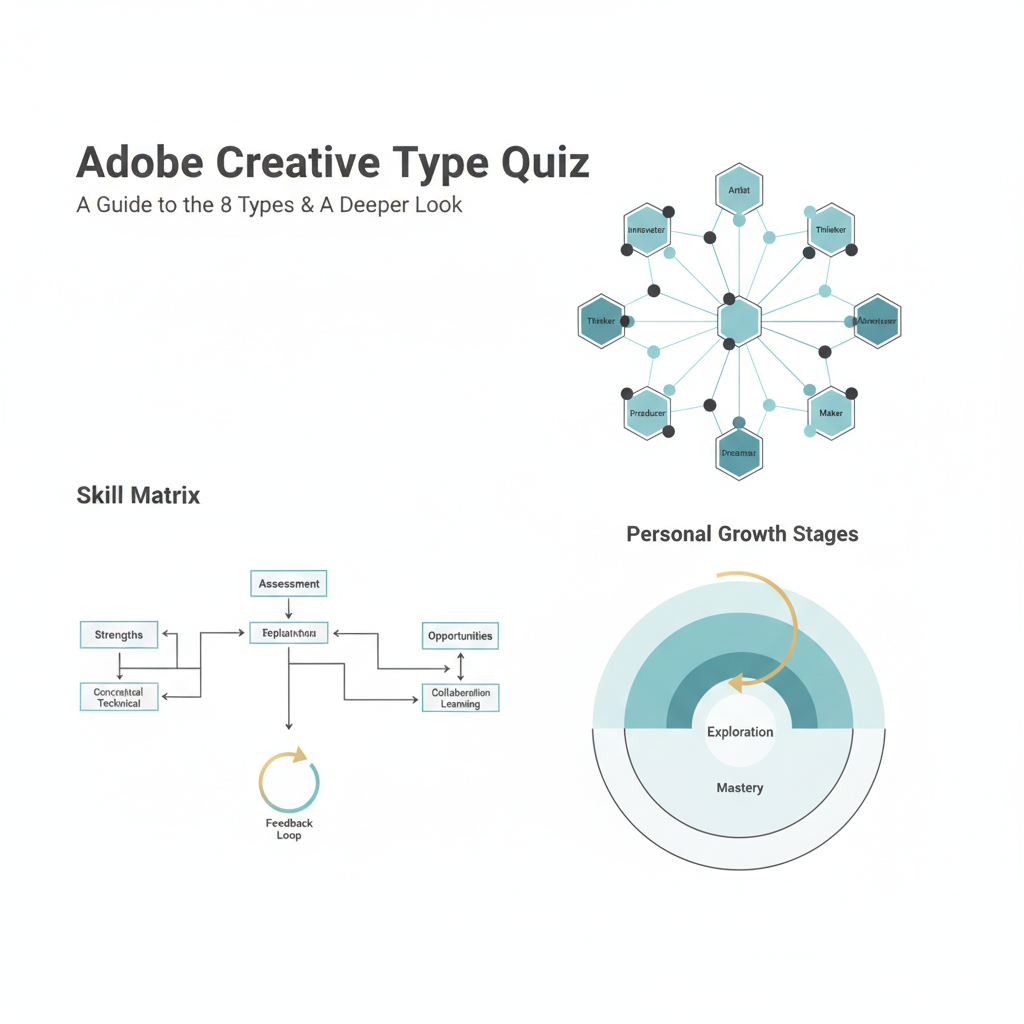
The Adobe Creative Type Quiz is a free online personality test created by Adobe to help individuals understand their unique creative style. Based on psychological research, the 15-question quiz assigns you one of eight creative types, such as The Visionary or The Maker, to provide insights into your motivations, strengths, and how you approach creative challenges.
Do you ever wonder how your mind works? We all think differently when it comes to creating ideas or solving problems. Many of us are curious about our creative potential, and fun tools like the Adobe Creative Type quiz offer a look into how your personality shapes your creative style. This popular creativity quiz helps people discover their unique creative strengths in an enjoyable way.
In this guide, we will explore the Adobe Creative Type quiz and its eight creative types. You’ll learn what each type means, how it relates to different ways of thinking, and the unique strengths each one has for solving problems. Knowing your quiz results can give you a better understanding of your natural talents. This can help you use your strengths more effectively at work and in your daily life.
While fun quizzes like the one from Adobe are a great first step, unlocking your full creative potential can require a deeper look at your cognitive flexibility, divergent thinking, and creative mindset. This article will give you an overview of the Adobe quiz and a foundation for exploring your creativity more deeply, giving you practical ways to keep learning and innovating.
What is the Adobe Creative Type Quiz?
Understanding the Goal of the Quiz
The Adobe Creative Type Quiz is a popular online tool that helps you understand your creative style. It’s a fun first step toward self-discovery.
This quiz identifies your main creative habits. Its goal is to make you think about your creative process in a fun way. By learning about the different “types,” you can see your strengths and find areas where you can grow.
While not a scientific assessment of creative ability, this quiz offers good insights into your creative personality. It shows how different styles lead to new ideas and solutions. Think of it as a guide to spark curiosity about your own creative mind [source: https://mycreativetype.com/].
How it Connects Personality to Creativity
Creativity is more than just artistic talent. It’s closely linked to our personality traits, how we think, and how we see the world. The Adobe Creative Type Quiz explores these connections.
The quiz asks questions to figure out your habits and what you like. Based on your answers, it places you into one of eight creative types. Each type shows a different way to think, solve problems, and create.
For example, some people love working in groups to get things done. Others prefer to think alone and dream up new ideas. Your personality influences:
- Idea Generation: How you brainstorm and come up with new thoughts.
- Problem-Solving Approach: Your preferred methods for tackling challenges.
- Work Style: Whether you enjoy structured tasks or prefer spontaneous exploration.
- Motivation: What drives your creative endeavors.
Knowing how your personality and creative style connect can be powerful. It helps you use your natural strengths. It also helps you understand why some creative tasks feel easier than others. This self-awareness is a key step to help you grow and become more creative.
What are the 8 Creative Types?
The 8 Creative Types Explained
The Adobe Creative Type Quiz is a fun way to explore your creative side. It outlines eight creative types. Each type has a unique way of thinking, solving problems, and sharing ideas.
Knowing your type can offer a glimpse into your creative style. But creativity is complex and involves many mental skills. Our science-backed Creative Ability Test measures these skills directly. This gives you a deeper, more practical look at your unique potential.
The Artist: Seeing Beauty Everywhere
The Artist connects with feelings and beauty. They see beauty in everyday life. They often express their feelings through different kinds of art.
They are highly sensitive to their surroundings. They are also good at turning abstract ideas into something real, like a painting, story, song, or design.
- Creative Strength: Expressing emotion and appreciating beauty.
- Thinking Style: Intuitive and empathetic.
- Practical Tip: Practice mindfulness exercises to sharpen your observation skills. Explore new art forms to expand your creative range.
Artists often show a high level of openness to experience [1]. This personality trait is strongly linked to creative thinking and imagination.
The Thinker: Solving Problems with Logic
Thinkers use logic and analysis in their creative work. They thrive on complex problems. Their solutions are often clever and well-organized.
They enjoy digging deep into information. They also use logic to come up with new ideas. This type sees challenges as chances to create new systems.
- Creative Strength: analytical problem-solving and strategic thinking.
- Thinking Style: Logical, systematic, and inquisitive.
- Practical Tip: Practice breaking down big problems into smaller, manageable parts. Use tools like mind maps or flowcharts to visualize your thought process.
Developing strong analytical skills is crucial for this type. This improves cognitive flexibility, which is key to creative problem-solving.
The Adventurer: Exploring New Experiences
Adventurers are curious and love trying new things. They find inspiration in the unknown. New experiences fuel their creative spirit.
They are often risk-takers. They are also unafraid to step outside their comfort zone. This helps them find unique viewpoints and creative solutions.
- Creative Strength: Embracing change and seeking new experiences.
- Thinking Style: Experiential, daring, and adaptable.
- Practical Tip: Travel to new places. Try new hobbies. Actively seek out unfamiliar situations to spark fresh ideas.
Their love for new sensations often links to divergent thinking abilities [2]. Divergent thinking is the ability to generate many varied ideas from a single starting point.
The Maker: Bringing Ideas to Life
The Maker loves making things. They enjoy turning ideas into something real. Their creativity is hands-on and practical.
They are good at getting things done. They are also skilled at building and improving their creations. Makers often learn best by doing and experimenting.
- Creative Strength: Execution, craftsmanship, and practical skills.
- Thinking Style: Pragmatic, resourceful, and experimental.
- Practical Tip: Start a personal project that requires building or crafting. Focus on completing it, even imperfectly. Learn from the process.
The Maker type shows how we learn by doing. This is a great way to gain skills and grow creatively [3].
The Producer: Making Things Happen
Producers are great at organizing projects and working efficiently. They excel at managing people and resources. Their creativity comes from making sure projects succeed.
They bring structure to creative chaos. They also make sure ideas become a reality. Producers are often the backbone of successful creative teams.
- Creative Strength: Project management, teamwork, and execution.
- Thinking Style: Organized, results-oriented, and collaborative.
- Practical Tip: Take charge of a group project. Develop your leadership and organizational skills. Learn to delegate effectively.
Good project management is needed to turn a creative vision into reality. This requires strong planning and follow-through.
The Dreamer: Imagining the Impossible
Dreamers are visionaries who focus on what is possible. They have a powerful imagination. Their ideas often challenge what people think is possible.
They are skilled at thinking about big ideas. They can also picture complex future situations. Dreamers inspire others with their big visions and new ideas.
- Creative Strength: Big ideas, imagination, and vision.
- Thinking Style: Idealistic, imaginative, and holistic.
- Practical Tip: Set aside time just for brainstorming. Don’t censor your thoughts. Practice picturing detailed future outcomes without limits.
A key part of a Dreamer’s creativity is their ability to think divergently. This allows them to generate many diverse and original ideas [4].
The Innovator: Challenging the Status Quo
Innovators are natural changemakers. They question the way things are. Their creativity focuses on finding new and better ways of doing things.
They are natural problem-solvers. They also love to push boundaries. Innovators often bring in game-changing ideas that redefine their field.
- Creative Strength: Disruptive thinking, problem-solving, and adaptability.
- Thinking Style: Rebellious, analytical, and forward-looking.
- Practical Tip: Find a process or product that doesn’t work well. Think of major ways to improve it. Don’t be afraid to challenge common beliefs.
Innovation is about using creative ideas to build new solutions. This often involves a blend of divergent and convergent thinking [5].
The Visionary: Seeing What Could Be
Visionaries have a special ability to see the big picture. They can predict future trends. Their creativity helps guide others toward an exciting future.
They combine different ideas into a single, clear vision. They also inspire people to work together. Visionaries often lead the way on complex creative projects.
- Creative Strength: Long-term thinking and inspirational leadership.
- Thinking Style: Forward-thinking, holistic, and influential.
- Practical Tip: Practice predicting trends in your field or life. Develop a clear vision for a project or goal. Communicate it effectively to others.
Visionary thinking depends on foresight and the skill to pull information together from many places. This is a key skill for planning and leadership.
How Can You Find Your Creative Type?
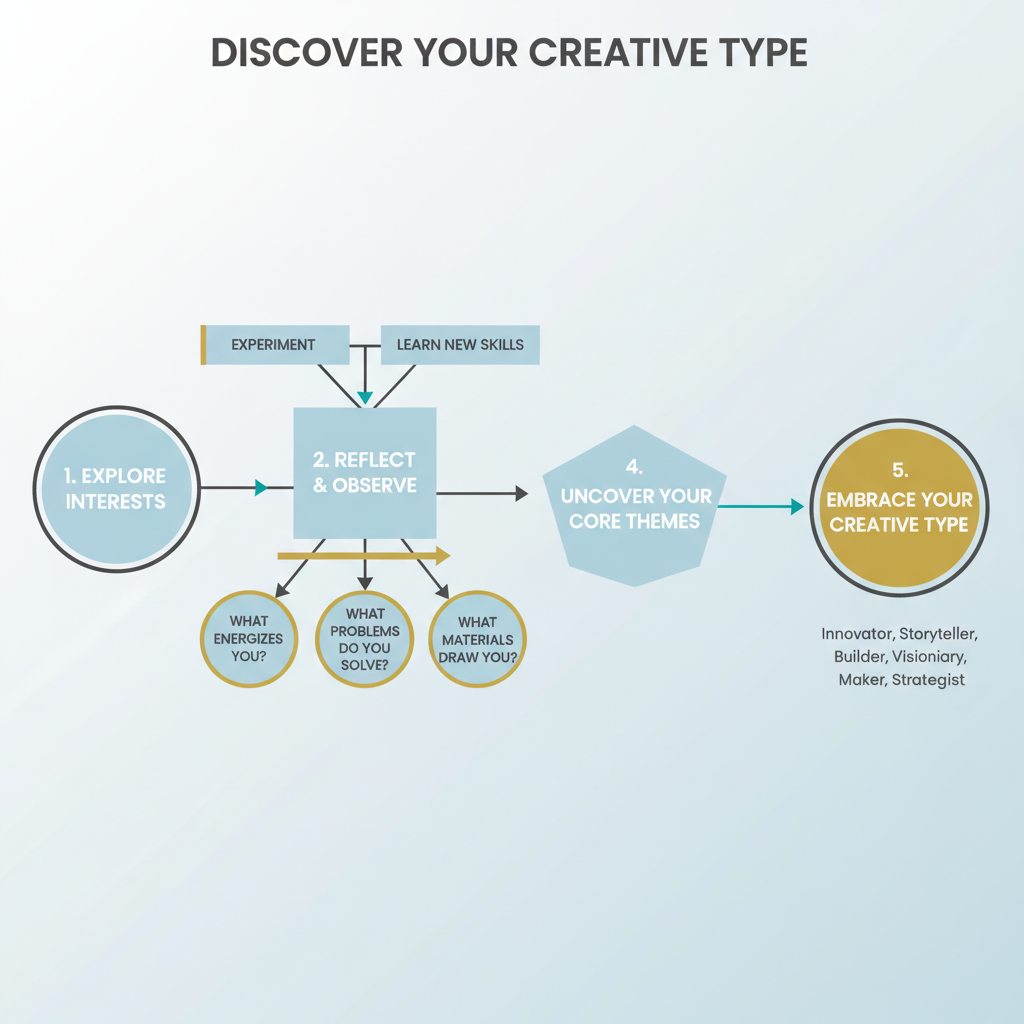
How Can You Find Your Creative Type?
Knowing your creative strengths is a great first step. It helps you find new ways to solve problems. A fun way to begin is with the Adobe Creative Type Quiz. This quiz helps you discover your creative personality and see your artistic side.
But finding your creative type is more than just a quiz. It’s a journey of self-reflection. It’s about understanding how you think, solve problems, and share your ideas.
Taking the Adobe Creative Quiz
The Adobe Creative Type Quiz is a fun online test designed to show your main creative strength. Think of it as a playful way to explore your inner creator and see yourself in a new light.
Here’s how to get started:
- Visit the Quiz Website: Go to the official Adobe Creative Type Quiz page. You can find it with a quick search for “Adobe Creative Type Quiz” [6].
- Engage with the Questions: The quiz will show you different situations. You’ll choose the images or phrases that you connect with. Your choices reveal your natural creative style.
- Answer Honestly: There are no right or wrong answers. Your honest responses give the most accurate result. Just go with your gut.
- Complete the Assessment: The quiz is short and usually takes just a few minutes. When you finish, you’ll get your creative type.
This quiz is a great way to start. It makes you curious about your creative side and helps you think about your natural talents. It’s a fun activity for anyone who wants to explore their creative potential.
Interpreting Your Results
After the quiz, you’ll get one of eight creative types, like “Visionary” or a “Maker.” Each type has a unique way of looking at the world and being creative.
Understanding your result is the next step. It shows your natural creative style. But remember, these types are general guides, not strict labels. They are a starting point for discovery.
Here’s how to make sense of your Adobe Creative Type result:
- Identify Your Core Strength: Each type highlights a key creative skill. For example, a “Thinker” is good at logical problem-solving, while a “Dreamer” uses imagination. Find what makes your type special.
- Reflect on Personal Experiences: Does the description match your own life? Think about past projects or how you handle new ideas. This helps you understand yourself better.
- Discover Potential Growth Areas: Your type can also show you areas to develop. A “Producer,” for instance, might benefit from exploring their “Dreamer” side. This helps you become a more well-rounded creator.
- Relate to Real-World Applications: Think about how your creative type shows up in your work, hobbies, or daily life. An “Innovator,” for example, might always be looking for new solutions at their job.
The Adobe quiz is a great start, but true creative understanding goes deeper. It means looking at skills like flexible and original thinking. Our science-backed tests at Creative Ability Test measure these areas to give you a more complete picture. We offer personal feedback to help you move from knowing your “type” to improving your creative skills. We help you turn these insights into a real plan for growth.
Is the Adobe Quiz a True Measure of Creativity?
The Strengths of Personality-Based Quizzes
Personality quizzes, like the Adobe Creative Type Quiz, are a great starting point for self-discovery. They offer an easy way to understand the different sides of creative thinking. These quizzes turn complex psychological ideas into simple categories, which makes them fun for everyone.
For many people, these quizzes are a fun way to think about their natural tendencies. They can make you curious about how your personality shapes your creativity. These tools also encourage you to think about how you usually approach challenges and new ideas.
Here are some key benefits:
- Initial Self-Reflection: They invite you to think about your creative tendencies in a fun way.
- Engagement and Awareness: These quizzes make the concept of creativity approachable and interesting.
- Common Language: They provide a simple framework for discussing different creative styles with others.
- Motivational Spark: Discovering your “creative type” can inspire you to explore your potential.
While fun and interesting, it’s important to see these quizzes as just a first step. They can open the door to a deeper understanding of your creative side and prepare you for a more serious look.
The Limitations: Moving Beyond Creative ‘Types’
While fun, quizzes like the Adobe Creative Type Quiz have real limits. They can’t truly measure creativity. Creativity is a complex skill with many parts. It’s much more than just a personality type. These quizzes often oversimplify this complex idea. They put people into categories that are too general [7].
Also, these personality quizzes usually lack the scientific proof found in proven, research-based tests. They don’t measure the key mental skills needed for creativity, like divergent thinking or cognitive flexibility. These are key skills that drive innovation and problem-solving. A fixed “type” also misses the fact that creativity can change and grow. It’s a skill you can improve over time with practice and the right methods.
Key areas where these quizzes fall short include:
- Oversimplification: Creativity is more than a personality type. It involves many different mental skills.
- Lack of Scientific Proof: They are usually not based on deep psychological research or standard measurements.
- Limited Actionable Advice: They tell you a “type” but rarely give you clear steps on how to improve.
- Ignores Cognitive Skills: They typically do not assess critical abilities like divergent thinking, convergent thinking, or cognitive flexibility.
- Static View: They treat creativity as a fixed trait, but it’s really a skill that can grow.
- Potential for Labeling: Focusing on a single type might limit how you see your own creative abilities.
To truly understand your creative potential and get useful advice for growth, it’s better to use a more complete, science-based approach. This approach goes beyond just identifying a type. Instead, it measures how your creative mind actually works.
Ready for a Deeper Analysis? Try the Creative Ability Test
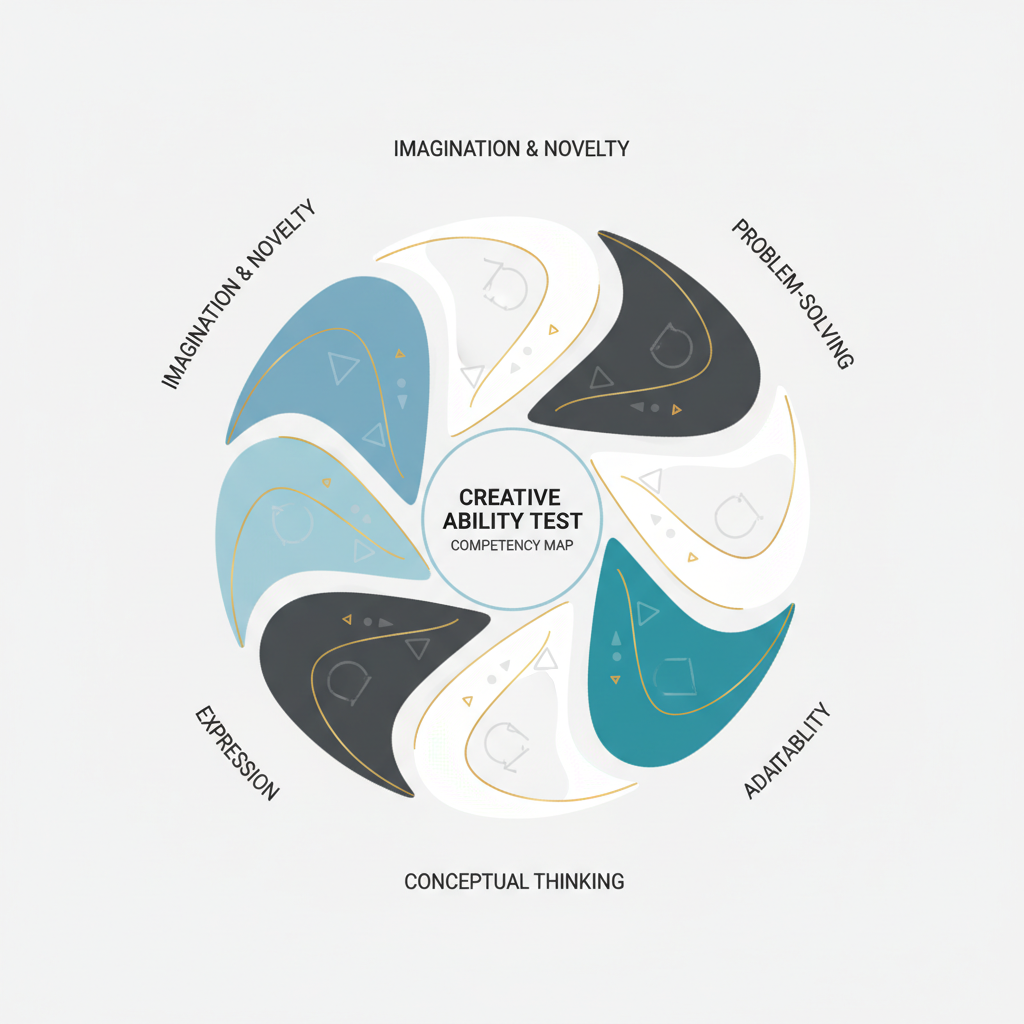
What Our Science-Backed Assessment Measures
The Adobe Creative Type Quiz is a great starting point for understanding your creative personality. But to truly understand your skills, you need to go deeper. Our Creative Ability Test moves beyond general “types.” It’s a science-backed assessment of your unique creative potential. We measure the specific mental skills that drive new ideas and problem-solving.
Our 30-question assessment looks at different parts of your creative mind. It shows how you tackle problems and come up with fresh ideas. We explore the core mental building blocks of creativity.
- Divergent Thinking: This measures your ability to come up with many different ideas from a single starting point. It is a key part of creative thought [8].
- Cognitive Flexibility: We assess your ability to change your perspective and adapt your thinking. This allows you to find different solutions to problems.
- Problem-Solving Skills: Our test evaluates how well you identify and solve complex problems in creative ways. This goes beyond simple answers.
- Openness to Experience: This area looks at how open you are to new ideas, different approaches, and imaginative concepts.
- Innovation Potential: We identify your natural tendency to question the usual way of doing things and create new solutions.
As a result, our assessment gives you a clear map of your creative strengths. It shows you the specific ways your mind works when you’re being creative. This helps you understand the “how” behind your ideas.
From Your ‘Type’ to Practical Steps for Growth
Knowing your creative “type” is a great start. But real change comes from insights you can use. The Creative Ability Test bridges that gap. We provide personalized feedback to guide your creative journey. Our goal is to help you turn self-discovery into real improvement.
Our platform offers more than just results. It gives you clear, practical strategies made just for you. These strategies help you improve your creative thinking in real, practical ways.
- Personalized Feedback: Get a detailed report showing your unique creative profile. Understand your strengths and areas for growth clearly.
- Targeted Exercises: Get practical tips and exercises designed to strengthen specific creative skills. For instance, if you’re good at divergent thinking, we show you how to use it even better.
- Real-World Application: Learn how to use your creative strengths in your daily life. This includes personal projects, schoolwork, and your job.
- Confidence Building: Gain a deeper appreciation for your natural creative talent. This builds confidence in your problem-solving abilities.
- Professional Development: Use your creative insights to innovate at work. Boost your career with a clear plan for growth.
Ultimately, our test replaces uncertainty with clear self-awareness you can act on. It helps you move from inconsistent creative moments to steady growth. You will gain practical ways to apply your creativity to solve problems and innovate. Discover your full creative potential with personalized, evidence-based guidance today.
Frequently Asked Questions
Is the Adobe creative type quiz free?
Yes, the Adobe Creative Type Quiz is completely free. Adobe created it as a fun way for you to explore your creative personality.
The quiz is a quick introduction to different creative styles. It gives you a look at how you like to think and create.
Can my creative type change over time?
Your main creative style, like the one from the Adobe quiz, often stays the same. But your creativity isn’t set in stone—it can change.
Think of creativity as a muscle. You can make it stronger with practice and new experiences. Your “creative type” can evolve as you grow.
Scientific research shows that creativity is a skill you can build. It grows based on your surroundings, education, and the effort you put in [9]. At Creative Ability Test, we understand this process. We offer practical tips to help you grow your creative skills. Our tests encourage you to try new ways of thinking, helping you develop both personally and professionally.
How can I use my creative type for personal growth?
Knowing your creative type helps you understand yourself better. You can use this knowledge to grow as a person. Here’s how to get started:
- Use Your Strengths: If you’re a “Maker,” find projects where you can build things and bring ideas to life. An “Innovator” might enjoy challenging the usual way of doing things.
- Work on Weaker Areas: See where your type might hold you back. For example, a “Dreamer” might need to get better at finishing projects. A “Thinker” could try exercises that spark more unusual ideas.
- Improve Teamwork: Knowing your type helps you see what you add to a team. It also helps you appreciate what skills others have. This leads to better teamwork and more creative results.
- Guide Your Learning: Pick classes or resources that fit your style. If you’re an “Adventurer,” explore new topics. If you’re a “Producer,” learn about managing creative projects.
- Solve Problems Better: Use your natural creative style to handle challenges. Then, make an effort to try different ways of thinking. This helps you become a more flexible thinker.
The Creative Ability Test gives you more than just a type. Our detailed test looks at specific parts of your creativity and gives you a personal plan for growth. This helps you turn what you learn about yourself into real action.
Are there creativity tests designed for students?
Yes, creativity tests are very helpful for students. They help them understand their unique creative strengths. The Adobe quiz is a fun place to start, but tests based on science can offer more detail.
For students, understanding creativity is key. It helps with schoolwork, improves critical thinking, and prepares them for future jobs [10]. Assessments can highlight:
- Divergent Thinking: The ability to generate many ideas.
- Cognitive Flexibility: Shifting perspectives and adapting strategies.
- Problem-Solving Skills: Applying creative thought to academic and real-world challenges.
- Openness to Experience: Willingness to explore new concepts and ideas.
The Creative Ability Test is a great tool for students. Our 30-question, science-backed test gives personal feedback on different areas of creativity. Students get practical tips to improve their learning, come up with new ideas, and get ready for a changing world.
Sources
- https://www.simplypsychology.org/big-five-personality.html
- https://psycnet.apa.org/record/2012-07018-001
- https://www.ncbi.nlm.nih.gov/pmc/articles/PMC8900762/
- https://www.sciencedirect.com/topics/psychology/divergent-thinking
- https://hbr.org/2012/03/is-yours-a-learning-organization
- https://mycreativetype.com
- https://hbr.org/2016/11/what-is-creativity
- https://www.sciencedirect.com/topics/neuroscience/divergent-thinking
- https://psycnet.apa.org/record/2013-43184-001
- https://www.oecd-ilibrary.org/education/fostering-students-creativity-and-critical-thinking_b1562965-en
Leave a Reply