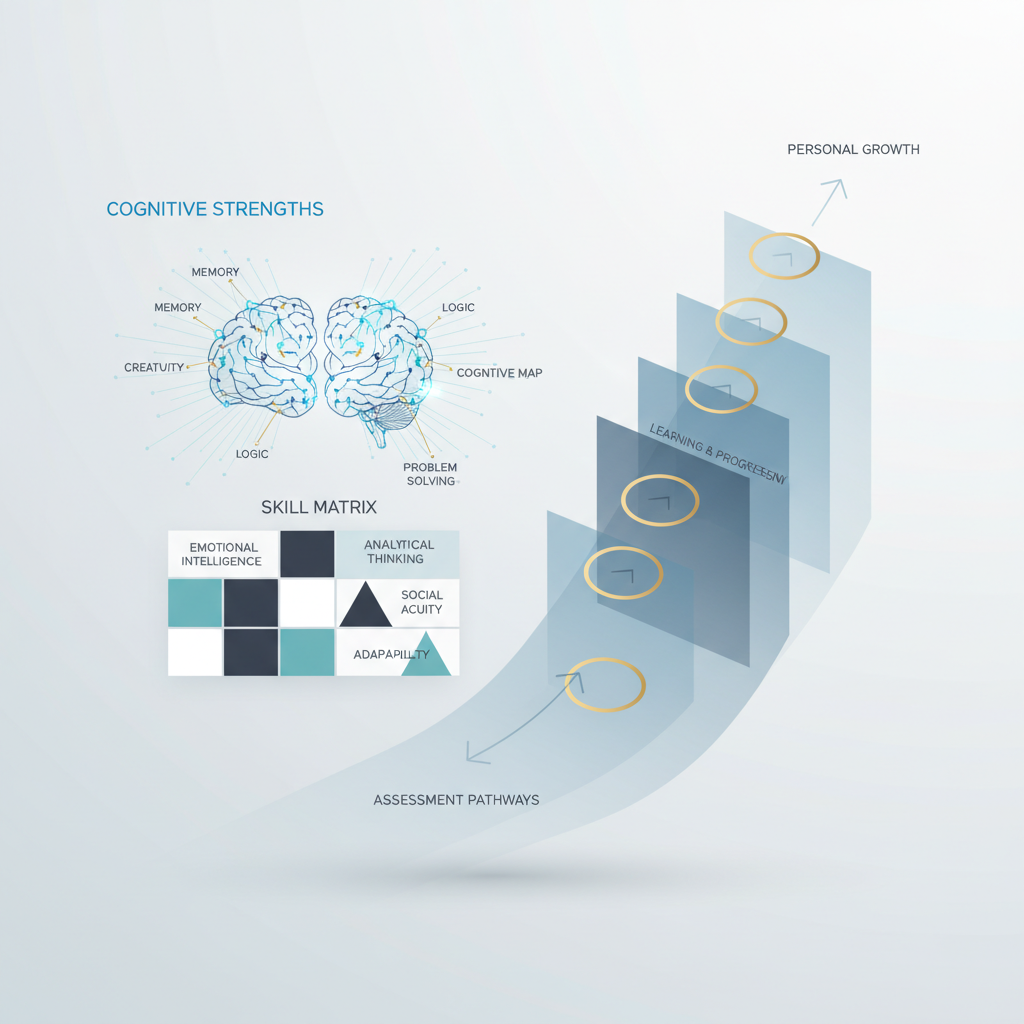
An intelligence test in psychology is a scientifically designed assessment used to measure a range of cognitive abilities, including reasoning, problem-solving, and abstract thinking. These standardized tools provide a score, commonly known as an IQ (Intelligence Quotient), to understand an individual’s mental aptitude relative to a larger population.
Do you ever wonder how your mind works, how you solve problems, or what your mental strengths are? The human brain has amazing potential, and for centuries, psychologists have worked to understand it. Knowing your mental abilities is about more than just labels. It gives you real insight into how you think, learn, and create. This journey begins with using proven tools designed to help you understand yourself better.
A key part of this exploration involves intelligence tests in psychology. These tests are not simple measures of “smartness.” Instead, they provide a detailed look at different thinking skills. They help identify your strengths in areas like verbal skills, logical reasoning, and processing speed. This offers a clearer picture of how you handle challenges and develop ideas. Learning about a standardized intelligence test can help you appreciate how your own mind works and contributes to your abilities.
This article will be your guide through the world of intelligence tests. We’ll explain what makes a standardized intelligence test reliable and review some of the best intelligence test options used today, like the Wechsler Adult Intelligence Scale (WAIS) and Raven’s Progressive Matrices. We will also cover the specific mental skills they measure. Most importantly, we’ll show how understanding these core parts of intelligence can give you deeper insights into your own way of thinking and boost your creative potential.
What is an Intelligence Test in Psychology?
Understanding the Purpose of Cognitive Measurement
Intelligence tests are advanced tools used to measure mental skills like reasoning, problem-solving, and learning. The main goal is to understand a person’s thinking strengths. These tests also show how you process information.
This careful measurement is a key part of psychological assessment [1]. It offers a clear look into how people think. Understanding these basic skills helps us see the full range of human abilities, including your own creative talent and how you create new ideas.
Beyond the IQ Score: What These Tests Reveal
An intelligence test gives you more than just an IQ score. Modern tests provide a detailed profile of your thinking skills. They break intelligence down into different parts to show how your mind works. For example, they measure your verbal skills and perceptual reasoning (how you solve visual problems). They also measure your working memory and how fast you process information.
These details are very useful. They help you understand your own thinking style. For instance, a high score in perceptual reasoning suggests you are good at solving problems visually. A strong working memory means you can handle several ideas at once. This understanding can lead to personal growth. It shows you how you handle challenges and learn new things.
These tests can also point out specific thinking skills you can work on. Knowing your mental profile builds self-awareness and helps you find ways to improve. This is especially important for creative people because it relates to flexible thinking. While many tests focus on finding one correct answer, they still map out your basic mental tools. You need these tools to use your creativity in the real world to invent and solve problems.
Our Creative Ability Test builds on this by focusing on your creative strengths. It offers real strategies to improve these skills. You can move from just understanding your thinking to taking steps to boost your creativity.
What is a standardized intelligence test?
The Importance of Norms and Uniform Procedures
To understand your mental strengths, you need a solid starting point. That’s the purpose of standardized tests. They are more than just a quick quiz. They offer a fair and consistent way to measure your abilities. This approach gives you accurate insights into how you think.
What Does “Standardized” Really Mean?
A “standardized” test is one where everyone takes it and is scored in the same way. Imagine a test where some people got more time or different instructions. You couldn’t compare the results. Standard rules make sure the test is fair for everyone.
For example, everyone gets the same questions, time limits, and testing environment. This consistency makes it possible to compare scores fairly.
The Power of Norms
Norms are like a benchmark. They are based on the scores of a large, diverse group of people who have already taken the test. This group, or “normative sample,” is chosen to be a good snapshot of the general population [2].
When you take the test, your score is compared to these norms. This shows you how your performance compares to others in your age group. It puts your score into perspective. For instance, a score of “X” on its own means little. But knowing that “X” is higher than 80% of your peers gives it real meaning.
At Creative Ability Test, we use these same strict principles. We provide a consistent testing experience and show how your results compare to a broad range of creative thinkers. This helps you move from guessing about your skills to gaining useful self-knowledge.
Reliability and Validity in Psychological Testing
When you take a test to learn about your mind, you need to trust the results. This trust is built on two key ideas: reliability and validity. They are the foundation of any good psychological test.
Reliability: Consistent Results Every Time
Imagine a measuring tape that gives you a different length each time you measure the same object. That would be unreliable. Reliability means a test gives consistent results. If you took a reliable test a few times, your scores would be about the same.
This consistency is very important. It means your score isn’t just a fluke; it truly reflects your abilities. A reliable test gives you feedback you can count on.
Validity: Measuring What Matters
Validity is even more important than reliability. It asks: Does the test actually measure what it claims to measure? A test can be reliable (consistent) but not valid (accurate). For instance, a scale might consistently read 5 pounds too high. It’s reliable, but not valid.
The main idea is simple: the test must actually measure what it’s supposed to measure [3]. For an intelligence test, it must truly measure intelligence. For a creativity test, it must genuinely capture aspects of creative thinking.
When a test is valid, you can trust what it tells you. The insights you get will be meaningful for your personal and professional growth.
At Creative Ability Test, our 30-question assessment is built on proven scientific methods. We focus on making our test both reliable and valid. This way, you get personal and practical insights into your creative strengths, mental flexibility, and problem-solving skills. You’ll go from simply wondering about your creativity to using it with confidence in the real world.
What are the most common intelligence tests?
Understanding different intelligence tests can be helpful. While your creativity relies on different skills, it’s useful to know how traditional intelligence tests work. These tests mostly measure convergent thinking, which is the ability to find a single, correct answer. However, real innovation often comes from divergent thinking—the skill of generating many unique solutions. Our Creative Ability Test focuses on these key creative skills.
Here, we’ll look at some of the best-known intelligence tests in psychology. Each one offers a different view of our cognitive abilities and helps us appreciate the many ways our minds work. This guide also shows how our platform can help you explore and enhance your creative thinking.
Wechsler Adult Intelligence Scale (WAIS)
The Wechsler Adult Intelligence Scale (WAIS) is a widely used and detailed test for adults aged 16 to 90. Many psychologists consider it the top standard for measuring adult intelligence [source: https://www.apa.org/pubs/books/wechsler-adult-intelligence-scale-fifth-edition]. The WAIS provides a Full Scale IQ score and also gives scores in four main areas.
- Verbal Comprehension Index (VCI): This measures your ability to understand and use spoken information. It shows your language skills and ability to reason with words.
- Perceptual Reasoning Index (PRI): The PRI tests your non-verbal reasoning and visual-spatial skills. It looks at how you solve problems using pictures and designs.
- Working Memory Index (WMI): This index measures your ability to hold and work with information in your mind. It shows how well you can focus and concentrate.
- Processing Speed Index (PSI): The PSI measures how quickly you can process simple visual information. It reflects your mental speed.
The WAIS helps identify cognitive strengths and areas that need improvement. This information can be very useful for guiding education or career choices. However, the test largely measures skills for convergent problem-solving. Creative ideas, in contrast, often come from divergent thinking. Our Creative Ability Test helps you explore these unique creative pathways.
Stanford-Binet Intelligence Scales
The Stanford-Binet Intelligence Scales have a long history and are among the oldest intelligence tests. First created in the early 1900s, they measure thinking skills across a wide age range, from two-year-olds to adults [source: https://www.apa.org/pubs/books/stanford-binet-intelligence-scales-fifth-edition]. The test measures five key cognitive factors:
- Fluid Reasoning: This is your ability to solve new problems and think flexibly.
- Knowledge: This assesses your general knowledge and vocabulary.
- Quantitative Reasoning: This measures your understanding of math concepts.
- Visual-Spatial Processing: This looks at your ability to understand visual relationships.
- Working Memory: Similar to the WAIS, this measures how you manage information in your mind.
The Stanford-Binet is very useful for understanding how thinking skills develop. It offers insights into different mental processes. However, like the WAIS, it focuses mainly on traditional intelligence. It helps us see one side of the coin, while our platform helps you see the other. We focus on boosting the creative side of your mind, including flexible thinking and generating original ideas.
Raven’s Progressive Matrices
Raven’s Progressive Matrices is different from other intelligence tests because it is non-verbal. Instead of using words, the test asks you to complete visual patterns using logic. This design makes it a “culture-fair” test, as it aims to reduce bias from language or cultural knowledge [source: https://psychology.jrank.org/pages/530/Raven-s-Progressive-Matrices.html].
The Raven’s test primarily measures fluid intelligence—your ability to solve new problems, see relationships, and adapt to new situations. This skill is key for effective problem-solving and contributes to cognitive flexibility, which is a cornerstone of creativity. Our Creative Ability Test helps you develop this flexibility, empowering you to see more connections and generate a wider range of solutions that can lead to breakthrough thinking.
Woodcock-Johnson Tests of Cognitive Abilities
The Woodcock-Johnson Tests of Cognitive Abilities (WJ IV) is a broad test that measures a wide range of thinking skills. It covers general intelligence, specific cognitive functions, and academic achievement. It’s often used in schools to help identify learning disabilities or giftedness [source: https://www.hmhco.com/assessments/woodcock-johnson-iv].
The WJ IV is known for being very thorough, providing a detailed profile of a person’s cognitive strengths and weaknesses. This level of detail is helpful, but its main goal is diagnostic and academic. It focuses on established cognitive skills. Our Creative Ability Test complements this by targeting the active parts of creative thinking, like innovation and openness to new experiences. We offer practical strategies to build on your unique creative potential.
Individual vs. Group Intelligence Tests
Intelligence tests can be given one-on-one or to a group. Each approach has its own pros and cons, and understanding the difference helps clarify how they are used.
| Feature | Individual Intelligence Tests | Group Intelligence Tests |
|---|---|---|
| Administration | Given one-on-one by a trained psychologist. | Given to many people at once. |
| Examples | WAIS, Stanford-Binet, Woodcock-Johnson. | School readiness tests, military aptitude tests. |
| Depth of Insight | Gives a detailed, in-depth understanding of cognitive processes. Allows for behavioral observation. | Offers a broad, general assessment of cognitive abilities. Limited behavioral observation. |
| Cost & Time | More expensive and time-consuming. | More cost-effective and time-efficient. |
| Purpose | Used for clinical diagnosis, personal education plans, and in-depth psychological reviews. | Used for screening, large-scale assessment, and identifying general cognitive trends. |
| Flexibility | The examiner can adapt the test based on the person’s needs. | Has a strict format with little to no flexibility. |
Individual tests offer deep, personalized insights and can reveal small details in a person’s thinking. Group tests are efficient for screening large numbers of people and providing a general overview. Our Creative Ability Test aligns with the spirit of personalized insight. It’s a detailed 30-question assessment that helps you discover your creative strengths. We provide a deep dive into your unique thinking styles, followed by personal feedback and practical strategies to support your personal and professional growth.
What do standardized intelligence tests measure?
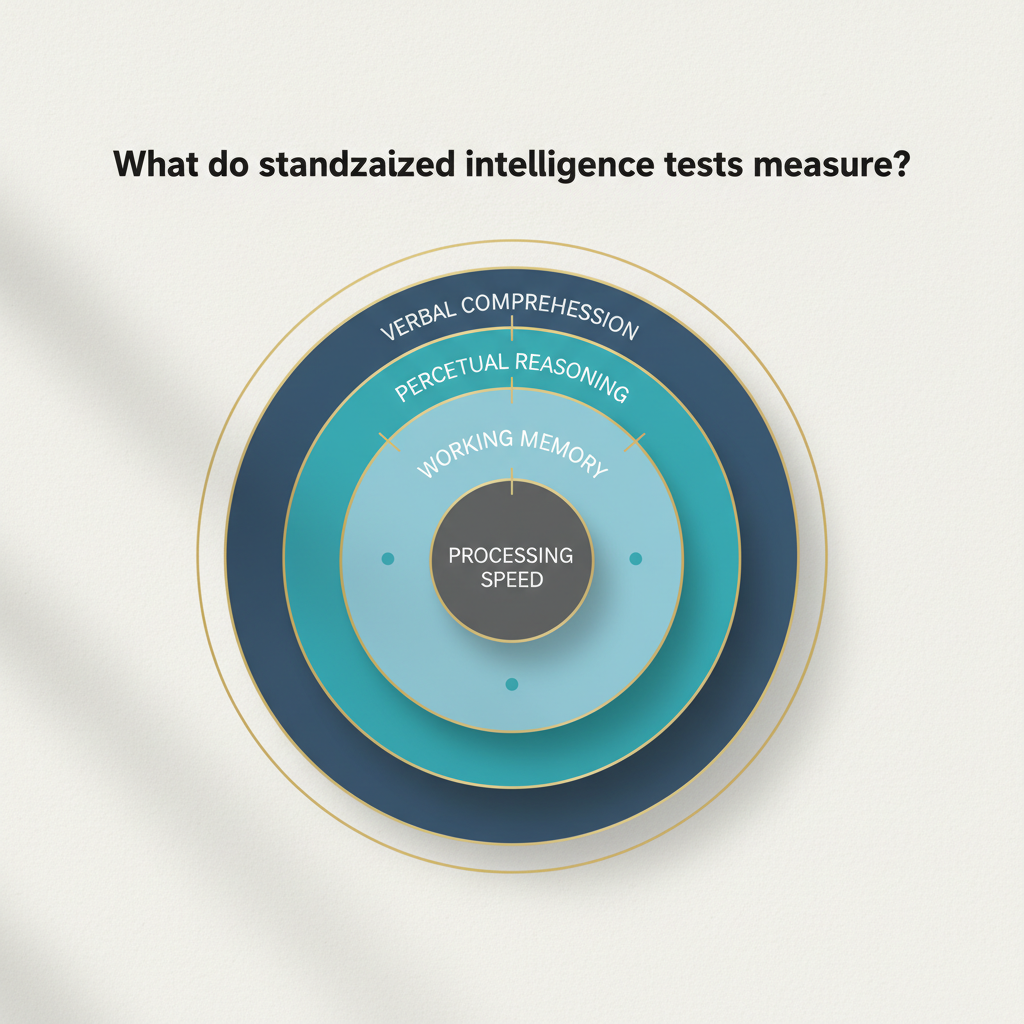
Standardized intelligence tests look at different mental skills. They show how your mind works with information. These tests are more than just a single “IQ” score—they evaluate specific mental functions. Learning about these areas can highlight your unique thinking style and show how you approach challenges.
While these tests once focused on traditional intelligence, their different parts offer valuable insights for creative thinking. They reveal the core cognitive strengths that support your ability to innovate and solve problems in new ways.
Verbal Comprehension and Reasoning
Verbal comprehension is your ability to understand and use language. It looks at your vocabulary, general knowledge, and how you solve problems using words. It also measures how well you can express your ideas.
For example, a test might ask you to define a word or explain how two concepts are related. This skill is key for clear communication. Strong verbal skills help you explain complex ideas and understand different points of view [4].
Connection to Creativity: Creativity often starts with a clear understanding of a topic. A large vocabulary and a wide range of knowledge help you make new connections. This allows you to look at problems from different angles and find original solutions. Our Creative Ability Test helps improve your communication skills. It shows how understanding concepts can lead to new forms of expression and more powerful creative results.
Perceptual and Fluid Reasoning
This skill measures your ability to solve new problems without using prior knowledge. It’s about spotting patterns, seeing how shapes relate to each other, and “thinking on your feet.” You look at new information and quickly find a solution.
Tasks might include finishing visual patterns or solving puzzles with abstract shapes. This skill is crucial for being adaptable and handling new situations well.
Connection to Creativity: This is a key part of creative problem-solving. It helps you see new connections and adapt to change. Fluid reasoning is all about flexible thinking, which lets you explore many different possibilities. This is a core part of creative thinking. Our platform measures your mental flexibility and your skill at finding new patterns, which is vital for innovation. Knowing this helps you actively develop new ways of looking at things.
Working Memory Capacity
Working memory is your mental workspace. It measures your ability to hold and use information in your mind for short periods. It’s about managing several pieces of information at once to complete a task. A simple example is remembering a phone number while you are dialing it.
Another example is following instructions with multiple steps. This requires focus and mental effort. It shows your ability to pay attention. A strong working memory helps with complex thinking [5].
Connection to Creativity: A strong working memory is very useful for creative work. It lets you juggle many ideas and limitations at the same time. You can hold different possibilities in your mind at once, which helps with tasks like design and revision. It also helps you connect unrelated concepts to create brand-new solutions. Our platform gives you insights to improve your creative process. We show you how to manage information better, helping you hold on to and develop your ideas.
Processing Speed and Efficiency
Processing speed is how quickly you can do simple mental tasks, like scanning for information or making a quick decision. It measures how efficiently your brain works to complete tasks both quickly and accurately. This is often tested with timed activities, such as matching symbols or doing simple coding exercises.
When you can process things quickly, you spend less time on basic mental tasks. This frees up your mind for more complex thinking and shows your overall cognitive efficiency.
Connection to Creativity: While not a direct measure of creativity, processing speed is a big help. When your mind works efficiently, it frees up brainpower for bigger ideas. This allows you to explore more possibilities in less time and quickly test out your creative solutions. It also helps you weigh different creative options faster. Our insights offer ways to improve your mental performance. We help you use your cognitive strengths well, which improves your creative problem-solving speed and flow. You can move from an idea to a finished product more easily.
How Do Intelligence and Creativity Connect?
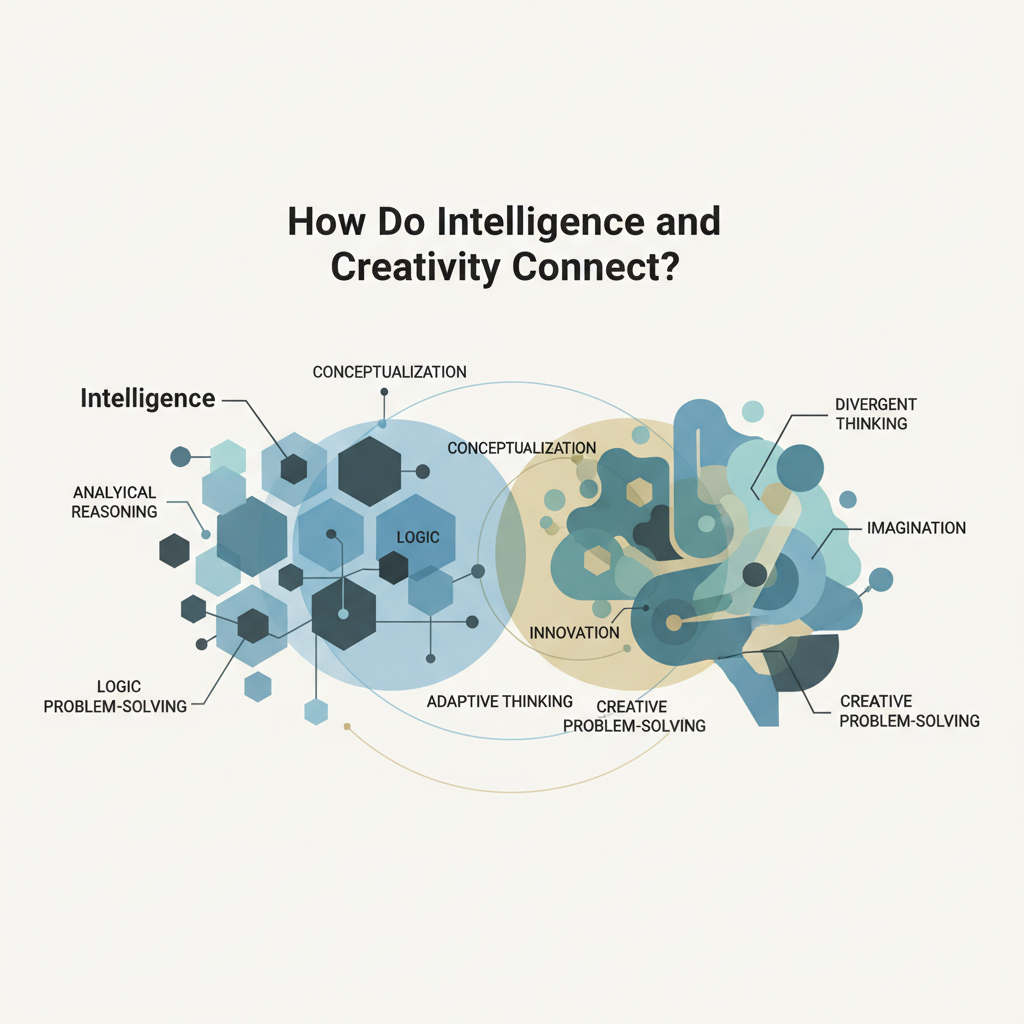
Convergent Thinking (Measured by IQ Tests) vs. Divergent Thinking (Key to Creativity)
Intelligence and creativity can seem like two different things. But they are closely related ways of thinking. Understanding how they differ helps us appreciate both IQ tests and creativity assessments.
What is Convergent Thinking?
Convergent thinking is a focused way of solving problems. It means using logic to find the single best answer. The goal is to be precise and accurate.
Most traditional intelligence tests measure convergent thinking. These tests present problems that have only one correct answer. Examples include:
- Solving math problems
- Answering multiple-choice questions
- Finding the missing piece in a pattern
These tests measure skills like verbal comprehension, logical reasoning, and processing speed [6]. A high score shows you have strong analytical skills and can solve problems well when there’s one right answer.
What is Divergent Thinking?
Divergent thinking is the opposite. It’s about exploring many possibilities and coming up with lots of unique ideas. This process encourages imagination and open-ended solutions.
Divergent thinking is a key part of creativity. It is all about brainstorming and expanding on new ideas. Our Creative Ability Test is designed to measure these skills, including your ability for:
- Fluency: Produce a large number of ideas.
- Flexibility: Generate ideas from different categories.
- Originality: Create unique and uncommon ideas.
- Elaboration: Develop ideas with greater detail.
So, while IQ tests measure how well you find one answer, creativity tests reveal how well you can invent many solutions.
Using These Insights to Unlock Your Creative Potential
Understanding how these two types of thinking work together is powerful. It helps you see your own strengths and shows you how to improve your creative skills.
How Insights Drive Growth:
Knowing your strengths helps you choose the right approach for different challenges. For example, you might use convergent thinking to define a problem clearly. Then, you can switch to divergent thinking to explore many possible solutions.
Our 30-question assessment measures more than a typical intelligence test. It gives you personalized feedback that shows you where you shine creatively and where you can improve.
Here’s how you can apply this in practice:
- Problem Solving: When facing a tough problem, first brainstorm many ideas (divergent). Then, use critical thinking to pick the best options (convergent).
- Innovation: To create something new, you need novel ideas. This relies on divergent thinking. Afterward, you use convergent skills to refine and implement them.
- Personal Development: When you know your thinking style, you can practice deliberately. This helps you build both your analytical and creative abilities.
It’s empowering to know that creativity is a skill you can build. This knowledge gives you the confidence to take action. Our platform offers practical strategies to help you think more flexibly and come up with new ideas. You’ll learn how to apply your creativity to real-world challenges.
Ultimately, understanding the link between intelligence and creativity changes how you approach challenges. You’ll go from knowing about creativity to actively using it to solve problems. Discover your creative potential with our science-backed assessment and personalized guidance.
How to Approach Taking an Intelligence Test
The Role of Professional Psychologists
Taking a formal intelligence test is a big step. These tests aren’t simple quizzes—they are powerful tools used by psychologists.
A professional psychologist is needed to use these tests correctly. They have special training and understand the details of giving and scoring them.
Most importantly, a psychologist explains what your results mean. They put your scores into context so you get a clear picture of your thinking skills [7].
A psychologist can identify your specific cognitive strengths and areas for improvement. This is much more than just a single score. Their guidance helps you use this information in your life. This personal feedback is very helpful for both personal and professional growth.
For example, knowing your working memory capacity can help you find better ways to study. Seeing strong reasoning skills might point to a talent for solving problems. This knowledge empowers you to make the most of your unique way of thinking.
This careful, professional method is very different from online quizzes. It gives you real, useful insights about yourself.
A Note on Free Online IQ and Brain-Based Intelligence Tests
The internet is full of “free IQ tests” that promise quick insights into your intelligence. However, it’s important to be cautious. Most of these tests are not scientifically sound.
Online tests are often just for fun. They usually haven’t been properly tested or proven. This means their questions might not measure your thinking skills correctly, and their scoring methods are often unchecked. As a result, the scores can be misleading.
A real intelligence test takes years to develop. It is based on a lot of research and is tested on large, diverse groups of people. This process ensures the test is accurate and consistent [8]. Free online tests cannot match this level of science.
However, you can still understand your cognitive strengths. Platforms like the Creative Ability Test offer assessments based on science. We focus on specific parts of creativity, which are different from general intelligence.
Our 30-question test measures your creative potential. It looks at your cognitive flexibility, problem-solving skills, and openness to new ideas. We give you personal feedback with practical tips to boost your creative thinking. This method offers real insights for self-improvement. It helps you turn confusion into a clear plan for growth. You will get a better understanding of your creative strengths and learn how to use them.
Frequently Asked Questions About Intelligence Tests
What is an example of a standardized intelligence test?
A great example is the Wechsler Adult Intelligence Scale (WAIS). It’s a well-known test used by psychologists. It measures different thinking skills in adults. The WAIS gives a clear picture of a person’s mental strengths and weaknesses. [9]
Standardized tests like the WAIS are designed to be fair. Everyone gets the same questions and instructions. Scores are compared to those of a large group of people. This shows how your performance stacks up against others. It provides a reliable way to measure thinking skills.
Learning about your thinking skills can teach you a lot about yourself. You can see how your mind works. Tests like the WAIS focus on “convergent thinking,” which is about finding one correct answer. This is an important skill. It builds a foundation for the “divergent thinking” skills our Creative Ability Test helps you explore.
What are the 4 types of intelligence tests?
Instead of “types,” it’s more useful to think about the different thinking skills that intelligence tests measure. Major tests like the WAIS or Stanford-Binet look at several aspects of intelligence. They usually cover four main areas:
- Verbal Comprehension: This measures how well you understand and use words. It looks at your vocabulary, word-based reasoning, and ability to express yourself. Strong verbal skills help you communicate well and share creative ideas.
- Perceptual Reasoning (or Fluid Reasoning): This tests your skill at solving new problems. It involves thinking visually and abstractly, like finding patterns or solving puzzles. This skill is key for creative problem-solving and seeing connections others might miss. [10]
- Working Memory: This measures your ability to hold and work with information in your head. It’s important for complex tasks, like following several steps at once. A strong working memory helps you manage many ideas when you’re brainstorming or developing a project.
- Processing Speed: This tests how quickly and accurately you can handle visual information. It shows how efficient your thinking is. Being a fast processor helps you react quickly to new information and generate ideas on the fly.
Understanding these four areas gives you a better sense of your own thinking style. Our Creative Ability Test builds on this. It explores how these core skills support your creative potential, focusing on strengths like flexible and innovative thinking.
Is the SB test still used today?
Yes, the Stanford-Binet (SB) Intelligence Scales are still widely used. With a long history in psychology, the test has been updated many times to stay current and accurate. Today’s version is the Stanford-Binet Intelligence Scales, Fifth Edition (SB5). [11]
The SB5 is a complete test that measures thinking skills in people of all ages, from two-year-olds to adults. It is used to identify learning challenges and giftedness. It also helps with educational planning and clinical diagnosis. Its careful design makes the results trustworthy.
Learning about tests like the Stanford-Binet shows how we measure human potential. For anyone curious about their own skills, a science-backed test can provide clear answers. It turns “I don’t know” into useful self-knowledge. This is what our Creative Ability Test is all about—helping you understand and grow your unique creative strengths.
Sources
- https://www.apa.org/topics/intelligence/assessment
- https://www.apa.org/education-career/guide/standardized-tests
- https://www.simplypsychology.org/validity.html
- https://www.apa.org/education-career/guide/science-psychology/intelligence
- https://psycnet.apa.org/record/2013-11915-001
- https://www.apa.org/education-career/guide/intelligence-tests
- https://www.apa.org/education-career/guide/science-psychology
- https://psychcentral.com/lib/what-is-a-standardized-test
- https://www.pearsonassessments.com/professional-assessments/cultural-linguistic/psychological/wechsler-adult-intelligence-scale-fourth-edition-wais-iv.html
- https://www.ncbi.nlm.nih.gov/pmc/articles/PMC3054522/
- https://www.riversideinsights.com/products/stanford-binet-intelligence-scales-fifth-edition/SB5
Leave a Reply