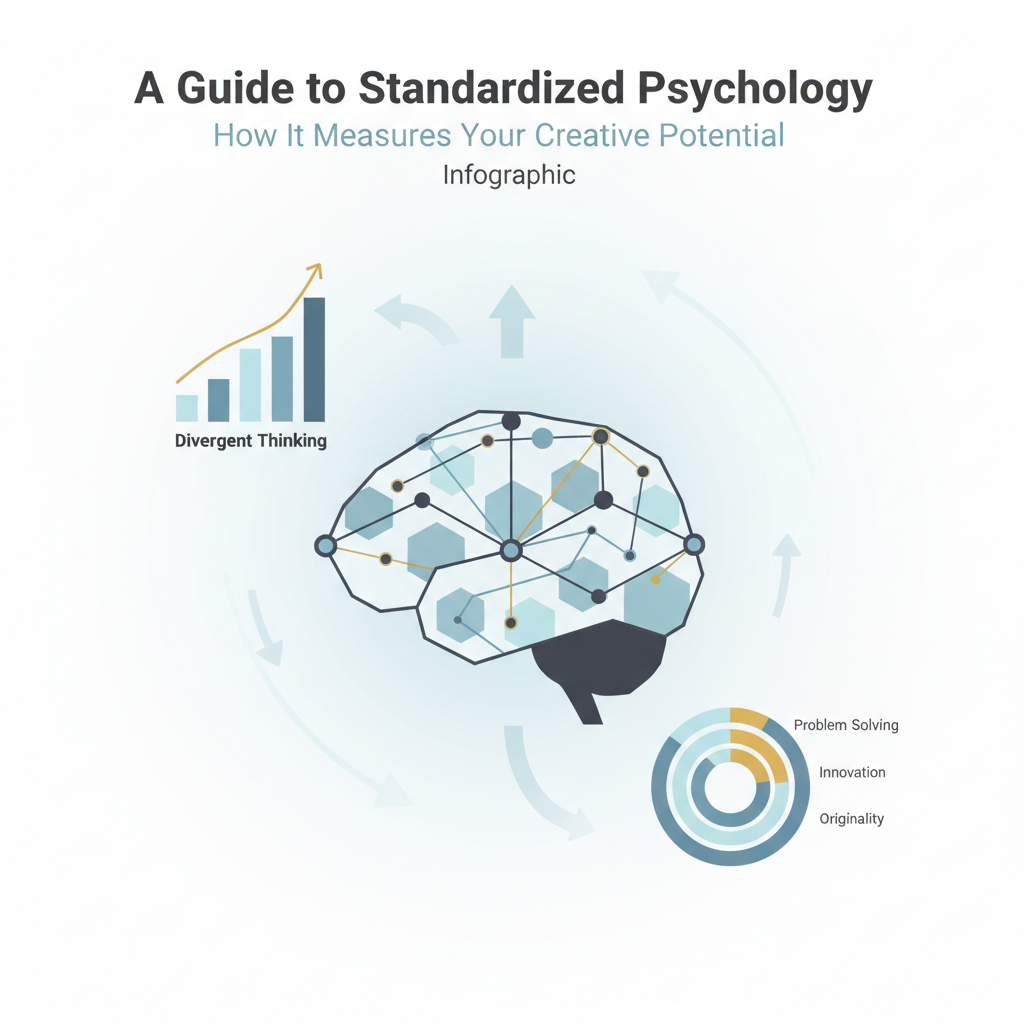
In psychology, standardization is the process of administering and scoring tests and assessments in a consistent and uniform way for all participants. This ensures that the results are objective and reliable, allowing for fair comparisons between individuals and establishing a clear baseline for measuring traits like creativity.
Have you ever wanted to measure your imagination or your unique way of solving problems? Creativity is more than just an idea—it’s a key skill for your personal and professional life. While many of us feel creative, it takes more than intuition to understand and use that potential. You need a clear, scientific way to learn about yourself.
That’s where standardized psychology comes in. At Creative Ability Test, we know that to give you useful insights, our assessment must be fair, consistent, and based on science. Unlocking your creative potential starts with self-awareness. Our test helps you move from uncertainty to clear, practical strategies. With this solid foundation, you can confidently explore your cognitive flexibility, divergent thinking, and openness to new experiences.
In this guide, we’ll explore standardized psychology and explain why it’s essential for any reliable assessment of creativity. We’ll show you what standardization means and how it allows our creative ability test to provide personalized, trustworthy insights. These insights can empower you to improve your creative skills and become a master at solving problems.
What is Standardized Psychology and Why Does It Matter?
Defining Standardization in a Simple Way
What does it mean for something to be “standardized” in psychology? It just means a test is fair and consistent for everyone who takes it. Think of it like a recipe. If everyone follows the same steps and uses the same ingredients, their cakes will turn out nearly the same. Similarly, standardization means everyone takes a test under the same conditions.
This covers everything from the questions you see to how your answers are scored. It removes any guesswork. This process gives you a reliable way to understand your unique skills.
When it comes to your creative potential, this means your results are truly about you. They aren’t swayed by outside factors during the test. This helps you trust your results.
The Goal: Fairness and Consistency
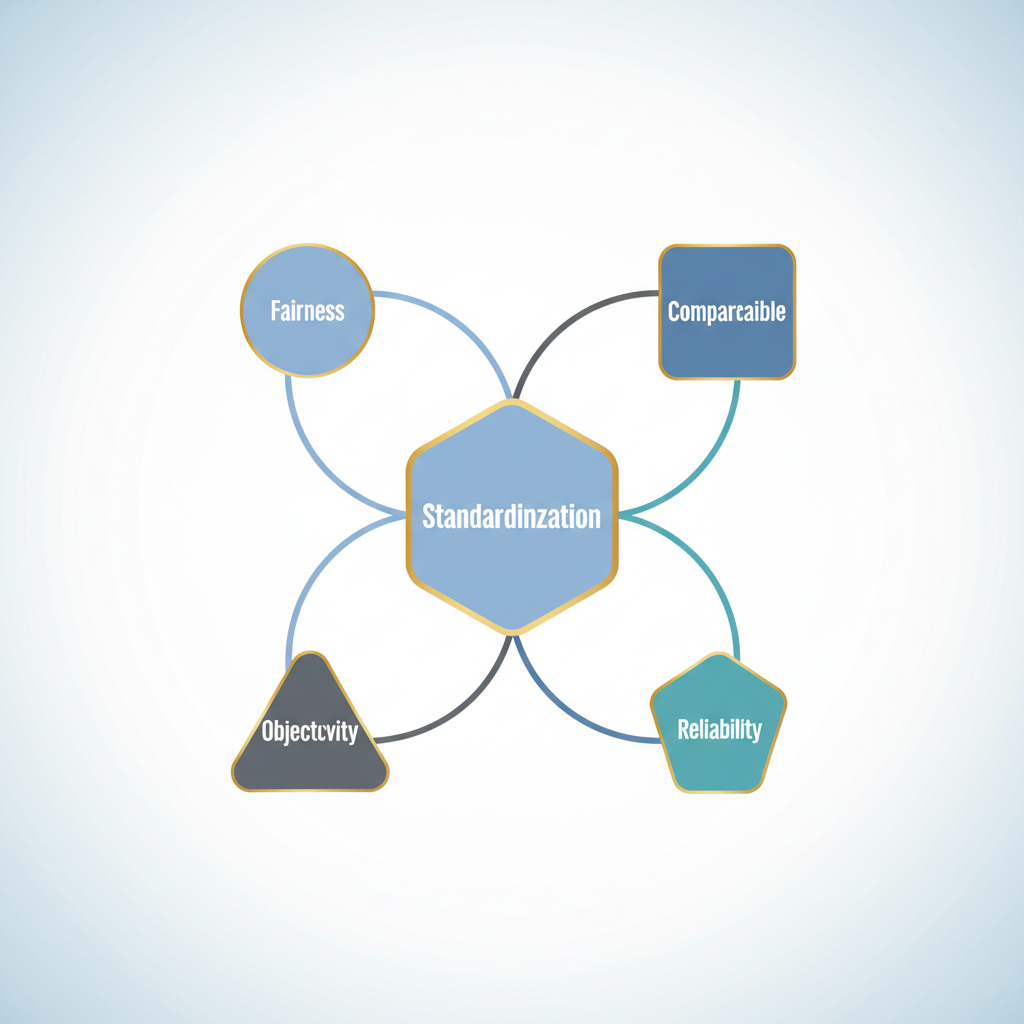
The main goals of standardization are fairness and consistency. These two things are key for any useful test, especially when measuring complex traits like creativity.
- Ensuring Fairness: Everyone gets the same instructions and questions. This consistency means no one has an unfair advantage or disadvantage. It allows your creative strengths to shine through.
- Promoting Consistency: The test setting, rules, and scoring are the same for everyone. This careful method makes sure results can be compared from person to person and stay reliable over time. It ensures that psychological assessments are given, scored, and understood the same way for all participants [1].
Why does this matter for your creative journey? It ensures your results truly show your natural talents. You can see how you compare to others or track your growth over time. Standardization makes this possible.
It turns opinions into clear, useful facts. This foundation helps you understand your unique creative thinking styles and gives you solid steps for personal and professional growth.
How Does Standardization Make a Psychology Test Reliable?
A good test must be reliable. This means it consistently measures what it’s supposed to measure. For our Creative Ability Test, reliability ensures your results accurately reflect your creative potential. The key to making a test reliable is standardization.
Standardization means using a strict set of rules for the test. These rules reduce outside influences and make the experience fair for everyone. They also allow for accurate comparisons between people. This way, you get dependable insights into your unique creative strengths.
Consistent Test Administration
Imagine taking a test where some people get extra time while others get clearer instructions. That would make the scores unfair, right?
To be reliable, a test must be given the same way every time. This ensures every test-taker has the same experience. Here’s what that involves:
- Identical Instructions: Everyone receives the exact same guidelines. This prevents confusion.
- Standardized Environment: Testing conditions are similar for all to minimize distractions.
- Fixed Time Limits: Each section has a set time limit, ensuring a level playing field.
- Uniform Procedures: The process is the same for everyone from start to finish. This prevents accidental bias.
When measuring creativity, it’s very important to be consistent. This makes sure that score differences come from actual differences in creative thinking, not from different test conditions. It’s why your Creative Ability Test results are accurate and easy to compare [2].
Uniform Scoring Procedures
Standardization is also key for scoring. A test isn’t reliable if different scorers give the same answer different points. Uniform scoring rules fix this problem.
This means we use clear, objective rules to grade every answer. These rules ensure:
- Objective Criteria: We use clear scoring guides that leave no room for personal opinion.
- No Scorer Bias: Every answer is judged by the same standards, removing the scorer’s personal views.
- Measurable Results: Creativity can seem abstract, but it can be measured. Our test looks at specific areas like originality, fluency, and cognitive flexibility.
- Consistent Scores: The same answer will always get the same score, which makes the test fair and accurate.
Uniform scoring is essential for the Creative Ability Test. It makes sure our test accurately measures your unique way of thinking. This gives you a reliable score for your creative potential.
Removing Bias for objective results
Bias can easily sneak into any test, making the results unfair and unreliable. Standardization helps remove that bias. The goal is to get results that are truly objective.
When a test removes bias, it is fair to everyone. Here’s what that means:
- Fairness for Everyone: The test is designed to be fair for people from all backgrounds.
- Focus on True Ability: Your score shows your creative skills, not outside factors like your culture or test-taking history.
- Trustworthy Results: With less bias, you can trust your results and feel confident in your personalized feedback.
- Universal Measures: We measure core creative thinking skills that aren’t tied to specific knowledge or culture [3].
The Creative Ability Test is built on these principles. Our scientific method provides unbiased results. This gives you a clear and accurate picture of your creative strengths and areas for growth, empowering you to improve your innovation skills and support your personal development.
What Is a Standardised Procedures Psychology Example?
Example in a General Cognitive Test
Imagine taking a test that measures your thinking skills. This might include problem-solving or logical reasoning. For the results to be fair, everyone must take the test under the same conditions.
This is why standard rules are so important. Test administrators follow strict guidelines, giving the exact same instructions to every test-taker. The time limits are also the same for everyone. The testing environment is kept the same for all participants as well [4].
Here are the key parts of a standard test:
- Uniform Instructions: Everyone gets the exact same directions. This makes sure they understand what to do.
- Consistent Time Limits: Every section has a set time limit. This prevents anyone from having an unfair advantage.
- Identical Scoring Rules: Answers are graded with the same rules. This removes personal opinion from the scoring.
- Controlled Environment: Distractions like noise are kept to a minimum. This gives every test-taker an equal chance to focus.
This careful process makes sure that score differences come from real differences in thinking skills, not from how the test was given.
How the Creative Ability Test Applies It
At Creative Ability Test, we use these same strict rules to ensure fair and accurate insights into your creativity. Our 30-question test is designed to measure different parts of your creativity, including flexible thinking, idea generation, and being open to new things.
We believe it’s powerful to understand your unique way of thinking. Here’s how we use standard rules on our platform:
- Clear, Consistent Questions: Every user gets the same set of questions. They are designed to bring out your creative side.
- Objective Scoring System: We use a science-backed system to score your answers. It looks at the originality, number, and detail of your ideas. This makes the scoring fair.
- Uniform Experience: Our online platform gives everyone the same test experience. The way questions are shown and timed is the same for all users.
- Research-Backed Framework: Our test is based on solid creativity research. This ensures your results are accurate and trustworthy.
By using standard rules, we can provide you with truly personal feedback. You gain a clear understanding of your creative strengths. You also discover areas to improve your creative thinking. This helps you go from feeling unsure about your creativity to knowing how to use it.
Our platform offers more than just a score. It provides practical strategies to help you use your creativity to solve problems and grow as a person. You will learn to use your unique creative skills in the real world.
Understanding Standardization and Norms in Psychology
What Are Norms?
Your creative potential is more than just a test score. That’s why psychological tests use a process called standardization to ensure they are fair and consistent. However, a raw score alone doesn’t tell you the whole story.
This is where “norms” come in. Norms give your score context and meaning. They are based on the typical scores of a specific group of people who have already taken the test [5]. Think of them as benchmarks or points of reference.
When you take the Creative Ability Test, we compare your results to the scores of a large, diverse group. This “normative group” has already completed the same test. Their combined scores show what is considered an “average” or “typical” result for different creative skills.
In short, norms answer a key question: What does my score mean compared to others? They turn a simple number into a useful insight about your abilities.
How Norms Help You Understand Your Score
Without norms, your test score is just a number. For example, if you answered 25 questions correctly, what does that mean? Is that score good, average, or exceptional?
Norms give your score context. They turn your raw score into an easier-to-understand measurement, like a percentile rank. A percentile shows the percentage of people in the comparison group who scored the same as you or lower [6].
Here are a couple of simple examples:
- If you score in the 75th percentile for divergent thinking: This means you scored higher than 75% of people in the comparison group. It suggests you have a strong ability to generate many different ideas.
- If you score in the 50th percentile for cognitive flexibility: This means your ability to switch between thinking styles is about average for the group. It also shows an area with room for growth.
Norms give you a clear picture of your creative strengths. They show where you excel and where you might want to improve. This process turns simple data into helpful insights about yourself.
Putting Your Creativity in Context
Using norms to understand your scores is empowering. It’s more than just a simple comparison—it’s a roadmap for personal growth. Your Creative Ability Test results use norms to show where your unique creative talents stand out.
For example, a high score in “openness to new experiences” confirms your natural curiosity. This might inspire you to explore new hobbies or take on different projects.
The personalized feedback on the Creative Ability Test goes even further. It turns these insights into practical tips. You’ll learn how to use your strengths and find ways to grow in other areas. This helps you use your creativity in daily life, from solving problems at work to trying new things on your own [7].
Ultimately, using tests with clear norms changes how you see yourself. It helps you unlock your full creative potential and guides you toward personal growth and self-discovery.
How the Creative Ability Test Uses Standardized Psychology for You
Our Scientific Approach to Creativity
The Creative Ability Test is built on proven principles from psychology. This scientific approach ensures your results are accurate and meaningful. Our 30-question assessment is carefully designed to measure the different parts of your creativity.
We use psychometrics—the science of psychological measurement—to build reliable and valid tests [8]. We focus on key areas of creativity, including:
- Divergent Thinking: Your ability to generate many unique ideas.
- Cognitive Flexibility: How easily you can switch between different perspectives.
- Problem-Solving Skills: Your approach to new and unfamiliar challenges.
- Openness to Experience: Your receptiveness to new ideas and concepts.
Every question is rigorously tested to ensure it measures what it’s supposed to. The test is given under consistent conditions, and our scoring is objective. This process removes bias, giving you a fair and reliable snapshot of your creative strengths.
Personalized Insights You Can Trust
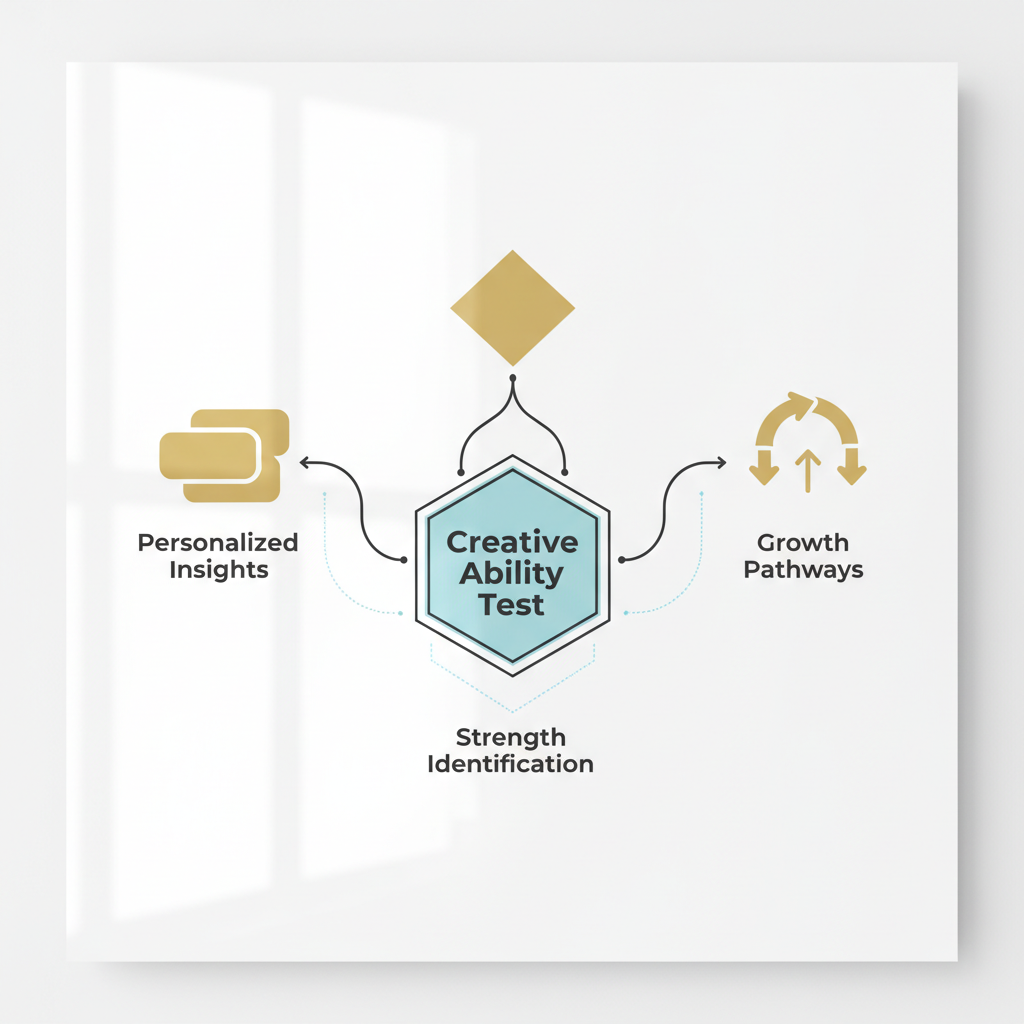
Our scientific method allows us to provide truly personal insights. To give your score meaning, we compare your results to a large, diverse group of people (known as a normative sample) [9]. This puts your creative abilities into context.
Instead of just a number, you get a detailed report that explains your unique creative profile. It highlights your strengths and identifies areas for growth. Because our methods are scientifically validated, you can trust this information.
Understanding your creative style builds confidence. You might discover a talent for brainstorming unique solutions or a knack for connecting unrelated ideas. We present these insights in a beginner-friendly way, making complex traits easy to grasp. This helps you gain actionable self-awareness.
Turning Your Results into Real Growth
The Creative Ability Test does more than just measure your skills—it empowers you to grow. Your personalized report is a roadmap from understanding to action. We provide practical strategies tailored to your unique creative profile.
For example, if you want to improve your cognitive flexibility, we’ll offer exercises to help you see problems from new angles. If divergent thinking is a strength, we’ll suggest ways to use it more effectively at work or in daily life. Here’s what you might explore:
- Boost Innovation Skills: Apply structured brainstorming techniques.
- Enhance Problem-Solving: Use creative thinking to overcome obstacles.
- Foster Personal Growth: Embrace new experiences and learning opportunities.
- Develop Creative Confidence: Regularly practice and apply your unique creative abilities.
Our goal is to help you transform. You’ll move from being uncertain about your potential to having clear strategies for growth. By learning to apply your creativity in real-world situations, you can turn your insights into tangible skills and make creativity a part of everything you do.
Frequently Asked Questions
What is a standardized psychology test?
A standardized psychology test is given the same way every time. This means everyone takes the test under the same conditions, with the same instructions, materials, and scoring rules [10].
The main goal is fairness. By removing potential bias, the test can make sure the results accurately measure what they are supposed to. For creativity, this means your unique potential is measured objectively. It also allows for meaningful comparisons between results.
The Creative Ability Test uses this approach. Our science-backed assessment provides reliable insights, helping you get a clear understanding of your creative strengths and thinking styles.
What are some standardized psychology questions?
Standardized psychology questions are often tasks or scenarios, not just simple multiple-choice items. They are designed to let you show specific ways you think or act.
For creativity tests, questions might include:
- Divergent Thinking Tasks: You might be asked to list many different uses for a common object. For example, “What are all the things you can do with a paperclip?” These questions measure your ability to generate many unique ideas.
- Problem-Solving Scenarios: You could be given an open-ended problem and asked to propose new solutions. This shows how you apply creative thought in practical ways.
- Imagination Prompts: Some tasks ask you to build a story or imagine a what-if situation. These assess how flexible and imaginative your thinking is.
- Preference and Experience Questions: You might answer questions about your openness to new experiences, curiosity, and willingness to take risks. These traits are vital for creative potential.
Our 30-question Creative Ability Test is designed this way. It looks at different aspects of your creative thinking to understand your unique approach to challenges.
How does standardization relate to reliability in psychology?
Standardization is key to making a psychology test reliable. Reliability means a test produces similar results over and over again [11]. Think of it like a good measuring tape—you expect it to show the same length every time you measure.
Here’s how standardization ensures a test is reliable:
- Consistent Administration: Every test-taker gets the same instructions and environment. This reduces the chance that outside factors will change the results.
- Uniform Scoring: The scoring rules are clear and objective. This removes personal opinion from the process, so different evaluators would arrive at the same score.
- Reduced Error: By keeping test conditions the same, standardization cuts down on random errors that could make the results less accurate.
Ultimately, a reliable test gives you confidence in your scores. For the Creative Ability Test, this means your insights are trustworthy. You can depend on our personalized feedback to support your journey toward growing your creative potential.
Sources
- https://dictionary.apa.org/standardized-test
- https://www.apa.org/education-career/guide/test-reliability
- https://psycnet.apa.org/doiLanding?doi=10.1037%2Fa0024474
- https://www.apa.org/education-career/guide/standardized-tests
- https://www.apa.org/pi/about/publications/clps/glossary
- https://www.simplypsychology.org/standardization.html
- https://hbr.org/2016/11/what-it-takes-to-be-creative
- https://www.apa.org/education-career/guide/science-psychology
- https://psychology.jrank.org/pages/446/Normative-Data.html
- https://www.apa.org/pubs/books/standardization-psychological-tests
- https://www.sciencedirect.com/topics/medicine-and-dentistry/reliability-psychology
Leave a Reply