Personality inventories in psychology are self-report questionnaires designed to measure different aspects of an individual’s character and psychological makeup. These assessment tools use a series of questions or statements about a person’s behaviors, feelings, and thoughts to provide structured insights into various personality scales and traits.
Have you ever wondered what makes you, you? What guides your choices, shapes your relationships, and forms your view of the world? This journey of self-discovery is a natural part of being human. In psychology, we use helpful tools called personality inventories in psychology to guide you. These science-based tests provide a clear way to understand the different sides of your character.
This guide offers a clear look at personality assessment in psychology. We will explain what these tests are, how they work, and what they can reveal about you. We’ll explore different personality tests in psychology, from general tests for common traits to more specific ones. This will help you understand the different personality scales psychology uses. Our goal is to help you see how these tools can support personal growth, improve self-awareness, and guide your career.
General personality tests provide valuable information about your core traits. But a full understanding of your potential goes beyond these basic characteristics. Just as personality scales help show who you are, other tools can show how you think, create, and solve problems. As you explore personality tests, remember that your creative side is also important. Understanding it, with tools like the Creative Ability Test, adds another layer to your self-awareness and personal growth.
What is a personality inventory in psychology?
The Role of Self-Report Questionnaires
A personality inventory is a useful tool in psychology. It helps us see how people differ. Most of these inventories are self-report questionnaires. In these surveys, you answer questions about yourself. Your answers show your unique ways of thinking, feeling, and acting.
When you take a self-report questionnaire, you are the expert on your own experiences. You respond to statements or questions about different parts of your life. For example, you might rate how much you agree with a statement like, “I enjoy trying new things.” Your answers help create a profile of you.
These questionnaires are designed with scientific care. They aim for results that are consistent and accurate. They also provide a structured way to explore your inner world. This process can show your creative strengths and thinking styles. Understanding these things is key for personal growth and creating new ideas.
Benefits of self-report questionnaires include:
- Direct Self-Insight: You think about your own traits. This helps you know yourself better.
- Efficiency: They can be given to many people at once, quickly.
- Standardization: Everyone answers the same questions. This makes the results fair and easy to compare.
- Focus on Specific Traits: They look at specific parts of personality. For instance, the Creative Ability Test focuses on parts of creativity like flexible thinking and openness.
By answering questions about yourself, these questionnaires reveal your unique potential. They help you move from uncertainty to clear self-awareness. This clarity helps you improve and use your creative abilities.
Objective vs. projective tests
Personality tests usually fall into two main types: objective and projective. Each type offers a different way to understand personality.
Objective tests are highly structured and have clear questions. Answers are limited to set choices, like “True/False” or a rating scale (e.g., “Strongly Agree” to “Strongly Disagree”). They’re called “objective” because the scoring is standardized. This means the results are interpreted the same way no matter who scores the test. They are based on data and statistical testing, which makes them very reliable and accurate tools in psychology [1].
Examples of objective tests include the Minnesota Multiphasic Personality Inventory (MMPI) and the Big Five personality model (OCEAN). These tools give a clear, measurable profile of your personality traits. The Creative Ability Test uses an objective, science-based method to measure specific parts of your creativity. This approach ensures you get consistent results and advice you can act on. We give personal feedback and practical tips that are based on evidence.
Projective Personality Tests
Projective tests, on the other hand, use unclear images or scenes. You are asked to say what you see in them. For example, you might describe an inkblot or create a story about a picture. The idea is that you “project” your hidden thoughts and feelings onto the image. The answers are open-ended and unique to each person.
Examples include the Rorschach Inkblot Test and the Thematic Apperception Test (TAT). Interpreting these tests is more subjective and depends heavily on the expert’s skill and training. While they can offer deep insights, psychologists often debate their scientific accuracy and consistency compared to objective tests [2].
Here is a brief comparison:
| Feature | Objective Tests | Projective Tests |
|---|---|---|
| Structure | Structured, clear questions | Unclear images, open questions |
| Responses | Set choices (e.g., True/False, scales) | Open-ended, personal answers |
| Scoring | Standardized, number-based | Subjective, based on interpretation |
| Reliability & Validity | Generally high, evidence-based | Often debated, lower consistency |
| Approach | Direct measurement of traits | Indirect look at unconscious thoughts |
At Creative Ability Test, we use the objective approach. Our 30-question assessment gives you clear, measurable results. This helps you truly understand your creative strengths. We offer a structured path to help you go from a limited understanding to using your creativity for problem-solving and innovation.
What is a personality assessment in psychology?
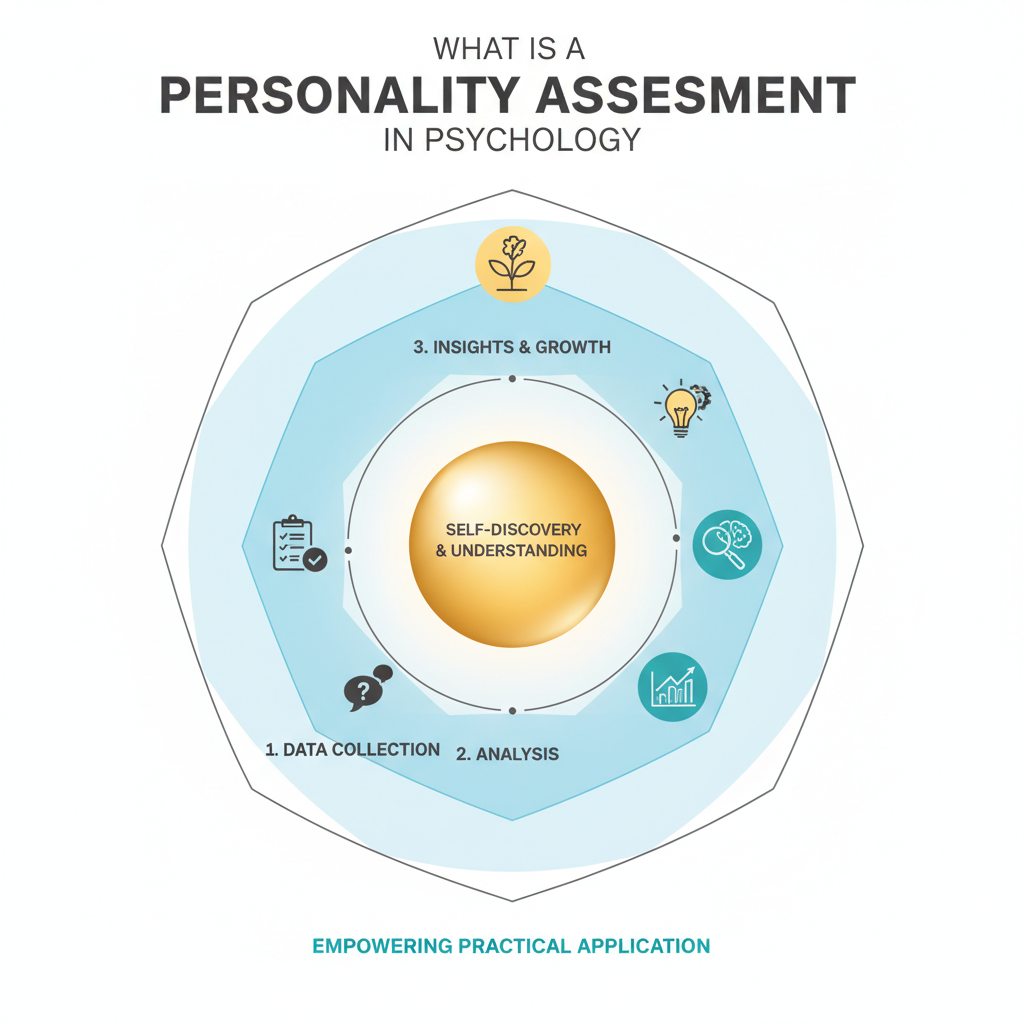
More Than Just a Test: A Detailed Process
A personality assessment is more than just a questionnaire. It’s a detailed process where psychologists use various tools to get a complete picture of you. These tools explore how you think, feel, and typically behave.
Think of it like putting together a puzzle where each piece helps you understand yourself better. This overall view is important because it highlights your unique strengths and pinpoints areas for growth. For instance, an assessment might show you are very open, a key trait for embracing new ideas and creative thinking.
An assessment also clarifies your problem-solving style. Do you brainstorm many different ideas (divergent thinking), or do you prefer to narrow down options to find the best solution (convergent thinking)? Learning the why behind your actions gives you deeper self-knowledge and helps you grow.
Our 30-question Creative Ability Test is a part of this process. It’s based on science and helps you understand your creative potential. You’ll get clear, detailed insights that lead to practical strategies for growth.
The Purpose of Personality Assessment
The main goal of a personality assessment is to help you understand yourself better. It clarifies your unique psychological makeup, which is valuable knowledge. You can learn about your motivations, typical reactions, and natural talents.
For individuals, this brings greater self-awareness, helping you make better personal choices and improve relationships. Professionals often use these assessments for career development and to build stronger, more effective teams [3].
When used to look at creativity, these assessments can be eye-opening. They help uncover your specific thinking style. For example, do you generate many ideas quickly (divergent thinking), or are you better at refining concepts to find the best one (convergent thinking)?
Our Creative Ability Test focuses on this, helping you pinpoint your creative strengths. You’ll receive practical strategies to boost your innovative thinking. Ultimately, these assessments give you the tools to use your full potential, leading to personal growth and more innovation in your life and work.
What are the 5 personality inventory?
An Introduction to the Big Five (OCEAN)
Knowing yourself is a great way to unlock your creative potential. A popular tool in psychology for this is the “Big Five” personality traits. This model uses the acronym OCEAN to offer a full picture of human personality. It helps us understand our basic nature [4].
The Big Five covers five main areas of personality. These traits tend to stay stable over time and affect how we think, feel, and act. By learning about them, you can better understand what you naturally prefer. This insight helps you tackle creative challenges and see your unique thinking style. In the end, it helps you find personal ways to grow.
Openness to Experience
Openness to Experience is about how willing you are to try new things. It includes being curious and having a good imagination. People high in openness love variety and thinking about new ideas. They often enjoy learning new things. This trait is a big part of being creative and original.
- Key Characteristics: Imaginative, curious, insightful, wide range of interests, adventurous.
- Connection to Creativity: If you have high openness, you probably enjoy exploring new ideas. You are happy to try things in a different way. This helps you think outside the box and come up with fresh concepts.
- Actionable Insight: Follow your curiosity. Look for new experiences and different points of view. Try new creative methods often. For example, if you usually draw, try writing a short story. This keeps your creative skills sharp.
Conscientiousness
Conscientiousness is about how organized and determined you are. It includes self-control, being responsible, and working toward goals. People with high conscientiousness are usually reliable. They are great at planning and getting things done. While it might seem like it’s just about being neat, this trait is key for turning creative ideas into reality.
- Key Characteristics: Organized, disciplined, diligent, punctual, efficient.
- Connection to Creativity: This trait helps you organize your creative work. It gives you the drive to finish your projects. It’s the focus you need to keep going, because even great ideas need a plan.
- Actionable Insight: Set clear goals for your projects. Build a regular creative routine. For example, set aside time each day to think of ideas or practice. This turns fuzzy dreams into real results.
Extraversion
Extraversion shows how outgoing and energetic you are. People high in extraversion love being around others. They get energy from social situations. They are often confident and talkative. This trait affects how you share your work and work with others.
- Key Characteristics: Outgoing, energetic, assertive, sociable, enthusiastic.
- Connection to Creativity: Extraverts often find inspiration from the world around them. They enjoy working with others on creative projects. They are usually comfortable sharing their ideas, which helps them get feedback and improve faster.
- Actionable Insight: Use your social energy. Share your creative ideas with people you trust. Join a creative group or class. Being around others can spark new ideas and give you helpful support.
Agreeableness
Agreeableness is about how cooperative and caring you are. It shows if you are kind, trusting, and get along with others. Agreeable people like it when everyone is happy. They often put others first. This trait is very important for working well in a creative team.
- Key Characteristics: Kind, cooperative, empathetic, trusting, compassionate.
- Connection to Creativity: Being agreeable helps create a positive space for creativity. It makes it easier to give and receive helpful feedback. It also helps you connect with your audience, which can make your work more powerful.
- Actionable Insight: Really listen to others in creative talks. Be open to what people have to say. Think about what your audience needs and how they see things. This makes working together better and improves your final work.
Neuroticism
Neuroticism (also called Emotional Stability) is about how you handle emotions. People high in neuroticism might feel more stress, anxiety, or mood swings. Those low in this trait are usually more calm and stable. Knowing this about yourself helps you manage your feelings when facing creative hurdles.
- Key Characteristics: Prone to stress, anxious, moody, sensitive, easily worried.
- Connection to Creativity: While high neuroticism can cause self-doubt, it can also lead to deep self-reflection. It can provide a wider range of emotions for your art. The key is to manage the challenges so you can create steadily.
- Actionable Insight: Find ways to handle creative stress or negative self-talk. Practice mindfulness to stay in the moment. Take small, manageable steps in your creative work. This helps you become stronger and get through creative blocks with more confidence. It also protects your creative energy.
What is an example of an inventory in psychology?
The Myers-Briggs Type Indicator (MBTI)
The Myers-Briggs Type Indicator (MBTI) is a popular personality test. It helps people learn about how they see the world and make choices. It was created by Katherine Briggs and Isabel Myers during World War II. They based their work on Carl Jung’s theory of personality types [5].
The MBTI looks at preferences in four key areas:
- Extraversion (E) or Introversion (I): This shows where you get your energy.
- Sensing (S) or Intuition (N): This describes how you gather information.
- Thinking (T) or Feeling (F): This reveals how you make decisions.
- Judging (J) or Perceiving (P): This shows how you like to organize your world.
Your preferences combine to form one of 16 personality types. Many people find the MBTI helpful for learning about themselves and their communication styles. It can also be used for career planning and teamwork. While the test is popular, some researchers question its scientific reliability and consistency [6]. However, it is still a common tool for self-discovery.
The Minnesota Multiphasic Personality Inventory (MMPI)
The Minnesota Multiphasic Personality Inventory (MMPI) is a clinical psychological test. Psychologists mainly use it to help diagnose mental health conditions. It was first developed in the late 1930s by Starke R. Hathaway and J.C. McKinley [7].
The test is a long questionnaire with hundreds of true-or-false questions. It was created in a unique way. Questions were chosen based on how people with certain mental health conditions answered them compared to others. The MMPI also has scales to check for honesty. These scales can tell if someone is answering truthfully or trying to seem a certain way. This makes the test a strong tool for clinical use, as it helps spot inconsistent or exaggerated answers. Because it was developed so carefully, the MMPI is a key tool in psychology.
The Sixteen Personality Factor Questionnaire (16PF)
The Sixteen Personality Factor Questionnaire (16PF) is another solid tool for understanding personality. It was created by Raymond Cattell, who studied thousands of human traits to find the most basic ones [8]. His goal was to identify the core factors of personality. As the name suggests, the 16PF measures 16 key personality traits. These include traits like warmth, reasoning, emotional stability, dominance, and openness to change.
The 16PF gives a detailed look at a person’s personality. Professionals use it in many areas, including:
- Career counseling: Helping people find jobs that fit them.
- Employee development: Identifying strengths for leadership or teamwork.
- Clinical diagnosis: Adding to other tests to better understand someone’s traits.
- Research: Studying the structure and development of personality.
Learning about these tests shows that psychology offers many paths to self-discovery. Tests like the MBTI, MMPI, and 16PF give a broad view of personality. Other tools focus on more specific areas. For example, the Creative Ability Test measures your creative strengths and ways of thinking. This helps you target your personal growth and find clear steps to build on your strengths.
How Do General Personality Tests Differ from Creativity Assessments?
Measuring Stable Traits vs. Malleable Skills
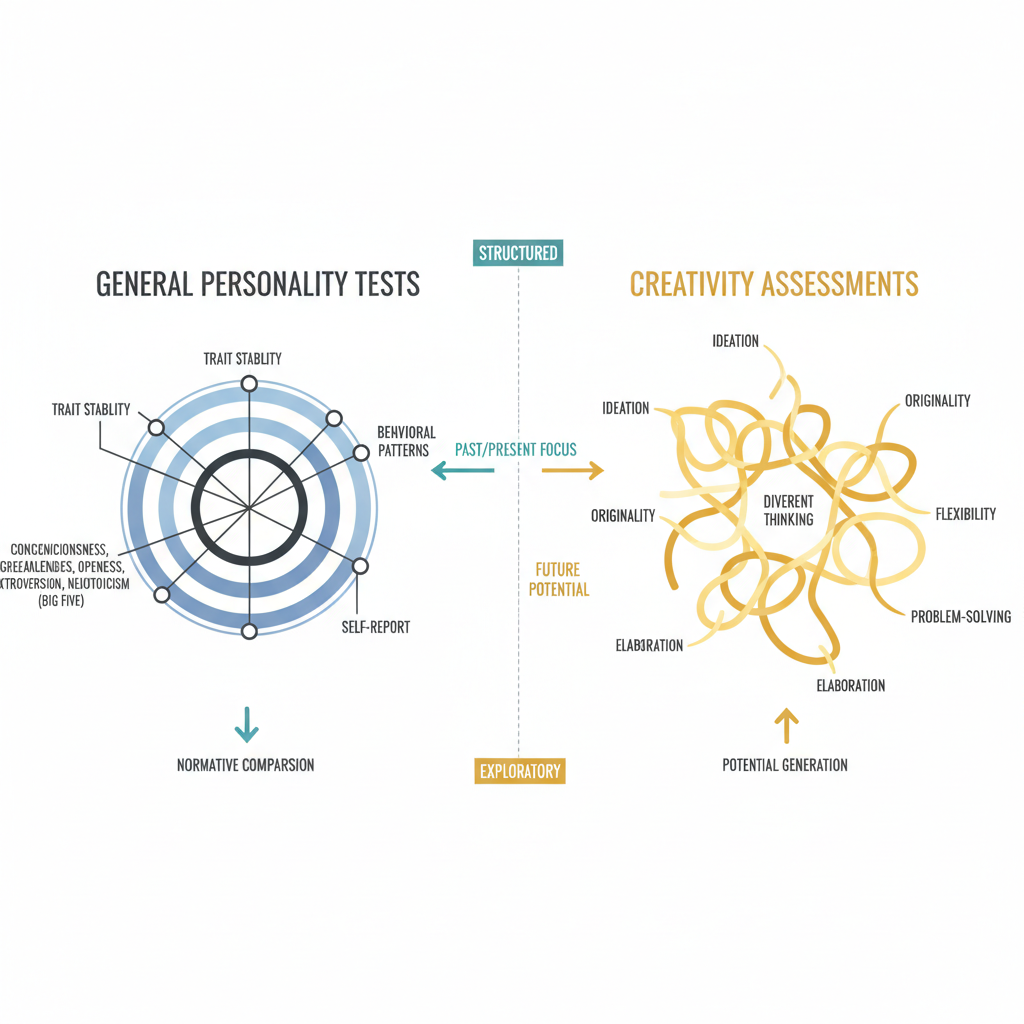
Personality tests look at the core parts of who you are. They often measure stable traits, like the ones in the Big Five model. These traits are long-lasting patterns in how you think, feel, and act. For example, how introverted or organized you are tends to stay the same over time [9].
Creativity tests, however, focus on something different. They measure skills you can build. These are abilities you can grow and improve with practice. We look at how you think, solve problems, and welcome new ideas. These skills are not set in stone—they are tools you can sharpen.
Our Creative Ability Test helps you understand these skills. It shows you how you come up with ideas, handle challenges, and think in new ways. This helps you grow your own creative talents.
From ‘Who You Are’ to ‘What You Can Do’
Think of it this way: personality tests answer the question, “Who are you?” They might show that you are naturally curious or very organized. This tells you a lot about your personality. They describe what you naturally prefer or how you tend to act.
Creativity tests focus more on what you can do. They ask, “What can you do with your natural talents?” They look at your ability to think and act in new ways. For example, a personality test might say you are “Open to Experience.” A creativity test shows how you use that openness. It shows how you find new solutions or connect ideas in unique ways. This change from knowing who you are to knowing what you can do is key for growth.
Understanding your creative skills gives you clear steps to take. It helps you use your way of thinking to solve real-world problems. This can be for anything, from everyday issues to big projects at work [10].
Unlocking Your Potential with the Creative Ability Test
The Creative Ability Test offers a different point of view. It focuses on the practical side of your creativity. Instead of broad traits, we show you your specific creative strengths. Our 30-question test is based on science and measures key parts of creative thinking, including:
- Cognitive Flexibility: Your ability to switch between different ideas or ways of thinking.
- Divergent Thinking: How well you come up with many different ideas from one starting point.
- Problem-Solving Skills: Your unique ways of handling tough problems creatively.
- Openness to New Experiences: Your willingness to try new things and consider unusual ideas.
Our test gives you feedback that is tailored to you. You get practical tips to improve how you create. It turns confusion about your abilities into a clear understanding. You’ll go from hitting creative blocks to having a clear plan for growth. You get practical advice to help you innovate and grow [11].
Discover not just who you are, but what you can achieve creatively. The Creative Ability Test helps you unlock and apply your full creative power.
Frequently Asked Questions
What are the five types of personality assessment?
Understanding yourself is a powerful step. Personality tests offer different ways to gain insight. Psychologists group them into five main types.
- Self-Report Inventories: These are questionnaires where you answer questions about your thoughts, feelings, and actions. They often use rating scales. The Big Five Inventory is a well-known example. Our Creative Ability Test is also a self-report assessment. It helps you discover your unique creative strengths.
- Projective Tests: These tests present unclear images, like inkblots or pictures. Your responses are thought to reveal hidden parts of your personality. The Rorschach Inkblot Test is a famous projective test.
- Observational Measures: Here, trained experts watch your behavior in specific situations. This provides a look into how you act and react. For instance, a child psychologist might watch a child play.
- Clinical Interviews: A psychologist talks with you one-on-one. They ask about your history, experiences, and current problems. This offers a deep, personalized understanding. Interviews can be structured or more like a conversation.
- Behavioral Assessments: These focus on directly measuring specific actions. They often involve tracking what you do in real-life settings. For example, counting how often a person does a certain activity.
Each type offers a unique view. They help you explore different sides of your personality. Our platform uses a science-based self-report test. It measures your creative abilities and offers practical steps for growth.
What is the most commonly used personality assessment?
The Big Five Personality Traits model is one of the most common and well-researched personality tests in psychology. It is also known as OCEAN [4]. This model looks at five main dimensions of personality.
- Openness to Experience: How curious and creative you are.
- Conscientiousness: How organized and disciplined you are.
- Extraversion: How social and outgoing you are.
- Agreeableness: How kind and cooperative you are.
- Neuroticism: How emotionally stable you are.
The Big Five gives a broad overview of your personality. However, specialized tests like the Creative Ability Test go deeper. They focus on specific skills you can use. Our 30-question assessment helps you uncover your creative potential and provides personal feedback. This helps you grow both personally and professionally.
What are personality inventories AP Psychology?
In AP Psychology, personality inventories are key testing tools. They are standard questionnaires where you answer a series of questions about yourself. These questions are made to measure specific personality traits. They provide an “inventory” of your personality.
Inventories are objective tests, which means they are scored in a consistent way. This makes them reliable for comparing results. Common examples studied in AP Psychology include:
- Minnesota Multiphasic Personality Inventory (MMPI): This is a clinical test used to assess mental health issues and personality structure [12].
- Myers-Briggs Type Indicator (MBTI): This test sorts people into 16 personality types based on how they see the world and make decisions.
- Big Five Inventory (BFI): This measures the five main dimensions of personality we’ve already discussed: Openness, Conscientiousness, Extraversion, Agreeableness, and Neuroticism.
These inventories help students understand how psychologists measure personality and how these tools can lead to self-discovery. Our Creative Ability Test follows this scientific approach. It offers a structured way to measure your creative thinking, helping you apply your insights to solve problems and create new ideas.
What are the three types of personality assessments?
To simplify, personality tests can be grouped into three main types. These different methods offer clear ways to understand a person’s unique qualities.
- Self-Report Questionnaires (Objective Tests): These are structured tests where you answer specific questions about yourself. Your answers are scored objectively with a standard key. This approach is efficient and allows for easy comparison. Many popular tests are in this category. Our Creative Ability Test is a great example of a science-based self-report assessment that helps you measure your creative strengths.
- Projective Techniques (Subjective Tests): These tests use unclear prompts, like an inkblot or a picture. You are asked to say what you see. The idea is that your answers reveal hidden parts of your personality. These methods are more open to interpretation and can provide deeper insights, but the scoring is less consistent.
- Observational and Behavioral Assessments: This approach involves watching a person’s behavior in a real-life or controlled setting. For example, an expert might observe how you solve a difficult problem. This provides real-world insights into how your personality shows up in your actions. This method is very useful for understanding practical skills.
Each type provides valuable information to help you build a full picture of yourself. The Creative Ability Test uses the self-report method to provide personalized, useful insights. This feedback empowers you to build on your creative potential. Understanding your creative thinking style can change how you face challenges, helping you grow personally and professionally.
Sources
- https://www.simplypsychology.org/objective-tests.html
- https://www.psychologytoday.com/us/basics/projective-tests
- https://hbr.org/2019/08/how-personality-tests-can-help-you-hire-the-right-people
- https://www.simplypsychology.org/big-five-personality.html
- https://www.myersbriggs.org/my-mbti-personality-type/mbti-basics/
- https://journals.sagepub.com/doi/full/10.1177/1745691617719200
- https://www.uoregon.edu/~sanjay/mmpi.html
- https://www.apa.org/pubs/books/4318104
- https://www.psychologytoday.com/us/basics/personality/personality-traits
- https://hbr.org/2019/08/the-innovation-skills-you-need-to-succeed-now
- https://www.forbes.com/sites/forbescoachescouncil/2021/04/13/why-creative-thinking-is-a-crucial-skill-for-personal-and-professional-growth/
- https://www.upenn.edu/irap/about/personality-assessments
Leave a Reply