Personality assessment models are structured frameworks used in psychology to measure and categorize individual personality traits. Popular models include the Big Five (OCEAN), the Myers-Briggs Type Indicator (MBTI), and the Enneagram, which help individuals understand their behaviors, preferences, and strengths for personal and professional growth.
Have you ever wondered about the unique patterns in how you think, react, and face challenges? Understanding yourself is the first step to unlocking your full potential, especially your natural creativity. This process is made easier with personality assessment in psychology, which offers proven ways to understand your strengths, preferences, and motivations.
These tools are much more than simple labels; they are designed for real personal and professional growth. By exploring personality inventories in psychology, you can see how your personality shapes your cognitive flexibility, problem-solving strategies, and your openness to new experiences. Whether it’s a C Jung personality test or a look into a Carl Jung cognitive functions test, these assessments explain different creative traits and thinking styles. They provide useful practical tips for improving creativity and help you build innovative thinking skills for every part of your life.
This guide will introduce you to seven of the most well-known personality models. We’ll break down their main ideas and show you how each one can help you see your strengths, motivations, and creative potential in a new light. Get ready to turn self-discovery into clear awareness and practical steps for growth.
What Are Personality Assessment Models and Why Do They Matter?
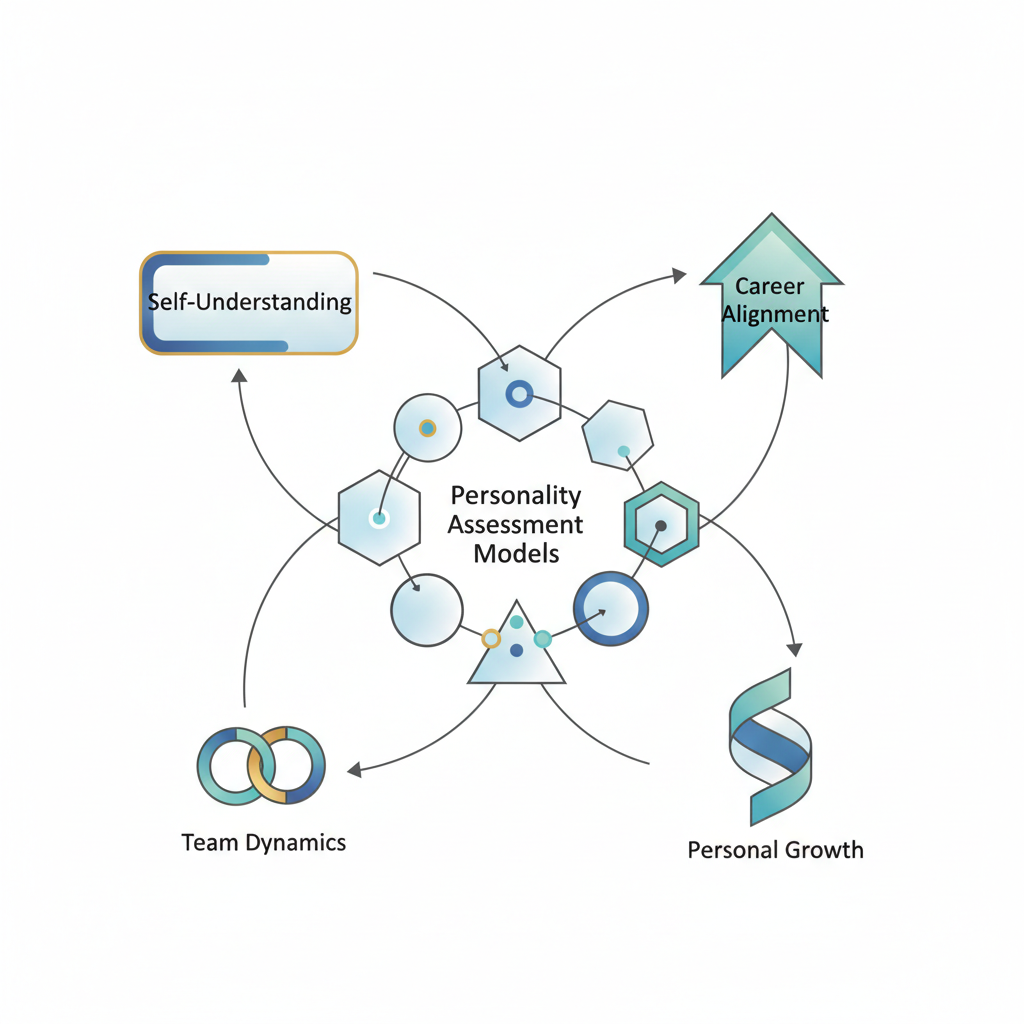
Understanding the Science of You
Have you ever wondered what makes you unique? Personality tests offer a way to understand yourself better. These tools use psychology to map out your patterns of thinking, feeling, and behaving.
Think of them as a guide to self-discovery. They help you see your main traits, preferences, and motivations. In short, these models give you a clear way to understand yourself.
Psychologists use many different tests. These include well-known models like the Big Five (OCEAN) and theories from Jungian psychology [1]. These tools help us understand why people act the way they do. Instead of just guessing, they provide insights based on data.
Exploring these models can help you understand:
- Your main personality traits.
- How you interact with the world around you.
- What motivates your decisions.
- Your typical response to challenges.
- Areas where you have natural strengths.
Understanding your personality is a powerful step toward self-awareness. This knowledge creates a solid base for personal growth.
How Personality Insights Fuel Creativity and Growth
Understanding your personality is more than just finding a label. It can spark your creativity and help you grow. When you know how you think, you can find new ways to create and solve problems better.
For example, if you know you love to explore, you can look for new experiences to boost your divergent thinking skills. And if you know you’re mentally flexible, you can adapt to change and welcome new ideas more easily.
Here’s how knowing your personality can help:
- Find Your Creative Strengths: Discover if you’re a natural at brainstorming or better at careful planning. This helps you focus on what you do best.
- Become More Adaptable: See how your personality affects your ability to look at things differently. This is a key skill for new ideas.
- Solve Problems Better: Learn your natural way of facing challenges. This helps you find more creative and effective solutions.
- Support Your Personal Growth: Find out where you have room to grow, like building new habits or changing your mindset.
- Build Confidence: When you understand your creative skills, you’ll trust your gut and be more willing to take creative risks.
When you understand your creative side, you can take clear, confident action. Our science-backed Creative Ability Test is designed to help. It offers personal feedback and practical tips for using your creativity every day [2]. This helps you move from being creative once in a while to growing your skills consistently. Your path from basic understanding to real innovation will become much clearer.
The 7 Most Influential Personality Assessment Models Explained
The Big Five (OCEAN) Model: The Gold Standard in Psychology
The Big Five, often remembered by the acronym OCEAN, is a key model in personality psychology. It breaks personality down into five main traits. Researchers trust it because it is scientifically valid and reliable [3]. Many see it as the strongest model available.
Understanding your Big Five traits can give you deep insights. It shows how you interact with the world and face challenges. This knowledge can directly affect how you create and solve problems.
- Openness to Experience: This trait measures your imagination, curiosity, and interest in new things. People high in openness often welcome new ideas. They look for different points of view. This helps with creative, out-of-the-box thinking.
- Conscientiousness: This trait shows how organized, disciplined, and goal-oriented you are. Conscientious people are careful with details and don’t give up easily. These skills are vital for turning creative ideas into real results.
- Extraversion: Extraversion shows how social, energetic, and assertive you are. Extraverts often get energy from being with others. They might enjoy brainstorming in groups and sharing ideas freely. This can lead to new creative ideas.
- Agreeableness: This trait measures how cooperative, kind, and understanding you are. Agreeable people work well in teams. They create a good atmosphere for creative teamwork.
- Neuroticism (Emotional Stability): Neuroticism is about how you handle emotions and stress. Lower neuroticism (which means higher emotional stability) often leads to more resilience. This helps you take creative risks and stick with projects.
Learning your Big Five profile helps you understand your natural tendencies. You can then use these strengths to improve your creative problem-solving. Our Creative Ability Test provides similar science-backed insights. It helps you understand your own cognitive flexibility and openness to new experiences.
The Myers-Briggs Type Indicator (MBTI): Understanding Your Preferences
The Myers-Briggs Type Indicator (MBTI) is a very popular personality test used around the world. It gives you a way to understand your personal preferences [4]. Katharine Cook Briggs and Isabel Myers created it during World War II. They based it on Carl Jung’s theory of psychological types.
The MBTI helps you find your preferences in four key areas. These preferences combine to make up 16 different personality types.
- Extraversion (E) or Introversion (I): How you focus your energy. Do you prefer the outer world of people and things, or your inner world of ideas and thoughts?
- Sensing (S) or Intuition (N): How you take in information. Do you focus on facts and details, or on patterns, possibilities, and what might happen next? Intuition is often linked with creative thinking.
- Thinking (T) or Feeling (F): How you make decisions. Do you prefer to use logic and facts, or do you consider people’s feelings and values?
- Judging (J) or Perceiving (P): How you like to live your life. Do you prefer a planned and organized life, or one that is flexible and spontaneous? Perceiving is often linked to being adaptable and open to creative ideas.
Although scientists debate its validity, the MBTI is still a popular tool for self-discovery. It gives people a common language to talk about their differences. Understanding your MBTI type can show you your favorite ways to think creatively. It can also show you how you might handle new challenges. This self-awareness is a great tool for personal growth and new ideas.
The Enneagram: Exploring Motivations and Fears
The Enneagram is a personality system that shows how people can change and grow. It outlines nine connected personality types. Each type has a core motivation, fear, and desire. It looks at the “why” behind what you do [5]. Unlike models that focus on traits, the Enneagram explores your deeper reasons for acting.
Learning your Enneagram type can be life-changing. It shows you patterns in how you think, feel, and act. This knowledge is key for personal growth and for getting past creative blocks.
- Type 1 – The Reformer: Ethical and has a strong sense of purpose, but can be too hard on themselves.
- Type 2 – The Helper: Caring and giving, but can forget to take care of their own needs.
- Type 3 – The Achiever: Can adapt and is driven to succeed, but can be too focused on their image.
- Type 4 – The Individualist: Expressive and creative, but may struggle with self-doubt. These types often have many creative strengths.
- Type 5 – The Investigator: Insightful and innovative, but can be distant from others. Their deep thinking leads to unique solutions.
- Type 6 – The Loyalist: Committed and responsible, but can be anxious.
- Type 7 – The Enthusiast: Spontaneous and loves adventure, but may try to avoid dealing with pain. Their love for life can inspire new ideas.
- Type 8 – The Challenger: Confident and makes decisions easily, but can be confrontational.
- Type 9 – The Peacemaker: Easy-going and supportive, but can avoid conflict and new challenges.
The Enneagram helps you observe yourself and grow. By knowing your core motivations, you can break free from unhelpful patterns. You can also use your unique motivations for better creative work. It helps you use your creativity in the real world, turning confusion about yourself into useful self-knowledge.
Jungian Psychology & Archetypes: The Foundation of Many Tests
Carl Jung, a famous Swiss psychiatrist, created a field called analytical psychology. His ideas are the foundation for many modern personality theories and tests. He introduced new concepts like the collective unconscious and archetypes [6]. He also studied different ways of thinking, which shaped how we understand personality today.
Jung’s ideas help us understand the deeper parts of our personality. They show how universal patterns can affect our minds and creative styles.
- Archetypes: These are universal patterns and images, like The Hero, The Sage, The Innocent, and The Creator. They come from a shared human unconscious. Understanding these patterns can give you insight into your natural roles and creative urges.
- The Collective Unconscious: This is a pool of shared experiences and knowledge that all humans have. You are born with it; you don’t learn it. This suggests we all share a source for our creative ideas.
- Cognitive Functions: Jung identified four main ways of thinking:
- Thinking: Making decisions based on logic and facts.
- Feeling: Making decisions based on values and how they affect people.
- Sensing: Noticing information using your five senses.
- Intuition: Seeing possibilities, patterns, and what might happen next. This is strongly linked to creative ideas and thinking ahead.
Understanding these Jungian ideas gives you a rich way to think about your personality. It helps you analyze your creative strengths and thinking styles. You can see how hidden patterns might affect your own approach to solving problems and creating new things. This connects to our platform’s goal of understanding the different sides of creativity.
The DISC Model: A Focus on Workplace Behavior
The DISC model is a test that focuses on behavior. It helps people understand their own and others’ communication styles. It’s often used at work to help teams and develop leaders [7]. DISC groups behaviors you can see into four main styles: Dominance, Influence, Steadiness, and Conscientiousness.
Knowing your DISC style, and the styles of your coworkers, can change how you work together. It leads to better communication and teamwork. This directly improves a team’s creativity and problem-solving skills.
- Dominance (D): People with a high ‘D’ style are direct, decisive, and focused on results. They often take the lead on creative projects and push new ideas forward.
- Influence (I): High ‘I’ people are enthusiastic, social, and persuasive. They are great at brainstorming, inspiring others, and getting support for new ideas.
- Steadiness (S): People with a high ‘S’ style are patient, supportive, and dependable. They bring stability to projects and make sure creative work gets finished.
- Conscientiousness (C): High ‘C’ people are analytical, careful, and focused on details. They make sure work is high-quality, gather information, and improve creative ideas to get the best results.
The DISC model gives you practical ideas on how different styles can help create a more creative workplace. It shows why having different approaches to problem-solving is so valuable. By understanding these behaviors, you can help your team work better together. This helps create new solutions and allows people to grow professionally through their creative work.
Strengths-Based Assessments: Highlighting Your Positive Traits
Strengths-based assessments come from the field of positive psychology. They focus on finding and building on your natural talents. Instead of focusing on your weaknesses, these tools show you what you’re good at. They encourage you to use these strengths to grow personally and professionally [8].
Popular examples are CliftonStrengths (once called StrengthsFinder) and the VIA Character Strengths survey. They help people see the unique things they have to offer.
Focusing on your strengths has several key benefits:
- Builds Confidence: Understanding what you are naturally good at makes you more self-assured. This encourages you to try new creative things.
- Increases Engagement: When you use your strengths, you are more engaged and motivated. This leads to more consistent creative work.
- Targets Development: You can use your strengths to improve in other areas. This can help you get past creative blocks or learn new skills.
- Uses Your Natural Talents: Knowing what you’re naturally good at helps you solve problems more effectively. It lets you handle tasks with more ease and creativity.
- Guides Personal Growth: These tests give you useful information. They guide you on how to use your unique skills to improve yourself.
Focusing on your strengths helps you turn confusion about your creativity into useful self-knowledge. It shows you how to use your unique skills to be more creative. This fits perfectly with our platform’s goal of helping you find and grow your creative potential.
Projective Tests: Uncovering the Unconscious Mind
Projective tests are a different kind of personality assessment. They show people unclear images or prompts. The idea is that people will share their inner thoughts, feelings, and hidden motives in their answers [9]. They are different from standard questionnaires that ask direct questions.
These tests are often used by therapists, but they can give a peek into the deeper parts of your personality. They can show hidden things that affect your creativity or cause blocks.
- Rorschach Inkblot Test: This is the most famous example. You look at a series of inkblots and say what you see. Your answers can show how you see the world, what you’re feeling, and how you think.
- Thematic Apperception Test (TAT): You are shown a series of emotional but unclear pictures and asked to tell a story about each one. This can show hidden desires, conflicts, or how you relate to others.
- Sentence Completion Tests: These ask you to finish incomplete sentences. For example, “My biggest fear is…” or “I feel happy when…”
It is important to know that scientists debate whether these tests are valid and reliable, especially compared to tests like the Big Five. However, they can provide deep, descriptive information. This information can give a more detailed look at how a person sees the world. If you are curious about how your unconscious mind affects your creativity, these tests offer a different way to look at it.
What tests do psychologists use to assess personality?
Objective Tests vs. Projective Tests
Psychologists use different tools to understand personality. These tools fall into two main types: objective tests and projective tests. Each type gives a unique look into who we are and how we think.
Objective Tests: Measuring with Precision
Objective tests are the most common way to assess personality. They use clear questions with set answers, like true/false, yes/no, or rating scales. Because the format is consistent, scoring and understanding the results are simple.
Many objective tests are based on solid science. They give reliable and valid results [10]. This means they consistently measure what they’re supposed to. They are great for spotting specific traits, like those in the Big Five (OCEAN) personality model.
Objective tests are also very useful for creativity. They can measure traits tied to creative thinking, such as openness to new experiences and flexible thinking. Our Creative Ability Test is an objective test designed to help you scientifically understand your creative strengths.
Projective Tests: Uncovering Deeper Meanings
Projective tests work differently. They show you unclear images, like inkblots or vague pictures, and ask what you see. The idea is that your free-form answers reveal hidden thoughts and feelings.
The Rorschach Inkblot Test is a famous example. Another is the Thematic Apperception Test (TAT). While these tests are interesting, they have drawbacks. Scoring can depend on the expert’s opinion, making it subjective. Their results are often less reliable and valid than objective tests for assessing personality [9].
While some people enjoy the creative freedom of these tests, objective tests offer more practical, useful insights for understanding and improving your creative skills.
Self-Report Inventories (Questionnaires)
Self-report inventories, or questionnaires, are the foundation of objective testing. In these tests, you simply answer questions about your own thoughts, feelings, and actions. Your answers give a direct look into how you view yourself.
Psychologists often use these questionnaires because they are efficient and easy to use. They can gather lots of information quickly. A well-designed test gives a clear picture of different parts of your personality.
How They Connect to Creativity
Questionnaires are especially useful for exploring creativity. They help us look at specific parts of your creative thinking, such as:
- Openness to Experience: How willing you are to explore new ideas and try new things.
- Cognitive Flexibility: How easily you can switch between different ways of thinking.
- Divergent Thinking: Your ability to come up with many different solutions to a problem.
- Problem-Solving Approaches: The ways you prefer to solve problems.
- Willingness to Take Risks: How comfortable you are with stepping outside your comfort zone.
Our 30-question Creative Ability Test is a self-report questionnaire based on science. It measures these key parts of creativity. Answering honestly provides the most accurate results. This information gives you personalized tips to help you grow.
The Role of Psychometric Assessments in Psychology
Psychometrics is the science of psychological measurement. It makes sure tests are accurate and meaningful, not just interesting. This science is built on three key ideas:
- Reliability: A reliable test provides consistent results. If you take it again, your score should be about the same.
- Validity: A valid test measures what it’s supposed to measure. For instance, a creativity test should actually measure creative thinking, not something else like general intelligence.
- Standardization: The test is given and scored the same way for everyone. This makes it possible to compare results fairly.
These principles are very important. They provide unbiased, evidence-based information that helps us understand people’s differences. This information can then guide personal growth.
Empowering Your Creative Journey
Scientific tests are key to understanding your creative potential. They turn uncertainty into clear self-awareness you can act on. They help pinpoint your unique creative strengths. For example, you might be great at coming up with new ideas or looking at problems in a new way.
The Creative Ability Test is built on these solid scientific principles, which guarantees that your results are reliable and valid. Our personalized feedback helps you:
- Understand your unique creative thinking styles.
- Pinpoint specific areas for improvement.
- Get practical tips to boost your creative skills.
- Use these insights to solve real-world problems.
- Feel more confident in your creative abilities.
By using a science-based test, you get a clear roadmap to unlock your full creative potential. It gives you a structured way to keep growing and improving.
How Can You Use Personality Assessments for Growth?
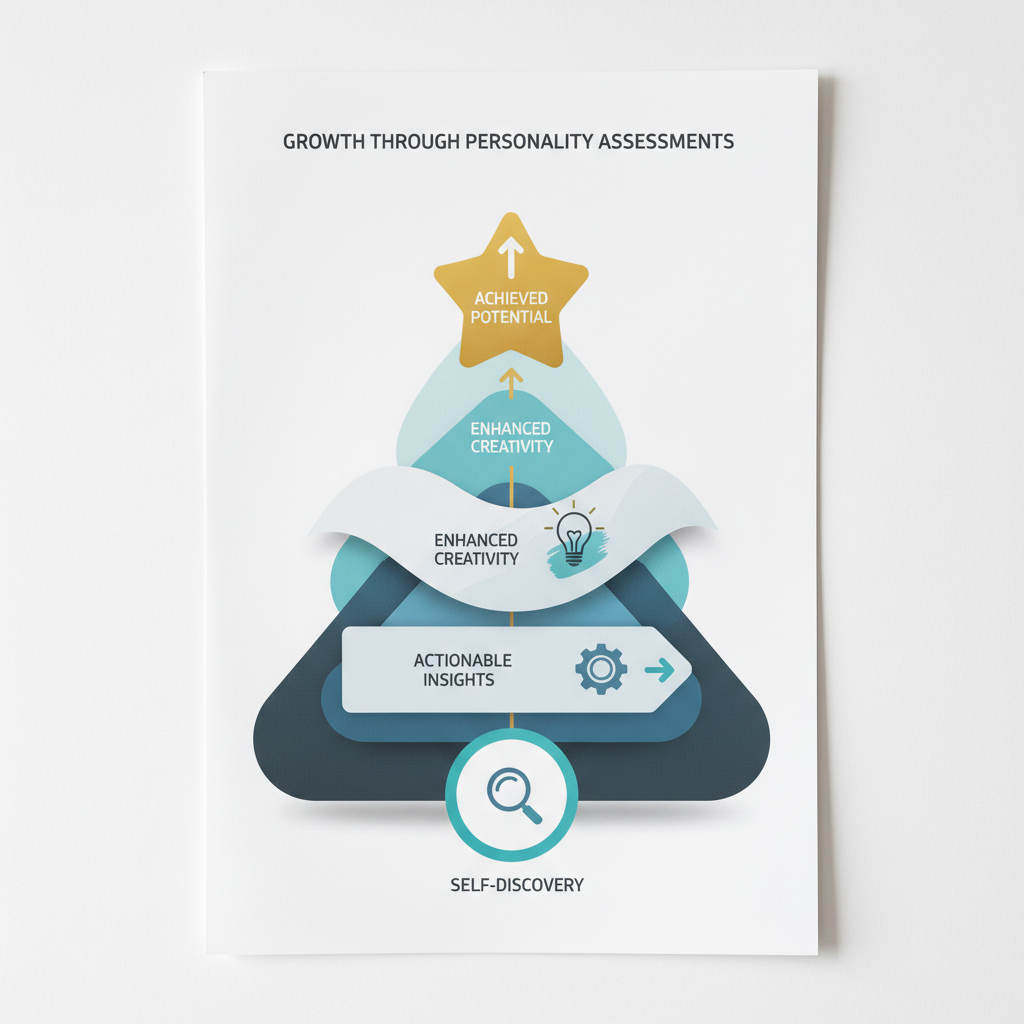
Choosing the Right Assessment for Your Goals
Learning about yourself is a powerful process. Personality tests can help guide you. But choosing the right one is key to making real progress. Let your goals guide your choice. Do you want a clearer career path? Are you hoping to improve relationships? Or maybe you want to unlock your creative side?
There are many reliable tests to choose from. The Big Five (OCEAN) model, for example, measures broad personality traits. The Enneagram explores core motivations. DISC focuses on observable behaviors. Each test gives you a different way to understand yourself. But they focus on very different things.
Think about the science behind a test. Look for tools backed by research. These tools give you more reliable results [10]. Our Creative Ability Test, for example, is based on scientific research. It’s designed to help you understand your unique creative strengths.
To make a good choice, ask yourself:
- What specific area of my life do I want to explore?
- Am I looking for broad personality traits or a targeted skill assessment?
- How will these insights help me achieve my objectives?
If you want to grow your creative skills, a specialized tool is very helpful. It focuses directly on your mental flexibility, problem-solving skills, and openness. This focused approach gives you practical steps to become more innovative.
Applying Insights for Professional Development
Understanding your personality can really help your career. You’ll go from feeling unsure to knowing how to take action. You’ll get a clear picture of your strengths and areas for growth. This knowledge helps you perform better at work. It also improves your teamwork and leadership skills.
Think about how your personality affects your work style. Someone who is very analytical does well with data-focused jobs. Someone who is very open often does well in creative settings. Your test results give you a roadmap. They highlight where you naturally shine. They also show you where you can improve.
Here are some practical ways to use what you learn:
- Strengthen Communication: Adapt your style to better connect with colleagues. Understand different perspectives.
- Optimize Teamwork: Find your best role within a team. Use your unique strengths.
- Enhance Leadership: Be a more genuine leader. Understand what motivates your team members.
- Target Skill Development: Focus on improving areas that support your career goals. For instance, an introverted leader might practice public speaking.
- Foster Innovation: Use your creative thinking styles to solve complex problems. Introduce fresh ideas.
The Creative Ability Test gives you personalized feedback. It helps you see your own creative thinking patterns. This means you can use what you learn to be more innovative. You can solve problems at work with fresh creativity. It gives you a clear strategy for professional growth.
Connecting Personality Traits to Your Creative Potential
Your personality and your creativity are closely connected. Some personality traits are strongly linked to creativity. For example, “Openness to Experience,” a core Big Five trait, often predicts creative success [11]. This trait reflects curiosity and a willingness to explore new ideas.
Our Creative Ability Test goes deeper. It looks at different parts of your creativity. This includes mental flexibility and divergent thinking. Mental flexibility is your ability to see things from different angles. Divergent thinking is your ability to come up with many different ideas. Both are signs of a very creative person.
When you understand how you think creatively, you can unlock your potential. You learn your main thinking styles. Do you like to brainstorm lots of ideas? Or do you prefer to carefully improve on existing ones? Knowing this helps you handle tasks better. It also builds confidence in your natural talents.
Here’s how knowing your creative traits can help you:
- Identify Strengths: Recognize your unique creative skills. Focus on what you do best.
- Overcome Blocks: Understand why you get stuck on certain tasks. Create specific plans to move forward.
- Cultivate New Approaches: Practice mental flexibility exercises. Find new ways to solve problems.
- Personalize Growth: Get practical tips that fit your profile. They are designed to improve your creative thinking.
- Apply to Real-World Challenges: Use your insights for innovation in any field. From art to engineering, creativity is a valuable skill.
The Creative Ability Test is a complete 30-question assessment. It gives you personalized feedback on your creative strengths. You’ll get a clear picture of your current skills. This knowledge is the first step to improving your creative performance. It helps you move from just knowing about creativity to using it with purpose. Our platform gives you practical tips to keep getting better.
Frequently Asked Questions
What are the five types of personality assessment?
Knowing your personality can help you be more creative. Personality tests show you different sides of yourself. Psychologists group these tests into five main types. Each type can reveal your strengths, how you think, and where you can grow.
- Self-Report Inventories: These are tests where you answer questions about yourself, often with multiple-choice or a rating scale. The Big Five (OCEAN) is a well-known example. They are great for learning about your known traits, like being open to new experiences, which is tied to creativity [12].
- Projective Tests: These tests show you unclear images, like inkblots. You then say what you see or create a story about them. The goal is to reveal thoughts you may not be aware of. While not a direct measure of creativity, they can show if you are imaginative or see things differently.
- Observational Measures: This method involves watching how you act in certain situations. For example, an expert might watch how you solve a new problem or work with a group. This provides a real-world look at your creative skills in action.
- Performance-Based Tests: For these tests, you do tasks that measure specific skills. For instance, you might be asked to brainstorm as many ideas as possible for a problem. This directly measures your ability to think in new directions, which is a key part of creativity [13].
- Interviews: A trained expert asks you a series of questions. Some interviews have set questions, while others are more like a natural conversation. They offer a deep, personal look at what drives you and how you solve problems.
Each type offers a different point of view. Together, they give you a full picture of your personality. This knowledge helps you use your creative strengths.
What are the three types of personality assessments?
While some models list five types, a simpler way is to group personality tests into three main kinds. This makes it easier to understand how we measure personality. These types are great for learning about your own creative thinking and how you face challenges.
- Self-Report Measures (Objective Tests): These are the most common type. You simply answer questions about what you think, feel, and do. The Creative Ability Test is a good example of this type of test, backed by science. It helps you find creative strengths like your ability to adapt your thinking or be open to new things. The results are clear and easy to measure.
- Projective Measures: These tests try to reveal parts of your personality you aren’t aware of. They use unclear images or ask you to tell stories, which lets you “project” your inner thoughts. While they don’t give a direct creativity score, they can show how you use your imagination.
- Behavioral Measures: This type looks at what you actually do. Instead of asking how you’d act, it watches you in action. This could be in a real-life situation or a specific task. For example, watching you solve a puzzle shows your problem-solving style. This gives a realistic look at how you use your creativity.
Each of these types helps you learn more about yourself. Self-report and behavioral tests are especially good for measuring and improving your creative thinking skills.
What is the most common method of assessing personality?
The most common way to measure personality is the self-report inventory. This is a questionnaire where you answer questions about yourself. You usually respond to statements on a scale, like from “strongly agree” to “strongly disagree.”
They are so popular for a few reasons:
- Ease of Administration: They are easy to give to many people at once, especially online.
- Standardization: The questions and scoring are the same for everyone. This makes it fair to compare results between people.
- Objectivity (in scoring): Results are scored with numbers, not opinions. This removes personal bias.
- Cost-Effectiveness: They usually cost less and take less time than interviews or observation.
- Direct Insights: They show you how you see yourself. This is key to understanding your own creative side.
Well-known examples include the Big Five personality test and our own Creative Ability Test. Our 30-question test is a self-report inventory backed by science. It measures key parts of creativity, like flexible thinking, problem-solving, and being open to new things. These insights help you understand your creative strengths so you can find practical ways to grow.
Self-report tests are used in many areas, from research to personal growth [14]. They give you useful, personalized information about your creative style.
Ready to Discover Your Creative Potential?
You’ve explored personality tests and seen how powerful they are. These tools offer deep insights into who you are and how you interact with the world.
But how does this connect to your creativity? The link is stronger than you might think. Your personality traits don’t just influence your creative thinking—they also shape how you solve problems.
Unlocking Your Unique Creative Code
Creativity isn’t just for artists. It’s a vital skill for solving problems, generating new ideas, and adapting to change.
Psychology shows that certain traits encourage creativity. For example, openness to experience is a key ingredient for creative success [15]. This trait means you’re curious, enjoy new and unconventional ideas, and are willing to explore different perspectives.
Our Creative Ability Test goes deeper than general personality. It focuses on the specific aspects of your creativity to help you understand your unique creative code.
When you understand your creative strengths and natural thinking style, you gain clarity that you can apply in practical ways.
The Creative Ability Test helps you uncover these key areas:
- Cognitive Flexibility: Your ability to switch between different concepts, adapt to new demands, and easily see things from various angles.
- Divergent Thinking: Your skill for generating many diverse ideas, which is crucial for brainstorming and exploring countless possibilities.
- Problem-Solving Skills: How you apply innovative solutions and approach challenges with fresh perspectives to tackle them effectively.
- Openness to New Experiences: The way you embrace novelty, welcome unconventional ideas, and seek out new knowledge and adventures.
Your Path to Creative Mastery Starts Here
Our Creative Ability Test uses a science-backed approach. The 30-question assessment provides clear results, giving you a detailed look at your creative strengths and highlighting areas for growth.
You’ll receive personalized, easy-to-understand feedback that interprets your results and gives you actionable strategies to enhance your creativity.
Think of it as a roadmap guiding you from creative uncertainty to clear self-awareness. This journey toward structured growth can transform your personal and professional life.
Here’s what you can expect by taking our test:
- Comprehensive Insights: Understand the different dimensions of your creativity and gain clarity on your thinking styles.
- Tailored Strategies: Get practical tips designed to boost your specific creative abilities.
- Enhanced Problem-Solving: Learn to apply your creativity to real-world challenges and develop innovative solutions.
- Personal & Professional Growth: Foster a creative mindset that benefits all areas of your life and career.
- Science-Backed Guidance: Receive reliable information from a platform built on scientifically supported methods.
Ready to Ignite Your Imagination?
Curious about your creative potential? Want to unlock new ways of thinking? Our platform is designed to empower individuals, students, and professionals just like you.
Take the next step. Discover your unique creative strengths today. Begin your journey toward innovative thinking and personal growth.
The Creative Ability Test empowers you to use your natural creativity and turn your ideas into reality. Your creative adventure awaits.
Sources
- https://www.simplypsychology.org/personality-theories.html
- https://creativeabilitytest.com/
- https://www.psychologytoday.com/us/basics/big-5-personality
- https://www.myersbriggs.org/my-mbti-personality-type/
- https://www.enneagraminstitute.com/how-the-enneagram-system-works
- https://www.britannica.com/biography/Carl-Jung
- https://www.discprofile.com/what-is-disc/
- https://www.gallup.com/cliftonstrengths/en/253683/what-is-cliftonstrengths.aspx
- https://www.simplypsychology.org/projective-tests.html
- https://www.apa.org/education-career/guide/science-psychology
- https://www.ncbi.nlm.nih.gov/pmc/articles/PMC3212891/
- https://www.simplypsychology.org/personality-tests.html
- https://psychology.iresearchnet.com/experimental-psychology/cognition/divergent-thinking/
- https://www.apa.org/education-career/guide/personality-assessment
- https://www.psychologicalscience.org/observer/openness-to-experience-and-creativity
Leave a Reply